STRUCTURE BASED
AND LIGAND
BASED DRUG
DESIGNING
VYSAKH MOHAN M
DRUG DESIGNING
INTRODUCTION
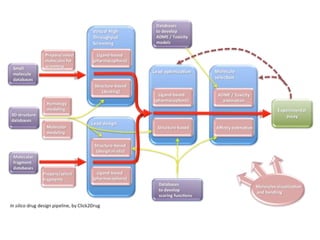
 CADD
STRUCTURE BASED DRUG DESIGNING
LIGAND BASED DRUG DESIGNING
STRUCTURE BASED AND
LIGAND BASED DRUG
DESIGNING
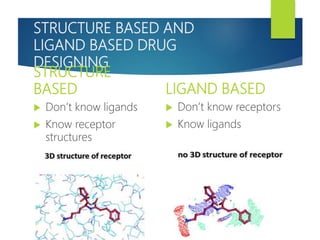
STRUCTURE
BASED
 Don’t know ligands
 Know receptor
structures
LIGAND BASED
 Don’t know receptors
 Know ligands
STRUCTURE-BASED
DRUG DESIGN
STRUCTURE BASED DRUG DESIGNING
 Three dimensional structure of the biological
target
 Obtained through x-ray crystallography or NMT
spectroscopy
 If experimental structure is not available, create a
homology model of the target, based on the
experimental structure of a related protein
 Various automated computational procedures
may be used
STRUCTURE BASED DRUG DESIGNING
 Protein structure determination
 Docking
 Binding free energy
 Flexibility of protein-ligand complex
 De novo evolution
PROTEIN STUCTURE DETERMINATION
 HOMOLOGY MODELING
 Fast method to obtain protein structures
 To ensure the rationality of modelled structures,
checks on stereochemistry, energy profile,
residue environments, and structure similarity
are needed
PROTEIN STUCTURE DETERMINATION
 FOLDING RECOGNITION
 Threading
 Calculates the probabilities of 3D structures
could form by given protein sequences
 Both environment of residues interactions and
protein surface area are considered in the
threading protocol
 Structure with highest probability is
recommended to construct the protein model
PROTEIN STUCTURE DETERMINATION
 Ab initio PROTEIN MODELING
 Based on physical principles, residue interaction
center and lattice representation of a protein to
build the target
 Used when other protocols fail to predict and
unknown protein structure
 Identity and accuracy given by this modelling is
lower than others
PROTEIN STUCTURE DETERMINATION
 HOT SPOT PREDICTION
 One big issue in SBDD is to determine ligand
active site
 Determined using X-ray crystallography
 But not possible for proteins that cannot be
crystallised
 Several binding site determination methods
have been invented
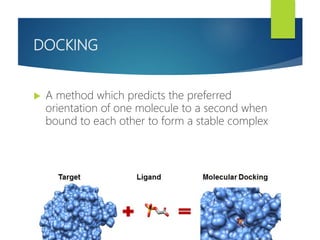
DOCKING
 A method which predicts the preferred
orientation of one molecule to a second when
bound to each other to form a stable complex
save
YES
NO
OK
BETTER
DOCKING TOOLS
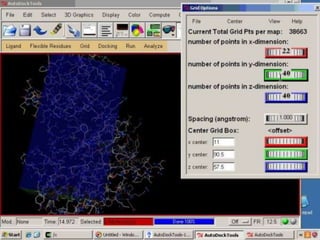
 AUTODOCK
 Software AutoDock, developed by Olsen’s
Laboratory
 A program for docking small flexible ligands into a
rigid 3D structure
DOCKING TOOLS
 CDOCKER
 This protocol is a docking algorithm and retain all
the advantages of full ligand flexibility
 Uses a sphere to define an active site, so the
knowledge of the binding site is not required
 CHARMM based docking algorithm
DOCKING TOOLS
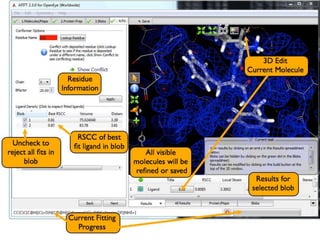
 FLEXIBLE DOCKING
 Retains receptor flexibility during docking of flexible
ligands
 ChiFlex algorithm
 LibDock program
 Indicates the binding site where ligand polar and
non-polar groups may be bound to the favourable
positions of protein
DOCKING TOOLS
 LIGAND FIT
 A grid-based method for calculating receptor-
ligand interaction energies, which is crucial in initial
ligand shape match to the receptor binding site
 Consists of
 Definition of active site
 Analysis of ligand conformations
 Docking of ligands to a selected site
 Scoring of predicted poses
DOCKING TOOLS
 TRANSMEMBRANE PROTEIN MODELING
 There are many medicines that target
transmembrane protein (HER2 and GABA receptor)
 Due to difficulties of crystallisation accurately
analysing transmembrane protein is difficult
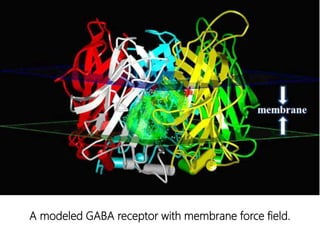
 Since there is influence of phospholipid bilayer a
membrane force field option can be included
A modeled GABA receptor with membrane force field.
BINDING FREE ENERGY
 All the docking protocols discussed above do not
include functions for calculating binding free
energy
energy of binding = energy of complex –
energy of ligand –
energy of receptor
FLEXIBILITY OF PROTEIN-
LIGAND COMPLEX
 Flexibility of complex must be studied
 The difference in result of flexible docking and
LigandFit is due to difference in flexibility of
molecules, such that:
Flexibility = score of LigandFit –
score of flexible docking
 The result of molecular simulation is related to
flexibility, and a positive relationship can be
obtained in flexibility vs. molecular dynamics.
De novo EVOLUTION
 After docking program, we can modify ligands by
two methods
 Based on active site features to identify functional
groups that can establish strong interactions with
the receptor. Then, functional groups can be linked
 Using the original ligand scaffolds to develop
derivatives that can complement the receptor
LIGAND-BASED
DRUG DESIGN
LIGAND-BASED DRUG DESIGN
 Relies on knowledge of other molecules that bind
to the biological target of interest
 These other molecules may be used to derive a
pharmacophore model
 Alternatively, a QSAR relationship, in which a
correlation between calculated properties of
molecules and their experimentally determined
biological activity, may be derived
 QSAR may be used to predict the activity of new
analogues
LIGAND-BASED DRUG DESIGN
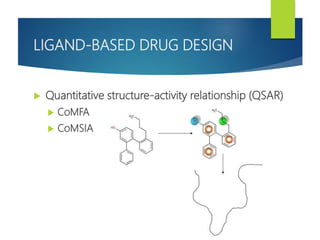
 Quantitative structure-activity relationship (QSAR)
 CoMFA
 CoMSIA
QUANTITATIVE STRUCTURE-
ACTIVITY RELATIONSHIP
 Employs statistics and analytical tools to
investigate the relationship between the
structures of ligands and their corresponding
effects.
 Mathematical models are built based on
structural parameters to describe
 Earlier 2D-QSAR, but 3D-QSAR have been
adopted
 3D-QSAR methodologies: CoMFA, CoMSIA
CoMFA
 Comparative molecular field analysis
 Biological activity of a molecule is dependent of
the surrounding molecular fields (Steric and
electrostatic fields)
 Has several problems
CoMSIA
 Comparative molecular similarity index analysis
 Includes more additional field properties
 Steric
 Electrostatic
 Hydrophobic
 Hydrogen bond donor
 Hydrogen bond acceptor
 Can offer a more accurate structural-activity
relationship than CoMFA
CONCLUSION
 Molecular simulation has a vital role in drug
design and CADD
 Fast, efficient and inexpensive tool to
 Discover new possible ligands against a
macromolecular target
 Test library design ideas
 Identify most promising scaffolds and R groups prior
to synthesis
THANK YOU