By,
Somasekhar guptha
A drug can be discovered by following approach
1. modification of known molecule.
2. Synergestic or additive drugs in combination.
3. Screening of wide variety of drugs obtained from
natural sources, banks of previously discovered chemical
entities.
4. Identification or elucidation of entirely new target for
druG.
5.Rational drug design.
6.Genetic approaches.
Lead generation:
Natural ligand / Screening
Biological Testing
Synthesis of New Compounds
Drug Design Cycle
If promising
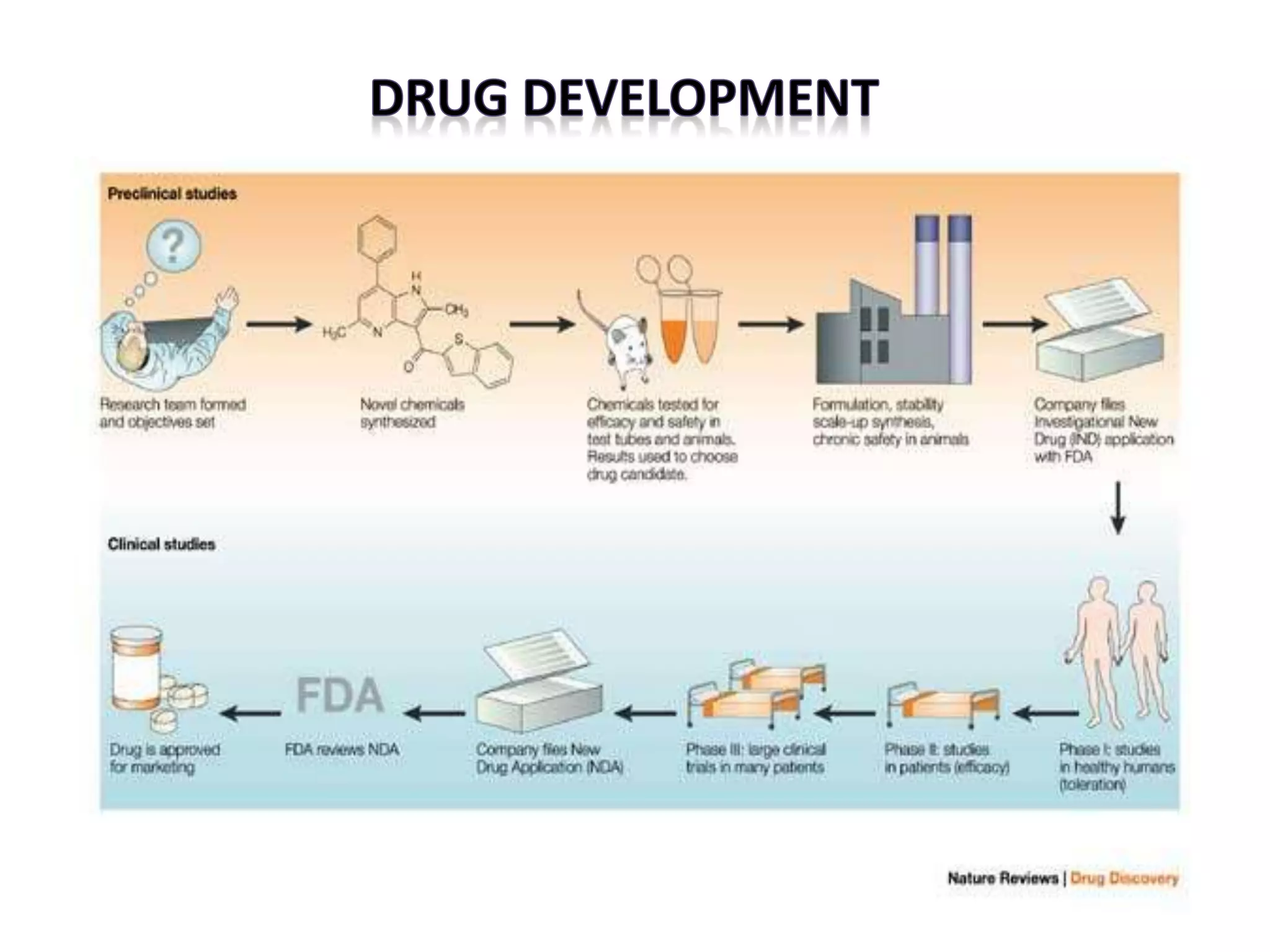
Pre-Clinical Studies
• A lead compound is a small molecule that serves as the starting
point for an optimization involving many small molecules that are
closely related in structure to the lead compound .
• Many organizations maintain databases of chemical compounds.
• Some of these are publically accessible others are proprietary
• Databases contain an extremely large number of compounds (ACS
data bases contains 10 million compounds)
• 3D databases have information about chemical and geometrical
features
» Hydrogen bond donors
» Hydrogen bond acceptors
» Positive Charge Centers
» Aromatic ring centers
» Hydrophobic centers
There are two approaches to this problem
• A computer program AutoDock (or similar
version Affinity (accelrys)) can be used to search a
database by generating “fit” between molecule and
the receptor
• Alternatively one can search 3D pharmacophore
• Drug design and development
• Structure based drug design exploits the 3D structure
of the target or a pharmacophore
– Find a molecule which would be expected to interact
with the receptor. (Searching a data base)
– Design entirely a new molecule from “SCRATCH” (de
novo drug/ligand design)
• In this context bioinformatics and chemoinformatics
play a crucial role
Structure-based Drug Design (SBDD)
Molecular Biology & Protein Chemistry
3D Structure Determination of Target
and Target-Ligand Complex
Modelling
Structure Analysis
and Compound Design
Biological Testing
Synthesis of New Compounds
If promising
Pre-Clinical
Studies
Drug Design Cycle
Natural ligand / Screening
• So the two important features in drug design are
 Target-receptor
 lead- ligand
so there are different approaches based on structural availibility
receptor ligand approach comments
known known DOCK receptor
based
Programmes-AUTO-
DOCK
known unknown De novo based GROW, LEGEND
unknown known Ligand based QSAR
unknown unknown Combinational
based
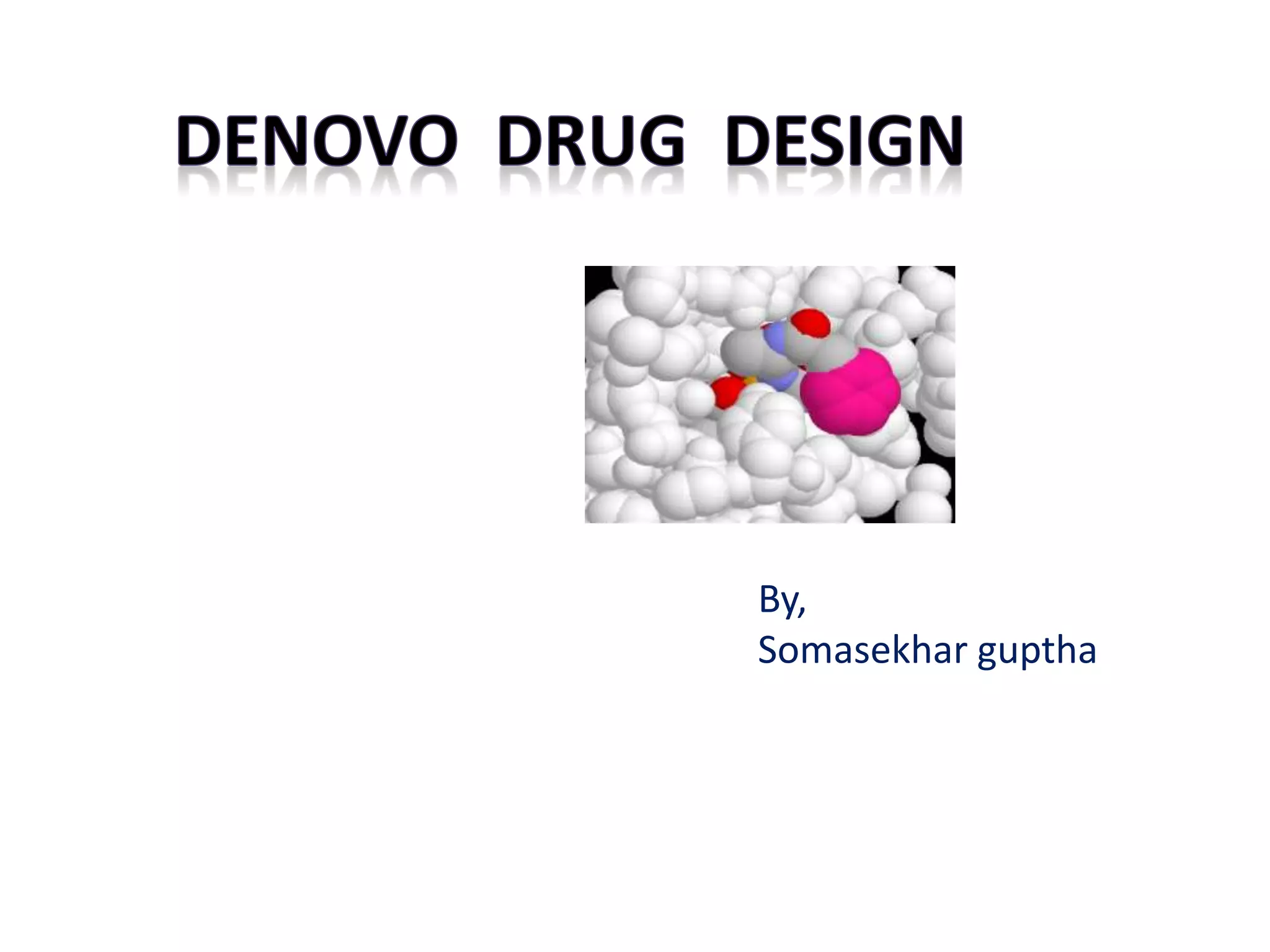
De novo means start afresh, from the beginning, from
the scratch
 It is a process in which the 3D structure of receptor is
used to design newer molecules
 It involves structural determination of the lead target
complexes and lead modifications using molecular
modeling tools.
 Information available about target receptor but no
existing leads that can interact.
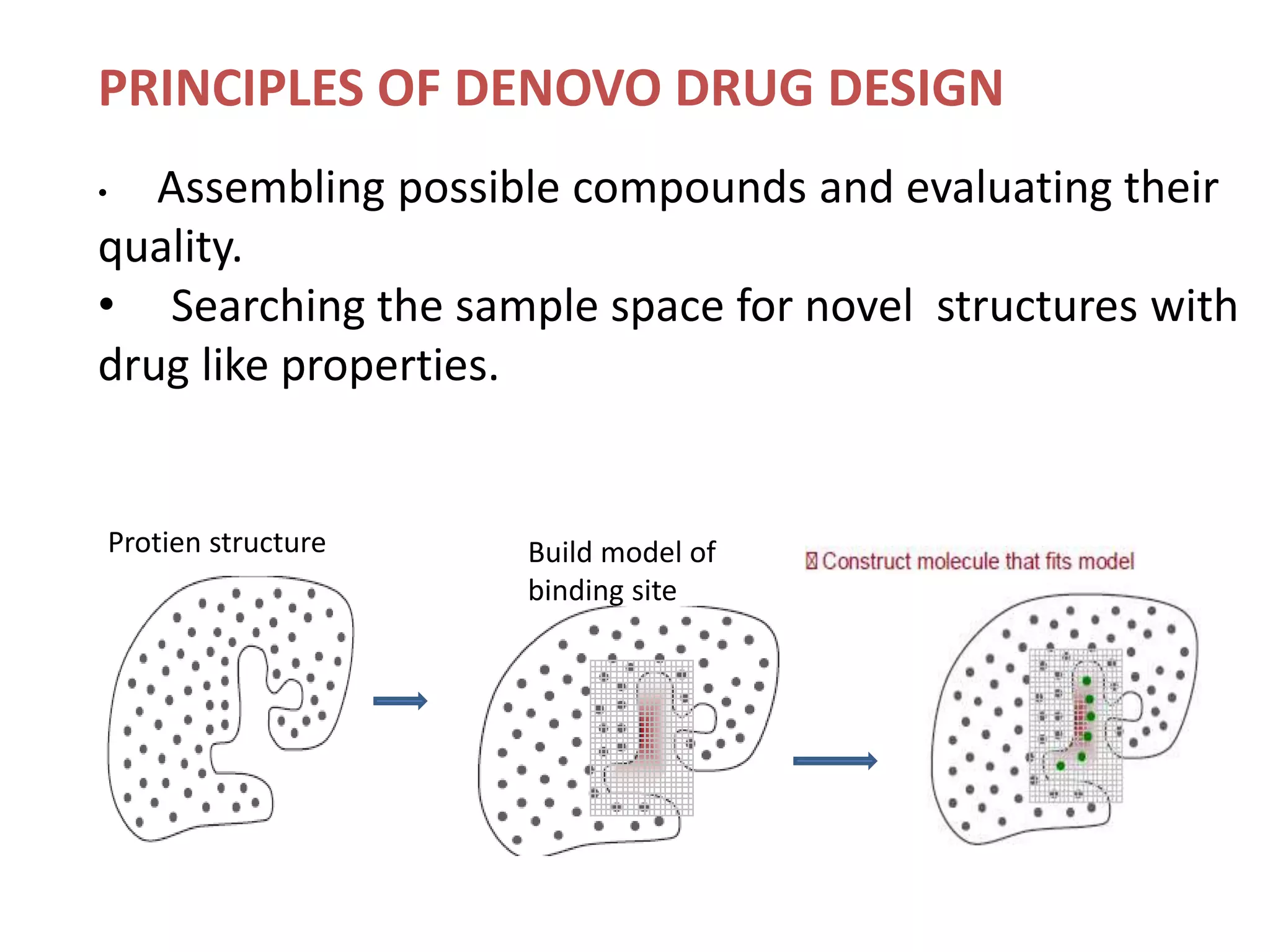
PRINCIPLES OF DENOVO DRUG DESIGN
• Assembling possible compounds and evaluating their
quality.
• Searching the sample space for novel structures with
drug like properties.
Build model of
binding site
Protien structure
COMPUTER BASED DRUG DESIGN CONSISTS
OF FOLLOWING STEPS :-
1) Generation of potentiol primary constraints
2) Derivation of interaction sites
3) Building up methods
4) Assay (or ) scoring
5) Search strategies
6) Secondary target constraints
These are the molecules which set up a framework
for the desired structure with the required ligand receptor
interactions
- These are of 2 types:
1) receptor based:-
interactions of the receptor form basis for the
drug design.
2) ligand based:- ligand to the target functions as
a key.
Primary target constraints
• In denovo design, the structure of the target should
be known to a high resolution, and the binding to site
must be well defined.
• This should defines not only a shape constraint but
hypothetical interaction sites, typically consisting of
hydrogen bonds, electrostatic and other non-covalent
interactions.
• These can greatly reducing the sample space, as
hydrogen bonds and other anisotropic interactions can
define specific orientations.
Derivation of Interaction Sites:
• A key step to model the binding site as accurately as possible.
• This starts with an atomic resolution structure of the active site.
• Programs like UCSF , DOCK define the volume available to a
ligand by filling the active site with spheres.
• Further constraints follow, using positions of H-bond acceptors
and donors.
• Other docking algorithms, such as FLOG, GOLD, and FlexiDock 16
use an all-atom representations to achieve fine detail.
• Ray-tracing algorithms, such as SMART,represent another strategy.
1) Growing
2) Linking
3) Lattice Based sampling
4) Molecular dynamics based
methods
GROWING:-
• A single key building block is the starting point or seed.
• Fragments are added to provide suitable interactions to
both key sites and space between key sites
• These include simple hydrocarbon chains, amines, alcohols,
and even single rings.
• In the case of multiple seeds, growth is usually simultaneous
and continues until all pieces have been integrated into a single
molecule.
Linking
The fragments, atoms, or building blocks are either placed at key
interaction sites
(or)
pre-docked using another program
They are joined together using pre-defined rules to yield a
complete molecule.
Linking groups or linkers may be predefined or generated to
satisfy all required conditions .
Lattice based method
• The lattice is placed in the binding site, and atoms
around key interaction sites are joined using the shortest
path.
• Then various iterations, each of which includes
translation, rotation or mutation of atoms, are guided by a
potential energy function, eventually leading to a target
molecule.
Molecular Dynamics Methods:
• The building blocks are initially randomly placed and then by
MD simulations allowed to rearrange.
• After each rearrangement certain bonds were broken and the
process repeated.
• During this procedure high scoring structures were stored for
later evaluation.
SCORING
• Each solution should be tested to decide which is the most
promising.this is called as scoring.
• Programs such as LEGEND18, LUDI19, Leap-Frog16, SPROUT20,
HOOK21, and PRO-LIGAND22 attempt this using different scoring
techniques
• These scoring functions vary from simple steric
constraints and H-bond placement to explicit force fields and
empirical or knowledge-based scoring methods.
• Programs like GRID and LigBuilder3 set up a grid in the
binding site and then assess interaction energies by placing
probe atoms or fragments at each grid point.
• Scoring functions guide the growth and optimization of
structures by assigning fitness values to the sampled space
• Scoring functions attempt to approximate the binding free
energy by substituting the exact physical model with simplified
statistical methods.
• Force fields usually involve more computation than the
other types of scoring functions eg:- LEGEND
• Empirical scoring functions are a weighted sum of individual
ligand–receptor interactions.
• Apart from scoring functions, attempts have been made to
use NMR, X-ray analysis and MS to validate the fragments.
• Essential to know which path to follow
Types:-
1) Combinatorial search algorithms
• reducing the effective size of the solution space
• explore the space efficiently.
2) Breadth first
• keep all possible solutions per step, and solves them all to end
structures.
• can only be done in a limited fashion, as an exhaustive search
would not be feasible.
3)Depth first
• select the highest scoring solution per stepand proceeds.
• This strategy may spontaneously generate nonsense
solutions.
• Usually combinations of these last two are used;
for example, a breadth-first search could be done until the
solution space is relatively limited and in subsequent steps depth-
first searcheswould be used.
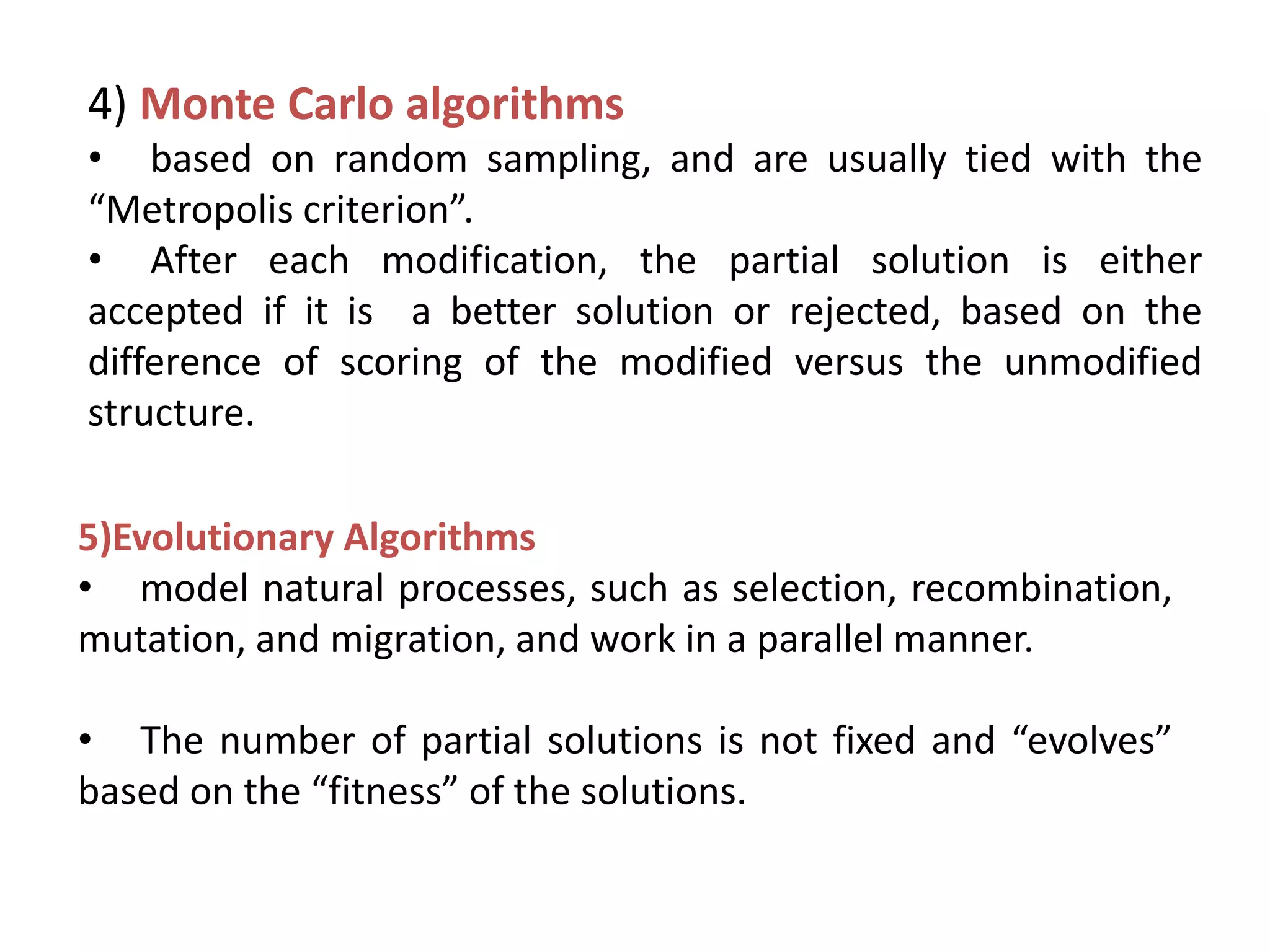
4) Monte Carlo algorithms
• based on random sampling, and are usually tied with the
“Metropolis criterion”.
• After each modification, the partial solution is either
accepted if it is a better solution or rejected, based on the
difference of scoring of the modified versus the unmodified
structure.
5)Evolutionary Algorithms
• model natural processes, such as selection, recombination,
mutation, and migration, and work in a parallel manner.
• The number of partial solutions is not fixed and “evolves”
based on the “fitness” of the solutions.
• Binding affinity alone does not suffice to make an effective drug
molecule.
• Essential properties include effective Absorption, Distribution,
Metabolism, Excretion and Toxicity (ADMET).
•In general, an orally active drug has
• (a) not more than 5 hydrogen bond donors (OH and NH groups),
• (b) not more than 10 hydrogen bond acceptors (notably Nand O),
• (c) a molecular weight under 500 Da
• (d), a LogP (log ratio of the concentrationsof the solute in the
solvent) under 5.
•Using these rules as a filter, the resulting compounds are more
likely to have biological activity.
METHOD PROGRAMS AVAILABLE
Site point connection
method
LUDI
Fragment connection
method
SPLICE, NEW LEAD,
PRO-LIGAND
Sequential build up
methods
LEGEND, GROW, SPORUT
Random connection and
disconnection methods
CONCEPTS, CONCERTS,
MCDNLG
Applications:-
• Design of HIV I protease inhibitors
• Design of bradykinin receptor antagonist
• Catechol ortho methyl transferase inhibitor
Ex:- entacapone and nitecapone
• Estrogen receptor antagonist
• Purine nucleoside phosphorylase inhibitors
HIV 1 protease inhibitor
• HIV 1 protease is an enzyme crucial for
replication of HIV virus
• Inhibitors include saquinavir, ritonavir,
indinavar
• These drugs have been developed using this
appraoch
HIV 1 protease inhibitor
Structure of enzyme
Enzyme with inhibitor
limitations
• Rather slow and inefficient
• Ignores synthetic feasibility while constructing
structures
• Cannot be a sole basis for drug design
• Although a relatively new design method, de novo
design will play an ever-increasing role in modern drug
design.
• Though yet not able to automatically generate viable
drugs by itself, it is able to give rise to novel and often
unexpected drugs
• when coupled with HTS, is proving to reduce drug
design turn around
time.
References
• Foye’s principles of medicinal chemistry-sixth edition,
published by lippincott williams and wilkins, page num-69-70
• Sanmati K jain and avantika agarwal- “ De novo drug design:an
overview”. Indian journal of pharmaceutical
sciences.,2004,66[6]:721-728
• http://www.bama.ua.edu/~chem/seminars/student_seminars
/spring06/papers-s06/luthra-sem.pdf
• http://journal.chemistrycentral.com/content/2/S1/
• http://en.wikipedia.org/wiki/HIV-1_protease
• Schneider G.; Fechner U.; “Computer-based de novo design of
drug-like molecules.” Nat Rev Drug Discov 2005 Aug; 4(8), 649-
63. Review
Denovo Drug Design

Denovo Drug Design

  • 1.
  • 3.
    A drug canbe discovered by following approach 1. modification of known molecule. 2. Synergestic or additive drugs in combination. 3. Screening of wide variety of drugs obtained from natural sources, banks of previously discovered chemical entities. 4. Identification or elucidation of entirely new target for druG. 5.Rational drug design. 6.Genetic approaches.
  • 4.
    Lead generation: Natural ligand/ Screening Biological Testing Synthesis of New Compounds Drug Design Cycle If promising Pre-Clinical Studies
  • 5.
    • A leadcompound is a small molecule that serves as the starting point for an optimization involving many small molecules that are closely related in structure to the lead compound . • Many organizations maintain databases of chemical compounds. • Some of these are publically accessible others are proprietary • Databases contain an extremely large number of compounds (ACS data bases contains 10 million compounds) • 3D databases have information about chemical and geometrical features » Hydrogen bond donors » Hydrogen bond acceptors » Positive Charge Centers » Aromatic ring centers » Hydrophobic centers
  • 6.
    There are twoapproaches to this problem • A computer program AutoDock (or similar version Affinity (accelrys)) can be used to search a database by generating “fit” between molecule and the receptor • Alternatively one can search 3D pharmacophore
  • 7.
    • Drug designand development • Structure based drug design exploits the 3D structure of the target or a pharmacophore – Find a molecule which would be expected to interact with the receptor. (Searching a data base) – Design entirely a new molecule from “SCRATCH” (de novo drug/ligand design) • In this context bioinformatics and chemoinformatics play a crucial role
  • 8.
    Structure-based Drug Design(SBDD) Molecular Biology & Protein Chemistry 3D Structure Determination of Target and Target-Ligand Complex Modelling Structure Analysis and Compound Design Biological Testing Synthesis of New Compounds If promising Pre-Clinical Studies Drug Design Cycle Natural ligand / Screening
  • 9.
    • So thetwo important features in drug design are  Target-receptor  lead- ligand so there are different approaches based on structural availibility receptor ligand approach comments known known DOCK receptor based Programmes-AUTO- DOCK known unknown De novo based GROW, LEGEND unknown known Ligand based QSAR unknown unknown Combinational based
  • 10.
    De novo meansstart afresh, from the beginning, from the scratch  It is a process in which the 3D structure of receptor is used to design newer molecules  It involves structural determination of the lead target complexes and lead modifications using molecular modeling tools.  Information available about target receptor but no existing leads that can interact.
  • 11.
    PRINCIPLES OF DENOVODRUG DESIGN • Assembling possible compounds and evaluating their quality. • Searching the sample space for novel structures with drug like properties. Build model of binding site Protien structure
  • 12.
    COMPUTER BASED DRUGDESIGN CONSISTS OF FOLLOWING STEPS :- 1) Generation of potentiol primary constraints 2) Derivation of interaction sites 3) Building up methods 4) Assay (or ) scoring 5) Search strategies 6) Secondary target constraints
  • 13.
    These are themolecules which set up a framework for the desired structure with the required ligand receptor interactions - These are of 2 types: 1) receptor based:- interactions of the receptor form basis for the drug design. 2) ligand based:- ligand to the target functions as a key. Primary target constraints
  • 14.
    • In denovodesign, the structure of the target should be known to a high resolution, and the binding to site must be well defined. • This should defines not only a shape constraint but hypothetical interaction sites, typically consisting of hydrogen bonds, electrostatic and other non-covalent interactions. • These can greatly reducing the sample space, as hydrogen bonds and other anisotropic interactions can define specific orientations.
  • 15.
    Derivation of InteractionSites: • A key step to model the binding site as accurately as possible. • This starts with an atomic resolution structure of the active site. • Programs like UCSF , DOCK define the volume available to a ligand by filling the active site with spheres. • Further constraints follow, using positions of H-bond acceptors and donors. • Other docking algorithms, such as FLOG, GOLD, and FlexiDock 16 use an all-atom representations to achieve fine detail. • Ray-tracing algorithms, such as SMART,represent another strategy.
  • 16.
    1) Growing 2) Linking 3)Lattice Based sampling 4) Molecular dynamics based methods
  • 17.
  • 18.
    • A singlekey building block is the starting point or seed. • Fragments are added to provide suitable interactions to both key sites and space between key sites • These include simple hydrocarbon chains, amines, alcohols, and even single rings. • In the case of multiple seeds, growth is usually simultaneous and continues until all pieces have been integrated into a single molecule.
  • 19.
  • 21.
    The fragments, atoms,or building blocks are either placed at key interaction sites (or) pre-docked using another program They are joined together using pre-defined rules to yield a complete molecule. Linking groups or linkers may be predefined or generated to satisfy all required conditions .
  • 22.
    Lattice based method •The lattice is placed in the binding site, and atoms around key interaction sites are joined using the shortest path. • Then various iterations, each of which includes translation, rotation or mutation of atoms, are guided by a potential energy function, eventually leading to a target molecule.
  • 24.
    Molecular Dynamics Methods: •The building blocks are initially randomly placed and then by MD simulations allowed to rearrange. • After each rearrangement certain bonds were broken and the process repeated. • During this procedure high scoring structures were stored for later evaluation.
  • 25.
    SCORING • Each solutionshould be tested to decide which is the most promising.this is called as scoring. • Programs such as LEGEND18, LUDI19, Leap-Frog16, SPROUT20, HOOK21, and PRO-LIGAND22 attempt this using different scoring techniques • These scoring functions vary from simple steric constraints and H-bond placement to explicit force fields and empirical or knowledge-based scoring methods.
  • 26.
    • Programs likeGRID and LigBuilder3 set up a grid in the binding site and then assess interaction energies by placing probe atoms or fragments at each grid point. • Scoring functions guide the growth and optimization of structures by assigning fitness values to the sampled space • Scoring functions attempt to approximate the binding free energy by substituting the exact physical model with simplified statistical methods. • Force fields usually involve more computation than the other types of scoring functions eg:- LEGEND
  • 27.
    • Empirical scoringfunctions are a weighted sum of individual ligand–receptor interactions. • Apart from scoring functions, attempts have been made to use NMR, X-ray analysis and MS to validate the fragments. • Essential to know which path to follow Types:- 1) Combinatorial search algorithms • reducing the effective size of the solution space • explore the space efficiently.
  • 28.
    2) Breadth first •keep all possible solutions per step, and solves them all to end structures. • can only be done in a limited fashion, as an exhaustive search would not be feasible. 3)Depth first • select the highest scoring solution per stepand proceeds. • This strategy may spontaneously generate nonsense solutions. • Usually combinations of these last two are used; for example, a breadth-first search could be done until the solution space is relatively limited and in subsequent steps depth- first searcheswould be used.
  • 29.
    4) Monte Carloalgorithms • based on random sampling, and are usually tied with the “Metropolis criterion”. • After each modification, the partial solution is either accepted if it is a better solution or rejected, based on the difference of scoring of the modified versus the unmodified structure. 5)Evolutionary Algorithms • model natural processes, such as selection, recombination, mutation, and migration, and work in a parallel manner. • The number of partial solutions is not fixed and “evolves” based on the “fitness” of the solutions.
  • 30.
    • Binding affinityalone does not suffice to make an effective drug molecule. • Essential properties include effective Absorption, Distribution, Metabolism, Excretion and Toxicity (ADMET). •In general, an orally active drug has • (a) not more than 5 hydrogen bond donors (OH and NH groups), • (b) not more than 10 hydrogen bond acceptors (notably Nand O), • (c) a molecular weight under 500 Da • (d), a LogP (log ratio of the concentrationsof the solute in the solvent) under 5. •Using these rules as a filter, the resulting compounds are more likely to have biological activity.
  • 31.
    METHOD PROGRAMS AVAILABLE Sitepoint connection method LUDI Fragment connection method SPLICE, NEW LEAD, PRO-LIGAND Sequential build up methods LEGEND, GROW, SPORUT Random connection and disconnection methods CONCEPTS, CONCERTS, MCDNLG
  • 32.
    Applications:- • Design ofHIV I protease inhibitors • Design of bradykinin receptor antagonist • Catechol ortho methyl transferase inhibitor Ex:- entacapone and nitecapone • Estrogen receptor antagonist • Purine nucleoside phosphorylase inhibitors
  • 33.
    HIV 1 proteaseinhibitor • HIV 1 protease is an enzyme crucial for replication of HIV virus • Inhibitors include saquinavir, ritonavir, indinavar • These drugs have been developed using this appraoch
  • 34.
    HIV 1 proteaseinhibitor Structure of enzyme Enzyme with inhibitor
  • 35.
    limitations • Rather slowand inefficient • Ignores synthetic feasibility while constructing structures • Cannot be a sole basis for drug design
  • 36.
    • Although arelatively new design method, de novo design will play an ever-increasing role in modern drug design. • Though yet not able to automatically generate viable drugs by itself, it is able to give rise to novel and often unexpected drugs • when coupled with HTS, is proving to reduce drug design turn around time.
  • 37.
    References • Foye’s principlesof medicinal chemistry-sixth edition, published by lippincott williams and wilkins, page num-69-70 • Sanmati K jain and avantika agarwal- “ De novo drug design:an overview”. Indian journal of pharmaceutical sciences.,2004,66[6]:721-728 • http://www.bama.ua.edu/~chem/seminars/student_seminars /spring06/papers-s06/luthra-sem.pdf • http://journal.chemistrycentral.com/content/2/S1/ • http://en.wikipedia.org/wiki/HIV-1_protease • Schneider G.; Fechner U.; “Computer-based de novo design of drug-like molecules.” Nat Rev Drug Discov 2005 Aug; 4(8), 649- 63. Review