
VIRTUAL SCREENING IN 
DRUG DISCOVERY 
Cheminformatics Approach 
dsdht.wikispaces.com 
Abhik Seal 
Indiana University Bloomington(dsdht.wikispaces.com)
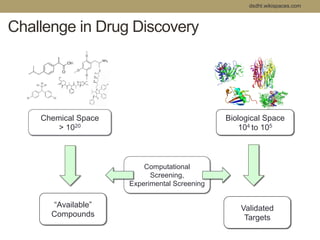
Challenge in Drug Discovery 
Biological Space 
104 to 105 
Chemical Space 
> 1020 
“Available” 
Compounds 
Validated 
Targets 
Computational 
Screening, 
Experimental Screening 
dsdht.wikispaces.com
Choosing the right molecule 
• Goal: to find a lead compound that can be optimized to give a drug candidate 
− Optimization: using chemical synthesis to modify the lead molecule in order to 
improve its chances of being a successful drug. 
• The challenge: chemical space is vast 
− Estimates vary 
• Reymond et al. suggest there are ~1 billion compounds with up to 13 heavy atoms 
• There are ~65 million known compounds (example UniChem, PubChem) 
• A typical pharmaceutical compound collection contains ~1-5 million compounds 
• High throughput screening allows large (up to 1 million) numbers of compounds to be tested 
− But very small proportion of “available” compounds 
− Large scale screening is expensive 
− Not all targets are suitable for HTS 
dsdht.wikispaces.com 
Blum, L.C. & Reymond, J.-louis . J. Am. Chem. Soc. 131, 
8732-8733(2009).
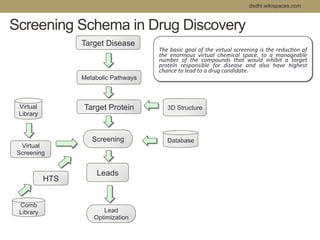
Screening Schema in Drug Discovery 
dsdht.wikispaces.com 
Virtual 
Library 
Database 
Comb 
Library 
Target Disease 
Metabolic Pathways 
Target Protein 
Leads 
Lead 
Optimization 
Virtual 
Screening 
HTS 
3D Structure 
Screening 
The 
basic 
goal 
of 
the 
virtual 
screening 
is 
the 
reduc4on 
of 
the 
enormous 
virtual 
chemical 
space, 
to 
a 
manageable 
number 
of 
the 
compounds 
that 
would 
inhibit 
a 
target 
protein 
responsible 
for 
disease 
and 
also 
have 
highest 
chance 
to 
lead 
to 
a 
drug 
candidate.
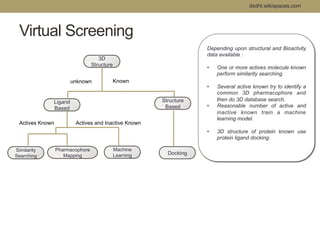
Virtual Screening 
dsdht.wikispaces.com 
3D 
Structure 
Ligand 
Based 
Structure 
Based 
unknown Known 
Actives Known Actives and Inactive Known 
Machine 
Learning 
Pharmacophore 
Similarity 
Searching Mapping 
Docking 
Depending upon structural and Bioactvity 
data available : 
• One or more actives molecule known 
perform similarity searching. 
• Several active known try to identify a 
common 3D pharmacophore and 
then do 3D database search. 
• Reasonable number of active and 
inactive known train a machine 
learning model. 
• 3D structure of protein known use 
protein ligand docking.
dsdht.wikispaces.com 
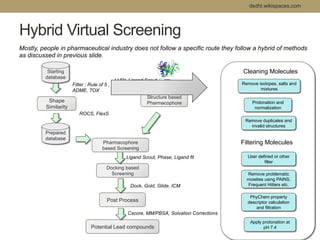
Hybrid Virtual Screening 
Mostly, people in pharmaceutical industry does not follow a specific route they follow a hybrid of methods 
as discussed in previous slide. 
Shape 
Similarity 
Filter : Rule of 5 , 
ADME, TOX 
ROCS, FlexS 
LUDI, Ligand Scout, 
Phase, DrugScore 
Pharmacophore 
based Screening 
Structure based 
Pharmacophore 
Docking based 
Screening 
Post Process 
Starting 
database 
Potential Lead compounds 
Prepared 
database 
Ligand Scout, Phase, Ligand fit 
Dock, Gold, Glide, ICM 
Cscore, MM/PBSA, Solvation Corrections 
Cleaning Molecules 
Remove isotopes, salts and 
mixtures 
Protonation and 
normalization 
Remove duplicates and 
invalid structures 
Filtering Molecules 
User defined or other 
filter 
Remove problematic 
moieties using PAINS, 
Frequent Hitters etc. 
PhyChem property 
descriptor calculation 
and filtration 
Apply protonation at 
pH 7.4
dsdht.wikispaces.com 
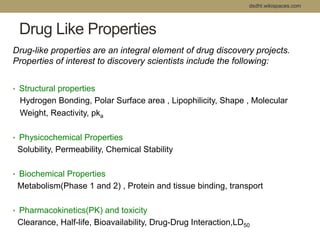
Drug Like Properties 
Drug-like properties are an integral element of drug discovery projects. 
Properties of interest to discovery scientists include the following: 
• Structural properties 
Hydrogen Bonding, Polar Surface area , Lipophilicity, Shape , Molecular 
Weight, Reactivity, pka 
• Physicochemical Properties 
Solubility, Permeability, Chemical Stability 
• Biochemical Properties 
Metabolism(Phase 1 and 2) , Protein and tissue binding, transport 
• Pharmacokinetics(PK) and toxicity 
Clearance, Half-life, Bioavailability, Drug-Drug Interaction,LD50
dsdht.wikispaces.com 
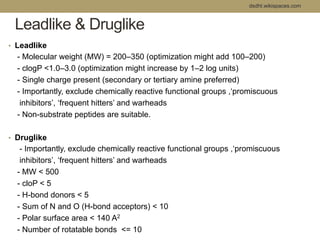
Leadlike & Druglike 
• Leadlike 
- Molecular weight (MW) = 200–350 (optimization might add 100–200) 
- clogP <1.0–3.0 (optimization might increase by 1–2 log units) 
- Single charge present (secondary or tertiary amine preferred) 
- Importantly, exclude chemically reactive functional groups ,‘promiscuous 
inhibitors’, ‘frequent hitters’ and warheads 
- Non-substrate peptides are suitable. 
• Druglike 
- Importantly, exclude chemically reactive functional groups ,‘promiscuous 
inhibitors’, ‘frequent hitters’ and warheads 
- MW < 500 
- cloP < 5 
- H-bond donors < 5 
- Sum of N and O (H-bond acceptors) < 10 
- Polar surface area < 140 A2 
- Number of rotatable bonds <= 10
dsdht.wikispaces.com 
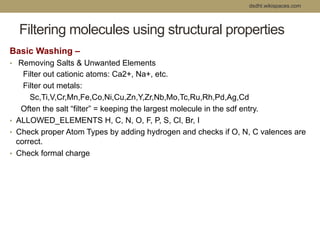
Filtering molecules using structural properties 
Basic Washing – 
• Removing Salts & Unwanted Elements 
Filter out cationic atoms: Ca2+, Na+, etc. 
Filter out metals: 
Sc,Ti,V,Cr,Mn,Fe,Co,Ni,Cu,Zn,Y,Zr,Nb,Mo,Tc,Ru,Rh,Pd,Ag,Cd 
Often the salt “filter” = keeping the largest molecule in the sdf entry. 
• ALLOWED_ELEMENTS H, C, N, O, F, P, S, Cl, Br, I 
• Check proper Atom Types by adding hydrogen and checks if O, N, C valences are 
correct. 
• Check formal charge
dsdht.wikispaces.com 
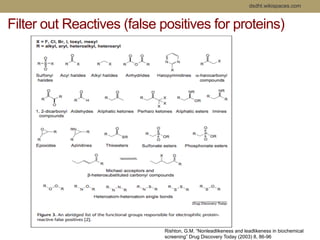
Filter out Reactives (false positives for proteins) 
Rishton, G.M. “Nonleadlikeness and leadlikeness in biochemical 
screening” Drug Discovery Today (2003) 8, 86-96
dsdht.wikispaces.com 
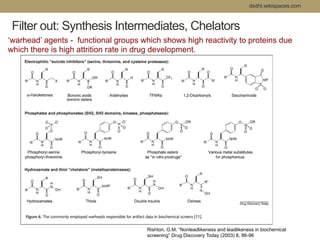
Filter out: Synthesis Intermediates, Chelators 
‘warhead’ agents - functional groups which shows high reactivity to proteins due 
which there is high attrition rate in drug development. 
Rishton, G.M. “Nonleadlikeness and leadlikeness in biochemical 
screening” Drug Discovery Today (2003) 8, 86-96
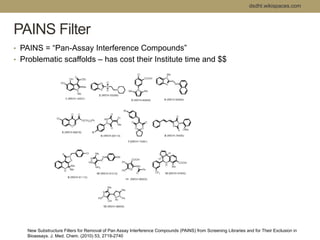
PAINS Filter 
• PAINS = “Pan-Assay Interference Compounds” 
• Problematic scaffolds – has cost their Institute time and $$ 
dsdht.wikispaces.com 
New Substructure Filters for Removal of Pan Assay Interference Compounds (PAINS) from Screening Libraries and for Their Exclusion in 
Bioassays. J. Med. Chem. (2010) 53, 2719-2740
dsdht.wikispaces.com 
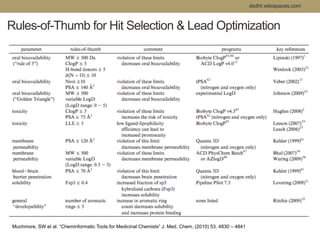
Rules-of-Thumb for Hit Selection & Lead Optimization 
Muchmore, SW et al. “Cheminformatic Tools for Medicinal Chemists” J. Med. Chem. (2010) 53, 4830 – 4841
Similarity Searching 
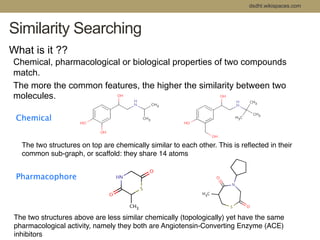
What is it ?? 
dsdht.wikispaces.com 
Chemical, pharmacological or biological properties of two compounds 
match. 
The more the common features, the higher the similarity between two 
molecules. 
Chemical! 
The two structures on top are chemically similar to each other. This is reflected in their 
common sub-graph, or scaffold: they share 14 atoms 
Pharmacophore 
The two structures above are less similar chemically (topologically) yet have the same 
pharmacological activity, namely they both are Angiotensin-Converting Enzyme (ACE) 
inhibitors
dsdht.wikispaces.com 
What is required for a similarity search ? 
• A Database SQL or NoSQL ( Postgres, MySQL, 
MongoDB) or flat file of descriptors eg: ChemFP 
• Chemical Cartridge to generate fingerprints(descriptors) 
for molecules ( RDKit, openbabel) 
• Similarity function to calculate similarity( Jaccard, Dice, 
Tversky) this can be written in c,c++ or python as a 
function inside SQL databases.
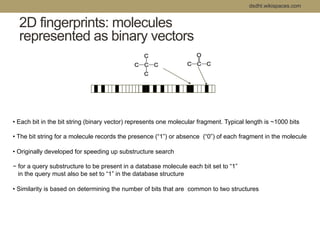
2D fingerprints: molecules 
represented as binary vectors 
dsdht.wikispaces.com 
• Each bit in the bit string (binary vector) represents one molecular fragment. Typical length is ~1000 bits 
• The bit string for a molecule records the presence (“1”) or absence (“0”) of each fragment in the molecule 
• Originally developed for speeding up substructure search 
− for a query substructure to be present in a database molecule each bit set to “1” 
in the query must also be set to “1” in the database structure 
• Similarity is based on determining the number of bits that are common to two structures
Calculate molecular similarity 
dsdht.wikispaces.com 
Sequences/vectors of bits, or numeric values that can be compared by 
distance functions, similarity metrics . 
E= Euclidean distance T = Tanimoto index /Jaccard 
T x y B x y 
( , ) ( & ) 
B x B y B x y 
( ) + ( ) − 
( & ) 
n 
= ( ) Σ= 
( , ) 2 
E x y = x y 
i − 
i i 
1
dsdht.wikispaces.com 
Don’t forget to check out the video of 2D 
similarity searching on a database 
https://www.youtube.com/watch?v=VHjUWCJITmE
3D based similarity 
• Shape-based 
ROCS (Rapid Overlay of Chemical Structures) 
Silicos-it.com (Shape it) 
• Computationally more expensive than 2D methods 
• Requires consideration of conformational flexibility 
− Rigid search - based on a single conformer 
− Flexible search 
• Conformation explored at search time 
• Ensemble of conformers generated prior to search time with each 
conformer of each molecule considered in turn 
• How many conformers are required? 
Check The video on ROCS 
https://www.youtube.com/watch?v=FEAUBlQWf0s 
dsdht.wikispaces.com
dsdht.wikispaces.com 
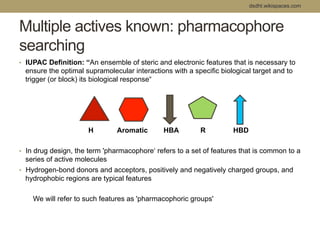
Multiple actives known: pharmacophore 
searching 
• IUPAC Definition: “An ensemble of steric and electronic features that is necessary to 
ensure the optimal supramolecular interactions with a specific biological target and to 
trigger (or block) its biological response“ 
H Aromatic HBA R HBD 
• In drug design, the term 'pharmacophore‘ refers to a set of features that is common to a 
series of active molecules 
• Hydrogen-bond donors and acceptors, positively and negatively charged groups, and 
hydrophobic regions are typical features 
We will refer to such features as 'pharmacophoric groups'
dsdht.wikispaces.com 
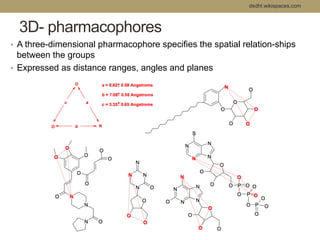
3D- pharmacophores 
• A three-dimensional pharmacophore specifies the spatial relation-ships 
between the groups 
• Expressed as distance ranges, angles and planes
dsdht.wikispaces.com 
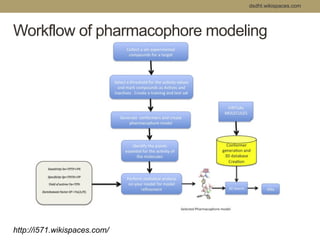
Workflow of pharmacophore modeling 
http://i571.wikispaces.com/
dsdht.wikispaces.com 
Watch the video on pharmacophore searching 
Ligand based pharmacophore screening using ligand scout 
https://www.youtube.com/watch?v=gwAB_Xz9g94
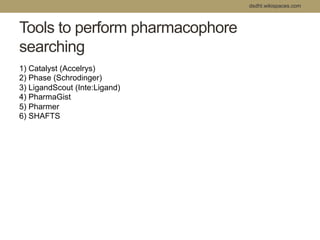
Tools to perform pharmacophore 
searching 
dsdht.wikispaces.com 
1) Catalyst (Accelrys) 
2) Phase (Schrodinger) 
3) LigandScout (Inte:Ligand) 
4) PharmaGist 
5) Pharmer 
6) SHAFTS
dsdht.wikispaces.com 
Many Actives and inactives known : Machine learning 
methods 
• SAR Modeling 
• Use knowledge of known active and known inactive compounds to build a predictive 
model 
• Quantitative-Structure Activity Relationships (QSARs) 
− Long established (Hansch analysis, Free-Wilson analysis) 
− Generally restricted to small, homogeneous datasets eg lead optimization. 
• Structure-Activity Relationships (SARs) 
− “Activity” data is usually treated qualitatively 
− Can be used with data consisting of diverse structural classes and multiple binding 
modes 
− Some resistance to noisy data (HTS data) 
− Resulting models used to prioritize compounds for lead finding (not to identify 
candidates or drugs)
dsdht.wikispaces.com 
Practical predictive modeling in Cheminformatics 
QSAR 
https://www.youtube.com/watch?v=EHbxFMfU_3A 
Binary Classification 
https://www.youtube.com/watch?v=6Mund7C964I
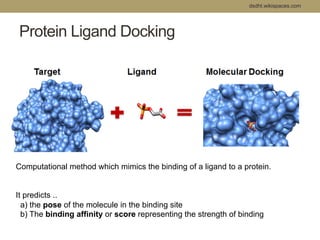
Protein Ligand Docking 
dsdht.wikispaces.com 
Computational method which mimics the binding of a ligand to a protein. 
It predicts .. 
a) the pose of the molecule in the binding site 
b) The binding affinity or score representing the strength of binding
Pose and Binding Site 
dsdht.wikispaces.com 
• Binding Site (or “active site”) 
- the part of the protein where the ligand binds . 
- generally a cavity on the protein surface. 
- can be identified by looking at the crystal structure of the protein bund with a 
known inhibitor. 
• Pose ( “binding mode”) 
- the geometry of the ligand in the binding site 
- Geometry- location , orientation and conformation of the molecule 
http://www.slideshare.net/baoilleach/proteinligand-docking
dsdht.wikispaces.com 
Protein Ligand Docking 
• How does a ligand (small molecule) bind into the active site of a 
protein? 
• Docking algorithms are based on two key components 
− search algorithm 
• to generate “poses” (conformation, position and orientation) of 
the ligand within the active site 
− scoring function 
• to identify the most likely pose for an individual ligand 
• to assign a priority order to a set of diverse ligands 
docked to the same protein – estimate binding affinity
The search space 
dsdht.wikispaces.com 
• The difficulty with protein–ligand docking is in part due to the fact that it involves many degrees of 
freedom 
− The translation and rotation of one molecule relative to another involves six degrees of 
freedom 
− These are in addition the conformational degrees of freedom of both the ligand and the protein 
− The solvent may also play a significant role in determining the protein–ligand geometry (often 
ignored though) 
• The search algorithm generates poses, orientations of particular conformations of the 
molecule in the binding site 
− Tries to cover the search space, if not exhaustively, then as extensively as possible 
− There is a tradeoff between time and search space coverage 
AR Leach, VJ Gillet, An Introduction to Cheminformatics
Dock Algorithms 
• DOCK: first docking program by Kuntz et al. 1982 
− Based on shape complementarity and rigid ligands 
• Current algorithms 
dsdht.wikispaces.com 
− Fragment-based methods: FlexX, DOCK (since version 4.0) 
− Monte Carlo/Simulated annealing: QXP(Flo), Autodock, Affinity 
& LigandFit (Accelrys) 
− Genetic algorithms: GOLD, AutoDock (since version 3.0) 
− Systematic search: FRED (OpenEye), Glide (Schrödinger) 
R. D. Taylor et al. “A review of protein-small molecule docking methods”, J. Comput. Aid. Mol. Des. 2002, 16, 
151-166.
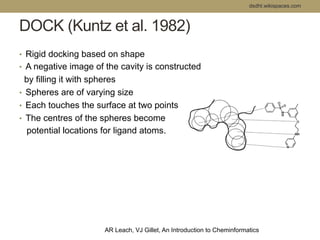
DOCK (Kuntz et al. 1982) 
• Rigid docking based on shape 
• A negative image of the cavity is constructed 
by filling it with spheres 
• Spheres are of varying size 
• Each touches the surface at two points 
• The centres of the spheres become 
potential locations for ligand atoms. 
dsdht.wikispaces.com 
AR Leach, VJ Gillet, An Introduction to Cheminformatics
DOCK 
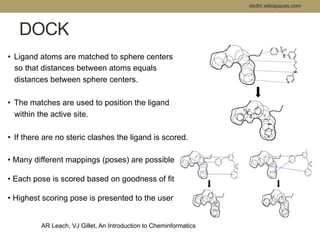
• Ligand atoms are matched to sphere centers 
so that distances between atoms equals 
distances between sphere centers. 
• The matches are used to position the ligand 
within the active site. 
• If there are no steric clashes the ligand is scored. 
dsdht.wikispaces.com 
• Many different mappings (poses) are possible 
• Each pose is scored based on goodness of fit 
• Highest scoring pose is presented to the user 
AR Leach, VJ Gillet, An Introduction to Cheminformatics
dsdht.wikispaces.com 
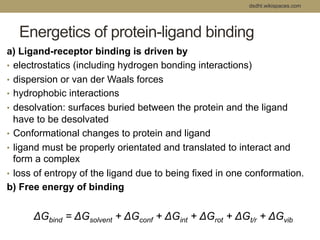
Energetics of protein-ligand binding 
a) Ligand-receptor binding is driven by 
• electrostatics (including hydrogen bonding interactions) 
• dispersion or van der Waals forces 
• hydrophobic interactions 
• desolvation: surfaces buried between the protein and the ligand 
have to be desolvated 
• Conformational changes to protein and ligand 
• ligand must be properly orientated and translated to interact and 
form a complex 
• loss of entropy of the ligand due to being fixed in one conformation. 
b) Free energy of binding 
ΔGbind = ΔGsolvent + ΔGconf + ΔGint + ΔGrot + ΔGt/r + ΔGvib
dsdht.wikispaces.com 
Conclusions 
• AutoDock, DOCK, e-Hits, FlexX, FRED, Glide, GOLD, LigandFit, 
QXP, Surflex-Dock…among others 
• Different scoring functions, different search algorithms, different 
approaches 
• See Section 12.5 in DC Young, Computational Drug Design (Wiley 2009) 
for good overview of different packages 
http://www.slideshare.net/baoilleach/proteinligand-docking
Conclusions 
dsdht.wikispaces.com 
• Wide range of virtual screening techniques have been 
developed 
• The performance of different methods varies on different 
datasets 
• Increased complexity in descriptors and method does not 
necessarily lead to greater success. 
• Combining different approaches can lead to improved 
results. 
• Computational filters should be applied to remove 
undesirable compounds from further consideration.
dsdht.wikispaces.com 
References 
• Ripphausen et al. (2010) Quo vadis, virtual screening? A comprehensive 
review of prospective applications. Journal of Medicinal Chemistry, 53, 
8461-8467. 
• Scior et al. (2012) Recognizing pitfalls in virtual screening: a critical 
review. Journal of Chemical Information and Modeling, 52, 867-881 
• Sotriffer (Ed) Virtual Screening. Principles, Challenges and 
PracticalGuidelines. Wiley-VCH, 2011. 
• Varnek A, Baskin I. Machine Learning Methods for Property Prediction in 
Chemoinformatics: Quo Vadis? Journal of Chemical Information and 
Modeling 2012, 52, 1413−1437 
• Hartenfeller, M.; Schneider, G. Enabling future drug discovery by de novo 
design. Wiley Interdisciplinary Reviews-Computational Molecular Science 
2011, 1, 742-759. 
• Open-source platform to benchmark fingerprints for ligand-based virtual 
screening Sereina Riniker, Gregory A Landrum Journal of Cheminformatics 
2013, 5:26 (30 May 2013)

Virtual Screening in Drug Discovery

  • 1.
    VIRTUAL SCREENING IN DRUG DISCOVERY Cheminformatics Approach dsdht.wikispaces.com Abhik Seal Indiana University Bloomington(dsdht.wikispaces.com)
  • 2.
    Challenge in DrugDiscovery Biological Space 104 to 105 Chemical Space > 1020 “Available” Compounds Validated Targets Computational Screening, Experimental Screening dsdht.wikispaces.com
  • 3.
    Choosing the rightmolecule • Goal: to find a lead compound that can be optimized to give a drug candidate − Optimization: using chemical synthesis to modify the lead molecule in order to improve its chances of being a successful drug. • The challenge: chemical space is vast − Estimates vary • Reymond et al. suggest there are ~1 billion compounds with up to 13 heavy atoms • There are ~65 million known compounds (example UniChem, PubChem) • A typical pharmaceutical compound collection contains ~1-5 million compounds • High throughput screening allows large (up to 1 million) numbers of compounds to be tested − But very small proportion of “available” compounds − Large scale screening is expensive − Not all targets are suitable for HTS dsdht.wikispaces.com Blum, L.C. & Reymond, J.-louis . J. Am. Chem. Soc. 131, 8732-8733(2009).
  • 4.
    Screening Schema inDrug Discovery dsdht.wikispaces.com Virtual Library Database Comb Library Target Disease Metabolic Pathways Target Protein Leads Lead Optimization Virtual Screening HTS 3D Structure Screening The basic goal of the virtual screening is the reduc4on of the enormous virtual chemical space, to a manageable number of the compounds that would inhibit a target protein responsible for disease and also have highest chance to lead to a drug candidate.
  • 5.
    Virtual Screening dsdht.wikispaces.com 3D Structure Ligand Based Structure Based unknown Known Actives Known Actives and Inactive Known Machine Learning Pharmacophore Similarity Searching Mapping Docking Depending upon structural and Bioactvity data available : • One or more actives molecule known perform similarity searching. • Several active known try to identify a common 3D pharmacophore and then do 3D database search. • Reasonable number of active and inactive known train a machine learning model. • 3D structure of protein known use protein ligand docking.
  • 6.
    dsdht.wikispaces.com Hybrid VirtualScreening Mostly, people in pharmaceutical industry does not follow a specific route they follow a hybrid of methods as discussed in previous slide. Shape Similarity Filter : Rule of 5 , ADME, TOX ROCS, FlexS LUDI, Ligand Scout, Phase, DrugScore Pharmacophore based Screening Structure based Pharmacophore Docking based Screening Post Process Starting database Potential Lead compounds Prepared database Ligand Scout, Phase, Ligand fit Dock, Gold, Glide, ICM Cscore, MM/PBSA, Solvation Corrections Cleaning Molecules Remove isotopes, salts and mixtures Protonation and normalization Remove duplicates and invalid structures Filtering Molecules User defined or other filter Remove problematic moieties using PAINS, Frequent Hitters etc. PhyChem property descriptor calculation and filtration Apply protonation at pH 7.4
  • 7.
    dsdht.wikispaces.com Drug LikeProperties Drug-like properties are an integral element of drug discovery projects. Properties of interest to discovery scientists include the following: • Structural properties Hydrogen Bonding, Polar Surface area , Lipophilicity, Shape , Molecular Weight, Reactivity, pka • Physicochemical Properties Solubility, Permeability, Chemical Stability • Biochemical Properties Metabolism(Phase 1 and 2) , Protein and tissue binding, transport • Pharmacokinetics(PK) and toxicity Clearance, Half-life, Bioavailability, Drug-Drug Interaction,LD50
  • 8.
    dsdht.wikispaces.com Leadlike &Druglike • Leadlike - Molecular weight (MW) = 200–350 (optimization might add 100–200) - clogP <1.0–3.0 (optimization might increase by 1–2 log units) - Single charge present (secondary or tertiary amine preferred) - Importantly, exclude chemically reactive functional groups ,‘promiscuous inhibitors’, ‘frequent hitters’ and warheads - Non-substrate peptides are suitable. • Druglike - Importantly, exclude chemically reactive functional groups ,‘promiscuous inhibitors’, ‘frequent hitters’ and warheads - MW < 500 - cloP < 5 - H-bond donors < 5 - Sum of N and O (H-bond acceptors) < 10 - Polar surface area < 140 A2 - Number of rotatable bonds <= 10
  • 9.
    dsdht.wikispaces.com Filtering moleculesusing structural properties Basic Washing – • Removing Salts & Unwanted Elements Filter out cationic atoms: Ca2+, Na+, etc. Filter out metals: Sc,Ti,V,Cr,Mn,Fe,Co,Ni,Cu,Zn,Y,Zr,Nb,Mo,Tc,Ru,Rh,Pd,Ag,Cd Often the salt “filter” = keeping the largest molecule in the sdf entry. • ALLOWED_ELEMENTS H, C, N, O, F, P, S, Cl, Br, I • Check proper Atom Types by adding hydrogen and checks if O, N, C valences are correct. • Check formal charge
  • 10.
    dsdht.wikispaces.com Filter outReactives (false positives for proteins) Rishton, G.M. “Nonleadlikeness and leadlikeness in biochemical screening” Drug Discovery Today (2003) 8, 86-96
  • 11.
    dsdht.wikispaces.com Filter out:Synthesis Intermediates, Chelators ‘warhead’ agents - functional groups which shows high reactivity to proteins due which there is high attrition rate in drug development. Rishton, G.M. “Nonleadlikeness and leadlikeness in biochemical screening” Drug Discovery Today (2003) 8, 86-96
  • 12.
    PAINS Filter •PAINS = “Pan-Assay Interference Compounds” • Problematic scaffolds – has cost their Institute time and $$ dsdht.wikispaces.com New Substructure Filters for Removal of Pan Assay Interference Compounds (PAINS) from Screening Libraries and for Their Exclusion in Bioassays. J. Med. Chem. (2010) 53, 2719-2740
  • 13.
    dsdht.wikispaces.com Rules-of-Thumb forHit Selection & Lead Optimization Muchmore, SW et al. “Cheminformatic Tools for Medicinal Chemists” J. Med. Chem. (2010) 53, 4830 – 4841
  • 14.
    Similarity Searching Whatis it ?? dsdht.wikispaces.com Chemical, pharmacological or biological properties of two compounds match. The more the common features, the higher the similarity between two molecules. Chemical! The two structures on top are chemically similar to each other. This is reflected in their common sub-graph, or scaffold: they share 14 atoms Pharmacophore The two structures above are less similar chemically (topologically) yet have the same pharmacological activity, namely they both are Angiotensin-Converting Enzyme (ACE) inhibitors
  • 15.
    dsdht.wikispaces.com What isrequired for a similarity search ? • A Database SQL or NoSQL ( Postgres, MySQL, MongoDB) or flat file of descriptors eg: ChemFP • Chemical Cartridge to generate fingerprints(descriptors) for molecules ( RDKit, openbabel) • Similarity function to calculate similarity( Jaccard, Dice, Tversky) this can be written in c,c++ or python as a function inside SQL databases.
  • 16.
    2D fingerprints: molecules represented as binary vectors dsdht.wikispaces.com • Each bit in the bit string (binary vector) represents one molecular fragment. Typical length is ~1000 bits • The bit string for a molecule records the presence (“1”) or absence (“0”) of each fragment in the molecule • Originally developed for speeding up substructure search − for a query substructure to be present in a database molecule each bit set to “1” in the query must also be set to “1” in the database structure • Similarity is based on determining the number of bits that are common to two structures
  • 17.
    Calculate molecular similarity dsdht.wikispaces.com Sequences/vectors of bits, or numeric values that can be compared by distance functions, similarity metrics . E= Euclidean distance T = Tanimoto index /Jaccard T x y B x y ( , ) ( & ) B x B y B x y ( ) + ( ) − ( & ) n = ( ) Σ= ( , ) 2 E x y = x y i − i i 1
  • 18.
    dsdht.wikispaces.com Don’t forgetto check out the video of 2D similarity searching on a database https://www.youtube.com/watch?v=VHjUWCJITmE
  • 19.
    3D based similarity • Shape-based ROCS (Rapid Overlay of Chemical Structures) Silicos-it.com (Shape it) • Computationally more expensive than 2D methods • Requires consideration of conformational flexibility − Rigid search - based on a single conformer − Flexible search • Conformation explored at search time • Ensemble of conformers generated prior to search time with each conformer of each molecule considered in turn • How many conformers are required? Check The video on ROCS https://www.youtube.com/watch?v=FEAUBlQWf0s dsdht.wikispaces.com
  • 20.
    dsdht.wikispaces.com Multiple activesknown: pharmacophore searching • IUPAC Definition: “An ensemble of steric and electronic features that is necessary to ensure the optimal supramolecular interactions with a specific biological target and to trigger (or block) its biological response“ H Aromatic HBA R HBD • In drug design, the term 'pharmacophore‘ refers to a set of features that is common to a series of active molecules • Hydrogen-bond donors and acceptors, positively and negatively charged groups, and hydrophobic regions are typical features We will refer to such features as 'pharmacophoric groups'
  • 21.
    dsdht.wikispaces.com 3D- pharmacophores • A three-dimensional pharmacophore specifies the spatial relation-ships between the groups • Expressed as distance ranges, angles and planes
  • 22.
    dsdht.wikispaces.com Workflow ofpharmacophore modeling http://i571.wikispaces.com/
  • 23.
    dsdht.wikispaces.com Watch thevideo on pharmacophore searching Ligand based pharmacophore screening using ligand scout https://www.youtube.com/watch?v=gwAB_Xz9g94
  • 24.
    Tools to performpharmacophore searching dsdht.wikispaces.com 1) Catalyst (Accelrys) 2) Phase (Schrodinger) 3) LigandScout (Inte:Ligand) 4) PharmaGist 5) Pharmer 6) SHAFTS
  • 25.
    dsdht.wikispaces.com Many Activesand inactives known : Machine learning methods • SAR Modeling • Use knowledge of known active and known inactive compounds to build a predictive model • Quantitative-Structure Activity Relationships (QSARs) − Long established (Hansch analysis, Free-Wilson analysis) − Generally restricted to small, homogeneous datasets eg lead optimization. • Structure-Activity Relationships (SARs) − “Activity” data is usually treated qualitatively − Can be used with data consisting of diverse structural classes and multiple binding modes − Some resistance to noisy data (HTS data) − Resulting models used to prioritize compounds for lead finding (not to identify candidates or drugs)
  • 26.
    dsdht.wikispaces.com Practical predictivemodeling in Cheminformatics QSAR https://www.youtube.com/watch?v=EHbxFMfU_3A Binary Classification https://www.youtube.com/watch?v=6Mund7C964I
  • 27.
    Protein Ligand Docking dsdht.wikispaces.com Computational method which mimics the binding of a ligand to a protein. It predicts .. a) the pose of the molecule in the binding site b) The binding affinity or score representing the strength of binding
  • 28.
    Pose and BindingSite dsdht.wikispaces.com • Binding Site (or “active site”) - the part of the protein where the ligand binds . - generally a cavity on the protein surface. - can be identified by looking at the crystal structure of the protein bund with a known inhibitor. • Pose ( “binding mode”) - the geometry of the ligand in the binding site - Geometry- location , orientation and conformation of the molecule http://www.slideshare.net/baoilleach/proteinligand-docking
  • 29.
    dsdht.wikispaces.com Protein LigandDocking • How does a ligand (small molecule) bind into the active site of a protein? • Docking algorithms are based on two key components − search algorithm • to generate “poses” (conformation, position and orientation) of the ligand within the active site − scoring function • to identify the most likely pose for an individual ligand • to assign a priority order to a set of diverse ligands docked to the same protein – estimate binding affinity
  • 30.
    The search space dsdht.wikispaces.com • The difficulty with protein–ligand docking is in part due to the fact that it involves many degrees of freedom − The translation and rotation of one molecule relative to another involves six degrees of freedom − These are in addition the conformational degrees of freedom of both the ligand and the protein − The solvent may also play a significant role in determining the protein–ligand geometry (often ignored though) • The search algorithm generates poses, orientations of particular conformations of the molecule in the binding site − Tries to cover the search space, if not exhaustively, then as extensively as possible − There is a tradeoff between time and search space coverage AR Leach, VJ Gillet, An Introduction to Cheminformatics
  • 31.
    Dock Algorithms •DOCK: first docking program by Kuntz et al. 1982 − Based on shape complementarity and rigid ligands • Current algorithms dsdht.wikispaces.com − Fragment-based methods: FlexX, DOCK (since version 4.0) − Monte Carlo/Simulated annealing: QXP(Flo), Autodock, Affinity & LigandFit (Accelrys) − Genetic algorithms: GOLD, AutoDock (since version 3.0) − Systematic search: FRED (OpenEye), Glide (Schrödinger) R. D. Taylor et al. “A review of protein-small molecule docking methods”, J. Comput. Aid. Mol. Des. 2002, 16, 151-166.
  • 32.
    DOCK (Kuntz etal. 1982) • Rigid docking based on shape • A negative image of the cavity is constructed by filling it with spheres • Spheres are of varying size • Each touches the surface at two points • The centres of the spheres become potential locations for ligand atoms. dsdht.wikispaces.com AR Leach, VJ Gillet, An Introduction to Cheminformatics
  • 33.
    DOCK • Ligandatoms are matched to sphere centers so that distances between atoms equals distances between sphere centers. • The matches are used to position the ligand within the active site. • If there are no steric clashes the ligand is scored. dsdht.wikispaces.com • Many different mappings (poses) are possible • Each pose is scored based on goodness of fit • Highest scoring pose is presented to the user AR Leach, VJ Gillet, An Introduction to Cheminformatics
  • 34.
    dsdht.wikispaces.com Energetics ofprotein-ligand binding a) Ligand-receptor binding is driven by • electrostatics (including hydrogen bonding interactions) • dispersion or van der Waals forces • hydrophobic interactions • desolvation: surfaces buried between the protein and the ligand have to be desolvated • Conformational changes to protein and ligand • ligand must be properly orientated and translated to interact and form a complex • loss of entropy of the ligand due to being fixed in one conformation. b) Free energy of binding ΔGbind = ΔGsolvent + ΔGconf + ΔGint + ΔGrot + ΔGt/r + ΔGvib
  • 35.
    dsdht.wikispaces.com Conclusions •AutoDock, DOCK, e-Hits, FlexX, FRED, Glide, GOLD, LigandFit, QXP, Surflex-Dock…among others • Different scoring functions, different search algorithms, different approaches • See Section 12.5 in DC Young, Computational Drug Design (Wiley 2009) for good overview of different packages http://www.slideshare.net/baoilleach/proteinligand-docking
  • 36.
    Conclusions dsdht.wikispaces.com •Wide range of virtual screening techniques have been developed • The performance of different methods varies on different datasets • Increased complexity in descriptors and method does not necessarily lead to greater success. • Combining different approaches can lead to improved results. • Computational filters should be applied to remove undesirable compounds from further consideration.
  • 37.
    dsdht.wikispaces.com References •Ripphausen et al. (2010) Quo vadis, virtual screening? A comprehensive review of prospective applications. Journal of Medicinal Chemistry, 53, 8461-8467. • Scior et al. (2012) Recognizing pitfalls in virtual screening: a critical review. Journal of Chemical Information and Modeling, 52, 867-881 • Sotriffer (Ed) Virtual Screening. Principles, Challenges and PracticalGuidelines. Wiley-VCH, 2011. • Varnek A, Baskin I. Machine Learning Methods for Property Prediction in Chemoinformatics: Quo Vadis? Journal of Chemical Information and Modeling 2012, 52, 1413−1437 • Hartenfeller, M.; Schneider, G. Enabling future drug discovery by de novo design. Wiley Interdisciplinary Reviews-Computational Molecular Science 2011, 1, 742-759. • Open-source platform to benchmark fingerprints for ligand-based virtual screening Sereina Riniker, Gregory A Landrum Journal of Cheminformatics 2013, 5:26 (30 May 2013)