
The Nucleus Hybrid L24 Cochlear
Implant System for sensorineural
hearing loss
Presentation By :
Indu Nath. S
M Pharm part II
Pharmacy Practice
Contents
Introduction
Physiology of
hearing
Hearing loss
Sensorineural
hearing loss
The Nucleus
Hybrid L24
Cochlear
Implant System
Advantage
Limitation Conclusion References
Introduction
 The ear is the organ of hearing and
balancing.
 It is supplied by the 8th cranial nerve,
i.e. the cochlear part of the
vestibulocochlear nerve which is
stimulated by vibrations caused by
the sound waves.
 The ear has three divisions, namely
external ear, middle ear and inner ear.
Physiology of hearing
Hearing loss
Hearing loss ,hearing impairment, or deafness, is a
partial or total inability to hear.10 % of adults has
some hearing loss and one third of individuals over
the age of 65 have a hearing loss of sufficient
magnitude and require hearing aid.
Results from disorder of the auricle, external
auditory canal, middle ear, inner ear, or central
auditory pathway.
Lesions in the auricle, external auditory canal, or
middle ear cause conductive hearing losses.
Lesions in the inner ear or eighth nerve cause
sensorineural hearing losses.
Types of hearing loss
Hearing
loss
Conducti
ve
Sensorin
eural
Mixed
 Hearing impairments are categorized by their type,
severity, ad the onset of age.
 Conductive hearing loss: a conductive hearing
impairment occurs when the sound is not reaching the
inner ear and the cochlea.
 External ear canal malformation, dysfunction of the ear
drum or malfunction of the bones of the middle ear.
 Other reasons include trauma and infections.
 Mixed hearing loss: conductive and sensorineural
hearing loss in combination is termed mixed hearing
loss.
 Otosclerosis involving the ossicles and cochlea, head
trauma, chronic otitis media, middle ear tumors and
inner ear malformations.
Sensorineural hearing loss
Sensorineural hearing loss is
the most common form of
hearing loss and occurs when
there is a lesion in the inner
ear or eighth cranial nerve
(vestibulocochlear nerve) .
It may be caused by aging,
heredity, exposure to loud
noise, ototoxic drugs, viral
infections and certain other
illnesses .
Sensorineural hearing loss can
be mild, moderate, or severe,
including total deafness.
Sensorineural hearing loss can
be treated with hearing aids
and also with cochlear
implants.
Sensorineural hearing loss
• Epidemiology:
 Gender: Males affected by hearing loss at an age earlier age
than females
 Age : Older people are affected. Onset of age is over 40
years
• Causes :
 Presbycusis (related to aging)
 Noise induced hearing loss
 Cranial nerve 8 disease
o Meniere's disease
o Acoustic neuroma
 Viral
 Micro vascular disease
o Diabetes mellitus
o Hyperlipidemia
 Ototoxic medications
 Endocrine disease
o Hypothyroidism
 Autoimmune hearing loss
 Congenital deafness
 Trauma
o Temporal bone fracture involving Cochlea or vestibule
• Signs and symptoms:
 Tinnitus
 Pain with loud noise exposure
 Impaired word understanding
 Loud patient's voice
 Hearing difficult in noisy environments
• Management:
 Formal audiology testing
 Acute hearing loss
o High dose steroids
o Carbogen Inhalation (5% CO2 and
95% Oxygen)
 Chronic hearing loss
o Cochlear implants
The Nucleus Hybrid L24 Cochlear
Implant System
The U.S. Food and Drug
Administration approved the
first implantable device for
people 18 and older with
severe or profound
Sensorineural hearing loss of
high-frequency sounds in both
ears.
The Nucleus Hybrid L24
Cochlear Implant System may
help those with this specific
kind of hearing loss who do
not benefit from conventional
hearing aids.
The hybrid system is mainly
used for candidates who have
good low-frequency hearing
but very poor high-frequency
hearing.
The hybrid works on the
concept of combining
electrical stimulation for high
frequency sound with
acoustic hearing for low
frequency information in the
same ear.
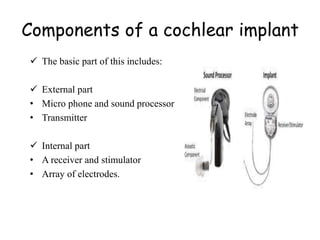
Components of a cochlear implant
 The basic part of this includes:
 External part
• Micro phone and sound processor
• Transmitter
 Internal part
• A receiver and stimulator
• Array of electrodes.
 The Nucleus Hybrid L24 Cochlear Implant
System combines the functions of a cochlear
implant and a hearing aid.
 This electronic device consists of an external
microphone and sound processor that picks up
sounds from the environment and converts them
into digital code.
 The sound processor transmits the digitally coded
sound via the coil to the implant just under the
skin.
 The implant converts the digitally coded sound to
electrical signals and sends them along the
electrode array, which is positioned in the
cochlea.
 The implants electrodes stimulate the cochlea’s
hearing nerve fibers, which relay the sound
signals to the brain to produce hearing sensations.
Advantages
Helps those with Sensorineural
hearing loss who do not benefit
from conventional hearing aids.
No loss of residual natural hearing
Reduce the risk of infection and
complications while improving the
patients ability to hear.
Preserve low frequency hearing
Minimal invasive surgery.
Limitations
Rapid fluctuations in
sounds are not well
transmitted by
cochlear implant.
Surgical issues like
tinnitus, vertigo.
Medical costs ,
device, processor
and accessories are
expensive.
conclusion
 Sensorineural hearing loss is the most common
form of hearing loss and occurs when there is a
lesion in the inner ear or eighth cranial nerve
(vestibulocochlear nerve) .
 The Nucleus Hybrid L24 Cochlear Implant
System is the first approved device by the FDA
for Sensorineural hearing loss.
 The hybrid L24 implant provides a better
treatment option for suitable candidates with
high frequency hearing loss.
References
 E. Murugasu. Recent advances in the treatment of sensorineural
deafness. Ann Acad Med Singapore 2005;34:313-21.
 Harrison’s Principle of Internal Medicine, Vol 1 by Longo, Fauci
Kasper, Hasper, Jamesoli Page No: 179-183 ,18 th edition.
 www.fda.gov
 www.medscape.com
 www.nlm.nih.gov/medlineplus/ency/article/003291.html
 emedicine.medscape.com/article/856116-overview
– All data were collected from various sources.. only
for educational purpose.
The Nucleus Hybrid L24 Cochlear Implant System for sensorineural hearing loss

The Nucleus Hybrid L24 Cochlear Implant System for sensorineural hearing loss

  • 2.
    The Nucleus HybridL24 Cochlear Implant System for sensorineural hearing loss Presentation By : Indu Nath. S M Pharm part II Pharmacy Practice
  • 3.
    Contents Introduction Physiology of hearing Hearing loss Sensorineural hearingloss The Nucleus Hybrid L24 Cochlear Implant System Advantage Limitation Conclusion References
  • 4.
    Introduction  The earis the organ of hearing and balancing.  It is supplied by the 8th cranial nerve, i.e. the cochlear part of the vestibulocochlear nerve which is stimulated by vibrations caused by the sound waves.  The ear has three divisions, namely external ear, middle ear and inner ear.
  • 5.
  • 7.
    Hearing loss Hearing loss,hearing impairment, or deafness, is a partial or total inability to hear.10 % of adults has some hearing loss and one third of individuals over the age of 65 have a hearing loss of sufficient magnitude and require hearing aid. Results from disorder of the auricle, external auditory canal, middle ear, inner ear, or central auditory pathway. Lesions in the auricle, external auditory canal, or middle ear cause conductive hearing losses. Lesions in the inner ear or eighth nerve cause sensorineural hearing losses.
  • 8.
    Types of hearingloss Hearing loss Conducti ve Sensorin eural Mixed
  • 9.
     Hearing impairmentsare categorized by their type, severity, ad the onset of age.  Conductive hearing loss: a conductive hearing impairment occurs when the sound is not reaching the inner ear and the cochlea.  External ear canal malformation, dysfunction of the ear drum or malfunction of the bones of the middle ear.  Other reasons include trauma and infections.  Mixed hearing loss: conductive and sensorineural hearing loss in combination is termed mixed hearing loss.  Otosclerosis involving the ossicles and cochlea, head trauma, chronic otitis media, middle ear tumors and inner ear malformations.
  • 10.
    Sensorineural hearing loss Sensorineuralhearing loss is the most common form of hearing loss and occurs when there is a lesion in the inner ear or eighth cranial nerve (vestibulocochlear nerve) . It may be caused by aging, heredity, exposure to loud noise, ototoxic drugs, viral infections and certain other illnesses . Sensorineural hearing loss can be mild, moderate, or severe, including total deafness. Sensorineural hearing loss can be treated with hearing aids and also with cochlear implants.
  • 11.
  • 12.
    • Epidemiology:  Gender:Males affected by hearing loss at an age earlier age than females  Age : Older people are affected. Onset of age is over 40 years • Causes :  Presbycusis (related to aging)  Noise induced hearing loss  Cranial nerve 8 disease o Meniere's disease o Acoustic neuroma  Viral  Micro vascular disease o Diabetes mellitus o Hyperlipidemia
  • 13.
     Ototoxic medications Endocrine disease o Hypothyroidism  Autoimmune hearing loss  Congenital deafness  Trauma o Temporal bone fracture involving Cochlea or vestibule • Signs and symptoms:  Tinnitus  Pain with loud noise exposure  Impaired word understanding  Loud patient's voice  Hearing difficult in noisy environments
  • 14.
    • Management:  Formalaudiology testing  Acute hearing loss o High dose steroids o Carbogen Inhalation (5% CO2 and 95% Oxygen)  Chronic hearing loss o Cochlear implants
  • 15.
    The Nucleus HybridL24 Cochlear Implant System The U.S. Food and Drug Administration approved the first implantable device for people 18 and older with severe or profound Sensorineural hearing loss of high-frequency sounds in both ears. The Nucleus Hybrid L24 Cochlear Implant System may help those with this specific kind of hearing loss who do not benefit from conventional hearing aids.
  • 16.
    The hybrid systemis mainly used for candidates who have good low-frequency hearing but very poor high-frequency hearing. The hybrid works on the concept of combining electrical stimulation for high frequency sound with acoustic hearing for low frequency information in the same ear.
  • 17.
    Components of acochlear implant  The basic part of this includes:  External part • Micro phone and sound processor • Transmitter  Internal part • A receiver and stimulator • Array of electrodes.
  • 19.
     The NucleusHybrid L24 Cochlear Implant System combines the functions of a cochlear implant and a hearing aid.  This electronic device consists of an external microphone and sound processor that picks up sounds from the environment and converts them into digital code.  The sound processor transmits the digitally coded sound via the coil to the implant just under the skin.  The implant converts the digitally coded sound to electrical signals and sends them along the electrode array, which is positioned in the cochlea.  The implants electrodes stimulate the cochlea’s hearing nerve fibers, which relay the sound signals to the brain to produce hearing sensations.
  • 21.
    Advantages Helps those withSensorineural hearing loss who do not benefit from conventional hearing aids. No loss of residual natural hearing Reduce the risk of infection and complications while improving the patients ability to hear. Preserve low frequency hearing Minimal invasive surgery.
  • 22.
    Limitations Rapid fluctuations in soundsare not well transmitted by cochlear implant. Surgical issues like tinnitus, vertigo. Medical costs , device, processor and accessories are expensive.
  • 23.
    conclusion  Sensorineural hearingloss is the most common form of hearing loss and occurs when there is a lesion in the inner ear or eighth cranial nerve (vestibulocochlear nerve) .  The Nucleus Hybrid L24 Cochlear Implant System is the first approved device by the FDA for Sensorineural hearing loss.  The hybrid L24 implant provides a better treatment option for suitable candidates with high frequency hearing loss.
  • 24.
    References  E. Murugasu.Recent advances in the treatment of sensorineural deafness. Ann Acad Med Singapore 2005;34:313-21.  Harrison’s Principle of Internal Medicine, Vol 1 by Longo, Fauci Kasper, Hasper, Jamesoli Page No: 179-183 ,18 th edition.  www.fda.gov  www.medscape.com  www.nlm.nih.gov/medlineplus/ency/article/003291.html  emedicine.medscape.com/article/856116-overview – All data were collected from various sources.. only for educational purpose.