WELCOME
INTRODUCTION TO
DRUG DESIGN AND
DISCOVERY
ANU S
MPHARM PART I
PHARMACEUTICAL
CHEMISTRY
INTRODUCTION
DRUG DISCOVERY - Finding a
lead
DRUG DESIGN
CONCLUSION
REFERENCES
CONTENTS
Ancient times – medicines were herbs and poisons
Serious efforts were made to isolate and purify the
active principles - after the mid-nineteenth century.
A large variety of biologically active compounds were
obtained and structures determined (e.g. morphine,
cocaine, quinine etc.)
Natural products became the lead compounds
No real design or reason.
INTRODUCTION
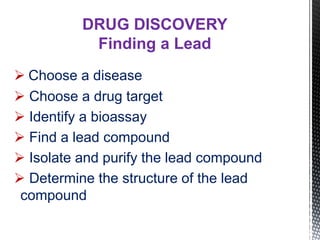
 Choose a disease
 Choose a drug target
 Identify a bioassay
 Find a lead compound
 Isolate and purify the lead compound
 Determine the structure of the lead
compound
DRUG DISCOVERY
Finding a Lead
Pharmaceutical companies tend to avoid
products with a small market
Avoid products for individuals of lower
economic status
Most research is carried out on diseases which
afflict “first world” countries
1. Choosing a Disease
Understand the disease and identify cause of the
condition.
Understand how the genes are altered and how
that affects the proteins they encode.
Choosing a Disease contd.
Drug Targets
Discovering drug targets
Target specificity and selectivity between
species, Eg:- Pencilin targets only bacterial cells
but not mammalian cells.
Target specificity and selectivity within the body,
Eg:- Specific enzyme inhibitors.
2. Choosing a Drug Target
Targeting drugs to specific organs and tissues
Eg:- β1 and β2 receptors in heart and lungs
Pitfalls Eg:- Metachlorpromide (D2 antagonist),
Ondansterone (5HT antagonist)
Choice of bioassay
In vitro tests
In vivo tests
Test validity
High-throughput screening
Screening by NMR
Affinity screening
Surface Plasmon resonance
Scintillation proximity assay
3. Identifying a bioassay
a) Screening of natural products
The plant kingdom
The microbial world
The marine world
Animal sources
Venoms and toxins
b) Medical folklore
4. Finding a lead compound
c) Screening synthetic compound libraries
d) Existing drugs
‘Me too’ drugs Eg:- Captopril
Enhancing a side effect, Eg:- Sulfonamides & sulfonyl
ureas
e) Starting from the natural ligand or modulator
Natural ligands for receptors – Adrenalin, nor
adrenalin
Natural substrates for enzymes - enkephalins
Enzyme products as lead compounds – Product of an
enzyme catalysed reaction –
L-benzyl succinic acid (Carboxypeptidase catalysed
hydrolysis)
Natural modulators as lead compounds
f) Combinatorial synthesis
It is an automated solid phase procedure aimed at
producing as many different structures as possible in as
short a time as possible.
g) Computer aided design
h) Serendipity and the prepared mind
Eg: Cisplatin, Ampicillin
i) Computerised searching for structural database
Database mining
j) Designing lead compounds by NMR
If the lead compound is present in a mixture
of other compounds it has to be isolated and
purified
5. Isolation and purification
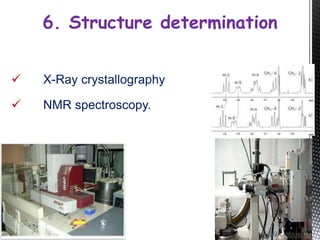
 X-Ray crystallography
 NMR spectroscopy.
6. Structure determination
Optimizing target interactions
Optimizing access to the target
DRUG DESIGN
Identify structure activity relationships
(SARs)
Identify the Pharmacophore
Drug optimization: strategies in drug
design
DRUG DESIGN – Optimizing target
interactions
The aim here is to discover which parts of the
molecule are important to biological activity and
which are not.
It is important to identify the binding roles of
different groups.
Structure activity relationships
The pharmacophore summarizes the
important binding groups which are
required for activity and their relative
positions in space with respect to each
other.
Identification of a pharmacophore
Variation in substituents
Alkyl substituents- Adrenaline,methyl group
substituted with isopropyl gives isoprenaline
Aromatic substitutions- Benzopyran substituted
with sulfonamides,increases antiarrythmic activity
Extension of the structure
Chain extension/contraction Eg:- Pencillin
Drug optimization: Strategies in
drug design
Ring expansion/contraction – CilazaprilAt
synthesized from captopril
Ring variations – Most of the NSAIDs are
variables of 1,2 biaryl system.
Ring fusions – Adrenaline and napthalene gives
pronethalol
Isosteres and bioisosteres – Uracil and 5 fluro
uracil
Simplification of the structure – Cocaine &
Procaine
Rigidification of the structure – Diazepine binds
with target group guanidine by a flexible chain
when it is rigidified activity increases
Conformational blockers – Substitution may
decreases rotation of single bond and decreases
activity eg:- substitution of CH3 in dopamine.
X-Ray crystallography
 Drug design by NMR
 The elements of luck and inspiration – Discovery
of propranolol from pronethalol
Structure based drug design and molecular
modelling
1. Improving absorption
Variation of alkyl or acyl substituents to vary
polarity – Introduction of alkyl group in sildenafil
increases absorption.
Varying polar functional groups to vary polarity –
Tioconazol only use in skin infections because of
its non polar solubility to blood
DRUG DESIGN – Optimizing
access to the target
Variation of N-alkyl substituents to vary pKa –
Increase in number of alkyl group increases
stearic bulk around N2 and decreases
absorption
Variation of aromatic substituents to vary pKa
– Done by adding electron withdrawing groups
Bioisosteres for polar groups – Carboxylic acid
(highly polar group) used to drcrease absorption
2. Making drugs more resistant to
chemical and enzymatic degradation
Steric shields – N butyl groups
Electronic effects of bioisosters – Substitution of
methyl group with amino group in ethanolic esters.
Metabolic blockers
Megesterol acetate oxidise at 6th position form
hydroxy group,when flurine is substituted prevent
oxidation.
Removal of susceptible metabolic groups –
Aromatic methyl substitution of tolbutamine
replaced by chlorine to give chlorpropamide
Group shifts – Salbutamol and adrenaline
Ring variation – Imidazol ring of tioconazole
replaced with 1,2,4 – triazol gives fluconazole
3. Making drugs less resistant to drug
metabolism
Introducing metabolically susceptible groups –
Renifentanil substituted with ester group
decrease metabolism
Self destruct drugs – Atracurium stable in acid
pH but unstable in basic pH.
4. Targeting drugs
Targeting tumour cells - ‘search and destroy
drugs’ – Monoclonal antibodies
Targeting gastrointestinal tract infections –
Done by producing fully ionized drugs eg:-
Sulfonamides
Targeting peripheral regions rather than CNS –
These drugs used to decrease CNS side effects
5. Reducing toxicity
6. Prodrugs
Prodrugs to improve membrane permeability- enalapril 
enalaprilat
Prodrugs to prolong drug activity
Azathioprine 6-mercaptopurine
Prodrugs masking drug toxicity and side effects
Aspirin salicylic acid
Prodrugs to lower water solubility
Palmitate ester of Chloramphenicol
7. Drug alliances
Some drugs are found to affect the activity or
pharmacokinetic properties of other drugs
‘Sentry’ drugs
Use of a second drug to assist – Clavulanic acid
with penicillins
Localizing a drug’s area of activity
Procaine with adrenaline
Increasing absorption
Metoclopramide with analgesics
The discovery and development of new
medicines is a long, complicated process.
Each success is built on many, many prior
failures.
 Advances in understanding human biology
and disease are opening up exciting new
possibilities for breakthrough medicines.
CONCLUSION
1. An introduction to Medicinal Chemistry – Graham L Patrick
2.http://www.phrma.org/sites/default/files/159/ rd_brochure_022307.pdf
REFERENCES
DRUG DESIGN AND DISCOVERY

DRUG DESIGN AND DISCOVERY

  • 1.
  • 2.
    INTRODUCTION TO DRUG DESIGNAND DISCOVERY ANU S MPHARM PART I PHARMACEUTICAL CHEMISTRY
  • 3.
    INTRODUCTION DRUG DISCOVERY -Finding a lead DRUG DESIGN CONCLUSION REFERENCES CONTENTS
  • 4.
    Ancient times –medicines were herbs and poisons Serious efforts were made to isolate and purify the active principles - after the mid-nineteenth century. A large variety of biologically active compounds were obtained and structures determined (e.g. morphine, cocaine, quinine etc.) Natural products became the lead compounds No real design or reason. INTRODUCTION

  • 5.
     Choose adisease  Choose a drug target  Identify a bioassay  Find a lead compound  Isolate and purify the lead compound  Determine the structure of the lead compound DRUG DISCOVERY Finding a Lead
  • 6.
    Pharmaceutical companies tendto avoid products with a small market Avoid products for individuals of lower economic status Most research is carried out on diseases which afflict “first world” countries 1. Choosing a Disease
  • 7.
    Understand the diseaseand identify cause of the condition. Understand how the genes are altered and how that affects the proteins they encode. Choosing a Disease contd.
  • 8.
    Drug Targets Discovering drugtargets Target specificity and selectivity between species, Eg:- Pencilin targets only bacterial cells but not mammalian cells. Target specificity and selectivity within the body, Eg:- Specific enzyme inhibitors. 2. Choosing a Drug Target
  • 9.
    Targeting drugs tospecific organs and tissues Eg:- β1 and β2 receptors in heart and lungs Pitfalls Eg:- Metachlorpromide (D2 antagonist), Ondansterone (5HT antagonist)
  • 10.
    Choice of bioassay Invitro tests In vivo tests Test validity High-throughput screening Screening by NMR Affinity screening Surface Plasmon resonance Scintillation proximity assay 3. Identifying a bioassay
  • 11.
    a) Screening ofnatural products The plant kingdom The microbial world The marine world Animal sources Venoms and toxins b) Medical folklore 4. Finding a lead compound
  • 12.
    c) Screening syntheticcompound libraries d) Existing drugs ‘Me too’ drugs Eg:- Captopril Enhancing a side effect, Eg:- Sulfonamides & sulfonyl ureas e) Starting from the natural ligand or modulator Natural ligands for receptors – Adrenalin, nor adrenalin Natural substrates for enzymes - enkephalins
  • 13.
    Enzyme products aslead compounds – Product of an enzyme catalysed reaction – L-benzyl succinic acid (Carboxypeptidase catalysed hydrolysis) Natural modulators as lead compounds f) Combinatorial synthesis It is an automated solid phase procedure aimed at producing as many different structures as possible in as short a time as possible.
  • 14.
    g) Computer aideddesign h) Serendipity and the prepared mind Eg: Cisplatin, Ampicillin i) Computerised searching for structural database Database mining j) Designing lead compounds by NMR
  • 15.
    If the leadcompound is present in a mixture of other compounds it has to be isolated and purified 5. Isolation and purification
  • 16.
     X-Ray crystallography NMR spectroscopy. 6. Structure determination
  • 17.
    Optimizing target interactions Optimizingaccess to the target DRUG DESIGN
  • 18.
    Identify structure activityrelationships (SARs) Identify the Pharmacophore Drug optimization: strategies in drug design DRUG DESIGN – Optimizing target interactions
  • 19.
    The aim hereis to discover which parts of the molecule are important to biological activity and which are not. It is important to identify the binding roles of different groups. Structure activity relationships
  • 20.
    The pharmacophore summarizesthe important binding groups which are required for activity and their relative positions in space with respect to each other. Identification of a pharmacophore
  • 21.
    Variation in substituents Alkylsubstituents- Adrenaline,methyl group substituted with isopropyl gives isoprenaline Aromatic substitutions- Benzopyran substituted with sulfonamides,increases antiarrythmic activity Extension of the structure Chain extension/contraction Eg:- Pencillin Drug optimization: Strategies in drug design
  • 22.
    Ring expansion/contraction –CilazaprilAt synthesized from captopril Ring variations – Most of the NSAIDs are variables of 1,2 biaryl system. Ring fusions – Adrenaline and napthalene gives pronethalol Isosteres and bioisosteres – Uracil and 5 fluro uracil
  • 23.
    Simplification of thestructure – Cocaine & Procaine Rigidification of the structure – Diazepine binds with target group guanidine by a flexible chain when it is rigidified activity increases Conformational blockers – Substitution may decreases rotation of single bond and decreases activity eg:- substitution of CH3 in dopamine.
  • 24.
    X-Ray crystallography  Drugdesign by NMR  The elements of luck and inspiration – Discovery of propranolol from pronethalol Structure based drug design and molecular modelling
  • 25.
    1. Improving absorption Variationof alkyl or acyl substituents to vary polarity – Introduction of alkyl group in sildenafil increases absorption. Varying polar functional groups to vary polarity – Tioconazol only use in skin infections because of its non polar solubility to blood DRUG DESIGN – Optimizing access to the target
  • 26.
    Variation of N-alkylsubstituents to vary pKa – Increase in number of alkyl group increases stearic bulk around N2 and decreases absorption Variation of aromatic substituents to vary pKa – Done by adding electron withdrawing groups Bioisosteres for polar groups – Carboxylic acid (highly polar group) used to drcrease absorption
  • 27.
    2. Making drugsmore resistant to chemical and enzymatic degradation Steric shields – N butyl groups Electronic effects of bioisosters – Substitution of methyl group with amino group in ethanolic esters. Metabolic blockers Megesterol acetate oxidise at 6th position form hydroxy group,when flurine is substituted prevent oxidation.
  • 28.
    Removal of susceptiblemetabolic groups – Aromatic methyl substitution of tolbutamine replaced by chlorine to give chlorpropamide Group shifts – Salbutamol and adrenaline Ring variation – Imidazol ring of tioconazole replaced with 1,2,4 – triazol gives fluconazole
  • 29.
    3. Making drugsless resistant to drug metabolism Introducing metabolically susceptible groups – Renifentanil substituted with ester group decrease metabolism Self destruct drugs – Atracurium stable in acid pH but unstable in basic pH.
  • 30.
    4. Targeting drugs Targetingtumour cells - ‘search and destroy drugs’ – Monoclonal antibodies Targeting gastrointestinal tract infections – Done by producing fully ionized drugs eg:- Sulfonamides Targeting peripheral regions rather than CNS – These drugs used to decrease CNS side effects
  • 31.
    5. Reducing toxicity 6.Prodrugs Prodrugs to improve membrane permeability- enalapril  enalaprilat Prodrugs to prolong drug activity Azathioprine 6-mercaptopurine Prodrugs masking drug toxicity and side effects Aspirin salicylic acid Prodrugs to lower water solubility Palmitate ester of Chloramphenicol
  • 32.
    7. Drug alliances Somedrugs are found to affect the activity or pharmacokinetic properties of other drugs ‘Sentry’ drugs Use of a second drug to assist – Clavulanic acid with penicillins Localizing a drug’s area of activity Procaine with adrenaline Increasing absorption Metoclopramide with analgesics
  • 33.
    The discovery anddevelopment of new medicines is a long, complicated process. Each success is built on many, many prior failures.  Advances in understanding human biology and disease are opening up exciting new possibilities for breakthrough medicines. CONCLUSION
  • 34.
    1. An introductionto Medicinal Chemistry – Graham L Patrick 2.http://www.phrma.org/sites/default/files/159/ rd_brochure_022307.pdf REFERENCES