

Virtual Screening
Prepared by
MAHENDRA.G.S
1 M pharm
Department of Pharmaceutical chemistry
J S S College of Pharmacy
Mysore
CONTENT
• Definition
• Advantages
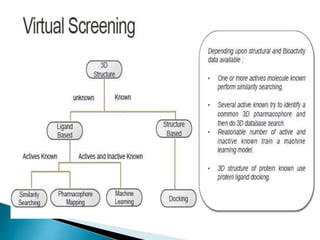
• Virtual screening methods
• Scoring
• Reference
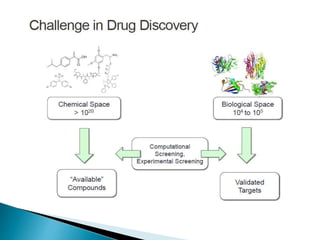
Choosing the right molecule
• Goal: to find a lead compound that can be optimized to give a drug
candidate.
Optimization: using chemical synthesis to modify the lead molecule
in order to improve its chances of being a successful drug.
• The challenge: chemical space is vast. Estimates vary
• There are ~65 million known compounds (example UniChem,
PubChem)
• A typical pharmaceutical compound collection contains ~1-5
million compounds.
• High throughput screening allows large (up to 1 million) numbers
of compounds to be tested
− But very small proportion of “available” compounds
− Large scale screening is expensive
− Not all targets are suitable for HTS
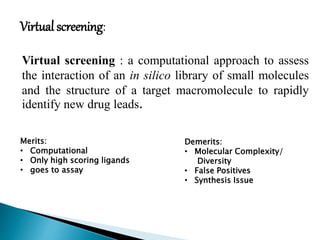
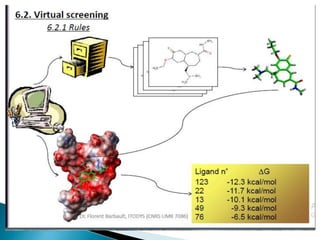
Virtual screening : a computational approach to assess
the interaction of an in silico library of small molecules
and the structure of a target macromolecule to rapidly
identify new drug leads.
Virtual screening:
Merits:
• Computational
• Only high scoring ligands
• goes to assay
Demerits:
• Molecular Complexity/
Diversity
• False Positives
• Synthesis Issue
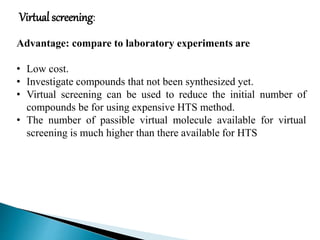
Virtual screening:
Advantage: compare to laboratory experiments are
• Low cost.
• Investigate compounds that not been synthesized yet.
• Virtual screening can be used to reduce the initial number of
compounds be for using expensive HTS method.
• The number of passible virtual molecule available for virtual
screening is much higher than there available for HTS
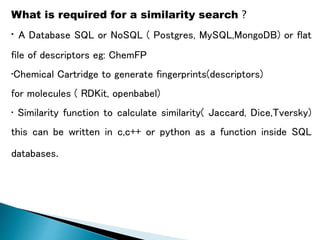
What is required for a similarity search ?
• A Database SQL or NoSQL ( Postgres, MySQL,MongoDB) or flat
file of descriptors eg: ChemFP
•Chemical Cartridge to generate fingerprints(descriptors)
for molecules ( RDKit, openbabel)
• Similarity function to calculate similarity( Jaccard, Dice,Tversky)
this can be written in c,c++ or python as a function inside SQL
databases.
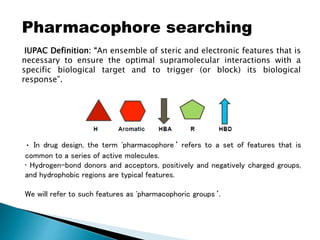
Pharmacophore searching
IUPAC Definition: “An ensemble of steric and electronic features that is
necessary to ensure the optimal supramolecular interactions with a
specific biological target and to trigger (or block) its biological
response”.
• In drug design, the term 'pharmacophore‘ refers to a set of features that is
common to a series of active molecules.
• Hydrogen-bond donors and acceptors, positively and negatively charged groups,
and hydrophobic regions are typical features.
We will refer to such features as 'pharmacophoric groups‘.
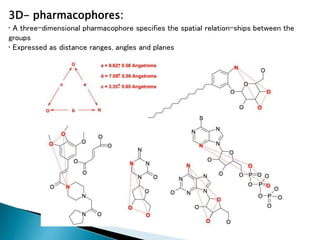
3D- pharmacophores:
• A three-dimensional pharmacophore specifies the spatial relation-ships between the
groups
• Expressed as distance ranges, angles and planes
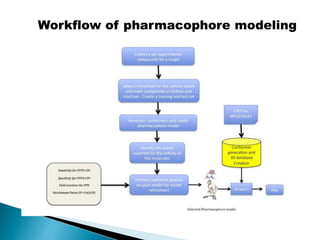
Workflow of pharmacophore modeling
Tools to perform pharmacophore searching:
1) Catalyst (Accelrys)
2) Phase (Schrodinger)
3) LigandScout (Inte:Ligand)
4) PharmaGist
5) Pharmer
6) SHAFTS
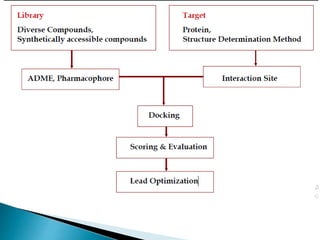
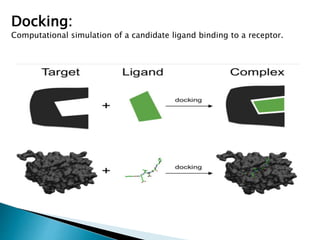
Docking:
Computational simulation of a candidate ligand binding to a receptor.
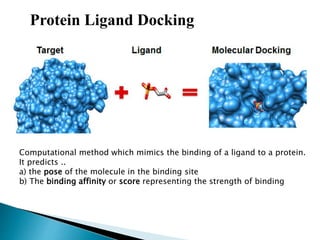
Protein Ligand Docking
Computational method which mimics the binding of a ligand to a protein.
It predicts ..
a) the pose of the molecule in the binding site
b) The binding affinity or score representing the strength of binding
Pose and Binding Site:
• Binding Site (or “active site”)
- the part of the protein where the ligand binds .
- generally a cavity on the protein surface.
- can be identified by looking at the crystal structure of the protein bund
with a known inhibitor.
• Pose ( “binding mode”)
- the geometry of the ligand in the binding site
- Geometry- location , orientation and conformation of the molecule.
Protein Ligand Docking
• How does a ligand (small molecule) bind into the active site of a
protein?
• Docking algorithms are based on two key components
− search algorithm
• to generate “poses” (conformation, position and orientation) of
the ligand within the active site
− scoring function
• to identify the most likely pose for an individual ligand
• to assign a priority order to a set of diverse ligands docked to the same
protein – estimate binding affinity.
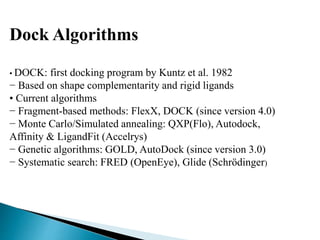
Dock Algorithms
• DOCK: first docking program by Kuntz et al. 1982
− Based on shape complementarity and rigid ligands
• Current algorithms
− Fragment-based methods: FlexX, DOCK (since version 4.0)
− Monte Carlo/Simulated annealing: QXP(Flo), Autodock,
Affinity & LigandFit (Accelrys)
− Genetic algorithms: GOLD, AutoDock (since version 3.0)
− Systematic search: FRED (OpenEye), Glide (Schrödinger)
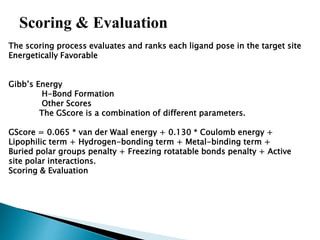
The scoring process evaluates and ranks each ligand pose in the target site
Energetically Favorable
Gibb’s Energy
H-Bond Formation
Other Scores
The GScore is a combination of different parameters.
GScore = 0.065 * van der Waal energy + 0.130 * Coulomb energy +
Lipophilic term + Hydrogen-bonding term + Metal-binding term +
Buried polar groups penalty + Freezing rotatable bonds penalty + Active
site polar interactions.
Scoring & Evaluation
References:
• Lengauer T, Rarey M (Jun 1996). "Computational methods for biomolecular
docking". Current Opinion in Structural Biology. 6 (3): 402–6
• Kitchen DB, Decornez H, Furr JR, Bajorath J (Nov 2004). "Docking and scoring in virtual
screening for drug discovery: methods and applications". Nature Reviews. Drug
Discovery. 3 (11): 935–49.
• Shoichet, B.K., D.L. Bodian, and I.D. Kuntz, J. Comp. Chem., 1992. 13(3): p. 380-397.
• Meng, E.C., B.K. Shoichet, and I.D. Kuntz, J. Comp. Chem., 1992. 13: p. 505-524.
• Kuntz, I.D., J.M. Blaney, S.J. Oatley, R. Langridge, and T.E. Ferrin, J. Mol. Biol., 1982.
161: p.269-288.
• Meng, E.C., D.A. Gschwend, J.M. Blaney, and I.D. Kuntz, Proteins, 1993. 17(3): p. 266-
278.
• F. Barbault, C. Landon,M. Guenneugues,M. Legrain, et al, Biochemistry 2003. 42 14434-
42.
Virtual sreening

Virtual sreening

  • 1.
    Virtual Screening Prepared by MAHENDRA.G.S 1M pharm Department of Pharmaceutical chemistry J S S College of Pharmacy Mysore
  • 2.
    CONTENT • Definition • Advantages •Virtual screening methods • Scoring • Reference
  • 4.
    Choosing the rightmolecule • Goal: to find a lead compound that can be optimized to give a drug candidate. Optimization: using chemical synthesis to modify the lead molecule in order to improve its chances of being a successful drug. • The challenge: chemical space is vast. Estimates vary • There are ~65 million known compounds (example UniChem, PubChem) • A typical pharmaceutical compound collection contains ~1-5 million compounds. • High throughput screening allows large (up to 1 million) numbers of compounds to be tested − But very small proportion of “available” compounds − Large scale screening is expensive − Not all targets are suitable for HTS
  • 5.
    Virtual screening :a computational approach to assess the interaction of an in silico library of small molecules and the structure of a target macromolecule to rapidly identify new drug leads. Virtual screening: Merits: • Computational • Only high scoring ligands • goes to assay Demerits: • Molecular Complexity/ Diversity • False Positives • Synthesis Issue
  • 7.
    Virtual screening: Advantage: compareto laboratory experiments are • Low cost. • Investigate compounds that not been synthesized yet. • Virtual screening can be used to reduce the initial number of compounds be for using expensive HTS method. • The number of passible virtual molecule available for virtual screening is much higher than there available for HTS
  • 12.
    What is requiredfor a similarity search ? • A Database SQL or NoSQL ( Postgres, MySQL,MongoDB) or flat file of descriptors eg: ChemFP •Chemical Cartridge to generate fingerprints(descriptors) for molecules ( RDKit, openbabel) • Similarity function to calculate similarity( Jaccard, Dice,Tversky) this can be written in c,c++ or python as a function inside SQL databases.
  • 13.
    Pharmacophore searching IUPAC Definition:“An ensemble of steric and electronic features that is necessary to ensure the optimal supramolecular interactions with a specific biological target and to trigger (or block) its biological response”. • In drug design, the term 'pharmacophore‘ refers to a set of features that is common to a series of active molecules. • Hydrogen-bond donors and acceptors, positively and negatively charged groups, and hydrophobic regions are typical features. We will refer to such features as 'pharmacophoric groups‘.
  • 14.
    3D- pharmacophores: • Athree-dimensional pharmacophore specifies the spatial relation-ships between the groups • Expressed as distance ranges, angles and planes
  • 15.
  • 16.
    Tools to performpharmacophore searching: 1) Catalyst (Accelrys) 2) Phase (Schrodinger) 3) LigandScout (Inte:Ligand) 4) PharmaGist 5) Pharmer 6) SHAFTS
  • 17.
    Docking: Computational simulation ofa candidate ligand binding to a receptor.
  • 18.
    Protein Ligand Docking Computationalmethod which mimics the binding of a ligand to a protein. It predicts .. a) the pose of the molecule in the binding site b) The binding affinity or score representing the strength of binding
  • 19.
    Pose and BindingSite: • Binding Site (or “active site”) - the part of the protein where the ligand binds . - generally a cavity on the protein surface. - can be identified by looking at the crystal structure of the protein bund with a known inhibitor. • Pose ( “binding mode”) - the geometry of the ligand in the binding site - Geometry- location , orientation and conformation of the molecule.
  • 20.
    Protein Ligand Docking •How does a ligand (small molecule) bind into the active site of a protein? • Docking algorithms are based on two key components − search algorithm • to generate “poses” (conformation, position and orientation) of the ligand within the active site − scoring function • to identify the most likely pose for an individual ligand • to assign a priority order to a set of diverse ligands docked to the same protein – estimate binding affinity.
  • 21.
    Dock Algorithms • DOCK:first docking program by Kuntz et al. 1982 − Based on shape complementarity and rigid ligands • Current algorithms − Fragment-based methods: FlexX, DOCK (since version 4.0) − Monte Carlo/Simulated annealing: QXP(Flo), Autodock, Affinity & LigandFit (Accelrys) − Genetic algorithms: GOLD, AutoDock (since version 3.0) − Systematic search: FRED (OpenEye), Glide (Schrödinger)
  • 22.
    The scoring processevaluates and ranks each ligand pose in the target site Energetically Favorable Gibb’s Energy H-Bond Formation Other Scores The GScore is a combination of different parameters. GScore = 0.065 * van der Waal energy + 0.130 * Coulomb energy + Lipophilic term + Hydrogen-bonding term + Metal-binding term + Buried polar groups penalty + Freezing rotatable bonds penalty + Active site polar interactions. Scoring & Evaluation Scoring & Evaluation
  • 23.
    References: • Lengauer T,Rarey M (Jun 1996). "Computational methods for biomolecular docking". Current Opinion in Structural Biology. 6 (3): 402–6 • Kitchen DB, Decornez H, Furr JR, Bajorath J (Nov 2004). "Docking and scoring in virtual screening for drug discovery: methods and applications". Nature Reviews. Drug Discovery. 3 (11): 935–49. • Shoichet, B.K., D.L. Bodian, and I.D. Kuntz, J. Comp. Chem., 1992. 13(3): p. 380-397. • Meng, E.C., B.K. Shoichet, and I.D. Kuntz, J. Comp. Chem., 1992. 13: p. 505-524. • Kuntz, I.D., J.M. Blaney, S.J. Oatley, R. Langridge, and T.E. Ferrin, J. Mol. Biol., 1982. 161: p.269-288. • Meng, E.C., D.A. Gschwend, J.M. Blaney, and I.D. Kuntz, Proteins, 1993. 17(3): p. 266- 278. • F. Barbault, C. Landon,M. Guenneugues,M. Legrain, et al, Biochemistry 2003. 42 14434- 42.