WE
LCO
ME
JESSEN GEORGE K
M PHARM PART 1
PHARMACY PRACTICE
CPS, MEDICAL COLLEGE
TVM
HYPERTENSI
ON
CONTENTS
 INTRODUCTION
 EPIDEMIOLOGY
 TYPES OF HYPERTENSION
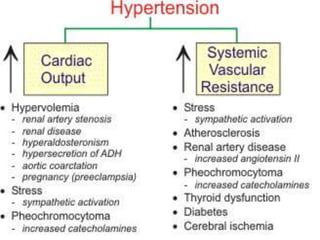
 ETIOLOGY
 PATHOPHYSIOLOGY
 CLINICAL PRESENTATION & DIAGNOSIS
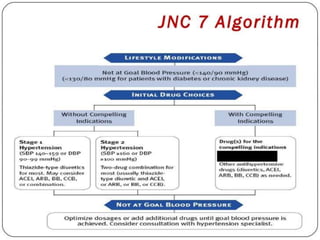
 MANAGEMENT OF HYPERTENSION
 SPECIAL POPULATION
 PATIENT COUNSELLING
 REFERENCES
INTRODUCTION
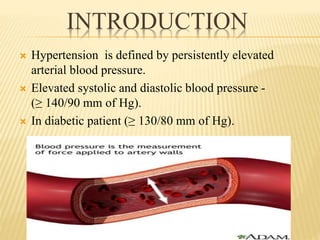
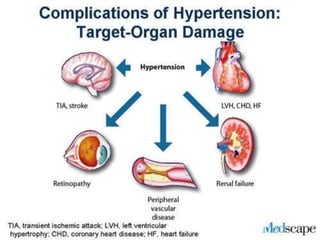
 Hypertension is defined by persistently elevated
arterial blood pressure.
 Elevated systolic and diastolic blood pressure -
(≥ 140/90 mm of Hg).
 In diabetic patient (≥ 130/80 mm of Hg).
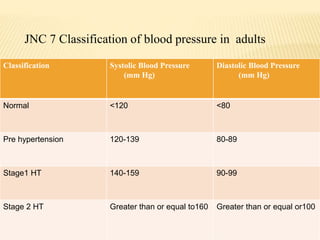
Classification Systolic Blood Pressure
(mm Hg)
Diastolic Blood Pressure
(mm Hg)
Normal <120 <80
Pre hypertension 120-139 80-89
Stage1 HT 140-159 90-99
Stage 2 HT Greater than or equal to160 Greater than or equal or100
JNC 7 Classification of blood pressure in adults
EPIDEMIOLOGY
 Prevalence of HT increases with age & greater among
African Americans than Caucasians.
 In US, 68% of adults have HT, only 53% are on
treatment & only 27% have achieved control of BP.
 Prevalence of HT in India is about 26.2% in men &
23.6% in women.
 Hypertension is similar between men and women of the
same race.
TYPES OF HYPERTENSION
 Essential hypertension.
 Secondary hypertension.
 White coat hypertension.
 Isolated systolic hypertension.
 Gestational hypertension.
 Hypertensive crisis.
a) Hypertensive urgencies.
b) Hypertensive emergencies.
ETIOLOGY
 Essential or Primary hypertension
- 90 % .
- sedentary lifestyle - smoking, alcohol intake, stress,
obesity.
- inherited genetic mutation, ageing etc.
- cannot be cured, but can be controlled.
 Secondary hypertension.
- 10 % .
- Due to either a co morbid disease or a drug.
- Diseases : chronic kidney disease, cushing's
syndrome, coarctation of aorta, pheochromocytoma,
primary aldosteronism, thyroid disease etc.
- Drugs :Oral contraceptives, phenylpropanolamine,
cyclosporine, corticosteroids, MAO inhibitors,
antidepressants etc.
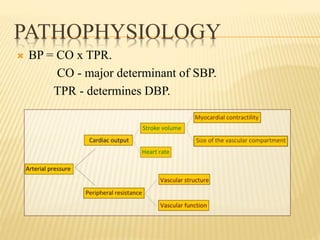
PATHOPHYSIOLOGY
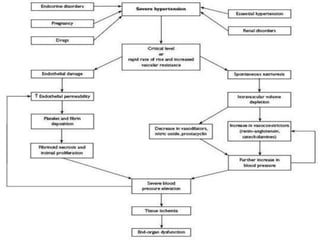
 BP = CO x TPR.
CO - major determinant of SBP.
TPR - determines DBP.
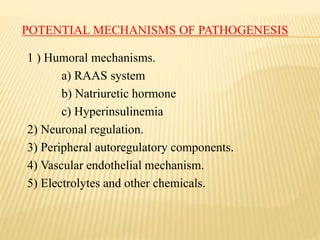
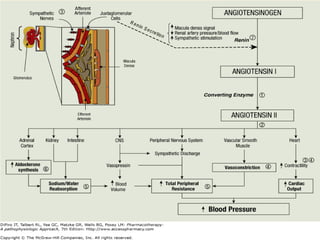
POTENTIAL MECHANISMS OF PATHOGENESIS
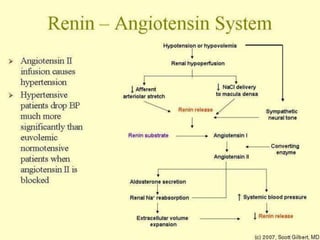
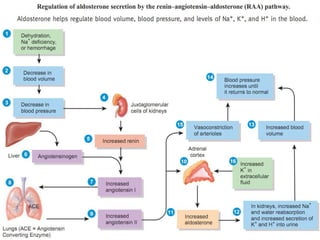
1 ) Humoral mechanisms.
a) RAAS system
b) Natriuretic hormone
c) Hyperinsulinemia
2) Neuronal regulation.
3) Peripheral autoregulatory components.
4) Vascular endothelial mechanism.
5) Electrolytes and other chemicals.
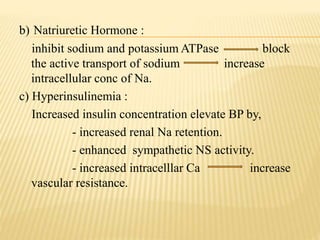
b) Natriuretic Hormone :
inhibit sodium and potassium ATPase block
the active transport of sodium increase
intracellular conc of Na.
c) Hyperinsulinemia :
Increased insulin concentration elevate BP by,
- increased renal Na retention.
- enhanced sympathetic NS activity.
- increased intracelllar Ca increase
vascular resistance.
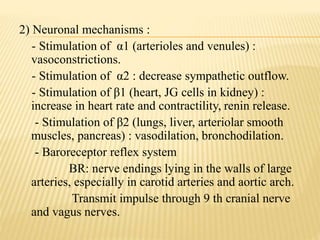
2) Neuronal mechanisms :
- Stimulation of α1 (arterioles and venules) :
vasoconstrictions.
- Stimulation of α2 : decrease sympathetic outflow.
- Stimulation of β1 (heart, JG cells in kidney) :
increase in heart rate and contractility, renin release.
- Stimulation of β2 (lungs, liver, arteriolar smooth
muscles, pancreas) : vasodilation, bronchodilation.
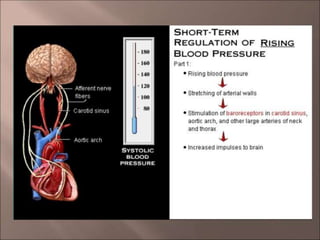
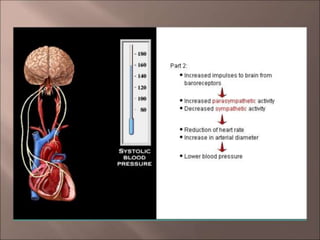
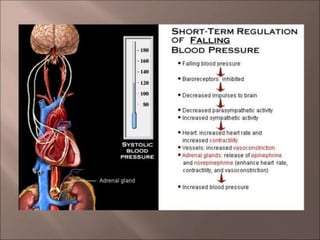
- Baroreceptor reflex system
BR: nerve endings lying in the walls of large
arteries, especially in carotid arteries and aortic arch.
Transmit impulse through 9 th cranial nerve
and vagus nerves.
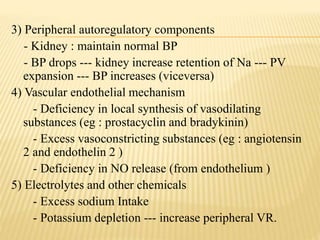
3) Peripheral autoregulatory components
- Kidney : maintain normal BP
- BP drops --- kidney increase retention of Na --- PV
expansion --- BP increases (viceversa)
4) Vascular endothelial mechanism
- Deficiency in local synthesis of vasodilating
substances (eg : prostacyclin and bradykinin)
- Excess vasoconstricting substances (eg : angiotensin
2 and endothelin 2 )
- Deficiency in NO release (from endothelium )
5) Electrolytes and other chemicals
- Excess sodium Intake
- Potassium depletion --- increase peripheral VR.
CLINICAL PRESENTATION & DIAGNOSIS
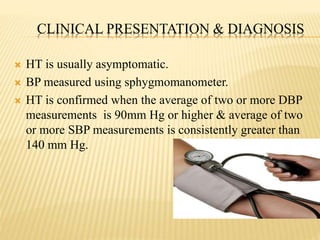
 HT is usually asymptomatic.
 BP measured using sphygmomanometer.
 HT is confirmed when the average of two or more DBP
measurements is 90mm Hg or higher & average of two
or more SBP measurements is consistently greater than
140 mm Hg.
 Initial assessment include a complete history and
physical examination.
 If hypertension seems reasonable, tests as
echocardiogram and electrocardiogram should be
done to measure the electrical activity of heart.
 Laboratory tests can also be performed to identify
possible causes of secondary hypertension.
(Eg : serum creatinine, fasting blood glucose, serum
potassium, urinalysis etc)
SIGNS AND SYMPTOMS
 Mild to moderate essential hypertension
- asymptomatic
 Secondary hypertension
- Hyperthyroidism : weight loss, tremors, heart rate
abnormalities, reddening of the palms and increased
sweating.
- Hyperaldosteronism : numbness, excessive
urination, excessive sweating, electrolytes imbalance ,
dehydration and elevated blood alkalinity.
 In pregnancy
- Pre Eclampsia, Eclampsia.
 In newborns and neonates
- Failure to thrive, seizures, irritability, lack of
energy and difficulty breathing.
 In children
- Headache, fatigue, blurred vision, nosebleeds, and
facial paralysis.
MANAGEMENT OF HYPERTENSION
1) Non pharmacologic therapy
- Weight reduction
- Dietary approaches
- Regular aerobic physical activity
- Avoid alcohol consumption
- Smoking cessation
- Potassium supplementation
- Magnesium supplements
- Stress reduction
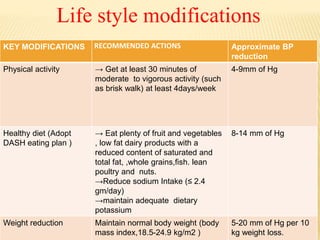
KEY MODIFICATIONS RECOMMENDED ACTIONS Approximate BP
reduction
Physical activity → Get at least 30 minutes of
moderate to vigorous activity (such
as brisk walk) at least 4days/week
4-9mm of Hg
Healthy diet (Adopt
DASH eating plan )
→ Eat plenty of fruit and vegetables
, low fat dairy products with a
reduced content of saturated and
total fat, ,whole grains,fish. lean
poultry and nuts.
→Reduce sodium Intake (≤ 2.4
gm/day)
→maintain adequate dietary
potassium
8-14 mm of Hg
Weight reduction Maintain normal body weight (body
mass index,18.5-24.9 kg/m2 )
5-20 mm of Hg per 10
kg weight loss.
Life style modifications
PHARMACOTHERAPY
A) PRIMARY ANTIHYPERTENSIVES
1) DIURETICS
a) Thiazides - eg : chlorthalidone, indapamide (lozol),
hydrochlorothiazide (esidrix ).
b) Loops - eg : furosemide (Lasix), torasemide.
c) Potassium sparing
(1) Inhibitors of renal epithelial Na channel -
eg : amiloride, triamterene.
(2) Aldosterone antagonist - eg : spironolactone,
(aldactone).
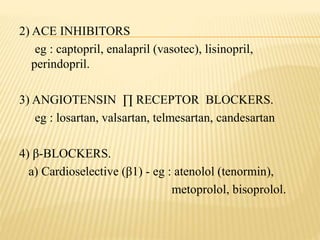
2) ACE INHIBITORS
eg : captopril, enalapril (vasotec), lisinopril,
perindopril.
3) ANGIOTENSIN ∏ RECEPTOR BLOCKERS.
eg : losartan, valsartan, telmesartan, candesartan
4) β-BLOCKERS.
a) Cardioselective (β1) - eg : atenolol (tenormin),
metoprolol, bisoprolol.
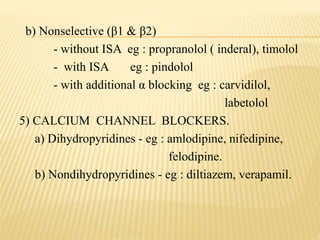
b) Nonselective (β1 & β2)
- without ISA eg : propranolol ( inderal), timolol
- with ISA eg : pindolol
- with additional α blocking eg : carvidilol,
labetolol
5) CALCIUM CHANNEL BLOCKERS.
a) Dihydropyridines - eg : amlodipine, nifedipine,
felodipine.
b) Nondihydropyridines - eg : diltiazem, verapamil.
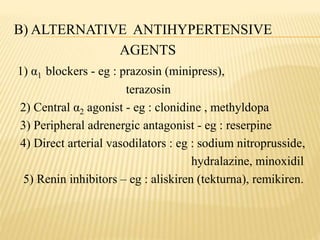
B) ALTERNATIVE ANTIHYPERTENSIVE
AGENTS
1) α1 blockers - eg : prazosin (minipress),
terazosin
2) Central α2 agonist - eg : clonidine , methyldopa
3) Peripheral adrenergic antagonist - eg : reserpine
4) Direct arterial vasodilators : eg : sodium nitroprusside,
hydralazine, minoxidil
5) Renin inhibitors – eg : aliskiren (tekturna), remikiren.
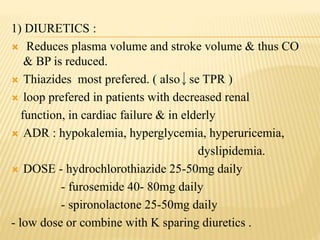
1) DIURETICS :
 Reduces plasma volume and stroke volume & thus CO
& BP is reduced.
 Thiazides most prefered. ( also se TPR )
 loop prefered in patients with decreased renal
function, in cardiac failure & in elderly
 ADR : hypokalemia, hyperglycemia, hyperuricemia,
dyslipidemia.
 DOSE - hydrochlorothiazide 25-50mg daily
- furosemide 40- 80mg daily
- spironolactone 25-50mg daily
- low dose or combine with K sparing diuretics .
2) ACE INHIBITORS
 Blocks the conversion of Ang I to Ang II.
 Also stimulate the synthesis of vasodilating
substances (prostaglandin E2 and prostacyclin)
 Contraindicated in bilateral artery stenosis also in
pregnancy.
 ADR : renal failure, dry cough, hypotension,
angioedema, dysgeusia, foetopathic, hyperkalaemia.
 DOSE : captopril initially 12.5 mg bid, max 50mg tid
enalapril initially 5mg at bedtime.
3) ANGIOTENSIN RECEPTOR BLOCKERS
 ARB directly block angiotensin type I receptor (AT 1)
which mediates the effect of angiotensin II.
 Stimulation of AT II– vasodilation
 Angiotensin II from RAAS and an alternative
pathway through the enzyme chymase.
 ADR : edema, headache, renal failure
 DOSE : losartan K 50-100mg in two divided doses,
telmesartan 40 mg OD, max 80 mg/day
4) β-BLOCKERS
 Decrease CO through –ve chronotropic & inotropic
effect.
 Patient with asthma, COPD, and diabetes :
cardioselective safer than non selective β-blockers.
 Abrupt cessation may cause rebound HT
 ADR- bradycardia, conduction abnormalities,
broncospasm, dizziness, drowsiness.
 DOSE : atenolol 25-100 mg OD
propranolol 160- 480 mg b.i.d
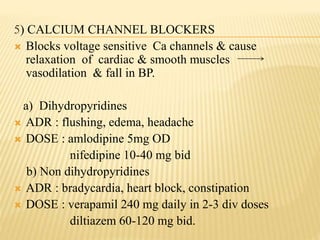
5) CALCIUM CHANNEL BLOCKERS
 Blocks voltage sensitive Ca channels & cause
relaxation of cardiac & smooth muscles
vasodilation & fall in BP.
a) Dihydropyridines
 ADR : flushing, edema, headache
 DOSE : amlodipine 5mg OD
nifedipine 10-40 mg bid
b) Non dihydropyridines
 ADR : bradycardia, heart block, constipation
 DOSE : verapamil 240 mg daily in 2-3 div doses
diltiazem 60-120 mg bid.
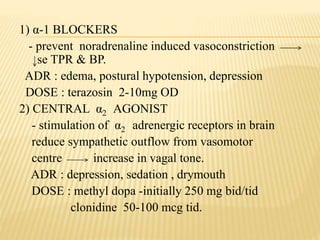
1) α-1 BLOCKERS
- prevent noradrenaline induced vasoconstriction
se TPR & BP.
ADR : edema, postural hypotension, depression
DOSE : terazosin 2-10mg OD
2) CENTRAL α2 AGONIST
- stimulation of α2 adrenergic receptors in brain
reduce sympathetic outflow from vasomotor
centre increase in vagal tone.
ADR : depression, sedation , drymouth
DOSE : methyl dopa -initially 250 mg bid/tid
clonidine 50-100 mcg tid.
3) PERIPHERAL ADRENERGIC ANTAGONIST
 Depletes norepinephrine from sympathetic nerve
endings & blocks transport of NE into storage
granules
 ADR : mental depression, nasal conjestion, headache
 DOSE : 250 mcg daily
4) DIRECT ARTERIAL VASODILATORS
 Direct arterial smooth muscle relaxation
 Hydralazine ADR : dermatitis, headache
DOSE : 20-100 mg/day
 Minoxidil ADR : reversible hypertrichosis on
face,arms etc
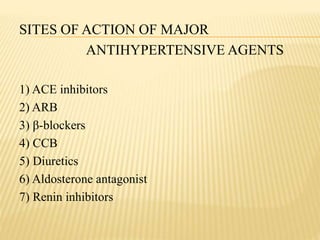
SITES OF ACTION OF MAJOR
ANTIHYPERTENSIVE AGENTS
1) ACE inhibitors
2) ARB
3) β-blockers
4) CCB
5) Diuretics
6) Aldosterone antagonist
7) Renin inhibitors
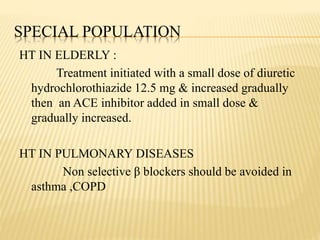
SPECIAL POPULATION
HT IN ELDERLY :
Treatment initiated with a small dose of diuretic
hydrochlorothiazide 12.5 mg & increased gradually
then an ACE inhibitor added in small dose &
gradually increased.
HT IN PULMONARY DISEASES
Non selective β blockers should be avoided in
asthma ,COPD
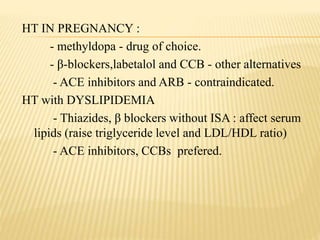
HT IN PREGNANCY :
- methyldopa - drug of choice.
- β-blockers,labetalol and CCB - other alternatives
- ACE inhibitors and ARB - contraindicated.
HT with DYSLIPIDEMIA
- Thiazides, β blockers without ISA : affect serum
lipids (raise triglyceride level and LDL/HDL ratio)
- ACE inhibitors, CCBs prefered.
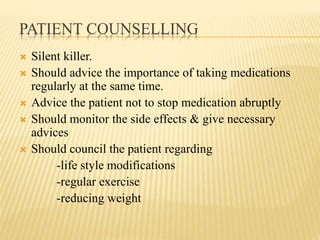
PATIENT COUNSELLING
 Silent killer.
 Should advice the importance of taking medications
regularly at the same time.
 Advice the patient not to stop medication abruptly
 Should monitor the side effects & give necessary
advices
 Should council the patient regarding
-life style modifications
-regular exercise
-reducing weight
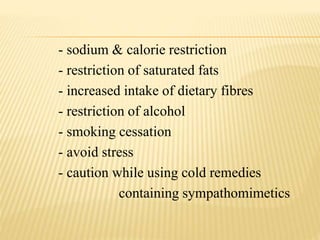
- sodium & calorie restriction
- restriction of saturated fats
- increased intake of dietary fibres
- restriction of alcohol
- smoking cessation
- avoid stress
- caution while using cold remedies
containing sympathomimetics
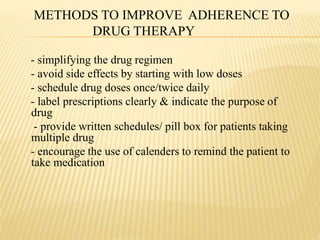
METHODS TO IMPROVE ADHERENCE TO
DRUG THERAPY
- simplifying the drug regimen
- avoid side effects by starting with low doses
- schedule drug doses once/twice daily
- label prescriptions clearly & indicate the purpose of
drug
- provide written schedules/ pill box for patients taking
multiple drug
- encourage the use of calenders to remind the patient to
take medication
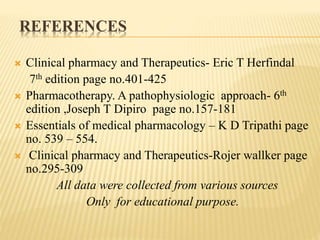
REFERENCES
 Clinical pharmacy and Therapeutics- Eric T Herfindal
7th edition page no.401-425
 Pharmacotherapy. A pathophysiologic approach- 6th
edition ,Joseph T Dipiro page no.157-181
 Essentials of medical pharmacology – K D Tripathi page
no. 539 – 554.
 Clinical pharmacy and Therapeutics-Rojer wallker page
no.295-309
All data were collected from various sources
Only for educational purpose.
THANK YOU

Hypertension

  • 1.
  • 2.
    JESSEN GEORGE K MPHARM PART 1 PHARMACY PRACTICE CPS, MEDICAL COLLEGE TVM HYPERTENSI ON
  • 3.
    CONTENTS  INTRODUCTION  EPIDEMIOLOGY TYPES OF HYPERTENSION  ETIOLOGY  PATHOPHYSIOLOGY  CLINICAL PRESENTATION & DIAGNOSIS  MANAGEMENT OF HYPERTENSION  SPECIAL POPULATION  PATIENT COUNSELLING  REFERENCES
  • 4.
    INTRODUCTION  Hypertension isdefined by persistently elevated arterial blood pressure.  Elevated systolic and diastolic blood pressure - (≥ 140/90 mm of Hg).  In diabetic patient (≥ 130/80 mm of Hg).
  • 5.
    Classification Systolic BloodPressure (mm Hg) Diastolic Blood Pressure (mm Hg) Normal <120 <80 Pre hypertension 120-139 80-89 Stage1 HT 140-159 90-99 Stage 2 HT Greater than or equal to160 Greater than or equal or100 JNC 7 Classification of blood pressure in adults
  • 6.
    EPIDEMIOLOGY  Prevalence ofHT increases with age & greater among African Americans than Caucasians.  In US, 68% of adults have HT, only 53% are on treatment & only 27% have achieved control of BP.  Prevalence of HT in India is about 26.2% in men & 23.6% in women.  Hypertension is similar between men and women of the same race.
  • 7.
    TYPES OF HYPERTENSION Essential hypertension.  Secondary hypertension.  White coat hypertension.  Isolated systolic hypertension.  Gestational hypertension.  Hypertensive crisis. a) Hypertensive urgencies. b) Hypertensive emergencies.
  • 8.
    ETIOLOGY  Essential orPrimary hypertension - 90 % . - sedentary lifestyle - smoking, alcohol intake, stress, obesity. - inherited genetic mutation, ageing etc. - cannot be cured, but can be controlled.
  • 9.
     Secondary hypertension. -10 % . - Due to either a co morbid disease or a drug. - Diseases : chronic kidney disease, cushing's syndrome, coarctation of aorta, pheochromocytoma, primary aldosteronism, thyroid disease etc. - Drugs :Oral contraceptives, phenylpropanolamine, cyclosporine, corticosteroids, MAO inhibitors, antidepressants etc.
  • 11.
    PATHOPHYSIOLOGY  BP =CO x TPR. CO - major determinant of SBP. TPR - determines DBP.
  • 13.
    POTENTIAL MECHANISMS OFPATHOGENESIS 1 ) Humoral mechanisms. a) RAAS system b) Natriuretic hormone c) Hyperinsulinemia 2) Neuronal regulation. 3) Peripheral autoregulatory components. 4) Vascular endothelial mechanism. 5) Electrolytes and other chemicals.
  • 16.
    b) Natriuretic Hormone: inhibit sodium and potassium ATPase block the active transport of sodium increase intracellular conc of Na. c) Hyperinsulinemia : Increased insulin concentration elevate BP by, - increased renal Na retention. - enhanced sympathetic NS activity. - increased intracelllar Ca increase vascular resistance.
  • 17.
    2) Neuronal mechanisms: - Stimulation of α1 (arterioles and venules) : vasoconstrictions. - Stimulation of α2 : decrease sympathetic outflow. - Stimulation of β1 (heart, JG cells in kidney) : increase in heart rate and contractility, renin release. - Stimulation of β2 (lungs, liver, arteriolar smooth muscles, pancreas) : vasodilation, bronchodilation. - Baroreceptor reflex system BR: nerve endings lying in the walls of large arteries, especially in carotid arteries and aortic arch. Transmit impulse through 9 th cranial nerve and vagus nerves.
  • 21.
    3) Peripheral autoregulatorycomponents - Kidney : maintain normal BP - BP drops --- kidney increase retention of Na --- PV expansion --- BP increases (viceversa) 4) Vascular endothelial mechanism - Deficiency in local synthesis of vasodilating substances (eg : prostacyclin and bradykinin) - Excess vasoconstricting substances (eg : angiotensin 2 and endothelin 2 ) - Deficiency in NO release (from endothelium ) 5) Electrolytes and other chemicals - Excess sodium Intake - Potassium depletion --- increase peripheral VR.
  • 23.
    CLINICAL PRESENTATION &DIAGNOSIS  HT is usually asymptomatic.  BP measured using sphygmomanometer.  HT is confirmed when the average of two or more DBP measurements is 90mm Hg or higher & average of two or more SBP measurements is consistently greater than 140 mm Hg.
  • 24.
     Initial assessmentinclude a complete history and physical examination.  If hypertension seems reasonable, tests as echocardiogram and electrocardiogram should be done to measure the electrical activity of heart.  Laboratory tests can also be performed to identify possible causes of secondary hypertension. (Eg : serum creatinine, fasting blood glucose, serum potassium, urinalysis etc)
  • 25.
    SIGNS AND SYMPTOMS Mild to moderate essential hypertension - asymptomatic  Secondary hypertension - Hyperthyroidism : weight loss, tremors, heart rate abnormalities, reddening of the palms and increased sweating. - Hyperaldosteronism : numbness, excessive urination, excessive sweating, electrolytes imbalance , dehydration and elevated blood alkalinity.
  • 26.
     In pregnancy -Pre Eclampsia, Eclampsia.  In newborns and neonates - Failure to thrive, seizures, irritability, lack of energy and difficulty breathing.  In children - Headache, fatigue, blurred vision, nosebleeds, and facial paralysis.
  • 27.
    MANAGEMENT OF HYPERTENSION 1)Non pharmacologic therapy - Weight reduction - Dietary approaches - Regular aerobic physical activity - Avoid alcohol consumption - Smoking cessation - Potassium supplementation - Magnesium supplements - Stress reduction
  • 28.
    KEY MODIFICATIONS RECOMMENDEDACTIONS Approximate BP reduction Physical activity → Get at least 30 minutes of moderate to vigorous activity (such as brisk walk) at least 4days/week 4-9mm of Hg Healthy diet (Adopt DASH eating plan ) → Eat plenty of fruit and vegetables , low fat dairy products with a reduced content of saturated and total fat, ,whole grains,fish. lean poultry and nuts. →Reduce sodium Intake (≤ 2.4 gm/day) →maintain adequate dietary potassium 8-14 mm of Hg Weight reduction Maintain normal body weight (body mass index,18.5-24.9 kg/m2 ) 5-20 mm of Hg per 10 kg weight loss. Life style modifications
  • 29.
    PHARMACOTHERAPY A) PRIMARY ANTIHYPERTENSIVES 1)DIURETICS a) Thiazides - eg : chlorthalidone, indapamide (lozol), hydrochlorothiazide (esidrix ). b) Loops - eg : furosemide (Lasix), torasemide. c) Potassium sparing (1) Inhibitors of renal epithelial Na channel - eg : amiloride, triamterene. (2) Aldosterone antagonist - eg : spironolactone, (aldactone).
  • 30.
    2) ACE INHIBITORS eg: captopril, enalapril (vasotec), lisinopril, perindopril. 3) ANGIOTENSIN ∏ RECEPTOR BLOCKERS. eg : losartan, valsartan, telmesartan, candesartan 4) β-BLOCKERS. a) Cardioselective (β1) - eg : atenolol (tenormin), metoprolol, bisoprolol.
  • 31.
    b) Nonselective (β1& β2) - without ISA eg : propranolol ( inderal), timolol - with ISA eg : pindolol - with additional α blocking eg : carvidilol, labetolol 5) CALCIUM CHANNEL BLOCKERS. a) Dihydropyridines - eg : amlodipine, nifedipine, felodipine. b) Nondihydropyridines - eg : diltiazem, verapamil.
  • 32.
    B) ALTERNATIVE ANTIHYPERTENSIVE AGENTS 1)α1 blockers - eg : prazosin (minipress), terazosin 2) Central α2 agonist - eg : clonidine , methyldopa 3) Peripheral adrenergic antagonist - eg : reserpine 4) Direct arterial vasodilators : eg : sodium nitroprusside, hydralazine, minoxidil 5) Renin inhibitors – eg : aliskiren (tekturna), remikiren.
  • 33.
    1) DIURETICS : Reduces plasma volume and stroke volume & thus CO & BP is reduced.  Thiazides most prefered. ( also se TPR )  loop prefered in patients with decreased renal function, in cardiac failure & in elderly  ADR : hypokalemia, hyperglycemia, hyperuricemia, dyslipidemia.  DOSE - hydrochlorothiazide 25-50mg daily - furosemide 40- 80mg daily - spironolactone 25-50mg daily - low dose or combine with K sparing diuretics .
  • 34.
    2) ACE INHIBITORS Blocks the conversion of Ang I to Ang II.  Also stimulate the synthesis of vasodilating substances (prostaglandin E2 and prostacyclin)  Contraindicated in bilateral artery stenosis also in pregnancy.  ADR : renal failure, dry cough, hypotension, angioedema, dysgeusia, foetopathic, hyperkalaemia.  DOSE : captopril initially 12.5 mg bid, max 50mg tid enalapril initially 5mg at bedtime.
  • 35.
    3) ANGIOTENSIN RECEPTORBLOCKERS  ARB directly block angiotensin type I receptor (AT 1) which mediates the effect of angiotensin II.  Stimulation of AT II– vasodilation  Angiotensin II from RAAS and an alternative pathway through the enzyme chymase.  ADR : edema, headache, renal failure  DOSE : losartan K 50-100mg in two divided doses, telmesartan 40 mg OD, max 80 mg/day
  • 36.
    4) β-BLOCKERS  DecreaseCO through –ve chronotropic & inotropic effect.  Patient with asthma, COPD, and diabetes : cardioselective safer than non selective β-blockers.  Abrupt cessation may cause rebound HT  ADR- bradycardia, conduction abnormalities, broncospasm, dizziness, drowsiness.  DOSE : atenolol 25-100 mg OD propranolol 160- 480 mg b.i.d
  • 37.
    5) CALCIUM CHANNELBLOCKERS  Blocks voltage sensitive Ca channels & cause relaxation of cardiac & smooth muscles vasodilation & fall in BP. a) Dihydropyridines  ADR : flushing, edema, headache  DOSE : amlodipine 5mg OD nifedipine 10-40 mg bid b) Non dihydropyridines  ADR : bradycardia, heart block, constipation  DOSE : verapamil 240 mg daily in 2-3 div doses diltiazem 60-120 mg bid.
  • 38.
    1) α-1 BLOCKERS -prevent noradrenaline induced vasoconstriction se TPR & BP. ADR : edema, postural hypotension, depression DOSE : terazosin 2-10mg OD 2) CENTRAL α2 AGONIST - stimulation of α2 adrenergic receptors in brain reduce sympathetic outflow from vasomotor centre increase in vagal tone. ADR : depression, sedation , drymouth DOSE : methyl dopa -initially 250 mg bid/tid clonidine 50-100 mcg tid.
  • 39.
    3) PERIPHERAL ADRENERGICANTAGONIST  Depletes norepinephrine from sympathetic nerve endings & blocks transport of NE into storage granules  ADR : mental depression, nasal conjestion, headache  DOSE : 250 mcg daily 4) DIRECT ARTERIAL VASODILATORS  Direct arterial smooth muscle relaxation  Hydralazine ADR : dermatitis, headache DOSE : 20-100 mg/day  Minoxidil ADR : reversible hypertrichosis on face,arms etc
  • 41.
    SITES OF ACTIONOF MAJOR ANTIHYPERTENSIVE AGENTS 1) ACE inhibitors 2) ARB 3) β-blockers 4) CCB 5) Diuretics 6) Aldosterone antagonist 7) Renin inhibitors
  • 43.
    SPECIAL POPULATION HT INELDERLY : Treatment initiated with a small dose of diuretic hydrochlorothiazide 12.5 mg & increased gradually then an ACE inhibitor added in small dose & gradually increased. HT IN PULMONARY DISEASES Non selective β blockers should be avoided in asthma ,COPD
  • 44.
    HT IN PREGNANCY: - methyldopa - drug of choice. - β-blockers,labetalol and CCB - other alternatives - ACE inhibitors and ARB - contraindicated. HT with DYSLIPIDEMIA - Thiazides, β blockers without ISA : affect serum lipids (raise triglyceride level and LDL/HDL ratio) - ACE inhibitors, CCBs prefered.
  • 46.
    PATIENT COUNSELLING  Silentkiller.  Should advice the importance of taking medications regularly at the same time.  Advice the patient not to stop medication abruptly  Should monitor the side effects & give necessary advices  Should council the patient regarding -life style modifications -regular exercise -reducing weight
  • 47.
    - sodium &calorie restriction - restriction of saturated fats - increased intake of dietary fibres - restriction of alcohol - smoking cessation - avoid stress - caution while using cold remedies containing sympathomimetics
  • 48.
    METHODS TO IMPROVEADHERENCE TO DRUG THERAPY - simplifying the drug regimen - avoid side effects by starting with low doses - schedule drug doses once/twice daily - label prescriptions clearly & indicate the purpose of drug - provide written schedules/ pill box for patients taking multiple drug - encourage the use of calenders to remind the patient to take medication
  • 49.
    REFERENCES  Clinical pharmacyand Therapeutics- Eric T Herfindal 7th edition page no.401-425  Pharmacotherapy. A pathophysiologic approach- 6th edition ,Joseph T Dipiro page no.157-181  Essentials of medical pharmacology – K D Tripathi page no. 539 – 554.  Clinical pharmacy and Therapeutics-Rojer wallker page no.295-309 All data were collected from various sources Only for educational purpose.
  • 50.