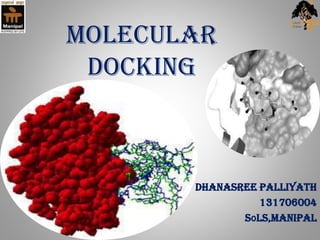
MOLECULAR
DOCKING
DHANASREE PALLIYATH
131706004
SoLS,Manipal
INTRODUCTION
• Docking is an attempt to find the best matching between two molecules.
• A more serious definition….
Docking is a method which predicts the preferred orientation of one ligand when
bound in an active site to form a stable complex.
Docking of small molecule ligand (brown) with a protein receptor (green) to produce
a complex.
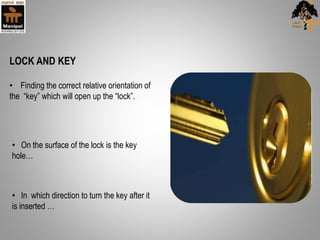
LOCK AND KEY
• Finding the correct relative orientation of
the “key” which will open up the “lock”.
• On the surface of the lock is the key
hole…
• In which direction to turn the key after it
is inserted …
• The protein can be thought of as the “lock” and the ligand can be
thought of as a “key”.
NVP: Nevirapine
Crystallographic structure of HIV-1 reverse
transcriptase:
green coloured P51 subunit & red coloured
P66 subunit
MOLECULAR DOCKING
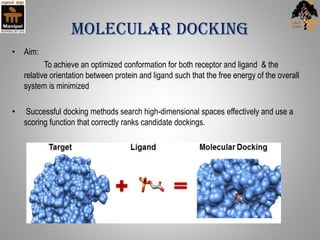
• Aim:
To achieve an optimized conformation for both receptor and ligand & the
relative orientation between protein and ligand such that the free energy of the overall
system is minimized
• Successful docking methods search high-dimensional spaces effectively and use a
scoring function that correctly ranks candidate dockings.
IMPORTANCE
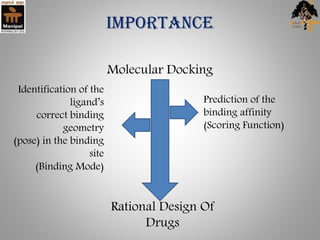
Molecular Docking
Prediction of the
binding affinity
(Scoring Function)
Identification of the
ligand’s
correct binding
geometry
(pose) in the binding
site
(Binding Mode)
Rational Design Of
Drugs
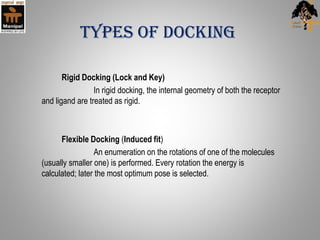
types of docking
Rigid Docking (Lock and Key)
In rigid docking, the internal geometry of both the receptor
and ligand are treated as rigid.
Flexible Docking (Induced fit)
An enumeration on the rotations of one of the molecules
(usually smaller one) is performed. Every rotation the energy is
calculated; later the most optimum pose is selected.
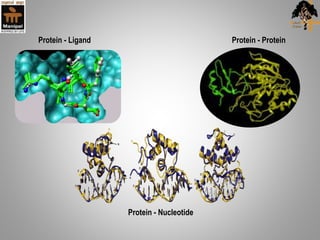
Docking can be between….
• Protein - Ligand
• Protein – Protein
• Protein – Nucleotide
Protein - Ligand Protein - Protein
Protein - Nucleotide
TYPES OF INTERACTIONS
• Electrostatic forces - Forces with electrostatic origin are due to the charges
residing in the matter.
• Electrodynamics forces - The most widely known is probably the van der Waals
interaction.
• Steric forces - These are caused by entropy. For example, in cases where entropy
is limited, there may be forces to minimize the free energy of the system.
• Solvent-related forces – These are due to the structural changes of the solvent.
These structural changes are generated, when ions, colloids, proteins etc, are
added into the structure of solvent. The most commonly are Hydrogen bond and
hydrophobic interactions
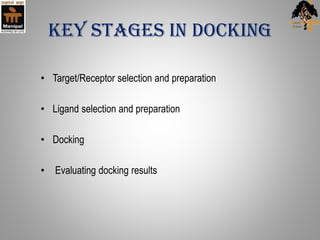
Key stages in docking
• Target/Receptor selection and preparation
• Ligand selection and preparation
• Docking
• Evaluating docking results
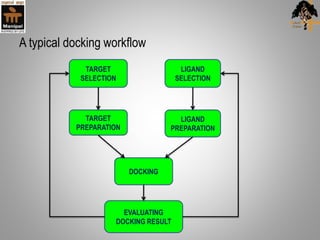
A typical docking workflow
TARGET
SELECTION
LIGAND
SELECTION
TARGET
PREPARATION
EVALUATING
DOCKING RESULT
DOCKING
LIGAND
PREPARATION
Receptor selection and preparation
Building the Receptor
The 3D structure of the receptor should be considered which can be
downloaded from PDB.
The available structure should be processed.
The receptor should be biologically active and stable.
Identification of the Active Site
The active site within the receptor should be identified.
The receptor may have many active sites but the one of the interest should
be selected.
Ligand selection and preparation
Ligands can be obtained from various databases like ZINC, PubChem or can
be sketched using tools like Chemsketch.
Docking
The ligand is docked onto the receptor and the interactions are checked. The
scoring function generates score, depending on which the best fit ligand is
selected.
Softwares
• SANJEEVINI – IIT Delhi (www.scfbio-iitd.res.in/sanjeevini/sanjeevini.jsp)
• GOLD – University of Cambridge ,UK
(www.ccdc.cam.ac.uk/Solutions/GoldSuite/Pages/GOLD.aspx)
• AUTODOCK - Scripps Research Institute,USA (autodock.scripps.edu/)
• GemDock(Generic Evolutionary Method for Molecular Docking) - A tool,
developed by Jinn-Moon Yang, a professor of the Institute of Bioinformatics,
National Chiao Tung University, Taiwan (gemdock.life.nctu.edu.tw/dock/)
• Hex Protein Docking - University of Aberdeen, UK (hex.loria.fr/)
• GRAMM (Global Range Molecular Matching) Protein docking - A Center for
Bioinformatics, University of Kansas, USA
(www.bioinformatics.ku.edu/files/vakser/gramm/)
Applications
• Virtual screening (hit identification)
docking with a scoring function can be used to quickly screen large
databases of potential drugs in silico to identify molecules that are likely to
bind to protein target of interest.
• Drug Discovery (lead optimization)
docking can be used to predict in where and in which relative
orientation a ligand binds to a protein (binding mode or pose). This
information may in turn be used to design more potent and selective
analogs.
• Bioremediation
Protein ligand docking can also be used to predict pollutants that can
be degraded by enzymes.
REFERENCE
• Morris GM, Goodsell DS, Halliday RS, Huey R, Hart WE, Belew RK, Olson AJ (1998).
"Automated docking using a Lamarckian genetic algorithm and an empirical binding
free energy function". Journal of Computational Chemistry 19 (14): 1639–1662.
• Morris RJ, Najmanovich RJ, Kahraman A, Thornton JM (May 2005). "Real spherical
harmonic expansion coefficients as 3D shape descriptors for protein binding pocket
and ligand comparisons".Bioinformatics 21 (10): 2347–55.
• Kahraman A, Morris RJ, Laskowski RA, Thornton JM (April 2007). "Shape variation in
protein binding pockets and their ligands". J. Mol. Biol. 368 (1): 283–301.
• Suresh PS, Kumar A, Kumar R, Singh VP (January 2008). "An in silico [correction of
insilico] approach to bioremediation: laccase as a case study". J. Mol. Graph.
Model. 26 (5): 845–9.
• www.ncbi.nlm.nih.gov/pubmed/18446297
Molecular docking

Molecular docking

  • 1.
  • 2.
    INTRODUCTION • Docking isan attempt to find the best matching between two molecules. • A more serious definition…. Docking is a method which predicts the preferred orientation of one ligand when bound in an active site to form a stable complex. Docking of small molecule ligand (brown) with a protein receptor (green) to produce a complex.
  • 3.
    LOCK AND KEY •Finding the correct relative orientation of the “key” which will open up the “lock”. • On the surface of the lock is the key hole… • In which direction to turn the key after it is inserted …
  • 4.
    • The proteincan be thought of as the “lock” and the ligand can be thought of as a “key”. NVP: Nevirapine Crystallographic structure of HIV-1 reverse transcriptase: green coloured P51 subunit & red coloured P66 subunit
  • 5.
    MOLECULAR DOCKING • Aim: Toachieve an optimized conformation for both receptor and ligand & the relative orientation between protein and ligand such that the free energy of the overall system is minimized • Successful docking methods search high-dimensional spaces effectively and use a scoring function that correctly ranks candidate dockings.
  • 6.
    IMPORTANCE Molecular Docking Prediction ofthe binding affinity (Scoring Function) Identification of the ligand’s correct binding geometry (pose) in the binding site (Binding Mode) Rational Design Of Drugs
  • 7.
    types of docking RigidDocking (Lock and Key) In rigid docking, the internal geometry of both the receptor and ligand are treated as rigid. Flexible Docking (Induced fit) An enumeration on the rotations of one of the molecules (usually smaller one) is performed. Every rotation the energy is calculated; later the most optimum pose is selected.
  • 8.
    Docking can bebetween…. • Protein - Ligand • Protein – Protein • Protein – Nucleotide
  • 9.
    Protein - LigandProtein - Protein Protein - Nucleotide
  • 10.
    TYPES OF INTERACTIONS •Electrostatic forces - Forces with electrostatic origin are due to the charges residing in the matter. • Electrodynamics forces - The most widely known is probably the van der Waals interaction. • Steric forces - These are caused by entropy. For example, in cases where entropy is limited, there may be forces to minimize the free energy of the system. • Solvent-related forces – These are due to the structural changes of the solvent. These structural changes are generated, when ions, colloids, proteins etc, are added into the structure of solvent. The most commonly are Hydrogen bond and hydrophobic interactions
  • 11.
    Key stages indocking • Target/Receptor selection and preparation • Ligand selection and preparation • Docking • Evaluating docking results
  • 12.
    A typical dockingworkflow TARGET SELECTION LIGAND SELECTION TARGET PREPARATION EVALUATING DOCKING RESULT DOCKING LIGAND PREPARATION
  • 13.
    Receptor selection andpreparation Building the Receptor The 3D structure of the receptor should be considered which can be downloaded from PDB. The available structure should be processed. The receptor should be biologically active and stable. Identification of the Active Site The active site within the receptor should be identified. The receptor may have many active sites but the one of the interest should be selected.
  • 14.
    Ligand selection andpreparation Ligands can be obtained from various databases like ZINC, PubChem or can be sketched using tools like Chemsketch. Docking The ligand is docked onto the receptor and the interactions are checked. The scoring function generates score, depending on which the best fit ligand is selected.
  • 15.
    Softwares • SANJEEVINI –IIT Delhi (www.scfbio-iitd.res.in/sanjeevini/sanjeevini.jsp) • GOLD – University of Cambridge ,UK (www.ccdc.cam.ac.uk/Solutions/GoldSuite/Pages/GOLD.aspx) • AUTODOCK - Scripps Research Institute,USA (autodock.scripps.edu/) • GemDock(Generic Evolutionary Method for Molecular Docking) - A tool, developed by Jinn-Moon Yang, a professor of the Institute of Bioinformatics, National Chiao Tung University, Taiwan (gemdock.life.nctu.edu.tw/dock/) • Hex Protein Docking - University of Aberdeen, UK (hex.loria.fr/) • GRAMM (Global Range Molecular Matching) Protein docking - A Center for Bioinformatics, University of Kansas, USA (www.bioinformatics.ku.edu/files/vakser/gramm/)
  • 16.
    Applications • Virtual screening(hit identification) docking with a scoring function can be used to quickly screen large databases of potential drugs in silico to identify molecules that are likely to bind to protein target of interest. • Drug Discovery (lead optimization) docking can be used to predict in where and in which relative orientation a ligand binds to a protein (binding mode or pose). This information may in turn be used to design more potent and selective analogs. • Bioremediation Protein ligand docking can also be used to predict pollutants that can be degraded by enzymes.
  • 17.
    REFERENCE • Morris GM,Goodsell DS, Halliday RS, Huey R, Hart WE, Belew RK, Olson AJ (1998). "Automated docking using a Lamarckian genetic algorithm and an empirical binding free energy function". Journal of Computational Chemistry 19 (14): 1639–1662. • Morris RJ, Najmanovich RJ, Kahraman A, Thornton JM (May 2005). "Real spherical harmonic expansion coefficients as 3D shape descriptors for protein binding pocket and ligand comparisons".Bioinformatics 21 (10): 2347–55. • Kahraman A, Morris RJ, Laskowski RA, Thornton JM (April 2007). "Shape variation in protein binding pockets and their ligands". J. Mol. Biol. 368 (1): 283–301. • Suresh PS, Kumar A, Kumar R, Singh VP (January 2008). "An in silico [correction of insilico] approach to bioremediation: laccase as a case study". J. Mol. Graph. Model. 26 (5): 845–9. • www.ncbi.nlm.nih.gov/pubmed/18446297