PRESENTED BY :- KINJAL S. GAMIT
DEPARTMENT OF PHARMACOLOGY
EN.NO :- 172280825005
M.PHARM
SEM -2
L.M.C.P.
 First introduced in 1990 by “Paul Herilich”.
 A pharmacophore is an abstract description of molecular features
which are necessary for molecular recognition of a ligand by a
biological macromolecule.
 A pharmacophore is a representation of generalized molecular
features including;
 3D (hydrophobic groups, charged/ionizable groups, hydrogen bond
donors/acceptors)
 2D (substructures)
 1D (physical or biological)
 properties that are considered to be responsible for a desired
biological activity.
2172280825005 (M.PH SEM-2)
 Pharmacophore Mapping is the definition and placement of
pharmacophoric features and the alignment techniques used to
overlay 3D.
 Two somewhat distinct usages:
 That substructure of a molecule that is responsible for its
pharmacological activity (c.f. chromophore)
 A set of geometrical constraints between specific functional groups
that enable the molecule to have biological activity
 The process of deriving pharmacophore is known as
pharmacophore mapping.
3172280825005 (M.PH SEM-2)
 It consist of three steps
 (1) identifying common binding element that are responsible for
the biological activity;
 (2) generating potential conformations that active compound may
adopt; and
 (3) determining the 3D relationship between pharmacophore
element in each conformation generated.
4172280825005 (M.PH SEM-2)
5172280825005 (M.PH SEM-2)
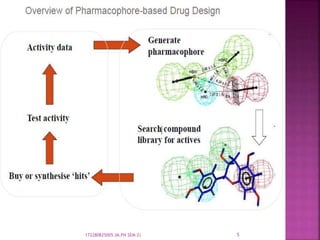
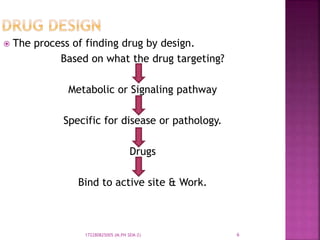
 The process of finding drug by design.
Based on what the drug targeting?
Metabolic or Signaling pathway
Specific for disease or pathology.
Drugs
Bind to active site & Work.
6172280825005 (M.PH SEM-2)
 Usually pharmacophore based search are done in two steps.
 First the software checks whether the compound has the atom
types or functional groups required by the pharmacophore,
 than its checks whether the spatial arrangement of this element
matches the query.
 Flexible 3D searches identified a higher number of hits than rigid
searches do.
 However flexible searches are more time consuming than rigid
ones.
 There are two main approaches for including conformational
flexibility in to the search
 one is top generate a user defined number of representative
conformation for each molecules when the database is to created,
 the other is to generate conformation during the search.
7172280825005 (M.PH SEM-2)
 Pharmacophore model provide powerful filter tools for virtual
screening even in case where the protein structure is not
available, pharmacophore filter are much faster than docking
approaches, and there for greatly reduce the number of compound
subjected to the more expensive docking application.
 Another interesting aspect of pharmacophore in virtual screening is
3D- pharmacophore diversity.
8172280825005 (M.PH SEM-2)
9172280825005 (M.PH SEM-2)
2-D Pharmacophore searching
 Searching of 2D database is of great importance for accelerating
the drug discovery different strategies are pursued to search a 2D
database to identified the compound of the interest Substructure
search identified larger molecules that contain user define query
irrespective of the environment in which the query substructure
occur.
 Biochemical data obtainable from these compounds can be used
for generating structure-activity-relationship (SAR) even before
synthetic plans are made for lead optimization.
 In contrast, superstructure search are used to find smaller
molecules that are embedded in the query.
 One problem that can arise from substructure search is that the
number of the compound identified can reach into the thousands.
 One solution o this problem is raking of the compound based on
similarity between compound in the database and in the query.
10172280825005 (M.PH SEM-2)
 Beyond structure similarity, activity similarity has also been
subject of several studies.
 Similarity search can be combined with substructure for limiting
the number of compound selected.
 Flexible searches are used to identify the compound that differs
from the query structure in user-specified ways.
3-D Pharmacophore searching
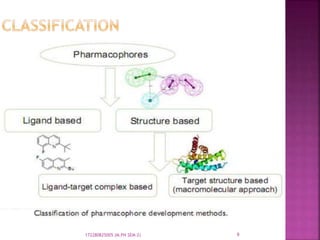
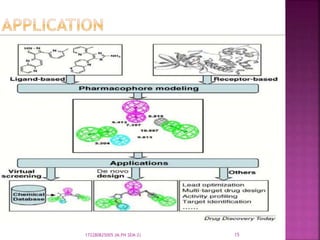
1.Ligand based pharmacophore generation
 Ligand based pharmacophores are generally used when
crystallographic;solution structure or molded structure of protein
cannot be obtained.
 When a set of active compound is known and it is hypothesized
that all the compounds bind in the similar way to the protein, then
common group should interact with the same protein residue.
11172280825005 (M.PH SEM-2)
 Thus, a pharmacophore capturing this compound feature should be
able to identified from a database novel compounds that binds to
the same site of the protein as the known compounds do.
2. Manual pharmacophore generation
 Manual pharmacophore generation is used when there is an easy
way to identify the common feature in a set of active compounds
and/or there is experimental evidence that same functional groups
should be present in the ligand for good activity.
 An example is the development of a pharmacophore model for
dopamine-transporter (DAT) inhibitor.
 Pharmacophores should also have some flexibility built in, thus
justifying the use of distance ranges.
12172280825005 (M.PH SEM-2)
3. Automatic pharmacophore generation
 Pharmacophore generation through conformational analysis and
manual alignment is a very time consuming task, especially when
the list of the active ligands is large and the elements of the
pharmacophore model are not obvious.
 There are several programs Hip Hop, Hypogen, Disco, Gaps, flo,
APEX, and ROCS, that can automatically generate potential
pharmacophore from a list of known inhibitors.
 The performance of these programs in automated pharmacophore
generation varies depending on the training set.
 These all program use algorithms that identified the common
pharmacophore features in the training set molecules; they scoring
function to rank the identified pharmacophores.
13172280825005 (M.PH SEM-2)
4. Receptor based pharmacophore generation
 If the 3D structure of receptor is known, a pharmacophore model
can be derived based on the receptor active site.
 Biochemical data used to identify the key residue that is important
for substrate and/or inhibiting binding.
 This information can be used for binding pharmacophores targeting
the region defined by key residue or for choosing among
pharmacophore generated by automated program.
 This can greatly improve the chance of finding small molecules
that inhibit the protein because the search is focused on a region
of the binding side that is crucial for binding substrate and
inhibitors.
14172280825005 (M.PH SEM-2)
15172280825005 (M.PH SEM-2)
 Discovery studio :
 Window ® and Linux® based protein modeling
software.
 Produced by Accelrys software company.
 Easy to use interface.
 Examples of the programs that perform pharmacophore
based searches are 3D search UNITY, MACCS-3D and
ROCS.
 ROCS is using as shape based super position for
identifying compound that have similar shaped.
16172280825005 (M.PH SEM-2)
Pharmacophore mapping

Pharmacophore mapping

  • 1.
    PRESENTED BY :-KINJAL S. GAMIT DEPARTMENT OF PHARMACOLOGY EN.NO :- 172280825005 M.PHARM SEM -2 L.M.C.P.
  • 2.
     First introducedin 1990 by “Paul Herilich”.  A pharmacophore is an abstract description of molecular features which are necessary for molecular recognition of a ligand by a biological macromolecule.  A pharmacophore is a representation of generalized molecular features including;  3D (hydrophobic groups, charged/ionizable groups, hydrogen bond donors/acceptors)  2D (substructures)  1D (physical or biological)  properties that are considered to be responsible for a desired biological activity. 2172280825005 (M.PH SEM-2)
  • 3.
     Pharmacophore Mappingis the definition and placement of pharmacophoric features and the alignment techniques used to overlay 3D.  Two somewhat distinct usages:  That substructure of a molecule that is responsible for its pharmacological activity (c.f. chromophore)  A set of geometrical constraints between specific functional groups that enable the molecule to have biological activity  The process of deriving pharmacophore is known as pharmacophore mapping. 3172280825005 (M.PH SEM-2)
  • 4.
     It consistof three steps  (1) identifying common binding element that are responsible for the biological activity;  (2) generating potential conformations that active compound may adopt; and  (3) determining the 3D relationship between pharmacophore element in each conformation generated. 4172280825005 (M.PH SEM-2)
  • 5.
  • 6.
     The processof finding drug by design. Based on what the drug targeting? Metabolic or Signaling pathway Specific for disease or pathology. Drugs Bind to active site & Work. 6172280825005 (M.PH SEM-2)
  • 7.
     Usually pharmacophorebased search are done in two steps.  First the software checks whether the compound has the atom types or functional groups required by the pharmacophore,  than its checks whether the spatial arrangement of this element matches the query.  Flexible 3D searches identified a higher number of hits than rigid searches do.  However flexible searches are more time consuming than rigid ones.  There are two main approaches for including conformational flexibility in to the search  one is top generate a user defined number of representative conformation for each molecules when the database is to created,  the other is to generate conformation during the search. 7172280825005 (M.PH SEM-2)
  • 8.
     Pharmacophore modelprovide powerful filter tools for virtual screening even in case where the protein structure is not available, pharmacophore filter are much faster than docking approaches, and there for greatly reduce the number of compound subjected to the more expensive docking application.  Another interesting aspect of pharmacophore in virtual screening is 3D- pharmacophore diversity. 8172280825005 (M.PH SEM-2)
  • 9.
  • 10.
    2-D Pharmacophore searching Searching of 2D database is of great importance for accelerating the drug discovery different strategies are pursued to search a 2D database to identified the compound of the interest Substructure search identified larger molecules that contain user define query irrespective of the environment in which the query substructure occur.  Biochemical data obtainable from these compounds can be used for generating structure-activity-relationship (SAR) even before synthetic plans are made for lead optimization.  In contrast, superstructure search are used to find smaller molecules that are embedded in the query.  One problem that can arise from substructure search is that the number of the compound identified can reach into the thousands.  One solution o this problem is raking of the compound based on similarity between compound in the database and in the query. 10172280825005 (M.PH SEM-2)
  • 11.
     Beyond structuresimilarity, activity similarity has also been subject of several studies.  Similarity search can be combined with substructure for limiting the number of compound selected.  Flexible searches are used to identify the compound that differs from the query structure in user-specified ways. 3-D Pharmacophore searching 1.Ligand based pharmacophore generation  Ligand based pharmacophores are generally used when crystallographic;solution structure or molded structure of protein cannot be obtained.  When a set of active compound is known and it is hypothesized that all the compounds bind in the similar way to the protein, then common group should interact with the same protein residue. 11172280825005 (M.PH SEM-2)
  • 12.
     Thus, apharmacophore capturing this compound feature should be able to identified from a database novel compounds that binds to the same site of the protein as the known compounds do. 2. Manual pharmacophore generation  Manual pharmacophore generation is used when there is an easy way to identify the common feature in a set of active compounds and/or there is experimental evidence that same functional groups should be present in the ligand for good activity.  An example is the development of a pharmacophore model for dopamine-transporter (DAT) inhibitor.  Pharmacophores should also have some flexibility built in, thus justifying the use of distance ranges. 12172280825005 (M.PH SEM-2)
  • 13.
    3. Automatic pharmacophoregeneration  Pharmacophore generation through conformational analysis and manual alignment is a very time consuming task, especially when the list of the active ligands is large and the elements of the pharmacophore model are not obvious.  There are several programs Hip Hop, Hypogen, Disco, Gaps, flo, APEX, and ROCS, that can automatically generate potential pharmacophore from a list of known inhibitors.  The performance of these programs in automated pharmacophore generation varies depending on the training set.  These all program use algorithms that identified the common pharmacophore features in the training set molecules; they scoring function to rank the identified pharmacophores. 13172280825005 (M.PH SEM-2)
  • 14.
    4. Receptor basedpharmacophore generation  If the 3D structure of receptor is known, a pharmacophore model can be derived based on the receptor active site.  Biochemical data used to identify the key residue that is important for substrate and/or inhibiting binding.  This information can be used for binding pharmacophores targeting the region defined by key residue or for choosing among pharmacophore generated by automated program.  This can greatly improve the chance of finding small molecules that inhibit the protein because the search is focused on a region of the binding side that is crucial for binding substrate and inhibitors. 14172280825005 (M.PH SEM-2)
  • 15.
  • 16.
     Discovery studio:  Window ® and Linux® based protein modeling software.  Produced by Accelrys software company.  Easy to use interface.  Examples of the programs that perform pharmacophore based searches are 3D search UNITY, MACCS-3D and ROCS.  ROCS is using as shape based super position for identifying compound that have similar shaped. 16172280825005 (M.PH SEM-2)