MOLECULAR DOCKING
By :
Divya Ashok Dhule
M. Pharm. (Pharmaceutical Chemistry) 1st
year
DEPARTMENT OF PHARMACEUTICAL SCIENCES
RASHTRASANT TUKADOJI MAHARAJ NAGPUR UNIVERSITY
NAGPUR-440033
Content:
• Introduction
• Definition
• Importance
• Types
• Docking based Screening
• De-novo drug design
• Application
What is docking?
structure-based technique which attempts to find the “best”
match, between two molecules
DEFINITION
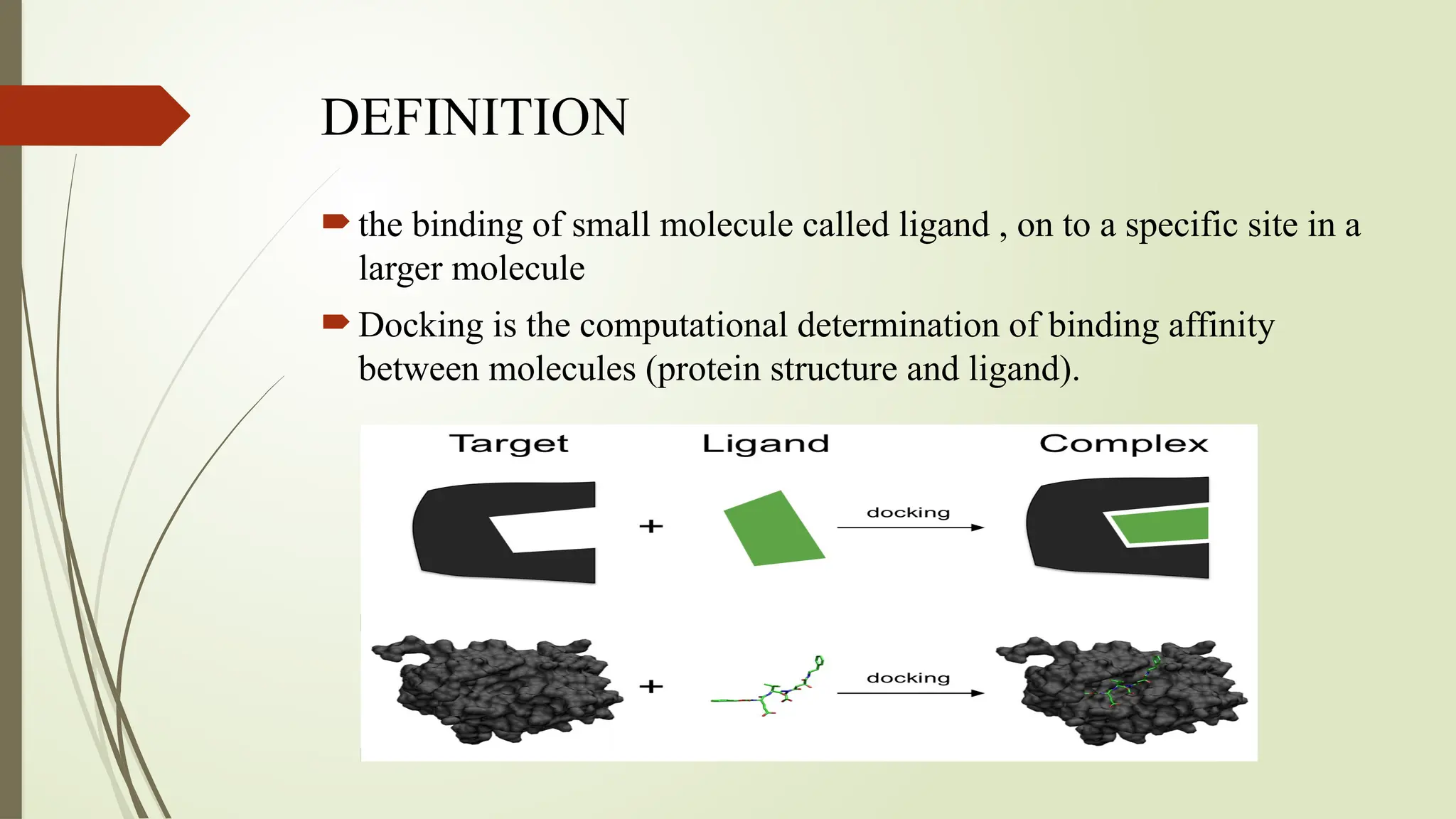
 the binding of small molecule called ligand , on to a specific site in a
larger molecule
 Docking is the computational determination of binding affinity
between molecules (protein structure and ligand).
IMPORTANCE OF DOCKING
It is the key to rational drug design.
Scoring function
Binding mode
Signal transduction
Types of Docking :
Rigid docking
Flexible docking
Manual docking
1. Rigid docking(lock & key)
 In the rigid docking molecules are rigid, in 3D space of
one of the molecule which brings it to an optimal fit with
the other molecules in terms of a scoring function.
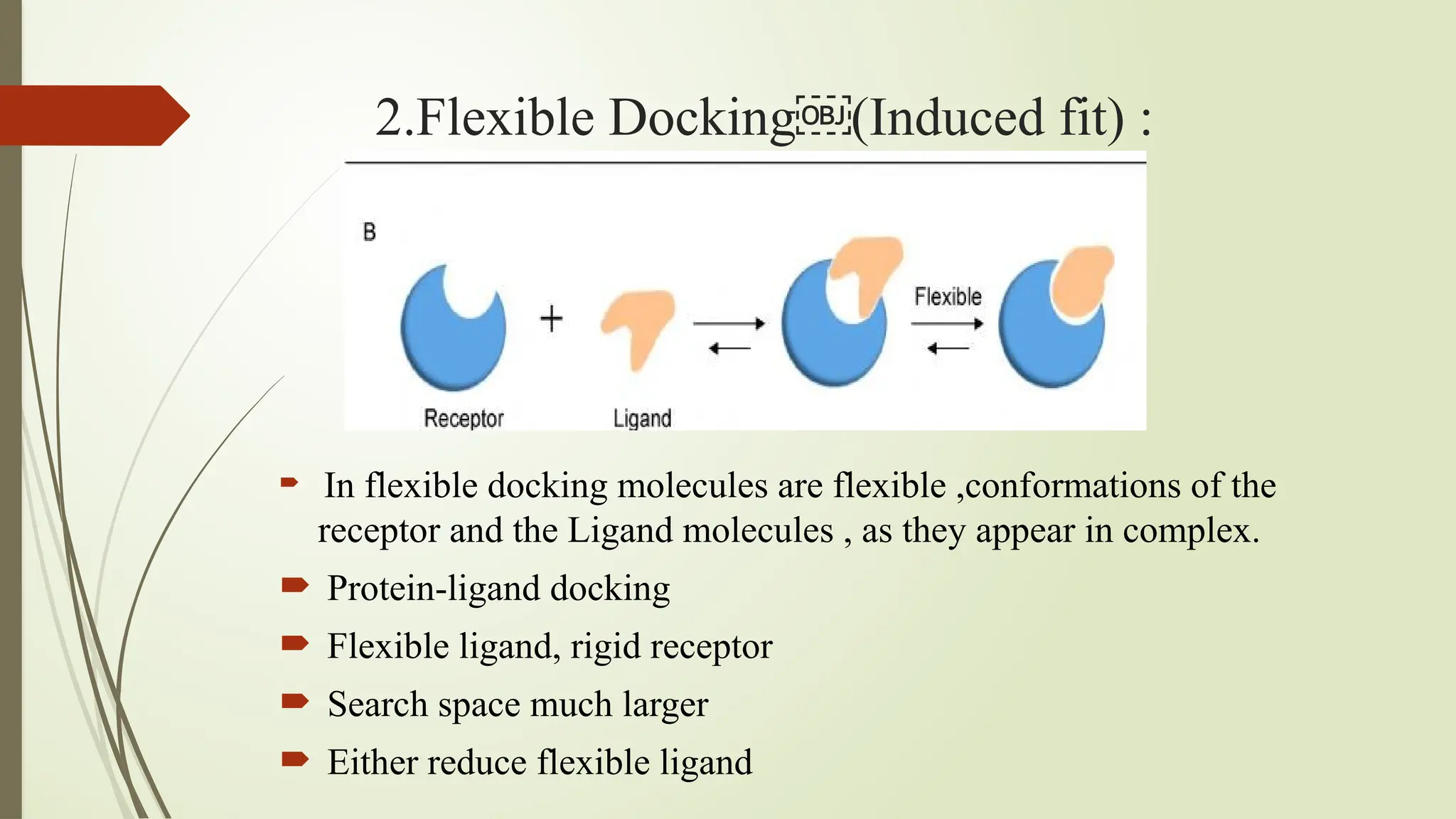
2.Flexible Docking(Induced fit) :
 In flexible docking molecules are flexible ,conformations of the
receptor and the Ligand molecules , as they appear in complex.
 Protein-ligand docking
 Flexible ligand, rigid receptor
 Search space much larger
 Either reduce flexible ligand
3.Manual Docking :
 The ligand is placed in the interacting site and the association
energy is calculated at each steps.
 The user manually moves, rotates or translates the compound inside
the protein cavity. A new association energy is recorded... Etc
 Advantages: quick , Can be very efficient if the user knows well the
interacting site
 Drawbacks: users dependant ,you can really obtain stupid results
this rudimentary method surprisingly provided interesting results in
the past.
 It is still applicable if only small ligand modifications are explored.
Docking can be between:
 Protein –protein
 Protein-Ligand
 Protein - Nucleotide
Types of Interactions
1. Electrostatic forces
2. Electrodyanamic forces
3. Solvent related forces
4. Steric forces
Atypical Docking Workflow:
Docking Based Screening :
 The docking based screening was performed in 3 screening protocol, starting with
HTVS followed by SP and XP methods.
 The high throughput virtual screening (htvs) mode is designed to screen large libraries
quickly with rough scoring functions, hence to screen 8.5 million compounds we
started with this method.
 The top ranked hits (top 20%) were passed through standard precision (SP) mode,
which is ten times slower and more precise than HTVS. The sp method is more
exhaustive in conformational sampling and more precise than htvs method with the
expense of time
 About 20,000 compounds obtained from sp method (best 50% of the compounds) were
further evaluated with even more precise and more computationally intensive extra
precision (xp) method.
 About 1000 compounds obtained from XP method were shortlisted based on docking score
that are -9.0 and above.
 The high glide score indicated a high binding affinity towards the target.
 We checked for the following interactions, hydrogen bonds, salt bridges, halogen bonds,
aromatic bonds, pi-cation and also pi-pi interactions all of which contribute towards the
stability of the protein-ligand complexes .
 It is used -1. To score 2.To rank 3.filter
De Novo Drug Design :
The analyzed active site properties are described to negative image of protein such
as hydrogen bond, hydrogen bond acceptor and hydrophobic contact region.
 De novo means start a fresh, from the beginning.
 It is a process in which the 3d structure of receptor is used to design newer
molecules .
 Following problems solved by this process:
1. Structure Sample Problem.
2. Scoring problems
3. Optimization Problems
 Automated (LUDI)
Principles of De Novo Drug Design :
Protein Structure Build a model for Protein Structure
 In de novo design, the structure of the target should be known to a high resolution
and the binding to site must be well defined.
 This should defines not only a shape constraint but hypothetical interaction sites,
typically consisting of hydrogen bonds, electrostatic and other non-covalent
interactions.
 These can greatly reducing the sample space, as hydrogen bonds and other
anisotropic interactions can define specific orientations.
Softwares:
 SANJEEVINI –IIT delhi.
 GOLD – university of cambridge .
 AUTODOCK – scripps research institute,usa (autodock.Scripps.Edu/)
 Gemdock (generic evolutionary method for molecular docking) – A tool,
developed by jinn-moon yang, a professor of the institute of bioinformatics,
national chiao tung university, Taiwan (gemdock.Life.Nctu.Edu.Tw/dock/)
 Hex protein docking – university of aberdeen, UK (hex.Loria.Fr/)
 GRAMM (global range molecular matching) protein docking – A center for
bioinformatics, university of kansas, USA
(www.Bioinformatics.Ku.Edu/files/vakser/gramm/) 


Applications :
References:
Morris GM, Goodsell DS, Halliday RS, Huey R, Hart WE, Belew RK, Olson AJ
(1998), “Automated docking using a Lamarckian genetic algorithm and an empirical
binding free energy function”. Journal of Computational Chemistry 19 (14): 1639-
1662. Morris RJ, Najmanovich RJ, Kahraman A, Thornton JM (May 2005). “Real
spherical
harmonic expansion coefficients as 3D shape descriptors for protein binding pocket
and ligand comparisons”. Bioinformatics 21 (10): 2347-55. Kahraman A, Morris RJ,
Laskowski RA, Thornton JM (April 2007). “Shape variation in
protein binding pockets and their ligands”. J. Mol. Biol. 368 (1): 283-301.
Suresh PS, Kumar A, Kumar R, Singh VP (January 2008). “An in silico [correction
of
 insilico] approach to bioremediation: laccase as a case study”. J. Mol.
Graph.Model. 26 (5): 845-9.
Thank You

importance ,Types,Docking of MOLECULAR DOCKING 11.pptx

  • 1.
    MOLECULAR DOCKING By : DivyaAshok Dhule M. Pharm. (Pharmaceutical Chemistry) 1st year DEPARTMENT OF PHARMACEUTICAL SCIENCES RASHTRASANT TUKADOJI MAHARAJ NAGPUR UNIVERSITY NAGPUR-440033
  • 2.
    Content: • Introduction • Definition •Importance • Types • Docking based Screening • De-novo drug design • Application
  • 3.
    What is docking? structure-basedtechnique which attempts to find the “best” match, between two molecules
  • 4.
    DEFINITION  the bindingof small molecule called ligand , on to a specific site in a larger molecule  Docking is the computational determination of binding affinity between molecules (protein structure and ligand).
  • 5.
    IMPORTANCE OF DOCKING Itis the key to rational drug design. Scoring function Binding mode Signal transduction
  • 6.
    Types of Docking: Rigid docking Flexible docking Manual docking
  • 7.
    1. Rigid docking(lock& key)  In the rigid docking molecules are rigid, in 3D space of one of the molecule which brings it to an optimal fit with the other molecules in terms of a scoring function.
  • 8.
    2.Flexible Docking(Induced fit):  In flexible docking molecules are flexible ,conformations of the receptor and the Ligand molecules , as they appear in complex.  Protein-ligand docking  Flexible ligand, rigid receptor  Search space much larger  Either reduce flexible ligand
  • 9.
    3.Manual Docking : The ligand is placed in the interacting site and the association energy is calculated at each steps.  The user manually moves, rotates or translates the compound inside the protein cavity. A new association energy is recorded... Etc  Advantages: quick , Can be very efficient if the user knows well the interacting site  Drawbacks: users dependant ,you can really obtain stupid results this rudimentary method surprisingly provided interesting results in the past.  It is still applicable if only small ligand modifications are explored.
  • 10.
    Docking can bebetween:  Protein –protein  Protein-Ligand  Protein - Nucleotide
  • 11.
    Types of Interactions 1.Electrostatic forces 2. Electrodyanamic forces 3. Solvent related forces 4. Steric forces
  • 12.
  • 13.
    Docking Based Screening:  The docking based screening was performed in 3 screening protocol, starting with HTVS followed by SP and XP methods.  The high throughput virtual screening (htvs) mode is designed to screen large libraries quickly with rough scoring functions, hence to screen 8.5 million compounds we started with this method.  The top ranked hits (top 20%) were passed through standard precision (SP) mode, which is ten times slower and more precise than HTVS. The sp method is more exhaustive in conformational sampling and more precise than htvs method with the expense of time  About 20,000 compounds obtained from sp method (best 50% of the compounds) were further evaluated with even more precise and more computationally intensive extra precision (xp) method.
  • 14.
     About 1000compounds obtained from XP method were shortlisted based on docking score that are -9.0 and above.  The high glide score indicated a high binding affinity towards the target.  We checked for the following interactions, hydrogen bonds, salt bridges, halogen bonds, aromatic bonds, pi-cation and also pi-pi interactions all of which contribute towards the stability of the protein-ligand complexes .  It is used -1. To score 2.To rank 3.filter
  • 15.
    De Novo DrugDesign : The analyzed active site properties are described to negative image of protein such as hydrogen bond, hydrogen bond acceptor and hydrophobic contact region.  De novo means start a fresh, from the beginning.  It is a process in which the 3d structure of receptor is used to design newer molecules .  Following problems solved by this process: 1. Structure Sample Problem. 2. Scoring problems 3. Optimization Problems  Automated (LUDI)
  • 16.
    Principles of DeNovo Drug Design : Protein Structure Build a model for Protein Structure  In de novo design, the structure of the target should be known to a high resolution and the binding to site must be well defined.  This should defines not only a shape constraint but hypothetical interaction sites, typically consisting of hydrogen bonds, electrostatic and other non-covalent interactions.  These can greatly reducing the sample space, as hydrogen bonds and other anisotropic interactions can define specific orientations.
  • 17.
    Softwares:  SANJEEVINI –IITdelhi.  GOLD – university of cambridge .  AUTODOCK – scripps research institute,usa (autodock.Scripps.Edu/)  Gemdock (generic evolutionary method for molecular docking) – A tool, developed by jinn-moon yang, a professor of the institute of bioinformatics, national chiao tung university, Taiwan (gemdock.Life.Nctu.Edu.Tw/dock/)  Hex protein docking – university of aberdeen, UK (hex.Loria.Fr/)  GRAMM (global range molecular matching) protein docking – A center for bioinformatics, university of kansas, USA (www.Bioinformatics.Ku.Edu/files/vakser/gramm/)   
  • 18.
  • 19.
    References: Morris GM, GoodsellDS, Halliday RS, Huey R, Hart WE, Belew RK, Olson AJ (1998), “Automated docking using a Lamarckian genetic algorithm and an empirical binding free energy function”. Journal of Computational Chemistry 19 (14): 1639- 1662. Morris RJ, Najmanovich RJ, Kahraman A, Thornton JM (May 2005). “Real spherical harmonic expansion coefficients as 3D shape descriptors for protein binding pocket and ligand comparisons”. Bioinformatics 21 (10): 2347-55. Kahraman A, Morris RJ, Laskowski RA, Thornton JM (April 2007). “Shape variation in protein binding pockets and their ligands”. J. Mol. Biol. 368 (1): 283-301. Suresh PS, Kumar A, Kumar R, Singh VP (January 2008). “An in silico [correction of  insilico] approach to bioremediation: laccase as a case study”. J. Mol. Graph.Model. 26 (5): 845-9.
  • 20.