PATIENTCOUNSELLINGPOINTS ON
ACE InhibitorAndARB
PREPARED BY
Roshin S Peter
2
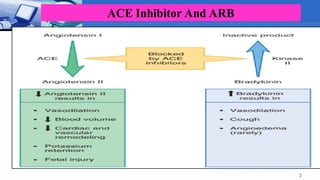
ACE Inhibitor And ARB
3
ACE Inhibitor And ARB
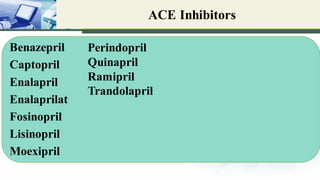
ACE Inhibitors
Benazepril
Captopril
Enalapril
Enalaprilat
Fosinopril
Lisinopril
Moexipril
Perindopril
Quinapril
Ramipril
Trandolapril
.
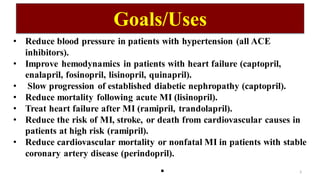
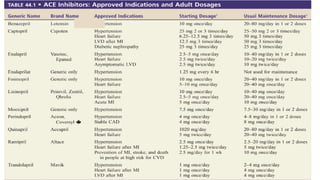
Goals/Uses
5
• Reduce blood pressure in patients with hypertension (all ACE
inhibitors).
• Improve hemodynamics in patients with heart failure (captopril,
enalapril, fosinopril, lisinopril, quinapril).
• Slow progression of established diabetic nephropathy (captopril).
• Reduce mortality following acute MI (lisinopril).
• Treat heart failure after MI (ramipril, trandolapril).
• Reduce the risk of MI, stroke, or death from cardiovascular causes in
patients at high risk (ramipril).
• Reduce cardiovascular mortality or nonfatal MI in patients with stable
coronary artery disease (perindopril).
6
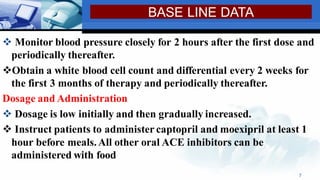
❖ Monitor blood pressure closely for 2 hours after the first dose and
periodically thereafter.
❖Obtain a white blood cell count and differential every 2 weeks for
the first 3 months of therapy and periodically thereafter.
Dosage and Administration
❖ Dosage is low initially and then gradually increased.
❖ Instruct patients to administer captopril and moexipril at least 1
hour before meals.All other oral ACE inhibitors can be
administered with food
7
BASE LINE DATA
HIGH RISK PATIENT GROUP
1)ACE inhibitors are contraindicated during the second and third
trimesters of pregnancy and for patients with bilateral renal
artery stenosis (or stenosis in the artery to a single remaining
kidney)
(2) a history of hypersensitivity reactions (especially angioedema)
to ACE inhibitors.
Exercise caution- in patients with salt or volume depletion, renal
impairment, or collagen vascular disease, and in those taking
potassium supplements, salt substitutes, potassiumsparing
diuretics, ARBs, aliskiren,Lithium 8
Evaluating Therapeutic Effects
1)Hypertension.
Monitor for reduced blood pressure. The usual target
pressure is systolic/diastolic of 140/90 mm Hg or 130/80 in
patients with diabetes.
2) Heart Failure.
Monitor for a lessening of signs and symptoms (e.g.,
dyspnea, cyanosis, jugular vein distention, edema)
3) Diabetic Nephropathy. Monitor for proteinuria and
altered glomerular filtration rate
9
MINIMISING ADVRSE EFFECT -ACEI
1. First-Dose Hypotension.
Severe hypotension can occur with the first dose.
Minimize hypotension by (A) withdrawing diuretics 2 to 3 days before initiatingACE
inhibitors and
(B) using low initial doses.
❖ Monitor blood pressure for 2 hours following the first dose.
❖ Instruct patients to lie down if hypotension develops. If necessary, infuse normal saline to
restore pressure
❖ If necessary, infuse normal saline to restore pressure.
2.Cough.
Warn patients about the possibility of persistent dry, irritating, nonproductive cough. Instruct
them to consult the prescriber if cough is bothersome. Stopping the ACE inhibitor may be
indicated 10
Minimizing Adverse Effect-ACEI (continued)
3.Hyperkalemia.
❖ ACE inhibitors may increase potassium levels.
❖Instruct patients to avoid potassium supplements and potassium-containing
salt substitutes unless they are prescribed by the provider.
❖Potassium-sparing diuretics must also be avoided.
11
4. Fetal Injury
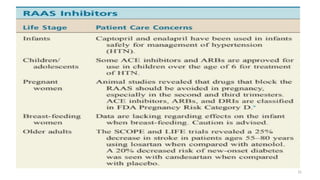
• Warn women of childbearing age that taking ACE inhibitors during
the second and third trimesters of pregnancy can cause major fetal
injury (hypotension, hyperkalemia, skull hypoplasia, anuria, reversible
and irreversible renal failure, death) and that taking these drugs
earlier in pregnancy may pose a risk as well.
• If the patient becomes pregnant, withdraw ACE inhibitors as soon as
possible.
• Closely monitor infants who have been exposed to ACE inhibitors
during the second or third trimester for hypotension, oliguria, and
hyperkalemia.
SAVIN /PHARMACY DEPT/HAI ALMINA HC 12
Minimising Adverse Effect-ACEI (continued)
SAVIN /PHARMACY DEPT/HAI ALMINA HC 13
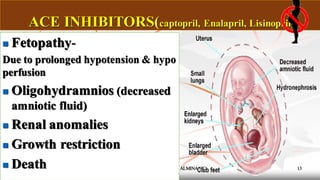
ACE INHIBITORS(captopril, Enalapril, Lisinopril)
◼ Fetopathy-
Due to prolonged hypotension & hypo
perfusion
◼ Oligohydramnios (decreased
amniotic fluid)
◼ Renal anomalies
◼ Growth restriction
◼ Death
5. Angioedema –
❖This rare and potentially fatal reaction is
characterized by giant wheals and edema of
the tongue, glottis, and pharynx.
❖ Instruct patients to seek immediate medical
attention if these symptoms develop.
❖If angioedema is diagnosed,ACE inhibitors
should be discontinued and never used again.
❖Treat severe reactions with subcutaneous
epinephrine
14
Minimising Adverse Effect-ACEI (continued)
15
6. Renal Failure
❖ Renal failure is a risk for patients with bilateral renal
artery stenosis or stenosis in the artery to a single
remaining kidney.
❖ ACE inhibitors must be used with extreme caution in these
people
Minimising Adverse Effect-ACEI (continued)
16
7. Neutropenia (Mainly With Captopril).
❖ Neutropenia poses a high risk of infection. Inform
patients about early signs of infection (fever, sore
throat, mouth sores), and instruct them to notify the
prescriber if these occur.
❖ If neutropenia develops, withdraw the drug
immediately; neutrophil counts should normalize in
approximately 2 weeks.
❖ Neutropenia is most likely in patients with renal
impairment and collagen vascular diseases (e.g.,
systemic lupus erythematosus, scleroderma);
monitor these patients closely
Minimizing Adverse Effect-ACEI (continued)
Minimizing-interactions
• ACEI+DIURETICS INTENSIFY FIRST DOSE
HYPOTENSION
• Withdraw diuretics 2 to 3 days before beginning an ACE inhibitor.
• Diuretics may be resumed later if needed.
SAVIN /PHARMACY DEPT/HAI ALMINA HC 17
MINIMISING INTERACTION-
ACEI CONTD
▪ ACEI + Antihypertensive agents (ARBS, Diuretics, Sympatholytics,
Vasodialators,CCB)
▪ The antihypertensive effects of ACE inhibitors are additive with
those of other antihypertensive drugs
▪ When an ACE inhibitor is added to an antihypertensive regimen,
dosages of the other drugs may require reduction.
18
19
Drugs That Elevate Potassium Levels.
❖ ACE inhibitors increase the risk of hyperkalemia
associated with potassium supplements, potassium-
sparing diuretics, and possibly aliskiren.
❖ Risk can be minimized by avoiding potassium
supplements and potassium-sparing diuretics except
when they are clearly indicated.
MINIMISING INTERACTIONACEI CONTD
20
Lithium.
❖ ACE inhibitors can increase serum levels of lithium,
causing toxicity.
❖ Monitor lithium levels frequently.
❖ Nonsteroidal Anti-Inflammatory Drugs. ----
NSAIDs (e.g., aspirin, ibuprofen) can interfere with
the antihypertensive effects of ACE inhibitors.
❖ Advise patients to minimize NSAID use.
MINIMISING INTERACTIONACEI CONTD
21
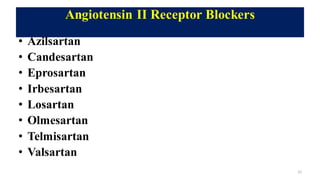
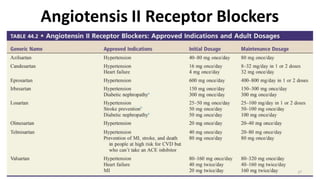
Angiotensin II Receptor Blockers
• Azilsartan
• Candesartan
• Eprosartan
• Irbesartan
• Losartan
• Olmesartan
• Telmisartan
• Valsartan
22
Therapeutic Goals (ARB)
• Reduce blood pressure in patients with hypertension (all ARBs).
• Treat heart failure (candesartan, valsartan).
• Slow the progression of established diabetic nephropathy
(irbesartan, losartan).
• Prevent stroke in patients with hypertension and LV
hypertrophy (losartan).
• Protect against MI, stroke, and death from cardiovascular
causes in high-risk patients, but only if they can’t tolerate ACE
inhibitors (telmisartan).Treat heart failure after MI (valsartan).
23
Identifying High-Risk Patients
• Same as ACEI
24
Evaluating Therapeutic Effects
• Same as ACEI
Minimizing Adverse Effects
• Angioedema - Same As ACEI
• Fetal Injury - Same As ACEI
• Renal Failure - Same As ACEI
25
Minimizing Adverse Interactions
• ARB + Antihypertensive agents
(ACEI,Diuretics,Sympatholytics,Vasodialators,CCB)
• The antihypertensive effects of ARB are additive with those
of other antihypertensive drugs
• When an ARB is added to an antihypertensive regimen,
dosages of the other drugs may require reduction.
26
27
Angiotensis II Receptor Blockers
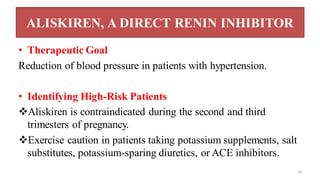
ALISKIREN, A DIRECT RENIN INHIBITOR
• Therapeutic Goal
Reduction of blood pressure in patients with hypertension.
• Identifying High-Risk Patients
❖Aliskiren is contraindicated during the second and third
trimesters of pregnancy.
❖Exercise caution in patients taking potassium supplements, salt
substitutes, potassium-sparing diuretics, or ACE inhibitors.
28
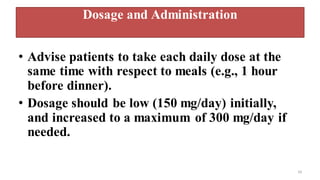
Dosage and Administration
• Advise patients to take each daily dose at the
same time with respect to meals (e.g., 1 hour
before dinner).
• Dosage should be low (150 mg/day) initially,
and increased to a maximum of 300 mg/day if
needed.
29
Minimizing Adverse Effects
• Hyperkalemia –
Same as ACE Inhibitor
• Fetal Injury –
Warn women of childbearing age that aliskiren taken during the
second and third trimesters of pregnancy can cause fetal injury
(hypotension, hyperkalemia, skull hypoplasia, anuria, reversible
and irreversible renal failure, death).
• Angioedema –
Same as ACE Inhibitor
30
31
32

ACE inhibitor and ARB .pdf

  • 1.
  • 2.
  • 3.
  • 4.
  • 5.
    . Goals/Uses 5 • Reduce bloodpressure in patients with hypertension (all ACE inhibitors). • Improve hemodynamics in patients with heart failure (captopril, enalapril, fosinopril, lisinopril, quinapril). • Slow progression of established diabetic nephropathy (captopril). • Reduce mortality following acute MI (lisinopril). • Treat heart failure after MI (ramipril, trandolapril). • Reduce the risk of MI, stroke, or death from cardiovascular causes in patients at high risk (ramipril). • Reduce cardiovascular mortality or nonfatal MI in patients with stable coronary artery disease (perindopril).
  • 6.
  • 7.
    ❖ Monitor bloodpressure closely for 2 hours after the first dose and periodically thereafter. ❖Obtain a white blood cell count and differential every 2 weeks for the first 3 months of therapy and periodically thereafter. Dosage and Administration ❖ Dosage is low initially and then gradually increased. ❖ Instruct patients to administer captopril and moexipril at least 1 hour before meals.All other oral ACE inhibitors can be administered with food 7 BASE LINE DATA
  • 8.
    HIGH RISK PATIENTGROUP 1)ACE inhibitors are contraindicated during the second and third trimesters of pregnancy and for patients with bilateral renal artery stenosis (or stenosis in the artery to a single remaining kidney) (2) a history of hypersensitivity reactions (especially angioedema) to ACE inhibitors. Exercise caution- in patients with salt or volume depletion, renal impairment, or collagen vascular disease, and in those taking potassium supplements, salt substitutes, potassiumsparing diuretics, ARBs, aliskiren,Lithium 8
  • 9.
    Evaluating Therapeutic Effects 1)Hypertension. Monitorfor reduced blood pressure. The usual target pressure is systolic/diastolic of 140/90 mm Hg or 130/80 in patients with diabetes. 2) Heart Failure. Monitor for a lessening of signs and symptoms (e.g., dyspnea, cyanosis, jugular vein distention, edema) 3) Diabetic Nephropathy. Monitor for proteinuria and altered glomerular filtration rate 9
  • 10.
    MINIMISING ADVRSE EFFECT-ACEI 1. First-Dose Hypotension. Severe hypotension can occur with the first dose. Minimize hypotension by (A) withdrawing diuretics 2 to 3 days before initiatingACE inhibitors and (B) using low initial doses. ❖ Monitor blood pressure for 2 hours following the first dose. ❖ Instruct patients to lie down if hypotension develops. If necessary, infuse normal saline to restore pressure ❖ If necessary, infuse normal saline to restore pressure. 2.Cough. Warn patients about the possibility of persistent dry, irritating, nonproductive cough. Instruct them to consult the prescriber if cough is bothersome. Stopping the ACE inhibitor may be indicated 10
  • 11.
    Minimizing Adverse Effect-ACEI(continued) 3.Hyperkalemia. ❖ ACE inhibitors may increase potassium levels. ❖Instruct patients to avoid potassium supplements and potassium-containing salt substitutes unless they are prescribed by the provider. ❖Potassium-sparing diuretics must also be avoided. 11
  • 12.
    4. Fetal Injury •Warn women of childbearing age that taking ACE inhibitors during the second and third trimesters of pregnancy can cause major fetal injury (hypotension, hyperkalemia, skull hypoplasia, anuria, reversible and irreversible renal failure, death) and that taking these drugs earlier in pregnancy may pose a risk as well. • If the patient becomes pregnant, withdraw ACE inhibitors as soon as possible. • Closely monitor infants who have been exposed to ACE inhibitors during the second or third trimester for hypotension, oliguria, and hyperkalemia. SAVIN /PHARMACY DEPT/HAI ALMINA HC 12 Minimising Adverse Effect-ACEI (continued)
  • 13.
    SAVIN /PHARMACY DEPT/HAIALMINA HC 13 ACE INHIBITORS(captopril, Enalapril, Lisinopril) ◼ Fetopathy- Due to prolonged hypotension & hypo perfusion ◼ Oligohydramnios (decreased amniotic fluid) ◼ Renal anomalies ◼ Growth restriction ◼ Death
  • 14.
    5. Angioedema – ❖Thisrare and potentially fatal reaction is characterized by giant wheals and edema of the tongue, glottis, and pharynx. ❖ Instruct patients to seek immediate medical attention if these symptoms develop. ❖If angioedema is diagnosed,ACE inhibitors should be discontinued and never used again. ❖Treat severe reactions with subcutaneous epinephrine 14 Minimising Adverse Effect-ACEI (continued)
  • 15.
    15 6. Renal Failure ❖Renal failure is a risk for patients with bilateral renal artery stenosis or stenosis in the artery to a single remaining kidney. ❖ ACE inhibitors must be used with extreme caution in these people Minimising Adverse Effect-ACEI (continued)
  • 16.
    16 7. Neutropenia (MainlyWith Captopril). ❖ Neutropenia poses a high risk of infection. Inform patients about early signs of infection (fever, sore throat, mouth sores), and instruct them to notify the prescriber if these occur. ❖ If neutropenia develops, withdraw the drug immediately; neutrophil counts should normalize in approximately 2 weeks. ❖ Neutropenia is most likely in patients with renal impairment and collagen vascular diseases (e.g., systemic lupus erythematosus, scleroderma); monitor these patients closely Minimizing Adverse Effect-ACEI (continued)
  • 17.
    Minimizing-interactions • ACEI+DIURETICS INTENSIFYFIRST DOSE HYPOTENSION • Withdraw diuretics 2 to 3 days before beginning an ACE inhibitor. • Diuretics may be resumed later if needed. SAVIN /PHARMACY DEPT/HAI ALMINA HC 17
  • 18.
    MINIMISING INTERACTION- ACEI CONTD ▪ACEI + Antihypertensive agents (ARBS, Diuretics, Sympatholytics, Vasodialators,CCB) ▪ The antihypertensive effects of ACE inhibitors are additive with those of other antihypertensive drugs ▪ When an ACE inhibitor is added to an antihypertensive regimen, dosages of the other drugs may require reduction. 18
  • 19.
    19 Drugs That ElevatePotassium Levels. ❖ ACE inhibitors increase the risk of hyperkalemia associated with potassium supplements, potassium- sparing diuretics, and possibly aliskiren. ❖ Risk can be minimized by avoiding potassium supplements and potassium-sparing diuretics except when they are clearly indicated. MINIMISING INTERACTIONACEI CONTD
  • 20.
    20 Lithium. ❖ ACE inhibitorscan increase serum levels of lithium, causing toxicity. ❖ Monitor lithium levels frequently. ❖ Nonsteroidal Anti-Inflammatory Drugs. ---- NSAIDs (e.g., aspirin, ibuprofen) can interfere with the antihypertensive effects of ACE inhibitors. ❖ Advise patients to minimize NSAID use. MINIMISING INTERACTIONACEI CONTD
  • 21.
  • 22.
    Angiotensin II ReceptorBlockers • Azilsartan • Candesartan • Eprosartan • Irbesartan • Losartan • Olmesartan • Telmisartan • Valsartan 22
  • 23.
    Therapeutic Goals (ARB) •Reduce blood pressure in patients with hypertension (all ARBs). • Treat heart failure (candesartan, valsartan). • Slow the progression of established diabetic nephropathy (irbesartan, losartan). • Prevent stroke in patients with hypertension and LV hypertrophy (losartan). • Protect against MI, stroke, and death from cardiovascular causes in high-risk patients, but only if they can’t tolerate ACE inhibitors (telmisartan).Treat heart failure after MI (valsartan). 23
  • 24.
    Identifying High-Risk Patients •Same as ACEI 24 Evaluating Therapeutic Effects • Same as ACEI
  • 25.
    Minimizing Adverse Effects •Angioedema - Same As ACEI • Fetal Injury - Same As ACEI • Renal Failure - Same As ACEI 25
  • 26.
    Minimizing Adverse Interactions •ARB + Antihypertensive agents (ACEI,Diuretics,Sympatholytics,Vasodialators,CCB) • The antihypertensive effects of ARB are additive with those of other antihypertensive drugs • When an ARB is added to an antihypertensive regimen, dosages of the other drugs may require reduction. 26
  • 27.
  • 28.
    ALISKIREN, A DIRECTRENIN INHIBITOR • Therapeutic Goal Reduction of blood pressure in patients with hypertension. • Identifying High-Risk Patients ❖Aliskiren is contraindicated during the second and third trimesters of pregnancy. ❖Exercise caution in patients taking potassium supplements, salt substitutes, potassium-sparing diuretics, or ACE inhibitors. 28
  • 29.
    Dosage and Administration •Advise patients to take each daily dose at the same time with respect to meals (e.g., 1 hour before dinner). • Dosage should be low (150 mg/day) initially, and increased to a maximum of 300 mg/day if needed. 29
  • 30.
    Minimizing Adverse Effects •Hyperkalemia – Same as ACE Inhibitor • Fetal Injury – Warn women of childbearing age that aliskiren taken during the second and third trimesters of pregnancy can cause fetal injury (hypotension, hyperkalemia, skull hypoplasia, anuria, reversible and irreversible renal failure, death). • Angioedema – Same as ACE Inhibitor 30
  • 31.
  • 32.