PRESENTED BY,
SHRIHITH.A
 A molecule is the smallest particle in a
chemical element or compound that has
the chemical properties of that element
or compound.
 A Molecules are made up of atoms that
are held together by chemical bonds.
These bonds form as a result of the
sharing or exchange of electron s among
atoms.
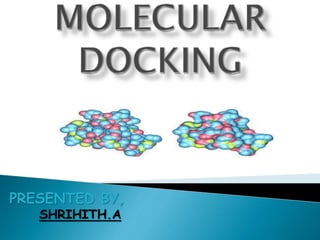
 Docking attempts to find the “best” matching
between two molecules.
 Docking is the computational determination of
binding affinity between molecules (protein
structure and ligand).
Molecular docking tries to predict the
structure of the intermolecular complex
formed between two or more constituent
molecules. Molecular docking has become an
increasingly important tool for drug
discovery.
It is of extreme relevance in cellular
biology, where function is accomplished by
proteins interacting with themselves and
with other molecular components
It is the key to rational drug design: The
results of docking can be used to find
inhibitors for specific target proteins and
thus to design new drugs. It is gaining
importance as the number of proteins
whose structure is known increases
Protein-Protein Docking
 Both molecules usually considered
rigid.
 6 degrees of freedom
 First apply steric constraints to limit
search space and the examine
energetics of possible binding
conformations
Protein-Ligand Docking
 Flexible ligand, rigid-receptor
 Search space much larger
 Either reduce flexible ligand to rigid
fragments connected by one or
several hinges, or search the
conformational space using monte-
carlo methods or molecular dynamics
 IN-silico generation of ligands(using
chemsketch in this software we can draw the
structure of Ligand/molecule).
 Conversion of file format( OPEN BABEL is the
software used to converting format of file .mol
to .pdb
 Protein optimization(RCSB- protein data bank,
here you can prepare your protein of interest
for docking).www.rcsb.org
 Energy Minimization( here SPDV swiss-Pdb
viewer software) Tis can be done by
commanding.
 Molecular docking (creation of .gpf-grid
parameter file and .dpf-dock parameter file
1) Autodock Vina
2) Autodock 4.0
3) Autodock 4.2
This are the software used to make auto griding
and dock parameters along with grid mapping
 Running the docking algorithm(CYGWIN-1 in
this software we will create GLG file and DLG
file here this software works commanding
after getting succesfull comand for auto
grid(glg) and auto dock (dlg)
 After this step we got to know minimal binding
energy CYGWIN-2
 Hydrogen bond analysis( UCSF CHIMERA we
use this software for visulisation and analysis
of result
 ADMET( the molecules which have shown H-
bond with the active site residue or any other
residue of the binding pocket note down
those molecules and then run these molecule
on the online ADMET servers
molecular properties http://molsoft.com/mprop/
Toxicity and bioactivity http://organic-
chemistry.org/prog/peo/
ADMET studies https://ilab.acdlabs.com/iLab2/
1. Structure based drug design
2. Lead Optimization
3. Virtual Screening
4. Protein-Protein Docking
5. Chemical mechanism studies.

Molecular docking

  • 1.
  • 2.
     A moleculeis the smallest particle in a chemical element or compound that has the chemical properties of that element or compound.  A Molecules are made up of atoms that are held together by chemical bonds. These bonds form as a result of the sharing or exchange of electron s among atoms.
  • 3.
     Docking attemptsto find the “best” matching between two molecules.  Docking is the computational determination of binding affinity between molecules (protein structure and ligand).
  • 4.
    Molecular docking triesto predict the structure of the intermolecular complex formed between two or more constituent molecules. Molecular docking has become an increasingly important tool for drug discovery.
  • 5.
    It is ofextreme relevance in cellular biology, where function is accomplished by proteins interacting with themselves and with other molecular components It is the key to rational drug design: The results of docking can be used to find inhibitors for specific target proteins and thus to design new drugs. It is gaining importance as the number of proteins whose structure is known increases
  • 6.
    Protein-Protein Docking  Bothmolecules usually considered rigid.  6 degrees of freedom  First apply steric constraints to limit search space and the examine energetics of possible binding conformations
  • 7.
    Protein-Ligand Docking  Flexibleligand, rigid-receptor  Search space much larger  Either reduce flexible ligand to rigid fragments connected by one or several hinges, or search the conformational space using monte- carlo methods or molecular dynamics
  • 8.
     IN-silico generationof ligands(using chemsketch in this software we can draw the structure of Ligand/molecule).  Conversion of file format( OPEN BABEL is the software used to converting format of file .mol to .pdb
  • 9.
     Protein optimization(RCSB-protein data bank, here you can prepare your protein of interest for docking).www.rcsb.org  Energy Minimization( here SPDV swiss-Pdb viewer software) Tis can be done by commanding.
  • 10.
     Molecular docking(creation of .gpf-grid parameter file and .dpf-dock parameter file 1) Autodock Vina 2) Autodock 4.0 3) Autodock 4.2 This are the software used to make auto griding and dock parameters along with grid mapping
  • 11.
     Running thedocking algorithm(CYGWIN-1 in this software we will create GLG file and DLG file here this software works commanding after getting succesfull comand for auto grid(glg) and auto dock (dlg)  After this step we got to know minimal binding energy CYGWIN-2
  • 12.
     Hydrogen bondanalysis( UCSF CHIMERA we use this software for visulisation and analysis of result  ADMET( the molecules which have shown H- bond with the active site residue or any other residue of the binding pocket note down those molecules and then run these molecule on the online ADMET servers
  • 13.
    molecular properties http://molsoft.com/mprop/ Toxicityand bioactivity http://organic- chemistry.org/prog/peo/ ADMET studies https://ilab.acdlabs.com/iLab2/
  • 14.
    1. Structure baseddrug design 2. Lead Optimization 3. Virtual Screening 4. Protein-Protein Docking 5. Chemical mechanism studies.