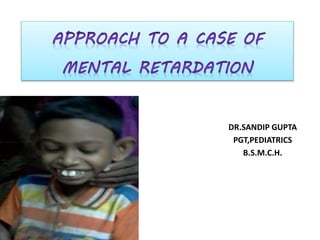
DR.SANDIP GUPTA
PGT,PEDIATRICS
B.S.M.C.H.
INTRODUCTION
• Mental retardation is one of most common
chronic neurologic disabiity of childhood.
• MR affects about 1-3% of population.
• Majority of cases are idiopathic.
• Most common mild MR(75-90%) often goes
unrecognised.
• More common in lower socio-economic
groups.
DSM IV – TR Definition
 Significantly below average intellectual functioning:
IQ of below 70 on an individually administered IQ
test.
 Accompanied by significant limitations in adaptive
functioning in at least 2 skill areas:
Communication, self-care, home living,
social/interpersonal skills, use of community
resources, self-direction, functional academic
skills, work & leisure, health and safety.
 Onset before age 18yr.
Signs & Symptoms
• Delay in language development.
• Find it hard to remember things.
• Difficulty in learning social rules.
• Have trouble learn specific subject
• Have trouble solving problems
• Lack of social inhibitors.
• Lack of self care skills.
• Persistence of infantile behaviour .
• Unable to take higher education.
Grades of MR :
According to IQ :
• Borderline intellectual functioning70--84
• Mild mental retardation 50–69
• Moderate mental retardation 35–49
• Severe mental retardation 20–34
• Profound mental retardation Below 20
Mild MR
• May not be obvious in early childhood, untill they go
to school.
• In School - have poor academic performance
(difficult to differentiate from learning disability or
emotional & behavioral disorder.)
• can learn reading & mathematical skills to level of a
typical 9-12 yr child.
• Learn self care &practical skills to live independently
& earn for them self.
Moderate MR
• obvious within 1st year of life
• Problem with social work
• Behaviourable age -8 yrs
• Academic skills – 2nd grade level
• will face difficulty in school, at home, and in the
community
• Need special school, but they can still progress to
become functioning members of society. As adults
they may live with their parents, in a supportive
group home.
Severe & Profound MR
• Little or no speech
• Limited abilities to manage self care.
• Require high supervision .
• Behaviourable age – 3 yrs.
• They may learn some daily activities but will
require full time care –taker.
ASSOCIATED PROBLEMS
• Self injury
• Pica
• CP
• Epilepsy
• Toilet probs
• Sleep disorders
• Eating problems
• Poisoning
• Sexual abuse
• Learning disorders
• Behavior problems
Developmental assesment
• Denver Development Screening Test-II
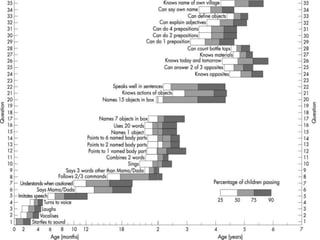
• Bayley Scales of Infant Development
• BARODA PHATAK DST
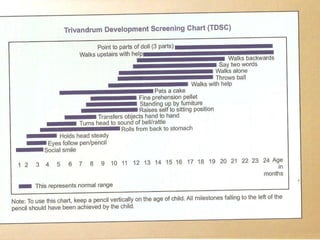
• Trivendrum Developmental Screening Chart
Test for intelligence
• Binet kamat test
• Weschler’s intelligence scale for children
• Goodenough draw a man test.
Denver II Developmental Screening Test
• Most widely used test for quick routine
screening, for children upto 6yrs.
Assesses child development in all four domains
(gross motor , fine motor adaptive, language,
personal social behavior),taking 10-30 min.
• The milestones are shown in a graphical
manner & items through which the
chronological age passes are tested.
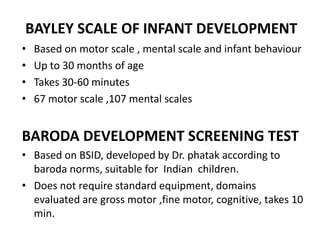
BAYLEY SCALE OF INFANT DEVELOPMENT
• Based on motor scale , mental scale and infant behaviour
• Up to 30 months of age
• Takes 30-60 minutes
• 67 motor scale ,107 mental scales
BARODA DEVELOPMENT SCREENING TEST
• Based on BSID, developed by Dr. phatak according to
baroda norms, suitable for Indian children.
• Does not require standard equipment, domains
evaluated are gross motor ,fine motor, cognitive, takes 10
min.
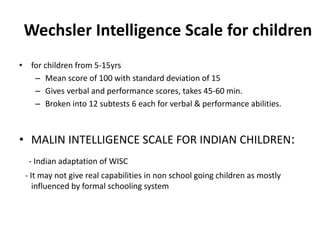
Wechsler Intelligence Scale for children
• for children from 5-15yrs
– Mean score of 100 with standard deviation of 15
– Gives verbal and performance scores, takes 45-60 min.
– Broken into 12 subtests 6 each for verbal & performance abilities.
• MALIN INTELLIGENCE SCALE FOR INDIAN CHILDREN:
- Indian adaptation of WISC
- It may not give real capabilities in non school going children as mostly
influenced by formal schooling system
STANFORD BINET INTELLIGENCE SCALE
• for children>2yr.
• Include verbal ability ,perceptual skills , short
term memory & hand and eye co-ordination
• takes 45-60 minutes
• BINET – KAMAT TEST
-indian adaptation of stanford - binet scale
- also available in hindi
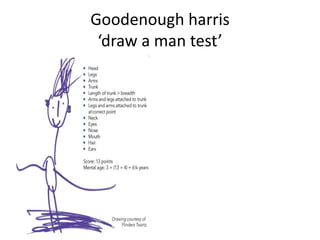
Goodenough harris
‘draw a man test’
APPROACH TO A CHILD WITH MR
• Detailed development history.
• Antenatal history.
• Perinatal history.
• Any neurological problem: seizure, spasticity,
motor deficit, abnormal movements, vision&
hearing.
• Features s/o of IEM: abdominal distension.
• F/o of hypothyroidism.
• Past history of febrile encephalopathy.
Cont..
• Emotional deprivation.
• Level of indipendence.
• Scholastic performance.
• Consangiunity.
• Sibling history.
• H/o temper tantrums, hyperkinesis, self
destructive behaviour.
• Any h/o physical & psychological abuse.
• Lead exposure.
Physical examination
• Anthropometry : OFC, shape, frontanelle
sutures, monitor OFC.
• Dysmorphic features: f/o MPS,f/o down’s
syndrome, fragileXsyndrome,
• Neurocutaneous disorder.
• Detailed neurological examiation: tone,
power, primitive reflexes, symmetry.
• Assesment of hearing & vision.
Investigations
• Individualised approach
• Vision & hearing assesment
• R/o hypothyroidism.
• Cytogenetic study: high resolution g banding karyogram
screening for numeric& structural anomalies,
• FISH analysis for subtelomeric rearrangement.
• Neuroimaging: MRI & CT scan.
• IEM EVAUATION:24 hr urinary screening for aminoacids,
organic acids, GAGs, pl.aminoacids, Enzymatic study in
fibroblasts & lymphoblasts.
• EEG
• Xray
• Fragile X syndrome screening
Management
Treatable /Preventable causes of MR
• Hypothyroidism
• Severe PEM
• Perinatal asphyxia
• Preterm /LBW
• Meningitis, encephalitis
• Bilirubin encephalopathy
• IEM: Galactosemia ,PKU
Prevention
• Primary prevention: improvement in perinatal
care, iodistion of salt,immunisations,detection
&care of high risk pregnancies, penatal screening
&genetic counselling.
• 2nd ary prevention: neonatal screening, screening
of “high risk babies” & early intervention
measures.
• Tertiary prevention: stimulation, training,&
education, vocational oppertunities.
• Mainstreaming
• Support for families
• Parenteral support groups.
Drug Therapies
• No specific drugs but some symptoms can be
controlled.
• Neuroleptic drugs to reduce aggressive and
antisocial behavior (phenothiazines).
• antipsychotic drugs( risperidone).
• Antidepressant drugs can improve sleep, possibly
help reduce self-injurious behavior, reduce
depression.
TAKE HOME MASSAGE
• Mental retardation is preventable in some cases.
• Most cases are idiopathic & are mild.
• Diagnosis is clinical.
• Examination for dysmorphology & detailed
neurology is of essence.
• Care rather than cure is the way of management in
most of the cases.
GROSS MOTOR: 180 degree flip
examination in infant < 8 months and gait
for > 1 year
• Supine: Note posture, abnormal ATNR, involuntary
movements with CP. paucity of movements for hemiplegia.
• Pull to sit: head lag. Sitting: Head and trunk control. Back is
straight or rounded.
• Weight bearing: scissoring, hypotonia, advanced weight
bearing (CP)
• Ventral suspension: Describe posture, low tone, increase
extensor tone.
• Prone: Observe ability to raise head, trunk above horizontal,
Primitive reflexes:
1. Sucking/Rooting :( 0-4,6mths),
2. Palmer grasp; (0-3 months).
3. Placing, stepping: (0-6weeks)
4. ATNR: 2-6 Months.
5. Landau: on ventral suspension, normally extend head, trunk,
and hip. Flex head and neck, response is flexion of hip, trunk.0-6
month).
6. Neck righting reflex: rotation of trunk 6mths-2 years.
7. Moro: 0-4 months.
8. Parachute: 6-12 months persist. Prone position, move rapidly,
face down. Will extend both upper limbs.

mental retardation

  • 1.
  • 2.
    INTRODUCTION • Mental retardationis one of most common chronic neurologic disabiity of childhood. • MR affects about 1-3% of population. • Majority of cases are idiopathic. • Most common mild MR(75-90%) often goes unrecognised. • More common in lower socio-economic groups.
  • 3.
    DSM IV –TR Definition  Significantly below average intellectual functioning: IQ of below 70 on an individually administered IQ test.  Accompanied by significant limitations in adaptive functioning in at least 2 skill areas: Communication, self-care, home living, social/interpersonal skills, use of community resources, self-direction, functional academic skills, work & leisure, health and safety.  Onset before age 18yr.
  • 5.
    Signs & Symptoms •Delay in language development. • Find it hard to remember things. • Difficulty in learning social rules. • Have trouble learn specific subject • Have trouble solving problems • Lack of social inhibitors. • Lack of self care skills. • Persistence of infantile behaviour . • Unable to take higher education.
  • 6.
    Grades of MR: According to IQ : • Borderline intellectual functioning70--84 • Mild mental retardation 50–69 • Moderate mental retardation 35–49 • Severe mental retardation 20–34 • Profound mental retardation Below 20
  • 7.
    Mild MR • Maynot be obvious in early childhood, untill they go to school. • In School - have poor academic performance (difficult to differentiate from learning disability or emotional & behavioral disorder.) • can learn reading & mathematical skills to level of a typical 9-12 yr child. • Learn self care &practical skills to live independently & earn for them self.
  • 8.
    Moderate MR • obviouswithin 1st year of life • Problem with social work • Behaviourable age -8 yrs • Academic skills – 2nd grade level • will face difficulty in school, at home, and in the community • Need special school, but they can still progress to become functioning members of society. As adults they may live with their parents, in a supportive group home.
  • 9.
    Severe & ProfoundMR • Little or no speech • Limited abilities to manage self care. • Require high supervision . • Behaviourable age – 3 yrs. • They may learn some daily activities but will require full time care –taker.
  • 10.
    ASSOCIATED PROBLEMS • Selfinjury • Pica • CP • Epilepsy • Toilet probs • Sleep disorders • Eating problems • Poisoning • Sexual abuse • Learning disorders • Behavior problems
  • 11.
    Developmental assesment • DenverDevelopment Screening Test-II • Bayley Scales of Infant Development • BARODA PHATAK DST • Trivendrum Developmental Screening Chart Test for intelligence • Binet kamat test • Weschler’s intelligence scale for children • Goodenough draw a man test.
  • 12.
    Denver II DevelopmentalScreening Test • Most widely used test for quick routine screening, for children upto 6yrs. Assesses child development in all four domains (gross motor , fine motor adaptive, language, personal social behavior),taking 10-30 min. • The milestones are shown in a graphical manner & items through which the chronological age passes are tested.
  • 15.
    BAYLEY SCALE OFINFANT DEVELOPMENT • Based on motor scale , mental scale and infant behaviour • Up to 30 months of age • Takes 30-60 minutes • 67 motor scale ,107 mental scales BARODA DEVELOPMENT SCREENING TEST • Based on BSID, developed by Dr. phatak according to baroda norms, suitable for Indian children. • Does not require standard equipment, domains evaluated are gross motor ,fine motor, cognitive, takes 10 min.
  • 18.
    Wechsler Intelligence Scalefor children • for children from 5-15yrs – Mean score of 100 with standard deviation of 15 – Gives verbal and performance scores, takes 45-60 min. – Broken into 12 subtests 6 each for verbal & performance abilities. • MALIN INTELLIGENCE SCALE FOR INDIAN CHILDREN: - Indian adaptation of WISC - It may not give real capabilities in non school going children as mostly influenced by formal schooling system
  • 19.
    STANFORD BINET INTELLIGENCESCALE • for children>2yr. • Include verbal ability ,perceptual skills , short term memory & hand and eye co-ordination • takes 45-60 minutes • BINET – KAMAT TEST -indian adaptation of stanford - binet scale - also available in hindi
  • 20.
  • 21.
    APPROACH TO ACHILD WITH MR • Detailed development history. • Antenatal history. • Perinatal history. • Any neurological problem: seizure, spasticity, motor deficit, abnormal movements, vision& hearing. • Features s/o of IEM: abdominal distension. • F/o of hypothyroidism. • Past history of febrile encephalopathy.
  • 22.
    Cont.. • Emotional deprivation. •Level of indipendence. • Scholastic performance. • Consangiunity. • Sibling history. • H/o temper tantrums, hyperkinesis, self destructive behaviour. • Any h/o physical & psychological abuse. • Lead exposure.
  • 23.
    Physical examination • Anthropometry: OFC, shape, frontanelle sutures, monitor OFC. • Dysmorphic features: f/o MPS,f/o down’s syndrome, fragileXsyndrome, • Neurocutaneous disorder. • Detailed neurological examiation: tone, power, primitive reflexes, symmetry. • Assesment of hearing & vision.
  • 24.
    Investigations • Individualised approach •Vision & hearing assesment • R/o hypothyroidism. • Cytogenetic study: high resolution g banding karyogram screening for numeric& structural anomalies, • FISH analysis for subtelomeric rearrangement. • Neuroimaging: MRI & CT scan. • IEM EVAUATION:24 hr urinary screening for aminoacids, organic acids, GAGs, pl.aminoacids, Enzymatic study in fibroblasts & lymphoblasts. • EEG • Xray • Fragile X syndrome screening
  • 25.
    Management Treatable /Preventable causesof MR • Hypothyroidism • Severe PEM • Perinatal asphyxia • Preterm /LBW • Meningitis, encephalitis • Bilirubin encephalopathy • IEM: Galactosemia ,PKU
  • 26.
    Prevention • Primary prevention:improvement in perinatal care, iodistion of salt,immunisations,detection &care of high risk pregnancies, penatal screening &genetic counselling. • 2nd ary prevention: neonatal screening, screening of “high risk babies” & early intervention measures. • Tertiary prevention: stimulation, training,& education, vocational oppertunities. • Mainstreaming • Support for families • Parenteral support groups.
  • 27.
    Drug Therapies • Nospecific drugs but some symptoms can be controlled. • Neuroleptic drugs to reduce aggressive and antisocial behavior (phenothiazines). • antipsychotic drugs( risperidone). • Antidepressant drugs can improve sleep, possibly help reduce self-injurious behavior, reduce depression.
  • 28.
    TAKE HOME MASSAGE •Mental retardation is preventable in some cases. • Most cases are idiopathic & are mild. • Diagnosis is clinical. • Examination for dysmorphology & detailed neurology is of essence. • Care rather than cure is the way of management in most of the cases.
  • 31.
    GROSS MOTOR: 180degree flip examination in infant < 8 months and gait for > 1 year • Supine: Note posture, abnormal ATNR, involuntary movements with CP. paucity of movements for hemiplegia. • Pull to sit: head lag. Sitting: Head and trunk control. Back is straight or rounded. • Weight bearing: scissoring, hypotonia, advanced weight bearing (CP) • Ventral suspension: Describe posture, low tone, increase extensor tone. • Prone: Observe ability to raise head, trunk above horizontal,
  • 32.
    Primitive reflexes: 1. Sucking/Rooting:( 0-4,6mths), 2. Palmer grasp; (0-3 months). 3. Placing, stepping: (0-6weeks) 4. ATNR: 2-6 Months. 5. Landau: on ventral suspension, normally extend head, trunk, and hip. Flex head and neck, response is flexion of hip, trunk.0-6 month). 6. Neck righting reflex: rotation of trunk 6mths-2 years. 7. Moro: 0-4 months. 8. Parachute: 6-12 months persist. Prone position, move rapidly, face down. Will extend both upper limbs.