





PRESENTED TO: PRESENTED BY:
MS. RITIKA SONI MS. MONIKA KANWAR
ASSISTANT PROFESSOR M.Sc. (N) 2ND YEAR
SHIMLA NURSING COLLEGE SHIMLA NURSING COLLEGE
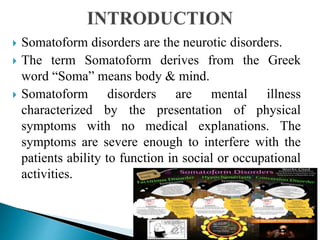
๏ฝ Somatoform disorders are the neurotic disorders.
๏ฝ The term Somatoform derives from the Greek
word โ€œSomaโ€ means body & mind.
๏ฝ Somatoform disorders are mental illness
characterized by the presentation of physical
symptoms with no medical explanations. The
symptoms are severe enough to interfere with the
patients ability to function in social or occupational
activities.
๏ฝ Somatoform disorders are characterized by
repeated presentation with physical symptoms
which do not have any physical basis, and a
persistent request for investigation and treatment
despite repeated assurance by the treating doctors.
๏ฝ In these disorders, manifestation of physical
symptoms are caused by psychological distress.
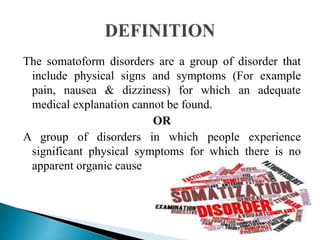
The somatoform disorders are a group of disorder that
include physical signs and symptoms (For example
pain, nausea & dizziness) for which an adequate
medical explanation cannot be found.
OR
A group of disorders in which people experience
significant physical symptoms for which there is no
apparent organic cause
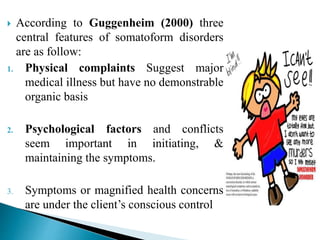
๏ฝ According to Guggenheim (2000) three
central features of somatoform disorders
are as follow:
1. Physical complaints Suggest major
medical illness but have no demonstrable
organic basis
2. Psychological factors and conflicts
seem important in initiating, &
maintaining the symptoms.
3. Symptoms or magnified health concerns
are under the clientโ€™s conscious control
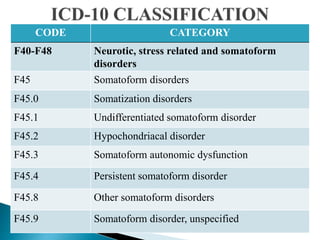
CODE CATEGORY
F40-F48 Neurotic, stress related and somatoform
disorders
F45 Somatoform disorders
F45.0 Somatization disorders
F45.1 Undifferentiated somatoform disorder
F45.2 Hypochondriacal disorder
F45.3 Somatoform autonomic dysfunction
F45.4 Persistent somatoform disorder
F45.8 Other somatoform disorders
F45.9 Somatoform disorder, unspecified
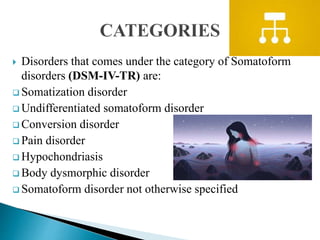
๏ฝ Disorders that comes under the category of Somatoform
disorders (DSM-IV-TR) are:
๏ฑ Somatization disorder
๏ฑ Undifferentiated somatoform disorder
๏ฑ Conversion disorder
๏ฑ Pain disorder
๏ฑ Hypochondriasis
๏ฑ Body dysmorphic disorder
๏ฑ Somatoform disorder not otherwise specified
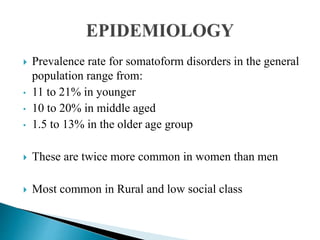
๏ฝ Prevalence rate for somatoform disorders in the general
population range from:
โ€ข 11 to 21% in younger
โ€ข 10 to 20% in middle aged
โ€ข 1.5 to 13% in the older age group
๏ฝ These are twice more common in women than men
๏ฝ Most common in Rural and low social class
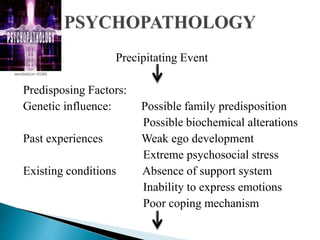
Precipitating Event
Predisposing Factors:
Genetic influence: Possible family predisposition
Possible biochemical alterations
Past experiences Weak ego development
Extreme psychosocial stress
Existing conditions Absence of support system
Inability to express emotions
Poor coping mechanism
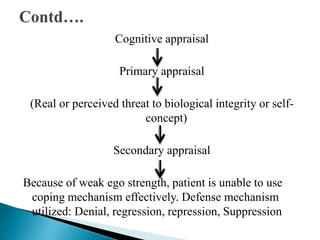
Cognitive appraisal
Primary appraisal
(Real or perceived threat to biological integrity or self-
concept)
Secondary appraisal
Because of weak ego strength, patient is unable to use
coping mechanism effectively. Defense mechanism
utilized: Denial, regression, repression, Suppression
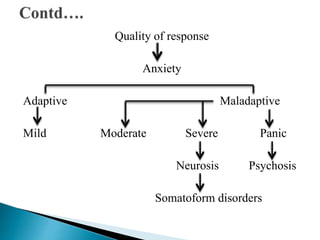
Quality of response
Anxiety
Adaptive Maladaptive
Mild Moderate Severe Panic
Neurosis Psychosis
Somatoform disorders
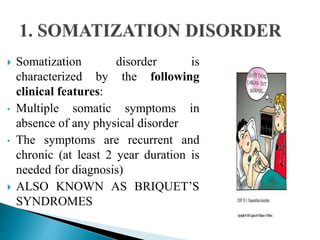
๏ฝ Somatization disorder is
characterized by the following
clinical features:
โ€ข Multiple somatic symptoms in
absence of any physical disorder
โ€ข The symptoms are recurrent and
chronic (at least 2 year duration is
needed for diagnosis)
๏ฝ ALSO KNOWN AS BRIQUETโ€™S
SYNDROMES
๏ฝ PSYCHOSOCIAL THEORIES:
โ€ข Unconsciously expressing internalized stress through physical
symptoms (Somatization)
โ€ข The symptoms substitute for repressed instinctual impulses
๏ฝ BIOLOGICAL THEORIES:
โ€ข Familial tendencies
โ€ข Patient have characteristic attention and cognitive impairement
that results in the faulty perception
๏ฝ CYTOKINES:
โ€ข Abnormal regulation of the cytokine may result in some of the
symptoms.
๏ฝ DEFENSE AGAINST PSYCHOLOGICAL DISTRESS:
One of the oldest theories suggests that it is a way of avoiding
psychological distress. Rather than experiences depression
and anxiety, some individuals will develop physical
symptoms.
๏ฝ HEIGHTENED SENSITIVITY TO PHYSICAL
SENSATIONS: People with somatization disorder may be
keenly aware of the minor pains and discomforts that most
people simply ignores.
๏ฝ CATASTROPHIC THINKING ABOUT PHYSICAL
SENSATIONS: Individuals with somatization disorders are
thus more likely to believe that vague physical symptoms are
indicators of serious disease and need to seek treatment.
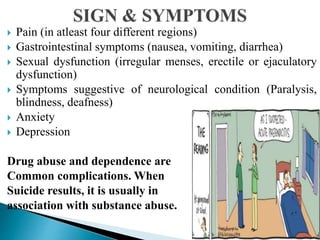
๏ฝ Pain (in atleast four different regions)
๏ฝ Gastrointestinal symptoms (nausea, vomiting, diarrhea)
๏ฝ Sexual dysfunction (irregular menses, erectile or ejaculatory
dysfunction)
๏ฝ Symptoms suggestive of neurological condition (Paralysis,
blindness, deafness)
๏ฝ Anxiety
๏ฝ Depression
Drug abuse and dependence are
Common complications. When
Suicide results, it is usually in
association with substance abuse.
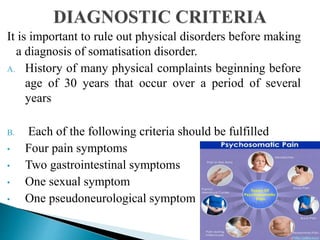
It is important to rule out physical disorders before making
a diagnosis of somatisation disorder.
A. History of many physical complaints beginning before
age of 30 years that occur over a period of several
years
B. Each of the following criteria should be fulfilled
โ€ข Four pain symptoms
โ€ข Two gastrointestinal symptoms
โ€ข One sexual symptom
โ€ข One pseudoneurological symptom
C. Either 1 or 2
1. After appropriate investigation, each of the symptom
in criterion B cannot be fully explained by a known
general medical condition or the direct effects of a
substance.
2. When there is a related general medical condition, the
physical complaints or resulting social or
occupational impairment are in excess of what would
be expected from the history, physical examination or
laboratory findings.
D. The symptoms are not intentionally produced or
feigned
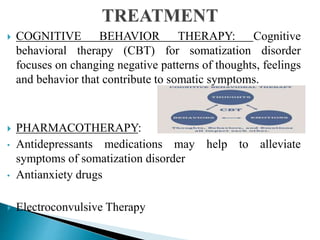
๏ฝ COGNITIVE BEHAVIOR THERAPY: Cognitive
behavioral therapy (CBT) for somatization disorder
focuses on changing negative patterns of thoughts, feelings
and behavior that contribute to somatic symptoms.
๏ฝ PHARMACOTHERAPY:
โ€ข Antidepressants medications may help to alleviate
symptoms of somatization disorder
โ€ข Antianxiety drugs
๏ฝ Electroconvulsive Therapy
๏ฝ RELAXATION TECHNIQUES: Directly acts on
physical symptoms, gives its effects on breathing, heart
rate, muscle tension etc.
โ€ข Helps with stress management
๏ฝ SLEEP STRATEGIES: Establish consistent sleep
patterns.
โ€ข Comfortable sleep environment
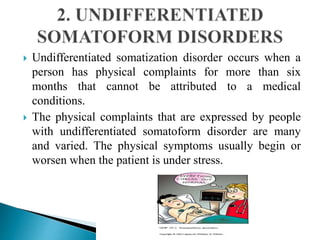
๏ฝ Undifferentiated somatization disorder occurs when a
person has physical complaints for more than six
months that cannot be attributed to a medical
conditions.
๏ฝ The physical complaints that are expressed by people
with undifferentiated somatoform disorder are many
and varied. The physical symptoms usually begin or
worsen when the patient is under stress.
๏ฝ The cause of Undifferentiated Somatoform disorder are
not clear
๏ฝ Some experts believe that problems in the family when
the affected person was a child may be related to
development of the disorder.
๏ฝ Depression and stress
๏ฝ Overreaction towards minor medical condition
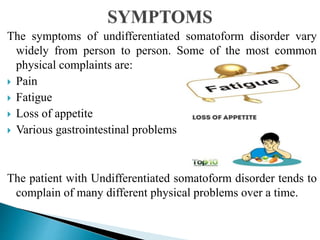
The symptoms of undifferentiated somatoform disorder vary
widely from person to person. Some of the most common
physical complaints are:
๏ฝ Pain
๏ฝ Fatigue
๏ฝ Loss of appetite
๏ฝ Various gastrointestinal problems
The patient with Undifferentiated somatoform disorder tends to
complain of many different physical problems over a time.
๏ฝ There must be no underlying medical cause evident that
could explain the patientโ€™s physical complaints. If there
is a medical condition that could be related to the
complaints, the symptoms reported must be far worse
that could be explained by the existing medical
problems.
๏ฝ The unexplained physical symptoms must persist for
atleast 6 months
๏ฝ The symptoms must cause problems in the patientโ€™s
daily life or relationships or interfere with the patient
achieving his/her goals.
๏ฝ There cannot be another mental disorder that accounts
for the complaints.
๏ฝ The patient cannot knowingly make false complaints of
physical distress.
๏ฝ Hypochondriasis is defined as a
persistent preoccupation with a fear
or belief of having a serious disease
based on personโ€™s own interpretation
of normal body function or a minor
physical abnormality.
๏ฝ Usual age of onset is late third
decade
๏ฝ Course is usually chronic with
remissions and relapse.
๏ฝ The cause of Hypochondriasis is not known. The
important theories are:
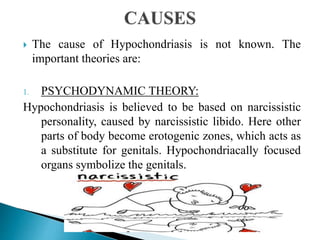
1. PSYCHODYNAMIC THEORY:
Hypochondriasis is believed to be based on narcissistic
personality, caused by narcissistic libido. Here other
parts of body become erotogenic zones, which acts as
a substitute for genitals. Hypochondriacally focused
organs symbolize the genitals.
2. AS A SYMPTOM OF DEPRESSION:
Hypochondriacal symptoms are commonly present in major
depression. According to some, Hypochondriasis is almost
always a part of another psychiatric syndrome, most
commonly a mood disorder.
OTHER CAUSES ARE:
๏ฝ Stressful life events
๏ฝ Disproportionate incidence of disease in family during
childhood
๏ฝ Decreased responsibility and increased attention
๏ฝ Enhanced sensitivity and over focusing on, physical
sensations and illness cues.
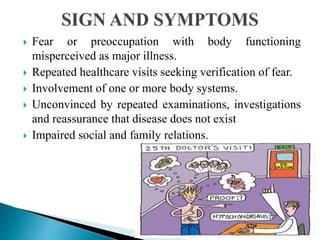
๏ฝ Fear or preoccupation with body functioning
misperceived as major illness.
๏ฝ Repeated healthcare visits seeking verification of fear.
๏ฝ Involvement of one or more body systems.
๏ฝ Unconvinced by repeated examinations, investigations
and reassurance that disease does not exist
๏ฝ Impaired social and family relations.
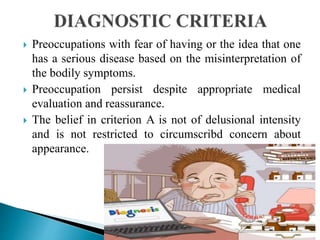
๏ฝ Preoccupations with fear of having or the idea that one
has a serious disease based on the misinterpretation of
the bodily symptoms.
๏ฝ Preoccupation persist despite appropriate medical
evaluation and reassurance.
๏ฝ The belief in criterion A is not of delusional intensity
and is not restricted to circumscribd concern about
appearance.
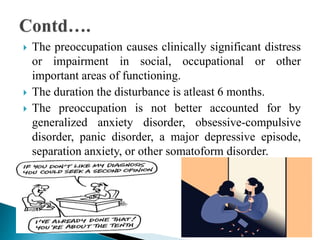
๏ฝ The preoccupation causes clinically significant distress
or impairment in social, occupational or other
important areas of functioning.
๏ฝ The duration the disturbance is atleast 6 months.
๏ฝ The preoccupation is not better accounted for by
generalized anxiety disorder, obsessive-compulsive
disorder, panic disorder, a major depressive episode,
separation anxiety, or other somatoform disorder.
Traditionally, Hypochondriasis has been considered very
difficult to treat. In last few years, however, cognitive and
behavioral treatments have demonstrated effectiveness in
reducing the symptoms of disorder.
๏ฝ COGNITIVE THERAPY: The goal of cognitive therapy for
hypochondriasis is to guide patients to recognition that their
chief problem is fear of illness, rather than vulnerability to
illness. Patients are asked to monitor worries and to evaluate
how realistic and reasonable they are.
๏ฝ BEHAVIORAL STRESS MANAGEMENT: Patients were
asked to identify stressors in their lives and taught stress
management techniques to help them cope with these
stressors.
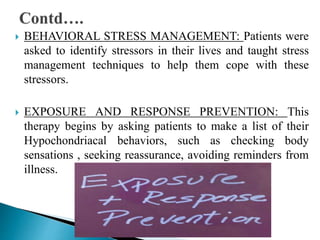
๏ฝ EXPOSURE AND RESPONSE PREVENTION: This
therapy begins by asking patients to make a list of their
Hypochondriacal behaviors, such as checking body
sensations , seeking reassurance, avoiding reminders from
illness.
๏ฝ PHARMACOTHERAPY:
โ€ข Antidepressants
โ€ข Antipsychotics
โ€ข Placebo
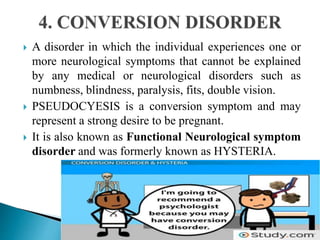
๏ฝ A disorder in which the individual experiences one or
more neurological symptoms that cannot be explained
by any medical or neurological disorders such as
numbness, blindness, paralysis, fits, double vision.
๏ฝ PSEUDOCYESIS is a conversion symptom and may
represent a strong desire to be pregnant.
๏ฝ It is also known as Functional Neurological symptom
disorder and was formerly known as HYSTERIA.
๏ฝ The immediate cause of conversion disorder is a stressful
event or situation that leads the patient to develop bodily
symptoms.
๏ฝ Emotional trauma
๏ฝ Depression
The physical symptoms may come about as a way to try and
resolve or relieve whatever is causing the extreme mental
stress.
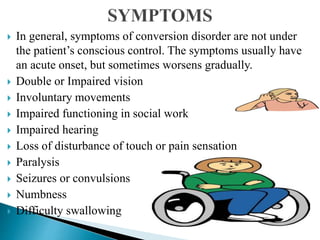
๏ฝ In general, symptoms of conversion disorder are not under
the patientโ€™s conscious control. The symptoms usually have
an acute onset, but sometimes worsens gradually.
๏ฝ Double or Impaired vision
๏ฝ Involuntary movements
๏ฝ Impaired functioning in social work
๏ฝ Impaired hearing
๏ฝ Loss of disturbance of touch or pain sensation
๏ฝ Paralysis
๏ฝ Seizures or convulsions
๏ฝ Numbness
๏ฝ Difficulty swallowing
๏ฝ One or more symptoms or deficits affecting voluntary
motor or sensory function that suggest a neurological
or other general medical condition.
๏ฝ Psychological factors are judged to be associated with
the symptom or deficit because the initiation or
exacerbation of the symptom or deficit is preceded by
conflicts or other stressors.
๏ฝ The symptom or deficit is not intentionally produced.
๏ฝ The symptom or deficit cannot, after appropriate
investigation, be fully explained by a general medical
condition, by the direct effects of a substance, or as a
culturally sanctioned behavior or experience.
๏ฝ The symptoms or deficit causes clinically significant
distress or impairment in social, occupational, or other
important areas of functioning or warrants medical
evaluations.
๏ฝ The symptom or deficit is not limited to pain or sexual
dysfunction, does not occur exclusively during the course of
somatization disorder, and is not better accounted for by
another mental disorder.
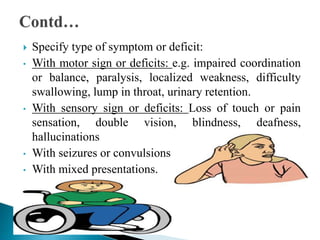
๏ฝ Specify type of symptom or deficit:
โ€ข With motor sign or deficits: e.g. impaired coordination
or balance, paralysis, localized weakness, difficulty
swallowing, lump in throat, urinary retention.
โ€ข With sensory sign or deficits: Loss of touch or pain
sensation, double vision, blindness, deafness,
hallucinations
โ€ข With seizures or convulsions
โ€ข With mixed presentations.
๏ฝ PSYCHODYNAMIC PSYCHOTHERAPY: It is
sometimes used with children and adolescents to help them
gain insight into their symptoms.
๏ฝ FAMILY THERAPY: It is often recommended for younger
patients whose symptoms may be related to family
dysfunction.
๏ฝ GROUP THERAPY: It appears to be particularly useful in
helping adolescents to learn social sills and coping
strategies, and to decrease their dependency on their
families.
๏ฝ INPATIENT TREATMENT: In patient treatment also
allows for a more complete assessment of possible
coexisting organic disorders, and for the child to
improve his or her level of functioning outside of an
abusive or otherwise dysfunctional home environment.
๏ฝ PHARMACOTHERAPY: There are no drugs for the
direct treatment of conversion disorder, medications are
sometimes given to patients to treat the anxiety or
depression that may be associated with conversion
disorder.
๏ฝ Pain disorder is a disorder in which the presence of
pain is the patients main complaint. Pain in one or
more anatomical sites is the predominant complaint and
is severe enough to require medical or therapeutic
intervention.
๏ฝ Earlier name for this disorder include Psychogenic
pain disorder and somatoform pain disorder.
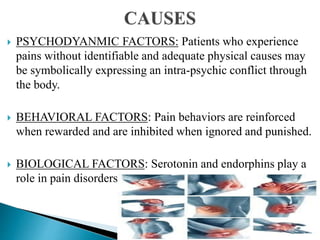
๏ฝ PSYCHODYANMIC FACTORS: Patients who experience
pains without identifiable and adequate physical causes may
be symbolically expressing an intra-psychic conflict through
the body.
๏ฝ BEHAVIORAL FACTORS: Pain behaviors are reinforced
when rewarded and are inhibited when ignored and punished.
๏ฝ BIOLOGICAL FACTORS: Serotonin and endorphins play a
role in pain disorders
๏ฝ PAIN DISORDER ASSOCIATED WITH
PSYCHOLOGICAL FACTORS: Psychological factors
are judged to have the major role in the onset, severity,
or maintenance of the pain
โ€ข Acute: Duration of less than 6 months
โ€ข Chronic: Duration of 6 months or longer
๏ฝ PAIN DISORDER ASSOCIATED WITH A
GENERAL MEDICAL CONDITION:
A general medical condition has a major role in the onset,
severity, or maintenance of the pain.
๏ฝ PAIN DISORDER ASSOCIATED WITH BOTH
PSYCHOLOGICAL FACTORS AND AGENERAL
MEDICAL CONDITIONS: Both psychological factors
and a general medical condition are judged to have
important roles in the onset, severity, or maintenance of
the pain
โ€ข Acute: Duration of less than 6 months
โ€ข Chronic: Duration of 6 months or longer
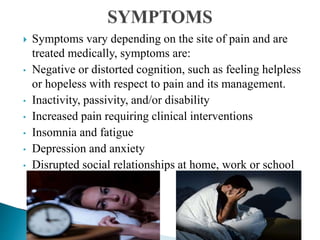
๏ฝ Symptoms vary depending on the site of pain and are
treated medically, symptoms are:
โ€ข Negative or distorted cognition, such as feeling helpless
or hopeless with respect to pain and its management.
โ€ข Inactivity, passivity, and/or disability
โ€ข Increased pain requiring clinical interventions
โ€ข Insomnia and fatigue
โ€ข Depression and anxiety
โ€ข Disrupted social relationships at home, work or school
๏ฝ Pain in one or more anatomical sites is the
predominant focus of the clinical presentation and is
of sufficient severity to warrant clinical attention.
๏ฝ The pain causes clinically significant distress or
impairment in social, occupational, or other
important areas of functioning.
๏ฝ Psychological factors are judged to have an
important role in the onset, severity, exacerbation, or
maintenance of the pain.
๏ฝ The symptom or deficit is not intentionally produced.
๏ฝ The pain is not better accounted for by a mood, anxiety
or psychotic disorder and does not meet criteria for
dyspareunia.
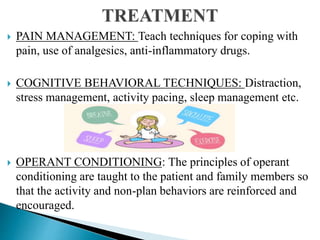
๏ฝ PAIN MANAGEMENT: Teach techniques for coping with
pain, use of analgesics, anti-inflammatory drugs.
๏ฝ COGNITIVE BEHAVIORAL TECHNIQUES: Distraction,
stress management, activity pacing, sleep management etc.
๏ฝ OPERANT CONDITIONING: The principles of operant
conditioning are taught to the patient and family members so
that the activity and non-plan behaviors are reinforced and
encouraged.
๏ฝ PHARMACOTHERAPY:
โ€ข Antidepressants
โ€ข NSAIDs
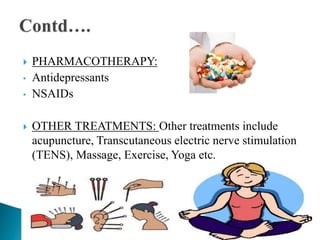
๏ฝ OTHER TREATMENTS: Other treatments include
acupuncture, Transcutaneous electric nerve stimulation
(TENS), Massage, Exercise, Yoga etc.
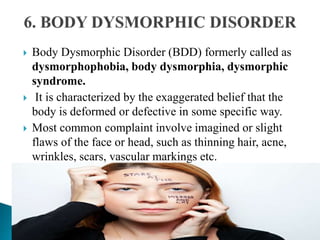
๏ฝ Body Dysmorphic Disorder (BDD) formerly called as
dysmorphophobia, body dysmorphia, dysmorphic
syndrome.
๏ฝ It is characterized by the exaggerated belief that the
body is deformed or defective in some specific way.
๏ฝ Most common complaint involve imagined or slight
flaws of the face or head, such as thinning hair, acne,
wrinkles, scars, vascular markings etc.
๏ฝ The causes of BDD falls into two categories that are:
๏‚ง NEUROBIOLOGICAL CAUSES: Research indicates that
patients diagnosed with BDD have lower serotonin levels.
๏‚ง PSYCHOLOGICAL CAUSES: Another important factor in
the development of BDD is the influence of the mass media
in developed countries, particularly the role of advertising
in spreading images of physically perfect men and women.
๏ฝ Ritualistic behavior: It refers to actions that the
patients performs to manage anxiety and that take up
excessive amounts of his or her time.
๏ฝ Social and occupational impairment
๏ฝ Symptoms of depression and characteristics associated
with obsessive compulsive personality are common.
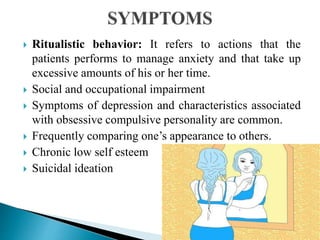
๏ฝ Frequently comparing oneโ€™s appearance to others.
๏ฝ Chronic low self esteem
๏ฝ Suicidal ideation
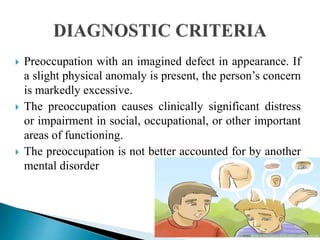
๏ฝ Preoccupation with an imagined defect in appearance. If
a slight physical anomaly is present, the personโ€™s concern
is markedly excessive.
๏ฝ The preoccupation causes clinically significant distress
or impairment in social, occupational, or other important
areas of functioning.
๏ฝ The preoccupation is not better accounted for by another
mental disorder
The standard treatment regimen for body dysmorphic disorder
is a combination of medication and psychotherapy
๏ฝ PHARMACOTHERAPY: Antidepressants
Selective serotonin Reuptake inhibitors at higher doses and
for long duration
Monoamine oxidase inhibitors
๏ฝ PSYCHOTHERAPY:
โ€ข The most effective approach to psychotherapy with BDD
patients is cognitive-behavioral therapy, of which
cognitive restructuring is one component.
โ€ข Relaxation techniques also work well with BDD patients
when they are combined with cognitive restructuring.
๏ฝ ALTERNATIVE TREATMENTS:
โ€ข Although no alternative and complementary form of
treatment has been recommended specially for BDD,
herbal remedies for depressed feelings, such as St.
Johnโ€™s Wort, have been reported as helping some
BDD patients.
โ€ข Aromatherapy and Yoga has helped some person with
BDD.
๏ฝ According to ICD-10, in this disorder, symptoms are
presented by the patient as if they were due to a physical
disorder of an organ system that is predominantly under
autonomic control e.g. cardiovascular system (palpitations),
Upper gastrointestinal tract (hiccoughs), lower
gastrointestinal tract (flatulence) or other organ system.
๏ฝ There is preoccupation with, and distress regarding the
possibility of serious (often unspecified) disorder of the
particular organ system. Physical examination and
investigations do not however show presence of any
significant abnormality.
๏ฝ The preoccupation persists despite repeated assurances
and explanations.
Treatment consists of:
๏ฝ Supportive psychotherapy
๏ฝ Relaxation techniques
๏ฝ PHARMACOTHERAPY:
โ€ข Hormonal treatment: Hormonal therapy is given to the
patients having Premenstrual syndrome. Treatment with
oral or parental progesterone has been recommended with
good results
โ€ข Benzodiazepines
โ€ข Antidepressants
๏ฝ Before a somatoform determination, a physical
examination and diagnostic testing are necessary to rule
out any underlying pathology.
๏ฝ Create an accepting, safe and supportive atmosphere
that allows open communication with the patient.
๏ฝ Should focus on the whole person, including
psychological, social and family factors in addition to
physical symptoms.
๏ฝ It must be remembered that they are not consciously
trying to be sick or avoid responsibility.
๏ฝ Respond to the patient with understanding and
patience.
๏ฝ Identify the types of primary and secondary gains
achieved by the symptoms
๏ฝ Minimize time and attention given to physical
symptoms.
๏ฝ Encourage the patient to keep a diary of daily
happenings and feelings, along with physical
symptoms.
๏ฝ Help the patient to identify more effective coping
mechanisms rather than somatic symptoms.
๏ฝ Ineffective individual coping related to inadequate
coping skills as evidenced by decreased social and
occupational functioning
๏ฝ Pain related to severe level of anxiety as evidenced by
sleep pattern disturbances.
๏ฝ Self care deficit related to pain as evidenced by
observation.
๏ฝ Introduction
๏ฝ Definition
๏ฝ ICD 10 classification
๏ฝ DSN-IV-TR Classification
๏ฝ Epidemiology
๏ฝ Psychopathology
๏ฝ Somatization Disorder
๏ฝ Undifferentiated somatoform disorders
๏ฝ Hypochondriasis
๏ฝ Conversion disorder
๏ฝ Pain disorder
๏ฝ Body dysmorphic disorder
๏ฝ Somatoform autonomic dysfunction
๏ฝ Nursing interventions
๏ฝ Nursing Diagnosis
At the end of Presentation, students was able to give
positive feedback regarding topic
๏ฝ What are somatoform disorders?
๏ฝ Explain psychopathology of Somatoform disorders?
๏ฝ What are the causes of somatoform disorders?
๏ฝ Explain conversion disorder?
๏ฝ What are the diagnostic criteria for pain disorder?
๏ฝ Write nursing management of Somatoform disorders?
๏ฝ What are somatoform disorders?
๏ฝ Explain psychopathology of somatoform disorders?
๏ฝ Write nursing management of somatoform disorders?
BOOK REFERENCES:
๏ฝ Townsend C. Mary โ€œPsychiatric Mental Health Nursingโ€;
Published by Jaypee;Edn-7th ; Pp-669-676
๏ฝ Ahuja Niraj โ€œA short textbook of Psychiatryโ€; Published by
Jaypee; Edn-7th; Pp-104-109
๏ฝ Sreevani R โ€œA guide to Mental Health & Psychiatric Nursingโ€;
published by Jaypee; Edn-4th; Pp-233-235
NET REFERENCES:
๏ฝ https://www.slideshare.net/mobile/saita1991/somatoform-
disorder-48816452 , viewed on 09/04/2020
๏ฝ https://www.sliseshare.net/mobile/arunmadanan/somatoform-
disorders-50168569 , viewed on 09/04/2020
๏ฝ https://www.slideshare.net/mobile/sandeepshrestha7946/somatof
orm-disorder-53361883 , viewed on 09/04/2020
๏ฝ https://www.slideshare.net/mobile/godwinlipz/somatoform-
disorders-32088994 , viewed on 10/04/2020
Somatoform disorders (1)

Somatoform disorders (1)

  • 1.
    PRESENTED TO: PRESENTEDBY: MS. RITIKA SONI MS. MONIKA KANWAR ASSISTANT PROFESSOR M.Sc. (N) 2ND YEAR SHIMLA NURSING COLLEGE SHIMLA NURSING COLLEGE
  • 2.
    ๏ฝ Somatoform disordersare the neurotic disorders. ๏ฝ The term Somatoform derives from the Greek word โ€œSomaโ€ means body & mind. ๏ฝ Somatoform disorders are mental illness characterized by the presentation of physical symptoms with no medical explanations. The symptoms are severe enough to interfere with the patients ability to function in social or occupational activities.
  • 3.
    ๏ฝ Somatoform disordersare characterized by repeated presentation with physical symptoms which do not have any physical basis, and a persistent request for investigation and treatment despite repeated assurance by the treating doctors. ๏ฝ In these disorders, manifestation of physical symptoms are caused by psychological distress.
  • 4.
    The somatoform disordersare a group of disorder that include physical signs and symptoms (For example pain, nausea & dizziness) for which an adequate medical explanation cannot be found. OR A group of disorders in which people experience significant physical symptoms for which there is no apparent organic cause
  • 5.
    ๏ฝ According toGuggenheim (2000) three central features of somatoform disorders are as follow: 1. Physical complaints Suggest major medical illness but have no demonstrable organic basis 2. Psychological factors and conflicts seem important in initiating, & maintaining the symptoms. 3. Symptoms or magnified health concerns are under the clientโ€™s conscious control
  • 6.
    CODE CATEGORY F40-F48 Neurotic,stress related and somatoform disorders F45 Somatoform disorders F45.0 Somatization disorders F45.1 Undifferentiated somatoform disorder F45.2 Hypochondriacal disorder F45.3 Somatoform autonomic dysfunction F45.4 Persistent somatoform disorder F45.8 Other somatoform disorders F45.9 Somatoform disorder, unspecified
  • 7.
    ๏ฝ Disorders thatcomes under the category of Somatoform disorders (DSM-IV-TR) are: ๏ฑ Somatization disorder ๏ฑ Undifferentiated somatoform disorder ๏ฑ Conversion disorder ๏ฑ Pain disorder ๏ฑ Hypochondriasis ๏ฑ Body dysmorphic disorder ๏ฑ Somatoform disorder not otherwise specified
  • 8.
    ๏ฝ Prevalence ratefor somatoform disorders in the general population range from: โ€ข 11 to 21% in younger โ€ข 10 to 20% in middle aged โ€ข 1.5 to 13% in the older age group ๏ฝ These are twice more common in women than men ๏ฝ Most common in Rural and low social class
  • 9.
    Precipitating Event Predisposing Factors: Geneticinfluence: Possible family predisposition Possible biochemical alterations Past experiences Weak ego development Extreme psychosocial stress Existing conditions Absence of support system Inability to express emotions Poor coping mechanism
  • 10.
    Cognitive appraisal Primary appraisal (Realor perceived threat to biological integrity or self- concept) Secondary appraisal Because of weak ego strength, patient is unable to use coping mechanism effectively. Defense mechanism utilized: Denial, regression, repression, Suppression
  • 11.
    Quality of response Anxiety AdaptiveMaladaptive Mild Moderate Severe Panic Neurosis Psychosis Somatoform disorders
  • 13.
    ๏ฝ Somatization disorderis characterized by the following clinical features: โ€ข Multiple somatic symptoms in absence of any physical disorder โ€ข The symptoms are recurrent and chronic (at least 2 year duration is needed for diagnosis) ๏ฝ ALSO KNOWN AS BRIQUETโ€™S SYNDROMES
  • 14.
    ๏ฝ PSYCHOSOCIAL THEORIES: โ€ขUnconsciously expressing internalized stress through physical symptoms (Somatization) โ€ข The symptoms substitute for repressed instinctual impulses ๏ฝ BIOLOGICAL THEORIES: โ€ข Familial tendencies โ€ข Patient have characteristic attention and cognitive impairement that results in the faulty perception ๏ฝ CYTOKINES: โ€ข Abnormal regulation of the cytokine may result in some of the symptoms.
  • 15.
    ๏ฝ DEFENSE AGAINSTPSYCHOLOGICAL DISTRESS: One of the oldest theories suggests that it is a way of avoiding psychological distress. Rather than experiences depression and anxiety, some individuals will develop physical symptoms. ๏ฝ HEIGHTENED SENSITIVITY TO PHYSICAL SENSATIONS: People with somatization disorder may be keenly aware of the minor pains and discomforts that most people simply ignores. ๏ฝ CATASTROPHIC THINKING ABOUT PHYSICAL SENSATIONS: Individuals with somatization disorders are thus more likely to believe that vague physical symptoms are indicators of serious disease and need to seek treatment.
  • 16.
    ๏ฝ Pain (inatleast four different regions) ๏ฝ Gastrointestinal symptoms (nausea, vomiting, diarrhea) ๏ฝ Sexual dysfunction (irregular menses, erectile or ejaculatory dysfunction) ๏ฝ Symptoms suggestive of neurological condition (Paralysis, blindness, deafness) ๏ฝ Anxiety ๏ฝ Depression Drug abuse and dependence are Common complications. When Suicide results, it is usually in association with substance abuse.
  • 17.
    It is importantto rule out physical disorders before making a diagnosis of somatisation disorder. A. History of many physical complaints beginning before age of 30 years that occur over a period of several years B. Each of the following criteria should be fulfilled โ€ข Four pain symptoms โ€ข Two gastrointestinal symptoms โ€ข One sexual symptom โ€ข One pseudoneurological symptom
  • 18.
    C. Either 1or 2 1. After appropriate investigation, each of the symptom in criterion B cannot be fully explained by a known general medical condition or the direct effects of a substance. 2. When there is a related general medical condition, the physical complaints or resulting social or occupational impairment are in excess of what would be expected from the history, physical examination or laboratory findings. D. The symptoms are not intentionally produced or feigned
  • 19.
    ๏ฝ COGNITIVE BEHAVIORTHERAPY: Cognitive behavioral therapy (CBT) for somatization disorder focuses on changing negative patterns of thoughts, feelings and behavior that contribute to somatic symptoms. ๏ฝ PHARMACOTHERAPY: โ€ข Antidepressants medications may help to alleviate symptoms of somatization disorder โ€ข Antianxiety drugs ๏ฝ Electroconvulsive Therapy
  • 20.
    ๏ฝ RELAXATION TECHNIQUES:Directly acts on physical symptoms, gives its effects on breathing, heart rate, muscle tension etc. โ€ข Helps with stress management ๏ฝ SLEEP STRATEGIES: Establish consistent sleep patterns. โ€ข Comfortable sleep environment
  • 21.
    ๏ฝ Undifferentiated somatizationdisorder occurs when a person has physical complaints for more than six months that cannot be attributed to a medical conditions. ๏ฝ The physical complaints that are expressed by people with undifferentiated somatoform disorder are many and varied. The physical symptoms usually begin or worsen when the patient is under stress.
  • 22.
    ๏ฝ The causeof Undifferentiated Somatoform disorder are not clear ๏ฝ Some experts believe that problems in the family when the affected person was a child may be related to development of the disorder. ๏ฝ Depression and stress ๏ฝ Overreaction towards minor medical condition
  • 23.
    The symptoms ofundifferentiated somatoform disorder vary widely from person to person. Some of the most common physical complaints are: ๏ฝ Pain ๏ฝ Fatigue ๏ฝ Loss of appetite ๏ฝ Various gastrointestinal problems The patient with Undifferentiated somatoform disorder tends to complain of many different physical problems over a time.
  • 24.
    ๏ฝ There mustbe no underlying medical cause evident that could explain the patientโ€™s physical complaints. If there is a medical condition that could be related to the complaints, the symptoms reported must be far worse that could be explained by the existing medical problems. ๏ฝ The unexplained physical symptoms must persist for atleast 6 months
  • 25.
    ๏ฝ The symptomsmust cause problems in the patientโ€™s daily life or relationships or interfere with the patient achieving his/her goals. ๏ฝ There cannot be another mental disorder that accounts for the complaints. ๏ฝ The patient cannot knowingly make false complaints of physical distress.
  • 26.
    ๏ฝ Hypochondriasis isdefined as a persistent preoccupation with a fear or belief of having a serious disease based on personโ€™s own interpretation of normal body function or a minor physical abnormality. ๏ฝ Usual age of onset is late third decade ๏ฝ Course is usually chronic with remissions and relapse.
  • 27.
    ๏ฝ The causeof Hypochondriasis is not known. The important theories are: 1. PSYCHODYNAMIC THEORY: Hypochondriasis is believed to be based on narcissistic personality, caused by narcissistic libido. Here other parts of body become erotogenic zones, which acts as a substitute for genitals. Hypochondriacally focused organs symbolize the genitals.
  • 28.
    2. AS ASYMPTOM OF DEPRESSION: Hypochondriacal symptoms are commonly present in major depression. According to some, Hypochondriasis is almost always a part of another psychiatric syndrome, most commonly a mood disorder. OTHER CAUSES ARE: ๏ฝ Stressful life events ๏ฝ Disproportionate incidence of disease in family during childhood ๏ฝ Decreased responsibility and increased attention ๏ฝ Enhanced sensitivity and over focusing on, physical sensations and illness cues.
  • 29.
    ๏ฝ Fear orpreoccupation with body functioning misperceived as major illness. ๏ฝ Repeated healthcare visits seeking verification of fear. ๏ฝ Involvement of one or more body systems. ๏ฝ Unconvinced by repeated examinations, investigations and reassurance that disease does not exist ๏ฝ Impaired social and family relations.
  • 30.
    ๏ฝ Preoccupations withfear of having or the idea that one has a serious disease based on the misinterpretation of the bodily symptoms. ๏ฝ Preoccupation persist despite appropriate medical evaluation and reassurance. ๏ฝ The belief in criterion A is not of delusional intensity and is not restricted to circumscribd concern about appearance.
  • 31.
    ๏ฝ The preoccupationcauses clinically significant distress or impairment in social, occupational or other important areas of functioning. ๏ฝ The duration the disturbance is atleast 6 months. ๏ฝ The preoccupation is not better accounted for by generalized anxiety disorder, obsessive-compulsive disorder, panic disorder, a major depressive episode, separation anxiety, or other somatoform disorder.
  • 32.
    Traditionally, Hypochondriasis hasbeen considered very difficult to treat. In last few years, however, cognitive and behavioral treatments have demonstrated effectiveness in reducing the symptoms of disorder. ๏ฝ COGNITIVE THERAPY: The goal of cognitive therapy for hypochondriasis is to guide patients to recognition that their chief problem is fear of illness, rather than vulnerability to illness. Patients are asked to monitor worries and to evaluate how realistic and reasonable they are.
  • 33.
    ๏ฝ BEHAVIORAL STRESSMANAGEMENT: Patients were asked to identify stressors in their lives and taught stress management techniques to help them cope with these stressors. ๏ฝ EXPOSURE AND RESPONSE PREVENTION: This therapy begins by asking patients to make a list of their Hypochondriacal behaviors, such as checking body sensations , seeking reassurance, avoiding reminders from illness.
  • 34.
  • 35.
    ๏ฝ A disorderin which the individual experiences one or more neurological symptoms that cannot be explained by any medical or neurological disorders such as numbness, blindness, paralysis, fits, double vision. ๏ฝ PSEUDOCYESIS is a conversion symptom and may represent a strong desire to be pregnant. ๏ฝ It is also known as Functional Neurological symptom disorder and was formerly known as HYSTERIA.
  • 36.
    ๏ฝ The immediatecause of conversion disorder is a stressful event or situation that leads the patient to develop bodily symptoms. ๏ฝ Emotional trauma ๏ฝ Depression The physical symptoms may come about as a way to try and resolve or relieve whatever is causing the extreme mental stress.
  • 37.
    ๏ฝ In general,symptoms of conversion disorder are not under the patientโ€™s conscious control. The symptoms usually have an acute onset, but sometimes worsens gradually. ๏ฝ Double or Impaired vision ๏ฝ Involuntary movements ๏ฝ Impaired functioning in social work ๏ฝ Impaired hearing ๏ฝ Loss of disturbance of touch or pain sensation ๏ฝ Paralysis ๏ฝ Seizures or convulsions ๏ฝ Numbness ๏ฝ Difficulty swallowing
  • 38.
    ๏ฝ One ormore symptoms or deficits affecting voluntary motor or sensory function that suggest a neurological or other general medical condition. ๏ฝ Psychological factors are judged to be associated with the symptom or deficit because the initiation or exacerbation of the symptom or deficit is preceded by conflicts or other stressors. ๏ฝ The symptom or deficit is not intentionally produced.
  • 39.
    ๏ฝ The symptomor deficit cannot, after appropriate investigation, be fully explained by a general medical condition, by the direct effects of a substance, or as a culturally sanctioned behavior or experience. ๏ฝ The symptoms or deficit causes clinically significant distress or impairment in social, occupational, or other important areas of functioning or warrants medical evaluations. ๏ฝ The symptom or deficit is not limited to pain or sexual dysfunction, does not occur exclusively during the course of somatization disorder, and is not better accounted for by another mental disorder.
  • 40.
    ๏ฝ Specify typeof symptom or deficit: โ€ข With motor sign or deficits: e.g. impaired coordination or balance, paralysis, localized weakness, difficulty swallowing, lump in throat, urinary retention. โ€ข With sensory sign or deficits: Loss of touch or pain sensation, double vision, blindness, deafness, hallucinations โ€ข With seizures or convulsions โ€ข With mixed presentations.
  • 41.
    ๏ฝ PSYCHODYNAMIC PSYCHOTHERAPY:It is sometimes used with children and adolescents to help them gain insight into their symptoms. ๏ฝ FAMILY THERAPY: It is often recommended for younger patients whose symptoms may be related to family dysfunction. ๏ฝ GROUP THERAPY: It appears to be particularly useful in helping adolescents to learn social sills and coping strategies, and to decrease their dependency on their families.
  • 42.
    ๏ฝ INPATIENT TREATMENT:In patient treatment also allows for a more complete assessment of possible coexisting organic disorders, and for the child to improve his or her level of functioning outside of an abusive or otherwise dysfunctional home environment. ๏ฝ PHARMACOTHERAPY: There are no drugs for the direct treatment of conversion disorder, medications are sometimes given to patients to treat the anxiety or depression that may be associated with conversion disorder.
  • 43.
    ๏ฝ Pain disorderis a disorder in which the presence of pain is the patients main complaint. Pain in one or more anatomical sites is the predominant complaint and is severe enough to require medical or therapeutic intervention. ๏ฝ Earlier name for this disorder include Psychogenic pain disorder and somatoform pain disorder.
  • 44.
    ๏ฝ PSYCHODYANMIC FACTORS:Patients who experience pains without identifiable and adequate physical causes may be symbolically expressing an intra-psychic conflict through the body. ๏ฝ BEHAVIORAL FACTORS: Pain behaviors are reinforced when rewarded and are inhibited when ignored and punished. ๏ฝ BIOLOGICAL FACTORS: Serotonin and endorphins play a role in pain disorders
  • 45.
    ๏ฝ PAIN DISORDERASSOCIATED WITH PSYCHOLOGICAL FACTORS: Psychological factors are judged to have the major role in the onset, severity, or maintenance of the pain โ€ข Acute: Duration of less than 6 months โ€ข Chronic: Duration of 6 months or longer ๏ฝ PAIN DISORDER ASSOCIATED WITH A GENERAL MEDICAL CONDITION: A general medical condition has a major role in the onset, severity, or maintenance of the pain.
  • 46.
    ๏ฝ PAIN DISORDERASSOCIATED WITH BOTH PSYCHOLOGICAL FACTORS AND AGENERAL MEDICAL CONDITIONS: Both psychological factors and a general medical condition are judged to have important roles in the onset, severity, or maintenance of the pain โ€ข Acute: Duration of less than 6 months โ€ข Chronic: Duration of 6 months or longer
  • 47.
    ๏ฝ Symptoms varydepending on the site of pain and are treated medically, symptoms are: โ€ข Negative or distorted cognition, such as feeling helpless or hopeless with respect to pain and its management. โ€ข Inactivity, passivity, and/or disability โ€ข Increased pain requiring clinical interventions โ€ข Insomnia and fatigue โ€ข Depression and anxiety โ€ข Disrupted social relationships at home, work or school
  • 48.
    ๏ฝ Pain inone or more anatomical sites is the predominant focus of the clinical presentation and is of sufficient severity to warrant clinical attention. ๏ฝ The pain causes clinically significant distress or impairment in social, occupational, or other important areas of functioning. ๏ฝ Psychological factors are judged to have an important role in the onset, severity, exacerbation, or maintenance of the pain.
  • 49.
    ๏ฝ The symptomor deficit is not intentionally produced. ๏ฝ The pain is not better accounted for by a mood, anxiety or psychotic disorder and does not meet criteria for dyspareunia.
  • 50.
    ๏ฝ PAIN MANAGEMENT:Teach techniques for coping with pain, use of analgesics, anti-inflammatory drugs. ๏ฝ COGNITIVE BEHAVIORAL TECHNIQUES: Distraction, stress management, activity pacing, sleep management etc. ๏ฝ OPERANT CONDITIONING: The principles of operant conditioning are taught to the patient and family members so that the activity and non-plan behaviors are reinforced and encouraged.
  • 51.
    ๏ฝ PHARMACOTHERAPY: โ€ข Antidepressants โ€ขNSAIDs ๏ฝ OTHER TREATMENTS: Other treatments include acupuncture, Transcutaneous electric nerve stimulation (TENS), Massage, Exercise, Yoga etc.
  • 52.
    ๏ฝ Body DysmorphicDisorder (BDD) formerly called as dysmorphophobia, body dysmorphia, dysmorphic syndrome. ๏ฝ It is characterized by the exaggerated belief that the body is deformed or defective in some specific way. ๏ฝ Most common complaint involve imagined or slight flaws of the face or head, such as thinning hair, acne, wrinkles, scars, vascular markings etc.
  • 53.
    ๏ฝ The causesof BDD falls into two categories that are: ๏‚ง NEUROBIOLOGICAL CAUSES: Research indicates that patients diagnosed with BDD have lower serotonin levels. ๏‚ง PSYCHOLOGICAL CAUSES: Another important factor in the development of BDD is the influence of the mass media in developed countries, particularly the role of advertising in spreading images of physically perfect men and women.
  • 54.
    ๏ฝ Ritualistic behavior:It refers to actions that the patients performs to manage anxiety and that take up excessive amounts of his or her time. ๏ฝ Social and occupational impairment ๏ฝ Symptoms of depression and characteristics associated with obsessive compulsive personality are common. ๏ฝ Frequently comparing oneโ€™s appearance to others. ๏ฝ Chronic low self esteem ๏ฝ Suicidal ideation
  • 55.
    ๏ฝ Preoccupation withan imagined defect in appearance. If a slight physical anomaly is present, the personโ€™s concern is markedly excessive. ๏ฝ The preoccupation causes clinically significant distress or impairment in social, occupational, or other important areas of functioning. ๏ฝ The preoccupation is not better accounted for by another mental disorder
  • 56.
    The standard treatmentregimen for body dysmorphic disorder is a combination of medication and psychotherapy ๏ฝ PHARMACOTHERAPY: Antidepressants Selective serotonin Reuptake inhibitors at higher doses and for long duration Monoamine oxidase inhibitors ๏ฝ PSYCHOTHERAPY: โ€ข The most effective approach to psychotherapy with BDD patients is cognitive-behavioral therapy, of which cognitive restructuring is one component. โ€ข Relaxation techniques also work well with BDD patients when they are combined with cognitive restructuring.
  • 57.
    ๏ฝ ALTERNATIVE TREATMENTS: โ€ขAlthough no alternative and complementary form of treatment has been recommended specially for BDD, herbal remedies for depressed feelings, such as St. Johnโ€™s Wort, have been reported as helping some BDD patients. โ€ข Aromatherapy and Yoga has helped some person with BDD.
  • 58.
    ๏ฝ According toICD-10, in this disorder, symptoms are presented by the patient as if they were due to a physical disorder of an organ system that is predominantly under autonomic control e.g. cardiovascular system (palpitations), Upper gastrointestinal tract (hiccoughs), lower gastrointestinal tract (flatulence) or other organ system.
  • 59.
    ๏ฝ There ispreoccupation with, and distress regarding the possibility of serious (often unspecified) disorder of the particular organ system. Physical examination and investigations do not however show presence of any significant abnormality. ๏ฝ The preoccupation persists despite repeated assurances and explanations.
  • 60.
    Treatment consists of: ๏ฝSupportive psychotherapy ๏ฝ Relaxation techniques ๏ฝ PHARMACOTHERAPY: โ€ข Hormonal treatment: Hormonal therapy is given to the patients having Premenstrual syndrome. Treatment with oral or parental progesterone has been recommended with good results โ€ข Benzodiazepines โ€ข Antidepressants
  • 61.
    ๏ฝ Before asomatoform determination, a physical examination and diagnostic testing are necessary to rule out any underlying pathology. ๏ฝ Create an accepting, safe and supportive atmosphere that allows open communication with the patient. ๏ฝ Should focus on the whole person, including psychological, social and family factors in addition to physical symptoms. ๏ฝ It must be remembered that they are not consciously trying to be sick or avoid responsibility.
  • 62.
    ๏ฝ Respond tothe patient with understanding and patience. ๏ฝ Identify the types of primary and secondary gains achieved by the symptoms ๏ฝ Minimize time and attention given to physical symptoms. ๏ฝ Encourage the patient to keep a diary of daily happenings and feelings, along with physical symptoms. ๏ฝ Help the patient to identify more effective coping mechanisms rather than somatic symptoms.
  • 63.
    ๏ฝ Ineffective individualcoping related to inadequate coping skills as evidenced by decreased social and occupational functioning ๏ฝ Pain related to severe level of anxiety as evidenced by sleep pattern disturbances. ๏ฝ Self care deficit related to pain as evidenced by observation.
  • 64.
    ๏ฝ Introduction ๏ฝ Definition ๏ฝICD 10 classification ๏ฝ DSN-IV-TR Classification ๏ฝ Epidemiology ๏ฝ Psychopathology ๏ฝ Somatization Disorder ๏ฝ Undifferentiated somatoform disorders ๏ฝ Hypochondriasis ๏ฝ Conversion disorder ๏ฝ Pain disorder ๏ฝ Body dysmorphic disorder ๏ฝ Somatoform autonomic dysfunction ๏ฝ Nursing interventions ๏ฝ Nursing Diagnosis
  • 65.
    At the endof Presentation, students was able to give positive feedback regarding topic ๏ฝ What are somatoform disorders? ๏ฝ Explain psychopathology of Somatoform disorders? ๏ฝ What are the causes of somatoform disorders? ๏ฝ Explain conversion disorder? ๏ฝ What are the diagnostic criteria for pain disorder? ๏ฝ Write nursing management of Somatoform disorders?
  • 66.
    ๏ฝ What aresomatoform disorders? ๏ฝ Explain psychopathology of somatoform disorders? ๏ฝ Write nursing management of somatoform disorders?
  • 67.
    BOOK REFERENCES: ๏ฝ TownsendC. Mary โ€œPsychiatric Mental Health Nursingโ€; Published by Jaypee;Edn-7th ; Pp-669-676 ๏ฝ Ahuja Niraj โ€œA short textbook of Psychiatryโ€; Published by Jaypee; Edn-7th; Pp-104-109 ๏ฝ Sreevani R โ€œA guide to Mental Health & Psychiatric Nursingโ€; published by Jaypee; Edn-4th; Pp-233-235 NET REFERENCES: ๏ฝ https://www.slideshare.net/mobile/saita1991/somatoform- disorder-48816452 , viewed on 09/04/2020 ๏ฝ https://www.sliseshare.net/mobile/arunmadanan/somatoform- disorders-50168569 , viewed on 09/04/2020 ๏ฝ https://www.slideshare.net/mobile/sandeepshrestha7946/somatof orm-disorder-53361883 , viewed on 09/04/2020 ๏ฝ https://www.slideshare.net/mobile/godwinlipz/somatoform- disorders-32088994 , viewed on 10/04/2020