Mental Retardation
Prepared By
Mrs. A. V. Sumirthi
Asst Professor
Ganga College Of Nursing
Coimbatore
CLASSIFICATION (ICD-10)
Mental retardation F70-F79
• F70- mild mental retardation
• F71- moderate mental retardation
• F72- severe mental retardation
• F73- profound mental retardation
• F78- other mental retardation
• F79- unspecified mental retardation
Definition
Significantly subaverage general intellectual
functioning, associated with significant deficit or
impairment in adaptive functioning, which manifests
during the developmental period
- American association (1983)
• A condition of arrested or incomplete
development of the mind, characterized by
impairment of skills manifested during
developmental period that contribute to
cognitive, language, motor and social abilities.
– ICD-10
• Intellectual functioning – Result of
standardized Intelligence Tests
• Subaverage – Below 70 IQ
• Adaptive behavior – Ability to meet the
responsibilities of social, personal,
occupational and interpersonal areas of life
according to his age and socio cultural
background
• Developmental Period – Below 18 years
INCIDENCE AND PREVALENCE
• 3% of the world population is estimated to be
mentally retarded
• 20 million children are suffering with MR
• Boys are more suffering than girls
• Mortality is high in severe or profound MR
• Common in 2-3 years, peak in 10-12 years
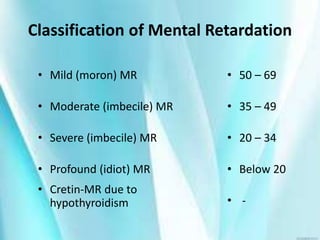
Classification of Mental Retardation
• Mild (moron) MR
• Moderate (imbecile) MR
• Severe (imbecile) MR
• Profound (idiot) MR
• Cretin-MR due to
hypothyroidism
• 50 – 69
• 35 – 49
• 20 – 34
• Below 20
• -
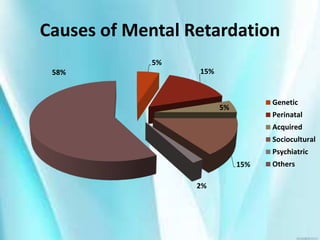
Causes of Mental Retardation
5%
15%
5%
15%
2%
58%
Genetic
Perinatal
Acquired
Sociocultural
Psychiatric
Others
Causes of Mental Retardation
I. Genetic Causes
II. Perinatal Causes
III. Acquired Physical Disorders in childhood
IV. Socio cultural causes
V. Psychiatric disorders
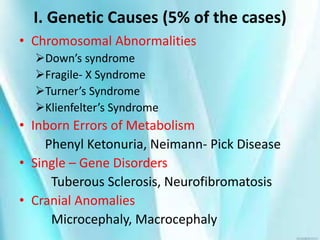
I. Genetic Causes (5% of the cases)
• Chromosomal Abnormalities
Down’s syndrome
Fragile- X Syndrome
Turner’s Syndrome
Klienfelter’s Syndrome
• Inborn Errors of Metabolism
Phenyl Ketonuria, Neimann- Pick Disease
• Single – Gene Disorders
Tuberous Sclerosis, Neurofibromatosis
• Cranial Anomalies
Microcephaly, Macrocephaly
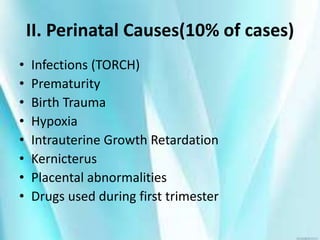
II. Perinatal Causes(10% of cases)
• Infections (TORCH)
• Prematurity
• Birth Trauma
• Hypoxia
• Intrauterine Growth Retardation
• Kernicterus
• Placental abnormalities
• Drugs used during first trimester
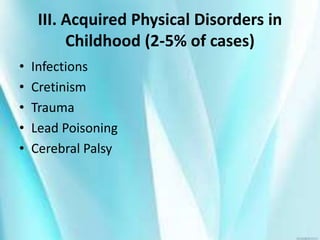
III. Acquired Physical Disorders in
Childhood (2-5% of cases)
• Infections
• Cretinism
• Trauma
• Lead Poisoning
• Cerebral Palsy
IV. Socio Cultural Causes (15% of cases)
Deprivation of socio cultural stimulation
V. Psychiatric Disorders
(1 – 2% of cases)
• Pervasive Developmental Disorder
Infantile Autism
• Childhood Onset Schizophrenia
Behavioural Manifestations
Mild Mental Retardation
• Commonest type
• Accounts for 85 – 90% of all cases
• Minimal retardation in sensory - motor areas
• They can progress up to VI standard
• They can achieve vocational skills
Mild Mental Retardation (Educable)
• They can achieve social self-sufficiency
• They can develop social and communication
skills
• But they have deficits in cognitive function like
poor ability for abstraction and egocentric
thinking
Moderate Mental Retardation (Trainable)
• Accounts for 10% of all cases
• They have poor social awareness during early
years
• Communication skills develop very slowly in
these individuals
• They drop out of school after 2nd Grade
• They can be trained to perform semi skilled
or unskilled work under supervision
• Even mild stress can destabilize them.
Severe Mental Retardation (Dependent)
• Recognized early in life
• Significantly delayed developmental mile stones
• Absent or markedly delayed speech or communication
skills
• Self care (ADL) can be taught
• They can perform very simple tasks under supervision
• They require a great amount of assistance for living
• They require a structured environment
Profound Mental Retardation ( Custodial Care)
• Accounts for 1-2% of all cases
• Often associated with physical disorders
• Marked delay in developmental milestones
• They need nursing care or life support
• Usually cared in a residential setting
Diagnosis
• History collection from Parents and Care Takers
• Physical Examination
• Neurological examination
• Assessing milestones development
• Investigations
– Urine and blood examination for metabolic disorders
– Culture for cytogenic and biochemical studies
– Amniocentesis in infant chromosomal disorders
– Chorionic villi sampling
Diagnosis
• Hearing and speech evaluation
• EEG, especially seizures present
• CT scan or MRI brain (Tuberous sclerosis)
• Thyroid function test (Cretinism)
• Psychological Tests
– Stanford Binet Intelligence Test
– Wechsler Intelligence Scale for Children (WISC)
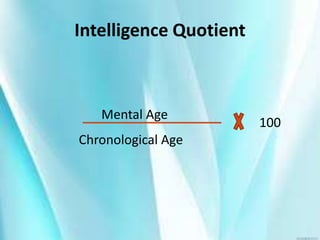
Intelligence Quotient
Mental Age
Chronological Age
100
Prevention
• Primary
• Secondary
• Tertiary
Primary Prevention
• Preconception:
 Genetic counseling
 Immunization for maternal rubella
 Blood tests for marriage
 Adequate maternal nutrition
 Family Planning (Size, Appropriate spacing, and
age of parents)
During Gestation
Two general approaches:
• Prenatal care
• Analysis of fetus for possible genetic
disorders
A. Prenatal Care
• Adequate nutrition, fetal monitoring and
protection from disease
• Avoidance of teratogenic substances like
exposure to radiation and consumption of alcohol
and drugs

B. Analysis of fetus
• Amniocentesis
• Fetoscopy
• Fetal biopsy
• Ultrasound
At Delivery
• Delivery conducted by expert doctors and
staff, especially in cases of high-risk pregnancy
• APGAR score done at 1 and 5 minutes after
the birth of the child
• Close monitoring of mother and child
• Injection of Gamma globulin, which can
prevent Rh-negative mothers from developing
antibodies that might otherwise affect
subsequent children
Childhood
• Proper nutrition throughout the developmental
period and particularly during the first 6 months
after birth
• Dietary restrictions for specific metabolic disorders
until no longer needed
• Avoidance of hazards in the child’s environment to
avert brain injury from causes such as lead
poisoning, ingestion of chemicals or accidents
Secondary Prevention
• Early detection and treatment of
preventable disorders
• Early recognition of presence of
mental retardation – A delay in
diagnosis may cause unfortunate
delay in rehabilitation
• Psychiatric treatment for emotional
and behavioural difficulties
Tertiary Prevention
• Rehabilitation in vocational, physical and
social areas according to the level of
handicap.
• Rehabilitation is aimed at reducing
disability and providing optimal
functioning in a child with mental
retardation
COMPLICATION
• Seizures
• Cerebral palsy
• Sensory deficit
• Communication disorders (speech and
language)
• Neuron degenerative disorders
• Psychiatric illnesses
Care and Rehabilitation of the
Mentally Retarded Child
Main Elements in a comprehensive service:
1. Prevention and early detection of mental handicaps
2. Regular assessment of the mentally retarded
3. Advice, support, and practical measures for families
4. Provision for education, training, occupation or
work appropriate for each handicapped person
5. Housing and social support to enable self-care
6. Medical, nursing and other services
7. Psychiatric and psychological services
Care of a Mentally retarded child
• Team approach
• Fostering (bring up)
• Boarding school / residential care
• Special education and training
• Vocational training
• Help for families
• Residential care
• Specialist medical services
• Psychiatric services
Hints for successful skill training…
• Divide each activity into small steps and
demonstrate
• Give repeated training in each activity
• Give the training regularly and
systematically
• Start the training with what the child knows
and proceed to what to be trained
• Reward his effort / task achievement
Hints for successful skill training…
• Reduce the reward gradually as he masters a
skill and move on to next skill
• Use the available training material
• Sibling relationship – learning
• No age limit for training
• Periodically assess the child
(Once in 6 months)
• Child learns very slowly
Thesechildrenare different
not bytheirdisability
but
bytheiruniqueabilities
Mental retardation

Mental retardation

  • 1.
    Mental Retardation Prepared By Mrs.A. V. Sumirthi Asst Professor Ganga College Of Nursing Coimbatore
  • 2.
    CLASSIFICATION (ICD-10) Mental retardationF70-F79 • F70- mild mental retardation • F71- moderate mental retardation • F72- severe mental retardation • F73- profound mental retardation • F78- other mental retardation • F79- unspecified mental retardation
  • 3.
    Definition Significantly subaverage generalintellectual functioning, associated with significant deficit or impairment in adaptive functioning, which manifests during the developmental period - American association (1983)
  • 4.
    • A conditionof arrested or incomplete development of the mind, characterized by impairment of skills manifested during developmental period that contribute to cognitive, language, motor and social abilities. – ICD-10
  • 5.
    • Intellectual functioning– Result of standardized Intelligence Tests • Subaverage – Below 70 IQ • Adaptive behavior – Ability to meet the responsibilities of social, personal, occupational and interpersonal areas of life according to his age and socio cultural background • Developmental Period – Below 18 years
  • 6.
    INCIDENCE AND PREVALENCE •3% of the world population is estimated to be mentally retarded • 20 million children are suffering with MR • Boys are more suffering than girls • Mortality is high in severe or profound MR • Common in 2-3 years, peak in 10-12 years
  • 7.
    Classification of MentalRetardation • Mild (moron) MR • Moderate (imbecile) MR • Severe (imbecile) MR • Profound (idiot) MR • Cretin-MR due to hypothyroidism • 50 – 69 • 35 – 49 • 20 – 34 • Below 20 • -
  • 8.
    Causes of MentalRetardation 5% 15% 5% 15% 2% 58% Genetic Perinatal Acquired Sociocultural Psychiatric Others
  • 9.
    Causes of MentalRetardation I. Genetic Causes II. Perinatal Causes III. Acquired Physical Disorders in childhood IV. Socio cultural causes V. Psychiatric disorders
  • 10.
    I. Genetic Causes(5% of the cases) • Chromosomal Abnormalities Down’s syndrome Fragile- X Syndrome Turner’s Syndrome Klienfelter’s Syndrome • Inborn Errors of Metabolism Phenyl Ketonuria, Neimann- Pick Disease • Single – Gene Disorders Tuberous Sclerosis, Neurofibromatosis • Cranial Anomalies Microcephaly, Macrocephaly
  • 11.
    II. Perinatal Causes(10%of cases) • Infections (TORCH) • Prematurity • Birth Trauma • Hypoxia • Intrauterine Growth Retardation • Kernicterus • Placental abnormalities • Drugs used during first trimester
  • 12.
    III. Acquired PhysicalDisorders in Childhood (2-5% of cases) • Infections • Cretinism • Trauma • Lead Poisoning • Cerebral Palsy
  • 13.
    IV. Socio CulturalCauses (15% of cases) Deprivation of socio cultural stimulation
  • 14.
    V. Psychiatric Disorders (1– 2% of cases) • Pervasive Developmental Disorder Infantile Autism • Childhood Onset Schizophrenia
  • 15.
  • 16.
    Mild Mental Retardation •Commonest type • Accounts for 85 – 90% of all cases • Minimal retardation in sensory - motor areas • They can progress up to VI standard • They can achieve vocational skills
  • 17.
    Mild Mental Retardation(Educable) • They can achieve social self-sufficiency • They can develop social and communication skills • But they have deficits in cognitive function like poor ability for abstraction and egocentric thinking
  • 18.
    Moderate Mental Retardation(Trainable) • Accounts for 10% of all cases • They have poor social awareness during early years • Communication skills develop very slowly in these individuals • They drop out of school after 2nd Grade • They can be trained to perform semi skilled or unskilled work under supervision • Even mild stress can destabilize them.
  • 19.
    Severe Mental Retardation(Dependent) • Recognized early in life • Significantly delayed developmental mile stones • Absent or markedly delayed speech or communication skills • Self care (ADL) can be taught • They can perform very simple tasks under supervision • They require a great amount of assistance for living • They require a structured environment
  • 20.
    Profound Mental Retardation( Custodial Care) • Accounts for 1-2% of all cases • Often associated with physical disorders • Marked delay in developmental milestones • They need nursing care or life support • Usually cared in a residential setting
  • 21.
    Diagnosis • History collectionfrom Parents and Care Takers • Physical Examination • Neurological examination • Assessing milestones development • Investigations – Urine and blood examination for metabolic disorders – Culture for cytogenic and biochemical studies – Amniocentesis in infant chromosomal disorders – Chorionic villi sampling
  • 22.
    Diagnosis • Hearing andspeech evaluation • EEG, especially seizures present • CT scan or MRI brain (Tuberous sclerosis) • Thyroid function test (Cretinism) • Psychological Tests – Stanford Binet Intelligence Test – Wechsler Intelligence Scale for Children (WISC)
  • 23.
  • 24.
  • 25.
    Primary Prevention • Preconception: Genetic counseling  Immunization for maternal rubella  Blood tests for marriage  Adequate maternal nutrition  Family Planning (Size, Appropriate spacing, and age of parents)
  • 26.
    During Gestation Two generalapproaches: • Prenatal care • Analysis of fetus for possible genetic disorders
  • 27.
    A. Prenatal Care •Adequate nutrition, fetal monitoring and protection from disease • Avoidance of teratogenic substances like exposure to radiation and consumption of alcohol and drugs
  • 28.
    B. Analysis offetus • Amniocentesis • Fetoscopy • Fetal biopsy • Ultrasound
  • 29.
    At Delivery • Deliveryconducted by expert doctors and staff, especially in cases of high-risk pregnancy • APGAR score done at 1 and 5 minutes after the birth of the child • Close monitoring of mother and child • Injection of Gamma globulin, which can prevent Rh-negative mothers from developing antibodies that might otherwise affect subsequent children
  • 30.
    Childhood • Proper nutritionthroughout the developmental period and particularly during the first 6 months after birth • Dietary restrictions for specific metabolic disorders until no longer needed • Avoidance of hazards in the child’s environment to avert brain injury from causes such as lead poisoning, ingestion of chemicals or accidents
  • 31.
    Secondary Prevention • Earlydetection and treatment of preventable disorders • Early recognition of presence of mental retardation – A delay in diagnosis may cause unfortunate delay in rehabilitation • Psychiatric treatment for emotional and behavioural difficulties
  • 32.
    Tertiary Prevention • Rehabilitationin vocational, physical and social areas according to the level of handicap. • Rehabilitation is aimed at reducing disability and providing optimal functioning in a child with mental retardation
  • 33.
    COMPLICATION • Seizures • Cerebralpalsy • Sensory deficit • Communication disorders (speech and language) • Neuron degenerative disorders • Psychiatric illnesses
  • 34.
    Care and Rehabilitationof the Mentally Retarded Child Main Elements in a comprehensive service: 1. Prevention and early detection of mental handicaps 2. Regular assessment of the mentally retarded 3. Advice, support, and practical measures for families 4. Provision for education, training, occupation or work appropriate for each handicapped person 5. Housing and social support to enable self-care 6. Medical, nursing and other services 7. Psychiatric and psychological services
  • 35.
    Care of aMentally retarded child • Team approach • Fostering (bring up) • Boarding school / residential care • Special education and training • Vocational training • Help for families • Residential care • Specialist medical services • Psychiatric services
  • 36.
    Hints for successfulskill training… • Divide each activity into small steps and demonstrate • Give repeated training in each activity • Give the training regularly and systematically • Start the training with what the child knows and proceed to what to be trained • Reward his effort / task achievement
  • 37.
    Hints for successfulskill training… • Reduce the reward gradually as he masters a skill and move on to next skill • Use the available training material • Sibling relationship – learning • No age limit for training • Periodically assess the child (Once in 6 months) • Child learns very slowly
  • 38.