DR. SANDIP GUPTA
PGT,PEDIATRICS
B.S.M.C.H.
HEART FAILURE IN PEDIATRICS
DEFINITION
 HEART FAILURE: It is syndrome in which heart is
unable to provide the output required to meet the
metabolic demands of the body(systolic failure)
and/or inability to receive blood in to the
ventricular cavities at low pressure during diastole
(diastolic failure).
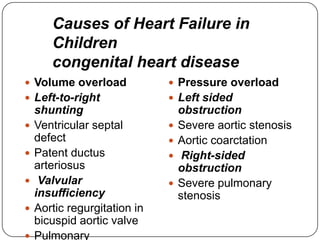
Causes of heart failure
 congenital
 acquired
 Volume overload
 Left-to-right
shunting
 Ventricular septal
defect
 Patent ductus
arteriosus
 Valvular
insufficiency
 Aortic regurgitation in
bicuspid aortic valve
 Pulmonary
 Pressure overload
 Left sided
obstruction
 Severe aortic stenosis
 Aortic coarctation
 Right-sided
obstruction
 Severe pulmonary
stenosis
Causes of Heart Failure in
Children
congenital heart disease
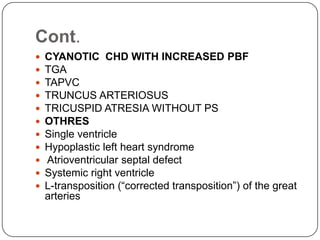
Cont.
 CYANOTIC CHD WITH INCREASED PBF
 TGA
 TAPVC
 TRUNCUS ARTERIOSUS
 TRICUSPID ATRESIA WITHOUT PS
 OTHRES
 Single ventricle
 Hypoplastic left heart syndrome
 Atrioventricular septal defect
 Systemic right ventricle
 L-transposition (“corrected transposition”) of the great
arteries
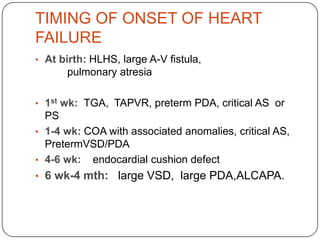
TIMING OF ONSET OF HEART
FAILURE
• At birth: HLHS, large A-V fistula,
pulmonary atresia
• 1st wk: TGA, TAPVR, preterm PDA, critical AS or
PS
• 1-4 wk: COA with associated anomalies, critical AS,
PretermVSD/PDA
• 4-6 wk: endocardial cushion defect
• 6 wk-4 mth: large VSD, large PDA,ALCAPA.
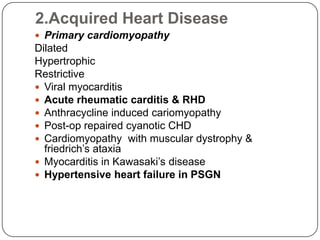
2.Acquired Heart Disease
 Primary cardiomyopathy
Dilated
Hypertrophic
Restrictive
 Viral myocarditis
 Acute rheumatic carditis & RHD
 Anthracycline induced cariomyopathy
 Post-op repaired cyanotic CHD
 Cardiomyopathy with muscular dystrophy &
friedrich’s ataxia
 Myocarditis in Kawasaki’s disease
 Hypertensive heart failure in PSGN
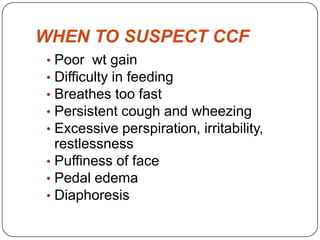
WHEN TO SUSPECT CCF
• Poor wt gain
• Difficulty in feeding
• Breathes too fast
• Persistent cough and wheezing
• Excessive perspiration, irritability,
restlessness
• Puffiness of face
• Pedal edema
• Diaphoresis
APPROACH TO PATIENT
 HISTORY
 PHYSICAL EXAMINATION
 INVESTIGATION
 TREATMENT
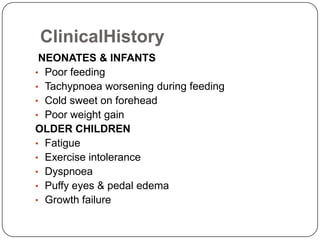
ClinicalHistory
NEONATES & INFANTS
• Poor feeding
• Tachypnoea worsening during feeding
• Cold sweet on forehead
• Poor weight gain
OLDER CHILDREN
• Fatigue
• Exercise intolerance
• Dyspnoea
• Puffy eyes & pedal edema
• Growth failure
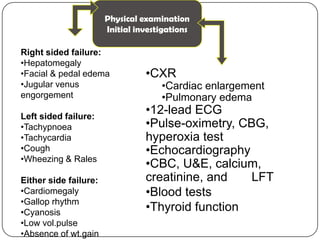
Physical examination
Initial investigations
Right sided failure:
•Hepatomegaly
•Facial & pedal edema
•Jugular venus
engorgement
Left sided failure:
•Tachypnoea
•Tachycardia
•Cough
•Wheezing & Rales
Either side failure:
•Cardiomegaly
•Gallop rhythm
•Cyanosis
•Low vol.pulse
•Absence of wt.gain
•CXR
•Cardiac enlargement
•Pulmonary edema
•12-lead ECG
•Pulse-oximetry, CBG,
hyperoxia test
•Echocardiography
•CBC, U&E, calcium,
creatinine, and LFT
•Blood tests
•Thyroid function
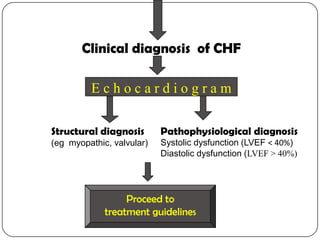
Clinical diagnosis of CHF
E c h o c a r d i o g r a m
Structural diagnosis
(eg myopathic, valvular)
Pathophysiological diagnosis
Systolic dysfunction (LVEF < 40%)
Diastolic dysfunction (LVEF > 40%)
Proceed to
treatment guidelines
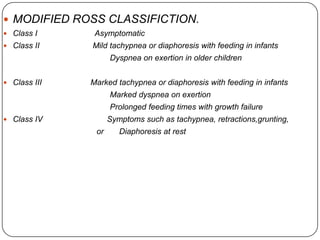
 MODIFIED ROSS CLASSIFICTION.
 Class I Asymptomatic
 Class II Mild tachypnea or diaphoresis with feeding in infants
Dyspnea on exertion in older children
 Class III Marked tachypnea or diaphoresis with feeding in infants
Marked dyspnea on exertion
Prolonged feeding times with growth failure
 Class IV Symptoms such as tachypnea, retractions,grunting,
or Diaphoresis at rest
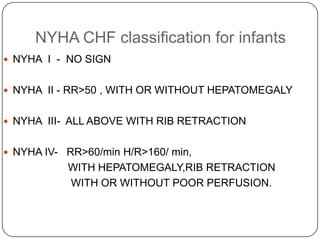
NYHA CHF classification for infants
 NYHA I - NO SIGN
 NYHA II - RR>50 , WITH OR WITHOUT HEPATOMEGALY
 NYHA III- ALL ABOVE WITH RIB RETRACTION
 NYHA IV- RR>60/min H/R>160/ min,
WITH HEPATOMEGALY,RIB RETRACTION
WITH OR WITHOUT POOR PERFUSION.
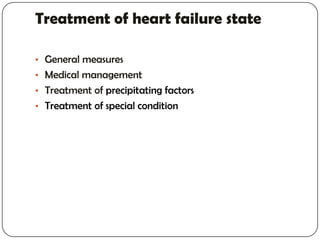
Treatment of heart failure state
• General measures
• Medical management
• Treatment of precipitating factors
• Treatment of special condition
General measures
• Propped –up position
• Oxygen
• Adequate calories
• Salt restriction
• Bed rest
• Daily wt
• Mx respiratory failure
Precipitating factors
• Hypertension
• Anemia
• Arrhythmia
• Hyperthyroidism
• Infection
• Fever
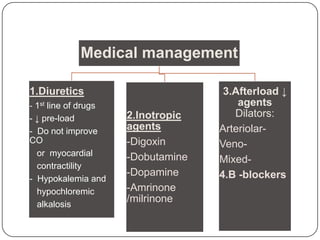
Medical management
1.Diuretics
- 1st line of drugs
- ↓ pre-load
- Do not improve
CO
or myocardial
contractility
- Hypokalemia and
hypochloremic
alkalosis
2.Inotropic
agents
-Digoxin
-Dobutamine
-Dopamine
-Amrinone
/milrinone
3.Afterload ↓
agents
Dilators:
Arteriolar-
Veno-
Mixed-
4.B -blockers
DIURETICS
 Act by ↓venous return ,end diastolic
volume, ↓ pulmonary edema & work of
breathing.
 Furosemide is diuretic of choice.
 Spironolactone(2-4mg/kg/d) may be
used as add on drug.
 Metolazone(0.1-0.2mg/kg) has been
tried in frusemide resistant edema.
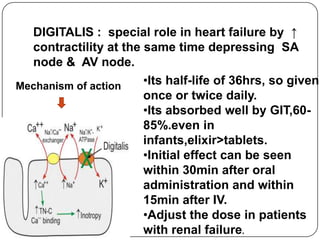
Mechanism of action
DIGITALIS : special role in heart failure by ↑
contractility at the same time depressing SA
node & AV node.
•Its half-life of 36hrs, so given
once or twice daily.
•Its absorbed well by GIT,60-
85%.even in
infants,elixir>tablets.
•Initial effect can be seen
within 30min after oral
administration and within
15min after IV.
•Adjust the dose in patients
with renal failure.
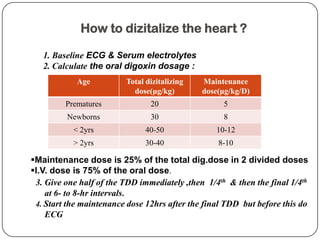
How to dizitalize the heart ?
1. Baseline ECG & Serum electrolytes
2. Calculate the oral digoxin dosage :
Age Total dizitalizing
dose(μg/kg)
Maintenance
dose(μg/kg/D)
Prematures 20 5
Newborns 30 8
< 2yrs 40-50 10-12
> 2yrs 30-40 8-10
Maintenance dose is 25% of the total dig.dose in 2 divided doses
I.V. dose is 75% of the oral dose.
3. Give one half of the TDD immediately ,then 1/4th & then the final 1/4th
at 6- to 8-hr intervals.
4. Start the maintenance dose 12hrs after the final TDD but before this do
ECG
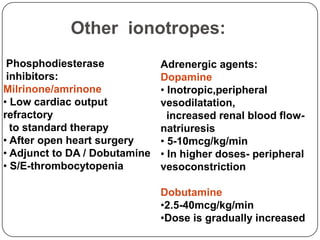
Other ionotropes:
Phosphodiesterase
inhibitors:
Milrinone/amrinone
• Low cardiac output
refractory
to standard therapy
• After open heart surgery
• Adjunct to DA / Dobutamine
• S/E-thrombocytopenia
Adrenergic agents:
Dopamine
• Inotropic,peripheral
vesodilatation,
increased renal blood flow-
natriuresis
• 5-10mcg/kg/min
• In higher doses- peripheral
vesoconstriction
Dobutamine
•2.5-40mcg/kg/min
•Dose is gradually increased
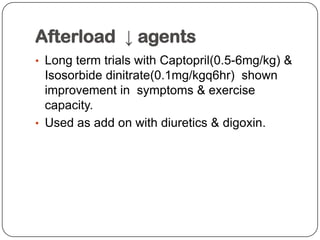
Afterload ↓ agents
• Long term trials with Captopril(0.5-6mg/kg) &
Isosorbide dinitrate(0.1mg/kgq6hr) shown
improvement in symptoms & exercise
capacity.
• Used as add on with diuretics & digoxin.
ß BLOCKERS
 Effacious in CHF in children due to CHD,
Anthracycline induced cardiomyopathy ,
dilated cardiomyopathy.
 Improved left ventricular function & exercise
tolerance, decreased need for heart transplant.
 It has been shown to improve clinical symptoms
& neurohormonal markers in infants with CHF
due to Lt to Rt shunts.
 Dose should titrated upwards
 Avoid in decompensated heart failure.
 Carvedilol(initial dose0.08→0.46mg/kg)
Nonpharmacological treatment
modalities
Cadiac resynchronization
therapy:
BiVP
• cardiomyopathy
• LBBB
LV assist device
Surgery:
(depends on the type of defect)
 Blalock Taussig
shunt
 Balloon
septoplasty
 Mustard Senning
 Jatene’s switch
HEART FAILURE IN SPECIAL
CONDITION
 Ductus dependent circulation
 Rheumatic carditis
 Kawasaki’s disease
 Anthracycline toxicity
 Preterm PDA
THANK YOU

Heart failure in pediatrics sandip

  • 1.
  • 2.
    DEFINITION  HEART FAILURE:It is syndrome in which heart is unable to provide the output required to meet the metabolic demands of the body(systolic failure) and/or inability to receive blood in to the ventricular cavities at low pressure during diastole (diastolic failure).
  • 3.
    Causes of heartfailure  congenital  acquired
  • 4.
     Volume overload Left-to-right shunting  Ventricular septal defect  Patent ductus arteriosus  Valvular insufficiency  Aortic regurgitation in bicuspid aortic valve  Pulmonary  Pressure overload  Left sided obstruction  Severe aortic stenosis  Aortic coarctation  Right-sided obstruction  Severe pulmonary stenosis Causes of Heart Failure in Children congenital heart disease
  • 5.
    Cont.  CYANOTIC CHDWITH INCREASED PBF  TGA  TAPVC  TRUNCUS ARTERIOSUS  TRICUSPID ATRESIA WITHOUT PS  OTHRES  Single ventricle  Hypoplastic left heart syndrome  Atrioventricular septal defect  Systemic right ventricle  L-transposition (“corrected transposition”) of the great arteries
  • 6.
    TIMING OF ONSETOF HEART FAILURE • At birth: HLHS, large A-V fistula, pulmonary atresia • 1st wk: TGA, TAPVR, preterm PDA, critical AS or PS • 1-4 wk: COA with associated anomalies, critical AS, PretermVSD/PDA • 4-6 wk: endocardial cushion defect • 6 wk-4 mth: large VSD, large PDA,ALCAPA.
  • 7.
    2.Acquired Heart Disease Primary cardiomyopathy Dilated Hypertrophic Restrictive  Viral myocarditis  Acute rheumatic carditis & RHD  Anthracycline induced cariomyopathy  Post-op repaired cyanotic CHD  Cardiomyopathy with muscular dystrophy & friedrich’s ataxia  Myocarditis in Kawasaki’s disease  Hypertensive heart failure in PSGN
  • 8.
    WHEN TO SUSPECTCCF • Poor wt gain • Difficulty in feeding • Breathes too fast • Persistent cough and wheezing • Excessive perspiration, irritability, restlessness • Puffiness of face • Pedal edema • Diaphoresis
  • 9.
    APPROACH TO PATIENT HISTORY  PHYSICAL EXAMINATION  INVESTIGATION  TREATMENT
  • 10.
    ClinicalHistory NEONATES & INFANTS •Poor feeding • Tachypnoea worsening during feeding • Cold sweet on forehead • Poor weight gain OLDER CHILDREN • Fatigue • Exercise intolerance • Dyspnoea • Puffy eyes & pedal edema • Growth failure
  • 11.
    Physical examination Initial investigations Rightsided failure: •Hepatomegaly •Facial & pedal edema •Jugular venus engorgement Left sided failure: •Tachypnoea •Tachycardia •Cough •Wheezing & Rales Either side failure: •Cardiomegaly •Gallop rhythm •Cyanosis •Low vol.pulse •Absence of wt.gain •CXR •Cardiac enlargement •Pulmonary edema •12-lead ECG •Pulse-oximetry, CBG, hyperoxia test •Echocardiography •CBC, U&E, calcium, creatinine, and LFT •Blood tests •Thyroid function
  • 12.
    Clinical diagnosis ofCHF E c h o c a r d i o g r a m Structural diagnosis (eg myopathic, valvular) Pathophysiological diagnosis Systolic dysfunction (LVEF < 40%) Diastolic dysfunction (LVEF > 40%) Proceed to treatment guidelines
  • 13.
     MODIFIED ROSSCLASSIFICTION.  Class I Asymptomatic  Class II Mild tachypnea or diaphoresis with feeding in infants Dyspnea on exertion in older children  Class III Marked tachypnea or diaphoresis with feeding in infants Marked dyspnea on exertion Prolonged feeding times with growth failure  Class IV Symptoms such as tachypnea, retractions,grunting, or Diaphoresis at rest
  • 14.
    NYHA CHF classificationfor infants  NYHA I - NO SIGN  NYHA II - RR>50 , WITH OR WITHOUT HEPATOMEGALY  NYHA III- ALL ABOVE WITH RIB RETRACTION  NYHA IV- RR>60/min H/R>160/ min, WITH HEPATOMEGALY,RIB RETRACTION WITH OR WITHOUT POOR PERFUSION.
  • 15.
    Treatment of heartfailure state • General measures • Medical management • Treatment of precipitating factors • Treatment of special condition
  • 16.
    General measures • Propped–up position • Oxygen • Adequate calories • Salt restriction • Bed rest • Daily wt • Mx respiratory failure
  • 17.
    Precipitating factors • Hypertension •Anemia • Arrhythmia • Hyperthyroidism • Infection • Fever
  • 18.
    Medical management 1.Diuretics - 1stline of drugs - ↓ pre-load - Do not improve CO or myocardial contractility - Hypokalemia and hypochloremic alkalosis 2.Inotropic agents -Digoxin -Dobutamine -Dopamine -Amrinone /milrinone 3.Afterload ↓ agents Dilators: Arteriolar- Veno- Mixed- 4.B -blockers
  • 19.
    DIURETICS  Act by↓venous return ,end diastolic volume, ↓ pulmonary edema & work of breathing.  Furosemide is diuretic of choice.  Spironolactone(2-4mg/kg/d) may be used as add on drug.  Metolazone(0.1-0.2mg/kg) has been tried in frusemide resistant edema.
  • 20.
    Mechanism of action DIGITALIS: special role in heart failure by ↑ contractility at the same time depressing SA node & AV node. •Its half-life of 36hrs, so given once or twice daily. •Its absorbed well by GIT,60- 85%.even in infants,elixir>tablets. •Initial effect can be seen within 30min after oral administration and within 15min after IV. •Adjust the dose in patients with renal failure.
  • 21.
    How to dizitalizethe heart ? 1. Baseline ECG & Serum electrolytes 2. Calculate the oral digoxin dosage : Age Total dizitalizing dose(μg/kg) Maintenance dose(μg/kg/D) Prematures 20 5 Newborns 30 8 < 2yrs 40-50 10-12 > 2yrs 30-40 8-10 Maintenance dose is 25% of the total dig.dose in 2 divided doses I.V. dose is 75% of the oral dose. 3. Give one half of the TDD immediately ,then 1/4th & then the final 1/4th at 6- to 8-hr intervals. 4. Start the maintenance dose 12hrs after the final TDD but before this do ECG
  • 22.
    Other ionotropes: Phosphodiesterase inhibitors: Milrinone/amrinone • Lowcardiac output refractory to standard therapy • After open heart surgery • Adjunct to DA / Dobutamine • S/E-thrombocytopenia Adrenergic agents: Dopamine • Inotropic,peripheral vesodilatation, increased renal blood flow- natriuresis • 5-10mcg/kg/min • In higher doses- peripheral vesoconstriction Dobutamine •2.5-40mcg/kg/min •Dose is gradually increased
  • 23.
    Afterload ↓ agents •Long term trials with Captopril(0.5-6mg/kg) & Isosorbide dinitrate(0.1mg/kgq6hr) shown improvement in symptoms & exercise capacity. • Used as add on with diuretics & digoxin.
  • 24.
    ß BLOCKERS  Effaciousin CHF in children due to CHD, Anthracycline induced cardiomyopathy , dilated cardiomyopathy.  Improved left ventricular function & exercise tolerance, decreased need for heart transplant.  It has been shown to improve clinical symptoms & neurohormonal markers in infants with CHF due to Lt to Rt shunts.  Dose should titrated upwards  Avoid in decompensated heart failure.  Carvedilol(initial dose0.08→0.46mg/kg)
  • 25.
    Nonpharmacological treatment modalities Cadiac resynchronization therapy: BiVP •cardiomyopathy • LBBB LV assist device Surgery: (depends on the type of defect)  Blalock Taussig shunt  Balloon septoplasty  Mustard Senning  Jatene’s switch
  • 26.
    HEART FAILURE INSPECIAL CONDITION  Ductus dependent circulation  Rheumatic carditis  Kawasaki’s disease  Anthracycline toxicity  Preterm PDA
  • 27.