Dr Hussein Abdeldayem
Prof of Pediatric
Neurology
Mental
retardation
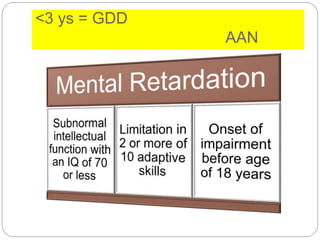
<3 ys = GDD
AAN
Investigation
s
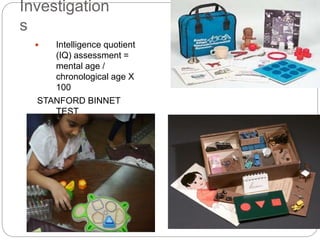
 Intelligence quotient
(IQ) assessment =
mental age /
chronological age X
100
STANFORD BINNET
TEST
WESCHLER TEST
Investigation (cont.)
 Delay speech: Hearing assessment
 thyroid functions (T4, TSH
 Chromosomal study
 Brain CT &/or MRI
 Urine: screening for organic acids and amino
acids, mucoplysacharides
 Blood: phenylalanine, lactic acid, ammonia,
aminoacids
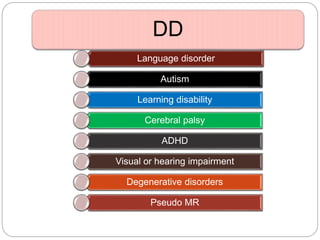
DD
Language disorder
Autism
Learning disability
Cerebral palsy
ADHD
Visual or hearing impairment
Degenerative disorders
Pseudo MR
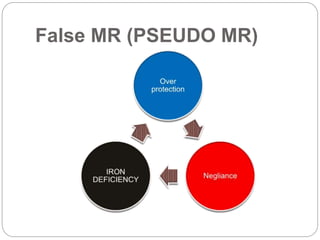
False MR (PSEUDO MR)
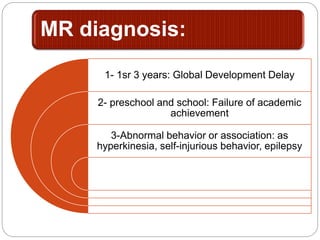
MR diagnosis:
1- 1sr 3 years: Global Development Delay
2- preschool and school: Failure of academic
achievement
3-Abnormal behavior or association: as
hyperkinesia, self-injurious behavior, epilepsy
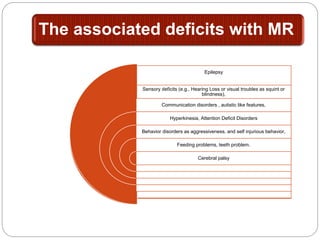
The associated deficits with MR
Epilepsy
Sensory deficits (e.g., Hearing Loss or visual troubles as squint or
blindness),
Communication disorders , autistic like features,
Hyperkinesia, Attention Deficit Disorders
Behavior disorders as aggressiveness, and self injurious behavior,
Feeding problems, teeth problem.
Cerebral palsy
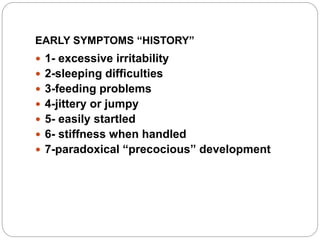
EARLY SYMPTOMS “HISTORY”
 1- excessive irritability
 2-sleeping difficulties
 3-feeding problems
 4-jittery or jumpy
 5- easily startled
 6- stiffness when handled
 7-paradoxical “precocious” development
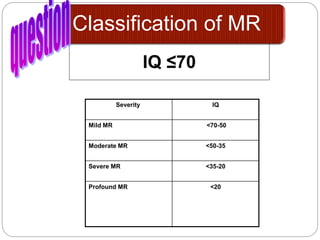
IQ ≤70
Classification of MR
Severity IQ
Mild MR <70-50
Moderate MR <50-35
Severe MR <35-20
Profound MR <20
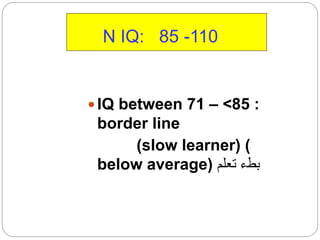
N IQ: 85 -110
 IQ between 71 – <85 :
border line
(slow learner) (
below average) ‫تعلم‬ ‫بطء‬
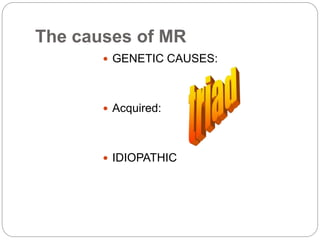
The causes of MR
 GENETIC CAUSES:
 Acquired:
 IDIOPATHIC
The causes of MR
 GENETIC CAUSES:
1- hereditary: AR, AD, AR
2- chromosomal: DS
3- syndrome and brain dysgenesis
 Acquired:
1- prenatal
2- perinatal
3- postnatal (acquired)
 IDIOPATHIC
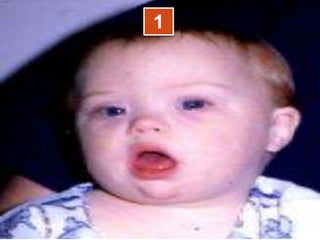
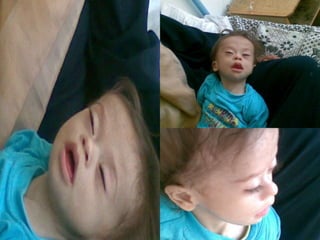
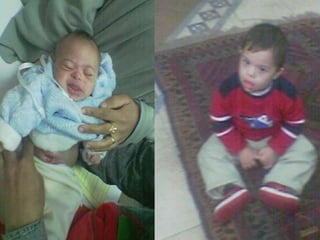
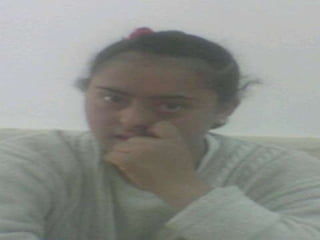
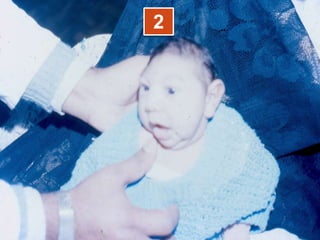
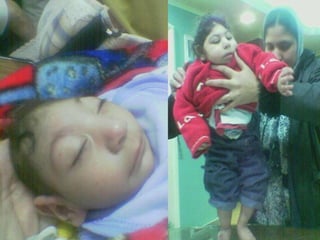
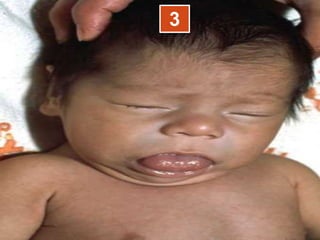
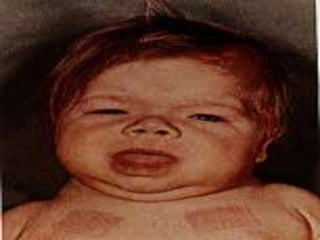
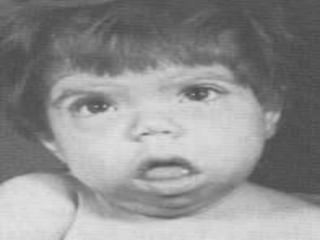
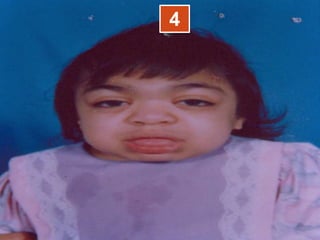
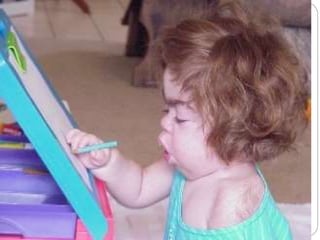
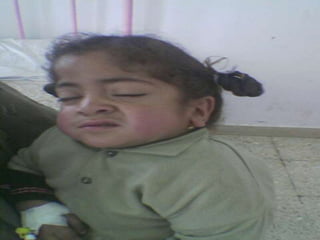
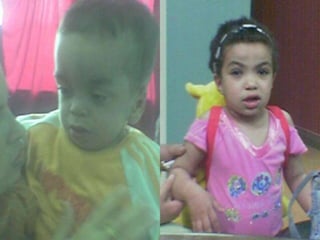
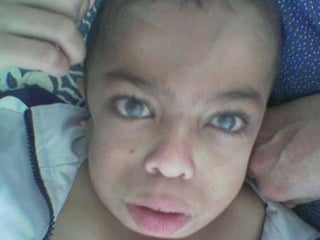
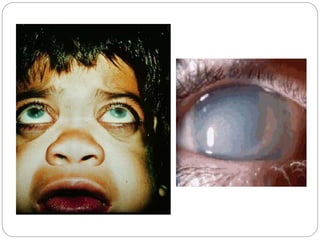
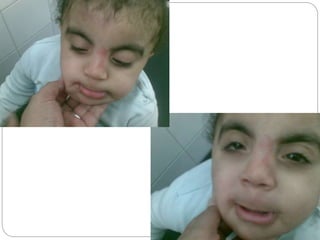
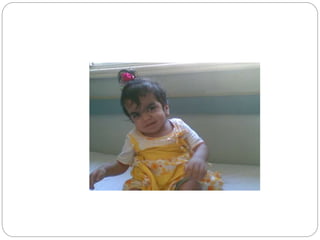
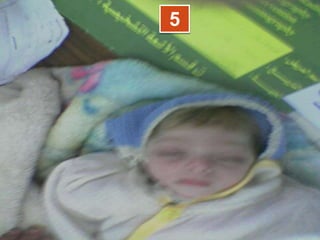
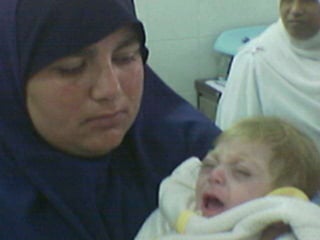
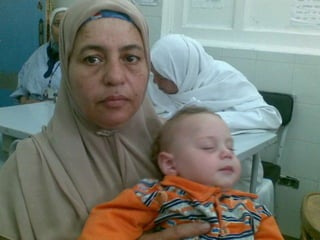
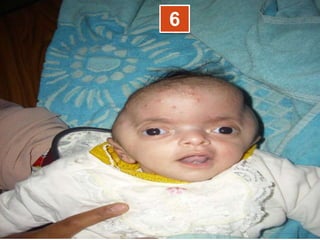
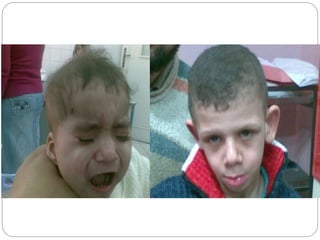
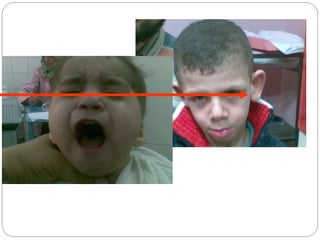
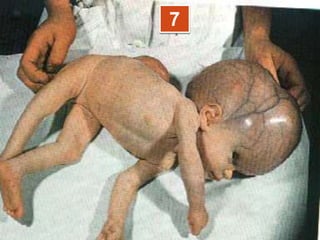
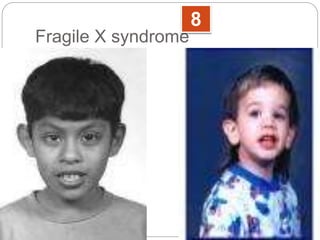
Cases of MR diagnosed by Face
1
2
3
4
5
6
7
Fragile X syndrome
8
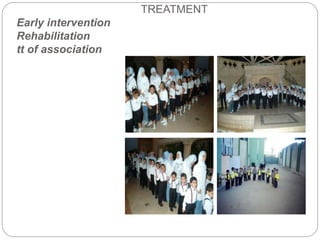
TREATMENT
Early intervention
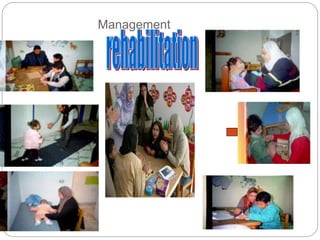
Rehabilitation
tt of association
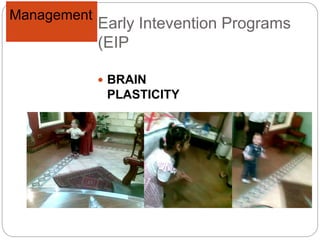
Early Intevention Programs
(EIP
 BRAIN
PLASTICITY
Management
Management
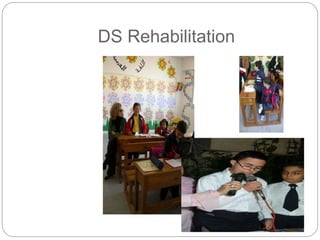
DS Rehabilitation
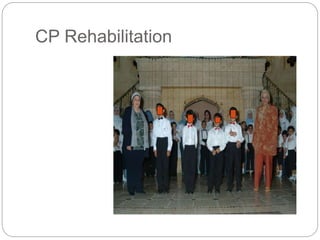
CP Rehabilitation
 all of the following are FALSE about mental
retardation except one:
1-IQ is less than 60
2- IQ is less than 70
3- IQ is less than 80
4- IQ is less than 90
Question
 the following cases are mental retardation that
can be diagnosed from face features, except
one:
1- Down syndrome
2- microcephaly
3- mucopolysaccharidoses
4- congenital hypothyroidism
5- cerebral palsy
Question
 9 months baby only coo, can’t sit, with
sissoring and increased deep tendon reflexes,
social smile. What is ur diagnosis?
Question
early spastic CP with global developmental delay
 9 months baby with ability to hold things
between thumb and index , say dada and papa
, able to crawl. Parents are anxious . what is
ur opinion?
Question
Assure the parent. He is a normal child
as regard his developmental milestones
achievement
 3 causes of preventable MR,
how to detect and
their preventable measures
Question
Congenital Hypothyroidism
PKU
Galactosemia
By
Abdul Rahman bin Saad (60)
Abdul Rahim bin Ramdzan (61)
Abdul Rahim bin Suhaini (62)
Prevention of Mental Retardation
Presentation
Prepared by
Abdul Rahman bin Saad (60)
Abdul Rahim bin Ramdzan (61)
Abdul Rahim bin Suhaini (62)
Abdul Rashid bin Abdul Ghani (63)
Ezza Syuhaida binti Zakaria (64)
Primary Prevention
Abdul Rahman Bin Saad 60
Dr Hussein Abdeldayem
Alex University
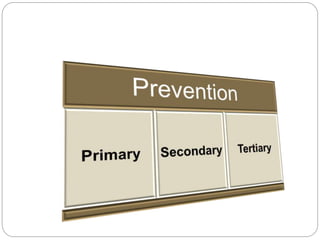
Prevention
 Primary Prevention
 Secondary Prevention
 Tertiary Prevention
 Quaternary Prevention
Dr Hussein Abdeldayem
Alex University
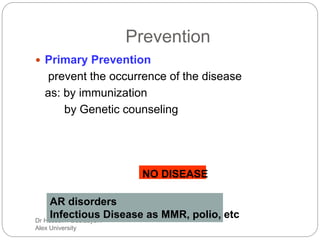
Prevention
 Primary Prevention
prevent the occurrence of the disease
as: by immunization
by Genetic counseling
NO DISEASE
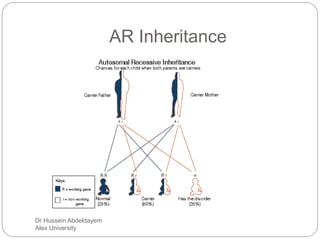
AR disorders
Infectious Disease as MMR, polio, etc
Dr Hussein Abdeldayem
Alex University
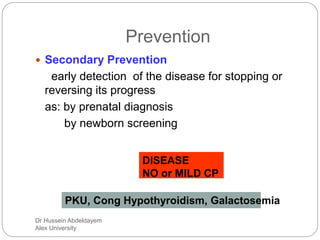
Prevention
 Secondary Prevention
early detection of the disease for stopping or
reversing its progress
as: by prenatal diagnosis
by newborn screening
DISEASE
NO or MILD CP
PKU, Cong Hypothyroidism, Galactosemia
Dr Hussein Abdeldayem
Alex University
Prevention
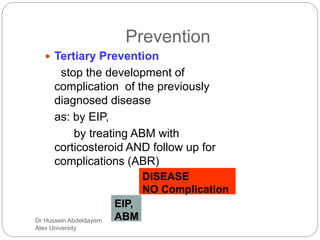
 Tertiary Prevention
stop the development of
complication of the previously
diagnosed disease
as: by EIP,
by treating ABM with
corticosteroid AND follow up for
complications (ABR)
DISEASE
NO Complication
EIP,
ABM
Dr Hussein Abdeldayem
Alex University
Prevention
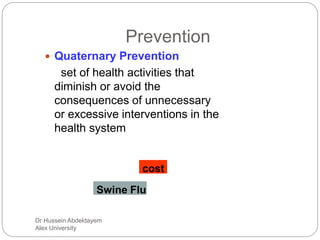
 Quaternary Prevention
set of health activities that
diminish or avoid the
consequences of unnecessary
or excessive interventions in the
health system
cost
Swine Flu
Dr Hussein Abdeldayem
Alex University
AR Inheritance
Dr Hussein Abdeldayem
Alex University
Prevention and Neurologic disorders
 Down syndrome
 PKU
 Congenital hypothyroidism
 Galactosemia
 Congenital rubella syndrome ( GM )
Dr Hussein Abdeldayem
Alex University
Down syndrome
1ry (no DS baby)
 Translocated mother (4%)
Risk 10%
Risk 100% (21/21)
Prevention: genetic counseling
(prevent conception)
 Non-Disjunction (95%)
Risk: 1/1000
increase by: age or with a DS baby
Prevention: avoid late age or
frequent conception
Recent: Pre-implantation selection
?? Folic acid supplementa
Dr Hussein Abdeldayem
Alex University
Down Syndrome
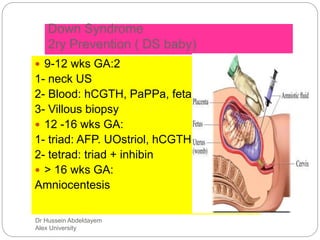
2ry Prevention ( DS baby)
 9-12 wks GA:2
1- neck US
2- Blood: hCGTH, PaPPa, fetal RBC
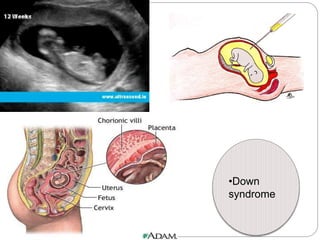
3- Villous biopsy
 12 -16 wks GA:
1- triad: AFP. UOstriol, hCGTH
2- tetrad: triad + inhibin
 > 16 wks GA:
Amniocentesis
•Down
syndrome
Dr Hussein Abdeldayem
Alex University
DS
3ry Prevention
 EIP
 Echocardiography
 Visual acuity/y
 Thyroid function/y (TSH,T4)
 Tympanometry/y
 Neck X ray at 3-5 yrs*
*Neutral view, flexion &
extension
Dr Hussein Abdeldayem
Alex University
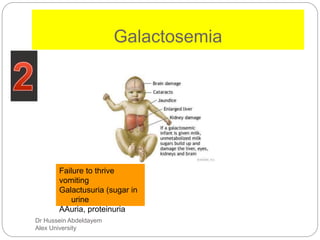
Galactosemia
Failure to thrive
vomiting
Galactusuria (sugar in
urine
AAuria, proteinuria
Dr Hussein Abdeldayem
Alex University
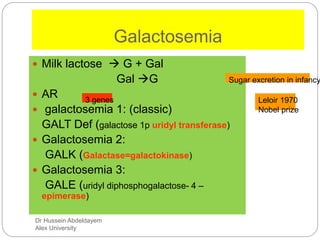
Galactosemia
 Milk lactose  G + Gal
Gal G
 AR
 galactosemia 1: (classic)
GALT Def (galactose 1p uridyl transferase)
 Galactosemia 2:
GALK (Galactase=galactokinase)
 Galactosemia 3:
GALE (uridyl diphosphogalactose- 4 –
epimerase)
Sugar excretion in infancy
Leloir 1970
Nobel prize
3 genes
Dr Hussein Abdeldayem
Alex University
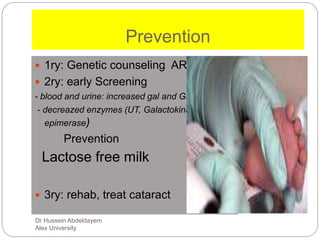
Prevention
 1ry: Genetic counseling AR
 2ry: early Screening
- blood and urine: increased gal and Gal 1 P
- decreazed enzymes (UT, Galactokinase,
epimerase)
Prevention
Lactose free milk
 3ry: rehab, treat cataract
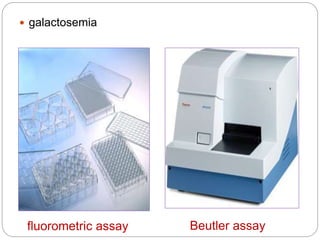
 galactosemia
fluorometric assay Beutler assay
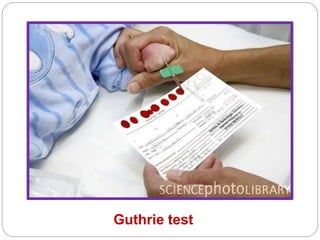
Guthrie test
Dr Hussein Abdeldayem
Alex University
PKU
 AR
 Gene on chromosome 12
 Enzyme deficiency: phenylalanine hydroxylase
 Types:
1- classic
2- cofactor BH4 (tetrahydrobiopterin )
3- mixed* : mild ( no disease)
Dr Hussein Abdeldayem
Alex University
PKU
 Classic: P Hydroxylase deficiency
- blood: severe hyperphenylalaninemia >20 mg/dl
 Cofactor BH4 deficiency
- normal phenylalanine in blood or mild raised
- BH4 Cofactor for phenylalanine, tyrosine and tryptophan
- diagnosis:
A- measure neopterin and biopterin in urine
B- loading test: oral BH4 (20 MG/KG) then measure phenylalanine
C- enzyme assay
 mixed
Dr Hussein Abdeldayem
Alex University
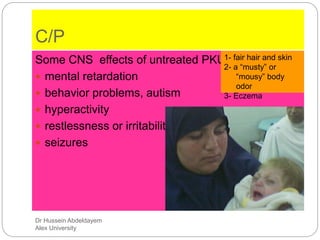
C/P
Some CNS effects of untreated PKU include:
 mental retardation
 behavior problems, autism
 hyperactivity
 restlessness or irritability
 seizures
1- fair hair and skin
2- a “musty” or
“mousy” body
odor
3- Eczema
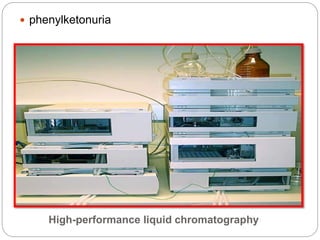
High-performance liquid chromatography
 phenylketonuria
Dr Hussein Abdeldayem
Alex University
PKU
PREVENTION
 1ry: genetic counseling AR
 2ry: a- neonatal screening
then low phenylalanine milk
 3ry: rehabilitation , diet resriction
LOW phenylalanine milk
Dr Hussein Abdeldayem
Alex University
maternal PKU syndrome
 Pregnancy in women with PKU (“Maternal PKU”)
Women with PKU who are not on the low-Phe diet
when they become pregnant have a high chance of
having babies with
 birth defects as congenital HD
 mental retardation
 microcephaly (recurrent)
 SGA
Dr Hussein Abdeldayem
Alex University
Maternal PKU syndrome / Prevention
During pregnancy, they need to:
 stay on the low-Phe diet
 visit their PKU clinic on a regular basis
 have their blood Phe levels checked often
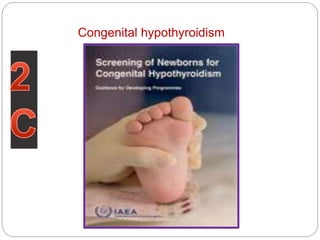
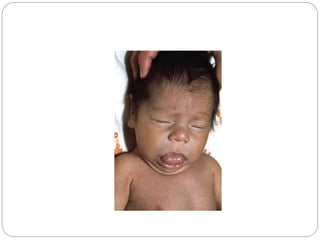
Congenital hypothyroidism
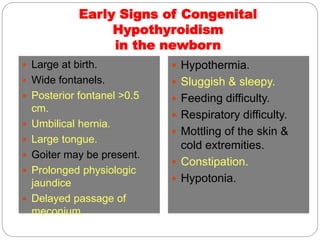
Early Signs of Congenital
Hypothyroidism
in the newborn
 Hypothermia.
 Sluggish & sleepy.
 Feeding difficulty.
 Respiratory difficulty.
 Mottling of the skin &
cold extremities.
 Constipation.
 Hypotonia.
 Large at birth.
 Wide fontanels.
 Posterior fontanel >0.5
cm.
 Umbilical hernia.
 Large tongue.
 Goiter may be present.
 Prolonged physiologic
jaundice
 Delayed passage of
meconium.
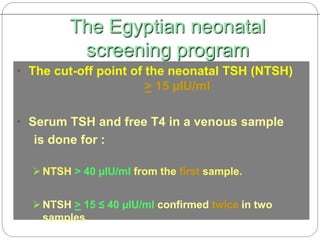
The Egyptian neonatal
screening program
• The cut-off point of the neonatal TSH (NTSH)
> 15 µIU/ml
• Serum TSH and free T4 in a venous sample
is done for :
NTSH > 40 µIU/ml from the first sample.
NTSH > 15 ≤ 40 µIU/ml confirmed twice in two
samples.
 Sodium-L-thyroxine given orally is the treatment of
choice.
 For infants, the starting dose usually is 12-15
ug/kg per day (37.5-50 µg/day).
 Children require 100 ug/m2/day.
 Thyroxine tablets should not be mixed with soy
protein formula or iron, because these can bind T4
and inhibit its absorption
Treatment
Dec 27,2003
Intra-Uterine Infection:
Cong Rubella Syndrome:
 1st 3 mo : 50% of fetus affected
 > 3mo : 15% of fetus affected
 CNS: MR, microcephaly, epilepsy
 SNHL
 Eyes: congenitaal cataract
 Cardiac: PDA
 organomagaly,
 SGA

Congenital Rubella Syndrome
Dr Hussein Abdeldayem
Alex University
Prevention
 Congenital Rubella Vaccine:
vaccine of all females against (at least 3 mo
preconception) of GM
LA vaccine
SC
Age: 12 mo age
5 year age
www.scc-osha.com
Facebook.com/‫للطفل‬ ‫التخصصى‬ ‫المركز‬
Etiology :
 1ry (genetic)
 2ry (acquired )
 Idiopathic
Etiology :
1ry (genetic)
1- hereditary: AR, AD,XL
2- chromosomal disorders
3- syndrome/dysgenesis
Etiology :
Secondary ( Acquired)
 1- prenatal :fetal disorder, gestational disease, maternal disease
 2- perinatal : HIE, birth anoxia, neonatal sepsis, neonatal
hemorrhage
 3-Postnatal: meningitis/encephalitis, head trauma, IC hge,
severe dehydration, severe chronic malnutrition
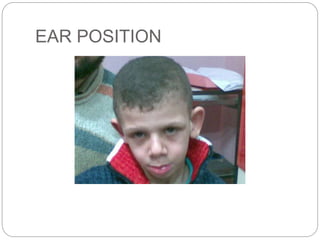
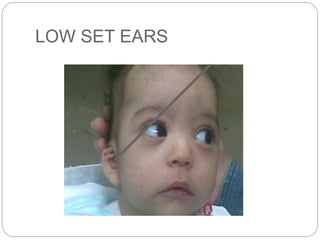
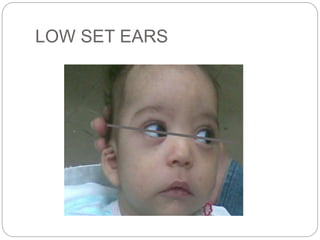
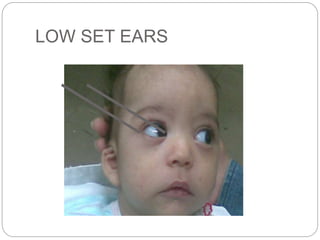
EAR POSITION
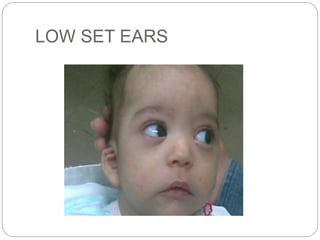
LOW SET EARS
LOW SET EARS
LOW SET EARS
LOW SET EARS
mental retardation
mental retardation

mental retardation

  • 1.
    Dr Hussein Abdeldayem Profof Pediatric Neurology Mental retardation
  • 2.
    <3 ys =GDD AAN
  • 3.
    Investigation s  Intelligence quotient (IQ)assessment = mental age / chronological age X 100 STANFORD BINNET TEST WESCHLER TEST
  • 4.
    Investigation (cont.)  Delayspeech: Hearing assessment  thyroid functions (T4, TSH  Chromosomal study  Brain CT &/or MRI  Urine: screening for organic acids and amino acids, mucoplysacharides  Blood: phenylalanine, lactic acid, ammonia, aminoacids
  • 5.
    DD Language disorder Autism Learning disability Cerebralpalsy ADHD Visual or hearing impairment Degenerative disorders Pseudo MR
  • 6.
  • 7.
    MR diagnosis: 1- 1sr3 years: Global Development Delay 2- preschool and school: Failure of academic achievement 3-Abnormal behavior or association: as hyperkinesia, self-injurious behavior, epilepsy
  • 8.
    The associated deficitswith MR Epilepsy Sensory deficits (e.g., Hearing Loss or visual troubles as squint or blindness), Communication disorders , autistic like features, Hyperkinesia, Attention Deficit Disorders Behavior disorders as aggressiveness, and self injurious behavior, Feeding problems, teeth problem. Cerebral palsy
  • 9.
    EARLY SYMPTOMS “HISTORY” 1- excessive irritability  2-sleeping difficulties  3-feeding problems  4-jittery or jumpy  5- easily startled  6- stiffness when handled  7-paradoxical “precocious” development
  • 10.
    IQ ≤70 Classification ofMR Severity IQ Mild MR <70-50 Moderate MR <50-35 Severe MR <35-20 Profound MR <20
  • 11.
    N IQ: 85-110  IQ between 71 – <85 : border line (slow learner) ( below average) ‫تعلم‬ ‫بطء‬
  • 12.
    The causes ofMR  GENETIC CAUSES:  Acquired:  IDIOPATHIC
  • 13.
    The causes ofMR  GENETIC CAUSES: 1- hereditary: AR, AD, AR 2- chromosomal: DS 3- syndrome and brain dysgenesis  Acquired: 1- prenatal 2- perinatal 3- postnatal (acquired)  IDIOPATHIC
  • 15.
    Cases of MRdiagnosed by Face
  • 16.
  • 20.
  • 22.
  • 25.
  • 33.
  • 36.
  • 37.
  • 38.
  • 39.
  • 40.
    Early Intevention Programs (EIP BRAIN PLASTICITY Management
  • 41.
  • 42.
  • 43.
  • 44.
     all ofthe following are FALSE about mental retardation except one: 1-IQ is less than 60 2- IQ is less than 70 3- IQ is less than 80 4- IQ is less than 90 Question
  • 45.
     the followingcases are mental retardation that can be diagnosed from face features, except one: 1- Down syndrome 2- microcephaly 3- mucopolysaccharidoses 4- congenital hypothyroidism 5- cerebral palsy Question
  • 46.
     9 monthsbaby only coo, can’t sit, with sissoring and increased deep tendon reflexes, social smile. What is ur diagnosis? Question early spastic CP with global developmental delay
  • 47.
     9 monthsbaby with ability to hold things between thumb and index , say dada and papa , able to crawl. Parents are anxious . what is ur opinion? Question Assure the parent. He is a normal child as regard his developmental milestones achievement
  • 48.
     3 causesof preventable MR, how to detect and their preventable measures Question Congenital Hypothyroidism PKU Galactosemia
  • 50.
    By Abdul Rahman binSaad (60) Abdul Rahim bin Ramdzan (61) Abdul Rahim bin Suhaini (62) Prevention of Mental Retardation
  • 51.
    Prevention of MentalRetardation Presentation Prepared by Abdul Rahman bin Saad (60) Abdul Rahim bin Ramdzan (61) Abdul Rahim bin Suhaini (62) Abdul Rashid bin Abdul Ghani (63) Ezza Syuhaida binti Zakaria (64)
  • 52.
  • 54.
    Dr Hussein Abdeldayem AlexUniversity Prevention  Primary Prevention  Secondary Prevention  Tertiary Prevention  Quaternary Prevention
  • 55.
    Dr Hussein Abdeldayem AlexUniversity Prevention  Primary Prevention prevent the occurrence of the disease as: by immunization by Genetic counseling NO DISEASE AR disorders Infectious Disease as MMR, polio, etc
  • 56.
    Dr Hussein Abdeldayem AlexUniversity Prevention  Secondary Prevention early detection of the disease for stopping or reversing its progress as: by prenatal diagnosis by newborn screening DISEASE NO or MILD CP PKU, Cong Hypothyroidism, Galactosemia
  • 57.
    Dr Hussein Abdeldayem AlexUniversity Prevention  Tertiary Prevention stop the development of complication of the previously diagnosed disease as: by EIP, by treating ABM with corticosteroid AND follow up for complications (ABR) DISEASE NO Complication EIP, ABM
  • 58.
    Dr Hussein Abdeldayem AlexUniversity Prevention  Quaternary Prevention set of health activities that diminish or avoid the consequences of unnecessary or excessive interventions in the health system cost Swine Flu
  • 59.
    Dr Hussein Abdeldayem AlexUniversity AR Inheritance
  • 60.
    Dr Hussein Abdeldayem AlexUniversity Prevention and Neurologic disorders  Down syndrome  PKU  Congenital hypothyroidism  Galactosemia  Congenital rubella syndrome ( GM )
  • 61.
    Dr Hussein Abdeldayem AlexUniversity Down syndrome 1ry (no DS baby)  Translocated mother (4%) Risk 10% Risk 100% (21/21) Prevention: genetic counseling (prevent conception)  Non-Disjunction (95%) Risk: 1/1000 increase by: age or with a DS baby Prevention: avoid late age or frequent conception Recent: Pre-implantation selection ?? Folic acid supplementa
  • 62.
    Dr Hussein Abdeldayem AlexUniversity Down Syndrome 2ry Prevention ( DS baby)  9-12 wks GA:2 1- neck US 2- Blood: hCGTH, PaPPa, fetal RBC 3- Villous biopsy  12 -16 wks GA: 1- triad: AFP. UOstriol, hCGTH 2- tetrad: triad + inhibin  > 16 wks GA: Amniocentesis
  • 63.
  • 64.
    Dr Hussein Abdeldayem AlexUniversity DS 3ry Prevention  EIP  Echocardiography  Visual acuity/y  Thyroid function/y (TSH,T4)  Tympanometry/y  Neck X ray at 3-5 yrs* *Neutral view, flexion & extension
  • 65.
    Dr Hussein Abdeldayem AlexUniversity Galactosemia Failure to thrive vomiting Galactusuria (sugar in urine AAuria, proteinuria
  • 66.
    Dr Hussein Abdeldayem AlexUniversity Galactosemia  Milk lactose  G + Gal Gal G  AR  galactosemia 1: (classic) GALT Def (galactose 1p uridyl transferase)  Galactosemia 2: GALK (Galactase=galactokinase)  Galactosemia 3: GALE (uridyl diphosphogalactose- 4 – epimerase) Sugar excretion in infancy Leloir 1970 Nobel prize 3 genes
  • 67.
    Dr Hussein Abdeldayem AlexUniversity Prevention  1ry: Genetic counseling AR  2ry: early Screening - blood and urine: increased gal and Gal 1 P - decreazed enzymes (UT, Galactokinase, epimerase) Prevention Lactose free milk  3ry: rehab, treat cataract
  • 68.
  • 69.
  • 70.
    Dr Hussein Abdeldayem AlexUniversity PKU  AR  Gene on chromosome 12  Enzyme deficiency: phenylalanine hydroxylase  Types: 1- classic 2- cofactor BH4 (tetrahydrobiopterin ) 3- mixed* : mild ( no disease)
  • 71.
    Dr Hussein Abdeldayem AlexUniversity PKU  Classic: P Hydroxylase deficiency - blood: severe hyperphenylalaninemia >20 mg/dl  Cofactor BH4 deficiency - normal phenylalanine in blood or mild raised - BH4 Cofactor for phenylalanine, tyrosine and tryptophan - diagnosis: A- measure neopterin and biopterin in urine B- loading test: oral BH4 (20 MG/KG) then measure phenylalanine C- enzyme assay  mixed
  • 72.
    Dr Hussein Abdeldayem AlexUniversity C/P Some CNS effects of untreated PKU include:  mental retardation  behavior problems, autism  hyperactivity  restlessness or irritability  seizures 1- fair hair and skin 2- a “musty” or “mousy” body odor 3- Eczema
  • 73.
  • 74.
    Dr Hussein Abdeldayem AlexUniversity PKU PREVENTION  1ry: genetic counseling AR  2ry: a- neonatal screening then low phenylalanine milk  3ry: rehabilitation , diet resriction LOW phenylalanine milk
  • 75.
    Dr Hussein Abdeldayem AlexUniversity maternal PKU syndrome  Pregnancy in women with PKU (“Maternal PKU”) Women with PKU who are not on the low-Phe diet when they become pregnant have a high chance of having babies with  birth defects as congenital HD  mental retardation  microcephaly (recurrent)  SGA
  • 76.
    Dr Hussein Abdeldayem AlexUniversity Maternal PKU syndrome / Prevention During pregnancy, they need to:  stay on the low-Phe diet  visit their PKU clinic on a regular basis  have their blood Phe levels checked often
  • 77.
  • 79.
    Early Signs ofCongenital Hypothyroidism in the newborn  Hypothermia.  Sluggish & sleepy.  Feeding difficulty.  Respiratory difficulty.  Mottling of the skin & cold extremities.  Constipation.  Hypotonia.  Large at birth.  Wide fontanels.  Posterior fontanel >0.5 cm.  Umbilical hernia.  Large tongue.  Goiter may be present.  Prolonged physiologic jaundice  Delayed passage of meconium.
  • 80.
    The Egyptian neonatal screeningprogram • The cut-off point of the neonatal TSH (NTSH) > 15 µIU/ml • Serum TSH and free T4 in a venous sample is done for : NTSH > 40 µIU/ml from the first sample. NTSH > 15 ≤ 40 µIU/ml confirmed twice in two samples.
  • 81.
     Sodium-L-thyroxine givenorally is the treatment of choice.  For infants, the starting dose usually is 12-15 ug/kg per day (37.5-50 µg/day).  Children require 100 ug/m2/day.  Thyroxine tablets should not be mixed with soy protein formula or iron, because these can bind T4 and inhibit its absorption Treatment
  • 82.
    Dec 27,2003 Intra-Uterine Infection: CongRubella Syndrome:  1st 3 mo : 50% of fetus affected  > 3mo : 15% of fetus affected  CNS: MR, microcephaly, epilepsy  SNHL  Eyes: congenitaal cataract  Cardiac: PDA  organomagaly,  SGA  Congenital Rubella Syndrome
  • 83.
    Dr Hussein Abdeldayem AlexUniversity Prevention  Congenital Rubella Vaccine: vaccine of all females against (at least 3 mo preconception) of GM LA vaccine SC Age: 12 mo age 5 year age
  • 84.
  • 86.
    Etiology :  1ry(genetic)  2ry (acquired )  Idiopathic
  • 87.
    Etiology : 1ry (genetic) 1-hereditary: AR, AD,XL 2- chromosomal disorders 3- syndrome/dysgenesis
  • 88.
    Etiology : Secondary (Acquired)  1- prenatal :fetal disorder, gestational disease, maternal disease  2- perinatal : HIE, birth anoxia, neonatal sepsis, neonatal hemorrhage  3-Postnatal: meningitis/encephalitis, head trauma, IC hge, severe dehydration, severe chronic malnutrition
  • 89.
  • 90.
  • 91.
  • 92.
  • 93.

Editor's Notes

  • #71 IDC, Zagazig University & Nicare