Mental retardation
Definition
• Group of disorders that have in common
deficits of adaptive & intellectual
function and an age of onset before
maturity is reached
Epidemiology
• The survey of Mental Retardation in Nepal
(1989) estimated 4.9 % of the total
population had learning difficulties
Diagnostic criteria
• Significantly sub-average intellectual
functioning: an IQ score of
approximately 70 or below
• Concurrent deficits or impairments in
present adaptive functioning
• The onset is before age 18 years
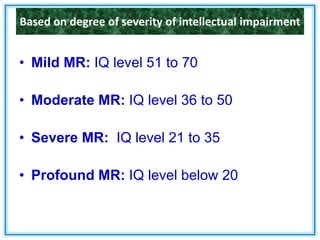
Based on degree of severity of intellectual impairment
• Mild MR: IQ level 51 to 70
• Moderate MR: IQ level 36 to 50
• Severe MR: IQ level 21 to 35
• Profound MR: IQ level below 20
Causes of mental retardation
• Chromosomal disorder:
– Down syndrome
– Fragile X syndrome
– Klinefelters syndrome
– Prader Willi syndrome
• Hypothyroidism
• Developmental brain abnormality
• Inborn errors of metabolism/neurodegenerative disorder
– PKU, Galactosemia, Tuberous Sclerosis
• Familial retardation
• Prenatal causes
– Maternal substance abuse (Fetal Alcohol syndrome), iron/folic acid
deficiency, Congenital infections
– Maternal chronic CVS/renal disease, placental dysfunction
• Postnatal causes
– Preterm, birth asphyxia, neonatal sepsis, jaundice, hypoglycemia
• Postnatal (during infancy)
– Meningitis/encephalitis, head injury, severe & prolonged malnutrition,
gross understimulation
• Unknown
• Interaction between genetic and
environmental factors (poverty,
undernutrition, low socioeconomic status,
maternal education)
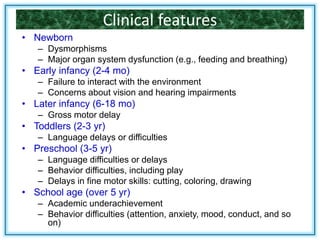
Clinical features
• Newborn
– Dysmorphisms
– Major organ system dysfunction (e.g., feeding and breathing)
• Early infancy (2-4 mo)
– Failure to interact with the environment
– Concerns about vision and hearing impairments
• Later infancy (6-18 mo)
– Gross motor delay
• Toddlers (2-3 yr)
– Language delays or difficulties
• Preschool (3-5 yr)
– Language difficulties or delays
– Behavior difficulties, including play
– Delays in fine motor skills: cutting, coloring, drawing
• School age (over 5 yr)
– Academic underachievement
– Behavior difficulties (attention, anxiety, mood, conduct, and so
on)
Clinical features
• Behavior problems: Symptoms like
restlessness (continuously moving around; unable to
sit in one place), poor concentration, impulsiveness,
temper tantrums, irritability and crying are common
• Convulsions: About 25% of people with mental
retardation get convulsions
• Sensory impairments: Difficulties in seeing
and hearing are present in about 5-10% of persons
with mental retardation
Investigations
• Neuroimaging
• Chromosomal study
• Metabolic screening
• EEG
Investigations depend on
•Degree of MR
•Family history/ specific other medical illness
•Planning for other children
•Parent wish
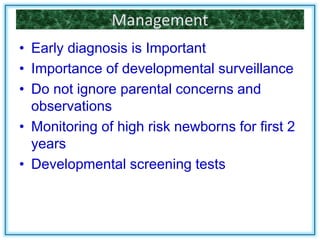
Management
• Early diagnosis is Important
• Importance of developmental surveillance
• Do not ignore parental concerns and
observations
• Monitoring of high risk newborns for first 2
years
• Developmental screening tests
Management
• Intelligence tests
• Tests for adaptive functioning
Management
• Medications
– Associated behavioral and psychiatric
disorders only
• Multidisciplinary care
Prevention
• Some are preventable
• Some of impairments are treatable and
benefitted by early intervention: limit the
disability
Some Do's and Don'ts for parents…
• Look at abilities rather than disabilities in the child.
• Notice successes and praise them, however small these may
be.
• Try to learn the techniques of training and practice them.
• Remember that those with mental retardation are slow in
learning but they can still be taught with patience, persistence,
and the correct approach.
• Find out about services that are available and utilize them.
• There is no need to feel ashamed about having a retarded
child.
• There is no need to blame oneself or other family members
for the child's condition.
• Do not overprotect the child; as far as possible encourage
them to stand on their own feet.
• Do not waste money unnecessarily on dubious treatments,
which have not been proven.
• Mental disorders in children
1.Behavioral disorders( ADHD,temper
tantrums,breath holding spells)
2.eating disorders
3.mental retardation
4.tics disorders
5.Enuresis
6.autism
• ADHD
• Incidence:
• Medications:
• Vasopressin
• Anti depressant
• Thank you
Mental retardation introduction

Mental retardation introduction

  • 1.
  • 2.
    Definition • Group ofdisorders that have in common deficits of adaptive & intellectual function and an age of onset before maturity is reached
  • 3.
    Epidemiology • The surveyof Mental Retardation in Nepal (1989) estimated 4.9 % of the total population had learning difficulties
  • 4.
    Diagnostic criteria • Significantlysub-average intellectual functioning: an IQ score of approximately 70 or below • Concurrent deficits or impairments in present adaptive functioning • The onset is before age 18 years
  • 5.
    Based on degreeof severity of intellectual impairment • Mild MR: IQ level 51 to 70 • Moderate MR: IQ level 36 to 50 • Severe MR: IQ level 21 to 35 • Profound MR: IQ level below 20
  • 6.
    Causes of mentalretardation • Chromosomal disorder: – Down syndrome – Fragile X syndrome – Klinefelters syndrome – Prader Willi syndrome • Hypothyroidism • Developmental brain abnormality • Inborn errors of metabolism/neurodegenerative disorder – PKU, Galactosemia, Tuberous Sclerosis • Familial retardation • Prenatal causes – Maternal substance abuse (Fetal Alcohol syndrome), iron/folic acid deficiency, Congenital infections – Maternal chronic CVS/renal disease, placental dysfunction • Postnatal causes – Preterm, birth asphyxia, neonatal sepsis, jaundice, hypoglycemia • Postnatal (during infancy) – Meningitis/encephalitis, head injury, severe & prolonged malnutrition, gross understimulation • Unknown
  • 7.
    • Interaction betweengenetic and environmental factors (poverty, undernutrition, low socioeconomic status, maternal education)
  • 8.
    Clinical features • Newborn –Dysmorphisms – Major organ system dysfunction (e.g., feeding and breathing) • Early infancy (2-4 mo) – Failure to interact with the environment – Concerns about vision and hearing impairments • Later infancy (6-18 mo) – Gross motor delay • Toddlers (2-3 yr) – Language delays or difficulties • Preschool (3-5 yr) – Language difficulties or delays – Behavior difficulties, including play – Delays in fine motor skills: cutting, coloring, drawing • School age (over 5 yr) – Academic underachievement – Behavior difficulties (attention, anxiety, mood, conduct, and so on)
  • 9.
    Clinical features • Behaviorproblems: Symptoms like restlessness (continuously moving around; unable to sit in one place), poor concentration, impulsiveness, temper tantrums, irritability and crying are common • Convulsions: About 25% of people with mental retardation get convulsions • Sensory impairments: Difficulties in seeing and hearing are present in about 5-10% of persons with mental retardation
  • 10.
    Investigations • Neuroimaging • Chromosomalstudy • Metabolic screening • EEG Investigations depend on •Degree of MR •Family history/ specific other medical illness •Planning for other children •Parent wish
  • 11.
    Management • Early diagnosisis Important • Importance of developmental surveillance • Do not ignore parental concerns and observations • Monitoring of high risk newborns for first 2 years • Developmental screening tests
  • 12.
    Management • Intelligence tests •Tests for adaptive functioning
  • 13.
    Management • Medications – Associatedbehavioral and psychiatric disorders only • Multidisciplinary care
  • 14.
    Prevention • Some arepreventable • Some of impairments are treatable and benefitted by early intervention: limit the disability
  • 15.
    Some Do's andDon'ts for parents… • Look at abilities rather than disabilities in the child. • Notice successes and praise them, however small these may be. • Try to learn the techniques of training and practice them. • Remember that those with mental retardation are slow in learning but they can still be taught with patience, persistence, and the correct approach. • Find out about services that are available and utilize them. • There is no need to feel ashamed about having a retarded child. • There is no need to blame oneself or other family members for the child's condition. • Do not overprotect the child; as far as possible encourage them to stand on their own feet. • Do not waste money unnecessarily on dubious treatments, which have not been proven.
  • 17.
    • Mental disordersin children 1.Behavioral disorders( ADHD,temper tantrums,breath holding spells) 2.eating disorders 3.mental retardation 4.tics disorders 5.Enuresis 6.autism
  • 18.
  • 41.
  • 42.