MENTAL
RETARDATION
Artwork
Presentation
By: MARY ALYSSA BOTIN
 The person with MR experiences
difficulties with the various
environments because he/she
lacks the mental, emotional and
social skills and competencies to
function in the environment meant
for people without disabilities.
Related limitations in the adaptive
skills areas
It means that the person
has difficulty in performing
the following tasks:
• Communication – ability to understand and
communicate information by speaking and
writing through symbols, sign-language or
non-symbolic behavior (facial expressions,
touch, gestures)
• Self-care – ability to take care of one’s
needs in hygiene, grooming, dressing, eating,
toileting
• Home living – ability to function in the
home, housekeeping, clothing care, property
maintenance, cooking, shopping, home
safety, daily scheduling of work
• Community use – travel in the
community, shopping, obtaining services
• Social skills – initiating and terminating
interactions, conversations, responding to
social cues, recognizing feelings,
regulating own behavior, assisting others,
fostering friendship
• Self-direction – making choices, following
schedule, completing required tasks,
seeking assistance and resolving problems
• Health and safety – maintaining own
health, identify and preventing illness, first
aid, sexuality, physical fitness and basic
safety
• Functional academics – learning the
basic skills taught in school
• Leisure – recreational activities
appropriate to the age of the person
• Work (Employment) appropriate to
one’s age
Low Motivation
 lack interest in learning their lessons
 develop learned helplessness where they
expect to continue to fail in doing
certain tasks because they were not
able to do the task in the past
 to avoid failure, the person tends to set
very low expectations for oneself
Self-Care and Daily Living Skills
 they are often taught basic daily living
skills deliberately which normal
individuals learn by absorption and
imitation
 direct instruction, simplified routine,
prompts and task analysis are used to
teach self-care skills in hygiene and
grooming, daily living skills in eating,
toileting, communication and the other
areas of adaptive behavior
Behavioral Excesses and Challenging
Behavior
 students with MR are more prone to
inappropriate behavior
 they have difficulties accepting
criticism, limited self-control as well as
behavior problem like aggression or
self-injury
 Students with mental retardation can
still enjoy their daily living through
different activities that would catch
their attention. And one of this
activities are crafts and art activities.
 However, these students may need
some help and/or assistance from the
teacher just like any other child.
 Be aware that art activities that are
too challenging may only frustrate the
child so it is advisable to only give
students with mental retardation an art
activities that are easy for them to
manage and as well as would help
them to boost their potentials.
Benefits of Art activities
 Self-discovery. At its most successful,
art therapy triggers an
emotional catharsis (a sense of relief
and wellbeing through the recognition
and acknowledgement of subconscious
feelings).
 Personal fulfillment. The creation of a
tangible reward can build confidence and
nurture feelings of self-worth. Personal
fulfillment comes from both the creative
and the analytical components of the
 Empowerment. Art therapy can help
individuals visually express emotions
and fears that they were never able to
articulate through conventional means,
and give them some sense of control
over these feelings.
 Relaxation and stress relief. Chronic
stress can be harmful to both mind and
body. It can weaken and damage the
immune system, cause insomnia
and depression, and trigger a host of
circulatory problems (e.g., high blood
pressure, atherosclerosis, and cardiac
arrhythmia). When used alone or in
combination with other relaxation
techniques such as guided imagery, art
therapy can be a potent stress reliever.
 Symptom relief and physical
rehabilitation. Art therapy can also
help individuals cope with pain and
promote physiological healing by
identifying and working
through anger and resentment issues
and other emotional stresses.
The goal is to help
them enjoy
creative
expression
through art.
ARTS!
ARTS!
ARTS!
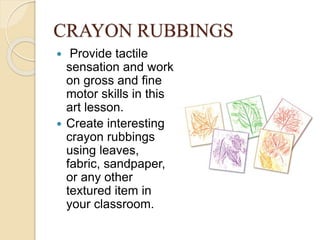
CRAYON RUBBINGS
 Provide tactile
sensation and work
on gross and fine
motor skills in this
art lesson.
 Create interesting
crayon rubbings
using leaves,
fabric, sandpaper,
or any other
textured item in
your classroom.
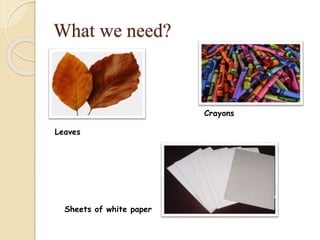
What we need?
Leaves
Crayons
Sheets of white paper
How to make?
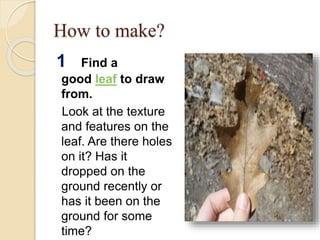
1 Find a
good leaf to draw
from.
Look at the texture
and features on the
leaf. Are there holes
on it? Has it
dropped on the
ground recently or
has it been on the
ground for some
time?
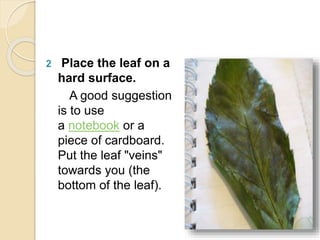
2 Place the leaf on a
hard surface.
A good suggestion
is to use
a notebook or a
piece of cardboard.
Put the leaf "veins"
towards you (the
bottom of the leaf).
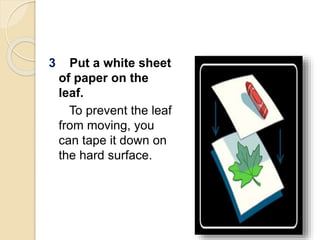
3 Put a white sheet
of paper on the
leaf.
To prevent the leaf
from moving, you
can tape it down on
the hard surface.
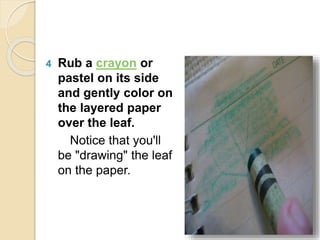
4 Rub a crayon or
pastel on its side
and gently color on
the layered paper
over the leaf.
Notice that you'll
be "drawing" the leaf
on the paper.
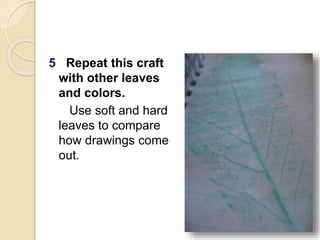
5 Repeat this craft
with other leaves
and colors.
Use soft and hard
leaves to compare
how drawings come
out.
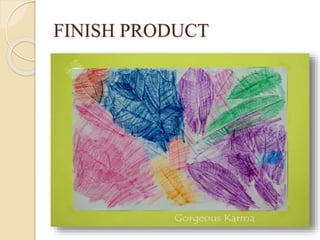
FINISH PRODUCT
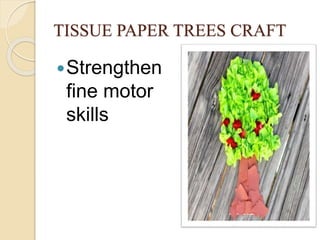
TISSUE PAPER TREES CRAFT
Strengthen
fine motor
skills
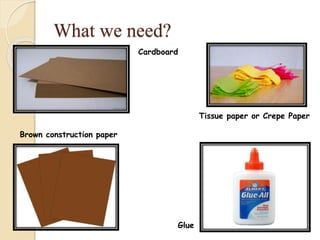
What we need?
Cardboard
Tissue paper or Crepe Paper
Brown construction paper
Glue
How to make it?
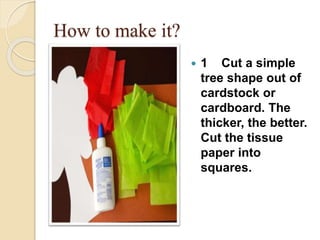
 1 Cut a simple
tree shape out of
cardstock or
cardboard. The
thicker, the better.
Cut the tissue
paper into
squares.
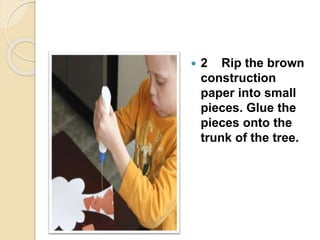
 2 Rip the brown
construction
paper into small
pieces. Glue the
pieces onto the
trunk of the tree.
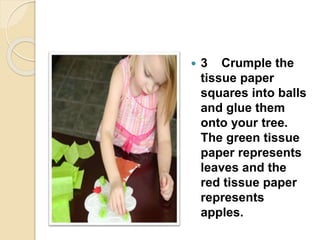
 3 Crumple the
tissue paper
squares into balls
and glue them
onto your tree.
The green tissue
paper represents
leaves and the
red tissue paper
represents
apples.
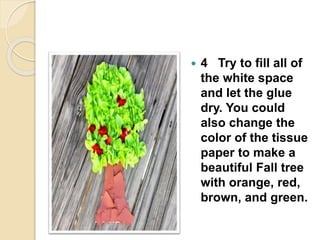
 4 Try to fill all of
the white space
and let the glue
dry. You could
also change the
color of the tissue
paper to make a
beautiful Fall tree
with orange, red,
brown, and green.

Art Activities for Mental Retardation

  • 1.
  • 2.
     The personwith MR experiences difficulties with the various environments because he/she lacks the mental, emotional and social skills and competencies to function in the environment meant for people without disabilities.
  • 3.
    Related limitations inthe adaptive skills areas It means that the person has difficulty in performing the following tasks:
  • 4.
    • Communication –ability to understand and communicate information by speaking and writing through symbols, sign-language or non-symbolic behavior (facial expressions, touch, gestures) • Self-care – ability to take care of one’s needs in hygiene, grooming, dressing, eating, toileting • Home living – ability to function in the home, housekeeping, clothing care, property maintenance, cooking, shopping, home safety, daily scheduling of work
  • 5.
    • Community use– travel in the community, shopping, obtaining services • Social skills – initiating and terminating interactions, conversations, responding to social cues, recognizing feelings, regulating own behavior, assisting others, fostering friendship • Self-direction – making choices, following schedule, completing required tasks, seeking assistance and resolving problems
  • 6.
    • Health andsafety – maintaining own health, identify and preventing illness, first aid, sexuality, physical fitness and basic safety • Functional academics – learning the basic skills taught in school • Leisure – recreational activities appropriate to the age of the person • Work (Employment) appropriate to one’s age
  • 7.
    Low Motivation  lackinterest in learning their lessons  develop learned helplessness where they expect to continue to fail in doing certain tasks because they were not able to do the task in the past  to avoid failure, the person tends to set very low expectations for oneself
  • 8.
    Self-Care and DailyLiving Skills  they are often taught basic daily living skills deliberately which normal individuals learn by absorption and imitation  direct instruction, simplified routine, prompts and task analysis are used to teach self-care skills in hygiene and grooming, daily living skills in eating, toileting, communication and the other areas of adaptive behavior
  • 9.
    Behavioral Excesses andChallenging Behavior  students with MR are more prone to inappropriate behavior  they have difficulties accepting criticism, limited self-control as well as behavior problem like aggression or self-injury
  • 10.
     Students withmental retardation can still enjoy their daily living through different activities that would catch their attention. And one of this activities are crafts and art activities.  However, these students may need some help and/or assistance from the teacher just like any other child.
  • 11.
     Be awarethat art activities that are too challenging may only frustrate the child so it is advisable to only give students with mental retardation an art activities that are easy for them to manage and as well as would help them to boost their potentials.
  • 12.
    Benefits of Artactivities  Self-discovery. At its most successful, art therapy triggers an emotional catharsis (a sense of relief and wellbeing through the recognition and acknowledgement of subconscious feelings).  Personal fulfillment. The creation of a tangible reward can build confidence and nurture feelings of self-worth. Personal fulfillment comes from both the creative and the analytical components of the
  • 13.
     Empowerment. Arttherapy can help individuals visually express emotions and fears that they were never able to articulate through conventional means, and give them some sense of control over these feelings.  Relaxation and stress relief. Chronic stress can be harmful to both mind and body. It can weaken and damage the immune system, cause insomnia and depression, and trigger a host of circulatory problems (e.g., high blood pressure, atherosclerosis, and cardiac arrhythmia). When used alone or in combination with other relaxation techniques such as guided imagery, art therapy can be a potent stress reliever.
  • 14.
     Symptom reliefand physical rehabilitation. Art therapy can also help individuals cope with pain and promote physiological healing by identifying and working through anger and resentment issues and other emotional stresses.
  • 15.
    The goal isto help them enjoy creative expression through art.
  • 16.
  • 17.
    CRAYON RUBBINGS  Providetactile sensation and work on gross and fine motor skills in this art lesson.  Create interesting crayon rubbings using leaves, fabric, sandpaper, or any other textured item in your classroom.
  • 18.
  • 19.
    How to make? 1Find a good leaf to draw from. Look at the texture and features on the leaf. Are there holes on it? Has it dropped on the ground recently or has it been on the ground for some time?
  • 20.
    2 Place theleaf on a hard surface. A good suggestion is to use a notebook or a piece of cardboard. Put the leaf "veins" towards you (the bottom of the leaf).
  • 21.
    3 Put awhite sheet of paper on the leaf. To prevent the leaf from moving, you can tape it down on the hard surface.
  • 22.
    4 Rub acrayon or pastel on its side and gently color on the layered paper over the leaf. Notice that you'll be "drawing" the leaf on the paper.
  • 23.
    5 Repeat thiscraft with other leaves and colors. Use soft and hard leaves to compare how drawings come out.
  • 24.
  • 25.
    TISSUE PAPER TREESCRAFT Strengthen fine motor skills
  • 26.
    What we need? Cardboard Tissuepaper or Crepe Paper Brown construction paper Glue
  • 27.
    How to makeit?  1 Cut a simple tree shape out of cardstock or cardboard. The thicker, the better. Cut the tissue paper into squares.
  • 28.
     2 Ripthe brown construction paper into small pieces. Glue the pieces onto the trunk of the tree.
  • 29.
     3 Crumplethe tissue paper squares into balls and glue them onto your tree. The green tissue paper represents leaves and the red tissue paper represents apples.
  • 30.
     4 Tryto fill all of the white space and let the glue dry. You could also change the color of the tissue paper to make a beautiful Fall tree with orange, red, brown, and green.