Dr CSN Vittal
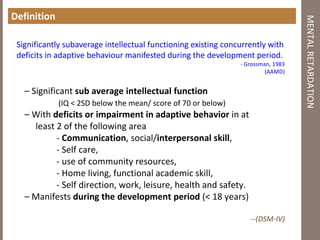
Definition
– Significant sub average intellectual function
(IQ < 2SD below the mean/ score of 70 or below)
– With deficits or impairment in adaptive behavior in at
least 2 of the following area
- Communication, social/interpersonal skill,
- Self care,
- use of community resources,
- Home living, functional academic skill,
- Self direction, work, leisure, health and safety.
– Manifests during the development period (< 18 years)
--(DSM-IV)
MENTALRETARDATION
Significantly subaverage intellectual functioning existing concurrently with
deficits in adaptive behaviour manifested during the development period.
- Grossman, 1983
(AAMD)
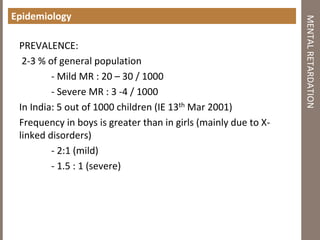
Epidemiology
PREVALENCE:
2-3 % of general population
- Mild MR : 20 – 30 / 1000
- Severe MR : 3 -4 / 1000
In India: 5 out of 1000 children (IE 13th Mar 2001)
Frequency in boys is greater than in girls (mainly due to X-
linked disorders)
- 2:1 (mild)
- 1.5 : 1 (severe)
MENTALRETARDATION
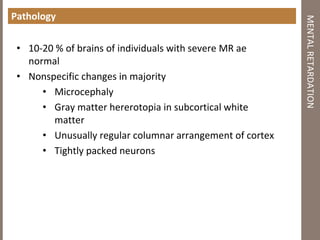
Pathology
• 10-20 % of brains of individuals with severe MR ae
normal
• Nonspecific changes in majority
• Microcephaly
• Gray matter hererotopia in subcortical white
matter
• Unusually regular columnar arrangement of cortex
• Tightly packed neurons
MENTALRETARDATION
MENTALRETARDATION
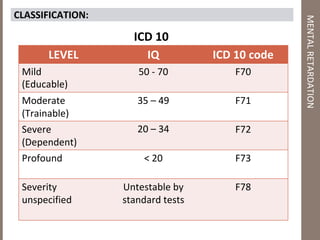
CLASSIFICATION:
LEVEL IQ ICD 10 code
Mild
(Educable)
50 - 70 F70
Moderate
(Trainable)
35 – 49 F71
Severe
(Dependent)
20 – 34 F72
Profound < 20 F73
Severity
unspecified
Untestable by
standard tests
F78
ICD 10
MENTALRETARDATION
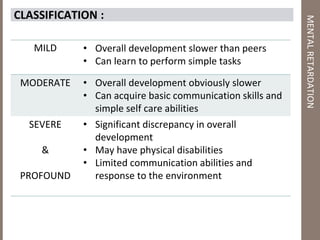
CLASSIFICATION :
MILD • Overall development slower than peers
• Can learn to perform simple tasks
MODERATE • Overall development obviously slower
• Can acquire basic communication skills and
simple self care abilities
SEVERE
&
PROFOUND
• Significant discrepancy in overall
development
• May have physical disabilities
• Limited communication abilities and
response to the environment
MENTALRETARDATION
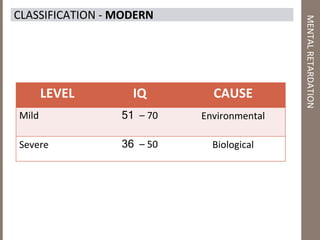
CLASSIFICATION - MODERN
LEVEL IQ CAUSE
Mild 51 – 70 Environmental
Severe 36 – 50 Biological
MENTALRETARDATION
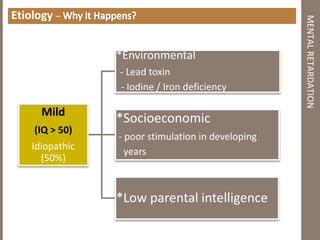
Etiology –
Mild
(IQ > 50)
Idiopathic
(50%)
*Environmental
- Lead toxin
- Iodine / Iron deficiency
*Socioeconomic
- poor stimulation in developing
years
*Low parental intelligence
MENTALRETARDATION
Etiology –
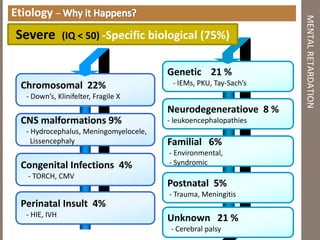
Chromosomal 22%
- Down’s, Klinifelter, Fragile X
CNS malformations 9%
- Hydrocephalus, Meningomyelocele,
Lissencephaly
Congenital Infections 4%
- TORCH, CMV
Perinatal Insult 4%
- HIE, IVH
Genetic 21 %
- IEMs, PKU, Tay-Sach’s
Neurodegeneratiove 8 %
- leukoencephalopathies
Familial 6%
- Environmental,
- Syndromic
Postnatal 5%
- Trauma, Meningitis
Unknown 21 %
- Cerebral palsy
Severe (IQ < 50) -Specific biological (75%)
Diagnosis
• Presence of risk factors
• Family history
• Prematurity
• Maternal substance abuse
• Perinatal insult
• Clinical manifestation
• Dysmorphisms
• Developmental delay – global
• Significant vision / hearing impairment by 6 mo
• Gross motor delay by 2 yrs
• Language delay by 3 yrs
• Fine motor delay by 5 yrs
MENTALRETARDATION
Diagnosis – contd…
• Associated dysfunctions
• Neurological disorder – CP, autism, microcephaly
• Unusual muscle tone
• Abnormal posture and feeding difficulity
• Seizure
• Behavioural difficulties (below 5 years)
(attention span, anxiety, mood and conduct)
• Academic underachievement (above 5 years)
• Typical symptoms - Hypothyroidism
MENTALRETARDATION
Diagnosis
IQ = Mental age / Chronological age
Standard Tests
• Bayley Scales of Infant Development (BSID II) till 3 yrs
• Wechsler preschool and primary scale intelligence
• Wechsler intellgence scale for children, above 6 yrs
• Malin’s Intelligence Scale for Indian Children 6‐15 y
• Vineland Social Maturity Scale (VSMS)‐ Indian
Adaptation, till 15yrs
• Stanford‐Binet IntelligenceScale
• Binet Kamat Test of intelligence (BKT ) 3‐22 yr
(revision of Binet’s scale by Kamat to suit indians)
MENTALRETARDATION
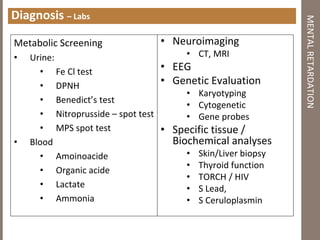
Diagnosis – Labs
Metabolic Screening
• Urine:
• Fe Cl test
• DPNH
• Benedict’s test
• Nitroprusside – spot test
• MPS spot test
• Blood
• Amoinoacide
• Organic acide
• Lactate
• Ammonia
MENTALRETARDATION
• Neuroimaging
• CT, MRI
• EEG
• Genetic Evaluation
• Karyotyping
• Cytogenetic
• Gene probes
• Specific tissue /
Biochemical analyses
• Skin/Liver biopsy
• Thyroid function
• TORCH / HIV
• S Lead,
• S Ceruloplasmin
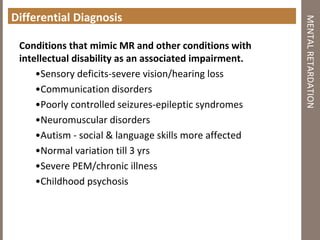
Differential Diagnosis
Conditions that mimic MR and other conditions with
intellectual disability as an associated impairment.
•Sensory deficits‐severe vision/hearing loss
•Communication disorders
•Poorly controlled seizures‐epileptic syndromes
•Neuromuscular disorders
•Autism ‐ social & language skills more affected
•Normal variation till 3 yrs
•Severe PEM/chronic illness
•Childhood psychosis
MENTALRETARDATION
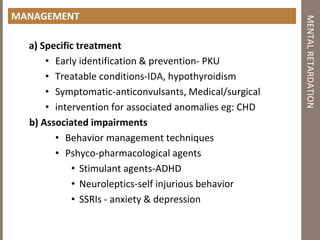
MANAGEMENT
a) Specific treatment
• Early identification & prevention‐ PKU
• Treatable conditions‐IDA, hypothyroidism
• Symptomatic‐anticonvulsants, Medical/surgical
• intervention for associated anomalies eg: CHD
b) Associated impairments
• Behavior management techniques
• Pshyco-pharmacological agents
• Stimulant agents‐ADHD
• Neuroleptics‐self injurious behavior
• SSRIs ‐ anxiety & depression
MENTALRETARDATION
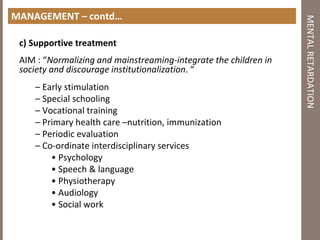
MANAGEMENT – contd…
c) Supportive treatment
AIM : “Normalizing and mainstreaming‐integrate the children in
society and discourage institutionalization. “
– Early stimulation
– Special schooling
– Vocational training
– Primary health care –nutrition, immunization
– Periodic evaluation
– Co‐ordinate interdisciplinary services
• Psychology
• Speech & language
• Physiotherapy
• Audiology
• Social work
MENTALRETARDATION
MANAGEMENT – contd…
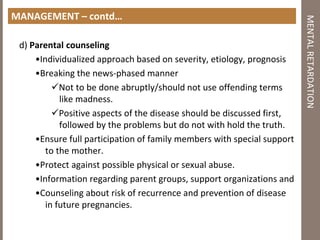
d) Parental counseling
•Individualized approach based on severity, etiology, prognosis
•Breaking the news‐phased manner
Not to be done abruptly/should not use offending terms
like madness.
Positive aspects of the disease should be discussed first,
followed by the problems but do not with hold the truth.
•Ensure full participation of family members with special support
to the mother.
•Protect against possible physical or sexual abuse.
•Information regarding parent groups, support organizations and
•Counseling about risk of recurrence and prevention of disease
in future pregnancies.
MENTALRETARDATION
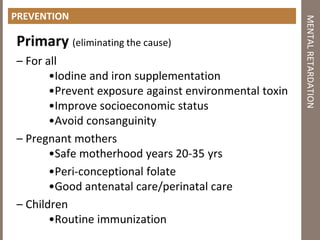
PREVENTION
Primary (eliminating the cause)
– For all
•Iodine and iron supplementation
•Prevent exposure against environmental toxin
•Improve socioeconomic status
•Avoid consanguinity
– Pregnant mothers
•Safe motherhood years 20‐35 yrs
•Peri-conceptional folate
•Good antenatal care/perinatal care
– Children
•Routine immunization
MENTALRETARDATION
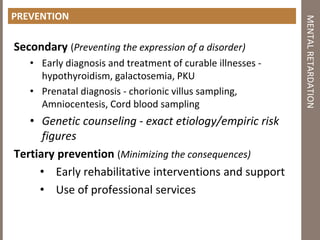
PREVENTION
Secondary (Preventing the expression of a disorder)
• Early diagnosis and treatment of curable illnesses ‐
hypothyroidism, galactosemia, PKU
• Prenatal diagnosis ‐ chorionic villus sampling,
Amniocentesis, Cord blood sampling
• Genetic counseling ‐ exact etiology/empiric risk
figures
Tertiary prevention (Minimizing the consequences)
• Early rehabilitative interventions and support
• Use of professional services
MENTALRETARDATION
MENTALRETARDATION
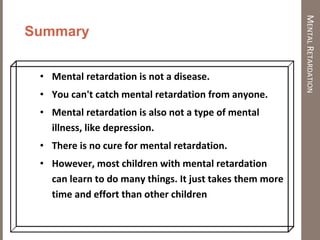
• Mental retardation is not a disease.
• You can't catch mental retardation from anyone.
• Mental retardation is also not a type of mental
illness, like depression.
• There is no cure for mental retardation.
• However, most children with mental retardation
can learn to do many things. It just takes them more
time and effort than other children
Summary

Mental Retardation

  • 1.
  • 2.
    Definition – Significant subaverage intellectual function (IQ < 2SD below the mean/ score of 70 or below) – With deficits or impairment in adaptive behavior in at least 2 of the following area - Communication, social/interpersonal skill, - Self care, - use of community resources, - Home living, functional academic skill, - Self direction, work, leisure, health and safety. – Manifests during the development period (< 18 years) --(DSM-IV) MENTALRETARDATION Significantly subaverage intellectual functioning existing concurrently with deficits in adaptive behaviour manifested during the development period. - Grossman, 1983 (AAMD)
  • 3.
    Epidemiology PREVALENCE: 2-3 % ofgeneral population - Mild MR : 20 – 30 / 1000 - Severe MR : 3 -4 / 1000 In India: 5 out of 1000 children (IE 13th Mar 2001) Frequency in boys is greater than in girls (mainly due to X- linked disorders) - 2:1 (mild) - 1.5 : 1 (severe) MENTALRETARDATION
  • 4.
    Pathology • 10-20 %of brains of individuals with severe MR ae normal • Nonspecific changes in majority • Microcephaly • Gray matter hererotopia in subcortical white matter • Unusually regular columnar arrangement of cortex • Tightly packed neurons MENTALRETARDATION
  • 5.
    MENTALRETARDATION CLASSIFICATION: LEVEL IQ ICD10 code Mild (Educable) 50 - 70 F70 Moderate (Trainable) 35 – 49 F71 Severe (Dependent) 20 – 34 F72 Profound < 20 F73 Severity unspecified Untestable by standard tests F78 ICD 10
  • 6.
    MENTALRETARDATION CLASSIFICATION : MILD •Overall development slower than peers • Can learn to perform simple tasks MODERATE • Overall development obviously slower • Can acquire basic communication skills and simple self care abilities SEVERE & PROFOUND • Significant discrepancy in overall development • May have physical disabilities • Limited communication abilities and response to the environment
  • 7.
    MENTALRETARDATION CLASSIFICATION - MODERN LEVELIQ CAUSE Mild 51 – 70 Environmental Severe 36 – 50 Biological
  • 8.
    MENTALRETARDATION Etiology – Mild (IQ >50) Idiopathic (50%) *Environmental - Lead toxin - Iodine / Iron deficiency *Socioeconomic - poor stimulation in developing years *Low parental intelligence
  • 9.
    MENTALRETARDATION Etiology – Chromosomal 22% -Down’s, Klinifelter, Fragile X CNS malformations 9% - Hydrocephalus, Meningomyelocele, Lissencephaly Congenital Infections 4% - TORCH, CMV Perinatal Insult 4% - HIE, IVH Genetic 21 % - IEMs, PKU, Tay-Sach’s Neurodegeneratiove 8 % - leukoencephalopathies Familial 6% - Environmental, - Syndromic Postnatal 5% - Trauma, Meningitis Unknown 21 % - Cerebral palsy Severe (IQ < 50) -Specific biological (75%)
  • 10.
    Diagnosis • Presence ofrisk factors • Family history • Prematurity • Maternal substance abuse • Perinatal insult • Clinical manifestation • Dysmorphisms • Developmental delay – global • Significant vision / hearing impairment by 6 mo • Gross motor delay by 2 yrs • Language delay by 3 yrs • Fine motor delay by 5 yrs MENTALRETARDATION
  • 11.
    Diagnosis – contd… •Associated dysfunctions • Neurological disorder – CP, autism, microcephaly • Unusual muscle tone • Abnormal posture and feeding difficulity • Seizure • Behavioural difficulties (below 5 years) (attention span, anxiety, mood and conduct) • Academic underachievement (above 5 years) • Typical symptoms - Hypothyroidism MENTALRETARDATION
  • 12.
    Diagnosis IQ = Mentalage / Chronological age Standard Tests • Bayley Scales of Infant Development (BSID II) till 3 yrs • Wechsler preschool and primary scale intelligence • Wechsler intellgence scale for children, above 6 yrs • Malin’s Intelligence Scale for Indian Children 6‐15 y • Vineland Social Maturity Scale (VSMS)‐ Indian Adaptation, till 15yrs • Stanford‐Binet IntelligenceScale • Binet Kamat Test of intelligence (BKT ) 3‐22 yr (revision of Binet’s scale by Kamat to suit indians) MENTALRETARDATION
  • 13.
    Diagnosis – Labs MetabolicScreening • Urine: • Fe Cl test • DPNH • Benedict’s test • Nitroprusside – spot test • MPS spot test • Blood • Amoinoacide • Organic acide • Lactate • Ammonia MENTALRETARDATION • Neuroimaging • CT, MRI • EEG • Genetic Evaluation • Karyotyping • Cytogenetic • Gene probes • Specific tissue / Biochemical analyses • Skin/Liver biopsy • Thyroid function • TORCH / HIV • S Lead, • S Ceruloplasmin
  • 14.
    Differential Diagnosis Conditions thatmimic MR and other conditions with intellectual disability as an associated impairment. •Sensory deficits‐severe vision/hearing loss •Communication disorders •Poorly controlled seizures‐epileptic syndromes •Neuromuscular disorders •Autism ‐ social & language skills more affected •Normal variation till 3 yrs •Severe PEM/chronic illness •Childhood psychosis MENTALRETARDATION
  • 15.
    MANAGEMENT a) Specific treatment •Early identification & prevention‐ PKU • Treatable conditions‐IDA, hypothyroidism • Symptomatic‐anticonvulsants, Medical/surgical • intervention for associated anomalies eg: CHD b) Associated impairments • Behavior management techniques • Pshyco-pharmacological agents • Stimulant agents‐ADHD • Neuroleptics‐self injurious behavior • SSRIs ‐ anxiety & depression MENTALRETARDATION
  • 16.
    MANAGEMENT – contd… c)Supportive treatment AIM : “Normalizing and mainstreaming‐integrate the children in society and discourage institutionalization. “ – Early stimulation – Special schooling – Vocational training – Primary health care –nutrition, immunization – Periodic evaluation – Co‐ordinate interdisciplinary services • Psychology • Speech & language • Physiotherapy • Audiology • Social work MENTALRETARDATION
  • 17.
    MANAGEMENT – contd… d)Parental counseling •Individualized approach based on severity, etiology, prognosis •Breaking the news‐phased manner Not to be done abruptly/should not use offending terms like madness. Positive aspects of the disease should be discussed first, followed by the problems but do not with hold the truth. •Ensure full participation of family members with special support to the mother. •Protect against possible physical or sexual abuse. •Information regarding parent groups, support organizations and •Counseling about risk of recurrence and prevention of disease in future pregnancies. MENTALRETARDATION
  • 18.
    PREVENTION Primary (eliminating thecause) – For all •Iodine and iron supplementation •Prevent exposure against environmental toxin •Improve socioeconomic status •Avoid consanguinity – Pregnant mothers •Safe motherhood years 20‐35 yrs •Peri-conceptional folate •Good antenatal care/perinatal care – Children •Routine immunization MENTALRETARDATION
  • 19.
    PREVENTION Secondary (Preventing theexpression of a disorder) • Early diagnosis and treatment of curable illnesses ‐ hypothyroidism, galactosemia, PKU • Prenatal diagnosis ‐ chorionic villus sampling, Amniocentesis, Cord blood sampling • Genetic counseling ‐ exact etiology/empiric risk figures Tertiary prevention (Minimizing the consequences) • Early rehabilitative interventions and support • Use of professional services MENTALRETARDATION
  • 20.
    MENTALRETARDATION • Mental retardationis not a disease. • You can't catch mental retardation from anyone. • Mental retardation is also not a type of mental illness, like depression. • There is no cure for mental retardation. • However, most children with mental retardation can learn to do many things. It just takes them more time and effort than other children Summary