MENTAL
RETARDATION
OBJECTIVES
• Define Mental Retardation.
• Pathophysiology of mental retardation .
• Etiology of Mental Retardation.
• Classification of mental retardation.
• Sign & symptoms of Mental Retardation.
• Diagnosis.
• Prevalence.
• Medical Management.
• Nursing Management.
• Care and Rehabilitation.
MENTAL RETARDATION
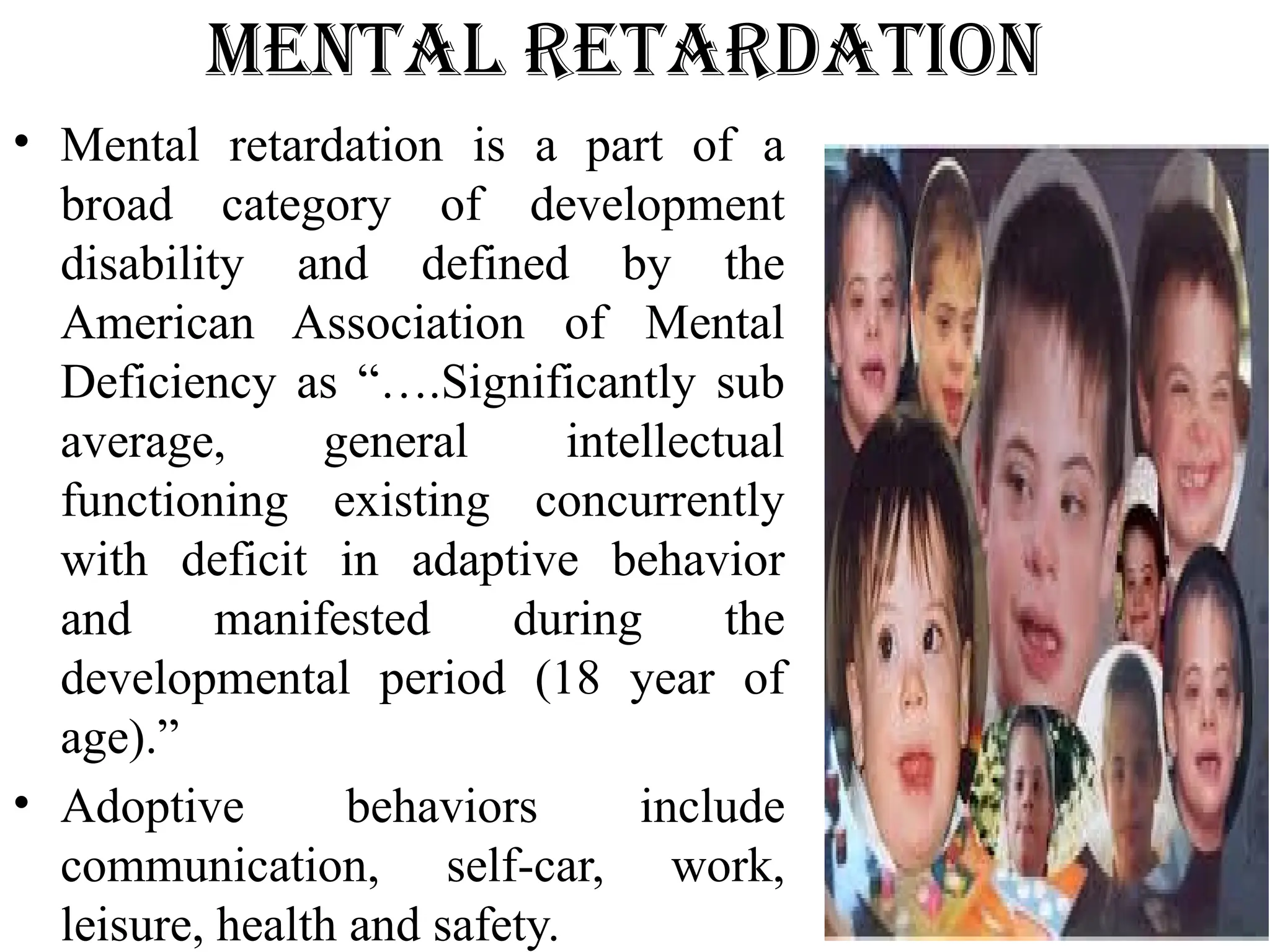
• Mental retardation is a part of a
broad category of development
disability and defined by the
American Association of Mental
Deficiency as “….Significantly sub
average, general intellectual
functioning existing concurrently
with deficit in adaptive behavior
and manifested during the
developmental period (18 year of
age).”
• Adoptive behaviors include
communication, self-car, work,
leisure, health and safety.
Chromosomal abnormalities can be a cause of
intellectual disability (formerly called mental
retardation). This happens when there is a deletion
(missing piece) of a chromosome. Chromosomes
contain genes, which are the instructions for making
proteins that the body needs to function. When a
piece of a chromosome is missing, there may be
missing genes or genes that are not working
correctly. This can lead to problems with brain
development and function, which can cause
intellectual disability.
PATHOPHYSIOLOGY
PATHOPHYSIOLOGY
There are several chromosomal abnormalities that
can cause intellectual disability, including Down
syndrome, Turner syndrome, and Cri-du-chat
syndrome.
Down syndrome is the most common chromosomal
abnormality, caused by having an extra copy of
chromosome 21.
Turner syndrome is a condition that affects females
and is caused by a missing or partially missing X
chromosome.
Cri-du-chat syndrome is a rare condition that is
caused by a deletion of part of chromosome 5.
• Prenatal
cause
• Chromosomal disorder(e.g. Down syndrome)
• TORCHS infection
• Congenital primary hypothyroidism
• Family history of mental retardation
• Malformation of brain
• Perinatal
causes
• Prematurity.
• Hypoxic-ischemic encephalopathy
• Birth trauma
• Intracranial hemorrhage
• Postnatal
causes
• Birth trauma
• Intraventricular hemorrhages
• Bilirubin encephalopathy
• Hypoglycemic
• Bacterial meningitis, sepsis
• Viral encephalitis
CAUSES
• Structural defects • Microcephaly
• Hydrocephalus
• Neural tube defects
• infection • Post-encephalitis
• Post-meningitis
• Sub acute sclerosing
• Rubella
• Chromosomal disorder • Down syndrome
• turner’s syndrome
• Cat-cry syndrome
• Fragile X syndrome
• Trisomy X syndromes
• Environmental factors • Psychosocial deprivation
• Nutritional deprivation
• Cranial trauma
CAUSES
• Genetic / Metabolic
Defects
• Cretinism
• Muco-poly-saccharidosis
• Leukodystrophy
• Galactosemia
• Phenylketonuria
• Wilson’s disease
• Physical damage &
disorders
• Injury
• Hypoxia
• Gross disease of
brain
• Neurofibromatosis
• Epilepcy
• intoxication • Substance abuse
• Lead & certain drugs
CAUSES
Classification of retardation
1. MILD (50-70 IQ)
Common type of retardation 85-90% . These individual have
minimum retardation in sensory-motor areas.
PRESCHOOL:
The child often is note noted as retarded, but is slow to
walk, talk, and feed self.
SCHOOLAGE:
The child can acquire practical skills and learn to read
and do arithmetic to sixth-grade level with special
education classes. The child achieves a mental age of 8
to 12 years.
ADULT:
The adult can usually achieve social and vocational
skills. Occasional guidance may be needed. The adult
may handle marriage, but not child rearing.
2. MODERATE (35-55 IQ)
About 10% of mentally retardated come under this group.
PRESCHOOL:
Noticeable delays, especially in speech, are evident.
SCHOOLAGE:
The child can learn simple communication, health and
safety habits, and simple manual skills. A mental age of
3-7 years is achieved.
ADULT:
The adult can perform simple tasks under sheltered
conditions and can travel alone to familiar places. Help
with self-maintenance is usually needed.
Classification of retardation
3. SEVERE (20-40 IQ)
Recognized early in life
PRESHOOL:
The child exhibits marked motor delay and has little to
no communication skills. The child may respond to
training in elementary self-help, such as feeding
SCHOOLAGE:
The child usually walks with disability. Some
understanding of speech and response is evident. The
child can respond to habit training and has the mental
age of toddler.
ADULT:
The adult can perform to daily routines and repetitive
activities, but needs constant direction and supervision in
protective environment.
Classification of retardation
4. PROFOUND (Below 20 IQ)
Delayed developmental milestones
PRESCHOOL:
Gross retardation is evident. There is a capacity for
function in sensorimotor areas, but the child need total
care.
SCHOOLAGE:
There are obvious delays in all areas. The child shows
basic emotional response and responds to skillful training
in the use of legs, hands and jaws. The child needs close
supervision and has the mental age of young infant.
ADULT:
The adult may walk but need complete custodial care.
The adult will have primitive speech. Regular physical
activity is beneficial.
Classification of retardation
Intelligent quotient (IQ)
• Intelligent quotient (IQ) is the ratio between mental age
(MA) & chronological age (CA).
• (Einstein’s IQ =160+)
MA
IQ = ---------------------- x 100
CA
• Chronological age is determined by date of birth,
• Mental age is determined by intelligence tests.
SIGN AND SYMPTOMS
• Failure to achieve developmental milestones
• Deficiency in cognitive functioning such as inability to
follow commands or directions
• Reduced ability to learn or to meet academic demands
• Distractibility , poor concentration
• Poor memory
• Psychomotor skill deficits
• Difficulty performing self-esteem
• Irritability when frustrated or upset (low frustration
tolerance
• Impulsiveness
• Persistence of infantile behavior
diagnosis
• History collection from parents & caretakers
• Physical examination
• Neurological examination (GCS)
• Assessing milestones development
• EEG, especially if seizure are present
• CT Scan or MRI brain (tuberous sclerosis)
• Thyroid function tests when cretinism is suspected
• Investigation :
• Chorionic villi sampling
• Amniocentesis in infant chromosomal disorders
• Culture for cytogenic & biochemical studies
• Urine and blood testing for metabolic disorders
• Chromosomal analysis
Diagnosis
• Serology for TORCHS infection
• X-ray skull (head injury)
• Hearing & speech evaluation
• Psychological tests like stanford binet intelligence
scale & wechsler intelligence scale for childern’s
(WISC) for categorizing the child’s level of ability .
• The Gesell and Bayley scales and the cattell infant
intelligence scale are most commonly used with
infants.
PREVALENCE
• The prevalence is 1% in the general population, with 6
per 1000 persons having a severe mental disability.
MEDICAL
MANAGEMENT
• Treatment for mental
retardation depends on
the type of illness. If
your or your loved
one's symptoms are
mild, you may only
need limited
intervention and
medication to manage
symptoms
DRUG
THERAPY
• No specific drugs
available..
• Neuroleptic drugs to
reduce aggressive
• antisocial behavior. Eg
phenothiazines.
• Antipsychotic drugs.
• Antidepressant drugs.
Nursing process
Assessment :
• Nurse should assess and focus on each client’s strengths
and individual abilities.
• Knowledge regarding level of independence in the
performance of self-care activities is essential to the
development of an adequate plan for the provision of
nursing care.
• Neurological examination (sensory impairment,
disturbance in motor areas are manifested by
abnormalities of muscle tone, reflexes and involuntary
movements.
Nursing diagnosis
• Self-care deficit related to altered physical mobility
or lack of maturity.
• Impaired verbal communication related to
developmental alteration.
• Risk for injury related to aggressive behavior or
altered physical mobility.
• Delayed growth and development related to
isolation from significant others ; inadequate
environmental stimulation; hereditary factors.
• Anxiety (moderate to severe) related to
hospitalization & absence of familiar surroundings.
NURSING CARE PLAN
 Primary prevention
 Preconception:
• Genetic counselling
• Immunization for
maternal rubella
• Blood test to identify
presence of vuneral
diseases
• Adequate maternal
nutrition
• Family planning
 Primary prevention
 During gestation:
• Prenatal care
• Adequate nutrition
• Analysis of fetus for possible
genetic disorders
 At delivery: should be
conducted by experts,
• APGAR scoring
 Childhood: proper nutrition,
• avoidance of hazards
• prevention of accidents
Nursing care plan
 Secondary prevention
• Early detection & treatment
• Early recognition of presence of MR
• Psychiatric treatment for emotional and
behaviour difficulties
CARE AND REHABILITATION OF
THE MENTALLY RETARDED
 The main elements in a comprehensive service for
mentally retarded individuals and their families include
 The prevention and early detection of mental handicaps.
 Regular assessment of the mentally retarded person's
attainments and disabilities.
 Advice, support, and practical measures for families
 Provision for education, training, occupation, or work
appropriate for each handicapped person.
 Housing and social support to enable self- care.
 Medical, nursing, and other services for those who require
them as outpatients, day patients, or inpatients.
 Psychiatric and psychological services.
REFERENCES
• Pervez Akber Khan (8th
Ed) Basis of Pediatrics
(2011) published by paramount publishing
enterprise.
• http://
www.slideshare.net/renitacresenciya/mental-re
tardation-100060437?from_m_app=android
• http://www.slideshare.net/divya2709/mental-
retardation-232170205?from_m_app=android
THANK
YOU!!!!

Mental Retardation pediatrics ppt.pptx

  • 1.
  • 2.
    OBJECTIVES • Define MentalRetardation. • Pathophysiology of mental retardation . • Etiology of Mental Retardation. • Classification of mental retardation. • Sign & symptoms of Mental Retardation. • Diagnosis. • Prevalence. • Medical Management. • Nursing Management. • Care and Rehabilitation.
  • 3.
    MENTAL RETARDATION • Mentalretardation is a part of a broad category of development disability and defined by the American Association of Mental Deficiency as “….Significantly sub average, general intellectual functioning existing concurrently with deficit in adaptive behavior and manifested during the developmental period (18 year of age).” • Adoptive behaviors include communication, self-car, work, leisure, health and safety.
  • 4.
    Chromosomal abnormalities canbe a cause of intellectual disability (formerly called mental retardation). This happens when there is a deletion (missing piece) of a chromosome. Chromosomes contain genes, which are the instructions for making proteins that the body needs to function. When a piece of a chromosome is missing, there may be missing genes or genes that are not working correctly. This can lead to problems with brain development and function, which can cause intellectual disability. PATHOPHYSIOLOGY
  • 5.
    PATHOPHYSIOLOGY There are severalchromosomal abnormalities that can cause intellectual disability, including Down syndrome, Turner syndrome, and Cri-du-chat syndrome. Down syndrome is the most common chromosomal abnormality, caused by having an extra copy of chromosome 21. Turner syndrome is a condition that affects females and is caused by a missing or partially missing X chromosome. Cri-du-chat syndrome is a rare condition that is caused by a deletion of part of chromosome 5.
  • 6.
    • Prenatal cause • Chromosomaldisorder(e.g. Down syndrome) • TORCHS infection • Congenital primary hypothyroidism • Family history of mental retardation • Malformation of brain • Perinatal causes • Prematurity. • Hypoxic-ischemic encephalopathy • Birth trauma • Intracranial hemorrhage • Postnatal causes • Birth trauma • Intraventricular hemorrhages • Bilirubin encephalopathy • Hypoglycemic • Bacterial meningitis, sepsis • Viral encephalitis CAUSES
  • 7.
    • Structural defects• Microcephaly • Hydrocephalus • Neural tube defects • infection • Post-encephalitis • Post-meningitis • Sub acute sclerosing • Rubella • Chromosomal disorder • Down syndrome • turner’s syndrome • Cat-cry syndrome • Fragile X syndrome • Trisomy X syndromes • Environmental factors • Psychosocial deprivation • Nutritional deprivation • Cranial trauma CAUSES
  • 8.
    • Genetic /Metabolic Defects • Cretinism • Muco-poly-saccharidosis • Leukodystrophy • Galactosemia • Phenylketonuria • Wilson’s disease • Physical damage & disorders • Injury • Hypoxia • Gross disease of brain • Neurofibromatosis • Epilepcy • intoxication • Substance abuse • Lead & certain drugs CAUSES
  • 9.
    Classification of retardation 1.MILD (50-70 IQ) Common type of retardation 85-90% . These individual have minimum retardation in sensory-motor areas. PRESCHOOL: The child often is note noted as retarded, but is slow to walk, talk, and feed self. SCHOOLAGE: The child can acquire practical skills and learn to read and do arithmetic to sixth-grade level with special education classes. The child achieves a mental age of 8 to 12 years. ADULT: The adult can usually achieve social and vocational skills. Occasional guidance may be needed. The adult may handle marriage, but not child rearing.
  • 10.
    2. MODERATE (35-55IQ) About 10% of mentally retardated come under this group. PRESCHOOL: Noticeable delays, especially in speech, are evident. SCHOOLAGE: The child can learn simple communication, health and safety habits, and simple manual skills. A mental age of 3-7 years is achieved. ADULT: The adult can perform simple tasks under sheltered conditions and can travel alone to familiar places. Help with self-maintenance is usually needed. Classification of retardation
  • 11.
    3. SEVERE (20-40IQ) Recognized early in life PRESHOOL: The child exhibits marked motor delay and has little to no communication skills. The child may respond to training in elementary self-help, such as feeding SCHOOLAGE: The child usually walks with disability. Some understanding of speech and response is evident. The child can respond to habit training and has the mental age of toddler. ADULT: The adult can perform to daily routines and repetitive activities, but needs constant direction and supervision in protective environment. Classification of retardation
  • 12.
    4. PROFOUND (Below20 IQ) Delayed developmental milestones PRESCHOOL: Gross retardation is evident. There is a capacity for function in sensorimotor areas, but the child need total care. SCHOOLAGE: There are obvious delays in all areas. The child shows basic emotional response and responds to skillful training in the use of legs, hands and jaws. The child needs close supervision and has the mental age of young infant. ADULT: The adult may walk but need complete custodial care. The adult will have primitive speech. Regular physical activity is beneficial. Classification of retardation
  • 13.
    Intelligent quotient (IQ) •Intelligent quotient (IQ) is the ratio between mental age (MA) & chronological age (CA). • (Einstein’s IQ =160+) MA IQ = ---------------------- x 100 CA • Chronological age is determined by date of birth, • Mental age is determined by intelligence tests.
  • 14.
    SIGN AND SYMPTOMS •Failure to achieve developmental milestones • Deficiency in cognitive functioning such as inability to follow commands or directions • Reduced ability to learn or to meet academic demands • Distractibility , poor concentration • Poor memory • Psychomotor skill deficits • Difficulty performing self-esteem • Irritability when frustrated or upset (low frustration tolerance • Impulsiveness • Persistence of infantile behavior
  • 15.
    diagnosis • History collectionfrom parents & caretakers • Physical examination • Neurological examination (GCS) • Assessing milestones development • EEG, especially if seizure are present • CT Scan or MRI brain (tuberous sclerosis) • Thyroid function tests when cretinism is suspected • Investigation : • Chorionic villi sampling • Amniocentesis in infant chromosomal disorders • Culture for cytogenic & biochemical studies • Urine and blood testing for metabolic disorders • Chromosomal analysis
  • 16.
    Diagnosis • Serology forTORCHS infection • X-ray skull (head injury) • Hearing & speech evaluation • Psychological tests like stanford binet intelligence scale & wechsler intelligence scale for childern’s (WISC) for categorizing the child’s level of ability . • The Gesell and Bayley scales and the cattell infant intelligence scale are most commonly used with infants.
  • 17.
    PREVALENCE • The prevalenceis 1% in the general population, with 6 per 1000 persons having a severe mental disability.
  • 18.
    MEDICAL MANAGEMENT • Treatment formental retardation depends on the type of illness. If your or your loved one's symptoms are mild, you may only need limited intervention and medication to manage symptoms DRUG THERAPY • No specific drugs available.. • Neuroleptic drugs to reduce aggressive • antisocial behavior. Eg phenothiazines. • Antipsychotic drugs. • Antidepressant drugs.
  • 19.
    Nursing process Assessment : •Nurse should assess and focus on each client’s strengths and individual abilities. • Knowledge regarding level of independence in the performance of self-care activities is essential to the development of an adequate plan for the provision of nursing care. • Neurological examination (sensory impairment, disturbance in motor areas are manifested by abnormalities of muscle tone, reflexes and involuntary movements.
  • 20.
    Nursing diagnosis • Self-caredeficit related to altered physical mobility or lack of maturity. • Impaired verbal communication related to developmental alteration. • Risk for injury related to aggressive behavior or altered physical mobility. • Delayed growth and development related to isolation from significant others ; inadequate environmental stimulation; hereditary factors. • Anxiety (moderate to severe) related to hospitalization & absence of familiar surroundings.
  • 21.
    NURSING CARE PLAN Primary prevention  Preconception: • Genetic counselling • Immunization for maternal rubella • Blood test to identify presence of vuneral diseases • Adequate maternal nutrition • Family planning  Primary prevention  During gestation: • Prenatal care • Adequate nutrition • Analysis of fetus for possible genetic disorders  At delivery: should be conducted by experts, • APGAR scoring  Childhood: proper nutrition, • avoidance of hazards • prevention of accidents
  • 22.
    Nursing care plan Secondary prevention • Early detection & treatment • Early recognition of presence of MR • Psychiatric treatment for emotional and behaviour difficulties
  • 23.
    CARE AND REHABILITATIONOF THE MENTALLY RETARDED  The main elements in a comprehensive service for mentally retarded individuals and their families include  The prevention and early detection of mental handicaps.  Regular assessment of the mentally retarded person's attainments and disabilities.  Advice, support, and practical measures for families  Provision for education, training, occupation, or work appropriate for each handicapped person.  Housing and social support to enable self- care.  Medical, nursing, and other services for those who require them as outpatients, day patients, or inpatients.  Psychiatric and psychological services.
  • 24.
    REFERENCES • Pervez AkberKhan (8th Ed) Basis of Pediatrics (2011) published by paramount publishing enterprise. • http:// www.slideshare.net/renitacresenciya/mental-re tardation-100060437?from_m_app=android • http://www.slideshare.net/divya2709/mental- retardation-232170205?from_m_app=android
  • 25.