


ENURESIS
Ranjita jena
Lecturer, SUM Nursing College
Siksha o Anusandhan University
INTRODUCTION
• The word enuresis is derived from a Greek
word (enourein) that means “to void urine.” It
refers to the act of involuntary urination and
can occur either during the day or at night
(though some restrict the term to bedwetting
that occurs at night only)
DEFINITION
• It is the involuntary urination, which may be
caused by a variety of factors. These include
disorders of the kidneys, bladder, or ureter
and/or poor control of the muscles that control
the release of urine.
• Enuresis is defined as intermittent urinary
incontinence during sleep in a child at least
five years of age.
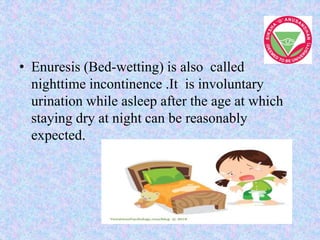
• Enuresis (Bed-wetting) is also called
nighttime incontinence .It is involuntary
urination while asleep after the age at which
staying dry at night can be reasonably
expected.
INCIDENCE
• It is now generally accepted that 15-20% of children
have some degree of nighttime wetting at 5 years of
age, with a spontaneous resolution rate of
approximately 15% per year. Worldwide,
the prevalence of enuresis among 6-12-year-old
children is reported as 1.4-28%.
ETIOLOGY
• A small bladder
• Inability to recognize a full bladder
• A hormone imbalance, During childhood, some kids don't
produce enough anti-diuretic hormone (ADH) to slow
nighttime urine production.
• Urinary tract infection.
• Sleep apnea.
• Diabetes.
• Chronic constipation.
• A structural problem in the urinary tract or nervous
system
RISK FACTORS
Bed-wetting can affect anyone, but it's twice as common in
boys as in girls. Several factors have been associated with an
increased risk of bed-wetting, including:
• Stress and anxiety.
Stressful events : such as becoming a big brother or sister,
starting a new school, or sleeping away from home — may
trigger bed-wetting.
• Family history.
If one or both of a child's parents wet the bed as children,
their child has a significant chance of wetting the bed, too.
• Attention-deficit/hyperactivity disorder (ADHD).
Bed-wetting is more common in children who have ADHD.
WHEN TO SEE A DOCTOR
• our child still wets the bed after age 7
• Your child starts to wet the bed after a few months of
being dry at night
• Bed-wetting is accompanied by painful urination,
unusual thirst, pink or red urine, hard stools, or
snoring
SYMPTOMS
 Wetting during the day.
 Frequency, urgency, or burning on urination.
 Straining, dribbling, or other unusual symptoms with
urination.
 Cloudy or pinkish urine, or blood stains on
underpants or pajamas.
 Soiling, being unable to control bowel movements(
fecal incontinence or Encopresis)
 Constipation.
MANAGEMENT AND TREATMENT
Healthcare provider may suggest trying behavioral
changes to begin. Behavioral techniques are changes
you can make to your child’s nighttime routine that
don’t involve medication. These techniques can
include:
• Limiting fluids before bedtime: Don’t give your
child anything to drink at least two hours before
bedtime. Make sure your child drinks plenty of
fluids during the day.
• Going to the bathroom before bedtime: Make sure
your child goes to the bathroom and empties his or
her bladder completely before going to bed.
• Enuresis alarm: This is a device that makes a loud
noise or vibrates to awaken the child when he or she
starts to wet the bed. It has a wetness sensor that
triggers the alarm so that the child can wake up and
finish urinating in the bathroom. This technique may
take several months to be successful.
• Bladder therapy: This approach is aimed at
gradually increasing the bladder’s functional capacity
by making the child wait to go to the bathroom.
Increasing the length of time between bathroom visits
helps enlarge the bladder to allow it to hold more
urine.
• Counseling: Psychological counseling may be
effective in cases where the child has had a traumatic
event or is suffering from low self-esteem because of
the bedwetting.
• The following medications may be used alone
or in combination with behavioral techniques
to treat bedwetting:
• Desmopressin
• Oxybutinin
• imipramine
COMPLICATIONS
• Guilt and embarrassment, which can lead to low self-
esteem
• Loss of opportunities for social activities, such as
sleepovers and camp
• Rashes on the child's bottom and genital area
;especially if your child sleeps in wet underwear
Enuresis

Enuresis

  • 1.
    ENURESIS Ranjita jena Lecturer, SUMNursing College Siksha o Anusandhan University
  • 2.
    INTRODUCTION • The wordenuresis is derived from a Greek word (enourein) that means “to void urine.” It refers to the act of involuntary urination and can occur either during the day or at night (though some restrict the term to bedwetting that occurs at night only)
  • 3.
    DEFINITION • It isthe involuntary urination, which may be caused by a variety of factors. These include disorders of the kidneys, bladder, or ureter and/or poor control of the muscles that control the release of urine. • Enuresis is defined as intermittent urinary incontinence during sleep in a child at least five years of age.
  • 4.
    • Enuresis (Bed-wetting)is also called nighttime incontinence .It is involuntary urination while asleep after the age at which staying dry at night can be reasonably expected.
  • 5.
    INCIDENCE • It isnow generally accepted that 15-20% of children have some degree of nighttime wetting at 5 years of age, with a spontaneous resolution rate of approximately 15% per year. Worldwide, the prevalence of enuresis among 6-12-year-old children is reported as 1.4-28%.
  • 6.
    ETIOLOGY • A smallbladder • Inability to recognize a full bladder • A hormone imbalance, During childhood, some kids don't produce enough anti-diuretic hormone (ADH) to slow nighttime urine production. • Urinary tract infection. • Sleep apnea. • Diabetes. • Chronic constipation. • A structural problem in the urinary tract or nervous system
  • 7.
    RISK FACTORS Bed-wetting canaffect anyone, but it's twice as common in boys as in girls. Several factors have been associated with an increased risk of bed-wetting, including: • Stress and anxiety. Stressful events : such as becoming a big brother or sister, starting a new school, or sleeping away from home — may trigger bed-wetting. • Family history. If one or both of a child's parents wet the bed as children, their child has a significant chance of wetting the bed, too. • Attention-deficit/hyperactivity disorder (ADHD). Bed-wetting is more common in children who have ADHD.
  • 8.
    WHEN TO SEEA DOCTOR • our child still wets the bed after age 7 • Your child starts to wet the bed after a few months of being dry at night • Bed-wetting is accompanied by painful urination, unusual thirst, pink or red urine, hard stools, or snoring
  • 9.
    SYMPTOMS  Wetting duringthe day.  Frequency, urgency, or burning on urination.  Straining, dribbling, or other unusual symptoms with urination.  Cloudy or pinkish urine, or blood stains on underpants or pajamas.  Soiling, being unable to control bowel movements( fecal incontinence or Encopresis)  Constipation.
  • 10.
    MANAGEMENT AND TREATMENT Healthcareprovider may suggest trying behavioral changes to begin. Behavioral techniques are changes you can make to your child’s nighttime routine that don’t involve medication. These techniques can include: • Limiting fluids before bedtime: Don’t give your child anything to drink at least two hours before bedtime. Make sure your child drinks plenty of fluids during the day.
  • 11.
    • Going tothe bathroom before bedtime: Make sure your child goes to the bathroom and empties his or her bladder completely before going to bed. • Enuresis alarm: This is a device that makes a loud noise or vibrates to awaken the child when he or she starts to wet the bed. It has a wetness sensor that triggers the alarm so that the child can wake up and finish urinating in the bathroom. This technique may take several months to be successful.
  • 12.
    • Bladder therapy:This approach is aimed at gradually increasing the bladder’s functional capacity by making the child wait to go to the bathroom. Increasing the length of time between bathroom visits helps enlarge the bladder to allow it to hold more urine. • Counseling: Psychological counseling may be effective in cases where the child has had a traumatic event or is suffering from low self-esteem because of the bedwetting.
  • 13.
    • The followingmedications may be used alone or in combination with behavioral techniques to treat bedwetting: • Desmopressin • Oxybutinin • imipramine
  • 14.
    COMPLICATIONS • Guilt andembarrassment, which can lead to low self- esteem • Loss of opportunities for social activities, such as sleepovers and camp • Rashes on the child's bottom and genital area ;especially if your child sleeps in wet underwear