APPROACH TO INTELLECTUAL
DISABILITY
DR.D.RASIKAPRIYA
MD PEADIATRICS
FIRST YEAR
OBJECTIVES
• INTRODUCTION
• CAUSES
• INTELLIGENCE TESTING
• APPROACH TO
DIAGNOSIS
• MANAGEMENT
• PROGNOSIS
• PREVENTION
INTRODUCTION
• Problem encountered in almost all clinical
setting
• Other terms- Mental retardation, General
learning disorder and Intellectual impairment.
• 20% children scholastically backward.[Indian J
Pediatr;72(11) : 961-967]
• Occurs in 2-3% of the general
population[INDIAN PAEDIATRICS]
DEFINITION
• American association on intellectual and
developmental disability measures- 3 domain:
1. Intelligence
2. Adaptive behavior
3. System of supports afforded the individual.
Contd..
• Clinically – disability characterized by
significant limitations both in intellectual
functioning and in adaptive behavior as
expressed in conceptual, social and practical
adaptive skills.
• Originates before 18 years.
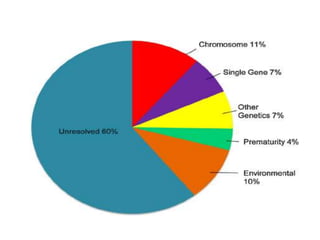
ETIOLOGY
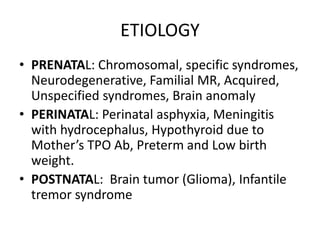
• PRENATAL: Chromosomal, specific syndromes,
Neurodegenerative, Familial MR, Acquired,
Unspecified syndromes, Brain anomaly
• PERINATAL: Perinatal asphyxia, Meningitis
with hydrocephalus, Hypothyroid due to
Mother’s TPO Ab, Preterm and Low birth
weight.
• POSTNATAL: Brain tumor (Glioma), Infantile
tremor syndrome
ETIOLOGY
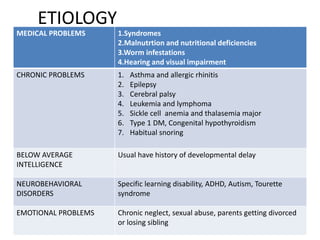
MEDICAL PROBLEMS 1.Syndromes
2.Malnutrtion and nutritional deficiencies
3.Worm infestations
4.Hearing and visual impairment
CHRONIC PROBLEMS 1. Asthma and allergic rhinitis
2. Epilepsy
3. Cerebral palsy
4. Leukemia and lymphoma
5. Sickle cell anemia and thalasemia major
6. Type 1 DM, Congenital hypothyroidism
7. Habitual snoring
BELOW AVERAGE
INTELLIGENCE
Usual have history of developmental delay
NEUROBEHAVIORAL
DISORDERS
Specific learning disability, ADHD, Autism, Tourette
syndrome
EMOTIONAL PROBLEMS Chronic neglect, sexual abuse, parents getting divorced
or losing sibling
Contd..
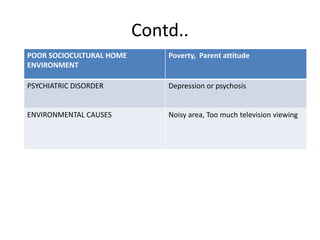
POOR SOCIOCULTURAL HOME
ENVIRONMENT
Poverty, Parent attitude
PSYCHIATRIC DISORDER Depression or psychosis
ENVIRONMENTAL CAUSES Noisy area, Too much television viewing
Contd…
• IDIOPATHIC
• Syndromes : Down syndrome,
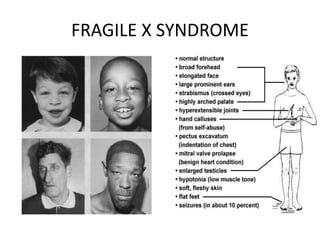
Fragile X syndrome,
Williams syndrome,
Noonan syndrome,
Rett syndrome,
Angelman syndrome.
DOWNS SYNDROME
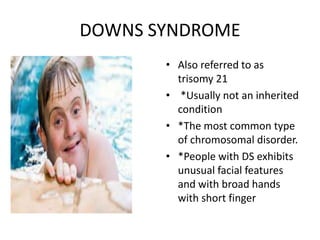
• Also referred to as
trisomy 21
• *Usually not an inherited
condition
• *The most common type
of chromosomal disorder.
• *People with DS exhibits
unusual facial features
and with broad hands
with short finger
FRAGILE X SYNDROME
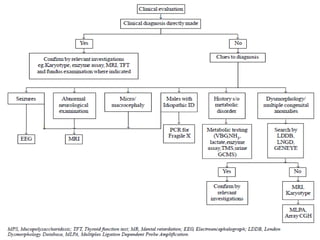
APPROACH
• History- detailed
• Physical examination
• IQ assessment
• Basic investigation
• Imaging
• Genetic evaluation
• Management
PRESENTATION
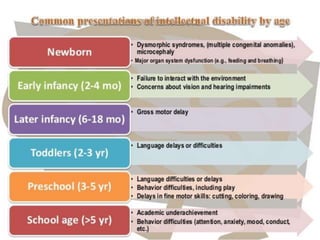
• Present to us during infancy or preschool as
developmental delay or poor school
performance.
• Congenital hypotonia, Seizures, feeding
problem, or other symptoms associated with
CNS malformation.
• Impairment in adaptive functioning – usual
presenting features.
DETAILED HISTORY:
• Prenatal ,Perinatal and Postnatal history.
• Medication during pregnancy
• Infancy - recurrent unexplained illness or
seizures or loss of psychomotor skills-
metabolic disorder.
• Family history – 3 generation pedigree chart.
• History and information should collected from
classroom teacher- social functioning, child’s
behavior and academic difficulties.
• About environment, socio-cultural, emotional.
PHYSICAL EXAMINATION
• GENERAL- PICCLE
• HEAD TO TOE- neurocutaneous marker,
abnormal pigmentation, dermatoglyphics
• Dysmorphic features – face, hand, feet and
genitalia – ANEUPLOIDY.
• ANTHROPOMETERY- head circumference.
• SYSTEMIC EXAMINATION- mainly neurological
examination.
TEAM WORK UP
• Ophthalmologist, ENT and clinical
psychologist.
• Behavioral phenotype- observing cognitive,
language and social skills.
• Counselor – to take detailed family and school
environment to rule out stress related
problems.
• Child psychiatrist – depression or anxiety
• IQ assessment
IQ ASSESSMENT
• Wechsler Intelligence Scale for children test
• Stanford Binet Intelligence scale – child’s level
of intelligence
• Special educator assess – child’s academic
achievements – standard educational test
EKTHA JAIN
CLINICAL PSYCHOLOGIST
DEPT OF PSYCHIATRY
MGMCI
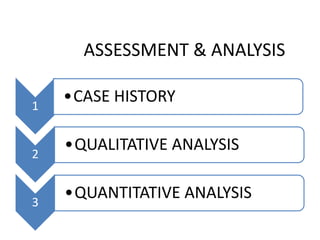
ASSESSMENT & ANALYSIS
1
•CASE HISTORY
2
•QUALITATIVE ANALYSIS
3
•QUANTITATIVE ANALYSIS
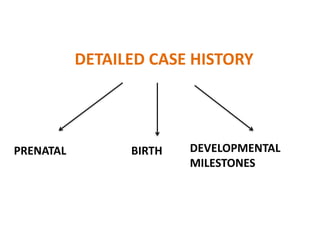
DETAILED CASE HISTORY
PRENATAL BIRTH DEVELOPMENTAL
MILESTONES
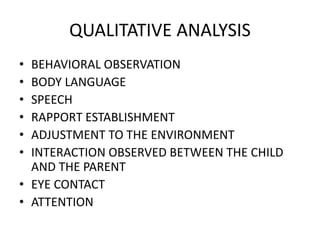
QUALITATIVE ANALYSIS
• BEHAVIORAL OBSERVATION
• BODY LANGUAGE
• SPEECH
• RAPPORT ESTABLISHMENT
• ADJUSTMENT TO THE ENVIRONMENT
• INTERACTION OBSERVED BETWEEN THE CHILD
AND THE PARENT
• EYE CONTACT
• ATTENTION
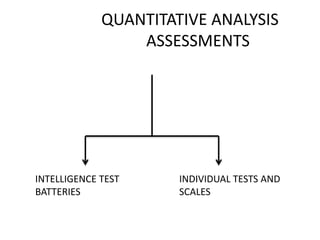
QUANTITATIVE ANALYSIS
ASSESSMENTS
INTELLIGENCE TEST
BATTERIES
INDIVIDUAL TESTS AND
SCALES
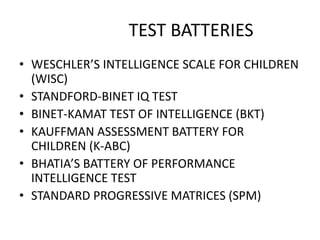
TEST BATTERIES
• WESCHLER’S INTELLIGENCE SCALE FOR CHILDREN
(WISC)
• STANDFORD-BINET IQ TEST
• BINET-KAMAT TEST OF INTELLIGENCE (BKT)
• KAUFFMAN ASSESSMENT BATTERY FOR
CHILDREN (K-ABC)
• BHATIA’S BATTERY OF PERFORMANCE
INTELLIGENCE TEST
• STANDARD PROGRESSIVE MATRICES (SPM)
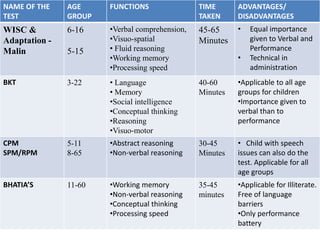
NAME OF THE
TEST
AGE
GROUP
FUNCTIONS TIME
TAKEN
ADVANTAGES/
DISADVANTAGES
WISC &
Adaptation -
Malin
6-16
5-15
•Verbal comprehension,
•Visuo-spatial
• Fluid reasoning
•Working memory
•Processing speed
45-65
Minutes
• Equal importance
given to Verbal and
Performance
• Technical in
administration
BKT 3-22 • Language
• Memory
•Social intelligence
•Conceptual thinking
•Reasoning
•Visuo-motor
40-60
Minutes
•Applicable to all age
groups for children
•Importance given to
verbal than to
performance
CPM
SPM/RPM
5-11
8-65
•Abstract reasoning
•Non-verbal reasoning
30-45
Minutes
• Child with speech
issues can also do the
test. Applicable for all
age groups
BHATIA’S 11-60 •Working memory
•Non-verbal reasoning
•Conceptual thinking
•Processing speed
35-45
minutes
•Applicable for Illiterate.
Free of language
barriers
•Only performance
battery
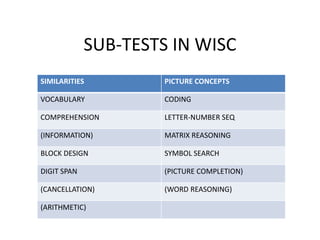
SUB-TESTS IN WISC
SIMILARITIES PICTURE CONCEPTS
VOCABULARY CODING
COMPREHENSION LETTER-NUMBER SEQ
(INFORMATION) MATRIX REASONING
BLOCK DESIGN SYMBOL SEARCH
DIGIT SPAN (PICTURE COMPLETION)
(CANCELLATION) (WORD REASONING)
(ARITHMETIC)
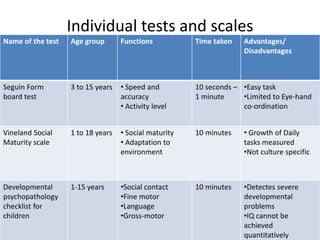
Individual tests and scales
Name of the test Age group Functions Time taken Advantages/
Disadvantages
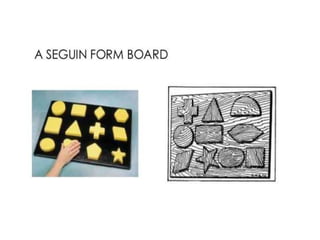
Seguin Form
board test
3 to 15 years • Speed and
accuracy
• Activity level
10 seconds –
1 minute
•Easy task
•Limited to Eye-hand
co-ordination
Vineland Social
Maturity scale
1 to 18 years • Social maturity
• Adaptation to
environment
10 minutes • Growth of Daily
tasks measured
•Not culture specific
Developmental
psychopathology
checklist for
children
1-15 years •Social contact
•Fine motor
•Language
•Gross-motor
10 minutes •Detectes severe
developmental
problems
•IQ cannot be
achieved
quantitatively
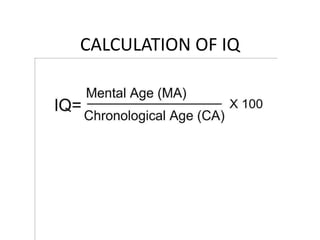
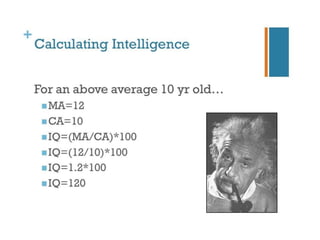
CALCULATION OF IQ
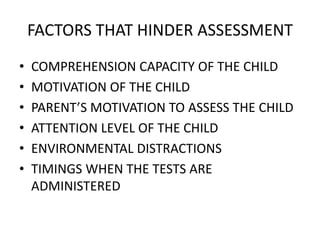
FACTORS THAT HINDER ASSESSMENT
• COMPREHENSION CAPACITY OF THE CHILD
• MOTIVATION OF THE CHILD
• PARENT’S MOTIVATION TO ASSESS THE CHILD
• ATTENTION LEVEL OF THE CHILD
• ENVIRONMENTAL DISTRACTIONS
• TIMINGS WHEN THE TESTS ARE
ADMINISTERED
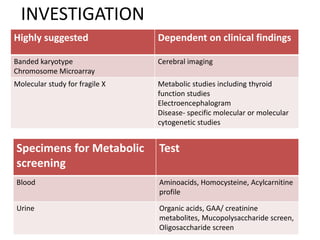
INVESTIGATION
Highly suggested Dependent on clinical findings
Banded karyotype
Chromosome Microarray
Cerebral imaging
Molecular study for fragile X Metabolic studies including thyroid
function studies
Electroencephalogram
Disease- specific molecular or molecular
cytogenetic studies
Specimens for Metabolic
screening
Test
Blood Aminoacids, Homocysteine, Acylcarnitine
profile
Urine Organic acids, GAA/ creatinine
metabolites, Mucopolysaccharide screen,
Oligosaccharide screen
MANAGEMENT
• AIM- To provide support to people with MR
and their families and to assist them in creating
personally satisfying lives.
• Most causes of intellectual disability are not
treated directly
Key features of management of MR
• Key aim is to improve or maximize quality of life
• Establish an etiology. Rarely will the condition be
curable or treatable
• Anticipate future medical problems (management of
Genetic syndromes)
• Intervene early
• Review the patient at regular intervals
• Explore long term placement options at an early stage
Contd..
• Modify behaviours that may harm the
individual, place stress on primary care givers
and minimize the chances of involvement in a
day program
• Adopt a family- focused approach looking at
the needs of parents and siblings
• Awareness of the role of prevention
• Act as an advocate for those with MR
KEY POINTS IN CONVEYING
• ATTITUDE
• LOCATION
• PERSONNEL
• LANGUAGE
• CONTENT
• QUESTIONS
• SUPPORT
MANAGEMENT
• Treat appropriate medical condition
• Nutritional supplements
• Treating chronic diseases and monitoring
• In SpLD – remedial education
• In Autism and ADHD- psychiatric consultation
for counseling, behavior modification and
medications like methlyphenidate
atomoxetine
PROGNOSIS
• Mild MR - Acquire Social and Vocational skills adequate
for minimum self- support
• Moderate MR
- communication skills during early childhood and
travel to familiar places
- unskilled or semiskilled work under supervision
during adulthood
• Severe MR
- talk and do elementary self- care skills during
school years
- perform simple tasks under supervision when
adults
- vocational support provide dignified & productive
work and leisure pursuits.
PREVENTION
• Training teachers to identify behavioral problems
• Providing good antenatal and perinatal and well
baby clinics
• Universal use of idionized salts and school
feeding programmes
• Pediatric De worming
• Nutritional supplements
• Regular screening programmes for vision and
hearing in schools
CONCLUSION
• Early indentification
• Determination of an underlying etiology
• Prompt provision of rehabilitation or support
services
• Being an advocate for the parents or caregiver
and helping them to advocate rights for their
child
THANK U
Thank you

Approach to intellectual disability

  • 1.
  • 2.
    OBJECTIVES • INTRODUCTION • CAUSES •INTELLIGENCE TESTING • APPROACH TO DIAGNOSIS • MANAGEMENT • PROGNOSIS • PREVENTION
  • 3.
    INTRODUCTION • Problem encounteredin almost all clinical setting • Other terms- Mental retardation, General learning disorder and Intellectual impairment. • 20% children scholastically backward.[Indian J Pediatr;72(11) : 961-967] • Occurs in 2-3% of the general population[INDIAN PAEDIATRICS]
  • 4.
    DEFINITION • American associationon intellectual and developmental disability measures- 3 domain: 1. Intelligence 2. Adaptive behavior 3. System of supports afforded the individual.
  • 5.
    Contd.. • Clinically –disability characterized by significant limitations both in intellectual functioning and in adaptive behavior as expressed in conceptual, social and practical adaptive skills. • Originates before 18 years.
  • 6.
    ETIOLOGY • PRENATAL: Chromosomal,specific syndromes, Neurodegenerative, Familial MR, Acquired, Unspecified syndromes, Brain anomaly • PERINATAL: Perinatal asphyxia, Meningitis with hydrocephalus, Hypothyroid due to Mother’s TPO Ab, Preterm and Low birth weight. • POSTNATAL: Brain tumor (Glioma), Infantile tremor syndrome
  • 8.
    ETIOLOGY MEDICAL PROBLEMS 1.Syndromes 2.Malnutrtionand nutritional deficiencies 3.Worm infestations 4.Hearing and visual impairment CHRONIC PROBLEMS 1. Asthma and allergic rhinitis 2. Epilepsy 3. Cerebral palsy 4. Leukemia and lymphoma 5. Sickle cell anemia and thalasemia major 6. Type 1 DM, Congenital hypothyroidism 7. Habitual snoring BELOW AVERAGE INTELLIGENCE Usual have history of developmental delay NEUROBEHAVIORAL DISORDERS Specific learning disability, ADHD, Autism, Tourette syndrome EMOTIONAL PROBLEMS Chronic neglect, sexual abuse, parents getting divorced or losing sibling
  • 9.
    Contd.. POOR SOCIOCULTURAL HOME ENVIRONMENT Poverty,Parent attitude PSYCHIATRIC DISORDER Depression or psychosis ENVIRONMENTAL CAUSES Noisy area, Too much television viewing
  • 10.
    Contd… • IDIOPATHIC • Syndromes: Down syndrome, Fragile X syndrome, Williams syndrome, Noonan syndrome, Rett syndrome, Angelman syndrome.
  • 11.
    DOWNS SYNDROME • Alsoreferred to as trisomy 21 • *Usually not an inherited condition • *The most common type of chromosomal disorder. • *People with DS exhibits unusual facial features and with broad hands with short finger
  • 12.
  • 13.
    APPROACH • History- detailed •Physical examination • IQ assessment • Basic investigation • Imaging • Genetic evaluation • Management
  • 14.
    PRESENTATION • Present tous during infancy or preschool as developmental delay or poor school performance. • Congenital hypotonia, Seizures, feeding problem, or other symptoms associated with CNS malformation. • Impairment in adaptive functioning – usual presenting features.
  • 16.
    DETAILED HISTORY: • Prenatal,Perinatal and Postnatal history. • Medication during pregnancy • Infancy - recurrent unexplained illness or seizures or loss of psychomotor skills- metabolic disorder. • Family history – 3 generation pedigree chart. • History and information should collected from classroom teacher- social functioning, child’s behavior and academic difficulties. • About environment, socio-cultural, emotional.
  • 17.
    PHYSICAL EXAMINATION • GENERAL-PICCLE • HEAD TO TOE- neurocutaneous marker, abnormal pigmentation, dermatoglyphics • Dysmorphic features – face, hand, feet and genitalia – ANEUPLOIDY. • ANTHROPOMETERY- head circumference. • SYSTEMIC EXAMINATION- mainly neurological examination.
  • 19.
    TEAM WORK UP •Ophthalmologist, ENT and clinical psychologist. • Behavioral phenotype- observing cognitive, language and social skills. • Counselor – to take detailed family and school environment to rule out stress related problems. • Child psychiatrist – depression or anxiety • IQ assessment
  • 20.
    IQ ASSESSMENT • WechslerIntelligence Scale for children test • Stanford Binet Intelligence scale – child’s level of intelligence • Special educator assess – child’s academic achievements – standard educational test
  • 21.
  • 23.
    ASSESSMENT & ANALYSIS 1 •CASEHISTORY 2 •QUALITATIVE ANALYSIS 3 •QUANTITATIVE ANALYSIS
  • 24.
    DETAILED CASE HISTORY PRENATALBIRTH DEVELOPMENTAL MILESTONES
  • 25.
    QUALITATIVE ANALYSIS • BEHAVIORALOBSERVATION • BODY LANGUAGE • SPEECH • RAPPORT ESTABLISHMENT • ADJUSTMENT TO THE ENVIRONMENT • INTERACTION OBSERVED BETWEEN THE CHILD AND THE PARENT • EYE CONTACT • ATTENTION
  • 26.
  • 27.
    TEST BATTERIES • WESCHLER’SINTELLIGENCE SCALE FOR CHILDREN (WISC) • STANDFORD-BINET IQ TEST • BINET-KAMAT TEST OF INTELLIGENCE (BKT) • KAUFFMAN ASSESSMENT BATTERY FOR CHILDREN (K-ABC) • BHATIA’S BATTERY OF PERFORMANCE INTELLIGENCE TEST • STANDARD PROGRESSIVE MATRICES (SPM)
  • 28.
    NAME OF THE TEST AGE GROUP FUNCTIONSTIME TAKEN ADVANTAGES/ DISADVANTAGES WISC & Adaptation - Malin 6-16 5-15 •Verbal comprehension, •Visuo-spatial • Fluid reasoning •Working memory •Processing speed 45-65 Minutes • Equal importance given to Verbal and Performance • Technical in administration BKT 3-22 • Language • Memory •Social intelligence •Conceptual thinking •Reasoning •Visuo-motor 40-60 Minutes •Applicable to all age groups for children •Importance given to verbal than to performance CPM SPM/RPM 5-11 8-65 •Abstract reasoning •Non-verbal reasoning 30-45 Minutes • Child with speech issues can also do the test. Applicable for all age groups BHATIA’S 11-60 •Working memory •Non-verbal reasoning •Conceptual thinking •Processing speed 35-45 minutes •Applicable for Illiterate. Free of language barriers •Only performance battery
  • 29.
    SUB-TESTS IN WISC SIMILARITIESPICTURE CONCEPTS VOCABULARY CODING COMPREHENSION LETTER-NUMBER SEQ (INFORMATION) MATRIX REASONING BLOCK DESIGN SYMBOL SEARCH DIGIT SPAN (PICTURE COMPLETION) (CANCELLATION) (WORD REASONING) (ARITHMETIC)
  • 30.
    Individual tests andscales Name of the test Age group Functions Time taken Advantages/ Disadvantages Seguin Form board test 3 to 15 years • Speed and accuracy • Activity level 10 seconds – 1 minute •Easy task •Limited to Eye-hand co-ordination Vineland Social Maturity scale 1 to 18 years • Social maturity • Adaptation to environment 10 minutes • Growth of Daily tasks measured •Not culture specific Developmental psychopathology checklist for children 1-15 years •Social contact •Fine motor •Language •Gross-motor 10 minutes •Detectes severe developmental problems •IQ cannot be achieved quantitatively
  • 32.
  • 37.
    FACTORS THAT HINDERASSESSMENT • COMPREHENSION CAPACITY OF THE CHILD • MOTIVATION OF THE CHILD • PARENT’S MOTIVATION TO ASSESS THE CHILD • ATTENTION LEVEL OF THE CHILD • ENVIRONMENTAL DISTRACTIONS • TIMINGS WHEN THE TESTS ARE ADMINISTERED
  • 42.
    INVESTIGATION Highly suggested Dependenton clinical findings Banded karyotype Chromosome Microarray Cerebral imaging Molecular study for fragile X Metabolic studies including thyroid function studies Electroencephalogram Disease- specific molecular or molecular cytogenetic studies Specimens for Metabolic screening Test Blood Aminoacids, Homocysteine, Acylcarnitine profile Urine Organic acids, GAA/ creatinine metabolites, Mucopolysaccharide screen, Oligosaccharide screen
  • 44.
    MANAGEMENT • AIM- Toprovide support to people with MR and their families and to assist them in creating personally satisfying lives. • Most causes of intellectual disability are not treated directly
  • 45.
    Key features ofmanagement of MR • Key aim is to improve or maximize quality of life • Establish an etiology. Rarely will the condition be curable or treatable • Anticipate future medical problems (management of Genetic syndromes) • Intervene early • Review the patient at regular intervals • Explore long term placement options at an early stage
  • 46.
    Contd.. • Modify behavioursthat may harm the individual, place stress on primary care givers and minimize the chances of involvement in a day program • Adopt a family- focused approach looking at the needs of parents and siblings • Awareness of the role of prevention • Act as an advocate for those with MR
  • 48.
    KEY POINTS INCONVEYING • ATTITUDE • LOCATION • PERSONNEL • LANGUAGE • CONTENT • QUESTIONS • SUPPORT
  • 49.
    MANAGEMENT • Treat appropriatemedical condition • Nutritional supplements • Treating chronic diseases and monitoring • In SpLD – remedial education • In Autism and ADHD- psychiatric consultation for counseling, behavior modification and medications like methlyphenidate atomoxetine
  • 50.
    PROGNOSIS • Mild MR- Acquire Social and Vocational skills adequate for minimum self- support • Moderate MR - communication skills during early childhood and travel to familiar places - unskilled or semiskilled work under supervision during adulthood • Severe MR - talk and do elementary self- care skills during school years - perform simple tasks under supervision when adults - vocational support provide dignified & productive work and leisure pursuits.
  • 51.
    PREVENTION • Training teachersto identify behavioral problems • Providing good antenatal and perinatal and well baby clinics • Universal use of idionized salts and school feeding programmes • Pediatric De worming • Nutritional supplements • Regular screening programmes for vision and hearing in schools
  • 53.
    CONCLUSION • Early indentification •Determination of an underlying etiology • Prompt provision of rehabilitation or support services • Being an advocate for the parents or caregiver and helping them to advocate rights for their child
  • 54.