ATTENTION DEFICIT
HYPERACTIVITY DISORDER
By
Sreetha Akhil
MSc Nsg
Attention Deficit Hyperactivity Disorder
•Attention Deficit Hyperactivity
Disorder commonly known as
ADHD
•Most common childhood
disorder
•Continue to adolescents to
adulthood
•More common in boys.
DEFINITION
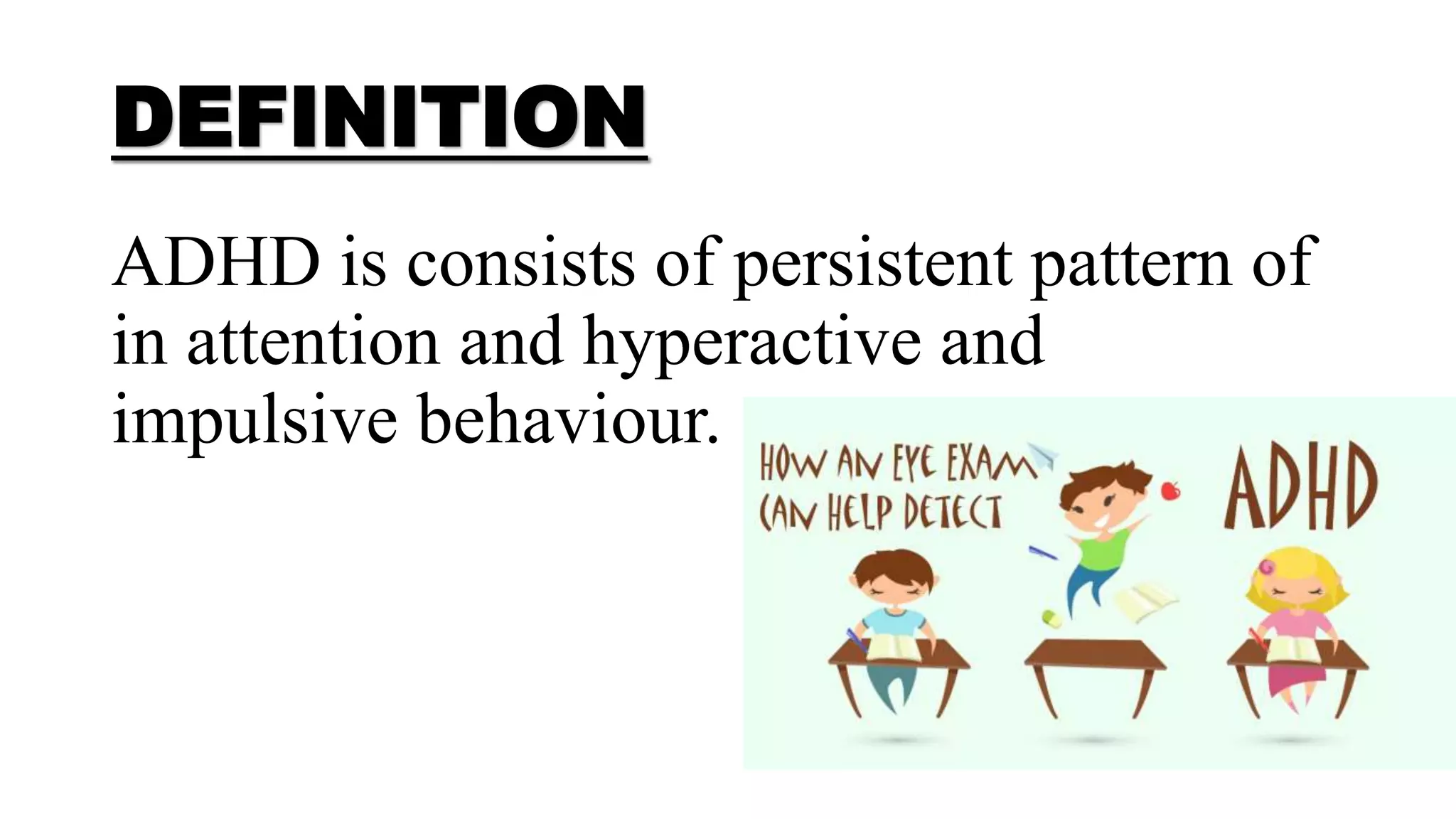
ADHD is consists of persistent pattern of
in attention and hyperactive and
impulsive behaviour.
• It also called hyperkinetic disorder.
•A neurological disorder.
•Unless identified & treated properly, ADHD may
progress to conduct disorder, academic & job
failure, depression, relationship problems,
&substance abuse.
• Most children with ADHD experience
signs &symptoms by age 4.
• A few aren’t diagnosed until they enter
school.
EPIDERMOLOGY
• 5% OF CHILDREN HAVE THIS
DISODER
• In India 11.32% of primary school children
• More prevalent in boys
ICD-10 Classification
• F90.0, Attention-deficit hyperactivity disorder, predominantly
inattentive type
• F90.1, Attention-deficit hyperactivity disorder, predominantly
hyperactive type
• F90.2, Attention-deficit hyperactivity disorder, combined type
• F90.8, Attention-deficit hyperactivity disorder, other type
• F90.9, Attention-deficit hyperactivity disorder, unspecified type
ETIOLOGY
1) Genetic factor
• Higher in monozygotic twins than in dizygotic twins
• Siblings of hyperactive children have about twice the risk of
having the disorder as does the general population.
• Family history of psychiatric illness
2) Biochemical factor
• A deficit of dopamine & norepinephrine has been attributed
in the over activity seen in ADHD.
3) Developmental factor
• Developmental delay in milestone
4) Pre, Intra & postnatal factors
•Prenatal toxic exposure, Infections.
•Perinatal Prematurity, foetal distress, precipitated or
prolonged labour, Perinatal asphyxia & low Apgar
scores.
•Postnatal infections, CNS abnormalities resulting from
trauma, Instrumental delivery.
5) Environmental influences
•Environmental lead
•Food additives, colouring preservatives & sugar level also
been suggested as possible causes of hyperactive
behaviour but there is no definite evidence
6) Psychosocial Factors
•Prolonged emotional deprivation
•Stress psychic events.
•Disruption of family equilibrium.
CLINICAL MANIFESTATION
1) Lack of attention( Inattentive presentation)
•Fails to give close attention
•Difficulty in sustaining attention during tasks or play
•Does not appear to listen
•Struggles to follow through with Instruction
•Has difficulty with Organization of task, activities
•Easily distracted
•Fails to finish schoolwork, routine task, or duties
2) Hyperactivity and Impulsivity
•Fidgets with hands or feet or squirms in seat
•Leaves seat when remaining seated is expected
•Runs about or climbs in inappropriate situations
•Has difficulty playing quietly
•Is often "on the go," acts as if "driven by a
motor," talks excessively
• Blurts out answers before questions have
been completed
•Has difficulty awaiting turn
•Interrupts or intrudes on others (butts into
conversations or games)
3) ADHD combined Presentation
Clients with both inattention, hyperactive- impulse
symptoms
Diagnostic tests
• History collection
• Physical examination
• Mental status examination
• Neurological examination
• Assessing Developmental milestone
• Investigations
• DSM Diagnostic criteria
DSM Diagnostic criteria
• Five or more symptoms of inattention and/or ≥5 symptoms of
hyperactivity/impulsivity must have persisted for ≥6 months
to a degree that is inconsistent with the developmental level
and negatively impacts social and academic/occupational
activities.
• Several symptoms (inattentive or hyperactive/impulsive)
were present before the age of 12 years.
• Several symptoms (inattentive or hyperactive/impulsive)
must be present in ≥2 settings (eg, at home, school, or work;
with friends or relatives; in other activities).
•There is clear evidence that the symptoms interfere
with or reduce the quality of social, academic, or
occupational functioning.
•Symptoms do not occur exclusively during the course
of schizophrenia or another psychotic disorder, and are
not better explained by another mental disorder (eg,
mood disorder, anxiety disorder, dissociative disorder,
personality disorder, substance intoxication, or
withdrawal).
TREATMENT
PHARMACOTHERAPY
1) Stimulant medication
Dextroamphitamine 2.5 – 20 mg/day
Methylphenidate 5 – 60 mg /day
2) Antidepressants
Tricyclic Antidepressants ( Bupropion, Imipramine)
Monoamine oxidase inhibitors (Phenelzine)
Selective serotonin reuptake inhibitors. (Citalopram,
Fluoxetine)
BEHAVIOURAL THERAPY
NURSING MANAGEMENT
NURSING DIAGNOSIS - 1
• Risk for violence towards self and others related to impulsive and
accident prone behaviour as evidenced by hyperactivity
Interventions
Assessment
Close supervision
Safe environment
Remove hazardous objects
Identify deliberate behaviour and teach consequences
Psychotherapy
Medication , anti psychotics, sedatives.
Non compliance with task expectations related to low
frustration tolerance and short attention span as evidenced by
inability to complete the task.
Interventions
Assess the clients impulse behaviour
Provide an environment for task effort that is free of
distraction
Provide assistance
Simple task
Rewarding each step completion
NURSING DIAGNOSIS - 2
• Impaired social interaction related to intrusive and immature
behaviour as evidenced by excessive talk to strangers.
Develop trusting relationship and convey acceptance
separate from the unacceptable behavior.
Assist client to decrease stimulation and distraction by a
altering environment to reduce distraction
Involve the child in a music based program if available
Provide group activities
Psychotherapy
Medication
NURSING DIAGNOSIS - 3
•Imbalanced nutrition less than body requirement
related to less intake of food as evidenced by
decreased appetite
•Defensive coping related to feelings of inadequacy and
need for acceptance from others.
•Risk for parental role conflict related to children with
attention deficit hyperactivity disorder.
•Disturbed family process related to have child with
attention deficit hyperactivity disorder as evidenced by
reducing usual communication.
Interventions
• Accept the child or individual as what he is. Consider his condition and
communicate with him as an equal.
• Approach the child at his current level of functioning. Do not use baby talk nor
direct him as to his chronological age; encourage him to express his thoughts or
emotions and respond to him therapeutically.
• Use simple and direct instructions. You may repeat your instructions more than
once and at times, you may utilize visual aids or pictures in order for him to relate
well
• Implement scheduled routine every day. Make his routine predictable and
something like ritualistic so that it will only be easy for him to grasp for his
independent functioning.
• Avoid stimulating or distracting settings. Ensure to involve the child in his daily
activities in a quiet and non-stimulating area to prevent him from becoming easily
distracted and hyperactive.
• Give positive reinforcements.
• Encourage physical activity.
Reference
 Townsend MC. Essentials of psychiatric mental health nursing. 3rd
edition. Philadelphia; F A Davis company publication.2005
 Ahuja N, Vyas JN. Textbook of postgraduate psychiatry. Second
edition. Jaypee publication. 2013.
 Sreevani R. A guide to mental health and psychiatric nursing. 3rd
edition. New Delhi: Jaypee brother medical publication.2010.
 Raju S M, Raju B. Psychiatry and mental health nursing. Bangaluru;
Jay pee brothers medical publications.2010
THANK YOY

Attention deficit hyperactivity disorder

  • 1.
  • 2.
    Attention Deficit HyperactivityDisorder •Attention Deficit Hyperactivity Disorder commonly known as ADHD •Most common childhood disorder •Continue to adolescents to adulthood •More common in boys.
  • 3.
    DEFINITION ADHD is consistsof persistent pattern of in attention and hyperactive and impulsive behaviour.
  • 4.
    • It alsocalled hyperkinetic disorder. •A neurological disorder. •Unless identified & treated properly, ADHD may progress to conduct disorder, academic & job failure, depression, relationship problems, &substance abuse.
  • 5.
    • Most childrenwith ADHD experience signs &symptoms by age 4. • A few aren’t diagnosed until they enter school.
  • 6.
    EPIDERMOLOGY • 5% OFCHILDREN HAVE THIS DISODER • In India 11.32% of primary school children • More prevalent in boys
  • 7.
    ICD-10 Classification • F90.0,Attention-deficit hyperactivity disorder, predominantly inattentive type • F90.1, Attention-deficit hyperactivity disorder, predominantly hyperactive type • F90.2, Attention-deficit hyperactivity disorder, combined type • F90.8, Attention-deficit hyperactivity disorder, other type • F90.9, Attention-deficit hyperactivity disorder, unspecified type
  • 8.
    ETIOLOGY 1) Genetic factor •Higher in monozygotic twins than in dizygotic twins • Siblings of hyperactive children have about twice the risk of having the disorder as does the general population. • Family history of psychiatric illness 2) Biochemical factor • A deficit of dopamine & norepinephrine has been attributed in the over activity seen in ADHD. 3) Developmental factor • Developmental delay in milestone
  • 9.
    4) Pre, Intra& postnatal factors •Prenatal toxic exposure, Infections. •Perinatal Prematurity, foetal distress, precipitated or prolonged labour, Perinatal asphyxia & low Apgar scores. •Postnatal infections, CNS abnormalities resulting from trauma, Instrumental delivery.
  • 10.
    5) Environmental influences •Environmentallead •Food additives, colouring preservatives & sugar level also been suggested as possible causes of hyperactive behaviour but there is no definite evidence 6) Psychosocial Factors •Prolonged emotional deprivation •Stress psychic events. •Disruption of family equilibrium.
  • 11.
    CLINICAL MANIFESTATION 1) Lackof attention( Inattentive presentation) •Fails to give close attention •Difficulty in sustaining attention during tasks or play •Does not appear to listen •Struggles to follow through with Instruction •Has difficulty with Organization of task, activities •Easily distracted •Fails to finish schoolwork, routine task, or duties
  • 12.
    2) Hyperactivity andImpulsivity •Fidgets with hands or feet or squirms in seat •Leaves seat when remaining seated is expected •Runs about or climbs in inappropriate situations •Has difficulty playing quietly •Is often "on the go," acts as if "driven by a motor," talks excessively
  • 13.
    • Blurts outanswers before questions have been completed •Has difficulty awaiting turn •Interrupts or intrudes on others (butts into conversations or games)
  • 14.
    3) ADHD combinedPresentation Clients with both inattention, hyperactive- impulse symptoms
  • 15.
    Diagnostic tests • Historycollection • Physical examination • Mental status examination • Neurological examination • Assessing Developmental milestone • Investigations • DSM Diagnostic criteria
  • 16.
    DSM Diagnostic criteria •Five or more symptoms of inattention and/or ≥5 symptoms of hyperactivity/impulsivity must have persisted for ≥6 months to a degree that is inconsistent with the developmental level and negatively impacts social and academic/occupational activities. • Several symptoms (inattentive or hyperactive/impulsive) were present before the age of 12 years. • Several symptoms (inattentive or hyperactive/impulsive) must be present in ≥2 settings (eg, at home, school, or work; with friends or relatives; in other activities).
  • 17.
    •There is clearevidence that the symptoms interfere with or reduce the quality of social, academic, or occupational functioning. •Symptoms do not occur exclusively during the course of schizophrenia or another psychotic disorder, and are not better explained by another mental disorder (eg, mood disorder, anxiety disorder, dissociative disorder, personality disorder, substance intoxication, or withdrawal).
  • 18.
    TREATMENT PHARMACOTHERAPY 1) Stimulant medication Dextroamphitamine2.5 – 20 mg/day Methylphenidate 5 – 60 mg /day 2) Antidepressants Tricyclic Antidepressants ( Bupropion, Imipramine) Monoamine oxidase inhibitors (Phenelzine) Selective serotonin reuptake inhibitors. (Citalopram, Fluoxetine)
  • 19.
  • 20.
  • 21.
    NURSING DIAGNOSIS -1 • Risk for violence towards self and others related to impulsive and accident prone behaviour as evidenced by hyperactivity Interventions Assessment Close supervision Safe environment Remove hazardous objects Identify deliberate behaviour and teach consequences Psychotherapy Medication , anti psychotics, sedatives.
  • 22.
    Non compliance withtask expectations related to low frustration tolerance and short attention span as evidenced by inability to complete the task. Interventions Assess the clients impulse behaviour Provide an environment for task effort that is free of distraction Provide assistance Simple task Rewarding each step completion NURSING DIAGNOSIS - 2
  • 23.
    • Impaired socialinteraction related to intrusive and immature behaviour as evidenced by excessive talk to strangers. Develop trusting relationship and convey acceptance separate from the unacceptable behavior. Assist client to decrease stimulation and distraction by a altering environment to reduce distraction Involve the child in a music based program if available Provide group activities Psychotherapy Medication NURSING DIAGNOSIS - 3
  • 24.
    •Imbalanced nutrition lessthan body requirement related to less intake of food as evidenced by decreased appetite •Defensive coping related to feelings of inadequacy and need for acceptance from others. •Risk for parental role conflict related to children with attention deficit hyperactivity disorder. •Disturbed family process related to have child with attention deficit hyperactivity disorder as evidenced by reducing usual communication.
  • 25.
    Interventions • Accept thechild or individual as what he is. Consider his condition and communicate with him as an equal. • Approach the child at his current level of functioning. Do not use baby talk nor direct him as to his chronological age; encourage him to express his thoughts or emotions and respond to him therapeutically. • Use simple and direct instructions. You may repeat your instructions more than once and at times, you may utilize visual aids or pictures in order for him to relate well • Implement scheduled routine every day. Make his routine predictable and something like ritualistic so that it will only be easy for him to grasp for his independent functioning. • Avoid stimulating or distracting settings. Ensure to involve the child in his daily activities in a quiet and non-stimulating area to prevent him from becoming easily distracted and hyperactive. • Give positive reinforcements. • Encourage physical activity.
  • 26.
    Reference  Townsend MC.Essentials of psychiatric mental health nursing. 3rd edition. Philadelphia; F A Davis company publication.2005  Ahuja N, Vyas JN. Textbook of postgraduate psychiatry. Second edition. Jaypee publication. 2013.  Sreevani R. A guide to mental health and psychiatric nursing. 3rd edition. New Delhi: Jaypee brother medical publication.2010.  Raju S M, Raju B. Psychiatry and mental health nursing. Bangaluru; Jay pee brothers medical publications.2010
  • 27.