HEMOLYTIC ANEMIA
DR SANDIP GUPTA
PGT,PEDIATRICS
B.S.M.C.H.
CLASSIFICATION
1.RED CELL ABNORMALITY
(INTRACORPUSCULAR DEFECT)
A.HEREDITARY
1.Membrane defect(spherocytosis,ellipsocytosis)
2.Enzyme defect
3.Hemoglobinopathies(Thalassemia,SCD, other)
B.ACQUIRED
1.Paroxysmal nocturnal hemoglobinuria
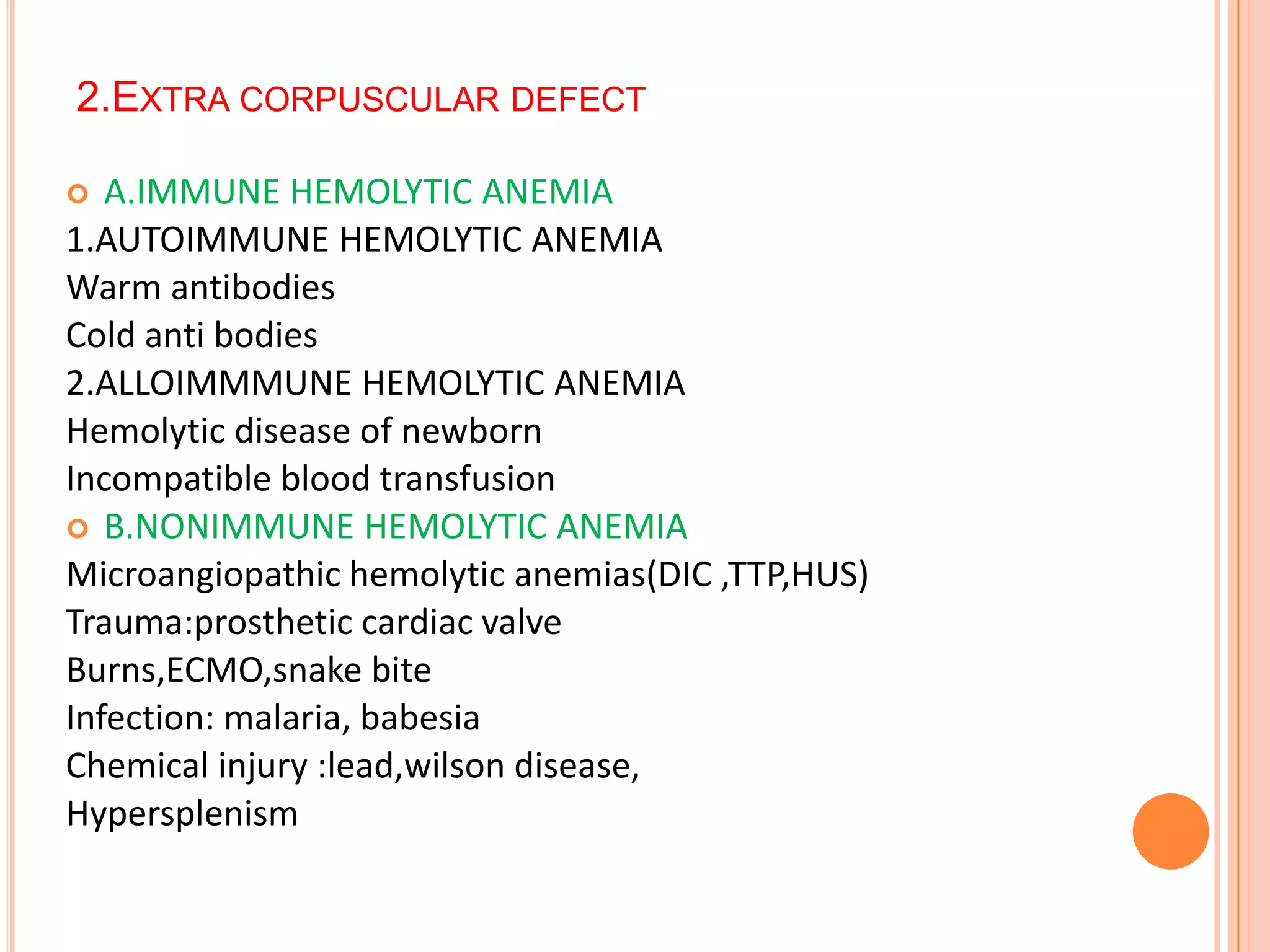
2.EXTRA CORPUSCULAR DEFECT
 A.IMMUNE HEMOLYTIC ANEMIA
1.AUTOIMMUNE HEMOLYTIC ANEMIA
Warm antibodies
Cold anti bodies
2.ALLOIMMMUNE HEMOLYTIC ANEMIA
Hemolytic disease of newborn
Incompatible blood transfusion
 B.NONIMMUNE HEMOLYTIC ANEMIA
Microangiopathic hemolytic anemias(DIC ,TTP,HUS)
Trauma:prosthetic cardiac valve
Burns,ECMO,snake bite
Infection: malaria, babesia
Chemical injury :lead,wilson disease,
Hypersplenism
EVALUATION OF ANEMIA
Low Hgb/Hct
Corr. Retic
Ct >2%
Corr. Retic
Ct <2%
Acute
Blood Loss
MCV>100
MCV 80-
100
MCV<80
EVALUATE &
TREAT
APPRO-
PRIATELY
Evaluate for
Hemolytic
Anemias
Evaluate for
microcytic
anemias
Evaluate for
macrocytic
anemias
Evaluate for
normocytic
anemias
STEP BY STEP APPROACH
1. Calculate for Corrected Reticulocyte Count
Retic count: 10%
Pt’s Hct 29
Control Hct 40
Corrected Retic Count = % Retic x Pt’s Hct
Control Hct
= 10% x 29/ 40 = 7.73 % > 2%
if no blood loss Indicates hemolysis
HEMOLYTIC ANEMIA
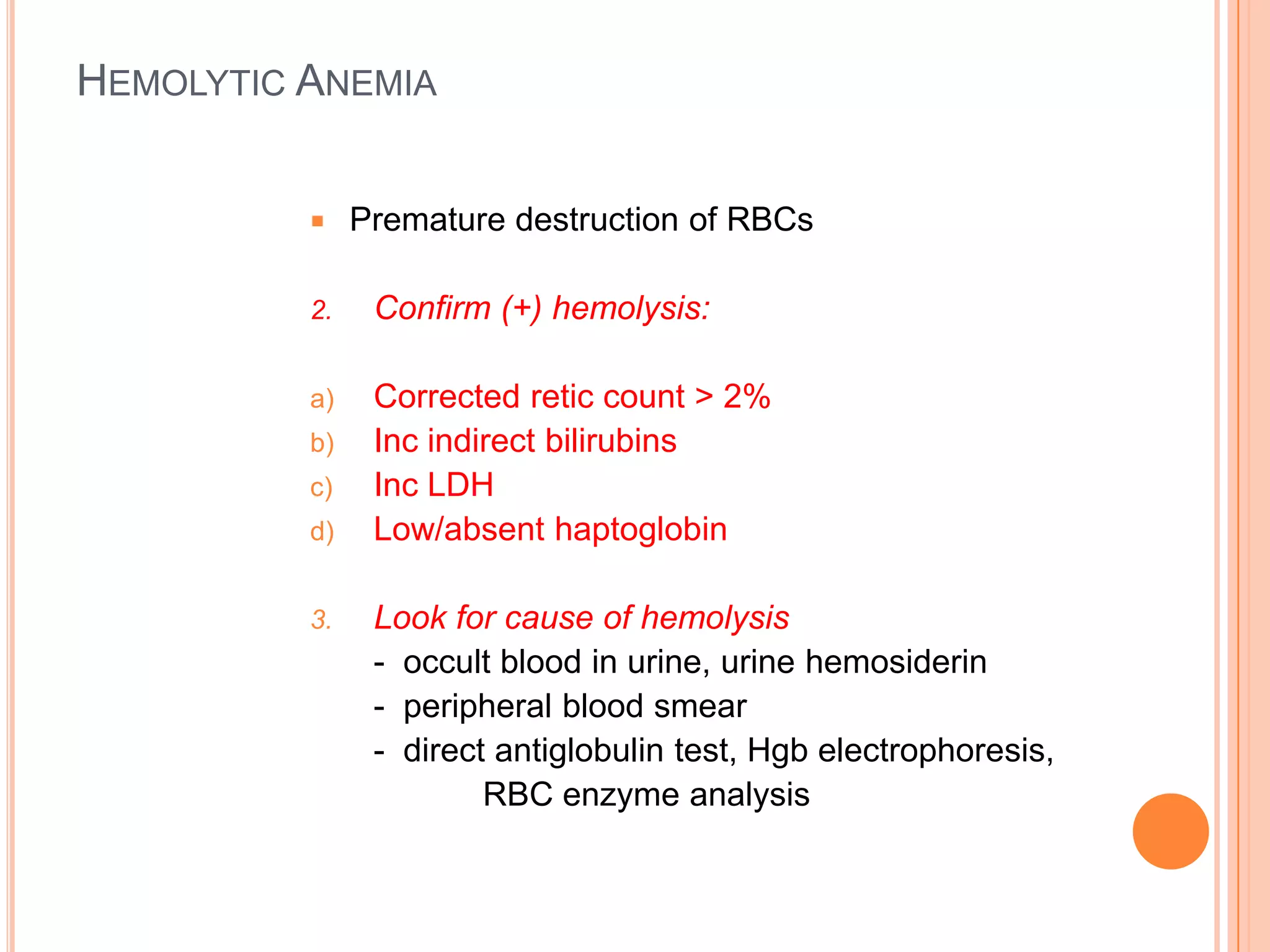
 Premature destruction of RBCs
2. Confirm (+) hemolysis:
a) Corrected retic count > 2%
b) Inc indirect bilirubins
c) Inc LDH
d) Low/absent haptoglobin
3. Look for cause of hemolysis
- occult blood in urine, urine hemosiderin
- peripheral blood smear
- direct antiglobulin test, Hgb electrophoresis,
RBC enzyme analysis
ROLE OF PBS
1 Sickled
cells
Bite
cells
Schisto-
cytes
Acantho-
cytes
Sphero-
cytes
Target
cells
parasite
inclusions
DAT
(+)
DAT
(-)
Hgb electro-
phoresis
G6PD
level
PT/PTT
Crea
platelets
Auto-
Immune
Hemo-
lytic
Anemia
Heredi-
tary
Sphero-
cytosis
Sickle
Cell
Ds
G6PD
Deficient
Vs
Unstable
Hgbs
Thalas-
semias
Hemo-
globino-
pathy
Liver Ds
Liver
Ds
Malaria
Babe-
siosis
Barto-
nella
TTP-HUS
DIC
Prosthe-
tic Valve
Malignant
HTN
Hemolytic Anemia (CRC>2% + no blood loss)
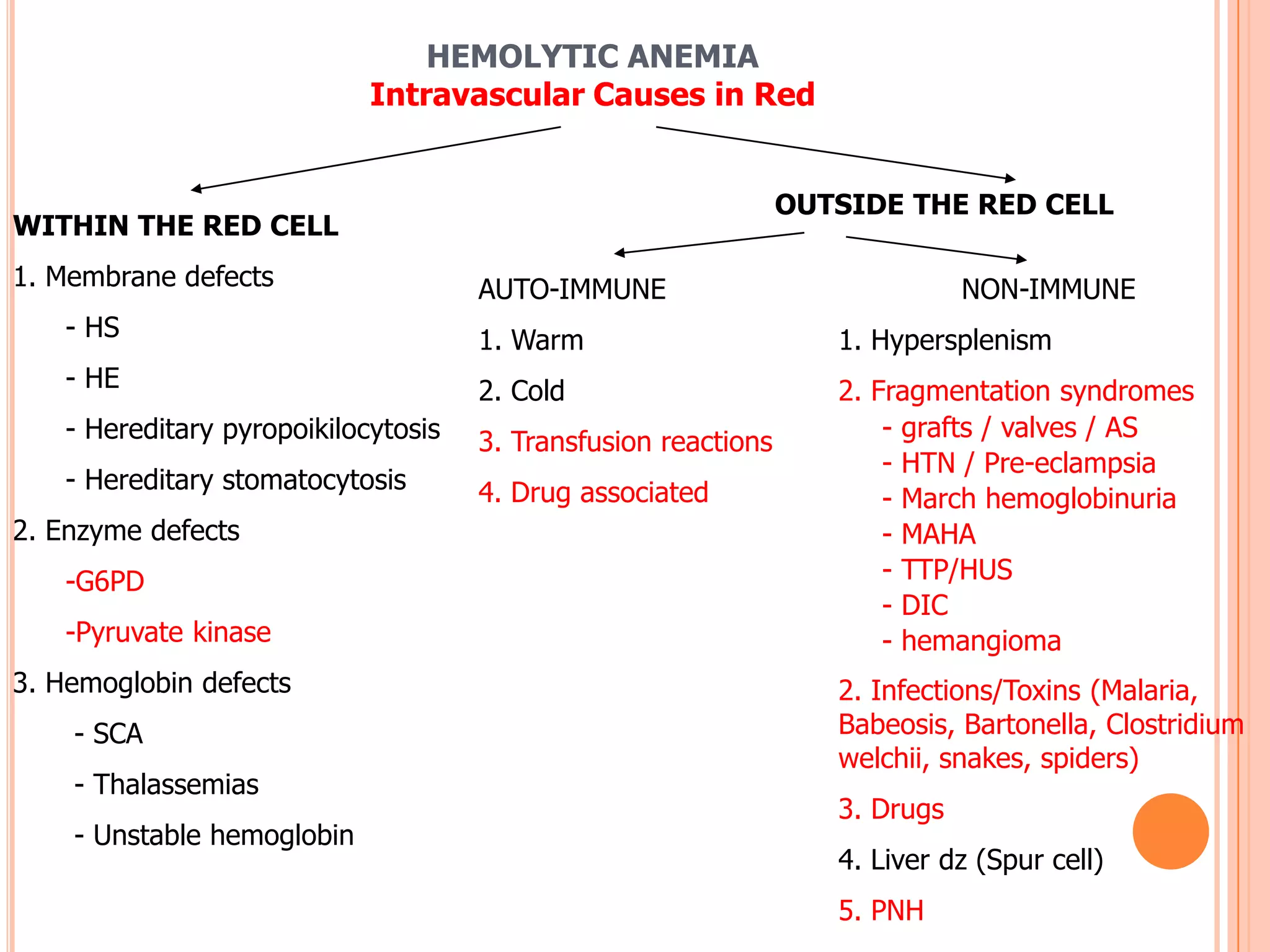
HEMOLYTIC ANEMIA
Intravascular Causes in Red
WITHIN THE RED CELL
1. Membrane defects
- HS
- HE
- Hereditary pyropoikilocytosis
- Hereditary stomatocytosis
2. Enzyme defects
-G6PD
-Pyruvate kinase
3. Hemoglobin defects
- SCA
- Thalassemias
- Unstable hemoglobin
NON-IMMUNE
1. Hypersplenism
2. Fragmentation syndromes
- grafts / valves / AS
- HTN / Pre-eclampsia
- March hemoglobinuria
- MAHA
- TTP/HUS
- DIC
- hemangioma
2. Infections/Toxins (Malaria,
Babeosis, Bartonella, Clostridium
welchii, snakes, spiders)
3. Drugs
4. Liver dz (Spur cell)
5. PNH
AUTO-IMMUNE
1. Warm
2. Cold
3. Transfusion reactions
4. Drug associated
OUTSIDE THE RED CELL
Intravascular Hemolysis
RBC LYSIS
HBG
HAPTOGLOBIN
REMOVED BY LIVER
HEMOGLOBINEMIA
HEMOGLOBINURIA
HBG TAKEN UP BY RENAL
TUBULAR CELLS
HEMOSIDERIN
CELLS SLOUGHED IN
URINE 1 WEEK LATER
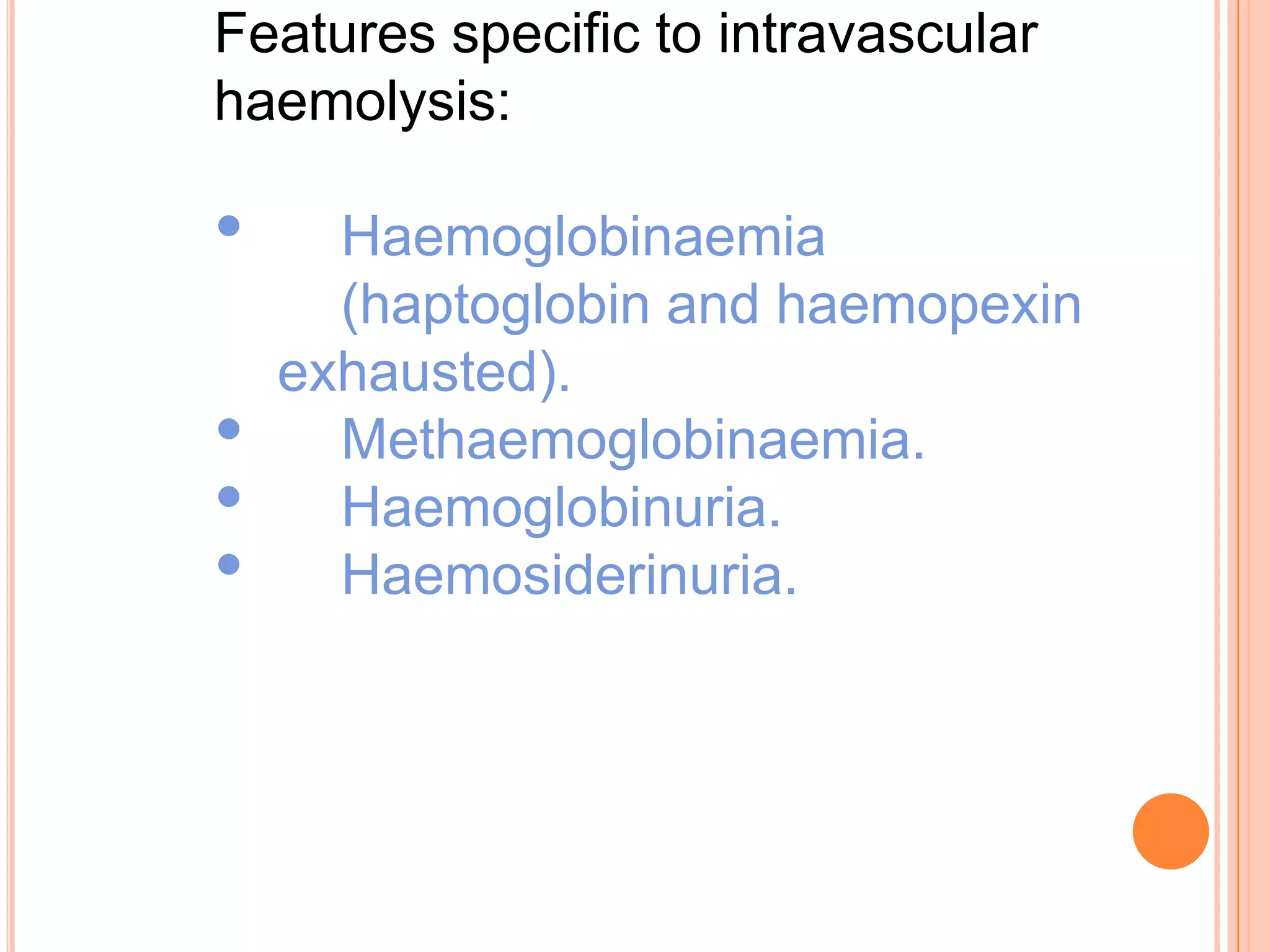
Features specific to intravascular
haemolysis:
• Haemoglobinaemia
(haptoglobin and haemopexin
exhausted).
• Methaemoglobinaemia.
• Haemoglobinuria.
• Haemosiderinuria.
HEREDITARY SPHEROCYTOSIS
 Incidence:1/5000 in North European
population
 Autosomal dominant
 Defect in RBC
cytoskeleton(spectrin,ankyrin)
 Pathophysiology:A deficiency in
spectrin, ankyrin,protein 3, leads to
weakening of the “vertical” interaction
of the lipid bilayer & loss of membrane
microvescicle . Loss of surface
area,↑cation permeability, ATP use,&
glycolysis leading to premature
destruction in spleen.
CLINICAL FEATURES
 Neonatal period: anemia+ jaundice, more severe.
 Infancy&childhood:variable severity.
 Mild: asymptomatic
 Moderate: intermittent jaundice,spleenomegaly,anemia.
 Severe:tranfusion dependeant,bone expansion,gall stone
 LAB. DIAGNOSIS:Anemia(Hb:6-10g%),PBS :Spherocytes
lacking central pallor ,reticulocytes,MCV-N
MCH↑,MCHC >35,RDW>14.5,DCT: Negative
Osmatic fragility& Incubated osmotic fragility test.
Differential diagnosis: autoimmune hemolytic anemia, G6PD def,
Clostridial sepsis, wilsons disease.
TREATMENT
 Splenectomy was routine in past.
 Anemia,reticulocytosis, hyperbilirubinemia resolve.
 Transfusion requirement↓,risk of gall stone falls.
 Current approach is to spenectomize pts with severe hemolytic
anemia &those with s/s of anemia, growth failure, skeletal
changes, leg ulcer, etramedullary hematopoiesis,
aplastic crises,cardiomegaly .
 Pt’s with Hb>10%& retic count<10% may not need splenectomy.
 Partial splenectomy in infants & young children with severe
hemolysis & transfusion dependent anemia has been recently
advocated.
 Suppoertive therapy : 1mg folic acid daily.
 Laparoscopic splenectomy.
 Lifelong antibiotic prophylaxis.
2.HEREDITARY ELLIPTOCYTOSIS
 Equatorial Africa, SE Asia
 AD / AR
 Functional abnormality in one or more anchor
proteins in RBC membrane- Alpha & beta
spectrin& defective spectrin heterodimer self
association , Protein 4.1& glycophorinC.
 Usually asymptomatic
 Mx: Similar to H. spherocytosis
 Variant:
3.SE-Asian ovalocytosis:
 Common in Malaysia , Indonesia…
 Asymptomatic-usually
 Cells oval , rigid ,resist invasion by malarial parasites
 SAO is associated with protein3 abnormality.
RED CELL ENZYMOPATHIES
 Physiology:
 EM pathway: ATP production
 HMP shunt pathway: NADPH & Glutathione production
1. Glucose-6-Phosphate Dehydrogenase
( G6PD ) Deficiency
 Pivotal enzyme in HMP Shunt & produces NADPH to protect RBC against
oxidative stress
 Most common enzymopathy -10% world’s population
 1% of indian males have G6PD deficiency
 Protection against Malaria
 X-linked recessive
 Clinical Features:
 Acute drug induced hemolysis:
 Aspirin, primaquine, quinine, chloroquine, dapsone….
 Chronic compensated hemolysis
 Infection/acute illness
 Neonatal jaundice
 Favism
(Oxidised form)(Reduced form)
 Inv:
 e/o non-spherocytic intravascular
hemolyis
 P. Smear: Bite cells, blister
cells, irregular small cells, Heinz
bodies, polychromasia
 G-6-PD level
 Treatment:
 Stop the precipitating drug or treat the
infection
 Acute transfusions if required
2. Pyruvate Kinase Deficiency
 AR
 Deficient ATP production, Chronic
hemolytic anemia
 Inv;
P. Smear: Prickle cells
Decreased enzyme activity
 Treatment:
Transfusion may be required
PAROXYSMAL NOCTURNAL HEMOGLOBINURIA
 Clonal cell disorder
 Ongoing Intra- & Extravascular hemolysis;
classically at night
 Testing
 Acid hemolysis (Ham test)
 Sucrose hemolysis
 CD-59 negative (Product of PIG-A gene)
 Acquired deficit of GPI-Associated proteins
(including Decay Activating Factor)
1.Warm AI Hemolysis:
 Can occurs at all age groups
 F > M
 Causes:
50% Idiopathic
Rest - secondary causes:
1.Lymphoid neoplasm: CLL, Lymphoma,
Myeloma
2.Solid Tumors: Lung, Colon, Kidney, Ovary,
Thymoma
3.CTD: SLE,RA
4.Drugs: Alpha methyl DOPA, Penicillin ,
Quinine, Chloroquine
5.Misc: UC, HIV
 Inv:
 e/o hemolysis, MCV
 P Smear: Microspherocytosis, n-RBC
 Confirmation: Coomb’s Test / Antiglobulin test
 Treatment
 Correct the underlying cause
 Prednisolone 1mg/kg po until Hb reaches 10mg/dl then taper
slowly and stop
 Transfusion: for life threatening problems
 If no response to steroids  Spleenectomy or,
 Immunosuppressive: Azathioprine, Cyclophosphamide
2. Cold AI Hemolysis
 Usually Ig M
 Acute or Chronic form
 Chronic:
C/F:
Elderly patients
Cold , painful & often blue
fingers, toes, ears, or nose ( Acrocyanosis)
 Inv:
 e/o hemolysis
 P Smear: Microspherocytosis
 Ig M
 Other causes of Cold Agglutination:
 Infection: Mycoplasma pneumonia, Infec Mononucleosis
 PCH : Rare cause seen in children in association with viral
infection.
 Demonstrable DONATH LANDSTEINER ANTIBODY
 Treatment:
 Treatment of the underlying cause
 Keep extremities warm
 Steroids treatment
 Blood transfusion
NON-IMMUNE ACQUIRED HEMOLYTIC
ANEMIA
1. Mechanical Trauma
A). Mechanical heart valves, Arterial grafts: cause shear stress
damage
B).March hemoglobinuria: Red cell damage in capillaries of feet
C). Thermal injury: burns
D). Microangiopathic hemolytic anemia (MAHA): by passage of
RBC through fibrin strands deposited in small vessels 
disruption of RBC eg: DIC,PIH, Malignant HTN,TTP,HUS
ACQUIRED HEMOLYSIS
2.Infection
F. malaria: intravascular hemolysis: severe called
‘Blackwater fever’
Cl. perfringens septicemia
3.Chemical/Drugs: oxidant denaturation of
hemoglobin
Eg: Dapsone, sulphasalazine, Arsenic
gas, Cu, Nitrates & Nitrobenzene
THALASSEMIAS/ THALASSEMIA SYNDROME
 Epidimiology :
– Most Common genetic disorder in
Pediatric ward
– 7% of the world population is
carriers of hemoglobin disorder
– 1.5% of world population is
carriers of ß Thalassemia gene
(20 millions in India alone)
– 8 to 10 thousand children born
in India with homozygous state
for the Thalassemia in every year.
– There are around 65 to 67 thousand
Thalassemia patients in our country.
– In India, Prevalence of defective ß gene varies from 1 to 17 %.
 Hallmark of Thalassemia is decreased or absent synthesis of Globin chains
of Hemoglobin i.e. it is quantitative disorder of Hb Synthesis.
 Based on the chain affected Thalassemias are classified as α and ß
Thalassemia.
 If ß gene is absent, it is term as ß0 Thalassemia. If partially affected, it is
called ß+ Thalassemia.
 The genetic classification does not necessarily define the phenotype and the
degree of Anemia does not always predict the genetic classification.
 Thus for the management, the Thalassemias are classified into four groups,
each for α & ß depending on clinical severity.
SALIENT FEATURES
α THALASSEMIA SYNDROMES :
Syndrome Clinical Features Hemoglobin
Pattern
α-globin
genes
affected
and
genotype
Silent carrier No Anemia,
normal red cells
1-2% Hb Bart’s(γ4) at birth 1
- α/ αα
Thalassemia Trait Mild anemia,
hypochromic
5-10 % Hb Bart’s(γ4) at birth,
microcytic red cells
2
- α/ -α, --/ αα
HbH Disease moderate anemia,
Hepatosplenomegaly,
malar prominence etc.
5-30 % HbH (ß4) red cells 20-
30% Hb Bart’s(γ4) at birth
3
--/ -α
Hydrops Fetalis/Hb
Bart’s Syndrome
Severe anemia,
Hepatosplenomegaly, Cardiac
defect, Genito-Urinary Systems
abnormality,
PET in mother
Death in Utero
Mainly Hb Bart’s 90 %, small
amount of HbH, gower 1,
gower 2 and portland
4
--/--
CLASSIFICATION, CLINICAL & HEMATOLOGICAL FEATURES OF ß
THALASSEMIA :
Syndrome Clinical Features Hemoglobin
Pattern
ß-globin
genes
affected
and
genotype
Heterozygous State
–Silent Carrier
–Thalassemia
trait
No Anemia, normal
Mild anemia, hypochromic,
microcytic red cells
Hb > 10 gm%
RBC > 5.5 x 10¹² per liter
Normal,
HbF < 5%
 Elevated HbA2
(3.6-8 %)
1
ß+ / A
1
ß0 / A, ß+ / A
Homozygous State
–Thalassemia
Intermedia
–Thalassemia
Major or Cooley’s
Anemia
Moderate anemia, requires
some transfusion
 Hb > 7-10 gm%
RBC < 5.5 x 10¹² per liter
 Severe anemia, transfusion
dependent
Hb < 7 gm%
RBC < 4 x 10¹² per liter
 HbF elevated(20 -
100 %)
HbA2 < 3.5 %
 HbF elevated
(90%)
HbA2 = 2%
HbE = 30-40%
2
ß+ / ß+
2
ß0 / ß0, ß0 / ß+,
E / ß0
PRINCIPLES OF MANAGEMENT
Confirmation of the Diagnosis
By HPLC
Diagnose of Complication
Correction of Anemia
–Packed Red Blood Cell (PRBC) transfusion
Management of Complications
–Iron Overload and Chelation Therapy
–Anemia/ Hypoxia
–Arrest of Growth
–Infections
–Hypersplenism
Pharmacological Methods
–Increase gamma chain Synthesis (HbF)
Curative Treatment
–Stem cell transplantation
Future Treatment
–Gene Replacement therapy
Prevention of Disease
DIAGNOSIS OF COMPLICATION:
 It is not sufficient to diagnose the case as Thalassemia ONLY.
 For complete management of the case, it is necessary to think about its
genetic classification, clinical and patho-physiological stage in which it
now belongs to.
THALASSEMIA
Spenomegaly
Skeletal Deformity
&
Arrest of Growth
Iron Overload
&
Chelation Therapy
Anaemia
Recurrent Blood
BormeInfection
DEATH
 Why need a Transfusion?
 Correct Anemia &prevention of hypoxia
 Reduce Hepatosplenomegaly &Hypersplenism
Reducing ineffective erythropoesis& GI absorption
 Reduce hemolytic facies& skeletal deformities.
 Improve growth
 BT is Mandatory For
 All children with Thalassemia Major
 Thalassemia Intermedia , Hb < 7 gm %
 Evidence of growth retardation
 Types of Transfusion
 Palliative(8.5g%)
 Hyper Transfusion(10g%)
 Super Transfusion(>12g%)
 Moderate Transfusion(9-10.5g%)
TRANSFUSION THERAPY IN THALASSEMIA
TRANSFUSION THERAPY (CONTD…)
 Frequency of Transfusion
– Every 3-4 weeks
– Shorter interval of 2-3 weeks is more physiological
– avg. time taken 3-4 hrs(@5mi/kg/hr).
 Amount of Transfusion
– 180 ml / kg. / yr in non spenctomised, non-sensitised pt.
– 130 ml / kg /yr in spenctomised, sensitised pt. ( 30 % less)
 Efficacy of Transfusion
– Rate of fall of Hb should not exceed 1 gm / dl /week with spleen
– Rate of fall of Hb should not exceed 1.5 gm / dl /week without spleen
 Allo immunisation of RBC
 Hyperspenism
 Drag induced hemolysis
 Infection
TRANSFUSION THERAPY (CONTD…)
 Adequacy of Transfusion
– First decade : normal growth
– No. of Normoblast < 5 / 100 WBC
Complication of Transfusion
– Non hemolytic febrile Transfusion reaction NHFTR
– Allo Immunisation
– Plasma Borne Infection
– Steps to prevent those infections
– Allergic reaction
INDICATION OF SPLENECTOMY
 Annual PRBCc>200-250ml/kg
 >1.5times basal requirement
 Massive spleenomegaly
 hypersplenism
IRON OVERLOAD
 Causes of Iron Overload
– Treatment with multiple transfusion
 One bottle blood increases iron store by 200 – 250 mg iron.
– Ineffective erythropoesis
– Excessive dietary absorption of Iron
 Consequence of Iron overload
– Iron overload in Liver
 Hepatomegaly, Fibrosis & cirrhosis
– Iron overload in Spleen
 Splenomegaly, Hypersplenisim
– Cardiac complication
 Failure & Arrhythmia
– Endocrinal Dysfunction
 Thyroid, Para-Thyroid, Pituitary, Pancreas, Gonads
– Iron overload in Bones
 Osteoporosis, Osteopenia
IRON CHELATION THERAPY
 Iron Chelation Therapy
– Goal
 Reduce the Iron store & sub sequently maintain it at low level
( < 1000 µg/ml )
– When to start
 Start after 15-20 transfusion or S.Ferritin > 1000 µg/ml
(approx. 3 yrs of age)
 Needle Biopsy of Liver : 3.2Mg iron per gm of Liver tissue
(
– Drugs presently used
 Inj. Deferrioxamine (SC/IV) : DFO/Desferal
 Oral Deferiprone
 Oral Deferasirox
– Newer Iron Chelator
 Desferrithiocin ( DFT)
 Hydroxy Benzyl Ethilene Diamine Diacetic acid (HBED)
 Pyridoxal iso nicotinyl Hydrazone (PIH)
 GT 56-252
 40 SD02 (CHF 1540)
IRON CHELATION THERAPY (CONTD…)
 Inj. Deferrioxamine (SC/IV) : DFO/Desferal
 Dose
 <2000ug/l→25mg/kg/d,2000-3000ug/kg/d →35mg/kg/d
 Mode of Delivery
 s/c:over 8-10 hrs as 10% sol
 Dipot DFO is more effective & latest.
 Recently I.V. is used in severe cardiac involvement.
 Toxicity/ adverse effect
Local reaction
 Visual abnormality ( 4-10 % of pt.)
 Sensori-neural hearing loss ( 4-38 % of pt.)
 Delayed linear growth
 Pulmonary Infarction
 Auditory & Visual Toxicity is reversible
 Yersinia sp. Infection
 Vit-c in a dose of 50-200mg/d
CURATIVE TREATMENT
 Stem Cell Transplantation
 This is the only curative therapy available today.
 Though expensive, it is cost effective as compared to yearly
cost of regular BT & chelation therapy
 Sources
 Bone Marrow
 Cord Blood
 Fetal Liver
 Peripheral Blood
FUTURE TREATMENT
 Gene Therapy
 Aim :
 Insertion of a normal copy
of gene along with key
regulatory sequences(LOCUS CONTROL
REGION) in the
stem cells of recipients.
 Two main approaches
 Somatic gene therapy in which non-germ
line cells are involved.
 Transgenic approach
 in which transfuse gene can be
expressed in subsequent generations
 Need high titre vectors for sustained
expression
 Lentiviral vector from HIV is a hope.
SCREENING & PREVENTION
 Premarital screening programmes
 Alternative is to screen pregnant woman in early
pregnancy.
 PRENATAL DIAGNOSIS: BY CVS AT 9-11WK
 Recently there has been attempt to isolate fetal
cells from maternal blood.
 PARENTERAL COUNSELLING
Hemolytic anemia sandip

Hemolytic anemia sandip

  • 1.
    HEMOLYTIC ANEMIA DR SANDIPGUPTA PGT,PEDIATRICS B.S.M.C.H.
  • 2.
    CLASSIFICATION 1.RED CELL ABNORMALITY (INTRACORPUSCULARDEFECT) A.HEREDITARY 1.Membrane defect(spherocytosis,ellipsocytosis) 2.Enzyme defect 3.Hemoglobinopathies(Thalassemia,SCD, other) B.ACQUIRED 1.Paroxysmal nocturnal hemoglobinuria
  • 3.
    2.EXTRA CORPUSCULAR DEFECT A.IMMUNE HEMOLYTIC ANEMIA 1.AUTOIMMUNE HEMOLYTIC ANEMIA Warm antibodies Cold anti bodies 2.ALLOIMMMUNE HEMOLYTIC ANEMIA Hemolytic disease of newborn Incompatible blood transfusion  B.NONIMMUNE HEMOLYTIC ANEMIA Microangiopathic hemolytic anemias(DIC ,TTP,HUS) Trauma:prosthetic cardiac valve Burns,ECMO,snake bite Infection: malaria, babesia Chemical injury :lead,wilson disease, Hypersplenism
  • 4.
    EVALUATION OF ANEMIA LowHgb/Hct Corr. Retic Ct >2% Corr. Retic Ct <2% Acute Blood Loss MCV>100 MCV 80- 100 MCV<80 EVALUATE & TREAT APPRO- PRIATELY Evaluate for Hemolytic Anemias Evaluate for microcytic anemias Evaluate for macrocytic anemias Evaluate for normocytic anemias
  • 5.
    STEP BY STEPAPPROACH 1. Calculate for Corrected Reticulocyte Count Retic count: 10% Pt’s Hct 29 Control Hct 40 Corrected Retic Count = % Retic x Pt’s Hct Control Hct = 10% x 29/ 40 = 7.73 % > 2% if no blood loss Indicates hemolysis
  • 6.
    HEMOLYTIC ANEMIA  Prematuredestruction of RBCs 2. Confirm (+) hemolysis: a) Corrected retic count > 2% b) Inc indirect bilirubins c) Inc LDH d) Low/absent haptoglobin 3. Look for cause of hemolysis - occult blood in urine, urine hemosiderin - peripheral blood smear - direct antiglobulin test, Hgb electrophoresis, RBC enzyme analysis
  • 7.
    ROLE OF PBS 1Sickled cells Bite cells Schisto- cytes Acantho- cytes Sphero- cytes Target cells parasite inclusions DAT (+) DAT (-) Hgb electro- phoresis G6PD level PT/PTT Crea platelets Auto- Immune Hemo- lytic Anemia Heredi- tary Sphero- cytosis Sickle Cell Ds G6PD Deficient Vs Unstable Hgbs Thalas- semias Hemo- globino- pathy Liver Ds Liver Ds Malaria Babe- siosis Barto- nella TTP-HUS DIC Prosthe- tic Valve Malignant HTN Hemolytic Anemia (CRC>2% + no blood loss)
  • 8.
    HEMOLYTIC ANEMIA Intravascular Causesin Red WITHIN THE RED CELL 1. Membrane defects - HS - HE - Hereditary pyropoikilocytosis - Hereditary stomatocytosis 2. Enzyme defects -G6PD -Pyruvate kinase 3. Hemoglobin defects - SCA - Thalassemias - Unstable hemoglobin NON-IMMUNE 1. Hypersplenism 2. Fragmentation syndromes - grafts / valves / AS - HTN / Pre-eclampsia - March hemoglobinuria - MAHA - TTP/HUS - DIC - hemangioma 2. Infections/Toxins (Malaria, Babeosis, Bartonella, Clostridium welchii, snakes, spiders) 3. Drugs 4. Liver dz (Spur cell) 5. PNH AUTO-IMMUNE 1. Warm 2. Cold 3. Transfusion reactions 4. Drug associated OUTSIDE THE RED CELL
  • 9.
    Intravascular Hemolysis RBC LYSIS HBG HAPTOGLOBIN REMOVEDBY LIVER HEMOGLOBINEMIA HEMOGLOBINURIA HBG TAKEN UP BY RENAL TUBULAR CELLS HEMOSIDERIN CELLS SLOUGHED IN URINE 1 WEEK LATER
  • 10.
    Features specific tointravascular haemolysis: • Haemoglobinaemia (haptoglobin and haemopexin exhausted). • Methaemoglobinaemia. • Haemoglobinuria. • Haemosiderinuria.
  • 11.
    HEREDITARY SPHEROCYTOSIS  Incidence:1/5000in North European population  Autosomal dominant  Defect in RBC cytoskeleton(spectrin,ankyrin)  Pathophysiology:A deficiency in spectrin, ankyrin,protein 3, leads to weakening of the “vertical” interaction of the lipid bilayer & loss of membrane microvescicle . Loss of surface area,↑cation permeability, ATP use,& glycolysis leading to premature destruction in spleen.
  • 12.
    CLINICAL FEATURES  Neonatalperiod: anemia+ jaundice, more severe.  Infancy&childhood:variable severity.  Mild: asymptomatic  Moderate: intermittent jaundice,spleenomegaly,anemia.  Severe:tranfusion dependeant,bone expansion,gall stone  LAB. DIAGNOSIS:Anemia(Hb:6-10g%),PBS :Spherocytes lacking central pallor ,reticulocytes,MCV-N MCH↑,MCHC >35,RDW>14.5,DCT: Negative Osmatic fragility& Incubated osmotic fragility test. Differential diagnosis: autoimmune hemolytic anemia, G6PD def, Clostridial sepsis, wilsons disease.
  • 13.
    TREATMENT  Splenectomy wasroutine in past.  Anemia,reticulocytosis, hyperbilirubinemia resolve.  Transfusion requirement↓,risk of gall stone falls.  Current approach is to spenectomize pts with severe hemolytic anemia &those with s/s of anemia, growth failure, skeletal changes, leg ulcer, etramedullary hematopoiesis, aplastic crises,cardiomegaly .  Pt’s with Hb>10%& retic count<10% may not need splenectomy.  Partial splenectomy in infants & young children with severe hemolysis & transfusion dependent anemia has been recently advocated.  Suppoertive therapy : 1mg folic acid daily.  Laparoscopic splenectomy.  Lifelong antibiotic prophylaxis.
  • 14.
    2.HEREDITARY ELLIPTOCYTOSIS  EquatorialAfrica, SE Asia  AD / AR  Functional abnormality in one or more anchor proteins in RBC membrane- Alpha & beta spectrin& defective spectrin heterodimer self association , Protein 4.1& glycophorinC.  Usually asymptomatic  Mx: Similar to H. spherocytosis  Variant: 3.SE-Asian ovalocytosis:  Common in Malaysia , Indonesia…  Asymptomatic-usually  Cells oval , rigid ,resist invasion by malarial parasites  SAO is associated with protein3 abnormality.
  • 15.
    RED CELL ENZYMOPATHIES Physiology:  EM pathway: ATP production  HMP shunt pathway: NADPH & Glutathione production
  • 16.
    1. Glucose-6-Phosphate Dehydrogenase (G6PD ) Deficiency  Pivotal enzyme in HMP Shunt & produces NADPH to protect RBC against oxidative stress  Most common enzymopathy -10% world’s population  1% of indian males have G6PD deficiency  Protection against Malaria  X-linked recessive  Clinical Features:  Acute drug induced hemolysis:  Aspirin, primaquine, quinine, chloroquine, dapsone….  Chronic compensated hemolysis  Infection/acute illness  Neonatal jaundice  Favism
  • 17.
  • 18.
     Inv:  e/onon-spherocytic intravascular hemolyis  P. Smear: Bite cells, blister cells, irregular small cells, Heinz bodies, polychromasia  G-6-PD level  Treatment:  Stop the precipitating drug or treat the infection  Acute transfusions if required
  • 19.
    2. Pyruvate KinaseDeficiency  AR  Deficient ATP production, Chronic hemolytic anemia  Inv; P. Smear: Prickle cells Decreased enzyme activity  Treatment: Transfusion may be required
  • 20.
    PAROXYSMAL NOCTURNAL HEMOGLOBINURIA Clonal cell disorder  Ongoing Intra- & Extravascular hemolysis; classically at night  Testing  Acid hemolysis (Ham test)  Sucrose hemolysis  CD-59 negative (Product of PIG-A gene)  Acquired deficit of GPI-Associated proteins (including Decay Activating Factor)
  • 21.
    1.Warm AI Hemolysis: Can occurs at all age groups  F > M  Causes: 50% Idiopathic Rest - secondary causes: 1.Lymphoid neoplasm: CLL, Lymphoma, Myeloma 2.Solid Tumors: Lung, Colon, Kidney, Ovary, Thymoma 3.CTD: SLE,RA 4.Drugs: Alpha methyl DOPA, Penicillin , Quinine, Chloroquine 5.Misc: UC, HIV
  • 22.
     Inv:  e/ohemolysis, MCV  P Smear: Microspherocytosis, n-RBC  Confirmation: Coomb’s Test / Antiglobulin test  Treatment  Correct the underlying cause  Prednisolone 1mg/kg po until Hb reaches 10mg/dl then taper slowly and stop  Transfusion: for life threatening problems  If no response to steroids  Spleenectomy or,  Immunosuppressive: Azathioprine, Cyclophosphamide
  • 23.
    2. Cold AIHemolysis  Usually Ig M  Acute or Chronic form  Chronic: C/F: Elderly patients Cold , painful & often blue fingers, toes, ears, or nose ( Acrocyanosis)  Inv:  e/o hemolysis  P Smear: Microspherocytosis  Ig M
  • 24.
     Other causesof Cold Agglutination:  Infection: Mycoplasma pneumonia, Infec Mononucleosis  PCH : Rare cause seen in children in association with viral infection.  Demonstrable DONATH LANDSTEINER ANTIBODY  Treatment:  Treatment of the underlying cause  Keep extremities warm  Steroids treatment  Blood transfusion
  • 25.
    NON-IMMUNE ACQUIRED HEMOLYTIC ANEMIA 1.Mechanical Trauma A). Mechanical heart valves, Arterial grafts: cause shear stress damage B).March hemoglobinuria: Red cell damage in capillaries of feet C). Thermal injury: burns D). Microangiopathic hemolytic anemia (MAHA): by passage of RBC through fibrin strands deposited in small vessels  disruption of RBC eg: DIC,PIH, Malignant HTN,TTP,HUS
  • 26.
    ACQUIRED HEMOLYSIS 2.Infection F. malaria:intravascular hemolysis: severe called ‘Blackwater fever’ Cl. perfringens septicemia 3.Chemical/Drugs: oxidant denaturation of hemoglobin Eg: Dapsone, sulphasalazine, Arsenic gas, Cu, Nitrates & Nitrobenzene
  • 27.
    THALASSEMIAS/ THALASSEMIA SYNDROME Epidimiology : – Most Common genetic disorder in Pediatric ward – 7% of the world population is carriers of hemoglobin disorder – 1.5% of world population is carriers of ß Thalassemia gene (20 millions in India alone) – 8 to 10 thousand children born in India with homozygous state for the Thalassemia in every year. – There are around 65 to 67 thousand Thalassemia patients in our country. – In India, Prevalence of defective ß gene varies from 1 to 17 %.
  • 28.
     Hallmark ofThalassemia is decreased or absent synthesis of Globin chains of Hemoglobin i.e. it is quantitative disorder of Hb Synthesis.  Based on the chain affected Thalassemias are classified as α and ß Thalassemia.  If ß gene is absent, it is term as ß0 Thalassemia. If partially affected, it is called ß+ Thalassemia.  The genetic classification does not necessarily define the phenotype and the degree of Anemia does not always predict the genetic classification.  Thus for the management, the Thalassemias are classified into four groups, each for α & ß depending on clinical severity. SALIENT FEATURES
  • 29.
    α THALASSEMIA SYNDROMES: Syndrome Clinical Features Hemoglobin Pattern α-globin genes affected and genotype Silent carrier No Anemia, normal red cells 1-2% Hb Bart’s(γ4) at birth 1 - α/ αα Thalassemia Trait Mild anemia, hypochromic 5-10 % Hb Bart’s(γ4) at birth, microcytic red cells 2 - α/ -α, --/ αα HbH Disease moderate anemia, Hepatosplenomegaly, malar prominence etc. 5-30 % HbH (ß4) red cells 20- 30% Hb Bart’s(γ4) at birth 3 --/ -α Hydrops Fetalis/Hb Bart’s Syndrome Severe anemia, Hepatosplenomegaly, Cardiac defect, Genito-Urinary Systems abnormality, PET in mother Death in Utero Mainly Hb Bart’s 90 %, small amount of HbH, gower 1, gower 2 and portland 4 --/--
  • 30.
    CLASSIFICATION, CLINICAL &HEMATOLOGICAL FEATURES OF ß THALASSEMIA : Syndrome Clinical Features Hemoglobin Pattern ß-globin genes affected and genotype Heterozygous State –Silent Carrier –Thalassemia trait No Anemia, normal Mild anemia, hypochromic, microcytic red cells Hb > 10 gm% RBC > 5.5 x 10¹² per liter Normal, HbF < 5%  Elevated HbA2 (3.6-8 %) 1 ß+ / A 1 ß0 / A, ß+ / A Homozygous State –Thalassemia Intermedia –Thalassemia Major or Cooley’s Anemia Moderate anemia, requires some transfusion  Hb > 7-10 gm% RBC < 5.5 x 10¹² per liter  Severe anemia, transfusion dependent Hb < 7 gm% RBC < 4 x 10¹² per liter  HbF elevated(20 - 100 %) HbA2 < 3.5 %  HbF elevated (90%) HbA2 = 2% HbE = 30-40% 2 ß+ / ß+ 2 ß0 / ß0, ß0 / ß+, E / ß0
  • 31.
    PRINCIPLES OF MANAGEMENT Confirmationof the Diagnosis By HPLC Diagnose of Complication Correction of Anemia –Packed Red Blood Cell (PRBC) transfusion Management of Complications –Iron Overload and Chelation Therapy –Anemia/ Hypoxia –Arrest of Growth –Infections –Hypersplenism Pharmacological Methods –Increase gamma chain Synthesis (HbF) Curative Treatment –Stem cell transplantation Future Treatment –Gene Replacement therapy Prevention of Disease
  • 32.
    DIAGNOSIS OF COMPLICATION: It is not sufficient to diagnose the case as Thalassemia ONLY.  For complete management of the case, it is necessary to think about its genetic classification, clinical and patho-physiological stage in which it now belongs to. THALASSEMIA Spenomegaly Skeletal Deformity & Arrest of Growth Iron Overload & Chelation Therapy Anaemia Recurrent Blood BormeInfection DEATH
  • 33.
     Why needa Transfusion?  Correct Anemia &prevention of hypoxia  Reduce Hepatosplenomegaly &Hypersplenism Reducing ineffective erythropoesis& GI absorption  Reduce hemolytic facies& skeletal deformities.  Improve growth  BT is Mandatory For  All children with Thalassemia Major  Thalassemia Intermedia , Hb < 7 gm %  Evidence of growth retardation  Types of Transfusion  Palliative(8.5g%)  Hyper Transfusion(10g%)  Super Transfusion(>12g%)  Moderate Transfusion(9-10.5g%) TRANSFUSION THERAPY IN THALASSEMIA
  • 34.
    TRANSFUSION THERAPY (CONTD…) Frequency of Transfusion – Every 3-4 weeks – Shorter interval of 2-3 weeks is more physiological – avg. time taken 3-4 hrs(@5mi/kg/hr).  Amount of Transfusion – 180 ml / kg. / yr in non spenctomised, non-sensitised pt. – 130 ml / kg /yr in spenctomised, sensitised pt. ( 30 % less)  Efficacy of Transfusion – Rate of fall of Hb should not exceed 1 gm / dl /week with spleen – Rate of fall of Hb should not exceed 1.5 gm / dl /week without spleen  Allo immunisation of RBC  Hyperspenism  Drag induced hemolysis  Infection
  • 35.
    TRANSFUSION THERAPY (CONTD…) Adequacy of Transfusion – First decade : normal growth – No. of Normoblast < 5 / 100 WBC Complication of Transfusion – Non hemolytic febrile Transfusion reaction NHFTR – Allo Immunisation – Plasma Borne Infection – Steps to prevent those infections – Allergic reaction INDICATION OF SPLENECTOMY  Annual PRBCc>200-250ml/kg  >1.5times basal requirement  Massive spleenomegaly  hypersplenism
  • 36.
    IRON OVERLOAD  Causesof Iron Overload – Treatment with multiple transfusion  One bottle blood increases iron store by 200 – 250 mg iron. – Ineffective erythropoesis – Excessive dietary absorption of Iron  Consequence of Iron overload – Iron overload in Liver  Hepatomegaly, Fibrosis & cirrhosis – Iron overload in Spleen  Splenomegaly, Hypersplenisim – Cardiac complication  Failure & Arrhythmia – Endocrinal Dysfunction  Thyroid, Para-Thyroid, Pituitary, Pancreas, Gonads – Iron overload in Bones  Osteoporosis, Osteopenia
  • 37.
    IRON CHELATION THERAPY Iron Chelation Therapy – Goal  Reduce the Iron store & sub sequently maintain it at low level ( < 1000 µg/ml ) – When to start  Start after 15-20 transfusion or S.Ferritin > 1000 µg/ml (approx. 3 yrs of age)  Needle Biopsy of Liver : 3.2Mg iron per gm of Liver tissue ( – Drugs presently used  Inj. Deferrioxamine (SC/IV) : DFO/Desferal  Oral Deferiprone  Oral Deferasirox – Newer Iron Chelator  Desferrithiocin ( DFT)  Hydroxy Benzyl Ethilene Diamine Diacetic acid (HBED)  Pyridoxal iso nicotinyl Hydrazone (PIH)  GT 56-252  40 SD02 (CHF 1540)
  • 38.
    IRON CHELATION THERAPY(CONTD…)  Inj. Deferrioxamine (SC/IV) : DFO/Desferal  Dose  <2000ug/l→25mg/kg/d,2000-3000ug/kg/d →35mg/kg/d  Mode of Delivery  s/c:over 8-10 hrs as 10% sol  Dipot DFO is more effective & latest.  Recently I.V. is used in severe cardiac involvement.  Toxicity/ adverse effect Local reaction  Visual abnormality ( 4-10 % of pt.)  Sensori-neural hearing loss ( 4-38 % of pt.)  Delayed linear growth  Pulmonary Infarction  Auditory & Visual Toxicity is reversible  Yersinia sp. Infection  Vit-c in a dose of 50-200mg/d
  • 39.
    CURATIVE TREATMENT  StemCell Transplantation  This is the only curative therapy available today.  Though expensive, it is cost effective as compared to yearly cost of regular BT & chelation therapy  Sources  Bone Marrow  Cord Blood  Fetal Liver  Peripheral Blood
  • 40.
    FUTURE TREATMENT  GeneTherapy  Aim :  Insertion of a normal copy of gene along with key regulatory sequences(LOCUS CONTROL REGION) in the stem cells of recipients.  Two main approaches  Somatic gene therapy in which non-germ line cells are involved.  Transgenic approach  in which transfuse gene can be expressed in subsequent generations  Need high titre vectors for sustained expression  Lentiviral vector from HIV is a hope.
  • 41.
    SCREENING & PREVENTION Premarital screening programmes  Alternative is to screen pregnant woman in early pregnancy.  PRENATAL DIAGNOSIS: BY CVS AT 9-11WK  Recently there has been attempt to isolate fetal cells from maternal blood.  PARENTERAL COUNSELLING