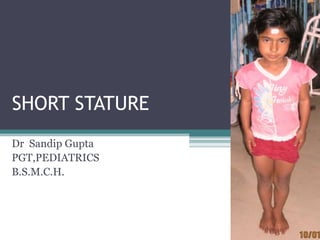
SHORT STATURE
Dr Sandip Gupta
PGT,PEDIATRICS
B.S.M.C.H.
Definition:
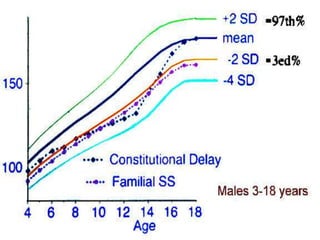
 Height below 3rd centile or less than 2 standard deviations below the
median height for that age & sex according to the population
standard
OR
 Even if the height is within the normal percentiles but growth
velocity is consistently below 25th percentile over 6-12 months of
observation
 The term ‘Dwarfism’ is no longer used for short stature
 Apprximately 3% children in any population will be short .
 Half of them normal variants(familial or constitutional short
stature).

Essential Pediatrics, 7th Edition, OP Ghai
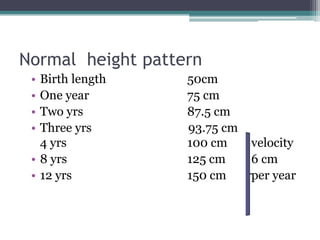
Normal height pattern
•
•
•
•

Birth length
One year
Two yrs
Three yrs
4 yrs
• 8 yrs
• 12 yrs

50cm
75 cm
87.5 cm
93.75 cm
100 cm
125 cm
150 cm

velocity
6 cm
per year
Factors affecting growth
• Birthsize
• Nutrition
• General well being
• Psycosocial factors
• Endocrinal factors
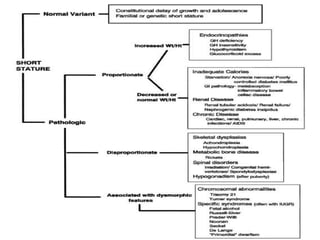
Causes Of Short Stature:
A) Proportionate Short Stature

1) Normal Variants:
i) Familial short stature
ii) Constitutional Delay of Growth & puberty

2) Prenatal Causes:
i) Intra-uterine Growth RestrictionPlacental causes, Infections, Teratogens
ii) Intra-uterine Infections
iii) Genetic Disorders (Chromosomal
& Metabolic Disorders)
3) Postnatal Causes:
i) Undernutrition
ii) Chronic Systemic Illness
- Cardiopulmonary: CHD, Chronic Asthma,
Cystic Fibrosis
- Renal: RTA, CRF, Steroid dependent
Nephrotic Syndrome
- GI and Hepatic: Malabsorption, IBD, chronic
liver disease
- Chronic Severe Infections
- Hematological : Thalassemia, Sickle cell
anemia
iii) Psychosocial Short Stature
(emotional deprivation)
iv) Endocrine Causes:
- Growth Hormone Deficiency/ insensitivity
- Hypothyroidism
- Juvenile Diabetes Mellitus
- Cushing Syndrome
- Pseudohypoparathyroidism
- Precocious/ delayed puberty
B) Disproportionate Short Stature
1) With Short Limbs:
- Achondroplasia, Hypochondroplasia,
Chondrodysplasia punctata,
Chondroectodermal Dysplasia,
Diastrophic dysplasia, Metaphyseal
Chondrodysplasia
- Deformities due to Osteogenesis Imperfecta,
Refractory Rickets
2) With Short Trunk:
- Spondyloepiphyseal dysplasia,
Mucolipidosis, Mucopolysaccharidosis
- Caries Spine, Hemivertebrae
History
Birth history
Maternal illness or use of certain drugs
Birth weight & height
Unexplained hypoglycemia, prolonged jaundice,or microphallus are
suggestive of Congenital GH deficiency
Growth pattern: a child who is short but growing at a normal rate &
parallel to the 5th centile curve is more likely to have familial or
constitutional short stature.
A child who progressively deviates away from normal curve
(specially after 24 months) is likely tobe suffering from underlying
medical disorder.
Developmental history
• Dietary history & apetite

• History of:
• Abdominal pain, diarrhea, mouth ulcer, joint pain ,wt loss-IBD
• Goitre, constipation, cold intolerance, wt gain,lethargyhypothyroidism
• Headache ,vomiting ,visual disturbances raise suspicion of
acquired hypopitutarism due to tumour or hydrocephalus.
• Polyuria ,oliguria,hematuria –CRF
• Recurrent LRTI,otitis media, malabsorbtion- cystic fibrosis
• Pubertal development-delay occurs in constitutional
delay,hypogonadism ,hypoitutarism,hypothyroidism
• Emotional deprivation- psychosocial dwarfism

• Steatorrhea , diarrhea –malabsorbtion
• Drug history
• Family history
Assessment of a child with short
stature
Accurate height measurement& height velocity
• Below 2 yrs- supine length with
infantometer
• For older children- Stadiometer

Assessment of body proportion
Upper segment: Lower segment ratio
Increase: rickets, achondroplasia,
untreated hypothyroidism
Decrease: spondyloepiphyseal
dysplasia,
vertebral anomalies
Arm span:
Short:skeletal dysplasia
Long:marfan syndrome

Weight
Increased wt/ht :endocrinal
Decreased or normal wt/ht: chronic systemic illness

Comparison with population norms
Height plotted on appropriate growth charts &
expressed as centile or SD score
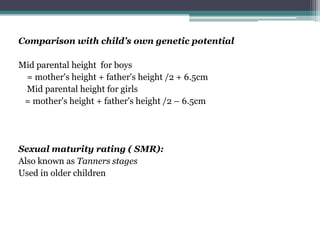
Comparison with child’s own genetic potential

Mid parental height for boys
= mother's height + father's height /2 + 6.5cm
Mid parental height for girls
= mother's height + father's height /2 – 6.5cm

Sexual maturity rating ( SMR):
Also known as Tanners stages
Used in older children
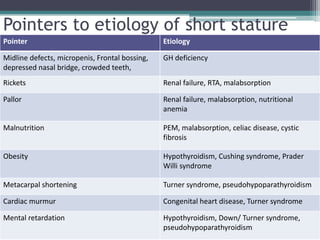
Pointers to etiology of short stature
Pointer

Etiology

Midline defects, micropenis, Frontal bossing,
depressed nasal bridge, crowded teeth,

GH deficiency

Rickets

Renal failure, RTA, malabsorption

Pallor

Renal failure, malabsorption, nutritional
anemia

Malnutrition

PEM, malabsorption, celiac disease, cystic
fibrosis

Obesity

Hypothyroidism, Cushing syndrome, Prader
Willi syndrome

Metacarpal shortening

Turner syndrome, pseudohypoparathyroidism

Cardiac murmur

Congenital heart disease, Turner syndrome

Mental retardation

Hypothyroidism, Down/ Turner syndrome,
pseudohypoparathyroidism
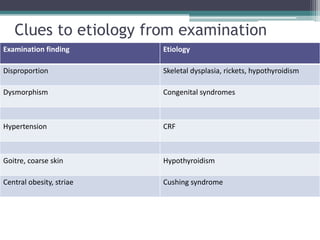
Clues to etiology from examination
Examination finding

Etiology

Disproportion

Skeletal dysplasia, rickets, hypothyroidism

Dysmorphism

Congenital syndromes

Hypertension

CRF

Goitre, coarse skin

Hypothyroidism

Central obesity, striae

Cushing syndrome
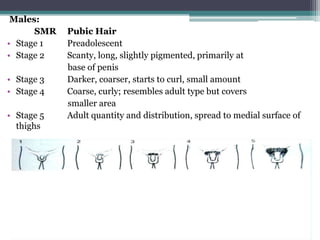
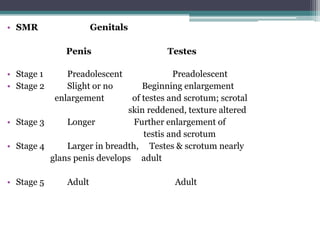
Males:
SMR
• Stage 1
• Stage 2
• Stage 3
• Stage 4
• Stage 5
thighs

Pubic Hair
Preadolescent
Scanty, long, slightly pigmented, primarily at
base of penis
Darker, coarser, starts to curl, small amount
Coarse, curly; resembles adult type but covers
smaller area
Adult quantity and distribution, spread to medial surface of
• SMR

Genitals
Penis

• Stage 1
• Stage 2

Testes

Preadolescent
Beginning enlargement
of testes and scrotum; scrotal
skin reddened, texture altered
• Stage 3
Longer
Further enlargement of
testis and scrotum
• Stage 4
Larger in breadth, Testes & scrotum nearly
glans penis develops adult
• Stage 5

Preadolescent
Slight or no
enlargement

Adult

Adult
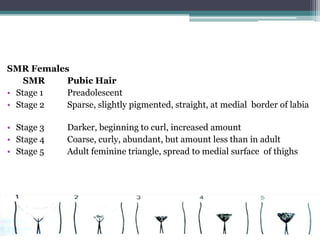
SMR Females
SMR
Pubic Hair
• Stage 1
Preadolescent
• Stage 2
Sparse, slightly pigmented, straight, at medial border of labia

• Stage 3
• Stage 4
• Stage 5

Darker, beginning to curl, increased amount
Coarse, curly, abundant, but amount less than in adult
Adult feminine triangle, spread to medial surface of thighs
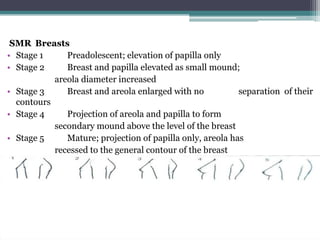
SMR Breasts
• Stage 1
Preadolescent; elevation of papilla only
• Stage 2
Breast and papilla elevated as small mound;
areola diameter increased
• Stage 3
Breast and areola enlarged with no
separation of their
contours
• Stage 4
Projection of areola and papilla to form
secondary mound above the level of the breast
• Stage 5
Mature; projection of papilla only, areola has
recessed to the general contour of the breast
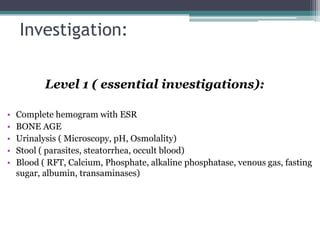
Investigation:
Level 1 ( essential investigations):
•
•
•
•
•

Complete hemogram with ESR
BONE AGE
Urinalysis ( Microscopy, pH, Osmolality)
Stool ( parasites, steatorrhea, occult blood)
Blood ( RFT, Calcium, Phosphate, alkaline phosphatase, venous gas, fasting
sugar, albumin, transaminases)
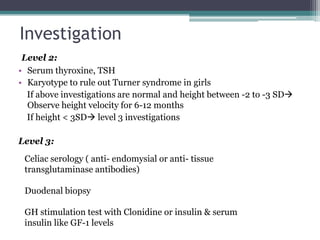
Investigation
Level 2:
• Serum thyroxine, TSH
• Karyotype to rule out Turner syndrome in girls
If above investigations are normal and height between -2 to -3 SD
Observe height velocity for 6-12 months
If height < 3SD level 3 investigations
Level 3:
Celiac serology ( anti- endomysial or anti- tissue
transglutaminase antibodies)

Duodenal biopsy
GH stimulation test with Clonidine or insulin & serum
insulin like GF-1 levels
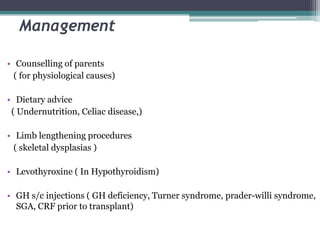
Management
• Counselling of parents
( for physiological causes)
• Dietary advice
( Undernutrition, Celiac disease,)

• Limb lengthening procedures
( skeletal dysplasias )
• Levothyroxine ( In Hypothyroidism)

• GH s/c injections ( GH deficiency, Turner syndrome, prader-willi syndrome,
SGA, CRF prior to transplant)
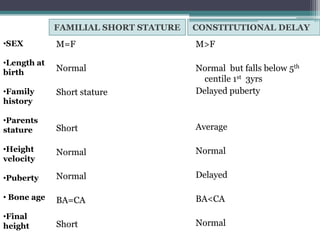
FAMILIAL SHORT STATURE

CONSTITUTIONAL DELAY

•SEX

M=F

M>F

•Length at
birth

Normal

Short stature

Normal but falls below 5th
centile 1st 3yrs
Delayed puberty

•Parents
stature

Short

Average

•Height
velocity

Normal

Normal

•Puberty

Normal

Delayed

• Bone age

BA=CA

BA<CA

•Final
height

Short

Normal

•Family
history
Shortstature sandip

Shortstature sandip

  • 1.
    SHORT STATURE Dr SandipGupta PGT,PEDIATRICS B.S.M.C.H.
  • 2.
    Definition:  Height below3rd centile or less than 2 standard deviations below the median height for that age & sex according to the population standard OR  Even if the height is within the normal percentiles but growth velocity is consistently below 25th percentile over 6-12 months of observation  The term ‘Dwarfism’ is no longer used for short stature  Apprximately 3% children in any population will be short .  Half of them normal variants(familial or constitutional short stature). Essential Pediatrics, 7th Edition, OP Ghai
  • 3.
    Normal height pattern • • • • Birthlength One year Two yrs Three yrs 4 yrs • 8 yrs • 12 yrs 50cm 75 cm 87.5 cm 93.75 cm 100 cm 125 cm 150 cm velocity 6 cm per year
  • 4.
    Factors affecting growth •Birthsize • Nutrition • General well being • Psycosocial factors • Endocrinal factors
  • 5.
    Causes Of ShortStature: A) Proportionate Short Stature 1) Normal Variants: i) Familial short stature ii) Constitutional Delay of Growth & puberty 2) Prenatal Causes: i) Intra-uterine Growth RestrictionPlacental causes, Infections, Teratogens ii) Intra-uterine Infections iii) Genetic Disorders (Chromosomal & Metabolic Disorders)
  • 6.
    3) Postnatal Causes: i)Undernutrition ii) Chronic Systemic Illness - Cardiopulmonary: CHD, Chronic Asthma, Cystic Fibrosis - Renal: RTA, CRF, Steroid dependent Nephrotic Syndrome - GI and Hepatic: Malabsorption, IBD, chronic liver disease - Chronic Severe Infections - Hematological : Thalassemia, Sickle cell anemia
  • 7.
    iii) Psychosocial ShortStature (emotional deprivation) iv) Endocrine Causes: - Growth Hormone Deficiency/ insensitivity - Hypothyroidism - Juvenile Diabetes Mellitus - Cushing Syndrome - Pseudohypoparathyroidism - Precocious/ delayed puberty
  • 8.
    B) Disproportionate ShortStature 1) With Short Limbs: - Achondroplasia, Hypochondroplasia, Chondrodysplasia punctata, Chondroectodermal Dysplasia, Diastrophic dysplasia, Metaphyseal Chondrodysplasia - Deformities due to Osteogenesis Imperfecta, Refractory Rickets 2) With Short Trunk: - Spondyloepiphyseal dysplasia, Mucolipidosis, Mucopolysaccharidosis - Caries Spine, Hemivertebrae
  • 9.
    History Birth history Maternal illnessor use of certain drugs Birth weight & height Unexplained hypoglycemia, prolonged jaundice,or microphallus are suggestive of Congenital GH deficiency Growth pattern: a child who is short but growing at a normal rate & parallel to the 5th centile curve is more likely to have familial or constitutional short stature. A child who progressively deviates away from normal curve (specially after 24 months) is likely tobe suffering from underlying medical disorder. Developmental history
  • 10.
    • Dietary history& apetite • History of: • Abdominal pain, diarrhea, mouth ulcer, joint pain ,wt loss-IBD • Goitre, constipation, cold intolerance, wt gain,lethargyhypothyroidism • Headache ,vomiting ,visual disturbances raise suspicion of acquired hypopitutarism due to tumour or hydrocephalus. • Polyuria ,oliguria,hematuria –CRF
  • 11.
    • Recurrent LRTI,otitismedia, malabsorbtion- cystic fibrosis • Pubertal development-delay occurs in constitutional delay,hypogonadism ,hypoitutarism,hypothyroidism • Emotional deprivation- psychosocial dwarfism • Steatorrhea , diarrhea –malabsorbtion • Drug history • Family history
  • 12.
    Assessment of achild with short stature Accurate height measurement& height velocity • Below 2 yrs- supine length with infantometer • For older children- Stadiometer Assessment of body proportion Upper segment: Lower segment ratio Increase: rickets, achondroplasia, untreated hypothyroidism Decrease: spondyloepiphyseal dysplasia, vertebral anomalies
  • 13.
    Arm span: Short:skeletal dysplasia Long:marfansyndrome Weight Increased wt/ht :endocrinal Decreased or normal wt/ht: chronic systemic illness Comparison with population norms Height plotted on appropriate growth charts & expressed as centile or SD score
  • 14.
    Comparison with child’sown genetic potential Mid parental height for boys = mother's height + father's height /2 + 6.5cm Mid parental height for girls = mother's height + father's height /2 – 6.5cm Sexual maturity rating ( SMR): Also known as Tanners stages Used in older children
  • 15.
    Pointers to etiologyof short stature Pointer Etiology Midline defects, micropenis, Frontal bossing, depressed nasal bridge, crowded teeth, GH deficiency Rickets Renal failure, RTA, malabsorption Pallor Renal failure, malabsorption, nutritional anemia Malnutrition PEM, malabsorption, celiac disease, cystic fibrosis Obesity Hypothyroidism, Cushing syndrome, Prader Willi syndrome Metacarpal shortening Turner syndrome, pseudohypoparathyroidism Cardiac murmur Congenital heart disease, Turner syndrome Mental retardation Hypothyroidism, Down/ Turner syndrome, pseudohypoparathyroidism
  • 16.
    Clues to etiologyfrom examination Examination finding Etiology Disproportion Skeletal dysplasia, rickets, hypothyroidism Dysmorphism Congenital syndromes Hypertension CRF Goitre, coarse skin Hypothyroidism Central obesity, striae Cushing syndrome
  • 17.
    Males: SMR • Stage 1 •Stage 2 • Stage 3 • Stage 4 • Stage 5 thighs Pubic Hair Preadolescent Scanty, long, slightly pigmented, primarily at base of penis Darker, coarser, starts to curl, small amount Coarse, curly; resembles adult type but covers smaller area Adult quantity and distribution, spread to medial surface of
  • 18.
    • SMR Genitals Penis • Stage1 • Stage 2 Testes Preadolescent Beginning enlargement of testes and scrotum; scrotal skin reddened, texture altered • Stage 3 Longer Further enlargement of testis and scrotum • Stage 4 Larger in breadth, Testes & scrotum nearly glans penis develops adult • Stage 5 Preadolescent Slight or no enlargement Adult Adult
  • 19.
    SMR Females SMR Pubic Hair •Stage 1 Preadolescent • Stage 2 Sparse, slightly pigmented, straight, at medial border of labia • Stage 3 • Stage 4 • Stage 5 Darker, beginning to curl, increased amount Coarse, curly, abundant, but amount less than in adult Adult feminine triangle, spread to medial surface of thighs
  • 20.
    SMR Breasts • Stage1 Preadolescent; elevation of papilla only • Stage 2 Breast and papilla elevated as small mound; areola diameter increased • Stage 3 Breast and areola enlarged with no separation of their contours • Stage 4 Projection of areola and papilla to form secondary mound above the level of the breast • Stage 5 Mature; projection of papilla only, areola has recessed to the general contour of the breast
  • 22.
    Investigation: Level 1 (essential investigations): • • • • • Complete hemogram with ESR BONE AGE Urinalysis ( Microscopy, pH, Osmolality) Stool ( parasites, steatorrhea, occult blood) Blood ( RFT, Calcium, Phosphate, alkaline phosphatase, venous gas, fasting sugar, albumin, transaminases)
  • 23.
    Investigation Level 2: • Serumthyroxine, TSH • Karyotype to rule out Turner syndrome in girls If above investigations are normal and height between -2 to -3 SD Observe height velocity for 6-12 months If height < 3SD level 3 investigations Level 3: Celiac serology ( anti- endomysial or anti- tissue transglutaminase antibodies) Duodenal biopsy GH stimulation test with Clonidine or insulin & serum insulin like GF-1 levels
  • 24.
    Management • Counselling ofparents ( for physiological causes) • Dietary advice ( Undernutrition, Celiac disease,) • Limb lengthening procedures ( skeletal dysplasias ) • Levothyroxine ( In Hypothyroidism) • GH s/c injections ( GH deficiency, Turner syndrome, prader-willi syndrome, SGA, CRF prior to transplant)
  • 25.
    FAMILIAL SHORT STATURE CONSTITUTIONALDELAY •SEX M=F M>F •Length at birth Normal Short stature Normal but falls below 5th centile 1st 3yrs Delayed puberty •Parents stature Short Average •Height velocity Normal Normal •Puberty Normal Delayed • Bone age BA=CA BA<CA •Final height Short Normal •Family history