Dr. Sandip Gupta
PGT – Pediatrics
BSMCH
Development of Heart
&
Congenital Malformations
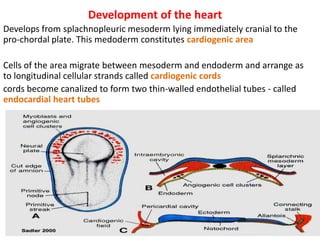
Development of the heart
Develops from splachnopleuric mesoderm lying immediately cranial to the
pro-chordal plate. This medoderm constitutes cardiogenic area
Cells of the area migrate between mesoderm and endoderm and arrange as
to longitudinal cellular strands called cardiogenic cords
cords become canalized to form two thin-walled endothelial tubes - called
endocardial heart tubes
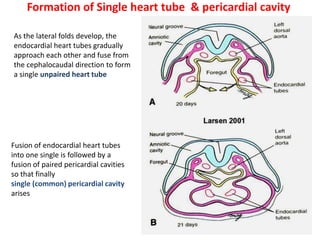
Formation of Single heart tube & pericardial cavity
As the lateral folds develop, the
endocardial heart tubes gradually
approach each other and fuse from
the cephalocaudal direction to form
a single unpaired heart tube
Fusion of endocardial heart tubes
into one single is followed by a
fusion of paired pericardial cavities
so that finally
single (common) pericardial cavity
arises
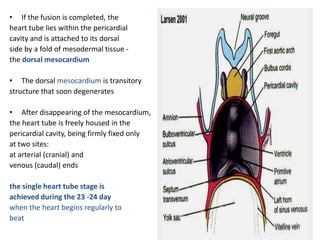
• If the fusion is completed, the
heart tube lies within the pericardial
cavity and is attached to its dorsal
side by a fold of mesodermal tissue -
the dorsal mesocardium
• The dorsal mesocardium is transitory
structure that soon degenerates
• After disappearing of the mesocardium,
the heart tube is freely housed in the
pericardial cavity, being firmly fixed only
at two sites:
at arterial (cranial) and
venous (caudal) ends
the single heart tube stage is
achieved during the 23 -24 day
when the heart begins regularly to
beat
Formation of the heart wall
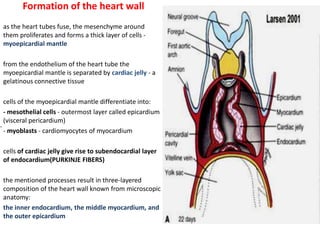
as the heart tubes fuse, the mesenchyme around
them proliferates and forms a thick layer of cells -
myoepicardial mantle
from the endothelium of the heart tube the
myoepicardial mantle is separated by cardiac jelly - a
gelatinous connective tissue
cells of the myoepicardial mantle differentiate into:
- mesothelial cells - outermost layer called epicardium
(visceral pericardium)
- myoblasts - cardiomyocytes of myocardium
cells of cardiac jelly give rise to subendocardial layer
of endocardium(PURKINJE FIBERS)
the mentioned processes result in three-layered
composition of the heart wall known from microscopic
anatomy:
the inner endocardium, the middle myocardium, and
the outer epicardium
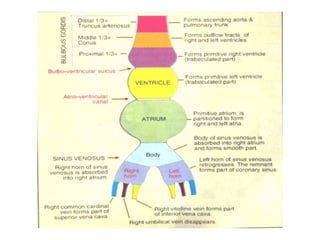
• Development of the heart tube then continues by its uneven growth in the
width and Length,
• As a result it distinguishes in several portions in caudocranial axis there are
as follows :
sinus venosus - venous end, receiving blood from the umbilical,
vitelline and common cardial veins on each side
primitive atrium - separated from the sinus by a terminal sulcus,
primitive ventricle - separated from the atrium by the AV sulcus,both
portions are connected each other with an AV foramen.
bulbus cordis - is continuous with ventricle through the primary
interventricular foramen;
--this portion will give rise to part the definitive right ventricle
truncus arteriosus - arterial end of the tube, which divides into paired
ventral aortae
Formation of the Cardiac Loop
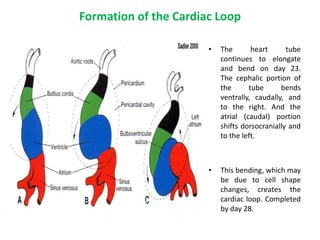
• The heart tube
continues to elongate
and bend on day 23.
The cephalic portion of
the tube bends
ventrally, caudally, and
to the right. And the
atrial (caudal) portion
shifts dorsocranially and
to the left.
• This bending, which may
be due to cell shape
changes, creates the
cardiac loop. Completed
by day 28.
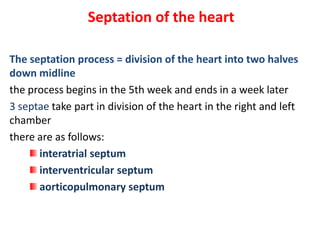
Septation of the heart
The septation process = division of the heart into two halves
down midline
the process begins in the 5th week and ends in a week later
3 septae take part in division of the heart in the right and left
chamber
there are as follows:
interatrial septum
interventricular septum
aorticopulmonary septum
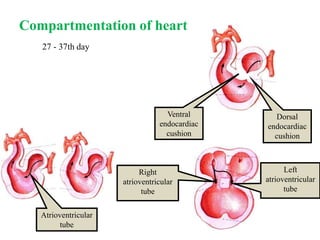
Ventral
endocardiac
cushion
Dorsal
endocardiac
cushion
Atrioventricular
tube
Left
atrioventricular
tube
Right
atrioventricular
tube
Compartmentation of heart
27 - 37th day
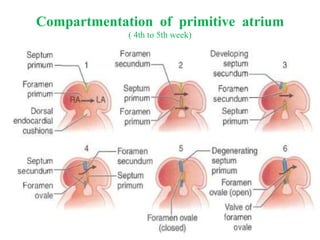
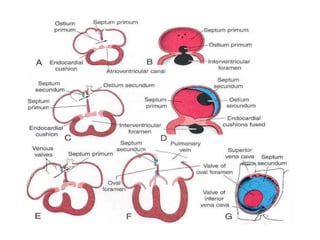
Compartmentation of primitive atrium
( 4th to 5th week)
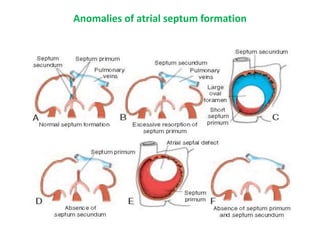
Anomalies of atrial septum formation
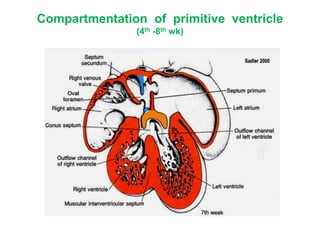
Compartmentation of primitive ventricle
(4th -8th wk)
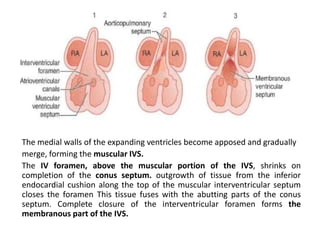
The medial walls of the expanding ventricles become apposed and gradually
merge, forming the muscular IVS.
The IV foramen, above the muscular portion of the IVS, shrinks on
completion of the conus septum. outgrowth of tissue from the inferior
endocardial cushion along the top of the muscular interventricular septum
closes the foramen This tissue fuses with the abutting parts of the conus
septum. Complete closure of the interventricular foramen forms the
membranous part of the IVS.
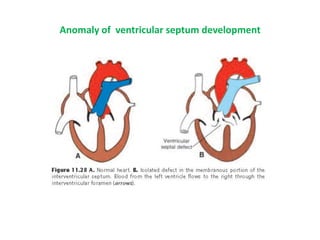
Anomaly of ventricular septum development
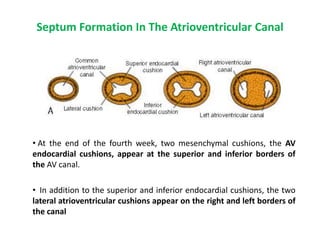
Septum Formation In The Atrioventricular Canal
• At the end of the fourth week, two mesenchymal cushions, the AV
endocardial cushions, appear at the superior and inferior borders of
the AV canal.
• In addition to the superior and inferior endocardial cushions, the two
lateral atrioventricular cushions appear on the right and left borders of
the canal
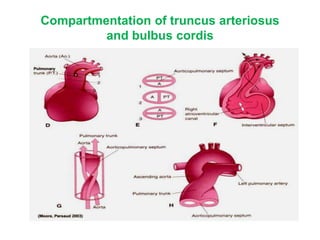
Compartmentation of truncus arteriosus
and bulbus cordis
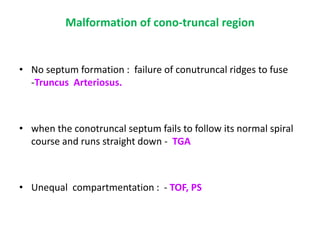
Malformation of cono-truncal region
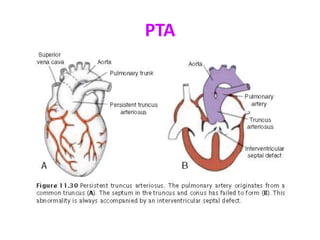
• No septum formation : failure of conutruncal ridges to fuse
-Truncus Arteriosus.
• when the conotruncal septum fails to follow its normal spiral
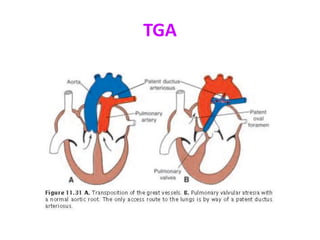
course and runs straight down - TGA
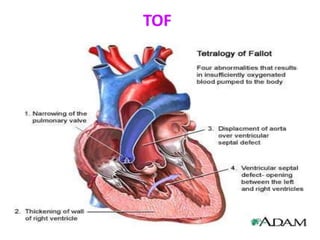
• Unequal compartmentation : - TOF, PS
PTA
TGA
TOF
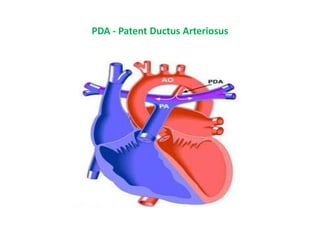
PDA - Patent Ductus Arteriosus
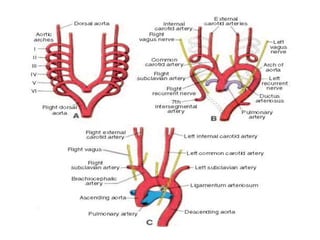
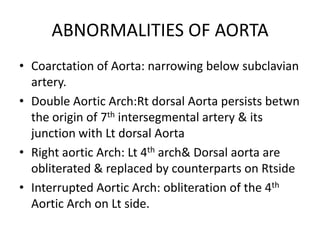
• 1st aortic arch – disappears
• 2nd aortic arch – disappears
• 3rd aortic arch - has the same development on the right and left
side it gives rise to the common carotid artery & initial portion of
the internal carotid artery.
•4th aortic arch - has ultimate fate different on the right and left
side on the left - it forms a part of the arch of the aorta between
left common carotid and left subclavian artery on the right - it
forms the proximal segment of the right subclavian artery
•5th aortic arch - is transient and soon obliterates
•the 6th aortic arch - pulmonary arch
ABNORMALITIES OF AORTA
• Coarctation of Aorta: narrowing below subclavian
artery.
• Double Aortic Arch:Rt dorsal Aorta persists betwn
the origin of 7th intersegmental artery & its
junction with Lt dorsal Aorta
• Right aortic Arch: Lt 4th arch& Dorsal aorta are
obliterated & replaced by counterparts on Rtside
• Interrupted Aortic Arch: obliteration of the 4th
Aortic Arch on Lt side.
THANK YOU
Cardiac development final

Cardiac development final

  • 1.
    Dr. Sandip Gupta PGT– Pediatrics BSMCH Development of Heart & Congenital Malformations
  • 2.
    Development of theheart Develops from splachnopleuric mesoderm lying immediately cranial to the pro-chordal plate. This medoderm constitutes cardiogenic area Cells of the area migrate between mesoderm and endoderm and arrange as to longitudinal cellular strands called cardiogenic cords cords become canalized to form two thin-walled endothelial tubes - called endocardial heart tubes
  • 3.
    Formation of Singleheart tube & pericardial cavity As the lateral folds develop, the endocardial heart tubes gradually approach each other and fuse from the cephalocaudal direction to form a single unpaired heart tube Fusion of endocardial heart tubes into one single is followed by a fusion of paired pericardial cavities so that finally single (common) pericardial cavity arises
  • 4.
    • If thefusion is completed, the heart tube lies within the pericardial cavity and is attached to its dorsal side by a fold of mesodermal tissue - the dorsal mesocardium • The dorsal mesocardium is transitory structure that soon degenerates • After disappearing of the mesocardium, the heart tube is freely housed in the pericardial cavity, being firmly fixed only at two sites: at arterial (cranial) and venous (caudal) ends the single heart tube stage is achieved during the 23 -24 day when the heart begins regularly to beat
  • 5.
    Formation of theheart wall as the heart tubes fuse, the mesenchyme around them proliferates and forms a thick layer of cells - myoepicardial mantle from the endothelium of the heart tube the myoepicardial mantle is separated by cardiac jelly - a gelatinous connective tissue cells of the myoepicardial mantle differentiate into: - mesothelial cells - outermost layer called epicardium (visceral pericardium) - myoblasts - cardiomyocytes of myocardium cells of cardiac jelly give rise to subendocardial layer of endocardium(PURKINJE FIBERS) the mentioned processes result in three-layered composition of the heart wall known from microscopic anatomy: the inner endocardium, the middle myocardium, and the outer epicardium
  • 7.
    • Development ofthe heart tube then continues by its uneven growth in the width and Length, • As a result it distinguishes in several portions in caudocranial axis there are as follows : sinus venosus - venous end, receiving blood from the umbilical, vitelline and common cardial veins on each side primitive atrium - separated from the sinus by a terminal sulcus, primitive ventricle - separated from the atrium by the AV sulcus,both portions are connected each other with an AV foramen. bulbus cordis - is continuous with ventricle through the primary interventricular foramen; --this portion will give rise to part the definitive right ventricle truncus arteriosus - arterial end of the tube, which divides into paired ventral aortae
  • 8.
    Formation of theCardiac Loop • The heart tube continues to elongate and bend on day 23. The cephalic portion of the tube bends ventrally, caudally, and to the right. And the atrial (caudal) portion shifts dorsocranially and to the left. • This bending, which may be due to cell shape changes, creates the cardiac loop. Completed by day 28.
  • 9.
    Septation of theheart The septation process = division of the heart into two halves down midline the process begins in the 5th week and ends in a week later 3 septae take part in division of the heart in the right and left chamber there are as follows: interatrial septum interventricular septum aorticopulmonary septum
  • 10.
  • 11.
    Compartmentation of primitiveatrium ( 4th to 5th week)
  • 13.
    Anomalies of atrialseptum formation
  • 14.
    Compartmentation of primitiveventricle (4th -8th wk)
  • 15.
    The medial wallsof the expanding ventricles become apposed and gradually merge, forming the muscular IVS. The IV foramen, above the muscular portion of the IVS, shrinks on completion of the conus septum. outgrowth of tissue from the inferior endocardial cushion along the top of the muscular interventricular septum closes the foramen This tissue fuses with the abutting parts of the conus septum. Complete closure of the interventricular foramen forms the membranous part of the IVS.
  • 16.
    Anomaly of ventricularseptum development
  • 17.
    Septum Formation InThe Atrioventricular Canal • At the end of the fourth week, two mesenchymal cushions, the AV endocardial cushions, appear at the superior and inferior borders of the AV canal. • In addition to the superior and inferior endocardial cushions, the two lateral atrioventricular cushions appear on the right and left borders of the canal
  • 18.
    Compartmentation of truncusarteriosus and bulbus cordis
  • 19.
    Malformation of cono-truncalregion • No septum formation : failure of conutruncal ridges to fuse -Truncus Arteriosus. • when the conotruncal septum fails to follow its normal spiral course and runs straight down - TGA • Unequal compartmentation : - TOF, PS
  • 20.
  • 21.
  • 22.
  • 24.
    PDA - PatentDuctus Arteriosus
  • 25.
    • 1st aorticarch – disappears • 2nd aortic arch – disappears • 3rd aortic arch - has the same development on the right and left side it gives rise to the common carotid artery & initial portion of the internal carotid artery. •4th aortic arch - has ultimate fate different on the right and left side on the left - it forms a part of the arch of the aorta between left common carotid and left subclavian artery on the right - it forms the proximal segment of the right subclavian artery •5th aortic arch - is transient and soon obliterates •the 6th aortic arch - pulmonary arch
  • 26.
    ABNORMALITIES OF AORTA •Coarctation of Aorta: narrowing below subclavian artery. • Double Aortic Arch:Rt dorsal Aorta persists betwn the origin of 7th intersegmental artery & its junction with Lt dorsal Aorta • Right aortic Arch: Lt 4th arch& Dorsal aorta are obliterated & replaced by counterparts on Rtside • Interrupted Aortic Arch: obliteration of the 4th Aortic Arch on Lt side.
  • 29.