MENTAL
RETARDATION
PRESENTED BY
MR.ROMAN BAJRANG
RELIANCE INSTITUTE OF NURSING
INTRODUCTION
Mental Retrdation is a state of development defiail that begins in
childhood and result in singnificant limitation of intelleat and poor
adaption to the demards of every day life .
 MR affects about 1.3% of population .
 Majarity of cases are idiopathic .
 Most common mild Mr (75-90) after goes unrecognised.
 More common in lower socio- economic groups .
 “Mental Retardation means significantly subaverage general
intelleatral functioning existing concurrently with deficits in adaptive
behaviour and manifested during the developmental period , that
adversely affected a childs educational perfarmace .
(According to Daroth D. theodare)
DEFINITION
 “ Group of disorders that have in common deficits of adaptive &
intellectual function and or age of onset before mulurity is reached ” .
(According to R. shreevani)
 “Mental retardation refers to significantly subaverage general
intellectual functioning resulting in or associated with concurrent
impairments in adaptive behavior & manifested during the
developmental period ” .
(American Association on Mental
Deficiency,1983).
CLASSIFICATION
• Retardation (IQ 50-70)
• Retardation (IQ 35-50)
• Retardation (IQ 20-35)
• Profound Retardation (IQ below 20)
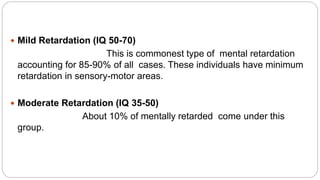
 Mild Retardation (IQ 50-70)
This is commonest type of mental retardation
accounting for 85-90% of all cases. These individuals have minimum
retardation in sensory-motor areas.
 Moderate Retardation (IQ 35-50)
About 10% of mentally retarded come under this
group.
Count…
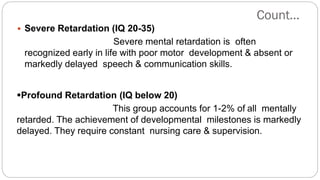
 Severe Retardation (IQ 20-35)
Severe mental retardation is often
recognized early in life with poor motor development & absent or
markedly delayed speech & communication skills.
Profound Retardation (IQ below 20)
This group accounts for 1-2% of all mentally
retarded. The achievement of developmental milestones is markedly
delayed. They require constant nursing care & supervision.
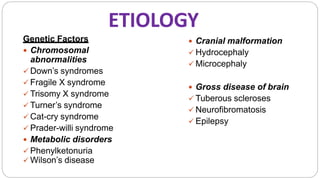
ETIOLOGY
Genetic Factors
 Chromosomal
abnormalities
 Down’s syndromes
 Fragile X syndrome
 Trisomy X syndrome
 Turner’s syndrome
 Cat-cry syndrome
 Prader-willi syndrome
 Metabolic disorders
 Phenylketonuria
 Wilson’s disease
 Cranial malformation
 Hydrocephaly
 Microcephaly
 Gross disease of brain
 Tuberous scleroses
 Neurofibromatosis
 Epilepsy
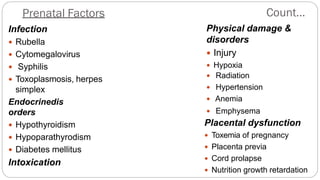
Prenatal Factors
Infection
 Rubella
 Cytomegalovirus
 Syphilis
 Toxoplasmosis, herpes
simplex
Endocrinedis
orders
 Hypothyroidism
 Hypoparathyrodism
 Diabetes mellitus
Intoxication
Physical damage &
disorders
 Injury
 Hypoxia
 Radiation
 Hypertension
 Anemia
 Emphysema
Placental dysfunction
 Toxemia of pregnancy
 Placenta previa
 Cord prolapse
 Nutrition growth retardation
Count…
Perinatal Factors
 Birth asphyxia
 Prolonged or difficult
birth
 Prematurity
 Kernicterus
 Postnatal factors
 Infections
i. Encephalitis
ii. Measles
iii. Meningitis
iv. Septicemia
 Accidents
 Lead poisoning
 Environmental & socio-cultural
Factors
 Cultural deprivation
 Low socio-economic status
 Inadequate caretakers
 Child abuse
Count…
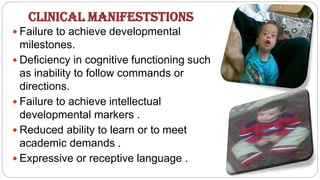
 Failure to achieve developmental
milestones.
 Deficiency in cognitive functioning such
as inability to follow commands or
directions.
 Failure to achieve intellectual
developmental markers .
 Reduced ability to learn or to meet
academic demands .
 Expressive or receptive language .
CLINICAL MANIFESTSTIONS
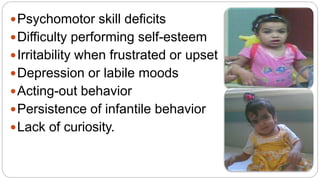
Psychomotor skill deficits
Difficulty performing self-esteem
Irritability when frustrated or upset
Depression or labile moods
Acting-out behavior
Persistence of infantile behavior
Lack of curiosity.
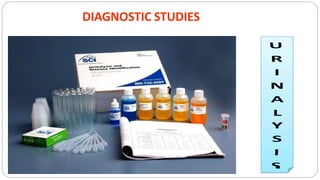
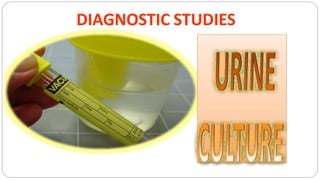
DIAGNOSTIC STUDIES
DIAGNOSTIC STUDIES
DIAGNOSIS
 History collection from parents & caretakers
 Physical examination
 Neurological examination
 Assessing milestones development
 Investigations
– Urine & blood examination for metabolic disorders
– Culture for cytogenic & biochemical studies
– Amniocentesis in infant chromosomal disorders
– chorionic villi sampling
– Hearing & speech evaluation
 EEG, especially if seizure are present
 CT scan or MRI brain, for example, in tuberous
sclerosis
 Thyroid function tests when cretinism is
suspected
 Psychological tests like Stanford Binet
Intelligence Scale & Wechsler Intelligence Scale
for Children’s (WISC), for categorizing the child’s
level of disability.
Count…
TREATMENT MODALITIES
 Environmental supervision .
 Behavior management .
 Monitoring the child’s development needs & problems.
 Programs that maximize speech, language, cognitive, psychomotor,
social, self-care, & occupational skills.
 Ongoing evaluation for overlapping psychiatric disorders, such as
depression, bipolar disorder, & ADHD.
 Family therapy to help parents develop coping skills & deal with guilt
or anger.
 Early intervention programs for children younger than 3 with mental
retardation
 Provide day schools to train the child in basic skills, such as bathing .
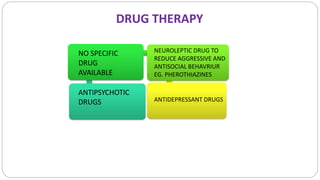
NO SPECIFIC
DRUG
AVAILABLE
ANTIPSYCHOTIC
DRUGS
NEUROLEPTIC DRUG TO
REDUCE AGGRESSIVE AND
ANTISOCIAL BEHAVRIUR
EG. PHEROTHIAZINES
ANTIDEPRESSANT DRUGS
DRUG THERAPY
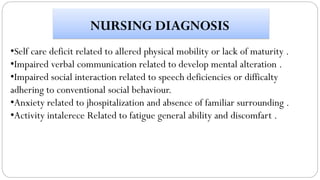
NURSING DIAGNOSIS
•Self care deficit related to allered physical mobility or lack of maturity .
•Impaired verbal communication related to develop mental alteration .
•Impaired social interaction related to speech deficiencies or difficalty
adhering to conventional social behaviour.
•Anxiety related to jhospitalization and absence of familiar surrounding .
•Activity intalerece Related to fatigue general ability and discomfart .
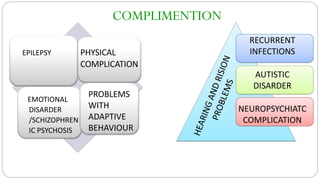
PHYSICAL
COMPLICATION
EPILEPSY
EMOTIONAL
DISARDER
/SCHIZOPHREN
IC PSYCHOSIS
PROBLEMS
WITH
ADAPTIVE
BEHAVIOUR
RECURRENT
INFECTIONS
AUTISTIC
DISARDER
NEUROPSYCHIATC
COMPLICATION
COMPLIMENTION
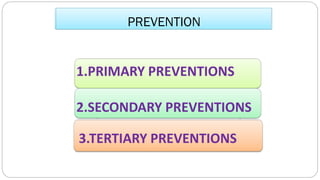
PREVENTION
1.PRIMARY PREVENTIONS
2.SECONDARY PREVENTIONS
33BB
3.TERTIARY PREVENTIONS
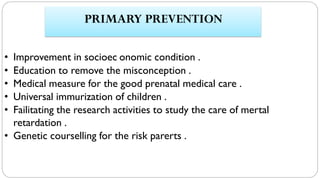
PRIMARY PREVENTION
• Improvement in socioec onomic condition .
• Education to remove the misconception .
• Medical measure for the good prenatal medical care .
• Universal immurization of children .
• Failitating the research activities to study the care of mertal
retardation .
• Genetic courselling for the risk parerts .
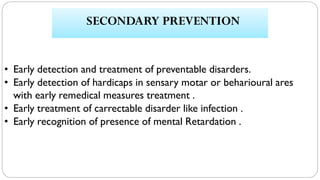
SECONDARY PREVENTION
• Early detection and treatment of preventable disarders.
• Early detection of hardicaps in sensary motar or beharioural ares
with early remedical measures treatment .
• Early treatment of carrectable disarder like infection .
• Early recognition of presence of mental Retardation .
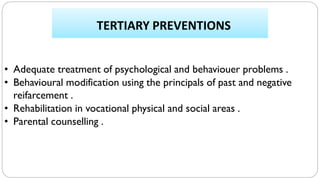
TERTIARY PREVENTIONS
• Adequate treatment of psychological and behaviouer problems .
• Behavioural modification using the principals of past and negative
reifarcement .
• Rehabilitation in vocational physical and social areas .
• Parental counselling .
QUESTIONS
???
THANK YOU

Mental retardation

  • 1.
  • 2.
    INTRODUCTION Mental Retrdation isa state of development defiail that begins in childhood and result in singnificant limitation of intelleat and poor adaption to the demards of every day life .  MR affects about 1.3% of population .  Majarity of cases are idiopathic .  Most common mild Mr (75-90) after goes unrecognised.  More common in lower socio- economic groups .
  • 3.
     “Mental Retardationmeans significantly subaverage general intelleatral functioning existing concurrently with deficits in adaptive behaviour and manifested during the developmental period , that adversely affected a childs educational perfarmace . (According to Daroth D. theodare) DEFINITION
  • 4.
     “ Groupof disorders that have in common deficits of adaptive & intellectual function and or age of onset before mulurity is reached ” . (According to R. shreevani)  “Mental retardation refers to significantly subaverage general intellectual functioning resulting in or associated with concurrent impairments in adaptive behavior & manifested during the developmental period ” . (American Association on Mental Deficiency,1983).
  • 5.
    CLASSIFICATION • Retardation (IQ50-70) • Retardation (IQ 35-50) • Retardation (IQ 20-35) • Profound Retardation (IQ below 20)
  • 6.
     Mild Retardation(IQ 50-70) This is commonest type of mental retardation accounting for 85-90% of all cases. These individuals have minimum retardation in sensory-motor areas.  Moderate Retardation (IQ 35-50) About 10% of mentally retarded come under this group.
  • 7.
    Count…  Severe Retardation(IQ 20-35) Severe mental retardation is often recognized early in life with poor motor development & absent or markedly delayed speech & communication skills. Profound Retardation (IQ below 20) This group accounts for 1-2% of all mentally retarded. The achievement of developmental milestones is markedly delayed. They require constant nursing care & supervision.
  • 8.
    ETIOLOGY Genetic Factors  Chromosomal abnormalities Down’s syndromes  Fragile X syndrome  Trisomy X syndrome  Turner’s syndrome  Cat-cry syndrome  Prader-willi syndrome  Metabolic disorders  Phenylketonuria  Wilson’s disease  Cranial malformation  Hydrocephaly  Microcephaly  Gross disease of brain  Tuberous scleroses  Neurofibromatosis  Epilepsy
  • 9.
    Prenatal Factors Infection  Rubella Cytomegalovirus  Syphilis  Toxoplasmosis, herpes simplex Endocrinedis orders  Hypothyroidism  Hypoparathyrodism  Diabetes mellitus Intoxication Physical damage & disorders  Injury  Hypoxia  Radiation  Hypertension  Anemia  Emphysema Placental dysfunction  Toxemia of pregnancy  Placenta previa  Cord prolapse  Nutrition growth retardation Count…
  • 10.
    Perinatal Factors  Birthasphyxia  Prolonged or difficult birth  Prematurity  Kernicterus  Postnatal factors  Infections i. Encephalitis ii. Measles iii. Meningitis iv. Septicemia  Accidents  Lead poisoning  Environmental & socio-cultural Factors  Cultural deprivation  Low socio-economic status  Inadequate caretakers  Child abuse Count…
  • 11.
     Failure toachieve developmental milestones.  Deficiency in cognitive functioning such as inability to follow commands or directions.  Failure to achieve intellectual developmental markers .  Reduced ability to learn or to meet academic demands .  Expressive or receptive language . CLINICAL MANIFESTSTIONS
  • 12.
    Psychomotor skill deficits Difficultyperforming self-esteem Irritability when frustrated or upset Depression or labile moods Acting-out behavior Persistence of infantile behavior Lack of curiosity.
  • 13.
  • 14.
  • 15.
    DIAGNOSIS  History collectionfrom parents & caretakers  Physical examination  Neurological examination  Assessing milestones development  Investigations – Urine & blood examination for metabolic disorders – Culture for cytogenic & biochemical studies – Amniocentesis in infant chromosomal disorders – chorionic villi sampling – Hearing & speech evaluation
  • 16.
     EEG, especiallyif seizure are present  CT scan or MRI brain, for example, in tuberous sclerosis  Thyroid function tests when cretinism is suspected  Psychological tests like Stanford Binet Intelligence Scale & Wechsler Intelligence Scale for Children’s (WISC), for categorizing the child’s level of disability. Count…
  • 17.
    TREATMENT MODALITIES  Environmentalsupervision .  Behavior management .  Monitoring the child’s development needs & problems.  Programs that maximize speech, language, cognitive, psychomotor, social, self-care, & occupational skills.  Ongoing evaluation for overlapping psychiatric disorders, such as depression, bipolar disorder, & ADHD.  Family therapy to help parents develop coping skills & deal with guilt or anger.  Early intervention programs for children younger than 3 with mental retardation  Provide day schools to train the child in basic skills, such as bathing .
  • 18.
    NO SPECIFIC DRUG AVAILABLE ANTIPSYCHOTIC DRUGS NEUROLEPTIC DRUGTO REDUCE AGGRESSIVE AND ANTISOCIAL BEHAVRIUR EG. PHEROTHIAZINES ANTIDEPRESSANT DRUGS DRUG THERAPY
  • 19.
    NURSING DIAGNOSIS •Self caredeficit related to allered physical mobility or lack of maturity . •Impaired verbal communication related to develop mental alteration . •Impaired social interaction related to speech deficiencies or difficalty adhering to conventional social behaviour. •Anxiety related to jhospitalization and absence of familiar surrounding . •Activity intalerece Related to fatigue general ability and discomfart .
  • 20.
  • 21.
  • 22.
    PRIMARY PREVENTION • Improvementin socioec onomic condition . • Education to remove the misconception . • Medical measure for the good prenatal medical care . • Universal immurization of children . • Failitating the research activities to study the care of mertal retardation . • Genetic courselling for the risk parerts .
  • 23.
    SECONDARY PREVENTION • Earlydetection and treatment of preventable disarders. • Early detection of hardicaps in sensary motar or beharioural ares with early remedical measures treatment . • Early treatment of carrectable disarder like infection . • Early recognition of presence of mental Retardation .
  • 24.
    TERTIARY PREVENTIONS • Adequatetreatment of psychological and behaviouer problems . • Behavioural modification using the principals of past and negative reifarcement . • Rehabilitation in vocational physical and social areas . • Parental counselling .
  • 25.
  • 26.