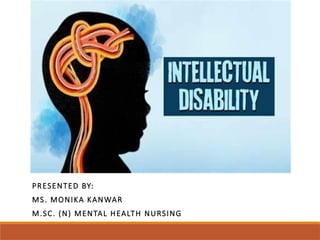

PRESENTED BY:
MS. MONIKA KANWAR
M.SC. (N) MENTAL HEALTH NURSING
INTRODUCTION
•Intellectual disability (ID), once called mental retardation, is
characterized by below-average intelligence or mental ability and
a lack of skills necessary for day-to-day living.
•People with intellectual disabilities can and do learn new skills,
but they learn them slowly.
•There are varying degrees of intellectual disability, from mild to
profound.
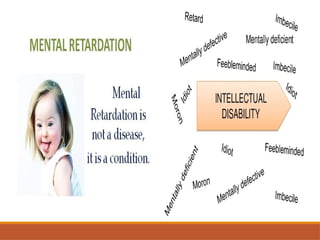
•The term “Mental Retardation” has been replaced by the term
“Intellectual Disability (ID), also known as Intellectual
Development Disorder (IDD)
CONTD….
•The older terms used for Mental Retardation are:
-Mental Subnormality: World Health Organization (WHO) used this
term as two categories:
1. Mental retardation: Subnormal functioning due to pathological
causes
2. Mental deficiency: Used for legal purpose when IQ is less than 70
-Feeble-mindedness: It denotes mild mental retardation
-Oligophrenia: This term is used in Western Europe countries
DEFINITION
Mental Retardation is a neurodevelopmental condition that affects
one’s ability to learn and perform daily activities. It impacts
behaviour, social skills, and the ability to maintain hygiene and
care for oneself.
OR
Mental Retardation is defined as, ‘subaverage intellectual
functioning which results in or is associated with concurrent
impairment in adaptive behaviour and is manifested during the
development
According to American Association for Mental Retardation,
1983
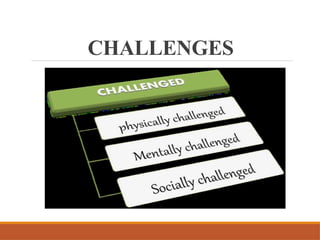
CHALLENGES
CONTD….
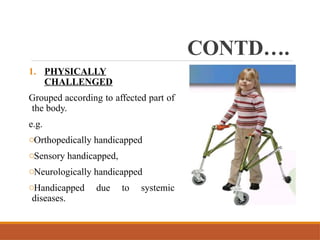
1. PHYSICALLY
CHALLENGED
Grouped according to affected part of
the body.
e.g.
oOrthopedically handicapped
oSensory handicapped,
oNeurologically handicapped
oHandicapped due to systemic
diseases.
CONTD….
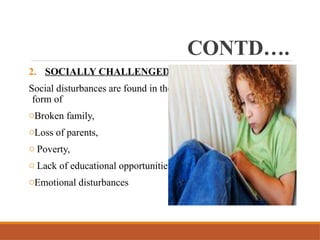
2. SOCIALLY CHALLENGED
Social disturbances are found in the
form of
oBroken family,
oLoss of parents,
o Poverty,
o Lack of educational opportunities,
oEmotional disturbances
CONTD….
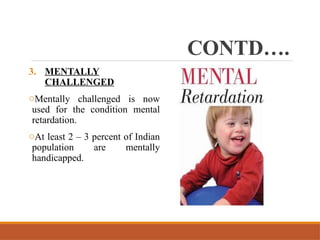
3. MENTALLY
CHALLENGED
oMentally challenged is now
used for the condition mental
retardation.
oAt least 2 – 3 percent of Indian
population are mentally
handicapped.
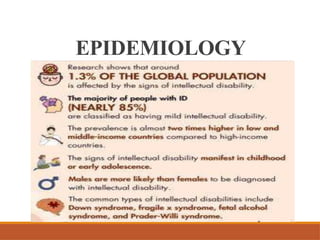
EPIDEMIOLOGY
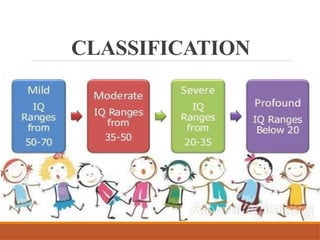
CLASSIFICATION
CLASSIFICATION
Mild Mental Retardation (IQ 50-70):
•Self care ability: The child may be able to live somewhat independently
with monitoring or assistance with life changes, challenges, or stressors
(such as personal illness or the death of a loved one).
•Education level: The child can achieve reading skills up to the level of
primary school and master vocational training.
•Social Skills: The child can learn and use social skills in structured
settings
•Psychomotor skills: The child can develop average to good skills but
may experience minor coordination problems
•Economic situation: The child can perform a job under close supervision
and manage money with proper guidance.
CONTD….
Moderate Mental Retardation (IQ 35-50):
•Self care ability: The child requires close supervision and must be
supervised when performing certain independent activities.
•Education level: The child can achieve skills up to second class
and may be trained in skills to participate in a workshop setting
•Social Skills: The child has certain speech limitations and
difficulty following expected social norms.
•Psychomotor skills: The child may have difficulty with gross
motor skills and may have limited vocational opportunities
•Economic situation: The child may learn to handle a small
amount of pocket money as well as how to make change
CONTD….
Severe Mental Retardation (IQ 20-35):
•Self care ability: The child requires complete supervision but may
be able to perform simple hygiene skills, such as brushing teeth
and washing hands.
•Education level: May learn a few simple skills.
•Social Skills: The child has limited verbal skills and tends to
communicate needs non-verbally or by acting them out.
•Psychomotor skills: The child has poor psychomotor skills, with
limited ability to perform simple tasks even under direct
supervision.
•Economic situation: The child may be taught how to use money
and supervised while shopping
CONTD….
Profound Mental Retardation (IQ below 20):
•Self care ability: The child requires assistance and supervision.
•Education level: The child cannot benefit from academic training.
•Social Skills: The child has little speech development and lacks
social skills.
•Psychomotor skills: The child lacks both fine and gross motor
skills.
•Economic situation: The child must depend on others for money
management.
CAUSES
BIOLOGICAL FACTORS:
1. Prenatal causes:
Genetic Syndromes
-Down Syndrome: Patients have 47 chromosomes with an
additional chromosome number 21.
-Fragile X Syndrome: Fragile site in band q27-28 on X
chromosome.
-Prader-Willi Syndrome: Disorder caused by deletion in part of
chromosome 15.
CONTD….
Errors in inborn metabolism
-Phenylketonuria: Simple autosomal recessive trait which has
deficiency on liver enzyme phenylalanine hydroxylase which
leads to lack of ability to metabolize phenylalanine (Involved in
the production of norepinephrine and dopamine, which are
essential for the proper functioning of brain and nervous system).
-Lesch-Nyhan Syndrome: It is also called as juvenile Gout which is
caused due to deficiency of hypoxanthine-guanine phosphoribosyl
transferase (HGPRT – it recycles the building block of RNA and
DNA)
CONTD….
-Galactosemia: Infant is unable to metabolise galactose (It is
simple sugar along with glucose it forms lactose), which
accumulates in brain and might lead to mental retardation.
-Tay-Sachs Disease: A rare fatal inherited disorder that occurs due
to the absence of an important enzyme hexosaminidase-A (Hex-
A) leads to the destruction of nerve cells in brain and spinal cord.
CONTD….
-Complications of pregnancy: Maternal malnutrition, toxemia of
pregnancy, placenta previa, vaginal haemorrhage, cord prolapse,
premature separation of placenta, iodine deficiency in pregnancy
(Restricts the growth of brain) and teratogenic effects of drugs,
especially in first trimester lead to mental retardation in children.
-Maternal infections: Rubella, toxoplasmosis, syphilis,
cytomegalic inclusion body disease, HIV infection, maternal
hepatitis, influenza, pneumonia.
CONTD….
2. Perinatal causes:
Premature birth, intrauterine growth retardation, birth injuries,
kernicterus, Rh incompatibility between mother and fetus are
responsible for Mental Retardation.
3. Postnatal causes:
Infections (Meningitis, encephalitis), malnutrition, toxins (lead,
alcohol), hydrocephalus (abnormal collection of cerebrospinal
fluid around the brain), macrocephaly, microcephaly, cerebral
palsy, Heller’s disease, Head injury, uncontrolled seizures are some
of the causes.
CONTD….
SOCIOCULTURAL FACTORS:
Social adversity: Lack of social skills may cause mild
intellectual disability.
Poverty and large family size: Mother is unable to take care of
the child due to low socio-economic status and increased family
size may lead to mental retardation in child
Lack of sensory impairment during pregnancy.
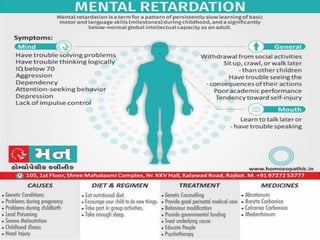
SYMPTOMS
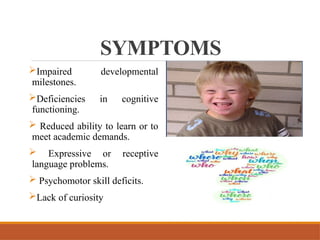
Impaired developmental
milestones.
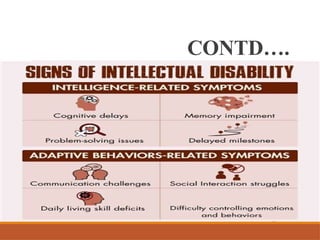
Deficiencies in cognitive
functioning.
 Reduced ability to learn or to
meet academic demands.
 Expressive or receptive
language problems.
 Psychomotor skill deficits.
Lack of curiosity
CONTD….
•Deficit in memory skills
•Difficulty in learning social
rules
•Difficulty with problem solving
skills
•Delays in development of
adaptive behaviours such as
self-help or self-care skills
•Acting-out behavior
CONTD….
•Difficulty performing self-care
activities.
• Neurologic impairment
•Medical problems such as
seizures
• Low self-esteem, depression
and labile moods
• Irritability when frustrated or
upset
CONTD….
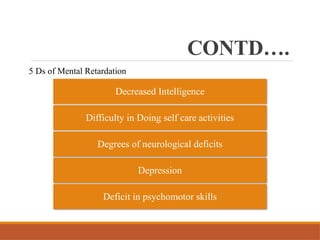
5 Ds of Mental Retardation
Decreased Intelligence
Difficulty in Doing self care activities
Degrees of neurological deficits
Depression
Deficit in psychomotor skills
CONTD….
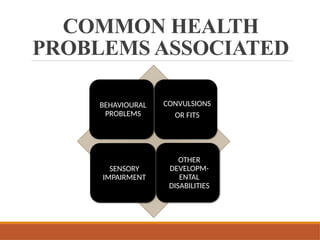
COMMON HEALTH
PROBLEMS ASSOCIATED
BEHAVIOURAL
PROBLEMS
CONVULSIONS
OR FITS
SENSORY
IMPAIRMENT
OTHER
DEVELOPM-
ENTAL
DISABILITIES
CONTD….
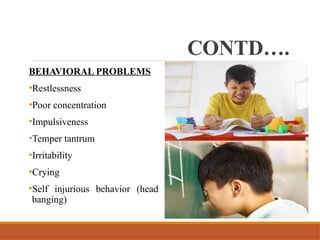
BEHAVIORAL PROBLEMS
•Restlessness
•Poor concentration
•Impulsiveness
•Temper tantrum
•Irritability
•Crying
•Self injurious behavior (head
banging)
CONTD….
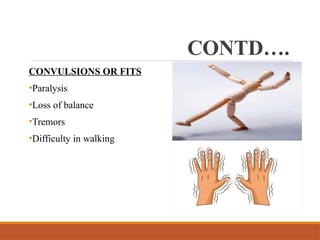
CONVULSIONS OR FITS
•Paralysis
•Loss of balance
•Tremors
•Difficulty in walking
CONTD….
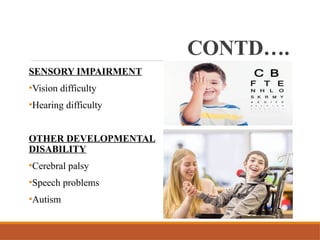
SENSORY IMPAIRMENT
•Vision difficulty
•Hearing difficulty
OTHER DEVELOPMENTAL
DISABILITY
•Cerebral palsy
•Speech problems
•Autism
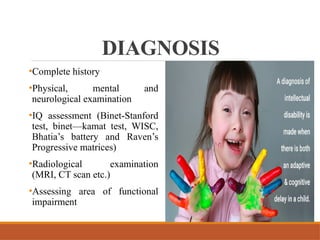
DIAGNOSIS
•Complete history
•Physical, mental and
neurological examination
•IQ assessment (Binet-Stanford
test, binet—kamat test, WISC,
Bhatia’s battery and Raven’s
Progressive matrices)
•Radiological examination
(MRI, CT scan etc.)
•Assessing area of functional
impairment
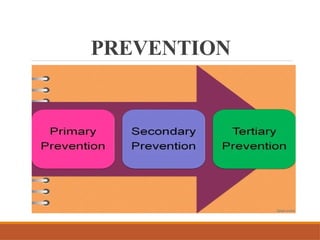
PREVENTION
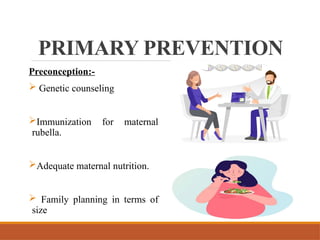
PRIMARY PREVENTION
Preconception:-
 Genetic counseling
Immunization for maternal
rubella.
Adequate maternal nutrition.
 Family planning in terms of
size
CONTD….
During gestation:-
Prenatal care:-
 Adequate nutrition, fetal monitoring and protection from
diseases.
 Avoidance of teratogenic substances like exposure to radiation
and consumption of alcohol and drugs.
Analysis of fetus for possible genetic disorder:-By
amniocentesis, fetoscopy, fetal biopsy and ultrasound.
CONTD….
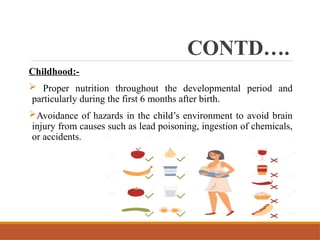
Childhood:-
 Proper nutrition throughout the developmental period and
particularly during the first 6 months after birth.
Avoidance of hazards in the child’s environment to avoid brain
injury from causes such as lead poisoning, ingestion of chemicals,
or accidents.
SECONDARY
PREVENTION
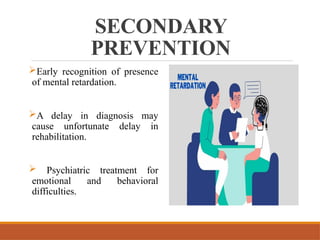
Early recognition of presence
of mental retardation.
A delay in diagnosis may
cause unfortunate delay in
rehabilitation.
 Psychiatric treatment for
emotional and behavioral
difficulties.
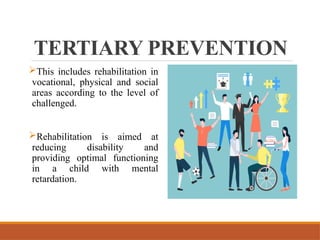
TERTIARY PREVENTION
This includes rehabilitation in
vocational, physical and social
areas according to the level of
challenged.
Rehabilitation is aimed at
reducing disability and
providing optimal functioning
in a child with mental
retardation.
CARE AND
REHABILITATION
The prevention and early detection of mentally handicaps.
 Regular assessment of the mentally retarded persons attainments
and disabilities.
 Advice, support, and practical measures for families.
 Provision for education, training, occupation, or work
appropriate for each handicapped person.
Social support to enable self-care.
 Medical, nursing, Psychiatric and psychological services those
who require them as outpatients, day patients or inpatients.
TREATMENT
Currently there is no cure for intellectual disability, though with
appropriate support and teaching, most individuals can learn
essential skills. In order to develop an appropriate treatment plan,
an assessment of age-appropriate adaptive behaviors should be
made using developmental screening test. The primary goal of
treatment is to:
•Develop the person’s potential to the fullest
•Special education and training may begin as early as possible
•Attention is given to social skills to help the person function as
normally as possible
CONTD….
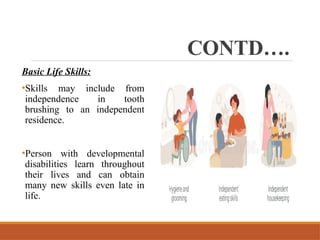
Basic Life Skills:
•Skills may include from
independence in tooth
brushing to an independent
residence.
•Person with developmental
disabilities learn throughout
their lives and can obtain
many new skills even late in
life.
CONTD….
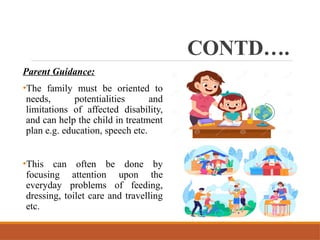
Parent Guidance:
•The family must be oriented to
needs, potentialities and
limitations of affected disability,
and can help the child in treatment
plan e.g. education, speech etc.
•This can often be done by
focusing attention upon the
everyday problems of feeding,
dressing, toilet care and travelling
etc.
CONTD….
Medication:
•Although there is no specific
medication, many people with
developmental disabilities have
further medical complications and
may take several medications.
•For example Autistic children
with developmental delay may be
prescribed antipsychotics or mood
stabilizers to help with behavior.
CONTD….
Rehabilitation Programs:
There are thousands of agencies around the world that provide
assistance for people with developmental disabilities. They include
state-run for profit and non-profit, privately run agencies. Such
services may include:
•Fully staffed residential homes
•Day rehabilitation programs in approximate schools
•Workshops wherein people with disabilities in obtaining jobs in
the community.
CONTD….
•Programs that assist people with
developmental disabilities in
obtaining jobs in the community
•Programs that provide support for
people with developmental
disabilities who have their own
apartments.
•Programs that assist people with
raising their children
Intellectual disability, Mental Retardation

Intellectual disability, Mental Retardation

  • 1.
    PRESENTED BY: MS. MONIKAKANWAR M.SC. (N) MENTAL HEALTH NURSING
  • 2.
    INTRODUCTION •Intellectual disability (ID),once called mental retardation, is characterized by below-average intelligence or mental ability and a lack of skills necessary for day-to-day living. •People with intellectual disabilities can and do learn new skills, but they learn them slowly. •There are varying degrees of intellectual disability, from mild to profound. •The term “Mental Retardation” has been replaced by the term “Intellectual Disability (ID), also known as Intellectual Development Disorder (IDD)
  • 3.
    CONTD…. •The older termsused for Mental Retardation are: -Mental Subnormality: World Health Organization (WHO) used this term as two categories: 1. Mental retardation: Subnormal functioning due to pathological causes 2. Mental deficiency: Used for legal purpose when IQ is less than 70 -Feeble-mindedness: It denotes mild mental retardation -Oligophrenia: This term is used in Western Europe countries
  • 5.
    DEFINITION Mental Retardation isa neurodevelopmental condition that affects one’s ability to learn and perform daily activities. It impacts behaviour, social skills, and the ability to maintain hygiene and care for oneself. OR Mental Retardation is defined as, ‘subaverage intellectual functioning which results in or is associated with concurrent impairment in adaptive behaviour and is manifested during the development According to American Association for Mental Retardation, 1983
  • 6.
  • 7.
    CONTD…. 1. PHYSICALLY CHALLENGED Grouped accordingto affected part of the body. e.g. oOrthopedically handicapped oSensory handicapped, oNeurologically handicapped oHandicapped due to systemic diseases.
  • 8.
    CONTD…. 2. SOCIALLY CHALLENGED Socialdisturbances are found in the form of oBroken family, oLoss of parents, o Poverty, o Lack of educational opportunities, oEmotional disturbances
  • 9.
    CONTD…. 3. MENTALLY CHALLENGED oMentally challengedis now used for the condition mental retardation. oAt least 2 – 3 percent of Indian population are mentally handicapped.
  • 10.
  • 11.
  • 12.
    CLASSIFICATION Mild Mental Retardation(IQ 50-70): •Self care ability: The child may be able to live somewhat independently with monitoring or assistance with life changes, challenges, or stressors (such as personal illness or the death of a loved one). •Education level: The child can achieve reading skills up to the level of primary school and master vocational training. •Social Skills: The child can learn and use social skills in structured settings •Psychomotor skills: The child can develop average to good skills but may experience minor coordination problems •Economic situation: The child can perform a job under close supervision and manage money with proper guidance.
  • 13.
    CONTD…. Moderate Mental Retardation(IQ 35-50): •Self care ability: The child requires close supervision and must be supervised when performing certain independent activities. •Education level: The child can achieve skills up to second class and may be trained in skills to participate in a workshop setting •Social Skills: The child has certain speech limitations and difficulty following expected social norms. •Psychomotor skills: The child may have difficulty with gross motor skills and may have limited vocational opportunities •Economic situation: The child may learn to handle a small amount of pocket money as well as how to make change
  • 14.
    CONTD…. Severe Mental Retardation(IQ 20-35): •Self care ability: The child requires complete supervision but may be able to perform simple hygiene skills, such as brushing teeth and washing hands. •Education level: May learn a few simple skills. •Social Skills: The child has limited verbal skills and tends to communicate needs non-verbally or by acting them out. •Psychomotor skills: The child has poor psychomotor skills, with limited ability to perform simple tasks even under direct supervision. •Economic situation: The child may be taught how to use money and supervised while shopping
  • 15.
    CONTD…. Profound Mental Retardation(IQ below 20): •Self care ability: The child requires assistance and supervision. •Education level: The child cannot benefit from academic training. •Social Skills: The child has little speech development and lacks social skills. •Psychomotor skills: The child lacks both fine and gross motor skills. •Economic situation: The child must depend on others for money management.
  • 16.
    CAUSES BIOLOGICAL FACTORS: 1. Prenatalcauses: Genetic Syndromes -Down Syndrome: Patients have 47 chromosomes with an additional chromosome number 21. -Fragile X Syndrome: Fragile site in band q27-28 on X chromosome. -Prader-Willi Syndrome: Disorder caused by deletion in part of chromosome 15.
  • 17.
    CONTD…. Errors in inbornmetabolism -Phenylketonuria: Simple autosomal recessive trait which has deficiency on liver enzyme phenylalanine hydroxylase which leads to lack of ability to metabolize phenylalanine (Involved in the production of norepinephrine and dopamine, which are essential for the proper functioning of brain and nervous system). -Lesch-Nyhan Syndrome: It is also called as juvenile Gout which is caused due to deficiency of hypoxanthine-guanine phosphoribosyl transferase (HGPRT – it recycles the building block of RNA and DNA)
  • 18.
    CONTD…. -Galactosemia: Infant isunable to metabolise galactose (It is simple sugar along with glucose it forms lactose), which accumulates in brain and might lead to mental retardation. -Tay-Sachs Disease: A rare fatal inherited disorder that occurs due to the absence of an important enzyme hexosaminidase-A (Hex- A) leads to the destruction of nerve cells in brain and spinal cord.
  • 19.
    CONTD…. -Complications of pregnancy:Maternal malnutrition, toxemia of pregnancy, placenta previa, vaginal haemorrhage, cord prolapse, premature separation of placenta, iodine deficiency in pregnancy (Restricts the growth of brain) and teratogenic effects of drugs, especially in first trimester lead to mental retardation in children. -Maternal infections: Rubella, toxoplasmosis, syphilis, cytomegalic inclusion body disease, HIV infection, maternal hepatitis, influenza, pneumonia.
  • 20.
    CONTD…. 2. Perinatal causes: Prematurebirth, intrauterine growth retardation, birth injuries, kernicterus, Rh incompatibility between mother and fetus are responsible for Mental Retardation. 3. Postnatal causes: Infections (Meningitis, encephalitis), malnutrition, toxins (lead, alcohol), hydrocephalus (abnormal collection of cerebrospinal fluid around the brain), macrocephaly, microcephaly, cerebral palsy, Heller’s disease, Head injury, uncontrolled seizures are some of the causes.
  • 21.
    CONTD…. SOCIOCULTURAL FACTORS: Social adversity:Lack of social skills may cause mild intellectual disability. Poverty and large family size: Mother is unable to take care of the child due to low socio-economic status and increased family size may lead to mental retardation in child Lack of sensory impairment during pregnancy.
  • 22.
    SYMPTOMS Impaired developmental milestones. Deficiencies incognitive functioning.  Reduced ability to learn or to meet academic demands.  Expressive or receptive language problems.  Psychomotor skill deficits. Lack of curiosity
  • 23.
    CONTD…. •Deficit in memoryskills •Difficulty in learning social rules •Difficulty with problem solving skills •Delays in development of adaptive behaviours such as self-help or self-care skills •Acting-out behavior
  • 24.
    CONTD…. •Difficulty performing self-care activities. •Neurologic impairment •Medical problems such as seizures • Low self-esteem, depression and labile moods • Irritability when frustrated or upset
  • 25.
    CONTD…. 5 Ds ofMental Retardation Decreased Intelligence Difficulty in Doing self care activities Degrees of neurological deficits Depression Deficit in psychomotor skills
  • 26.
  • 27.
    COMMON HEALTH PROBLEMS ASSOCIATED BEHAVIOURAL PROBLEMS CONVULSIONS ORFITS SENSORY IMPAIRMENT OTHER DEVELOPM- ENTAL DISABILITIES
  • 28.
    CONTD…. BEHAVIORAL PROBLEMS •Restlessness •Poor concentration •Impulsiveness •Tempertantrum •Irritability •Crying •Self injurious behavior (head banging)
  • 29.
    CONTD…. CONVULSIONS OR FITS •Paralysis •Lossof balance •Tremors •Difficulty in walking
  • 30.
    CONTD…. SENSORY IMPAIRMENT •Vision difficulty •Hearingdifficulty OTHER DEVELOPMENTAL DISABILITY •Cerebral palsy •Speech problems •Autism
  • 31.
    DIAGNOSIS •Complete history •Physical, mentaland neurological examination •IQ assessment (Binet-Stanford test, binet—kamat test, WISC, Bhatia’s battery and Raven’s Progressive matrices) •Radiological examination (MRI, CT scan etc.) •Assessing area of functional impairment
  • 32.
  • 33.
    PRIMARY PREVENTION Preconception:-  Geneticcounseling Immunization for maternal rubella. Adequate maternal nutrition.  Family planning in terms of size
  • 34.
    CONTD…. During gestation:- Prenatal care:- Adequate nutrition, fetal monitoring and protection from diseases.  Avoidance of teratogenic substances like exposure to radiation and consumption of alcohol and drugs. Analysis of fetus for possible genetic disorder:-By amniocentesis, fetoscopy, fetal biopsy and ultrasound.
  • 35.
    CONTD…. Childhood:-  Proper nutritionthroughout the developmental period and particularly during the first 6 months after birth. Avoidance of hazards in the child’s environment to avoid brain injury from causes such as lead poisoning, ingestion of chemicals, or accidents.
  • 36.
    SECONDARY PREVENTION Early recognition ofpresence of mental retardation. A delay in diagnosis may cause unfortunate delay in rehabilitation.  Psychiatric treatment for emotional and behavioral difficulties.
  • 37.
    TERTIARY PREVENTION This includesrehabilitation in vocational, physical and social areas according to the level of challenged. Rehabilitation is aimed at reducing disability and providing optimal functioning in a child with mental retardation.
  • 38.
    CARE AND REHABILITATION The preventionand early detection of mentally handicaps.  Regular assessment of the mentally retarded persons attainments and disabilities.  Advice, support, and practical measures for families.  Provision for education, training, occupation, or work appropriate for each handicapped person. Social support to enable self-care.  Medical, nursing, Psychiatric and psychological services those who require them as outpatients, day patients or inpatients.
  • 39.
    TREATMENT Currently there isno cure for intellectual disability, though with appropriate support and teaching, most individuals can learn essential skills. In order to develop an appropriate treatment plan, an assessment of age-appropriate adaptive behaviors should be made using developmental screening test. The primary goal of treatment is to: •Develop the person’s potential to the fullest •Special education and training may begin as early as possible •Attention is given to social skills to help the person function as normally as possible
  • 40.
    CONTD…. Basic Life Skills: •Skillsmay include from independence in tooth brushing to an independent residence. •Person with developmental disabilities learn throughout their lives and can obtain many new skills even late in life.
  • 41.
    CONTD…. Parent Guidance: •The familymust be oriented to needs, potentialities and limitations of affected disability, and can help the child in treatment plan e.g. education, speech etc. •This can often be done by focusing attention upon the everyday problems of feeding, dressing, toilet care and travelling etc.
  • 42.
    CONTD…. Medication: •Although there isno specific medication, many people with developmental disabilities have further medical complications and may take several medications. •For example Autistic children with developmental delay may be prescribed antipsychotics or mood stabilizers to help with behavior.
  • 43.
    CONTD…. Rehabilitation Programs: There arethousands of agencies around the world that provide assistance for people with developmental disabilities. They include state-run for profit and non-profit, privately run agencies. Such services may include: •Fully staffed residential homes •Day rehabilitation programs in approximate schools •Workshops wherein people with disabilities in obtaining jobs in the community.
  • 44.
    CONTD…. •Programs that assistpeople with developmental disabilities in obtaining jobs in the community •Programs that provide support for people with developmental disabilities who have their own apartments. •Programs that assist people with raising their children