DR SANDIP GUPTA
PGT,PEDIATRICS
B.S.M.C.H.
RATIONAL ANTIBIOTIC THERAPYRATIONAL ANTIBIOTIC THERAPY
Why Rational Antibiotic Therapy ?
• Better care of patients.
• Combating antimicrobial resistance.
• Prevent misuse of antibiotics.
• Reduce cost of treatment.
Misuse of antibiotics
• Lack of awareness & evidence based practice.
• Fear of secondary infection.
• False sense of security.
• Fear of losing patients.
• Parental anxiety & pressure.
• Is an antibiotic really necessary?
• Must have a provisional diagnosis.
• Predict the organisms.
• Consider stensitivity pattern.
• Narrowest spectrum, least toxic, less costly.
• Host factors.
• Co existing medical problem.
HOW TO CHOOSE ANTIBIOTICS
• Skin & soft tissue infections
• ENT infections
• LRTI
• GI infections
• UTI
• CNS infections
• CVS infections
• Osteoarticular infections
Common bacterial infections
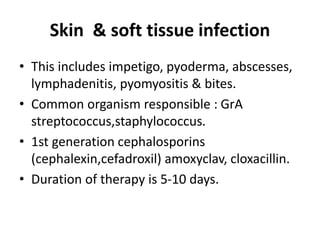
• This includes impetigo, pyoderma, abscesses,
lymphadenitis, pyomyositis & bites.
• Common organism responsible : GrA
streptococcus,staphylococcus.
• 1st generation cephalosporins
(cephalexin,cefadroxil) amoxyclav, cloxacillin.
• Duration of therapy is 5-10 days.
Skin & soft tissue infection
ENT INFECTIONS
Otitis media & sinusitis:
cover pseudomonas, H influenze &
moraxella.
(a) 1st line: Amoxycillin for 5 to 10 days.
(b) 2nd line: coamoxyclav/inj
ceftriaxone/macrolide.
(c) for sinusitis complete at least 14-21 days
of therapy
LOWER RESPIRATORY TRACT
INFECTIONS
Community acquired:
Cover for Gp A streptococcus, pneumococcus, &
staph aureus in infants& toddlers . Atypical
agents in school age & adolescent.
(a) Outpatient– consider in less severe illness.
(i) Amoxycillin.
(ii)coamoxyclav/cefpodoxime/cefuroxime axetil.
(iii) Add macrolide if atypical pneumonia
suspected.
Cont.
(b) Hospitalized:
 1st line:inj cetriaxone/inj cefotaxime/inj cefuroxime for 10 to 14 days
 if staph is suspected (rapid evolution,empyema,pneumatocele)
initial antibiotic should include vancomycin or clindamycin.
 Add macrolides if atypical pneumonia is suspected.
 Respiratory floroquinolones are alternative in adolescence
 Reassess choice of antibiotic after 48 -96 hrs if no response/modify as
per results of cultures, look for other factors.
GASTROINTESTINAL INFECTIONS
1.Cholera: Doxycycline 4mg/kg/day bid for 3d cotrimoxazole,
erythromycin, furazolidone.
2. Enteric fever:
3rd gen cephalosporin (14 days), azithromycin.
3. Acute dysentery: ciprofloxacin 30mg /kg for 5d.
4. Peritonitis:
(a) SBP– inj cetriaxone/inj cefotaxime.
(b) Secondary to bowel pathology– inj meropenem/inj
imipenem/inj ampicillin+inj gentamycin+inj clindamycin
URINARY TRACT INFECTIONS
1. Uncomplicated UTI:
oral:cefixime,amoxyclav,cephalexin,floroquinolones
for 7-10 days.
2. Complicated UTI:
inj ceftriaxone,amikacin,amoxyclav for 10-14
days.
3. Prophylaxis:
Nitrofurantoin/cotrimoxazole,cephalexin,cefadroxil.
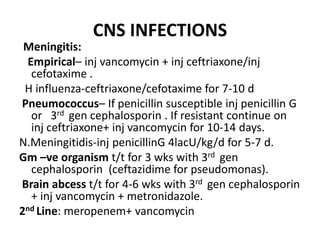
CNS INFECTIONS
Meningitis:
Empirical– inj vancomycin + inj ceftriaxone/inj
cefotaxime .
H influenza-ceftriaxone/cefotaxime for 7-10 d
Pneumococcus– If penicillin susceptible inj penicillin G
or 3rd gen cephalosporin . If resistant continue on
inj ceftriaxone+ inj vancomycin for 10-14 days.
N.Meningitidis-inj penicillinG 4lacU/kg/d for 5-7 d.
Gm –ve organism t/t for 3 wks with 3rd gen
cephalosporin (ceftazidime for pseudomonas).
Brain abcess t/t for 4-6 wks with 3rd gen cephalosporin
+ inj vancomycin + metronidazole.
2nd Line: meropenem+ vancomycin
CARDIOVASCULAR INFECTIONS
Endocarditis:
inj vancomycin & inj gentamycin to start with. Modify as per
c/s report.
(a) inj penicillin G / inj ceftriaxone & inj gentamycin/ inj
vancomycin in case of S Viridans.
(b) Enterococcus– Ampicillin/vancomycin & inj gentamycin.
(c)S aureus/ Epidermidis– inj vancomycin/ inj cloxacillin & inj
gentamycin for 6wks.
(d) Pneumococcus/ Gonococcus/ Gp A streptococcus– inj
penicillin G/ inj ceftriaxone/ inj vancomycin.
HACEKorganisms: inj ceftriaxone & inj gentamycin for 6wks
Gm-veorganisms:piperacillin/ceftazidime+gentamycin 6wks
OSTEOARTICULAR INFECTIONS
1. Bacterial arthritis/ osteomyelitis:
Cover S aureus & Gp A streptococcus;
Pneumococcus & H influenze in infancy. Modify
therpy according to c/s reports.
(a) 1st line: inj cloxacillin iv for 21 days followed by
oral therapy for a total of 4-6 weeks+ceftriaxone.
(b) 2nd line: inj vancomycin or inj clindamycin for
21 days followed by oral therapy for a total
period of 4-6 weeks. Use as first line if MRSA is
suspected.
.
Antibiotic prophylaxis
• UTI: in infants waiting imaging, VUR,
Frequent febrile UTI(30 or more/yr).
• Rheumatic fever
• Tuberculosis
• IE prophylaxis
• Pertussis contacts
Stratergies to prevent antibiotic
resistance
• Optimal use of antimicrobials.
• National protocol .
• Restriction policy.
• Antibiotic cycling.
• Combination therapy.
• Surveillance for resistant bacterial pathogen.
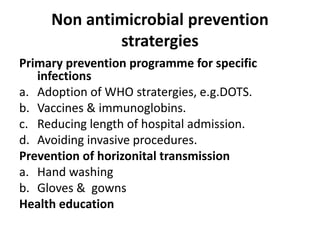
Non antimicrobial prevention
stratergies
Primary prevention programme for specific
infections
a. Adoption of WHO stratergies, e.g.DOTS.
b. Vaccines & immunoglobins.
c. Reducing length of hospital admission.
d. Avoiding invasive procedures.
Prevention of horizonital transmission
a. Hand washing
b. Gloves & gowns
Health education
Rational antibiotic therapy  NEW

Rational antibiotic therapy NEW

  • 1.
    DR SANDIP GUPTA PGT,PEDIATRICS B.S.M.C.H. RATIONALANTIBIOTIC THERAPYRATIONAL ANTIBIOTIC THERAPY
  • 2.
    Why Rational AntibioticTherapy ? • Better care of patients. • Combating antimicrobial resistance. • Prevent misuse of antibiotics. • Reduce cost of treatment.
  • 3.
    Misuse of antibiotics •Lack of awareness & evidence based practice. • Fear of secondary infection. • False sense of security. • Fear of losing patients. • Parental anxiety & pressure.
  • 4.
    • Is anantibiotic really necessary? • Must have a provisional diagnosis. • Predict the organisms. • Consider stensitivity pattern. • Narrowest spectrum, least toxic, less costly. • Host factors. • Co existing medical problem. HOW TO CHOOSE ANTIBIOTICS
  • 5.
    • Skin &soft tissue infections • ENT infections • LRTI • GI infections • UTI • CNS infections • CVS infections • Osteoarticular infections Common bacterial infections
  • 6.
    • This includesimpetigo, pyoderma, abscesses, lymphadenitis, pyomyositis & bites. • Common organism responsible : GrA streptococcus,staphylococcus. • 1st generation cephalosporins (cephalexin,cefadroxil) amoxyclav, cloxacillin. • Duration of therapy is 5-10 days. Skin & soft tissue infection
  • 7.
    ENT INFECTIONS Otitis media& sinusitis: cover pseudomonas, H influenze & moraxella. (a) 1st line: Amoxycillin for 5 to 10 days. (b) 2nd line: coamoxyclav/inj ceftriaxone/macrolide. (c) for sinusitis complete at least 14-21 days of therapy
  • 8.
    LOWER RESPIRATORY TRACT INFECTIONS Communityacquired: Cover for Gp A streptococcus, pneumococcus, & staph aureus in infants& toddlers . Atypical agents in school age & adolescent. (a) Outpatient– consider in less severe illness. (i) Amoxycillin. (ii)coamoxyclav/cefpodoxime/cefuroxime axetil. (iii) Add macrolide if atypical pneumonia suspected.
  • 9.
    Cont. (b) Hospitalized:  1stline:inj cetriaxone/inj cefotaxime/inj cefuroxime for 10 to 14 days  if staph is suspected (rapid evolution,empyema,pneumatocele) initial antibiotic should include vancomycin or clindamycin.  Add macrolides if atypical pneumonia is suspected.  Respiratory floroquinolones are alternative in adolescence  Reassess choice of antibiotic after 48 -96 hrs if no response/modify as per results of cultures, look for other factors.
  • 10.
    GASTROINTESTINAL INFECTIONS 1.Cholera: Doxycycline4mg/kg/day bid for 3d cotrimoxazole, erythromycin, furazolidone. 2. Enteric fever: 3rd gen cephalosporin (14 days), azithromycin. 3. Acute dysentery: ciprofloxacin 30mg /kg for 5d. 4. Peritonitis: (a) SBP– inj cetriaxone/inj cefotaxime. (b) Secondary to bowel pathology– inj meropenem/inj imipenem/inj ampicillin+inj gentamycin+inj clindamycin
  • 11.
    URINARY TRACT INFECTIONS 1.Uncomplicated UTI: oral:cefixime,amoxyclav,cephalexin,floroquinolones for 7-10 days. 2. Complicated UTI: inj ceftriaxone,amikacin,amoxyclav for 10-14 days. 3. Prophylaxis: Nitrofurantoin/cotrimoxazole,cephalexin,cefadroxil.
  • 12.
    CNS INFECTIONS Meningitis: Empirical– injvancomycin + inj ceftriaxone/inj cefotaxime . H influenza-ceftriaxone/cefotaxime for 7-10 d Pneumococcus– If penicillin susceptible inj penicillin G or 3rd gen cephalosporin . If resistant continue on inj ceftriaxone+ inj vancomycin for 10-14 days. N.Meningitidis-inj penicillinG 4lacU/kg/d for 5-7 d. Gm –ve organism t/t for 3 wks with 3rd gen cephalosporin (ceftazidime for pseudomonas). Brain abcess t/t for 4-6 wks with 3rd gen cephalosporin + inj vancomycin + metronidazole. 2nd Line: meropenem+ vancomycin
  • 13.
    CARDIOVASCULAR INFECTIONS Endocarditis: inj vancomycin& inj gentamycin to start with. Modify as per c/s report. (a) inj penicillin G / inj ceftriaxone & inj gentamycin/ inj vancomycin in case of S Viridans. (b) Enterococcus– Ampicillin/vancomycin & inj gentamycin. (c)S aureus/ Epidermidis– inj vancomycin/ inj cloxacillin & inj gentamycin for 6wks. (d) Pneumococcus/ Gonococcus/ Gp A streptococcus– inj penicillin G/ inj ceftriaxone/ inj vancomycin. HACEKorganisms: inj ceftriaxone & inj gentamycin for 6wks Gm-veorganisms:piperacillin/ceftazidime+gentamycin 6wks
  • 14.
    OSTEOARTICULAR INFECTIONS 1. Bacterialarthritis/ osteomyelitis: Cover S aureus & Gp A streptococcus; Pneumococcus & H influenze in infancy. Modify therpy according to c/s reports. (a) 1st line: inj cloxacillin iv for 21 days followed by oral therapy for a total of 4-6 weeks+ceftriaxone. (b) 2nd line: inj vancomycin or inj clindamycin for 21 days followed by oral therapy for a total period of 4-6 weeks. Use as first line if MRSA is suspected. .
  • 15.
    Antibiotic prophylaxis • UTI:in infants waiting imaging, VUR, Frequent febrile UTI(30 or more/yr). • Rheumatic fever • Tuberculosis • IE prophylaxis • Pertussis contacts
  • 16.
    Stratergies to preventantibiotic resistance • Optimal use of antimicrobials. • National protocol . • Restriction policy. • Antibiotic cycling. • Combination therapy. • Surveillance for resistant bacterial pathogen.
  • 17.
    Non antimicrobial prevention stratergies Primaryprevention programme for specific infections a. Adoption of WHO stratergies, e.g.DOTS. b. Vaccines & immunoglobins. c. Reducing length of hospital admission. d. Avoiding invasive procedures. Prevention of horizonital transmission a. Hand washing b. Gloves & gowns Health education