Logistics
Objective of information and
     logistics management


Minimise logistics costs

     Deliver maximum customer service
Objectives of the supply chain
           manager
1. Communication increase along chain –
   uninterrupted flow
2. Cost control: decreasing inventory,
   keeping high C-service levels …
   decrease supplier base and develop
   supplier relationships
3. Standardisation of parts … on time,
   happy customers, reduced inventory …
Factors to be taken into
          consideration


• IT systems
• Cost
• Customers
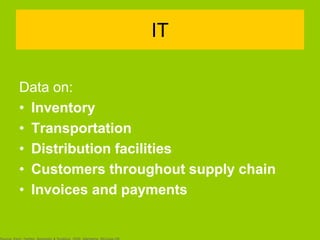
IT

Data on:
• Inventory
• Transportation
• Distribution facilities
• Customers throughout supply chain
• Invoices and payments
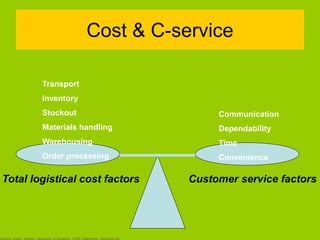
Cost & C-service

        Transport
        Inventory
        Stockout                     Communication
        Materials handling           Dependability
        Warehousing                  Time
        Order processing             Convenience

Total logistical cost factors   Customer service factors
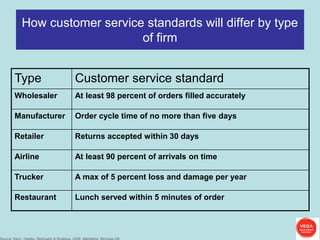
How customer service standards will differ by type
                      of firm


Type           Customer service standard
Wholesaler     At least 98 percent of orders filled accurately

Manufacturer   Order cycle time of no more than five days

Retailer       Returns accepted within 30 days

Airline        At least 90 percent of arrivals on time

Trucker        A max of 5 percent loss and damage per year

Restaurant     Lunch served within 5 minutes of order
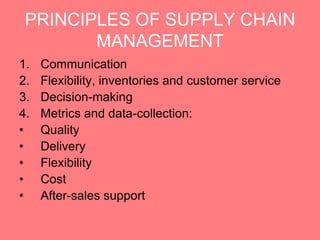
PRINCIPLES OF SUPPLY CHAIN
        MANAGEMENT
1.   Communication
2.   Flexibility, inventories and customer service
3.   Decision-making
4.   Metrics and data-collection:
•    Quality
•    Delivery
•    Flexibility
•    Cost
•    After-sales support
COMMUNICATION


A clever retailer would share the point-of-
sale data and forecasts with suppliers


Till point link from retailer to supplier …
automatic ordering …
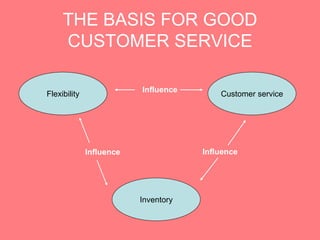
THE BASIS FOR GOOD
     CUSTOMER SERVICE

                          Influence
Flexibility                               Customer service


              Influence               Influence


                          Inventory
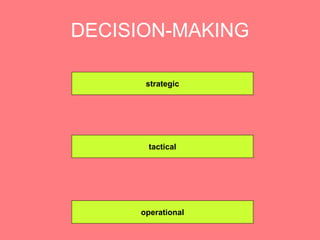
DECISION-MAKING

      strategic


      tactical


     operational
PRINCIPLES OF SUPPLY CHAIN
        MANAGEMENT
1.   Communication
2.   Flexibility, inventories and customer service
3.   Decision-making
4.   Metrics and data-collection:
•    Quality
•    Delivery
•    Flexibility
•    Cost
•    After-sales support
METRICS AND DATA
       COLLECTION


Metric = standard of measurement
against performance … benchmark


Can only KNOW if have data …
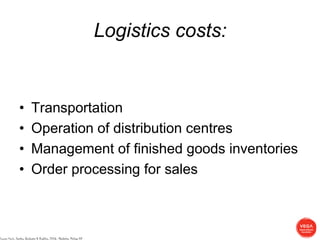
Logistics costs:


                 •          Transportation
                 •          Operation of distribution centres
                 •          Management of finished goods inventories
                 •          Order processing for sales


Source: Kerin, Hartley, Berkowitz & Rudelius, 2006: Marketing, McGraw Hill
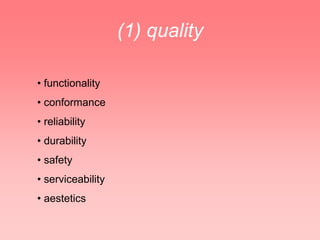
(1) quality

• functionality
• conformance
• reliability
• durability
• safety
• serviceability
• aestetics
(2) delivery


• speed
• reliability
(3) flexibility


• mix flexibility
• changeover flexibility
• design flexibility
• volume flexibility
(4) cost


Just so that ops and supply chain usually account for
most of organisations’ cost … thus target for cost
reduction …
(5) after-sales support


Especially if there is a high price tag to product …
Pitfalls of supply chain inventory management and
                   their symptoms
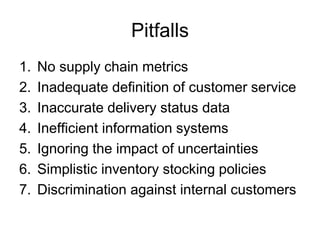
Pitfalls
1.   No supply chain metrics
2.   Inadequate definition of customer service
3.   Inaccurate delivery status data
4.   Inefficient information systems
5.   Ignoring the impact of uncertainties
6.   Simplistic inventory stocking policies
7.   Discrimination against internal customers
Pitfalls
8. Poor coordination
9. Incomplete shipment methods analysis
10. Incorrect assessment of inventory costs
11. Organisational barriers
12. Product-process design without supply
  chain considerations
13. Separation of supply chain design from
  operational decisions
14. Incomplete supply chain
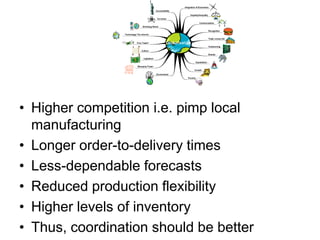
• Higher competition i.e. pimp local
  manufacturing
• Longer order-to-delivery times
• Less-dependable forecasts
• Reduced production flexibility
• Higher levels of inventory
• Thus, coordination should be better
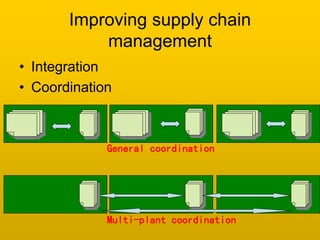
Improving supply chain
           management
• Integration
• Coordination


             General coordination


             Multi-plant coordination
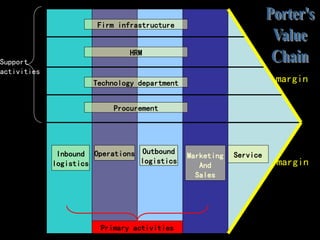
= systematic approach to
examining the development of
   competitive advantage
Firm infrastructure


                               HRM
Support
activities
                      Technology department                         margin

                           Procurement


              Inbound Operations Outbound     Marketing   Service
             logistics           logistics
                                                 And                margin
                                                Sales


                        Primary activities
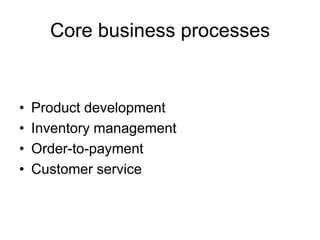
Core business processes


•   Product development
•   Inventory management
•   Order-to-payment
•   Customer service

Logistics management 2

  • 1.
  • 3.
    Objective of informationand logistics management Minimise logistics costs Deliver maximum customer service
  • 4.
    Objectives of thesupply chain manager 1. Communication increase along chain – uninterrupted flow 2. Cost control: decreasing inventory, keeping high C-service levels … decrease supplier base and develop supplier relationships 3. Standardisation of parts … on time, happy customers, reduced inventory …
  • 5.
    Factors to betaken into consideration • IT systems • Cost • Customers
  • 6.
    IT Data on: • Inventory •Transportation • Distribution facilities • Customers throughout supply chain • Invoices and payments
  • 7.
    Cost & C-service Transport Inventory Stockout Communication Materials handling Dependability Warehousing Time Order processing Convenience Total logistical cost factors Customer service factors
  • 8.
    How customer servicestandards will differ by type of firm Type Customer service standard Wholesaler At least 98 percent of orders filled accurately Manufacturer Order cycle time of no more than five days Retailer Returns accepted within 30 days Airline At least 90 percent of arrivals on time Trucker A max of 5 percent loss and damage per year Restaurant Lunch served within 5 minutes of order
  • 10.
    PRINCIPLES OF SUPPLYCHAIN MANAGEMENT 1. Communication 2. Flexibility, inventories and customer service 3. Decision-making 4. Metrics and data-collection: • Quality • Delivery • Flexibility • Cost • After-sales support
  • 11.
    COMMUNICATION A clever retailerwould share the point-of- sale data and forecasts with suppliers Till point link from retailer to supplier … automatic ordering …
  • 12.
    THE BASIS FORGOOD CUSTOMER SERVICE Influence Flexibility Customer service Influence Influence Inventory
  • 13.
    DECISION-MAKING strategic tactical operational
  • 14.
    PRINCIPLES OF SUPPLYCHAIN MANAGEMENT 1. Communication 2. Flexibility, inventories and customer service 3. Decision-making 4. Metrics and data-collection: • Quality • Delivery • Flexibility • Cost • After-sales support
  • 15.
    METRICS AND DATA COLLECTION Metric = standard of measurement against performance … benchmark Can only KNOW if have data …
  • 16.
    Logistics costs: • Transportation • Operation of distribution centres • Management of finished goods inventories • Order processing for sales Source: Kerin, Hartley, Berkowitz & Rudelius, 2006: Marketing, McGraw Hill
  • 17.
    (1) quality • functionality •conformance • reliability • durability • safety • serviceability • aestetics
  • 18.
  • 19.
    (3) flexibility • mixflexibility • changeover flexibility • design flexibility • volume flexibility
  • 20.
    (4) cost Just sothat ops and supply chain usually account for most of organisations’ cost … thus target for cost reduction …
  • 21.
    (5) after-sales support Especiallyif there is a high price tag to product …
  • 22.
    Pitfalls of supplychain inventory management and their symptoms
  • 23.
    Pitfalls 1. No supply chain metrics 2. Inadequate definition of customer service 3. Inaccurate delivery status data 4. Inefficient information systems 5. Ignoring the impact of uncertainties 6. Simplistic inventory stocking policies 7. Discrimination against internal customers
  • 24.
    Pitfalls 8. Poor coordination 9.Incomplete shipment methods analysis 10. Incorrect assessment of inventory costs 11. Organisational barriers 12. Product-process design without supply chain considerations 13. Separation of supply chain design from operational decisions 14. Incomplete supply chain
  • 26.
    • Higher competitioni.e. pimp local manufacturing • Longer order-to-delivery times • Less-dependable forecasts • Reduced production flexibility • Higher levels of inventory • Thus, coordination should be better
  • 27.
    Improving supply chain management • Integration • Coordination General coordination Multi-plant coordination
  • 28.
    = systematic approachto examining the development of competitive advantage
  • 29.
    Firm infrastructure HRM Support activities Technology department margin Procurement Inbound Operations Outbound Marketing Service logistics logistics And margin Sales Primary activities
  • 30.
    Core business processes • Product development • Inventory management • Order-to-payment • Customer service