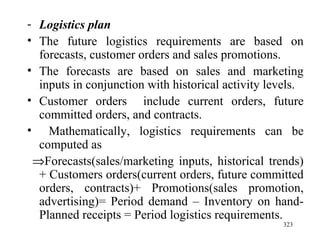
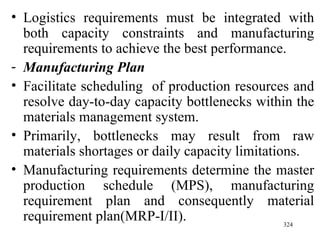
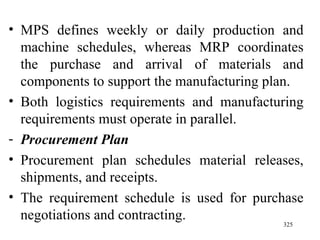
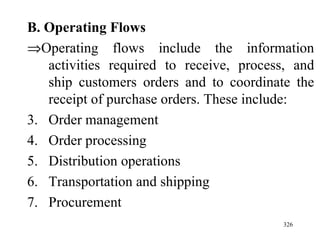
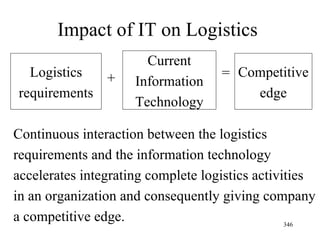
What is Logistics Management? The objective is to plan and coordinate all the activities necessary to achieve desired level of delivered service and quality at lowest possible cost. The scope of logistics include the entire gamut of activities starting from the procurement and management of raw materials through to delivery of final product to the customer. The ultimate purpose of any logistics system is to satisfy the customer by establishing linkages of people at all levels in the organization directly or indirectly to the market place.
As it is getting increasingly difficult to maintain a competitive edge through product alone, customer service has started to provide the distinctive difference between one company’s offer and that of its competitors. The underlying concept is “ The process of strategically managing the procurement, movement and storage of materials, parts and finished inventory and the related information flows through the organization and its marketing channels in such a way that the current and future profitability are maximized through the cost effective fulfillment of orders.”
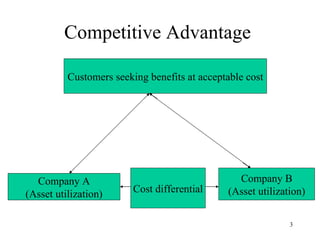
Competitive Advantage  Customers seeking benefits at acceptable cost Company A (Asset utilization) Company B (Asset utilization) Cost differential
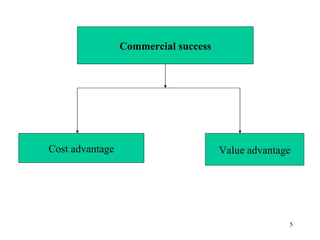
Source of Competitive Advantage Competitive advantage is the ability of an organization to differentiate itself in the eyes of the customer, from its competition, and to operate at a lower cost and hence greater profit. Competitive advantage helps organizations to achieve commercial success which mainly depends upon two factors – cost advantage and value advantage.
Commercial success Cost advantage Value advantage
Cost advantage or Productivity advantage Characterized by low cost of production due to greater sales volume, economies of scale enabling fixed costs to be spread over a greater volume and the impact of the ‘experience curve’. Value advantage is in terms of product offering a differential ‘plus’ over competitive offerings. Based on marketing concept that customers that ‘customers don't buy products, they buy benefits’. Benefits may be intangibles and may not relate to specific product features. It can be an image or reputation or even some functional aspects.
Adding value through differentiation is extremely powerful means of achieving competitive edge in the market. One of the significant method of adding value is service. Service  helps in developing relationship with the customers   through provision of an augmented offer. Augmentation   takes many forms such as delivery services, after-sales services, financial packages, technical support etc.
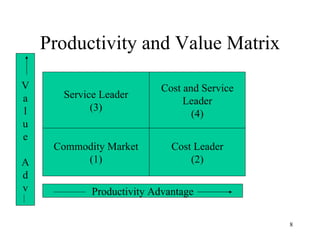
Productivity and Value Matrix Commodity Market (1) Cost Leader (2) Service Leader (3) Cost and Service Leader (4) Productivity Advantage V a l u e A d v
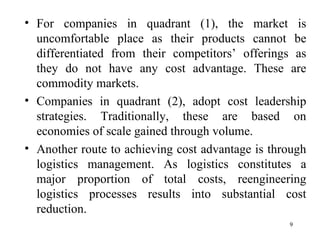
For companies in quadrant (1), the market is uncomfortable place as their products cannot be differentiated from their competitors’ offerings as they do not have any cost advantage. These are commodity markets. Companies in quadrant (2), adopt cost leadership strategies. Traditionally, these are based on economies of scale gained through volume.  Another route to achieving cost advantage is through logistics management. As logistics constitutes a major proportion of total costs, reengineering logistics processes results into substantial cost reduction.
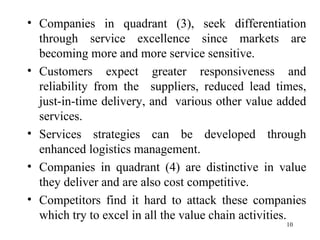
Companies in quadrant (3), seek differentiation through service excellence since markets are becoming more and more service sensitive.  Customers expect greater responsiveness and reliability from the  suppliers, reduced lead times, just-in-time delivery, and  various other value added services. Services strategies can be developed through enhanced logistics management. Companies in quadrant (4) are distinctive in value they deliver and are also cost competitive.  Competitors find it hard to attack these companies which try to excel in all the value chain activities.
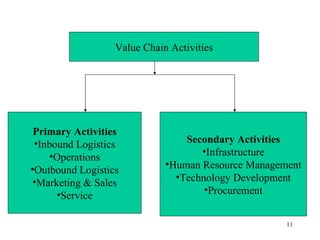
Value Chain Activities Value Chain Activities Primary Activities Inbound Logistics Operations Outbound Logistics Marketing & Sales Service Secondary Activities Infrastructure Human Resource Management Technology Development Procurement
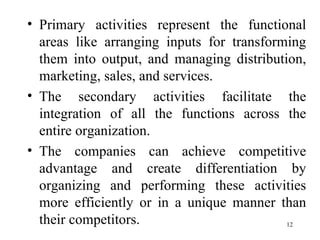
Primary activities represent the functional areas like arranging inputs for transforming them into output, and managing distribution, marketing, sales, and services. The secondary activities facilitate the integration of all the functions across the entire organization. The companies can achieve competitive advantage and create differentiation by organizing and performing these activities more efficiently or in a unique manner than their competitors.
Factors affecting value and productivity advantage Productivity advantage Capacity utilization Asset utilization Inventory reduction Integration with the suppliers. B. Value advantage Customized services Reliability Responsiveness.
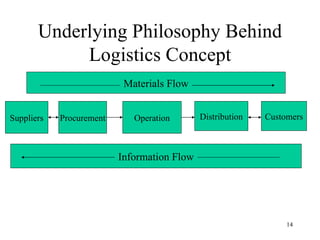
Underlying Philosophy Behind Logistics Concept Suppliers Procurement Operation Distribution Customers Materials Flow Information Flow
The objective of logistics is to link the market place, distribution network, the manufacturing process and procurement activity, so as to provide higher levels of services to the consumers yet at a lower cost. Scope of logistics management encompasses management of raw materials and other inputs through the delivery of the final product.
How do we define logistics management? A process of satisfying customer needs through coordination of materials and information flows that extend from the market through the firm’s operation and beyond that to the suppliers. A shift to an integrated orientation from the conventional manufacturing or marketing orientation. Traditionally, manufacturing and marketing have been considered as separate activities each having different priorities.
Manufacturing priorities and objectives are concerned with achieving operating efficiencies based on long production runs, minimized set ups and changeovers, and product standardization. Marketing priorities and objectives are concerned with achieving competitive advantage based on varieties, high service levels, and frequent product changes. Customer orientation and cost competitiveness has been integrated by introducing flexible manufacturing systems, practicing inventory management policies based on manufacturing requirement planning and just-in-time inventory policy, laying sustained emphasis on quality and integrating supply side issues in strategic plans.
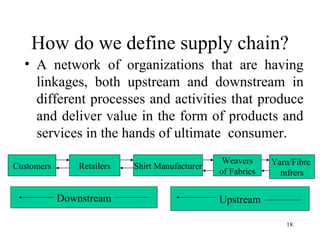
How do we define supply chain? A network of organizations that are having linkages, both upstream and downstream in different processes and activities that produce and deliver value in the form of products and services in the hands of ultimate  consumer. Customers Retailers Shirt Manufacturer Weavers of Fabrics Yarn/Fibre  mfrers Downstream Upstream
A shirt manufacturer is a part of supply chain that extends upstream through the weavers of fabrics to the spinners and the manufacturers of fibres, and downstream though distributors and retailers to the final consumers. Though each of these organizations are dependent on each other yet traditionally do not closely cooperate with one another.
Is Supply chain management same as vertical integration? SCM is not the same as vertical integration. Vertical integration implies ownership of upstream suppliers and downstream customers. Earlier, vertical integration used to be the desirable strategy but increasingly the companies are focusing on their core business i.e. the activities that they do really well and where they have a differential advantage. Everything else is outsourced.
Implementation of SCM through Logistics Management SCM raises the challenge of integrating and coordinating the flow of materials from multitude of suppliers, including offshore, and similarly managing the distribution of the finished product by way of multitude intermediaries.  Transferring costs upstream or downstream leads to logistics myopia as all costs ultimately will make way to the final market place to be reflected in the price paid by the end user.  The prime objective of SCM is to reduce or eliminate the buffers of inventory that exists between the organizations in a chain through sharing of information on demand and current stock levels.
How does Logistics differ from SCM? Logistics management is primarily concerned with optimizing flows within the organization. Supply chain management deals with integration of all partners in the value chain. Logistics is essentially a framework that creates a single plan for flow of products and information through a business. Supply chain builds upon this framework and seeks to achieve linkage and coordination between processes of other entities in the pipeline i.e. suppliers and customers, and organization itself.
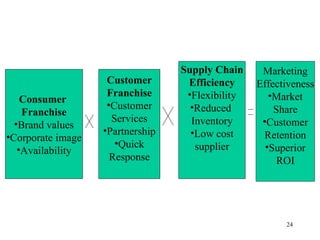
Impact of Logistics and Customer Service on Marketing Traditionally, marketing has focused on end-customer or consumer, seeking to promote brand values and to generate a ‘demand pull’ in the market place for company’s products. Due to shift in power in marketing channels, companies are realizing to develop strong relations with such intermediaries like large retail outlets to create a customer franchise as well as consumer franchise. The impact of both strong consumer franchise and customer franchise can be enhanced or diminished by effectiveness of suppliers’ logistics system.
Consumer  Franchise Brand values Corporate image Availability Customer Franchise Customer Services Partnership Quick Response Supply Chain Efficiency Flexibility Reduced  Inventory Low cost supplier Marketing Effectiveness Market Share Customer Retention Superior ROI
Activities Included in Logistics Logistics competency is achieved by coordinating the following functional areas. Network design Information Transportation Inventory Warehousing, material handling and packaging.
Network Design Network design is the prime responsibility of logistics managers since a firm’ facilities and structure is used to provide products and materials  to the customers.  Logistics facilities typically include manufacturing plants, warehouses, cross-dock operations, and retail stores.  Determining the number and type of facility required, their geographic locations, and the work to be performed at each is an important part of network design. In certain situations, some of the facility operations may be outsourced to service specialists.
Network design determines the type of the inventory and the quantity to be stocked at each facility, and the assigning of customer orders for shipment. Network of facilities also includes information and transportation as a part of entire structure from where logistical operations such as processing of customer orders, maintaining inventory and material handling are performed. The network design must consider geographical variations.
The factors influencing modifications of network design are: Change in demand and supply Product assortments Changes in suppliers’ source of supplies. Manufacturing requirements. The first step towards achieving competitive advantage lies in superior network design, as the real competition is not between two companies but between efficiency and effectiveness in managing their supply chain network.
Information Deficiencies in the quality of information Incorrect information  with respect to trends may cause Inventory shortage Over commitment Incorrect information relating to a specific customer’s requirements leads to Processing of incorrect  orders creating additional costs. Reduced sales
Forecasting and order management are the two areas of logistical work that depend on information. Forecasting enables to decide on positioning of inventory to satisfy anticipated customer requirements. Order management involves handling of specific customer’s requirements, both external as well internal. External customers are those that consume the product or service, or trading partners that purchase the products or services for resale.
Internal customers are organizational units within a firm that require logistical support to perform their designated work.  (c)The process of order management involves Receipt of an initial order Invoicing Delivery, and Collection. Incorrect information and delays in order processing can cripple the logistics performance; thus quality  and timeliness are the key issues in logistical operations.
Transportation  Transportation is the operational area of logistics that geographically positions the inventory i.e. provides for place utility. Companies accomplish transportation in three different ways: A private fleet of vehicles may be operated. Contracts may be entered into with transport companies. The service of different transport companies may be engaged on an individual shipment basis.
Factors affecting transportation performance Transportation performance Cost Speed Consistency
Cost of transportation The payment for movement between two geographical locations and expenses related to administration and and maintaining in-transit inventory. B. Speed of transportation The time required to complete a specific movement. Transport firms capable of providing faster services normally charge higher rate. The faster the transportation services, shorter is the time interval during which the inventory is in transit and unvailable.
C. Consistency of transportation Refers to variations in time required to perform a specific movement over a number of shipments. Consistency is a measure of dependability of transportation. Inconsistency in transportation leads to inventory safety stocks required to protect against unpredictable service breakdowns.  Speed and consistency combine to create quality aspect of transportation.
Inventory The objective is to achieve the desired customer service with minimum inventory commitment, consistent with lowest total cost. Excessive inventories may be helpful in compensating for deficiencies in network design but ultimately result into higher total logistics cost.  The best practice of inventory management is to achieve maximum turnover while satisfying customer commitments.
Warehousing, Material Handling, And Packaging Merchandise needs to be warehoused at selected times, transport vehicles material handling for efficient loading and unloading and goods are most efficiently handled when packaged together into shipping cartons or other type of containers. The logistical activities carried out in warehouse are sorting, sequencing, order selection, transport consolidation and sometimes product modification and assembly.
Within the warehouse, products must be received, moved, sorted, and assembled to meet customer order requirements and for these activities material handling becomes significant. Products packed in cans, bottles or boxes are handled more efficiently when combined into larger units such as Master Cartons. Master units can further be consolidated into large units such as pallets, containers etc.
Inventory Management Policy The following factors are required to be considered while formulating inventory management policy. Customer segmentation Product requirements Transport integration Time-based requirements Competitive performance.
Customer Segmentation The profitability of business depends upon the products purchased by the customers, sales volumes, prices, value-added services required and supplementary activities to develop and maintain an ongoing relationship. Some customers are highly profitable and have growth potential, while others do not. Hence, highly profitable customers constitute the core market for an enterprise and inventory strategies need to be focused on meeting requirements of such core customers. Inventory priorities designed to support core customers come out of effective segmented logistics.
Product Requirements Applying Pareto’s principle, firm’s 20%  of all products marketed account for more than 80% of total profits. Offer high availability and consistent delivery on more profitable products, though sometimes high –level support of less profitable items becomes necessary to provide full-line service to core customers. Not advisable to provide high service performance on less profitable products purchased by non core customers.
Thus, it may be desirable to hold slow-moving or low profit items at a central distribution warehouse whereas core customers may be served by fast, reliable air services. Orders to fringe customers may be delivered by less expensive ground transportation.
Transport Integration A sound inventory management strategy would be to stock sufficient products at warehouse to be able to arrange consolidated shipments to a customer or a geographic area. The corresponding savings in transportation may more than offset the increased cost of holding the inventory.
Time-Based Requirements  Time-based arrangements reduce the overall inventories by developing the capability to respond rapidly to exact to exact manufacturing or retail customers. If the products/materials can be delivered quickly, it may not be necessary to maintain inventories at manufacturing plants/ retail stores. If replenishment can be achieved rapidly less safety stock will be required and instead of stockpiling and holding safety stock the requirement will be to receive the exact quantity of inventory at the time required.
Time-based programmes tend to reduce shipment sizes, which in  turn increases the number, frequency, cost of shipments and hence higher transportation cost. An effective logistical arrangement will be to achieve a trade-off resulting into desired customer service at the lowest total cost.
Competitive Performance Sound inventory management policy is designed to gain customer service advantage or neutralize a strength that a competitor may be enjoying currently. As inventories exist across a logistical system for various reasons, the policy should be viewed from holistic cost perspective.
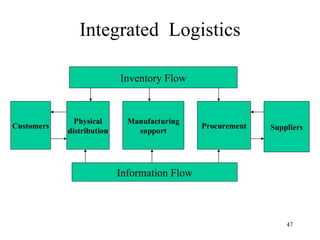
Integrated  Logistics Customers Physical distribution Manufacturing support Procurement Suppliers Inventory Flow Information Flow
Information from and about customers flows through the enterprise in the form of sales activity, forecasts and orders. Information is then translated into manufacturing and purchasing plans. The materials are then procured,value addition takes place along with the inventory flow ultimately resulting into transfer of ownership of finished products to the customers. The process of integration is not restricted  to manufacturing companies alone, the retailing and wholesaling firms link physical distribution and purchasing since manufacturing is not required.
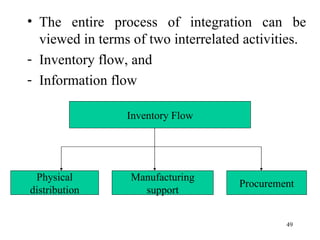
The entire process of integration can be viewed in terms of two interrelated activities. Inventory flow, and Information flow Inventory Flow Physical distribution Manufacturing support Procurement
Physical Distribution Establishes linkage of marketing channel with its customers facilitating the movement of a finished product to the final destination of a marketing channel. Would need a proper marketing effort resulting into desired assortment being delivered when and where needed.-Outbound logistics. Fulfills objective of implementation of time and space dimension of customer service as an integral part of marketing.
Manufacturing Support Concerned with managing work-in-process inventory as it flows between the stages of manufacturing. Formulates a master production schedule that subsequently facilitates arranging for timely availability of materials, component parts, and work-in-process inventory. Is not concerned with  ‘how’  production occurs but rather  ‘what,’ ‘when’, ‘where’  products will be manufactured.
Difference between Physical distribution and Manufacturing Support Physical distribution attempts to serve the desires of the customers and therefore must accommodate the uncertainties of consumer and industrial demand. Manufacturing support involves movement requirements that are under the contol of manufacturing enterprise.
Procurement Concerned with purchasing and arranging in-bound movement of materials, parts, and/or finished inventory from suppliers to manufacturing or assembly plants , warehouses, or retail stores thereby ensuring availability of materials/ assortments where and when needed. -Inbound logistics.  In a given marketing situation, manufacturers’ physical distribution is same as retailers’ procurement  operations.
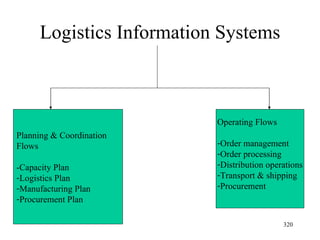
Information Flow A. Planning & Coordination Flows Nature & Location of customers Required products & services matching to needs of customers. Limitations or bottlenecks within manufacturing capabilities thus helping to decide outsourcing requirements. Requirements of logistical facilities based upon forecasting. MPS and MRP to support manufacturing /procurement requirements.
B. Operational Flow Order management and processing Procurement Inventory management Transportation and shipping  Advantages of effective operational flows Allocates and assigns inventory/ assortments to customers according to predetermined priorities.  - Use of information technology in deploying inventory to ensure effective performance of logistical system.  Consolidating orders to achieve freight economies and making correct documentation. Facilitate purchase order preparation, amendments and release to ensure overall supplier compliance.
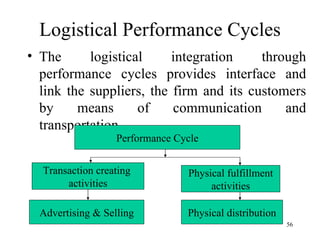
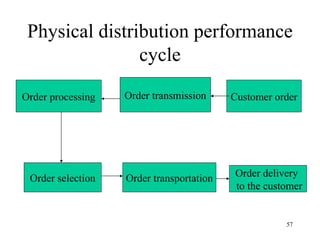
Logistical Performance Cycles The logistical integration through performance cycles provides interface and link the suppliers, the firm and its customers by means of communication and transportation. Performance Cycle Transaction creating  activities Physical fulfillment activities Advertising & Selling Physical distribution
Physical distribution performance cycle Customer order Order transmission Order processing Order selection Order transportation Order delivery  to the customer
Significance of physical distribution performance cycle As it links a firm with its customers, it helps create marketing and manufacturing initiatives into an integrated efforts. It resolves conflicting interface between marketing & manufacturing. As marketing is dedicated to delighting customers, it would like to maintain broad product line with high inventory regardless of each product’s profit potential. By doing so, any customer's  requirement, no matter how small or large would be satisfied.
Traditional mindset in manufacturing is to control cost, which is achieved by long production runs. Continuous manufacturing processes maintain economies of scale and reduce per unit cost. Therefore, a narrow line of products is mass produced. Inventories are kept to resolve the inherent conflict between these two philosophies. The above is achieved by forward deployment of inventory throughout the logistical system in anticipation of future sales on the basis of forecasted information.
How to reduce physical distribution operational variance Improve accuracy of forecast Improve order management and coordination with the customers. Have responsive and flexible cycle.
Manufacture Support Performance Cycle It provides production logistics being positioned between the physical distribution and procurement operations of a firm. Movement and storage of product, materials, and semi-finished parts and components between enterprise facilities represent the responsibility of manufacturing support logistics. In context of wholesale & retail trade, it implies selection of assortment of inventory to be moved to the next level of value chain. Basically, supports what, where and when of the production and not how.
Features of manufacturing support performance cycle. Initiates provision of materials and externally manufactured components at a place and time needed. Operations are restricted to dock-to-dock movement within the firm and where intermediate storage is required. After completion of manufacturing cycle the finished goods inventory is allocated and deployed either directly to the customers or to distribution warehouses for further customer shipment.
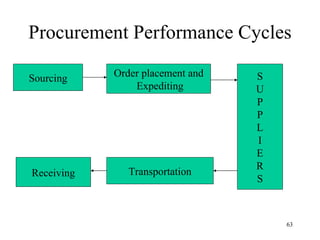
Procurement Performance Cycles Sourcing Order placement and Expediting S U P P L I E R S Transportation Receiving
The procurement operations are identified as inbound logistics. International procurement often requires large shipments necessitating the use of barges, ocean going vessels, trains and multiple truckloads for transportation. The lower value of materials and components as compared to finished product implies greater trade-off between higher cost of maintaining inventory in transit and the use of low cost modes of transport. As the cost of maintaining inventory in the pipeline is less per day than the cost of maintaining finished inventory, there is no benefit for paying higher freight rates for faster inbound transport.
Procurement performance cycles are invariably longer excepting in those cases where the value of material or component may justify paying higher freight rates for faster inbound transport. A critical issue in procurement is uncertainty in respect of price change, and/or supply discontinuity.
Reducing performance cycle uncertainties Use of electronic data interchange Monitoring daily changes in workloads Human resource availability Availability of specialized unloading and loading handling equipments Establishing safety stock/ buffer inventory to cover variances so as to avoid delays.
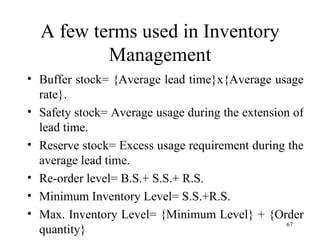
A few terms used in Inventory Management Buffer stock= {Average lead time}x{Average usage rate}. Safety stock= Average usage during the extension of lead time. Reserve stock= Excess usage requirement during the average lead time. Re-order level= B.S.+ S.S.+ R.S. Minimum Inventory Level= S.S.+R.S. Max. Inventory Level= {Minimum Level} + {Order quantity}
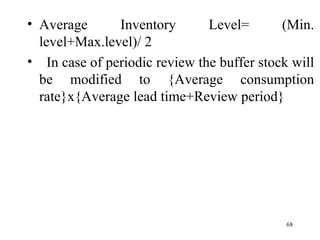
Average Inventory Level= (Min. level+Max.level)/ 2  In case of periodic review the buffer stock will be modified to {Average consumption rate}x{Average lead time+Review period}
Inventory Planning Ideally, if the forecast is done accurately, there will not be any need for an inventory. Most warehousing would vanish, product would move with less handling requirements from warehouses to customers. However, in real life situations, the thrust is on reducing inventory and maintain proper customer service and optimal inventory levels.
Inventory decisions-High risk & high cost Without the proper inventory assortment, marketing may find that sales are lost and customer satisfaction declining. Overstocks increase cost and reduce profitability through added warehousing, working capital requirements, deterioration, insurance, and obsolescence. As the significance percentage of assets are inventory related, a reduction of firm’s inventory by a few percentage points can lead to dramatic improvement in profits.  ROI= (Profit/ Fixed assets +Current assets)
Substantial improvement in the productivity of inventory can be achieved by re-engineering supply chain processes. Poor inventory management may lead to stock outs and hence cancellation of customers orders, overstocking leading to insufficient storage space and increase in the number and rupee value of obsolete products.  Consequently, inventory management has a large financial impact on the firm. Investments blocked in inventory cannot be used to obtain other goods or assets that could  improve the enterprise performance.
Types of Inventory Broadly there are three types of inventory Manufacturing inventory Wholesale inventory Retail inventory Manufacturing inventory Manufacturer’s inventory commitment starts with raw material and component parts, including work-in-process, and ends with finished goods. Manufacturer needs to transfer the finished goods inventory to warehouses in closer proximity to wholesalers and retailers. Manufacturer’s inventory commitment is relatively deep and has long duration.
(b) Wholesale inventory Wholesaler purchases large quantities from manufacturers and sells small quantities to retailers in order to provide retail customers with assorted merchandise from different manufacturers in smaller quantities. Thus wholesaler risk exposure is narrower but deeper and of longer duration than that of retailers. In case of seasonal goods, the wholesaler is forced to commit inventory, far in advance of selling, thus increasing the depth and duration of risk. The current trend of expansion of product lines has increased the width of inventory risk.
(c) Retail inventory Retailer inventory risk is wide but not deep. The emphasis is more on inventory velocity. Inventory velocity is measured by inventory turnover.  The risk is undertaken on variety of products but for a given product the risk is not deep relatively. The exception is specialty retailer where the depth and duration will be longer as they handle narrower lines. For instance, retailers’ risk is spread across more than 10,000 SKUs, a general merchandise and food store may carry around 25,000 SKUs and a full line department store may have as many as 50,000 SKUs.
Functions underlying inventory commitments Geographical Specialization It allows for geographical specialization for individual operating units. The need  for geographical specialization arises because various factors of production viz. power, materials, water, labour, manufacturing facilities are located at a considerable distance from the major markets. For instance, tyres, batteries, transmission equipments and springs for an automobile assembly. The production facilities for each of the these are traditionally located near the source of materials to minimize transportation cost.
- This strategy leads to specialization of manufacturing each automobile component and hence economically. - This will also involve internal inventory transfer to completely integrate various components into final assembly.  - Thus, manufactured goods from various locations are collected at a single warehouse and then combined as a consolidated/ assorted shipment. - P&G uses distribution centres to combine products from its laundry, food, and healthcare divisions to offer the customer a single integrated shipment. Economies gained through geographical specialization invariably offset increased inventory and transportation cost.
B. Decoupling Provides for increasing operating efficiency within a single manufacturing facility by stockpiling work-in-process inventory between production operations. Decoupling enables manufacturing and distribution of economic lot sizes in anticipation of sales thus ensuring large sized shipments with minimum freight cost. Decoupling permits products manufactured over a period of time to be sold as an assortment. Decoupling increases the operating efficiency at a single location while geographical specialization includes multiple locations.  However, JIT,DRP etc have reduced the economic benefits of decoupling considerably.
C. Balancing Supply and Demand  Balancing is concerned with elapsed time between consumption and manufacturing as balancing inventory reconciles supply availability with demand. Particularly useful in linking variations of consumption with manufacturing in case of seasonal products. Balancing seasonal production and year round consumption such as orange juice or year round production and seasonal consumption of blankets or knitting wool. In case of sort selling season, manufacturers, wholesalers and retailers are forced to take an inventory position far in advance of peak selling season.
From retailers’ perspective, an inventory position is planned six months prior to the peak selling period.  The main function of balancing supply and demand is to ensure that investment in stocks is liquidated completely within the season. Buffer Uncertainties Safety stock protects against two types of uncertainties: (a) Demand in excess of forecast during the performance cycle. For instance, customers’ request of more or less units  than planned. Delays in the performance-cycle length itself. For instance, delay in order receipt, order processing, or transportation.
Inventory Management Strategy Companies can postpone positioning of inventory by maintaining stock at the plants or they may decide to place more products in local distribution centres to have it closer to the market. Manage inventory at each distribution centre  independently. Consider inventory interdependence across distribution sites by managing inventory centrally. Ensure more coordination and communication in case of centralized inventory management.
Inventory Cost Consideration Origin purchase consideration Transportation cost. Origin  purchase means the buyer is responsible for freight cost and product risk when the product is in transit. Depending on the delivery terms, the buyer assumes full risk on inventory at the time of shipment. Depending on the payment terms, transit inventory would be a part of enterprise's average inventory and therefore subject to an appropriate charge. Transportation cost must be added to purchase price to obtain an accurate assessment of the value of goods tied up in inventory.
After the inventory is received, the amount invested in the product must be increased by transportation expenses.  Thus, inventory carrying cost should be assessed on the combined cost of the product plus transportation.
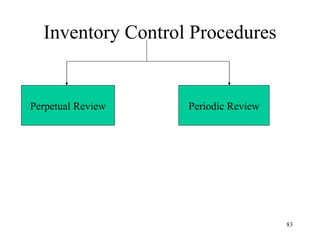
Inventory Control Procedures Perpetual Review Periodic Review
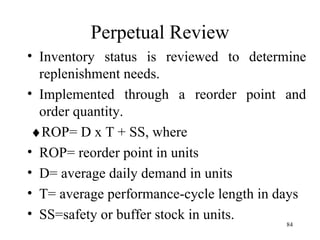
Perpetual Review Inventory status is reviewed to determine replenishment needs. Implemented through a reorder point and order quantity.  ROP= D x T + SS, where ROP= reorder point in units D= average daily demand in units T= average performance-cycle length in days SS=safety or buffer stock in units.
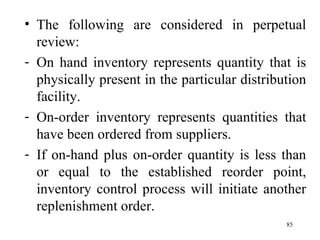
The following are considered in perpetual review: On hand inventory represents quantity that is physically present in the particular distribution facility. On-order inventory represents quantities that have been ordered from suppliers. If on-hand plus on-order quantity is less than or equal to the established reorder point, inventory control process will initiate another replenishment order.
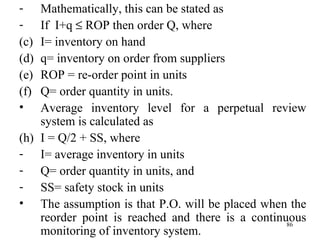
Mathematically, this can be stated as If  I+q    ROP then order Q, where I= inventory on hand q= inventory on order from suppliers ROP = re-order point in units Q= order quantity in units. Average inventory level for a perpetual review system is calculated as I = Q/2 + SS, where I= average inventory in units Q= order quantity in units, and  SS= safety stock in units The assumption is that P.O. will be placed when the reorder point is reached and there is a continuous monitoring of inventory system.
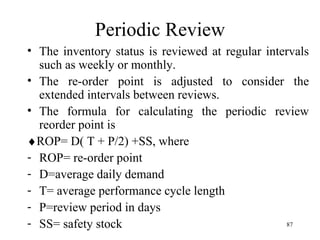
Periodic Review The inventory status is reviewed at regular intervals such as weekly or monthly. The re-order point is adjusted to consider the extended intervals between reviews. The formula for calculating the periodic review reorder point is  ROP= D( T + P/2) +SS, where ROP= re-order point  D=average daily demand T= average performance cycle length P=review period in days SS= safety stock
Average inventory for periodic review is represented as I= Q/2 + (P x D)/2 + SS, I= average inventory in units Q= order quantity in units P= review period in days D= average daily demand SS= safety stock. Because of the time interval introduced by periodic review, periodic control systems generally require larger average inventories than perpetual system.
Inventory Planning Methods Fair Share allocation Distribution  Requirement Planning
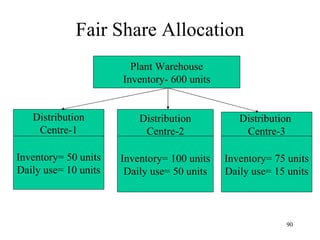
Fair Share Allocation Plant Warehouse Inventory- 600 units Distribution Centre-1 Distribution Centre-2 Distribution  Centre-3 Inventory= 50 units Daily use= 10 units Inventory= 100 units Daily use= 50 units Inventory= 75 units Daily use= 15 units
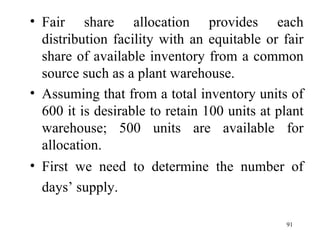
Fair share allocation provides each distribution facility with an equitable or fair share of available inventory from a common source such as a plant warehouse. Assuming that from a total inventory units of 600 it is desirable to retain 100 units at plant warehouse; 500 units are available for allocation.  First we need to determine the number of days’ supply.
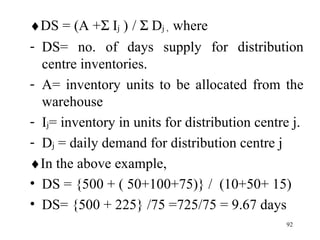
 DS = (A +   I j  )   /    D j ,   where DS= no. of days supply for distribution centre inventories. A= inventory units to be allocated from the warehouse I j = inventory in units for distribution centre j. D j  = daily demand for distribution centre j  In the above example, DS = {500 + ( 50+100+75)} /  (10+50+ 15) DS= {500 + 225} /75 =725/75 = 9.67 days
Thus, fair share allocation means that each distribution centre should be brought up to 9.67 days stock. The amount to be allocated to each distribution centre is determined as under:  A j  = (DS – I j  /D j  ) x D j , where A j  = amount allocated to distribution centre j DS= number of days supply that each distribution centre is brought upto. I j  = inventory in units for distribution centre j D j = daily demand  for distribution centre j Thus, the amount allocated to distribution centre 1 will be  A 1 = (9.67- 50/10) x 10 = (9.67- 5) x 10= 4.67x 10= 46.7 or 47 units.
 A 2 = (9.67-100/50)x50=(9.67-2.00)x50=383.5 or 384.00  A 3 = (9.67-75/15)x15=(9.67-5.00)x15=70 units. However, does not consider site specific factors. Difference in performance cycle. Economic order quantity. Safety stock requirements.
Distribution Requirement Planning Logical extension of manufacturing requirement planning (MRP). Operates in an independent environment where uncertain customer demand determines inventory requirements.  Requires forecast for each distribution centre and SKU as well as adequate lead-time to allow product movement. Errors may creep in because of prediction of demand at wrong location or at wrong time.  Requires consistent and reliable performance cycles for movement between distribution facilities.
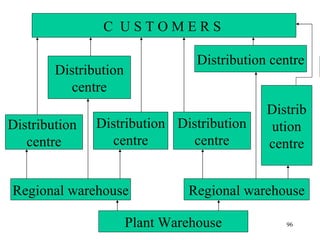
Plant Warehouse Regional warehouse Regional warehouse Distribution  centre Distribution centre Distribution centre Distribution centre Distrib ution centre Distribution centre C  U S T O M E R S
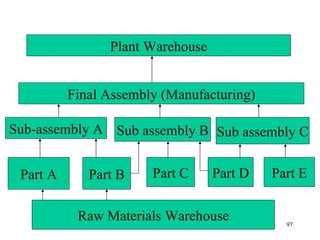
Raw Materials Warehouse Part A Part B Sub-assembly A Part C Part D Part E Sub assembly B Sub assembly C Final Assembly (Manufacturing) Plant Warehouse
DRP/MRP system integrates finished goods, work-in-process, and materials planning. DRP provides a schedule for each SKU and each distribution facility. For each planning period, the schedule will report the following: Gross requirements reflecting demand from customers being catered to by different distribution facilities. Scheduled receipts i.e.replenishment shipments planned for arrival at the distribution centre. Anticipated week ending total deliveries. Projected on-hand inventory i.e. prior week’s on-hand inventory- current week’s gross requirement + scheduled receipts.
Benefits of DRP Improved service levels by increasing on –time deliveries and decreasing customer complaints. Better planning of new product launches. Improved ability to anticipate shortages so that marketing efforts are not expended on products with low stock.  Reduced distribution centre freight costs resulting from coordinated shipments. Improved inventory visibility and coordination between logistics and manufacturing. Reduced warehousing space requirements because of inventory reductions.
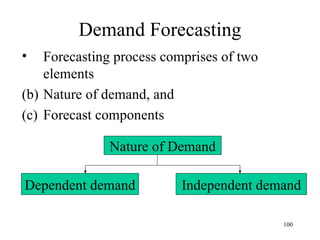
Demand Forecasting Forecasting process comprises of two elements Nature of demand, and Forecast components Nature of Demand Dependent demand Independent demand
Dependent versus Independent Demand Vertical dependent is characterized by sequence of purchasing and manufacturing, such as  number of tyres used for assembly of automobiles. Horizontal dependent occurs in a situation where an attachment, promotion item or operator’s manual is included with each item shipped.  The demanded item may not be required to complete the manufacturing process but may be needed to complete the marketing process.
(b) Once manufacturing plan for base item is determined , requirements of components/ attachments can be calculated directly and no separate forecasting is done. Independent demands are ones that are not related to the demand for another item. For instance, demand for refrigerator is not related to the demand for milk. Independent demand items are forecasted individually.
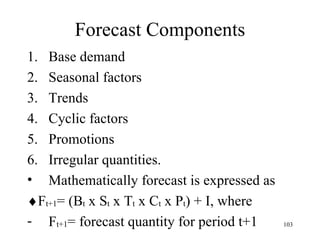
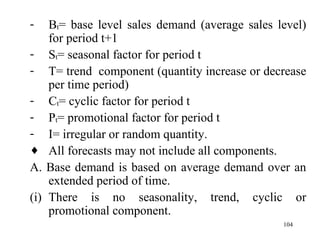
Forecast Components Base demand Seasonal factors Trends Cyclic factors Promotions Irregular quantities. Mathematically forecast is expressed as  F t+1 = (B t  x S t  x T t  x C t  x P t ) + I, where F t+1 = forecast quantity for period t+1
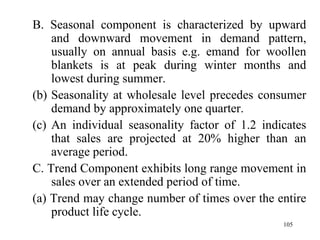
B t = base level sales demand (average sales level) for period t+1 S t = seasonal factor for period t T= trend  component (quantity increase or decrease per time period) C t = cyclic factor for period t P t = promotional factor for period t I= irregular or random quantity. All forecasts may not include all components. A. Base demand is based on average demand over an extended period of time. There is no seasonality, trend, cyclic or promotional component.
B. Seasonal component is characterized by upward and downward movement in demand pattern, usually on annual basis e.g. emand for woollen blankets is at peak during winter months and lowest during summer. Seasonality at wholesale level precedes consumer demand by approximately one quarter. An individual seasonality factor of 1.2 indicates that sales are projected at 20% higher than an average period. C. Trend Component exhibits long range movement in sales over an extended period of time.  (a) Trend may change number of times over the entire product life cycle.
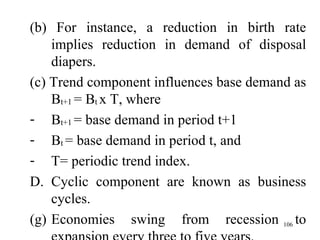
(b) For instance, a reduction in birth rate implies reduction in demand of disposal diapers. (c) Trend component influences base demand as B t+1  = B t  x T, where B t+1  = base demand in period t+1 B t  = base demand in period t, and T= periodic trend index. D. Cyclic component are known as business cycles. Economies swing from recession to expansion every three to five years.
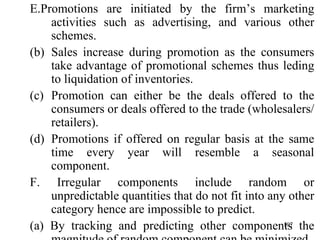
E.Promotions are initiated by the firm’s marketing activities such as advertising, and various other schemes. Sales increase during promotion as the consumers take advantage of promotional schemes thus leding to liquidation of inventories. Promotion can either be the deals offered to the consumers or deals offered to the trade (wholesalers/ retailers). Promotions if offered on regular basis at the same time every year will resemble a seasonal component. F. Irregular components include random or unpredictable quantities that do not fit into any other category hence are impossible to predict. (a) By tracking and predicting other components the magnitude of random component can be minimized.
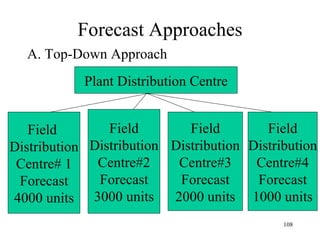
Forecast Approaches A. Top-Down Approach  Plant Distribution Centre Field  Distribution Centre# 1 Forecast 4000 units Field Distribution Centre#2 Forecast 3000 units Field Distribution Centre#3 Forecast 2000 units Field Distribution Centre#4 Forecast 1000 units
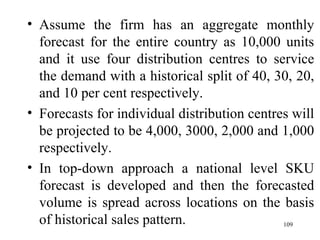
Assume the firm has an aggregate monthly forecast for the entire country as 10,000 units and it use four distribution centres to service the demand with a historical split of 40, 30, 20, and 10 per cent respectively. Forecasts for individual distribution centres will be projected to be 4,000, 3000, 2,000 and 1,000 respectively. In top-down approach a national level SKU forecast is developed and then the forecasted volume is spread across locations on the basis of historical sales pattern.
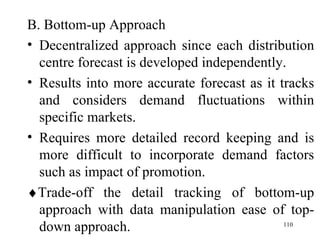
B. Bottom-up Approach Decentralized approach since each distribution centre forecast is developed independently. Results into more accurate forecast as it tracks and considers demand fluctuations within specific markets. Requires more detailed record keeping and is more difficult to incorporate demand factors such as impact of promotion.  Trade-off the detail tracking of bottom-up approach with data manipulation ease of top-down approach.
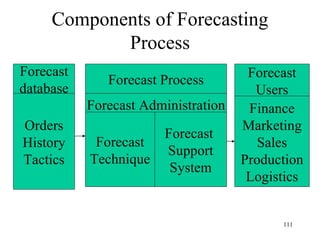
Components of Forecasting Process Orders History Tactics Forecast database Forecast Administration Forecast Technique Forecast  Support System Forecast Process Forecast Users Finance Marketing Sales Production Logistics
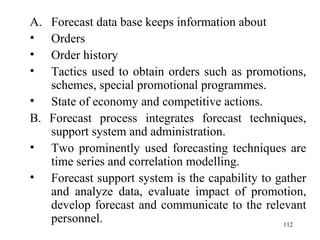
Forecast data base keeps information about Orders Order history Tactics used to obtain orders such as promotions, schemes, special promotional programmes. State of economy and competitive actions. B. Forecast process integrates forecast techniques, support system and administration. Two prominently used forecasting techniques are time series and correlation modelling. Forecast support system is the capability to gather and analyze data, evaluate impact of promotion, develop forecast and communicate to the relevant personnel.
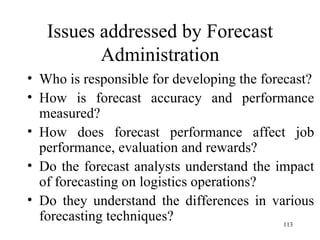
Issues addressed by Forecast Administration Who is responsible for developing the forecast? How is forecast accuracy and performance measured? How does forecast performance affect job performance, evaluation and rewards? Do the forecast analysts understand the impact of forecasting on logistics operations? Do they understand the differences in various forecasting techniques?
Transportation Transportation decisions are more strategic ones closely linked with inventory decisions. Decisions are based on trade-off between the cost of using a particular mode of transport with the cost of inventory associated with that mode. For instance, air shipments may be fast, reliable , and warrant less safety stocks; they are expensive whereas  shipping by sea or rail may be much cheaper but they necessitate holding relatively large amount of inventory to protect against the inherent uncertainty associated with them.
Customer service levels and geographic locations are important aspects in transportation decisions. Transportation accounts for roughly 30% of the logistics costs and therefore operating efficiencies become important aspects . Shipment sizes i.e. consolidated bulk shipments versus smaller lot sizes; routing and scheduling of vehicles become important part of company’s transport strategy. Transportation is one of the most visible elements in the logistics operation.
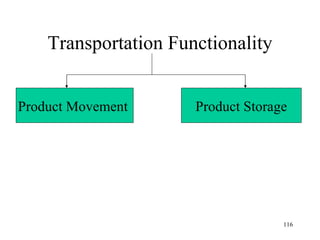
Transportation Functionality Product Movement  Product Storage
A. Product Movement Primary function is the movement up and down the value chain. As transportation uses temporal, financial and environmental resources, the movement of materials should take place only when it enhances the product value.  Uses  temporal resources  because the product is inaccessible while in transit. Due to JIT strategies transit inventories are becoming more significant thereby reducing manufacturing and distribution centre inventories. (b) Expenses incurred internally for private fleet of vehicles or externally for commercial or public transportation constitute  financial resources.
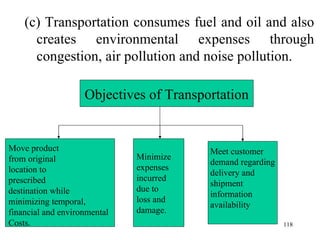
(c) Transportation consumes fuel and oil and also creates environmental expenses through congestion, air pollution and noise pollution.  Objectives of Transportation Move product  from original  location to  prescribed  destination while  minimizing temporal, financial and environmental Costs. Minimize expenses incurred due to loss and damage. Meet customer demand regarding delivery and shipment information availability
B. Product Storage Temporary storage through vehicles becomes expensive as in-transit storage is required to be moved again in a short duration of time. Sometimes temporary storage becomes advantageous as the cost of unloading and reloading the product in a warehouse may exceed the daily charge of storage in transportation vehicles. Many times where the warehouse space is limited, utilizing transportation vehicles becomes a viable option.
The options available to a transporter in case of warehouse space constraints are Instruct driver to take a circuitous  or indirect route to its destination, as the transit time would be  greater as compared to direct route. Thus transport vehicle is used as temporary storage option. Change the shipment destination i.e. temporary storage is achieved through diversion. For instance, product that is, say, scheduled initially from Mumbai to Hyderabad gets diverted  mid way to Vishakapatnam (Vizag) as Vizag warehouse may be in greater need of product and has the storage capacity.
Traditionally, the telephone was used to direct diversion but nowadays satellite communications between headquarters and vehicle handle such tasks more efficiently. Though product storage in vehicles can be costly, it can be justified from a total cost perspective when loading, unloading costs,or  capacity constraints are considered.
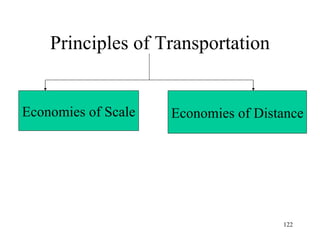
Principles of Transportation Economies of Scale Economies of Distance
A. Economies of Scale  Transportation cost per unit of weight decreases when the size of the shipment increases i.e. shipments that utilize the entire vehicle’s capacity like truck load (TL) cost less per kg than less than truck load (LTL) shipments.  Fixed costs in transportation include administrative costs of taking transportation order, time to position the vehicle for loading or unloading, invoicing and equipment cost. It costs as much to administer a shipment of 1 kg as it does to administer a 1000 kg shipment.
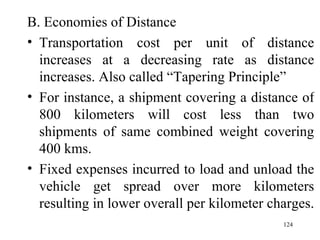
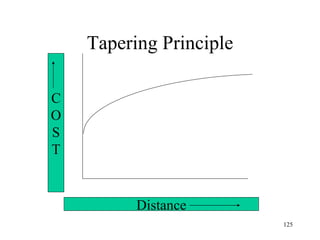
B. Economies of Distance Transportation cost per unit of distance increases at a decreasing rate as distance increases. Also called “Tapering Principle” For instance, a shipment covering a distance of 800 kilometers will cost less than two shipments of same combined weight covering 400 kms. Fixed expenses incurred to load and unload the vehicle get spread over more kilometers resulting in lower overall per kilometer charges.
Tapering Principle Distance C O S T
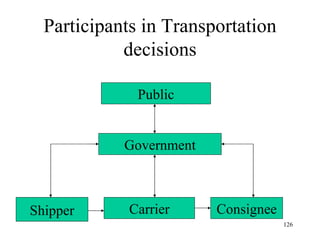
Participants in Transportation decisions Government Shipper Carrier Consignee Public
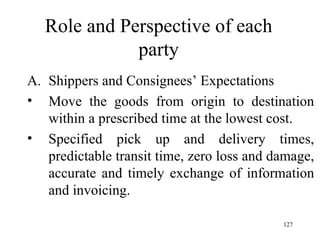
Role and Perspective of each party Shippers and Consignees’ Expectations Move the goods from origin to destination within a prescribed time at the lowest cost. Specified pick up and delivery times, predictable transit time, zero loss and damage, accurate and timely exchange of information and invoicing.
B. The Government Role  Stable and efficient transportation environment to sustain economic growth. Product availability throughout the country at a reasonable cost. Providing right-of-way such as road or railways or air traffic control system.  C. The Public concerns Accessibility, cost effectiveness and protection of environmental and safety standards. Development of transport infrastructure to have goods from global sources.
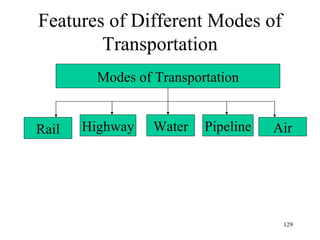
Features of Different Modes of Transportation Modes of Transportation Rail Highway Water Pipeline Air
Rail Capability to transport large shipments economically with more frequency. High fixed costs because of expensive equipment, right of way, switching yards, and terminals. Variable cost per kg/km has been consierably reduced by electrification.  Bulk industries and heavy manufacturing use railways more frequently. Can improve effectiveness of transportation by having alliances with other modes.
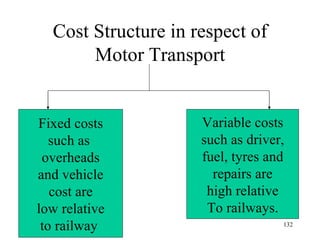
B. Highway Growth of motor carrier industry has resulted into door-to-door operating flexibility and speed of inter-city movement. Compared to railways, motor carriers have relatively small fixed investments in terminal facilities and operate on publicly maintained highways. Variable cost per kilometer is high because a separate driver and cleaner are required for each vehicle. Labour cost is also high because of the need for substantial dock labour.
Cost Structure in respect of Motor Transport Fixed costs such as  overheads and vehicle cost are low relative to railway  Variable costs such as driver, fuel, tyres and repairs are high relative To railways.
Motor carriers are best suited to handle small shipments moving short distances. Favour light manufacturing and distributive traders, short distances and high value products. Have captured significant market share of railways in medium and light manufacturing industries. Because of delivery flexibility, motor transport has captured almost all  freight moving from wholesalers or warehouses to retail stores. Higher cost in replacing equipment, higher wages to driver and other dock labour.
C. Water Capacity to move extremely large shipments. Fixed costs are somewhere between rail and motor carriers. Though water carriers have to develop and operate their own terminals, the right-of-way is developed and maintained by the government, resulting into moderate fixed costs compared to rail and highways. Low variable cost makes this an attractive mode when low freight rates are desired and speed is secondary consideration. Typically bulk commodities such as mining , chemicals, cement, and certain selected agricultural products are transported by ocean going vessel.
Unless the point of origin and point of destination  are adjacent to a waterway, it needs to be supplemented by rail or trucks.  D. Pipelines Used for transporting natural gas, manufactured chemicals, pulverized dry bulk materials such as cement and flour via hydraulic suspensions, sewage and water within the cities and municipalities. Operate on 24x7 basis are limited only by commodity changeover and maintenance. No empty container or vehicle that must be returned. Highest fixed cost an lowest variable cost. High fixed costs due to right-of-way, construction and requirements for control station and pumping capacity.
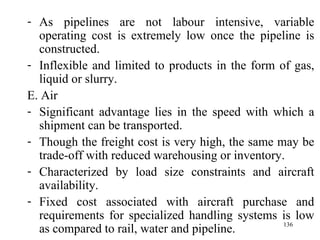
As pipelines are not labour intensive, variable operating cost is extremely low once the pipeline is constructed. Inflexible and limited to products in the form of gas, liquid or slurry.  E. Air Significant advantage lies in the speed with which a shipment can be transported. Though the freight cost is very high, the same may be trade-off with reduced warehousing or inventory. Characterized by load size constraints and aircraft availability.  Fixed cost associated with aircraft purchase and requirements for specialized handling systems is low as compared to rail, water and pipeline.
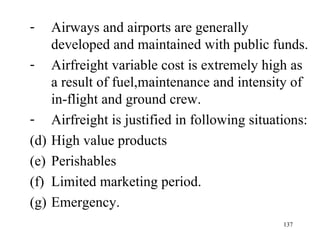
Airways and airports are generally developed and maintained with public funds. Airfreight variable cost is extremely high as a result of fuel,maintenance and intensity of in-flight and ground crew.  Airfreight is justified in following situations: High value products Perishables Limited marketing period. Emergency.
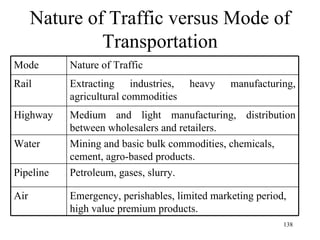
Nature of Traffic versus Mode of Transportation Mode Nature of Traffic Rail Extracting industries, heavy manufacturing, agricultural commodities Highway Medium and light manufacturing, distribution between wholesalers and retailers. Water Mining and basic bulk commodities, chemicals, cement, agro-based products. Pipeline Petroleum, gases, slurry. Air Emergency, perishables, limited marketing period, high value premium products.
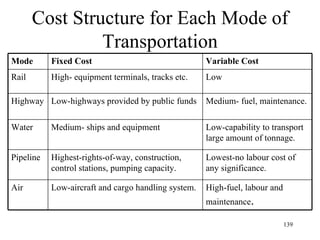
Cost Structure for Each Mode of Transportation Mode Fixed Cost Variable Cost Rail High- equipment terminals, tracks etc. Low Highway Low-highways provided by public funds Medium- fuel, maintenance. Water Medium- ships and equipment Low-capability to transport large amount of tonnage. Pipeline Highest-rights-of-way, construction, control stations, pumping capacity.  Lowest-no labour cost of any significance. Air Low-aircraft and cargo handling system. High-fuel, labour and maintenance .
Transport Economies Distance Volume Density Stow ability Handling Liability Market factors
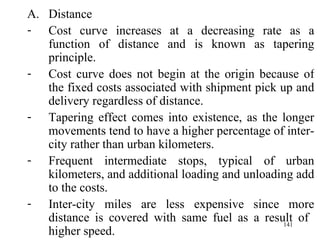
Distance Cost curve increases at a decreasing rate as a function of distance and is known as tapering principle. Cost curve does not begin at the origin because of the fixed costs associated with shipment pick up and delivery regardless of distance. Tapering effect comes into existence, as the longer movements tend to have a higher percentage of inter-city rather than urban kilometers. Frequent intermediate stops, typical of urban kilometers, and additional loading and unloading add to the costs. Inter-city miles are less expensive since more distance is covered with same fuel as a result of  higher speed.
B. Volume Transport cost per unit of weight decreases as load volume increases. Fixed costs of pick up and delivery as well as administrative costs get spread over additional volumes. Smaller loads must be consolidated into larger loads.  C. Density Transportation cost per unit declines as product density increases.  In terms of weight and space, an individual vehicle is constrained more by space than by weight. Once is the vehicle is full, it is not possible to increase the amount carried even if the product is lightweight.
Higher density products allow fixed costs to be spread across additional weight, as a result the products are assessed at a lower transport cost per unit. Attempts are made to increase product density so that more can be loaded in a vehicle to utilize its capacity.  D. Stow ability Refers to product dimensions and impact of the same on vehicle utilization. Odd sizes and shapes as well as excessive weights and lengths do not stow well and typically waste space.  Though density and stow ability are similar, products may have same density that stow differently.
Items with regular shapes are easier to stow than odd shaped items. While the steel blocks and rods have the same density, rods are more difficult to stow because of their length and shape.  E. Handling Special handling equipments may be required for loading or unloading trucks, trains, or ships and the unitization/ palletization affects the handling cost. F. Liability - Product characteristics such as susceptibility to damage, perishability, susceptibility to to theft, susceptibility to explosion affect the risks and hence claims.
G. Market factors Back-haul i.e. vehicle returning back to the point of origin with load. Dead head to be avoided because empty returns incur labour, fuel, and maintenance costs. Thus design of logistics system must add back-haul movement wherever possible.
Multimodal Transport System Multimodal or Intermodal transport refers to journeys that involve two or more different modes of transport.  For instance, if materials are moved from Lanchow in central China to Warsaw in Poland goods may be loaded on to trucks, transferring them onto rails for a journey across China to Shanghai, then ship to Rotterdam, back into rails to cross Europe, then truck for local delivery.
For Logistics managers intermodal services become necessary because of their characteristics and costs. For example, limited accessibility of air transport requires coordination with a land carrier to make the pick ups and deliveries. Similarly, inaccessibility applies to rail, water and pipeline but not to the motor which has a definite advantage here. The intermodal services maximizes the primary advantages inherent in the combined modes and minimize their disadvantages. The combined services will have both good and bad aspects of the utilized modes.
For instance, coordinate of rail and water will have a lower total cost than an all-rail movement but higher cost than that of all-water. Likewise, combined system transit time will be lower than all water movement but higher than all-rail. The decision to use multi-modal system must consider the effect on total logistics costs. The aim of intermodal transport is to combine the benefits of several separate modes but avoid the disadvantages of each, like, combining the low cost of shipping with flexibility of the road, or getting the speed of air with the cost of road.
However, each transfer between modes causes delays and adds costs of extra handling. Intermodal transport works well when transfer can be done efficiently. Transfer of motor carrier trailer to another transport mode is facilitated through containerization.
Choice of Mode Factors influencing the choice of mode are as under: Bulkiness of the materials; heavy items would be shipped by ocean going vessels.  Value of materials; expensive items raise inventory costs and thus encourage faster modes. Criticality of materials; even low unit value items that hold up the operations need fast and reliable transport. Susceptibility to market changes; operations that respond quickly to changes cannot wait for critical supplies using slower transport. Reliability with consistent delivery is important.
Cost and flexibility to negotiate rates. Reputation and stability of carrier. Susceptibility to loss, theft and pilferage Schedule and frequency of delivery. Special facilities available Limitations of Multimodal system Sometimes carriers are reluctant to participate. Willingness to coordinate in respect of moving the product is higher when any one carrier is incapable to transport in its entirety.
Containerization Container is large rectangular box into which a firm places commodities to be shipped. After initial loading, the commodities themselves are not rehandled until they are unloaded at their final destinations. Throughout the movement, the carrier handles the container, not the commodities. The shipper can transfer the container from one mode to another, eliminating the need to handle the commodities each time thus reducing handling costs, damage costs, theft, pilferage and the time required to complete the modal transfer.
Many firms that modify their material handling systems to include cranes, forklift trucks, and other equipment capable of handling large, heavy containers have found containerization to be desirable avenues for increasing productivity and controlling material handling costs, especially in periods of continually increasing labour costs. As the objective of intermodal transport system is to provide virtually seamless journey, the best way to achieve same is to use modular or unitized loads.
Piggyback –Trailer on Flat Car  TOFC  is a specialized form of containerization in which rail and motor transport coordinate. Carrier places motor carrier trailer on a rail flatcar, which moves the trailer by rail for long distance. A motor carrier then moves the trailer for short distance pickups and deliveries. This service combines the long-haul, low cost advantage of rail with accessibility of motor. Piggyback services mostly move under contract.
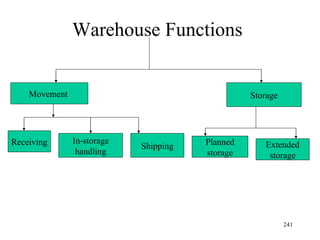
Material Handling The primary material handling objective is to efficiently move large quantities of inventory into and specific customers orders out of the warehouse. The functions performed in a warehouse are classified as movement or Handling and storage. Movement or handling is emphasized and storage is secondary. Handling is divided into Receiving In storage handling , and Shipping
An extremely important aspect of logistics is the productivity potential that can be realized from capital investment in material-handling equipment. Specialized handling equipment is required for unloading bulk materials such as for solids, fluids, or gaseous materials. The guidelines suggested in designing the material handling systems are: Equipment for handling and storage should be  as standardized as possible. When in motion, the system should provide maximum continuous flow. Investment should be made in handling rather than stationery equipment.
(d) Handling equipment should be utilized to the maximum extent possible. (e) In selecting handling equipment, the ratio of deadweight to payload should be minimized. (f) Whenever possible, gravity flow should be incorporated in the system design. The handling systems can be classified as under: Mechanized  Semi automated Automated, and Information directed.
Mechanized Systems Forklift Trucks Forklift trucks can move loads of master cartons both horizontally and vertically. A pallet or slip sheet forms a platform upon which master cartons are stacked. A slip sheet is a thin sheet of solid fibre or corrugated paper and are used for situations when product is handled only a few times.  A forklift truck normally transports a maximum of two unit loads i.e. two pallets at a time
High stacking trucks are capable of up to 40 feet of vertical movement. Even trucks capable of operating in aisles as narrow as 56 inches ar also found in warehouses. The significance of narrow-aisle forklift trucks has increased as warehouses seek to increase rack storage density and overall storage capacity. Forklift trucks are not economical for long distance horizontal movements because of high ratio of labour per unit of transfer. Most effectively utilized in shipping and receiving  and placing merchandise in a predetermined storage space. Common sources of power are propane gas and electricity.
Many forklift operations are utilizing radio frequency data communication to speed up load put away and retrieval assignments. Under the above system, workers receive their assignments through either handheld or vehicle –mounted RF terminals. RF technology provides real-time communication capability to central data processing systems, and when combined with bar code scanning of cartons and pallets,it allows fork lift operators to receive and update item status inquiry, material orders and movement and inventory adjustments.
B. Walkie-Rider Pallet Trucks Low cost, effective method of material handling. Highly versatile low-lift pallet and/or skid handlers with load capabilities from 3,000 to 8,000 lbs. Typical applications include loading and unloading, order selection and shuttling over longer distances throughout the warehouse. Popular in grocery warehouses. Electricity is the power source.
C. Towlines Either in-floor or overhead mounted drag devices. The major advantage is the continuous movement but lacks flexibility of forklift trucks. Most common application is for order selection within the warehouse. Order selectors place merchandise on a four wheel trailer, which is then towed to the shipping dock.  D. Conveyors Conveyors are classified according to power, gravity or roller/belt movement. Portable gravity style roller conveyors are often used for loading and unloading. In some cases these are transported on the over-the-road trailers to assist in unloading at the destination.
Semi automated Handling Semi automated system supplements a mechanized system  by automating a specific handling requirements. Semi automated warehouse is a mixture of mechanized and automated handling. Automated-Guided Vehicle Systems Performs similar kind of handling function as a mechanized tow tractor with a trailer.  The essential difference is that an AGVS does not require an operator and is automatically routed and positioned at destination with intervention of the operator.
Typical AGVS equipment relies on an optical or magnetic guidance system. In the optical application, tape is placed on the warehouse floor, and the equipment is guide by a light beam that focuses on the guide path. A magnetic AGVS follows an energized wire installed in the floor. The primary advantage is the elimination of a driver and newer AGVS use video and information technology to follow paths without the need for fixed tracks.
B. Sortations Typically used in combination with conveyors. The products are selected in the warehouse, they are sorted as per specific specific shipment docks and taken onto the conveyors for moving out. Master cartons have a distinguishing code, these are read by optical scanning devices and automatically routed to the desired locations. The rate of flow is customized to meet changing requirements. The benefits are Reduction in labour, and Increase in speed and accuracy.
C. Robotics Humanlike machine that can be programmed by microprocessors to perform various activities. Robots are use in warehouses to break down and build unit loads to accommodate exact merchandise requirements of a customer’s orders. In break down process, the robot is programmed to recognize stocking pattern and place products in the desired position on a conveyor belt. Similarly, robots are used to build unit loads.
Robots are used effectively in warehouses where prevailing environments make it difficult for humans to work such as high noise areas and extreme temperatures like cold storage freezers. The capability to incorporate artificial intelligence in addition to speed, dependability, and accuracy makes robotics an attractive alternative to traditional manual handling systems.
Automated Handling Substitutes capital investment in equipment for labour required in mechanized handling systems. Though operates faster and more accurately, requires high degree of capital investment and complex to operate. Most automated systems are custom deigned and constructed for each application. Automated handling concentrates on order selection system at  the master carton level as well as on high rise storage and retrieval system.
Order Selection System The handling of fast moving products in master cartons is fully automated from the point of merchandise receipt to placement in over-the-road trailers. Such systems use an integrated network of power and gravity conveyors linking the storage. System is controlled by computer coupled with inventory and order processing systems of warehouse. Upon arrival, merchandise is automatically routed to storage position and inventory records are updated. Upon order receipt, merchandise is unitized to vehicle size and schedules made for selection.
At an appropriate time, all merchandise is selected in loading sequence and automatically transported by conveyor to th loading dock. The only manual handling of merchandise occurs while stacking into transport vehicle.  B. Automatic Storage and Retrieval System (ASRS) High rise handling systems are fully automated from receiving to shipping. The components of this system are storage racks, storage and retrieval equipment and control systems. The high rise are the vertical storage racks  up to the height of 120 feet.
The storage and retrieval machine travels back and forth with the primary objective of moving products in and out of storage.  Functions of storage & retrieval equipment To reach the desired position rapidly. To deposit or retract a load of merchandise. To ensure merchandise flowing from production is automatically stacked to create a unit load. To transport the unit load to the high rise storage area by power conveyor.
C. Information-directed Systems All material handling movements are directed and monitored by the command of microprocessors. To begin with all required handling movements are  fed into the computer for analysis and equipment assignment. Analysis of handling requirements and equipment assignment is done in such a way that direct movements are emphasized and deadhead movements are minimized. Work assignments are provided to individual forklifts by terminals located on the truck.
Communication between the computer and the truck uses radio frequency (RF) waves with antennae located on the forklifts and high up in the warehouse. Information-directed systems can increase productivity by tracking material handler performance and allowing compensation to be based on activity level. A single handling equipment may be involved in loading or unloading several vehicles, selecting many orders, and completing several handling assignments, thus increasing the complexity of work direction.
Packaging Packaging can be categorized into two types viz. Consumer packaging, which has a marketing emphasis, and Industrial packaging, which has more of logistics emphasis. Consumer Packaging (Marketing Emphasis)  Consumer packaging design focuses on customer convenience, market appeal, retail shelf utilization, and product protection. Large containers and odd sizes may increase the consumer visibility but make poor logistical packaging.
For example, shipping products fully assembled such as motorcycles results in substantial reduction in density. A low density package would mean higher transportation costs and greater warehousing requirements.  B. Industrial Packaging (Industrial emphasis) Individual products or parts are normally grouped into cartons, bags, bins, or barrels for handling efficiency.  These containers are used to group individual products and are referred to as  master cartons.
When master cartons are grouped into larger units for handling, the combination is referred to as  containerization  or  unitization. The master carton and the unitized load provide the basic handling unit in the logistics channel. The weight, volume, and fragility of the master carton in an overall product line determines transportation and material handing requirements. If the package is not designed for efficient logistical processing, overall performance of the system would suffer.
Standardization of master carton facilitates material handling and transportation. Standardization of master carton is beneficial even in context of retail backend operations.  For instance, in case of shoe store as the contents of each master carton are known, it is not necessary to search through many cartons for a particular style or size of shoe. Allows master cartons to be more efficiently stacked, resulting in to less backroom congestion. Complete identification of master carton contents facilitates completion of retail inventory and merchandise reorder.
Standardized cartons are selected to achieve maximum conformity in increasing the density in the  trailer thereby eliminating dead space in stacking. The end result of standardized master carton usage is substantial reduction in total cost combined with an effective material handling system at both warehouse and the retail store. In situations, when master cartons of more than one size are required, extreme care should be taken to arrive at an assortment of compatible units. These different sizes of master cartons should result into modular compatibility.
How to design an Ideal Package? Invariably, logistical considerations alone cannot fully dominate package design. The ideal package for material handling and transportation would be a perfect cube having equal length, depth, and width with maximum possible density but such a package does not exist in practice. Thus, logistical requirements should be evaluated along with manufacturing, marketing, and product design considerations when standardizing master cartons.
Another critical issue to be considered in package design is to determine the degree of protection required to cope with the anticipated physical and climatic environments. The package design and material should combine to achieve the desired level of protection without incurring the expense of overprotection. In most cases the cost of absolute protection will be prohibitive and therefore the package construction should be a proper blend of design and material.  Three broad functions of packaging are - Damage protection, Utility/ efficiency, and Communication.
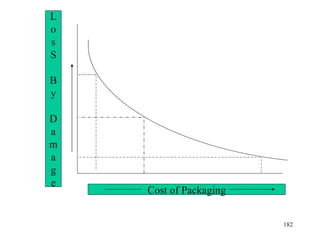
A.Damage Protection A major function of the master carton is to protect products from damage while moving and being stored in the logistical system. Master carton also serve as a deterrent to pilferage. Achieving desired degree of protection involves tailoring the package to the product and selecting proper material for package construction. The determining factors are the value and fragility of the product; higher the value, the greater is the justification for nearly absolute protection. If the product is fragile and has high value, then the cost of absolute protection can be significant.
Cost of Packaging L o s S B y D a m a g e
The susceptibility to damage of a given package is directly related to the environment in which it moves and is stored. Product fragility can be measured by product/package testing by means of shock and vibration equipment. If packaging requirements and cost are prohibitive, alternative product designs can be evaluated utilizing the same testing equipment. The end result is the determination of the exact packaging required to protect the product.
During the logistical process, common causes of product damage are vibrations, impact,puncture, and compression. Stacking failure can also result in damage while the product is in storage. The potential physical damage of poor stacking ranges from surface scuffing and marring to complete product crushing, buckling and cracking. Typical methods of securing the packages are strapping, tie-downs, and use of various dunnage materials that limit vibrations and shock.
B. Efficiency/ Utilization Logistical operations  are affected by packaging utility i.e. from truck loading and warehouse picking productivity to transportation and storage space utilization. Logistical activity output can be described in terms of packages, such as number of cartons loaded per hour into a trailer, number of cartons picked per hour in a warehouse or distribution centre. Material handling efficiency is also strongly influenced by the unitization of packages.
An important part of packaging relating to storage and material handling is the concept of unitization. Unitization describes the physical grouping of master cartons into one restrained load for material handling or transport. Concept of containerization includes all forms of unitization, from taping two master cartons together to the use of specialized transpotation equipment. All types of containerization have the basic objective of increasing material handling efficiency.
 Benefits of Unit Loads Unloading time and congestion at destination is minimized. Products shipped in unit load quantities facilitate material handling and inventory can be positioned rapidly for order selection. Damage in transit can be reduced by unit load shipping and specialized transportation equipment. All above factors lead to reduction in logistical cost.
A unit load can increase damage potential if it is not properly restrained during handling or transport. Standard method of imparting stability to unit load include rope ties, steel strapping, adhesives, wrapping- both shrink wrap as well as stretch wrap. C. Communication Critical to content identification, tracking, and handling as the these are becoming necessary to total channel success.
Content Identification A very obvious communication role is identifying package contents for all channel members. The typical information includes manufacturer, product, type of container i.e. can or bottle, count and product code number. The carton information is used to identify product for receiving, order selection, and shipment verification. Visibility is the major consideration, and material handlers should be able to see the label from reasonable distances in all directions.  High value products often have small labels to minimize the temptation of theft.
(b) Tracking A well controlled material handling system tracks product as it is received, stored, retrieved, and shipped. A good control on movement reduces product  loss and pilferage and is useful for monitoring employee productivity. Low cost scanning equipment, and codification increases the tracking capabilities and effectiveness.
(c) Handling Instructions Final role of logistics package is to provide handling and damage instructions. The information should be provided about any special product handling considerations such as glass containers, temperature restrictions, stacking considerations, or potential environments concerns. If the product is dangerous, such as an explosive chemical , the packaging should provide instructions for ealing with spills and container damage.
Channel Integration-PCM Packaging, Containerization, and Material handling represent integral parts of the logistical operating system; as all three areas influence each other. For instance, automated handling cannot be efficiently designed without a high degree of master carton standardization, which in turn provide the opportunity to containerize individual products. The integration between material handling capability,  transportation, warehousing, inventory policy and packaging communication into customer’s logistical system leads to minimum handling during the exchange of merchandise. This type of integration is commonly found in physical distribution.
Scrap/Waste Disposal Scrap Material Input Material Processing Material Output Recycle Disposal
Scrap Scrap is a waste created while processing the materials. The process scrap is unavoidable extra material removed from the stock of material while generating a component. For example, while making a machined component some material has to be removed in the form of chips. Quite often, while manufacturing any component some dimensions are not maintained  and the lot is scrapped as these cannot be used in the assembly of the product.
B. Surplus When the project or product needs a specific quantity of the item, extra leftover cannot be used and this quantity is called surplus. The surplus quantity has to be disposed off. C. Obsolete When the item cannot be used in the product/ project due to changes that might have taken place in respect of dimensions, shape, colour etc, these are called obsolete items. Changes ay occur due to defect in product design, or shelf life etc. These components have to be scrapped/ disposed off.
Wastivity of a System Wastivity of the system is defined as the ratio of the waste to the input. Wastivity= Waste / Input Gross wastivity= Total waste generated/  Total input. All waste is not the waste, some part of it can be recycled. Net waste={Total waste generated}-{Waste recycled within the system}. Net wasitivity= Waste which cannot be recycled/ Total input. Wastivity assesses the productivity for each type of input. Both wasitivity and productivity are complementary to each other.
Issues to be addressed Quick identification of the waste generated. Separation of different types of waste. Economic reduction. Efficient collection and handling. Recycling, and effective disposal without affecting the environment.  Designing a suitable ‘waste control programme’.
Recycling /reusing/ disposal of waste/ surplus/ scrap. Recycling refers to the use of bad quality outputs (rejects) or wastes as inputs to the same process or system e.g. reusing plastic scrap. Use the scrap for producing by-products. Transfer the surplus from one department to another. Sell the scrap/surplus as raw materials to other user factories, external agents, or even to the employees. Sell scrap through advertisement and auctioning. Return the surplus to the vendor, if possible. Donate rejected material to charitable organizations to gain social respect.
Warehousing The primary purpose of a warehouse management is to control the movement and storage of materials within an operation. Warehousing can be viewed as a place to store inventory as well as a facility for switching the inventory. Warehousing is becoming significant to achieve the following objectives: To reduce inventory To reduced labour costs To increase storage capacity To increase customer service To increase inventory accuracy.
Typically, the warehouses received merchandise by rail or road and the materials were moved manually to a storage area within the warehouse and piled up on the floor in stacks manually. Due to above, though different products were stored in the same warehouse it was difficult to identify the merchandise with respect to a particular order.  On the receipt of the customer orders, products were handpicked and placed on the wagons and these wagons were pushed out of shipping area.
As the labour was inexpensive, human resources were used extensively and no consideration was given to efficiency utilization, work methods, or material handling. Inspite of poor efficiency, warehouses continued to provide a necessary bridge between production and marketing.  With the improved techniques of forecasting and production scheduling the need to build up inventory was considerably reduced. Also, delays during manufacturing process reduced as the production became more coordinated. Seasonal products continue to require warehousing. The overall need to store materials to support manufacturing has been reduced.
In context of retailing, the department stores face the necessity of stocking an increased variety of products and are unable to order in sufficient quantities from a single supplier to enjoy the benefits of consolidated shipment. Direct ordering from manufacturers becomes prohibitively expensive due to high cost of transporting small shipments. This necessitates the need for warehousing to provide timely and economical inventory assortments. At wholesale level, the warehouse becomes a support unit for retailing.
In context of manufacturing, companies producing products at multiple locations, efficient warehousing becomes a method for reducing material and parts storage and handling costs while optimizing production.  For implementing JIT and stockless production strategies warehousing becomes an integral part of entire value chain. As the basic objective of JIT is to reduce work-in-process inventory, manufacturing needs to supported by highly dependable delivery.
In a country as large as India, this is possible only by having strategically located warehouses.  The stocks can be held at a central warehouse thereby reducing the need to maintain inventory at each assembly plant. Using consolidated shipments, materials are purchased and transported to the supply warehouse and then distributed to manufacturing plants as and when needed. A fully integrated warehouse is a vital extension of manufacturing.
In context of outbound logistics, warehouses have made possible the direct shipment of mixed/ assorted  products to the customers thereby enhancing the service capabilities. The direct assorted shipments have two advantages, namely, Reduced logistical cost because the full product assortment can be delivered while taking the advantage of benefits obtained through consolidated transportation. More competitive advantage for the manufacturers due to speedier shipments and mixed lots. Recently, warehouses have been able to increase productivity due to effective use of Information Technology.
Role of Warehousing in Logistical System Provision of strategic storage, though an effective distribution system should not have the necessity of inventory for an excessive length of time, sometimes storage becomes inevitable. Acting as a switching facility Provision of economic and service benefits.
Economic Benefits Consolidation Break-bulk Cross-docking Postponing Stock piling
Consolidation Plant A Plant B Plant C Consolidation warehouse Customers A B C
The benefits and features are Realization of lowest possible transportation rate. Reduction of congestion at a customer’s receiving dock. Manufacturing plants can use warehouse as a forward stock location or as sorting and assembly facility. Combines the logistical flow of small shipments to a specific market area. A single firm may use consolidation warehousing or a number of firms may join together and hire the consolidation service.
Break-bulk Plant A Break-bulk warehouse Customer A Customer B Customer C
Break-bulk operations receive combined orders from manufactures and ships them to individual customers. Break-bulk warehouse splits individual orders and arranges for local delivery.  Cross-dock facility is similar to break-bulk except that it involves multiple manufacturers. In transit-mixing and release as well as manufacturing support are also included in cross dock facility.
Cross-docking  Company A or Plant A Company B or Plant B Company C or Plant C Distribution centre Customer A Customer B Customer C
In Transit mixing and release Plant A Plant B Plant C Warehousing  Transit mixing point Product D Customer X Customer Y Customer Z Customer W
Manufacturing Support Vendor A Vendor B Vendor C Manufacturing warehouse  Assembly plant
The features and benefits of cross-dock facilities are:  The full trailer loads of product arrive from multiple manufacturers and as the product is received it is sorted and allocated to customers. The product is then moved across the dock to be loaded onto the trucks destined for appropriate customer. The trucks are then transported to retail outlets once the same have been filled with the mixed product from multiple manufacturer.
Processing/Postponement Warehouses can also be used to postpone, or delay production by performing processing and light manufacturing  activities. A warehouse with packaging and labelling capability allows postponement of final production until actual demand is known.  For example, vegetables can be processed and canned at the manufacturer’s end without pre-attached labels.No pre-attached labels means the product does not have to be committed to a specific customer.Once a specific customer order is received, the warehouse can complete final processing by adding label and finalizing the packaging.
Stockpiling  Useful for seasonal storage such as: Blankets and Knitting wool are produced year round and primarily sold during a very short marketing period. Agricultural products are harvested at specific times with subsequent consumption throughout the year. In both the above situations, stockpiling becomes necessary to support the marketing efforts. Stockpiling provides for a buffer inventory allowing for a balance between the availability of materials and the market demand.
Service Benefits Spot Stock Assortment Mixing Production support Market presence
Spot Stock Used often in physical distribution particularly in case of seasonal products. Selected amount of firm’s product line is placed or spot stocked in a warehouse to fill customer orders during a critical market period.  Spot stocking allows inventories to be placed in a variety of markets adjacent to key customers just prior to a peak selling period of season. For examples, suppliers of agricultural products to farmers often use spot stocking to position their products closer to market during growing season and once the sales season is over, the remaining inventory is withdrawn to central warehouse.
Assortment  Assortment warehouse stocks product combinations in anticipation of customer orders. Assortment represents multiple products from different manufacturers or special assortments as specified by the customers.  For instance, a wholesaler of athletic clothing would stock products from number of clothing suppliers so that the customers can be offered assortments.  Wholesalers would create a specific uniform for the team including shirts, pants, and shoes.
Advantages of Assortment warehouses Improves services by reducing the number of suppliers that  customer must deal with. The combined assortments allow large shipment quantities leading to reduced transportation costs.
Mixing  Several shipments from different manufacturers are involved. Quite similar to break-bulk process. Truckloads of products are shipped from manufacturing plants to warehouses and each large shipment enjoys lowest possible transportation cost. Upon arrival at the mixing warehouse, factory shipments are unloaded and desired combination of each product for each customer is selected. An effective service benefit because inventory is sorted to precise customer specification.
Production Support Production support warehouses provides a steady supply of components and materials to assembly plants. The safety stocks of items purchased from outside vendors are justified because of long lead time or variation in usage. Production support warehousing is used to supply processed materials, components, and subassemblies into assembly plant in an economic and timely manner.
Market Presence Perceived by marketing managers as an advantage of local warehouses. Local warehouses and hence local inventory can be more responsive to customer needs and offer quicker delivery than more distnt warehouses. Local warehouse may enhance market share and potentially increase the profitability.
Warehouse Design Principles to be considered in warehousing designing are: Design criteria Handling technology Storage plan Design criteria Factors to be considered are: Number of storeys in the facility  Height utilization, and Product flow
Number of storeys in the facility  Ideally, the warehouse design should be limited to a single storey so that the product is not required to be moved up and down. Use of elevators to move product from one floor to the next requires time and energy and hence cost.  Elevators can also become bottlenecks in product flow since many material handlers  usually compete for a limited number of elevators. Hence, as far as possible, warehouses should be limited to a single storey unless it is situated in Central Business District where land is restricted or expensive.
(b) Height utilization Maximum usage of available space by allowing for the optimum utilization of height on each floor Maximum effective warehouse height is limited by safe lifting capabilities of material-handling equipment such as forklifts and fire safety regulations.  (c) Product flow Design should allow for straight product flow i.e. product should be received at one end of the building, stored in the middle, and then shipped from the other end.
Design of a typical warehouse Receiving area Bulk storage area Rack storage  area Order picking area Packaging or unitizing area Stacking area Finished product flow
B. Handling Technology Focuses on effectiveness and efficiency of material handling technology and primarily takes into account the following: Movement continuity, and Economies of scale in movement. Movement continuity It is better for a material handler or a handling equipment to make a longer move than to have a number of handlers make numerous, individual, short length moves. Exchanging the product between handlers or moving it from one equipment to another wastes time and increases the potential for damage.
(b) Economies of scale in movement. Warehousing activities should be designed to move a group of cases such as master cartons or containers, as grouping or batching reduces the number of activities and hence the cost.  C. Storage plan High sales volume or fast moving products should be stored in a location that minimizes the distance it is moved such as low height storage racks. The objective is to minimize the travel distance and also the need for extended lifting. Low sales volume or slow moving product can be assigned locations that are distant from the centre or higher up in the storage rack.
Storage plan based on product movement Storage space for low volume  products Storage space for low volume  products Storage space for low volume  products Storage space for low volume  products Storage space for low volume  products Storage space for low volume  products Storage Space For  High Volume products Primary  gangway
Warehousing strategies Private Public Contract
Private Warehouses  Operated by the firm owning the product i.e. facility may either be owned or leased. Quite often the warehouses requiring specific material handling activities designed to fit exact needs of the firm may not be available on hire. Generally efficient warehouse should be planned  around a material handling system in order to encourage maximum efficiency of product flow.  Firms with specialized customers or products often develop their own warehouse.
Public Warehouses Classified on the basis of  range of specialized operations performed, as under General merchandise e.g. paper, small home appliances and household maintenance goods. Refrigeration facilities  to preserve food products, pharmaceutical medicines and certain chemicals requiring specific ambient temperature. Bulk commodities requiring specialized material handling systems such as liquid chemicals, tres, and textile fabrics.
(d) Bonded,licensed by the government to store goods prior to payment of custom duties, taxes etc. (e) Furniture requiring special handling systems. (f) Provide greater flexibility in operations since warehousing becomes the core business. (g) Due to high volume operations., fixed costs get spread over and justify more efficient handling operations. (h) Transportation economies are leveraged by delivery of loads representing various customers.
Public warehouses charge a client a basic fee for handling and storage based on number of cases or the weight handled. (j) When economies of scale are nt posible in a private warehouse, public warehousing may be a low cost alternative.
Contract Warehouses Contract warehouses provide all logistics activities such as Transportation Inventory control Order processing Customer services, and Returns Assume total responsibility for enterprises that desire only to manufacture and market.
How firm utilize warehousing facilities? A private or contract facility may be used to cover regular year round requirements. Public facilities are used to handle peak season. In many cases central warehouse may be private, while market or field warehouse are public warehouse. Where the warehouse space is fully utilized at least 75-80% of the time, private facility may be more efficient. A firm may find private warehousing to be more justified at certain locations on the basis of distribution volume, while in other cases public warehousing may be the least cost option.
Some customer groups may be served better from a private warehouse, while a public warehouse may be appropriate for others. Where the customers can be served better by local presence of the products, private or contract facility may be useful. Public and contract warehousing increases the potential for industry synergy.   For example, firms in grocery business share public warehousing facilities with other suppliers serving the same industry.   The benefit is the reduced transportation cost due to joint use of same public warehouse allowing for frequent delivery of consolidated loads from multiple suppliers.
Public and contract warehouses demonstrate more responsiveness as they offer location flexibility.For example, in-season demand for agricultural chemicals require warehouses to be located near markets to serve customers better. After growing season, local warehouse become unnecessary.  Public and contract warehouses generally offer better economies of scale, as they are able to design operations and facilities to meet higher volumes of multiple clients. Contract warehousing facilities can provide complete logistical support such as transportation, order processing, inventory control, storage and other administrative assistance in an integrated manner.
Warehouse Functions Movement  Storage Receiving In-storage handling Shipping Planned storage Extended storage
Movement: Receiving, In-storage handling and shipping. Receiving-Activities involved are Unloading the transportation vehicle, which in most cases is done manually. In Indian context, limited automated and mechanized methods have been developed that are suitable to varying product characteristics. The product is hand-stacked on pallets to form unit load for movement efficiency.
(b) In-storage handling On receipt of the product, the merchandise is transferred within the warehouse to position for storage or order selection. On receipt of order, the required products are accumulated and transported to a shipping area. The entire operation helps in selection process for grouping materials, parts, and products into customers’ orders.  (c) Shipping Involves checking and loading orders onto transportation vehicles. Shipping in unit loads leads to considerable saving of time in loading the vehicle. Checking is important at a point when merchandise changes ownership as a result of shipment.
B.Storage: can be either planned or extended. (a) Planned storage Storage for basic inventory replenishment is referred to as a planned storage. Duration varies depending on the performance cycle length. (b) Extended storage Sometimes storage may be required for several months prior to customer shipment. Seasonal items require storage to wait for demand or to spread supply across time. Erratic demand, product conditioning, speculative purchases and discounts call for extended storage.
Warehouse Site Selection Process Traditionally, sales were key drivers in influencing warehouse site selection. Companies satisfied the needs of their sales force by building warehouses with the hope to increase market presence and hence revenue. Many companies still believe that in order to succeed in certain markets,they must have a warehouse presence. While this may be the case in for  some industries such as food where the warehouses must deliver the products to customers in a timely manner; there are alternatives to building warehouses.
Before making a site selection companies must closely examine the current distribution network and the impact of adding , subtracting or consolidating facilities for the entire organization. Many factors come into play when analyzing the impact a new warehouse will have on the company’s distribution network. These are: Quantitative variables Cost drivers, tangible and relatively easy to define. Demand potential and trends, consumption pattern, transportation requirements and costs, labou costs, facility costs and utility cost.
Qualitative variables More difficult to understand and to measure. Customer service levels and top management preferences. Once all the data is collected, the actual analysis is done depending on the number of alternative location strategies. The company should be able to select the best site according to cost, operating factors, and expected customer service levels.  The idea is to ensure the greatest return on investment.
The Square Root Law The square root law states that “The total inventory in a system is proportional to the Square Root of the Number of Locations at which a product is stocked.” The significance of  The square Root Law is that a firm currently operating out of five warehouses which centralizes to one warehouse can theoretically reduce inventory carried in stock by 55 percent.  This will of course result in large savings in  inventory carrying cost which will be slightly offset by more rapid transport to meet current delivery service levels.
It is recognized that the inventory tends to increase as the number of locations increase. While the reduction of inventory and number of locations for keeping finished products are desired, the companies must do so without reducing service to customers. The square root law determines the extent to which inventory reduces by reducing the number of locations. An important assumption is the total customer demand remains same.
The Square Root Law states that the total inventory in a future number of warehouses is determined by multiplying the total inventory at the existing warehouses by the square root of number of future warehouses divided by number of existing warehouses. Mathematically, it is represented as under: L = [(L 1 ) x {   (W 2 ÷ W 1 ) }], where  L= Total inventory in future warehouses L 1 = Total inventory in existing warehouses W 1 = Number of existing warehouses W 2  = Number of future warehouses.
For example, In a company there are 40 warehouses and the existing inventory is 2,00,000 units. If the number of warehouses are reduced to 10 what will be impact on total inventory. L 1 = 2,00,000 W 1 = 40  W 2 = 10 L= [(2,00,000) x {   (10 ÷ 40 )}] = 1,00,000  Thus, inventory will consist of 1,00,000 units giving a reduction of 50%. Conversely, if the number of warehouses are increased, the total inventory will increase.
Assumptions are Inventory transfer from one warehouse to other is not done. Lead time does not vary. Customer service level does not change from any warehouse. Demand level is well distributed from all warehouse.
Warehouses as Distribution Centres Distribution strategies can be of following types Cross docking Milk runs Direct shipping Hub and spoke model  Pool distribution
Cross Docking Cross-docking co-ordinates the supply and delivery so that the goods arrive at the receiving area and transferred straight away to the loading area, where they are put into delivery vehicles. Cross docking is a flow-through concept as it is not desirable to interrupt flow of products anywhere, because space, brick and mortar is getting very expensive these days. Cross docking shifts the focus from “supply chain” to demand chain”. The stock coming into cross docking centre has already been pre-allocated against a replenishment order generated by a retailer in the supply chain. Cross docking encourages electronic communications between retailers and their suppliers.
There are two forms of cross docking Basic cross Dock In this form packages are moved directly from the arriving vehicles to the departing ones. This form of cross docking does not need a warehouse and a simple transfer point is enough. (2) Flow though Cross Dock In this case, when the materials arrive and they are in large packages, these packages are opened and broken into smaller quantities, sorted, consolidated and transferred to vehicles for delivering to different customers.
Cross docking can be developed into a phase where nothing actually moves through a warehouse. The stock kept within the vehicles are referred to as “stock on wheels”. Nowadays, wholesalers use the method of drop-shipping, where they do not keep the stock themselves, but coordinate the movement of goods from the upstream suppliers to the downstream buyers.
How Cross Docking Works? Receiving Sorting Shipping
On receiving the goods workers put them in lanes corresponding to the receiving doors. A second team of workers sort the goods into shipping lanes from which a final team loads them into outbound trailers.  Benefits of Cross Docking Helps to improve the speed of flow of the products from the supplier to the stores. Helps to reduce the cost as the labour is removed from the job of storage as well as by eliminating warehousing/storage.
Helps to reduce the amount of finished goods inventory that is required to be maintained as safety stock.  Constraints of Cross Docking Requires a strong IT base and real time information sharing facilities e.g. Bar codes on cartons. Appropriate for products with large, and  predictable demands. Requires that distribution centres should be set up such that the benefits of economies of scale in transportation can be achieved on both the inbound and outbound side.
Requires a great degree of coordination and synchronization between the incoming and outgoing shipments which, in turn, relies on better information and planning. Product availability, accuracy and quality aspects are critical. B. Milk Runs A milk run is a route in which a truck either delivers product from a single to multiple retailers or goes from multiple suppliers to a single retailer. In other words, a supplier delivers directly to multiple retail stores on a truck or a truck picks up deliveries for many suppliers of the same retail store.
Milk runs from single supplier to multiple retailers Retail Store 1 Retail Store 2 Retail Store 3 Retail Store 4 Retail Store 5 Supplier Retail Store 6
Milk runs from multiple suppliers to single retailer. S 1 S 2 S 3 S 4 S 5 S 6 Retail Store
 Benefits/ Limitations of Milk Runs Milk runs help to reduce the the transportation costs by consolidating shipments to multiple stores on a single truck . Milk runs allow deliveries to multiple stores to be consolidated on a single truck, resulting in a better utilization of the truck and somewhat lower costs. The use of milk run is helpful if very frequent, small deliveries are needed on a regular basis and either a set of suppliers or a set of retailers is in geographic proximity. Helps to reduce the amount of inventory to be kept as a safety stock in the warehouses. High degree of coordination and synchronization required among the members of supply chain.
C. Direct Shipping Direct shipping refer to the method of distribution in which goods come directly from the suppliers to the retail stores. In this case, routing of each shipment is specified and the supply chain manager needs to decide on the quantity to ship and the mode of transportation to use. This system eliminates the need for the intermediates facilities such as warehouses and distribution centres. Goods that are generally distributed through the method of direct shipping are certain perishable items, high volume goods, high bulk items and specialty products.
Direct Shipment Network S 1 S 2 S 3 S 4 R 1 R 2 R 3 R 4 R 5 R 6
 Benefits/Limitations of Direct Shipment The major advantage of direct shipment network is the elimination of intermediate warehouses and the simplicity of its operation and coordination. Saves a lot of time as the time required for distribution of goods from the supplier to the retail store would be short because each shipment goes direct. As goods move directly from the supplier to the retailer there is less handling of the products as a result there is less product damage. Since the distribution is direct, the invoice match receiving records resulting into ease of maintaining store records.
The direct shipment network is justified if the retail stores are large enough because with the small size of retail stores the direct shipment network tends to have high costs. Direct shipment from the supplier to the retailer poses a lot of hassles for the store personnel e.g. more deliveries, paperwork, loading and unloading etc.  Due to uncertainties of shipments from suppliers such as delay in transportation, wrong goods supplied, transit damage make it necessary to maintain safety stock.
D. Hub and Spoke Model In this model, the distribution hub is the location that holds inventory for a large region, with each spoke leading to smaller distribution centre, which houses inventory for a smaller region. The main driver of the hub and spoke model is the proximity to the customer, with the goal being to supply to a maximum numbers  of customers in minimum time. Currently, Hub and Spoke model is restricted to fulfilling the just-in-time needs of heavy manufacturing industries.
If a company expands its operations, its suppliers may move to nearby areas so as to supply it more efficiently. In this case, company that expands is the hub and suppliers are its spokes. The type of product to be distributed largely necessitates a hub and spoke operation.  The products that cannot be air freighted are mostly distributed through hub and spoke model. E. Pool Distribution Pool distribution is the distribution of product to numerous destination points- customers, stores, stop points within a particular geographic  region.
Pool distribution is is useful when high frequency regular shipments in LTL quantities are involved. Pool distribution represents an excellent cost effective alternative to the higher cost of individual LTL shipments. Instead of LTL direct, product is  shipped to regional terminals in truckload quantities. There it is offloaded, then segregated and sorted by delivery point then reloaded on local delivery trucks for delivery to the individual destinations.
Normal LTL and pool distribution S 1 R 1 R 2 R 3 R 4
S 1 W 1 R 2 R 1 R 3 R 4
 Benefits When you have multiple shipments bound for specific region, pool distribution is simple cost effective alternative to LTL. Merchandise reaches retail stores speedily. Less handling than normal LTL service and hence reduced claims. Meet customer delivery requirements.Handle peaks in business effectively.
Storehouse Operations Storage Systems  The Receipt System Physical Upkeep and Maintenance System Issue system
System design should not only permit matching of present requirements with the existing supplies, but also must take care of the future growth potential an demands. Stores must act as a buffer between procurement and various other consuming departments to ensure timely receipts, storage, upkeep, handling, accounting, issues and disposals. Primarily stores must render effective services to all internal customers.
Regular Activities of Stores To receive the materials, check them for quantity, coordinate for inspection and quality checks and prepare the goods receipt note. To approve the accepted materials, prepare the rejection notes, and complete the formalities for bill payment. To take into stock the accepted materials; store them in respective locations as predetermined. To prepare issue vouchers; make actual issues for disposals and account for them. To keep the purchasing people well informed through systematic indents and other reports.
To keep the storage place clean for facilitating handling movements and observe all safety measures and security regulations.  To ensure easy storage, minimum pilferage, proper identification, and quick retreival with minimum waste of time and efforts. To establish, maintain and update rationalized system of codification. To analyze the consumption and issues from stock records and establishing norms. To highlight abnormal consumption, accumulation, obsolescence and surpluses. To arrange for periodic review, physical verification,  and ensure proper accounting. To supervise for smooth functioning.
Choosing the most suitable storage system  Any storage system is a compromise between the use of space and the use of time. The basic systems of storage are: Fixed location Random location  Zoned location  Fixed location means that stock can be found immediately without a complex system of recording but there can be a considerable waste of space.
 Random location means space is better utilized, but accurate and elaborate records have to be kept about where the materials are.  Zonal location means that goods of a particular group are stored in a given area. They may be either randomly stored in a zoned  location or stored according to fixed location.    A large mechanized stores is characterized by grouping together the fast moving or high turnover goods, and medium and slow moving items.    Fast moving materials are usually positioned near the input and output end of a store with the objective of reducing travel time and thus speeding the process throughout.
Centralization and Decentralization of Stores  Centralization helps to ensure economy, effect better control, reduce manpower needs and is suitable for small installations. Centralization makes it difficult to provide service to various work centres scattered in different locations. Decentralization on the other hand is advantageous to workshops lying scattered in wide areas so that the various stores may be kept near production shop floors.
Variety Reduction Many times purchases are made to meet urgent requirements and these materials become slow moving or even totally dead stock within a short period. Quite often, purchases are not linked with stock availability because of the fact that many items are not properly identified and included in the stores catalog. Variety reduction would require Periodic review of non-moving and slow moving items. Eliminating non-moving and obsolete items. Deliberate elimination of duplicate and unnecessary items held in the stock.
Standardization Mass production techniques are based on the principle of uniformity and interchangeability of many parts, components and materials used in production process. Standard products can be manufactured on a mass scale and their production cost can be kept to minimum. Standardization leads to cheaper and easier procurement and the cost of replacement can also be reduced.
In India, Bureau of Indian Standards/ Indian Standards Institution is the national body that deals with standardization at national level. The standardization can be done in respect of products, processes, materials, parts, components etc. With the help of frequency distribution, it is easy to ascertain the sizes and types most frequently used and which can be retained as standard sizes and types. Standardization enables industry to have a better control on inventory, achieves economy  of materials and parts, avoids wastages, plans for disposal of unwanted stock, and overall reduction in stocks.  Through standardization and variety reduction, rationalized codification becomes becomes easier.
Classification and Codification  Invariably, a large number of unnecessary items in inventory can be traced to different and misleading nomenclature, faulty numbering and use of trade or brand names to describe the same items. It is useful to classify the materials in relation to their basic characteristics thereby bringing together all closely similar materials and parts together irrespective of their functions. A standard numerical coding is used for the purpose of purchase, stores and issue thus resulting in reduction of long, and ambiguous descriptions.
Ways to classify and codify The first step is to know the basic nature and characteristics of all materials used in an enterprise. Classify the materials in broad categories and then group and subgroup them in logical progression of kinds, types and sizes etc. The examples are: Raw materials Semi-processed materials Mechanical products and equipments
(c) Mechanical products and equipments (d) Electrical products and equipments (e) Chemicals, allied products, chemical processing equipments (f) Laboratory chemicals and supplies (g) Office equipments and supplies After classification as per the nature and use, a code or symbol is allocated to each of them. The code or symbol should be simple, flexible and adaptable to changing situations.
Codification System Alphabetic system Numeric system Decimal system Alphanumeric system- a combination of alphabetical and numeric system Brisch system Kodak system
Alphabetical system Alphabets become the basis for allotting the codes. The first alphabet of the name of the material becomes the starting point of codification. This system is suitable when the numbers of items are not very large and also availability of codes is limited.
Class Group Code Raw Materials Iron Bars, M.S. IR-BS-MS Iron Bars, Bright Steel IR-BA-BS Iron Melted IR-MEL Iron Mould IR-MLD Iron Ore IR-OR Iron Pig IR-PG Iron Sheets, M.S. IR-SH-MS Iron Sheets, Bright Steel IR-SH-BS
Numerical System System is based on numbers-either simple numbers, or block number or dash or stroke numbers. Simple numbers One number is alloted against each material, while certain other numbers are kept as provision of other items. (b) Block number - The numbers are designed so  that materials of similar nature or block come under one block e.g. raw materials under one block of 1-1000; consumables and lubricants under 1001-2000; packing materials  under 2001-3000.
Materials Simple number Raw materials 01 Iron ore 05 Iron. melted 07 Iron, bright  08 Iron, steel 09 Iron, pig 06 Iron sheets 10 Iron, bars 11 Iron, mould 12
Materials Block numbers Raw materials 1-1000 Iron ore 1-10 Iron, pig 11-20 Iron, melted 21-30 Iron, bright 31-40 Iron, steel 41-50 Iron, sheets 51-60 Iron, bars 61-70 Iron,mould 71-80
Codification according to the Category of materials Iron 1-100 Steel & allied products 101-200 Copper 201-300 Nickel 301-400 Alloy 401-500
(c) Dash/Stroke number Materials Dash/stroke number Raw materials 15 Iron ore 15-1 or 15/1 Iron, pig 15-2, or 15/2 Iron melted 15-3, or 15/3  Iron, bright 15-4, or 15/4 Iron, steel 15-5, or 15/5 Iron, sheets 15-6, 15/6 Iron, bars 15-7, 15/7 Iron, moulds 15-8, 15/8
Decimal system Within the range of ten numerals 0-9, some significance is attached to every digit in the code and whole range of items in stores can be codified. Generally 7 to 8 digits are found to be sufficient for all practical purposes but it may be extended up to 10 digits in order to accommodate any other characteristics of the material. As a first step, the entire range is classified under broad categories.
Further, classification is done for type, size, grade, shape, conditions, etc. The first digit signifies the broad class, the second digit signifies the group, the third digit signifies the sub-group. fourth digit signifies the type, the fifth digit signifies the size, sixth digit signifies the grade, seventh digit signifies the shape, the eighth digit signifies the condition etc. Generally the primary classification should not be extended to more than 10 broad classes.
Materials Code Number Materials Code Number Raw Materials including ferrous & non-ferrous metals 0 Electrical equipment, accessories and fittings 5 Steel sections-rolled, flat and square 1 Capital machinery including spares and parts 6 Casting and forgings 2 Jigs, tools and fixtures-production stores 7 Mechanical assemblies, sub-assemblies, components and accessories 3 Fuels, lubricants, chemicals and allied items 8 Work in progress, comprising of sub assemblies, components and semi finished goods. 4 Miscellaneous stores 10
Combined alphabetic and numeric system  Main class Sub group-  Subgroup-  Code Carbon CB Carbonic acid 11 CB-11 Carbon Monoxide  12 CB-12 Carbon Dioxide 13 CB-13 Manganese MN Manganese Acetate  21 MN-21 Manganese Dioxide 22 MN-22 Manganese Oxalate 23 MN-23
Main class Subgroups- I Subgroups- II Code Phosphorus PH Phosphoric Acid 51 PH-51 Phosphorus Pentoxide 52 PH-52 Phosphorus Trioxide 53 PH-53 Sulphur SP Sulpherous Acid 81 SP-81 Sulphuric Acid 82 SP-82 Sulphur Oxide 83 SP-83
Brisch System Quite similar to numerical system in which 7-digit numerical code assigned to each item. The materials are grouped as under: Primary materials Over the shelf items purchased Components according to company’s own design. Assemblies and subassemblies. Tools, jigs and fixtures etc. Materials are further subdivided according to their class characteristics. By establishing differences at various levels, thy are again sub-divided at sill lower levels.
Kodak system First step is to classify on the basis of purchase category. Class code Materials 00-10 Raw and semi-processed materials 11-20 Machinery and mechanical equipment 21-30 Mechanical products and loose tools 31-40 Electrical products and equipments 41-50 Chemicals and chemical processing equipments 51-60 Chemicals and allied products 61-70 Furniture and fixtures
71-80 Office, laboratory equipments and stationeries  81-90 Fuels and lubricants
In the second step, sub classification details of the materials, say, class code 21-30 i.e. mechanical products and loose tools is provided.
Principals of Logistics Information Information flow is a key element of logistics information. The common forms of  logistics information  are: Customer and replenishment orders Inventory requirements Warehouse work orders Transportation documentation Invoices. Traditional paper-based information flow results in slow, unreliable, and error-prone information transfer thereby increasing operating cost and decreasing customer satisfaction.
As technology costs are declining and usage is easier, logistics managers are managing information electronically at reduced logistics expenses with increased coordination resulting in enhanced services by offering better information to customers. The specific technologies include electronic data interchange (EDI), personal computers, artificial intelligence, wireless communications,bar coding and scanning.
For effective logistics information, timely and accurate information flow is critical because of the following three reasons. (1) Customers perceive that information about order status, product availability, delivery schedule and invoices is necessary element of total customer service.  (2) Information can reduce inventory by minimizing demand uncertainty. (3) Information facilitates allocation of resources for achieving strategic advantage.
Information Functionality Logistics information system links logistics activities into an integrated process that is built on the following four levels of functionality. Transaction system Management control Decision analysis Strategic planning
 Transaction system:  Initiates and records the individual logistics activities in a sequence as given under: Order entry Inventory assignment Order selection Shipping Pricing Invoicing Customer inquiry
Customer order receipt  Inventory assigned to the order Directing material handlers to  select the order Movement, loading and delivery of order Printing of invoice for payment
 Management control Focuses on performance measurement and reporting.The common performance measures include: Financial Customer service Productivity Quality A few examples are: Transportation and warehousing cost per kg.-Cost measure Inventory turnover-Asset measure
(c) Case fill rate-Customer service measure (d) Cases per labour hour-Productivity measure (e) Customer perception-Quality measure.  Decision analysis Vehicle routing and scheduling Inventory management Facility location Operational trade-offs and arrangements e.g. vertical integration versus third party outsourcing.
 Strategic planning Strategic alliances with various value chain members. Development of firm capabilities and scanning market opportunities. Customer responsiveness to improved services.
Principles of designing LIS applications The principles underlying the designing of logistics information systems applications are: Availability Accuracy Timeliness Exception-based LIS Flexibility Appropriate format
Availability Rapid availability of information is extremely necessary to respond to customers and improve management decisions. Customers frequently need quick access to inventory and order status information regardless of managerial, customer, or product order location. Many times it warrants the need for decentralized logistics operations so that information system is capable of being accessed and information updated from anywhere in the country or even the world. Information availability reduces substantially the operating and planning uncertainty.
2. Accuracy Logistics information must accurately reflect both current status and periodic activity for customer orders and inventory levels. ‘ Accuracy’ is the degree to which LIS reports match actual physical counts or status. In case of low consistency between physical and information system inventory levels, buffer stock becomes necessary to accommodate the uncertainty. Increased information accuracy reduces inventory requirements.
3. Timeliness - Timeliness refers to the delay between the occurrence of an activity and the recognition of that activity in the information system. Logistics information must be timely to provide quick management feedback. Timely information reduces uncertainty and identifies problems, thus reducing inventory  requirements and increases decision accuracy. When a continuous physical product flow may exist such as “work in process” to “finished goods”, information system providing inventory status may be updated on an hourly, shift, or daily basis.  Real time or immediate updates are timelier but result in increased record-keeping efforts.
4. Exception-based LIS LIS should be strongly exception  oriented and utilized to identify decisions that require management attention, particularly in respect of very large orders, products with little or no inventory, delayed shipments, and declining operating productivity. 5. Flexibility LIS must be able to provide data tailored to meet the requirements of a specific customer. For example, some customers may want invoices aggregated across certain geographic boundaries or divisions or retailer. Retailer ‘A’ may want individual invoices for each store, while Retailer ‘B’ may desire an aggregated invoice that totals all stores.
6. Appropriate Format Logistics reports and screens must contain right information in the right structure and sequence. For example, LIS showing a distribution centre inventory status with one product and one distribution centre listed per screen. This format will require customer service executive check inventory status at each distribution centre when attempting to locate inventory to satisfy a specific customer order. This implies that if there are five distribution centres, a  review and comparison of five computer screens is required.
(c) Appropriate format would provide a single screen with inventory status for all fve-distribution centres. (d) The combined screen makes it much easier for a customer service executive to identify the best source for the product. (e) This can be considered as an appropriate format as one single screen or report contains and effectively presents all relevant information for a decision maker. An effective format should integrate past and future information regarding on hand inventory, demand forecast, and planned receipts for each single tem at a distribution centre.
Logistics Information Systems Planning & Coordination  Flows -Capacity Plan Logistics Plan Manufacturing Plan Procurement Plan Operating Flows Order management Order processing Distribution operations Transport & shipping Procurement
A. Planning & Coordination Flows Capacity Plan Developed keeping in mind the internal and external manufacturing , warehousing, and transportation resources. For each product, capacity plans determine the “where”, “when” and “how much” for production, storage, and movement.  Capacity problems can be resolved either by resource acquisition or alliances i.e. contract manufacturing or facility leasing. Estimating production capacity requirements through prior scheduling or contract manufacturing helps in managing capacity constraints.
Postponement of production or delivery i.e. by delaying production and shipment until specific requirements are known and capacity can be allocated is another method of solving such problems. Sometimes, it may become necessary to offer customer incentives such as discounts or allowances in order to postpone delivery. Capacity constraints have a major influence on monthly or weekly production for each manufacturing location.
Logistics plan The future logistics requirements are based on forecasts, customer orders and sales promotions. The forecasts are based on sales and marketing inputs in conjunction with historical activity levels. Customer orders  include current orders, future committed orders, and contracts.  Mathematically, logistics requirements can be computed as  Forecasts(sales/marketing inputs, historical trends) + Customers orders(current orders, future committed orders, contracts)+ Promotions(sales promotion, advertising)= Period demand – Inventory on hand- Planned receipts = Period logistics requirements.
Logistics requirements must be integrated with both capacity constraints and manufacturing requirements to achieve the best performance. Manufacturing Plan Facilitate scheduling  of production resources and resolve day-to-day capacity bottlenecks within the materials management system. Primarily, bottlenecks may result from raw materials shortages or daily capacity limitations. Manufacturing requirements determine the master production schedule (MPS), manufacturing requirement plan and consequently material requirement plan(MRP- I/II).
MPS defines weekly or daily production and machine schedules, whereas MRP coordinates the purchase and arrival of materials and components to support the manufacturing plan. Both logistics requirements and manufacturing requirements must operate in parallel. Procurement Plan Procurement plan   schedules material releases, shipments, and receipts. The requirement schedule is used for purchase negotiations and contracting.
B. Operating Flows  Operating flows include the information activities required to receive, process, and ship customers orders and to coordinate the receipt of purchase orders. These include: Order management Order processing Distribution operations Transportation and shipping Procurement
Order management Involves   entry and maintenance of customer orders using communication technologies such as mail, phone, fax, or EDI. Offers information regarding inventory availability and delivery dates to establish and confirm customer expectations. Order management in combination with customer service representatives form the basic interface between  the customer and enterprise LIS.
Order processing Involves assigning and allocating available inventory to customer and replenishment orders. Allocation may take place on a real time basis or batch mode. Batch mode means orders are grouped for periodic processing, such as day or shift. Order processing also includes selection of order from distribution centre or warehouse and pack it for shipment. Order processing also includes selection of order from distribution centres or warehouses and pack it for shipment.
Distribution operations Distribution operations must have synergy with inventory control and warehousing systems. LIS in distribution operation would include product receipt, material movement, and storage and order selection. In a batch environment, LIS guides tasks done by each material handler handling forklifts, pallets etc in the warehouse. In a real-time time environments, the technologies like bar coding, automated handling equipment are used to reduce time elapsed between the decision and action.
Transport and shipping The activities include shipment planning, scheduling, shipment consolidation, transport documentation generation, and carrier management. Historically, transportation and shipping emphasizes generation of documentation and rate generation. Modern LIS in transportation and shipping lays more stress upon auditing, routing and scheduling, invoicing, reporting and performance monitoring.
Procurement Includes management of purchase order preparation, amendment, release, vendor evaluation and vendor rating. Procurement LIS must be able to track and coordinate material receipt, facility capacity, inbound and outbound movements, and performance measurement.
Application of Information Technology  The specific technologies that have widespread use in logistics are:  Electronic Data Interchange (EDI) Personal Computers Artificial intelligence Communication technology Bar coding and scanning
Electronic Data Interchange Intercompany computer-to-computer exchange of business documents in standard formats. Determines capability of communicating information between two organizations electronically instead of traditional mail, courier or  even fax. LIS would consist of real time data on inbound material flows, production status, product inventories, customers’ shipments and incoming orders.
Can be visualized in two different perspectives viz. external perspective and internal prospective. External perspective includes need to communicate order shipment and billing information with vendors, financial institutions, transport carriers, and customers. Internal perspective includes exchange of information on production schedule and control data. Benefits of EDI are: Increased internal productivity though faster information transmission as well as reduced information redundancy. Better accuracy by reducing the number of times and individuals involved in data entry. Improved channel relationship. Increase ability to compete internationally.
(e) Reduced labour cost associated with printing, mailing, and handling paper-based transactions, telephone and other clerical activities. 2. Personal computers Low cost and high portability with a capability of bringing accurate and timely information to the decision maker whether in office, at the warehouse, or on the road.  Responsiveness and flexibility offered by decentralized PCs results in more focused service capability.
The use of LAN , WAN and Client/server architecture offers benefits of decentralization, responsiveness and flexibility throughout the enterprise. The client/server network can globally track inventory in motion,provide shipment information to the customers when desired and also facilitate decisions regarding facility location, inventory analysis, routing and scheduling. The decisions are invariably in respect of Which markets to serve? Which product to pick next in the warehouse?
(c) Driver reporting and deliver information. (d) Reporting vehicle location (e) Identifying lowest-cost fuel stop.  3. Artificial Intelligence Aimed at making computers imitate human reasoning and are more concerned about rationalizing rather than numeric processing. The applications are: Carrier selection International marketing & logistics Inventory management
4. Communication technology Application of radio frequency, satellite communications, and image processing technologies can relate quickly to the product movement and decentralization. Radio frequency: used within relatively smaller areas such as distribution centres to facilitate two-way information exchange Real-time communication with material handlers such as fork lift drivers and order selectors.
Updating instructions and priorities to fork lift drivers on real time basis. (b) Satellite communication Useful for providing a fast and high volume information around the globe. Communication dishes on the top of vehicles allow communication between driver and shippers. Provides up-to-date information regarding location and delivery and allows dispatchers to redirect trucks in response to need or traffic congestion.
Used by the retail chains to transmit quickly daily sales to headquarters that helps in activating store replenishment and also to provided input to marketing regarding local sales pattern. (c) Image processing Relies upon fax and optical scanning technology. Used in transmission of fright bill information Proof of delivery receipt Bills of lading. As the consignment gets delivered to customers, supporting documents are sent to image processing locations where it is electronically scanned and logged onto the system.
Electronic images of documents are then  transmitted to main data centre where they are stored on optical laser disk and customers can access the documents through computer linkages or phone call to the service representatives. As the customers experience the competitive benefits of real time information transfer, there will be increase demand for this communication technology.
Information sharing though geostationary satellite Geostationary satellite Retail store Head office Transport company
Geostationary satellite communication technology has facilitated real time information transmission and sharing amongst the company, its transporters, and retail outlets.
5. Bar Coding and Scanning Typical applications include tracking receipts at the warehouse and sales at the retail stores. Bar coding involves placement of readable codes on the items, cartons, containers and even railcars. These bar codes distinguish package size and flavours and reduce errors when receiving, handling, or shipping product. While the requirements of retailers are individual item, the shippers and carriers are concerned with contents of pallets, containers or cartons. It is important to include as much information as possible in the smallest area.
The limitation, however, is “smaller and more compact codes increase the potential for scanning errors.”  A scanner optically collects the bar code data and converts them to usable information. The applications of bar code and scanning are: Point-of-sales (POS) in retail stores, receipts, accurate inventory control, tracking of each stock-keeping unit (SKU) sold, replenishment, and providing timely information beneficial to all channel members. Facilitating material  handlers track product movement, storage location, shipments and receipts.
Impact of IT on Logistics  Logistics requirements Current Information Technology + Competitive edge = Continuous interaction between the logistics  requirements and the information technology  accelerates integrating complete logistics activities in an organization and consequently giving company a competitive edge.
Enterprise Resource Planning (ERP) ERP is an information technology industry term for integrated, multi-module application software packages designed to serve and support several business functions across an organization.  A strategic tool that helps the organization improve operations by integrating business processes and helping to optimize the allocation of available resources.
These systems are commercial software packages that facilitate collection and integration of information related to various areas of an organization such as finance, accounting, human resources, inventory, procurement, and customer services. ERP acts as a core information centre of the organization that leads to better understanding of its business, direct resources, and plan for future. The systems enable the organization to standardize and improve its business processes to implement best practices for their industry. The popular ERP packages in the market are SAP, Oracle Financials, BAAN, Peoplesoft, and JD Edwards.
Lean Manufacturing Lean manufacturing is a business initiative to reduce waste in manufactured products.  The waste may be from the production process or from any part of the organization. The basic idea is to reduce the cost systematically throughout the product and production process. Basic concepts an organization must have before implementing lean manufacturing are: Continuous flow Standardized flow
(c) Value stream (d) Value added activities (e) Pull production  Continuous flow Refers to the flow of material from inventory i.e. raw materials to the finished goods stage. Processing of the materials from raw material to the finished good stage should be continuous and there should not be any delays or waiting time in between as it leaps  up to the increase in cost of production for a particular product. Waiting time can occur due to various reasons such as change in set up, replacing a broken or damaged tool etc.
Thus the aim of organization should be to reduce the waiting time and to make manufacturing process a continuous process without any stoppages in between for the flow of materials from the raw material stage to the finished goods stage.  Standardized work Refers to improved layout, work sequence, and work methods. Involves training of people to develop efficient work flows considering safety, quality, quantity and use of resources. Standardized work would eliminate wastages thereby improving work.
 Value Stream All activities required to bring a physical product through the manufacturing and other business processes starting from acceptance of raw materials or components to delivery of the finished product. These would include The delivery of  the raw materials The quality procedure to be followed to accept the material. The loading of the raw material on the poduction line. The manufacturing of tools for the production of the finished product. The set up time required for manufacturing a particular product. The removal of the finished product from the production line and its packaging.
(g) The value stream is mapped to analyze all steps from start to finish and redesign them to ensure that they add value to the final product. Value-added activities Activities in the value stream are identified as value-added (VA) or non-value added (NVA). VA activities are those activities that add value to the product and the value addition can be in any form like the machine that converts the raw materials to the finished products. NVA activities are those activities which do not add any value to the finished product like the movement of the semi-finished good from one machine to another.
These activities should be eliminated as much as possible as instead of adding value to the finished product they add more cost to the product. Some NVA activities are unavoidable such as quality checking procedures at various stages of the manufacturing process. These quality procedures even though, do not add any value to the final product, are required as they are very much essential for the finished product to be of the required quality. Once mapped, the value stream activities are identified as VA or NVA.
 Pull production Materials are supplied when needed, avoiding unnecessary WIP and the flow of materials through the system. This ensures that work is performed only when required, there is no waiting time and leading to reduced production cost and consequently the cost of finished product. The main concern here is the availability of the right material at the right time. This may be a problem for a company which does not have a vendor relationship programme in place as the vendors might delay the delivery of material resulting in a delay in production which in turn leads to the increase in the cost of the product.
Lean manufacturing takes into account all the concepts mentioned and tries to decrease the the cost of production which in turn leads to decrease in the cost of the finished product. Lean addresses the waste of time during set up by trying to minimize the set up time rather than minimizing the number set ups. Rather than reducing the number of  products or putting new machines on the shop floor, it tries to minimize the set up time by analyzing the requirements of different components for all the set ups on a particular machine.
Lean manufacturing coordinates with all the supply lines-internal and external-and links all parts of value stream thus saving time and minimizing production delays Internal supply line corresponds to the WIP material being shifted  from one machine to another  or  from stores to a machine or raw materials from the inventory to the production line. The external supply line corresponds to the supply of raw materials by vendors on time so that the machines can be put into production as soon as the production plan is complete. The identification of VA and NVA activities at all parts of value stream is carried out extensively and focus is on how to minimize NVA activities.
Emphasis is also on pull production so that the waiting time for the materials before they are loaded on to a machine for processing is reduced as it helps in reducing the cost of production. Thus, the basic idea of lean manufacturing is to reduce waste and Toyota is pioneer in developing and implementing this system popularly known as ‘Toyota Production System.’
Misconceptions and Misgivings of Lean Manufacturing  Some of the most frequent misconceptions and misgivings of lean manufacturing are: Lean manufacturing should give results as soon as it is implemented. It is confined to an internal implementation in an organization and should not be extended to suppliers. Leads to retrenchment of personnel as the very idea of going lean is to streamline the processes and remove waste from the system.
How it functions is the not the responsibility of the employees of an organization but only of those few who are implementing lean manufacturing in the organization. It can function only on the shop floor and cannot be applied to the other activities of an organization. If one technique is successful in implementing lean in one organization, it has to be successful; in another organization as well. It provides solutions to all the problems.
Lean Manufacturing and SCM In world of lean, manufacturing companies try to produce only what has been demanded by the customer, and only when that product is required.  But why should it stop there? What about the rest of the supply chain?  To optimize the benefits of lean throughout the supply chain, it is essential for manufacturing company to build a partnership with its suppliers, as if they were departments within their own company. The partnership works on the premise that manufacturing company will pull only what it consumes and nothing more.
The suppliers replace what manufacturing company has consumed and nothing more. In this way inventories are maintained at their minimum for both supplier and customer. Achieving this level of trust and efficiency with company’s supplier will require frequent communication and extensive sharing of information. Successful partnership would result from inviting each other to strategic planning sessions, attending each other’s events for removing waste/ process improvements and other joint activities.
To create an effective supplier-customer relationships, it is advantageous to develop a two-way service level agreement (SLA). SLA forces both parties to clarify the relationship by establishing the type and level of service to be provided by your supplier and what types of quality inputs required from you.
Key Approaches to make lean successful throughout Supply Chain Manufacturing companies must share information to the very detailed level to help suppliers see the savings potential. Manufacturing companies must be committed to long-term implementation of lean strategies and not just a “flavour of the month”. Manufacturing companies must give support t its suppliers support in terms of training and troubleshooting. Manufacturing companies must demonstrate the potential benefits of lean not only for their own company but also for all their suppliers covering both bottom line and service points of view.
Difference between mass production & lean production Attributes Mass production Lean production Customer satisfaction Makes what engineers want in large quantities at statistically acceptable quality levels.  Makes what customers want with zero defects and only in quanities wanted by the customers. External relations Based on price Based on long-term relationship building. Information management Based on reports generated by and for managers.  Rich in information based on control systems maintained by employees.
Culture Obedience, loyalty and subculture of labour strife Based on long-term development  Production/ Purchases Large inventories, Massive purchases, minimal skill, assembly line, batches Cell type layout, zero inventory, single piece flow. Engineering Isolated genius model Team based model Demand Management Forecasting Customization
The basic element are waste elimination, continuous one piece workflow, and customer pull.  Focus of above in the areas of cost, quality and delivery forms the basis for a lean production system.  Benefits of lean manufacturing Waste reduction by 80% Production cost reduction by 50% Manufacturing cycle time decreased by 50% Labour reduction by 50% while maintaining or increasing throughput.
Inventory reduction by 80% while increasing customer service levels. Capacity in current facilities increase by 50%. Improved cash flow through increasing shipping and billing frequencies.  Components of lean production system Flexible manufacturing Just-in-time Outsourcing Lean supply chain ERP & CRM E-business and EDI.
Integration of Lean manufacturing and SCM . Reduce the supply base Reduce the number of suppliers for each commodity of purchases to a minimum, a few or often only one. 2. Develop strategic long term partners Develop supplier partners, especially in the commodities key to the company’s growth and future success. Plan and execute for a long term relationship and exchange information.
3. Manage supplier with commodity teams Involve cross functional teams for strategic issues with key suppliers. Above will help in considering total cost than immediate price in purchase decisions.  4. Certify suppliers Create and use a certification process that challenges suppliers and make them proud to be certified. Ensue that the certification process contains the criteria important to your company. Recognize certified suppliers publicly.
5. Connect to suppliers with Internet Technologies Exchange data pertaining to quality, schedules, engineering change, prototypes and pilot runs, return goods, order status, capacity planning, etc. Customize web page for key suppliers. 6. Collaborate with suppliers Make buying decisions based on total cost of ownership. Inform suppliers as soon as new orders arrive. Eliminate incoming inspection. Buy complete, tested subassemblies. Let suppliers choose where to buy components from an approved list.
Give incentives to companies to locate their plants nearby to reduce delivery time and encourage frequent , small  daily deliveries. Train and help suppliers to be compatible with their production systems. Certify suppliers and eliminate incoming inspection. Let  suppliers choose where to buy components from an approved list. 7. Outsource for right reason - Focus on ore competencies and outsource the rest.
Purchase completed assemblies, tested and ready to go on the assembly line. Allow suppliers to participate in design and subsequently build and test assemblies. Provide suppliers drawings, blue prints and other information quickly.
Supply Chain Vulnerability & Ethical Issues The fundamental principles are: Loyalty to your organization. Justice to those with whom you deal. Faith in your profession. Demonstrate loyalty to the employer by diligently following the lawful instructions of the employer, using reasonable care in exercising granted authority. Avoid any personal business or professional activity that would create a conflict between personal interests and the interests of the employer.
Avoid soliciting or accepting money, loans, or preferential discounts, gifts, entertainment, favours or services from present or potential suppliers that might influence, or appear to influence, supply management decisions. Handle confidential or proprietary information with due care. Promote positive supplier relationships through courtesy and impartiality.  Avoid improper reciprocal agreements. Conduct supply management activities in accordance with national and international laws, customs and practices.
Recommended guidelines Situations may occur in which, through unanticipated circumstances, a business relationship transpires with a personal friend. The perception as well as potential of a conflict of interest should be discussed with management, and a reassignment of procurement responsibility should be considered. Business meeting locations should be carefully chosen. Environments other than the office may be perceived as inappropriate by the business community or by co-workers. Conversation that centres around excessively on personal affairs should be avoided.
Obtain the maximum value for monies expended as agent for the employer. Avoid using the employer’s purchasing power to make purchases for specific individuals’ nonbusiness use.   Conduct to be Avoided Engaging in business or employment in an organization that is a supplier to the employer  Lending money to, or borrowing money from any customer or supplier. Using the organization’s name (unless authorized) to lend weight or prestige to sponsorship of a political party or cause, or endorsing the product or service of another organization.
Ownership of stocks in a supplier of goods or services should be reported to the employer for review to avoid the potential for impropriety. Interests by members of the professional’s immediate family are considered to be of the same significance as direct ownership.   How to deal with issues of influence? Exercise extreme caution in evaluating the acceptance of gifts and the frequency of the same. Establish nominal value in organization policy to address supplier’s  offerings of nominal value as a gesture of goodwill or for public relations purposes. Refuse gifts exceeding nominal value, and return them with a polite explanation.
Seek direction of management if it appears that business relationship may be impaired o appear to be impaired by refusal of a gift or entertainment. Occasionally, during the course of business, it may be appropriate to conduct business during meals.  Such meals should be for a specific business purpose and frequent meals with the same supplier should be avoided. The supply management professional should be in a position to pay for meals as frequently as the supplier. Budgeting is recommene for this business activity.
 International practices In some cultures, business gifts, meals, entertainment are normal and expected while in other cultures, business is transacted at arm’s length and business gifts, meals and entertainment are viewed as inappropriate. Supply management professionals must understand such variations and establish policies and procedures to deal effectively with suppliers from different cultures. Suppliers also should be informed of organization’s policies with respect to business gifts, meals, and entertainment. Supply management professionals should act courteously  to supplier’s representatives who may inadvertently act contrary to organization's policies.
 Confidentiality & proprietary information Confidential & proprietary information would include quotation/ bids, cost sheets, financial information, wage and salary scales, personal information about employees, officers and directors, product design, supply sources or supplier information etc. It is the responsibility of the individual sharing confidential or proprietary information to ensure that recipient understands his or her obligation to protect such information. Supply professionals are cautioned not to divulge such information unless it is required to be shared.
 Dealing with reciprocity When supply management professionals or their organizations give preference to suppliers because they  also customers or when organization influences a supplier to become a customer, the professional or the organization is engaging in a practice known as reciprocity. Dealing with a supplier that is also a customer may not constitute a problem if, in fact, the supplier is one of the best sources. Supply professional should not get influenced by sales or marketing professionals to engage in reciprocity.
List of suppliers should not be provided to sales or marketing department for their use in pursuing improper reciprocal arrangement. When making sourcing decisions, supply professionals must be especially careful when dealing with suppliers that are customers.   Applicable laws Supply management professionals must be aware of the following laws: Contract and commercial laws Trade regulations Government procurement regulations Patents, copyrights, trademark laws. Transportation and logistics laws and regulations Environmental laws.
Outsourcing Organizations outsource to address specific business issues and opportunities. Typically, the issues and opportunities an organization faces will fall in one or more of three general categories Tactical Strategic, and Transformational
Tactical reasons for Short-term Outsourcing Reduce and control operating costs Most important tactical reason for outsourcing is to reduce or control operating costs. Access to the outside provider’s lower cost structure is one of the compelling short term benefits of outsourcing. Certain research studies have found companies reporting an average 9% reduction in costs due to outsourcing.
Freeing capital for investment Outsourcing reduces the need to invest capital funds in non-core business functions. Thus, funds are available for investment in core areas. Improves financial measurements of the firm by eliminating the need to show return on equity from capital investments in non-core areas.  Cash infusion Outsourcing sometimes involves the transfer of assets from the customer to the service provider. Equipments, facilities, vehicles, and licenses used in current operations are sold to the service provider as a part of transaction resulting in cash payment. This cash can be used in other parts of the operation.
Unavailability of resources internally Companies outsource because they do not have access to the required resources-human, capital or intellectual. For instance, if an organization is expanding its operations, especially into new geographic area, outsourcing is viable and important alternative to building the needed capability from the ground-up. Functions difficult to manage or out of control - Introducing best in class management and business processes a service provider offers can be quick way to bring control to a situation.
Strategic Reasons for Long-term Outsourcing Improve business focus Allows the company focus on broader business issues while having operational details assumed by an outside expert. Provides access to world-class capabilities  Partnering with an organization with world class capabilities can offer access to new technology, tools,and techniques that the organization may not currently possess.
Frees resource for other purpose - Outsourcing permits an organization to redirect its resources from non-core activities towards building knowledge base skills having long term pay back and impact on innovation.
Better career opportunities for personnel who switch to the outsourcing provider. More structured methodologies, procedures, procedures, and documentation. Competitive advantage through expanded skills.  Provides acceleration to reengineering efforts. Outsourcing is a powerful tool for Business Process Reengineering. Shared risks & quick response When companies outsource they become more flexible, more dynamic, and better able to adapt to changing opportunities. Companies can respond quickly to customers to resolve delivery and any other service related issue.
Transformational Reasons for Outsourcing Helps respond to shortening product life cycles Companies facing shortening of PLC are using outsourcing to concentrate their time and efforts to market. Redefines relationships with suppliers and business partners. - Outsourcing transforms the entire supply chain by shortening the chain and provides additional services transforming the customer experience.
Helps in surpassing the competitors Amazon.com changed retailing due to new technology, and a cadre of outsourcing providers. Change was effected by partnering with the third party providers who could manage  call centres, process orders, and fulfill orders. Helps to enter new markets with reduced risks Firms move into new markets or new opportunities with little experience, particularly in the areas of e-commerce. Service providers like IBM Global Services are helping brick and mortar firms create entirely new customer base on-line.
Concept of Outsourcing When an enterprise identifies a need for a specific product or service, it has to decide whether to make the product and perform the service internally (make) or to purchase the requirement from an external source (buy).  Make-versus-buy decision centres around the economic trade-off associated with each option. Outsourcing decisions examine not only the firm that has the lowest cost but also which one can produce or market the product better or perform superior service. Calls for assessment of strategic core competency.
For instance, for a firm to evaluate whether to own a private fleet of trucks or outsource by hiring carriers, not only the current rates and costs are important but also the long-term cost trends. Specialization Outsourcing decision is taken  by considering the specialized skills that differentiate the company from its competitors.  For instance,   a   transport company can implement a satellite tracking service capable of quickly pinpointing the location of a truck so that it can provide customers with accurate delivery status information. This technology will provide   the transport company a unique competitive advantage for customers who value the availability of instantaneous information tracking.
Thus, the company will stand to gain by outsourcing transportation by obtaining specialized skills rather than develop the ame capability internally.
Logistical Measurement In order to optimize the performance of logistics system it is essential to evaluate the same and control it. To have a better track of  logistical system we need to divide the measurement into: Internal performance , and  External performance. Dimensions of Performance measurement (1) For performance measurement, first step is to improve the quality of information that must be obtained to measure, compare and guide logistical performance.
(2) Secondly, the old reporting formats need to be redesigned to take advantage of the new computer-based control systems.  ->   Objectives  Objectives for developing & implementing performance measurement system . Monitoring Controlling Directing
Monitoring Measures and tracks the historical logistics performance for reporting to management and customers. Typical monitoring includes service levels and logistics cost components. Controlling Measures and tracks ongoing performance and is used to review a logistics process in order to bring into compliance when it exceeds control standards. For example, “transportation –damage tracking”. By having a system periodically reporting the product damage, logistics management can identify the cause and modify the packaging or loading process.
Directing Refers to the methods designed to motivate personnel. Typically, it would include “pay for performance” practice used to encourage warehouse or transportation personnel to achieve higher levels of productivity. An example: Consider the material handlers in the warehouse or delivery boys who are paid for eight hours of work based on standard production rate.
When the material handlers/ delivery boys complete the assigned tasks in less than the allotted time, they are given bonus. If the employees require more than the allotted time, the disincentive is that they are compensated for the additional time.
Perspective of Performance Measurement Performance measurement perspective refers to activity based measures as well as process based measures. Focus is on individual tasks required to process and ship orders, efficiency and effectiveness of work efforts. Activity Based Measures  Emphasize on  the individual tasks required to process and to ship orders such as: Customers orders entered Cases received from suppliers Cases shipped to customers.
Objectives of Activity Based Measures To record the level of activity Example: Number of cases To record the level of productivity Example: Cases per labour hour. The typical activity-based measures are: Order entry time per order Deliver time per order Order selection time per order.
(4) Inquiry time per order (5) Order entry time per customer (6) Order selection time per customer (7) Delivery time  per customer (8) Order selection time per product (9) Delivery time per product. B. Process based measures The above stated activity based measures record the level of activity/productivity but do not measure the performance of overall process of satisfying the customers.
For instance, the order takers may be rated high with respect to activity based measurement on the basis of number  of calls per hour; they may fair poorly in overall satisfaction process as they fail to listen carefully to  customers. It is important that performance measures take into account the overall process perspective. Thus, process based measures refer to the customer satisfaction delivered by the entire supply chain.
Internal Performance Measurement Internal performance measurement focuses on activities required to serve customers. Measurement of these activities and the comparison thereof with the standards is necessary to improve performance, motivate and reward employees. Also focuses on comparing activities and processes to previous operations and/or objectives in terms of  cost,  customer service  and productivity measures.
Cost Reflects in percentage, the actual cost incurred to accomplish a specific operating objective, by business units like manufacturers, wholesalers, retailers etc. The typical cost performance measures are: Cost per unit (b) Warehouse costs ( c) Inbound freight (d) Order processing (e) Cost as a percentage of sales
(f) Administrative costs (g) Outbound freight (h) Direct labour Customer Service Focuses on the customer service provided by the manufacturers, wholesalers, and retailers. Typically these services include Fill rate Stock outs Shipping errors
(d) On time delivery (e) Back orders (f) Cycle time (g) Customer feedback These measures examine a firm’s relative ability to satisfy customers. Productivity measures Establishes a relationship (usually a ratio or an index) between output (goods and/or services) produced and quantities of inputs (resources) utilized by the system to produce that output.
The typical logistics productivity performance measures reported as used by manufacturers, wholesalers and retailers are: Units shipped per employee Units per labour (Rs) Order per sales representative Comparison with historical data Comparison with standards set Productivity index
Types of Productivity Measures There are three types of productivity measures- static, dynamic and surrogate. Static productivity measures When all the outputs and inputs in a given system for a specific period are included, it is considered static as it is based on only one measurement. Dynamic productivity measures When outputs and inputs in a system for one period compare with another period, the result is dynamic productivity index.
For example: (Outputs 2008/Inputs 2008)    (Outputs 2007/Inputs 2007) Surrogate productivity measure Represents factors that are not typically included in the productivity but have high impact on the same. Examples are customer satisfaction, profit, effectiveness, and efficiency.
Asset Measurement  Focus is on how fast liquid assets such as inventory as well as how well fixed assets generate return on investment. Typical logistics asset measurement measures, (often reported as percentage), used by manufacturers, wholesalers, and retailers are: Inventory turnover Inventory carrying costs  Inventory levels (no. of days) Obsolete inventory Return on net assets Return on investment
Quality Measurement Refers to process oriented evaluation to determine the effectiveness of a series of activities rather than an individual activity. The typical quality measures, reported as percentage, used by manufacturers, wholesalers, and retailers are: Frequency of damage Damage reported in rupees Number of customer  Cost of returned goods
Perfect Order Perfect order represents ideal performance. It measures order entry, credit clearance, inventory availability, accurate picking, on-time delivery, correct invoicing, payment without deductions. The perfect order represents the following standards: Complete delivery of all items requested. Delivery as required by customer with one-day tolerance.
Complete and accurate documentation supporting the order, including packing lists, bills of lading, invoices. Faultless installation, correct configuration, no damage.    Perfect Order Busters Order entry error Missing information e.g. missing code Non-availability of ordered item Inability to meet shipment date Picking error
6. Inaccurate packing list/ documentation 7. Late shipment Late arrival Early arrival Damaged shipment Invoicing error/ overcharging/deductions Errors in payment processing    Best logistics organization report achieving a 55 to 60 per cent perfect order performance, while most organizations report less than 20 per cent
External Performance Measurement Done on the basis of customer perception measurement and best practice benchmarking. Customer Perception Measurement Refers to regular measurement of customer perceptions that is obtained through company or industry sponsored surveys or by systematic follow up. The most important measurement of customer perceptions are regarding: Availability Performance cycle length
3. Information availability 4. Product support services Consultants and industry associations administer these measurements. Best Practices Benchmarking Benchmarking may be carried out in relation to operations of both competitors and leading firms in related and non-related industries. Typically, organizations are using benchmarking in important strategic areas to calibrate logistics operations.  Benchmarking provides the foundation for customer satisfaction and the perfect order.
The key areas of benchmarking are as under: Asset management Cost Customer service Productivity Quality Technology Transportation Warehousing Order processing Materials handling
The best practice benchmarking focuses on practices and processes of a comparable organization. The areas of review include identifying key performance measures and tracking historical and current performance levels. Methods of benchmarking 1. By taking help from published logistics data available, periodicals, consultants, and university researchers.
2. By benchmarking privately against noncompetitive firms in one’s own or a related industry. 3. By creating a strategic alliance with the organization(s) that systematically share benchmark data on a regular basis.  These alliances require more effort to maintain but usually provide substantial information.
Benchmarking at Xerox Stage 1 Identify what is to be benchmarked Identify comparative companies Determine data collection method and collect data Stage 2 Determine current performance levels Project future performance levels Communicate benchmark findings and gain acceptance
Stage 3 1. Establish functional goals 2. Develop action plans Stage 4 Implement specific actions and monitor progress Re-calibrate benchmarks
Logistics Costing Logistics related costs are dynamic and do not readily fit with traditional accounting methods. The accounting difficulties become more pronounced when trying to determine costs for a particular operation or a particular customer. Activity-based costing can be used to help firms manage and to benchmark logistics costs. Based on this, one can evaluate their logistics costs, in total or by function.
Total logistical cost is the basic integrative concept in logistical network design. For example, the use of expensive airfreight in a situation wherein speed and dependability of air delivery would reduce other costs such as warehousing and inventory. In such situation, high cost premium transportation would be justified  by achievement of lower total cost.
Logistics Performance Evaluation It is important to identify costs associated with performing specific logistics tasks such as warehousing expenses for specific SKU. Though the cost of logistics function is given in most accounting systems , allocation of logistics costs broken down to individual activities is not given.
Deficiencies of Traditional Accounting System Reporting of transportation expenditure  In many purchasing situations the freight is not reported at all as a specific costs as many times products are purchased on delivered basis, which includes transportation cost. Progressive procurement procedures require expenses for all services including transportation are identified separately from purchase cost for evaluative purposes.
2. Failure to specify and assign inventory cost Insurance and taxes are not identified and assigned resulting in ambiguity in reporting inventory cost. The financial burden for assets committed to materials, work-in-process and finished goods inventory is not identified , measured, and separated from other forms of capital expense incurred  by the enterprise. Brand Manager should be held responsible for his brand’s inventory carrying cost.
Activity Based Costing  Relies on the concept that expenses need to be assigned to that activity that consumes a resource rather than to an organizational budget. For example, assume that the two products, produced in the same manufacturing facility, require different assembly and handling procedures. - Out of the two products, one may need additional equipment  or labour for assembly or packaging operations.
If total labour and equipment costs are allocated to the products on the basis of sales or the number of units produced, then both the products will be charged for additional assembly and packaging operations required by only one of them. This will reduce the profitability of that product which did not require additional equipment or labour because this product will be paying for the operations it did not need. In the context of manufacturing, the fair share of all overheads and operating cost factors should be identified and assigned to a specific product.
Logistical activity based costing must provide the managers detailed information about the profitability of a specific customer, order, product, or service. ->  Cost Identification The costs associated with the performance of a logistics function are: Forecasting Order management Transportation Inventory Warehousing Packaging
Logistics Costs Direct Costs Indirect costs Overheads
Direct or operational costs Expenses incurred specifically by performance of logistics work. Include cost of transportation, inventory costs, warehousing costs, and material handling costs. For example, Transportation costs for an individual truckload order can be directly attributed to a specific order.  Similarly,  direct administrative cost of logistic operation can be isolated.
Indirect expenses - For example, cost of capital invested in real estate, cost of transportation equipment, prime rate of interest, an alternate use of capital and expected rate of return..  Indirect costs are attributed to logistical activities by managerial judgment and are difficult to  isolate. The question is how indirect cost such as equipment cost associated with the warehouse should be allocated to the customer order shipped from the warehouse? This can be answered by allocating the cost on the basis of the average cost per unit.  As a general rule, a specific cost is not assigned to logistical factors unless it is under the managerial control of logistics organization.
Cost Formatting The typical way to format activity-based costs is to assign expenses to the event being managed. For instance, to analyze a customer order, all costs that result from associated performance cycle contribute to total activity cost. The areas of analysis in logistics activity based costing are Customer orders Channels Products Value-based services
Three common ways of formatting are: Functional grouping Allocated grouping Fixed-variance grouping. Functional grouping All expenditures for direct and indirect logistical services performed in a specified operating time are formatted and reported under sub-accounts classification. By doing so a total cost statement can be constructed for comparison of one or more operating periods.
Allocated cost formatting Overall logistical expenditure is assigned to a measure of physical performance. This will generate logistical cost per tonne, per unit, per product line, per order etc. This method becomes useful for comparative analysis of operating results. Fixed-variance grouping Consists of assigning costs either fixed or variable to the operating expenditure that result from different volumes of activity. The formatting will use use fixed and variable costs separately.
Fixed costs do not directly vary with volume such as cost of delivery truck. These costs would remain as it is even if the volume were reduced to zero. However, cost of diesel to operate the truck is variable, as the total cost would depend on how frequently the truck is driven. Use of fixed and variable cost formatting provides a convenient way to control expenses in logistical system design.
Total Cost Presentation For the purpose of presenting logistical total cost analysis, the focus remains on inventory and transportation. Both inventory and transportation expenses can be represented in a format that includes both activity and functional cost relationship. For example, communication costs associated with order processing, warehousing storage and material handling can be classified under the inventory umbrella.
In terms of inventory, total cost includes all expenses related to inventory carrying cost and customer ordering. Inventory carrying cost includes taxes, storage, capital, insurance, and obsolescence. Cost of ordering includes the full expense of inventory control, order preparation, communications, updating activities, and managerial supervision. The total cost of transportation includes hiring expenses, accessorial charges, costs related to hazards incurred in various modes of transport, and legal and associated administrative expenses.
Logistical Operations Spatial dimension Temporal Dimension
Transportation deals with  spatial (geographical) dimensions  of logistical operation by positioning the product where the customer wants. Inventory involves the rate at which the capital assets are used  (temporal)  to meet the customer requirements by having the product available when customer wants to purchase. Classification of costs in terms of inventory or transportation provides for the trade-off determining the cost justification for logistical network design.  The basic purpose of activity based costing is to give managers a better perspective of the total cost associated with the performance of a specific activity.
Summary of Costs- Transportation and inventory account for 80-90 per cent of total logistical expenses Inventory carrying costs include Expenses on tax, storage, capital insurance etc. Costs incurred to avoid obsolescence. Material handling and packaging Cost on updating activities including data processing in receiving, managing and controlling inventory. Transportation related costs include Direct costs such as freight rate and accessorial charges.  Indirect costs such as the cost incurred on liabilities not protected by the carriers, and the managerial costs.
Mission Based Costing The premises this system is based on are as under: It should mirror the materials flow i.e. it should be capable of identifying  the costs that result from providing customer service in the market place. It should be capable of enabling separate cost and revenue analysis to be made by customer type and by market segment or distribution channel.
This system overcomes dangers inherent in dealing with the averages like average cost per delivery since average cost can conceal substantial variations either side of the mean. A useful concept of ‘mission’ emerges to address above problems. In context of logistics mission is a set of customer service goals to be achieved within a particular product/market. Missions can be defined in terms of the type of market served, by which products and within what constraints of service and costs.
Distribution mission A Distribution mission B Distribution mission C Purchasing Production Sales Marketing Transportation Etc
The successful achievement of defined mission goals involves inputs from large number of functional areas within the firm. An effective mission based logistics costing system would seek to determine total systems cost of meeting desired logistic objective i.e. the output of the system and the costs of the various inputs involved in meeting these outputs. The figure shown is indicative how three distribution missions may make a differential impact upon functional area costs. In this system of costing the functional budget is determined by the demands of the mission it serves.
Functional area 1 Functional area 2 Functional area  3 Functional area 4 Mission A Mission B Mission C Functional area inputs Total mission cost 100 50 70 220 90 70 30 190 20 200 50 270 80 20 70 170 290 340 220 850
The cost per mission is identified horizontally and from this the functional budgets may be determined vertically.  -> How does this approach work? Firstly, the functional areas associated with a particular distribution mission is identified e,g. transport, warehousing, inventory etc. Secondly, incremental costs for each functional area incurred as a result of undertaking that mission must be isolated. In incremental costs, the sunk costs are not included as these would be still incurred even if the mission were abandoned.
In determining the costs of a functional area e.g. transport , attributable to a specific mission, the question should be asked: What costs would we avoid if this customer/segment/channel were no longer serviced? These avoidable costs are the true incremental costs of servicing customer/ segment/channel. Often they will be substantially lower than the average cost because so many distribution costs are fixed and/or shared.
For example, a vehicle leaves a Mumbai Depot to make deliveries in Kalyan and Nashik. If those customers in Kalyan  abandoned but those in Nashik retained, what would be the difference in the total cost of transport? The answer would be – not very much. However, if the customers in Nashik were dropped, but not those in Kalyan, there would be greater savings of costs because of the reduction of kilometers travelled.
This approach becomes powerful when combined with a customer revenue analysis, because even customers with low sales off take may still be profitable in incremental cost terms, if not on average cost basis. In other words the company would be worse off if those customers were abandoned. Mission based costing helps in determining profitability analysis for customers, market segments or distribution channels. Customer profitability attempts to relate the revenue produced by a customer/market segment/ distribution channel to the costs of servicing that customer/market segment/channel.

Logistics and supply chain management

  • 1.
    What is LogisticsManagement? The objective is to plan and coordinate all the activities necessary to achieve desired level of delivered service and quality at lowest possible cost. The scope of logistics include the entire gamut of activities starting from the procurement and management of raw materials through to delivery of final product to the customer. The ultimate purpose of any logistics system is to satisfy the customer by establishing linkages of people at all levels in the organization directly or indirectly to the market place.
  • 2.
    As it isgetting increasingly difficult to maintain a competitive edge through product alone, customer service has started to provide the distinctive difference between one company’s offer and that of its competitors. The underlying concept is “ The process of strategically managing the procurement, movement and storage of materials, parts and finished inventory and the related information flows through the organization and its marketing channels in such a way that the current and future profitability are maximized through the cost effective fulfillment of orders.”
  • 3.
    Competitive Advantage Customers seeking benefits at acceptable cost Company A (Asset utilization) Company B (Asset utilization) Cost differential
  • 4.
    Source of CompetitiveAdvantage Competitive advantage is the ability of an organization to differentiate itself in the eyes of the customer, from its competition, and to operate at a lower cost and hence greater profit. Competitive advantage helps organizations to achieve commercial success which mainly depends upon two factors – cost advantage and value advantage.
  • 5.
    Commercial success Costadvantage Value advantage
  • 6.
    Cost advantage orProductivity advantage Characterized by low cost of production due to greater sales volume, economies of scale enabling fixed costs to be spread over a greater volume and the impact of the ‘experience curve’. Value advantage is in terms of product offering a differential ‘plus’ over competitive offerings. Based on marketing concept that customers that ‘customers don't buy products, they buy benefits’. Benefits may be intangibles and may not relate to specific product features. It can be an image or reputation or even some functional aspects.
  • 7.
    Adding value throughdifferentiation is extremely powerful means of achieving competitive edge in the market. One of the significant method of adding value is service. Service helps in developing relationship with the customers through provision of an augmented offer. Augmentation takes many forms such as delivery services, after-sales services, financial packages, technical support etc.
  • 8.
    Productivity and ValueMatrix Commodity Market (1) Cost Leader (2) Service Leader (3) Cost and Service Leader (4) Productivity Advantage V a l u e A d v
  • 9.
    For companies inquadrant (1), the market is uncomfortable place as their products cannot be differentiated from their competitors’ offerings as they do not have any cost advantage. These are commodity markets. Companies in quadrant (2), adopt cost leadership strategies. Traditionally, these are based on economies of scale gained through volume. Another route to achieving cost advantage is through logistics management. As logistics constitutes a major proportion of total costs, reengineering logistics processes results into substantial cost reduction.
  • 10.
    Companies in quadrant(3), seek differentiation through service excellence since markets are becoming more and more service sensitive. Customers expect greater responsiveness and reliability from the suppliers, reduced lead times, just-in-time delivery, and various other value added services. Services strategies can be developed through enhanced logistics management. Companies in quadrant (4) are distinctive in value they deliver and are also cost competitive. Competitors find it hard to attack these companies which try to excel in all the value chain activities.
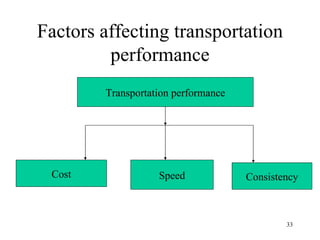
  • 11.
    Value Chain ActivitiesValue Chain Activities Primary Activities Inbound Logistics Operations Outbound Logistics Marketing & Sales Service Secondary Activities Infrastructure Human Resource Management Technology Development Procurement
  • 12.
    Primary activities representthe functional areas like arranging inputs for transforming them into output, and managing distribution, marketing, sales, and services. The secondary activities facilitate the integration of all the functions across the entire organization. The companies can achieve competitive advantage and create differentiation by organizing and performing these activities more efficiently or in a unique manner than their competitors.
  • 13.
    Factors affecting valueand productivity advantage Productivity advantage Capacity utilization Asset utilization Inventory reduction Integration with the suppliers. B. Value advantage Customized services Reliability Responsiveness.
  • 14.
    Underlying Philosophy BehindLogistics Concept Suppliers Procurement Operation Distribution Customers Materials Flow Information Flow
  • 15.
    The objective oflogistics is to link the market place, distribution network, the manufacturing process and procurement activity, so as to provide higher levels of services to the consumers yet at a lower cost. Scope of logistics management encompasses management of raw materials and other inputs through the delivery of the final product.
  • 16.
    How do wedefine logistics management? A process of satisfying customer needs through coordination of materials and information flows that extend from the market through the firm’s operation and beyond that to the suppliers. A shift to an integrated orientation from the conventional manufacturing or marketing orientation. Traditionally, manufacturing and marketing have been considered as separate activities each having different priorities.
  • 17.
    Manufacturing priorities andobjectives are concerned with achieving operating efficiencies based on long production runs, minimized set ups and changeovers, and product standardization. Marketing priorities and objectives are concerned with achieving competitive advantage based on varieties, high service levels, and frequent product changes. Customer orientation and cost competitiveness has been integrated by introducing flexible manufacturing systems, practicing inventory management policies based on manufacturing requirement planning and just-in-time inventory policy, laying sustained emphasis on quality and integrating supply side issues in strategic plans.
  • 18.
    How do wedefine supply chain? A network of organizations that are having linkages, both upstream and downstream in different processes and activities that produce and deliver value in the form of products and services in the hands of ultimate consumer. Customers Retailers Shirt Manufacturer Weavers of Fabrics Yarn/Fibre mfrers Downstream Upstream
  • 19.
    A shirt manufactureris a part of supply chain that extends upstream through the weavers of fabrics to the spinners and the manufacturers of fibres, and downstream though distributors and retailers to the final consumers. Though each of these organizations are dependent on each other yet traditionally do not closely cooperate with one another.
  • 20.
    Is Supply chainmanagement same as vertical integration? SCM is not the same as vertical integration. Vertical integration implies ownership of upstream suppliers and downstream customers. Earlier, vertical integration used to be the desirable strategy but increasingly the companies are focusing on their core business i.e. the activities that they do really well and where they have a differential advantage. Everything else is outsourced.
  • 21.
    Implementation of SCMthrough Logistics Management SCM raises the challenge of integrating and coordinating the flow of materials from multitude of suppliers, including offshore, and similarly managing the distribution of the finished product by way of multitude intermediaries. Transferring costs upstream or downstream leads to logistics myopia as all costs ultimately will make way to the final market place to be reflected in the price paid by the end user. The prime objective of SCM is to reduce or eliminate the buffers of inventory that exists between the organizations in a chain through sharing of information on demand and current stock levels.
  • 22.
    How does Logisticsdiffer from SCM? Logistics management is primarily concerned with optimizing flows within the organization. Supply chain management deals with integration of all partners in the value chain. Logistics is essentially a framework that creates a single plan for flow of products and information through a business. Supply chain builds upon this framework and seeks to achieve linkage and coordination between processes of other entities in the pipeline i.e. suppliers and customers, and organization itself.
  • 23.
    Impact of Logisticsand Customer Service on Marketing Traditionally, marketing has focused on end-customer or consumer, seeking to promote brand values and to generate a ‘demand pull’ in the market place for company’s products. Due to shift in power in marketing channels, companies are realizing to develop strong relations with such intermediaries like large retail outlets to create a customer franchise as well as consumer franchise. The impact of both strong consumer franchise and customer franchise can be enhanced or diminished by effectiveness of suppliers’ logistics system.
  • 24.
    Consumer FranchiseBrand values Corporate image Availability Customer Franchise Customer Services Partnership Quick Response Supply Chain Efficiency Flexibility Reduced Inventory Low cost supplier Marketing Effectiveness Market Share Customer Retention Superior ROI
  • 25.
    Activities Included inLogistics Logistics competency is achieved by coordinating the following functional areas. Network design Information Transportation Inventory Warehousing, material handling and packaging.
  • 26.
    Network Design Networkdesign is the prime responsibility of logistics managers since a firm’ facilities and structure is used to provide products and materials to the customers. Logistics facilities typically include manufacturing plants, warehouses, cross-dock operations, and retail stores. Determining the number and type of facility required, their geographic locations, and the work to be performed at each is an important part of network design. In certain situations, some of the facility operations may be outsourced to service specialists.
  • 27.
    Network design determinesthe type of the inventory and the quantity to be stocked at each facility, and the assigning of customer orders for shipment. Network of facilities also includes information and transportation as a part of entire structure from where logistical operations such as processing of customer orders, maintaining inventory and material handling are performed. The network design must consider geographical variations.
  • 28.
    The factors influencingmodifications of network design are: Change in demand and supply Product assortments Changes in suppliers’ source of supplies. Manufacturing requirements. The first step towards achieving competitive advantage lies in superior network design, as the real competition is not between two companies but between efficiency and effectiveness in managing their supply chain network.
  • 29.
    Information Deficiencies inthe quality of information Incorrect information with respect to trends may cause Inventory shortage Over commitment Incorrect information relating to a specific customer’s requirements leads to Processing of incorrect orders creating additional costs. Reduced sales
  • 30.
    Forecasting and ordermanagement are the two areas of logistical work that depend on information. Forecasting enables to decide on positioning of inventory to satisfy anticipated customer requirements. Order management involves handling of specific customer’s requirements, both external as well internal. External customers are those that consume the product or service, or trading partners that purchase the products or services for resale.
  • 31.
    Internal customers areorganizational units within a firm that require logistical support to perform their designated work. (c)The process of order management involves Receipt of an initial order Invoicing Delivery, and Collection. Incorrect information and delays in order processing can cripple the logistics performance; thus quality and timeliness are the key issues in logistical operations.
  • 32.
    Transportation Transportationis the operational area of logistics that geographically positions the inventory i.e. provides for place utility. Companies accomplish transportation in three different ways: A private fleet of vehicles may be operated. Contracts may be entered into with transport companies. The service of different transport companies may be engaged on an individual shipment basis.
  • 33.
    Factors affecting transportationperformance Transportation performance Cost Speed Consistency
  • 34.
    Cost of transportationThe payment for movement between two geographical locations and expenses related to administration and and maintaining in-transit inventory. B. Speed of transportation The time required to complete a specific movement. Transport firms capable of providing faster services normally charge higher rate. The faster the transportation services, shorter is the time interval during which the inventory is in transit and unvailable.
  • 35.
    C. Consistency oftransportation Refers to variations in time required to perform a specific movement over a number of shipments. Consistency is a measure of dependability of transportation. Inconsistency in transportation leads to inventory safety stocks required to protect against unpredictable service breakdowns.  Speed and consistency combine to create quality aspect of transportation.
  • 36.
    Inventory The objectiveis to achieve the desired customer service with minimum inventory commitment, consistent with lowest total cost. Excessive inventories may be helpful in compensating for deficiencies in network design but ultimately result into higher total logistics cost. The best practice of inventory management is to achieve maximum turnover while satisfying customer commitments.
  • 37.
    Warehousing, Material Handling,And Packaging Merchandise needs to be warehoused at selected times, transport vehicles material handling for efficient loading and unloading and goods are most efficiently handled when packaged together into shipping cartons or other type of containers. The logistical activities carried out in warehouse are sorting, sequencing, order selection, transport consolidation and sometimes product modification and assembly.
  • 38.
    Within the warehouse,products must be received, moved, sorted, and assembled to meet customer order requirements and for these activities material handling becomes significant. Products packed in cans, bottles or boxes are handled more efficiently when combined into larger units such as Master Cartons. Master units can further be consolidated into large units such as pallets, containers etc.
  • 39.
    Inventory Management PolicyThe following factors are required to be considered while formulating inventory management policy. Customer segmentation Product requirements Transport integration Time-based requirements Competitive performance.
  • 40.
    Customer Segmentation Theprofitability of business depends upon the products purchased by the customers, sales volumes, prices, value-added services required and supplementary activities to develop and maintain an ongoing relationship. Some customers are highly profitable and have growth potential, while others do not. Hence, highly profitable customers constitute the core market for an enterprise and inventory strategies need to be focused on meeting requirements of such core customers. Inventory priorities designed to support core customers come out of effective segmented logistics.
  • 41.
    Product Requirements ApplyingPareto’s principle, firm’s 20% of all products marketed account for more than 80% of total profits. Offer high availability and consistent delivery on more profitable products, though sometimes high –level support of less profitable items becomes necessary to provide full-line service to core customers. Not advisable to provide high service performance on less profitable products purchased by non core customers.
  • 42.
    Thus, it maybe desirable to hold slow-moving or low profit items at a central distribution warehouse whereas core customers may be served by fast, reliable air services. Orders to fringe customers may be delivered by less expensive ground transportation.
  • 43.
    Transport Integration Asound inventory management strategy would be to stock sufficient products at warehouse to be able to arrange consolidated shipments to a customer or a geographic area. The corresponding savings in transportation may more than offset the increased cost of holding the inventory.
  • 44.
    Time-Based Requirements Time-based arrangements reduce the overall inventories by developing the capability to respond rapidly to exact to exact manufacturing or retail customers. If the products/materials can be delivered quickly, it may not be necessary to maintain inventories at manufacturing plants/ retail stores. If replenishment can be achieved rapidly less safety stock will be required and instead of stockpiling and holding safety stock the requirement will be to receive the exact quantity of inventory at the time required.
  • 45.
    Time-based programmes tendto reduce shipment sizes, which in turn increases the number, frequency, cost of shipments and hence higher transportation cost. An effective logistical arrangement will be to achieve a trade-off resulting into desired customer service at the lowest total cost.
  • 46.
    Competitive Performance Soundinventory management policy is designed to gain customer service advantage or neutralize a strength that a competitor may be enjoying currently. As inventories exist across a logistical system for various reasons, the policy should be viewed from holistic cost perspective.
  • 47.
    Integrated LogisticsCustomers Physical distribution Manufacturing support Procurement Suppliers Inventory Flow Information Flow
  • 48.
    Information from andabout customers flows through the enterprise in the form of sales activity, forecasts and orders. Information is then translated into manufacturing and purchasing plans. The materials are then procured,value addition takes place along with the inventory flow ultimately resulting into transfer of ownership of finished products to the customers. The process of integration is not restricted to manufacturing companies alone, the retailing and wholesaling firms link physical distribution and purchasing since manufacturing is not required.
  • 49.
    The entire processof integration can be viewed in terms of two interrelated activities. Inventory flow, and Information flow Inventory Flow Physical distribution Manufacturing support Procurement
  • 50.
    Physical Distribution Establisheslinkage of marketing channel with its customers facilitating the movement of a finished product to the final destination of a marketing channel. Would need a proper marketing effort resulting into desired assortment being delivered when and where needed.-Outbound logistics. Fulfills objective of implementation of time and space dimension of customer service as an integral part of marketing.
  • 51.
    Manufacturing Support Concernedwith managing work-in-process inventory as it flows between the stages of manufacturing. Formulates a master production schedule that subsequently facilitates arranging for timely availability of materials, component parts, and work-in-process inventory. Is not concerned with ‘how’ production occurs but rather ‘what,’ ‘when’, ‘where’ products will be manufactured.
  • 52.
    Difference between Physicaldistribution and Manufacturing Support Physical distribution attempts to serve the desires of the customers and therefore must accommodate the uncertainties of consumer and industrial demand. Manufacturing support involves movement requirements that are under the contol of manufacturing enterprise.
  • 53.
    Procurement Concerned withpurchasing and arranging in-bound movement of materials, parts, and/or finished inventory from suppliers to manufacturing or assembly plants , warehouses, or retail stores thereby ensuring availability of materials/ assortments where and when needed. -Inbound logistics. In a given marketing situation, manufacturers’ physical distribution is same as retailers’ procurement operations.
  • 54.
    Information Flow A.Planning & Coordination Flows Nature & Location of customers Required products & services matching to needs of customers. Limitations or bottlenecks within manufacturing capabilities thus helping to decide outsourcing requirements. Requirements of logistical facilities based upon forecasting. MPS and MRP to support manufacturing /procurement requirements.
  • 55.
    B. Operational FlowOrder management and processing Procurement Inventory management Transportation and shipping  Advantages of effective operational flows Allocates and assigns inventory/ assortments to customers according to predetermined priorities. - Use of information technology in deploying inventory to ensure effective performance of logistical system. Consolidating orders to achieve freight economies and making correct documentation. Facilitate purchase order preparation, amendments and release to ensure overall supplier compliance.
  • 56.
    Logistical Performance CyclesThe logistical integration through performance cycles provides interface and link the suppliers, the firm and its customers by means of communication and transportation. Performance Cycle Transaction creating activities Physical fulfillment activities Advertising & Selling Physical distribution
  • 57.
    Physical distribution performancecycle Customer order Order transmission Order processing Order selection Order transportation Order delivery to the customer
  • 58.
    Significance of physicaldistribution performance cycle As it links a firm with its customers, it helps create marketing and manufacturing initiatives into an integrated efforts. It resolves conflicting interface between marketing & manufacturing. As marketing is dedicated to delighting customers, it would like to maintain broad product line with high inventory regardless of each product’s profit potential. By doing so, any customer's requirement, no matter how small or large would be satisfied.
  • 59.
    Traditional mindset inmanufacturing is to control cost, which is achieved by long production runs. Continuous manufacturing processes maintain economies of scale and reduce per unit cost. Therefore, a narrow line of products is mass produced. Inventories are kept to resolve the inherent conflict between these two philosophies. The above is achieved by forward deployment of inventory throughout the logistical system in anticipation of future sales on the basis of forecasted information.
  • 60.
    How to reducephysical distribution operational variance Improve accuracy of forecast Improve order management and coordination with the customers. Have responsive and flexible cycle.
  • 61.
    Manufacture Support PerformanceCycle It provides production logistics being positioned between the physical distribution and procurement operations of a firm. Movement and storage of product, materials, and semi-finished parts and components between enterprise facilities represent the responsibility of manufacturing support logistics. In context of wholesale & retail trade, it implies selection of assortment of inventory to be moved to the next level of value chain. Basically, supports what, where and when of the production and not how.
  • 62.
    Features of manufacturingsupport performance cycle. Initiates provision of materials and externally manufactured components at a place and time needed. Operations are restricted to dock-to-dock movement within the firm and where intermediate storage is required. After completion of manufacturing cycle the finished goods inventory is allocated and deployed either directly to the customers or to distribution warehouses for further customer shipment.
  • 63.
    Procurement Performance CyclesSourcing Order placement and Expediting S U P P L I E R S Transportation Receiving
  • 64.
    The procurement operationsare identified as inbound logistics. International procurement often requires large shipments necessitating the use of barges, ocean going vessels, trains and multiple truckloads for transportation. The lower value of materials and components as compared to finished product implies greater trade-off between higher cost of maintaining inventory in transit and the use of low cost modes of transport. As the cost of maintaining inventory in the pipeline is less per day than the cost of maintaining finished inventory, there is no benefit for paying higher freight rates for faster inbound transport.
  • 65.
    Procurement performance cyclesare invariably longer excepting in those cases where the value of material or component may justify paying higher freight rates for faster inbound transport. A critical issue in procurement is uncertainty in respect of price change, and/or supply discontinuity.
  • 66.
    Reducing performance cycleuncertainties Use of electronic data interchange Monitoring daily changes in workloads Human resource availability Availability of specialized unloading and loading handling equipments Establishing safety stock/ buffer inventory to cover variances so as to avoid delays.
  • 67.
    A few termsused in Inventory Management Buffer stock= {Average lead time}x{Average usage rate}. Safety stock= Average usage during the extension of lead time. Reserve stock= Excess usage requirement during the average lead time. Re-order level= B.S.+ S.S.+ R.S. Minimum Inventory Level= S.S.+R.S. Max. Inventory Level= {Minimum Level} + {Order quantity}
  • 68.
    Average Inventory Level=(Min. level+Max.level)/ 2 In case of periodic review the buffer stock will be modified to {Average consumption rate}x{Average lead time+Review period}
  • 69.
    Inventory Planning Ideally,if the forecast is done accurately, there will not be any need for an inventory. Most warehousing would vanish, product would move with less handling requirements from warehouses to customers. However, in real life situations, the thrust is on reducing inventory and maintain proper customer service and optimal inventory levels.
  • 70.
    Inventory decisions-High risk& high cost Without the proper inventory assortment, marketing may find that sales are lost and customer satisfaction declining. Overstocks increase cost and reduce profitability through added warehousing, working capital requirements, deterioration, insurance, and obsolescence. As the significance percentage of assets are inventory related, a reduction of firm’s inventory by a few percentage points can lead to dramatic improvement in profits. ROI= (Profit/ Fixed assets +Current assets)
  • 71.
    Substantial improvement inthe productivity of inventory can be achieved by re-engineering supply chain processes. Poor inventory management may lead to stock outs and hence cancellation of customers orders, overstocking leading to insufficient storage space and increase in the number and rupee value of obsolete products. Consequently, inventory management has a large financial impact on the firm. Investments blocked in inventory cannot be used to obtain other goods or assets that could improve the enterprise performance.
  • 72.
    Types of InventoryBroadly there are three types of inventory Manufacturing inventory Wholesale inventory Retail inventory Manufacturing inventory Manufacturer’s inventory commitment starts with raw material and component parts, including work-in-process, and ends with finished goods. Manufacturer needs to transfer the finished goods inventory to warehouses in closer proximity to wholesalers and retailers. Manufacturer’s inventory commitment is relatively deep and has long duration.
  • 73.
    (b) Wholesale inventoryWholesaler purchases large quantities from manufacturers and sells small quantities to retailers in order to provide retail customers with assorted merchandise from different manufacturers in smaller quantities. Thus wholesaler risk exposure is narrower but deeper and of longer duration than that of retailers. In case of seasonal goods, the wholesaler is forced to commit inventory, far in advance of selling, thus increasing the depth and duration of risk. The current trend of expansion of product lines has increased the width of inventory risk.
  • 74.
    (c) Retail inventoryRetailer inventory risk is wide but not deep. The emphasis is more on inventory velocity. Inventory velocity is measured by inventory turnover. The risk is undertaken on variety of products but for a given product the risk is not deep relatively. The exception is specialty retailer where the depth and duration will be longer as they handle narrower lines. For instance, retailers’ risk is spread across more than 10,000 SKUs, a general merchandise and food store may carry around 25,000 SKUs and a full line department store may have as many as 50,000 SKUs.
  • 75.
    Functions underlying inventorycommitments Geographical Specialization It allows for geographical specialization for individual operating units. The need for geographical specialization arises because various factors of production viz. power, materials, water, labour, manufacturing facilities are located at a considerable distance from the major markets. For instance, tyres, batteries, transmission equipments and springs for an automobile assembly. The production facilities for each of the these are traditionally located near the source of materials to minimize transportation cost.
  • 76.
    - This strategyleads to specialization of manufacturing each automobile component and hence economically. - This will also involve internal inventory transfer to completely integrate various components into final assembly. - Thus, manufactured goods from various locations are collected at a single warehouse and then combined as a consolidated/ assorted shipment. - P&G uses distribution centres to combine products from its laundry, food, and healthcare divisions to offer the customer a single integrated shipment. Economies gained through geographical specialization invariably offset increased inventory and transportation cost.
  • 77.
    B. Decoupling Providesfor increasing operating efficiency within a single manufacturing facility by stockpiling work-in-process inventory between production operations. Decoupling enables manufacturing and distribution of economic lot sizes in anticipation of sales thus ensuring large sized shipments with minimum freight cost. Decoupling permits products manufactured over a period of time to be sold as an assortment. Decoupling increases the operating efficiency at a single location while geographical specialization includes multiple locations. However, JIT,DRP etc have reduced the economic benefits of decoupling considerably.
  • 78.
    C. Balancing Supplyand Demand Balancing is concerned with elapsed time between consumption and manufacturing as balancing inventory reconciles supply availability with demand. Particularly useful in linking variations of consumption with manufacturing in case of seasonal products. Balancing seasonal production and year round consumption such as orange juice or year round production and seasonal consumption of blankets or knitting wool. In case of sort selling season, manufacturers, wholesalers and retailers are forced to take an inventory position far in advance of peak selling season.
  • 79.
    From retailers’ perspective,an inventory position is planned six months prior to the peak selling period. The main function of balancing supply and demand is to ensure that investment in stocks is liquidated completely within the season. Buffer Uncertainties Safety stock protects against two types of uncertainties: (a) Demand in excess of forecast during the performance cycle. For instance, customers’ request of more or less units than planned. Delays in the performance-cycle length itself. For instance, delay in order receipt, order processing, or transportation.
  • 80.
    Inventory Management StrategyCompanies can postpone positioning of inventory by maintaining stock at the plants or they may decide to place more products in local distribution centres to have it closer to the market. Manage inventory at each distribution centre independently. Consider inventory interdependence across distribution sites by managing inventory centrally. Ensure more coordination and communication in case of centralized inventory management.
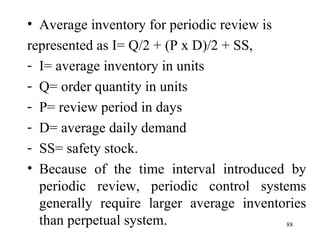
  • 81.
    Inventory Cost ConsiderationOrigin purchase consideration Transportation cost. Origin purchase means the buyer is responsible for freight cost and product risk when the product is in transit. Depending on the delivery terms, the buyer assumes full risk on inventory at the time of shipment. Depending on the payment terms, transit inventory would be a part of enterprise's average inventory and therefore subject to an appropriate charge. Transportation cost must be added to purchase price to obtain an accurate assessment of the value of goods tied up in inventory.
  • 82.
    After the inventoryis received, the amount invested in the product must be increased by transportation expenses. Thus, inventory carrying cost should be assessed on the combined cost of the product plus transportation.
  • 83.
    Inventory Control ProceduresPerpetual Review Periodic Review
  • 84.
    Perpetual Review Inventorystatus is reviewed to determine replenishment needs. Implemented through a reorder point and order quantity.  ROP= D x T + SS, where ROP= reorder point in units D= average daily demand in units T= average performance-cycle length in days SS=safety or buffer stock in units.
  • 85.
    The following areconsidered in perpetual review: On hand inventory represents quantity that is physically present in the particular distribution facility. On-order inventory represents quantities that have been ordered from suppliers. If on-hand plus on-order quantity is less than or equal to the established reorder point, inventory control process will initiate another replenishment order.
  • 86.
    Mathematically, this canbe stated as If I+q  ROP then order Q, where I= inventory on hand q= inventory on order from suppliers ROP = re-order point in units Q= order quantity in units. Average inventory level for a perpetual review system is calculated as I = Q/2 + SS, where I= average inventory in units Q= order quantity in units, and SS= safety stock in units The assumption is that P.O. will be placed when the reorder point is reached and there is a continuous monitoring of inventory system.
  • 87.
    Periodic Review Theinventory status is reviewed at regular intervals such as weekly or monthly. The re-order point is adjusted to consider the extended intervals between reviews. The formula for calculating the periodic review reorder point is  ROP= D( T + P/2) +SS, where ROP= re-order point D=average daily demand T= average performance cycle length P=review period in days SS= safety stock
  • 88.
    Average inventory forperiodic review is represented as I= Q/2 + (P x D)/2 + SS, I= average inventory in units Q= order quantity in units P= review period in days D= average daily demand SS= safety stock. Because of the time interval introduced by periodic review, periodic control systems generally require larger average inventories than perpetual system.
  • 89.
    Inventory Planning MethodsFair Share allocation Distribution Requirement Planning
  • 90.
    Fair Share AllocationPlant Warehouse Inventory- 600 units Distribution Centre-1 Distribution Centre-2 Distribution Centre-3 Inventory= 50 units Daily use= 10 units Inventory= 100 units Daily use= 50 units Inventory= 75 units Daily use= 15 units
  • 91.
    Fair share allocationprovides each distribution facility with an equitable or fair share of available inventory from a common source such as a plant warehouse. Assuming that from a total inventory units of 600 it is desirable to retain 100 units at plant warehouse; 500 units are available for allocation. First we need to determine the number of days’ supply.
  • 92.
     DS =(A +  I j ) /  D j , where DS= no. of days supply for distribution centre inventories. A= inventory units to be allocated from the warehouse I j = inventory in units for distribution centre j. D j = daily demand for distribution centre j  In the above example, DS = {500 + ( 50+100+75)} / (10+50+ 15) DS= {500 + 225} /75 =725/75 = 9.67 days
  • 93.
    Thus, fair shareallocation means that each distribution centre should be brought up to 9.67 days stock. The amount to be allocated to each distribution centre is determined as under:  A j = (DS – I j /D j ) x D j , where A j = amount allocated to distribution centre j DS= number of days supply that each distribution centre is brought upto. I j = inventory in units for distribution centre j D j = daily demand for distribution centre j Thus, the amount allocated to distribution centre 1 will be  A 1 = (9.67- 50/10) x 10 = (9.67- 5) x 10= 4.67x 10= 46.7 or 47 units.
  • 94.
     A 2= (9.67-100/50)x50=(9.67-2.00)x50=383.5 or 384.00  A 3 = (9.67-75/15)x15=(9.67-5.00)x15=70 units. However, does not consider site specific factors. Difference in performance cycle. Economic order quantity. Safety stock requirements.
  • 95.
    Distribution Requirement PlanningLogical extension of manufacturing requirement planning (MRP). Operates in an independent environment where uncertain customer demand determines inventory requirements. Requires forecast for each distribution centre and SKU as well as adequate lead-time to allow product movement. Errors may creep in because of prediction of demand at wrong location or at wrong time. Requires consistent and reliable performance cycles for movement between distribution facilities.
  • 96.
    Plant Warehouse Regionalwarehouse Regional warehouse Distribution centre Distribution centre Distribution centre Distribution centre Distrib ution centre Distribution centre C U S T O M E R S
  • 97.
    Raw Materials WarehousePart A Part B Sub-assembly A Part C Part D Part E Sub assembly B Sub assembly C Final Assembly (Manufacturing) Plant Warehouse
  • 98.
    DRP/MRP system integratesfinished goods, work-in-process, and materials planning. DRP provides a schedule for each SKU and each distribution facility. For each planning period, the schedule will report the following: Gross requirements reflecting demand from customers being catered to by different distribution facilities. Scheduled receipts i.e.replenishment shipments planned for arrival at the distribution centre. Anticipated week ending total deliveries. Projected on-hand inventory i.e. prior week’s on-hand inventory- current week’s gross requirement + scheduled receipts.
  • 99.
    Benefits of DRPImproved service levels by increasing on –time deliveries and decreasing customer complaints. Better planning of new product launches. Improved ability to anticipate shortages so that marketing efforts are not expended on products with low stock. Reduced distribution centre freight costs resulting from coordinated shipments. Improved inventory visibility and coordination between logistics and manufacturing. Reduced warehousing space requirements because of inventory reductions.
  • 100.
    Demand Forecasting Forecastingprocess comprises of two elements Nature of demand, and Forecast components Nature of Demand Dependent demand Independent demand
  • 101.
    Dependent versus IndependentDemand Vertical dependent is characterized by sequence of purchasing and manufacturing, such as number of tyres used for assembly of automobiles. Horizontal dependent occurs in a situation where an attachment, promotion item or operator’s manual is included with each item shipped. The demanded item may not be required to complete the manufacturing process but may be needed to complete the marketing process.
  • 102.
    (b) Once manufacturingplan for base item is determined , requirements of components/ attachments can be calculated directly and no separate forecasting is done. Independent demands are ones that are not related to the demand for another item. For instance, demand for refrigerator is not related to the demand for milk. Independent demand items are forecasted individually.
  • 103.
    Forecast Components Basedemand Seasonal factors Trends Cyclic factors Promotions Irregular quantities. Mathematically forecast is expressed as  F t+1 = (B t x S t x T t x C t x P t ) + I, where F t+1 = forecast quantity for period t+1
  • 104.
    B t =base level sales demand (average sales level) for period t+1 S t = seasonal factor for period t T= trend component (quantity increase or decrease per time period) C t = cyclic factor for period t P t = promotional factor for period t I= irregular or random quantity. All forecasts may not include all components. A. Base demand is based on average demand over an extended period of time. There is no seasonality, trend, cyclic or promotional component.
  • 105.
    B. Seasonal componentis characterized by upward and downward movement in demand pattern, usually on annual basis e.g. emand for woollen blankets is at peak during winter months and lowest during summer. Seasonality at wholesale level precedes consumer demand by approximately one quarter. An individual seasonality factor of 1.2 indicates that sales are projected at 20% higher than an average period. C. Trend Component exhibits long range movement in sales over an extended period of time. (a) Trend may change number of times over the entire product life cycle.
  • 106.
    (b) For instance,a reduction in birth rate implies reduction in demand of disposal diapers. (c) Trend component influences base demand as B t+1 = B t x T, where B t+1 = base demand in period t+1 B t = base demand in period t, and T= periodic trend index. D. Cyclic component are known as business cycles. Economies swing from recession to expansion every three to five years.
  • 107.
    E.Promotions are initiatedby the firm’s marketing activities such as advertising, and various other schemes. Sales increase during promotion as the consumers take advantage of promotional schemes thus leding to liquidation of inventories. Promotion can either be the deals offered to the consumers or deals offered to the trade (wholesalers/ retailers). Promotions if offered on regular basis at the same time every year will resemble a seasonal component. F. Irregular components include random or unpredictable quantities that do not fit into any other category hence are impossible to predict. (a) By tracking and predicting other components the magnitude of random component can be minimized.
  • 108.
    Forecast Approaches A.Top-Down Approach Plant Distribution Centre Field Distribution Centre# 1 Forecast 4000 units Field Distribution Centre#2 Forecast 3000 units Field Distribution Centre#3 Forecast 2000 units Field Distribution Centre#4 Forecast 1000 units
  • 109.
    Assume the firmhas an aggregate monthly forecast for the entire country as 10,000 units and it use four distribution centres to service the demand with a historical split of 40, 30, 20, and 10 per cent respectively. Forecasts for individual distribution centres will be projected to be 4,000, 3000, 2,000 and 1,000 respectively. In top-down approach a national level SKU forecast is developed and then the forecasted volume is spread across locations on the basis of historical sales pattern.
  • 110.
    B. Bottom-up ApproachDecentralized approach since each distribution centre forecast is developed independently. Results into more accurate forecast as it tracks and considers demand fluctuations within specific markets. Requires more detailed record keeping and is more difficult to incorporate demand factors such as impact of promotion.  Trade-off the detail tracking of bottom-up approach with data manipulation ease of top-down approach.
  • 111.
    Components of ForecastingProcess Orders History Tactics Forecast database Forecast Administration Forecast Technique Forecast Support System Forecast Process Forecast Users Finance Marketing Sales Production Logistics
  • 112.
    Forecast data basekeeps information about Orders Order history Tactics used to obtain orders such as promotions, schemes, special promotional programmes. State of economy and competitive actions. B. Forecast process integrates forecast techniques, support system and administration. Two prominently used forecasting techniques are time series and correlation modelling. Forecast support system is the capability to gather and analyze data, evaluate impact of promotion, develop forecast and communicate to the relevant personnel.
  • 113.
    Issues addressed byForecast Administration Who is responsible for developing the forecast? How is forecast accuracy and performance measured? How does forecast performance affect job performance, evaluation and rewards? Do the forecast analysts understand the impact of forecasting on logistics operations? Do they understand the differences in various forecasting techniques?
  • 114.
    Transportation Transportation decisionsare more strategic ones closely linked with inventory decisions. Decisions are based on trade-off between the cost of using a particular mode of transport with the cost of inventory associated with that mode. For instance, air shipments may be fast, reliable , and warrant less safety stocks; they are expensive whereas shipping by sea or rail may be much cheaper but they necessitate holding relatively large amount of inventory to protect against the inherent uncertainty associated with them.
  • 115.
    Customer service levelsand geographic locations are important aspects in transportation decisions. Transportation accounts for roughly 30% of the logistics costs and therefore operating efficiencies become important aspects . Shipment sizes i.e. consolidated bulk shipments versus smaller lot sizes; routing and scheduling of vehicles become important part of company’s transport strategy. Transportation is one of the most visible elements in the logistics operation.
  • 116.
    Transportation Functionality ProductMovement Product Storage
  • 117.
    A. Product MovementPrimary function is the movement up and down the value chain. As transportation uses temporal, financial and environmental resources, the movement of materials should take place only when it enhances the product value. Uses temporal resources because the product is inaccessible while in transit. Due to JIT strategies transit inventories are becoming more significant thereby reducing manufacturing and distribution centre inventories. (b) Expenses incurred internally for private fleet of vehicles or externally for commercial or public transportation constitute financial resources.
  • 118.
    (c) Transportation consumesfuel and oil and also creates environmental expenses through congestion, air pollution and noise pollution. Objectives of Transportation Move product from original location to prescribed destination while minimizing temporal, financial and environmental Costs. Minimize expenses incurred due to loss and damage. Meet customer demand regarding delivery and shipment information availability
  • 119.
    B. Product StorageTemporary storage through vehicles becomes expensive as in-transit storage is required to be moved again in a short duration of time. Sometimes temporary storage becomes advantageous as the cost of unloading and reloading the product in a warehouse may exceed the daily charge of storage in transportation vehicles. Many times where the warehouse space is limited, utilizing transportation vehicles becomes a viable option.
  • 120.
    The options availableto a transporter in case of warehouse space constraints are Instruct driver to take a circuitous or indirect route to its destination, as the transit time would be greater as compared to direct route. Thus transport vehicle is used as temporary storage option. Change the shipment destination i.e. temporary storage is achieved through diversion. For instance, product that is, say, scheduled initially from Mumbai to Hyderabad gets diverted mid way to Vishakapatnam (Vizag) as Vizag warehouse may be in greater need of product and has the storage capacity.
  • 121.
    Traditionally, the telephonewas used to direct diversion but nowadays satellite communications between headquarters and vehicle handle such tasks more efficiently. Though product storage in vehicles can be costly, it can be justified from a total cost perspective when loading, unloading costs,or capacity constraints are considered.
  • 122.
    Principles of TransportationEconomies of Scale Economies of Distance
  • 123.
    A. Economies ofScale Transportation cost per unit of weight decreases when the size of the shipment increases i.e. shipments that utilize the entire vehicle’s capacity like truck load (TL) cost less per kg than less than truck load (LTL) shipments. Fixed costs in transportation include administrative costs of taking transportation order, time to position the vehicle for loading or unloading, invoicing and equipment cost. It costs as much to administer a shipment of 1 kg as it does to administer a 1000 kg shipment.
  • 124.
    B. Economies ofDistance Transportation cost per unit of distance increases at a decreasing rate as distance increases. Also called “Tapering Principle” For instance, a shipment covering a distance of 800 kilometers will cost less than two shipments of same combined weight covering 400 kms. Fixed expenses incurred to load and unload the vehicle get spread over more kilometers resulting in lower overall per kilometer charges.
  • 125.
  • 126.
    Participants in Transportationdecisions Government Shipper Carrier Consignee Public
  • 127.
    Role and Perspectiveof each party Shippers and Consignees’ Expectations Move the goods from origin to destination within a prescribed time at the lowest cost. Specified pick up and delivery times, predictable transit time, zero loss and damage, accurate and timely exchange of information and invoicing.
  • 128.
    B. The GovernmentRole Stable and efficient transportation environment to sustain economic growth. Product availability throughout the country at a reasonable cost. Providing right-of-way such as road or railways or air traffic control system. C. The Public concerns Accessibility, cost effectiveness and protection of environmental and safety standards. Development of transport infrastructure to have goods from global sources.
  • 129.
    Features of DifferentModes of Transportation Modes of Transportation Rail Highway Water Pipeline Air
  • 130.
    Rail Capability totransport large shipments economically with more frequency. High fixed costs because of expensive equipment, right of way, switching yards, and terminals. Variable cost per kg/km has been consierably reduced by electrification. Bulk industries and heavy manufacturing use railways more frequently. Can improve effectiveness of transportation by having alliances with other modes.
  • 131.
    B. Highway Growthof motor carrier industry has resulted into door-to-door operating flexibility and speed of inter-city movement. Compared to railways, motor carriers have relatively small fixed investments in terminal facilities and operate on publicly maintained highways. Variable cost per kilometer is high because a separate driver and cleaner are required for each vehicle. Labour cost is also high because of the need for substantial dock labour.
  • 132.
    Cost Structure inrespect of Motor Transport Fixed costs such as overheads and vehicle cost are low relative to railway Variable costs such as driver, fuel, tyres and repairs are high relative To railways.
  • 133.
    Motor carriers arebest suited to handle small shipments moving short distances. Favour light manufacturing and distributive traders, short distances and high value products. Have captured significant market share of railways in medium and light manufacturing industries. Because of delivery flexibility, motor transport has captured almost all freight moving from wholesalers or warehouses to retail stores. Higher cost in replacing equipment, higher wages to driver and other dock labour.
  • 134.
    C. Water Capacityto move extremely large shipments. Fixed costs are somewhere between rail and motor carriers. Though water carriers have to develop and operate their own terminals, the right-of-way is developed and maintained by the government, resulting into moderate fixed costs compared to rail and highways. Low variable cost makes this an attractive mode when low freight rates are desired and speed is secondary consideration. Typically bulk commodities such as mining , chemicals, cement, and certain selected agricultural products are transported by ocean going vessel.
  • 135.
    Unless the pointof origin and point of destination are adjacent to a waterway, it needs to be supplemented by rail or trucks. D. Pipelines Used for transporting natural gas, manufactured chemicals, pulverized dry bulk materials such as cement and flour via hydraulic suspensions, sewage and water within the cities and municipalities. Operate on 24x7 basis are limited only by commodity changeover and maintenance. No empty container or vehicle that must be returned. Highest fixed cost an lowest variable cost. High fixed costs due to right-of-way, construction and requirements for control station and pumping capacity.
  • 136.
    As pipelines arenot labour intensive, variable operating cost is extremely low once the pipeline is constructed. Inflexible and limited to products in the form of gas, liquid or slurry. E. Air Significant advantage lies in the speed with which a shipment can be transported. Though the freight cost is very high, the same may be trade-off with reduced warehousing or inventory. Characterized by load size constraints and aircraft availability. Fixed cost associated with aircraft purchase and requirements for specialized handling systems is low as compared to rail, water and pipeline.
  • 137.
    Airways and airportsare generally developed and maintained with public funds. Airfreight variable cost is extremely high as a result of fuel,maintenance and intensity of in-flight and ground crew. Airfreight is justified in following situations: High value products Perishables Limited marketing period. Emergency.
  • 138.
    Nature of Trafficversus Mode of Transportation Mode Nature of Traffic Rail Extracting industries, heavy manufacturing, agricultural commodities Highway Medium and light manufacturing, distribution between wholesalers and retailers. Water Mining and basic bulk commodities, chemicals, cement, agro-based products. Pipeline Petroleum, gases, slurry. Air Emergency, perishables, limited marketing period, high value premium products.
  • 139.
    Cost Structure forEach Mode of Transportation Mode Fixed Cost Variable Cost Rail High- equipment terminals, tracks etc. Low Highway Low-highways provided by public funds Medium- fuel, maintenance. Water Medium- ships and equipment Low-capability to transport large amount of tonnage. Pipeline Highest-rights-of-way, construction, control stations, pumping capacity. Lowest-no labour cost of any significance. Air Low-aircraft and cargo handling system. High-fuel, labour and maintenance .
  • 140.
    Transport Economies DistanceVolume Density Stow ability Handling Liability Market factors
  • 141.
    Distance Cost curveincreases at a decreasing rate as a function of distance and is known as tapering principle. Cost curve does not begin at the origin because of the fixed costs associated with shipment pick up and delivery regardless of distance. Tapering effect comes into existence, as the longer movements tend to have a higher percentage of inter-city rather than urban kilometers. Frequent intermediate stops, typical of urban kilometers, and additional loading and unloading add to the costs. Inter-city miles are less expensive since more distance is covered with same fuel as a result of higher speed.
  • 142.
    B. Volume Transportcost per unit of weight decreases as load volume increases. Fixed costs of pick up and delivery as well as administrative costs get spread over additional volumes. Smaller loads must be consolidated into larger loads. C. Density Transportation cost per unit declines as product density increases. In terms of weight and space, an individual vehicle is constrained more by space than by weight. Once is the vehicle is full, it is not possible to increase the amount carried even if the product is lightweight.
  • 143.
    Higher density productsallow fixed costs to be spread across additional weight, as a result the products are assessed at a lower transport cost per unit. Attempts are made to increase product density so that more can be loaded in a vehicle to utilize its capacity. D. Stow ability Refers to product dimensions and impact of the same on vehicle utilization. Odd sizes and shapes as well as excessive weights and lengths do not stow well and typically waste space. Though density and stow ability are similar, products may have same density that stow differently.
  • 144.
    Items with regularshapes are easier to stow than odd shaped items. While the steel blocks and rods have the same density, rods are more difficult to stow because of their length and shape. E. Handling Special handling equipments may be required for loading or unloading trucks, trains, or ships and the unitization/ palletization affects the handling cost. F. Liability - Product characteristics such as susceptibility to damage, perishability, susceptibility to to theft, susceptibility to explosion affect the risks and hence claims.
  • 145.
    G. Market factorsBack-haul i.e. vehicle returning back to the point of origin with load. Dead head to be avoided because empty returns incur labour, fuel, and maintenance costs. Thus design of logistics system must add back-haul movement wherever possible.
  • 146.
    Multimodal Transport SystemMultimodal or Intermodal transport refers to journeys that involve two or more different modes of transport. For instance, if materials are moved from Lanchow in central China to Warsaw in Poland goods may be loaded on to trucks, transferring them onto rails for a journey across China to Shanghai, then ship to Rotterdam, back into rails to cross Europe, then truck for local delivery.
  • 147.
    For Logistics managersintermodal services become necessary because of their characteristics and costs. For example, limited accessibility of air transport requires coordination with a land carrier to make the pick ups and deliveries. Similarly, inaccessibility applies to rail, water and pipeline but not to the motor which has a definite advantage here. The intermodal services maximizes the primary advantages inherent in the combined modes and minimize their disadvantages. The combined services will have both good and bad aspects of the utilized modes.
  • 148.
    For instance, coordinateof rail and water will have a lower total cost than an all-rail movement but higher cost than that of all-water. Likewise, combined system transit time will be lower than all water movement but higher than all-rail. The decision to use multi-modal system must consider the effect on total logistics costs. The aim of intermodal transport is to combine the benefits of several separate modes but avoid the disadvantages of each, like, combining the low cost of shipping with flexibility of the road, or getting the speed of air with the cost of road.
  • 149.
    However, each transferbetween modes causes delays and adds costs of extra handling. Intermodal transport works well when transfer can be done efficiently. Transfer of motor carrier trailer to another transport mode is facilitated through containerization.
  • 150.
    Choice of ModeFactors influencing the choice of mode are as under: Bulkiness of the materials; heavy items would be shipped by ocean going vessels. Value of materials; expensive items raise inventory costs and thus encourage faster modes. Criticality of materials; even low unit value items that hold up the operations need fast and reliable transport. Susceptibility to market changes; operations that respond quickly to changes cannot wait for critical supplies using slower transport. Reliability with consistent delivery is important.
  • 151.
    Cost and flexibilityto negotiate rates. Reputation and stability of carrier. Susceptibility to loss, theft and pilferage Schedule and frequency of delivery. Special facilities available Limitations of Multimodal system Sometimes carriers are reluctant to participate. Willingness to coordinate in respect of moving the product is higher when any one carrier is incapable to transport in its entirety.
  • 152.
    Containerization Container islarge rectangular box into which a firm places commodities to be shipped. After initial loading, the commodities themselves are not rehandled until they are unloaded at their final destinations. Throughout the movement, the carrier handles the container, not the commodities. The shipper can transfer the container from one mode to another, eliminating the need to handle the commodities each time thus reducing handling costs, damage costs, theft, pilferage and the time required to complete the modal transfer.
  • 153.
    Many firms thatmodify their material handling systems to include cranes, forklift trucks, and other equipment capable of handling large, heavy containers have found containerization to be desirable avenues for increasing productivity and controlling material handling costs, especially in periods of continually increasing labour costs. As the objective of intermodal transport system is to provide virtually seamless journey, the best way to achieve same is to use modular or unitized loads.
  • 154.
    Piggyback –Trailer onFlat Car TOFC is a specialized form of containerization in which rail and motor transport coordinate. Carrier places motor carrier trailer on a rail flatcar, which moves the trailer by rail for long distance. A motor carrier then moves the trailer for short distance pickups and deliveries. This service combines the long-haul, low cost advantage of rail with accessibility of motor. Piggyback services mostly move under contract.
  • 155.
    Material Handling Theprimary material handling objective is to efficiently move large quantities of inventory into and specific customers orders out of the warehouse. The functions performed in a warehouse are classified as movement or Handling and storage. Movement or handling is emphasized and storage is secondary. Handling is divided into Receiving In storage handling , and Shipping
  • 156.
    An extremely importantaspect of logistics is the productivity potential that can be realized from capital investment in material-handling equipment. Specialized handling equipment is required for unloading bulk materials such as for solids, fluids, or gaseous materials. The guidelines suggested in designing the material handling systems are: Equipment for handling and storage should be as standardized as possible. When in motion, the system should provide maximum continuous flow. Investment should be made in handling rather than stationery equipment.
  • 157.
    (d) Handling equipmentshould be utilized to the maximum extent possible. (e) In selecting handling equipment, the ratio of deadweight to payload should be minimized. (f) Whenever possible, gravity flow should be incorporated in the system design. The handling systems can be classified as under: Mechanized Semi automated Automated, and Information directed.
  • 158.
    Mechanized Systems ForkliftTrucks Forklift trucks can move loads of master cartons both horizontally and vertically. A pallet or slip sheet forms a platform upon which master cartons are stacked. A slip sheet is a thin sheet of solid fibre or corrugated paper and are used for situations when product is handled only a few times. A forklift truck normally transports a maximum of two unit loads i.e. two pallets at a time
  • 159.
    High stacking trucksare capable of up to 40 feet of vertical movement. Even trucks capable of operating in aisles as narrow as 56 inches ar also found in warehouses. The significance of narrow-aisle forklift trucks has increased as warehouses seek to increase rack storage density and overall storage capacity. Forklift trucks are not economical for long distance horizontal movements because of high ratio of labour per unit of transfer. Most effectively utilized in shipping and receiving and placing merchandise in a predetermined storage space. Common sources of power are propane gas and electricity.
  • 160.
    Many forklift operationsare utilizing radio frequency data communication to speed up load put away and retrieval assignments. Under the above system, workers receive their assignments through either handheld or vehicle –mounted RF terminals. RF technology provides real-time communication capability to central data processing systems, and when combined with bar code scanning of cartons and pallets,it allows fork lift operators to receive and update item status inquiry, material orders and movement and inventory adjustments.
  • 161.
    B. Walkie-Rider PalletTrucks Low cost, effective method of material handling. Highly versatile low-lift pallet and/or skid handlers with load capabilities from 3,000 to 8,000 lbs. Typical applications include loading and unloading, order selection and shuttling over longer distances throughout the warehouse. Popular in grocery warehouses. Electricity is the power source.
  • 162.
    C. Towlines Eitherin-floor or overhead mounted drag devices. The major advantage is the continuous movement but lacks flexibility of forklift trucks. Most common application is for order selection within the warehouse. Order selectors place merchandise on a four wheel trailer, which is then towed to the shipping dock. D. Conveyors Conveyors are classified according to power, gravity or roller/belt movement. Portable gravity style roller conveyors are often used for loading and unloading. In some cases these are transported on the over-the-road trailers to assist in unloading at the destination.
  • 163.
    Semi automated HandlingSemi automated system supplements a mechanized system by automating a specific handling requirements. Semi automated warehouse is a mixture of mechanized and automated handling. Automated-Guided Vehicle Systems Performs similar kind of handling function as a mechanized tow tractor with a trailer. The essential difference is that an AGVS does not require an operator and is automatically routed and positioned at destination with intervention of the operator.
  • 164.
    Typical AGVS equipmentrelies on an optical or magnetic guidance system. In the optical application, tape is placed on the warehouse floor, and the equipment is guide by a light beam that focuses on the guide path. A magnetic AGVS follows an energized wire installed in the floor. The primary advantage is the elimination of a driver and newer AGVS use video and information technology to follow paths without the need for fixed tracks.
  • 165.
    B. Sortations Typicallyused in combination with conveyors. The products are selected in the warehouse, they are sorted as per specific specific shipment docks and taken onto the conveyors for moving out. Master cartons have a distinguishing code, these are read by optical scanning devices and automatically routed to the desired locations. The rate of flow is customized to meet changing requirements. The benefits are Reduction in labour, and Increase in speed and accuracy.
  • 166.
    C. Robotics Humanlikemachine that can be programmed by microprocessors to perform various activities. Robots are use in warehouses to break down and build unit loads to accommodate exact merchandise requirements of a customer’s orders. In break down process, the robot is programmed to recognize stocking pattern and place products in the desired position on a conveyor belt. Similarly, robots are used to build unit loads.
  • 167.
    Robots are usedeffectively in warehouses where prevailing environments make it difficult for humans to work such as high noise areas and extreme temperatures like cold storage freezers. The capability to incorporate artificial intelligence in addition to speed, dependability, and accuracy makes robotics an attractive alternative to traditional manual handling systems.
  • 168.
    Automated Handling Substitutescapital investment in equipment for labour required in mechanized handling systems. Though operates faster and more accurately, requires high degree of capital investment and complex to operate. Most automated systems are custom deigned and constructed for each application. Automated handling concentrates on order selection system at the master carton level as well as on high rise storage and retrieval system.
  • 169.
    Order Selection SystemThe handling of fast moving products in master cartons is fully automated from the point of merchandise receipt to placement in over-the-road trailers. Such systems use an integrated network of power and gravity conveyors linking the storage. System is controlled by computer coupled with inventory and order processing systems of warehouse. Upon arrival, merchandise is automatically routed to storage position and inventory records are updated. Upon order receipt, merchandise is unitized to vehicle size and schedules made for selection.
  • 170.
    At an appropriatetime, all merchandise is selected in loading sequence and automatically transported by conveyor to th loading dock. The only manual handling of merchandise occurs while stacking into transport vehicle. B. Automatic Storage and Retrieval System (ASRS) High rise handling systems are fully automated from receiving to shipping. The components of this system are storage racks, storage and retrieval equipment and control systems. The high rise are the vertical storage racks up to the height of 120 feet.
  • 171.
    The storage andretrieval machine travels back and forth with the primary objective of moving products in and out of storage.  Functions of storage & retrieval equipment To reach the desired position rapidly. To deposit or retract a load of merchandise. To ensure merchandise flowing from production is automatically stacked to create a unit load. To transport the unit load to the high rise storage area by power conveyor.
  • 172.
    C. Information-directed SystemsAll material handling movements are directed and monitored by the command of microprocessors. To begin with all required handling movements are fed into the computer for analysis and equipment assignment. Analysis of handling requirements and equipment assignment is done in such a way that direct movements are emphasized and deadhead movements are minimized. Work assignments are provided to individual forklifts by terminals located on the truck.
  • 173.
    Communication between thecomputer and the truck uses radio frequency (RF) waves with antennae located on the forklifts and high up in the warehouse. Information-directed systems can increase productivity by tracking material handler performance and allowing compensation to be based on activity level. A single handling equipment may be involved in loading or unloading several vehicles, selecting many orders, and completing several handling assignments, thus increasing the complexity of work direction.
  • 174.
    Packaging Packaging canbe categorized into two types viz. Consumer packaging, which has a marketing emphasis, and Industrial packaging, which has more of logistics emphasis. Consumer Packaging (Marketing Emphasis) Consumer packaging design focuses on customer convenience, market appeal, retail shelf utilization, and product protection. Large containers and odd sizes may increase the consumer visibility but make poor logistical packaging.
  • 175.
    For example, shippingproducts fully assembled such as motorcycles results in substantial reduction in density. A low density package would mean higher transportation costs and greater warehousing requirements. B. Industrial Packaging (Industrial emphasis) Individual products or parts are normally grouped into cartons, bags, bins, or barrels for handling efficiency. These containers are used to group individual products and are referred to as master cartons.
  • 176.
    When master cartonsare grouped into larger units for handling, the combination is referred to as containerization or unitization. The master carton and the unitized load provide the basic handling unit in the logistics channel. The weight, volume, and fragility of the master carton in an overall product line determines transportation and material handing requirements. If the package is not designed for efficient logistical processing, overall performance of the system would suffer.
  • 177.
    Standardization of mastercarton facilitates material handling and transportation. Standardization of master carton is beneficial even in context of retail backend operations. For instance, in case of shoe store as the contents of each master carton are known, it is not necessary to search through many cartons for a particular style or size of shoe. Allows master cartons to be more efficiently stacked, resulting in to less backroom congestion. Complete identification of master carton contents facilitates completion of retail inventory and merchandise reorder.
  • 178.
    Standardized cartons areselected to achieve maximum conformity in increasing the density in the trailer thereby eliminating dead space in stacking. The end result of standardized master carton usage is substantial reduction in total cost combined with an effective material handling system at both warehouse and the retail store. In situations, when master cartons of more than one size are required, extreme care should be taken to arrive at an assortment of compatible units. These different sizes of master cartons should result into modular compatibility.
  • 179.
    How to designan Ideal Package? Invariably, logistical considerations alone cannot fully dominate package design. The ideal package for material handling and transportation would be a perfect cube having equal length, depth, and width with maximum possible density but such a package does not exist in practice. Thus, logistical requirements should be evaluated along with manufacturing, marketing, and product design considerations when standardizing master cartons.
  • 180.
    Another critical issueto be considered in package design is to determine the degree of protection required to cope with the anticipated physical and climatic environments. The package design and material should combine to achieve the desired level of protection without incurring the expense of overprotection. In most cases the cost of absolute protection will be prohibitive and therefore the package construction should be a proper blend of design and material. Three broad functions of packaging are - Damage protection, Utility/ efficiency, and Communication.
  • 181.
    A.Damage Protection Amajor function of the master carton is to protect products from damage while moving and being stored in the logistical system. Master carton also serve as a deterrent to pilferage. Achieving desired degree of protection involves tailoring the package to the product and selecting proper material for package construction. The determining factors are the value and fragility of the product; higher the value, the greater is the justification for nearly absolute protection. If the product is fragile and has high value, then the cost of absolute protection can be significant.
  • 182.
    Cost of PackagingL o s S B y D a m a g e
  • 183.
    The susceptibility todamage of a given package is directly related to the environment in which it moves and is stored. Product fragility can be measured by product/package testing by means of shock and vibration equipment. If packaging requirements and cost are prohibitive, alternative product designs can be evaluated utilizing the same testing equipment. The end result is the determination of the exact packaging required to protect the product.
  • 184.
    During the logisticalprocess, common causes of product damage are vibrations, impact,puncture, and compression. Stacking failure can also result in damage while the product is in storage. The potential physical damage of poor stacking ranges from surface scuffing and marring to complete product crushing, buckling and cracking. Typical methods of securing the packages are strapping, tie-downs, and use of various dunnage materials that limit vibrations and shock.
  • 185.
    B. Efficiency/ UtilizationLogistical operations are affected by packaging utility i.e. from truck loading and warehouse picking productivity to transportation and storage space utilization. Logistical activity output can be described in terms of packages, such as number of cartons loaded per hour into a trailer, number of cartons picked per hour in a warehouse or distribution centre. Material handling efficiency is also strongly influenced by the unitization of packages.
  • 186.
    An important partof packaging relating to storage and material handling is the concept of unitization. Unitization describes the physical grouping of master cartons into one restrained load for material handling or transport. Concept of containerization includes all forms of unitization, from taping two master cartons together to the use of specialized transpotation equipment. All types of containerization have the basic objective of increasing material handling efficiency.
  • 187.
     Benefits ofUnit Loads Unloading time and congestion at destination is minimized. Products shipped in unit load quantities facilitate material handling and inventory can be positioned rapidly for order selection. Damage in transit can be reduced by unit load shipping and specialized transportation equipment. All above factors lead to reduction in logistical cost.
  • 188.
    A unit loadcan increase damage potential if it is not properly restrained during handling or transport. Standard method of imparting stability to unit load include rope ties, steel strapping, adhesives, wrapping- both shrink wrap as well as stretch wrap. C. Communication Critical to content identification, tracking, and handling as the these are becoming necessary to total channel success.
  • 189.
    Content Identification Avery obvious communication role is identifying package contents for all channel members. The typical information includes manufacturer, product, type of container i.e. can or bottle, count and product code number. The carton information is used to identify product for receiving, order selection, and shipment verification. Visibility is the major consideration, and material handlers should be able to see the label from reasonable distances in all directions. High value products often have small labels to minimize the temptation of theft.
  • 190.
    (b) Tracking Awell controlled material handling system tracks product as it is received, stored, retrieved, and shipped. A good control on movement reduces product loss and pilferage and is useful for monitoring employee productivity. Low cost scanning equipment, and codification increases the tracking capabilities and effectiveness.
  • 191.
    (c) Handling InstructionsFinal role of logistics package is to provide handling and damage instructions. The information should be provided about any special product handling considerations such as glass containers, temperature restrictions, stacking considerations, or potential environments concerns. If the product is dangerous, such as an explosive chemical , the packaging should provide instructions for ealing with spills and container damage.
  • 192.
    Channel Integration-PCM Packaging,Containerization, and Material handling represent integral parts of the logistical operating system; as all three areas influence each other. For instance, automated handling cannot be efficiently designed without a high degree of master carton standardization, which in turn provide the opportunity to containerize individual products. The integration between material handling capability, transportation, warehousing, inventory policy and packaging communication into customer’s logistical system leads to minimum handling during the exchange of merchandise. This type of integration is commonly found in physical distribution.
  • 193.
    Scrap/Waste Disposal ScrapMaterial Input Material Processing Material Output Recycle Disposal
  • 194.
    Scrap Scrap isa waste created while processing the materials. The process scrap is unavoidable extra material removed from the stock of material while generating a component. For example, while making a machined component some material has to be removed in the form of chips. Quite often, while manufacturing any component some dimensions are not maintained and the lot is scrapped as these cannot be used in the assembly of the product.
  • 195.
    B. Surplus Whenthe project or product needs a specific quantity of the item, extra leftover cannot be used and this quantity is called surplus. The surplus quantity has to be disposed off. C. Obsolete When the item cannot be used in the product/ project due to changes that might have taken place in respect of dimensions, shape, colour etc, these are called obsolete items. Changes ay occur due to defect in product design, or shelf life etc. These components have to be scrapped/ disposed off.
  • 196.
    Wastivity of aSystem Wastivity of the system is defined as the ratio of the waste to the input. Wastivity= Waste / Input Gross wastivity= Total waste generated/ Total input. All waste is not the waste, some part of it can be recycled. Net waste={Total waste generated}-{Waste recycled within the system}. Net wasitivity= Waste which cannot be recycled/ Total input. Wastivity assesses the productivity for each type of input. Both wasitivity and productivity are complementary to each other.
  • 197.
    Issues to beaddressed Quick identification of the waste generated. Separation of different types of waste. Economic reduction. Efficient collection and handling. Recycling, and effective disposal without affecting the environment. Designing a suitable ‘waste control programme’.
  • 198.
    Recycling /reusing/ disposalof waste/ surplus/ scrap. Recycling refers to the use of bad quality outputs (rejects) or wastes as inputs to the same process or system e.g. reusing plastic scrap. Use the scrap for producing by-products. Transfer the surplus from one department to another. Sell the scrap/surplus as raw materials to other user factories, external agents, or even to the employees. Sell scrap through advertisement and auctioning. Return the surplus to the vendor, if possible. Donate rejected material to charitable organizations to gain social respect.
  • 199.
    Warehousing The primarypurpose of a warehouse management is to control the movement and storage of materials within an operation. Warehousing can be viewed as a place to store inventory as well as a facility for switching the inventory. Warehousing is becoming significant to achieve the following objectives: To reduce inventory To reduced labour costs To increase storage capacity To increase customer service To increase inventory accuracy.
  • 200.
    Typically, the warehousesreceived merchandise by rail or road and the materials were moved manually to a storage area within the warehouse and piled up on the floor in stacks manually. Due to above, though different products were stored in the same warehouse it was difficult to identify the merchandise with respect to a particular order. On the receipt of the customer orders, products were handpicked and placed on the wagons and these wagons were pushed out of shipping area.
  • 201.
    As the labourwas inexpensive, human resources were used extensively and no consideration was given to efficiency utilization, work methods, or material handling. Inspite of poor efficiency, warehouses continued to provide a necessary bridge between production and marketing. With the improved techniques of forecasting and production scheduling the need to build up inventory was considerably reduced. Also, delays during manufacturing process reduced as the production became more coordinated. Seasonal products continue to require warehousing. The overall need to store materials to support manufacturing has been reduced.
  • 202.
    In context ofretailing, the department stores face the necessity of stocking an increased variety of products and are unable to order in sufficient quantities from a single supplier to enjoy the benefits of consolidated shipment. Direct ordering from manufacturers becomes prohibitively expensive due to high cost of transporting small shipments. This necessitates the need for warehousing to provide timely and economical inventory assortments. At wholesale level, the warehouse becomes a support unit for retailing.
  • 203.
    In context ofmanufacturing, companies producing products at multiple locations, efficient warehousing becomes a method for reducing material and parts storage and handling costs while optimizing production. For implementing JIT and stockless production strategies warehousing becomes an integral part of entire value chain. As the basic objective of JIT is to reduce work-in-process inventory, manufacturing needs to supported by highly dependable delivery.
  • 204.
    In a countryas large as India, this is possible only by having strategically located warehouses. The stocks can be held at a central warehouse thereby reducing the need to maintain inventory at each assembly plant. Using consolidated shipments, materials are purchased and transported to the supply warehouse and then distributed to manufacturing plants as and when needed. A fully integrated warehouse is a vital extension of manufacturing.
  • 205.
    In context ofoutbound logistics, warehouses have made possible the direct shipment of mixed/ assorted products to the customers thereby enhancing the service capabilities. The direct assorted shipments have two advantages, namely, Reduced logistical cost because the full product assortment can be delivered while taking the advantage of benefits obtained through consolidated transportation. More competitive advantage for the manufacturers due to speedier shipments and mixed lots. Recently, warehouses have been able to increase productivity due to effective use of Information Technology.
  • 206.
    Role of Warehousingin Logistical System Provision of strategic storage, though an effective distribution system should not have the necessity of inventory for an excessive length of time, sometimes storage becomes inevitable. Acting as a switching facility Provision of economic and service benefits.
  • 207.
    Economic Benefits ConsolidationBreak-bulk Cross-docking Postponing Stock piling
  • 208.
    Consolidation Plant APlant B Plant C Consolidation warehouse Customers A B C
  • 209.
    The benefits andfeatures are Realization of lowest possible transportation rate. Reduction of congestion at a customer’s receiving dock. Manufacturing plants can use warehouse as a forward stock location or as sorting and assembly facility. Combines the logistical flow of small shipments to a specific market area. A single firm may use consolidation warehousing or a number of firms may join together and hire the consolidation service.
  • 210.
    Break-bulk Plant ABreak-bulk warehouse Customer A Customer B Customer C
  • 211.
    Break-bulk operations receivecombined orders from manufactures and ships them to individual customers. Break-bulk warehouse splits individual orders and arranges for local delivery. Cross-dock facility is similar to break-bulk except that it involves multiple manufacturers. In transit-mixing and release as well as manufacturing support are also included in cross dock facility.
  • 212.
    Cross-docking CompanyA or Plant A Company B or Plant B Company C or Plant C Distribution centre Customer A Customer B Customer C
  • 213.
    In Transit mixingand release Plant A Plant B Plant C Warehousing Transit mixing point Product D Customer X Customer Y Customer Z Customer W
  • 214.
    Manufacturing Support VendorA Vendor B Vendor C Manufacturing warehouse Assembly plant
  • 215.
    The features andbenefits of cross-dock facilities are: The full trailer loads of product arrive from multiple manufacturers and as the product is received it is sorted and allocated to customers. The product is then moved across the dock to be loaded onto the trucks destined for appropriate customer. The trucks are then transported to retail outlets once the same have been filled with the mixed product from multiple manufacturer.
  • 216.
    Processing/Postponement Warehouses canalso be used to postpone, or delay production by performing processing and light manufacturing activities. A warehouse with packaging and labelling capability allows postponement of final production until actual demand is known.  For example, vegetables can be processed and canned at the manufacturer’s end without pre-attached labels.No pre-attached labels means the product does not have to be committed to a specific customer.Once a specific customer order is received, the warehouse can complete final processing by adding label and finalizing the packaging.
  • 217.
    Stockpiling Usefulfor seasonal storage such as: Blankets and Knitting wool are produced year round and primarily sold during a very short marketing period. Agricultural products are harvested at specific times with subsequent consumption throughout the year. In both the above situations, stockpiling becomes necessary to support the marketing efforts. Stockpiling provides for a buffer inventory allowing for a balance between the availability of materials and the market demand.
  • 218.
    Service Benefits SpotStock Assortment Mixing Production support Market presence
  • 219.
    Spot Stock Usedoften in physical distribution particularly in case of seasonal products. Selected amount of firm’s product line is placed or spot stocked in a warehouse to fill customer orders during a critical market period. Spot stocking allows inventories to be placed in a variety of markets adjacent to key customers just prior to a peak selling period of season. For examples, suppliers of agricultural products to farmers often use spot stocking to position their products closer to market during growing season and once the sales season is over, the remaining inventory is withdrawn to central warehouse.
  • 220.
    Assortment Assortmentwarehouse stocks product combinations in anticipation of customer orders. Assortment represents multiple products from different manufacturers or special assortments as specified by the customers.  For instance, a wholesaler of athletic clothing would stock products from number of clothing suppliers so that the customers can be offered assortments.  Wholesalers would create a specific uniform for the team including shirts, pants, and shoes.
  • 221.
    Advantages of Assortmentwarehouses Improves services by reducing the number of suppliers that customer must deal with. The combined assortments allow large shipment quantities leading to reduced transportation costs.
  • 222.
    Mixing Severalshipments from different manufacturers are involved. Quite similar to break-bulk process. Truckloads of products are shipped from manufacturing plants to warehouses and each large shipment enjoys lowest possible transportation cost. Upon arrival at the mixing warehouse, factory shipments are unloaded and desired combination of each product for each customer is selected. An effective service benefit because inventory is sorted to precise customer specification.
  • 223.
    Production Support Productionsupport warehouses provides a steady supply of components and materials to assembly plants. The safety stocks of items purchased from outside vendors are justified because of long lead time or variation in usage. Production support warehousing is used to supply processed materials, components, and subassemblies into assembly plant in an economic and timely manner.
  • 224.
    Market Presence Perceivedby marketing managers as an advantage of local warehouses. Local warehouses and hence local inventory can be more responsive to customer needs and offer quicker delivery than more distnt warehouses. Local warehouse may enhance market share and potentially increase the profitability.
  • 225.
    Warehouse Design Principlesto be considered in warehousing designing are: Design criteria Handling technology Storage plan Design criteria Factors to be considered are: Number of storeys in the facility Height utilization, and Product flow
  • 226.
    Number of storeysin the facility Ideally, the warehouse design should be limited to a single storey so that the product is not required to be moved up and down. Use of elevators to move product from one floor to the next requires time and energy and hence cost. Elevators can also become bottlenecks in product flow since many material handlers usually compete for a limited number of elevators. Hence, as far as possible, warehouses should be limited to a single storey unless it is situated in Central Business District where land is restricted or expensive.
  • 227.
    (b) Height utilizationMaximum usage of available space by allowing for the optimum utilization of height on each floor Maximum effective warehouse height is limited by safe lifting capabilities of material-handling equipment such as forklifts and fire safety regulations. (c) Product flow Design should allow for straight product flow i.e. product should be received at one end of the building, stored in the middle, and then shipped from the other end.
  • 228.
    Design of atypical warehouse Receiving area Bulk storage area Rack storage area Order picking area Packaging or unitizing area Stacking area Finished product flow
  • 229.
    B. Handling TechnologyFocuses on effectiveness and efficiency of material handling technology and primarily takes into account the following: Movement continuity, and Economies of scale in movement. Movement continuity It is better for a material handler or a handling equipment to make a longer move than to have a number of handlers make numerous, individual, short length moves. Exchanging the product between handlers or moving it from one equipment to another wastes time and increases the potential for damage.
  • 230.
    (b) Economies ofscale in movement. Warehousing activities should be designed to move a group of cases such as master cartons or containers, as grouping or batching reduces the number of activities and hence the cost. C. Storage plan High sales volume or fast moving products should be stored in a location that minimizes the distance it is moved such as low height storage racks. The objective is to minimize the travel distance and also the need for extended lifting. Low sales volume or slow moving product can be assigned locations that are distant from the centre or higher up in the storage rack.
  • 231.
    Storage plan basedon product movement Storage space for low volume products Storage space for low volume products Storage space for low volume products Storage space for low volume products Storage space for low volume products Storage space for low volume products Storage Space For High Volume products Primary gangway
  • 232.
  • 233.
    Private Warehouses Operated by the firm owning the product i.e. facility may either be owned or leased. Quite often the warehouses requiring specific material handling activities designed to fit exact needs of the firm may not be available on hire. Generally efficient warehouse should be planned around a material handling system in order to encourage maximum efficiency of product flow. Firms with specialized customers or products often develop their own warehouse.
  • 234.
    Public Warehouses Classifiedon the basis of range of specialized operations performed, as under General merchandise e.g. paper, small home appliances and household maintenance goods. Refrigeration facilities to preserve food products, pharmaceutical medicines and certain chemicals requiring specific ambient temperature. Bulk commodities requiring specialized material handling systems such as liquid chemicals, tres, and textile fabrics.
  • 235.
    (d) Bonded,licensed bythe government to store goods prior to payment of custom duties, taxes etc. (e) Furniture requiring special handling systems. (f) Provide greater flexibility in operations since warehousing becomes the core business. (g) Due to high volume operations., fixed costs get spread over and justify more efficient handling operations. (h) Transportation economies are leveraged by delivery of loads representing various customers.
  • 236.
    Public warehouses chargea client a basic fee for handling and storage based on number of cases or the weight handled. (j) When economies of scale are nt posible in a private warehouse, public warehousing may be a low cost alternative.
  • 237.
    Contract Warehouses Contractwarehouses provide all logistics activities such as Transportation Inventory control Order processing Customer services, and Returns Assume total responsibility for enterprises that desire only to manufacture and market.
  • 238.
    How firm utilizewarehousing facilities? A private or contract facility may be used to cover regular year round requirements. Public facilities are used to handle peak season. In many cases central warehouse may be private, while market or field warehouse are public warehouse. Where the warehouse space is fully utilized at least 75-80% of the time, private facility may be more efficient. A firm may find private warehousing to be more justified at certain locations on the basis of distribution volume, while in other cases public warehousing may be the least cost option.
  • 239.
    Some customer groupsmay be served better from a private warehouse, while a public warehouse may be appropriate for others. Where the customers can be served better by local presence of the products, private or contract facility may be useful. Public and contract warehousing increases the potential for industry synergy.  For example, firms in grocery business share public warehousing facilities with other suppliers serving the same industry.  The benefit is the reduced transportation cost due to joint use of same public warehouse allowing for frequent delivery of consolidated loads from multiple suppliers.
  • 240.
    Public and contractwarehouses demonstrate more responsiveness as they offer location flexibility.For example, in-season demand for agricultural chemicals require warehouses to be located near markets to serve customers better. After growing season, local warehouse become unnecessary. Public and contract warehouses generally offer better economies of scale, as they are able to design operations and facilities to meet higher volumes of multiple clients. Contract warehousing facilities can provide complete logistical support such as transportation, order processing, inventory control, storage and other administrative assistance in an integrated manner.
  • 241.
    Warehouse Functions Movement Storage Receiving In-storage handling Shipping Planned storage Extended storage
  • 242.
    Movement: Receiving, In-storagehandling and shipping. Receiving-Activities involved are Unloading the transportation vehicle, which in most cases is done manually. In Indian context, limited automated and mechanized methods have been developed that are suitable to varying product characteristics. The product is hand-stacked on pallets to form unit load for movement efficiency.
  • 243.
    (b) In-storage handlingOn receipt of the product, the merchandise is transferred within the warehouse to position for storage or order selection. On receipt of order, the required products are accumulated and transported to a shipping area. The entire operation helps in selection process for grouping materials, parts, and products into customers’ orders. (c) Shipping Involves checking and loading orders onto transportation vehicles. Shipping in unit loads leads to considerable saving of time in loading the vehicle. Checking is important at a point when merchandise changes ownership as a result of shipment.
  • 244.
    B.Storage: can beeither planned or extended. (a) Planned storage Storage for basic inventory replenishment is referred to as a planned storage. Duration varies depending on the performance cycle length. (b) Extended storage Sometimes storage may be required for several months prior to customer shipment. Seasonal items require storage to wait for demand or to spread supply across time. Erratic demand, product conditioning, speculative purchases and discounts call for extended storage.
  • 245.
    Warehouse Site SelectionProcess Traditionally, sales were key drivers in influencing warehouse site selection. Companies satisfied the needs of their sales force by building warehouses with the hope to increase market presence and hence revenue. Many companies still believe that in order to succeed in certain markets,they must have a warehouse presence. While this may be the case in for some industries such as food where the warehouses must deliver the products to customers in a timely manner; there are alternatives to building warehouses.
  • 246.
    Before making asite selection companies must closely examine the current distribution network and the impact of adding , subtracting or consolidating facilities for the entire organization. Many factors come into play when analyzing the impact a new warehouse will have on the company’s distribution network. These are: Quantitative variables Cost drivers, tangible and relatively easy to define. Demand potential and trends, consumption pattern, transportation requirements and costs, labou costs, facility costs and utility cost.
  • 247.
    Qualitative variables Moredifficult to understand and to measure. Customer service levels and top management preferences. Once all the data is collected, the actual analysis is done depending on the number of alternative location strategies. The company should be able to select the best site according to cost, operating factors, and expected customer service levels. The idea is to ensure the greatest return on investment.
  • 248.
    The Square RootLaw The square root law states that “The total inventory in a system is proportional to the Square Root of the Number of Locations at which a product is stocked.” The significance of The square Root Law is that a firm currently operating out of five warehouses which centralizes to one warehouse can theoretically reduce inventory carried in stock by 55 percent. This will of course result in large savings in inventory carrying cost which will be slightly offset by more rapid transport to meet current delivery service levels.
  • 249.
    It is recognizedthat the inventory tends to increase as the number of locations increase. While the reduction of inventory and number of locations for keeping finished products are desired, the companies must do so without reducing service to customers. The square root law determines the extent to which inventory reduces by reducing the number of locations. An important assumption is the total customer demand remains same.
  • 250.
    The Square RootLaw states that the total inventory in a future number of warehouses is determined by multiplying the total inventory at the existing warehouses by the square root of number of future warehouses divided by number of existing warehouses. Mathematically, it is represented as under: L = [(L 1 ) x {  (W 2 ÷ W 1 ) }], where L= Total inventory in future warehouses L 1 = Total inventory in existing warehouses W 1 = Number of existing warehouses W 2 = Number of future warehouses.
  • 251.
    For example, Ina company there are 40 warehouses and the existing inventory is 2,00,000 units. If the number of warehouses are reduced to 10 what will be impact on total inventory. L 1 = 2,00,000 W 1 = 40 W 2 = 10 L= [(2,00,000) x {  (10 ÷ 40 )}] = 1,00,000 Thus, inventory will consist of 1,00,000 units giving a reduction of 50%. Conversely, if the number of warehouses are increased, the total inventory will increase.
  • 252.
    Assumptions are Inventorytransfer from one warehouse to other is not done. Lead time does not vary. Customer service level does not change from any warehouse. Demand level is well distributed from all warehouse.
  • 253.
    Warehouses as DistributionCentres Distribution strategies can be of following types Cross docking Milk runs Direct shipping Hub and spoke model Pool distribution
  • 254.
    Cross Docking Cross-dockingco-ordinates the supply and delivery so that the goods arrive at the receiving area and transferred straight away to the loading area, where they are put into delivery vehicles. Cross docking is a flow-through concept as it is not desirable to interrupt flow of products anywhere, because space, brick and mortar is getting very expensive these days. Cross docking shifts the focus from “supply chain” to demand chain”. The stock coming into cross docking centre has already been pre-allocated against a replenishment order generated by a retailer in the supply chain. Cross docking encourages electronic communications between retailers and their suppliers.
  • 255.
    There are twoforms of cross docking Basic cross Dock In this form packages are moved directly from the arriving vehicles to the departing ones. This form of cross docking does not need a warehouse and a simple transfer point is enough. (2) Flow though Cross Dock In this case, when the materials arrive and they are in large packages, these packages are opened and broken into smaller quantities, sorted, consolidated and transferred to vehicles for delivering to different customers.
  • 256.
    Cross docking canbe developed into a phase where nothing actually moves through a warehouse. The stock kept within the vehicles are referred to as “stock on wheels”. Nowadays, wholesalers use the method of drop-shipping, where they do not keep the stock themselves, but coordinate the movement of goods from the upstream suppliers to the downstream buyers.
  • 257.
    How Cross DockingWorks? Receiving Sorting Shipping
  • 258.
    On receiving thegoods workers put them in lanes corresponding to the receiving doors. A second team of workers sort the goods into shipping lanes from which a final team loads them into outbound trailers.  Benefits of Cross Docking Helps to improve the speed of flow of the products from the supplier to the stores. Helps to reduce the cost as the labour is removed from the job of storage as well as by eliminating warehousing/storage.
  • 259.
    Helps to reducethe amount of finished goods inventory that is required to be maintained as safety stock.  Constraints of Cross Docking Requires a strong IT base and real time information sharing facilities e.g. Bar codes on cartons. Appropriate for products with large, and predictable demands. Requires that distribution centres should be set up such that the benefits of economies of scale in transportation can be achieved on both the inbound and outbound side.
  • 260.
    Requires a greatdegree of coordination and synchronization between the incoming and outgoing shipments which, in turn, relies on better information and planning. Product availability, accuracy and quality aspects are critical. B. Milk Runs A milk run is a route in which a truck either delivers product from a single to multiple retailers or goes from multiple suppliers to a single retailer. In other words, a supplier delivers directly to multiple retail stores on a truck or a truck picks up deliveries for many suppliers of the same retail store.
  • 261.
    Milk runs fromsingle supplier to multiple retailers Retail Store 1 Retail Store 2 Retail Store 3 Retail Store 4 Retail Store 5 Supplier Retail Store 6
  • 262.
    Milk runs frommultiple suppliers to single retailer. S 1 S 2 S 3 S 4 S 5 S 6 Retail Store
  • 263.
     Benefits/ Limitationsof Milk Runs Milk runs help to reduce the the transportation costs by consolidating shipments to multiple stores on a single truck . Milk runs allow deliveries to multiple stores to be consolidated on a single truck, resulting in a better utilization of the truck and somewhat lower costs. The use of milk run is helpful if very frequent, small deliveries are needed on a regular basis and either a set of suppliers or a set of retailers is in geographic proximity. Helps to reduce the amount of inventory to be kept as a safety stock in the warehouses. High degree of coordination and synchronization required among the members of supply chain.
  • 264.
    C. Direct ShippingDirect shipping refer to the method of distribution in which goods come directly from the suppliers to the retail stores. In this case, routing of each shipment is specified and the supply chain manager needs to decide on the quantity to ship and the mode of transportation to use. This system eliminates the need for the intermediates facilities such as warehouses and distribution centres. Goods that are generally distributed through the method of direct shipping are certain perishable items, high volume goods, high bulk items and specialty products.
  • 265.
    Direct Shipment NetworkS 1 S 2 S 3 S 4 R 1 R 2 R 3 R 4 R 5 R 6
  • 266.
     Benefits/Limitations ofDirect Shipment The major advantage of direct shipment network is the elimination of intermediate warehouses and the simplicity of its operation and coordination. Saves a lot of time as the time required for distribution of goods from the supplier to the retail store would be short because each shipment goes direct. As goods move directly from the supplier to the retailer there is less handling of the products as a result there is less product damage. Since the distribution is direct, the invoice match receiving records resulting into ease of maintaining store records.
  • 267.
    The direct shipmentnetwork is justified if the retail stores are large enough because with the small size of retail stores the direct shipment network tends to have high costs. Direct shipment from the supplier to the retailer poses a lot of hassles for the store personnel e.g. more deliveries, paperwork, loading and unloading etc. Due to uncertainties of shipments from suppliers such as delay in transportation, wrong goods supplied, transit damage make it necessary to maintain safety stock.
  • 268.
    D. Hub andSpoke Model In this model, the distribution hub is the location that holds inventory for a large region, with each spoke leading to smaller distribution centre, which houses inventory for a smaller region. The main driver of the hub and spoke model is the proximity to the customer, with the goal being to supply to a maximum numbers of customers in minimum time. Currently, Hub and Spoke model is restricted to fulfilling the just-in-time needs of heavy manufacturing industries.
  • 269.
    If a companyexpands its operations, its suppliers may move to nearby areas so as to supply it more efficiently. In this case, company that expands is the hub and suppliers are its spokes. The type of product to be distributed largely necessitates a hub and spoke operation. The products that cannot be air freighted are mostly distributed through hub and spoke model. E. Pool Distribution Pool distribution is the distribution of product to numerous destination points- customers, stores, stop points within a particular geographic region.
  • 270.
    Pool distribution isis useful when high frequency regular shipments in LTL quantities are involved. Pool distribution represents an excellent cost effective alternative to the higher cost of individual LTL shipments. Instead of LTL direct, product is shipped to regional terminals in truckload quantities. There it is offloaded, then segregated and sorted by delivery point then reloaded on local delivery trucks for delivery to the individual destinations.
  • 271.
    Normal LTL andpool distribution S 1 R 1 R 2 R 3 R 4
  • 272.
    S 1 W1 R 2 R 1 R 3 R 4
  • 273.
     Benefits Whenyou have multiple shipments bound for specific region, pool distribution is simple cost effective alternative to LTL. Merchandise reaches retail stores speedily. Less handling than normal LTL service and hence reduced claims. Meet customer delivery requirements.Handle peaks in business effectively.
  • 274.
    Storehouse Operations StorageSystems The Receipt System Physical Upkeep and Maintenance System Issue system
  • 275.
    System design shouldnot only permit matching of present requirements with the existing supplies, but also must take care of the future growth potential an demands. Stores must act as a buffer between procurement and various other consuming departments to ensure timely receipts, storage, upkeep, handling, accounting, issues and disposals. Primarily stores must render effective services to all internal customers.
  • 276.
    Regular Activities ofStores To receive the materials, check them for quantity, coordinate for inspection and quality checks and prepare the goods receipt note. To approve the accepted materials, prepare the rejection notes, and complete the formalities for bill payment. To take into stock the accepted materials; store them in respective locations as predetermined. To prepare issue vouchers; make actual issues for disposals and account for them. To keep the purchasing people well informed through systematic indents and other reports.
  • 277.
    To keep thestorage place clean for facilitating handling movements and observe all safety measures and security regulations. To ensure easy storage, minimum pilferage, proper identification, and quick retreival with minimum waste of time and efforts. To establish, maintain and update rationalized system of codification. To analyze the consumption and issues from stock records and establishing norms. To highlight abnormal consumption, accumulation, obsolescence and surpluses. To arrange for periodic review, physical verification, and ensure proper accounting. To supervise for smooth functioning.
  • 278.
    Choosing the mostsuitable storage system  Any storage system is a compromise between the use of space and the use of time. The basic systems of storage are: Fixed location Random location Zoned location  Fixed location means that stock can be found immediately without a complex system of recording but there can be a considerable waste of space.
  • 279.
     Random locationmeans space is better utilized, but accurate and elaborate records have to be kept about where the materials are.  Zonal location means that goods of a particular group are stored in a given area. They may be either randomly stored in a zoned location or stored according to fixed location.  A large mechanized stores is characterized by grouping together the fast moving or high turnover goods, and medium and slow moving items.  Fast moving materials are usually positioned near the input and output end of a store with the objective of reducing travel time and thus speeding the process throughout.
  • 280.
    Centralization and Decentralizationof Stores Centralization helps to ensure economy, effect better control, reduce manpower needs and is suitable for small installations. Centralization makes it difficult to provide service to various work centres scattered in different locations. Decentralization on the other hand is advantageous to workshops lying scattered in wide areas so that the various stores may be kept near production shop floors.
  • 281.
    Variety Reduction Manytimes purchases are made to meet urgent requirements and these materials become slow moving or even totally dead stock within a short period. Quite often, purchases are not linked with stock availability because of the fact that many items are not properly identified and included in the stores catalog. Variety reduction would require Periodic review of non-moving and slow moving items. Eliminating non-moving and obsolete items. Deliberate elimination of duplicate and unnecessary items held in the stock.
  • 282.
    Standardization Mass productiontechniques are based on the principle of uniformity and interchangeability of many parts, components and materials used in production process. Standard products can be manufactured on a mass scale and their production cost can be kept to minimum. Standardization leads to cheaper and easier procurement and the cost of replacement can also be reduced.
  • 283.
    In India, Bureauof Indian Standards/ Indian Standards Institution is the national body that deals with standardization at national level. The standardization can be done in respect of products, processes, materials, parts, components etc. With the help of frequency distribution, it is easy to ascertain the sizes and types most frequently used and which can be retained as standard sizes and types. Standardization enables industry to have a better control on inventory, achieves economy of materials and parts, avoids wastages, plans for disposal of unwanted stock, and overall reduction in stocks. Through standardization and variety reduction, rationalized codification becomes becomes easier.
  • 284.
    Classification and Codification Invariably, a large number of unnecessary items in inventory can be traced to different and misleading nomenclature, faulty numbering and use of trade or brand names to describe the same items. It is useful to classify the materials in relation to their basic characteristics thereby bringing together all closely similar materials and parts together irrespective of their functions. A standard numerical coding is used for the purpose of purchase, stores and issue thus resulting in reduction of long, and ambiguous descriptions.
  • 285.
    Ways to classifyand codify The first step is to know the basic nature and characteristics of all materials used in an enterprise. Classify the materials in broad categories and then group and subgroup them in logical progression of kinds, types and sizes etc. The examples are: Raw materials Semi-processed materials Mechanical products and equipments
  • 286.
    (c) Mechanical productsand equipments (d) Electrical products and equipments (e) Chemicals, allied products, chemical processing equipments (f) Laboratory chemicals and supplies (g) Office equipments and supplies After classification as per the nature and use, a code or symbol is allocated to each of them. The code or symbol should be simple, flexible and adaptable to changing situations.
  • 287.
    Codification System Alphabeticsystem Numeric system Decimal system Alphanumeric system- a combination of alphabetical and numeric system Brisch system Kodak system
  • 288.
    Alphabetical system Alphabetsbecome the basis for allotting the codes. The first alphabet of the name of the material becomes the starting point of codification. This system is suitable when the numbers of items are not very large and also availability of codes is limited.
  • 289.
    Class Group CodeRaw Materials Iron Bars, M.S. IR-BS-MS Iron Bars, Bright Steel IR-BA-BS Iron Melted IR-MEL Iron Mould IR-MLD Iron Ore IR-OR Iron Pig IR-PG Iron Sheets, M.S. IR-SH-MS Iron Sheets, Bright Steel IR-SH-BS
  • 290.
    Numerical System Systemis based on numbers-either simple numbers, or block number or dash or stroke numbers. Simple numbers One number is alloted against each material, while certain other numbers are kept as provision of other items. (b) Block number - The numbers are designed so that materials of similar nature or block come under one block e.g. raw materials under one block of 1-1000; consumables and lubricants under 1001-2000; packing materials under 2001-3000.
  • 291.
    Materials Simple numberRaw materials 01 Iron ore 05 Iron. melted 07 Iron, bright 08 Iron, steel 09 Iron, pig 06 Iron sheets 10 Iron, bars 11 Iron, mould 12
  • 292.
    Materials Block numbersRaw materials 1-1000 Iron ore 1-10 Iron, pig 11-20 Iron, melted 21-30 Iron, bright 31-40 Iron, steel 41-50 Iron, sheets 51-60 Iron, bars 61-70 Iron,mould 71-80
  • 293.
    Codification according tothe Category of materials Iron 1-100 Steel & allied products 101-200 Copper 201-300 Nickel 301-400 Alloy 401-500
  • 294.
    (c) Dash/Stroke numberMaterials Dash/stroke number Raw materials 15 Iron ore 15-1 or 15/1 Iron, pig 15-2, or 15/2 Iron melted 15-3, or 15/3 Iron, bright 15-4, or 15/4 Iron, steel 15-5, or 15/5 Iron, sheets 15-6, 15/6 Iron, bars 15-7, 15/7 Iron, moulds 15-8, 15/8
  • 295.
    Decimal system Withinthe range of ten numerals 0-9, some significance is attached to every digit in the code and whole range of items in stores can be codified. Generally 7 to 8 digits are found to be sufficient for all practical purposes but it may be extended up to 10 digits in order to accommodate any other characteristics of the material. As a first step, the entire range is classified under broad categories.
  • 296.
    Further, classification isdone for type, size, grade, shape, conditions, etc. The first digit signifies the broad class, the second digit signifies the group, the third digit signifies the sub-group. fourth digit signifies the type, the fifth digit signifies the size, sixth digit signifies the grade, seventh digit signifies the shape, the eighth digit signifies the condition etc. Generally the primary classification should not be extended to more than 10 broad classes.
  • 297.
    Materials Code NumberMaterials Code Number Raw Materials including ferrous & non-ferrous metals 0 Electrical equipment, accessories and fittings 5 Steel sections-rolled, flat and square 1 Capital machinery including spares and parts 6 Casting and forgings 2 Jigs, tools and fixtures-production stores 7 Mechanical assemblies, sub-assemblies, components and accessories 3 Fuels, lubricants, chemicals and allied items 8 Work in progress, comprising of sub assemblies, components and semi finished goods. 4 Miscellaneous stores 10
  • 298.
    Combined alphabetic andnumeric system Main class Sub group-  Subgroup-  Code Carbon CB Carbonic acid 11 CB-11 Carbon Monoxide 12 CB-12 Carbon Dioxide 13 CB-13 Manganese MN Manganese Acetate 21 MN-21 Manganese Dioxide 22 MN-22 Manganese Oxalate 23 MN-23
  • 299.
    Main class Subgroups-I Subgroups- II Code Phosphorus PH Phosphoric Acid 51 PH-51 Phosphorus Pentoxide 52 PH-52 Phosphorus Trioxide 53 PH-53 Sulphur SP Sulpherous Acid 81 SP-81 Sulphuric Acid 82 SP-82 Sulphur Oxide 83 SP-83
  • 300.
    Brisch System Quitesimilar to numerical system in which 7-digit numerical code assigned to each item. The materials are grouped as under: Primary materials Over the shelf items purchased Components according to company’s own design. Assemblies and subassemblies. Tools, jigs and fixtures etc. Materials are further subdivided according to their class characteristics. By establishing differences at various levels, thy are again sub-divided at sill lower levels.
  • 301.
    Kodak system Firststep is to classify on the basis of purchase category. Class code Materials 00-10 Raw and semi-processed materials 11-20 Machinery and mechanical equipment 21-30 Mechanical products and loose tools 31-40 Electrical products and equipments 41-50 Chemicals and chemical processing equipments 51-60 Chemicals and allied products 61-70 Furniture and fixtures
  • 302.
    71-80 Office, laboratoryequipments and stationeries 81-90 Fuels and lubricants
  • 303.
    In the secondstep, sub classification details of the materials, say, class code 21-30 i.e. mechanical products and loose tools is provided.
  • 304.
    Principals of LogisticsInformation Information flow is a key element of logistics information. The common forms of logistics information are: Customer and replenishment orders Inventory requirements Warehouse work orders Transportation documentation Invoices. Traditional paper-based information flow results in slow, unreliable, and error-prone information transfer thereby increasing operating cost and decreasing customer satisfaction.
  • 305.
    As technology costsare declining and usage is easier, logistics managers are managing information electronically at reduced logistics expenses with increased coordination resulting in enhanced services by offering better information to customers. The specific technologies include electronic data interchange (EDI), personal computers, artificial intelligence, wireless communications,bar coding and scanning.
  • 306.
    For effective logisticsinformation, timely and accurate information flow is critical because of the following three reasons. (1) Customers perceive that information about order status, product availability, delivery schedule and invoices is necessary element of total customer service. (2) Information can reduce inventory by minimizing demand uncertainty. (3) Information facilitates allocation of resources for achieving strategic advantage.
  • 307.
    Information Functionality Logisticsinformation system links logistics activities into an integrated process that is built on the following four levels of functionality. Transaction system Management control Decision analysis Strategic planning
  • 308.
     Transaction system: Initiates and records the individual logistics activities in a sequence as given under: Order entry Inventory assignment Order selection Shipping Pricing Invoicing Customer inquiry
  • 309.
    Customer order receipt Inventory assigned to the order Directing material handlers to select the order Movement, loading and delivery of order Printing of invoice for payment
  • 310.
     Management controlFocuses on performance measurement and reporting.The common performance measures include: Financial Customer service Productivity Quality A few examples are: Transportation and warehousing cost per kg.-Cost measure Inventory turnover-Asset measure
  • 311.
    (c) Case fillrate-Customer service measure (d) Cases per labour hour-Productivity measure (e) Customer perception-Quality measure.  Decision analysis Vehicle routing and scheduling Inventory management Facility location Operational trade-offs and arrangements e.g. vertical integration versus third party outsourcing.
  • 312.
     Strategic planningStrategic alliances with various value chain members. Development of firm capabilities and scanning market opportunities. Customer responsiveness to improved services.
  • 313.
    Principles of designingLIS applications The principles underlying the designing of logistics information systems applications are: Availability Accuracy Timeliness Exception-based LIS Flexibility Appropriate format
  • 314.
    Availability Rapid availabilityof information is extremely necessary to respond to customers and improve management decisions. Customers frequently need quick access to inventory and order status information regardless of managerial, customer, or product order location. Many times it warrants the need for decentralized logistics operations so that information system is capable of being accessed and information updated from anywhere in the country or even the world. Information availability reduces substantially the operating and planning uncertainty.
  • 315.
    2. Accuracy Logisticsinformation must accurately reflect both current status and periodic activity for customer orders and inventory levels. ‘ Accuracy’ is the degree to which LIS reports match actual physical counts or status. In case of low consistency between physical and information system inventory levels, buffer stock becomes necessary to accommodate the uncertainty. Increased information accuracy reduces inventory requirements.
  • 316.
    3. Timeliness -Timeliness refers to the delay between the occurrence of an activity and the recognition of that activity in the information system. Logistics information must be timely to provide quick management feedback. Timely information reduces uncertainty and identifies problems, thus reducing inventory requirements and increases decision accuracy. When a continuous physical product flow may exist such as “work in process” to “finished goods”, information system providing inventory status may be updated on an hourly, shift, or daily basis. Real time or immediate updates are timelier but result in increased record-keeping efforts.
  • 317.
    4. Exception-based LISLIS should be strongly exception oriented and utilized to identify decisions that require management attention, particularly in respect of very large orders, products with little or no inventory, delayed shipments, and declining operating productivity. 5. Flexibility LIS must be able to provide data tailored to meet the requirements of a specific customer. For example, some customers may want invoices aggregated across certain geographic boundaries or divisions or retailer. Retailer ‘A’ may want individual invoices for each store, while Retailer ‘B’ may desire an aggregated invoice that totals all stores.
  • 318.
    6. Appropriate FormatLogistics reports and screens must contain right information in the right structure and sequence. For example, LIS showing a distribution centre inventory status with one product and one distribution centre listed per screen. This format will require customer service executive check inventory status at each distribution centre when attempting to locate inventory to satisfy a specific customer order. This implies that if there are five distribution centres, a review and comparison of five computer screens is required.
  • 319.
    (c) Appropriate formatwould provide a single screen with inventory status for all fve-distribution centres. (d) The combined screen makes it much easier for a customer service executive to identify the best source for the product. (e) This can be considered as an appropriate format as one single screen or report contains and effectively presents all relevant information for a decision maker. An effective format should integrate past and future information regarding on hand inventory, demand forecast, and planned receipts for each single tem at a distribution centre.
  • 320.
    Logistics Information SystemsPlanning & Coordination Flows -Capacity Plan Logistics Plan Manufacturing Plan Procurement Plan Operating Flows Order management Order processing Distribution operations Transport & shipping Procurement
  • 321.
    A. Planning &Coordination Flows Capacity Plan Developed keeping in mind the internal and external manufacturing , warehousing, and transportation resources. For each product, capacity plans determine the “where”, “when” and “how much” for production, storage, and movement. Capacity problems can be resolved either by resource acquisition or alliances i.e. contract manufacturing or facility leasing. Estimating production capacity requirements through prior scheduling or contract manufacturing helps in managing capacity constraints.
  • 322.
    Postponement of productionor delivery i.e. by delaying production and shipment until specific requirements are known and capacity can be allocated is another method of solving such problems. Sometimes, it may become necessary to offer customer incentives such as discounts or allowances in order to postpone delivery. Capacity constraints have a major influence on monthly or weekly production for each manufacturing location.
  • 323.
    Logistics plan Thefuture logistics requirements are based on forecasts, customer orders and sales promotions. The forecasts are based on sales and marketing inputs in conjunction with historical activity levels. Customer orders include current orders, future committed orders, and contracts. Mathematically, logistics requirements can be computed as  Forecasts(sales/marketing inputs, historical trends) + Customers orders(current orders, future committed orders, contracts)+ Promotions(sales promotion, advertising)= Period demand – Inventory on hand- Planned receipts = Period logistics requirements.
  • 324.
    Logistics requirements mustbe integrated with both capacity constraints and manufacturing requirements to achieve the best performance. Manufacturing Plan Facilitate scheduling of production resources and resolve day-to-day capacity bottlenecks within the materials management system. Primarily, bottlenecks may result from raw materials shortages or daily capacity limitations. Manufacturing requirements determine the master production schedule (MPS), manufacturing requirement plan and consequently material requirement plan(MRP- I/II).
  • 325.
    MPS defines weeklyor daily production and machine schedules, whereas MRP coordinates the purchase and arrival of materials and components to support the manufacturing plan. Both logistics requirements and manufacturing requirements must operate in parallel. Procurement Plan Procurement plan schedules material releases, shipments, and receipts. The requirement schedule is used for purchase negotiations and contracting.
  • 326.
    B. Operating Flows Operating flows include the information activities required to receive, process, and ship customers orders and to coordinate the receipt of purchase orders. These include: Order management Order processing Distribution operations Transportation and shipping Procurement
  • 327.
    Order management Involves entry and maintenance of customer orders using communication technologies such as mail, phone, fax, or EDI. Offers information regarding inventory availability and delivery dates to establish and confirm customer expectations. Order management in combination with customer service representatives form the basic interface between the customer and enterprise LIS.
  • 328.
    Order processing Involvesassigning and allocating available inventory to customer and replenishment orders. Allocation may take place on a real time basis or batch mode. Batch mode means orders are grouped for periodic processing, such as day or shift. Order processing also includes selection of order from distribution centre or warehouse and pack it for shipment. Order processing also includes selection of order from distribution centres or warehouses and pack it for shipment.
  • 329.
    Distribution operations Distributionoperations must have synergy with inventory control and warehousing systems. LIS in distribution operation would include product receipt, material movement, and storage and order selection. In a batch environment, LIS guides tasks done by each material handler handling forklifts, pallets etc in the warehouse. In a real-time time environments, the technologies like bar coding, automated handling equipment are used to reduce time elapsed between the decision and action.
  • 330.
    Transport and shippingThe activities include shipment planning, scheduling, shipment consolidation, transport documentation generation, and carrier management. Historically, transportation and shipping emphasizes generation of documentation and rate generation. Modern LIS in transportation and shipping lays more stress upon auditing, routing and scheduling, invoicing, reporting and performance monitoring.
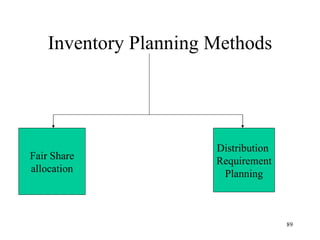
  • 331.
    Procurement Includes managementof purchase order preparation, amendment, release, vendor evaluation and vendor rating. Procurement LIS must be able to track and coordinate material receipt, facility capacity, inbound and outbound movements, and performance measurement.
  • 332.
    Application of InformationTechnology  The specific technologies that have widespread use in logistics are: Electronic Data Interchange (EDI) Personal Computers Artificial intelligence Communication technology Bar coding and scanning
  • 333.
    Electronic Data InterchangeIntercompany computer-to-computer exchange of business documents in standard formats. Determines capability of communicating information between two organizations electronically instead of traditional mail, courier or even fax. LIS would consist of real time data on inbound material flows, production status, product inventories, customers’ shipments and incoming orders.
  • 334.
    Can be visualizedin two different perspectives viz. external perspective and internal prospective. External perspective includes need to communicate order shipment and billing information with vendors, financial institutions, transport carriers, and customers. Internal perspective includes exchange of information on production schedule and control data. Benefits of EDI are: Increased internal productivity though faster information transmission as well as reduced information redundancy. Better accuracy by reducing the number of times and individuals involved in data entry. Improved channel relationship. Increase ability to compete internationally.
  • 335.
    (e) Reduced labourcost associated with printing, mailing, and handling paper-based transactions, telephone and other clerical activities. 2. Personal computers Low cost and high portability with a capability of bringing accurate and timely information to the decision maker whether in office, at the warehouse, or on the road. Responsiveness and flexibility offered by decentralized PCs results in more focused service capability.
  • 336.
    The use ofLAN , WAN and Client/server architecture offers benefits of decentralization, responsiveness and flexibility throughout the enterprise. The client/server network can globally track inventory in motion,provide shipment information to the customers when desired and also facilitate decisions regarding facility location, inventory analysis, routing and scheduling. The decisions are invariably in respect of Which markets to serve? Which product to pick next in the warehouse?
  • 337.
    (c) Driver reportingand deliver information. (d) Reporting vehicle location (e) Identifying lowest-cost fuel stop. 3. Artificial Intelligence Aimed at making computers imitate human reasoning and are more concerned about rationalizing rather than numeric processing. The applications are: Carrier selection International marketing & logistics Inventory management
  • 338.
    4. Communication technologyApplication of radio frequency, satellite communications, and image processing technologies can relate quickly to the product movement and decentralization. Radio frequency: used within relatively smaller areas such as distribution centres to facilitate two-way information exchange Real-time communication with material handlers such as fork lift drivers and order selectors.
  • 339.
    Updating instructions andpriorities to fork lift drivers on real time basis. (b) Satellite communication Useful for providing a fast and high volume information around the globe. Communication dishes on the top of vehicles allow communication between driver and shippers. Provides up-to-date information regarding location and delivery and allows dispatchers to redirect trucks in response to need or traffic congestion.
  • 340.
    Used by theretail chains to transmit quickly daily sales to headquarters that helps in activating store replenishment and also to provided input to marketing regarding local sales pattern. (c) Image processing Relies upon fax and optical scanning technology. Used in transmission of fright bill information Proof of delivery receipt Bills of lading. As the consignment gets delivered to customers, supporting documents are sent to image processing locations where it is electronically scanned and logged onto the system.
  • 341.
    Electronic images ofdocuments are then transmitted to main data centre where they are stored on optical laser disk and customers can access the documents through computer linkages or phone call to the service representatives. As the customers experience the competitive benefits of real time information transfer, there will be increase demand for this communication technology.
  • 342.
    Information sharing thoughgeostationary satellite Geostationary satellite Retail store Head office Transport company
  • 343.
    Geostationary satellite communicationtechnology has facilitated real time information transmission and sharing amongst the company, its transporters, and retail outlets.
  • 344.
    5. Bar Codingand Scanning Typical applications include tracking receipts at the warehouse and sales at the retail stores. Bar coding involves placement of readable codes on the items, cartons, containers and even railcars. These bar codes distinguish package size and flavours and reduce errors when receiving, handling, or shipping product. While the requirements of retailers are individual item, the shippers and carriers are concerned with contents of pallets, containers or cartons. It is important to include as much information as possible in the smallest area.
  • 345.
    The limitation, however,is “smaller and more compact codes increase the potential for scanning errors.” A scanner optically collects the bar code data and converts them to usable information. The applications of bar code and scanning are: Point-of-sales (POS) in retail stores, receipts, accurate inventory control, tracking of each stock-keeping unit (SKU) sold, replenishment, and providing timely information beneficial to all channel members. Facilitating material handlers track product movement, storage location, shipments and receipts.
  • 346.
    Impact of ITon Logistics Logistics requirements Current Information Technology + Competitive edge = Continuous interaction between the logistics requirements and the information technology accelerates integrating complete logistics activities in an organization and consequently giving company a competitive edge.
  • 347.
    Enterprise Resource Planning(ERP) ERP is an information technology industry term for integrated, multi-module application software packages designed to serve and support several business functions across an organization. A strategic tool that helps the organization improve operations by integrating business processes and helping to optimize the allocation of available resources.
  • 348.
    These systems arecommercial software packages that facilitate collection and integration of information related to various areas of an organization such as finance, accounting, human resources, inventory, procurement, and customer services. ERP acts as a core information centre of the organization that leads to better understanding of its business, direct resources, and plan for future. The systems enable the organization to standardize and improve its business processes to implement best practices for their industry. The popular ERP packages in the market are SAP, Oracle Financials, BAAN, Peoplesoft, and JD Edwards.
  • 349.
    Lean Manufacturing Leanmanufacturing is a business initiative to reduce waste in manufactured products. The waste may be from the production process or from any part of the organization. The basic idea is to reduce the cost systematically throughout the product and production process. Basic concepts an organization must have before implementing lean manufacturing are: Continuous flow Standardized flow
  • 350.
    (c) Value stream(d) Value added activities (e) Pull production  Continuous flow Refers to the flow of material from inventory i.e. raw materials to the finished goods stage. Processing of the materials from raw material to the finished good stage should be continuous and there should not be any delays or waiting time in between as it leaps up to the increase in cost of production for a particular product. Waiting time can occur due to various reasons such as change in set up, replacing a broken or damaged tool etc.
  • 351.
    Thus the aimof organization should be to reduce the waiting time and to make manufacturing process a continuous process without any stoppages in between for the flow of materials from the raw material stage to the finished goods stage.  Standardized work Refers to improved layout, work sequence, and work methods. Involves training of people to develop efficient work flows considering safety, quality, quantity and use of resources. Standardized work would eliminate wastages thereby improving work.
  • 352.
     Value StreamAll activities required to bring a physical product through the manufacturing and other business processes starting from acceptance of raw materials or components to delivery of the finished product. These would include The delivery of the raw materials The quality procedure to be followed to accept the material. The loading of the raw material on the poduction line. The manufacturing of tools for the production of the finished product. The set up time required for manufacturing a particular product. The removal of the finished product from the production line and its packaging.
  • 353.
    (g) The valuestream is mapped to analyze all steps from start to finish and redesign them to ensure that they add value to the final product. Value-added activities Activities in the value stream are identified as value-added (VA) or non-value added (NVA). VA activities are those activities that add value to the product and the value addition can be in any form like the machine that converts the raw materials to the finished products. NVA activities are those activities which do not add any value to the finished product like the movement of the semi-finished good from one machine to another.
  • 354.
    These activities shouldbe eliminated as much as possible as instead of adding value to the finished product they add more cost to the product. Some NVA activities are unavoidable such as quality checking procedures at various stages of the manufacturing process. These quality procedures even though, do not add any value to the final product, are required as they are very much essential for the finished product to be of the required quality. Once mapped, the value stream activities are identified as VA or NVA.
  • 355.
     Pull productionMaterials are supplied when needed, avoiding unnecessary WIP and the flow of materials through the system. This ensures that work is performed only when required, there is no waiting time and leading to reduced production cost and consequently the cost of finished product. The main concern here is the availability of the right material at the right time. This may be a problem for a company which does not have a vendor relationship programme in place as the vendors might delay the delivery of material resulting in a delay in production which in turn leads to the increase in the cost of the product.
  • 356.
    Lean manufacturing takesinto account all the concepts mentioned and tries to decrease the the cost of production which in turn leads to decrease in the cost of the finished product. Lean addresses the waste of time during set up by trying to minimize the set up time rather than minimizing the number set ups. Rather than reducing the number of products or putting new machines on the shop floor, it tries to minimize the set up time by analyzing the requirements of different components for all the set ups on a particular machine.
  • 357.
    Lean manufacturing coordinateswith all the supply lines-internal and external-and links all parts of value stream thus saving time and minimizing production delays Internal supply line corresponds to the WIP material being shifted from one machine to another or from stores to a machine or raw materials from the inventory to the production line. The external supply line corresponds to the supply of raw materials by vendors on time so that the machines can be put into production as soon as the production plan is complete. The identification of VA and NVA activities at all parts of value stream is carried out extensively and focus is on how to minimize NVA activities.
  • 358.
    Emphasis is alsoon pull production so that the waiting time for the materials before they are loaded on to a machine for processing is reduced as it helps in reducing the cost of production. Thus, the basic idea of lean manufacturing is to reduce waste and Toyota is pioneer in developing and implementing this system popularly known as ‘Toyota Production System.’
  • 359.
    Misconceptions and Misgivingsof Lean Manufacturing  Some of the most frequent misconceptions and misgivings of lean manufacturing are: Lean manufacturing should give results as soon as it is implemented. It is confined to an internal implementation in an organization and should not be extended to suppliers. Leads to retrenchment of personnel as the very idea of going lean is to streamline the processes and remove waste from the system.
  • 360.
    How it functionsis the not the responsibility of the employees of an organization but only of those few who are implementing lean manufacturing in the organization. It can function only on the shop floor and cannot be applied to the other activities of an organization. If one technique is successful in implementing lean in one organization, it has to be successful; in another organization as well. It provides solutions to all the problems.
  • 361.
    Lean Manufacturing andSCM In world of lean, manufacturing companies try to produce only what has been demanded by the customer, and only when that product is required. But why should it stop there? What about the rest of the supply chain? To optimize the benefits of lean throughout the supply chain, it is essential for manufacturing company to build a partnership with its suppliers, as if they were departments within their own company. The partnership works on the premise that manufacturing company will pull only what it consumes and nothing more.
  • 362.
    The suppliers replacewhat manufacturing company has consumed and nothing more. In this way inventories are maintained at their minimum for both supplier and customer. Achieving this level of trust and efficiency with company’s supplier will require frequent communication and extensive sharing of information. Successful partnership would result from inviting each other to strategic planning sessions, attending each other’s events for removing waste/ process improvements and other joint activities.
  • 363.
    To create aneffective supplier-customer relationships, it is advantageous to develop a two-way service level agreement (SLA). SLA forces both parties to clarify the relationship by establishing the type and level of service to be provided by your supplier and what types of quality inputs required from you.
  • 364.
    Key Approaches tomake lean successful throughout Supply Chain Manufacturing companies must share information to the very detailed level to help suppliers see the savings potential. Manufacturing companies must be committed to long-term implementation of lean strategies and not just a “flavour of the month”. Manufacturing companies must give support t its suppliers support in terms of training and troubleshooting. Manufacturing companies must demonstrate the potential benefits of lean not only for their own company but also for all their suppliers covering both bottom line and service points of view.
  • 365.
    Difference between massproduction & lean production Attributes Mass production Lean production Customer satisfaction Makes what engineers want in large quantities at statistically acceptable quality levels. Makes what customers want with zero defects and only in quanities wanted by the customers. External relations Based on price Based on long-term relationship building. Information management Based on reports generated by and for managers. Rich in information based on control systems maintained by employees.
  • 366.
    Culture Obedience, loyaltyand subculture of labour strife Based on long-term development Production/ Purchases Large inventories, Massive purchases, minimal skill, assembly line, batches Cell type layout, zero inventory, single piece flow. Engineering Isolated genius model Team based model Demand Management Forecasting Customization
  • 367.
    The basic elementare waste elimination, continuous one piece workflow, and customer pull. Focus of above in the areas of cost, quality and delivery forms the basis for a lean production system.  Benefits of lean manufacturing Waste reduction by 80% Production cost reduction by 50% Manufacturing cycle time decreased by 50% Labour reduction by 50% while maintaining or increasing throughput.
  • 368.
    Inventory reduction by80% while increasing customer service levels. Capacity in current facilities increase by 50%. Improved cash flow through increasing shipping and billing frequencies.  Components of lean production system Flexible manufacturing Just-in-time Outsourcing Lean supply chain ERP & CRM E-business and EDI.
  • 369.
    Integration of Leanmanufacturing and SCM . Reduce the supply base Reduce the number of suppliers for each commodity of purchases to a minimum, a few or often only one. 2. Develop strategic long term partners Develop supplier partners, especially in the commodities key to the company’s growth and future success. Plan and execute for a long term relationship and exchange information.
  • 370.
    3. Manage supplierwith commodity teams Involve cross functional teams for strategic issues with key suppliers. Above will help in considering total cost than immediate price in purchase decisions. 4. Certify suppliers Create and use a certification process that challenges suppliers and make them proud to be certified. Ensue that the certification process contains the criteria important to your company. Recognize certified suppliers publicly.
  • 371.
    5. Connect tosuppliers with Internet Technologies Exchange data pertaining to quality, schedules, engineering change, prototypes and pilot runs, return goods, order status, capacity planning, etc. Customize web page for key suppliers. 6. Collaborate with suppliers Make buying decisions based on total cost of ownership. Inform suppliers as soon as new orders arrive. Eliminate incoming inspection. Buy complete, tested subassemblies. Let suppliers choose where to buy components from an approved list.
  • 372.
    Give incentives tocompanies to locate their plants nearby to reduce delivery time and encourage frequent , small daily deliveries. Train and help suppliers to be compatible with their production systems. Certify suppliers and eliminate incoming inspection. Let suppliers choose where to buy components from an approved list. 7. Outsource for right reason - Focus on ore competencies and outsource the rest.
  • 373.
    Purchase completed assemblies,tested and ready to go on the assembly line. Allow suppliers to participate in design and subsequently build and test assemblies. Provide suppliers drawings, blue prints and other information quickly.
  • 374.
    Supply Chain Vulnerability& Ethical Issues The fundamental principles are: Loyalty to your organization. Justice to those with whom you deal. Faith in your profession. Demonstrate loyalty to the employer by diligently following the lawful instructions of the employer, using reasonable care in exercising granted authority. Avoid any personal business or professional activity that would create a conflict between personal interests and the interests of the employer.
  • 375.
    Avoid soliciting oraccepting money, loans, or preferential discounts, gifts, entertainment, favours or services from present or potential suppliers that might influence, or appear to influence, supply management decisions. Handle confidential or proprietary information with due care. Promote positive supplier relationships through courtesy and impartiality. Avoid improper reciprocal agreements. Conduct supply management activities in accordance with national and international laws, customs and practices.
  • 376.
    Recommended guidelines Situationsmay occur in which, through unanticipated circumstances, a business relationship transpires with a personal friend. The perception as well as potential of a conflict of interest should be discussed with management, and a reassignment of procurement responsibility should be considered. Business meeting locations should be carefully chosen. Environments other than the office may be perceived as inappropriate by the business community or by co-workers. Conversation that centres around excessively on personal affairs should be avoided.
  • 377.
    Obtain the maximumvalue for monies expended as agent for the employer. Avoid using the employer’s purchasing power to make purchases for specific individuals’ nonbusiness use.  Conduct to be Avoided Engaging in business or employment in an organization that is a supplier to the employer Lending money to, or borrowing money from any customer or supplier. Using the organization’s name (unless authorized) to lend weight or prestige to sponsorship of a political party or cause, or endorsing the product or service of another organization.
  • 378.
    Ownership of stocksin a supplier of goods or services should be reported to the employer for review to avoid the potential for impropriety. Interests by members of the professional’s immediate family are considered to be of the same significance as direct ownership.  How to deal with issues of influence? Exercise extreme caution in evaluating the acceptance of gifts and the frequency of the same. Establish nominal value in organization policy to address supplier’s offerings of nominal value as a gesture of goodwill or for public relations purposes. Refuse gifts exceeding nominal value, and return them with a polite explanation.
  • 379.
    Seek direction ofmanagement if it appears that business relationship may be impaired o appear to be impaired by refusal of a gift or entertainment. Occasionally, during the course of business, it may be appropriate to conduct business during meals. Such meals should be for a specific business purpose and frequent meals with the same supplier should be avoided. The supply management professional should be in a position to pay for meals as frequently as the supplier. Budgeting is recommene for this business activity.
  • 380.
     International practicesIn some cultures, business gifts, meals, entertainment are normal and expected while in other cultures, business is transacted at arm’s length and business gifts, meals and entertainment are viewed as inappropriate. Supply management professionals must understand such variations and establish policies and procedures to deal effectively with suppliers from different cultures. Suppliers also should be informed of organization’s policies with respect to business gifts, meals, and entertainment. Supply management professionals should act courteously to supplier’s representatives who may inadvertently act contrary to organization's policies.
  • 381.
     Confidentiality &proprietary information Confidential & proprietary information would include quotation/ bids, cost sheets, financial information, wage and salary scales, personal information about employees, officers and directors, product design, supply sources or supplier information etc. It is the responsibility of the individual sharing confidential or proprietary information to ensure that recipient understands his or her obligation to protect such information. Supply professionals are cautioned not to divulge such information unless it is required to be shared.
  • 382.
     Dealing withreciprocity When supply management professionals or their organizations give preference to suppliers because they also customers or when organization influences a supplier to become a customer, the professional or the organization is engaging in a practice known as reciprocity. Dealing with a supplier that is also a customer may not constitute a problem if, in fact, the supplier is one of the best sources. Supply professional should not get influenced by sales or marketing professionals to engage in reciprocity.
  • 383.
    List of suppliersshould not be provided to sales or marketing department for their use in pursuing improper reciprocal arrangement. When making sourcing decisions, supply professionals must be especially careful when dealing with suppliers that are customers.  Applicable laws Supply management professionals must be aware of the following laws: Contract and commercial laws Trade regulations Government procurement regulations Patents, copyrights, trademark laws. Transportation and logistics laws and regulations Environmental laws.
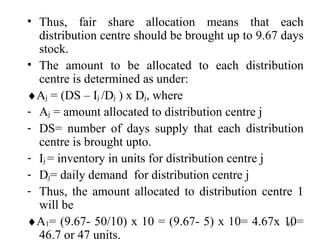
  • 384.
    Outsourcing Organizations outsourceto address specific business issues and opportunities. Typically, the issues and opportunities an organization faces will fall in one or more of three general categories Tactical Strategic, and Transformational
  • 385.
    Tactical reasons forShort-term Outsourcing Reduce and control operating costs Most important tactical reason for outsourcing is to reduce or control operating costs. Access to the outside provider’s lower cost structure is one of the compelling short term benefits of outsourcing. Certain research studies have found companies reporting an average 9% reduction in costs due to outsourcing.
  • 386.
    Freeing capital forinvestment Outsourcing reduces the need to invest capital funds in non-core business functions. Thus, funds are available for investment in core areas. Improves financial measurements of the firm by eliminating the need to show return on equity from capital investments in non-core areas. Cash infusion Outsourcing sometimes involves the transfer of assets from the customer to the service provider. Equipments, facilities, vehicles, and licenses used in current operations are sold to the service provider as a part of transaction resulting in cash payment. This cash can be used in other parts of the operation.
  • 387.
    Unavailability of resourcesinternally Companies outsource because they do not have access to the required resources-human, capital or intellectual. For instance, if an organization is expanding its operations, especially into new geographic area, outsourcing is viable and important alternative to building the needed capability from the ground-up. Functions difficult to manage or out of control - Introducing best in class management and business processes a service provider offers can be quick way to bring control to a situation.
  • 388.
    Strategic Reasons forLong-term Outsourcing Improve business focus Allows the company focus on broader business issues while having operational details assumed by an outside expert. Provides access to world-class capabilities Partnering with an organization with world class capabilities can offer access to new technology, tools,and techniques that the organization may not currently possess.
  • 389.
    Frees resource forother purpose - Outsourcing permits an organization to redirect its resources from non-core activities towards building knowledge base skills having long term pay back and impact on innovation.
  • 390.
    Better career opportunitiesfor personnel who switch to the outsourcing provider. More structured methodologies, procedures, procedures, and documentation. Competitive advantage through expanded skills. Provides acceleration to reengineering efforts. Outsourcing is a powerful tool for Business Process Reengineering. Shared risks & quick response When companies outsource they become more flexible, more dynamic, and better able to adapt to changing opportunities. Companies can respond quickly to customers to resolve delivery and any other service related issue.
  • 391.
    Transformational Reasons forOutsourcing Helps respond to shortening product life cycles Companies facing shortening of PLC are using outsourcing to concentrate their time and efforts to market. Redefines relationships with suppliers and business partners. - Outsourcing transforms the entire supply chain by shortening the chain and provides additional services transforming the customer experience.
  • 392.
    Helps in surpassingthe competitors Amazon.com changed retailing due to new technology, and a cadre of outsourcing providers. Change was effected by partnering with the third party providers who could manage call centres, process orders, and fulfill orders. Helps to enter new markets with reduced risks Firms move into new markets or new opportunities with little experience, particularly in the areas of e-commerce. Service providers like IBM Global Services are helping brick and mortar firms create entirely new customer base on-line.
  • 393.
    Concept of OutsourcingWhen an enterprise identifies a need for a specific product or service, it has to decide whether to make the product and perform the service internally (make) or to purchase the requirement from an external source (buy). Make-versus-buy decision centres around the economic trade-off associated with each option. Outsourcing decisions examine not only the firm that has the lowest cost but also which one can produce or market the product better or perform superior service. Calls for assessment of strategic core competency.
  • 394.
    For instance, fora firm to evaluate whether to own a private fleet of trucks or outsource by hiring carriers, not only the current rates and costs are important but also the long-term cost trends. Specialization Outsourcing decision is taken by considering the specialized skills that differentiate the company from its competitors. For instance, a transport company can implement a satellite tracking service capable of quickly pinpointing the location of a truck so that it can provide customers with accurate delivery status information. This technology will provide the transport company a unique competitive advantage for customers who value the availability of instantaneous information tracking.
  • 395.
    Thus, the companywill stand to gain by outsourcing transportation by obtaining specialized skills rather than develop the ame capability internally.
  • 396.
    Logistical Measurement Inorder to optimize the performance of logistics system it is essential to evaluate the same and control it. To have a better track of logistical system we need to divide the measurement into: Internal performance , and External performance. Dimensions of Performance measurement (1) For performance measurement, first step is to improve the quality of information that must be obtained to measure, compare and guide logistical performance.
  • 397.
    (2) Secondly, theold reporting formats need to be redesigned to take advantage of the new computer-based control systems. -> Objectives Objectives for developing & implementing performance measurement system . Monitoring Controlling Directing
  • 398.
    Monitoring Measures andtracks the historical logistics performance for reporting to management and customers. Typical monitoring includes service levels and logistics cost components. Controlling Measures and tracks ongoing performance and is used to review a logistics process in order to bring into compliance when it exceeds control standards. For example, “transportation –damage tracking”. By having a system periodically reporting the product damage, logistics management can identify the cause and modify the packaging or loading process.
  • 399.
    Directing Refers tothe methods designed to motivate personnel. Typically, it would include “pay for performance” practice used to encourage warehouse or transportation personnel to achieve higher levels of productivity. An example: Consider the material handlers in the warehouse or delivery boys who are paid for eight hours of work based on standard production rate.
  • 400.
    When the materialhandlers/ delivery boys complete the assigned tasks in less than the allotted time, they are given bonus. If the employees require more than the allotted time, the disincentive is that they are compensated for the additional time.
  • 401.
    Perspective of PerformanceMeasurement Performance measurement perspective refers to activity based measures as well as process based measures. Focus is on individual tasks required to process and ship orders, efficiency and effectiveness of work efforts. Activity Based Measures Emphasize on the individual tasks required to process and to ship orders such as: Customers orders entered Cases received from suppliers Cases shipped to customers.
  • 402.
    Objectives of ActivityBased Measures To record the level of activity Example: Number of cases To record the level of productivity Example: Cases per labour hour. The typical activity-based measures are: Order entry time per order Deliver time per order Order selection time per order.
  • 403.
    (4) Inquiry timeper order (5) Order entry time per customer (6) Order selection time per customer (7) Delivery time per customer (8) Order selection time per product (9) Delivery time per product. B. Process based measures The above stated activity based measures record the level of activity/productivity but do not measure the performance of overall process of satisfying the customers.
  • 404.
    For instance, theorder takers may be rated high with respect to activity based measurement on the basis of number of calls per hour; they may fair poorly in overall satisfaction process as they fail to listen carefully to customers. It is important that performance measures take into account the overall process perspective. Thus, process based measures refer to the customer satisfaction delivered by the entire supply chain.
  • 405.
    Internal Performance MeasurementInternal performance measurement focuses on activities required to serve customers. Measurement of these activities and the comparison thereof with the standards is necessary to improve performance, motivate and reward employees. Also focuses on comparing activities and processes to previous operations and/or objectives in terms of cost, customer service and productivity measures.
  • 406.
    Cost Reflects inpercentage, the actual cost incurred to accomplish a specific operating objective, by business units like manufacturers, wholesalers, retailers etc. The typical cost performance measures are: Cost per unit (b) Warehouse costs ( c) Inbound freight (d) Order processing (e) Cost as a percentage of sales
  • 407.
    (f) Administrative costs(g) Outbound freight (h) Direct labour Customer Service Focuses on the customer service provided by the manufacturers, wholesalers, and retailers. Typically these services include Fill rate Stock outs Shipping errors
  • 408.
    (d) On timedelivery (e) Back orders (f) Cycle time (g) Customer feedback These measures examine a firm’s relative ability to satisfy customers. Productivity measures Establishes a relationship (usually a ratio or an index) between output (goods and/or services) produced and quantities of inputs (resources) utilized by the system to produce that output.
  • 409.
    The typical logisticsproductivity performance measures reported as used by manufacturers, wholesalers and retailers are: Units shipped per employee Units per labour (Rs) Order per sales representative Comparison with historical data Comparison with standards set Productivity index
  • 410.
    Types of ProductivityMeasures There are three types of productivity measures- static, dynamic and surrogate. Static productivity measures When all the outputs and inputs in a given system for a specific period are included, it is considered static as it is based on only one measurement. Dynamic productivity measures When outputs and inputs in a system for one period compare with another period, the result is dynamic productivity index.
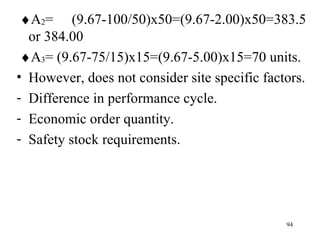
  • 411.
    For example: (Outputs2008/Inputs 2008)  (Outputs 2007/Inputs 2007) Surrogate productivity measure Represents factors that are not typically included in the productivity but have high impact on the same. Examples are customer satisfaction, profit, effectiveness, and efficiency.
  • 412.
    Asset Measurement Focus is on how fast liquid assets such as inventory as well as how well fixed assets generate return on investment. Typical logistics asset measurement measures, (often reported as percentage), used by manufacturers, wholesalers, and retailers are: Inventory turnover Inventory carrying costs Inventory levels (no. of days) Obsolete inventory Return on net assets Return on investment
  • 413.
    Quality Measurement Refersto process oriented evaluation to determine the effectiveness of a series of activities rather than an individual activity. The typical quality measures, reported as percentage, used by manufacturers, wholesalers, and retailers are: Frequency of damage Damage reported in rupees Number of customer Cost of returned goods
  • 414.
    Perfect Order Perfectorder represents ideal performance. It measures order entry, credit clearance, inventory availability, accurate picking, on-time delivery, correct invoicing, payment without deductions. The perfect order represents the following standards: Complete delivery of all items requested. Delivery as required by customer with one-day tolerance.
  • 415.
    Complete and accuratedocumentation supporting the order, including packing lists, bills of lading, invoices. Faultless installation, correct configuration, no damage.  Perfect Order Busters Order entry error Missing information e.g. missing code Non-availability of ordered item Inability to meet shipment date Picking error
  • 416.
    6. Inaccurate packinglist/ documentation 7. Late shipment Late arrival Early arrival Damaged shipment Invoicing error/ overcharging/deductions Errors in payment processing  Best logistics organization report achieving a 55 to 60 per cent perfect order performance, while most organizations report less than 20 per cent
  • 417.
    External Performance MeasurementDone on the basis of customer perception measurement and best practice benchmarking. Customer Perception Measurement Refers to regular measurement of customer perceptions that is obtained through company or industry sponsored surveys or by systematic follow up. The most important measurement of customer perceptions are regarding: Availability Performance cycle length
  • 418.
    3. Information availability4. Product support services Consultants and industry associations administer these measurements. Best Practices Benchmarking Benchmarking may be carried out in relation to operations of both competitors and leading firms in related and non-related industries. Typically, organizations are using benchmarking in important strategic areas to calibrate logistics operations. Benchmarking provides the foundation for customer satisfaction and the perfect order.
  • 419.
    The key areasof benchmarking are as under: Asset management Cost Customer service Productivity Quality Technology Transportation Warehousing Order processing Materials handling
  • 420.
    The best practicebenchmarking focuses on practices and processes of a comparable organization. The areas of review include identifying key performance measures and tracking historical and current performance levels. Methods of benchmarking 1. By taking help from published logistics data available, periodicals, consultants, and university researchers.
  • 421.
    2. By benchmarkingprivately against noncompetitive firms in one’s own or a related industry. 3. By creating a strategic alliance with the organization(s) that systematically share benchmark data on a regular basis. These alliances require more effort to maintain but usually provide substantial information.
  • 422.
    Benchmarking at XeroxStage 1 Identify what is to be benchmarked Identify comparative companies Determine data collection method and collect data Stage 2 Determine current performance levels Project future performance levels Communicate benchmark findings and gain acceptance
  • 423.
    Stage 3 1.Establish functional goals 2. Develop action plans Stage 4 Implement specific actions and monitor progress Re-calibrate benchmarks
  • 424.
    Logistics Costing Logisticsrelated costs are dynamic and do not readily fit with traditional accounting methods. The accounting difficulties become more pronounced when trying to determine costs for a particular operation or a particular customer. Activity-based costing can be used to help firms manage and to benchmark logistics costs. Based on this, one can evaluate their logistics costs, in total or by function.
  • 425.
    Total logistical costis the basic integrative concept in logistical network design. For example, the use of expensive airfreight in a situation wherein speed and dependability of air delivery would reduce other costs such as warehousing and inventory. In such situation, high cost premium transportation would be justified by achievement of lower total cost.
  • 426.
    Logistics Performance EvaluationIt is important to identify costs associated with performing specific logistics tasks such as warehousing expenses for specific SKU. Though the cost of logistics function is given in most accounting systems , allocation of logistics costs broken down to individual activities is not given.
  • 427.
    Deficiencies of TraditionalAccounting System Reporting of transportation expenditure In many purchasing situations the freight is not reported at all as a specific costs as many times products are purchased on delivered basis, which includes transportation cost. Progressive procurement procedures require expenses for all services including transportation are identified separately from purchase cost for evaluative purposes.
  • 428.
    2. Failure tospecify and assign inventory cost Insurance and taxes are not identified and assigned resulting in ambiguity in reporting inventory cost. The financial burden for assets committed to materials, work-in-process and finished goods inventory is not identified , measured, and separated from other forms of capital expense incurred by the enterprise. Brand Manager should be held responsible for his brand’s inventory carrying cost.
  • 429.
    Activity Based Costing Relies on the concept that expenses need to be assigned to that activity that consumes a resource rather than to an organizational budget. For example, assume that the two products, produced in the same manufacturing facility, require different assembly and handling procedures. - Out of the two products, one may need additional equipment or labour for assembly or packaging operations.
  • 430.
    If total labourand equipment costs are allocated to the products on the basis of sales or the number of units produced, then both the products will be charged for additional assembly and packaging operations required by only one of them. This will reduce the profitability of that product which did not require additional equipment or labour because this product will be paying for the operations it did not need. In the context of manufacturing, the fair share of all overheads and operating cost factors should be identified and assigned to a specific product.
  • 431.
    Logistical activity basedcosting must provide the managers detailed information about the profitability of a specific customer, order, product, or service. -> Cost Identification The costs associated with the performance of a logistics function are: Forecasting Order management Transportation Inventory Warehousing Packaging
  • 432.
    Logistics Costs DirectCosts Indirect costs Overheads
  • 433.
    Direct or operationalcosts Expenses incurred specifically by performance of logistics work. Include cost of transportation, inventory costs, warehousing costs, and material handling costs. For example, Transportation costs for an individual truckload order can be directly attributed to a specific order. Similarly, direct administrative cost of logistic operation can be isolated.
  • 434.
    Indirect expenses -For example, cost of capital invested in real estate, cost of transportation equipment, prime rate of interest, an alternate use of capital and expected rate of return.. Indirect costs are attributed to logistical activities by managerial judgment and are difficult to isolate. The question is how indirect cost such as equipment cost associated with the warehouse should be allocated to the customer order shipped from the warehouse? This can be answered by allocating the cost on the basis of the average cost per unit. As a general rule, a specific cost is not assigned to logistical factors unless it is under the managerial control of logistics organization.
  • 435.
    Cost Formatting Thetypical way to format activity-based costs is to assign expenses to the event being managed. For instance, to analyze a customer order, all costs that result from associated performance cycle contribute to total activity cost. The areas of analysis in logistics activity based costing are Customer orders Channels Products Value-based services
  • 436.
    Three common waysof formatting are: Functional grouping Allocated grouping Fixed-variance grouping. Functional grouping All expenditures for direct and indirect logistical services performed in a specified operating time are formatted and reported under sub-accounts classification. By doing so a total cost statement can be constructed for comparison of one or more operating periods.
  • 437.
    Allocated cost formattingOverall logistical expenditure is assigned to a measure of physical performance. This will generate logistical cost per tonne, per unit, per product line, per order etc. This method becomes useful for comparative analysis of operating results. Fixed-variance grouping Consists of assigning costs either fixed or variable to the operating expenditure that result from different volumes of activity. The formatting will use use fixed and variable costs separately.
  • 438.
    Fixed costs donot directly vary with volume such as cost of delivery truck. These costs would remain as it is even if the volume were reduced to zero. However, cost of diesel to operate the truck is variable, as the total cost would depend on how frequently the truck is driven. Use of fixed and variable cost formatting provides a convenient way to control expenses in logistical system design.
  • 439.
    Total Cost PresentationFor the purpose of presenting logistical total cost analysis, the focus remains on inventory and transportation. Both inventory and transportation expenses can be represented in a format that includes both activity and functional cost relationship. For example, communication costs associated with order processing, warehousing storage and material handling can be classified under the inventory umbrella.
  • 440.
    In terms ofinventory, total cost includes all expenses related to inventory carrying cost and customer ordering. Inventory carrying cost includes taxes, storage, capital, insurance, and obsolescence. Cost of ordering includes the full expense of inventory control, order preparation, communications, updating activities, and managerial supervision. The total cost of transportation includes hiring expenses, accessorial charges, costs related to hazards incurred in various modes of transport, and legal and associated administrative expenses.
  • 441.
    Logistical Operations Spatialdimension Temporal Dimension
  • 442.
    Transportation deals with spatial (geographical) dimensions of logistical operation by positioning the product where the customer wants. Inventory involves the rate at which the capital assets are used (temporal) to meet the customer requirements by having the product available when customer wants to purchase. Classification of costs in terms of inventory or transportation provides for the trade-off determining the cost justification for logistical network design. The basic purpose of activity based costing is to give managers a better perspective of the total cost associated with the performance of a specific activity.
  • 443.
    Summary of Costs-Transportation and inventory account for 80-90 per cent of total logistical expenses Inventory carrying costs include Expenses on tax, storage, capital insurance etc. Costs incurred to avoid obsolescence. Material handling and packaging Cost on updating activities including data processing in receiving, managing and controlling inventory. Transportation related costs include Direct costs such as freight rate and accessorial charges. Indirect costs such as the cost incurred on liabilities not protected by the carriers, and the managerial costs.
  • 444.
    Mission Based CostingThe premises this system is based on are as under: It should mirror the materials flow i.e. it should be capable of identifying the costs that result from providing customer service in the market place. It should be capable of enabling separate cost and revenue analysis to be made by customer type and by market segment or distribution channel.
  • 445.
    This system overcomesdangers inherent in dealing with the averages like average cost per delivery since average cost can conceal substantial variations either side of the mean. A useful concept of ‘mission’ emerges to address above problems. In context of logistics mission is a set of customer service goals to be achieved within a particular product/market. Missions can be defined in terms of the type of market served, by which products and within what constraints of service and costs.
  • 446.
    Distribution mission ADistribution mission B Distribution mission C Purchasing Production Sales Marketing Transportation Etc
  • 447.
    The successful achievementof defined mission goals involves inputs from large number of functional areas within the firm. An effective mission based logistics costing system would seek to determine total systems cost of meeting desired logistic objective i.e. the output of the system and the costs of the various inputs involved in meeting these outputs. The figure shown is indicative how three distribution missions may make a differential impact upon functional area costs. In this system of costing the functional budget is determined by the demands of the mission it serves.
  • 448.
    Functional area 1Functional area 2 Functional area 3 Functional area 4 Mission A Mission B Mission C Functional area inputs Total mission cost 100 50 70 220 90 70 30 190 20 200 50 270 80 20 70 170 290 340 220 850
  • 449.
    The cost permission is identified horizontally and from this the functional budgets may be determined vertically. -> How does this approach work? Firstly, the functional areas associated with a particular distribution mission is identified e,g. transport, warehousing, inventory etc. Secondly, incremental costs for each functional area incurred as a result of undertaking that mission must be isolated. In incremental costs, the sunk costs are not included as these would be still incurred even if the mission were abandoned.
  • 450.
    In determining thecosts of a functional area e.g. transport , attributable to a specific mission, the question should be asked: What costs would we avoid if this customer/segment/channel were no longer serviced? These avoidable costs are the true incremental costs of servicing customer/ segment/channel. Often they will be substantially lower than the average cost because so many distribution costs are fixed and/or shared.
  • 451.
    For example, avehicle leaves a Mumbai Depot to make deliveries in Kalyan and Nashik. If those customers in Kalyan abandoned but those in Nashik retained, what would be the difference in the total cost of transport? The answer would be – not very much. However, if the customers in Nashik were dropped, but not those in Kalyan, there would be greater savings of costs because of the reduction of kilometers travelled.
  • 452.
    This approach becomespowerful when combined with a customer revenue analysis, because even customers with low sales off take may still be profitable in incremental cost terms, if not on average cost basis. In other words the company would be worse off if those customers were abandoned. Mission based costing helps in determining profitability analysis for customers, market segments or distribution channels. Customer profitability attempts to relate the revenue produced by a customer/market segment/ distribution channel to the costs of servicing that customer/market segment/channel.