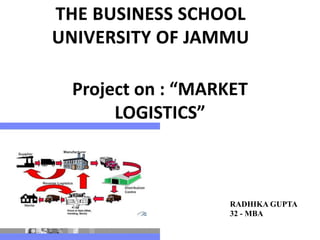
Project on : “MARKET
LOGISTICS”
RADHIKA GUPTA
32 - MBA
Contents :
• Market logistics ( defination )
• Objectives of logistic management
• Integrated logistics systems
• Market-logistics objectives
• Fact
• Market-logistics decisions
• Logistics for business excellence
• Scope of logistic
• Logistics process of CIPLA
MARKET LOGISTICS
Market logistics includes planning the infrastructure to meet
demand, then implementing and controlling the physical flows
of materials and final goods from points of origin to points of
use, to meet customer requirements at a profit.
Market Logistics
• Interrelated Aspects Associated with Market Logistics:
– Physical distribution
– Supply chain management (SCM)
– Value network
– Demand chain planning
– Market logistics
– Integrated logistics systems (ILS)
Vendor
Purchase
Stores
RM
Customer
Warehousing
Stores
FG
Inbound Logistics Out bound logistics
OPERATIONS
P
r
o
c
u
r
e
m
e
n
t
D
is
tr
i
b
u
ti
o
n
Material flow Material flow
Information flow
Supply Chain
Market logistics planning has four steps
 Deciding on the company's value proposition to its customers. (What
on-time delivery standard should we offer? What levels should we
attain in ordering and billing accuracy?)
 Deciding on the best channel design and network strategy for reaching
the customers. (Should the company serve customers directly or
through intermediaries? What products should we source from which
manufacturing facilities? How many warehouses should we maintain
and where should we locate them?)
 Developing operational excellence in sales forecasting, warehouse
management, transportation management, and materials management
 Implementing the solution with the best information systems,
equipment, policies, and procedures
Objectives of Logistic
management
• Inventory reduction
• Reliable and consistent delivery performance
• Freight economy
• Minimum product damage
• Quick response
Integrated Logistics Systems
• It includes material management, material flow system&
physical distribution, aided by information technology.
• It plays a crucial role in managing market logistic, especially
through computers, point of sale terminals, uniform product
bar codes, satellite tracking, electonic data interchange,&
electronic funds transfer.
Market-Logistics Objectives
 It means “getting the right goods to the right places at the right
time for the least cost.”
 Market-logistics costs interact and are often negatively related.
For example:
• The traffic manager favors rail shipment over air shipment
because rail costs less. However, because the railroads are
slower, rail shipment ties up working capital longer, delays
customer payment, and might cause customers to buy from
competitors who offer faster service.
• The shipping department uses cheap containers to minimize
shipping costs. Cheaper containers lead to a higher rate of
damaged goods and customer will.
Given the market-logistics objectives, the company must
design a system that will minimize the cost of achieving these
objectives.
Each possible market-logistics system will lead to the
following cost:
M= T+ FW+ VW+ S
where,
M = total market-logistics cost of proposed system
T = total freight cost of proposed system
FW = total fixed warehouse cost of proposed system
VW= total variable warehouse costs
(including inventoly) of proposed system
S = total cost of lost sales due to average
delivery delay under proposed system
Fact
• In a manufacturing org. the business process starts with the
flow of material from the suppliers, progress to the plant, then
to the customer through the distribution channel the
department may excel in their respective function but org. as a
whole their performance may be dismal.
Reason
 Lack of Co ordination in their activities
 They have different goal to cherish
 There is no single agency that coordinates their functions and
homogenizes them.
How to overcome ?
Use of Logistic as a system
Market-Logistics Decisions
The firm must make four major decisions about its
market logistics:
 How should we handle orders (order processing)?
 Where should we locate our stock (warehousing)?
 How much stock should we hold (inventory)?
 How should we ship goods (transportation)?
Order Processing:
• Involve following activities
 Order checking for any deviation in agreed on negotiated term
 Technical details;price;delivery period;payment terms;taxes etc
 Checking the availability of material in stock (material requisition)
 Production & material scheduling for shortage
 Acknowledging the order, indicating deviation if any
• It is routine operation but require great deal of planning training of
people involved and investment to bring about efficiency & accuracy
• In a large organization a system capable of handling thousands of
voluminous orders with minimum human involvement or without
human involvement is a must involving shortened order fulfillment
cycle to have edge over rivals
Warehousing:
• A storage place wherein finished goods are stored till they are
sold.Effectiveness of an organization`s marketing strategy
depends on making the right decision regarding warehouse.
• Nowadays
• Warehouse are treated as switching facilities rather than
storage place.It is a major cost center, many customer problem
are the direct result of improper warehousing management.
• Major decision of ware house are as follows:-
 Location ,Size & Number of warehousing facilities
 Warehouse layout
 Design of building
 Ownership of the warehouse
Inventory management
• Management needs to know how much sales & profits would
increase as a result of carrying larger inventories & promising
faster order fullfillment times , & then make a decision.
• Determine reorder point, relevant cost comparison, optimal
order quantity.
Transportation
• For the movement of goods from supplier to buyer ,
transportation is the most fundamental and important
component of logistic.
• E.g. for low unit value products the transportation cost
component is 20% of the product cost.
• In logistic cost its share varies up to 65-70% in case of mass
consumed very low unit price products.
 Mode of transportation ( Cost & time factor)
 Own fleet or Outsourcing
 Route Planning
 Vehicle scheduling
• Are the few decision which are involved in transportation
Logistics for Business Excellence
• For Business Excellence logistics operation need to be
integrated on the following two fronts
 Integration of logistic into business
 Integration of components of logistics
• To achieve the objective of making available right product at
the right place and at a right time at low cost , every business
is required to integrate logistics into the business process.
• For logistic operation to run smoothly, proper integration
amongst the component of logistic process is a must.
Scope of Logistic
• It is of critical importance to the organization how it delivers
products & services to the customer , whether the product is
tangible or intangible.
• Effective & efficient Physical movement of the tangible
product will speak of intangible services associated with the
product and the organization which is delivering it.
• In Case of intangible product , the delivery of tangibles at the
right place & right time will speak about its quality.
• On the macro level infrastructure such as various modes of
transport , transportation equipment, storage facilities,
connectivity & information processing are contributing to a
large extent in the physical movement of goods produced in
manufacturing , mining & agriculture Sectors.
• “ Public distribution system in the country needs logistical
support for delivering goods at right place on time and the
lowest cost.
• At Micro Level logistic plays a critical role in the value
delivery system of business organization to provide superior
customer service i.e. to achieve a desired level of delivered
services and quality at the lowest possible cost.
• In a nutshell any productivity improvement that could be
achieved in any part of logistic system,at the micro or
macro level would help in cost reduction and proper
deployment of scare national resources to the productive
purposes.
NOTE:
Amongst most of the Indian companies logistics
outsourcing has now become an accepted trend for the
following reasons:
• Cost Saving
• Focus on core Business
• Paucity of funds
• Reduction in liabilities
• Wider Geographical coverage
• Cross pollination of better available practice
Logistics Process Of CIPLA
MANUFACTURING
PROCUREMENT
OUTPUT/ FINISHED
GOODS
WAREHOUSING
TRANSPORTATION
DISTRIBUTION
LABORATORIES RETAILERS
CUSTOMERS
MEDICAL STORES
BIBLOGRAPHY:
• Marketing management – A South Asian Perspective By Philip
Kotler, Kelvin Lane Keller, Abraham Koshy & M Jha,14th
Edition Pearson(2014),india
• Marketing management by Dr. K Karunakaran , Himalaya
Publishing House

Market logistic

  • 1.
    Project on :“MARKET LOGISTICS” RADHIKA GUPTA 32 - MBA
  • 2.
    Contents : • Marketlogistics ( defination ) • Objectives of logistic management • Integrated logistics systems • Market-logistics objectives • Fact • Market-logistics decisions • Logistics for business excellence • Scope of logistic • Logistics process of CIPLA
  • 3.
    MARKET LOGISTICS Market logisticsincludes planning the infrastructure to meet demand, then implementing and controlling the physical flows of materials and final goods from points of origin to points of use, to meet customer requirements at a profit.
  • 4.
    Market Logistics • InterrelatedAspects Associated with Market Logistics: – Physical distribution – Supply chain management (SCM) – Value network – Demand chain planning – Market logistics – Integrated logistics systems (ILS)
  • 5.
    Vendor Purchase Stores RM Customer Warehousing Stores FG Inbound Logistics Outbound logistics OPERATIONS P r o c u r e m e n t D is tr i b u ti o n Material flow Material flow Information flow Supply Chain
  • 6.
    Market logistics planninghas four steps  Deciding on the company's value proposition to its customers. (What on-time delivery standard should we offer? What levels should we attain in ordering and billing accuracy?)  Deciding on the best channel design and network strategy for reaching the customers. (Should the company serve customers directly or through intermediaries? What products should we source from which manufacturing facilities? How many warehouses should we maintain and where should we locate them?)  Developing operational excellence in sales forecasting, warehouse management, transportation management, and materials management  Implementing the solution with the best information systems, equipment, policies, and procedures
  • 7.
    Objectives of Logistic management •Inventory reduction • Reliable and consistent delivery performance • Freight economy • Minimum product damage • Quick response
  • 8.
    Integrated Logistics Systems •It includes material management, material flow system& physical distribution, aided by information technology. • It plays a crucial role in managing market logistic, especially through computers, point of sale terminals, uniform product bar codes, satellite tracking, electonic data interchange,& electronic funds transfer.
  • 9.
    Market-Logistics Objectives  Itmeans “getting the right goods to the right places at the right time for the least cost.”  Market-logistics costs interact and are often negatively related. For example: • The traffic manager favors rail shipment over air shipment because rail costs less. However, because the railroads are slower, rail shipment ties up working capital longer, delays customer payment, and might cause customers to buy from competitors who offer faster service. • The shipping department uses cheap containers to minimize shipping costs. Cheaper containers lead to a higher rate of damaged goods and customer will.
  • 10.
    Given the market-logisticsobjectives, the company must design a system that will minimize the cost of achieving these objectives. Each possible market-logistics system will lead to the following cost: M= T+ FW+ VW+ S where, M = total market-logistics cost of proposed system T = total freight cost of proposed system FW = total fixed warehouse cost of proposed system VW= total variable warehouse costs (including inventoly) of proposed system S = total cost of lost sales due to average delivery delay under proposed system
  • 11.
    Fact • In amanufacturing org. the business process starts with the flow of material from the suppliers, progress to the plant, then to the customer through the distribution channel the department may excel in their respective function but org. as a whole their performance may be dismal. Reason  Lack of Co ordination in their activities  They have different goal to cherish  There is no single agency that coordinates their functions and homogenizes them. How to overcome ? Use of Logistic as a system
  • 12.
    Market-Logistics Decisions The firmmust make four major decisions about its market logistics:  How should we handle orders (order processing)?  Where should we locate our stock (warehousing)?  How much stock should we hold (inventory)?  How should we ship goods (transportation)?
  • 13.
    Order Processing: • Involvefollowing activities  Order checking for any deviation in agreed on negotiated term  Technical details;price;delivery period;payment terms;taxes etc  Checking the availability of material in stock (material requisition)  Production & material scheduling for shortage  Acknowledging the order, indicating deviation if any • It is routine operation but require great deal of planning training of people involved and investment to bring about efficiency & accuracy • In a large organization a system capable of handling thousands of voluminous orders with minimum human involvement or without human involvement is a must involving shortened order fulfillment cycle to have edge over rivals
  • 14.
    Warehousing: • A storageplace wherein finished goods are stored till they are sold.Effectiveness of an organization`s marketing strategy depends on making the right decision regarding warehouse. • Nowadays • Warehouse are treated as switching facilities rather than storage place.It is a major cost center, many customer problem are the direct result of improper warehousing management. • Major decision of ware house are as follows:-  Location ,Size & Number of warehousing facilities  Warehouse layout  Design of building  Ownership of the warehouse
  • 15.
    Inventory management • Managementneeds to know how much sales & profits would increase as a result of carrying larger inventories & promising faster order fullfillment times , & then make a decision. • Determine reorder point, relevant cost comparison, optimal order quantity.
  • 16.
    Transportation • For themovement of goods from supplier to buyer , transportation is the most fundamental and important component of logistic. • E.g. for low unit value products the transportation cost component is 20% of the product cost. • In logistic cost its share varies up to 65-70% in case of mass consumed very low unit price products.  Mode of transportation ( Cost & time factor)  Own fleet or Outsourcing  Route Planning  Vehicle scheduling • Are the few decision which are involved in transportation
  • 17.
    Logistics for BusinessExcellence • For Business Excellence logistics operation need to be integrated on the following two fronts  Integration of logistic into business  Integration of components of logistics • To achieve the objective of making available right product at the right place and at a right time at low cost , every business is required to integrate logistics into the business process. • For logistic operation to run smoothly, proper integration amongst the component of logistic process is a must.
  • 18.
    Scope of Logistic •It is of critical importance to the organization how it delivers products & services to the customer , whether the product is tangible or intangible. • Effective & efficient Physical movement of the tangible product will speak of intangible services associated with the product and the organization which is delivering it. • In Case of intangible product , the delivery of tangibles at the right place & right time will speak about its quality. • On the macro level infrastructure such as various modes of transport , transportation equipment, storage facilities, connectivity & information processing are contributing to a large extent in the physical movement of goods produced in manufacturing , mining & agriculture Sectors.
  • 19.
    • “ Publicdistribution system in the country needs logistical support for delivering goods at right place on time and the lowest cost. • At Micro Level logistic plays a critical role in the value delivery system of business organization to provide superior customer service i.e. to achieve a desired level of delivered services and quality at the lowest possible cost. • In a nutshell any productivity improvement that could be achieved in any part of logistic system,at the micro or macro level would help in cost reduction and proper deployment of scare national resources to the productive purposes.
  • 20.
    NOTE: Amongst most ofthe Indian companies logistics outsourcing has now become an accepted trend for the following reasons: • Cost Saving • Focus on core Business • Paucity of funds • Reduction in liabilities • Wider Geographical coverage • Cross pollination of better available practice
  • 21.
  • 22.
  • 23.
  • 24.
    BIBLOGRAPHY: • Marketing management– A South Asian Perspective By Philip Kotler, Kelvin Lane Keller, Abraham Koshy & M Jha,14th Edition Pearson(2014),india • Marketing management by Dr. K Karunakaran , Himalaya Publishing House