What is a Supply Chain ?
 All activities associated with the flow and All
activities associated with the flow and transformation
of goods from raw materials to end transformation of
goods from raw materials to end users. users.
 A network of facilities including: –
Material flow from suppliers and their “upstream ”
suppliers at all levels,
Transformation of materials into semi-finished and
finished products ( internal process)
Distribution of products to customers and their
“downstream ”customers at all levels
Three Flows in Supply Chain
There are three kinds of flows in a supply chain:
material, information, capital.
Downstream
 Material: Products, Parts –
 Information: Capacity, Delivery Schedules
 Finance: Invoices, Pricing, Credit Terms
Upstream
 Material: Returns, Repairs, After-sales Services
 Information: Orders, Point-of-sale Data
 Finance: Payments
Push vs. Pull in supply chain
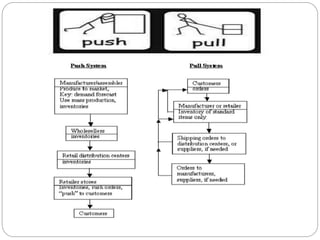
 Push or Building-to-stock(BTS): Producing stock on
the basis of anticipated demand. Demand
forecasting can be done via a variety of
sophisticated techniques (some from the Operations
Research area and some using Data Mining).
 Pull or Building-to-order(BTO): Producing stock in
response to actual demand (firm orders).
 The Push-Pull Point: In many supply chains,
upstream units employ BTS, while downstream units
employ BTO strategies. The point in the supply chain
where the switch-over (from BTS to BTO) occurs is
called the Push-Pull point
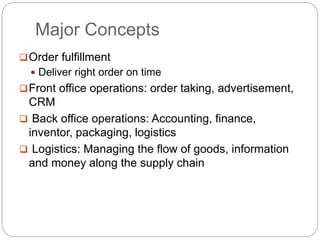
Major Concepts
Order fulfillment
 Deliver right order on time
Front office operations: order taking, advertisement,
CRM
 Back office operations: Accounting, finance,
inventor, packaging, logistics
 Logistics: Managing the flow of goods, information
and money along the supply chain
The Process of Order Fulfillment
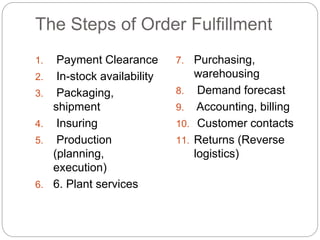
The Steps of Order Fulfillment
1. Payment Clearance
2. In-stock availability
3. Packaging,
shipment
4. Insuring
5. Production
(planning,
execution)
6. 6. Plant services
7. Purchasing,
warehousing
8. Demand forecast
9. Accounting, billing
10. Customer contacts
11. Returns (Reverse
logistics)
Benefits of SCM
 Reduce uncertainty along the chain
 Proper inventory levels in the chain
 Minimize delays
 Eliminate rush (unplanned) activities
 Provide good customer service
Global Supply Chain
 Can be very long
 Possible cross-border problems
 Need information technology support for:
— communication and collaboration
 Possible delays due to: customs, tax,
translations, politics
Problems along the Supply Chain
 Delay in production, distribution etc.
 Expensive Inventories
Lack of partners’ coordination
Uncertainties in deliveries
Poor demand forecast
Interference with production
 Poor quality
More Challenges
Complexity of the supply chain network
– e.g. large numbers of suppliers and distributors
Complexity in product structure and manufacturing
process
–How much product differentiation/customization/
localization should be supported
–Where do you customize a product (upstream or
downstream) ?
 decentralized control/organizational "silos“
 increasing pressure for customer service and asset
increasing pressure for customer service and asset
utilization
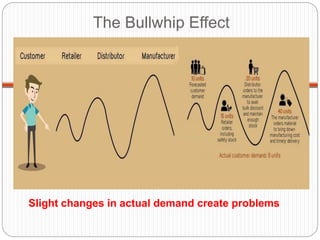
The Bullwhip Effect
Slight changes in actual demand create problems
Common Causes of the Bullwhip
Effect
 Demand forecast
mismatches
 Demand forecasting
distributed across units in the
supply chain
Order Batching
 Sometimes helps achieve
economies of scale
Price Fluctuations
 “forward buy” inducements
through lower prices
 Others:
 Partners build “just in
case” inventories
 Lack of trust among
partners
 Cannot order material
from suppliers
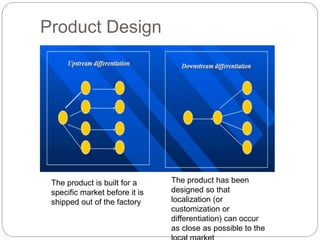
Product Design
The product is built for a
specific market before it is
shipped out of the factory
The product has been
designed so that
localization (or
customization or
differentiation) can occur
as close as possible to the
Example: Dell
Create “Virtual integration” :the entire supply
chain acts like a single integrated company.
 Upstream partners: contract manufacturers (CM) and
component supplier
 Downstream partners/customers (most are business
corporations)
Share information with suppliers on inventory
levels.
Maintain long-term relationships with key
suppliers for design collaboration.
Benefits for Dell
 Dell and Suppliers work together as a “Virtual
Enterprise’’
 BTO benefits (low inventory)
 Dynamic pricing: change prices rapidly in
response to demand and availability
 Strong links to corporate customers
Supply chain integration: Benefits
Tangible benefits Intangible benefits
 Inventory reduction
 personnel reduction
 productivity
improvement
 order management
improvement
 financial cycle
improvements
 Information visibility
 new / improved
processes
 customer
responsiveness
 standardization
 flexibility
 globalization
 and business
performance
Supply chain optimization
Business objective: improve supply chain efficiency
(velocity ?), optimize operation of the supply chain
 Metrics for efficiency - what do we optimize ?
 Define the problem in terms of Define the problem in
terms of decision variables
 Define an objective function in terms of the decision
variables. The goal would be to maximize or minimize the
value of this function , i.e., to find an allocation of values
to the decision variables such that the value of this
function is either maximized or minimized.
 Supply chain optimization is the continuous process of
seeking optimal allocations of values to decision
variables
Common optimization problems: I
Long-term planning (time-frame: several
months/years):
 Questions:
 How much of each product type should I manufacture ? When ? Where
? (Assumes a network of manufacturing centers with potential
duplication of manufacturing capability)
 How much should I keep in inventory (both for manufacturing inputs
and outputs) ? Where ? (Assumes a distributed network of
warehouses)
 Constraints:
 Capacity constraints (both manufacturing and inventory)
 Demand profile
 Process constraints (downtimes, planned outages)
 Supply variability
Objectives: Profit/revenue maximization, maximizing asset
utilization, minimization of deviation from demand profile,
Common optimization problems: II
Medium-term /scheduling (time-frame: a few
months/weeks) :
 Similar to long-term planning, but with scheduling constraints and
objectives added
Unit scheduling/reactive scheduling:
 Questions:
 In what sequence should orders/jobs be manufactured ? Which
job should I process on a given production unit at a given point
in time ? Should I go into overtime ?
 Constraints:
 Capacity constraints
 Sequencing constraints
 Orders + deadlines
 Process constraints (downtimes etc.)
Objectives: Minimize make span (i.e., maximize asset
utilization), minimize deviation from order deadlines,
maximize profit/revenue
Common optimization problems:
III
 Shipping:
 How do I allocate orders to trucks ?
What routes should trucks travel on ?
How do I allocate truck to routes ?
Supply chain management

Supply chain management

  • 2.
    What is aSupply Chain ?  All activities associated with the flow and All activities associated with the flow and transformation of goods from raw materials to end transformation of goods from raw materials to end users. users.  A network of facilities including: – Material flow from suppliers and their “upstream ” suppliers at all levels, Transformation of materials into semi-finished and finished products ( internal process) Distribution of products to customers and their “downstream ”customers at all levels
  • 3.
    Three Flows inSupply Chain There are three kinds of flows in a supply chain: material, information, capital. Downstream  Material: Products, Parts –  Information: Capacity, Delivery Schedules  Finance: Invoices, Pricing, Credit Terms Upstream  Material: Returns, Repairs, After-sales Services  Information: Orders, Point-of-sale Data  Finance: Payments
  • 4.
    Push vs. Pullin supply chain  Push or Building-to-stock(BTS): Producing stock on the basis of anticipated demand. Demand forecasting can be done via a variety of sophisticated techniques (some from the Operations Research area and some using Data Mining).  Pull or Building-to-order(BTO): Producing stock in response to actual demand (firm orders).  The Push-Pull Point: In many supply chains, upstream units employ BTS, while downstream units employ BTO strategies. The point in the supply chain where the switch-over (from BTS to BTO) occurs is called the Push-Pull point
  • 6.
    Major Concepts Order fulfillment Deliver right order on time Front office operations: order taking, advertisement, CRM  Back office operations: Accounting, finance, inventor, packaging, logistics  Logistics: Managing the flow of goods, information and money along the supply chain
  • 7.
    The Process ofOrder Fulfillment
  • 8.
    The Steps ofOrder Fulfillment 1. Payment Clearance 2. In-stock availability 3. Packaging, shipment 4. Insuring 5. Production (planning, execution) 6. 6. Plant services 7. Purchasing, warehousing 8. Demand forecast 9. Accounting, billing 10. Customer contacts 11. Returns (Reverse logistics)
  • 9.
    Benefits of SCM Reduce uncertainty along the chain  Proper inventory levels in the chain  Minimize delays  Eliminate rush (unplanned) activities  Provide good customer service
  • 10.
    Global Supply Chain Can be very long  Possible cross-border problems  Need information technology support for: — communication and collaboration  Possible delays due to: customs, tax, translations, politics
  • 11.
    Problems along theSupply Chain  Delay in production, distribution etc.  Expensive Inventories Lack of partners’ coordination Uncertainties in deliveries Poor demand forecast Interference with production  Poor quality
  • 12.
    More Challenges Complexity ofthe supply chain network – e.g. large numbers of suppliers and distributors Complexity in product structure and manufacturing process –How much product differentiation/customization/ localization should be supported –Where do you customize a product (upstream or downstream) ?  decentralized control/organizational "silos“  increasing pressure for customer service and asset increasing pressure for customer service and asset utilization
  • 13.
    The Bullwhip Effect Slightchanges in actual demand create problems
  • 14.
    Common Causes ofthe Bullwhip Effect  Demand forecast mismatches  Demand forecasting distributed across units in the supply chain Order Batching  Sometimes helps achieve economies of scale Price Fluctuations  “forward buy” inducements through lower prices  Others:  Partners build “just in case” inventories  Lack of trust among partners  Cannot order material from suppliers
  • 15.
    Product Design The productis built for a specific market before it is shipped out of the factory The product has been designed so that localization (or customization or differentiation) can occur as close as possible to the
  • 16.
    Example: Dell Create “Virtualintegration” :the entire supply chain acts like a single integrated company.  Upstream partners: contract manufacturers (CM) and component supplier  Downstream partners/customers (most are business corporations) Share information with suppliers on inventory levels. Maintain long-term relationships with key suppliers for design collaboration.
  • 17.
    Benefits for Dell Dell and Suppliers work together as a “Virtual Enterprise’’  BTO benefits (low inventory)  Dynamic pricing: change prices rapidly in response to demand and availability  Strong links to corporate customers
  • 18.
    Supply chain integration:Benefits Tangible benefits Intangible benefits  Inventory reduction  personnel reduction  productivity improvement  order management improvement  financial cycle improvements  Information visibility  new / improved processes  customer responsiveness  standardization  flexibility  globalization  and business performance
  • 19.
    Supply chain optimization Businessobjective: improve supply chain efficiency (velocity ?), optimize operation of the supply chain  Metrics for efficiency - what do we optimize ?  Define the problem in terms of Define the problem in terms of decision variables  Define an objective function in terms of the decision variables. The goal would be to maximize or minimize the value of this function , i.e., to find an allocation of values to the decision variables such that the value of this function is either maximized or minimized.  Supply chain optimization is the continuous process of seeking optimal allocations of values to decision variables
  • 20.
    Common optimization problems:I Long-term planning (time-frame: several months/years):  Questions:  How much of each product type should I manufacture ? When ? Where ? (Assumes a network of manufacturing centers with potential duplication of manufacturing capability)  How much should I keep in inventory (both for manufacturing inputs and outputs) ? Where ? (Assumes a distributed network of warehouses)  Constraints:  Capacity constraints (both manufacturing and inventory)  Demand profile  Process constraints (downtimes, planned outages)  Supply variability Objectives: Profit/revenue maximization, maximizing asset utilization, minimization of deviation from demand profile,
  • 21.
    Common optimization problems:II Medium-term /scheduling (time-frame: a few months/weeks) :  Similar to long-term planning, but with scheduling constraints and objectives added Unit scheduling/reactive scheduling:  Questions:  In what sequence should orders/jobs be manufactured ? Which job should I process on a given production unit at a given point in time ? Should I go into overtime ?  Constraints:  Capacity constraints  Sequencing constraints  Orders + deadlines  Process constraints (downtimes etc.) Objectives: Minimize make span (i.e., maximize asset utilization), minimize deviation from order deadlines, maximize profit/revenue
  • 22.
    Common optimization problems: III Shipping:  How do I allocate orders to trucks ? What routes should trucks travel on ? How do I allocate truck to routes ?