Supply Chain Management
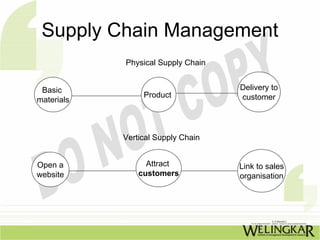
            Physical Supply Chain


 Basic                              Delivery to
                 Product            customer
materials


            Vertical Supply Chain


Open a            Attract           Link to sales
website         customers           organisation
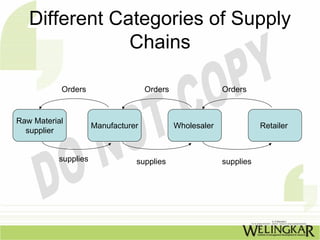
Different Categories of Supply
               Chains

           Orders                   Orders                Orders


Raw Material
                     Manufacturer            Wholesaler              Retailer
  supplier


          supplies              supplies                  supplies
Benefits of SCM

i.   Get the right product at the right place at
     the least cost
ii. Keep Inventory as low as possible and
     still offer superior customer service
iii. Reduce cycle times
Goals of SCM
• To cut costs
• Increase profits
• Improve performance in
  relationships with
  customers and suppliers
• Develop value added
  services that give a
  company a competitive
  edge
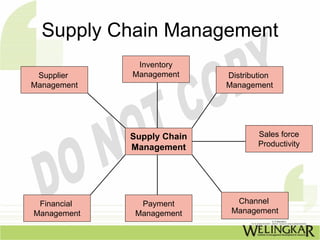
Supply Chain Management
              Inventory
 Supplier    Management     Distribution
Management                  Management


             Supply Chain           Sales force
             Management             Productivity


 Financial     Payment        Channel
Management    Management     Management
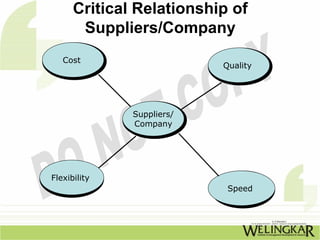
Critical Relationship of
       Suppliers/Company
   Cost
                           Quality


              Suppliers/
              Company


Flexibility
                            Speed
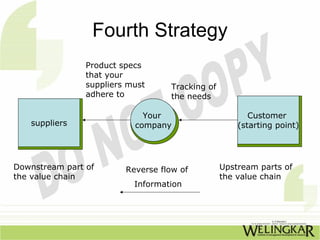
Fourth Strategy
                Product specs
                that your
                suppliers must     Tracking of
                adhere to          the needs

                             Your                       Customer
   suppliers               company                   (starting point)


Downstream part of       Reverse flow of         Upstream parts of
the value chain                                  the value chain
                           Information
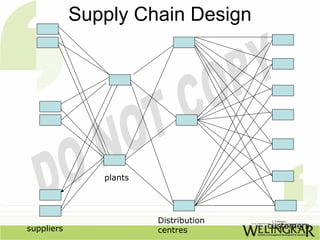
Supply Chain Design


               plants


                        Distribution
suppliers                              customers
                        centres
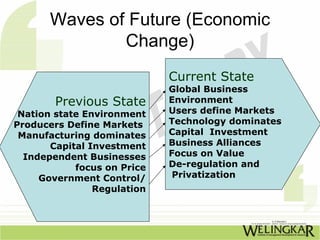
Waves of Future (Economic
               Change)
                             Current State
                             Global Business
        Previous State       Environment
 Nation state Environment    Users define Markets
Producers Define Markets     Technology dominates
 Manufacturing dominates     Capital Investment
       Capital Investment    Business Alliances
  Independent Businesses     Focus on Value
            focus on Price   De-regulation and
     Government Control/      Privatization
                Regulation
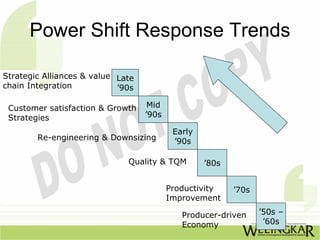
Power Shift Response Trends

Strategic Alliances & value Late
chain Integration           ’90s

 Customer satisfaction & Growth     Mid
 Strategies                        ’90s

                                           Early
        Re-engineering & Downsizing        ’90s

                              Quality & TQM        ’80s


                                          Productivity    ’70s
                                          Improvement

                                             Producer-driven     ’50s –
                                             Economy              ’60s
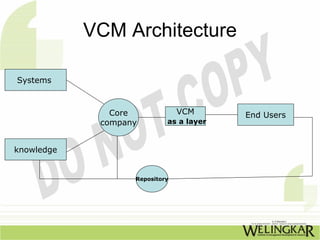
VCM Architecture

Systems


               Core             VCM      End Users
             company        as a layer


knowledge


                   Repository
Characteristics of SCM - 1
• Sourcing of raw materials or finished
  goods from anywhere in the world
• Centralised global business &
  management strategy with hem less local
  execution
• On-line, real time distributed information
  processing providing total supply chain
  information visibility
• Ability to manage information not only
  within a company but across industries &
  enterprises
Characteristics of SCM - 2
• Seamless integration of all supply chain
  processes including third party suppliers,
  information systems, cost accuring
  standards and measurement systems
• Development & implementation of
  accounting models
• Reorganisation of the supply chain
  organisation into high-performance teams
Factors hindering re-combinant
          business models
• Disparate data           • Proprietary standards
  models                   • Inertia & fear of
• Disparate trading          change
  partner capabilities     • Competitiveness
• Disparate process          based on business
  models                     process differences
• Semantic                 • Point to point
  heterogeneity              interfaces
• Integration as trading
  partner lockin
SCP Tools

    • Strategic planning
      tools
    • Executive &
      implementation
      tools
    • Tactical planning
      tools
Tactical Planning
•   Network                  • Transportation &
•   Available to Promise(ATP) Scheduling
•   Capable to Promise (CTP) • Manufacturing
•   Capacity planning
•   Demand planning
•   Distribution planning
•   Deployment planning
•   Sales & operation
Enterprise Collaboration
Goals

Communicate

Coordinate

Collaborate
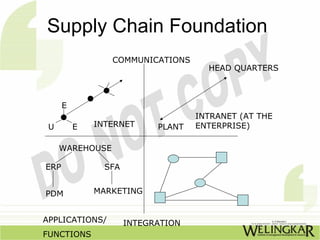
Supply Chain Foundation
                 COMMUNICATIONS
                                      HEAD QUARTERS


      E
                                    INTRANET (AT THE
 U        E   INTERNET      PLANT   ENTERPRISE)

     WAREHOUSE

ERP             SFA


PDM           MARKETING


APPLICATIONS/         INTEGRATION
FUNCTIONS
“Like” us on Facebook: 
   p //                 /
http://www.facebook.com/welearnindia 

“Follow” us on Twitter:
http://twitter.com/WeLearnIndia
http://twitter com/WeLearnIndia

Watch informative videos on Youtube: 
http://www.youtube.com/WelingkarDLP

Supply Chain Management

  • 1.
  • 2.
    Supply Chain Management Physical Supply Chain Basic Delivery to Product customer materials Vertical Supply Chain Open a Attract Link to sales website customers organisation
  • 3.
    Different Categories ofSupply Chains Orders Orders Orders Raw Material Manufacturer Wholesaler Retailer supplier supplies supplies supplies
  • 4.
    Benefits of SCM i. Get the right product at the right place at the least cost ii. Keep Inventory as low as possible and still offer superior customer service iii. Reduce cycle times
  • 5.
    Goals of SCM •To cut costs • Increase profits • Improve performance in relationships with customers and suppliers • Develop value added services that give a company a competitive edge
  • 6.
    Supply Chain Management Inventory Supplier Management Distribution Management Management Supply Chain Sales force Management Productivity Financial Payment Channel Management Management Management
  • 7.
    Critical Relationship of Suppliers/Company Cost Quality Suppliers/ Company Flexibility Speed
  • 8.
    Fourth Strategy Product specs that your suppliers must Tracking of adhere to the needs Your Customer suppliers company (starting point) Downstream part of Reverse flow of Upstream parts of the value chain the value chain Information
  • 9.
    Supply Chain Design plants Distribution suppliers customers centres
  • 10.
    Waves of Future(Economic Change) Current State Global Business Previous State Environment Nation state Environment Users define Markets Producers Define Markets Technology dominates Manufacturing dominates Capital Investment Capital Investment Business Alliances Independent Businesses Focus on Value focus on Price De-regulation and Government Control/ Privatization Regulation
  • 11.
    Power Shift ResponseTrends Strategic Alliances & value Late chain Integration ’90s Customer satisfaction & Growth Mid Strategies ’90s Early Re-engineering & Downsizing ’90s Quality & TQM ’80s Productivity ’70s Improvement Producer-driven ’50s – Economy ’60s
  • 12.
    VCM Architecture Systems Core VCM End Users company as a layer knowledge Repository
  • 13.
    Characteristics of SCM- 1 • Sourcing of raw materials or finished goods from anywhere in the world • Centralised global business & management strategy with hem less local execution • On-line, real time distributed information processing providing total supply chain information visibility • Ability to manage information not only within a company but across industries & enterprises
  • 14.
    Characteristics of SCM- 2 • Seamless integration of all supply chain processes including third party suppliers, information systems, cost accuring standards and measurement systems • Development & implementation of accounting models • Reorganisation of the supply chain organisation into high-performance teams
  • 15.
    Factors hindering re-combinant business models • Disparate data • Proprietary standards models • Inertia & fear of • Disparate trading change partner capabilities • Competitiveness • Disparate process based on business models process differences • Semantic • Point to point heterogeneity interfaces • Integration as trading partner lockin
  • 16.
    SCP Tools • Strategic planning tools • Executive & implementation tools • Tactical planning tools
  • 17.
    Tactical Planning • Network • Transportation & • Available to Promise(ATP) Scheduling • Capable to Promise (CTP) • Manufacturing • Capacity planning • Demand planning • Distribution planning • Deployment planning • Sales & operation
  • 18.
  • 19.
    Supply Chain Foundation COMMUNICATIONS HEAD QUARTERS E INTRANET (AT THE U E INTERNET PLANT ENTERPRISE) WAREHOUSE ERP SFA PDM MARKETING APPLICATIONS/ INTEGRATION FUNCTIONS
  • 20.
    “Like” us on Facebook:  p // / http://www.facebook.com/welearnindia  “Follow” us on Twitter: http://twitter.com/WeLearnIndia http://twitter com/WeLearnIndia Watch informative videos on Youtube:  http://www.youtube.com/WelingkarDLP