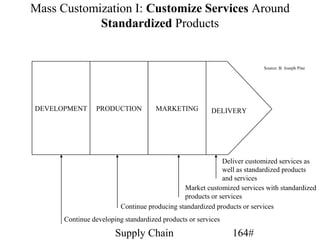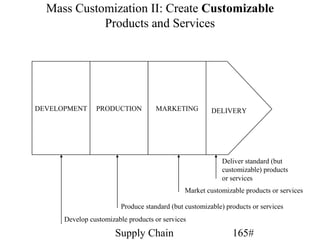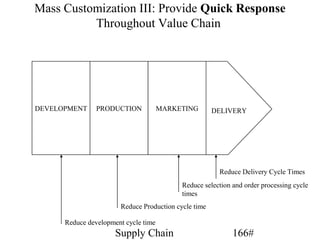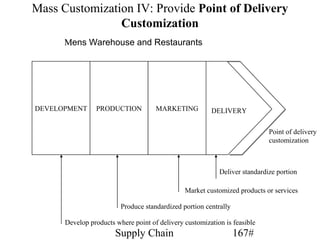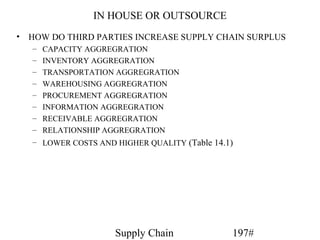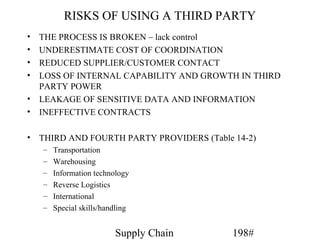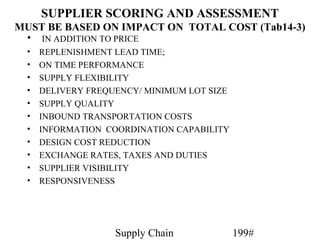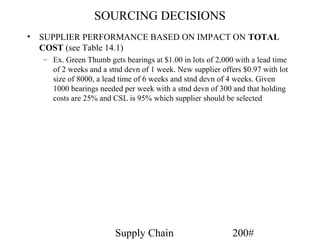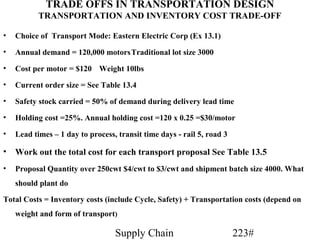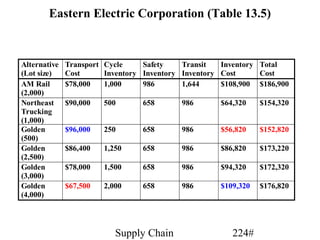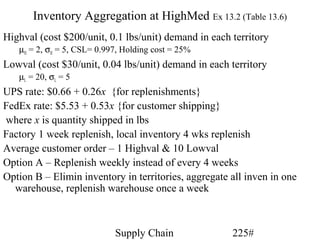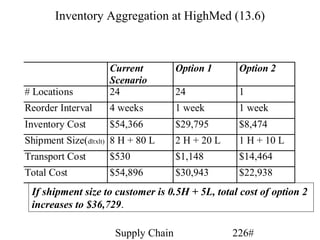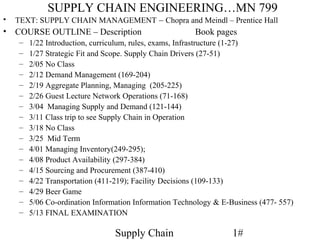
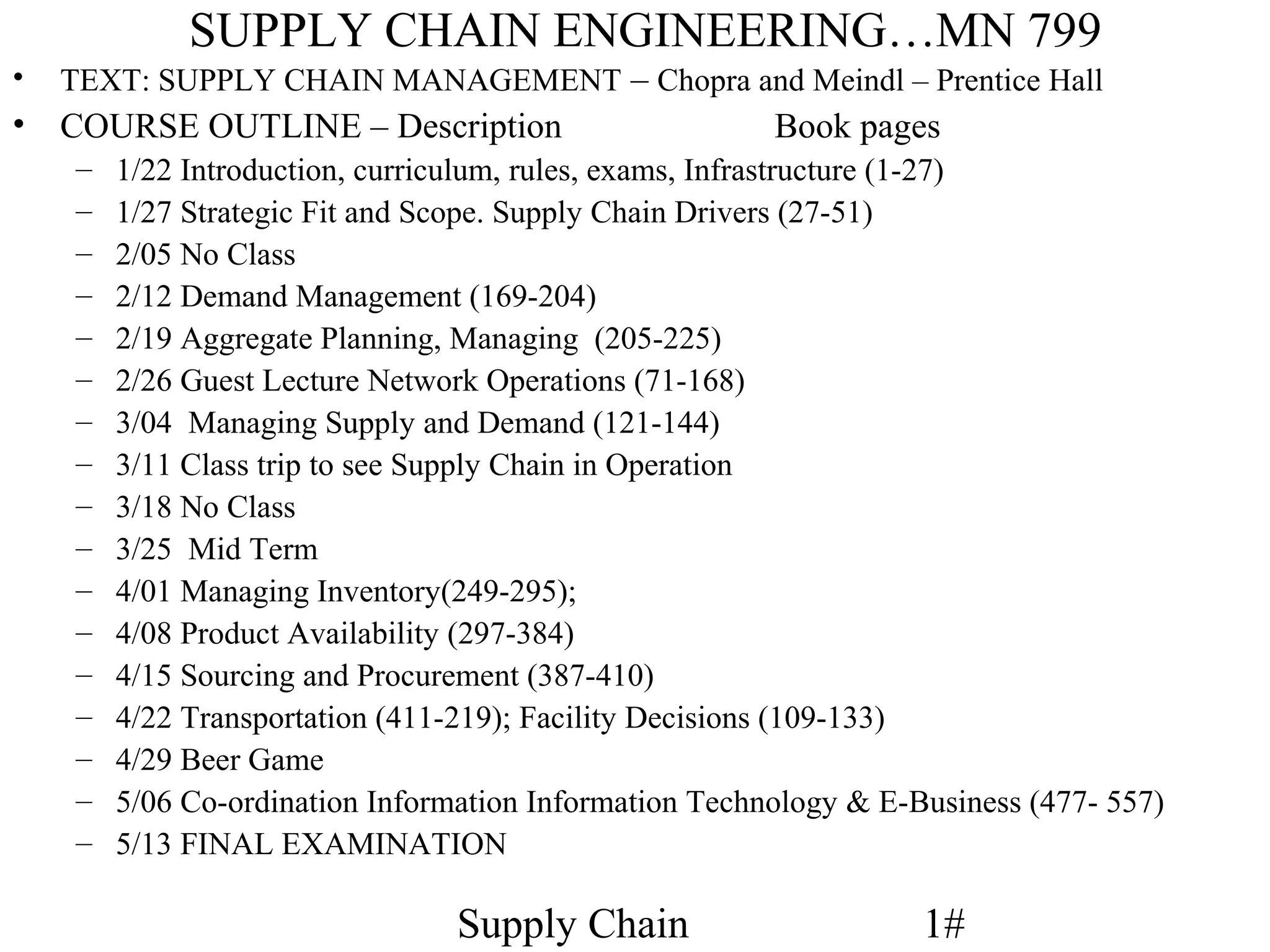
SUPPLY CHAIN ENGINEERING…MN 799
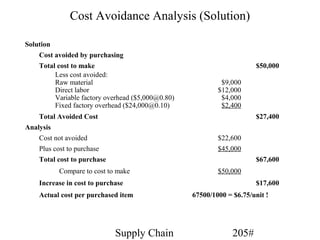
•   TEXT: SUPPLY CHAIN MANAGEMENT – Chopra and Meindl – Prentice Hall
•   COURSE OUTLINE – Description                        Book pages
    –   1/22 Introduction, curriculum, rules, exams, Infrastructure (1-27)
    –   1/27 Strategic Fit and Scope. Supply Chain Drivers (27-51)
    –   2/05 No Class
    –   2/12 Demand Management (169-204)
    –   2/19 Aggregate Planning, Managing (205-225)
    –   2/26 Guest Lecture Network Operations (71-168)
    –   3/04 Managing Supply and Demand (121-144)
    –   3/11 Class trip to see Supply Chain in Operation
    –   3/18 No Class
    –   3/25 Mid Term
    –   4/01 Managing Inventory(249-295);
    –   4/08 Product Availability (297-384)
    –   4/15 Sourcing and Procurement (387-410)
    –   4/22 Transportation (411-219); Facility Decisions (109-133)
    –   4/29 Beer Game
    –   5/06 Co-ordination Information Information Technology & E-Business (477- 557)
    –   5/13 FINAL EXAMINATION

                                 Supply Chain                      1#
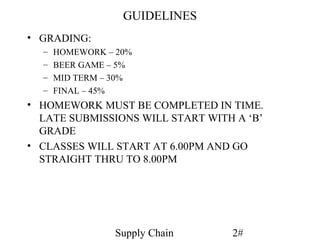
GUIDELINES
• GRADING:
  –   HOMEWORK – 20%
  –   BEER GAME – 5%
  –   MID TERM – 30%
  –   FINAL – 45%
• HOMEWORK MUST BE COMPLETED IN TIME.
  LATE SUBMISSIONS WILL START WITH A ‘B’
  GRADE
• CLASSES WILL START AT 6.00PM AND GO
  STRAIGHT THRU TO 8.00PM


                 Supply Chain     2#
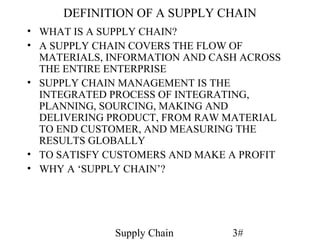
DEFINITION OF A SUPPLY CHAIN
• WHAT IS A SUPPLY CHAIN?
• A SUPPLY CHAIN COVERS THE FLOW OF
  MATERIALS, INFORMATION AND CASH ACROSS
  THE ENTIRE ENTERPRISE
• SUPPLY CHAIN MANAGEMENT IS THE
  INTEGRATED PROCESS OF INTEGRATING,
  PLANNING, SOURCING, MAKING AND
  DELIVERING PRODUCT, FROM RAW MATERIAL
  TO END CUSTOMER, AND MEASURING THE
  RESULTS GLOBALLY
• TO SATISFY CUSTOMERS AND MAKE A PROFIT
• WHY A ‘SUPPLY CHAIN’?


             Supply Chain       3#
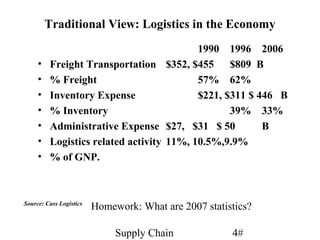
Traditional View: Logistics in the Economy
                                          1990 1996 2006
     •   Freight Transportation $352, $455       $809 B
     •   % Freight                        57% 62%
     •   Inventory Expense                $221, $311 $ 446 B
     •   % Inventory                             39% 33%
     •   Administrative Expense $27, $31 $ 50           B
     •   Logistics related activity 11%, 10.5%,9.9%
     •   % of GNP.


Source: Cass Logistics
                         Homework: What are 2007 statistics?

                              Supply Chain             4#
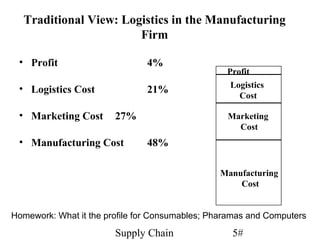
Traditional View: Logistics in the Manufacturing
                       Firm

 • Profit                      4%
                                                  Profit
 • Logistics Cost                                  Logistics
                               21%
                                                     Cost

 • Marketing Cost       27%                       Marketing
                                                    Cost
 • Manufacturing Cost          48%

                                                Manufacturing
                                                    Cost


Homework: What it the profile for Consumables; Pharamas and Computers

                        Supply Chain               5#
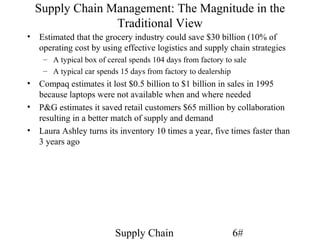
Supply Chain Management: The Magnitude in the
                Traditional View
• Estimated that the grocery industry could save $30 billion (10% of
  operating cost by using effective logistics and supply chain strategies
    – A typical box of cereal spends 104 days from factory to sale
    – A typical car spends 15 days from factory to dealership
• Compaq estimates it lost $0.5 billion to $1 billion in sales in 1995
  because laptops were not available when and where needed
• P&G estimates it saved retail customers $65 million by collaboration
  resulting in a better match of supply and demand
• Laura Ashley turns its inventory 10 times a year, five times faster than
  3 years ago


                         Supply Chain                        6#
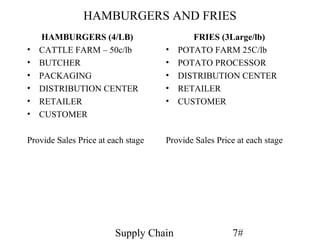
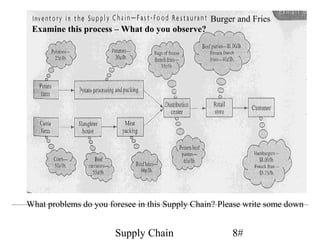
HAMBURGERS AND FRIES
    HAMBURGERS (4/LB)                      FRIES (3Large/lb)
•   CATTLE FARM – 50c/lb            •   POTATO FARM 25C/lb
•   BUTCHER                         •   POTATO PROCESSOR
•   PACKAGING                       •   DISTRIBUTION CENTER
•   DISTRIBUTION CENTER             •   RETAILER
•   RETAILER                        •   CUSTOMER
•   CUSTOMER

Provide Sales Price at each stage   Provide Sales Price at each stage


                        Supply Chain                  7#
Burger and Fries
 Examine this process – What do you observe?


What problems do you foresee in this Supply Chain? Please write some down


                       Supply Chain                   8#
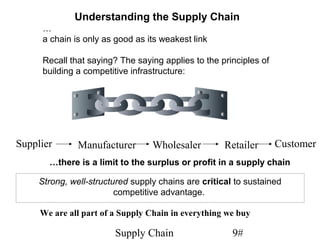
Understanding the Supply Chain
     …
     a chain is only as good as its weakest link

     Recall that saying? The saying applies to the principles of
     building a competitive infrastructure:


Supplier       Manufacturer       Wholesaler         Retailer      Customer
       …there is a limit to the surplus or profit in a supply chain

     Strong, well-structured supply chains are critical to sustained
                         competitive advantage.

     We are all part of a Supply Chain in everything we buy

                        Supply Chain                   9#
OBJECTIVES OF A SUPPLY CHAIN
• MAXIMIZE OVERALL VALUE GENERATED
  – SATISFYING CUSTOMER NEEDS AT A PROFIT
  – VALUE STRONGLY CORRELATED TO PROFITABILITY
  – SOURCE OF REVENUE – CUSTOMER
  – COST GENERATED WITHIN SUPPLY CHAIN BY FLOWS OF
    INFORMATION, PRODUCT AND CASH
  – FLOWS OCCUR ACROSS ALL STAGES – CUSTOMER,
    RETAILER, WHOLESALER, DISTRIBUTOR, MANUFACTURER
    AND SUPPLIER
  – MANAGEMENT OF FLOWS KEY TO SUPPLY CHAIN
    SUCCESS


        UNDERSTAND EACH OBJECTIVE
               Supply Chain          10#
DECISION PHASES IN A SUPPLY CHAIN
• OVERALL STRATEGY OF COMPANY – EFFICIENT OR
  RESPONSIVE
• SUPPLY CHAIN STRATEGY OR DESIGN ?
  – LOCATION AND CAPACITY OF PRODUCTION AND WAREHOUSE
    FACILITIES?
  – PRODUCTS TO BE MANUF, PURCHASED OR STORED BY LOCATION?
  – MODES OF TRANSPORTATION?
  – INFORMATION SYSTEMS TO BE USED?
  – CONFIGURATION MUST SUPPORT OVERALL STRAGEGY
• SUPPLY CHAIN PLANNING?
  – OPERATING POLICIES – MARKETS SERVED, INVENTORY HELD,
    SUBCONTRACTING, PROMOTIONS, …?
• SUPPLY CHAIN OPERATION?
  – DECISIONS AND EXECUTION OF ORDERS?


                    Supply Chain           11#
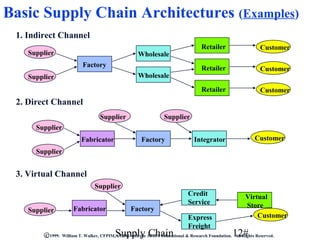
Basic Supply Chain Architectures (Examples)
 1. Indirect Channel
                                                                                   Retailer                    Customer
    Supplier                                         Wholesale
                          Factory                                                  Retailer                    Customer
    Supplier                                         Wholesale
                                                                                   Retailer                    Customer
 2. Direct Channel
                                   Supplier                      Supplier
      Supplier
                          Fabricator                  Factory                  Integrator                   Customer
      Supplier


 3. Virtual Channel
                                Supplier
                                                                             Credit                     Virtual
                                                                             Service                    Store
    Supplier          Fabricator                 Factory
                                                                             Express                        Customer
                                                                             Freight
                                          Supply Chain                                            12#
         C 1999. William T. Walker, CFPIM, CIRM with the APICS Educational & Research Foundation. All Rights Reserved.
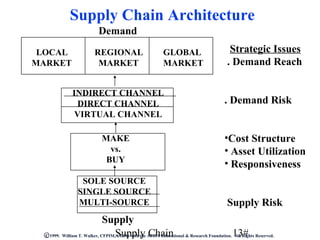
Supply Chain Architecture
                         Demand
 LOCAL                 REGIONAL                       GLOBAL                       Strategic Issues
MARKET                  MARKET                        MARKET                      . Demand Reach

             INDIRECT CHANNEL
              DIRECT CHANNEL                                                     . Demand Risk
              VIRTUAL CHANNEL

                          MAKE                                                   •Cost Structure
                            vs.                                                  • Asset Utilization
                           BUY                                                   • Responsiveness
                 SOLE SOURCE
                SINGLE SOURCE
                MULTI-SOURCE                                                      Supply Risk
                              Supply
  C 1999. William T. Walker, CFPIM,Supply APICS Educational & Research Foundation. 13#
                                   CIRM with the Chain                             All Rights Reserved.
SUPPLY CHAIN FRAMEWORK AND
      INFRASTRUCTURE


        PRINCIPLE:

     BUILD A COMPETITIVE
       INFRASTRUCTURE

       This principle is about

         VELOCITY


       Supply Chain          14#
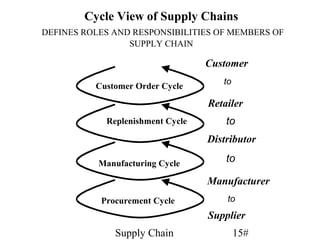
Cycle View of Supply Chains
DEFINES ROLES AND RESPONSIBILITIES OF MEMBERS OF
                 SUPPLY CHAIN

                                  Customer
                                     to
          Customer Order Cycle

                                  Retailer
            Replenishment Cycle       to
                                  Distributor

           Manufacturing Cycle        to

                                  Manufacturer
           Procurement Cycle          to
                                  Supplier
              Supply Chain                15#
PROCESS VIEW OF A SUPPLY CHAIN

• CUSTOMER ORDER CYCLE
  – TRIGGER: MAXIMIZE CONVERSION OF CUSTOMER
    ARRIVALS TO CUSTOMER ORDERS
  – ENTRY: ENSURE ORDER QUICKLY AND ACCURATELY
    COMMUNICATED TO ALL SUPPLY CHAIN PROCESSES
  – FULFILLMENT: GET CORRECT AND COMPLETE ORDERS
    TO CUSTOMERS BY PROMISED DUE DATES AT LOWEST
    COST
  – RECEIVING: CUSTOMER GETS ORDER


               Supply Chain          16#
PROCESS VIEW OF A SUPPLY CHAIN
• REPLENISHMENT CYCLE
  – REPLENISH INVENTORIES AT RETAILER AT MINIMUM COST WHILE
    PROVIDING NECESSARY PRODUCT AVAILABILITY TO CUSTOMER
  – RETAIL ORDER:
     • TRIGGER – REPLENISHMENT POINT – BALANCE SERVICE AND
       INVENTORY
     • ENTRY – ACCURATE AND QUICK TO ALL SUPPLY CHAIN
     • FULFILLMENT – BY DISTRIBUTOR OR MFG. – ON TIME
     • RECEIVING – BY RETAILER, UPDATE RECORDS
• MANUFACTURING CYCLE
  – INCLUDES ALL PROCESSES INVOLVED IN REPLENISHING
    DISTRIBUTOR (RETAILER) INVENTORY, ON TIME @ OPTIMUM COST
  – ORDER ARRIVAL
  – PRODUCTION SCHEDULING
  – MANUFACTURING AND SHIPPING
  – RECEIVING


                     Supply Chain                 17#
PROCESS VIEW OF A SUPPLY CHAIN
• PROCUREMENT CYCLE
   – SEVERAL TIERS OF SUPPLIERS
   – INCLUDES ALL PROCESSES INVOLVED IN ENSURING
     MATERIAL AVAILABLE WHEN REQUIRED


• SUPPLY CHAIN MACRO PROCESSES
• CRM – All processes focusing on interface between firm and
  customers
• ISCM – A processes internal to firm
• SRM – All processes focusing on interface between firm and
  suppliers


                   Supply Chain              18#
FRONT OFFICE

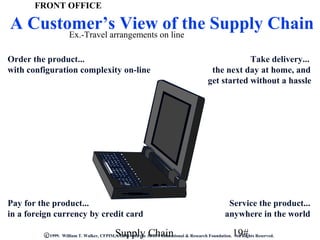
A Customer’s View on linethe Supply Chain
       Ex.-Travel arrangements
                               of
Order the product...                                                                               Take delivery...
with configuration complexity on-line                                                   the next day at home, and
                                                                                       get started without a hassle


Pay for the product...                                                                          Service the product...
in a foreign currency by credit card                                                           anywhere in the world

                                           Supply Chain                                            19#
          C 1999. William T. Walker, CFPIM, CIRM with the APICS Educational & Research Foundation. All Rights Reserved.
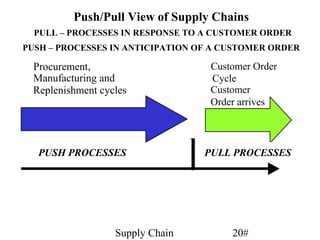
Push/Pull View of Supply Chains
  PULL – PROCESSES IN RESPONSE TO A CUSTOMER ORDER
PUSH – PROCESSES IN ANTICIPATION OF A CUSTOMER ORDER

 Procurement,                      Customer Order
 Manufacturing and                 Cycle
 Replenishment cycles              Customer
                                   Order arrives


  PUSH PROCESSES                  PULL PROCESSES


                  Supply Chain         20#
UNDERSTANDING THE SUPPLY CHAIN
• Homework
• EXAMPLES:
  – EXAMPLES OF SUPPLY CHAINS –1.5 – pp 20-25
  – WHAT ARE SOME OF THE KEY ISSUES IN THESE SUPPLY
    CHAINS
  – ANALYSE AND COMMENT ON 7-Eleven and Amazon– ANSWER
    QUESTIONS 1TO 6 FOR EACH


                 Supply Chain            21#
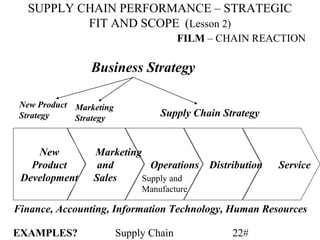
SUPPLY CHAIN PERFORMANCE – STRATEGIC
          FIT AND SCOPE (Lesson 2)
                                        FILM – CHAIN REACTION

                 Business Strategy

 New Product Marketing
 Strategy    Strategy
                                  Supply Chain Strategy


    New          Marketing
   Product        and        Operations Distribution      Service
 Development     Sales     Supply and
                              Manufacture

Finance, Accounting, Information Technology, Human Resources

EXAMPLES?                Supply Chain            22#
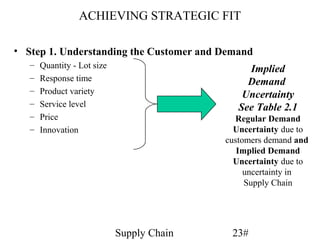
ACHIEVING STRATEGIC FIT

• Step 1. Understanding the Customer and Demand
   –   Quantity - Lot size                       Implied
   –   Response time                             Demand
   –   Product variety                          Uncertainty
   –   Service level                           See Table 2.1
   –   Price                                  Regular Demand
   –   Innovation                             Uncertainty due to
                                            customers demand and
                                               Implied Demand
                                              Uncertainty due to
                                                 uncertainty in
                                                 Supply Chain


                             Supply Chain    23#
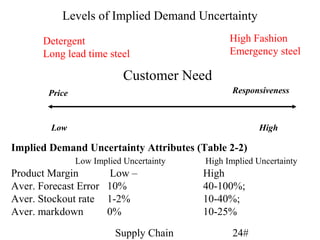
Levels of Implied Demand Uncertainty
       Detergent                                High Fashion
       Long lead time steel                     Emergency steel

                            Customer Need
        Price                                    Responsiveness


         Low                                            High

Implied Demand Uncertainty Attributes (Table 2-2)
                Low Implied Uncertainty   High Implied Uncertainty
Product Margin           Low –            High
Aver. Forecast Error    10%               40-100%;
Aver. Stockout rate     1-2%              10-40%;
Aver. markdown          0%                10-25%

                          Supply Chain           24#
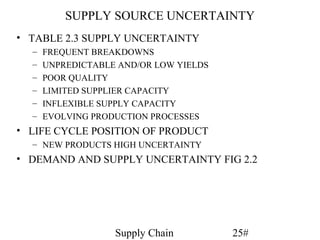
SUPPLY SOURCE UNCERTAINTY
• TABLE 2.3 SUPPLY UNCERTAINTY
  –   FREQUENT BREAKDOWNS
  –   UNPREDICTABLE AND/OR LOW YIELDS
  –   POOR QUALITY
  –   LIMITED SUPPLIER CAPACITY
  –   INFLEXIBLE SUPPLY CAPACITY
  –   EVOLVING PRODUCTION PROCESSES
• LIFE CYCLE POSITION OF PRODUCT
  – NEW PRODUCTS HIGH UNCERTAINTY
• DEMAND AND SUPPLY UNCERTAINTY FIG 2.2


                   Supply Chain         25#
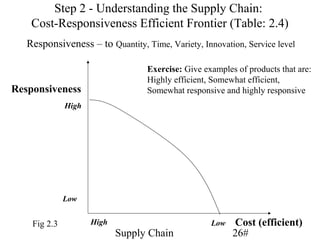
Step 2 - Understanding the Supply Chain:
    Cost-Responsiveness Efficient Frontier (Table: 2.4)
   Responsiveness – to Quantity, Time, Variety, Innovation, Service level

                                  Exercise: Give examples of products that are:
                                  Highly efficient, Somewhat efficient,
Responsiveness                    Somewhat responsive and highly responsive
              High


              Low


    Fig 2.3          High                          Low   Cost (efficient)
                            Supply Chain                 26#
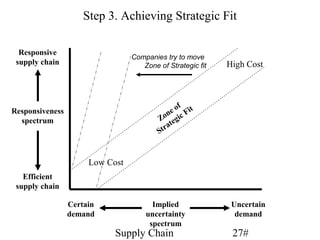
Step 3. Achieving Strategic Fit

  Responsive
                                 Companies try to move
 supply chain                       Zone of Strategic fit   High Cost


                                                 f
Responsiveness                              n e o Fit
  spectrum                               Zo egic
                                             t
                                         Stra


                      Low Cost
   Efficient
 supply chain

                 Certain               Implied               Uncertain
                 demand              uncertainty              demand
                                      spectrum
                            Supply Chain                     27#
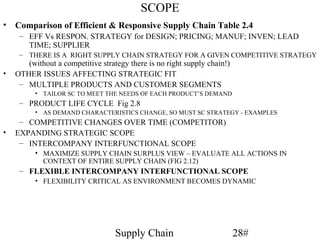
SCOPE
•   Comparison of Efficient & Responsive Supply Chain Table 2.4
     – EFF Vs RESPON. STRATEGY for DESIGN; PRICING; MANUF; INVEN; LEAD
       TIME; SUPPLIER
     – THERE IS A RIGHT SUPPLY CHAIN STRATEGY FOR A GIVEN COMPETITIVE STRATEGY
       (without a competitive strategy there is no right supply chain!)
•   OTHER ISSUES AFFECTING STRATEGIC FIT
     – MULTIPLE PRODUCTS AND CUSTOMER SEGMENTS
          • TAILOR SC TO MEET THE NEEDS OF EACH PRODUCT’S DEMAND
     – PRODUCT LIFE CYCLE Fig 2.8
          • AS DEMAND CHARACTERISTICS CHANGE, SO MUST SC STRATEGY - EXAMPLES
     – COMPETITIVE CHANGES OVER TIME (COMPETITOR)
•   EXPANDING STRATEGIC SCOPE
     – INTERCOMPANY INTERFUNCTIONAL SCOPE
          • MAXIMIZE SUPPLY CHAIN SURPLUS VIEW – EVALUATE ALL ACTIONS IN
            CONTEXT OF ENTIRE SUPPLY CHAIN (FIG 2.12)
     – FLEXIBLE INTERCOMPANY INTERFUNCTIONAL SCOPE
          • FLEXIBILITY CRITICAL AS ENVIRONMENT BECOMES DYNAMIC


                                   Supply Chain                           28#
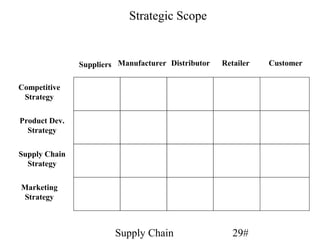
Strategic Scope


               Suppliers Manufacturer Distributor   Retailer   Customer


Competitive
 Strategy

Product Dev.
  Strategy

Supply Chain
  Strategy

Marketing
 Strategy


                        Supply Chain                   29#
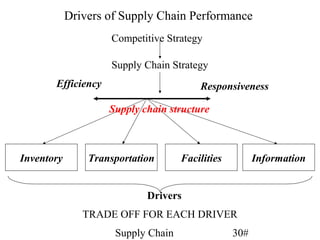
Drivers of Supply Chain Performance
                    Competitive Strategy

                    Supply Chain Strategy
       Efficiency                       Responsiveness

                    Supply chain structure


Inventory       Transportation      Facilities         Information


                            Drivers
               TRADE OFF FOR EACH DRIVER
                     Supply Chain                30#
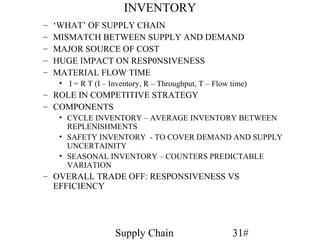
INVENTORY
–   ‘WHAT’ OF SUPPLY CHAIN
–   MISMATCH BETWEEN SUPPLY AND DEMAND
–   MAJOR SOURCE OF COST
–   HUGE IMPACT ON RESP0NSIVENESS
–   MATERIAL FLOW TIME
     • I = R T (I – Inventory, R – Throughput, T – Flow time)
– ROLE IN COMPETITIVE STRATEGY
– COMPONENTS
     • CYCLE INVENTORY – AVERAGE INVENTORY BETWEEN
       REPLENISHMENTS
     • SAFETY INVENTORY - TO COVER DEMAND AND SUPPLY
       UNCERTAINITY
     • SEASONAL INVENTORY – COUNTERS PREDICTABLE
       VARIATION
– OVERALL TRADE OFF: RESPONSIVENESS VS
  EFFICIENCY


                     Supply Chain                       31#
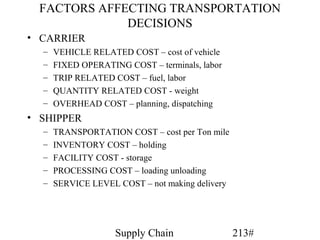
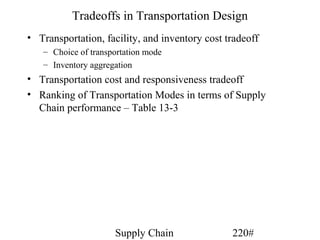
TRANSPORTATION
•   ‘HOW’ OF SUPPLY CHAIN
•   LARGE IMPACT ON RESPONSIVENESS AND EFFICIENCY
•   ROLE IN COMPETITIVE STRATEGY
•   COMPONENTS
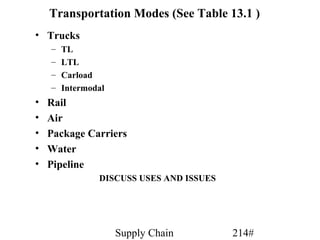
    – MODE – AIR, TRUCK, RAIL, SHIP, PIPELINE, ELECTRONIC
    – ROUTE SELECTION
    – IN HOUSE OR OUTSOURCE
• OVERALL TRADE OFF: RESPONSIVENESS VS EFFICIENCY


                     Supply Chain                32#
FACILITIES
• ‘WHERE’ OF SUPPLY CHAIN
• TRANSFORMED (FACTORY) OR STORED
  (WAREHOUSE)
• ROLE IN COMPETITIVE STRATEGY
• COMPONENTS
  – LOCATION - CENTRAL OR DECENTRAL
  – CAPACITY – FLEXIBILITY VS EFFICIENCY
  – MANUFACTURING METHODOLOGY – PRODUCT OR
    PROCESS FOCUS
  – WAREHOUSING METHODOLOGY – STORAGE – SKU, JOB
    LOT, CROSSDOCKING
• OVERALL TRADE OFF: RESPONSIVENESS VS
  EFFICIENCY


               Supply Chain          33#
INFORMATION
• AFFECTS EVERY PART OF SUPPLY CHAIN
   – CONNECTS ALL STAGES
   – ESSENTIAL TO OPERATION OF ALL STAGES
• ROLE IN COMPETITIVE STATEGY
   – SUBSTITUTE FOR INVENTORY
• COMPONENTS
   –   PUSH VS PULL
   –   COORDINATION AND INFORMATION SHARING
   –   FORECASTING AND AGGREGATE PLANNING
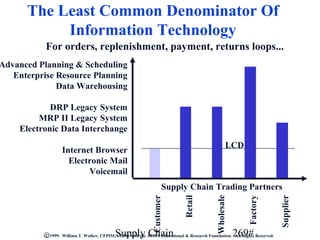
   –   ENABLING TECHNOLOGIES
        •   EDI
        •   INTERNET
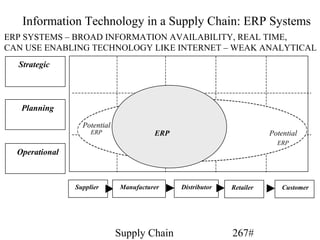
        •   ERP
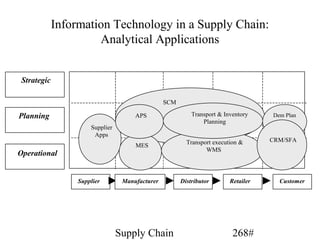
        •   SCM
• OVERALL TRADE OFF: RESPONSIVENESS VS EFFICIENCY ?


                       Supply Chain           34#
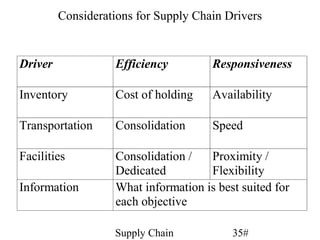
Considerations for Supply Chain Drivers


Driver              Efficiency         Responsiveness

Inventory           Cost of holding    Availability

Transportation      Consolidation      Speed

Facilities          Consolidation /   Proximity /
                    Dedicated         Flexibility
Information         What information is best suited for
                    each objective

                   Supply Chain            35#
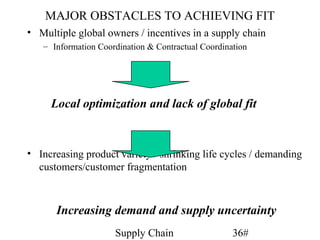
MAJOR OBSTACLES TO ACHIEVING FIT
• Multiple global owners / incentives in a supply chain
   – Information Coordination & Contractual Coordination


     Local optimization and lack of global fit


• Increasing product variety / shrinking life cycles / demanding
  customers/customer fragmentation


      Increasing demand and supply uncertainty
                     Supply Chain                   36#
OBSTACLES TO ACHIEVING STRATEGIC FIT
•   INCREASING VARIETY OF PRODUCTS
•   DECREASING PRODUCT LIFE CYCLES
•   INCREASINGLY DEMANDING CUSTOMERS
•   FRAGMENTATION OF SUPPLY CHAIN OWNERSHIP
•   GLOBALIZATION
•   DIFFICULTY EXECUTING NEW STRATEGIES
•   ALL INCREASE UNCERTAINTY


               Supply Chain      37#
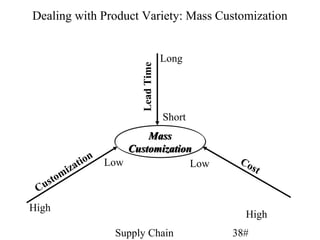
Dealing with Product Variety: Mass Customization


                                   Long


                       Lead Time
                                   Short
                          Mass
                      Customization
            t ion Low              Low      Co
         za                                    st
       mi
   sto
 Cu
High
                                             High
                 Supply Chain              38#
Fragmentation of Markets and Product Variety

• Are the requirements of all market segments served
  identical?
• Are the characteristics of all products identical?
• Can a single supply chain structure be used for all
  products / customers?
• No! A single supply chain will fail different customers
  on efficiency or responsiveness or both.


                    Supply Chain              39#
HOMEWORK
• Page 49 – Nordstrom
   – Answer Questions 1 to 4
• Answer the above questions for Amazon.com
• Page 67
   – Answer Questions 1 to 4


                     Supply Chain         40#
REVIEW QUESTIONS
• WHAT IS STRATEGIC FIT? HOW IS IT ACHIEVED?
  – COMPANY’S APPROACH TO MATCH DEMAND REQUIREMENTS
    AND SUPPLY POSITIONING
  – MULTIPLE PRODUCTS AND CUSTOMER SEGMENTS
  – PRODUCT LIFE CYCLE
• WHAT IS STRATEGIC SCOPE?
  – INTERCOMPANY, INTERFUNCTIONAL EXTENSION
• WHAT ARE THE SUPPLY CHAIN DRIVERS. WHAT ARE
  THEIR ROLES AND COMPONENTS?
  – INVENTORY; FACILITIES; TRANSPORTATION; INFORMATION
• OBSTACLES


                   Supply Chain           41#
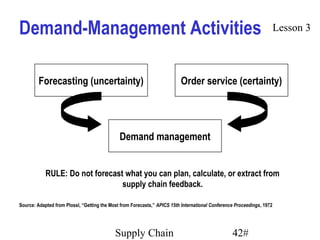
Demand-Management Activities                                                                                            Lesson 3


        Forecasting (uncertainty)                                         Order service (certainty)


                                              Demand management


            RULE: Do not forecast what you can plan, calculate, or extract from
                                 supply chain feedback.

Source: Adapted from Plossl, “Getting the Most from Forecasts,” APICS 15th International Conference Proceedings, 1972


                                            Supply Chain                                          42#
DETERMINING DEMAND
• FORECASTING
  – TWO TYPES – WRONG AND LUCKY
  – TWO NUMBERS – QUANTITY AND DATE
  – ELEMENTS of a GOOD FORECASTING SYSTEM:
     •   EQUAL CHANCE OF BEING OVER OR UNDER
     •   INCLUDES KNOWN FUTURE EVENTS
     •   HAS RANGE OR FORECAST ERROR ESTIMATE
     •   REVIEWED REGULARLY


                   Supply Chain            43#
FORECASTING
• GENERAL PRINCIPLES:
  – MORE ACCURATE AT THE AGGREGATE LEVEL
  – MORE ACCURATE FOR SHORTER PERIODS OF TIME CLOSER TO
    PRESENT
  – SET OF NUMBERS TO WORK FROM, NOT TO WORK TO
  – MOSTLY ALWAYS WRONG

  – EXAMPLE: MONTHLY vs DAILY EXPENDITURE


                    Supply Chain            44#
FORECASTING
• MAIN TECHNIQUES:
  – QUALITATIVE
     • MANAGEMENT REVIEW
     • DELPHI METHOD
     • MARKET RESEARCH
  – QUANTITIVE
     •   MOVING AVERAGE
     •   WEIGHTED MOVING AVERAGE
     •   EXPONENTIAL SMOOTHING
     •   REGRESSION ANALYSIS
     •   SEASONALILTY
     •   PYRAMID


                  Supply Chain     45#
FORECASTING
• QUALITATIVE
  – USEFUL ON NEW PRODUCTS
  – AS A SUPPLEMENT TO QUANTITATIVE NUMBERS
• QUANTITATIVE
  –   NEEDS HISTORICAL DATA OR PROJECTED DATA
  –   AVAILABLE
  –   CONSISTENT
  –   ACCURATE
  –   UNITS - MEASURABLE


                 Supply Chain           46#
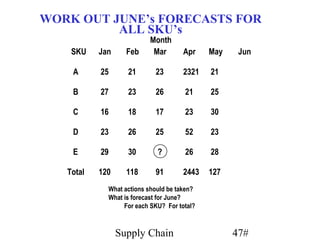
WORK OUT JUNE’s FORECASTS FOR
          ALL SKU’s
                          Month
    SKU    Jan     Feb     Mar        Apr    May    Jun

    A      25      21       23        2321   21

    B      27      23       26        21     25

    C      16      18       17        23     30

    D      23      26       25        52     23

    E      29      30        ?        26     28

   Total   120     118      91        2443   127
             What actions should be taken?
             What is forecast for June?
                  For each SKU? For total?


                 Supply Chain                      47#
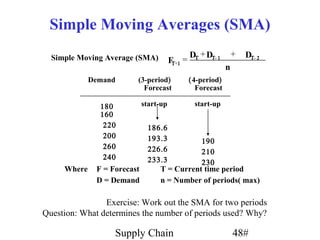
Simple Moving Averages (SMA)
  Simple Moving Average (SMA)                    DΤ + DΤ- 1       +   DΤ- 2
                                        F +1 =
                                         Τ
                                                              n
             Demand      (3-period)              (4-period)
                           Forecast                Forecast

               180           start-up             start-up
               160
                220           186.6
                200           193.3                 190
                260           226.6                 210
                240           233.3                 230
     Where    F = Forecast        T = Current time period
              D = Demand          n = Number of periods( max)

                Exercise: Work out the SMA for two periods
Question: What determines the number of periods used? Why?

                   Supply Chain                                   48#
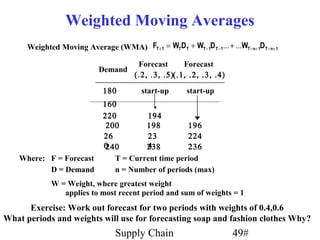
Weighted Moving Averages
      Weighted Moving Average (WMA) FT + 1 = WTD T + WT − 1D T − 1... + ...WT − n+ 1D T − n+ 1

                                            Forecast      Forecast
                               Demand
                                           (.2, .3, .5)(.1, .2, .3, .4)

                                180           start-up       start-up
                                160
                                220        194
                                 200       198         196
                                26         23          224
                                0240       4
                                           238         236
    Where: F = Forecast            T = Current time period
           D = Demand              n = Number of periods (max)
              W = Weight, where greatest weight
                 applies to most recent period and sum of weights = 1
      Exercise: Work out forecast for two periods with weights of 0.4,0.6
What periods and weights will use for forecasting soap and fashion clothes Why?
                                    Supply Chain                              49#
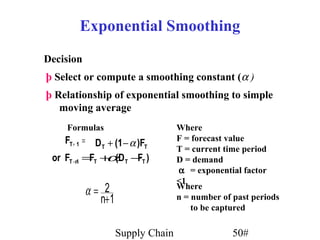
Exponential Smoothing
Decision
þ Select or compute a smoothing constant (α )
þ Relationship of exponential smoothing to simple
   moving average
     Formulas                      Where
     1 T+ 1 =     α
 FT +F= = T D (1+− − α )F T
     F D + + (1 − α )F
              D T (1 )FT           F = forecast value
     T+1      T           T        T = current time period
    FT 1 T + FT= Fαα (D T − F
 or or +F= = + +(D T(D FT−)F T))
    or F 1 FT + α −                D = demand
         T+1      T    T     T
                                   α = exponential factor
                                   <1
           α= 2                    Where
             n+ 1                  n = number of past periods
                                       to be captured

                    Supply Chain                 50#
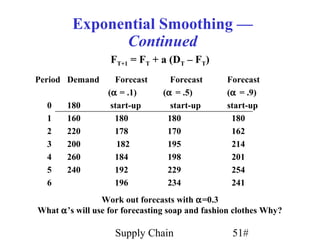
Exponential Smoothing —
              Continued
                  FT+1 = FT + a (DT – FT)
Period Demand       Forecast      Forecast      Forecast
                  (α = .1)      (α = .5)        (α = .9)
  0    180         start-up       start-up      start-up
  1    160          180          180             180
  2    220          178          170             162
  3    200           182         195             214
  4    260          184          198             201
  5    240          192          229             254
  6                 196          234             241
                Work out forecasts with α=0.3
What α’s will use for forecasting soap and fashion clothes Why?

                   Supply Chain                   51#
Simple Trended Series — Example

 Algebraic Trend Projection
      X         Y    a. Trend (“rise” over “run”) = (13 - 4)/3 = 3 = b
      0        4     b.Y-intercept (a) = “compute”
      1         7      the Y value for X = 0, thus Y-int = 4
      2       10
      3       13     c. Period 4: Y = a + bX = 4 + 3 (4 [for period 4]) = 16

            13
            10
                                Rise
             7
             4        Run
                  1    2    3

                            Supply Chain                52#
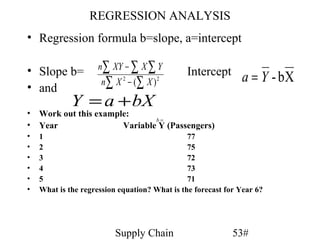
REGRESSION ANALYSIS
• Regression formula b=slope, a=intercept

• Slope b=           n∑ XY − ∑ X ∑ Y
                                               Intercept
                      n ∑ X − (∑ X )
                            2          2                      a = Y - bX
• and
             Y = a + bX
• Work out this example:
                              b=
• Year                Variable Y (Passengers)
•   1                                          77
•   2                                          75
•   3                                          72
•   4                                          73
•   5                                          71
•   What is the regression equation? What is the forecast for Year 6?


                          Supply Chain                      53#
TRENDED TIME SERIES FORECASTING
• Question: How do you forecast a seasonal item


• Y(forecast) = [A (intercept) + X (trend) x T (time period) ]
         x S (seasonality factor)
• FIRST DETERMINE LEVEL AND TREND - IF SEASONAL
  DESEASONALIZE
• THEN FORECAST USING EXPONENTIAL OR TREND
• RESEASONALIZE


                       Supply Chain                   54#
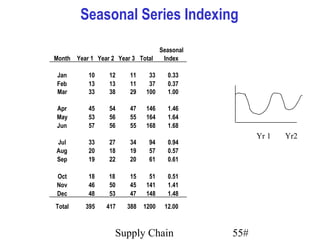
Seasonal Series Indexing

                                 Seasonal
Month Year 1 Year 2 Year 3 Total  Index

Jan       10     12     11    33     0.33
Feb       13     13     11    37     0.37
Mar       33     38     29   100     1.00

Apr       45     54     47   146     1.46
May       53     56     55   164     1.64
Jun       57     56     55   168     1.68
                                                  Yr 1   Yr2
Jul       33     27     34    94     0.94
Aug       20     18     19    57     0.57
Sep       19     22     20    61     0.61

Oct       18     18     15    51     0.51
Nov       46     50     45   141     1.41
Dec       48     53     47   148     1.48
Total     395   417    388   1200   12.00


                   Supply Chain             55#
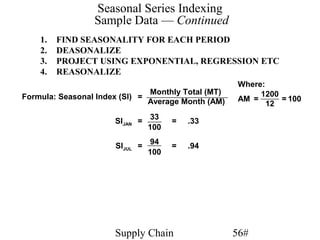
Seasonal Series Indexing
                  Sample Data — Continued
    1.   FIND SEASONALITY FOR EACH PERIOD
    2.   DEASONALIZE
    3.   PROJECT USING EXPONENTIAL, REGRESSION ETC
    4.   REASONALIZE
                                                       Where:
                                 Monthly Total (MT)         1200
Formula: Seasonal Index (SI) =                         AM =      = 100
                                 Average Month (AM)           12
                                  33
                       SIJAN =         =   .33
                                 100
                                  94
                       SIJUL =         =   .94
                                 100


                       Supply Chain                   56#
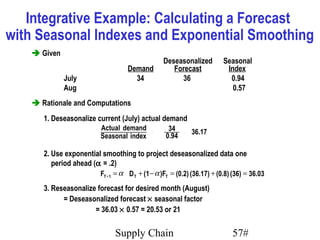
Integrative Example: Calculating a Forecast
with Seasonal Indexes and Exponential Smoothing
    Given
                                                 Deseasonalized        Seasonal
                                    Demand          Forecast            Index
             July                     34              36                 0.94
             Aug                                                          0.57
    Rationale and Computations
      1. Deseasonalize current (July) actual demand
                          Actual demand = 34/0.94 = 36.17
                                                34
                           Actual demand = 34/0.94 = 36.17
                             Actual demand demand = = 34/0.94 = 36.17
                                      Actual = 34/0.94 36.17
                             Seasonal index 0.94
                          Seasonal index
                           Seasonal index
                                     Seasonal index

      2. Use exponential smoothing to project deseasonalized data one
         period ahead (α = .2)
                        FT +1 = α D T + (1 − α )FT = (0.2) (36.17) + (0.8) (36) = 36.03
      3. Reseasonalize forecast for desired month (August)
            = Deseasonalized forecast × seasonal factor
                      = 36.03 × 0.57 = 20.53 or 21


                                Supply Chain                               57#
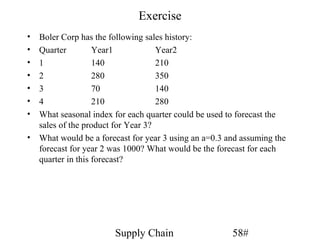
Exercise
• Boler Corp has the following sales history:
• Quarter         Year1            Year2
• 1               140              210
• 2               280              350
• 3               70               140
• 4               210              280
• What seasonal index for each quarter could be used to forecast the
  sales of the product for Year 3?
• What would be a forecast for year 3 using an a=0.3 and assuming the
  forecast for year 2 was 1000? What would be the forecast for each
  quarter in this forecast?


                       Supply Chain                   58#
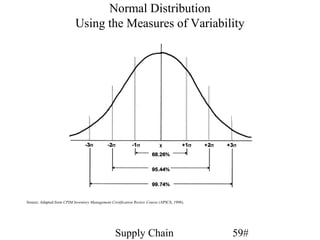
Normal Distribution
                           Using the Measures of Variability


                                                                           x
                                                                      68.26%


                                                                      95.44%


                                                                      99.74%


Source: Adapted from CPIM Inventory Management Certification Review Course (APICS, 1998).


                                                  Supply Chain                              59#
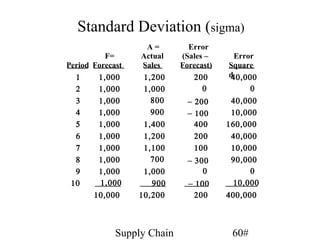
Standard Deviation (sigma)
                   A=         Error
          F=      Actual    (Sales –      Error
Period Forecast   Sales     Forecast)   Square
  1     1,000      1,200       200      d40,000
  2     1,000      1,000         0             0
  3     1,000        800      – 200      40,000
  4     1,000        900      – 100      10,000
  5     1,000      1,400       400      160,000
  6     1,000      1,200       200       40,000
  7     1,000      1,100       100       10,000
  8     1,000        700      – 300      90,000
  9     1,000      1,000          0           0
 10     1,000        900      – 100       10,000
       10,000     10,200       200      400,000


             Supply Chain                60#
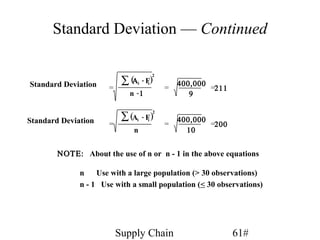
Standard Deviation — Continued


                           ∑ (Αi - Fi)
                                      2

Standard Deviation                            400,000
                      =                   =           =211
                             n -1                9


                           ∑ (Ai
                                      2
                                   - F)       400,000
Standard Deviation    =
                                      i
                                          =           =200
                               n                10


        ΝΟΤΕ: About the use of n or n - 1 in the above equations

              n    Use with a large population (> 30 observations)
              n - 1 Use with a small population (< 30 observations)


                          Supply Chain                       61#
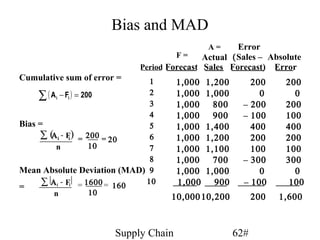
Bias and MAD
                                              A=    Error
                                     F=     Actual (Sales – Absolute
                            Period Forecast Sales Forecast) Error
Cumulative sum of error =     1       1,000   1,200       200      200
     ∑ ( A i − Fi ) = 200     2       1,000   1,000         0        0
                              3       1,000     800     – 200      200
                              4       1,000     900     – 100      100
Bias =                        5       1,000   1,400       400      400
     ∑ (Αi - Fi ) = 200 = 20  6       1,000   1,200       200      200
           n            10    7       1,000   1,100       100      100
                              8       1,000     700     – 300      300
Mean Absolute Deviation (MAD) 9       1,000   1,000         0        0
=     ∑ Αi - Fi = 1600 = 160 10       1,000     900     – 100       100
          n             10
                                   10,000 10,200            200   1,600


                       Supply Chain                   62#
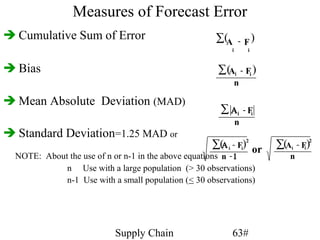
Measures of Forecast Error
 Cumulative Sum of Error                            ∑(A      - F)
                                                          i         i


 Bias                                                ∑ (Ai       - Fi )
                                                              n

 Mean Absolute Deviation (MAD)
                                                       ∑ Αi       - Fi
                                                              n
 Standard Deviation=1.25 MAD or
                                                    ∑(Α i - Fi)2 or        ∑(Ai - Fi )2
  NOTE: About the use of n or n-1 in the above equations n - 1                 n
             n Use with a large population (> 30 observations)
             n-1 Use with a small population (< 30 observations)


                           Supply Chain                   63#
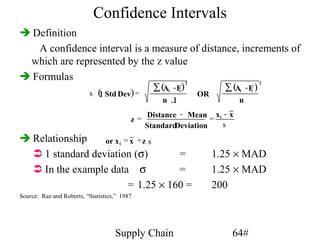
Confidence Intervals
 Definition
   A confidence interval is a measure of distance, increments of
  which are represented by the z value
 Formulas                                 2                 2
                              ∑ (Ai - Fi )      ∑ (Ai - Fi )
               s ( Std Dev) =
                 1                           OR
                                                  n -1                   n
                                             Distance - Mean = x i - x
                                          z=
                                             StandardDeviation    s
 Relationship    or x i = x + z s
   1 standard deviation (σ)         =                          1.25 × MAD
   In the example data σ            =                          1.25 × MAD
                          = 1.25 × 160 =                        200
Source: Raz and Roberts, “Statistics,” 1987


                                    Supply Chain                     64#
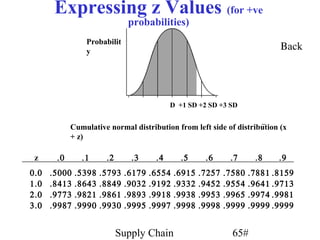
Expressing z Values (for +ve
                              probabilities)
                Probabilit
                y
                                                                             Βack


                                            D +1 SD +2 SD +3 SD


            Cumulative normal distribution from left side of distribution (x
            + z)

 z     .0      .1      .2      .3      .4      .5      .6      .7      .8    .9
0.0   .5000   .5398   .5793   .6179   .6554   .6915   .7257   .7580   .7881 .8159
1.0   .8413   .8643   .8849   .9032   .9192   .9332   .9452   .9554   .9641 .9713
2.0   .9773   .9821   .9861   .9893   .9918   .9938   .9953   .9965   .9974 .9981
3.0   .9987   .9990   .9930   .9995   .9997   .9998   .9998   .9999   .9999 .9999


                            Supply Chain                        65#
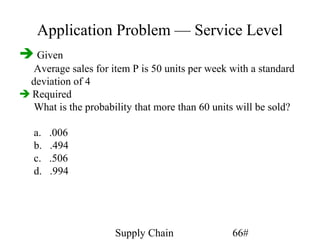
Application Problem — Service Level
 Given
   Average sales for item P is 50 units per week with a standard
  deviation of 4
 Required
   What is the probability that more than 60 units will be sold?

   a.   .006
   b.   .494
   c.   .506
   d.   .994


                      Supply Chain               66#
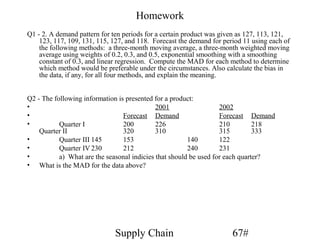
Homework
Q1 - 2. A demand pattern for ten periods for a certain product was given as 127, 113, 121,
    123, 117, 109, 131, 115, 127, and 118. Forecast the demand for period 11 using each of
    the following methods: a three-month moving average, a three-month weighted moving
    average using weights of 0.2, 0.3, and 0.5, exponential smoothing with a smoothing
    constant of 0.3, and linear regression. Compute the MAD for each method to determine
    which method would be preferable under the circumstances. Also calculate the bias in
    the data, if any, for all four methods, and explain the meaning.


Q2 - The following information is presented for a product:
•                                            2001                  2002
•                                Forecast Demand                   Forecast Demand
•          Quarter I             200         226                   210         218
    Quarter II                   320         310                   315         333
•          Quarter III 145       153                    140        122
•          Quarter IV 230        212                    240        231
•          a) What are the seasonal indicies that should be used for each quarter?
• What is the MAD for the data above?


                              Supply Chain                            67#
Supply Chain Network
   Fundamentals


 William T. Walker, CFPIM, CIRM, CSCP
   Practitioner, Author, and Supply Chain Architect


  Supply Chain                  68#
Session Outline

•   Understanding How Supply Chains Work
•   The Value Principle and Network Stakeholders
•   Mapping a Supply Chain Network
•   The Velocity and Variability Principles
•   Locating the Push/Pull Boundary
•   The Vocalize and Visualize Principles
•   Summary


                         Supply Chain              69#
Learning Objectives

By teaching the principles of supply chain management
to understand how a supply chain network works...

 We learn how to map a supply chain network.

 We learn how to engineer reliable network infrastructure
  by maximizing velocity and minimizing variability.

 We learn how the Bill Of Materials relates to the network.

 We learn how locating the push/pull boundary converts
  network operations from Build-To-Stock to Build-To-Order.

 We learn how to maximize throughput by engineering
  the means to vocalize demand and to visualize supply.


                       Supply Chain                70#
A SUPPLY CHAIN is
     the global network
     used to deliver products and services
     from raw materials to end customers
     through engineered flows of
     information, material, and cash.
Contributed to the APICS Dictionary, 10th Edition by William T. Walker


                                   Supply Chain                          71#
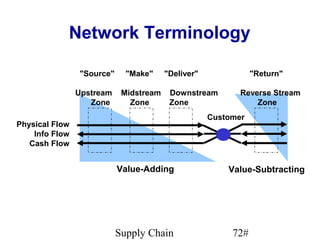
Network Terminology

                "Source"     "Make"     "Deliver"              "Return"

                Upstream    Midstream    Downstream        Reverse Stream
                   Zone       Zone       Zone                  Zone
                                                    Customer
Physical Flow
    Info Flow
   Cash Flow


                           Value-Adding                 Value-Subtracting


                           Supply Chain                  72#
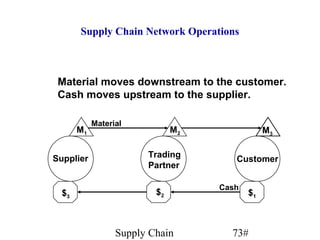
Supply Chain Network Operations


 Material moves downstream to the customer.
 Cash moves upstream to the supplier.

            Material
       M1                      M2               M3


Supplier                Trading        Customer
                        Partner

                                    Cash
  $3                      $2               $1


                  Supply Chain        73#
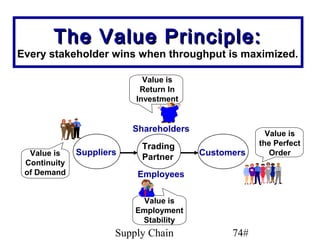
The Value Principle:
Every stakeholder wins when throughput is maximized.

                            Value is
                           Return In
                          Investment


                          Shareholders
                                                       Value is
                            Trading                  the Perfect
  Value is    Suppliers                  Customers      Order
                            Partner
 Continuity
 of Demand                 Employees

                           Value is
                          Employment
                           Stability
                      Supply Chain             74#
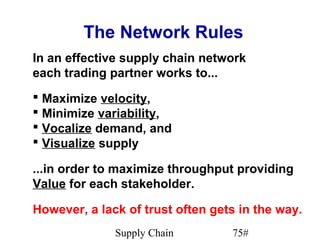
The Network Rules
In an effective supply chain network
each trading partner works to...
 Maximize velocity,
 Minimize variability,
 Vocalize demand, and
 Visualize supply

...in order to maximize throughput providing
Value for each stakeholder.

However, a lack of trust often gets in the way.
              Supply Chain        75#
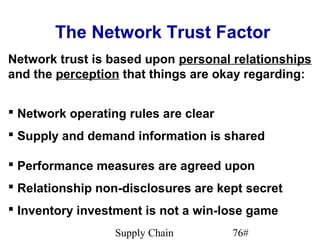
The Network Trust Factor
Network trust is based upon personal relationships
and the perception that things are okay regarding:


 Network operating rules are clear
 Supply and demand information is shared

 Performance measures are agreed upon
 Relationship non-disclosures are kept secret
 Inventory investment is not a win-lose game
                  Supply Chain        76#
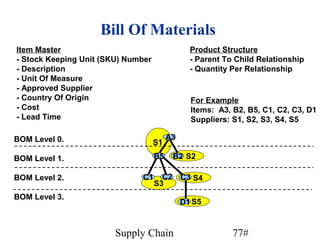
Bill Of Materials
Item Master                                     Product Structure
- Stock Keeping Unit (SKU) Number               - Parent To Child Relationship
- Description                                   - Quantity Per Relationship
- Unit Of Measure
- Approved Supplier
- Country Of Origin                             For Example
- Cost                                          Items: A3, B2, B5, C1, C2, C3, D1
- Lead Time                                     Suppliers: S1, S2, S3, S4, S5

BOM Level 0.                             A3
                                    S1

BOM Level 1.                        B5     B2 S2

BOM Level 2.                  C1      C2      C3 S4
                                    S3
BOM Level 3.
                                              D1 S5


                        Supply Chain                       77#
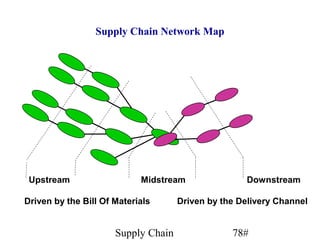
Supply Chain Network Map


 Upstream                   Midstream                Downstream

Driven by the Bill Of Materials      Driven by the Delivery Channel


                      Supply Chain               78#
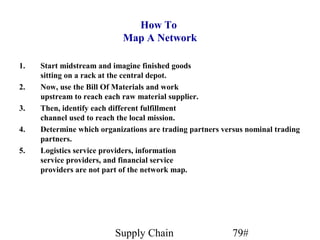
How To
                            Map A Network

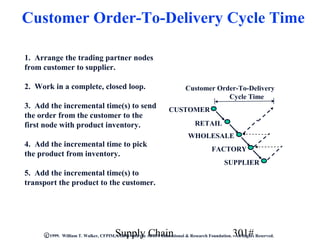
1.   Start midstream and imagine finished goods
     sitting on a rack at the central depot.
2.   Now, use the Bill Of Materials and work
     upstream to reach each raw material supplier.
3.   Then, identify each different fulfillment
     channel used to reach the local mission.
4.   Determine which organizations are trading partners versus nominal trading
     partners.
5.   Logistics service providers, information
     service providers, and financial service
     providers are not part of the network map.


                          Supply Chain                     79#
The Velocity Principle:
               In network implementation
                throughput is maximized
   when order-to-delivery-to-cash velocity is maximized
           by minimizing process cycle time.


The 5V Principles of Supply Chain Management explain how a supply
chain network works by answering what, when, where, why, and how:

Velocity – how are relationships connected to make the delivery?


                       Supply Chain               80#
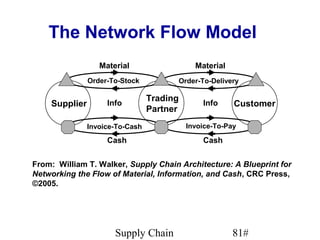
The Network Flow Model
                  Material                     Material
               Order-To-Stock              Order-To-Delivery

                                 Trading
    Supplier        Info                         Info     Customer
                                 Partner
               Invoice-To-Cash               Invoice-To-Pay

                    Cash                         Cash


From: William T. Walker, Supply Chain Architecture: A Blueprint for
Networking the Flow of Material, Information, and Cash, CRC Press,
©2005.


                      Supply Chain                        81#
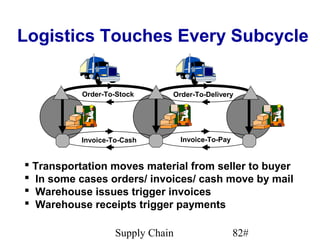
Logistics Touches Every Subcycle


           Order-To-Stock      Order-To-Delivery


           Invoice-To-Cash         Invoice-To-Pay


 Transportation moves material from seller to buyer
 In some cases orders/ invoices/ cash move by mail
 Warehouse issues trigger invoices
 Warehouse receipts trigger payments

                    Supply Chain                    82#
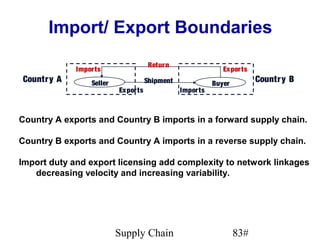
Import/ Export Boundaries
                                     Return
             Imports                                        Exports
Countr y A       Seller             Shipment             Buyer
                                                                       Countr y B
                          Exports              Imports


Country A exports and Country B imports in a forward supply chain.

Country B exports and Country A imports in a reverse supply chain.

Import duty and export licensing add complexity to network linkages
   decreasing velocity and increasing variability.


                          Supply Chain                           83#
The Variability Principle:
                               In network implementation
                                throughput is maximized
                  when order-to-delivery-to-cash variability is minimized
                            by minimizing process variance.


The 5V Principles of Supply Chain Management explain how a supply
chain network works by answering what, when, where, why, and how:

Variability – what is likely to change from one delivery to the next?


                           Supply Chain                                84#
Outward Signs of Variability
    Unplanned demand
    Backordered inventory
    Inventory leakage
    Capacity constraints
    Lower than normal yields
    Longer than expected transit times
    Delays in clearing Customs
    Delayed payment


                 Supply Chain             85#
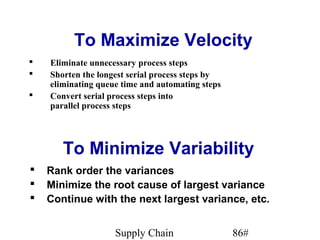
To Maximize Velocity
   Eliminate unnecessary process steps
   Shorten the longest serial process steps by
    eliminating queue time and automating steps
   Convert serial process steps into
    parallel process steps


       To Minimize Variability
   Rank order the variances
   Minimize the root cause of largest variance
   Continue with the next largest variance, etc.


                    Supply Chain                  86#
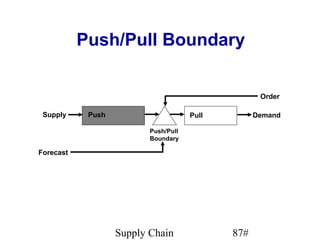
Push/Pull Boundary

                                                    Order

 Supply     Push                      Pull         Demand

                          Push/Pull
                          Boundary

Forecast


                   Supply Chain              87#
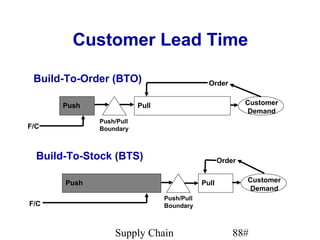
Customer Lead Time

 Build-To-Order (BTO)                          Order


      Push                Pull                              Customer
                                                            Demand
              Push/Pull
F/C           Boundary


  Build-To-Stock (BTS)                              Order


       Push                                  Pull           Customer
                                                             Demand
                                 Push/Pull
F/C                              Boundary


                  Supply Chain                          88#
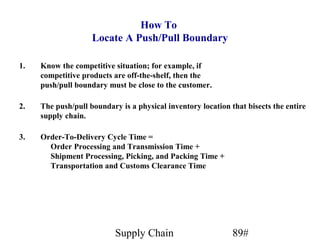
How To
                    Locate A Push/Pull Boundary

1.   Know the competitive situation; for example, if
     competitive products are off-the-shelf, then the
     push/pull boundary must be close to the customer.

2.   The push/pull boundary is a physical inventory location that bisects the entire
     supply chain.

3.   Order-To-Delivery Cycle Time =
       Order Processing and Transmission Time +
       Shipment Processing, Picking, and Packing Time +
       Transportation and Customs Clearance Time


                           Supply Chain                       89#
The Vocalize Principle:
                   In network operations
                 throughput is maximized
               by pulling supply to demand
  by vocalizing actual demand at the network constraint.


The 5V Principles of Supply Chain Management explain how a supply
chain network works by answering what, when, where, why, and how:

Vocalize – who knows the full requirements of the order?


                       Supply Chain                90#
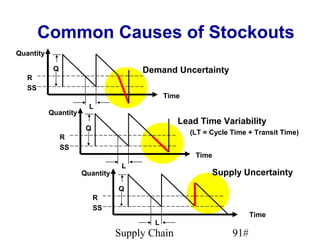
Common Causes of Stockouts
Quantity

            Q                         Demand Uncertainty
   R
   SS
                                             Time
                        L
           Quantity
                                                Lead Time Variability
                       Q
                                                    (LT = Cycle Time + Transit Time)
                R
                SS
                                                     Time
                                  L
                      Quantity                            Supply Uncertainty
                                 Q
                           R
                           SS
                                                                      Time
                                         L
                                 Supply Chain                   91#
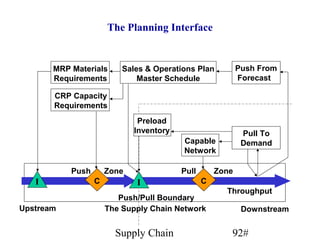
The Planning Interface


       MRP Materials      Sales & Operations Plan          Push From
       Requirements           Master Schedule              Forecast

       CRP Capacity
       Requirements
                              Preload
                             Inventory                      Pull To
                                         Capable            Demand
                                         Network

           Push       Zone               Pull       Zone
   I              C          I                  C
                                                      Throughput
                         Push/Pull Boundary
Upstream              The Supply Chain Network              Downstream


                        Supply Chain                   92#
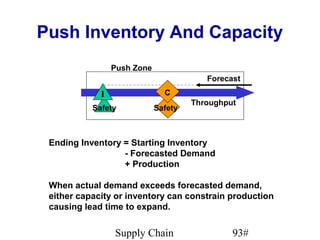
Push Inventory And Capacity
                 Push Zone
                                         Forecast
             I                 C
                                      Throughput
           Safety            Safety


 Ending Inventory = Starting Inventory
                  - Forecasted Demand
                  + Production

 When actual demand exceeds forecasted demand,
 either capacity or inventory can constrain production
 causing lead time to expand.


                 Supply Chain                  93#
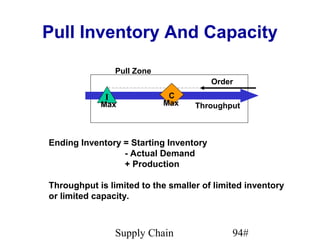
Pull Inventory And Capacity

                 Pull Zone
                                        Order
             I                C
            Max              Max   Throughput


Ending Inventory = Starting Inventory
                 - Actual Demand
                 + Production

Throughput is limited to the smaller of limited inventory
or limited capacity.


                 Supply Chain               94#
The Visualize Principle:
                                   In network operations
                                 throughput is maximized
                               by pushing supply to demand
                by visualizing actual inventory supply across the network.


The 5V Principles of Supply Chain Management explain how a supply
chain network works by answering what, when, where, why, and how:

Visualize – where is the inventory now and when will it be available?


                            Supply Chain                                95#
Packaging And Labeling
                      [ ] Cartons, plastic cushions, and labels
Cartons               may be missing from the product BOM.

                      [ ] RFID/ bar code on all packaging.

                      [ ] Select a wall thickness and box burst
Master                strength to protect the product.
Carton
                      [ ] Keep Country Of Origin labeling consistent
                      from the product to the outside packaging.


                      [ ] Transportation and warehousing costs
Unit Load             are a function of cubic dimensions and weight.

                      [ ] Items that have to be repalletized for
                      transport or storage cost more.


                Supply Chain                      96#
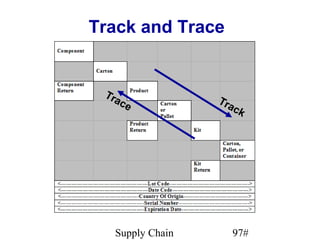
Track and Trace


 Tra
     c   e        Tra
                      ck


   Supply Chain      97#
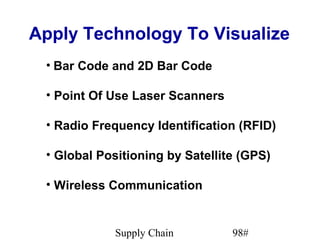
Apply Technology To Visualize
 • Bar Code and 2D Bar Code

 • Point Of Use Laser Scanners

 • Radio Frequency Identification (RFID)

 • Global Positioning by Satellite (GPS)

 • Wireless Communication


             Supply Chain        98#
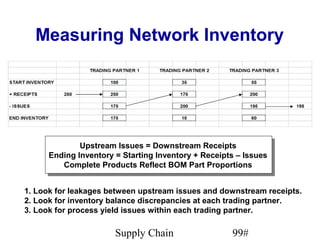
Measuring Network Inventory


              Upstream Issues = Downstream Receipts
      Ending Inventory = Starting Inventory + Receipts – Issues
         Complete Products Reflect BOM Part Proportions


1. Look for leakages between upstream issues and downstream receipts.
2. Look for inventory balance discrepancies at each trading partner.
3. Look for process yield issues within each trading partner.

                       Supply Chain                  99#
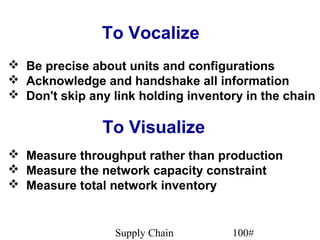
To Vocalize
 Be precise about units and configurations
 Acknowledge and handshake all information
 Don't skip any link holding inventory in the chain

               To Visualize
 Measure throughput rather than production
 Measure the network capacity constraint
 Measure total network inventory


                  Supply Chain       100#
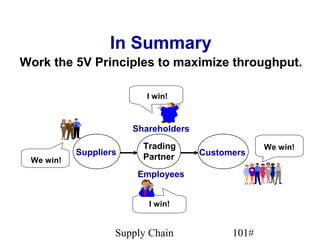
In Summary
Work the 5V Principles to maximize throughput.

                          I win!


                       Shareholders
                         Trading                   We win!
           Suppliers                  Customers
 We win!                 Partner
                        Employees


                          I win!


                   Supply Chain             101#
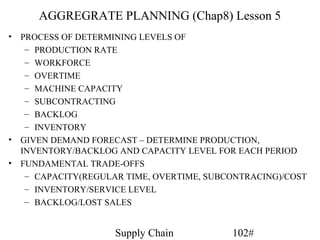
AGGREGRATE PLANNING (Chap8) Lesson 5
•   PROCESS OF DETERMINING LEVELS OF
     – PRODUCTION RATE
     – WORKFORCE
     – OVERTIME
     – MACHINE CAPACITY
     – SUBCONTRACTING
     – BACKLOG
     – INVENTORY
•   GIVEN DEMAND FORECAST – DETERMINE PRODUCTION,
    INVENTORY/BACKLOG AND CAPACITY LEVEL FOR EACH PERIOD
•   FUNDAMENTAL TRADE-OFFS
     – CAPACITY(REGULAR TIME, OVERTIME, SUBCONTRACING)/COST
     – INVENTORY/SERVICE LEVEL
     – BACKLOG/LOST SALES


                      Supply Chain          102#
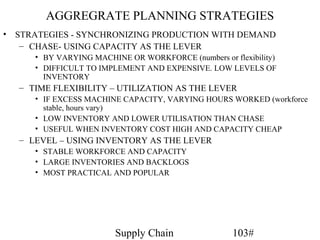
AGGREGRATE PLANNING STRATEGIES
•   STRATEGIES - SYNCHRONIZING PRODUCTION WITH DEMAND
     – CHASE- USING CAPACITY AS THE LEVER
       • BY VARYING MACHINE OR WORKFORCE (numbers or flexibility)
       • DIFFICULT TO IMPLEMENT AND EXPENSIVE. LOW LEVELS OF
         INVENTORY
    – TIME FLEXIBILITY – UTILIZATION AS THE LEVER
       • IF EXCESS MACHINE CAPACITY, VARYING HOURS WORKED (workforce
         stable, hours vary)
       • LOW INVENTORY AND LOWER UTILISATION THAN CHASE
       • USEFUL WHEN INVENTORY COST HIGH AND CAPACITY CHEAP
    – LEVEL – USING INVENTORY AS THE LEVER
       • STABLE WORKFORCE AND CAPACITY
       • LARGE INVENTORIES AND BACKLOGS
       • MOST PRACTICAL AND POPULAR


                          Supply Chain                103#
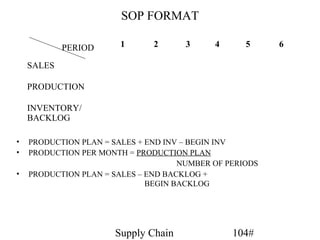
SOP FORMAT

            PERIOD      1      2      3     4      5     6

    SALES

    PRODUCTION

    INVENTORY/
    BACKLOG

•   PRODUCTION PLAN = SALES + END INV – BEGIN INV
•   PRODUCTION PER MONTH = PRODUCTION PLAN
                                     NUMBER OF PERIODS
•   PRODUCTION PLAN = SALES – END BACKLOG +
                              BEGIN BACKLOG


                      Supply Chain              104#
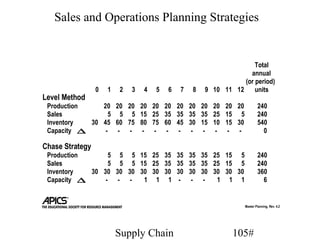
Sales and Operations Planning Strategies


                                                                    Total
                                                                  annual
                                                                (or period)
                 0   1   2   3   4   5   6   7   8   9 10 11 12     units
Level Method
 Production    20 20 20 20 20 20 20 20 20 20 20 20                       240
 Sales           5 5 5 15 25 35 35 35 35 25 15 5                         240
 Inventory  30 45 60 75 80 75 60 45 30 15 10 15 30                       540
 Capacity ∆     - - - - - - - - - - - -                                    0

Chase Strategy
 Production      5 5 5 15 25 35              35 35 35 25 15 5            240
 Sales           5 5 5 15 25 35              35 35 35 25 15 5            240
 Inventory  30 30 30 30 30 30 30             30 30 30 30 30 30           360
 Capacity ∆     - - -    1 1 1                - - -    1 1 1               6


                                                                 Master Planning, Rev. 4.2


                         Supply Chain                        105#
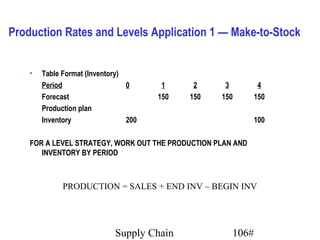
Production Rates and Levels Application 1 — Make-to-Stock


    •   Table Format (Inventory)
        Period                   0      1     2     3         4
        Forecast                       150   150   150       150
        Production plan
        Inventory                200                         100

    FOR A LEVEL STRATEGY, WORK OUT THE PRODUCTION PLAN AND
       INVENTORY BY PERIOD


              PRODUCTION = SALES + END INV – BEGIN INV


                             Supply Chain             106#
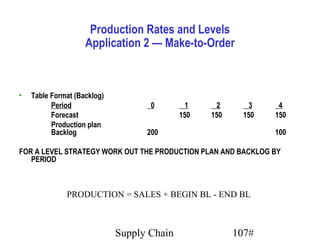
Production Rates and Levels
                    Application 2 — Make-to-Order


•   Table Format (Backlog)
          Period                    0        1     2       3     4
          Forecast                          150   150     150   150
          Production plan
          Backlog                  200                          100

FOR A LEVEL STRATEGY WORK OUT THE PRODUCTION PLAN AND BACKLOG BY
   PERIOD


              PRODUCTION = SALES + BEGIN BL - END BL


                             Supply Chain               107#
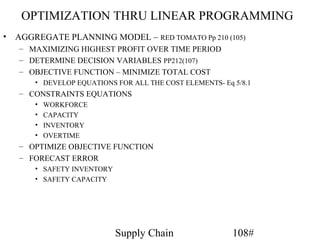
OPTIMIZATION THRU LINEAR PROGRAMMING
•   AGGREGATE PLANNING MODEL – RED TOMATO Pp 210 (105)
    – MAXIMIZING HIGHEST PROFIT OVER TIME PERIOD
    – DETERMINE DECISION VARIABLES PP212(107)
    – OBJECTIVE FUNCTION – MINIMIZE TOTAL COST
        • DEVELOP EQUATIONS FOR ALL THE COST ELEMENTS- Eq 5/8.1
    – CONSTRAINTS EQUATIONS
        •   WORKFORCE
        •   CAPACITY
        •   INVENTORY
        •   OVERTIME
    – OPTIMIZE OBJECTIVE FUNCTION
    – FORECAST ERROR
        • SAFETY INVENTORY
        • SAFETY CAPACITY


                             Supply Chain                 108#
Excel File

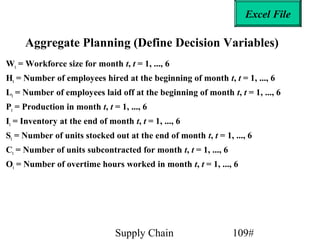
     Aggregate Planning (Define Decision Variables)
Wt = Workforce size for month t, t = 1, ..., 6
Ht = Number of employees hired at the beginning of month t, t = 1, ..., 6
Lt = Number of employees laid off at the beginning of month t, t = 1, ..., 6
Pt = Production in month t, t = 1, ..., 6
It = Inventory at the end of month t, t = 1, ..., 6
St = Number of units stocked out at the end of month t, t = 1, ..., 6
Ct = Number of units subcontracted for month t, t = 1, ..., 6
Ot = Number of overtime hours worked in month t, t = 1, ..., 6


                               Supply Chain                     109#
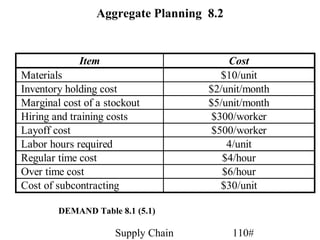
Aggregate Planning 8.2


             Item                       Cost
Materials                              $10/unit
Inventory holding cost              $2/unit/month
Marginal cost of a stockout         $5/unit/month
Hiring and training costs            $300/worker
Layoff cost                          $500/worker
Labor hours required                    4/unit
Regular time cost                      $4/hour
Over time cost                         $6/hour
Cost of subcontracting                 $30/unit

        DEMAND Table 8.1 (5.1)

                     Supply Chain         110#
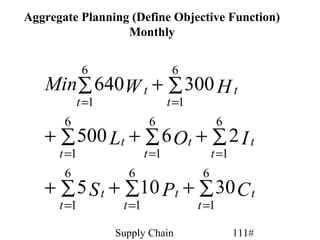
Aggregate Planning (Define Objective Function)
                  Monthly


             6                    6
   Min ∑ 640W t + ∑ 300 H t
           t =1                  t =1
       6                   6                   6
   + ∑ 500 Lt + ∑ 6 Ot + ∑ 2 I t
      t =1                t =1               t =1
       6            6                    6
   + ∑ 5 S t + ∑10 Pt + ∑ 30 C t
      t =1         t =1                 t =1

                  Supply Chain                      111#
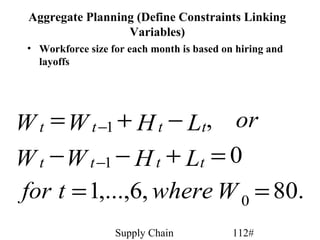
Aggregate Planning (Define Constraints Linking
                  Variables)
 • Workforce size for each month is based on hiring and
   layoffs


W t = W t −1 + H t − Lt, or
W t − W t −1 − H t + Lt = 0
for t = 1,...,6, where W 0 = 80.
                   Supply Chain             112#
Aggregate Planning (Constraints)
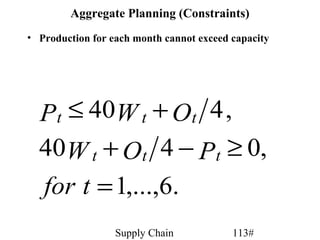
• Production for each month cannot exceed capacity


  Pt ≤ 40W t + Ot 4 ,
  40W t + Ot 4 − Pt ≥ 0,
  for t = 1,...,6.
                  Supply Chain            113#
Aggregate Planning (Constraints)
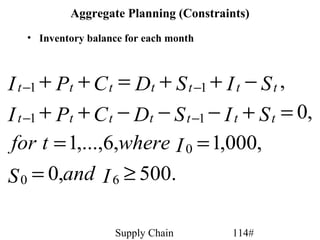
   • Inventory balance for each month


I t −1 + Pt + C t = Dt + S t −1 + I t − S t ,
I t −1 + Pt + C t − Dt − S t −1 − I t + S t = 0,
for t = 1,...,6,where I 0 = 1,000,
S 0 = 0,and I 6 ≥ 500.

                    Supply Chain        114#
Aggregate Planning (Constraints)
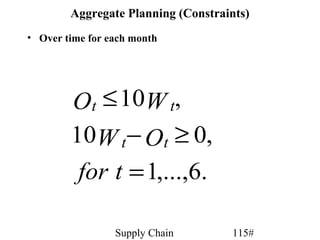
• Over time for each month


        Ot ≤ 10W t,
        10W t − Ot ≥ 0,
         for t = 1,...,6.

                 Supply Chain       115#
SOLVING PROBLEM USING EXCEL
• STEP 1 BUILD DECISION VARIABLE TABLE (fig8.1)
  – ALL CELLS 0, EXCEPT PERIOD 0 FOR WORKFORCE AND INVENTORY
  – ENTER DEMAND (TABLE 8.4)
• STEP 2 CONSTRUCT CONSTRAINT TABLE (fig8.2)
• STEP 3 CREATE a CELL HAVING THE OBJECTIVE FUNCTION
  – (Formula 8.1) Optimizing TOTAL COSTS (Fig 8.3)
• STEP 4 USE TOOLS SOLVER (Fig 8.4)
• REPEAT IF OPTIMUM SOLUTION NOT OBTAINED

• HOMEWORK (see homework)


                         Supply Chain                116#
AGGREGATE PLANNING IN PRACTICE
• MAKE PLANS FLEXIBLE BECAUSE FORECASTS
  ARE ALWAYS WRONG
  – PERFORM SENSITIVITY ANALYSIS ON THE INPUTS – I.E.
    LOOK AT EFFECTS OF HIGH/LOW
• RERUN THE AGGREGATE PLAN AS NEW DATA
  EMERGES
• USE AGGREGATE PLANNING AS CAPACITY
  UTILIZATION INCREASES
  – WHEN UTILIZATION IS HIGH, THERE IS LIKELY TO BE
    CAPACITY LIMITATIONS AND ALL THE ORDERS WILL
    NOT BE PRODUCED


                 Supply Chain            117#
Process Flow Measures
• FLOW RATE (Rt), CYCLE TIME (Tt), & INVENTORY (It)
  RELATIONSHIPS
   –   F = Flow Rate or Throughput is output of a line in pieces per time
   –   T = Cycle time is the time taken to complete an operation
   –   I = Inventory is the material on the line
   –    LITTLE’s LAW: Av. I = Av. R x Av. T x Variability factor Examples:
        • If Inventory is 100 pieces and Cycle time is 10 hours, the Throughput rate is 10 pcs
          per hour
        • If Cycle time is halved; Throughput is doubled
        • If Inventory is halved; cycle time is halved
   See Equation 8.6 How do we get Av Inv of 895 and Flow time of 0.34 months
     on page 227/216


                                Supply Chain                         118#
Homework


• Ex. Work out Inventory, Rate and cycle time for values in
  Tables 8.4,8.5


                   Supply Chain               119#
Supply Chain Network Basics – Lesson 4
• Guest Lecture – go to Poly Blackboard


                   Supply Chain           120#
MANAGING SUPPLY AND DEMAND
              PREDICTABLE VARIABILITY (LESSON 6)
•   Predictable Variability – Change in Demand that can be forecast or guided
     – MANAGING DEMAND – Short time price discounts, trade promotions
•   MANAGING SUPPLY – Capacity, Inventory, Subcontracting & Backlog, Purchased
    product
     – MANAGING CAPACITY
         •   TIME FLEXIBILITY FROM WORKFORCE (OVERTIME)
         •   USE OF SEASONAL WORKFORCE
         •   USE OF SUBCONTRACTING
         •   USE OF DUAL FACILITIES – DEDICATED AND FLEXIBLE
         •   DESIGN PRODUCT FLEXIBILITY INTO PRODUCTION
         •   USE OF MULTI-PURPOSE MACHINES (CNC MACHINE CENTERS)
     – MANAGING INVENTORY
         • USING COMMON COMPONENTS ACROSS MULTIPLE PRODUCTS
         • BUILD INVENTORY OF HIGH DEMAND OR PREDICTABLE DEMAND PRODUCTS


                               Supply Chain                    121#
MANAGING DEMAND (Predictable Variability)
• Manage demand with pricing
    – Factors influencing the timing of a promotion:
        • Impact on demand; product margins; cost of holding inventory; cost of
          changing capacity
• Demand increase (from discounting) due to:
     – Market growth
     – Stealing market share
     – Forward buying
Discount of $1 increases period demand by 10%
Reduce price by $1 in Jan, increases sales by 10% in first month - Tab
    9.4, 9.5 – effect on cost, profit, inventory
If discount is in April, highest demand month - Tab 9.6, 9.7
• See the effects of various combination Tab 9-12
• Summary Tab 9.12 & 9.13 Discuss


                          Supply Chain                     122#
PREDICTABLE VARIABILITY IN PRACTICE
• COORDINATE MARKETING, SALES AND OPERATIONS
  – SALES AND OPERATIONS PLANNING
  – ONE GOAL MAXIMIZING PROFIT, ONE GAME PLAN
• TAKE PREDICABLE VARIABILITY INTO ACCOUNT
  WHEN MAKING STRATEGIC DECISIONS
• PARTNER WITH PRINCIPAL CUSTOMERS, ELIMINATE
  PREDICTIONS!
• PREEMPT (PROMOS ETC.), DO NOT JUST REACT TO
  PREDICTABLE VARIABILITY


                  Supply Chain           123#
MANUFACTURING - MANAGING LEAD TIME


• CRITICAL DRIVER OF ALL MANUFACTURE
  –   LAYOUT AND WORKPLACE ORGANIZATION
  –   CONSTRAINT MANAGEMENT
  –   VARIABILITY AND QUEUES
  –   LOT SIZES AND SET UP REDUCTION
  –   WORK IN PROCESS
  –   FLEXIBILITY
• MUST BE COMPANY FOCUS
• MEASURED AND MONITORED
  – X BUTT TO BUTT

  –


                     Supply Chain         124#
MANAGING INVENTORY

• The role of inventory in the supply chain
   – Cycle Inventory (making or purchasing inventory in large
     lots) takes advantage of economies of scale to lower total cost –
     material cost, fixed ordering cost and holding cost.
• Why hold inventory?
   – Economies of scale
       • Batch size and cycle time
       • Quantity discounts
       • Short term discounts / Trade promotions
   – Stochastic variability of supply and demand
       • Evaluating service level given safety inventory
       • Evaluating safety inventory given desired service level
• Levers to improve performance


                        Supply Chain                       125#
Role of Inventory in the Supply Chain

• Overstocking: Amount available exceeds demand
   – Liquidation, Obsolescence, Holding

• Understocking: Demand exceeds amount available
   – Lost margin and future sales


Goal: Matching supply and demand


                     Supply Chain         126#
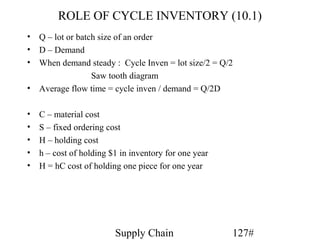
ROLE OF CYCLE INVENTORY (10.1)
• Q – lot or batch size of an order
• D – Demand
• When demand steady : Cycle Inven = lot size/2 = Q/2
                 Saw tooth diagram
• Average flow time = cycle inven / demand = Q/2D

•   C – material cost
•   S – fixed ordering cost
•   H – holding cost
•   h – cost of holding $1 in inventory for one year
•   H = hC cost of holding one piece for one year


                         Supply Chain                  127#
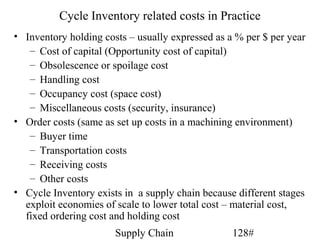
Cycle Inventory related costs in Practice
• Inventory holding costs – usually expressed as a % per $ per year
   – Cost of capital (Opportunity cost of capital)
   – Obsolescence or spoilage cost
   – Handling cost
   – Occupancy cost (space cost)
   – Miscellaneous costs (security, insurance)
• Order costs (same as set up costs in a machining environment)
   – Buyer time
   – Transportation costs
   – Receiving costs
   – Other costs
• Cycle Inventory exists in a supply chain because different stages
  exploit economies of scale to lower total cost – material cost,
  fixed ordering cost and holding cost
                       Supply Chain               128#
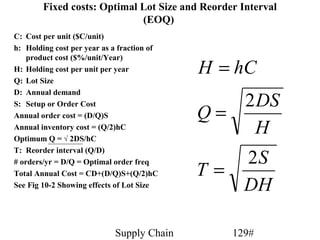
Fixed costs: Optimal Lot Size and Reorder Interval
                             (EOQ)
C: Cost per unit ($C/unit)
h: Holding cost per year as a fraction of
    product cost ($%/unit/Year)
H: Holding cost per unit per year           H = hC
Q: Lot Size
D: Annual demand
                                               2 DS
                                            Q=
S: Setup or Order Cost
Annual order cost = (D/Q)S
Annual inventory cost = (Q/2)hC
Optimum Q = √ 2DS/hC
                                                H
T: Reorder interval (Q/D)
                                                   2S
                                            T=
# orders/yr = D/Q = Optimal order freq
Total Annual Cost = CD+(D/Q)S+(Q/2)hC
See Fig 10-2 Showing effects of Lot Size           DH

                            Supply Chain         129#
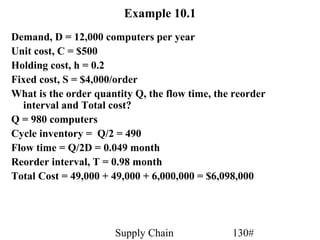
Example 10.1
Demand, D = 12,000 computers per year
Unit cost, C = $500
Holding cost, h = 0.2
Fixed cost, S = $4,000/order
What is the order quantity Q, the flow time, the reorder
  interval and Total cost?
Q = 980 computers
Cycle inventory = Q/2 = 490
Flow time = Q/2D = 0.049 month
Reorder interval, T = 0.98 month
Total Cost = 49,000 + 49,000 + 6,000,000 = $6,098,000


                      Supply Chain              130#
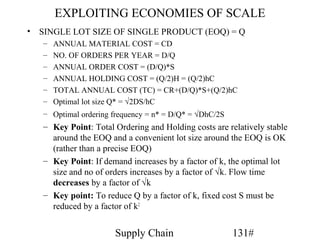
EXPLOITING ECONOMIES OF SCALE
• SINGLE LOT SIZE OF SINGLE PRODUCT (EOQ) = Q
   –   ANNUAL MATERIAL COST = CD
   –   NO. OF ORDERS PER YEAR = D/Q
   –   ANNUAL ORDER COST = (D/Q)*S
   –   ANNUAL HOLDING COST = (Q/2)H = (Q/2)hC
   –   TOTAL ANNUAL COST (TC) = CR+(D/Q)*S+(Q/2)hC
   –   Optimal lot size Q* = √2DS/hC
   – Optimal ordering frequency = n* = D/Q* = √DhC/2S
   – Key Point: Total Ordering and Holding costs are relatively stable
     around the EOQ and a convenient lot size around the EOQ is OK
     (rather than a precise EOQ)
   – Key Point: If demand increases by a factor of k, the optimal lot
     size and no of orders increases by a factor of √k. Flow time
     decreases by a factor of √k
   – Key point: To reduce Q by a factor of k, fixed cost S must be
     reduced by a factor of k2


                      Supply Chain                      131#
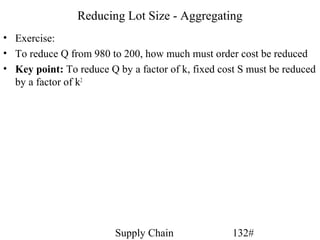
Reducing Lot Size - Aggregating
• Exercise:
• To reduce Q from 980 to 200, how much must order cost be reduced
• Key point: To reduce Q by a factor of k, fixed cost S must be reduced
  by a factor of k2


                         Supply Chain               132#
LOT SIZING WITH MULTIPLE PRODUCTS & CUSTOMERS
•   Lot sizing with Multiple Product or Customers
     – Aggregating replenishment across products, retailers or suppliers in a single order,
       allows for a reduction in lot sizes because fixed costs spread across multiple
       products and businesses
     – Ordering and delivering independently (See Ex.10.3)
          • Each order has independent Holding, Ordering and Annual costs with independent
            EOQ’s and Flow Times – Table 10-1
          • Total cost = $155,140
     – Total cost Ordered and delivered jointly (See Ex.10.4)
          • Independent holding costs but combined fixed order cost Table 10-2
          • Total Cost = $136,528
     – Transportation capacity constraint – aggregating multiple products from same
       supplier; single delivery from multiple suppliers (Ex. 10-5)
•   Key Point –The key to reducing cycle inventory is reducing lot size. The key
    to reducing lot size without increasing costs is to reduce fixed costs associated
    with each lot – by reducing the fixed cost itself or aggregating lots across
    multiple products, customers or suppliers. We reduce lot size to reduce cycle
    time


                                 Supply Chain                           133#
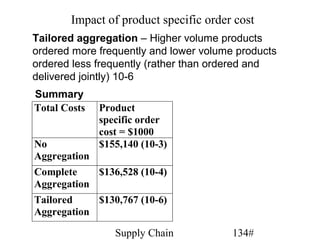
Impact of product specific order cost
Tailored aggregation – Higher volume products
ordered more frequently and lower volume products
ordered less frequently (rather than ordered and
delivered jointly) 10-6
Summary
Total Costs   Product
              specific order
              cost = $1000
No            $155,140 (10-3)
Aggregation
Complete    $136,528 (10-4)
Aggregation
Tailored    $130,767 (10-6)
Aggregation

                 Supply Chain           134#
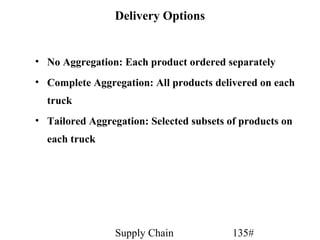
Delivery Options


• No Aggregation: Each product ordered separately
• Complete Aggregation: All products delivered on each
  truck
• Tailored Aggregation: Selected subsets of products on
  each truck


                 Supply Chain             135#
Economies of Scale to exploit Quantity Discounts
• Two common Lot Size based discount schemes
   – All unit quantity discounts
      • Pricing based on specific quantity break points
   – Marginal unit quantity discounts or multiblock tariffs
      • Pricing based on quantity break points, but the price is not the
        average per block, but the marginal cost of a unit that
        decreases at breakpoint
   – See example in book on these discounts pages 276-280


                      Supply Chain                      136#
WHY QUANTITY DISCOUNTS
– Improved coordination to increase total supply chain profits
    • Commodity Products = price set by market.
    • Large Manufacturers should use lot based quantity discounts, to
      maximize profits (cycle inventory will increase)
    • The supply chain profit is lower if each stage makes pricing decisions
      independently, maximizing its own profit
    • Coordination to maximize profit
        – Two part tariff or quantity discounts – supplier passes on some of the
          profit to the retailer, depending on volume
– Extraction of surplus through price discrimination
– Trade Promotions
        – Lead to significant forward buying by the retailer
        – Retailer should pass on optimal discount to customer and keep rest for
          themselves


                         Supply Chain                           137#
Quantity Discounts
•   Discounts improve coordination between Supplier and Retailer to
    maximize Supply Chain profits.
•   Quantity Discounts are a form of manufacturer returning some reduced
    costs (less orders) to the retailer (costs increase as more holding costs)
•   Supply chain profit is lower, if each stage of supply chain independently
    makes its pricing decisions with the objective of maximizing its own
    profit. A coordinated solution results in higher profit
•   For products that have market power, two-part tariffs or volume based
    quantity discounts can be used to achieve coordination in the supply
    chain and maximize profits
•   Promotions lead to significant increase in lot size and cycle inventory,
    because of forward buying by the retailer. This generally reduces the
    supply chain profits 280-281


                            Supply Chain                      138#
Strategies for reducing fixed costs
•   Wal-Mart: 3 day replenishment cycle
•   Seven Eleven Japan: Multiple daily replenishment
•   P&G: Mixed truck loads
•   Efforts required in:
    – Transportation (Cross docking)
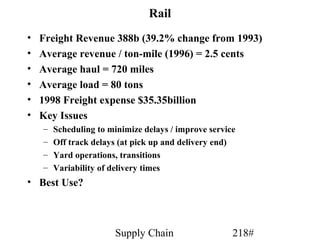
    – Information
    – Receiving
Aggregate across products, supply points, or delivery points
  in a single order, allows reduction of lot size for
  individual products Ex 10.6


                      Supply Chain             139#
ESTIMATING CYCLE INVENTORY COSTS

• HOLDING COSTS
   –   Cost of capital
   –   Obsolescence or spoilage costs
   –   Handling costs
   –   Occupancy cost
   –   Miscellaneous
• Order Cost
   –   Buyer time
   –   Transportation costs
   –   Receiving costs
   –   Other costs


                        Supply Chain    140#
Lessons From Aggregation
• Key to reducing cycle inventory is reducing lot size. Key
  to reducing lot size without increasing costs is to reduce
  the fixed cost itself by aggregation (across multiple
  products, customers or suppliers)
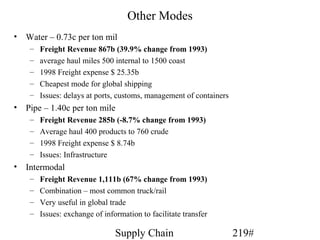
• Aggregation allows firm to lower lot size without
  increasing cost
• Complete aggregation is effective if product specific fixed
  cost is a small fraction of joint fixed cost
• Tailored aggregation is effective if product specific fixed
  cost is large fraction of joint fixed cost


                    Supply Chain               141#
Lessons From Discounting Schemes
• Lot size based discounts increase lot size and cycle
  inventory in the supply chain
• The supply chain profit is lower if each stage
  independently makes pricing decisions with the objective
  of maximizing its own profit. Coordinated solution results
  in higher profit
• Lot size based discounts are justified to achieve
  coordination for commodity products – competitive market
  and price fixed by market
• Volume based discounts with some fixed cost passed on to
  retailer are more effective in general
   – Volume based discounts are better over rolling horizon


                      Supply Chain                    142#
Levers to Reduce Lot Sizes Without Hurting
                    Costs
• Cycle Inventory Reduction
   – Reduce transfer and production lot sizes
       • Aggregate fixed cost across multiple products, supply points, or
         delivery points
   – Are quantity discounts consistent with manufacturing and
     logistics operations?
       • Volume discounts on rolling horizon
       • Two-part tariff – volume based discount in stages
   – Are trade promotions essential?
       • EDLP (Every day low pricing)
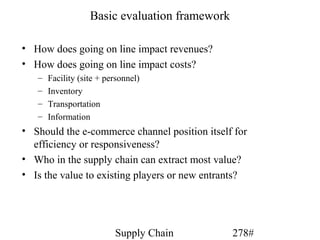
       • Base on sell-thru (customers) rather than sell-in (retailers)
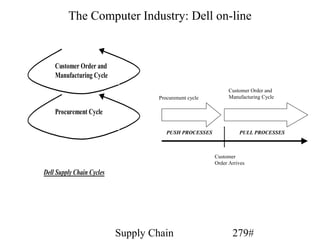
• HOMEWORK
       • EXERCISES 1 AND 2 Pp291/297


                        Supply Chain                       143#
Discussions on Site Visit
• Macy’s Distribution Center (DC)
• In teams please answer the following:
   –   What is the size of the operation
   –   What strategy do they adopt and why
   –   What are the key competitive practices
   –   How do they deal with each of the Supply Chain Drivers
• Measurements used for efficiency?


• How can they improve their operations?


                          Supply Chain                   144#
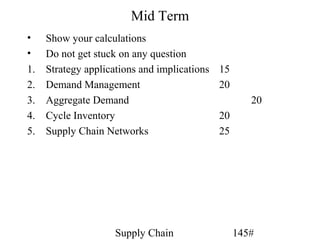
Mid Term
•    Show your calculations
•    Do not get stuck on any question
1.   Strategy applications and implications   15
2.   Demand Management                        20
3.   Aggregate Demand                                 20
4.   Cycle Inventory                          20
5.   Supply Chain Networks                    25


                     Supply Chain                  145#
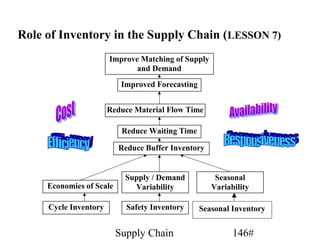
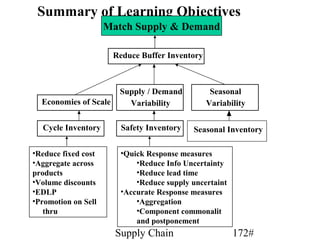
Role of Inventory in the Supply Chain (LESSON 7)
                       Improve Matching of Supply
                              and Demand
                           Improved Forecasting


                       Reduce Material Flow Time

                           Reduce Waiting Time

                          Reduce Buffer Inventory


                            Supply / Demand               Seasonal
     Economies of Scale       Variability                Variability

     Cycle Inventory        Safety Inventory          Seasonal Inventory
                           Figure Error! No text of

                          Supply Chain                         146#
WHY HOLD SAFETY INVENTORY? (SAFETY STOCK)
  • DEMAND UNCERTAINTY
  • SUPPLY UNCERTAINTY
  • TODAY’S ENVIRONMENT
      – INTERNET MAKES SEARCH EASIER
      – PRODUCT VARIETY GROWN WITH CUSTOMIZATION
      – EASE AND VARIETY PUTS PRESSURE ON PRODUCT
        AVAILABILITY
      – PUSH UP LEVELS OF INVENTORY / SAFETY STOCK
  • KEY QUESTIONS
      – APPROPRIATE LEVEL OF SAFETY STOCK
      – WHAT ACTIONS IMPROVE AVAILABILITY AND REDUCE
        SAFETY STOCK?
  Measures of product availability
      – Product fill rate (fr)
      – Order fill rate
      – Cycle service level (CSL) - THIS COURSE WILL DEAL mainly WITH CSL


                          Supply Chain                    147#
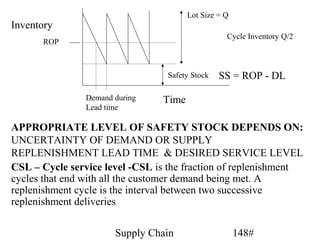
Lot Size = Q
Inventory
                                                  Cycle Inventory Q/2
      ROP


                                 Safety Stock   SS = ROP - DL

                Demand during   Time
                Lead time

APPROPRIATE LEVEL OF SAFETY STOCK DEPENDS ON:
UNCERTAINTY OF DEMAND OR SUPPLY
REPLENISHMENT LEAD TIME & DESIRED SERVICE LEVEL
CSL – Cycle service level -CSL is the fraction of replenishment
cycles that end with all the customer demand being met. A
replenishment cycle is the interval between two successive
replenishment deliveries

                       Supply Chain                   148#
Replenishment policies
• Replenishment policies
   – When to reorder?
   – How much to reorder?
Continuous Review: Order fixed quantity when total
  inventory drops below Reorder Point (ROP)
Periodic Review: Order at fixed time intervals to raise total
  inventory to Order up to Level (OUL)
Factors driving safety inventory
   – Demand and/or Supply uncertainty
   – Desired level of product availability
   – Replenishment lead time
• Demand Uncertainty– Av.Demand; Stnd Devn; Lead Time


                       Supply Chain             149#
Continuous Review Policy: Safety Inventory and Cycle
               Demand Uncertainty & Service Level

L: Lead time for replenishment                     SS = ROP - RL
D: Average demand per unit time
σ D:Standard deviation of demand               Average Inventory = Q/2 + SS
     per period
DL : Mean demand during lead time
σ L: Standard deviation of demand
     during lead time
CSL: Cycle service level –
     Probability of not stocking out in
     replenishment cycle
SS: Safety inventory
ROP: Reorder point
Cv: Coefficient of variance


                                Supply Chain               150#
FORMULAS USED FOR CALCULATING SERVICE LEVELS


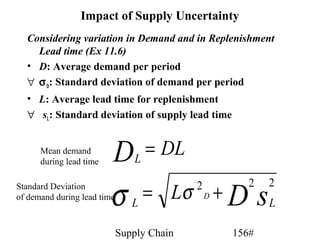
D   L
        = LD

σ L
        = Lσ D
ROP = D L + ss
CSL = F ( ROP, D L ,σ L )
cv = σ / µ
CSL = F ( ROP, DL ,σ L ) = NORMDIST ( ROP, D L ,σ L ,1)
fr = 1 − ESC / Q = (Q − ESC ) / Q
orESC = −( ss[1 − NORMDIST ( ss / σ L ,0,1,1] + σ L NORMDIST ( ss / σ L ,0,1,1)


                            Supply Chain                151#
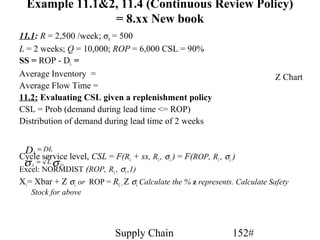
Example 11.1&2, 11.4 (Continuous Review Policy)
                = 8.xx New book
11.1: R = 2,500 /week; σR = 500
L = 2 weeks; Q = 10,000; ROP = 6,000 CSL = 90%
SS = ROP - DL =
Average Inventory =                                                          Z Chart
Average Flow Time =
11.2: Evaluating CSL given a replenishment policy
CSL = Prob (demand during lead time <= ROP)
Distribution of demand during lead time of 2 weeks


 D = DL
    L
Cycle service level, CSL = F(RL + ss, RL , σL ) = F(ROP, RL , σL )
 σ = Lσ
   L        D
Excel: NORMDIST (ROP, RL , σL ,1)
X1= Xbar + Z σL or ROP = RL + Z σL Calculate the % z represents. Calculate Safety
   Stock for above


                             Supply Chain                        152#
Examples of Safety Stock Calculations
•   Weekly demand for Lego at Wal Mart is normally distributed with a mean of
    2500 boxes and a standard deviation of 500. The replenishment lead time is 2
    weeks. Assuming a continuous replenishment policy, evaluate the safety
    inventory that the store should carry to achieve a cycle service of 90 percent


                           Supply Chain                         153#
Factors Affecting Fill Rate
• Fill Rate: Proportion of customer demand that is satisfied from
  Inventory. Directly related to CSL
• Safety inventory: Safety inventory is increased by:
    –   Increasing fill rate (Table 11-1)
    –   Increasing CSL
    –   Increasing supplier lead time by factor k – SS increases by factor of SQRT k
    –   Increasing standard deviation of demand by factor k – SS increases by factor
        of k
• Lot size: Fill rate increases on increasing the lot size even though cycle service
   level does not change.


   Actions: 1. Reduce supplier Lead Time L
            2. Reduce underlying uncertainty of demand σ R

                              Supply Chain                    154#
Evaluating Safety Inventory Given Fill Rate
      Required safety stock grows rapidly with increase in the desired
      Product availability

           Fill Rate                 Safety Inventory
             97.5%                               67
             98.0%                              183
             98.5%                              321
             99.0%                              499
             99.5%                              767


        The required SS grows rapidily with increase in desired Fill Rate
The required SS increases with increase in Lead time and the σ of demand


                          Supply Chain               155#
Impact of Supply Uncertainty
  Considering variation in Demand and in Replenishment
    Lead time (Ex 11.6)
  • D: Average demand per period
  ∀ σ D: Standard deviation of demand per period
  • L: Average lead time for replenishment
  ∀ sL: Standard deviation of supply lead time


      Mean demand
      during lead time   D = DL L


                         σ
                                                         2       2
Standard Deviation
of demand during lead time = Lσ L
                                            2
                                                D   +D       s   L

                             Supply Chain            156#
Impact of Supply Uncertainty ((See Ex. 11.6 & Table 11.2)
Ex.11.6: R = 2,500/day; σR = 500; L = 7 days; Q = 10,000;
CSL = 0.90 (z=1.29); sL = Standard Deviation of lead time=7days What is S.S?
Large potential benefits of reducing Lead time or lead time variability in
   reduction of Safety stock
                                    SS units SS (d)       Stnd Dev(σ L )
Safety inventory when sL = 0 1,695                     0.68              1,323
Safety inventory when sL = 1 3,625                     1.45              2,828
Safety inventory when sL = 2 6,628                     2.65              5,172
Safety inventory when sL = 3 9,760                     3.90              7,616
Safety inventory when sL = 4 12,927          5.17               10,087
Safety inventory when sL = 5 16,109          6.44               12,750
Safety inventory when sL = 6 19,298          7.72               16,109
Safety inventory when sL = 7 is 22,491       8.99               17,550


                             Supply Chain                     157#
Basic Quick Response Initiatives

• Reduce information uncertainty in demand
• Reduce replenishment lead time
• Reduce supply uncertainty or replenishment lead
  time uncertainty
• Increase reorder frequency or go to continuous
  review


                Supply Chain           158#
Factors Affecting Value of Aggregation
• DEMAND CORRELATION –
    – AS CORRELATION INCREASES, THE SS BENEFIT OF AGGREGRATION
      DECREASES
    – IF THERE IS LITTLE CORRELATION BETWEEN DEMAND, AGGREGRATION
      REDUCES STND. DEVN. OF DEMAND AND HENCE SAFETY STOCK (see ex.
      11.7, Table 11.3)
       •   Coefficient Of Variation = Stnd Devn/Mean (uncertainty relative to size of demand) p=0 No
           Correlation
    – THE HIGHER THE COEFFICIENT OF VARIATION OF AN ITEM, THE
      GREATER THE REDUCTION IN SAFETY STOCK AS A RESULT OF
      CENTRALIZATION (LOW COEFFICIENT OF VARIATION ALLOW
      ACCURATE FORECASTING AND DECENTRALIZED STOCKING)
• REDUCING SUPPLY VARIATION REDUCES SAFETY STOCK WITHOUT
  REDUCING CSL
• VALUE OF A PRODUCT
    – DIRECTLY DETERMINES THE SAFETY STOCK LEVEL


                                Supply Chain                            159#
IMPACT OF AGGREGRATION ON SAFETY STOCK
• HOW TO REDUCE SS WITHOUT REDUCING CSL?
  – AGGREGRATION REDUCES STANDARD DEVIATION OF DEMAND,
    ONLY IF DEMAND ACROSS AREAS IS NOT CORRELATED, THAT IS
    EACH AREA IS INDEPENDENT
     • See Table 11.4 p323
  – AGGREGRATION REDUCES SS BY THE SQRT OF NUMBER OF AREAS
    AGGREGRATED (REDUCING NUMBER OF STOCKING LOCATIONS)–
    SQUARE ROOT LAW (Ex. AMAZON) See Fig 11.4
  – INFORMATION CENTRALIZATION – ORDERS FILLED FROM
    WAREHOUSE CLOSEST TO CUSTOMER
  – SPECIALIZATION BY LOCATION
     • LOW DEMAND, SLOW MOVING ITEMS: CENTRALIZED – HIGH
       COEFFICIENT OF VARIATION
     • HIGH DEMAND, FAST MOVING ITEMS: DECENTRALIZED – LOW
       COEFFICIENT OF VARIATION
  – Centralization Disadvantage:
     • Increase in Response time;
     • Increase in Transport costs

                             Supply Chain      160#
IMPACT OF AGGREGRATION ON SAFETY STOCK
• HOW TO REDUCE SS WITHOUT REDUCING CSL?
  – PRODUCT SUBSTITUTION
     • MANUFACTURER DRIVEN – AGGREGATE DEMAND & REDUCE SS;
     • IF PRODUCTS STRONGLY CORRELATED, LESS VALUE IN SUBSTITUTION
     • CUSTOMER DRIVEN – TWO WAY SUBSTITUTION – ALLOWS REDUCTION
       IN SS WHILE MAINTAINING HIGH PRODUCT AVAILABILITY
     • GREATER THE VARIABILITY AND LESS THE CORRELATION OF
       DEMAND, THE GREATER THE BENEFIT IN SUBSTITUTION
  – COMPONENT COMMONALITY (TABLE 11.5)
     • WITHOUT COMMONALITY, UNCERTAINTY OF DEMAND FOR
       COMPONENTS SAME AS THAT FOR PRODUCT (SEE Ex. 11.9)
  – POSTPONMENT
     • DELAY DIFFERENTIATION OR CUSTOMIZATION AS CLOSE TO SALE
       TIME AS POSSIBLE
        – COMMON COMPONENTS IN PUSH PHASE
        – POWERFUL CONCEPT FOR E-COMMERCE


                      Supply Chain              161#
Example 11.9: Value of Component Commonality
Y Axis – SS Quantity; X Axis – No. of common components
450000
400000
350000
300000
250000
                                                     SS
200000
150000
100000
 50000
     0
         1   2    3     4    5   6     7   8   9
  Without component commonality and postponment, product differentiation
  Occurs early in the Supply Chain and inventories are disaggregate
                     Supply Chain                  162#
ESTIMATING AND MANAGING SS IN PRACTICE
•   ACCOUNT FOR LUMPY SUPPLY CHAIN DEMAND
    – CAUSED BY LARGE LOT SIZES & ADDS TO VARIABILITY
    – EMPIRICALLY – RAISING SS BY HALF LOT SIZE
•   ADJUST INVENTORY POLICY IF DEMAND SEASONAL
    – CHANGE BOTH MEAN AND STND DEVN
•   USE SIMULATION TO TEST INVENTORY POLICIES
    – EXCEL
•   START WITH A PILOT
•   MONITOR SERVICE LEVELS
•   FOCUS ON REDUCING SAFETY STOCK
•   PERIODIC REVIEW REPLENISHMENT REQUIRES MORE SAFETY STOCK
    THAN CONTINUOUS REVIEW POLICIES


                         Supply Chain             163#
Mass Customization I: Customize Services Around
            Standardized Products


                                                                        Source: B. Joseph Pine


DEVELOPMENT     PRODUCTION           MARKETING          DELIVERY


                                                           Deliver customized services as
                                                           well as standardized products
                                                           and services
                                              Market customized services with standardized
                                              products or services
                         Continue producing standardized products or services
      Continue developing standardized products or services

                       Supply Chain                           164#
Mass Customization II: Create Customizable
            Products and Services


DEVELOPMENT     PRODUCTION           MARKETING          DELIVERY


                                                           Deliver standard (but
                                                           customizable) products
                                                           or services
                                               Market customizable products or services

                         Produce standard (but customizable) products or services
      Develop customizable products or services

                       Supply Chain                            165#
Mass Customization III: Provide Quick Response
          Throughout Value Chain


DEVELOPMENT     PRODUCTION            MARKETING       DELIVERY


                                                       Reduce Delivery Cycle Times
                                           Reduce selection and order processing cycle
                                           times
                       Reduce Production cycle time

      Reduce development cycle time
                      Supply Chain                          166#
Mass Customization IV: Provide Point of Delivery
                Customization
      Μens Warehouse and Restaurants


DEVELOPMENT     PRODUCTION           MARKETING          DELIVERY

                                                                            Point of delivery
                                                                            customization


                                                           Deliver standardize portion

                                               Market customized products or services

                         Produce standardized portion centrally

      Develop products where point of delivery customization is feasible
                       Supply Chain                               167#
Mass Customization V: Modularize Components to
           Customize End Products
Αutos


 DEVELOPMENT      PRODUCTION           MARKETING     DELIVERY


                                                          Deliver customized product

                                             Market customized products or services

                         Produce modularized components

        Develop modularized products
                        Supply Chain                          168#
Types of Modularity for Mass Customization


                            Component Sharing Modularity


                                       Cut-to-Fit Modularity


                                    Bus Modularity


    Mix Modularity
                                 Sectional Modularity


             Supply Chain           169#
Example of Point of Service Replenishment
•   Safety Stock and Re-order point management in Toyota
    Another advantage of Toyota’s new system is that safety stock criteria can be adjusted
    according to seasonal requirements. Previously, the company had no ability to recognize
    the seasonality of items such as wiper blades. It worked from one forecast model — a
    simple moving average — that didn’t allow for fine-tuning or sudden shifts in consumer
    taste. Reorder points were recalculated just once a month.
    To support the new system, Toyota implemented Exam Inventory, a solution made by
    Entity Software in Epson, U.K. Exam is an inventory management program that runs on
    a PC and is fed raw data directly from a computer. As a result, Toyota (GB) was able to
    fully customize the package to its needs with minimal impact on the company’s larger
    computers. The software allows for more sophisticated forecasting and more accurate
    calculation of reorder points (ROPs), while keeping safety stocks low.
    Toyota now has moved to weekly ROP calculations and hopes eventually to carry out
    that function on a daily basis when the technology permits, Results of the program so far
    include an improvement in Toyota’s service level from 94 percent to 96 percent,
    reduction in the number of manual order changes from 3,000 a day to 50, and reduction
    in run times from 12 to 3.5 hours.


                              Supply Chain                              170#
Cautions in Implementing Postponement and
                    Modularity
• End products must look suitably different to the consumer
• Design and production costs can only be justified over a
  family of products
• Performance and cost of a product can be optimized by
  eliminating modularity. Do a small set of products provide
  most of the sales?


                    Supply Chain              171#
Summary of Learning Objectives
                     Match Supply & Demand

                       Reduce Buffer Inventory


                        Supply / Demand           Seasonal
  Economies of Scale      Variability            Variability

  Cycle Inventory        Safety Inventory   Seasonal Inventory

•Reduce fixed cost      •Quick Response measures
•Aggregate across           •Reduce Info Uncertainty
products                    •Reduce lead time
•Volume discounts           •Reduce supply uncertaint
•EDLP                   •Accurate Response measures
•Promotion on Sell          •Aggregation
   thru                     •Component commonalit
                            and postponement
                       Supply Chain                     172#
HOMEWORK
• Page 336 Q4 and Q5

• Provide actual examples of the five types of customization


                    Supply Chain               173#
OPTIMUM LEVEL OF PRODUCT AVAILABILITY
   Exercise: Swimsuit Production Lesson 8
 • Fashion items have short life cycles, high variety of competitors
 • SnowTime Sporting Goods
      – New designs are completed
      – One production opportunity
      – Based on past sales, knowledge of the industry, and economic conditions,
          the marketing department has a probabilistic forecast
      – The forecast averages about 13,000, but there is a chance that demand will
          be greater or less than this
 •   Production cost per unit (C): $80
 •   Selling price per unit (S): $125
 •   Salvage value per unit (V): $20
 •   Fixed production cost (F): $100,000
 •   Q is production quantity, D demand
 •   Profit = Revenue - Variable Cost - Fixed Cost + Salvage


                            Supply Chain                       174#
Demand Distribution

                     Demand Scenarios
                               28%
              30%
Probability

              25%                      22%
                                             18%
              20%
                    11%   11
              15%         %                           10%
              10%
               5%
               0%
                  00

                   0

                   0

                   0

                   0

                   0
                 00

                 00

                 00

                 00

                 00
                80

               10

               12

               14

               16

               18
                                    Sales

                     Supply Chain              175#
Exercise
•   Scenario One:
     – Suppose you make 12,000 jackets and demand ends up being 13,000
        jackets.
     – Profit = 125(12,000) - 80(12,000) - 100,000 = $440,000
•   Scenario Two:
     – Suppose you make 12,000 jackets and demand ends up being 11,000
        jackets.
     – Profit = 125(11,000) - 80(12,000) - 100,000 + 20(1000) = $ 335,000
• Find order quantity that maximizes weighted average profit.
• Average demand is 13,100 (work out – Σp.D)
• Question: Will this quantity be less than, equal to, or greater than
  average demand?
• Look at marginal cost Vs. marginal profit
   – if extra jacket sold, profit is 125-80 = 45
   – if not sold, cost is 80-20 = 60
• So we will make less than average

                          Supply Chain                      176#
Profitability Calculations

                       Expected Profit

         $400,000

         $300,000
Profit


         $200,000

         $100,000

              $0
               8000          12000       16000          20000
                               Order Quantity


                       Supply Chain              177#
Profitability scenarios

              100%
              80%
Probability


              60%                               Q=9000
              40%                               Q=16000

              20%
               0%
                   00

                   00
                   00
                    0

                    0
                  00

                  00

                 00

                 00

                 00
                00

                00


               30

               50
               10
              -3

              -1


                             Cost


                       Supply Chain            178#
OPTIMAL LEVEL OF PRODUCT AVAILABILITY
• FACTORS AFFECTING OPTIMAL PRODUCT
  AVAILABILITY
  – COST OF OVERSTOCKING Co
     • PROFIT FROM SALES
     • INVENTORY HOLDING COSTS
     • OBSELESCENCE – SALVAGE COSTS
  – COST OF UNDERSTOCKING Cu
     • LOST SALES
     • LOST CUSTOMERS
• EXAMPLE OF L.L.BEAN (Table 12.1)
  – For all references New Book 12.xx


                   Supply Chain         179#
Parkas at L.L. Bean
Cost per parka = $45
Sale price per parka = $100
Discount price per parka = $50
Holding and transportation cost = $10

•   Profit from selling parka = $100-$45 = $55
•   Cost of overstocking = $45+$10-$50 = $5
•   Expected demand =       =1026, ordered 1000 parkas CSL51%
•
•   See formula on page 224
                            ∑
    Expected profit from ordering 1000 parkas = $49,900
                                Di pi
    – Expected profit =

                          10
                          ∑ [ Di ( p − c ) − (1000 − Di )(c − s )] pi + (1 − Pi )1000 ( p − c )
                          i= 4


                                 Supply Chain                              180#
Summary
•   Tradeoff between ordering enough to meet demand and ordering too much
•   Several quantities have the same average profit
•   Average profit does not tell the whole story
•   Question: 9000 and 16000 units lead to about the same average
    profit, so which do we prefer? Work out probabilities of profit and loss
•   The optimal order quantity is not necessarily equal to average forecast demand
    (13,100)
•   The optimal quantity depends on the relationship between marginal profit and
    marginal cost
•   As order quantity increases, average profit first increases and then decreases
•   As production quantity increases, risk increases. In other words, the
    probability of large gains and of large losses increases


                           Supply Chain                        181#
How much to order? Parkas at L.L. Bean (Table 12.1)
 Demand    Probabability     Cumulative Probability of        Probability of demand
  (00’s)                    demand being this size or less     greater than this size
     4          .01                     .01                             .99
     5          .02                     .03                             .97
     6          .04                     .07                             .93
     7          .08                     .15                             .85
     8          .09                     .24                             .76
     9          .11                     .35                             .65
    10          .16                     .51                             .49
    11          .20                     .71                             .29
    12          .11                     .82                             .18
    13          .10                     .92                             .08
    14          .04                     .96                             .04
    15          .02                     .98                             .02
    16          .01                     .99                             .01
    17          .01                    1.00                             .00

   The probability that demand is greater than 1100 is 0.29 but the probability that
 demand is greater than or equal to 1100 is 0.49. O.51 is the probability that the
 demand is 1000 or less. Thus, 1-0.51 = 0.49 is the probability that the demand is
  greater than 1000 = probability that demand is greater than or equal to 1100

                             Supply Chain                           182#
Parkas at L.L. Bean (Table 12.2)
Expected Marginal Contribution of each 100 parkas Fig 9.1

 Additional Expected         Expected      Expected Marginal
 100s       Marginal Benefit Marginal Cost Contribution
 11th       5500×.49 = 2695 500×.51 = 255 2695-255 = 2440
 12th       5500×.29 = 1595 500×.71 = 355 1595-355 = 1240
 13th       5500×.18 = 990   500×.82 = 410 990-410 = 580
 14th       5500×.08 = 440   500×.92 = 460 440-460 = -20
 15th       5500×.04 = 220   500×.96 = 480 220-480 = -260
 16th       5500×.02 = 110   500×.98 = 490 110-490 = -380
 17th       5500×.01 = 55    500×.99 = 495 55-495 = -440


                    Supply Chain               183#
Optimal Order Quantity

        1.2

         1
0.917

        0.8
Prob
        0.6                                         Probability

        0.4

        0.2

         0
           4 5 6 7 8 9 10 11 12 13 14 15 16 87
          Optimal Order Quantity = 13
                             Supply Chain        184#
Optimal level of service (Eqn. 12.1)
p = retail sale price; s = outlet or salvage price;
c = purchase price;
Co = cost of overstocking by one unit, Co = c - s
Cu = cost of understocking by one unit, Cu = p - c
CSL* = Optimal SL. Optimal order size O*
If O* +1, expected marginal benefit from increasing order size by 1 = (1-CSL*)
   (p - c) (understocking cost x prob of understock)
If O* -1, Expected Marginal Cost = CSL*(c - s).
               Thus expected marginal contribution of O* to O* +1
                      (1-CSL*)Cu - CSL*× Co (or optimally) = 0
                 CSL*= prob. (dem. =< O* ) = Cu / (Cu + Co) = (p-c)
                                                                  (p-s)


                             Supply Chain                     185#
Order Quantity for a Single Order (ex 12.1)

Salvage value = $80
Co = Cost of overstocking

    = c-s = $20
Cu = Cost of understocking                                             *
                                 CSL * = Pr ob( Demand ≤ R ) =
    = p – c = $150
                                     C   u
                                                 =
                                                       150
                                                              = 0.88
O* = Optimal order size          C +Cu       o
                                                     150 + 20
                                 O* = µ + zσ = 350 + 1.18 x100 = 468


                      Supply Chain                        186#
MANAGERIAL LEVERS TO IMPROVE
           PROFITABILITY

• How to Estimate Demand Distribution?
   – Historical data: Time series forecasting
   – Dependent factors: Regression, causal forecasting
   – Expert opinion: Buying committee


Key: Forecast must include estimated demand and
  uncertainty (standard deviation) of demand


                      Supply Chain                  187#
Levers for Increasing Supply Chain Profitability
• Increase salvage value (cost of overstock) or decrease margin lost from stockout –
  backup sourcing; rain checks.
• As Co/Cu gets smaller, optimal level of product availability (CSL) increases (see Fig
  12.2). Companies with high margin have high cost of understocking and so provide
  high CSL
• Improved forecasting to lower demand uncertainty (table 12.3) – CSL is constant.
  Optimum order size decreases and Expected profit increases
• Quick response Reduce replenishment lead time so as to increase number of orders
  per season (table 12.4, 12.5). With two or more orders:
    – Possible to provide same CSL with less inventory
    – Average overstock at end of season is less
    – Profits higher with second order
• If quick response allows multiple orders in the season, profits increase and overstock
  quantity reduces (Fig 12.4,12.5)


                                Supply Chain                    188#
Levers for Increasing Supply Chain Profitability
• Postponement of product differentiation
   – Better match of supply and demand for products not positively
     correlated and about the same size
   – Postponment may reduce overall profits, if one product contributes
     to majority of demand (extra cost of later manufacturing)
   – Tailored postponement only uncertain part of demand, producing
     predictable part at lower cost without postponement
• Tailored supply sourcing – focus on two sources
   – One source focus on cost; unable to handle uncertainty –
     predictable portion
   – One source focus on flexibility; at a higher cost – unpredictable
     portion


                       Supply Chain                     189#
Tailored Sourcing: Multiple Sourcing Sites


Characteristic   Primary Site      Secondary Site
Manufacturing High                 Low
Cost
Flexibility    High                Low
(Volume/Mix)
Responsiveness High                Low
Engineering      High              Low
Support

                 Supply Chain           190#
Dual Sourcing Strategies


Strategy      Primary Site      Secondary Site

Volume based Fluctuation        Stable demand
dual sourcing
Product based Unpredictable     Predictable,
dual sourcing products,         large batch
              Small batch       products
Model based Newer               Older stable
dual sourcing products          products

              Supply Chain            191#
SUPPLY CHAIN CONTRACTS
•   DOUBLE MARGINALIZATION (SUBOPTIMIZATION)
    – BUY BACK (Ex. Mfg cost 10, retailer cost 100, selling 200 – SC profit 190, retailer
      profit – 100, manuf profit 90). EACH TRY TO MAXIMIZE OWN PROFIT, NOT THE
      SUPPLY CHAINS)
    – RETAILER ORDERS LESS AS THE LOSS FROM UNSOLD PRODUCT HIGH (100).
      Loss to Supply Chain is 10 only
    – MANUFACTURER IN BUYING BACK UNSOLD PRODUCT, INCREASES
      SALVAGE VALUE, AND INDUCES RETAILER TO ORDER MORE (table 9.70
    – TOTAL SUPPLY CHAIN PROFITS INCREASE
•   QUANTITY FLEXIBILITY CONTRACTS
    – MANUFACTURER ALLOWS RETAILER TO CHANGE CONTRACTS AFTER
      CHANGING DEMAND
    – INCREASES PROFITABILITY OF ALL AND TOTAL SUPPLY CHAIN
•   VMI REPLENISHMENT BY MANUFACTURER (Ex. P&G/WALMART)
        • CONTROL OF REPLENISHMENT MOVES TO MANUFACTURER
        • CUSTOMER INFORMATION TO MANUFACTURER


                               Supply Chain                      192#
SETTING OPTIMAL LEVELS OF PRODUCT
                AVAILABILITY
• USE ANALYTICAL FRAMEWORK TO INCREASE PROFITS
   – COMPANIES SET TARGETS WITHOUT ANALYSIS
• BEWARE OF PRESET LEVELS OF AVAILABILITY
   – OFTEN SET WITHOUT JUSTIFICATION
   – WORK ANALYSIS TO MAXIMIZE PROFITS
• USE APPROXIMATE COSTS AS PROFIT MAXIMIZING SOLUTIONS
  ARE ROBUST
• ESTIMATE A RANGE FOR STOCKING OUT
• ENSURE THAT LEVELS OF PRODUCT AVAILABILITY FIT WITH
  STRATEGY

               •   HOME WORK Page 373 Ex. 1 and 3


                      Supply Chain             193#
CASE STUDY – OPTIMIZED DEMAND PULL
• HIGHLY VARIABLE, HI TECH, HIGH COST
  – 12 MONTH ROLLING FORECAST WITH MANUFACTURING
    LEAD TIME COMMITTED
  – CHANGE OUTSIDE LEAD TIME LIMITED TO +/- 20%
  – TWO YEAR FORECAST ON YEAR FORECAST
    COMMITTED TO, NOT MONTHLY QUANTITIES
  – INCENTIVES FOR INCREASED FORECAST, DISCOUNTS
    FOR REDUCED FORECASTS
  – REPLENISHMENT RATE DRIVEN BY MAX/MIN ON HAND
    LEVELS
  – WEEKLY ON HAND
  – MONTHLY 12 MONTH ROLLING FORECAST


               Supply Chain         194#
SOURCING and PROCUREMENT (CH 14)                                     Lesson 9
• SOURCING
  – Entire set of business processes to purchase goods and services
  – Includes:
      •   Selection of supplies
      •   Design of supplier contracts
      •   Product design collaboration
      •   Procurement of material
      •   Evaluation of Supplier performance
• PROCUREMENT
  – Process of purchasing materials, products and services
  – COGS 50% or more of product cost
  – Even higher % with outsourcing


                               Supply Chain                  195#
EFFECTIVE SOURCING
• ECONOMIES OF SCALE – ORDERS AGGREGRATED
• MORE EFFICIENT PROCUREMENT TRANSACTIONS
  (LESS) REDUCES OVERALL COST
• DESIGN COLLABORATION
• IMPROVE FORECASTING
• CONTRACTS FOR SHARING RISK
• LOWER PURCHASING PRICE


             Supply Chain      196#
IN HOUSE OR OUTSOURCE
• HOW DO THIRD PARTIES INCREASE SUPPLY CHAIN SURPLUS
   –   CAPACITY AGGREGRATION
   –   INVENTORY AGGREGRATION
   –   TRANSPORTATION AGGREGRATION
   –   WAREHOUSING AGGREGRATION
   –   PROCUREMENT AGGREGRATION
   –   INFORMATION AGGREGRATION
   –   RECEIVABLE AGGREGRATION
   –   RELATIONSHIP AGGREGRATION
   – LOWER COSTS AND HIGHER QUALITY (Table 14.1)


                     Supply Chain              197#
RISKS OF USING A THIRD PARTY
• THE PROCESS IS BROKEN – lack control
• UNDERESTIMATE COST OF COORDINATION
• REDUCED SUPPLIER/CUSTOMER CONTACT
• LOSS OF INTERNAL CAPABILITY AND GROWTH IN THIRD
  PARTY POWER
• LEAKAGE OF SENSITIVE DATA AND INFORMATION
• INEFFECTIVE CONTRACTS

• THIRD AND FOURTH PARTY PROVIDERS (Table 14-2)
    –   Transportation
    –   Warehousing
    –   Information technology
    –   Reverse Logistics
    –   International
    –   Special skills/handling


                          Supply Chain    198#
SUPPLIER SCORING AND ASSESSMENT
MUST BE BASED ON IMPACT ON TOTAL COST (Tab14-3)
 • IN ADDITION TO PRICE
  •   REPLENISHMENT LEAD TIME;
  •   ON TIME PERFORMANCE
  •   SUPPLY FLEXIBILITY
  •   DELIVERY FREQUENCY/ MINIMUM LOT SIZE
  •   SUPPLY QUALITY
  •   INBOUND TRANSPORTATION COSTS
  •   INFORMATION COORDINATION CAPABILITY
  •   DESIGN COST REDUCTION
  •   EXCHANGE RATES, TAXES AND DUTIES
  •   SUPPLIER VISIBILITY
  •   RESPONSIVENESS


                    Supply Chain             199#
SOURCING DECISIONS
• SUPPLIER PERFORMANCE BASED ON IMPACT ON TOTAL
  COST (see Table 14.1)
  – Ex. Green Thumb gets bearings at $1.00 in lots of 2,000 with a lead time
    of 2 weeks and a stnd devn of 1 week. New supplier offers $0.97 with lot
    size of 8000, a lead time of 6 weeks and stnd devn of 4 weeks. Given
    1000 bearings needed per week with a stnd devn of 300 and that holding
    costs are 25% and CSL is 95% which supplier should be selected


                       Supply Chain                        200#
SOURCING DECISIONS
•   CONTRACTS
    – BUYBACK OR RETURN CONTRACTS
       • LOWERS COST OF OVERSTOCKING
    – REVENUE SHARING CONTRACTS
       • REDUCES COST PER UNIT TO RETAILER & COST OF OVERSTOCKING
    – QUANTITY FLEXIBILITY CONTRACTS – BEST
       • RETAILER CAN MODIFY ORDER CLOSER TO POINT OF SALE
    – CONTRACTS TO INDUCE PERFORMANCE IMPROVEMENT
       • SHARED SAVINGS CONTRACT
•   DESIGN COLLABORATION
    – HELPS REDUCE COST, IMPROVE QUALITY AND TIME TO MARKET
•   PROCUREMENT PROCESS
    – FOCUS ON IMPROVING DIRECT MATERIALS COORDINATION AND
      VISIBILITY WITH SUPPLIER
    – LOOKING SEPARATELY AT DIRECT AND INDIRECT MATERIAL COSTS (14-7)
    – CLASSIFYING ITEMS PER COST AND CRITICALITY (FIG 14.2)
    – FOCUS ON IMPROVING INDIRECT MATERIALS BY DECREASING
      TRANSACTION COST OF ORDER
    – BOTH SHOULD CONSOLIDATE ORDERS FOR ECONOMIES OF SCALE


                          Supply Chain                 201#
SOURCING DECISIONS
• SOURCING DECISIONS IN PRACTICE
  – USE MULTIFUNCTIONAL TEAMS
  – ENSURE APPROPRIATE COORDINATION ACROSS
    REGIONS AND BUSINESS UNITS
  – ALWAYS EVALUATE TOTAL COST OF OWNERSHIP
  – BUILD LONG TERM RELATIONSHIP WITH KEY
    SUPPLIERS


               Supply Chain         202#
Make or Buy Decision

–   Cost
–   Time
–   Capacity Utilization
–   Control of Production/Quality
–   Design Secrecy
–   Supplier Reliability and Technical Expertise
–   Volume
–   Workforce Stability


                     Supply Chain                  203#
Make-or-Buy Decision
•Original Data:
•Produce 10,000 units
 Cost Factors
           Raw material                                           $9,000
           Direct labor                                          $12,000
           Variable factory overhead                              $5,000
           Fixed factory overhead                                $24,000
 Total Cost to Make                                              $50,000
 Make cost per unit = $50,000/10,000 = $5.00/unit
 Purchase proposal = $4.50/unit
 Should the product be bought?
•Factors to Consider:
 1.   You only avoid 80% of the variable factory overhead cost
 2.   And only avoid 10% of the fixed factory overhead cost


                               Supply Chain                          204#
Cost Avoidance Analysis (Solution)

Solution
    Cost avoided by purchasing
    Total cost to make                                                 $50,000
         Less cost avoided:
         Raw material                                       $9,000
         Direct labor                                      $12,000
         Variable factory overhead ($5,000@0.80)            $4,000
         Fixed factory overhead ($24,000@0.10)              $2,400
    Total Avoided Cost                                                 $27,400
Analysis
    Cost not avoided                                       $22,600
    Plus cost to purchase                                  $45,000
    Total cost to purchase                                             $67,600
           Compare to cost to make                         $50,000
    Increase in cost to purchase                                       $17,600
    Actual cost per purchased item                 67500/1000 = $6.75/unit !


                             Supply Chain                       205#
SUPPLIER PARTNERSHIPS

• QUALIFICATION AND SELECTION
  – RATIONALIZATION OF SUPPLIER BASE
• PARTNERSHIP
  –   WIN-WIN AND TRUST
  –   SHARING OF RISK AND COMMITMENT
  –   PRICE REDUCTIONS AND INCREASES BASED ON FORECAST
  –   RATE REPLENISHMENT
• MEAUREMENT AND FEEDBACK
  – QUALITY, DELIVERY, RESPONSIVENESS
  – QUARTERLY FEEDBACK
  – IMPLICATIONS


                    Supply Chain           206#
HOMEWORK

• Exercises 1 & 2


                    Supply Chain   207#
MANAGING TRANSPORTATION IN A
    SUPPLY CHAIN (Chap 13) – Lesson 10


• Key modes of transport and major issues
• Transportation System Design
• Tradeoffs in transportation design – costs vs.
  responsiveness
   – Transportation and inventory: Choice of mode
   – Transportation and inventory: Consolidation


                  Supply Chain            208#
LOGISTICAL PROCESSES
• TRANSPORTATION
  – PALLETIZATION AND CONTAINERIZATION
  – FREIGHT FORWARDERS AND CUSTOMS
  – TRADE-OFF IN TRANSPORTATION TYPES & TRANSITONS
• WAREHOUSING AND DISTRIBUTION
  – CENTRALIZED OR REGIONAL
  – REPLENISHMENT STRATEGIES
     • DRP
     • POINT OF USE
  – CROSS DOCKING
• DELIVERY
• GLOBAL SUPPLY CHAINS


                      Supply Chain         209#
Principle:
                    Leverage World-Wide Logistics


                This principle is about Variability.


                                 Supply Chain                                            210#
C 1999. William T. Walker, CFPIM, CIRM with the APICS Educational & Research Foundation. All Rights Reserved.
Fundamental Logistics Tradeoffs

                                           Supply Chain
                                         Inventory
                                                                   Units


Landed Cost


                                                              Transit Time
                                                               Variability
                                 Supply Chain                                            211#
C 1999. William T. Walker, CFPIM, CIRM with the APICS Educational & Research Foundation. All Rights Reserved.
Tailored Logistics
•   Transportation costs in 1996 - $455 billion (6% GNP). In 2005 744b 10%
    GDP
•   E-com and home delivery of small loads makes transport more significant
     – Wal-Mart – low inventory, frequent replenish, cross dock
     – Amazon – centralized warehouses, package carriers and postal system
     – Dell – centralized assembly, package carriers (Airborne)
•   Each Logistically Distinct Business (LDB) will have distinct requirements
    in terms of
     – Inventory
     – Transportation
     – Facility
     – Information
Key: How to gain efficiencies while tailoring logistics?


                             Supply Chain                         212#
FACTORS AFFECTING TRANSPORTATION
              DECISIONS
• CARRIER
  –   VEHICLE RELATED COST – cost of vehicle
  –   FIXED OPERATING COST – terminals, labor
  –   TRIP RELATED COST – fuel, labor
  –   QUANTITY RELATED COST - weight
  –   OVERHEAD COST – planning, dispatching
• SHIPPER
  –   TRANSPORTATION COST – cost per Ton mile
  –   INVENTORY COST – holding
  –   FACILITY COST - storage
  –   PROCESSING COST – loading unloading
  –   SERVICE LEVEL COST – not making delivery


                    Supply Chain                 213#
Transportation Modes (See Table 13.1 )
• Trucks
    –   TL
    –   LTL
    –   Carload
    –   Intermodal
•   Rail
•   Air
•   Package Carriers
•   Water
•   Pipeline
                DISCUSS USES AND ISSUES


                     Supply Chain         214#
AIR
•   Freight Revenue 777b 2002 (96.7% change from 1993)
•   Average revenue / ton-mile (1996) = 58.75 cents
•   Average haul = 1,260 miles
•   Average load = 10.5 tons
•   1998 Freight expense $22.678b
•   Key Issues
    –   Location/Number of hubs
    –   Location of fleet bases / crew bases
    –   Schedule optimization
    –   Fleet assignment
    –   Crew scheduling
    –   Yield management
• Best Use


                        Supply Chain           215#
Truckload (TL)
•   Freight Revenue 6,660b (42.2% change from 1993)
•   Average revenue per ton mile (1996) = 9.13 cents
•   Average haul = 274 miles
•   Average Capacity = 42,000 - 50,000 lb.
•   1998 Freight expense $ 401.68billion
•   Low fixed and variable costs
•   Major Issues
    – Utilization (Idle and empty travel)
    – Consistent service
    – Backhauls
• Best Use?


                      Supply Chain          216#
Less Than Truckload (LTL)
•   Average revenue per ton-mile (1996) = 25.08 cents
•   Average haul = 646 miles
•   1998 Freight expense with TL
•   Higher fixed costs (terminals) and low variable costs
•   Major Issues
    –   Location of consolidation facilities
    –   Utilization
    –   Vehicle routing
    –   Customer service (delivery time and reliability)
• Best Use?


                        Supply Chain                   217#
Rail
•   Freight Revenue 388b (39.2% change from 1993)
•   Average revenue / ton-mile (1996) = 2.5 cents
•   Average haul = 720 miles
•   Average load = 80 tons
•   1998 Freight expense $35.35billion
•   Key Issues
    –   Scheduling to minimize delays / improve service
    –   Off track delays (at pick up and delivery end)
    –   Yard operations, transitions
    –   Variability of delivery times
• Best Use?


                       Supply Chain                   218#
Other Modes
•   Water – 0.73c per ton mil
     –   Freight Revenue 867b (39.9% change from 1993)
     –   average haul miles 500 internal to 1500 coast
     –   1998 Freight expense $ 25.35b
     –   Cheapest mode for global shipping
     –   Issues: delays at ports, customs, management of containers
•   Pipe – 1.40c per ton mile
     –   Freight Revenue 285b (-8.7% change from 1993)
     –   Average haul 400 products to 760 crude
     –   1998 Freight expense $ 8.74b
     –   Issues: Infrastructure
•   Intermodal
     –   Freight Revenue 1,111b (67% change from 1993)
     –   Combination – most common truck/rail
     –   Very useful in global trade
     –   Issues: exchange of information to facilitate transfer

                                 Supply Chain                         219#
Tradeoffs in Transportation Design
• Transportation, facility, and inventory cost tradeoff
   – Choice of transportation mode
   – Inventory aggregation
• Transportation cost and responsiveness tradeoff
• Ranking of Transportation Modes in terms of Supply
  Chain performance – Table 13-3


                     Supply Chain               220#
DESIGN OPTIONS FOR TRANSP NETWORK
•   DIRECT SHIP NETWORK (fig 13.2)
    – IF REPLENISHMENT LARGE ENOUGH FOR TL
•   DIRECT SHIP WITH MILKRUNS (fig 13.3)
    – SINGLE SUPPLIER TO MULTIPLE RETAILER OR VICE VERSA
    – ELIMINATE INTERMEDIATE WAREHOUSES
    – LOWER TRANSPORTATION COSTS
•   ALL SHIPMENTS VIA CDC (FIG 13.4, 13.5)
    – DC STORE INVENTORY OR TRANFER LOCATION
    – CROSS DOCKING
    – SHIP VIA DC WITH MILK RUN
•   TAILORED NETWORK (FIG 13.5)

    EXERCISE: ADVANTAGES AND DISADVANTAGES OF EACH – next slide


                       Supply Chain             221#
PROS AND CONS OF TRANP. NETWORKS (Tab 13.2)
Network Structure                Pros                              Cons

Direct Shipping                  *No intermediate Whse             *High inventories
                                 * Simple to coordinate            *Significant Receiving
                                                                   expense

Direct Shipping with milk runs   *Lower transp costs small lots    * More coordination
                                 *Lower inventories                complexity

All shipments via CDC with       *Consolidation less inbound       *Increased Inventory
inventory storage                transp cost                       *Increased handling

Ship via CDC with cross          *Very low inventory               * More coordination
docking                          *Consolidation-less trans Cost    complexity

Shipping via DC using milk       * Lower outbound trans cost for   *Further increase in
runs                             small lots                        coordin complexity
Tailored network                 *Match trans choice with needs    *Highest coordin
                                                                   complexity


                                 Supply Chain                       222#
TRADE OFFS IN TRANSPORTATION DESIGN
           TRANSPORTATION AND INVENTORY COST TRADE-OFF

•   Choice of Transport Mode: Eastern Electric Corp (Ex 13.1)
•   Annual demand = 120,000 motorsTraditional lot size 3000
•   Cost per motor = $120 Weight 10lbs
•   Current order size = See Table 13.4
•   Safety stock carried = 50% of demand during delivery lead time
•   Holding cost =25%. Annual holding cost =120 x 0.25 =$30/motor
•   Lead times – 1 day to process, transit time days - rail 5, road 3

• Work out the total cost for each transport proposal See Table 13.5
•   Proposal Quantity over 250cwt $4/cwt to $3/cwt and shipment batch size 4000. What
    should plant do

Total Costs = Inventory costs (include Cycle, Safety) + Transportation costs (depend on
    weight and form of transport)

                                  Supply Chain                          223#
Eastern Electric Corporation (Table 13.5)


Alternative   Transport Cycle     Safety    Transit   Inventory Total
(Lot size)    Cost      Inventory Inventory Inventory Cost      Cost
AM Rail       $78,000   1,000     986       1,644     $108,900 $186,900
(2,000)
Northeast     $90,000   500      658       986       $64,320    $154,320
Trucking
(1,000)
Golden        $96,000   250      658       986       $56,820    $152,820
(500)
Golden        $86,400   1,250    658       986       $86,820    $173,220
(2,500)
Golden        $78,000   1,500    658       986       $94,320    $172,320
(3,000)
Golden        $67,500   2,000    658       986       $109,320   $176,820
(4,000)


                           Supply Chain                 224#
Inventory Aggregation at HighMed Ex 13.2 (Table 13.6)
Highval (cost $200/unit, 0.1 lbs/unit) demand in each territory
   µH = 2, σH = 5, CSL= 0.997, Holding cost = 25%
Lowval (cost $30/unit, 0.04 lbs/unit) demand in each territory
   µL = 20, σL = 5
UPS rate: $0.66 + 0.26x {for replenishments}
FedEx rate: $5.53 + 0.53x {for customer shipping}
where x is quantity shipped in lbs
Factory 1 week replenish, local inventory 4 wks replenish
Average customer order – 1 Highval & 10 Lowval
Option A – Replenish weekly instead of every 4 weeks
Option B – Elimin inventory in territories, aggregate all inven in one
  warehouse, replenish warehouse once a week


                            Supply Chain              225#
Inventory Aggregation at HighMed (13.6)


                    Current          Option 1      Option 2
                    Scenario
# Locations         24               24            1
Reorder Interval    4 weeks          1 week        1 week
Inventory Cost      $54,366          $29,795       $8,474
Shipment Size(dltxlt) 8 H + 80 L     2 H + 20 L    1 H + 10 L
Transport Cost      $530             $1,148        $14,464
Total Cost          $54,896          $30,943       $22,938
 If shipment size to customer is 0.5H + 5L, total cost of option 2
 increases to $36,729.

                      Supply Chain                226#
Physical Inventory Aggregation: Inventory vs.
                    Transportation cost
• Firms can significantly reduce SS by physically aggregating
  inventory in one location
• As a result of physical aggregation
   – Inventory costs decrease
   – Inbound transportation cost decreases – one destination DC
   – Outbound transportation cost increases – several deliveries
• Advantageous when inventory and facility costs form a large
  fraction of supply chain costs
   – Large value to weight ratio (ex PC’s)
   – High demand uncertainty and large value (ex designer dresses)
   – Large customer orders to cover economies of scale on outbound
     transportation


                           Supply Chain                    227#
Tailored Transportation (Table 13.9)
• Factors affecting tailoring – Optimizing response vs cost
   – Customer distance and density
              » Short distance                         Med distance           Long distance
       Hi Density Private fleet milk runs              Crossdock, milk runs    Crossdock, milk runs
       Med Dens    Third party milk runs               LTL carrier LTL or package carrier
       Low Dens Third party milk runs or LTL           LTL or package carr    Package carrier
   – Customer size
       • Large can use a TL; medium and small LTL use LTL or milk runs
   – Product demand and value (Table 13.10)
       • Product             Hi value                             Lo value
       • High demand         Disaggreg   cycle inven              Disaggreg all inven, use inexpen trans
                  »          Aggregate safety stock,           for replen inven
                  »          inexpen transp for replen, cycle &
                  »          fast mode for safety inventory
       • Low demand          Aggregate all inven. Use fast        Aggregate Safety inven only. Use inexpen
                  »          trans for filling cust orders        trans for replen cycle inven


                                   Supply Chain                                 228#
ROUTING AND SCHEDULING IN
                TRANSPORTATION Chapter 5)
• Framework for Network Design Decisions (Table 5.2)
   –   Phase I : Define a supply chain strategy
   –   Phase II: Define regional facility configuration
   –   Phase III: Select a set of desirable potential sites
   –   Phase IV: Location Choices
   –   Exercise Sun Oil Fig 5-3
• Phase II Network Optimization Models: Capacitated Plant
  Location Model
   – Decide on Network design that maximizes profits
• Phase III: Gravity Location Models (Table 5-1) – Work out
  manually
   –   Identify the distance matrix
   –   Identify the savings matrix
   –   Assign customers to vehicles or routes
   –   Sequence customers within routes

                             Supply Chain                     229#
RISK MANAGEMENT IN TRANSPORTATION

• RISK THAT SHIPMENT IS DELAYED
• RISK THAT SHIPMENT DOES NOT REACH ITS
  FINAL DESTINATION, BECAUSE INTERMEDIATE
  NODES DISRUPTED
• RISK OF HAZARDOUS MATERIAL


              Supply Chain       230#
MAKING TRANSPORTATION DECISIONS IN
                 PRACTICE
• ALIGN TRANSPORTATION STRATEGY WITH COMPETITIVE
  STRATEGY
• CONSIDER BOTH IN HOUSE AND OUTSOURCED TRANSPORTATION
   – STRATEGIC IMPORTANCE AND PROFITABILITY
• DESIGN A TRANSPORTATION NETWORK THAT CAN HANDLE E-
  COMMERCE
   – DECREASE IN SHIPMENT SIZE & INCREASE IN HOME DELIVERY
• USE TECHNOLOGY TO IMPROVE TRANSPORTATION PERFORMANCE
   – IDENTIFY LOCATION AND SHIPMENT IN VEHICLE
• DESIGN FLEXIBILITY INTO THE TRANSPORTATION NETWORK
   – TAKE INTO ACCOUNT UNCERTAINTYIN DEMAND AND IN AVAILABILITY OF
     TRANSPORTATION


                        Supply Chain                 231#
HOMEWORK
• EXERCISE 13.1 Coal and MRO
• Ex 13.2 Work out single location and 1 week replenishment
• EXAMPLE HIGHMED (Ex 13.2)
   – WORK OUT OPTION A & IF SHIPMENT SIZE IS 0.5H + 5.0L
   – WHAT ARE YOUR CONCLUSIONS?


                   Supply Chain              232#
FACILITY DECISIONS: Network Design Decisions
            Lesson 11 (Chap 4)
• FACILITY ROLE
  – What processes are performed
• FACILITY LOCATION
  – Where should facilities be located
• CAPACITY ALLOCATION
  – How much capacity should be allocated to each facility
• MARKET & SUPPLY ALLOCATION
  – What markets should each facility serve
  – What supply sources should feed each facility


                     Supply Chain                    233#
Factors Influencing Network Design Decisions
• Strategic
   – Cost or Responsiveness focus
• Technological
   – Fixed costs and flexibility determine consolidation
• Macroeconomic
   – Tariffs and Tax incentives. Stability of currency
• Political stability - clear commerce & legal rules
• Infrastructure
   – sites, labor, transportation, highways, congestion, utilities
• Competition
• Logistics and facility costs


                        Supply Chain                      234#
The Cost-Response Time Frontier


Low      Local FG
          Mix
           Regional FG

                Local WIP
Cost             Central FG

                     Central WIP

                              Central Raw Material and Custom production


                                             Custom production with raw material at suppliers
Hi

       Low (QUICK)              Response Time                  Hi (LONG)

                         Supply Chain                                235#
LOGISTICS AND FACILITIES COSTS
• INVENTORY COSTS
• TRANSPORTATION COSTS
  – INBOUND AND OUTBOUND
• FACILITY (SETUP AND OPERATING) COSTS
• TOTAL LOGISTICS COSTS

     SEE SUCCEEDING CHARTS


              Supply Chain        236#
Service and Number of Facilities
           AS THE NUMBER OF FACILITIES INCREASE,
      RESPONSE TIME REDUCES, AND COST INCREASES


Response
           Response                           Costs
Time
           Time
                                                      Costs


                                  Number of Facilities

                  Supply Chain           237#
Costs and Number of Facilities


                                     Inventory


Costs                                     Facility costs


                                         Transportation
                                         Frequent inbound trans


                  Number of facilities

              Supply Chain               238#
Cost Build-up as a function of facilities
                                                    Total Costs
Cost of Operations


                                                Percent Service
                                                 Level Within
                                                Promised Time

                                                     Facilities
                                                    Inventory
                                                    Transportation
                                                    Labor


                      Number of Facilities
                     Supply Chain            239#
FRAMEWORK FOR NETWORK DESIGN DECISIONS
  • DEFINE A SUPPLY CHAIN STRATEGY
    – COMPETITIVE STATEGY, COMPETITION, SWOT
  • DEFINE A REGIONAL FACILITY STRATEGY
    – LOCATION, ROLES AND CAPACITY
  • SELECT DESIRABLE SITES
    – HARD INFRASTURCTURE – TRANSPORT, UTILITIES,
      SUPPLIERS, WAREHOUSES
    – SOFT INFRASTRUCTURE – SKILLED WORKFORCE,
      COMMUNITY
  • CHOOSE LOCATION
    – PRICE LOCATION AND CAPACITY ALLOCATION
             SEE FRAMEWORK NEXT


                  Supply Chain           240#
A Framework for Global Site Location (107)


 Competitive STRATEGY                                         GLOBAL COMPETITION
                                           PHASE I
                                         Supply Chain
INTERNAL CONSTRAINTS                       Strategy               TARIFFS AND TAX
Capital, growth strategy,                                         INCENTIVES
existing network

PRODUCTION TECHNOLOGIES                                      REGIONAL DEMAND
Cost, Scale/Scope impact, support          PHASE II          Size, growth, homogeneity,
required, flexibility
                                        Regional Facility    local specifications
                                         Configuration
         COMPETITIVE
        ENVIRONMENT                                         POLITICAL, EXCHANGE
                                                            RATE AND DEMAND RISK

                                          PHASE III
                                         Desirable Sites            AVAILABLE
                                                                 INFRASTRUCTURE
 PRODUCTION METHODS
 Skill needs, response time


FACTOR COSTS                              PHASE IV          LOGISTICS COSTS
Labor, materials, site specific         Location Choices    Transport, inventory, coordination


                                    Supply Chain                  241#
Tailored Network: Multi - Echelon Finished Goods
                        Network


                               Local DC
                              Cross-Dock                Store 1
             Regional                      Customer 1
              Finished                        DC
             Goods DC                                   Store 1
                              Local DC
                              Cross-Dock
 National                                               Store 2
                                           Customer 2
 Finished
                                              DC
Goods DC
                               Local DC                 Store 2
                              Cross-Dock
             Regional
              Finished                                  Store 3
             Goods DC

                                                        Store 3


                         Supply Chain          242#
Network Optimization Models
• Allocating demand to production facilities
• Locating facilities and allocating capacity
   – Speculative Strategy
       • Single sourcing
   – Hedging Strategy
       • Match revenue and cost exposure
   – Flexible Strategy                              Key Costs:
       • Excess total capacity in multiple plants
       • Flexible technologies                      •Fixed facility cost
                                                    •Transportation cost
                                                    •Production cost
                                                    •Inventory cost
                                                    •Coordination cost

  Which plants to establish? How to configure the network?

                         Supply Chain                 243#
Gravity Methods for Location – Min. cost of transportn 316,116)
  ASSUMPTION: TRANSPORT COSTS GROW LINEARLY WITH SHIPMENTS

Ton Mile-Center Solution
(Table 11.29, 5.1)
 – x,y: Warehouse Coordinates
                                                                ( x − x n) + ( y − y n)
                                                                                                      2   2
 – xn, yn : Coordinates of delivery location n         d   n
                                                               =
 – dn : Distance to delivery location n
                                                               ∑x F
                                                                n
                                                                              i       i
 – Fn : Cost per ton mile to delivery location n               i =1
 – Dn Quantity to be shipped
                                                       x=                                 d   i


                                                                   ∑F d
                                                                        n
 – Fi = Dn Fn                                                                     i

                                                                       i =1               i


 Min ∑ F i ( xi − x) + ( y − y )   2               2               n
                                                                            yF
                          i                                    ∑
                                                               i =1
                                                                              i       i


Reiterate x,y calculation till x,y values close        y=                                 d       i


                                                                    ∑F d
                               k                                        n


                             ∑Dnd nFn
                                                                                  i
      Total Cost TC=                                                   i =1               i
                             n =1
                                       Supply Chain                               244#
Demand Allocation Model (pp319) (Table 5.2)
                                                            n    m
                                                Min∑∑cij xij
•   Which market is served by which plant?
•   Which supply sources are used by a plant?
xij = Quantity shipped from plant site i to                i =1 j =1
    customer j
Cij = cost to produce & ship one unit from
                                                st.
   factory i to market j                          n
n = no. of factory locations
m = no. of markets
                                                ∑x
                                                 i =1
                                                           ij
                                                                = Dj
Dj = Annual demand from market j                All mkt demand satisfied
                                                 m
Ki = Annual capacity of factory i
                                                ∑x
                                                 j =1
                                                           ij
                                                              ≤ Ki
                                                No factory capacity exceed
                                                x     ij
                                                           ≥0

                             Supply Chain                   245#
NETWORK DESIGN DECISIONS IN PRACTICE
• DO NOT UNDERESTIMATE THE LIFE SPAN
  – LONG LIFE HENCE LONG TERM CONSEQUENCES
  – ANTICIPATE EFFECT FUTURE DEMANDS, COSTS AND TECHNOLOGY
    CHANGE
  – STORAGE FACILITIES EASIER TO CHANCE THAN PRODUCTION
    FACILITIES
• DO NOT GLOSS OVER CULTURAL IMPLICATIONS
  – LOCATION – URBAN, RURAL, PROXIMITY TO OTHERS
• DO NOT IGNORE QUALITY OF LIFE ISSUES
  – WORKFORCE AVAILABILITY AND MORALE
• FOCUS ON TARIFFS& TAX INCENTIVES WHEN LOCATING
  FACILITIES
  – PARTICULARLY IN INTERNATIONAL LOCATIONS


                    Supply Chain           246#
HOMEWORK
• Page 330– Exercise 2


                  Supply Chain   247#
BEER GAME                 Lesson 12
• Beer Game
• HOMEWORK –
• WRITE UP A SUMMARY OF THE LESSONS FROM
  THE BEER GAME
• GIVE AN EXAMPLE OF THIS PHENOMENA IN REAL
  LIFE
• WHAT WOULD YOU DO TO CORRECT IT


              Supply Chain       248#
DISCUSSION OF BEER GAME

• GET INTO SAME TEAMS
• FORMULATE TWO OR LEARNINGS – WHAT IS THE
  EFFECT; WHY IS IT CAUSED; HOW CAN IT BE
  REDUCED?
  – FROM THE GAME
  – FROM YOUR INTUITION
  – FROM YOUR KNOWLEDGE OR INDUSTRY
• PRESENT THEM TO CLASS FOR DISCUSSION


              Supply Chain            249#
SUPPLY CHAIN COORDINATION (Chap 16)                                          Lesson 13
• The role of Information Technology
   – What is coordination? Take action to increase total SC profits
   – Obstacles to coordination:
       • The Bull-Whip Effect –every trading partner must understand effect of its
         actions on other trading partners
   – Effect of lack of coordination
       • Increased costs – Manufacturing, Inventory, Transportation, labor
       • Increased Replenishment lead time
       • Lower level of Product availability
   – Countermeasures to achieve coordination
   – The role of information technology in a supply chain


                             Supply Chain                        250#
As Information Moves Thru A Supply Chain


                        Demand uncertainty

Customer
           Retailer               becomes more

                                   Distributor                     A N D M ORE

                                                                Manufacturer
                                                                                         distorted
                                                                                                         Supplier
                                        Supply Chain                                            251#
       C 1999. William T. Walker, CFPIM, CIRM with the APICS Educational & Research Foundation. All Rights Reserved.
Bullwhip Effect

    The magnification of variability in orders in the supply-chain.


           Retailer’s Orders                     Wholesaler’s Orders                   Manufacturer’s Orders
Quantity


                                      Quantity


                                                                         Quantity
Order


                                      Order


                                                                         Order
                               Time                               Time                                  Time


  A lot of retailers                  …can lead to                            …can lead to even
  each with little                    greater variability for                 greater variability
  variability in their                a fewer number of                       for a single
  orders….                            wholesalers, and…                       manufacturer.
                                      Supply Chain                                  252#
Information Coordination: The Bullwhip Effect

                                             Consumer Sales at Retailer                                                                                                 Retailer's Orders to Wholesaler
              1000                                                                                                                         1000
                   900                                                                                                                            900
Consumer demand


                   800                                                                                                                            800


                                                                                                                             Retailer Order
                   700                                                                                                                            700
                   600                                                                                                                            600
                   500                                                                                                                            500
                   400                                                                                                                            400
                   300                                                                                                                            300
                   200                                                                                                                            200
                   100                                                                                                                            100
                     0                                                                                                                              0
                                             11
                                                  13


                                                                                25
                                                                                     27
                                                                                          29


                                                                                                              37
                                                                                                                   39
                                                                                                                        41
                         1
                             3
                                 5
                                     7
                                         9


                                                       15
                                                            17
                                                                 19
                                                                      21
                                                                           23


                                                                                               31
                                                                                                    33
                                                                                                         35


                                                                                                                                                                                                                         29


                                                                                                                                                                                                                                   33


                                                                                                                                                                                                                                             37
                                                                                                                                                                                                                                                  39
                                                                                                                                                                                                                                                       41
                                                                                                                                                        1
                                                                                                                                                            3
                                                                                                                                                                5
                                                                                                                                                                    7
                                                                                                                                                                        9
                                                                                                                                                                            11
                                                                                                                                                                                 13
                                                                                                                                                                                      15
                                                                                                                                                                                           17
                                                                                                                                                                                                19
                                                                                                                                                                                                     21
                                                                                                                                                                                                          23
                                                                                                                                                                                                               25
                                                                                                                                                                                                                    27


                                                                                                                                                                                                                              31


                                                                                                                                                                                                                                        35
                                 Wholesaler's Orders to Manufacturer                                                                                            Manufacturer's Orders with Supplier
            1000                                                                                                                            1000

                                                                                                                             Manufacturer Order
Wholesaler Order


                   900                                                                                                                            900
                   800                                                                                                                            800
                   700                                                                                                                            700
                   600                                                                                                                            600
                   500                                                                                                                            500
                   400
                                                                                                                                                  400
                   300
                                                                                                                                                  300
                   200
                                                                                                                                                  200
                   100
                                                                                                                                                  100
                    0
                                                                                                                                                    0
                                             11
                                                  13
                                                       15
                                                            17
                                                                 19
                                                                      21


                                                                                                              37
                                                                                                                   39
                                                                                                                        41
                         1
                             3
                                 5
                                     7
                                         9


                                                                           23
                                                                                25
                                                                                     27
                                                                                          29
                                                                                               31
                                                                                                    33
                                                                                                         35


                                                                                                                                                                                                      22

                                                                                                                                                                                                               25
                                                                                                                                                        1

                                                                                                                                                            4

                                                                                                                                                                    7

                                                                                                                                                                        10

                                                                                                                                                                                 13

                                                                                                                                                                                       16

                                                                                                                                                                                                19


                                                                                                                                                                                                                     28

                                                                                                                                                                                                                              31

                                                                                                                                                                                                                                    34

                                                                                                                                                                                                                                             37

                                                                                                                                                                                                                                                   40
                                                                                               Supply Chain                                                                                          253#
Impact of the Bullwhip Effect

Performance Measure       Impact on Performance
Manufacturing Cost
Inventories
Lead Time
Transport Cost
Shipping & Receiving Cost
Customer Service Level
Profitability

                Supply Chain          254#
Bull Whip Effect - Incentive Obstacles
• Contributing factors
    – Incentives based on sell-in leading to forward buy
    – Localized optimization Ex Transportation Mgr linked to lowest transport cost –
      even if inventory cost increased
    – Sales Force incentives – quantity sold to next stage, not final customer
    – Buying policies based on max profits at one stage of supply chain

• Counter Measures
    –   Align goals and incentives across functions
    –   Price for coordination -
    –   Focus sales force on increasing sell-thru to customer
    –   Incentives based on rolling horizon
    –   Sales force do not compete with each other but with the competition


                               Supply Chain                        255#
The Bullwhip Effect: Information Processing Obstacles
• Contributing factors
    –   No visibility of end demand
    –   Multiple forecasts, based on orders received not customer demand (magnifies incr/decr)
    –   Long lead-time
    –   Lack of information sharing
• Counter Measures
    –   Collaborative forecasting and planning (CFAR, CPFR)
    –   Access sell-thru or POS data. Sharing POS data
    –   Direct sales (natural on web)
    –   Single control of replenishment – continuous replenishment and VMI
    –   Leadtime reduction
• State of Practice
    –   Sell-thru data in contracts (e.g., HP, Apple, IBM)
    –   CFAR, CPFR, CRP, VMI (P&G and Walmart)
    –   Quick Response Mfg. Strategy
    –   Dell direct supply to customer


                                   Supply Chain                      256#
Bull Whip Effect - Operational Obstacles (Batching)
•   Contributing factors
     –   High Order Cost – Ordering large lots
     –   Large replenishment times
     –   Full TL economies
     –   Random or correlated ordering
•   Counter Measures
     – Reduce replenishment lead time – EDI, manuf techniques, Advanced Shipping
       notices (ASN), & Computer Assisted Ordering (CAO)
     – Reduce Lot sizes – reduce fixed costs to (order, manuf, transport, receive)
     – Discounted on Assorted Truckload, consolidated by 3rd party logistics
     – Regular delivery appointment, milk runs, mixing deliveries
     – Volume and not lot size discounts
•   State of Practice
     – McKesson, Nabisco, ...
     – 3rd party logistics in Europe, emerging in the U.S.
     – P&G


                              Supply Chain                      257#
Bull Whip Effect - Operational Obstacles (Rationing
                          Game)

•   Contributing factors
     –   Rationing and Shortage gaming (inflating order rewarded)
     –   Proportional rationing scheme
     –   Ignorance of supply conditions
     –   Unrestricted orders & free return policy
•   Counter Measures
     – Allocation based on past sales.
     – Shared Capacity and Supply Information
     – Flexibility Limited over time, capacity reservation
•   State of Practice
     – Saturn, HP
     – Schedule Sharing (HP with TI and Motorola)
     – HP, Sun, Seagate


                              Supply Chain                          258#
Bull Whip Effect - Pricing Obstacles
•   Contributing factors
     – Lot size based quantity discounts
     – High-Low Pricing leading to forward buy
     – Delivery and Purchase not synchronized
•   Counter Measures
     –   Lot size based to Volume based quantity discounts
     –   EDLP (Every day low pricing)
     –   Limited purchase quantities
     –   Scan based promotions
•   State of Practice
     – P&G (resisted by some retailers)
     – Scan based promotion


                               Supply Chain                  259#
Managerial Implications of the Bull Whip Effect -
                  Behavioral Factors

•   Contributing factors
     –   Lack of trust
     –   Local reaction – to current local condition
     –   Each stage sub –optimizes
     –   Each stage blames each other for fluctuations
•   Counter Measures
     –   Building trust and partnership
     –   Aligning incentives and objectives – co-identification
     –   Sharing information – sales and production
     –   Eliminating duplication (Inspection)
•   State of Practice
     – Wal-Mart and P&G with CFAR


                               Supply Chain                       260#
How Should A Middle Link Behave?
IF: The Middle Link makes an independent decision to increase production

  THEN: Finished goods inventory increases for the Middle Link

  THEN: Return On Assets are reduced for the Enterprise, and
        there is no improvement in end-to-end throughput!

IF: The Middle Link makes an independent decision to decrease production

  THEN: The system constraint moves to the Middle Link

  THEN: There is no reduction in operational costs for the Enterprise, and
        profit margins are lowered for every trading partner!

THEREFORE: The Middle Link should stay synchronized to the
       demand signal from the system constraint


                                        Supply Chain                                            261#
       C 1999. William T. Walker, CFPIM, CIRM with the APICS Educational & Research Foundation. All Rights Reserved.
ACHIEVING COORDINATION IN PRACTICE
•   QUANTIFY THE BULLWHIP EFFECT
•   GET TOP MANAGEMENT COMMITMENT
•   DEVOTE RESOURCES FOR COORDINATION - DEDICATED
•   FOCUS ON COMMUNICATION WITH OTHER STAGES
•   TRY TO ACHIEVE COORDINATION IN THE ENTIRE SUPPLY CHAIN
    NETWORK
•   USE TECHNOLOGY TO IMPROVE CONNECTIVITY IN THE SUPPLY SIDE -
    INCREASING VISIBILITY&COMMUNICATION
•   REDUCE TIME TO – ORDER, MAKE, TRANSPORT, REPLENISH
•   SHARE BENEFITS OF COORDINATION EQUITABLY


                       Supply Chain           262#
Principle:
     Synchronize Supply With Demand


     This principle is about Vocalization.


                                 Supply Chain                                            263#
C 1999. William T. Walker, CFPIM, CIRM with the APICS Educational & Research Foundation. All Rights Reserved.
ROLE OF INFORMATION IN SUPPLY CHAIN SUCCESS
Information is the glue that binds the other three drivers, to create an
integrated, coordinated supply chain. Provides facts to give visibility of
whole supply chain and make sound decisions to improve performance
* TYPES – Supplier, Manufacturing, Distribution & Retailing, and
Demand
* CHARACTERISTICS –Accurate, Timely, Accessible, Appropriate
* OPTIMIZING – Inventory, Transportation, Facilities


  Information            Global           Coordinated          Supply Chain
                         Scope             Decisions             Success


Global scope enables decisions to maximize the total supply chain profit


                           Supply Chain                 264#
USE OF INFORMATION
• INVENTORY
  – SETTING OPTIMUM INVENTORY POLICIES
     • DEMAND PATTERNS, CARRYING COSTS, STOCK OUT COSTS,
       ORDERING COSTS, SERVICE LEVEL, LEAD TIMES ETC
• TRANSPORTATION
  – DECIDING NETWORKS, ROUTINGS, MODES, SHIPMENTS AND
    VENDORS
     • COSTS, CUSTOMER LOCATIONS, SHIP COSTS & LOCATIONS
• FACILITY
  – DETERMINING LOCATION, CAPACITY AND SCHEDULE
     • TRADE OFFS EFFICIENCY VS FLEXIBILITY; DEMAND, EXCHANGE
       RATES, TAXES ETC


                     Supply Chain              265#
Information Technology in a Supply Chain: Legacy Systems
 THERE ARE IT SYSTEMS ACROSS ENTIRE SUPPLY CHAIN
  Strategic


  Planning


 Operational


               Supplier   Manufacturer   Distributor   Retailer   Customer


 STRATEGIC – HIGH ORGANIZATIONAL LEVEL, LONG TIME FRAME,
 LITTLE LOW LEVEL DETAIL, HIGHLY ANALYTICAL, TOP MANAGERS
 LEGACY – ONE FUNCTION OR ONE STAGE OF SUPPLY CHAIN,
 TRANSACTIONAL ABILITY, DIFFICULT TO MODIFY, NO ANALYTICAL
                          Supply Chain                  266#
Information Technology in a Supply Chain: ERP Systems
ERP SYSTEMS – BROAD INFORMATION AVAILABILITY, REAL TIME,
CAN USE ENABLING TECHNOLOGY LIKE INTERNET – WEAK ANALYTICAL
  Strategic


   Planning
                  Potential
                     ERP                ERP                            Potential
                                                                         ERP
  Operational


                Supplier      Manufacturer    Distributor   Retailer       Customer


                              Supply Chain                  267#
Information Technology in a Supply Chain:
                      Analytical Applications


 Strategic

                                                 SCM

Planning                              APS                  Transport & Inventory    Dem Plan
                                                               Planning
                      Supplier
                       Apps
                                                         Transport execution &      CRM/SFA
                                      MES
                                                                WMS
Operational


                  Supplier        Manufacturer         Distributor       Retailer     Customer


                                 Supply Chain                             268#
The Least Common Denominator Of
           Information Technology
           For orders, replenishment, payment, returns loops...
Advanced Planning & Scheduling
   Enterprise Resource Planning
              Data Warehousing

            DRP Legacy System
         MRP II Legacy System
    Electronic Data Interchange
                                                                                                    LCD
                  Internet Browser
                    Electronic Mail
                         Voicemail
                                                                    Supply Chain Trading Partners


                                                                                            Wholesale
                                                                             Retail
                                                             Customer


                                                                                                                           Supplier
                                                                                                           Factory
                                            Supply Chain                                                269#
           C 1999. William T. Walker, CFPIM, CIRM with the APICS Educational & Research Foundation. All Rights Reserved.
Information Technology in a Supply Chain: Future
                  Trends and Issues
  • Best of breed versus single integrator
  • Shifts in Platform Technology
      – Client server
      – Browser based internet
      – Application service providers (ASP) – owns and hosts software and
        charges for third party use of software
  • The role of the Internet and B2B exchanges
      – Exchanges create efficient market
          • AUCTIONS, REVERSE AUCTIONS, FIXED PRICE, BID/ASK
      – Collaboration between buyer and seller essential
      – Convergence between B2B and Supply Chain


What do you see? Teams – come up with three major trends - present
                         Supply Chain                      270#
SUPPLY CHAIN INFORMATION
        TECHNOLOGY IN PRACTICE
• SELECT AN IT SYSTEM THAT ADDRESSES THE
  COMPANY’S KEY SUCCESS FACTORS
  – COMPUTERS – INVENTORY LEVEL,
  – OIL REFINERY - UTILIZATION
• ALIGN LEVEL OF SOPHISTICATION WITH NEED
  FOR SOPHISTICATION - KISS
• USE IT SYSTEMS TO SUPPORT DECISION MAKING,
  NOT TO MAKE DECISIONS
• THINK ABOUT THE FUTURE
  – WEB-BASED APPLICATIONS
  – FLEXIBILITY OF SYSTEMS TO ACCOMMODATE CHANGE


               Supply Chain          271#
Which E-Business is Right for Your Supply Chain?

         What is different about e-commerce?

What are some potential opportunities in a supply chain?

    Implications of e-business in different industries


                  Supply Chain             272#
Applying the Framework to e-commerce:What is e-commerce?

    • Commerce transacted over the Internet
       –   Is product information displayed on the Internet?
       –   Is negotiation over the Internet? EBay
       –   Is the order placed over the Internet? Amazon
       –   Is the order tracked over the Internet?
       –   Is the order fulfilled over the Internet?
       –   Is payment transacted over the Internet?
    • Information publicly available, no dedicated connection
      required
    • B to C and B to B
    • Expected to reduce prices, increase productivity, lower
      labor costs


                            Supply Chain                       273#
Existing Channels for Business


•   Product information
     – Physical stores, EDI, catalogs, face to face, …
•   Negotiation
     – Face to face, phone, fax, sealed bids, …
•   Order placement
     – Physical store, EDI, phone, fax, face to face, …
•   Order tracking
     – EDI, phone, fax, …
•   Order fulfillment
     – Customer pick up, physical delivery


                        Supply Chain                      274#
Potential Revenue Opportunities from E-Business
•   Direct sales to customers
•   24 hour access for order placement
•   Accessibility to all customers
•   Information aggregation
•   Personalization and Customization of Information
•   Information sharing in supply chain
•   Flexibility on pricing and promotion
•   Price and service discrimination
•   Faster time to market
•   Efficient funds transfer - reduce working capital
•   Disadvantage: Takes longer to deliver, transport costs and shipping time


                           Supply Chain                        275#
Potential Cost Opportunities from E-Business
•   Direct customer contact for manufacturers (no handoffs)
•   Coordination in the supply chain
•   Customer participation
•   Postpone product differentiation to after order is placed
•   Downloadable product
•   Reduce product handling with shorter supply chain
•   Reduce facility and processing costs
•   Geographical centralization and resulting reduction in inventories
•   Improving supply chain coordination thru information sharing


                         Supply Chain                276#
POTENTIAL COST DISADVANTAGES
• INCREASED TRANSPORTATION COSTS
  – INVENTORY AGGREGRATION
  – SMALLER, MORE FREQUENT ORDERS
• INCREASED HANDLING COSTS
  – COMPANY HAS TO PICK, PACK AND SHIP
• LARGE INITIAL INVESTMENT in INFORMATION
  INFRASTRUCTURE
  – PROGRAMMING
  – WEB SERVERS
• SECURITY ?? CASH AND PRODUCT


                Supply Chain             277#
Basic evaluation framework

• How does going on line impact revenues?
• How does going on line impact costs?
   –   Facility (site + personnel)
   –   Inventory
   –   Transportation
   –   Information
• Should the e-commerce channel position itself for
  efficiency or responsiveness?
• Who in the supply chain can extract most value?
• Is the value to existing players or new entrants?


                          Supply Chain          278#
The Computer Industry: Dell on-line


    Customer Order and
    Manufacturing Cycle
                                                             Customer Order and
                                   Procurement cycle         Manufacturing Cycle

    Procurement Cycle

                                      PUSH PROCESSES             PULL PROCESSES


                                                       Customer
                                                       Order Arrives
Dell Supply Chain Cycles


                           Supply Chain                       279#
Potential opportunities exploited by Dell


• Revenue opportunities
   –    24 hour access for order placement
   –    Direct sales
   –    Providing customization and large selection information
   –    Flexibility on pricing and promotion
   –    Faster time to market
   –    Efficient funds transfer –Negative working capital
• Revenue negatives
   – Longer response time than store and no help with selection


                      Supply Chain                    280#
Potential opportunities exploited by Dell
• Cost opportunities
   –   Geographical Centralization and reduced inventories (aggregated)
   –   Reduce facility costs – no physical distribution or retail
   –   Direct sales eliminating intermediary
   –   Customer participation: Call center & catalog costs
   –   Information sharing in supply chain
   –   Postpone product differentiation to after order is placed using
       product platforms and common components
• Outbound transportation costs increase


                       Supply Chain                    281#
Opportunities


• Significant, but must be combined with component
  commonality, and build to order. Must move product
  customization to pull phase of supply chain and hold
  inventories as common components during the push phase
• Opportunity most significant for new, hard to forecast
  products
• Complements strength of existing retail channels


                Supply Chain             282#
Retailing: Amazon.com


   Customer                        Customer
                        Pull                         Pull
    Amazon                        Retail Store

   Distributor                   Warehouse (?)

   Publisher                       Publisher

Amazon Supply Chain             Bookstore Supply Chain

                 Supply Chain            283#
Potential opportunities exploited by Amazon

• Revenue opportunities
   –   24 hour access for order placement
   –   Providing large selection and other information
   –   Attract customers who do not want to go to store
   –   Flexibility on pricing
   –   Efficient funds transfer
• Revenue negatives
   – Intermediary (distributor) reduces margin
   – Longer response time than bookstore
   – Cannot browse


                        Supply Chain                      284#
Potential opportunities exploited by Amazon
• Cost opportunities
   – Geographical centralization and reduced inventories: Most
     effective for low volume, hard to forecast books, least effective for
     high volume best sellers
   – Reduce facility costs
• Cost increases
   – Outbound transportation costs increase
   – Handling cost increase


                       Supply Chain                      285#
Opportunities
• Going on-line, by itself, offers lower cost advantages (may
  be some disadvantages) than in Dell model given current
  form of books
• Cost and availability advantages are more significant for
  low volume books
• On-line channel has significant cost benefit if books are
  downloadable


                    Supply Chain               286#
How should bookstore chains react?
• An on line channel allows it to match Amazon’s revenue
  advantages
• Use a hybrid approach in stocking and pricing
   – High volume books for local storage
   – Low volume books for browsing and purchase on line
   – Pricing varies by delivery and pick up option


                     Supply Chain                  287#
Grocery on-line


    Customer                         Customer

                                    Supermarket

  Online Grocer
                                   Warehouse (?)

  Manufacturer                       Suppliers

On-Line Supply Chain            Supermarket Supply Chain
Ex. Fresh Direct (NY)
                 Supply Chain              288#
Key Messages


• Some supply chains are better suited to exploit the cost
  benefits of going on-line
   –   Ability to increase processes in pull phase
   –   Ability to delay product differentiation
   –   Big inventory benefit from geographical centralization
   –   Significant facility cost reduction on centralization
   –   Transport to customer is a small fraction of product cost


         All are achieved if product is downloadable


                     Supply Chain                      289#
B2B: Free Markets


• The worldwide market for direct materials procurement is
  approximately $5 trillion, with the U.S. segment at approximately $1
  trillion
          Morgan Stanley Dean Witter Internet Industry Research


FreeMarkets is a B2B Internet company that creates online
   auctions for procurers of direct materials

• MSDW Claim: FreeMarkets’ clients typically achieve
  savings of 2% to 25%


                        Supply Chain                      290#
B2B: Matching Base Demand and Capacity
• Potential opportunities
   – Ability to reach more bidders and get lower unit price
   – E Bay and Price Line (price set by customer)
• Key questions
   – What does it do to total cost of material?
   – How many bidders do you need to achieve this?
   – How does this impact cooperative relationships within supply
     chain?
   – Does intermediary provide any value?


                       Supply Chain                    291#
B2B: Matching Demand Shortage and Surplus
                   Capacity

• Potential opportunities
   – Ability to aggregate and display all available surplus capacity
   – Better match of surplus capacity and unmet demand
Best provided by an intermediary
• Key issue
   – Total cost (product + transportation + …) must be accounted for in
     the auction


                       Supply Chain                     292#
Key Messages
• Significant B2B opportunity to use Internet to reduce cost
  and improve efficiency of existing processes
• Significant B2B opportunity to improve collaboration
  within existing supply chains
• Auction opportunity for B2B is primarily for matching
  demand shortage with surplus capacity, not for base load


                    Supply Chain               293#
USING E-BUSINESS TO CREATE MARKETS
• INTERNET EXCHANGES, MARKETPLACES or PORTALS –
  – ELECTRONIC MARKETPLACES AND COMMUNITIES OF INTEREST,
    WHERE COMPANIES/INDIVIDUALS CAN OBTAIN INFORMATION
    AND BUY AND SELL PRODUCTS. CAN AGGREGRATE DEMAND AND
    SUPPLY
  – BUYERS CAN USE EXCHANGES BY:
     • USING THIRD PARTY TO FACILITATE TRANSACTIONS
     • CONDUCTING AUCTIONS BETWEEN MANY BUYERS AND SELLERS
  – ADVANTAGES FOR BUYERS:
     • REDUCE TRANSACTION COSTS, IMPROVE PERFORMANCE AND
       COLLOBORATIVE PLANNING WITHIN THE SUPPLY CHAIN
     • OFFER BUYERs ABILITY TO SEARCH ACROSS MULTIPLE SUPPLIERS
     • DOWNWARD PRESSURE ON SELLING PRICES
  – ADVANTAGES FOR SELLERS:
     • REDUCE REPLENISHMENT LEAD TIME AND BETTER SUPPLY DEMAND
       MATCH THROUGH IMPROVED COORDINATION
     • USEFUL IN SELLING SURPLUS INVENTOY & CAPACITY


                      Supply Chain              294#
SETTING UP E-BUSINESS IN PRACTICE
•   INTEGRATE THE INTERNET WITH THE EXISTING PHYSICAL NETWORK –
    CLICKS AND MORTAR
    – SUCCESS CLOSELY LINKED TO DISTRIBUTION CAPABILITIES OF EXISTING
      SUPPLY CHAIN NETWORK
•   DEVISE SHIPPING STRATEGIES THAT REFLECT COSTS
    – MUST INCLUDE SIZE AND WEIGHT CONSIDERATIONS
•   OPTIMIZE E-BUSINESS LOGISTICS TO HANDLE PACKAGES NOT PALLETS
    – NEED TO CONSOLIDATE OR BUNDLE, WITH OTHER SUPPLIERS
•   DESIGN THE E-BUSINESS SUPPLY CHAIN TO HANDLE RETURNS
    EFFICIENTLY
    – LIKELY TO BE INCREASED RETURNS – IDEALLY TO ONE LOCATION
•   KEEP CUSTOMERS INFORMED THROUGHOUT THE ORDER FULFILLMENT
    CYCLE
    – STATUS ON LINE


                                               END

                          Supply Chain                  295#
FINAL EXAM


Supply Chain   296#
Factory Cash-To-Cash Cycle Time
1. Arrange the trading partner
nodes from supplier to customer.

2. Start with a negative number to                           SUPPLIER
represent the time a factory
                                                                   FACTORY
has to pay a supplier’s invoice.
                                                                    WHOLESALE
3. Work in a complete, closed loop.                                               RETAIL
                                                                                  CUSTOMER
4. Add the incremental time(s) to
send the factory invoice down the
chain to the next paying trading partner.

5. Add the incremental time(s) for
each node to send the payment back
up the chain to the factory.

6. Sum the negative time of step #2 with
the positive loop time of step #4, #5.

                                    Supply Chain                                            297#
   C 1999. William T. Walker, CFPIM, CIRM with the APICS Educational & Research Foundation. All Rights Reserved.
Continuously Stocked Items: Optimal Safety
          Inventory Levels (Eq 11.6)
For each order cycle
   – Benefit of increasing safety stock by one unit                  =
     (1-CSL)Cu
   – Cost of increasing safety stock by one unit = HQ */R
where
   – CSL = probability of not stocking out in a cycle with current
     level of safety stock = Cycle Service Level
   – H = cost of holding one unit for one year
   – R = Annual demand
   – Q* = Economic order quantity


                      Supply Chain                    298#
Optimal Safety Inventory Levels (Ex 9.3)

                  CSL = 1-(HQ*/CuR)

R = 100 gallons/week; σ R= 20; H = $0.6/gal./year
L = 2 weeks; Q = 400; ROP = 300.


What is the imputed cost of stocking out?


                   Supply Chain               299#
Postponement Adds Value Within Logistics
      By Trading Information For Inventory
  “Postponement is delaying product differentiation until the customer demand
  is known.” Corey Billington, Hewlett-Packard Strategic Planning and Modeling

                                                                                                FGI                      Orders
 Without Postponement:                                                                                                   None

            Trading                  Trading                 Trading
            Partner                  Partner                 Partner


With Postponement:
                                                                                                FGI                      Orders
              Trading               Trading               Postponement
              Partner               Partner                                                     None


         Design for generic production                                                   Postpone to an actual order
                                           Supply Chain                                            300#
         C 1999. William T. Walker, CFPIM, CIRM with the APICS Educational & Research Foundation. All Rights Reserved.
Customer Order-To-Delivery Cycle Time

1. Arrange the trading partner nodes
from customer to supplier.

2. Work in a complete, closed loop.                                     Customer Order-To-Delivery
                                                                                    Cycle Time
3. Add the incremental time(s) to send                          CUSTOMER
the order from the customer to the
first node with product inventory.                                           RETAIL
                                                                          WHOLESALE
4. Add the incremental time to pick
                                                                                     FACTORY
the product from inventory.
                                                                                           SUPPLIER
5. Add the incremental time(s) to
transport the product to the customer.


                                       Supply Chain                                            301#
      C 1999. William T. Walker, CFPIM, CIRM with the APICS Educational & Research Foundation. All Rights Reserved.
Amazon vs Barnes and Noble
•   The effect of Barnes and noble Responsive supply chain strategies today, the
    company is enhancing its original system by transitioning the back-end
    services fulfillment systems to an on-line, real-time, Microsoft BackOffice-
    based shipping, order management, and financial reporting system called
    PRISM—or Pod Receiving and Integrated Shipping Management System.
    PRISM allows Barnes and Noble to ship products much faster and deliver
    higher service levels to customers

    Amazon is going to become a market leader because of its early start in Web
    enabled low-cost access to an infinite number of customers. Treating every
    customer the same, with limited choice of access, is an unwise Barnes and
    Noble approach. Amazon has several advantages over Barnes and Noble,
    which could provide significant competitive leverage, such as:
    •Real-time customer information and transaction data,
    •Direct customer "dialog" opportunities, and
    •Low-cost channel operations


                           Supply Chain                        302#
Amazon vs Barnes and Noble
•   Both have some unpredictable demand and some predictable demand. Yes
    basically Amazon is efficient and B&N responsive (to a point). Both try and
    influence demand by suggesting (and discounting) what they have stock in and
    want purchased. Amazon stocks what it presumes or knows will be best sellers
    I see the future bringing down the price of books further (particularly text
    books) by even more outsourcing. I also see inventory in supply chain
    reducing by print on demand, especially for books not commonly popular.
    There will also be a lot more on line books, and condensed books, that one can
    read or review
    The key question is how will Amazon compete with a Chinese or Indian on
    line supplier with similar products. I do not think it can compete. I see
    Amazon partnering with a major Chinese and/or Indian company.
    As for Barnes and Noble, they have to also move more to print on demand and
    outsource more (they are already doing a lot of that). They provide a social
    function that they are emphasizing, so there will be some need for them, but
    not as a major book supplier


                           Supply Chain                        303#
Amazon
•   The company’s management has started to expand the business geographically, as well
    as into new product areas. Amazon now has a U.K. subsidiary, headquartered in Slough,
    west of London, employing around 500 people — Amazon.co.uk — as well as a slightly
    smaller German one, Amazon.de, headquartered in Regensburg, Germany. It resoled in
    increasing the overall sales of the company. Amazon is currently achieving a run rate of
    $280m a year.
    Amazon.co.uk started offering same-day delivery, at least within London... So, provided
    that customers order within a given time window, they are offered the option of same
    day delivery as a free upgrade. It resulted in better and efficient customer service than
    any other online stores.
    Identifying desirable global locations for new distribution centers is one use Amazon
    will make of new supply-chain software from Manugistics of Rockville, Md. It would
    install Manugistics’ NetWORKS solutions to support its global expansion and
    operational improvement initiatives. It will use NetWORKS Strategy to model fixed and
    variable network costs, taking into consideration such factors as varying transportation
    and supplier lead times, and global constraints such as tariffs and taxes. The model will
    then be used to design an optimal global network


                              Supply Chain                              304#

Poly supply-chain-engin-mn-799-1213140782078568-8

  • 1.
    SUPPLY CHAIN ENGINEERING…MN799 • TEXT: SUPPLY CHAIN MANAGEMENT – Chopra and Meindl – Prentice Hall • COURSE OUTLINE – Description Book pages – 1/22 Introduction, curriculum, rules, exams, Infrastructure (1-27) – 1/27 Strategic Fit and Scope. Supply Chain Drivers (27-51) – 2/05 No Class – 2/12 Demand Management (169-204) – 2/19 Aggregate Planning, Managing (205-225) – 2/26 Guest Lecture Network Operations (71-168) – 3/04 Managing Supply and Demand (121-144) – 3/11 Class trip to see Supply Chain in Operation – 3/18 No Class – 3/25 Mid Term – 4/01 Managing Inventory(249-295); – 4/08 Product Availability (297-384) – 4/15 Sourcing and Procurement (387-410) – 4/22 Transportation (411-219); Facility Decisions (109-133) – 4/29 Beer Game – 5/06 Co-ordination Information Information Technology & E-Business (477- 557) – 5/13 FINAL EXAMINATION Supply Chain 1#
  • 2.
    GUIDELINES • GRADING: – HOMEWORK – 20% – BEER GAME – 5% – MID TERM – 30% – FINAL – 45% • HOMEWORK MUST BE COMPLETED IN TIME. LATE SUBMISSIONS WILL START WITH A ‘B’ GRADE • CLASSES WILL START AT 6.00PM AND GO STRAIGHT THRU TO 8.00PM Supply Chain 2#
  • 3.
    DEFINITION OF ASUPPLY CHAIN • WHAT IS A SUPPLY CHAIN? • A SUPPLY CHAIN COVERS THE FLOW OF MATERIALS, INFORMATION AND CASH ACROSS THE ENTIRE ENTERPRISE • SUPPLY CHAIN MANAGEMENT IS THE INTEGRATED PROCESS OF INTEGRATING, PLANNING, SOURCING, MAKING AND DELIVERING PRODUCT, FROM RAW MATERIAL TO END CUSTOMER, AND MEASURING THE RESULTS GLOBALLY • TO SATISFY CUSTOMERS AND MAKE A PROFIT • WHY A ‘SUPPLY CHAIN’? Supply Chain 3#
  • 4.
    Traditional View: Logisticsin the Economy 1990 1996 2006 • Freight Transportation $352, $455 $809 B • % Freight 57% 62% • Inventory Expense $221, $311 $ 446 B • % Inventory 39% 33% • Administrative Expense $27, $31 $ 50 B • Logistics related activity 11%, 10.5%,9.9% • % of GNP. Source: Cass Logistics Homework: What are 2007 statistics? Supply Chain 4#
  • 5.
    Traditional View: Logisticsin the Manufacturing Firm • Profit 4% Profit • Logistics Cost Logistics 21% Cost • Marketing Cost 27% Marketing Cost • Manufacturing Cost 48% Manufacturing Cost Homework: What it the profile for Consumables; Pharamas and Computers Supply Chain 5#
  • 6.
    Supply Chain Management:The Magnitude in the Traditional View • Estimated that the grocery industry could save $30 billion (10% of operating cost by using effective logistics and supply chain strategies – A typical box of cereal spends 104 days from factory to sale – A typical car spends 15 days from factory to dealership • Compaq estimates it lost $0.5 billion to $1 billion in sales in 1995 because laptops were not available when and where needed • P&G estimates it saved retail customers $65 million by collaboration resulting in a better match of supply and demand • Laura Ashley turns its inventory 10 times a year, five times faster than 3 years ago Supply Chain 6#
  • 7.
    HAMBURGERS AND FRIES HAMBURGERS (4/LB) FRIES (3Large/lb) • CATTLE FARM – 50c/lb • POTATO FARM 25C/lb • BUTCHER • POTATO PROCESSOR • PACKAGING • DISTRIBUTION CENTER • DISTRIBUTION CENTER • RETAILER • RETAILER • CUSTOMER • CUSTOMER Provide Sales Price at each stage Provide Sales Price at each stage Supply Chain 7#
  • 8.
    Burger and Fries Examine this process – What do you observe? What problems do you foresee in this Supply Chain? Please write some down Supply Chain 8#
  • 9.
    Understanding the SupplyChain … a chain is only as good as its weakest link Recall that saying? The saying applies to the principles of building a competitive infrastructure: Supplier Manufacturer Wholesaler Retailer Customer …there is a limit to the surplus or profit in a supply chain Strong, well-structured supply chains are critical to sustained competitive advantage. We are all part of a Supply Chain in everything we buy Supply Chain 9#
  • 10.
    OBJECTIVES OF ASUPPLY CHAIN • MAXIMIZE OVERALL VALUE GENERATED – SATISFYING CUSTOMER NEEDS AT A PROFIT – VALUE STRONGLY CORRELATED TO PROFITABILITY – SOURCE OF REVENUE – CUSTOMER – COST GENERATED WITHIN SUPPLY CHAIN BY FLOWS OF INFORMATION, PRODUCT AND CASH – FLOWS OCCUR ACROSS ALL STAGES – CUSTOMER, RETAILER, WHOLESALER, DISTRIBUTOR, MANUFACTURER AND SUPPLIER – MANAGEMENT OF FLOWS KEY TO SUPPLY CHAIN SUCCESS UNDERSTAND EACH OBJECTIVE Supply Chain 10#
  • 11.
    DECISION PHASES INA SUPPLY CHAIN • OVERALL STRATEGY OF COMPANY – EFFICIENT OR RESPONSIVE • SUPPLY CHAIN STRATEGY OR DESIGN ? – LOCATION AND CAPACITY OF PRODUCTION AND WAREHOUSE FACILITIES? – PRODUCTS TO BE MANUF, PURCHASED OR STORED BY LOCATION? – MODES OF TRANSPORTATION? – INFORMATION SYSTEMS TO BE USED? – CONFIGURATION MUST SUPPORT OVERALL STRAGEGY • SUPPLY CHAIN PLANNING? – OPERATING POLICIES – MARKETS SERVED, INVENTORY HELD, SUBCONTRACTING, PROMOTIONS, …? • SUPPLY CHAIN OPERATION? – DECISIONS AND EXECUTION OF ORDERS? Supply Chain 11#
  • 12.
    Basic Supply ChainArchitectures (Examples) 1. Indirect Channel Retailer Customer Supplier Wholesale Factory Retailer Customer Supplier Wholesale Retailer Customer 2. Direct Channel Supplier Supplier Supplier Fabricator Factory Integrator Customer Supplier 3. Virtual Channel Supplier Credit Virtual Service Store Supplier Fabricator Factory Express Customer Freight Supply Chain 12# C 1999. William T. Walker, CFPIM, CIRM with the APICS Educational & Research Foundation. All Rights Reserved.
  • 13.
    Supply Chain Architecture Demand LOCAL REGIONAL GLOBAL Strategic Issues MARKET MARKET MARKET . Demand Reach INDIRECT CHANNEL DIRECT CHANNEL . Demand Risk VIRTUAL CHANNEL MAKE •Cost Structure vs. • Asset Utilization BUY • Responsiveness SOLE SOURCE SINGLE SOURCE MULTI-SOURCE Supply Risk Supply C 1999. William T. Walker, CFPIM,Supply APICS Educational & Research Foundation. 13# CIRM with the Chain All Rights Reserved.
  • 14.
    SUPPLY CHAIN FRAMEWORKAND INFRASTRUCTURE PRINCIPLE: BUILD A COMPETITIVE INFRASTRUCTURE This principle is about VELOCITY Supply Chain 14#
  • 15.
    Cycle View ofSupply Chains DEFINES ROLES AND RESPONSIBILITIES OF MEMBERS OF SUPPLY CHAIN Customer to Customer Order Cycle Retailer Replenishment Cycle to Distributor Manufacturing Cycle to Manufacturer Procurement Cycle to Supplier Supply Chain 15#
  • 16.
    PROCESS VIEW OFA SUPPLY CHAIN • CUSTOMER ORDER CYCLE – TRIGGER: MAXIMIZE CONVERSION OF CUSTOMER ARRIVALS TO CUSTOMER ORDERS – ENTRY: ENSURE ORDER QUICKLY AND ACCURATELY COMMUNICATED TO ALL SUPPLY CHAIN PROCESSES – FULFILLMENT: GET CORRECT AND COMPLETE ORDERS TO CUSTOMERS BY PROMISED DUE DATES AT LOWEST COST – RECEIVING: CUSTOMER GETS ORDER Supply Chain 16#
  • 17.
    PROCESS VIEW OFA SUPPLY CHAIN • REPLENISHMENT CYCLE – REPLENISH INVENTORIES AT RETAILER AT MINIMUM COST WHILE PROVIDING NECESSARY PRODUCT AVAILABILITY TO CUSTOMER – RETAIL ORDER: • TRIGGER – REPLENISHMENT POINT – BALANCE SERVICE AND INVENTORY • ENTRY – ACCURATE AND QUICK TO ALL SUPPLY CHAIN • FULFILLMENT – BY DISTRIBUTOR OR MFG. – ON TIME • RECEIVING – BY RETAILER, UPDATE RECORDS • MANUFACTURING CYCLE – INCLUDES ALL PROCESSES INVOLVED IN REPLENISHING DISTRIBUTOR (RETAILER) INVENTORY, ON TIME @ OPTIMUM COST – ORDER ARRIVAL – PRODUCTION SCHEDULING – MANUFACTURING AND SHIPPING – RECEIVING Supply Chain 17#
  • 18.
    PROCESS VIEW OFA SUPPLY CHAIN • PROCUREMENT CYCLE – SEVERAL TIERS OF SUPPLIERS – INCLUDES ALL PROCESSES INVOLVED IN ENSURING MATERIAL AVAILABLE WHEN REQUIRED • SUPPLY CHAIN MACRO PROCESSES • CRM – All processes focusing on interface between firm and customers • ISCM – A processes internal to firm • SRM – All processes focusing on interface between firm and suppliers Supply Chain 18#
  • 19.
    FRONT OFFICE A Customer’sView on linethe Supply Chain Ex.-Travel arrangements of Order the product... Take delivery... with configuration complexity on-line the next day at home, and get started without a hassle Pay for the product... Service the product... in a foreign currency by credit card anywhere in the world Supply Chain 19# C 1999. William T. Walker, CFPIM, CIRM with the APICS Educational & Research Foundation. All Rights Reserved.
  • 20.
    Push/Pull View ofSupply Chains PULL – PROCESSES IN RESPONSE TO A CUSTOMER ORDER PUSH – PROCESSES IN ANTICIPATION OF A CUSTOMER ORDER Procurement, Customer Order Manufacturing and Cycle Replenishment cycles Customer Order arrives PUSH PROCESSES PULL PROCESSES Supply Chain 20#
  • 21.
    UNDERSTANDING THE SUPPLYCHAIN • Homework • EXAMPLES: – EXAMPLES OF SUPPLY CHAINS –1.5 – pp 20-25 – WHAT ARE SOME OF THE KEY ISSUES IN THESE SUPPLY CHAINS – ANALYSE AND COMMENT ON 7-Eleven and Amazon– ANSWER QUESTIONS 1TO 6 FOR EACH Supply Chain 21#
  • 22.
    SUPPLY CHAIN PERFORMANCE– STRATEGIC FIT AND SCOPE (Lesson 2) FILM – CHAIN REACTION Business Strategy New Product Marketing Strategy Strategy Supply Chain Strategy New Marketing Product and Operations Distribution Service Development Sales Supply and Manufacture Finance, Accounting, Information Technology, Human Resources EXAMPLES? Supply Chain 22#
  • 23.
    ACHIEVING STRATEGIC FIT •Step 1. Understanding the Customer and Demand – Quantity - Lot size Implied – Response time Demand – Product variety Uncertainty – Service level See Table 2.1 – Price Regular Demand – Innovation Uncertainty due to customers demand and Implied Demand Uncertainty due to uncertainty in Supply Chain Supply Chain 23#
  • 24.
    Levels of ImpliedDemand Uncertainty Detergent High Fashion Long lead time steel Emergency steel Customer Need Price Responsiveness Low High Implied Demand Uncertainty Attributes (Table 2-2) Low Implied Uncertainty High Implied Uncertainty Product Margin Low – High Aver. Forecast Error 10% 40-100%; Aver. Stockout rate 1-2% 10-40%; Aver. markdown 0% 10-25% Supply Chain 24#
  • 25.
    SUPPLY SOURCE UNCERTAINTY •TABLE 2.3 SUPPLY UNCERTAINTY – FREQUENT BREAKDOWNS – UNPREDICTABLE AND/OR LOW YIELDS – POOR QUALITY – LIMITED SUPPLIER CAPACITY – INFLEXIBLE SUPPLY CAPACITY – EVOLVING PRODUCTION PROCESSES • LIFE CYCLE POSITION OF PRODUCT – NEW PRODUCTS HIGH UNCERTAINTY • DEMAND AND SUPPLY UNCERTAINTY FIG 2.2 Supply Chain 25#
  • 26.
    Step 2 -Understanding the Supply Chain: Cost-Responsiveness Efficient Frontier (Table: 2.4) Responsiveness – to Quantity, Time, Variety, Innovation, Service level Exercise: Give examples of products that are: Highly efficient, Somewhat efficient, Responsiveness Somewhat responsive and highly responsive High Low Fig 2.3 High Low Cost (efficient) Supply Chain 26#
  • 27.
    Step 3. AchievingStrategic Fit Responsive Companies try to move supply chain Zone of Strategic fit High Cost f Responsiveness n e o Fit spectrum Zo egic t Stra Low Cost Efficient supply chain Certain Implied Uncertain demand uncertainty demand spectrum Supply Chain 27#
  • 28.
    SCOPE • Comparison of Efficient & Responsive Supply Chain Table 2.4 – EFF Vs RESPON. STRATEGY for DESIGN; PRICING; MANUF; INVEN; LEAD TIME; SUPPLIER – THERE IS A RIGHT SUPPLY CHAIN STRATEGY FOR A GIVEN COMPETITIVE STRATEGY (without a competitive strategy there is no right supply chain!) • OTHER ISSUES AFFECTING STRATEGIC FIT – MULTIPLE PRODUCTS AND CUSTOMER SEGMENTS • TAILOR SC TO MEET THE NEEDS OF EACH PRODUCT’S DEMAND – PRODUCT LIFE CYCLE Fig 2.8 • AS DEMAND CHARACTERISTICS CHANGE, SO MUST SC STRATEGY - EXAMPLES – COMPETITIVE CHANGES OVER TIME (COMPETITOR) • EXPANDING STRATEGIC SCOPE – INTERCOMPANY INTERFUNCTIONAL SCOPE • MAXIMIZE SUPPLY CHAIN SURPLUS VIEW – EVALUATE ALL ACTIONS IN CONTEXT OF ENTIRE SUPPLY CHAIN (FIG 2.12) – FLEXIBLE INTERCOMPANY INTERFUNCTIONAL SCOPE • FLEXIBILITY CRITICAL AS ENVIRONMENT BECOMES DYNAMIC Supply Chain 28#
  • 29.
    Strategic Scope Suppliers Manufacturer Distributor Retailer Customer Competitive Strategy Product Dev. Strategy Supply Chain Strategy Marketing Strategy Supply Chain 29#
  • 30.
    Drivers of SupplyChain Performance Competitive Strategy Supply Chain Strategy Efficiency Responsiveness Supply chain structure Inventory Transportation Facilities Information Drivers TRADE OFF FOR EACH DRIVER Supply Chain 30#
  • 31.
    INVENTORY – ‘WHAT’ OF SUPPLY CHAIN – MISMATCH BETWEEN SUPPLY AND DEMAND – MAJOR SOURCE OF COST – HUGE IMPACT ON RESP0NSIVENESS – MATERIAL FLOW TIME • I = R T (I – Inventory, R – Throughput, T – Flow time) – ROLE IN COMPETITIVE STRATEGY – COMPONENTS • CYCLE INVENTORY – AVERAGE INVENTORY BETWEEN REPLENISHMENTS • SAFETY INVENTORY - TO COVER DEMAND AND SUPPLY UNCERTAINITY • SEASONAL INVENTORY – COUNTERS PREDICTABLE VARIATION – OVERALL TRADE OFF: RESPONSIVENESS VS EFFICIENCY Supply Chain 31#
  • 32.
    TRANSPORTATION • ‘HOW’ OF SUPPLY CHAIN • LARGE IMPACT ON RESPONSIVENESS AND EFFICIENCY • ROLE IN COMPETITIVE STRATEGY • COMPONENTS – MODE – AIR, TRUCK, RAIL, SHIP, PIPELINE, ELECTRONIC – ROUTE SELECTION – IN HOUSE OR OUTSOURCE • OVERALL TRADE OFF: RESPONSIVENESS VS EFFICIENCY Supply Chain 32#
  • 33.
    FACILITIES • ‘WHERE’ OFSUPPLY CHAIN • TRANSFORMED (FACTORY) OR STORED (WAREHOUSE) • ROLE IN COMPETITIVE STRATEGY • COMPONENTS – LOCATION - CENTRAL OR DECENTRAL – CAPACITY – FLEXIBILITY VS EFFICIENCY – MANUFACTURING METHODOLOGY – PRODUCT OR PROCESS FOCUS – WAREHOUSING METHODOLOGY – STORAGE – SKU, JOB LOT, CROSSDOCKING • OVERALL TRADE OFF: RESPONSIVENESS VS EFFICIENCY Supply Chain 33#
  • 34.
    INFORMATION • AFFECTS EVERYPART OF SUPPLY CHAIN – CONNECTS ALL STAGES – ESSENTIAL TO OPERATION OF ALL STAGES • ROLE IN COMPETITIVE STATEGY – SUBSTITUTE FOR INVENTORY • COMPONENTS – PUSH VS PULL – COORDINATION AND INFORMATION SHARING – FORECASTING AND AGGREGATE PLANNING – ENABLING TECHNOLOGIES • EDI • INTERNET • ERP • SCM • OVERALL TRADE OFF: RESPONSIVENESS VS EFFICIENCY ? Supply Chain 34#
  • 35.
    Considerations for SupplyChain Drivers Driver Efficiency Responsiveness Inventory Cost of holding Availability Transportation Consolidation Speed Facilities Consolidation / Proximity / Dedicated Flexibility Information What information is best suited for each objective Supply Chain 35#
  • 36.
    MAJOR OBSTACLES TOACHIEVING FIT • Multiple global owners / incentives in a supply chain – Information Coordination & Contractual Coordination Local optimization and lack of global fit • Increasing product variety / shrinking life cycles / demanding customers/customer fragmentation Increasing demand and supply uncertainty Supply Chain 36#
  • 37.
    OBSTACLES TO ACHIEVINGSTRATEGIC FIT • INCREASING VARIETY OF PRODUCTS • DECREASING PRODUCT LIFE CYCLES • INCREASINGLY DEMANDING CUSTOMERS • FRAGMENTATION OF SUPPLY CHAIN OWNERSHIP • GLOBALIZATION • DIFFICULTY EXECUTING NEW STRATEGIES • ALL INCREASE UNCERTAINTY Supply Chain 37#
  • 38.
    Dealing with ProductVariety: Mass Customization Long Lead Time Short Mass Customization t ion Low Low Co za st mi sto Cu High High Supply Chain 38#
  • 39.
    Fragmentation of Marketsand Product Variety • Are the requirements of all market segments served identical? • Are the characteristics of all products identical? • Can a single supply chain structure be used for all products / customers? • No! A single supply chain will fail different customers on efficiency or responsiveness or both. Supply Chain 39#
  • 40.
    HOMEWORK • Page 49– Nordstrom – Answer Questions 1 to 4 • Answer the above questions for Amazon.com • Page 67 – Answer Questions 1 to 4 Supply Chain 40#
  • 41.
    REVIEW QUESTIONS • WHATIS STRATEGIC FIT? HOW IS IT ACHIEVED? – COMPANY’S APPROACH TO MATCH DEMAND REQUIREMENTS AND SUPPLY POSITIONING – MULTIPLE PRODUCTS AND CUSTOMER SEGMENTS – PRODUCT LIFE CYCLE • WHAT IS STRATEGIC SCOPE? – INTERCOMPANY, INTERFUNCTIONAL EXTENSION • WHAT ARE THE SUPPLY CHAIN DRIVERS. WHAT ARE THEIR ROLES AND COMPONENTS? – INVENTORY; FACILITIES; TRANSPORTATION; INFORMATION • OBSTACLES Supply Chain 41#
  • 42.
    Demand-Management Activities Lesson 3 Forecasting (uncertainty) Order service (certainty) Demand management RULE: Do not forecast what you can plan, calculate, or extract from supply chain feedback. Source: Adapted from Plossl, “Getting the Most from Forecasts,” APICS 15th International Conference Proceedings, 1972 Supply Chain 42#
  • 43.
    DETERMINING DEMAND • FORECASTING – TWO TYPES – WRONG AND LUCKY – TWO NUMBERS – QUANTITY AND DATE – ELEMENTS of a GOOD FORECASTING SYSTEM: • EQUAL CHANCE OF BEING OVER OR UNDER • INCLUDES KNOWN FUTURE EVENTS • HAS RANGE OR FORECAST ERROR ESTIMATE • REVIEWED REGULARLY Supply Chain 43#
  • 44.
    FORECASTING • GENERAL PRINCIPLES: – MORE ACCURATE AT THE AGGREGATE LEVEL – MORE ACCURATE FOR SHORTER PERIODS OF TIME CLOSER TO PRESENT – SET OF NUMBERS TO WORK FROM, NOT TO WORK TO – MOSTLY ALWAYS WRONG – EXAMPLE: MONTHLY vs DAILY EXPENDITURE Supply Chain 44#
  • 45.
    FORECASTING • MAIN TECHNIQUES: – QUALITATIVE • MANAGEMENT REVIEW • DELPHI METHOD • MARKET RESEARCH – QUANTITIVE • MOVING AVERAGE • WEIGHTED MOVING AVERAGE • EXPONENTIAL SMOOTHING • REGRESSION ANALYSIS • SEASONALILTY • PYRAMID Supply Chain 45#
  • 46.
    FORECASTING • QUALITATIVE – USEFUL ON NEW PRODUCTS – AS A SUPPLEMENT TO QUANTITATIVE NUMBERS • QUANTITATIVE – NEEDS HISTORICAL DATA OR PROJECTED DATA – AVAILABLE – CONSISTENT – ACCURATE – UNITS - MEASURABLE Supply Chain 46#
  • 47.
    WORK OUT JUNE’sFORECASTS FOR ALL SKU’s Month SKU Jan Feb Mar Apr May Jun A 25 21 23 2321 21 B 27 23 26 21 25 C 16 18 17 23 30 D 23 26 25 52 23 E 29 30 ? 26 28 Total 120 118 91 2443 127 What actions should be taken? What is forecast for June? For each SKU? For total? Supply Chain 47#
  • 48.
    Simple Moving Averages(SMA) Simple Moving Average (SMA) DΤ + DΤ- 1 + DΤ- 2 F +1 = Τ n Demand (3-period) (4-period) Forecast Forecast 180 start-up start-up 160 220 186.6 200 193.3 190 260 226.6 210 240 233.3 230 Where F = Forecast T = Current time period D = Demand n = Number of periods( max) Exercise: Work out the SMA for two periods Question: What determines the number of periods used? Why? Supply Chain 48#
  • 49.
    Weighted Moving Averages Weighted Moving Average (WMA) FT + 1 = WTD T + WT − 1D T − 1... + ...WT − n+ 1D T − n+ 1 Forecast Forecast Demand (.2, .3, .5)(.1, .2, .3, .4) 180 start-up start-up 160 220 194 200 198 196 26 23 224 0240 4 238 236 Where: F = Forecast T = Current time period D = Demand n = Number of periods (max) W = Weight, where greatest weight applies to most recent period and sum of weights = 1 Exercise: Work out forecast for two periods with weights of 0.4,0.6 What periods and weights will use for forecasting soap and fashion clothes Why? Supply Chain 49#
  • 50.
    Exponential Smoothing Decision þ Selector compute a smoothing constant (α ) þ Relationship of exponential smoothing to simple moving average Formulas Where 1 T+ 1 = α FT +F= = T D (1+− − α )F T F D + + (1 − α )F D T (1 )FT F = forecast value T+1 T T T = current time period FT 1 T + FT= Fαα (D T − F or or +F= = + +(D T(D FT−)F T)) or F 1 FT + α − D = demand T+1 T T T α = exponential factor <1 α= 2 Where n+ 1 n = number of past periods to be captured Supply Chain 50#
  • 51.
    Exponential Smoothing — Continued FT+1 = FT + a (DT – FT) Period Demand Forecast Forecast Forecast (α = .1) (α = .5) (α = .9) 0 180 start-up start-up start-up 1 160 180 180 180 2 220 178 170 162 3 200 182 195 214 4 260 184 198 201 5 240 192 229 254 6 196 234 241 Work out forecasts with α=0.3 What α’s will use for forecasting soap and fashion clothes Why? Supply Chain 51#
  • 52.
    Simple Trended Series— Example  Algebraic Trend Projection X Y a. Trend (“rise” over “run”) = (13 - 4)/3 = 3 = b 0 4 b.Y-intercept (a) = “compute” 1 7 the Y value for X = 0, thus Y-int = 4 2 10 3 13 c. Period 4: Y = a + bX = 4 + 3 (4 [for period 4]) = 16 13 10 Rise 7 4 Run 1 2 3 Supply Chain 52#
  • 53.
    REGRESSION ANALYSIS • Regressionformula b=slope, a=intercept • Slope b= n∑ XY − ∑ X ∑ Y Intercept n ∑ X − (∑ X ) 2 2 a = Y - bX • and Y = a + bX • Work out this example: b= • Year Variable Y (Passengers) • 1 77 • 2 75 • 3 72 • 4 73 • 5 71 • What is the regression equation? What is the forecast for Year 6? Supply Chain 53#
  • 54.
    TRENDED TIME SERIESFORECASTING • Question: How do you forecast a seasonal item • Y(forecast) = [A (intercept) + X (trend) x T (time period) ] x S (seasonality factor) • FIRST DETERMINE LEVEL AND TREND - IF SEASONAL DESEASONALIZE • THEN FORECAST USING EXPONENTIAL OR TREND • RESEASONALIZE Supply Chain 54#
  • 55.
    Seasonal Series Indexing Seasonal Month Year 1 Year 2 Year 3 Total Index Jan 10 12 11 33 0.33 Feb 13 13 11 37 0.37 Mar 33 38 29 100 1.00 Apr 45 54 47 146 1.46 May 53 56 55 164 1.64 Jun 57 56 55 168 1.68 Yr 1 Yr2 Jul 33 27 34 94 0.94 Aug 20 18 19 57 0.57 Sep 19 22 20 61 0.61 Oct 18 18 15 51 0.51 Nov 46 50 45 141 1.41 Dec 48 53 47 148 1.48 Total 395 417 388 1200 12.00 Supply Chain 55#
  • 56.
    Seasonal Series Indexing Sample Data — Continued 1. FIND SEASONALITY FOR EACH PERIOD 2. DEASONALIZE 3. PROJECT USING EXPONENTIAL, REGRESSION ETC 4. REASONALIZE Where: Monthly Total (MT) 1200 Formula: Seasonal Index (SI) = AM = = 100 Average Month (AM) 12 33 SIJAN = = .33 100 94 SIJUL = = .94 100 Supply Chain 56#
  • 57.
    Integrative Example: Calculatinga Forecast with Seasonal Indexes and Exponential Smoothing  Given Deseasonalized Seasonal Demand Forecast Index July 34 36 0.94 Aug 0.57  Rationale and Computations 1. Deseasonalize current (July) actual demand Actual demand = 34/0.94 = 36.17 34 Actual demand = 34/0.94 = 36.17 Actual demand demand = = 34/0.94 = 36.17 Actual = 34/0.94 36.17 Seasonal index 0.94 Seasonal index Seasonal index Seasonal index 2. Use exponential smoothing to project deseasonalized data one period ahead (α = .2) FT +1 = α D T + (1 − α )FT = (0.2) (36.17) + (0.8) (36) = 36.03 3. Reseasonalize forecast for desired month (August) = Deseasonalized forecast × seasonal factor = 36.03 × 0.57 = 20.53 or 21 Supply Chain 57#
  • 58.
    Exercise • Boler Corphas the following sales history: • Quarter Year1 Year2 • 1 140 210 • 2 280 350 • 3 70 140 • 4 210 280 • What seasonal index for each quarter could be used to forecast the sales of the product for Year 3? • What would be a forecast for year 3 using an a=0.3 and assuming the forecast for year 2 was 1000? What would be the forecast for each quarter in this forecast? Supply Chain 58#
  • 59.
    Normal Distribution Using the Measures of Variability x 68.26% 95.44% 99.74% Source: Adapted from CPIM Inventory Management Certification Review Course (APICS, 1998). Supply Chain 59#
  • 60.
    Standard Deviation (sigma) A= Error F= Actual (Sales – Error Period Forecast Sales Forecast) Square 1 1,000 1,200 200 d40,000 2 1,000 1,000 0 0 3 1,000 800 – 200 40,000 4 1,000 900 – 100 10,000 5 1,000 1,400 400 160,000 6 1,000 1,200 200 40,000 7 1,000 1,100 100 10,000 8 1,000 700 – 300 90,000 9 1,000 1,000 0 0 10 1,000 900 – 100 10,000 10,000 10,200 200 400,000 Supply Chain 60#
  • 61.
    Standard Deviation —Continued ∑ (Αi - Fi) 2 Standard Deviation 400,000 = = =211 n -1 9 ∑ (Ai 2 - F) 400,000 Standard Deviation = i = =200 n 10 ΝΟΤΕ: About the use of n or n - 1 in the above equations n Use with a large population (> 30 observations) n - 1 Use with a small population (< 30 observations) Supply Chain 61#
  • 62.
    Bias and MAD A= Error F= Actual (Sales – Absolute Period Forecast Sales Forecast) Error Cumulative sum of error = 1 1,000 1,200 200 200 ∑ ( A i − Fi ) = 200 2 1,000 1,000 0 0 3 1,000 800 – 200 200 4 1,000 900 – 100 100 Bias = 5 1,000 1,400 400 400 ∑ (Αi - Fi ) = 200 = 20 6 1,000 1,200 200 200 n 10 7 1,000 1,100 100 100 8 1,000 700 – 300 300 Mean Absolute Deviation (MAD) 9 1,000 1,000 0 0 = ∑ Αi - Fi = 1600 = 160 10 1,000 900 – 100 100 n 10 10,000 10,200 200 1,600 Supply Chain 62#
  • 63.
    Measures of ForecastError  Cumulative Sum of Error ∑(A - F) i i  Bias ∑ (Ai - Fi ) n  Mean Absolute Deviation (MAD) ∑ Αi - Fi n  Standard Deviation=1.25 MAD or ∑(Α i - Fi)2 or ∑(Ai - Fi )2 NOTE: About the use of n or n-1 in the above equations n - 1 n n Use with a large population (> 30 observations) n-1 Use with a small population (< 30 observations) Supply Chain 63#
  • 64.
    Confidence Intervals  Definition A confidence interval is a measure of distance, increments of which are represented by the z value  Formulas 2 2 ∑ (Ai - Fi ) ∑ (Ai - Fi ) s ( Std Dev) = 1 OR n -1 n Distance - Mean = x i - x z= StandardDeviation s  Relationship or x i = x + z s  1 standard deviation (σ) = 1.25 × MAD  In the example data σ = 1.25 × MAD = 1.25 × 160 = 200 Source: Raz and Roberts, “Statistics,” 1987 Supply Chain 64#
  • 65.
    Expressing z Values(for +ve probabilities) Probabilit y Βack D +1 SD +2 SD +3 SD Cumulative normal distribution from left side of distribution (x + z) z .0 .1 .2 .3 .4 .5 .6 .7 .8 .9 0.0 .5000 .5398 .5793 .6179 .6554 .6915 .7257 .7580 .7881 .8159 1.0 .8413 .8643 .8849 .9032 .9192 .9332 .9452 .9554 .9641 .9713 2.0 .9773 .9821 .9861 .9893 .9918 .9938 .9953 .9965 .9974 .9981 3.0 .9987 .9990 .9930 .9995 .9997 .9998 .9998 .9999 .9999 .9999 Supply Chain 65#
  • 66.
    Application Problem —Service Level  Given Average sales for item P is 50 units per week with a standard deviation of 4  Required What is the probability that more than 60 units will be sold? a. .006 b. .494 c. .506 d. .994 Supply Chain 66#
  • 67.
    Homework Q1 - 2.A demand pattern for ten periods for a certain product was given as 127, 113, 121, 123, 117, 109, 131, 115, 127, and 118. Forecast the demand for period 11 using each of the following methods: a three-month moving average, a three-month weighted moving average using weights of 0.2, 0.3, and 0.5, exponential smoothing with a smoothing constant of 0.3, and linear regression. Compute the MAD for each method to determine which method would be preferable under the circumstances. Also calculate the bias in the data, if any, for all four methods, and explain the meaning. Q2 - The following information is presented for a product: • 2001 2002 • Forecast Demand Forecast Demand • Quarter I 200 226 210 218 Quarter II 320 310 315 333 • Quarter III 145 153 140 122 • Quarter IV 230 212 240 231 • a) What are the seasonal indicies that should be used for each quarter? • What is the MAD for the data above? Supply Chain 67#
  • 68.
    Supply Chain Network Fundamentals William T. Walker, CFPIM, CIRM, CSCP Practitioner, Author, and Supply Chain Architect Supply Chain 68#
  • 69.
    Session Outline • Understanding How Supply Chains Work • The Value Principle and Network Stakeholders • Mapping a Supply Chain Network • The Velocity and Variability Principles • Locating the Push/Pull Boundary • The Vocalize and Visualize Principles • Summary Supply Chain 69#
  • 70.
    Learning Objectives By teachingthe principles of supply chain management to understand how a supply chain network works...  We learn how to map a supply chain network.  We learn how to engineer reliable network infrastructure by maximizing velocity and minimizing variability.  We learn how the Bill Of Materials relates to the network.  We learn how locating the push/pull boundary converts network operations from Build-To-Stock to Build-To-Order.  We learn how to maximize throughput by engineering the means to vocalize demand and to visualize supply. Supply Chain 70#
  • 71.
    A SUPPLY CHAINis the global network used to deliver products and services from raw materials to end customers through engineered flows of information, material, and cash. Contributed to the APICS Dictionary, 10th Edition by William T. Walker Supply Chain 71#
  • 72.
    Network Terminology "Source" "Make" "Deliver" "Return" Upstream Midstream Downstream Reverse Stream Zone Zone Zone Zone Customer Physical Flow Info Flow Cash Flow Value-Adding Value-Subtracting Supply Chain 72#
  • 73.
    Supply Chain NetworkOperations Material moves downstream to the customer. Cash moves upstream to the supplier. Material M1 M2 M3 Supplier Trading Customer Partner Cash $3 $2 $1 Supply Chain 73#
  • 74.
    The Value Principle: Everystakeholder wins when throughput is maximized. Value is Return In Investment Shareholders Value is Trading the Perfect Value is Suppliers Customers Order Partner Continuity of Demand Employees Value is Employment Stability Supply Chain 74#
  • 75.
    The Network Rules Inan effective supply chain network each trading partner works to...  Maximize velocity,  Minimize variability,  Vocalize demand, and  Visualize supply ...in order to maximize throughput providing Value for each stakeholder. However, a lack of trust often gets in the way. Supply Chain 75#
  • 76.
    The Network TrustFactor Network trust is based upon personal relationships and the perception that things are okay regarding:  Network operating rules are clear  Supply and demand information is shared  Performance measures are agreed upon  Relationship non-disclosures are kept secret  Inventory investment is not a win-lose game Supply Chain 76#
  • 77.
    Bill Of Materials ItemMaster Product Structure - Stock Keeping Unit (SKU) Number - Parent To Child Relationship - Description - Quantity Per Relationship - Unit Of Measure - Approved Supplier - Country Of Origin For Example - Cost Items: A3, B2, B5, C1, C2, C3, D1 - Lead Time Suppliers: S1, S2, S3, S4, S5 BOM Level 0. A3 S1 BOM Level 1. B5 B2 S2 BOM Level 2. C1 C2 C3 S4 S3 BOM Level 3. D1 S5 Supply Chain 77#
  • 78.
    Supply Chain NetworkMap Upstream Midstream Downstream Driven by the Bill Of Materials Driven by the Delivery Channel Supply Chain 78#
  • 79.
    How To Map A Network 1. Start midstream and imagine finished goods sitting on a rack at the central depot. 2. Now, use the Bill Of Materials and work upstream to reach each raw material supplier. 3. Then, identify each different fulfillment channel used to reach the local mission. 4. Determine which organizations are trading partners versus nominal trading partners. 5. Logistics service providers, information service providers, and financial service providers are not part of the network map. Supply Chain 79#
  • 80.
    The Velocity Principle: In network implementation throughput is maximized when order-to-delivery-to-cash velocity is maximized by minimizing process cycle time. The 5V Principles of Supply Chain Management explain how a supply chain network works by answering what, when, where, why, and how: Velocity – how are relationships connected to make the delivery? Supply Chain 80#
  • 81.
    The Network FlowModel Material Material Order-To-Stock Order-To-Delivery Trading Supplier Info Info Customer Partner Invoice-To-Cash Invoice-To-Pay Cash Cash From: William T. Walker, Supply Chain Architecture: A Blueprint for Networking the Flow of Material, Information, and Cash, CRC Press, ©2005. Supply Chain 81#
  • 82.
    Logistics Touches EverySubcycle Order-To-Stock Order-To-Delivery Invoice-To-Cash Invoice-To-Pay  Transportation moves material from seller to buyer  In some cases orders/ invoices/ cash move by mail  Warehouse issues trigger invoices  Warehouse receipts trigger payments Supply Chain 82#
  • 83.
    Import/ Export Boundaries Return Imports Exports Countr y A Seller Shipment Buyer Countr y B Exports Imports Country A exports and Country B imports in a forward supply chain. Country B exports and Country A imports in a reverse supply chain. Import duty and export licensing add complexity to network linkages decreasing velocity and increasing variability. Supply Chain 83#
  • 84.
    The Variability Principle: In network implementation throughput is maximized when order-to-delivery-to-cash variability is minimized by minimizing process variance. The 5V Principles of Supply Chain Management explain how a supply chain network works by answering what, when, where, why, and how: Variability – what is likely to change from one delivery to the next? Supply Chain 84#
  • 85.
    Outward Signs ofVariability  Unplanned demand  Backordered inventory  Inventory leakage  Capacity constraints  Lower than normal yields  Longer than expected transit times  Delays in clearing Customs  Delayed payment Supply Chain 85#
  • 86.
    To Maximize Velocity  Eliminate unnecessary process steps  Shorten the longest serial process steps by eliminating queue time and automating steps  Convert serial process steps into parallel process steps To Minimize Variability  Rank order the variances  Minimize the root cause of largest variance  Continue with the next largest variance, etc. Supply Chain 86#
  • 87.
    Push/Pull Boundary Order Supply Push Pull Demand Push/Pull Boundary Forecast Supply Chain 87#
  • 88.
    Customer Lead Time Build-To-Order (BTO) Order Push Pull Customer Demand Push/Pull F/C Boundary Build-To-Stock (BTS) Order Push Pull Customer Demand Push/Pull F/C Boundary Supply Chain 88#
  • 89.
    How To Locate A Push/Pull Boundary 1. Know the competitive situation; for example, if competitive products are off-the-shelf, then the push/pull boundary must be close to the customer. 2. The push/pull boundary is a physical inventory location that bisects the entire supply chain. 3. Order-To-Delivery Cycle Time = Order Processing and Transmission Time + Shipment Processing, Picking, and Packing Time + Transportation and Customs Clearance Time Supply Chain 89#
  • 90.
    The Vocalize Principle: In network operations throughput is maximized by pulling supply to demand by vocalizing actual demand at the network constraint. The 5V Principles of Supply Chain Management explain how a supply chain network works by answering what, when, where, why, and how: Vocalize – who knows the full requirements of the order? Supply Chain 90#
  • 91.
    Common Causes ofStockouts Quantity Q Demand Uncertainty R SS Time L Quantity Lead Time Variability Q (LT = Cycle Time + Transit Time) R SS Time L Quantity Supply Uncertainty Q R SS Time L Supply Chain 91#
  • 92.
    The Planning Interface MRP Materials Sales & Operations Plan Push From Requirements Master Schedule Forecast CRP Capacity Requirements Preload Inventory Pull To Capable Demand Network Push Zone Pull Zone I C I C Throughput Push/Pull Boundary Upstream The Supply Chain Network Downstream Supply Chain 92#
  • 93.
    Push Inventory AndCapacity Push Zone Forecast I C Throughput Safety Safety Ending Inventory = Starting Inventory - Forecasted Demand + Production When actual demand exceeds forecasted demand, either capacity or inventory can constrain production causing lead time to expand. Supply Chain 93#
  • 94.
    Pull Inventory AndCapacity Pull Zone Order I C Max Max Throughput Ending Inventory = Starting Inventory - Actual Demand + Production Throughput is limited to the smaller of limited inventory or limited capacity. Supply Chain 94#
  • 95.
    The Visualize Principle: In network operations throughput is maximized by pushing supply to demand by visualizing actual inventory supply across the network. The 5V Principles of Supply Chain Management explain how a supply chain network works by answering what, when, where, why, and how: Visualize – where is the inventory now and when will it be available? Supply Chain 95#
  • 96.
    Packaging And Labeling [ ] Cartons, plastic cushions, and labels Cartons may be missing from the product BOM. [ ] RFID/ bar code on all packaging. [ ] Select a wall thickness and box burst Master strength to protect the product. Carton [ ] Keep Country Of Origin labeling consistent from the product to the outside packaging. [ ] Transportation and warehousing costs Unit Load are a function of cubic dimensions and weight. [ ] Items that have to be repalletized for transport or storage cost more. Supply Chain 96#
  • 97.
    Track and Trace Tra c e Tra ck Supply Chain 97#
  • 98.
    Apply Technology ToVisualize • Bar Code and 2D Bar Code • Point Of Use Laser Scanners • Radio Frequency Identification (RFID) • Global Positioning by Satellite (GPS) • Wireless Communication Supply Chain 98#
  • 99.
    Measuring Network Inventory Upstream Issues = Downstream Receipts Ending Inventory = Starting Inventory + Receipts – Issues Complete Products Reflect BOM Part Proportions 1. Look for leakages between upstream issues and downstream receipts. 2. Look for inventory balance discrepancies at each trading partner. 3. Look for process yield issues within each trading partner. Supply Chain 99#
  • 100.
    To Vocalize  Beprecise about units and configurations  Acknowledge and handshake all information  Don't skip any link holding inventory in the chain To Visualize  Measure throughput rather than production  Measure the network capacity constraint  Measure total network inventory Supply Chain 100#
  • 101.
    In Summary Work the5V Principles to maximize throughput. I win! Shareholders Trading We win! Suppliers Customers We win! Partner Employees I win! Supply Chain 101#
  • 102.
    AGGREGRATE PLANNING (Chap8)Lesson 5 • PROCESS OF DETERMINING LEVELS OF – PRODUCTION RATE – WORKFORCE – OVERTIME – MACHINE CAPACITY – SUBCONTRACTING – BACKLOG – INVENTORY • GIVEN DEMAND FORECAST – DETERMINE PRODUCTION, INVENTORY/BACKLOG AND CAPACITY LEVEL FOR EACH PERIOD • FUNDAMENTAL TRADE-OFFS – CAPACITY(REGULAR TIME, OVERTIME, SUBCONTRACING)/COST – INVENTORY/SERVICE LEVEL – BACKLOG/LOST SALES Supply Chain 102#
  • 103.
    AGGREGRATE PLANNING STRATEGIES • STRATEGIES - SYNCHRONIZING PRODUCTION WITH DEMAND – CHASE- USING CAPACITY AS THE LEVER • BY VARYING MACHINE OR WORKFORCE (numbers or flexibility) • DIFFICULT TO IMPLEMENT AND EXPENSIVE. LOW LEVELS OF INVENTORY – TIME FLEXIBILITY – UTILIZATION AS THE LEVER • IF EXCESS MACHINE CAPACITY, VARYING HOURS WORKED (workforce stable, hours vary) • LOW INVENTORY AND LOWER UTILISATION THAN CHASE • USEFUL WHEN INVENTORY COST HIGH AND CAPACITY CHEAP – LEVEL – USING INVENTORY AS THE LEVER • STABLE WORKFORCE AND CAPACITY • LARGE INVENTORIES AND BACKLOGS • MOST PRACTICAL AND POPULAR Supply Chain 103#
  • 104.
    SOP FORMAT PERIOD 1 2 3 4 5 6 SALES PRODUCTION INVENTORY/ BACKLOG • PRODUCTION PLAN = SALES + END INV – BEGIN INV • PRODUCTION PER MONTH = PRODUCTION PLAN NUMBER OF PERIODS • PRODUCTION PLAN = SALES – END BACKLOG + BEGIN BACKLOG Supply Chain 104#
  • 105.
    Sales and OperationsPlanning Strategies Total annual (or period) 0 1 2 3 4 5 6 7 8 9 10 11 12 units Level Method Production 20 20 20 20 20 20 20 20 20 20 20 20 240 Sales 5 5 5 15 25 35 35 35 35 25 15 5 240 Inventory 30 45 60 75 80 75 60 45 30 15 10 15 30 540 Capacity ∆ - - - - - - - - - - - - 0 Chase Strategy Production 5 5 5 15 25 35 35 35 35 25 15 5 240 Sales 5 5 5 15 25 35 35 35 35 25 15 5 240 Inventory 30 30 30 30 30 30 30 30 30 30 30 30 30 360 Capacity ∆ - - - 1 1 1 - - - 1 1 1 6 Master Planning, Rev. 4.2 Supply Chain 105#
  • 106.
    Production Rates andLevels Application 1 — Make-to-Stock • Table Format (Inventory) Period 0 1 2 3 4 Forecast 150 150 150 150 Production plan Inventory 200 100 FOR A LEVEL STRATEGY, WORK OUT THE PRODUCTION PLAN AND INVENTORY BY PERIOD PRODUCTION = SALES + END INV – BEGIN INV Supply Chain 106#
  • 107.
    Production Rates andLevels Application 2 — Make-to-Order • Table Format (Backlog) Period 0 1 2 3 4 Forecast 150 150 150 150 Production plan Backlog 200 100 FOR A LEVEL STRATEGY WORK OUT THE PRODUCTION PLAN AND BACKLOG BY PERIOD PRODUCTION = SALES + BEGIN BL - END BL Supply Chain 107#
  • 108.
    OPTIMIZATION THRU LINEARPROGRAMMING • AGGREGATE PLANNING MODEL – RED TOMATO Pp 210 (105) – MAXIMIZING HIGHEST PROFIT OVER TIME PERIOD – DETERMINE DECISION VARIABLES PP212(107) – OBJECTIVE FUNCTION – MINIMIZE TOTAL COST • DEVELOP EQUATIONS FOR ALL THE COST ELEMENTS- Eq 5/8.1 – CONSTRAINTS EQUATIONS • WORKFORCE • CAPACITY • INVENTORY • OVERTIME – OPTIMIZE OBJECTIVE FUNCTION – FORECAST ERROR • SAFETY INVENTORY • SAFETY CAPACITY Supply Chain 108#
  • 109.
    Excel File Aggregate Planning (Define Decision Variables) Wt = Workforce size for month t, t = 1, ..., 6 Ht = Number of employees hired at the beginning of month t, t = 1, ..., 6 Lt = Number of employees laid off at the beginning of month t, t = 1, ..., 6 Pt = Production in month t, t = 1, ..., 6 It = Inventory at the end of month t, t = 1, ..., 6 St = Number of units stocked out at the end of month t, t = 1, ..., 6 Ct = Number of units subcontracted for month t, t = 1, ..., 6 Ot = Number of overtime hours worked in month t, t = 1, ..., 6 Supply Chain 109#
  • 110.
    Aggregate Planning 8.2 Item Cost Materials $10/unit Inventory holding cost $2/unit/month Marginal cost of a stockout $5/unit/month Hiring and training costs $300/worker Layoff cost $500/worker Labor hours required 4/unit Regular time cost $4/hour Over time cost $6/hour Cost of subcontracting $30/unit DEMAND Table 8.1 (5.1) Supply Chain 110#
  • 111.
    Aggregate Planning (DefineObjective Function) Monthly 6 6 Min ∑ 640W t + ∑ 300 H t t =1 t =1 6 6 6 + ∑ 500 Lt + ∑ 6 Ot + ∑ 2 I t t =1 t =1 t =1 6 6 6 + ∑ 5 S t + ∑10 Pt + ∑ 30 C t t =1 t =1 t =1 Supply Chain 111#
  • 112.
    Aggregate Planning (DefineConstraints Linking Variables) • Workforce size for each month is based on hiring and layoffs W t = W t −1 + H t − Lt, or W t − W t −1 − H t + Lt = 0 for t = 1,...,6, where W 0 = 80. Supply Chain 112#
  • 113.
    Aggregate Planning (Constraints) •Production for each month cannot exceed capacity Pt ≤ 40W t + Ot 4 , 40W t + Ot 4 − Pt ≥ 0, for t = 1,...,6. Supply Chain 113#
  • 114.
    Aggregate Planning (Constraints) • Inventory balance for each month I t −1 + Pt + C t = Dt + S t −1 + I t − S t , I t −1 + Pt + C t − Dt − S t −1 − I t + S t = 0, for t = 1,...,6,where I 0 = 1,000, S 0 = 0,and I 6 ≥ 500. Supply Chain 114#
  • 115.
    Aggregate Planning (Constraints) •Over time for each month Ot ≤ 10W t, 10W t − Ot ≥ 0, for t = 1,...,6. Supply Chain 115#
  • 116.
    SOLVING PROBLEM USINGEXCEL • STEP 1 BUILD DECISION VARIABLE TABLE (fig8.1) – ALL CELLS 0, EXCEPT PERIOD 0 FOR WORKFORCE AND INVENTORY – ENTER DEMAND (TABLE 8.4) • STEP 2 CONSTRUCT CONSTRAINT TABLE (fig8.2) • STEP 3 CREATE a CELL HAVING THE OBJECTIVE FUNCTION – (Formula 8.1) Optimizing TOTAL COSTS (Fig 8.3) • STEP 4 USE TOOLS SOLVER (Fig 8.4) • REPEAT IF OPTIMUM SOLUTION NOT OBTAINED • HOMEWORK (see homework) Supply Chain 116#
  • 117.
    AGGREGATE PLANNING INPRACTICE • MAKE PLANS FLEXIBLE BECAUSE FORECASTS ARE ALWAYS WRONG – PERFORM SENSITIVITY ANALYSIS ON THE INPUTS – I.E. LOOK AT EFFECTS OF HIGH/LOW • RERUN THE AGGREGATE PLAN AS NEW DATA EMERGES • USE AGGREGATE PLANNING AS CAPACITY UTILIZATION INCREASES – WHEN UTILIZATION IS HIGH, THERE IS LIKELY TO BE CAPACITY LIMITATIONS AND ALL THE ORDERS WILL NOT BE PRODUCED Supply Chain 117#
  • 118.
    Process Flow Measures •FLOW RATE (Rt), CYCLE TIME (Tt), & INVENTORY (It) RELATIONSHIPS – F = Flow Rate or Throughput is output of a line in pieces per time – T = Cycle time is the time taken to complete an operation – I = Inventory is the material on the line – LITTLE’s LAW: Av. I = Av. R x Av. T x Variability factor Examples: • If Inventory is 100 pieces and Cycle time is 10 hours, the Throughput rate is 10 pcs per hour • If Cycle time is halved; Throughput is doubled • If Inventory is halved; cycle time is halved See Equation 8.6 How do we get Av Inv of 895 and Flow time of 0.34 months on page 227/216 Supply Chain 118#
  • 119.
    Homework • Ex. Workout Inventory, Rate and cycle time for values in Tables 8.4,8.5 Supply Chain 119#
  • 120.
    Supply Chain NetworkBasics – Lesson 4 • Guest Lecture – go to Poly Blackboard Supply Chain 120#
  • 121.
    MANAGING SUPPLY ANDDEMAND PREDICTABLE VARIABILITY (LESSON 6) • Predictable Variability – Change in Demand that can be forecast or guided – MANAGING DEMAND – Short time price discounts, trade promotions • MANAGING SUPPLY – Capacity, Inventory, Subcontracting & Backlog, Purchased product – MANAGING CAPACITY • TIME FLEXIBILITY FROM WORKFORCE (OVERTIME) • USE OF SEASONAL WORKFORCE • USE OF SUBCONTRACTING • USE OF DUAL FACILITIES – DEDICATED AND FLEXIBLE • DESIGN PRODUCT FLEXIBILITY INTO PRODUCTION • USE OF MULTI-PURPOSE MACHINES (CNC MACHINE CENTERS) – MANAGING INVENTORY • USING COMMON COMPONENTS ACROSS MULTIPLE PRODUCTS • BUILD INVENTORY OF HIGH DEMAND OR PREDICTABLE DEMAND PRODUCTS Supply Chain 121#
  • 122.
    MANAGING DEMAND (PredictableVariability) • Manage demand with pricing – Factors influencing the timing of a promotion: • Impact on demand; product margins; cost of holding inventory; cost of changing capacity • Demand increase (from discounting) due to: – Market growth – Stealing market share – Forward buying Discount of $1 increases period demand by 10% Reduce price by $1 in Jan, increases sales by 10% in first month - Tab 9.4, 9.5 – effect on cost, profit, inventory If discount is in April, highest demand month - Tab 9.6, 9.7 • See the effects of various combination Tab 9-12 • Summary Tab 9.12 & 9.13 Discuss Supply Chain 122#
  • 123.
    PREDICTABLE VARIABILITY INPRACTICE • COORDINATE MARKETING, SALES AND OPERATIONS – SALES AND OPERATIONS PLANNING – ONE GOAL MAXIMIZING PROFIT, ONE GAME PLAN • TAKE PREDICABLE VARIABILITY INTO ACCOUNT WHEN MAKING STRATEGIC DECISIONS • PARTNER WITH PRINCIPAL CUSTOMERS, ELIMINATE PREDICTIONS! • PREEMPT (PROMOS ETC.), DO NOT JUST REACT TO PREDICTABLE VARIABILITY Supply Chain 123#
  • 124.
    MANUFACTURING - MANAGINGLEAD TIME • CRITICAL DRIVER OF ALL MANUFACTURE – LAYOUT AND WORKPLACE ORGANIZATION – CONSTRAINT MANAGEMENT – VARIABILITY AND QUEUES – LOT SIZES AND SET UP REDUCTION – WORK IN PROCESS – FLEXIBILITY • MUST BE COMPANY FOCUS • MEASURED AND MONITORED – X BUTT TO BUTT – Supply Chain 124#
  • 125.
    MANAGING INVENTORY • Therole of inventory in the supply chain – Cycle Inventory (making or purchasing inventory in large lots) takes advantage of economies of scale to lower total cost – material cost, fixed ordering cost and holding cost. • Why hold inventory? – Economies of scale • Batch size and cycle time • Quantity discounts • Short term discounts / Trade promotions – Stochastic variability of supply and demand • Evaluating service level given safety inventory • Evaluating safety inventory given desired service level • Levers to improve performance Supply Chain 125#
  • 126.
    Role of Inventoryin the Supply Chain • Overstocking: Amount available exceeds demand – Liquidation, Obsolescence, Holding • Understocking: Demand exceeds amount available – Lost margin and future sales Goal: Matching supply and demand Supply Chain 126#
  • 127.
    ROLE OF CYCLEINVENTORY (10.1) • Q – lot or batch size of an order • D – Demand • When demand steady : Cycle Inven = lot size/2 = Q/2 Saw tooth diagram • Average flow time = cycle inven / demand = Q/2D • C – material cost • S – fixed ordering cost • H – holding cost • h – cost of holding $1 in inventory for one year • H = hC cost of holding one piece for one year Supply Chain 127#
  • 128.
    Cycle Inventory relatedcosts in Practice • Inventory holding costs – usually expressed as a % per $ per year – Cost of capital (Opportunity cost of capital) – Obsolescence or spoilage cost – Handling cost – Occupancy cost (space cost) – Miscellaneous costs (security, insurance) • Order costs (same as set up costs in a machining environment) – Buyer time – Transportation costs – Receiving costs – Other costs • Cycle Inventory exists in a supply chain because different stages exploit economies of scale to lower total cost – material cost, fixed ordering cost and holding cost Supply Chain 128#
  • 129.
    Fixed costs: OptimalLot Size and Reorder Interval (EOQ) C: Cost per unit ($C/unit) h: Holding cost per year as a fraction of product cost ($%/unit/Year) H: Holding cost per unit per year H = hC Q: Lot Size D: Annual demand 2 DS Q= S: Setup or Order Cost Annual order cost = (D/Q)S Annual inventory cost = (Q/2)hC Optimum Q = √ 2DS/hC H T: Reorder interval (Q/D) 2S T= # orders/yr = D/Q = Optimal order freq Total Annual Cost = CD+(D/Q)S+(Q/2)hC See Fig 10-2 Showing effects of Lot Size DH Supply Chain 129#
  • 130.
    Example 10.1 Demand, D= 12,000 computers per year Unit cost, C = $500 Holding cost, h = 0.2 Fixed cost, S = $4,000/order What is the order quantity Q, the flow time, the reorder interval and Total cost? Q = 980 computers Cycle inventory = Q/2 = 490 Flow time = Q/2D = 0.049 month Reorder interval, T = 0.98 month Total Cost = 49,000 + 49,000 + 6,000,000 = $6,098,000 Supply Chain 130#
  • 131.
    EXPLOITING ECONOMIES OFSCALE • SINGLE LOT SIZE OF SINGLE PRODUCT (EOQ) = Q – ANNUAL MATERIAL COST = CD – NO. OF ORDERS PER YEAR = D/Q – ANNUAL ORDER COST = (D/Q)*S – ANNUAL HOLDING COST = (Q/2)H = (Q/2)hC – TOTAL ANNUAL COST (TC) = CR+(D/Q)*S+(Q/2)hC – Optimal lot size Q* = √2DS/hC – Optimal ordering frequency = n* = D/Q* = √DhC/2S – Key Point: Total Ordering and Holding costs are relatively stable around the EOQ and a convenient lot size around the EOQ is OK (rather than a precise EOQ) – Key Point: If demand increases by a factor of k, the optimal lot size and no of orders increases by a factor of √k. Flow time decreases by a factor of √k – Key point: To reduce Q by a factor of k, fixed cost S must be reduced by a factor of k2 Supply Chain 131#
  • 132.
    Reducing Lot Size- Aggregating • Exercise: • To reduce Q from 980 to 200, how much must order cost be reduced • Key point: To reduce Q by a factor of k, fixed cost S must be reduced by a factor of k2 Supply Chain 132#
  • 133.
    LOT SIZING WITHMULTIPLE PRODUCTS & CUSTOMERS • Lot sizing with Multiple Product or Customers – Aggregating replenishment across products, retailers or suppliers in a single order, allows for a reduction in lot sizes because fixed costs spread across multiple products and businesses – Ordering and delivering independently (See Ex.10.3) • Each order has independent Holding, Ordering and Annual costs with independent EOQ’s and Flow Times – Table 10-1 • Total cost = $155,140 – Total cost Ordered and delivered jointly (See Ex.10.4) • Independent holding costs but combined fixed order cost Table 10-2 • Total Cost = $136,528 – Transportation capacity constraint – aggregating multiple products from same supplier; single delivery from multiple suppliers (Ex. 10-5) • Key Point –The key to reducing cycle inventory is reducing lot size. The key to reducing lot size without increasing costs is to reduce fixed costs associated with each lot – by reducing the fixed cost itself or aggregating lots across multiple products, customers or suppliers. We reduce lot size to reduce cycle time Supply Chain 133#
  • 134.
    Impact of productspecific order cost Tailored aggregation – Higher volume products ordered more frequently and lower volume products ordered less frequently (rather than ordered and delivered jointly) 10-6 Summary Total Costs Product specific order cost = $1000 No $155,140 (10-3) Aggregation Complete $136,528 (10-4) Aggregation Tailored $130,767 (10-6) Aggregation Supply Chain 134#
  • 135.
    Delivery Options • NoAggregation: Each product ordered separately • Complete Aggregation: All products delivered on each truck • Tailored Aggregation: Selected subsets of products on each truck Supply Chain 135#
  • 136.
    Economies of Scaleto exploit Quantity Discounts • Two common Lot Size based discount schemes – All unit quantity discounts • Pricing based on specific quantity break points – Marginal unit quantity discounts or multiblock tariffs • Pricing based on quantity break points, but the price is not the average per block, but the marginal cost of a unit that decreases at breakpoint – See example in book on these discounts pages 276-280 Supply Chain 136#
  • 137.
    WHY QUANTITY DISCOUNTS –Improved coordination to increase total supply chain profits • Commodity Products = price set by market. • Large Manufacturers should use lot based quantity discounts, to maximize profits (cycle inventory will increase) • The supply chain profit is lower if each stage makes pricing decisions independently, maximizing its own profit • Coordination to maximize profit – Two part tariff or quantity discounts – supplier passes on some of the profit to the retailer, depending on volume – Extraction of surplus through price discrimination – Trade Promotions – Lead to significant forward buying by the retailer – Retailer should pass on optimal discount to customer and keep rest for themselves Supply Chain 137#
  • 138.
    Quantity Discounts • Discounts improve coordination between Supplier and Retailer to maximize Supply Chain profits. • Quantity Discounts are a form of manufacturer returning some reduced costs (less orders) to the retailer (costs increase as more holding costs) • Supply chain profit is lower, if each stage of supply chain independently makes its pricing decisions with the objective of maximizing its own profit. A coordinated solution results in higher profit • For products that have market power, two-part tariffs or volume based quantity discounts can be used to achieve coordination in the supply chain and maximize profits • Promotions lead to significant increase in lot size and cycle inventory, because of forward buying by the retailer. This generally reduces the supply chain profits 280-281 Supply Chain 138#
  • 139.
    Strategies for reducingfixed costs • Wal-Mart: 3 day replenishment cycle • Seven Eleven Japan: Multiple daily replenishment • P&G: Mixed truck loads • Efforts required in: – Transportation (Cross docking) – Information – Receiving Aggregate across products, supply points, or delivery points in a single order, allows reduction of lot size for individual products Ex 10.6 Supply Chain 139#
  • 140.
    ESTIMATING CYCLE INVENTORYCOSTS • HOLDING COSTS – Cost of capital – Obsolescence or spoilage costs – Handling costs – Occupancy cost – Miscellaneous • Order Cost – Buyer time – Transportation costs – Receiving costs – Other costs Supply Chain 140#
  • 141.
    Lessons From Aggregation •Key to reducing cycle inventory is reducing lot size. Key to reducing lot size without increasing costs is to reduce the fixed cost itself by aggregation (across multiple products, customers or suppliers) • Aggregation allows firm to lower lot size without increasing cost • Complete aggregation is effective if product specific fixed cost is a small fraction of joint fixed cost • Tailored aggregation is effective if product specific fixed cost is large fraction of joint fixed cost Supply Chain 141#
  • 142.
    Lessons From DiscountingSchemes • Lot size based discounts increase lot size and cycle inventory in the supply chain • The supply chain profit is lower if each stage independently makes pricing decisions with the objective of maximizing its own profit. Coordinated solution results in higher profit • Lot size based discounts are justified to achieve coordination for commodity products – competitive market and price fixed by market • Volume based discounts with some fixed cost passed on to retailer are more effective in general – Volume based discounts are better over rolling horizon Supply Chain 142#
  • 143.
    Levers to ReduceLot Sizes Without Hurting Costs • Cycle Inventory Reduction – Reduce transfer and production lot sizes • Aggregate fixed cost across multiple products, supply points, or delivery points – Are quantity discounts consistent with manufacturing and logistics operations? • Volume discounts on rolling horizon • Two-part tariff – volume based discount in stages – Are trade promotions essential? • EDLP (Every day low pricing) • Base on sell-thru (customers) rather than sell-in (retailers) • HOMEWORK • EXERCISES 1 AND 2 Pp291/297 Supply Chain 143#
  • 144.
    Discussions on SiteVisit • Macy’s Distribution Center (DC) • In teams please answer the following: – What is the size of the operation – What strategy do they adopt and why – What are the key competitive practices – How do they deal with each of the Supply Chain Drivers • Measurements used for efficiency? • How can they improve their operations? Supply Chain 144#
  • 145.
    Mid Term • Show your calculations • Do not get stuck on any question 1. Strategy applications and implications 15 2. Demand Management 20 3. Aggregate Demand 20 4. Cycle Inventory 20 5. Supply Chain Networks 25 Supply Chain 145#
  • 146.
    Role of Inventoryin the Supply Chain (LESSON 7) Improve Matching of Supply and Demand Improved Forecasting Reduce Material Flow Time Reduce Waiting Time Reduce Buffer Inventory Supply / Demand Seasonal Economies of Scale Variability Variability Cycle Inventory Safety Inventory Seasonal Inventory Figure Error! No text of Supply Chain 146#
  • 147.
    WHY HOLD SAFETYINVENTORY? (SAFETY STOCK) • DEMAND UNCERTAINTY • SUPPLY UNCERTAINTY • TODAY’S ENVIRONMENT – INTERNET MAKES SEARCH EASIER – PRODUCT VARIETY GROWN WITH CUSTOMIZATION – EASE AND VARIETY PUTS PRESSURE ON PRODUCT AVAILABILITY – PUSH UP LEVELS OF INVENTORY / SAFETY STOCK • KEY QUESTIONS – APPROPRIATE LEVEL OF SAFETY STOCK – WHAT ACTIONS IMPROVE AVAILABILITY AND REDUCE SAFETY STOCK? Measures of product availability – Product fill rate (fr) – Order fill rate – Cycle service level (CSL) - THIS COURSE WILL DEAL mainly WITH CSL Supply Chain 147#
  • 148.
    Lot Size =Q Inventory Cycle Inventory Q/2 ROP Safety Stock SS = ROP - DL Demand during Time Lead time APPROPRIATE LEVEL OF SAFETY STOCK DEPENDS ON: UNCERTAINTY OF DEMAND OR SUPPLY REPLENISHMENT LEAD TIME & DESIRED SERVICE LEVEL CSL – Cycle service level -CSL is the fraction of replenishment cycles that end with all the customer demand being met. A replenishment cycle is the interval between two successive replenishment deliveries Supply Chain 148#
  • 149.
    Replenishment policies • Replenishmentpolicies – When to reorder? – How much to reorder? Continuous Review: Order fixed quantity when total inventory drops below Reorder Point (ROP) Periodic Review: Order at fixed time intervals to raise total inventory to Order up to Level (OUL) Factors driving safety inventory – Demand and/or Supply uncertainty – Desired level of product availability – Replenishment lead time • Demand Uncertainty– Av.Demand; Stnd Devn; Lead Time Supply Chain 149#
  • 150.
    Continuous Review Policy:Safety Inventory and Cycle Demand Uncertainty & Service Level L: Lead time for replenishment SS = ROP - RL D: Average demand per unit time σ D:Standard deviation of demand Average Inventory = Q/2 + SS per period DL : Mean demand during lead time σ L: Standard deviation of demand during lead time CSL: Cycle service level – Probability of not stocking out in replenishment cycle SS: Safety inventory ROP: Reorder point Cv: Coefficient of variance Supply Chain 150#
  • 151.
    FORMULAS USED FORCALCULATING SERVICE LEVELS D L = LD σ L = Lσ D ROP = D L + ss CSL = F ( ROP, D L ,σ L ) cv = σ / µ CSL = F ( ROP, DL ,σ L ) = NORMDIST ( ROP, D L ,σ L ,1) fr = 1 − ESC / Q = (Q − ESC ) / Q orESC = −( ss[1 − NORMDIST ( ss / σ L ,0,1,1] + σ L NORMDIST ( ss / σ L ,0,1,1) Supply Chain 151#
  • 152.
    Example 11.1&2, 11.4(Continuous Review Policy) = 8.xx New book 11.1: R = 2,500 /week; σR = 500 L = 2 weeks; Q = 10,000; ROP = 6,000 CSL = 90% SS = ROP - DL = Average Inventory = Z Chart Average Flow Time = 11.2: Evaluating CSL given a replenishment policy CSL = Prob (demand during lead time <= ROP) Distribution of demand during lead time of 2 weeks D = DL L Cycle service level, CSL = F(RL + ss, RL , σL ) = F(ROP, RL , σL ) σ = Lσ L D Excel: NORMDIST (ROP, RL , σL ,1) X1= Xbar + Z σL or ROP = RL + Z σL Calculate the % z represents. Calculate Safety Stock for above Supply Chain 152#
  • 153.
    Examples of SafetyStock Calculations • Weekly demand for Lego at Wal Mart is normally distributed with a mean of 2500 boxes and a standard deviation of 500. The replenishment lead time is 2 weeks. Assuming a continuous replenishment policy, evaluate the safety inventory that the store should carry to achieve a cycle service of 90 percent Supply Chain 153#
  • 154.
    Factors Affecting FillRate • Fill Rate: Proportion of customer demand that is satisfied from Inventory. Directly related to CSL • Safety inventory: Safety inventory is increased by: – Increasing fill rate (Table 11-1) – Increasing CSL – Increasing supplier lead time by factor k – SS increases by factor of SQRT k – Increasing standard deviation of demand by factor k – SS increases by factor of k • Lot size: Fill rate increases on increasing the lot size even though cycle service level does not change. Actions: 1. Reduce supplier Lead Time L 2. Reduce underlying uncertainty of demand σ R Supply Chain 154#
  • 155.
    Evaluating Safety InventoryGiven Fill Rate Required safety stock grows rapidly with increase in the desired Product availability Fill Rate Safety Inventory 97.5% 67 98.0% 183 98.5% 321 99.0% 499 99.5% 767 The required SS grows rapidily with increase in desired Fill Rate The required SS increases with increase in Lead time and the σ of demand Supply Chain 155#
  • 156.
    Impact of SupplyUncertainty Considering variation in Demand and in Replenishment Lead time (Ex 11.6) • D: Average demand per period ∀ σ D: Standard deviation of demand per period • L: Average lead time for replenishment ∀ sL: Standard deviation of supply lead time Mean demand during lead time D = DL L σ 2 2 Standard Deviation of demand during lead time = Lσ L 2 D +D s L Supply Chain 156#
  • 157.
    Impact of SupplyUncertainty ((See Ex. 11.6 & Table 11.2) Ex.11.6: R = 2,500/day; σR = 500; L = 7 days; Q = 10,000; CSL = 0.90 (z=1.29); sL = Standard Deviation of lead time=7days What is S.S? Large potential benefits of reducing Lead time or lead time variability in reduction of Safety stock SS units SS (d) Stnd Dev(σ L ) Safety inventory when sL = 0 1,695 0.68 1,323 Safety inventory when sL = 1 3,625 1.45 2,828 Safety inventory when sL = 2 6,628 2.65 5,172 Safety inventory when sL = 3 9,760 3.90 7,616 Safety inventory when sL = 4 12,927 5.17 10,087 Safety inventory when sL = 5 16,109 6.44 12,750 Safety inventory when sL = 6 19,298 7.72 16,109 Safety inventory when sL = 7 is 22,491 8.99 17,550 Supply Chain 157#
  • 158.
    Basic Quick ResponseInitiatives • Reduce information uncertainty in demand • Reduce replenishment lead time • Reduce supply uncertainty or replenishment lead time uncertainty • Increase reorder frequency or go to continuous review Supply Chain 158#
  • 159.
    Factors Affecting Valueof Aggregation • DEMAND CORRELATION – – AS CORRELATION INCREASES, THE SS BENEFIT OF AGGREGRATION DECREASES – IF THERE IS LITTLE CORRELATION BETWEEN DEMAND, AGGREGRATION REDUCES STND. DEVN. OF DEMAND AND HENCE SAFETY STOCK (see ex. 11.7, Table 11.3) • Coefficient Of Variation = Stnd Devn/Mean (uncertainty relative to size of demand) p=0 No Correlation – THE HIGHER THE COEFFICIENT OF VARIATION OF AN ITEM, THE GREATER THE REDUCTION IN SAFETY STOCK AS A RESULT OF CENTRALIZATION (LOW COEFFICIENT OF VARIATION ALLOW ACCURATE FORECASTING AND DECENTRALIZED STOCKING) • REDUCING SUPPLY VARIATION REDUCES SAFETY STOCK WITHOUT REDUCING CSL • VALUE OF A PRODUCT – DIRECTLY DETERMINES THE SAFETY STOCK LEVEL Supply Chain 159#
  • 160.
    IMPACT OF AGGREGRATIONON SAFETY STOCK • HOW TO REDUCE SS WITHOUT REDUCING CSL? – AGGREGRATION REDUCES STANDARD DEVIATION OF DEMAND, ONLY IF DEMAND ACROSS AREAS IS NOT CORRELATED, THAT IS EACH AREA IS INDEPENDENT • See Table 11.4 p323 – AGGREGRATION REDUCES SS BY THE SQRT OF NUMBER OF AREAS AGGREGRATED (REDUCING NUMBER OF STOCKING LOCATIONS)– SQUARE ROOT LAW (Ex. AMAZON) See Fig 11.4 – INFORMATION CENTRALIZATION – ORDERS FILLED FROM WAREHOUSE CLOSEST TO CUSTOMER – SPECIALIZATION BY LOCATION • LOW DEMAND, SLOW MOVING ITEMS: CENTRALIZED – HIGH COEFFICIENT OF VARIATION • HIGH DEMAND, FAST MOVING ITEMS: DECENTRALIZED – LOW COEFFICIENT OF VARIATION – Centralization Disadvantage: • Increase in Response time; • Increase in Transport costs Supply Chain 160#
  • 161.
    IMPACT OF AGGREGRATIONON SAFETY STOCK • HOW TO REDUCE SS WITHOUT REDUCING CSL? – PRODUCT SUBSTITUTION • MANUFACTURER DRIVEN – AGGREGATE DEMAND & REDUCE SS; • IF PRODUCTS STRONGLY CORRELATED, LESS VALUE IN SUBSTITUTION • CUSTOMER DRIVEN – TWO WAY SUBSTITUTION – ALLOWS REDUCTION IN SS WHILE MAINTAINING HIGH PRODUCT AVAILABILITY • GREATER THE VARIABILITY AND LESS THE CORRELATION OF DEMAND, THE GREATER THE BENEFIT IN SUBSTITUTION – COMPONENT COMMONALITY (TABLE 11.5) • WITHOUT COMMONALITY, UNCERTAINTY OF DEMAND FOR COMPONENTS SAME AS THAT FOR PRODUCT (SEE Ex. 11.9) – POSTPONMENT • DELAY DIFFERENTIATION OR CUSTOMIZATION AS CLOSE TO SALE TIME AS POSSIBLE – COMMON COMPONENTS IN PUSH PHASE – POWERFUL CONCEPT FOR E-COMMERCE Supply Chain 161#
  • 162.
    Example 11.9: Valueof Component Commonality Y Axis – SS Quantity; X Axis – No. of common components 450000 400000 350000 300000 250000 SS 200000 150000 100000 50000 0 1 2 3 4 5 6 7 8 9 Without component commonality and postponment, product differentiation Occurs early in the Supply Chain and inventories are disaggregate Supply Chain 162#
  • 163.
    ESTIMATING AND MANAGINGSS IN PRACTICE • ACCOUNT FOR LUMPY SUPPLY CHAIN DEMAND – CAUSED BY LARGE LOT SIZES & ADDS TO VARIABILITY – EMPIRICALLY – RAISING SS BY HALF LOT SIZE • ADJUST INVENTORY POLICY IF DEMAND SEASONAL – CHANGE BOTH MEAN AND STND DEVN • USE SIMULATION TO TEST INVENTORY POLICIES – EXCEL • START WITH A PILOT • MONITOR SERVICE LEVELS • FOCUS ON REDUCING SAFETY STOCK • PERIODIC REVIEW REPLENISHMENT REQUIRES MORE SAFETY STOCK THAN CONTINUOUS REVIEW POLICIES Supply Chain 163#
  • 164.
    Mass Customization I:Customize Services Around Standardized Products Source: B. Joseph Pine DEVELOPMENT PRODUCTION MARKETING DELIVERY Deliver customized services as well as standardized products and services Market customized services with standardized products or services Continue producing standardized products or services Continue developing standardized products or services Supply Chain 164#
  • 165.
    Mass Customization II:Create Customizable Products and Services DEVELOPMENT PRODUCTION MARKETING DELIVERY Deliver standard (but customizable) products or services Market customizable products or services Produce standard (but customizable) products or services Develop customizable products or services Supply Chain 165#
  • 166.
    Mass Customization III:Provide Quick Response Throughout Value Chain DEVELOPMENT PRODUCTION MARKETING DELIVERY Reduce Delivery Cycle Times Reduce selection and order processing cycle times Reduce Production cycle time Reduce development cycle time Supply Chain 166#
  • 167.
    Mass Customization IV:Provide Point of Delivery Customization Μens Warehouse and Restaurants DEVELOPMENT PRODUCTION MARKETING DELIVERY Point of delivery customization Deliver standardize portion Market customized products or services Produce standardized portion centrally Develop products where point of delivery customization is feasible Supply Chain 167#
  • 168.
    Mass Customization V:Modularize Components to Customize End Products Αutos DEVELOPMENT PRODUCTION MARKETING DELIVERY Deliver customized product Market customized products or services Produce modularized components Develop modularized products Supply Chain 168#
  • 169.
    Types of Modularityfor Mass Customization Component Sharing Modularity Cut-to-Fit Modularity Bus Modularity Mix Modularity Sectional Modularity Supply Chain 169#
  • 170.
    Example of Pointof Service Replenishment • Safety Stock and Re-order point management in Toyota Another advantage of Toyota’s new system is that safety stock criteria can be adjusted according to seasonal requirements. Previously, the company had no ability to recognize the seasonality of items such as wiper blades. It worked from one forecast model — a simple moving average — that didn’t allow for fine-tuning or sudden shifts in consumer taste. Reorder points were recalculated just once a month. To support the new system, Toyota implemented Exam Inventory, a solution made by Entity Software in Epson, U.K. Exam is an inventory management program that runs on a PC and is fed raw data directly from a computer. As a result, Toyota (GB) was able to fully customize the package to its needs with minimal impact on the company’s larger computers. The software allows for more sophisticated forecasting and more accurate calculation of reorder points (ROPs), while keeping safety stocks low. Toyota now has moved to weekly ROP calculations and hopes eventually to carry out that function on a daily basis when the technology permits, Results of the program so far include an improvement in Toyota’s service level from 94 percent to 96 percent, reduction in the number of manual order changes from 3,000 a day to 50, and reduction in run times from 12 to 3.5 hours. Supply Chain 170#
  • 171.
    Cautions in ImplementingPostponement and Modularity • End products must look suitably different to the consumer • Design and production costs can only be justified over a family of products • Performance and cost of a product can be optimized by eliminating modularity. Do a small set of products provide most of the sales? Supply Chain 171#
  • 172.
    Summary of LearningObjectives Match Supply & Demand Reduce Buffer Inventory Supply / Demand Seasonal Economies of Scale Variability Variability Cycle Inventory Safety Inventory Seasonal Inventory •Reduce fixed cost •Quick Response measures •Aggregate across •Reduce Info Uncertainty products •Reduce lead time •Volume discounts •Reduce supply uncertaint •EDLP •Accurate Response measures •Promotion on Sell •Aggregation thru •Component commonalit and postponement Supply Chain 172#
  • 173.
    HOMEWORK • Page 336Q4 and Q5 • Provide actual examples of the five types of customization Supply Chain 173#
  • 174.
    OPTIMUM LEVEL OFPRODUCT AVAILABILITY Exercise: Swimsuit Production Lesson 8 • Fashion items have short life cycles, high variety of competitors • SnowTime Sporting Goods – New designs are completed – One production opportunity – Based on past sales, knowledge of the industry, and economic conditions, the marketing department has a probabilistic forecast – The forecast averages about 13,000, but there is a chance that demand will be greater or less than this • Production cost per unit (C): $80 • Selling price per unit (S): $125 • Salvage value per unit (V): $20 • Fixed production cost (F): $100,000 • Q is production quantity, D demand • Profit = Revenue - Variable Cost - Fixed Cost + Salvage Supply Chain 174#
  • 175.
    Demand Distribution Demand Scenarios 28% 30% Probability 25% 22% 18% 20% 11% 11 15% % 10% 10% 5% 0% 00 0 0 0 0 0 00 00 00 00 00 80 10 12 14 16 18 Sales Supply Chain 175#
  • 176.
    Exercise • Scenario One: – Suppose you make 12,000 jackets and demand ends up being 13,000 jackets. – Profit = 125(12,000) - 80(12,000) - 100,000 = $440,000 • Scenario Two: – Suppose you make 12,000 jackets and demand ends up being 11,000 jackets. – Profit = 125(11,000) - 80(12,000) - 100,000 + 20(1000) = $ 335,000 • Find order quantity that maximizes weighted average profit. • Average demand is 13,100 (work out – Σp.D) • Question: Will this quantity be less than, equal to, or greater than average demand? • Look at marginal cost Vs. marginal profit – if extra jacket sold, profit is 125-80 = 45 – if not sold, cost is 80-20 = 60 • So we will make less than average Supply Chain 176#
  • 177.
    Profitability Calculations Expected Profit $400,000 $300,000 Profit $200,000 $100,000 $0 8000 12000 16000 20000 Order Quantity Supply Chain 177#
  • 178.
    Profitability scenarios 100% 80% Probability 60% Q=9000 40% Q=16000 20% 0% 00 00 00 0 0 00 00 00 00 00 00 00 30 50 10 -3 -1 Cost Supply Chain 178#
  • 179.
    OPTIMAL LEVEL OFPRODUCT AVAILABILITY • FACTORS AFFECTING OPTIMAL PRODUCT AVAILABILITY – COST OF OVERSTOCKING Co • PROFIT FROM SALES • INVENTORY HOLDING COSTS • OBSELESCENCE – SALVAGE COSTS – COST OF UNDERSTOCKING Cu • LOST SALES • LOST CUSTOMERS • EXAMPLE OF L.L.BEAN (Table 12.1) – For all references New Book 12.xx Supply Chain 179#
  • 180.
    Parkas at L.L.Bean Cost per parka = $45 Sale price per parka = $100 Discount price per parka = $50 Holding and transportation cost = $10 • Profit from selling parka = $100-$45 = $55 • Cost of overstocking = $45+$10-$50 = $5 • Expected demand = =1026, ordered 1000 parkas CSL51% • • See formula on page 224 ∑ Expected profit from ordering 1000 parkas = $49,900 Di pi – Expected profit = 10 ∑ [ Di ( p − c ) − (1000 − Di )(c − s )] pi + (1 − Pi )1000 ( p − c ) i= 4 Supply Chain 180#
  • 181.
    Summary • Tradeoff between ordering enough to meet demand and ordering too much • Several quantities have the same average profit • Average profit does not tell the whole story • Question: 9000 and 16000 units lead to about the same average profit, so which do we prefer? Work out probabilities of profit and loss • The optimal order quantity is not necessarily equal to average forecast demand (13,100) • The optimal quantity depends on the relationship between marginal profit and marginal cost • As order quantity increases, average profit first increases and then decreases • As production quantity increases, risk increases. In other words, the probability of large gains and of large losses increases Supply Chain 181#
  • 182.
    How much toorder? Parkas at L.L. Bean (Table 12.1) Demand Probabability Cumulative Probability of Probability of demand (00’s) demand being this size or less greater than this size 4 .01 .01 .99 5 .02 .03 .97 6 .04 .07 .93 7 .08 .15 .85 8 .09 .24 .76 9 .11 .35 .65 10 .16 .51 .49 11 .20 .71 .29 12 .11 .82 .18 13 .10 .92 .08 14 .04 .96 .04 15 .02 .98 .02 16 .01 .99 .01 17 .01 1.00 .00 The probability that demand is greater than 1100 is 0.29 but the probability that demand is greater than or equal to 1100 is 0.49. O.51 is the probability that the demand is 1000 or less. Thus, 1-0.51 = 0.49 is the probability that the demand is greater than 1000 = probability that demand is greater than or equal to 1100 Supply Chain 182#
  • 183.
    Parkas at L.L.Bean (Table 12.2) Expected Marginal Contribution of each 100 parkas Fig 9.1 Additional Expected Expected Expected Marginal 100s Marginal Benefit Marginal Cost Contribution 11th 5500×.49 = 2695 500×.51 = 255 2695-255 = 2440 12th 5500×.29 = 1595 500×.71 = 355 1595-355 = 1240 13th 5500×.18 = 990 500×.82 = 410 990-410 = 580 14th 5500×.08 = 440 500×.92 = 460 440-460 = -20 15th 5500×.04 = 220 500×.96 = 480 220-480 = -260 16th 5500×.02 = 110 500×.98 = 490 110-490 = -380 17th 5500×.01 = 55 500×.99 = 495 55-495 = -440 Supply Chain 183#
  • 184.
    Optimal Order Quantity 1.2 1 0.917 0.8 Prob 0.6 Probability 0.4 0.2 0 4 5 6 7 8 9 10 11 12 13 14 15 16 87 Optimal Order Quantity = 13 Supply Chain 184#
  • 185.
    Optimal level ofservice (Eqn. 12.1) p = retail sale price; s = outlet or salvage price; c = purchase price; Co = cost of overstocking by one unit, Co = c - s Cu = cost of understocking by one unit, Cu = p - c CSL* = Optimal SL. Optimal order size O* If O* +1, expected marginal benefit from increasing order size by 1 = (1-CSL*) (p - c) (understocking cost x prob of understock) If O* -1, Expected Marginal Cost = CSL*(c - s). Thus expected marginal contribution of O* to O* +1 (1-CSL*)Cu - CSL*× Co (or optimally) = 0 CSL*= prob. (dem. =< O* ) = Cu / (Cu + Co) = (p-c) (p-s) Supply Chain 185#
  • 186.
    Order Quantity fora Single Order (ex 12.1) Salvage value = $80 Co = Cost of overstocking = c-s = $20 Cu = Cost of understocking * CSL * = Pr ob( Demand ≤ R ) = = p – c = $150 C u = 150 = 0.88 O* = Optimal order size C +Cu o 150 + 20 O* = µ + zσ = 350 + 1.18 x100 = 468 Supply Chain 186#
  • 187.
    MANAGERIAL LEVERS TOIMPROVE PROFITABILITY • How to Estimate Demand Distribution? – Historical data: Time series forecasting – Dependent factors: Regression, causal forecasting – Expert opinion: Buying committee Key: Forecast must include estimated demand and uncertainty (standard deviation) of demand Supply Chain 187#
  • 188.
    Levers for IncreasingSupply Chain Profitability • Increase salvage value (cost of overstock) or decrease margin lost from stockout – backup sourcing; rain checks. • As Co/Cu gets smaller, optimal level of product availability (CSL) increases (see Fig 12.2). Companies with high margin have high cost of understocking and so provide high CSL • Improved forecasting to lower demand uncertainty (table 12.3) – CSL is constant. Optimum order size decreases and Expected profit increases • Quick response Reduce replenishment lead time so as to increase number of orders per season (table 12.4, 12.5). With two or more orders: – Possible to provide same CSL with less inventory – Average overstock at end of season is less – Profits higher with second order • If quick response allows multiple orders in the season, profits increase and overstock quantity reduces (Fig 12.4,12.5) Supply Chain 188#
  • 189.
    Levers for IncreasingSupply Chain Profitability • Postponement of product differentiation – Better match of supply and demand for products not positively correlated and about the same size – Postponment may reduce overall profits, if one product contributes to majority of demand (extra cost of later manufacturing) – Tailored postponement only uncertain part of demand, producing predictable part at lower cost without postponement • Tailored supply sourcing – focus on two sources – One source focus on cost; unable to handle uncertainty – predictable portion – One source focus on flexibility; at a higher cost – unpredictable portion Supply Chain 189#
  • 190.
    Tailored Sourcing: MultipleSourcing Sites Characteristic Primary Site Secondary Site Manufacturing High Low Cost Flexibility High Low (Volume/Mix) Responsiveness High Low Engineering High Low Support Supply Chain 190#
  • 191.
    Dual Sourcing Strategies Strategy Primary Site Secondary Site Volume based Fluctuation Stable demand dual sourcing Product based Unpredictable Predictable, dual sourcing products, large batch Small batch products Model based Newer Older stable dual sourcing products products Supply Chain 191#
  • 192.
    SUPPLY CHAIN CONTRACTS • DOUBLE MARGINALIZATION (SUBOPTIMIZATION) – BUY BACK (Ex. Mfg cost 10, retailer cost 100, selling 200 – SC profit 190, retailer profit – 100, manuf profit 90). EACH TRY TO MAXIMIZE OWN PROFIT, NOT THE SUPPLY CHAINS) – RETAILER ORDERS LESS AS THE LOSS FROM UNSOLD PRODUCT HIGH (100). Loss to Supply Chain is 10 only – MANUFACTURER IN BUYING BACK UNSOLD PRODUCT, INCREASES SALVAGE VALUE, AND INDUCES RETAILER TO ORDER MORE (table 9.70 – TOTAL SUPPLY CHAIN PROFITS INCREASE • QUANTITY FLEXIBILITY CONTRACTS – MANUFACTURER ALLOWS RETAILER TO CHANGE CONTRACTS AFTER CHANGING DEMAND – INCREASES PROFITABILITY OF ALL AND TOTAL SUPPLY CHAIN • VMI REPLENISHMENT BY MANUFACTURER (Ex. P&G/WALMART) • CONTROL OF REPLENISHMENT MOVES TO MANUFACTURER • CUSTOMER INFORMATION TO MANUFACTURER Supply Chain 192#
  • 193.
    SETTING OPTIMAL LEVELSOF PRODUCT AVAILABILITY • USE ANALYTICAL FRAMEWORK TO INCREASE PROFITS – COMPANIES SET TARGETS WITHOUT ANALYSIS • BEWARE OF PRESET LEVELS OF AVAILABILITY – OFTEN SET WITHOUT JUSTIFICATION – WORK ANALYSIS TO MAXIMIZE PROFITS • USE APPROXIMATE COSTS AS PROFIT MAXIMIZING SOLUTIONS ARE ROBUST • ESTIMATE A RANGE FOR STOCKING OUT • ENSURE THAT LEVELS OF PRODUCT AVAILABILITY FIT WITH STRATEGY • HOME WORK Page 373 Ex. 1 and 3 Supply Chain 193#
  • 194.
    CASE STUDY –OPTIMIZED DEMAND PULL • HIGHLY VARIABLE, HI TECH, HIGH COST – 12 MONTH ROLLING FORECAST WITH MANUFACTURING LEAD TIME COMMITTED – CHANGE OUTSIDE LEAD TIME LIMITED TO +/- 20% – TWO YEAR FORECAST ON YEAR FORECAST COMMITTED TO, NOT MONTHLY QUANTITIES – INCENTIVES FOR INCREASED FORECAST, DISCOUNTS FOR REDUCED FORECASTS – REPLENISHMENT RATE DRIVEN BY MAX/MIN ON HAND LEVELS – WEEKLY ON HAND – MONTHLY 12 MONTH ROLLING FORECAST Supply Chain 194#
  • 195.
    SOURCING and PROCUREMENT(CH 14) Lesson 9 • SOURCING – Entire set of business processes to purchase goods and services – Includes: • Selection of supplies • Design of supplier contracts • Product design collaboration • Procurement of material • Evaluation of Supplier performance • PROCUREMENT – Process of purchasing materials, products and services – COGS 50% or more of product cost – Even higher % with outsourcing Supply Chain 195#
  • 196.
    EFFECTIVE SOURCING • ECONOMIESOF SCALE – ORDERS AGGREGRATED • MORE EFFICIENT PROCUREMENT TRANSACTIONS (LESS) REDUCES OVERALL COST • DESIGN COLLABORATION • IMPROVE FORECASTING • CONTRACTS FOR SHARING RISK • LOWER PURCHASING PRICE Supply Chain 196#
  • 197.
    IN HOUSE OROUTSOURCE • HOW DO THIRD PARTIES INCREASE SUPPLY CHAIN SURPLUS – CAPACITY AGGREGRATION – INVENTORY AGGREGRATION – TRANSPORTATION AGGREGRATION – WAREHOUSING AGGREGRATION – PROCUREMENT AGGREGRATION – INFORMATION AGGREGRATION – RECEIVABLE AGGREGRATION – RELATIONSHIP AGGREGRATION – LOWER COSTS AND HIGHER QUALITY (Table 14.1) Supply Chain 197#
  • 198.
    RISKS OF USINGA THIRD PARTY • THE PROCESS IS BROKEN – lack control • UNDERESTIMATE COST OF COORDINATION • REDUCED SUPPLIER/CUSTOMER CONTACT • LOSS OF INTERNAL CAPABILITY AND GROWTH IN THIRD PARTY POWER • LEAKAGE OF SENSITIVE DATA AND INFORMATION • INEFFECTIVE CONTRACTS • THIRD AND FOURTH PARTY PROVIDERS (Table 14-2) – Transportation – Warehousing – Information technology – Reverse Logistics – International – Special skills/handling Supply Chain 198#
  • 199.
    SUPPLIER SCORING ANDASSESSMENT MUST BE BASED ON IMPACT ON TOTAL COST (Tab14-3) • IN ADDITION TO PRICE • REPLENISHMENT LEAD TIME; • ON TIME PERFORMANCE • SUPPLY FLEXIBILITY • DELIVERY FREQUENCY/ MINIMUM LOT SIZE • SUPPLY QUALITY • INBOUND TRANSPORTATION COSTS • INFORMATION COORDINATION CAPABILITY • DESIGN COST REDUCTION • EXCHANGE RATES, TAXES AND DUTIES • SUPPLIER VISIBILITY • RESPONSIVENESS Supply Chain 199#
  • 200.
    SOURCING DECISIONS • SUPPLIERPERFORMANCE BASED ON IMPACT ON TOTAL COST (see Table 14.1) – Ex. Green Thumb gets bearings at $1.00 in lots of 2,000 with a lead time of 2 weeks and a stnd devn of 1 week. New supplier offers $0.97 with lot size of 8000, a lead time of 6 weeks and stnd devn of 4 weeks. Given 1000 bearings needed per week with a stnd devn of 300 and that holding costs are 25% and CSL is 95% which supplier should be selected Supply Chain 200#
  • 201.
    SOURCING DECISIONS • CONTRACTS – BUYBACK OR RETURN CONTRACTS • LOWERS COST OF OVERSTOCKING – REVENUE SHARING CONTRACTS • REDUCES COST PER UNIT TO RETAILER & COST OF OVERSTOCKING – QUANTITY FLEXIBILITY CONTRACTS – BEST • RETAILER CAN MODIFY ORDER CLOSER TO POINT OF SALE – CONTRACTS TO INDUCE PERFORMANCE IMPROVEMENT • SHARED SAVINGS CONTRACT • DESIGN COLLABORATION – HELPS REDUCE COST, IMPROVE QUALITY AND TIME TO MARKET • PROCUREMENT PROCESS – FOCUS ON IMPROVING DIRECT MATERIALS COORDINATION AND VISIBILITY WITH SUPPLIER – LOOKING SEPARATELY AT DIRECT AND INDIRECT MATERIAL COSTS (14-7) – CLASSIFYING ITEMS PER COST AND CRITICALITY (FIG 14.2) – FOCUS ON IMPROVING INDIRECT MATERIALS BY DECREASING TRANSACTION COST OF ORDER – BOTH SHOULD CONSOLIDATE ORDERS FOR ECONOMIES OF SCALE Supply Chain 201#
  • 202.
    SOURCING DECISIONS • SOURCINGDECISIONS IN PRACTICE – USE MULTIFUNCTIONAL TEAMS – ENSURE APPROPRIATE COORDINATION ACROSS REGIONS AND BUSINESS UNITS – ALWAYS EVALUATE TOTAL COST OF OWNERSHIP – BUILD LONG TERM RELATIONSHIP WITH KEY SUPPLIERS Supply Chain 202#
  • 203.
    Make or BuyDecision – Cost – Time – Capacity Utilization – Control of Production/Quality – Design Secrecy – Supplier Reliability and Technical Expertise – Volume – Workforce Stability Supply Chain 203#
  • 204.
    Make-or-Buy Decision •Original Data: •Produce10,000 units Cost Factors Raw material $9,000 Direct labor $12,000 Variable factory overhead $5,000 Fixed factory overhead $24,000 Total Cost to Make $50,000 Make cost per unit = $50,000/10,000 = $5.00/unit Purchase proposal = $4.50/unit Should the product be bought? •Factors to Consider: 1. You only avoid 80% of the variable factory overhead cost 2. And only avoid 10% of the fixed factory overhead cost Supply Chain 204#
  • 205.
    Cost Avoidance Analysis(Solution) Solution Cost avoided by purchasing Total cost to make $50,000 Less cost avoided: Raw material $9,000 Direct labor $12,000 Variable factory overhead ($5,000@0.80) $4,000 Fixed factory overhead ($24,000@0.10) $2,400 Total Avoided Cost $27,400 Analysis Cost not avoided $22,600 Plus cost to purchase $45,000 Total cost to purchase $67,600 Compare to cost to make $50,000 Increase in cost to purchase $17,600 Actual cost per purchased item 67500/1000 = $6.75/unit ! Supply Chain 205#
  • 206.
    SUPPLIER PARTNERSHIPS • QUALIFICATIONAND SELECTION – RATIONALIZATION OF SUPPLIER BASE • PARTNERSHIP – WIN-WIN AND TRUST – SHARING OF RISK AND COMMITMENT – PRICE REDUCTIONS AND INCREASES BASED ON FORECAST – RATE REPLENISHMENT • MEAUREMENT AND FEEDBACK – QUALITY, DELIVERY, RESPONSIVENESS – QUARTERLY FEEDBACK – IMPLICATIONS Supply Chain 206#
  • 207.
    HOMEWORK • Exercises 1& 2 Supply Chain 207#
  • 208.
    MANAGING TRANSPORTATION INA SUPPLY CHAIN (Chap 13) – Lesson 10 • Key modes of transport and major issues • Transportation System Design • Tradeoffs in transportation design – costs vs. responsiveness – Transportation and inventory: Choice of mode – Transportation and inventory: Consolidation Supply Chain 208#
  • 209.
    LOGISTICAL PROCESSES • TRANSPORTATION – PALLETIZATION AND CONTAINERIZATION – FREIGHT FORWARDERS AND CUSTOMS – TRADE-OFF IN TRANSPORTATION TYPES & TRANSITONS • WAREHOUSING AND DISTRIBUTION – CENTRALIZED OR REGIONAL – REPLENISHMENT STRATEGIES • DRP • POINT OF USE – CROSS DOCKING • DELIVERY • GLOBAL SUPPLY CHAINS Supply Chain 209#
  • 210.
    Principle: Leverage World-Wide Logistics This principle is about Variability. Supply Chain 210# C 1999. William T. Walker, CFPIM, CIRM with the APICS Educational & Research Foundation. All Rights Reserved.
  • 211.
    Fundamental Logistics Tradeoffs Supply Chain Inventory Units Landed Cost Transit Time Variability Supply Chain 211# C 1999. William T. Walker, CFPIM, CIRM with the APICS Educational & Research Foundation. All Rights Reserved.
  • 212.
    Tailored Logistics • Transportation costs in 1996 - $455 billion (6% GNP). In 2005 744b 10% GDP • E-com and home delivery of small loads makes transport more significant – Wal-Mart – low inventory, frequent replenish, cross dock – Amazon – centralized warehouses, package carriers and postal system – Dell – centralized assembly, package carriers (Airborne) • Each Logistically Distinct Business (LDB) will have distinct requirements in terms of – Inventory – Transportation – Facility – Information Key: How to gain efficiencies while tailoring logistics? Supply Chain 212#
  • 213.
    FACTORS AFFECTING TRANSPORTATION DECISIONS • CARRIER – VEHICLE RELATED COST – cost of vehicle – FIXED OPERATING COST – terminals, labor – TRIP RELATED COST – fuel, labor – QUANTITY RELATED COST - weight – OVERHEAD COST – planning, dispatching • SHIPPER – TRANSPORTATION COST – cost per Ton mile – INVENTORY COST – holding – FACILITY COST - storage – PROCESSING COST – loading unloading – SERVICE LEVEL COST – not making delivery Supply Chain 213#
  • 214.
    Transportation Modes (SeeTable 13.1 ) • Trucks – TL – LTL – Carload – Intermodal • Rail • Air • Package Carriers • Water • Pipeline DISCUSS USES AND ISSUES Supply Chain 214#
  • 215.
    AIR • Freight Revenue 777b 2002 (96.7% change from 1993) • Average revenue / ton-mile (1996) = 58.75 cents • Average haul = 1,260 miles • Average load = 10.5 tons • 1998 Freight expense $22.678b • Key Issues – Location/Number of hubs – Location of fleet bases / crew bases – Schedule optimization – Fleet assignment – Crew scheduling – Yield management • Best Use Supply Chain 215#
  • 216.
    Truckload (TL) • Freight Revenue 6,660b (42.2% change from 1993) • Average revenue per ton mile (1996) = 9.13 cents • Average haul = 274 miles • Average Capacity = 42,000 - 50,000 lb. • 1998 Freight expense $ 401.68billion • Low fixed and variable costs • Major Issues – Utilization (Idle and empty travel) – Consistent service – Backhauls • Best Use? Supply Chain 216#
  • 217.
    Less Than Truckload(LTL) • Average revenue per ton-mile (1996) = 25.08 cents • Average haul = 646 miles • 1998 Freight expense with TL • Higher fixed costs (terminals) and low variable costs • Major Issues – Location of consolidation facilities – Utilization – Vehicle routing – Customer service (delivery time and reliability) • Best Use? Supply Chain 217#
  • 218.
    Rail • Freight Revenue 388b (39.2% change from 1993) • Average revenue / ton-mile (1996) = 2.5 cents • Average haul = 720 miles • Average load = 80 tons • 1998 Freight expense $35.35billion • Key Issues – Scheduling to minimize delays / improve service – Off track delays (at pick up and delivery end) – Yard operations, transitions – Variability of delivery times • Best Use? Supply Chain 218#
  • 219.
    Other Modes • Water – 0.73c per ton mil – Freight Revenue 867b (39.9% change from 1993) – average haul miles 500 internal to 1500 coast – 1998 Freight expense $ 25.35b – Cheapest mode for global shipping – Issues: delays at ports, customs, management of containers • Pipe – 1.40c per ton mile – Freight Revenue 285b (-8.7% change from 1993) – Average haul 400 products to 760 crude – 1998 Freight expense $ 8.74b – Issues: Infrastructure • Intermodal – Freight Revenue 1,111b (67% change from 1993) – Combination – most common truck/rail – Very useful in global trade – Issues: exchange of information to facilitate transfer Supply Chain 219#
  • 220.
    Tradeoffs in TransportationDesign • Transportation, facility, and inventory cost tradeoff – Choice of transportation mode – Inventory aggregation • Transportation cost and responsiveness tradeoff • Ranking of Transportation Modes in terms of Supply Chain performance – Table 13-3 Supply Chain 220#
  • 221.
    DESIGN OPTIONS FORTRANSP NETWORK • DIRECT SHIP NETWORK (fig 13.2) – IF REPLENISHMENT LARGE ENOUGH FOR TL • DIRECT SHIP WITH MILKRUNS (fig 13.3) – SINGLE SUPPLIER TO MULTIPLE RETAILER OR VICE VERSA – ELIMINATE INTERMEDIATE WAREHOUSES – LOWER TRANSPORTATION COSTS • ALL SHIPMENTS VIA CDC (FIG 13.4, 13.5) – DC STORE INVENTORY OR TRANFER LOCATION – CROSS DOCKING – SHIP VIA DC WITH MILK RUN • TAILORED NETWORK (FIG 13.5) EXERCISE: ADVANTAGES AND DISADVANTAGES OF EACH – next slide Supply Chain 221#
  • 222.
    PROS AND CONSOF TRANP. NETWORKS (Tab 13.2) Network Structure Pros Cons Direct Shipping *No intermediate Whse *High inventories * Simple to coordinate *Significant Receiving expense Direct Shipping with milk runs *Lower transp costs small lots * More coordination *Lower inventories complexity All shipments via CDC with *Consolidation less inbound *Increased Inventory inventory storage transp cost *Increased handling Ship via CDC with cross *Very low inventory * More coordination docking *Consolidation-less trans Cost complexity Shipping via DC using milk * Lower outbound trans cost for *Further increase in runs small lots coordin complexity Tailored network *Match trans choice with needs *Highest coordin complexity Supply Chain 222#
  • 223.
    TRADE OFFS INTRANSPORTATION DESIGN TRANSPORTATION AND INVENTORY COST TRADE-OFF • Choice of Transport Mode: Eastern Electric Corp (Ex 13.1) • Annual demand = 120,000 motorsTraditional lot size 3000 • Cost per motor = $120 Weight 10lbs • Current order size = See Table 13.4 • Safety stock carried = 50% of demand during delivery lead time • Holding cost =25%. Annual holding cost =120 x 0.25 =$30/motor • Lead times – 1 day to process, transit time days - rail 5, road 3 • Work out the total cost for each transport proposal See Table 13.5 • Proposal Quantity over 250cwt $4/cwt to $3/cwt and shipment batch size 4000. What should plant do Total Costs = Inventory costs (include Cycle, Safety) + Transportation costs (depend on weight and form of transport) Supply Chain 223#
  • 224.
    Eastern Electric Corporation(Table 13.5) Alternative Transport Cycle Safety Transit Inventory Total (Lot size) Cost Inventory Inventory Inventory Cost Cost AM Rail $78,000 1,000 986 1,644 $108,900 $186,900 (2,000) Northeast $90,000 500 658 986 $64,320 $154,320 Trucking (1,000) Golden $96,000 250 658 986 $56,820 $152,820 (500) Golden $86,400 1,250 658 986 $86,820 $173,220 (2,500) Golden $78,000 1,500 658 986 $94,320 $172,320 (3,000) Golden $67,500 2,000 658 986 $109,320 $176,820 (4,000) Supply Chain 224#
  • 225.
    Inventory Aggregation atHighMed Ex 13.2 (Table 13.6) Highval (cost $200/unit, 0.1 lbs/unit) demand in each territory µH = 2, σH = 5, CSL= 0.997, Holding cost = 25% Lowval (cost $30/unit, 0.04 lbs/unit) demand in each territory µL = 20, σL = 5 UPS rate: $0.66 + 0.26x {for replenishments} FedEx rate: $5.53 + 0.53x {for customer shipping} where x is quantity shipped in lbs Factory 1 week replenish, local inventory 4 wks replenish Average customer order – 1 Highval & 10 Lowval Option A – Replenish weekly instead of every 4 weeks Option B – Elimin inventory in territories, aggregate all inven in one warehouse, replenish warehouse once a week Supply Chain 225#
  • 226.
    Inventory Aggregation atHighMed (13.6) Current Option 1 Option 2 Scenario # Locations 24 24 1 Reorder Interval 4 weeks 1 week 1 week Inventory Cost $54,366 $29,795 $8,474 Shipment Size(dltxlt) 8 H + 80 L 2 H + 20 L 1 H + 10 L Transport Cost $530 $1,148 $14,464 Total Cost $54,896 $30,943 $22,938 If shipment size to customer is 0.5H + 5L, total cost of option 2 increases to $36,729. Supply Chain 226#
  • 227.
    Physical Inventory Aggregation:Inventory vs. Transportation cost • Firms can significantly reduce SS by physically aggregating inventory in one location • As a result of physical aggregation – Inventory costs decrease – Inbound transportation cost decreases – one destination DC – Outbound transportation cost increases – several deliveries • Advantageous when inventory and facility costs form a large fraction of supply chain costs – Large value to weight ratio (ex PC’s) – High demand uncertainty and large value (ex designer dresses) – Large customer orders to cover economies of scale on outbound transportation Supply Chain 227#
  • 228.
    Tailored Transportation (Table13.9) • Factors affecting tailoring – Optimizing response vs cost – Customer distance and density » Short distance Med distance Long distance Hi Density Private fleet milk runs Crossdock, milk runs Crossdock, milk runs Med Dens Third party milk runs LTL carrier LTL or package carrier Low Dens Third party milk runs or LTL LTL or package carr Package carrier – Customer size • Large can use a TL; medium and small LTL use LTL or milk runs – Product demand and value (Table 13.10) • Product Hi value Lo value • High demand Disaggreg cycle inven Disaggreg all inven, use inexpen trans » Aggregate safety stock, for replen inven » inexpen transp for replen, cycle & » fast mode for safety inventory • Low demand Aggregate all inven. Use fast Aggregate Safety inven only. Use inexpen » trans for filling cust orders trans for replen cycle inven Supply Chain 228#
  • 229.
    ROUTING AND SCHEDULINGIN TRANSPORTATION Chapter 5) • Framework for Network Design Decisions (Table 5.2) – Phase I : Define a supply chain strategy – Phase II: Define regional facility configuration – Phase III: Select a set of desirable potential sites – Phase IV: Location Choices – Exercise Sun Oil Fig 5-3 • Phase II Network Optimization Models: Capacitated Plant Location Model – Decide on Network design that maximizes profits • Phase III: Gravity Location Models (Table 5-1) – Work out manually – Identify the distance matrix – Identify the savings matrix – Assign customers to vehicles or routes – Sequence customers within routes Supply Chain 229#
  • 230.
    RISK MANAGEMENT INTRANSPORTATION • RISK THAT SHIPMENT IS DELAYED • RISK THAT SHIPMENT DOES NOT REACH ITS FINAL DESTINATION, BECAUSE INTERMEDIATE NODES DISRUPTED • RISK OF HAZARDOUS MATERIAL Supply Chain 230#
  • 231.
    MAKING TRANSPORTATION DECISIONSIN PRACTICE • ALIGN TRANSPORTATION STRATEGY WITH COMPETITIVE STRATEGY • CONSIDER BOTH IN HOUSE AND OUTSOURCED TRANSPORTATION – STRATEGIC IMPORTANCE AND PROFITABILITY • DESIGN A TRANSPORTATION NETWORK THAT CAN HANDLE E- COMMERCE – DECREASE IN SHIPMENT SIZE & INCREASE IN HOME DELIVERY • USE TECHNOLOGY TO IMPROVE TRANSPORTATION PERFORMANCE – IDENTIFY LOCATION AND SHIPMENT IN VEHICLE • DESIGN FLEXIBILITY INTO THE TRANSPORTATION NETWORK – TAKE INTO ACCOUNT UNCERTAINTYIN DEMAND AND IN AVAILABILITY OF TRANSPORTATION Supply Chain 231#
  • 232.
    HOMEWORK • EXERCISE 13.1Coal and MRO • Ex 13.2 Work out single location and 1 week replenishment • EXAMPLE HIGHMED (Ex 13.2) – WORK OUT OPTION A & IF SHIPMENT SIZE IS 0.5H + 5.0L – WHAT ARE YOUR CONCLUSIONS? Supply Chain 232#
  • 233.
    FACILITY DECISIONS: NetworkDesign Decisions Lesson 11 (Chap 4) • FACILITY ROLE – What processes are performed • FACILITY LOCATION – Where should facilities be located • CAPACITY ALLOCATION – How much capacity should be allocated to each facility • MARKET & SUPPLY ALLOCATION – What markets should each facility serve – What supply sources should feed each facility Supply Chain 233#
  • 234.
    Factors Influencing NetworkDesign Decisions • Strategic – Cost or Responsiveness focus • Technological – Fixed costs and flexibility determine consolidation • Macroeconomic – Tariffs and Tax incentives. Stability of currency • Political stability - clear commerce & legal rules • Infrastructure – sites, labor, transportation, highways, congestion, utilities • Competition • Logistics and facility costs Supply Chain 234#
  • 235.
    The Cost-Response TimeFrontier Low Local FG Mix Regional FG Local WIP Cost Central FG Central WIP Central Raw Material and Custom production Custom production with raw material at suppliers Hi Low (QUICK) Response Time Hi (LONG) Supply Chain 235#
  • 236.
    LOGISTICS AND FACILITIESCOSTS • INVENTORY COSTS • TRANSPORTATION COSTS – INBOUND AND OUTBOUND • FACILITY (SETUP AND OPERATING) COSTS • TOTAL LOGISTICS COSTS SEE SUCCEEDING CHARTS Supply Chain 236#
  • 237.
    Service and Numberof Facilities AS THE NUMBER OF FACILITIES INCREASE, RESPONSE TIME REDUCES, AND COST INCREASES Response Response Costs Time Time Costs Number of Facilities Supply Chain 237#
  • 238.
    Costs and Numberof Facilities Inventory Costs Facility costs Transportation Frequent inbound trans Number of facilities Supply Chain 238#
  • 239.
    Cost Build-up asa function of facilities Total Costs Cost of Operations Percent Service Level Within Promised Time Facilities Inventory Transportation Labor Number of Facilities Supply Chain 239#
  • 240.
    FRAMEWORK FOR NETWORKDESIGN DECISIONS • DEFINE A SUPPLY CHAIN STRATEGY – COMPETITIVE STATEGY, COMPETITION, SWOT • DEFINE A REGIONAL FACILITY STRATEGY – LOCATION, ROLES AND CAPACITY • SELECT DESIRABLE SITES – HARD INFRASTURCTURE – TRANSPORT, UTILITIES, SUPPLIERS, WAREHOUSES – SOFT INFRASTRUCTURE – SKILLED WORKFORCE, COMMUNITY • CHOOSE LOCATION – PRICE LOCATION AND CAPACITY ALLOCATION SEE FRAMEWORK NEXT Supply Chain 240#
  • 241.
    A Framework forGlobal Site Location (107) Competitive STRATEGY GLOBAL COMPETITION PHASE I Supply Chain INTERNAL CONSTRAINTS Strategy TARIFFS AND TAX Capital, growth strategy, INCENTIVES existing network PRODUCTION TECHNOLOGIES REGIONAL DEMAND Cost, Scale/Scope impact, support PHASE II Size, growth, homogeneity, required, flexibility Regional Facility local specifications Configuration COMPETITIVE ENVIRONMENT POLITICAL, EXCHANGE RATE AND DEMAND RISK PHASE III Desirable Sites AVAILABLE INFRASTRUCTURE PRODUCTION METHODS Skill needs, response time FACTOR COSTS PHASE IV LOGISTICS COSTS Labor, materials, site specific Location Choices Transport, inventory, coordination Supply Chain 241#
  • 242.
    Tailored Network: Multi- Echelon Finished Goods Network Local DC Cross-Dock Store 1 Regional Customer 1 Finished DC Goods DC Store 1 Local DC Cross-Dock National Store 2 Customer 2 Finished DC Goods DC Local DC Store 2 Cross-Dock Regional Finished Store 3 Goods DC Store 3 Supply Chain 242#
  • 243.
    Network Optimization Models •Allocating demand to production facilities • Locating facilities and allocating capacity – Speculative Strategy • Single sourcing – Hedging Strategy • Match revenue and cost exposure – Flexible Strategy Key Costs: • Excess total capacity in multiple plants • Flexible technologies •Fixed facility cost •Transportation cost •Production cost •Inventory cost •Coordination cost Which plants to establish? How to configure the network? Supply Chain 243#
  • 244.
    Gravity Methods forLocation – Min. cost of transportn 316,116) ASSUMPTION: TRANSPORT COSTS GROW LINEARLY WITH SHIPMENTS Ton Mile-Center Solution (Table 11.29, 5.1) – x,y: Warehouse Coordinates ( x − x n) + ( y − y n) 2 2 – xn, yn : Coordinates of delivery location n d n = – dn : Distance to delivery location n ∑x F n i i – Fn : Cost per ton mile to delivery location n i =1 – Dn Quantity to be shipped x= d i ∑F d n – Fi = Dn Fn i i =1 i Min ∑ F i ( xi − x) + ( y − y ) 2 2 n yF i ∑ i =1 i i Reiterate x,y calculation till x,y values close y= d i ∑F d k n ∑Dnd nFn i Total Cost TC= i =1 i n =1 Supply Chain 244#
  • 245.
    Demand Allocation Model(pp319) (Table 5.2) n m Min∑∑cij xij • Which market is served by which plant? • Which supply sources are used by a plant? xij = Quantity shipped from plant site i to i =1 j =1 customer j Cij = cost to produce & ship one unit from st. factory i to market j n n = no. of factory locations m = no. of markets ∑x i =1 ij = Dj Dj = Annual demand from market j All mkt demand satisfied m Ki = Annual capacity of factory i ∑x j =1 ij ≤ Ki No factory capacity exceed x ij ≥0 Supply Chain 245#
  • 246.
    NETWORK DESIGN DECISIONSIN PRACTICE • DO NOT UNDERESTIMATE THE LIFE SPAN – LONG LIFE HENCE LONG TERM CONSEQUENCES – ANTICIPATE EFFECT FUTURE DEMANDS, COSTS AND TECHNOLOGY CHANGE – STORAGE FACILITIES EASIER TO CHANCE THAN PRODUCTION FACILITIES • DO NOT GLOSS OVER CULTURAL IMPLICATIONS – LOCATION – URBAN, RURAL, PROXIMITY TO OTHERS • DO NOT IGNORE QUALITY OF LIFE ISSUES – WORKFORCE AVAILABILITY AND MORALE • FOCUS ON TARIFFS& TAX INCENTIVES WHEN LOCATING FACILITIES – PARTICULARLY IN INTERNATIONAL LOCATIONS Supply Chain 246#
  • 247.
    HOMEWORK • Page 330–Exercise 2 Supply Chain 247#
  • 248.
    BEER GAME Lesson 12 • Beer Game • HOMEWORK – • WRITE UP A SUMMARY OF THE LESSONS FROM THE BEER GAME • GIVE AN EXAMPLE OF THIS PHENOMENA IN REAL LIFE • WHAT WOULD YOU DO TO CORRECT IT Supply Chain 248#
  • 249.
    DISCUSSION OF BEERGAME • GET INTO SAME TEAMS • FORMULATE TWO OR LEARNINGS – WHAT IS THE EFFECT; WHY IS IT CAUSED; HOW CAN IT BE REDUCED? – FROM THE GAME – FROM YOUR INTUITION – FROM YOUR KNOWLEDGE OR INDUSTRY • PRESENT THEM TO CLASS FOR DISCUSSION Supply Chain 249#
  • 250.
    SUPPLY CHAIN COORDINATION(Chap 16) Lesson 13 • The role of Information Technology – What is coordination? Take action to increase total SC profits – Obstacles to coordination: • The Bull-Whip Effect –every trading partner must understand effect of its actions on other trading partners – Effect of lack of coordination • Increased costs – Manufacturing, Inventory, Transportation, labor • Increased Replenishment lead time • Lower level of Product availability – Countermeasures to achieve coordination – The role of information technology in a supply chain Supply Chain 250#
  • 251.
    As Information MovesThru A Supply Chain Demand uncertainty Customer Retailer becomes more Distributor A N D M ORE Manufacturer distorted Supplier Supply Chain 251# C 1999. William T. Walker, CFPIM, CIRM with the APICS Educational & Research Foundation. All Rights Reserved.
  • 252.
    Bullwhip Effect The magnification of variability in orders in the supply-chain. Retailer’s Orders Wholesaler’s Orders Manufacturer’s Orders Quantity Quantity Quantity Order Order Order Time Time Time A lot of retailers …can lead to …can lead to even each with little greater variability for greater variability variability in their a fewer number of for a single orders…. wholesalers, and… manufacturer. Supply Chain 252#
  • 253.
    Information Coordination: TheBullwhip Effect Consumer Sales at Retailer Retailer's Orders to Wholesaler 1000 1000 900 900 Consumer demand 800 800 Retailer Order 700 700 600 600 500 500 400 400 300 300 200 200 100 100 0 0 11 13 25 27 29 37 39 41 1 3 5 7 9 15 17 19 21 23 31 33 35 29 33 37 39 41 1 3 5 7 9 11 13 15 17 19 21 23 25 27 31 35 Wholesaler's Orders to Manufacturer Manufacturer's Orders with Supplier 1000 1000 Manufacturer Order Wholesaler Order 900 900 800 800 700 700 600 600 500 500 400 400 300 300 200 200 100 100 0 0 11 13 15 17 19 21 37 39 41 1 3 5 7 9 23 25 27 29 31 33 35 22 25 1 4 7 10 13 16 19 28 31 34 37 40 Supply Chain 253#
  • 254.
    Impact of theBullwhip Effect Performance Measure Impact on Performance Manufacturing Cost Inventories Lead Time Transport Cost Shipping & Receiving Cost Customer Service Level Profitability Supply Chain 254#
  • 255.
    Bull Whip Effect- Incentive Obstacles • Contributing factors – Incentives based on sell-in leading to forward buy – Localized optimization Ex Transportation Mgr linked to lowest transport cost – even if inventory cost increased – Sales Force incentives – quantity sold to next stage, not final customer – Buying policies based on max profits at one stage of supply chain • Counter Measures – Align goals and incentives across functions – Price for coordination - – Focus sales force on increasing sell-thru to customer – Incentives based on rolling horizon – Sales force do not compete with each other but with the competition Supply Chain 255#
  • 256.
    The Bullwhip Effect:Information Processing Obstacles • Contributing factors – No visibility of end demand – Multiple forecasts, based on orders received not customer demand (magnifies incr/decr) – Long lead-time – Lack of information sharing • Counter Measures – Collaborative forecasting and planning (CFAR, CPFR) – Access sell-thru or POS data. Sharing POS data – Direct sales (natural on web) – Single control of replenishment – continuous replenishment and VMI – Leadtime reduction • State of Practice – Sell-thru data in contracts (e.g., HP, Apple, IBM) – CFAR, CPFR, CRP, VMI (P&G and Walmart) – Quick Response Mfg. Strategy – Dell direct supply to customer Supply Chain 256#
  • 257.
    Bull Whip Effect- Operational Obstacles (Batching) • Contributing factors – High Order Cost – Ordering large lots – Large replenishment times – Full TL economies – Random or correlated ordering • Counter Measures – Reduce replenishment lead time – EDI, manuf techniques, Advanced Shipping notices (ASN), & Computer Assisted Ordering (CAO) – Reduce Lot sizes – reduce fixed costs to (order, manuf, transport, receive) – Discounted on Assorted Truckload, consolidated by 3rd party logistics – Regular delivery appointment, milk runs, mixing deliveries – Volume and not lot size discounts • State of Practice – McKesson, Nabisco, ... – 3rd party logistics in Europe, emerging in the U.S. – P&G Supply Chain 257#
  • 258.
    Bull Whip Effect- Operational Obstacles (Rationing Game) • Contributing factors – Rationing and Shortage gaming (inflating order rewarded) – Proportional rationing scheme – Ignorance of supply conditions – Unrestricted orders & free return policy • Counter Measures – Allocation based on past sales. – Shared Capacity and Supply Information – Flexibility Limited over time, capacity reservation • State of Practice – Saturn, HP – Schedule Sharing (HP with TI and Motorola) – HP, Sun, Seagate Supply Chain 258#
  • 259.
    Bull Whip Effect- Pricing Obstacles • Contributing factors – Lot size based quantity discounts – High-Low Pricing leading to forward buy – Delivery and Purchase not synchronized • Counter Measures – Lot size based to Volume based quantity discounts – EDLP (Every day low pricing) – Limited purchase quantities – Scan based promotions • State of Practice – P&G (resisted by some retailers) – Scan based promotion Supply Chain 259#
  • 260.
    Managerial Implications ofthe Bull Whip Effect - Behavioral Factors • Contributing factors – Lack of trust – Local reaction – to current local condition – Each stage sub –optimizes – Each stage blames each other for fluctuations • Counter Measures – Building trust and partnership – Aligning incentives and objectives – co-identification – Sharing information – sales and production – Eliminating duplication (Inspection) • State of Practice – Wal-Mart and P&G with CFAR Supply Chain 260#
  • 261.
    How Should AMiddle Link Behave? IF: The Middle Link makes an independent decision to increase production THEN: Finished goods inventory increases for the Middle Link THEN: Return On Assets are reduced for the Enterprise, and there is no improvement in end-to-end throughput! IF: The Middle Link makes an independent decision to decrease production THEN: The system constraint moves to the Middle Link THEN: There is no reduction in operational costs for the Enterprise, and profit margins are lowered for every trading partner! THEREFORE: The Middle Link should stay synchronized to the demand signal from the system constraint Supply Chain 261# C 1999. William T. Walker, CFPIM, CIRM with the APICS Educational & Research Foundation. All Rights Reserved.
  • 262.
    ACHIEVING COORDINATION INPRACTICE • QUANTIFY THE BULLWHIP EFFECT • GET TOP MANAGEMENT COMMITMENT • DEVOTE RESOURCES FOR COORDINATION - DEDICATED • FOCUS ON COMMUNICATION WITH OTHER STAGES • TRY TO ACHIEVE COORDINATION IN THE ENTIRE SUPPLY CHAIN NETWORK • USE TECHNOLOGY TO IMPROVE CONNECTIVITY IN THE SUPPLY SIDE - INCREASING VISIBILITY&COMMUNICATION • REDUCE TIME TO – ORDER, MAKE, TRANSPORT, REPLENISH • SHARE BENEFITS OF COORDINATION EQUITABLY Supply Chain 262#
  • 263.
    Principle: Synchronize Supply With Demand This principle is about Vocalization. Supply Chain 263# C 1999. William T. Walker, CFPIM, CIRM with the APICS Educational & Research Foundation. All Rights Reserved.
  • 264.
    ROLE OF INFORMATIONIN SUPPLY CHAIN SUCCESS Information is the glue that binds the other three drivers, to create an integrated, coordinated supply chain. Provides facts to give visibility of whole supply chain and make sound decisions to improve performance * TYPES – Supplier, Manufacturing, Distribution & Retailing, and Demand * CHARACTERISTICS –Accurate, Timely, Accessible, Appropriate * OPTIMIZING – Inventory, Transportation, Facilities Information Global Coordinated Supply Chain Scope Decisions Success Global scope enables decisions to maximize the total supply chain profit Supply Chain 264#
  • 265.
    USE OF INFORMATION •INVENTORY – SETTING OPTIMUM INVENTORY POLICIES • DEMAND PATTERNS, CARRYING COSTS, STOCK OUT COSTS, ORDERING COSTS, SERVICE LEVEL, LEAD TIMES ETC • TRANSPORTATION – DECIDING NETWORKS, ROUTINGS, MODES, SHIPMENTS AND VENDORS • COSTS, CUSTOMER LOCATIONS, SHIP COSTS & LOCATIONS • FACILITY – DETERMINING LOCATION, CAPACITY AND SCHEDULE • TRADE OFFS EFFICIENCY VS FLEXIBILITY; DEMAND, EXCHANGE RATES, TAXES ETC Supply Chain 265#
  • 266.
    Information Technology ina Supply Chain: Legacy Systems THERE ARE IT SYSTEMS ACROSS ENTIRE SUPPLY CHAIN Strategic Planning Operational Supplier Manufacturer Distributor Retailer Customer STRATEGIC – HIGH ORGANIZATIONAL LEVEL, LONG TIME FRAME, LITTLE LOW LEVEL DETAIL, HIGHLY ANALYTICAL, TOP MANAGERS LEGACY – ONE FUNCTION OR ONE STAGE OF SUPPLY CHAIN, TRANSACTIONAL ABILITY, DIFFICULT TO MODIFY, NO ANALYTICAL Supply Chain 266#
  • 267.
    Information Technology ina Supply Chain: ERP Systems ERP SYSTEMS – BROAD INFORMATION AVAILABILITY, REAL TIME, CAN USE ENABLING TECHNOLOGY LIKE INTERNET – WEAK ANALYTICAL Strategic Planning Potential ERP ERP Potential ERP Operational Supplier Manufacturer Distributor Retailer Customer Supply Chain 267#
  • 268.
    Information Technology ina Supply Chain: Analytical Applications Strategic SCM Planning APS Transport & Inventory Dem Plan Planning Supplier Apps Transport execution & CRM/SFA MES WMS Operational Supplier Manufacturer Distributor Retailer Customer Supply Chain 268#
  • 269.
    The Least CommonDenominator Of Information Technology For orders, replenishment, payment, returns loops... Advanced Planning & Scheduling Enterprise Resource Planning Data Warehousing DRP Legacy System MRP II Legacy System Electronic Data Interchange LCD Internet Browser Electronic Mail Voicemail Supply Chain Trading Partners Wholesale Retail Customer Supplier Factory Supply Chain 269# C 1999. William T. Walker, CFPIM, CIRM with the APICS Educational & Research Foundation. All Rights Reserved.
  • 270.
    Information Technology ina Supply Chain: Future Trends and Issues • Best of breed versus single integrator • Shifts in Platform Technology – Client server – Browser based internet – Application service providers (ASP) – owns and hosts software and charges for third party use of software • The role of the Internet and B2B exchanges – Exchanges create efficient market • AUCTIONS, REVERSE AUCTIONS, FIXED PRICE, BID/ASK – Collaboration between buyer and seller essential – Convergence between B2B and Supply Chain What do you see? Teams – come up with three major trends - present Supply Chain 270#
  • 271.
    SUPPLY CHAIN INFORMATION TECHNOLOGY IN PRACTICE • SELECT AN IT SYSTEM THAT ADDRESSES THE COMPANY’S KEY SUCCESS FACTORS – COMPUTERS – INVENTORY LEVEL, – OIL REFINERY - UTILIZATION • ALIGN LEVEL OF SOPHISTICATION WITH NEED FOR SOPHISTICATION - KISS • USE IT SYSTEMS TO SUPPORT DECISION MAKING, NOT TO MAKE DECISIONS • THINK ABOUT THE FUTURE – WEB-BASED APPLICATIONS – FLEXIBILITY OF SYSTEMS TO ACCOMMODATE CHANGE Supply Chain 271#
  • 272.
    Which E-Business isRight for Your Supply Chain? What is different about e-commerce? What are some potential opportunities in a supply chain? Implications of e-business in different industries Supply Chain 272#
  • 273.
    Applying the Frameworkto e-commerce:What is e-commerce? • Commerce transacted over the Internet – Is product information displayed on the Internet? – Is negotiation over the Internet? EBay – Is the order placed over the Internet? Amazon – Is the order tracked over the Internet? – Is the order fulfilled over the Internet? – Is payment transacted over the Internet? • Information publicly available, no dedicated connection required • B to C and B to B • Expected to reduce prices, increase productivity, lower labor costs Supply Chain 273#
  • 274.
    Existing Channels forBusiness • Product information – Physical stores, EDI, catalogs, face to face, … • Negotiation – Face to face, phone, fax, sealed bids, … • Order placement – Physical store, EDI, phone, fax, face to face, … • Order tracking – EDI, phone, fax, … • Order fulfillment – Customer pick up, physical delivery Supply Chain 274#
  • 275.
    Potential Revenue Opportunitiesfrom E-Business • Direct sales to customers • 24 hour access for order placement • Accessibility to all customers • Information aggregation • Personalization and Customization of Information • Information sharing in supply chain • Flexibility on pricing and promotion • Price and service discrimination • Faster time to market • Efficient funds transfer - reduce working capital • Disadvantage: Takes longer to deliver, transport costs and shipping time Supply Chain 275#
  • 276.
    Potential Cost Opportunitiesfrom E-Business • Direct customer contact for manufacturers (no handoffs) • Coordination in the supply chain • Customer participation • Postpone product differentiation to after order is placed • Downloadable product • Reduce product handling with shorter supply chain • Reduce facility and processing costs • Geographical centralization and resulting reduction in inventories • Improving supply chain coordination thru information sharing Supply Chain 276#
  • 277.
    POTENTIAL COST DISADVANTAGES •INCREASED TRANSPORTATION COSTS – INVENTORY AGGREGRATION – SMALLER, MORE FREQUENT ORDERS • INCREASED HANDLING COSTS – COMPANY HAS TO PICK, PACK AND SHIP • LARGE INITIAL INVESTMENT in INFORMATION INFRASTRUCTURE – PROGRAMMING – WEB SERVERS • SECURITY ?? CASH AND PRODUCT Supply Chain 277#
  • 278.
    Basic evaluation framework •How does going on line impact revenues? • How does going on line impact costs? – Facility (site + personnel) – Inventory – Transportation – Information • Should the e-commerce channel position itself for efficiency or responsiveness? • Who in the supply chain can extract most value? • Is the value to existing players or new entrants? Supply Chain 278#
  • 279.
    The Computer Industry:Dell on-line Customer Order and Manufacturing Cycle Customer Order and Procurement cycle Manufacturing Cycle Procurement Cycle PUSH PROCESSES PULL PROCESSES Customer Order Arrives Dell Supply Chain Cycles Supply Chain 279#
  • 280.
    Potential opportunities exploitedby Dell • Revenue opportunities – 24 hour access for order placement – Direct sales – Providing customization and large selection information – Flexibility on pricing and promotion – Faster time to market – Efficient funds transfer –Negative working capital • Revenue negatives – Longer response time than store and no help with selection Supply Chain 280#
  • 281.
    Potential opportunities exploitedby Dell • Cost opportunities – Geographical Centralization and reduced inventories (aggregated) – Reduce facility costs – no physical distribution or retail – Direct sales eliminating intermediary – Customer participation: Call center & catalog costs – Information sharing in supply chain – Postpone product differentiation to after order is placed using product platforms and common components • Outbound transportation costs increase Supply Chain 281#
  • 282.
    Opportunities • Significant, butmust be combined with component commonality, and build to order. Must move product customization to pull phase of supply chain and hold inventories as common components during the push phase • Opportunity most significant for new, hard to forecast products • Complements strength of existing retail channels Supply Chain 282#
  • 283.
    Retailing: Amazon.com Customer Customer Pull Pull Amazon Retail Store Distributor Warehouse (?) Publisher Publisher Amazon Supply Chain Bookstore Supply Chain Supply Chain 283#
  • 284.
    Potential opportunities exploitedby Amazon • Revenue opportunities – 24 hour access for order placement – Providing large selection and other information – Attract customers who do not want to go to store – Flexibility on pricing – Efficient funds transfer • Revenue negatives – Intermediary (distributor) reduces margin – Longer response time than bookstore – Cannot browse Supply Chain 284#
  • 285.
    Potential opportunities exploitedby Amazon • Cost opportunities – Geographical centralization and reduced inventories: Most effective for low volume, hard to forecast books, least effective for high volume best sellers – Reduce facility costs • Cost increases – Outbound transportation costs increase – Handling cost increase Supply Chain 285#
  • 286.
    Opportunities • Going on-line,by itself, offers lower cost advantages (may be some disadvantages) than in Dell model given current form of books • Cost and availability advantages are more significant for low volume books • On-line channel has significant cost benefit if books are downloadable Supply Chain 286#
  • 287.
    How should bookstorechains react? • An on line channel allows it to match Amazon’s revenue advantages • Use a hybrid approach in stocking and pricing – High volume books for local storage – Low volume books for browsing and purchase on line – Pricing varies by delivery and pick up option Supply Chain 287#
  • 288.
    Grocery on-line Customer Customer Supermarket Online Grocer Warehouse (?) Manufacturer Suppliers On-Line Supply Chain Supermarket Supply Chain Ex. Fresh Direct (NY) Supply Chain 288#
  • 289.
    Key Messages • Somesupply chains are better suited to exploit the cost benefits of going on-line – Ability to increase processes in pull phase – Ability to delay product differentiation – Big inventory benefit from geographical centralization – Significant facility cost reduction on centralization – Transport to customer is a small fraction of product cost All are achieved if product is downloadable Supply Chain 289#
  • 290.
    B2B: Free Markets •The worldwide market for direct materials procurement is approximately $5 trillion, with the U.S. segment at approximately $1 trillion Morgan Stanley Dean Witter Internet Industry Research FreeMarkets is a B2B Internet company that creates online auctions for procurers of direct materials • MSDW Claim: FreeMarkets’ clients typically achieve savings of 2% to 25% Supply Chain 290#
  • 291.
    B2B: Matching BaseDemand and Capacity • Potential opportunities – Ability to reach more bidders and get lower unit price – E Bay and Price Line (price set by customer) • Key questions – What does it do to total cost of material? – How many bidders do you need to achieve this? – How does this impact cooperative relationships within supply chain? – Does intermediary provide any value? Supply Chain 291#
  • 292.
    B2B: Matching DemandShortage and Surplus Capacity • Potential opportunities – Ability to aggregate and display all available surplus capacity – Better match of surplus capacity and unmet demand Best provided by an intermediary • Key issue – Total cost (product + transportation + …) must be accounted for in the auction Supply Chain 292#
  • 293.
    Key Messages • SignificantB2B opportunity to use Internet to reduce cost and improve efficiency of existing processes • Significant B2B opportunity to improve collaboration within existing supply chains • Auction opportunity for B2B is primarily for matching demand shortage with surplus capacity, not for base load Supply Chain 293#
  • 294.
    USING E-BUSINESS TOCREATE MARKETS • INTERNET EXCHANGES, MARKETPLACES or PORTALS – – ELECTRONIC MARKETPLACES AND COMMUNITIES OF INTEREST, WHERE COMPANIES/INDIVIDUALS CAN OBTAIN INFORMATION AND BUY AND SELL PRODUCTS. CAN AGGREGRATE DEMAND AND SUPPLY – BUYERS CAN USE EXCHANGES BY: • USING THIRD PARTY TO FACILITATE TRANSACTIONS • CONDUCTING AUCTIONS BETWEEN MANY BUYERS AND SELLERS – ADVANTAGES FOR BUYERS: • REDUCE TRANSACTION COSTS, IMPROVE PERFORMANCE AND COLLOBORATIVE PLANNING WITHIN THE SUPPLY CHAIN • OFFER BUYERs ABILITY TO SEARCH ACROSS MULTIPLE SUPPLIERS • DOWNWARD PRESSURE ON SELLING PRICES – ADVANTAGES FOR SELLERS: • REDUCE REPLENISHMENT LEAD TIME AND BETTER SUPPLY DEMAND MATCH THROUGH IMPROVED COORDINATION • USEFUL IN SELLING SURPLUS INVENTOY & CAPACITY Supply Chain 294#
  • 295.
    SETTING UP E-BUSINESSIN PRACTICE • INTEGRATE THE INTERNET WITH THE EXISTING PHYSICAL NETWORK – CLICKS AND MORTAR – SUCCESS CLOSELY LINKED TO DISTRIBUTION CAPABILITIES OF EXISTING SUPPLY CHAIN NETWORK • DEVISE SHIPPING STRATEGIES THAT REFLECT COSTS – MUST INCLUDE SIZE AND WEIGHT CONSIDERATIONS • OPTIMIZE E-BUSINESS LOGISTICS TO HANDLE PACKAGES NOT PALLETS – NEED TO CONSOLIDATE OR BUNDLE, WITH OTHER SUPPLIERS • DESIGN THE E-BUSINESS SUPPLY CHAIN TO HANDLE RETURNS EFFICIENTLY – LIKELY TO BE INCREASED RETURNS – IDEALLY TO ONE LOCATION • KEEP CUSTOMERS INFORMED THROUGHOUT THE ORDER FULFILLMENT CYCLE – STATUS ON LINE END Supply Chain 295#
  • 296.
  • 297.
    Factory Cash-To-Cash CycleTime 1. Arrange the trading partner nodes from supplier to customer. 2. Start with a negative number to SUPPLIER represent the time a factory FACTORY has to pay a supplier’s invoice. WHOLESALE 3. Work in a complete, closed loop. RETAIL CUSTOMER 4. Add the incremental time(s) to send the factory invoice down the chain to the next paying trading partner. 5. Add the incremental time(s) for each node to send the payment back up the chain to the factory. 6. Sum the negative time of step #2 with the positive loop time of step #4, #5. Supply Chain 297# C 1999. William T. Walker, CFPIM, CIRM with the APICS Educational & Research Foundation. All Rights Reserved.
  • 298.
    Continuously Stocked Items:Optimal Safety Inventory Levels (Eq 11.6) For each order cycle – Benefit of increasing safety stock by one unit = (1-CSL)Cu – Cost of increasing safety stock by one unit = HQ */R where – CSL = probability of not stocking out in a cycle with current level of safety stock = Cycle Service Level – H = cost of holding one unit for one year – R = Annual demand – Q* = Economic order quantity Supply Chain 298#
  • 299.
    Optimal Safety InventoryLevels (Ex 9.3) CSL = 1-(HQ*/CuR) R = 100 gallons/week; σ R= 20; H = $0.6/gal./year L = 2 weeks; Q = 400; ROP = 300. What is the imputed cost of stocking out? Supply Chain 299#
  • 300.
    Postponement Adds ValueWithin Logistics By Trading Information For Inventory “Postponement is delaying product differentiation until the customer demand is known.” Corey Billington, Hewlett-Packard Strategic Planning and Modeling FGI Orders Without Postponement: None Trading Trading Trading Partner Partner Partner With Postponement: FGI Orders Trading Trading Postponement Partner Partner None Design for generic production Postpone to an actual order Supply Chain 300# C 1999. William T. Walker, CFPIM, CIRM with the APICS Educational & Research Foundation. All Rights Reserved.
  • 301.
    Customer Order-To-Delivery CycleTime 1. Arrange the trading partner nodes from customer to supplier. 2. Work in a complete, closed loop. Customer Order-To-Delivery Cycle Time 3. Add the incremental time(s) to send CUSTOMER the order from the customer to the first node with product inventory. RETAIL WHOLESALE 4. Add the incremental time to pick FACTORY the product from inventory. SUPPLIER 5. Add the incremental time(s) to transport the product to the customer. Supply Chain 301# C 1999. William T. Walker, CFPIM, CIRM with the APICS Educational & Research Foundation. All Rights Reserved.
  • 302.
    Amazon vs Barnesand Noble • The effect of Barnes and noble Responsive supply chain strategies today, the company is enhancing its original system by transitioning the back-end services fulfillment systems to an on-line, real-time, Microsoft BackOffice- based shipping, order management, and financial reporting system called PRISM—or Pod Receiving and Integrated Shipping Management System. PRISM allows Barnes and Noble to ship products much faster and deliver higher service levels to customers Amazon is going to become a market leader because of its early start in Web enabled low-cost access to an infinite number of customers. Treating every customer the same, with limited choice of access, is an unwise Barnes and Noble approach. Amazon has several advantages over Barnes and Noble, which could provide significant competitive leverage, such as: •Real-time customer information and transaction data, •Direct customer "dialog" opportunities, and •Low-cost channel operations Supply Chain 302#
  • 303.
    Amazon vs Barnesand Noble • Both have some unpredictable demand and some predictable demand. Yes basically Amazon is efficient and B&N responsive (to a point). Both try and influence demand by suggesting (and discounting) what they have stock in and want purchased. Amazon stocks what it presumes or knows will be best sellers I see the future bringing down the price of books further (particularly text books) by even more outsourcing. I also see inventory in supply chain reducing by print on demand, especially for books not commonly popular. There will also be a lot more on line books, and condensed books, that one can read or review The key question is how will Amazon compete with a Chinese or Indian on line supplier with similar products. I do not think it can compete. I see Amazon partnering with a major Chinese and/or Indian company. As for Barnes and Noble, they have to also move more to print on demand and outsource more (they are already doing a lot of that). They provide a social function that they are emphasizing, so there will be some need for them, but not as a major book supplier Supply Chain 303#
  • 304.
    Amazon • The company’s management has started to expand the business geographically, as well as into new product areas. Amazon now has a U.K. subsidiary, headquartered in Slough, west of London, employing around 500 people — Amazon.co.uk — as well as a slightly smaller German one, Amazon.de, headquartered in Regensburg, Germany. It resoled in increasing the overall sales of the company. Amazon is currently achieving a run rate of $280m a year. Amazon.co.uk started offering same-day delivery, at least within London... So, provided that customers order within a given time window, they are offered the option of same day delivery as a free upgrade. It resulted in better and efficient customer service than any other online stores. Identifying desirable global locations for new distribution centers is one use Amazon will make of new supply-chain software from Manugistics of Rockville, Md. It would install Manugistics’ NetWORKS solutions to support its global expansion and operational improvement initiatives. It will use NetWORKS Strategy to model fixed and variable network costs, taking into consideration such factors as varying transportation and supplier lead times, and global constraints such as tariffs and taxes. The model will then be used to design an optimal global network Supply Chain 304#

Editor's Notes

  • #2 Lesson 1
  • #5 Notes: Traditionally logistics and supply chain management has been measured in terms transportation and inventory costs and the administration required to manage both. Traditionally firms would have an inventory manager and a transportation manager. This view is very narrow and causes significant problems in the proper functioning of the supply chain.
  • #6 Notes: Key message here is that logistics costs are a significant fraction of the total value of a product. The problem here is that this a purely cost based view of the supply chain and drives a firm to simply reducing logistics costs. This is an incomplete picture. Manuf. Cost Marketing cost R&amp;D Logistics Profits Pharma 15% 32% 15% 35% Consumable 48% 21% 27% 4% Computer 35% 25% 25% 15%
  • #9 Material not available.WHY? Length of chain, quality, price Too little or too little material available Too many or two few customers Breakdowns There is a limit to the profit that can be extracted from the chain. Must be shared
  • #10 SIMPLE MODEL: Understanding of the limit to total surplus or profits in a Supply Chain. The Supply Chain surplus (Total Revenue – Total Costs) is only so big. Must support all A cliché but a neglected fact. Stronger links are continuing to bully weaker links and weaker links are trying to deceive stronger links! Why?
  • #14 The design of a supply chain architecture involves making four strategic decisions Market reach defines the geographical boundaries of the enterprise customer base The direct vs. indirect vs. virtual channel decision impacts responsiveness, flexibility, inventory, and cost structure The make vs. buy decision impacts flexibility, inventory, cost structure, and time-to-market The sole source vs. single source, vs. multi-sourced decision determines the continuity of supply risk for the enterprise
  • #16 The supply chain is a concatenation of cycles with each cycle at the interface of two successive stages in the supply chain. Each cycle involves the customer stage placing an order and receiving it after it has been supplied by the supplier stage. One difference is in size of order. Second difference is in predictability of orders - orders in the procurement cycle are predictable once manufacturing planning has been done. This is the predominant view for ERP systems. It is a transaction level view and clearly defines each process and its owner.
  • #21 In this view processes are divided based on their timing relative to the timing of a customer order. Define push and pull processes. They key difference is the uncertainty during the two phases. Give examples at Amazon and Borders to illustrate the two views
  • #22 Homework End of Lesson 1
  • #23 Lesson 2 Supply Chain performance – Strategic fit and scope Competitive strategy – how a company will satisfy customer needs; how adds value; how differentiates itself
  • #24 Implied Demand Uncertainty – Uncertainity over and above the normal customer demand; due to the variability of the supply chain process Competitive strategy and functional strategies must be consistent and functional strategies must support each other and overall strategy Strategic Fit by – Understanding 1) The customer 2) The Supply Chain 3) Achieving strategic fit
  • #25 Products with high demand uncertainty associated with: Less mature and less direct competition – more margin Forecasting less accurate Lead time dynamic – high oversupply, high stockout Mark downs high
  • #27 Highly efficient Somewhat efficient Somewhat responsive Highly responsive Integrated steel Hanes apparel Automotives Dell PC’s
  • #28 Example Dell: Somewhat High uncertainty and Responsive strategy Wall Mart: Less uncertainty with Efficient strategy Match Supply Chain responsiveness with implied demand uncertainty in zone of Strategic Fit All functional strategies must support supply chain’s level of responsiveness
  • #29 Same company sells high and low demand uncertainty products – Independent supply chains for different products (if large enough) or tailor SC to meet individual product Product Life Cycle: Move from Responsiveness to Efficiency Initial – Demand very uncertain Growth – High margins, time critical Mature – Availability crucial; differentiate Decline – Cost critical
  • #30 Strategic scope must cover all boxes, at least at the supply chain end. Each stage must have fit across its vertical boxes and supply chain strategy spanning all players. This fit allows the countering of multiple owners and helps avoid local optimization. END OF LESSON 2
  • #31 Lesson 3 How does a supply chain make the efficiency / responsiveness tradeoff and position at the appropriate point - using Inventory, Transportation, Facilities, and Information decisions.
  • #39 Stress the importance of time compression in supply chain. Detail NPD (New Product Develop) time as well as material flow time. The advantage of lower flow times is magnified for short product life cycles. Consider a firm with a 10 day material flow time versus a 90 day material flow time(rough comparison of Dell and Compaq in Early 1998). For a six month product life cycle this advantage is significant. For a three year product life cycle this advantage is somewhat less significant. Base goal in a supply chain : Flow time reduction (this is what the operations course was all about)
  • #40 Notes: Dell is a niche player. Compaq has a broader set of customers served. Compaq cannot come up with a single supply chain that is best in all instances. The same case can be made for Amazon as well - different people use the web channel as either a convenience or to get a better deal. Currently Amazon is trying to satisfy both with a single supply channel. Is this appropriate in the long term.
  • #43 6 Lesson 3 Demand – Product and Services required from a company The slide shows that demand has uncertain forecasts and certain customer orders. The rule is never forecast what you can book as orders, or calculate (remember dependent demand) As a corollary always try to find out what the customer wants – before trying to forecast it
  • #44 Remember whenever there is an alternative – do not forecast ! (READ SLIDE – Discuss each point) Two numbers – how much and when Elements- Not biased Compensates for known events Range of forecast error specified Regular review with mktg and sales
  • #45 Slide 41 General principles: (READ and give example) -Aggregate level: Forecasting Monthly expen on food versus what you spend day to day -Shorter periods close to today: Spending on food – can budget for next few weeks vs. next few months – tastes change, prices change etc -Set of numbers – represents inexact science -Mostly always wrong!
  • #46 Slide 42 Main techniques: Qualitative – that is subjective or judgmental, not statistical (READ TYPES AND DESCRIBE) Management Review-most popular Delphi- panel of experts Market research – conduct survey Quantitative- that is using data (READ Types WE WILL COVER EACH OF THESE)
  • #47 Slide 43 When do we use a particular technique? (READ SLIDE) Qualitative – New Products since there is no history and no data. To provide management insight to the numbers Quantitative – Needs historical data and data that has the characteristics of Available – not too much time or money to collect Consistent – can be relied upon Accurate- very imp. Must reflect what is measured Units not $’s as the conversion is difficult
  • #48 20 Slide 44 Here are some sales figures for Products A to E What actions should be taken? 2. What should be June’s forecast? – by Product, for the entire group? Take 5 minutes to work out
  • #49 10 Slide 45 Simple Moving averages and weighted moving averages Look at the forecast for the 3 period moving average: For the 4 th period: Forecast=(180+160+220)/3=186.6 Work out the forecast for the 4 period moving average Understand the formula
  • #50 11 Slide 46 Weighted moving average Similar to moving average, except the periods are weighted, the sum of the weight being = 1.00. Usually more importance (higher weight) is given to the most recent period In example, weightage is .5,.3,,2 for the last three periods Then the forecast for the fourth period is [180(.2)+160(.3)+220(.5)] / 3 = 194 Work out the forecast for the 4 weighted period moving average Understand the formula
  • #51 13 Slide 48 Exponential smoothing Similar to weighted moving average except there is no need to have all the detailed historical numbers as the exponential is based on the number of periods being considered. For a=.2, no. of periods in 9, and for a=.5, no. of periods is 3. The weight or exponential (a) determines the reactivity of the forecast. The higher the more reactive (like a few moving average periods) Examine the formula and understand them
  • #52 14 Slide 49 Example: Where the demand in period 2 is 160 and the forecast was 180 If a=.1 Period 3 forecast= 180+.1(180-160) = 180+.1(-20) = 180-2 = 178 Work out the forecasts for a=.5 and a=.9 Observe the reactiveness or how close the new forecast is to the actual demand
  • #53 20
  • #54 What does / would Pfizer use as an independent variable?
  • #56 22
  • #57 23
  • #58 24
  • #60 Most random series have a Normal Distribution in each a measurement called Sigma is used. Sigma corresponds to the area under the curve and hence the probability of the event occurring. Ex Height Mean 70” Sigma 2”, then +/- 1sigma or 68% of the population will have height between 68” and 72”. What height range are 95% of the population?
  • #61 8 Slide 59 Show how to calculate the Standard Deviation (  – go through and understand the working (Explain)
  • #62 9 Slide 60 Show how to calculate the Standard Deviation (Explain)
  • #63 7 Slide 61 Shows how to understand Bias and MAD (Explain)
  • #64 5 Lesson 6 – More forecasting Slide 58 Here are some basic formula: Cumulative sum of error is the arithmetic sum of the forecast errors Bias shows whether the forecast error is positive or negative MAD is a the average of the absolute sum of the forecast errors Standard Deviation is a statistical measure of a distribution. It is used to understand the probability of an event occurring
  • #65 10 Slide 64 A Confidence interval is a value along the X axis, called ‘z’ value, that indicates probability. The z value is the x value less the mean, divided by the standard deviation There is a direct relationship between Standard Deviation and MAD
  • #66 11 Slide 65 Chart of z values Example z=2.5 has a probability of 99.38% of occurring
  • #67 16 Slide 66 Work the problem, using the z chart of the previous slide
  • #68 Method MAD 3-month moving average 7.1 3-month weighted moving average 7.9 Exponential smoothing 7.1 Linear regression 5.7
  • #103 Lesson 4
  • #105 WORK AN EXAMPLE ON FLIP CHART: SALES 30 pm: BI= 90: EI 30; PP = 360+90-30 = 420 OR 70pm
  • #107 7
  • #108 9
  • #109 Given the forecast to determine the production level, inventory level, capacity for each period that maximizes the profit
  • #110 Notes:
  • #111 Notes:
  • #112 Notes:
  • #113 Notes:
  • #114 Notes:
  • #115 DEMAND IS FILLED BY PROD + CHANGE IN INVEN + CHANGE IN BLOG + SUBCONTRACT CURRENT DEMAND: Dt = PRODt + (OPEN INV – CURR INV) + Ct + (CURR BLOG – OPEN BLOG)
  • #116 Notes:
  • #122 Lesson 5
  • #123 Notes:
  • #126 Lesson 6
  • #127 Notes:
  • #130 Notes:
  • #131 Notes:
  • #135 Discuss role of information technology in reducing product specific order cost both at the ordering and receiving end when aggregating across multiple products. On the transportation end this relates supply points or delivery points located close to each other.
  • #136 Notes:
  • #144 13 Notes:
  • #147 Notes:
  • #148 Lesson 7
  • #151 Notes:
  • #153 Notes:
  • #155 Notes:
  • #157 Notes:
  • #165 Notes: Contact lenses with different warranty. On one extreme is the IBM system/360 mainframe where the system was customized for each customer. This is very expensive and soon disappeared. An effort was made to develop a standardized product that filled most of the needs at a lower cost. One may build many views of a database of cases and readings to satisfy marketing professionals, operations, new product etc. Here design of the data base becomes important since the kinds of views that are easily feasible will depend upon the way the data base has been designed. For example if articles can be sorted and searched based on key words that are assigned, it may be much easier to design different views. Personalized newspapers and web profiles which only show a certain view of the web. Here we have “postponed” differentiation to the point of delivery.
  • #166 Notes: HP deskjets can be configured to be black and white or color by customer Gillette sensor which “automatically adjusts to the contours of your face.” ATMs The key here is to identify the most personal, most individual characteristics. These are then embedded within the product or service. This is a lot of effort in terms of the development phase. Here we have “postponed” product differentiation to the customer.
  • #167 Notes: The idea here is to shrink all times so that a significant part of the chain can be postponed. Discuss in detail with the Sport Obermeyer story. Mention the apparel industry in the US. Mention that markdowns are the key problem in the apparel industry. Quick response allows the manufacturer to provide products that are in tune with customer needs since there is little in the supply chain. It brings the customer closer to the development making the loop much quicker.
  • #168 Notes: Paint mixing Mention HP in this case. Lenscrafters for glasses. This method works when there are a few inherently individual characteristics in an otherwise standardized product. The rest is produced centrally in advance. All build-to-order computer manufacturers Dell, Micron, Compaq is moving to it, essentially do this form of customization. In this form of customization, modularity plays an important role.
  • #169 Notes: Computer industry
  • #170 Notes: Component sharing modularity: HP, Dell, Create a book (individualizes books using personal information on a child) Cut-to-fit: National bicycle. Sized to fit individual customers. Englert’s gutter and roofing machine produces gutters for a specific house not requiring seams. Observe that the raw material is held in pooled form. Bus modularity: Individualized magazines based on Selectronic binding by R.R. Donnelly. Key here is the presence of a bus (superset) of components that are slected among to get different products. Product design is key here Mix modularity: Paint mixed in the store itself. Fertilizer mixed. Anything with a recipe. Key design factor is the mixing device sine that will usually be at point of sale or delivery. Sectional modularity: LEGO. Agfa’s Shared Document Management System (Xerox is doing the same). “Document objects” can be any size and any type (tables etc.) and can be put together in any way desired by the user. Interfaces are key here. Lego has simple interfaces but in general that is not true. Once again this allows for pooling.
  • #172 Notes:
  • #181 Notes: What information is required to make the ordering decision? Stress cost of understocking and overstocking. How to evaluate these costs for this example?
  • #183 Notes: Mention that L.L. Grain is a mail order company deciding on the number of units of a Fall jacket to order. An estimate of demand using past information and expertise of buyers is given here. What should the appropriate order quantity be? In general distribution may not be known. Discuss methodology used in the Matching supply and demand article as a possibility in deciding on demand uncertainty (distribution).
  • #184 Notes: Discuss marginal benefit and marginal cost of each jacket. We keep increasing order size as long as expected benefit exceeds expected cost.
  • #185 Notes:
  • #186 Notes:
  • #187 Notes: Explain how formula is derived using decision tree.
  • #188 Notes: Mention some forecasting methods. Focus on discussion in Accurate response article on use of expert opinion. Contrast with Adelphi method which would try to obtain a consensus. Here we use the difference in opinion among buyers as a measure of uncertainty.
  • #209 Lesson 9
  • #213 Notes: Clever here refers to the ability of a firm to service these different requirements in the most cost effective way without hurting customer service in any case. The key ability will be one to make the right tradeoffs and come up with optimal structures for communication, inventory, transportation, and location.
  • #215 Notes:
  • #216 Notes:
  • #217 Notes:
  • #218 Notes:
  • #219 Notes:
  • #224 Notes:
  • #225 Notes: Safety stock = 3 days demand for rail and 2 days demand for truck. Daily demand = 120,000/365 = 329 motors. Transit inventory = 120,000*5/365 = 986 for rail 120,000*3/365 = 658 for truck Case discussion: Mention role of incentives in choice of mode. Stress importance of considering beyond mere transportation cost.
  • #234 Lesson 10
  • #236 Notes:
  • #238 Notes:
  • #239 Notes:
  • #240 Notes:
  • #242 Notes:
  • #243 Notes:
  • #244 Notes:
  • #245 Notes:
  • #256 Notes: EDLP Every day low price Synchronize delivery and purchase. That is, manufacturer may give hi-lo prices and retailers may order large quantities, but mfr. will deliver them over multiple periods. Special Purchase contracts - E.g., discounts for total minimum commitments.
  • #257 Notes: Direct marketing channels not subject to bull whip effect due to demand signal processing. E.g., Dell-Direct of Dell Computers. The manufacturer has control of the entire supply chain.
  • #258 Notes: Also seen in NOVA; access to sell-thru data by manufacturer allows him to schedule production based on sales rather than orders. Reduce transaction costs - EDI - CAO - McKesson’s “Economost” Discounts for ordering assortments rather than single product full-truckloads. Coordination of delivery schedules. Third party logistics can consolidate orders from multiple retailers.
  • #259 Notes: Allocate supply in proportion to retailers market share in previous period. GM, TI, HP … Real shortage vs. Perception of shortage. Perception of shortage can be avoided by information sharing. Special contracts that restrict ordering (e.g., HP, SUN) - our paper on forecasts and flexibility - reserve capacity (Seagate reserves a portion of supplier’s capacity) Free return policies and generous order cancellation can lead to gaming.
  • #260 Notes: EDLP Synchronize delivery and purchase. That is, manufacturer may give hi-lo prices and retailers may order large quantities, but mfr. will deliver them over multiple periods. Special Purchase contracts - E.g., discounts for total minimum commitments.
  • #261 Notes: Historically SC driven by either Power or Trust Allocate supply in proportion to retailers market share in previous period. GM, TI, HP … Real shortage vs. Perception of shortage. Perception of shortage can be avoided by information sharing. Special contracts that restrict ordering (e.g., HP, SUN) - our paper on forecasts and flexibility - reserve capacity (Seagate reserves a portion of supplier’s capacity) Free return policies and generous order cancellation can lead to gaming.
  • #265 Lesson 12
  • #269 APS – Produces schedules what, how much and where to make taking into account material availability, plant capacity and other business objectives Highly analytical and can optimize solutions. Add on to ERP
  • #273 Lesson 13
  • #299 Notes:
  • #300 Notes: