Chapter 13


    Order Fulfillment, Logistics,
    Supply Chain Management


                                1
Learning Objectives
1. Understand the role of order fulfillment and back-office
   operations in EC
2. Describe the process of order fulfillment
3. Understand the concept of the supply chain, its
   importance and management
4. Describe the problems of managing the supply chain
   and the use of innovative solutions there
5. Describe the need for integrating information systems of
   front office and back office
6. Trace the evolution of software that support activities
   along the supply chain and their management
7. Understand the relationship among ERP, SCM and EC.
                                                2
The Y2K Order Fulfillment
Problem

 In Dec. 1999 Competition among E-Tailers
 increases
 Special area: Toys; Big promotions, coupons
 Demand: very high, not anticipated
 Retailers: were unable to meet demand
 Customers: very unhappy
 Similar problems in gifts, book, etc.
   Also: online retailers has warehousing and
   logistics problems                 3
Order Fulfillment

 Taking orders may be the easiest part
 Difficulties in groceries and fresh food
 One reason: Customized products
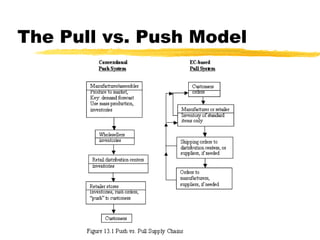
 Second: Pull type manufacturing


                                   4
The Pull vs. Push Model


                      5
Major Concepts

 Order fulfillment: Deliver right order on
 time
 Front office operations: Order taking,
 advertisement, CRM
 Back office operations: Accounting,
 finance, inventor, packaging, logistics
 Logistics: Managing the flow of goods,
 information and money along the supply
 chain                               6
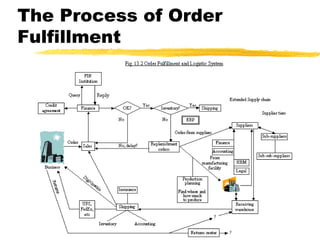
The Process of Order
Fulfillment


                       7
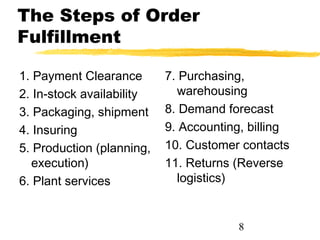
The Steps of Order
Fulfillment

1. Payment Clearance       7. Purchasing,
2. In-stock availability     warehousing
3. Packaging, shipment     8. Demand forecast
4. Insuring                9. Accounting, billing
5. Production (planning,   10. Customer contacts
  execution)               11. Returns (Reverse
6. Plant services            logistics)


                                        8
Shipping a Tropical Fish

1. Placing order, payment
2. Transfer order to petstore.com, check stock
3. Use an wholesaler to get the fish
4. Supplier finds fish, ships to wholesalers
5. Wholesalers rushes to Petstore
6. Petstore uses FedEx to ship to customer
  with copy of credit card payment
Discussion: What is the contribution of EC?
                                  9
Why Intermediaries?

1. Wholesaler and deliveries in the Petstore
  case
2. Wholesalers as an aggregators; between
  many sellers and buyers
3. Can a virtual store replace a retailer?
4. Direct sales for large items
5. Example: The Lego Co. case

                                    10
Channel Conflict

 Elimination of Intermediary many create a
 conflict
 Conflict between online and offline
 distribution
 This may impact order fulfillment and returns
 What if a manufacturer sells both wholesale
 and retail? (Microsoft)
 Customized product by manufacturers: ideal
 for direct sale                   11
Supply Chain Management
 Definition: Flow of material, information,
 money, etc. from raw material suppliers
 through factories to customers
 It includes: organizations, procedures,
 people
 SCM: Integration of the business
 processes along the chain, Planning,
 Organizing, control of many activities
 Activities: Purchasing, delivery,
                                    12
 packaging, checking, warehousing, etc.
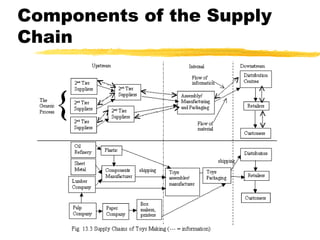
Components of the Supply
Chain


                    13
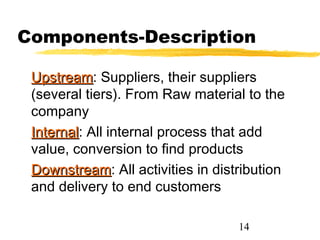
Components-Description

 Upstream: Suppliers, their suppliers
 Upstream
 (several tiers). From Raw material to the
 company
 Internal: All internal process that add
 Internal
 value, conversion to find products
 Downstream: All activities in distribution
 Downstream
 and delivery to end customers

                                   14
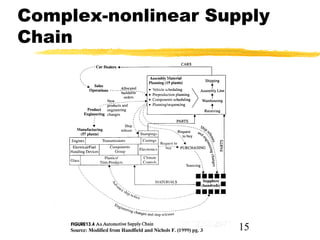
Complex-nonlinear Supply
Chain


                     15
Benefits of SCM

 Reduce uncertainty along the chain
 Proper inventory levels in the chain
 Minimize delays
 Eliminate rush (unplanned) activities
 Provide superb customer service
 Major contributor of success (ever
 survival)
                                  16
Global Supply Chain

 Can be very long
 Possible cross-broader problems
 Need information technology support of:
   communication and collaboration
 Possible delays due to: customs, tax,
 translations, politics


                                     17
Problems along the Supply
Chain

 Delays in production, distribution etc.
 Expensive Inventories
 Lack of partners’ coordination
 Uncertainties in deliveries
 Poor demand forecast
 Interference with production
 Poor quality
                                   18
More difficulties

 Virtual companies do not have logistics
 infrastructures
 One company is a member of several
 supply chain
 Conventional warehouses are too
 expensive
 Need automatic warehouses with robots
 as pickers
                                19
Preliminary Activities

 Understand the supply chain (flow charts)
 Study internal and external parts
 Performance measurement are a must
 (Benchmarking)
 Multidimension performance analysis
 a BPR may be needed
 People’s relationships are a must
                                 20
Areas of Opportunities
 Manufacturing processes
 Warehousing operation
 Packaging and delivery
 Material inspection/receiving
 Inbound and outbound transportation
 Reverse logistics (return)
 In-plant material handling
 Vendor management program
 Customer order processing         21
Areas of Opportunities
(cont’d)
 Invoicing, auditing and other accounting
 activities
 Collaboration procedures with partners
 Employee training and deployments
 Labor scheduling
 Use of teams and empowerment of
 employees
 Automation of processes
 Use of software for facilitating all the above
 Inventory management and control 22
Using Inventories

 An insurance against stock out
 Can be in several places
 Can be excessive
 Can be insufficient

 Example: Littlewoods stores; UK


                                   23
Proper SCN

 Coordination is needed
 Understanding of the causes/problems
 Information flow is a key
 Communication is important
 IT is needed


                               24
Information Technology for SCM

 Links that enable
 communication/collaboration
 Links the partners
 Provide effective and efficient solutions
 Extremely important
 Need for information sharing


                                   25
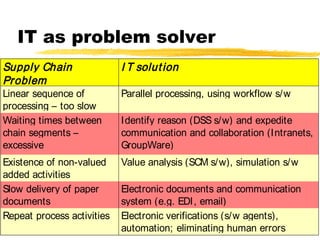
IT as problem solver
Supply Chain                I T solut ion
Problem
Linear sequence of          Parallel processing, using workflow s/w
processing – too slow
Waiting times between       Identify reason (DSS s/w) and expedite
chain segments –            communication and collaboration (Intranets,
excessive                   GroupWare)
Existence of non-valued     Value analysis (SCM s/w), simulation s/w
added activities
Slow delivery of paper      Electronic documents and communication
documents                   system (e.g. EDI, email)
Repeat process activities   Electronic verifications (s/w agents),
                            automation; eliminating human errors
                                                         26
The bullwhip effect

 Slight changes in actual demand create
 problems
 Partners build “just in case” inventories
 Lack of trust among partners
 Stockpilling result in huge cost
 The manufacturers can not plan
 production
 Cannot order material from suppliers
                                   27
Avoiding the sting of the
bullwhip

 Information sharing is a must
 Trust and agreements
 How to do it?
 $30 billion/year just in the grocery industry


                                    28
IT solutions
 Automate order taking
 Use EDI/Internet
 Web based ordering; intelligent agents
 Electronic payments
 Make-to-order (JIT)
 Tracking systems
 Supplier monitor and manage inventories
 Information from POS to suppliers
 Electronic trading markets and exchanges
                                   29
Electronic trading
markets/exchanges

 One company with many suppliers
 (catalogs, auctions)
 One company with many buyers (RFQ)
 Exchanges controlled by few large
 companies (e.g. ANX)
 3rd party managed exchanges
 Vertical vs. Horizontal portals

                             30
Non-supply Chain
Partnerships

 Starbucks: Coffee to retailers, customers
   Needed fast service; less expensive
 Kozmo delivers in cities 30-60 minutes
 Kozmo.com: Had a problem with drop
 boxes for returns
 Partnership: Place Kozmo’s drop boxes
 inside starbuck coffee houses (open long
 hours) solve both problems
 Amazon uses Kozmo for fast deliveries
                                  31
The Role of 7-Eleven &
Convenience Stores

 Can be used as a collection point for
 returns
 Can be used as a pick up place
 Can be used as a place for order placing
 Can pay in cash/card to the store
 Returns are a problem: up to 30%


                                 32
The role of FedEx &
Similar Shippers

 From a delivery to all-logistics
 Many services (see Box 13.4)
 Complete inventory control
 Packaging, warehousing, reordering etc.
 Tracking services to customers


                                33
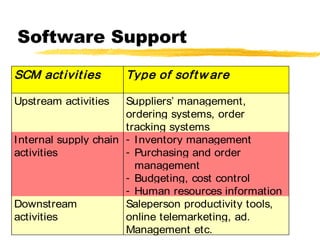
Software Support

SCM act ivit ies      Type of sof t w are

Upstream activities    Suppliers’ management,
                       ordering systems, order
                       tracking systems
I nternal supply chain - I nventory management
activities             - Purchasing and order
                         management
                       - Budgeting, cost control
                       - Human resources information
Downstream             Saleperson productivity tools,
activities             online telemarketing, ad.
                       Management etc.        34
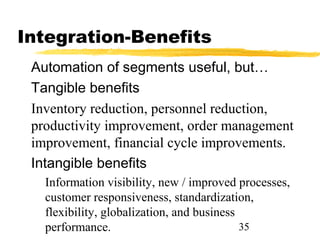
Integration-Benefits
 Automation of segments useful, but…
 Tangible benefits
 Inventory reduction, personnel reduction,
 productivity improvement, order management
 improvement, financial cycle improvements.
 Intangible benefits
   Information visibility, new / improved processes,
   customer responsiveness, standardization,
   flexibility, globalization, and business
   performance.                             35
Integration along the
Supply Chain

 Need to streamline operations
 New business models
 New organizational relationships (virtual
 companies)
 Examples Warner Lamber and Wal*Mart
 (Box 13.5)


                                  36
Areas of Integration

 Order taking - production inventory levels
 Payment info in B2B - Visa, Master Card,
 etc.
 Low inventory levels - automatic ordering
 Order to manufacturing - generate a list of
 needed resources & their availability
 Changes in an order - transmit to suppliers
 and their suppliers
                                  37
 Tracking systems - available to customers
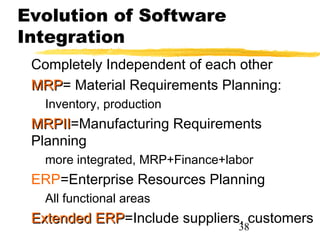
Evolution of Software
Integration
 Completely Independent of each other
 MRP= Material Requirements Planning:
 MRP
   Inventory, production
 MRPII=Manufacturing Requirements
 MRPII
 Planning
   more integrated, MRP+Finance+labor
 ERP=Enterprise Resources Planning
   All functional areas
 Extended ERP=Include suppliers, customers
          ERP                  38
From SAP to mySAP.com
SAP=Traditional ERP=Automate and
Integrate transactions
MySAP.com = web based comprehensive
system
 Workplace - a personalized, role-based interface
 Marketplace - one stop destination for business
 professional to collaborate
 Business Scenarios - products for the Internet and
 intranet
 Application-hosing - hosting Web applications for
                                         39
 SMEs
Enterprise Resource
Planning (ERP)
 ERP = Integrating business processes and
 activities in real time
 Solves many supply chain problems
 Necessary for medium to large corporations
 Helpful also for some SMEs
 Need to interface with EC order taking system
 Manages all routine transactions in the
 Enterprise
 Recently extended to suppliers and customers
                                   40
Developing ERP Systems

 Do it yourself, from scratch (only few will)
 Use Integrated packages such as R/3
 from SAP
 “Best of Bread” approach, using
 integrating software
 Rent in from ASP service


                                    41
Post ERP (2nd Generation)
1st generation - transaction processing orientation
2nd generation
  including decision making capabilities
  EC requires decision support
  EC requires business intelligence
SCM software: Production Planning, Manpower
utilization, Profitability models, market analysis.
Integration of SCM capabilities
Other added functionalities: CRM, KM
                                   42
ASP

 Leasing information systems application
 Back to the days of “time sharing”
 A risk prevention strategy
 Very popular with ERP (expensive,
 cumbersome)


                                 43

Ecommerce Chap 13

  • 1.
    Chapter 13 Order Fulfillment, Logistics, Supply Chain Management 1
  • 2.
    Learning Objectives 1. Understandthe role of order fulfillment and back-office operations in EC 2. Describe the process of order fulfillment 3. Understand the concept of the supply chain, its importance and management 4. Describe the problems of managing the supply chain and the use of innovative solutions there 5. Describe the need for integrating information systems of front office and back office 6. Trace the evolution of software that support activities along the supply chain and their management 7. Understand the relationship among ERP, SCM and EC. 2
  • 3.
    The Y2K OrderFulfillment Problem In Dec. 1999 Competition among E-Tailers increases Special area: Toys; Big promotions, coupons Demand: very high, not anticipated Retailers: were unable to meet demand Customers: very unhappy Similar problems in gifts, book, etc. Also: online retailers has warehousing and logistics problems 3
  • 4.
    Order Fulfillment Takingorders may be the easiest part Difficulties in groceries and fresh food One reason: Customized products Second: Pull type manufacturing 4
  • 5.
    The Pull vs.Push Model 5
  • 6.
    Major Concepts Orderfulfillment: Deliver right order on time Front office operations: Order taking, advertisement, CRM Back office operations: Accounting, finance, inventor, packaging, logistics Logistics: Managing the flow of goods, information and money along the supply chain 6
  • 7.
    The Process ofOrder Fulfillment 7
  • 8.
    The Steps ofOrder Fulfillment 1. Payment Clearance 7. Purchasing, 2. In-stock availability warehousing 3. Packaging, shipment 8. Demand forecast 4. Insuring 9. Accounting, billing 5. Production (planning, 10. Customer contacts execution) 11. Returns (Reverse 6. Plant services logistics) 8
  • 9.
    Shipping a TropicalFish 1. Placing order, payment 2. Transfer order to petstore.com, check stock 3. Use an wholesaler to get the fish 4. Supplier finds fish, ships to wholesalers 5. Wholesalers rushes to Petstore 6. Petstore uses FedEx to ship to customer with copy of credit card payment Discussion: What is the contribution of EC? 9
  • 10.
    Why Intermediaries? 1. Wholesalerand deliveries in the Petstore case 2. Wholesalers as an aggregators; between many sellers and buyers 3. Can a virtual store replace a retailer? 4. Direct sales for large items 5. Example: The Lego Co. case 10
  • 11.
    Channel Conflict Eliminationof Intermediary many create a conflict Conflict between online and offline distribution This may impact order fulfillment and returns What if a manufacturer sells both wholesale and retail? (Microsoft) Customized product by manufacturers: ideal for direct sale 11
  • 12.
    Supply Chain Management Definition: Flow of material, information, money, etc. from raw material suppliers through factories to customers It includes: organizations, procedures, people SCM: Integration of the business processes along the chain, Planning, Organizing, control of many activities Activities: Purchasing, delivery, 12 packaging, checking, warehousing, etc.
  • 13.
    Components of theSupply Chain 13
  • 14.
    Components-Description Upstream: Suppliers,their suppliers Upstream (several tiers). From Raw material to the company Internal: All internal process that add Internal value, conversion to find products Downstream: All activities in distribution Downstream and delivery to end customers 14
  • 15.
  • 16.
    Benefits of SCM Reduce uncertainty along the chain Proper inventory levels in the chain Minimize delays Eliminate rush (unplanned) activities Provide superb customer service Major contributor of success (ever survival) 16
  • 17.
    Global Supply Chain Can be very long Possible cross-broader problems Need information technology support of: communication and collaboration Possible delays due to: customs, tax, translations, politics 17
  • 18.
    Problems along theSupply Chain Delays in production, distribution etc. Expensive Inventories Lack of partners’ coordination Uncertainties in deliveries Poor demand forecast Interference with production Poor quality 18
  • 19.
    More difficulties Virtualcompanies do not have logistics infrastructures One company is a member of several supply chain Conventional warehouses are too expensive Need automatic warehouses with robots as pickers 19
  • 20.
    Preliminary Activities Understandthe supply chain (flow charts) Study internal and external parts Performance measurement are a must (Benchmarking) Multidimension performance analysis a BPR may be needed People’s relationships are a must 20
  • 21.
    Areas of Opportunities Manufacturing processes Warehousing operation Packaging and delivery Material inspection/receiving Inbound and outbound transportation Reverse logistics (return) In-plant material handling Vendor management program Customer order processing 21
  • 22.
    Areas of Opportunities (cont’d) Invoicing, auditing and other accounting activities Collaboration procedures with partners Employee training and deployments Labor scheduling Use of teams and empowerment of employees Automation of processes Use of software for facilitating all the above Inventory management and control 22
  • 23.
    Using Inventories Aninsurance against stock out Can be in several places Can be excessive Can be insufficient Example: Littlewoods stores; UK 23
  • 24.
    Proper SCN Coordinationis needed Understanding of the causes/problems Information flow is a key Communication is important IT is needed 24
  • 25.
    Information Technology forSCM Links that enable communication/collaboration Links the partners Provide effective and efficient solutions Extremely important Need for information sharing 25
  • 26.
    IT as problemsolver Supply Chain I T solut ion Problem Linear sequence of Parallel processing, using workflow s/w processing – too slow Waiting times between Identify reason (DSS s/w) and expedite chain segments – communication and collaboration (Intranets, excessive GroupWare) Existence of non-valued Value analysis (SCM s/w), simulation s/w added activities Slow delivery of paper Electronic documents and communication documents system (e.g. EDI, email) Repeat process activities Electronic verifications (s/w agents), automation; eliminating human errors 26
  • 27.
    The bullwhip effect Slight changes in actual demand create problems Partners build “just in case” inventories Lack of trust among partners Stockpilling result in huge cost The manufacturers can not plan production Cannot order material from suppliers 27
  • 28.
    Avoiding the stingof the bullwhip Information sharing is a must Trust and agreements How to do it? $30 billion/year just in the grocery industry 28
  • 29.
    IT solutions Automateorder taking Use EDI/Internet Web based ordering; intelligent agents Electronic payments Make-to-order (JIT) Tracking systems Supplier monitor and manage inventories Information from POS to suppliers Electronic trading markets and exchanges 29
  • 30.
    Electronic trading markets/exchanges Onecompany with many suppliers (catalogs, auctions) One company with many buyers (RFQ) Exchanges controlled by few large companies (e.g. ANX) 3rd party managed exchanges Vertical vs. Horizontal portals 30
  • 31.
    Non-supply Chain Partnerships Starbucks:Coffee to retailers, customers Needed fast service; less expensive Kozmo delivers in cities 30-60 minutes Kozmo.com: Had a problem with drop boxes for returns Partnership: Place Kozmo’s drop boxes inside starbuck coffee houses (open long hours) solve both problems Amazon uses Kozmo for fast deliveries 31
  • 32.
    The Role of7-Eleven & Convenience Stores Can be used as a collection point for returns Can be used as a pick up place Can be used as a place for order placing Can pay in cash/card to the store Returns are a problem: up to 30% 32
  • 33.
    The role ofFedEx & Similar Shippers From a delivery to all-logistics Many services (see Box 13.4) Complete inventory control Packaging, warehousing, reordering etc. Tracking services to customers 33
  • 34.
    Software Support SCM activit ies Type of sof t w are Upstream activities Suppliers’ management, ordering systems, order tracking systems I nternal supply chain - I nventory management activities - Purchasing and order management - Budgeting, cost control - Human resources information Downstream Saleperson productivity tools, activities online telemarketing, ad. Management etc. 34
  • 35.
    Integration-Benefits Automation ofsegments useful, but… Tangible benefits Inventory reduction, personnel reduction, productivity improvement, order management improvement, financial cycle improvements. Intangible benefits Information visibility, new / improved processes, customer responsiveness, standardization, flexibility, globalization, and business performance. 35
  • 36.
    Integration along the SupplyChain Need to streamline operations New business models New organizational relationships (virtual companies) Examples Warner Lamber and Wal*Mart (Box 13.5) 36
  • 37.
    Areas of Integration Order taking - production inventory levels Payment info in B2B - Visa, Master Card, etc. Low inventory levels - automatic ordering Order to manufacturing - generate a list of needed resources & their availability Changes in an order - transmit to suppliers and their suppliers 37 Tracking systems - available to customers
  • 38.
    Evolution of Software Integration Completely Independent of each other MRP= Material Requirements Planning: MRP Inventory, production MRPII=Manufacturing Requirements MRPII Planning more integrated, MRP+Finance+labor ERP=Enterprise Resources Planning All functional areas Extended ERP=Include suppliers, customers ERP 38
  • 39.
    From SAP tomySAP.com SAP=Traditional ERP=Automate and Integrate transactions MySAP.com = web based comprehensive system Workplace - a personalized, role-based interface Marketplace - one stop destination for business professional to collaborate Business Scenarios - products for the Internet and intranet Application-hosing - hosting Web applications for 39 SMEs
  • 40.
    Enterprise Resource Planning (ERP) ERP = Integrating business processes and activities in real time Solves many supply chain problems Necessary for medium to large corporations Helpful also for some SMEs Need to interface with EC order taking system Manages all routine transactions in the Enterprise Recently extended to suppliers and customers 40
  • 41.
    Developing ERP Systems Do it yourself, from scratch (only few will) Use Integrated packages such as R/3 from SAP “Best of Bread” approach, using integrating software Rent in from ASP service 41
  • 42.
    Post ERP (2ndGeneration) 1st generation - transaction processing orientation 2nd generation including decision making capabilities EC requires decision support EC requires business intelligence SCM software: Production Planning, Manpower utilization, Profitability models, market analysis. Integration of SCM capabilities Other added functionalities: CRM, KM 42
  • 43.
    ASP Leasing informationsystems application Back to the days of “time sharing” A risk prevention strategy Very popular with ERP (expensive, cumbersome) 43