The document discusses the logistics, production, and evaluation functions related to media programs. The logistics function focuses on acquiring, storing, circulating, maintaining, and retrieving materials and equipment. It also covers competencies like arranging previews, compiling orders, determining replacements, receiving and preparing items, storage, circulation, maintenance and repair, and equipment setup. The production function involves developing various audiovisual materials like audio, graphics, motion pictures, programmed materials, and reproducing printed works. It also covers identifying equipment needs and evaluating products. The evaluation function analyzes curriculum needs, applies selection criteria, synthesizes requests, and uses reviews to aid in the selection process.
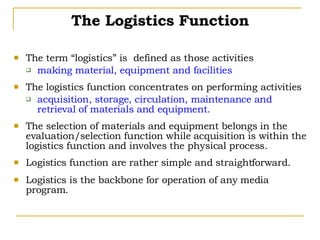
The Logistics FunctionThe term “logistics” is defined as those activities making material, equipment and facilities The logistics function concentrates on performing activities acquisition, storage, circulation, maintenance and retrieval of materials and equipment. The selection of materials and equipment belongs in the evaluation/selection function while acquisition is within the logistics function and involves the physical process. Logistics function are rather simple and straightforward. Logistics is the backbone for operation of any media program.
3.
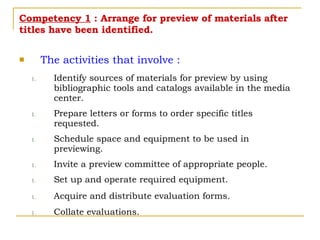
Competency 1 : Arrange for preview of materials after titles have been identified. The activities that involve : Identify sources of materials for preview by using bibliographic tools and catalogs available in the media center. Prepare letters or forms to order specific titles requested. Schedule space and equipment to be used in previewing. Invite a preview committee of appropriate people. Set up and operate required equipment. Acquire and distribute evaluation forms. Collate evaluations.
4.
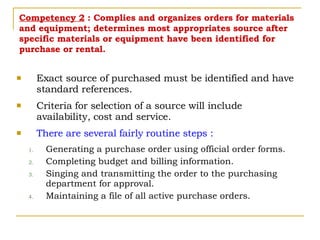
Competency 2 : Complies and organizes orders for materials and equipment; determines most appropriates source after specific materials or equipment have been identified for purchase or rental. Exact source of purchased must be identified and have standard references. Criteria for selection of a source will include availability, cost and service. There are several fairly routine steps : Generating a purchase order using official order forms. Completing budget and billing information. Singing and transmitting the order to the purchasing department for approval. Maintaining a file of all active purchase orders.
5.
Competency 3 : Determines replacement of materials and equipment. The critical element is to determine the set of criteria which can be used to determine replacement of materials and equipment. Existing policies and “rules of thumb” which are used to guide in performing the replacement competency. These policies and procedures will vary from location to location. Replacement is directly related to the maintenance programs for keeping materials and equipment in good condition.
6.
Competency 4 : Receives and prepares materials for storage and circulation. Materials and equipment must be inspected to ascertain the quality and correctness of shipment. The systematic process which began with ordering must be followed through. The materials and equipment must be given to the person who is responsible for technical processing, cataloging, and routine check-in. To actual storage and announcement of availability Records of purchase orders should be maintained for future reference.
7.
Competency 5 : Determines the most appropriate storage arrangements for all materials. Storage is used to describe the space and locations where materials and equipment are placed and made accessible to users. There are several policy decisions which must be made prior to actual storage of media and equipment. Determining appropriate storage arrangements is conducting periodic inventories. Involves the ability to verify the location or status of any equipment or material that has been received and placed in a specific location.
8.
Competency 6 : Circulates media and equipment. The term “circulation” includes scheduling and distribution of the various audiovisual media and equipment. Requires a set of policies and procedures which guide the process. Ability to maintain accurate records and the need for security. Files must be maintained to identify the location of media and equipment in circulation. The process should incorporate procedures for handling overdue materials and for handling reserve items.
9.
Competency 7 : Conducts inspection of materials and equipment; arranges for maintenance and repair Within this competency are tasks which involve: The development of policies and procedures for maintaining media and equipment. The decisions regarding local or contract maintenance and repair. The quality control of all work completed locally and on contract. The establishment of a repair which can be handled locally. The review of contracts with outside repair agencies to handle maintenance beyond that which can be done internally.
10.
Competency 8 : Set up and operates equipment. The competency “to set up and operate” includes: Removing a unit from its carrying case. Plugging in and testing audio and/or video components. Inserting the appropriate material in a reasonable time without error Running the materials and making necessary adjustments with minimum distraction and without damage. Stopping and starting at any time during presentation. Rewinding material (if applicable). Packing up equipment or returning to original status for the next user.
The are certainsteps need to be considered in media product development : The objectives that are to be achieved need to be specified. The appropriate medium to use must be specified. The preliminary planning must take place. The actual production of product. Pretesting of the product. Actual use of the product. Evaluation of the product. Storage and dissemination of the product. Monitoring and maintaining of the product. The Production Function
13.
Competency 1 : Produces audio and materials. The most commonly used means for producing audio materials : reel-to-reel tape recorders - Usually used in audio production for splicing and editing. - Recording quality is superior. cassette tape recorder - The most convenient to carry and to operate.
14.
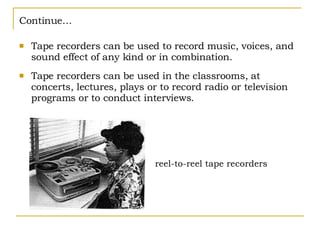
Continue… Tape recorderscan be used to record music, voices, and sound effect of any kind or in combination. Tape recorders can be used in the classrooms, at concerts, lectures, plays or to record radio or television programs or to conduct interviews. reel-to-reel tape recorders
15.
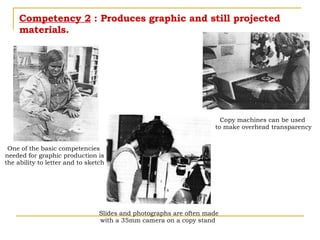
Competency 2 : Produces graphic and still projected materials. Copy machines can be used to make overhead transparency Slides and photographs are often made with a 35mm camera on a copy stand One of the basic competencies needed for graphic production is the ability to letter and to sketch
16.
Continue… The commongoal is to communicate visually. The goal of communicating visually can be achieved through clarity, composition, use of color, legibility, and appropriate emphasis. The production of many of these materials requires the use of a variety of tools and equipment.
17.
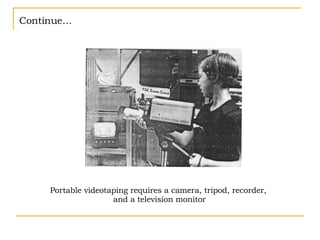
Competency 3 : Produces motion projected materials. Motion projected materials include 8mm and 16mm films and videotapes. It sometimes expensive, and does require special equipment. The activities and processes relating to filmmaking can be provide a valuable learning experience for students. Filmmaking often becomes a group process and provide opportunities for students to learn to work together under stimulating and challenging conditions.
Competency 4 : Produces programmed materials. The term programmed materials includes a range of different kinds of media, at many levels of sophistication. Presented in a very simple format : - Resembling a paperback book - Produced for use on a teaching machine The more complex : - Developed as computer-assisted instruction
20.
Continue… The characteristicof programmed materials : The content is carefully structured in a sequential learning pattern. The material is presented in a controlled fashion. The learner must interact with the material. Cues are presented to prompt the learner to give correct responses. The learner has immediate feedback. The student can proceed at his own rate. The student usually can check his cumulative performance.
21.
Competency 5 : Reproduces printed materials. These processes are usually quite routine and demand little or no creativity. Four major reproduction technique : Spirit duplicating Mimeographing Photocopying Printing All of these methods of reproduction of various items are vital and important.
22.
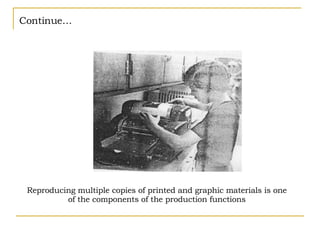
Continue… Reproducing multiplecopies of printed and graphic materials is one of the components of the production functions
23.
Competency 6 : Identifies specific equipment and materials required for production. Basic principles should be followed as specific items are selected : Equipment should be ordered that meets and need of the students and teachers. The equipment should be sturdy enough to withstand use and its transport from room to room. The equipment should have easily replaceable parts. Equipment should be similar in all buildings. Committees should agree to order identical equipment for most school. Equipment should be uncomplicated and simple to operate. Equipment should be ordered for which adequate software is available.
24.
Competency 7 : Applies rules and standards for evaluation of products. Standard for evaluation should apply to locally produced products, as well as to those purchased commercially. The criteria for evaluation should be adapted so that they are realistic and appropriate.
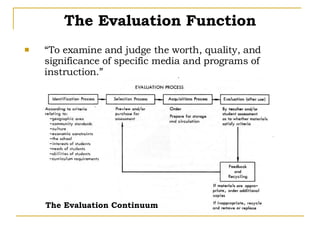
The Evaluation Function“ To examine and judge the worth, quality, and significance of specific media and programs of instruction.” The Evaluation Continuum
27.
Competency 1 : Analyzes present and future curriculum requirements to identify material and equipment needs. Activities may include : Requesting an overview of all courses taught. Serving on curriculum development committees. Developing forms and procedures for requesting materials. Informing all users that materials may be acquired through a diversity of ways, by rental, purchase, interlibrary loan, as gifts, exchanges or free.
28.
Competency 2 : Writes and applies criteria and guidelines for the selection, use and evaluation of materials. Evaluation determines the quality of materials selected and this in turn determines the adequacy of the materials made available to the users. Evaluation must be based on the criteria established for selection. Should work closely with the students, faculty, and administration to establish a consistent and comprehensive system of evaluation. A basic requirement in the selection process is to develop a written selection policy.
29.
Competency 3 : Synthesizes teacher and student request and recommendations for acquiring materials. Serves in some ways like a radar screen, picking up signals from every possible source. There has to be contact with formalized curriculum development committees. A simple form should be developed for a student or faculty member to use in submitting a request for materials. After records are developed and the amount of the budget is known then it is necessary to synthesize all requests, assess them as to relative value to the users, and spend available money in the wisest way. These decisions are not easy to make and require careful attention and sound judgment.
30.
Competency 4 : Collects and uses review and evaluation tools to aid in selection. Several steps in the selection process : The product must be identified correctly. The order information must be complete (title, producer or author, company which produced material, address of company, price, identifying features, color, etc.) There should be evaluative reviews available, so that selection can be guided by the perceptions of skilled reviewers and critics.
Utilization – theSynthesis Utilization is a unique function. It is the culminating function since it deals with the actual interaction between the user and the medium. Is the engagement of the student with ideas and with the medium (teacher) of communication. During utilization learning is most likely to occur. This function is unusual in that it is perhaps the most critical and vital function.