Logistics Strategy &
Planning
Why the Increasing Interest?
Deregulation
Globalization
Technological breakthroughs
Environmental concerns
Performance impact
Logistics Decision Areas
Transportation
◦ Modes
◦ Formats
◦ Pricing
Warehousing
◦ Consolidation
◦ Cross-Docking and Break-Bulk
◦ Hub-and-Spoke
◦ Inventory
Major Transportation Modes
Road
Water
Rail
Air
Pipeline
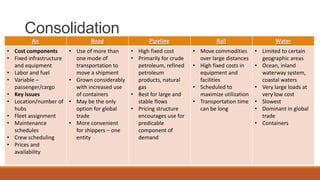
Consolidation
Air Road Pipeline Rail Water
• Cost components
• Fixed infrastructure
and equipment
• Labor and fuel
• Variable –
passenger/cargo
• Key issues
• Location/number of
hubs
• Fleet assignment
• Maintenance
schedules
• Crew scheduling
• Prices and
availability
• Use of more than
one mode of
transportation to
move a shipment
• Grown considerably
with increased use
of containers
• May be the only
option for global
trade
• More convenient
for shippers – one
entity
• High fixed cost
• Primarily for crude
petroleum, refined
petroleum
products, natural
gas
• Best for large and
stable flows
• Pricing structure
encourages use for
predicable
component of
demand
• Move commodities
over large distances
• High fixed costs in
equipment and
facilities
• Scheduled to
maximize utilization
• Transportation time
can be long
• Limited to certain
geographic areas
• Ocean, inland
waterway system,
coastal waters
• Very large loads at
very low cost
• Slowest
• Dominant in global
trade
• Containers
Warehousing
Any operation that stores, repackages, stages, sorts, or centralizes goods or
materials
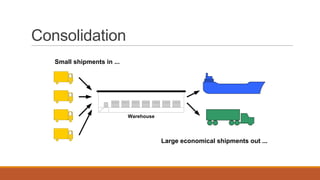
Consolidation
Warehouse
Small shipments in ...
Large economical shipments out ...
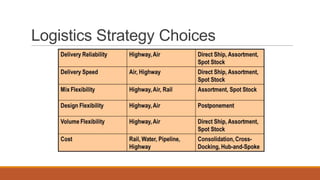
Logistics Strategy Choices
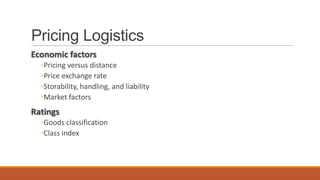
Pricing Logistics
Economic factors
◦Pricing versus distance
◦Price exchange rate
◦Storability, handling, and liability
◦Market factors
Ratings
◦Goods classification
◦Class index
Customer Service
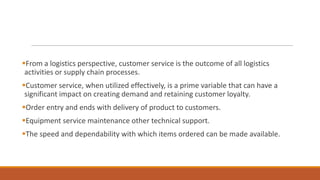
From a logistics perspective, customer service is the outcome of all logistics
activities or supply chain processes.
Customer service, when utilized effectively, is a prime variable that can have a
significant impact on creating demand and retaining customer loyalty.
Order entry and ends with delivery of product to customers.
Equipment service maintenance other technical support.
The speed and dependability with which items ordered can be made available.
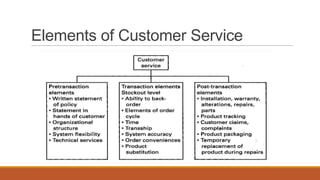
Elements of Customer Service
Dimensions of Customer Service
oTime
oDependability
oFlexibility
oCommunication
Logistics Products
1.Nature of the logistics product
2.Product characteristics
3.Product packaging
4.Product pricing
5.Incentive pricing arrangement
6.Risk
Nature of logistics Products
oCustomer Products
oIndustrial Products
oConvenience Products
oShopping Products
oSpecialty Products
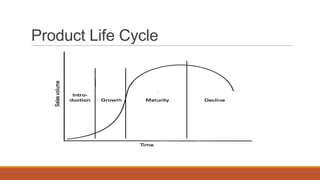
Product Life Cycle
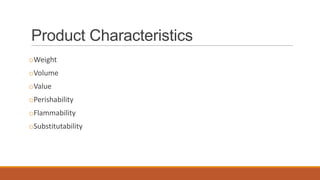
Product Characteristics
oWeight
oVolume
oValue
oPerishability
oFlammability
oSubstitutability
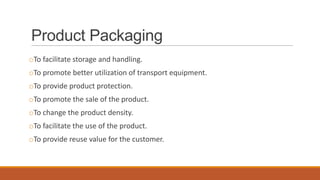
Product Packaging
oTo facilitate storage and handling.
oTo promote better utilization of transport equipment.
oTo provide product protection.
oTo promote the sale of the product.
oTo change the product density.
oTo facilitate the use of the product.
oTo provide reuse value for the customer.
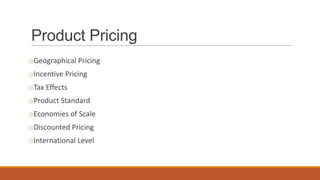
Product Pricing
oGeographical Pricing
oIncentive Pricing
oTax Effects
oProduct Standard
oEconomies of Scale
oDiscounted Pricing
oInternational Level
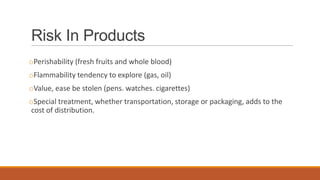
Risk In Products
oPerishability (fresh fruits and whole blood)
oFlammability tendency to explore (gas, oil)
oValue, ease be stolen (pens. watches. cigarettes)
oSpecial treatment, whether transportation, storage or packaging, adds to the
cost of distribution.

Logistics strategy & planning, Customer Service & Products

  • 1.
  • 2.
    Why the IncreasingInterest? Deregulation Globalization Technological breakthroughs Environmental concerns Performance impact
  • 3.
    Logistics Decision Areas Transportation ◦Modes ◦ Formats ◦ Pricing Warehousing ◦ Consolidation ◦ Cross-Docking and Break-Bulk ◦ Hub-and-Spoke ◦ Inventory
  • 4.
  • 5.
    Consolidation Air Road PipelineRail Water • Cost components • Fixed infrastructure and equipment • Labor and fuel • Variable – passenger/cargo • Key issues • Location/number of hubs • Fleet assignment • Maintenance schedules • Crew scheduling • Prices and availability • Use of more than one mode of transportation to move a shipment • Grown considerably with increased use of containers • May be the only option for global trade • More convenient for shippers – one entity • High fixed cost • Primarily for crude petroleum, refined petroleum products, natural gas • Best for large and stable flows • Pricing structure encourages use for predicable component of demand • Move commodities over large distances • High fixed costs in equipment and facilities • Scheduled to maximize utilization • Transportation time can be long • Limited to certain geographic areas • Ocean, inland waterway system, coastal waters • Very large loads at very low cost • Slowest • Dominant in global trade • Containers
  • 6.
    Warehousing Any operation thatstores, repackages, stages, sorts, or centralizes goods or materials
  • 7.
    Consolidation Warehouse Small shipments in... Large economical shipments out ...
  • 8.
  • 9.
    Pricing Logistics Economic factors ◦Pricingversus distance ◦Price exchange rate ◦Storability, handling, and liability ◦Market factors Ratings ◦Goods classification ◦Class index
  • 10.
  • 11.
    From a logisticsperspective, customer service is the outcome of all logistics activities or supply chain processes. Customer service, when utilized effectively, is a prime variable that can have a significant impact on creating demand and retaining customer loyalty. Order entry and ends with delivery of product to customers. Equipment service maintenance other technical support. The speed and dependability with which items ordered can be made available.
  • 12.
  • 13.
    Dimensions of CustomerService oTime oDependability oFlexibility oCommunication
  • 14.
  • 15.
    1.Nature of thelogistics product 2.Product characteristics 3.Product packaging 4.Product pricing 5.Incentive pricing arrangement 6.Risk
  • 16.
    Nature of logisticsProducts oCustomer Products oIndustrial Products oConvenience Products oShopping Products oSpecialty Products
  • 17.
  • 18.
  • 19.
    Product Packaging oTo facilitatestorage and handling. oTo promote better utilization of transport equipment. oTo provide product protection. oTo promote the sale of the product. oTo change the product density. oTo facilitate the use of the product. oTo provide reuse value for the customer.
  • 20.
    Product Pricing oGeographical Pricing oIncentivePricing oTax Effects oProduct Standard oEconomies of Scale oDiscounted Pricing oInternational Level
  • 21.
    Risk In Products oPerishability(fresh fruits and whole blood) oFlammability tendency to explore (gas, oil) oValue, ease be stolen (pens. watches. cigarettes) oSpecial treatment, whether transportation, storage or packaging, adds to the cost of distribution.