TOPIC
LENGTH OF AN ARC
and
AREA OF SURFACE OF REVOLUTION
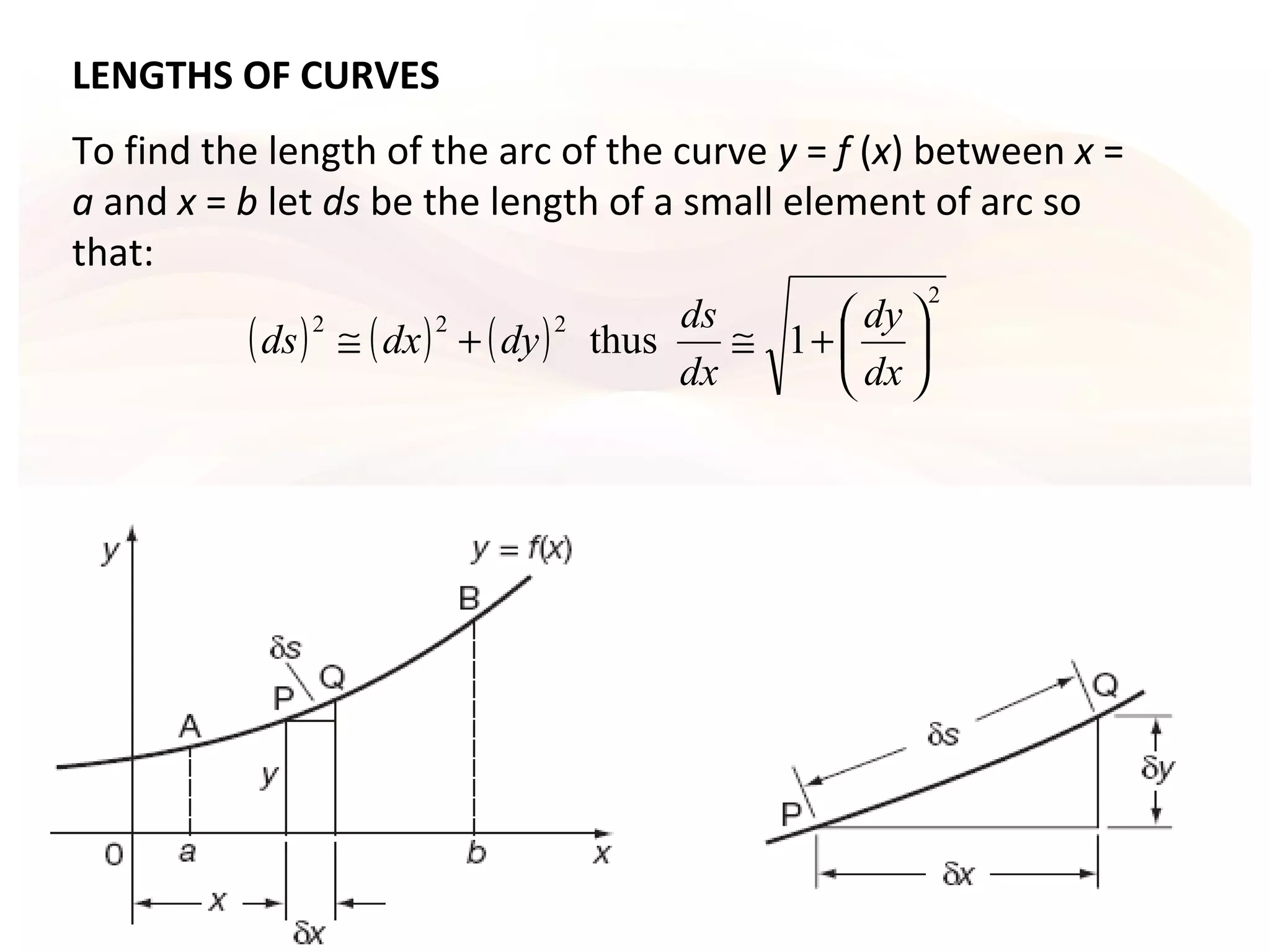
LENGTHS OF CURVES
To find the length of the arc of the curve y = f (x) between x =
a and x = b let ds be the length of a small element of arc so
that:
( ) ( ) ( )
2
222
1thus 





+≅+≅
dx
dy
dx
ds
dydxds
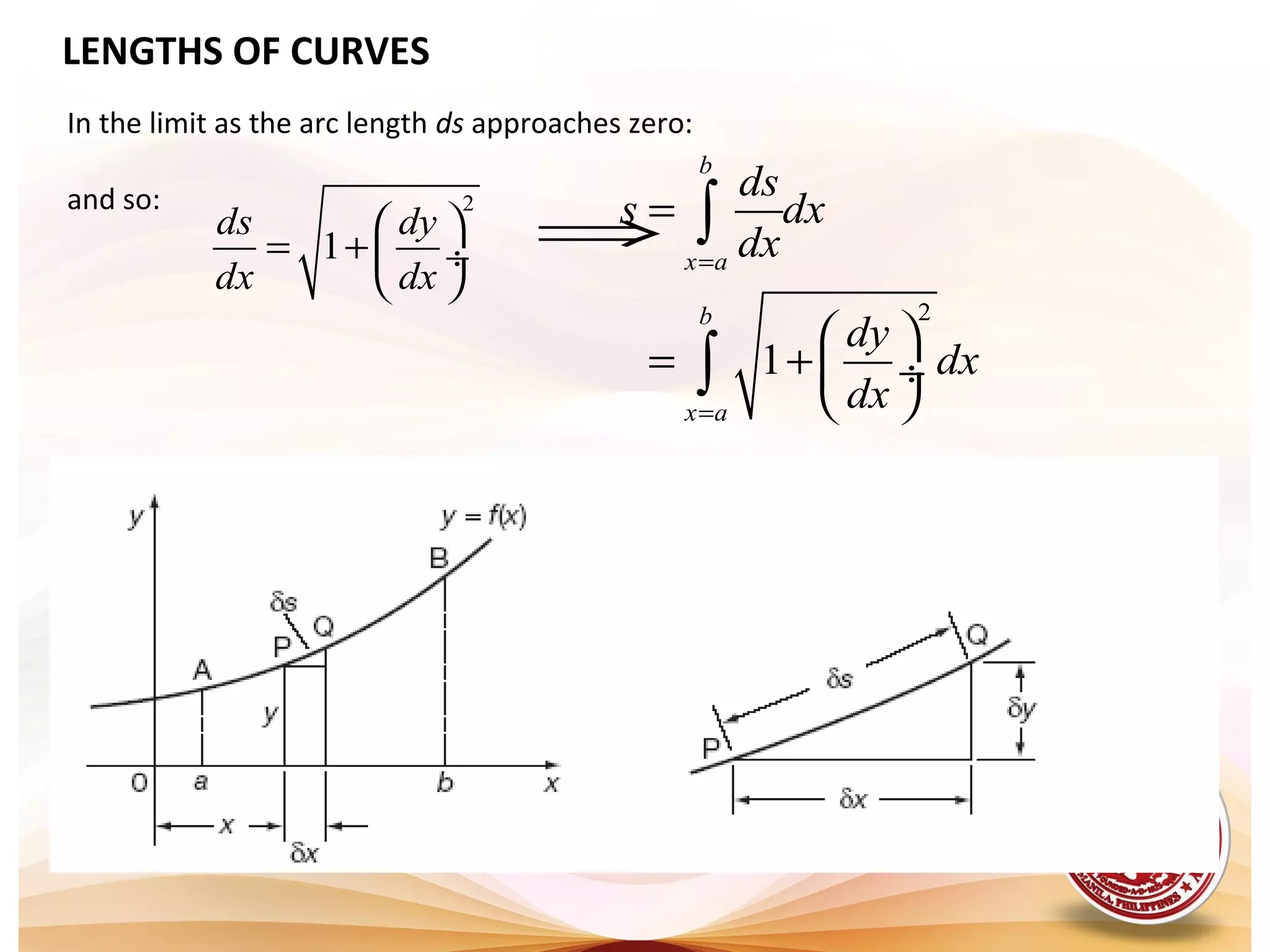
LENGTHS OF CURVES
In the limit as the arc length ds approaches zero:
and so: 2
1
ds dy
dx dx
 
= + ÷
 
2
1
b
x a
b
x a
ds
s dx
dx
dy
dx
dx
=
=
=
 
= + ÷
 
∫
∫
⇒
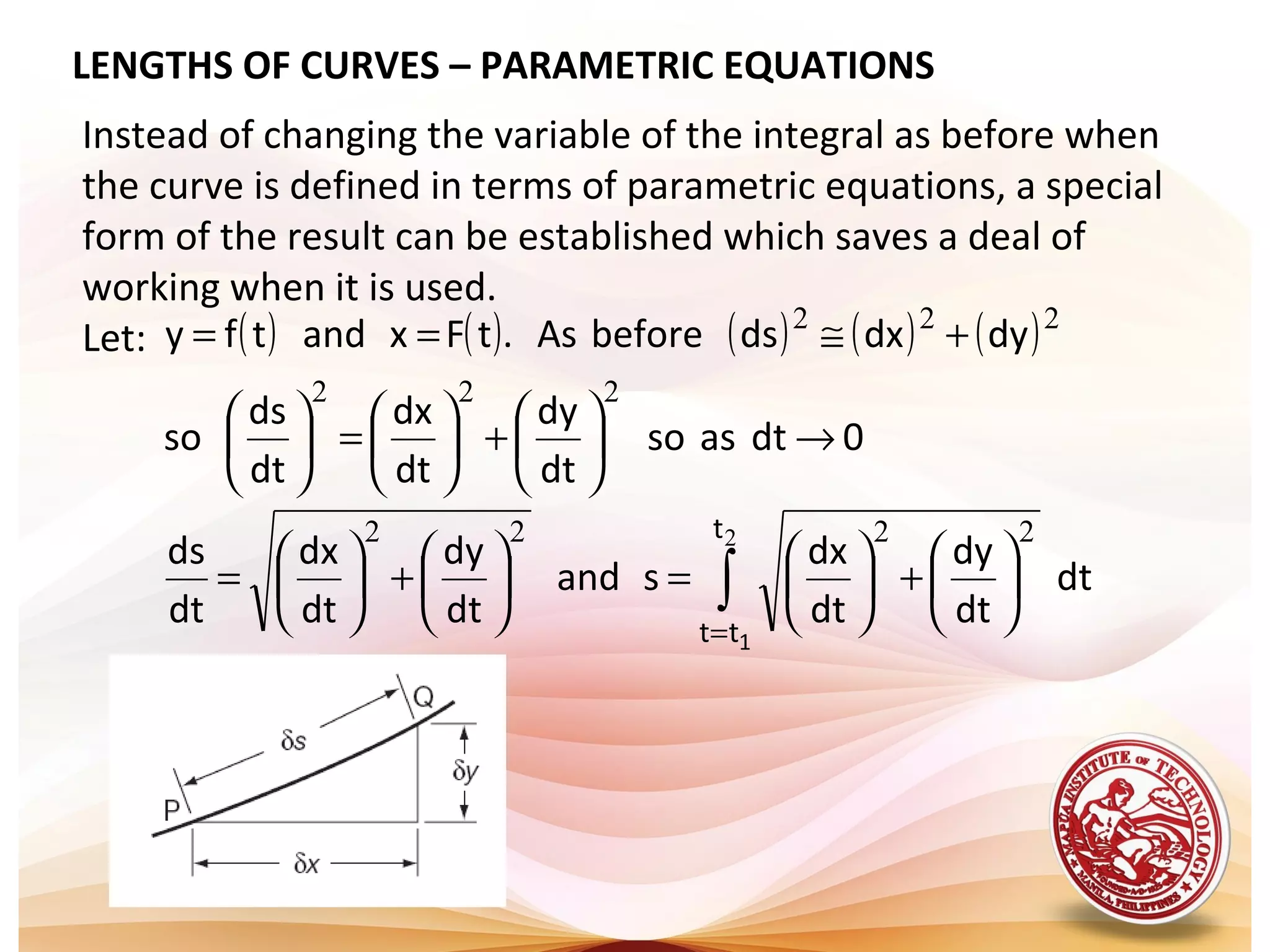
LENGTHS OF CURVES – PARAMETRIC EQUATIONS
Instead of changing the variable of the integral as before when
the curve is defined in terms of parametric equations, a special
form of the result can be established which saves a deal of
working when it is used.
Let: ( ) ( ) ( ) ( ) ( )
dt
dt
dy
dt
dx
sand
dt
dy
dt
dx
dt
ds
0dtasso
dt
dy
dt
dx
dt
ds
so
dydxdsbeforeAs.tFxandtfy
t
tt 1
∫
=






+





=





+





=
→





+





=





+≅==
2 2222
222
222
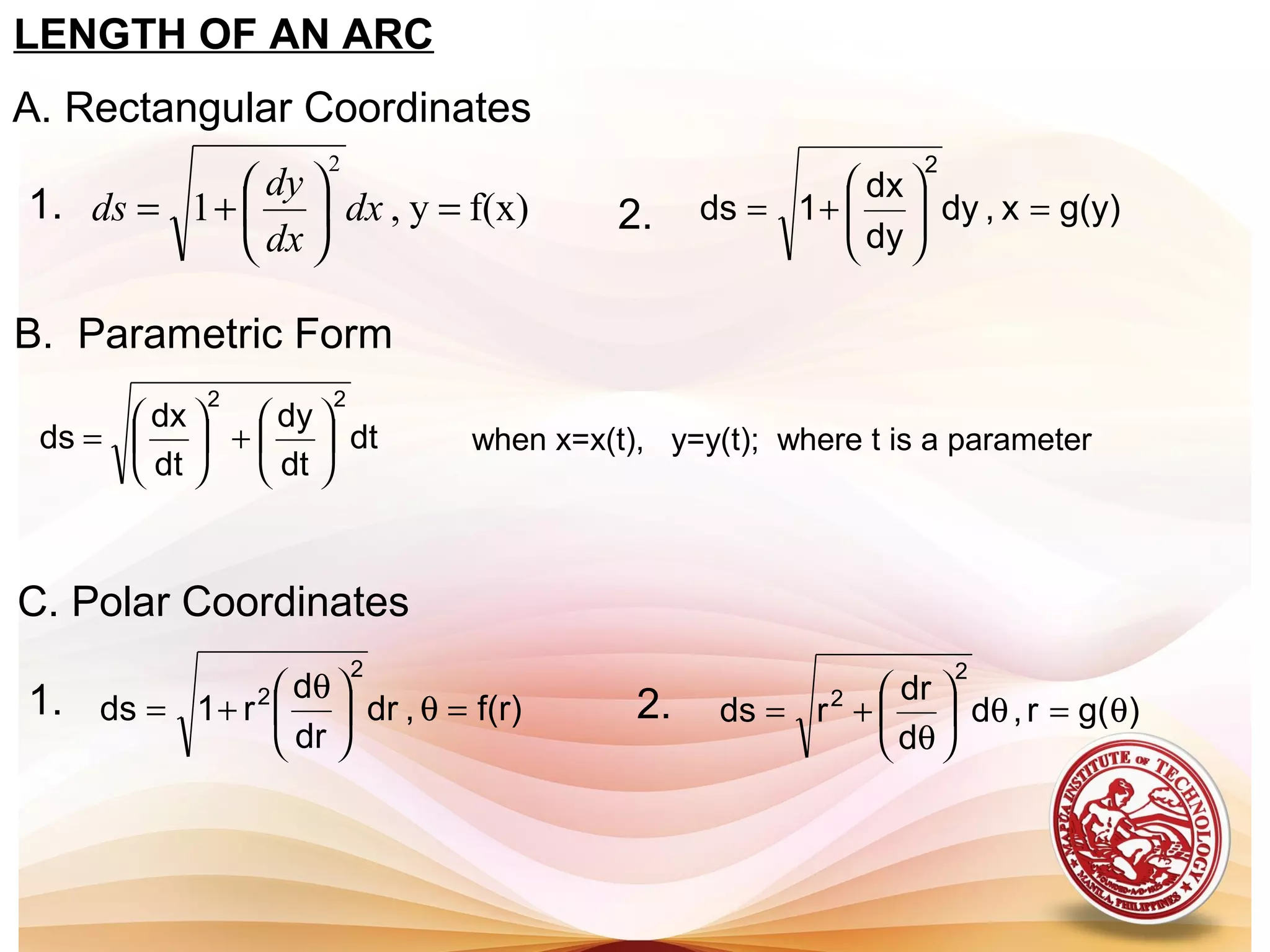
LENGTH OF AN ARC
A. Rectangular Coordinates
f(x)y,1
2
=





+= dx
dx
dy
ds g(y)x,dy
dy
dx
1ds
2
=





+=
B. Parametric Form
dt
dt
dy
dt
dx
ds
22






+





= when x=x(t), y=y(t); where t is a parameter
1. 2.
C. Polar Coordinates
f(r),dr
dr
d
r1ds
2
2
=θ




 θ
+= )g(r,d
d
dr
rds
2
2
θ=θ





θ
+=2.1.
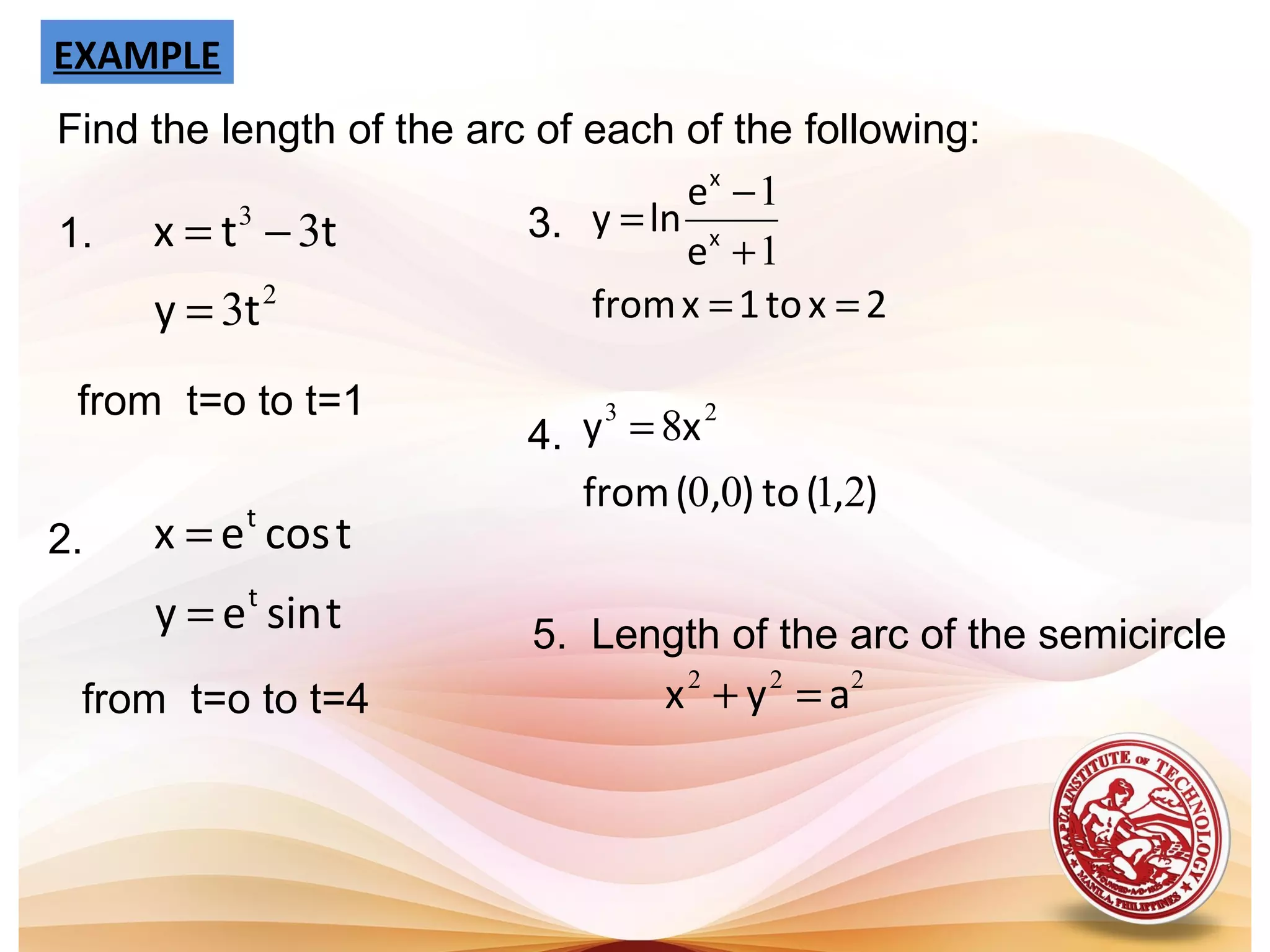
EXAMPLE
Find the length of the arc of each of the following:
2
3
3
3
ty
ttx
=
−=1.
from t=o to t=1
2.
tsiney
tcosex
t
t
=
=
from t=o to t=4
5. Length of the arc of the semicircle
222
ayx =+
2xto1xfrom
e
e
lny x
x
==
+
−
=
1
1
3.
4.
),(to),(from
xy
2100
8 23
=
AREA OF SURFACE OF REVOLUTION
• DEFINITION:
Let y = f(x) have a continuous derivative on the interval [a, b].
The area S of the surface of revolution formed by revolving
the graph of f about a horizontal or vertical axis is
where r(x) is the distance between the graph of f and the axis
of revolution.
[ ] xoffunctionaisydx)x('f)x(rS
b
a
→+π= ∫
2
12
If x = g(y) on the interval [c, d], then the surface area is
where r(y) is the distance between the graph of g and the axis of
revolution.
[ ] yoffunctionaisxdy)y('g)y(rS
d
c
→+π= ∫
2
12
EXAMPLE
1. Find the area formed by revolving the graph of f(x) = x3
on
the interval [0,1] about the x-axis.
2. Find the area formed by revolving the graph of f(x) = x2
on
the interval [0, ] about the y – axis.
3. Find the area of the surface generated by revolving the
curve
, 1 ≤ x ≤ 2 about the x – axis.
4. The line segment x = 1 – y, 0 ≤ y ≤ 1, is revolved about the y
– axis to generate the cone. Find its lateral surface area.
2
xy 2=
EXAMPLE
1. Find the area formed by revolving the graph of f(x) = x3
on
the interval [0,1] about the x-axis.
2. Find the area formed by revolving the graph of f(x) = x2
on
the interval [0, ] about the y – axis.
3. Find the area of the surface generated by revolving the
curve
, 1 ≤ x ≤ 2 about the x – axis.
4. The line segment x = 1 – y, 0 ≤ y ≤ 1, is revolved about the y
– axis to generate the cone. Find its lateral surface area.
2
xy 2=

Lesson 16 length of an arc

  • 1.
    TOPIC LENGTH OF ANARC and AREA OF SURFACE OF REVOLUTION
  • 2.
    LENGTHS OF CURVES Tofind the length of the arc of the curve y = f (x) between x = a and x = b let ds be the length of a small element of arc so that: ( ) ( ) ( ) 2 222 1thus       +≅+≅ dx dy dx ds dydxds
  • 3.
    LENGTHS OF CURVES Inthe limit as the arc length ds approaches zero: and so: 2 1 ds dy dx dx   = + ÷   2 1 b x a b x a ds s dx dx dy dx dx = = =   = + ÷   ∫ ∫ ⇒
  • 4.
    LENGTHS OF CURVES– PARAMETRIC EQUATIONS Instead of changing the variable of the integral as before when the curve is defined in terms of parametric equations, a special form of the result can be established which saves a deal of working when it is used. Let: ( ) ( ) ( ) ( ) ( ) dt dt dy dt dx sand dt dy dt dx dt ds 0dtasso dt dy dt dx dt ds so dydxdsbeforeAs.tFxandtfy t tt 1 ∫ =       +      =      +      = →      +      =      +≅== 2 2222 222 222
  • 5.
    LENGTH OF ANARC A. Rectangular Coordinates f(x)y,1 2 =      += dx dx dy ds g(y)x,dy dy dx 1ds 2 =      += B. Parametric Form dt dt dy dt dx ds 22       +      = when x=x(t), y=y(t); where t is a parameter 1. 2. C. Polar Coordinates f(r),dr dr d r1ds 2 2 =θ      θ += )g(r,d d dr rds 2 2 θ=θ      θ +=2.1.
  • 6.
    EXAMPLE Find the lengthof the arc of each of the following: 2 3 3 3 ty ttx = −=1. from t=o to t=1 2. tsiney tcosex t t = = from t=o to t=4 5. Length of the arc of the semicircle 222 ayx =+ 2xto1xfrom e e lny x x == + − = 1 1 3. 4. ),(to),(from xy 2100 8 23 =
  • 7.
    AREA OF SURFACEOF REVOLUTION • DEFINITION: Let y = f(x) have a continuous derivative on the interval [a, b]. The area S of the surface of revolution formed by revolving the graph of f about a horizontal or vertical axis is where r(x) is the distance between the graph of f and the axis of revolution. [ ] xoffunctionaisydx)x('f)x(rS b a →+π= ∫ 2 12
  • 8.
    If x =g(y) on the interval [c, d], then the surface area is where r(y) is the distance between the graph of g and the axis of revolution. [ ] yoffunctionaisxdy)y('g)y(rS d c →+π= ∫ 2 12
  • 9.
    EXAMPLE 1. Find thearea formed by revolving the graph of f(x) = x3 on the interval [0,1] about the x-axis. 2. Find the area formed by revolving the graph of f(x) = x2 on the interval [0, ] about the y – axis. 3. Find the area of the surface generated by revolving the curve , 1 ≤ x ≤ 2 about the x – axis. 4. The line segment x = 1 – y, 0 ≤ y ≤ 1, is revolved about the y – axis to generate the cone. Find its lateral surface area. 2 xy 2=
  • 10.
    EXAMPLE 1. Find thearea formed by revolving the graph of f(x) = x3 on the interval [0,1] about the x-axis. 2. Find the area formed by revolving the graph of f(x) = x2 on the interval [0, ] about the y – axis. 3. Find the area of the surface generated by revolving the curve , 1 ≤ x ≤ 2 about the x – axis. 4. The line segment x = 1 – y, 0 ≤ y ≤ 1, is revolved about the y – axis to generate the cone. Find its lateral surface area. 2 xy 2=