Indeterminate Forms
and L’Hôpital’s Rule
Objectives
At the end of the lesson, the student should
be able to:
• recognize limits that produce indeterminate
forms.
• apply L’Hôpital’s Rule to evaluate a limit.
It may happen that in the evaluation of the
limit of an expression, substitution of the
limit of the independent variable into the
expression leads to a meaningless symbol
such as
Expressions such as these whose limits
cannot be determined by direct use of the
theorems on limits are called indeterminate
forms.
0
0
,
∞
∞
𝑜𝑟 0 ∙ ∞
• A very useful tool in the evaluation of
indeterminate forms is the rule given below
which was named after the mathematician
Guillaume F. A. de L’Hôpital.
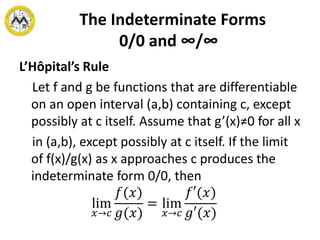
The Indeterminate Forms
0/0 and ∞/∞
L’Hôpital’s Rule
Let f and g be functions that are differentiable
on an open interval (a,b) containing c, except
possibly at c itself. Assume that g’(x)≠0 for all x
in (a,b), except possibly at c itself. If the limit
of f(x)/g(x) as x approaches c produces the
indeterminate form 0/0, then
lim
𝑥→𝑐
𝑓(𝑥)
𝑔(𝑥)
= lim
𝑥→𝑐
𝑓′(𝑥)
𝑔′(𝑥)
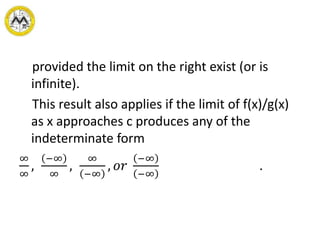
provided the limit on the right exist (or is
infinite).
This result also applies if the limit of f(x)/g(x)
as x approaches c produces any of the
indeterminate form
∞
∞
,
−∞
∞
,
∞
−∞
, 𝑜𝑟
−∞
−∞
.
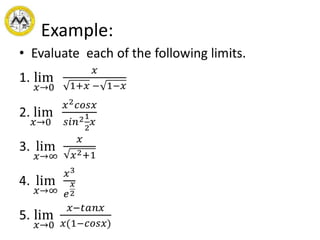
Example:
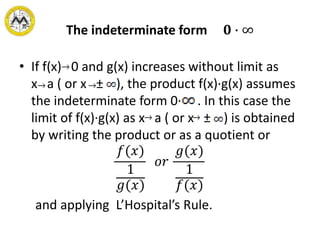
The indeterminate form 𝟎 ∙ ∞
• If f(x) 0 and g(x) increases without limit as
x a ( or x ± ), the product f(x)·g(x) assumes
the indeterminate form 0· . In this case the
limit of f(x)·g(x) as x a ( or x ± ) is obtained
by writing the product or as a quotient or
𝑓(𝑥)
1
𝑔(𝑥)
𝑜𝑟
𝑔(𝑥)
1
𝑓(𝑥)
and applying L’Hospital’s Rule.
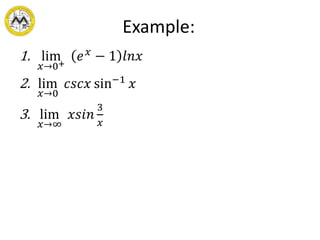
Example:
1. lim
𝑥→0+
𝑒 𝑥
− 1 𝑙𝑛𝑥
2. lim
𝑥→0
𝑐𝑠𝑐𝑥 sin−1
𝑥
3. lim
𝑥→∞
𝑥𝑠𝑖𝑛
3
𝑥
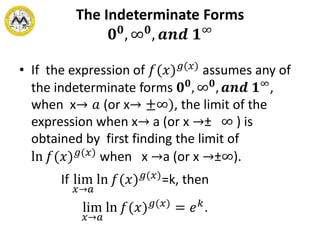
The Indeterminate Forms
𝟎 𝟎
, ∞ 𝟎
, 𝒂𝒏𝒅 𝟏∞
• If the expression of 𝑓(𝑥) 𝑔(𝑥)
assumes any of
the indeterminate forms 𝟎 𝟎
, ∞ 𝟎
, 𝒂𝒏𝒅 𝟏∞
,
when x→ 𝑎 (or x→ ±∞), the limit of the
expression when x→ a (or x →± ∞ ) is
obtained by first finding the limit of
ln 𝑓(𝑥) 𝑔(𝑥)
when x →a (or x →±∞).
If lim
𝑥→𝑎
ln 𝑓(𝑥) 𝑔(𝑥)
=k, then
lim
𝑥→𝑎
ln 𝑓(𝑥) 𝑔(𝑥)
= 𝑒 𝑘
.
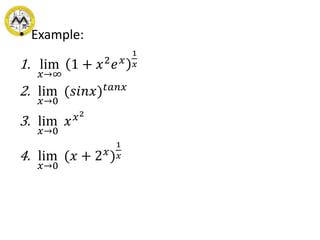
• Example:
1. lim
𝑥→∞
1 + 𝑥2
𝑒 𝑥
1
𝑥
2. lim
𝑥→0
(𝑠𝑖𝑛𝑥) 𝑡𝑎𝑛𝑥
3. lim
𝑥→0
𝑥 𝑥2
4. lim
𝑥→0
(𝑥 + 2 𝑥
)
1
𝑥
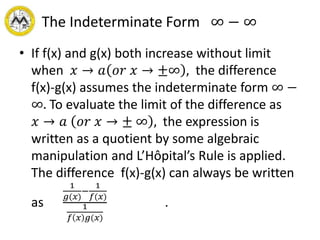
The Indeterminate Form ∞ − ∞
• If f(x) and g(x) both increase without limit
when 𝑥 → 𝑎 𝑜𝑟 𝑥 → ±∞ , the difference
f(x)-g(x) assumes the indeterminate form ∞ −
∞. To evaluate the limit of the difference as
𝑥 → 𝑎 𝑜𝑟 𝑥 → ± ∞ , the expression is
written as a quotient by some algebraic
manipulation and L’Hôpital’s Rule is applied.
The difference f(x)-g(x) can always be written
as
1
𝑔(𝑥)
−
1
𝑓(𝑥)
1
𝑓 𝑥 𝑔(𝑥)
.
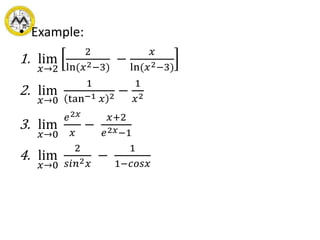
• Example:
1. lim
𝑥→2
2
ln(𝑥2−3)
−
𝑥
ln(𝑥2−3)
2. lim
𝑥→0
1
tan−1 𝑥 2 −
1
𝑥2
3. lim
𝑥→0
𝑒2𝑥
𝑥
−
𝑥+2
𝑒2𝑥−1
4. lim
𝑥→0
2
𝑠𝑖𝑛2 𝑥
−
1
1−𝑐𝑜𝑠𝑥
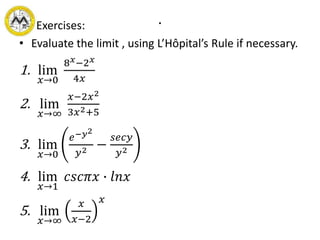
.Exercises:
• Evaluate the limit , using L’Hôpital’s Rule if necessary.
1. lim
𝑥→0
8 𝑥−2 𝑥
4𝑥
2. lim
𝑥→∞
𝑥−2𝑥2
3𝑥2+5
3. lim
𝑥→0
𝑒−𝑦2
𝑦2 −
𝑠𝑒𝑐𝑦
𝑦2
4. lim
𝑥→1
𝑐𝑠𝑐𝜋𝑥 ∙ 𝑙𝑛𝑥
5. lim
𝑥→∞
𝑥
𝑥−2
𝑥

Lesson 5 indeterminate forms

  • 1.
  • 2.
    Objectives At the endof the lesson, the student should be able to: • recognize limits that produce indeterminate forms. • apply L’Hôpital’s Rule to evaluate a limit.
  • 3.
    It may happenthat in the evaluation of the limit of an expression, substitution of the limit of the independent variable into the expression leads to a meaningless symbol such as Expressions such as these whose limits cannot be determined by direct use of the theorems on limits are called indeterminate forms. 0 0 , ∞ ∞ 𝑜𝑟 0 ∙ ∞
  • 4.
    • A veryuseful tool in the evaluation of indeterminate forms is the rule given below which was named after the mathematician Guillaume F. A. de L’Hôpital.
  • 5.
    The Indeterminate Forms 0/0and ∞/∞ L’Hôpital’s Rule Let f and g be functions that are differentiable on an open interval (a,b) containing c, except possibly at c itself. Assume that g’(x)≠0 for all x in (a,b), except possibly at c itself. If the limit of f(x)/g(x) as x approaches c produces the indeterminate form 0/0, then lim 𝑥→𝑐 𝑓(𝑥) 𝑔(𝑥) = lim 𝑥→𝑐 𝑓′(𝑥) 𝑔′(𝑥)
  • 6.
    provided the limiton the right exist (or is infinite). This result also applies if the limit of f(x)/g(x) as x approaches c produces any of the indeterminate form ∞ ∞ , −∞ ∞ , ∞ −∞ , 𝑜𝑟 −∞ −∞ .
  • 7.
  • 8.
    The indeterminate form𝟎 ∙ ∞ • If f(x) 0 and g(x) increases without limit as x a ( or x ± ), the product f(x)·g(x) assumes the indeterminate form 0· . In this case the limit of f(x)·g(x) as x a ( or x ± ) is obtained by writing the product or as a quotient or 𝑓(𝑥) 1 𝑔(𝑥) 𝑜𝑟 𝑔(𝑥) 1 𝑓(𝑥) and applying L’Hospital’s Rule.
  • 9.
    Example: 1. lim 𝑥→0+ 𝑒 𝑥 −1 𝑙𝑛𝑥 2. lim 𝑥→0 𝑐𝑠𝑐𝑥 sin−1 𝑥 3. lim 𝑥→∞ 𝑥𝑠𝑖𝑛 3 𝑥
  • 10.
    The Indeterminate Forms 𝟎𝟎 , ∞ 𝟎 , 𝒂𝒏𝒅 𝟏∞ • If the expression of 𝑓(𝑥) 𝑔(𝑥) assumes any of the indeterminate forms 𝟎 𝟎 , ∞ 𝟎 , 𝒂𝒏𝒅 𝟏∞ , when x→ 𝑎 (or x→ ±∞), the limit of the expression when x→ a (or x →± ∞ ) is obtained by first finding the limit of ln 𝑓(𝑥) 𝑔(𝑥) when x →a (or x →±∞). If lim 𝑥→𝑎 ln 𝑓(𝑥) 𝑔(𝑥) =k, then lim 𝑥→𝑎 ln 𝑓(𝑥) 𝑔(𝑥) = 𝑒 𝑘 .
  • 11.
    • Example: 1. lim 𝑥→∞ 1+ 𝑥2 𝑒 𝑥 1 𝑥 2. lim 𝑥→0 (𝑠𝑖𝑛𝑥) 𝑡𝑎𝑛𝑥 3. lim 𝑥→0 𝑥 𝑥2 4. lim 𝑥→0 (𝑥 + 2 𝑥 ) 1 𝑥
  • 12.
    The Indeterminate Form∞ − ∞ • If f(x) and g(x) both increase without limit when 𝑥 → 𝑎 𝑜𝑟 𝑥 → ±∞ , the difference f(x)-g(x) assumes the indeterminate form ∞ − ∞. To evaluate the limit of the difference as 𝑥 → 𝑎 𝑜𝑟 𝑥 → ± ∞ , the expression is written as a quotient by some algebraic manipulation and L’Hôpital’s Rule is applied. The difference f(x)-g(x) can always be written as 1 𝑔(𝑥) − 1 𝑓(𝑥) 1 𝑓 𝑥 𝑔(𝑥) .
  • 13.
    • Example: 1. lim 𝑥→2 2 ln(𝑥2−3) − 𝑥 ln(𝑥2−3) 2.lim 𝑥→0 1 tan−1 𝑥 2 − 1 𝑥2 3. lim 𝑥→0 𝑒2𝑥 𝑥 − 𝑥+2 𝑒2𝑥−1 4. lim 𝑥→0 2 𝑠𝑖𝑛2 𝑥 − 1 1−𝑐𝑜𝑠𝑥
  • 14.
    .Exercises: • Evaluate thelimit , using L’Hôpital’s Rule if necessary. 1. lim 𝑥→0 8 𝑥−2 𝑥 4𝑥 2. lim 𝑥→∞ 𝑥−2𝑥2 3𝑥2+5 3. lim 𝑥→0 𝑒−𝑦2 𝑦2 − 𝑠𝑒𝑐𝑦 𝑦2 4. lim 𝑥→1 𝑐𝑠𝑐𝜋𝑥 ∙ 𝑙𝑛𝑥 5. lim 𝑥→∞ 𝑥 𝑥−2 𝑥