© ABCC Australia 2015 www.new-physics.com
THE PLANE POLAR COORDINATES
PM [BO4]
90°
180° 0°
© ABCC Australia 2015 www.new-physics.com
PLANE POLAR
COORDINATES
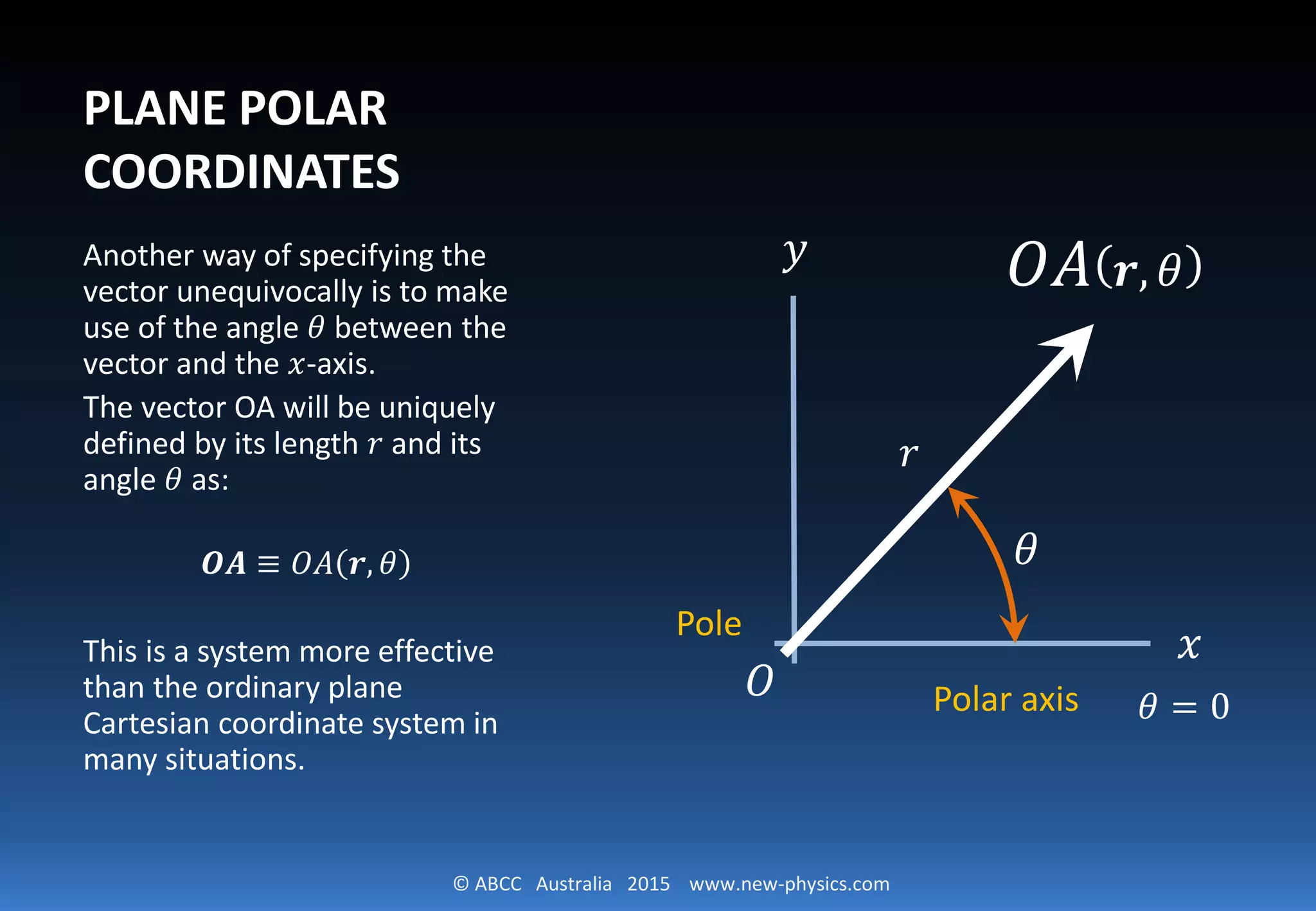
Another way of specifying the
vector unequivocally is to make
use of the angle 𝜃𝜃 between the
vector and the 𝑥𝑥-axis.
The vector OA will be uniquely
defined by its length 𝑟𝑟 and its
angle 𝜃𝜃 as:
𝑶𝑶𝑶𝑶 ≡ 𝑂𝑂𝑂𝑂 𝒓𝒓, 𝜃𝜃
This is a system more effective
than the ordinary plane
Cartesian coordinate system in
many situations.
𝜃𝜃
𝑦𝑦
𝑥𝑥
𝑂𝑂
𝑂𝑂𝐴𝐴 𝒓𝒓, 𝜃𝜃
𝑟𝑟
Pole
Polar axis 𝜃𝜃 = 0
© ABCC Australia 2015 www.new-physics.com
PLANE POLAR CARTESIAN
COORDINATES
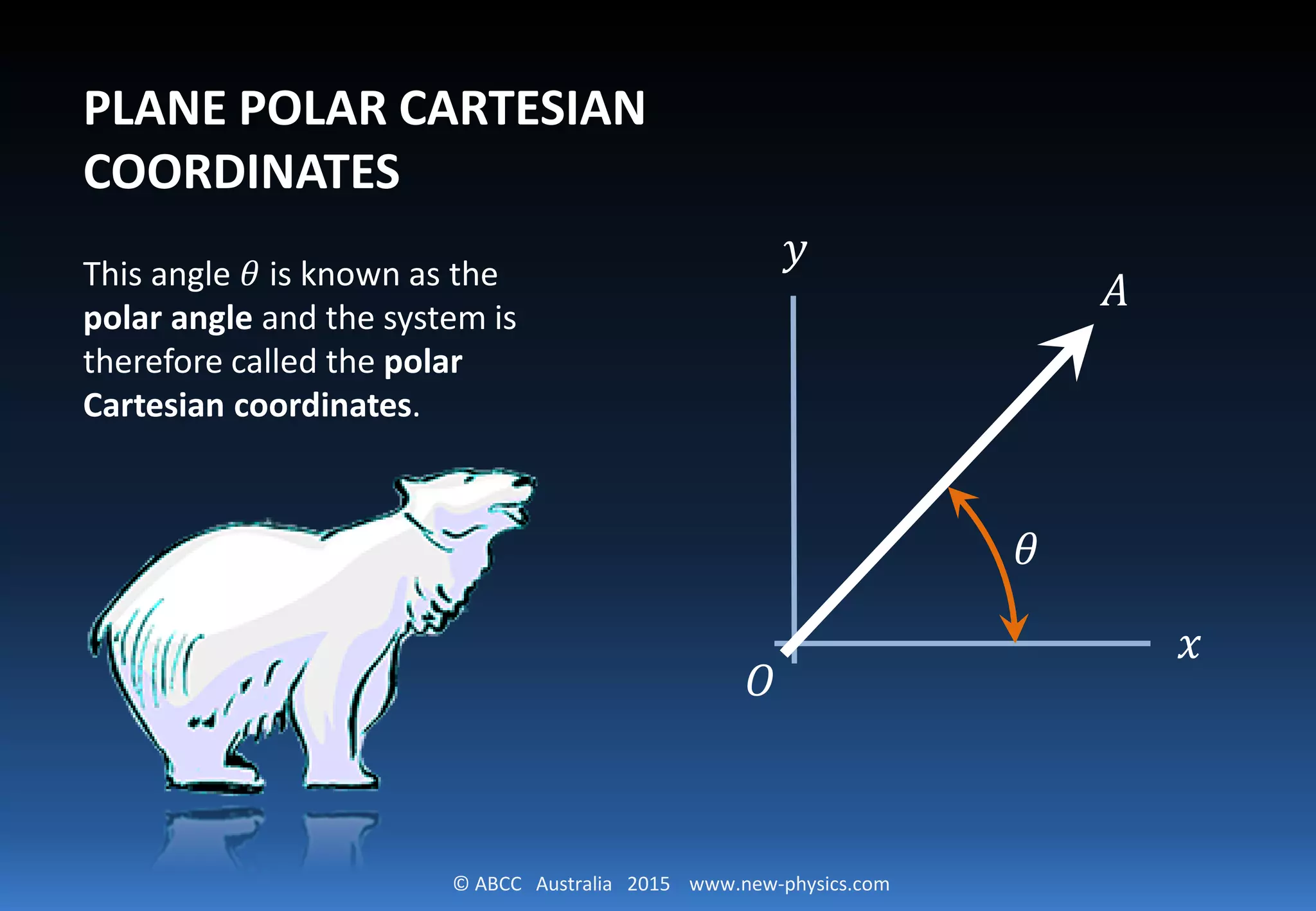
This angle 𝜃𝜃 is known as the
polar angle and the system is
therefore called the polar
Cartesian coordinates.
𝜃𝜃
𝑦𝑦
𝑥𝑥
𝑂𝑂
𝐴𝐴
© ABCC Australia 2015 www.new-physics.com
Vector Components
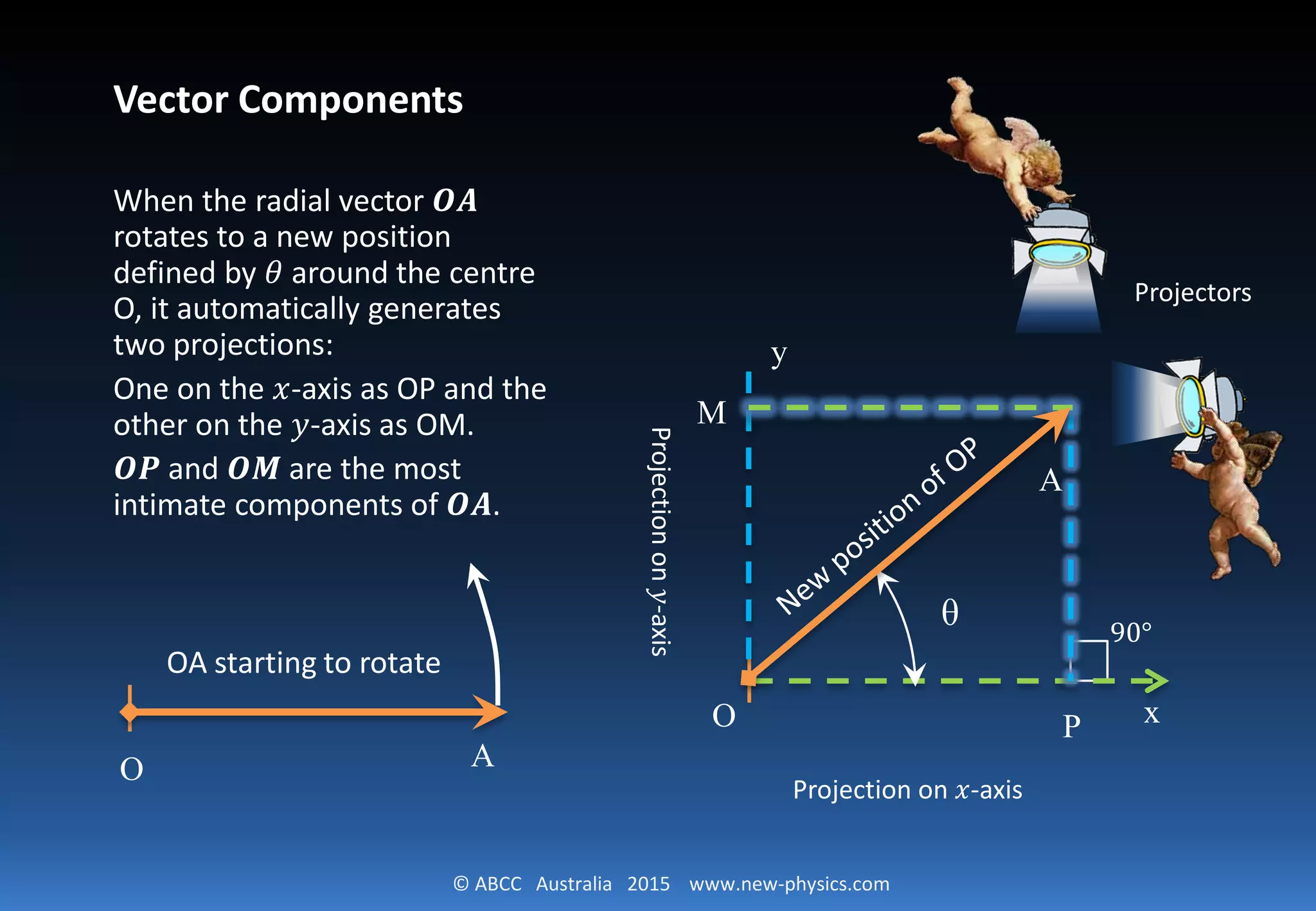
When the radial vector 𝑶𝑶𝑶𝑶
rotates to a new position
defined by 𝜃𝜃 around the centre
O, it automatically generates
two projections:
One on the 𝑥𝑥-axis as OP and the
other on the 𝑦𝑦-axis as OM.
𝑶𝑶𝑶𝑶 and 𝑶𝑶𝑶𝑶 are the most
intimate components of 𝑶𝑶𝑶𝑶.
O
A
x
θ 90°
P
O A
OA starting to rotate
y
Projectionon𝑦𝑦-axis
Projection on 𝑥𝑥-axis
Projectors
M
© ABCC Australia 2015 www.new-physics.com
Trigonometric Functions
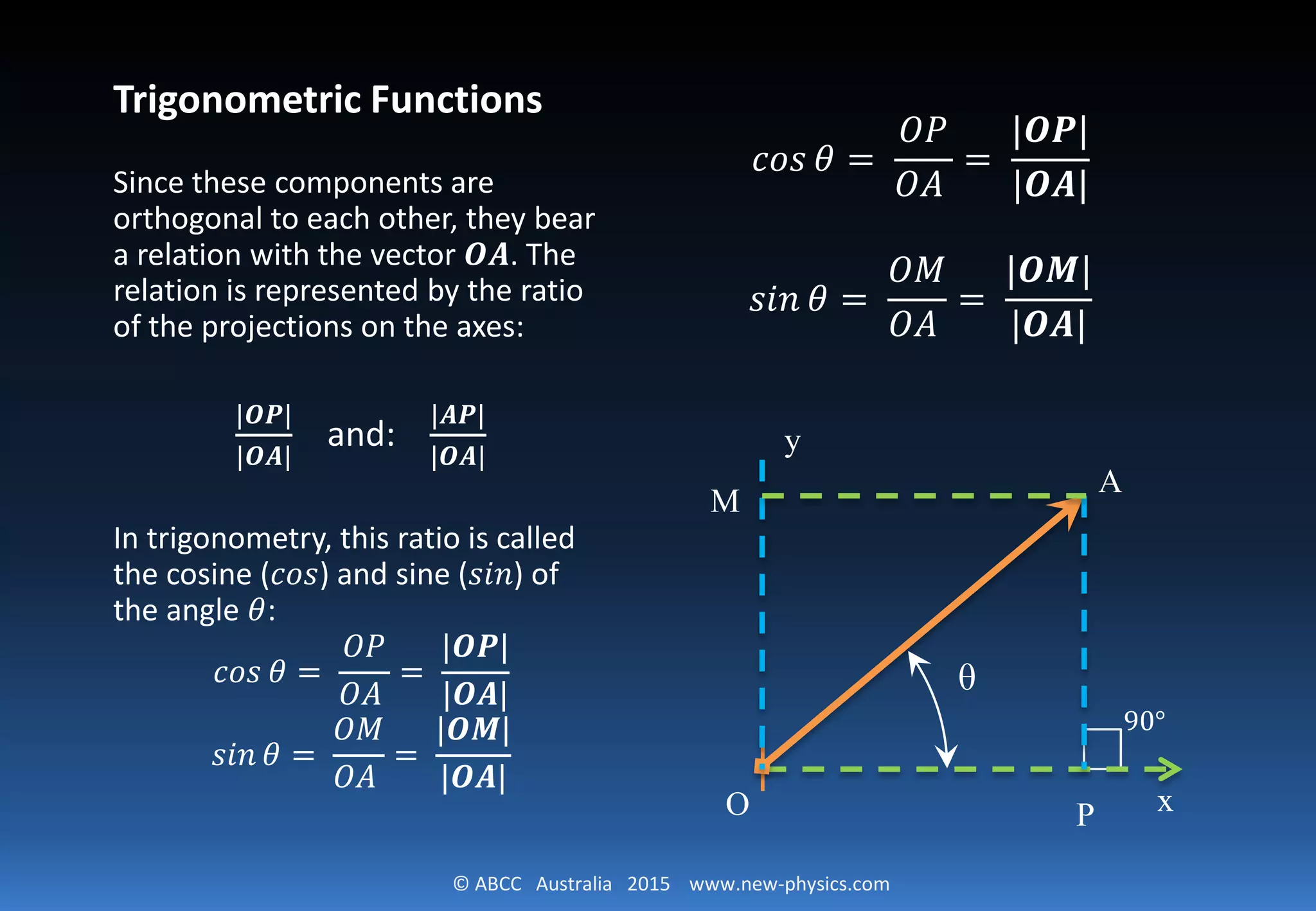
Since these components are
orthogonal to each other, they bear
a relation with the vector 𝑶𝑶𝑨𝑨. The
relation is represented by the ratio
of the projections on the axes:
|𝑶𝑶𝑶𝑶|
|𝑶𝑶𝑶𝑶|
and:
|𝑨𝑨𝑷𝑷|
|𝑶𝑶𝑶𝑶|
In trigonometry, this ratio is called
the cosine (𝑐𝑐𝑐𝑐𝑐𝑐) and sine (𝑠𝑠𝑠𝑠𝑠𝑠) of
the angle 𝜃𝜃:
𝑐𝑐𝑐𝑐𝑐𝑐 𝜃𝜃 =
𝑂𝑂𝑂𝑂
𝑂𝑂𝑂𝑂
=
|𝑶𝑶𝑶𝑶|
|𝑶𝑶𝑶𝑶|
𝑠𝑠𝑠𝑠𝑠𝑠 𝜃𝜃 =
𝑂𝑂𝑀𝑀
𝑂𝑂𝑂𝑂
=
|𝑶𝑶𝑴𝑴|
|𝑶𝑶𝑶𝑶|
O
A
x
θ
90°
P
y
M
𝑐𝑐𝑐𝑐𝑐𝑐 𝜃𝜃 =
𝑂𝑂𝑂𝑂
𝑂𝑂𝑂𝑂
=
|𝑶𝑶𝑶𝑶|
|𝑶𝑶𝑶𝑶|
𝑠𝑠𝑠𝑠𝑠𝑠 𝜃𝜃 =
𝑂𝑂𝑀𝑀
𝑂𝑂𝑂𝑂
=
|𝑶𝑶𝑴𝑴|
|𝑶𝑶𝑶𝑶|
© ABCC Australia 2015 www.new-physics.com
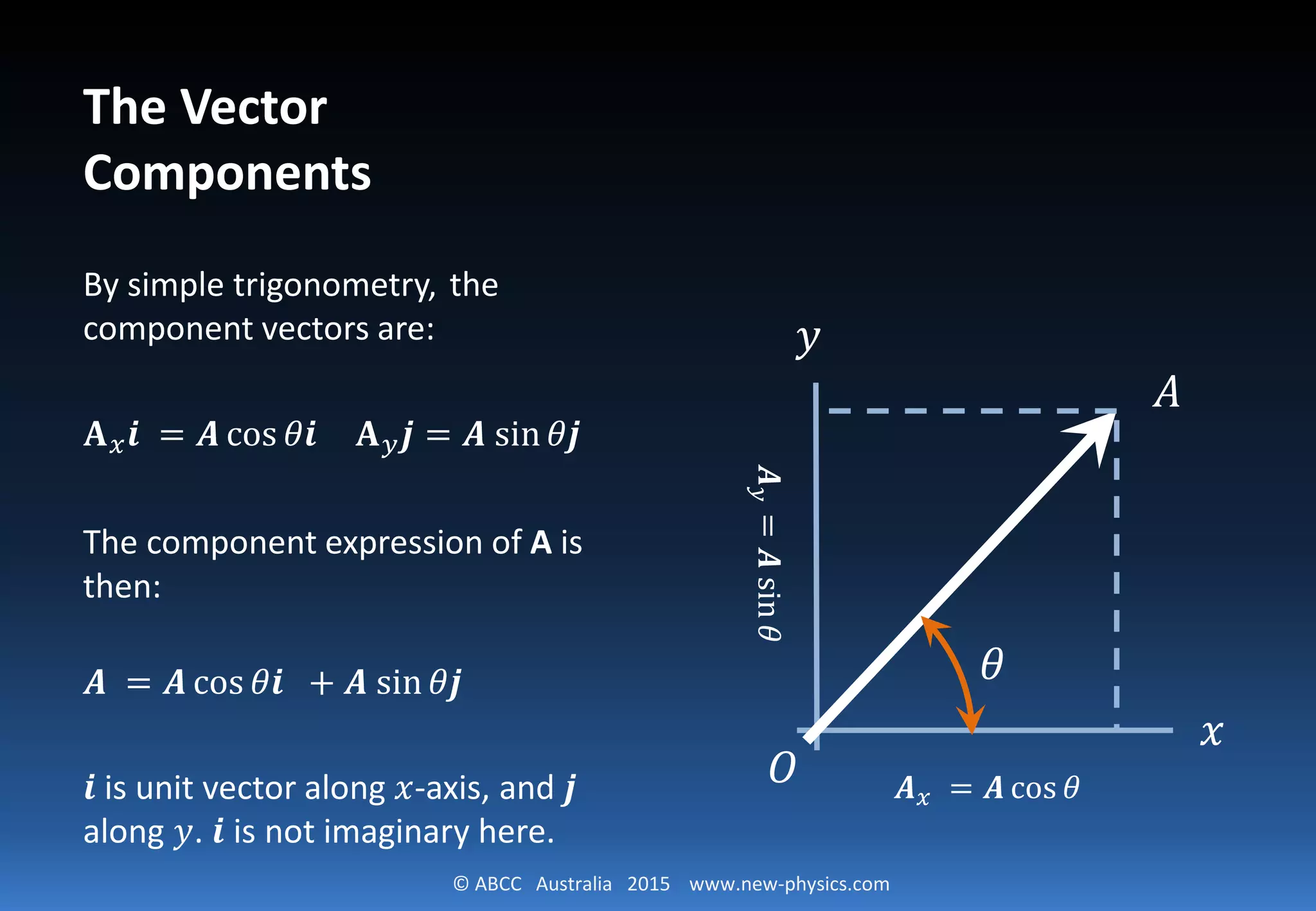
The Vector
Components
By simple trigonometry, the
component vectors are:
𝐀𝐀𝑥𝑥 𝒊𝒊 = 𝑨𝑨 cos 𝜃𝜃𝒊𝒊 𝐀𝐀𝑦𝑦 𝒋𝒋 = 𝑨𝑨 sin 𝜃𝜃𝒋𝒋
The component expression of A is
then:
𝑨𝑨 = 𝑨𝑨 cos 𝜃𝜃𝒊𝒊 + 𝑨𝑨 sin 𝜃𝜃𝒋𝒋
𝒊𝒊 is unit vector along 𝑥𝑥-axis, and 𝒋𝒋
along 𝑦𝑦. 𝒊𝒊 is not imaginary here.
𝜃𝜃
𝑦𝑦
𝑥𝑥
𝑂𝑂
𝐴𝐴
𝑨𝑨𝑦𝑦=𝑨𝑨sin𝜃𝜃
𝑨𝑨𝑥𝑥 = 𝑨𝑨 cos 𝜃𝜃
© ABCC Australia 2015 www.new-physics.com
ANGLES & MEASUREMENT
PM [B05]

PM [B04] Plane Polar Coordinates

  • 1.
    © ABCC Australia2015 www.new-physics.com THE PLANE POLAR COORDINATES PM [BO4] 90° 180° 0°
  • 2.
    © ABCC Australia2015 www.new-physics.com PLANE POLAR COORDINATES Another way of specifying the vector unequivocally is to make use of the angle 𝜃𝜃 between the vector and the 𝑥𝑥-axis. The vector OA will be uniquely defined by its length 𝑟𝑟 and its angle 𝜃𝜃 as: 𝑶𝑶𝑶𝑶 ≡ 𝑂𝑂𝑂𝑂 𝒓𝒓, 𝜃𝜃 This is a system more effective than the ordinary plane Cartesian coordinate system in many situations. 𝜃𝜃 𝑦𝑦 𝑥𝑥 𝑂𝑂 𝑂𝑂𝐴𝐴 𝒓𝒓, 𝜃𝜃 𝑟𝑟 Pole Polar axis 𝜃𝜃 = 0
  • 3.
    © ABCC Australia2015 www.new-physics.com PLANE POLAR CARTESIAN COORDINATES This angle 𝜃𝜃 is known as the polar angle and the system is therefore called the polar Cartesian coordinates. 𝜃𝜃 𝑦𝑦 𝑥𝑥 𝑂𝑂 𝐴𝐴
  • 4.
    © ABCC Australia2015 www.new-physics.com Vector Components When the radial vector 𝑶𝑶𝑶𝑶 rotates to a new position defined by 𝜃𝜃 around the centre O, it automatically generates two projections: One on the 𝑥𝑥-axis as OP and the other on the 𝑦𝑦-axis as OM. 𝑶𝑶𝑶𝑶 and 𝑶𝑶𝑶𝑶 are the most intimate components of 𝑶𝑶𝑶𝑶. O A x θ 90° P O A OA starting to rotate y Projectionon𝑦𝑦-axis Projection on 𝑥𝑥-axis Projectors M
  • 5.
    © ABCC Australia2015 www.new-physics.com Trigonometric Functions Since these components are orthogonal to each other, they bear a relation with the vector 𝑶𝑶𝑨𝑨. The relation is represented by the ratio of the projections on the axes: |𝑶𝑶𝑶𝑶| |𝑶𝑶𝑶𝑶| and: |𝑨𝑨𝑷𝑷| |𝑶𝑶𝑶𝑶| In trigonometry, this ratio is called the cosine (𝑐𝑐𝑐𝑐𝑐𝑐) and sine (𝑠𝑠𝑠𝑠𝑠𝑠) of the angle 𝜃𝜃: 𝑐𝑐𝑐𝑐𝑐𝑐 𝜃𝜃 = 𝑂𝑂𝑂𝑂 𝑂𝑂𝑂𝑂 = |𝑶𝑶𝑶𝑶| |𝑶𝑶𝑶𝑶| 𝑠𝑠𝑠𝑠𝑠𝑠 𝜃𝜃 = 𝑂𝑂𝑀𝑀 𝑂𝑂𝑂𝑂 = |𝑶𝑶𝑴𝑴| |𝑶𝑶𝑶𝑶| O A x θ 90° P y M 𝑐𝑐𝑐𝑐𝑐𝑐 𝜃𝜃 = 𝑂𝑂𝑂𝑂 𝑂𝑂𝑂𝑂 = |𝑶𝑶𝑶𝑶| |𝑶𝑶𝑶𝑶| 𝑠𝑠𝑠𝑠𝑠𝑠 𝜃𝜃 = 𝑂𝑂𝑀𝑀 𝑂𝑂𝑂𝑂 = |𝑶𝑶𝑴𝑴| |𝑶𝑶𝑶𝑶|
  • 6.
    © ABCC Australia2015 www.new-physics.com The Vector Components By simple trigonometry, the component vectors are: 𝐀𝐀𝑥𝑥 𝒊𝒊 = 𝑨𝑨 cos 𝜃𝜃𝒊𝒊 𝐀𝐀𝑦𝑦 𝒋𝒋 = 𝑨𝑨 sin 𝜃𝜃𝒋𝒋 The component expression of A is then: 𝑨𝑨 = 𝑨𝑨 cos 𝜃𝜃𝒊𝒊 + 𝑨𝑨 sin 𝜃𝜃𝒋𝒋 𝒊𝒊 is unit vector along 𝑥𝑥-axis, and 𝒋𝒋 along 𝑦𝑦. 𝒊𝒊 is not imaginary here. 𝜃𝜃 𝑦𝑦 𝑥𝑥 𝑂𝑂 𝐴𝐴 𝑨𝑨𝑦𝑦=𝑨𝑨sin𝜃𝜃 𝑨𝑨𝑥𝑥 = 𝑨𝑨 cos 𝜃𝜃
  • 7.
    © ABCC Australia2015 www.new-physics.com ANGLES & MEASUREMENT PM [B05]