Prior Knowledge Check
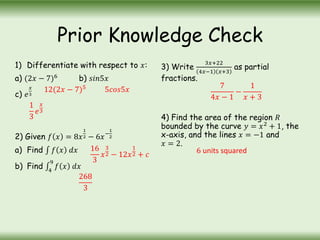
1) Differentiate with respect to 𝑥:
a) (2𝑥 − 7)6
b) 𝑠𝑖𝑛5𝑥
c) 𝑒
𝑥
3
2) Given 𝑓 𝑥 = 8𝑥
1
2 − 6𝑥−
1
2
a) Find 𝑓 𝑥 𝑑𝑥
b) Find 4
9
𝑓 𝑥 𝑑𝑥
3) Write
3𝑥+22
4𝑥−1 𝑥+3
as partial
fractions.
4) Find the area of the region 𝑅
bounded by the curve 𝑦 = 𝑥2 + 1, the
x-axis, and the lines 𝑥 = −1 and
𝑥 = 2.
12(2𝑥 − 7)5 5𝑐𝑜𝑠5𝑥
1
3
𝑒
𝑥
3
16
3
𝑥
3
2 − 12𝑥
1
2 + 𝑐
268
3
7
4𝑥 − 1
−
1
𝑥 + 3
6 units squared
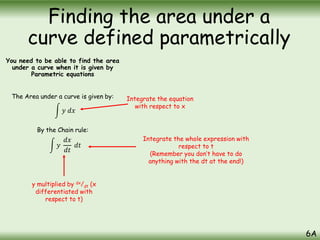
You need to be able to find the area
under a curve when it is given by
Parametric equations
The Area under a curve is given by:
By the Chain rule:
6A
𝑦 𝑑𝑥
𝑦
𝑑𝑥
𝑑𝑡
𝑑𝑡
Integrate the equation
with respect to x
y multiplied by dx/dt (x
differentiated with
respect to t)
Integrate the whole expression with
respect to t
(Remember you don’t have to do
anything with the dt at the end!)
Finding the area under a
curve defined parametrically
You need to be able to find the area
under a curve when it is given by
Parametric equations
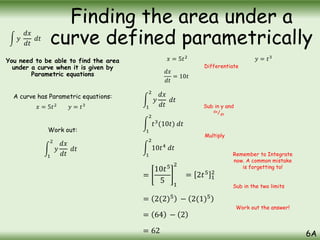
A curve has Parametric equations:
Work out:
𝑦
𝑑𝑥
𝑑𝑡
𝑑𝑡
𝑥 = 5𝑡2
𝑦 = 𝑡3
1
2
𝑦
𝑑𝑥
𝑑𝑡
𝑑𝑡
𝑥 = 5𝑡2
𝑦 = 𝑡3
𝑑𝑥
𝑑𝑡
= 10𝑡
Differentiate
1
2
𝑡3
(10𝑡) 𝑑𝑡
1
2
10𝑡4
𝑑𝑡
1
2
𝑦
𝑑𝑥
𝑑𝑡
𝑑𝑡
= 2𝑡5
1
2
=
10𝑡5
5 1
2
= 2(2)5
− 2(1)5
= 64 − 2
= 62
Sub in y and
dx/dt
Multiply
Remember to Integrate
now. A common mistake
is forgetting to!
Sub in the two limits
Work out the answer!
6A
Finding the area under a
curve defined parametrically
You need to be able to find the area
under a curve when it is given by
Parametric equations
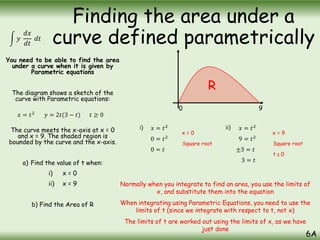
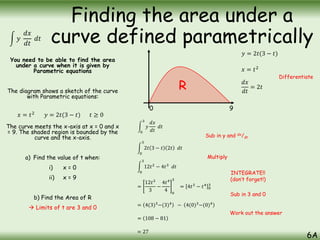
The diagram shows a sketch of the
curve with Parametric equations:
The curve meets the x-axis at x = 0
and x = 9. The shaded region is
bounded by the curve and the x-axis.
a) Find the value of t when:
i) x = 0
ii) x = 9
b) Find the Area of R
𝑦
𝑑𝑥
𝑑𝑡
𝑑𝑡
𝑥 = 𝑡2
𝑦 = 2𝑡(3 − 𝑡) 𝑡 ≥ 0
0 9
R
𝑥 = 𝑡2
0 = 𝑡2
0 = 𝑡
𝑥 = 𝑡2
9 = 𝑡2
±3 = 𝑡
3 = 𝑡
x = 0
Square root
x = 9
Square root
t ≥ 0
i) ii)
Normally when you integrate to find an area, you use the limits of
x, and substitute them into the equation
When integrating using Parametric Equations, you need to use the
limits of t (since we integrate with respect to t, not x)
The limits of t are worked out using the limits of x, as we have
just done
6A
Finding the area under a
curve defined parametrically
You need to be able to find the area
under a curve when it is given by
Parametric equations
The diagram shows a sketch of the curve
with Parametric equations:
The curve meets the x-axis at x = 0 and x
= 9. The shaded region is bounded by the
curve and the x-axis.
a) Find the value of t when:
i) x = 0
ii) x = 9
b) Find the Area of R
 Limits of t are 3 and 0
𝑦
𝑑𝑥
𝑑𝑡
𝑑𝑡
𝑥 = 𝑡2
𝑦 = 2𝑡(3 − 𝑡) 𝑡 ≥ 0
0 9
R
𝑥 = 𝑡2
𝑦 = 2𝑡(3 − 𝑡)
𝑑𝑥
𝑑𝑡
= 2𝑡
Differentiate
0
3
𝑦
𝑑𝑥
𝑑𝑡
𝑑𝑡
0
3
2𝑡 3 − 𝑡 2𝑡 𝑑𝑡
0
3
12𝑡2
− 4𝑡3
𝑑𝑡
=
12𝑡3
3
−
4𝑡4
4 0
3
= 4𝑡3
− 𝑡4
0
3
= 4(3)3
−(3)4
− 4(0)3
−(0)4
= 108 − 81
= 27
Sub in y and dx/dt
Multiply
INTEGRATE!!
(don’t forget!)
Sub in 3 and 0
Work out the answer
6A
Finding the area under a
curve defined parametrically
You need to be able to find the area
under a curve when it is given by
Parametric equations
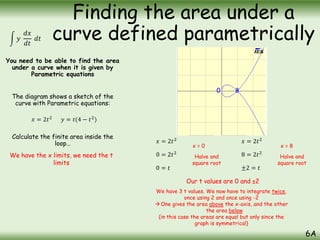
The diagram shows a sketch of the
curve with Parametric equations:
Calculate the finite area inside the
loop…
𝑦
𝑑𝑥
𝑑𝑡
𝑑𝑡
𝑥 = 2𝑡2
𝑦 = 𝑡(4 − 𝑡2
)
0 8
We have the x limits, we need the t
limits
𝑥 = 2𝑡2
0 = 2𝑡2
0 = 𝑡
𝑥 = 2𝑡2
8 = 2𝑡2
±2 = 𝑡
x = 0
Halve and
square root
x = 8
Halve and
square root
Our t values are 0 and ±2
We have 3 t values. We now have to integrate twice,
once using 2 and once using -2
 One gives the area above the x-axis, and the other
the area below
(in this case the areas are equal but only since the
graph is symmetrical)
6A
Finding the area under a
curve defined parametrically
You need to be able to find the area
under a curve when it is given by
Parametric equations
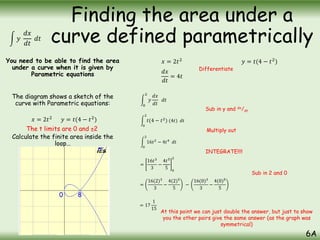
The diagram shows a sketch of the
curve with Parametric equations:
Calculate the finite area inside the
loop…
𝑦
𝑑𝑥
𝑑𝑡
𝑑𝑡
The t limits are 0 and ±2
0
2
𝑦
𝑑𝑥
𝑑𝑡
𝑑𝑡
𝑥 = 2𝑡2
𝑦 = 𝑡(4 − 𝑡2
)
𝑑𝑥
𝑑𝑡
= 4𝑡
0
2
𝑡(4 − 𝑡2) (4𝑡) 𝑑𝑡
0
2
16𝑡2
− 4𝑡4
𝑑𝑡
=
16𝑡3
3
−
4𝑡5
5 0
2
=
16(2)3
3
−
4(2)5
5
−
16(0)3
3
−
4(0)5
5
= 17
1
15
Sub in y and dx/dt
Multiply out
INTEGRATE!!!!
Sub in 2 and 0
Differentiate
At this point we can just double the answer, but just to show
you the other pairs give the same answer (as the graph was
symmetrical)
0 8
6A
Finding the area under a
curve defined parametrically
𝑥 = 2𝑡2
𝑦 = 𝑡(4 − 𝑡2
)
You need to be able to find the area
under a curve when it is given by
Parametric equations
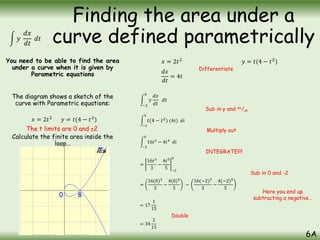
The diagram shows a sketch of the
curve with Parametric equations:
Calculate the finite area inside the
loop…
𝑦
𝑑𝑥
𝑑𝑡
𝑑𝑡
−2
0
𝑦
𝑑𝑥
𝑑𝑡
𝑑𝑡
𝑥 = 2𝑡2
𝑦 = 𝑡(4 − 𝑡2
)
𝑑𝑥
𝑑𝑡
= 4𝑡
−2
0
𝑡(4 − 𝑡2) (4𝑡) 𝑑𝑡
−2
0
16𝑡2
− 4𝑡4
𝑑𝑡
=
16𝑡3
3
−
4𝑡5
5 −2
0
=
16(0)3
3
−
4(0)5
5
−
16(−2)3
3
−
4(−2)5
5
= 17
1
15
Sub in y and dx/dt
Multiply out
INTEGRATE!!!!
Sub in 0 and -2
Differentiate
Here you end up
subtracting a negative…
= 34
2
15
Double
0 8
6A
Finding the area under a
curve defined parametrically
The t limits are 0 and ±2
𝑥 = 2𝑡2
𝑦 = 𝑡(4 − 𝑡2
)
You need to be able to find the area
under a curve when it is given by
Parametric equations
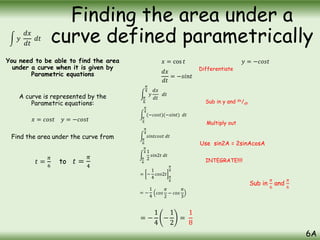
A curve is represented by the
Parametric equations:
Find the area under the curve from
𝑡 =
𝜋
6
to 𝑡 =
𝜋
4
𝑦
𝑑𝑥
𝑑𝑡
𝑑𝑡
𝜋
6
𝜋
4
𝑦
𝑑𝑥
𝑑𝑡
𝑑𝑡
𝑥 = cos 𝑡 𝑦 = −𝑐𝑜𝑠𝑡
𝑑𝑥
𝑑𝑡
= −𝑠𝑖𝑛𝑡
𝜋
6
𝜋
4
(−𝑐𝑜𝑠𝑡)(−𝑠𝑖𝑛𝑡) 𝑑𝑡
𝜋
6
𝜋
4
𝑠𝑖𝑛𝑡𝑐𝑜𝑠𝑡 𝑑𝑡
= −
1
4
𝑐𝑜𝑠2𝑡 𝜋
6
𝜋
4
= −
1
4
𝑐𝑜𝑠
𝜋
2
− 𝑐𝑜𝑠
𝜋
3
= −
1
4
−
1
2
=
1
8
Sub in y and dx/dt
Multiply out
INTEGRATE!!!!
Sub in
𝜋
6
and
𝜋
6
Differentiate
6A
Finding the area under a
curve defined parametrically
𝑥 = 𝑐𝑜𝑠𝑡 𝑦 = −𝑐𝑜𝑠𝑡
𝜋
6
𝜋
4 1
2
𝑠𝑖𝑛2𝑡 𝑑𝑡
Use sin2A = 2sinAcosA
Volumes of Revolution
You can use Integration to find
areas and volumes
6B
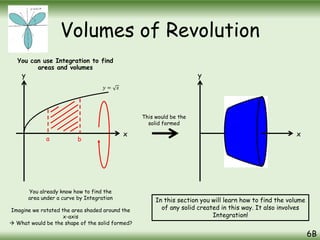
𝑦 = 𝑥
x
y
a b
You already know how to find the
area under a curve by Integration
Imagine we rotated the area shaded around the
x-axis
 What would be the shape of the solid formed?
y
x
This would be the
solid formed
In this section you will learn how to find the volume
of any solid created in this way. It also involves
Integration!
Volumes of Revolution
You can use Integration to find
areas and volumes
6B
x
y
a b
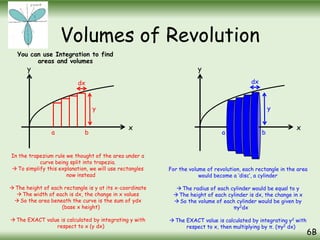
In the trapezium rule we thought of the area under a
curve being split into trapezia.
 To simplify this explanation, we will use rectangles
now instead
 The height of each rectangle is y at its x-coordinate
 The width of each is dx, the change in x values
 So the area beneath the curve is the sum of ydx
(base x height)
 The EXACT value is calculated by integrating y with
respect to x (y dx)
y
dx
y
x
For the volume of revolution, each rectangle in the area
would become a ‘disc’, a cylinder
 The radius of each cylinder would be equal to y
 The height of each cylinder is dx, the change in x
 So the volume of each cylinder would be given by
πy2dx
 The EXACT value is calculated by integrating y2 with
respect to x, then multiplying by π. (πy2 dx)
a b
y
dx
Volumes of Revolution
You can use Integration to find
areas and volumes
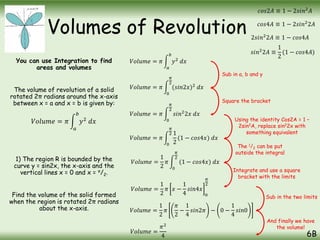
The volume of revolution of a solid
rotated 2π radians around the x-axis
between x = a and x = b is given by:
1) The region R is bounded by the
curve y = sin2x, the x-axis and the
vertical lines x = 0 and x = π/2.
Find the volume of the solid formed
when the region is rotated 2π radians
about the x-axis.
6B
𝑉𝑜𝑙𝑢𝑚𝑒 = 𝜋
𝑎
𝑏
𝑦2
𝑑𝑥
𝑉𝑜𝑙𝑢𝑚𝑒 = 𝜋
𝑎
𝑏
𝑦2
𝑑𝑥
𝑉𝑜𝑙𝑢𝑚𝑒 = 𝜋
0
𝜋
2
(𝑠𝑖𝑛2𝑥)2
𝑑𝑥
𝑉𝑜𝑙𝑢𝑚𝑒 = 𝜋
0
𝜋
2
𝑠𝑖𝑛2
2𝑥 𝑑𝑥
𝑐𝑜𝑠2𝐴 ≡ 1 − 2𝑠𝑖𝑛2
𝐴
𝑐𝑜𝑠4𝐴 ≡ 1 − 2𝑠𝑖𝑛2
2𝐴
2𝑠𝑖𝑛2
2𝐴 ≡ 1 − 𝑐𝑜𝑠4𝐴
𝑠𝑖𝑛2
2𝐴 ≡
1
2
(1 − 𝑐𝑜𝑠4𝐴)
𝑉𝑜𝑙𝑢𝑚𝑒 = 𝜋
0
𝜋
2 1
2
(1 − 𝑐𝑜𝑠4𝑥) 𝑑𝑥
𝑉𝑜𝑙𝑢𝑚𝑒 =
1
2
𝜋
0
𝜋
2
(1 − 𝑐𝑜𝑠4𝑥) 𝑑𝑥
𝑉𝑜𝑙𝑢𝑚𝑒 =
1
2
𝜋 𝑥 −
1
4
𝑠𝑖𝑛4𝑥
0
𝜋
2
𝑉𝑜𝑙𝑢𝑚𝑒 =
1
2
𝜋
𝜋
2
−
1
4
𝑠𝑖𝑛2𝜋 − 0 −
1
4
𝑠𝑖𝑛0
𝑉𝑜𝑙𝑢𝑚𝑒 =
𝜋2
4
Sub in a, b and y
Square the bracket
Using the identity Cos2A = 1 –
2sin2A, replace sin22x with
something equivalent
The 1/2 can be put
outside the integral
Integrate and use a square
bracket with the limits
Sub in the two limits
And finally we have
the volume!
Volumes of Revolution
You can use Integration to find
areas and volumes
The volume of revolution can also be
calculated when x and y are given
parametrically. In this case you must
also include dx/dt in the integral.
You will also need to change limits so
they are in terms of t rather than x!
6B
𝑉𝑜𝑙𝑢𝑚𝑒 = 𝜋
𝑎
𝑏
𝑦2
𝑑𝑥
𝑉𝑜𝑙𝑢𝑚𝑒 = 𝜋
𝑎
𝑏
𝑦2
𝑑𝑥
𝑑𝑡
𝑑𝑡
Volumes of Revolution
You can use Integration to find areas and
volumes
The volume of revolution can also be
calculated when x and y are given
parametrically. In this case you must also
include dx/dt in the integral.
The curve C has parametric equations:
Find the volume of the solid formed when
the curve is rotated 2π radians about the x-
axis, from t = 2 to t = 4.
6B
𝑉𝑜𝑙𝑢𝑚𝑒 = 𝜋
𝑎
𝑏
𝑦2
𝑑𝑥
𝑑𝑡
𝑑𝑡
𝑉𝑜𝑙𝑢𝑚𝑒 = 𝜋
𝑎
𝑏
𝑦2
𝑑𝑥
𝑥 = 2𝑡 𝑦 = 𝑡2
𝑉𝑜𝑙𝑢𝑚𝑒 = 𝜋
𝑎
𝑏
𝑦2
𝑑𝑥
𝑑𝑡
𝑑𝑡
𝑉𝑜𝑙𝑢𝑚𝑒 = 𝜋
2
4
𝑡2 2
𝑑𝑥
𝑑𝑡
= 2
2𝑑𝑡
𝑉𝑜𝑙𝑢𝑚𝑒 = 2𝜋
𝑎
𝑏
𝑡4
𝑑𝑡
Replace y, and
calculate dx/dt
Square the bracket
and combine them
= 2𝜋
1
5
𝑡5
2
4
=
2𝜋
5
1024 − 32
=
1984
5
𝜋
Integrate and write as a
square bracket
Sub in limits
separately
Simplify/Calculate
Volumes of Revolution
You can use Integration to find
areas and volumes
The volume of revolution can also be
calculated when x and y are given
parametrically. In this case you must
also include dx/dt in the integral.
The curve C has parametric equations:
The curve cuts the x-axis at the
points A and B.
The curve is rotated about the x-
axis, between the points A and B. Find
the volume generated.
𝑉𝑜𝑙𝑢𝑚𝑒 = 𝜋
𝑎
𝑏
𝑦2
𝑑𝑥
𝑑𝑡
𝑑𝑡
𝑉𝑜𝑙𝑢𝑚𝑒 = 𝜋
𝑎
𝑏
𝑦2
𝑑𝑥
𝑥 = 4𝑡2
− 1 𝑦 = 𝑡2
− 𝑡
𝑉𝑜𝑙𝑢𝑚𝑒 = 𝜋
𝑎
𝑏
𝑦2
𝑑𝑥
𝑑𝑡
𝑑𝑡
𝑉𝑜𝑙𝑢𝑚𝑒 = 𝜋
0
1
𝑡2
− 𝑡 2
𝑑𝑥
𝑑𝑡
= 8𝑡
× 8𝑡 𝑑𝑡
𝑉𝑜𝑙𝑢𝑚𝑒 = 8𝜋
0
1
(𝑡4
−2𝑡3
+ 𝑡2
)𝑡 𝑑𝑡
Replace y, and
calculate dx/dt
Square the bracket
and combine them
Find where the
curve cuts the x-
axis
𝑊ℎ𝑒𝑛 𝑦 = 0; 0 = 𝑡2
− 𝑡 0 = 𝑡(𝑡 −1)
𝑡 = 0, 𝑡 = 1
𝑉𝑜𝑙𝑢𝑚𝑒 = 8𝜋
0
1
(𝑡5
−2𝑡4
+ 𝑡3
) 𝑑𝑡
= 8𝜋
1
6
𝑡6
−
2
5
𝑡5
+
1
4
𝑡4
0
1
= 8𝜋
1
6
−
2
5
+
1
4
Integrate and write as a
square bracket
Sub in limits
separately
=
2
15
𝜋
Volumes of Revolution
You can use Integration to find areas
and volumes
The volume of revolution can also be
calculated when x and y are given
parametrically. In this case you must
also include dx/dt in the integral.
The curve C has parametric equations:
Where t ≥ 0.
The region R is bounded by C, the x-axis
and the lines x = 0 and x = 2.
Find the volume of the solid formed
when R is rotated 2π radians about the
x-axis. 6B
𝑉𝑜𝑙𝑢𝑚𝑒 = 𝜋
𝑎
𝑏
𝑦2
𝑑𝑥
𝑑𝑡
𝑑𝑡
𝑉𝑜𝑙𝑢𝑚𝑒 = 𝜋
𝑎
𝑏
𝑦2
𝑑𝑥
𝑥 = 𝑡(1 + 𝑡) 𝑦 =
1
1 + 𝑡
𝑉𝑜𝑙𝑢𝑚𝑒 = 𝜋
𝑎
𝑏
𝑦2
𝑑𝑥
𝑑𝑡
𝑑𝑡
𝑉𝑜𝑙𝑢𝑚𝑒 = 𝜋
𝑎
𝑏
1
1 + 𝑡
2
𝑥 = 𝑡 + 𝑡2
𝑑𝑥
𝑑𝑡
= 1 + 2𝑡
1 + 2𝑡 𝑑𝑡
𝑉𝑜𝑙𝑢𝑚𝑒 = 𝜋
𝑎
𝑏
1 + 2𝑡
(1 + 𝑡)2
𝑑𝑡
1 + 2𝑡
(1 + 𝑡)2
≡
𝐴
(1 + 𝑡)2
+
𝐵
1 + 𝑡
𝐴 + 𝐵(1 + 𝑡)
(1 + 𝑡)2
1 + 2𝑡 = 𝐴 + 𝐵(1 + 𝑡)
−1 = 𝐴
t = -1
t = 0 1 = 𝐴 + 𝐵
2 = 𝐵
We know A = -1 from before
Replace y, and
calculate dx/dt
Square the bracket
and combine them
We need to use
partial fractions here
Combine with a
common denominator
Sub in values to find
A and B
1 + 2𝑡
(1 + 𝑡)2
≡
−1
(1 + 𝑡)2
+
2
1 + 𝑡
1 + 2𝑡
(1 + 𝑡)2
≡
−
1
(1 + 𝑡)2
2
1 + 𝑡
Volumes of Revolution
You can use Integration to find areas
and volumes
The volume of revolution can also be
calculated when x and y are given
parametrically. In this case you must
also include dx/dt in the integral.
The curve C has parametric equations:
Where t ≥ 0.
The region R is bounded by C, the x-axis
and the lines x = 0 and x = 2.
Find the volume of the solid formed
when R is rotated 2π radians about the
x-axis. 6B
𝑉𝑜𝑙𝑢𝑚𝑒 = 𝜋
𝑎
𝑏
𝑦2
𝑑𝑥
𝑑𝑡
𝑑𝑡
𝑉𝑜𝑙𝑢𝑚𝑒 = 𝜋
𝑎
𝑏
𝑦2
𝑑𝑥
𝑥 = 𝑡(1 + 𝑡) 𝑦 =
1
1 + 𝑡
𝑉𝑜𝑙𝑢𝑚𝑒 = 𝜋
𝑎
𝑏
𝑦2
𝑑𝑥
𝑑𝑡
𝑑𝑡
𝑉𝑜𝑙𝑢𝑚𝑒 = 𝜋
𝑎
𝑏
1
1 + 𝑡
2
𝑥 = 𝑡 + 𝑡2
𝑑𝑥
𝑑𝑡
= 1 + 2𝑡
1 + 2𝑡 𝑑𝑡
𝑉𝑜𝑙𝑢𝑚𝑒 = 𝜋
𝑎
𝑏
1 + 2𝑡
(1 + 𝑡)2
𝑑𝑡
Replace y, and
calculate dx/dt
Square the bracket
and combine them
We need to use
partial fractions here
𝑉𝑜𝑙𝑢𝑚𝑒 = 𝜋
𝑎
𝑏
2
1 + 𝑡
−
1
(1 + 𝑡)2
𝑥 = 𝑡(1 + 𝑡)
We also need to calculate
the limits for t rather than
x, because we are
Integrating with respect to
t.
 Sub in the x limits and
solve for t
x = 0
0 = 𝑡(1 + 𝑡)
𝑡 = 0 𝑜𝑟 − 1
𝑡 = 0
x = 2
2 = 𝑡(1 + 𝑡)
0 = 𝑡2
+ 𝑡 − 2
0 = (𝑡 + 2)(𝑡 − 1)
𝑡 = −2 𝑜𝑟 1
𝑡 = 1
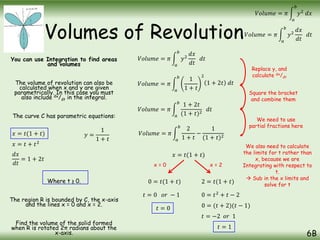
Volumes of Revolution
You can use Integration to find areas
and volumes
The volume of revolution can also be
calculated when x and y are given
parametrically. In this case you must
also include dx/dt in the integral.
The curve C has parametric equations:
Where t ≥ 0.
The region R is bounded by C, the x-axis
and the lines x = 0 and x = 2.
Find the volume of the solid formed
when R is rotated 2π radians about the
x-axis. 6B
𝑉𝑜𝑙𝑢𝑚𝑒 = 𝜋
𝑎
𝑏
𝑦2
𝑑𝑥
𝑑𝑡
𝑑𝑡
𝑉𝑜𝑙𝑢𝑚𝑒 = 𝜋
𝑎
𝑏
𝑦2
𝑑𝑥
𝑥 = 𝑡(1 + 𝑡) 𝑦 =
1
1 + 𝑡
𝑉𝑜𝑙𝑢𝑚𝑒 = 𝜋
𝑎
𝑏
𝑦2
𝑑𝑥
𝑑𝑡
𝑑𝑡
𝑉𝑜𝑙𝑢𝑚𝑒 = 𝜋
𝑎
𝑏
1
1 + 𝑡
2
𝑥 = 𝑡 + 𝑡2
𝑑𝑥
𝑑𝑡
= 1 + 2𝑡
1 + 2𝑡 𝑑𝑡
𝑉𝑜𝑙𝑢𝑚𝑒 = 𝜋
𝑎
𝑏
1 + 2𝑡
(1 + 𝑡)2
𝑑𝑡
Replace y, and
calculate dx/dt
Square the bracket
and combine them
We need to use
partial fractions here
𝑉𝑜𝑙𝑢𝑚𝑒 = 𝜋
𝑎
𝑏
2
1 + 𝑡
−
1
1 + 𝑡 2
𝑑𝑡
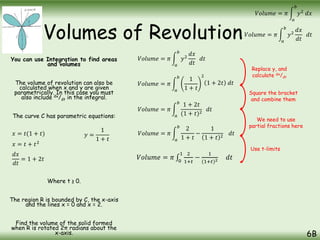
Use t-limits
𝑉𝑜𝑙𝑢𝑚𝑒 = 𝜋 0
1 2
1+𝑡
−
1
(1+𝑡)2 𝑑𝑡
Volumes of Revolution
You can use Integration to find areas
and volumes
The volume of revolution can also be
calculated when x and y are given
parametrically. In this case you must
also include dx/dt in the integral.
The curve C has parametric equations:
Where t ≥ 0.
The region R is bounded by C, the x-axis
and the lines x = 0 and x = 2.
Find the volume of the solid formed
when R is rotated 2π radians about the
x-axis. 6B
𝑉𝑜𝑙𝑢𝑚𝑒 = 𝜋
𝑎
𝑏
𝑦2
𝑑𝑥
𝑑𝑡
𝑑𝑡
𝑉𝑜𝑙𝑢𝑚𝑒 = 𝜋
𝑎
𝑏
𝑦2
𝑑𝑥
𝑥 = 𝑡(1 + 𝑡) 𝑦 =
1
1 + 𝑡
𝑥 = 𝑡 + 𝑡2
𝑑𝑥
𝑑𝑡
= 1 + 2𝑡
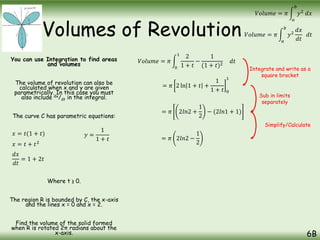
𝑉𝑜𝑙𝑢𝑚𝑒 = 𝜋
0
1
2
1 + 𝑡
−
1
(1 + 𝑡)2
𝑑𝑡
= 𝜋 2 ln 1 + 𝑡 +
1
1 + 𝑡 0
1
= 𝜋 2𝑙𝑛2 +
1
2
− (2𝑙𝑛1 + 1)
= 𝜋 2𝑙𝑛2 −
1
2
Integrate and write as a
square bracket
Sub in limits
separately
Simplify/Calculate
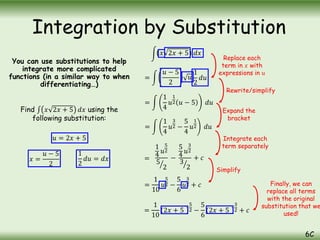
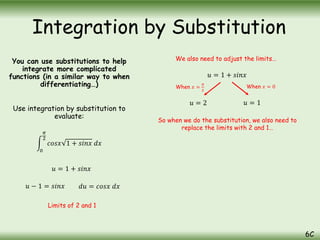
You can use substitutions to help
integrate more complicated
functions (in a similar way to when
differentiating…)
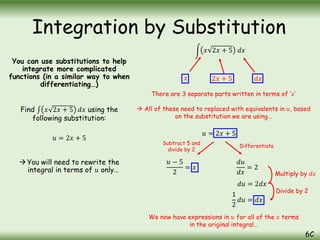
Find 𝑥 2𝑥 + 5 𝑑𝑥 using the
following substitution:
𝑢 = 2𝑥 + 5
You will need to rewrite the
integral in terms of 𝑢 only…
Integration by Substitution
6C
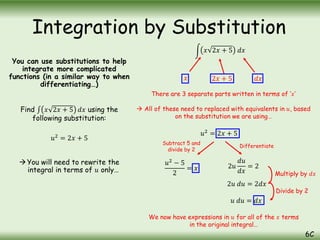
𝑥 𝑑𝑥
2𝑥 + 5
There are 3 separate parts written in terms of ‘𝑥’
 All of these need to replaced with equivalents in 𝑢, based
on the substitution we are using…
𝑢 = 2𝑥 + 5
𝑢 − 5
2
= 𝑥
𝑑𝑢
𝑑𝑥
= 2
𝑑𝑢 = 2𝑑𝑥
1
2
𝑑𝑢 = 𝑑𝑥
Subtract 5 and
divide by 2
Differentiate
Multiply by 𝑑𝑥
Divide by 2
We now have expressions in 𝑢 for all of the 𝑥 terms
in the original integral…
𝑥 2𝑥 + 5 𝑑𝑥
You can use substitutions to help
integrate more complicated
functions (in a similar way to when
differentiating…)
Find 𝑥 2𝑥 + 5 𝑑𝑥 using the
following substitution:
𝑢 = 2𝑥 + 5
Integration by Substitution
6C
𝑥 =
𝑢 − 5
2
1
2
𝑑𝑢 = 𝑑𝑥
=
𝑥 2𝑥 + 5 𝑑𝑥
𝑢 − 5
2
𝑢
1
2
𝑑𝑢
Replace each
term in 𝑥 with
expressions in 𝑢
=
1
4
𝑢
1
2 𝑢 − 5 𝑑𝑢
=
1
4
𝑢
3
2 −
5
4
𝑢
1
2 𝑑𝑢
=
1
4
𝑢
5
2
5
2
−
5
4
𝑢
3
2
3
2
+ 𝑐
Rewrite/simplify
Expand the
bracket
Integrate each
term separately
=
1
10
𝑢
5
2 −
5
6
𝑢
3
2 + 𝑐
=
1
10
2𝑥 + 5
5
2 −
5
6
2𝑥 + 5
3
2 + 𝑐
Simplify
Finally, we can
replace all terms
with the original
substitution that we
used!
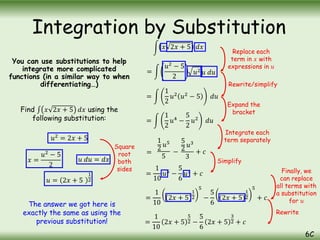
You can use substitutions to help
integrate more complicated
functions (in a similar way to when
differentiating…)
Find 𝑥 2𝑥 + 5 𝑑𝑥 using the
following substitution:
𝑢2
= 2𝑥 + 5
You will need to rewrite the
integral in terms of 𝑢 only…
Integration by Substitution
6C
𝑥 𝑑𝑥
2𝑥 + 5
There are 3 separate parts written in terms of ‘𝑥’
 All of these need to replaced with equivalents in 𝑢, based
on the substitution we are using…
𝑢2
= 2𝑥 + 5
𝑢2
− 5
2
= 𝑥 2𝑢
𝑑𝑢
𝑑𝑥
= 2
2𝑢 𝑑𝑢 = 2𝑑𝑥
𝑢 𝑑𝑢 = 𝑑𝑥
Subtract 5 and
divide by 2
Differentiate
Multiply by 𝑑𝑥
Divide by 2
We now have expressions in 𝑢 for all of the 𝑥 terms
in the original integral…
𝑥 2𝑥 + 5 𝑑𝑥
You can use substitutions to help
integrate more complicated
functions (in a similar way to when
differentiating…)
Find 𝑥 2𝑥 + 5 𝑑𝑥 using the
following substitution:
𝑢2
= 2𝑥 + 5
Integration by Substitution
6C
𝑥 =
𝑢2
− 5
2
𝑢 𝑑𝑢 = 𝑑𝑥
=
𝑥 2𝑥 + 5 𝑑𝑥
𝑢2
− 5
2
𝑢2 𝑢 𝑑𝑢
Replace each
term in 𝑥 with
expressions in 𝑢
=
1
2
𝑢2
𝑢2
− 5 𝑑𝑢
=
1
2
𝑢4
−
5
2
𝑢2
𝑑𝑢
=
1
2
𝑢5
5
−
5
2
𝑢3
3
+ 𝑐
Rewrite/simplify
Expand the
bracket
Integrate each
term separately
=
1
10
𝑢5
−
5
6
𝑢3
+ 𝑐
=
1
10
2𝑥 + 5
1
2
5
−
5
6
2𝑥 + 5
1
2
5
+ 𝑐
Simplify
Finally, we
can replace
all terms with
a substitution
for 𝑢
𝑢 = 2𝑥 + 5
1
2
Square
root
both
sides
=
1
10
2𝑥 + 5
5
2 −
5
6
2𝑥 + 5
3
2 + 𝑐
Rewrite
The answer we got here is
exactly the same as using the
previous substitution!
You can use substitutions to help
integrate more complicated
functions (in a similar way to when
differentiating…)
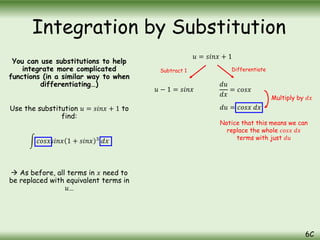
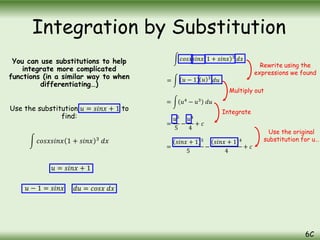
Use the substitution 𝑢 = 𝑠𝑖𝑛𝑥 + 1 to
find:
𝑐𝑜𝑠𝑥𝑠𝑖𝑛𝑥 1 + 𝑠𝑖𝑛𝑥 3
𝑑𝑥
 As before, all terms in 𝑥 need to
be replaced with equivalent terms in
𝑢…
Integration by Substitution
6C
𝑢 = 𝑠𝑖𝑛𝑥 + 1
𝑢 − 1 = 𝑠𝑖𝑛𝑥
𝑑𝑢
𝑑𝑥
= 𝑐𝑜𝑠𝑥
𝑑𝑢 = 𝑐𝑜𝑠𝑥 𝑑𝑥
Subtract 1 Differentiate
Multiply by 𝑑𝑥
Notice that this means we can
replace the whole 𝑐𝑜𝑠𝑥 𝑑𝑥
terms with just 𝑑𝑢
You can use substitutions to help
integrate more complicated
functions (in a similar way to when
differentiating…)
Use the substitution 𝑢 = 𝑠𝑖𝑛𝑥 + 1 to
find:
𝑐𝑜𝑠𝑥𝑠𝑖𝑛𝑥 1 + 𝑠𝑖𝑛𝑥 3
𝑑𝑥
Integration by Substitution
6C
𝑢 = 𝑠𝑖𝑛𝑥 + 1
𝑢 − 1 = 𝑠𝑖𝑛𝑥 𝑑𝑢 = 𝑐𝑜𝑠𝑥 𝑑𝑥
𝑐𝑜𝑠𝑥𝑠𝑖𝑛𝑥 1 + 𝑠𝑖𝑛𝑥 3
𝑑𝑥
= 𝑢 − 1 𝑢 3
𝑑𝑢
= 𝑢4
− 𝑢3
𝑑𝑢
=
𝑢5
5
−
𝑢4
4
+ 𝑐
Rewrite using the
expressions we found
Multiply out
Integrate
Use the original
substitution for u…
=
𝑠𝑖𝑛𝑥 + 1 5
5
−
𝑠𝑖𝑛𝑥 + 1 4
4
+ 𝑐
You can use substitutions to help
integrate more complicated
functions (in a similar way to when
differentiating…)
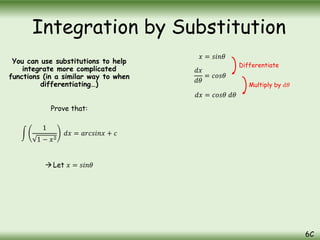
Prove that:
1
1 − 𝑥2
𝑑𝑥 = 𝑎𝑟𝑐𝑠𝑖𝑛𝑥 + 𝑐
Let 𝑥 = 𝑠𝑖𝑛𝜃
Integration by Substitution
6C
𝑥 = 𝑠𝑖𝑛𝜃
Differentiate
𝑑𝑥
𝑑𝜃
= 𝑐𝑜𝑠𝜃
Multiply by 𝑑𝜃
𝑑𝑥 = 𝑐𝑜𝑠𝜃 𝑑𝜃
You can use substitutions to help
integrate more complicated
functions (in a similar way to when
differentiating…)
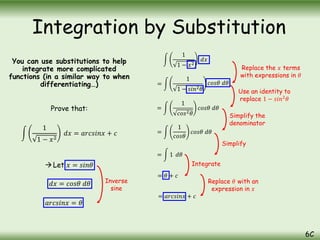
Prove that:
1
1 − 𝑥2
𝑑𝑥 = 𝑎𝑟𝑐𝑠𝑖𝑛𝑥 + 𝑐
Let 𝑥 = 𝑠𝑖𝑛𝜃
Integration by Substitution
6C
𝑑𝑥 = 𝑐𝑜𝑠𝜃 𝑑𝜃
1
1 − 𝑥2
𝑑𝑥
=
1
1 − 𝑠𝑖𝑛2𝜃
𝑐𝑜𝑠𝜃 𝑑𝜃
=
1
𝑐𝑜𝑠2𝜃
𝑐𝑜𝑠𝜃 𝑑𝜃
=
1
𝑐𝑜𝑠𝜃
𝑐𝑜𝑠𝜃 𝑑𝜃
= 1 𝑑𝜃
= 𝜃 + 𝑐
𝑎𝑟𝑐𝑠𝑖𝑛𝑥 = 𝜃
= 𝑎𝑟𝑐𝑠𝑖𝑛𝑥 + 𝑐
Replace the 𝑥 terms
with expressions in 𝜃
Use an identity to
replace 1 − 𝑠𝑖𝑛2
𝜃
Simplify the
denominator
Simplify
Integrate
Replace 𝜃 with an
expression in 𝑥
Inverse
sine
You can use substitutions to help
integrate more complicated
functions (in a similar way to when
differentiating…)
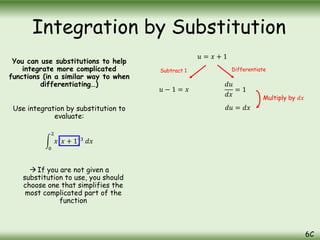
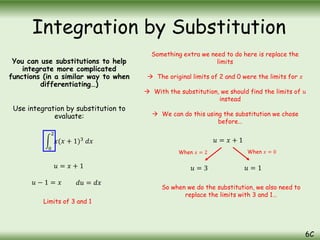
Use integration by substitution to
evaluate:
0
2
𝑥(𝑥 + 1)3
𝑑𝑥
 If you are not given a
substitution to use, you should
choose one that simplifies the
most complicated part of the
function
Integration by Substitution
6C
𝑢 = 𝑥 + 1
𝑢 − 1 = 𝑥
𝑑𝑢
𝑑𝑥
= 1
𝑑𝑢 = 𝑑𝑥
Subtract 1 Differentiate
Multiply by 𝑑𝑥
You can use substitutions to help
integrate more complicated
functions (in a similar way to when
differentiating…)
Use integration by substitution to
evaluate:
0
2
𝑥(𝑥 + 1)3
𝑑𝑥
Integration by Substitution
6C
𝑢 = 𝑥 + 1
𝑢 − 1 = 𝑥 𝑑𝑢 = 𝑑𝑥
Something extra we need to do here is replace the
limits
 The original limits of 2 and 0 were the limits for 𝑥
 With the substitution, we should find the limits of 𝑢
instead
 We can do this using the substitution we chose
before…
𝑢 = 𝑥 + 1
When 𝑥 = 2 When 𝑥 = 0
𝑢 = 3 𝑢 = 1
So when we do the substitution, we also need to
replace the limits with 3 and 1…
Limits of 3 and 1
You can use substitutions to help
integrate more complicated
functions (in a similar way to when
differentiating…)
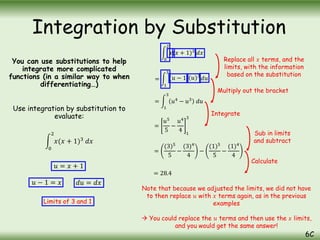
Use integration by substitution to
evaluate:
0
2
𝑥(𝑥 + 1)3
𝑑𝑥
Integration by Substitution
6C
𝑢 = 𝑥 + 1
𝑢 − 1 = 𝑥 𝑑𝑢 = 𝑑𝑥
0
2
𝑥(𝑥 + 1)3
𝑑𝑥
=
1
3
(𝑢 − 1) 𝑢 3
𝑑𝑢
=
1
3
𝑢4
− 𝑢3
𝑑𝑢
=
𝑢5
5
−
𝑢4
4 1
3
=
(3)5
5
−
(3)4
4
−
(1)5
5
−
(1)4
4
Limits of 3 and 1
= 28.4
Replace all 𝑥 terms, and the
limits, with the information
based on the substitution
Multiply out the bracket
Integrate
Sub in limits
and subtract
Calculate
Note that because we adjusted the limits, we did not have
to then replace 𝑢 with 𝑥 terms again, as in the previous
examples
 You could replace the 𝑢 terms and then use the 𝑥 limits,
and you would get the same answer!
You can use substitutions to help
integrate more complicated
functions (in a similar way to when
differentiating…)
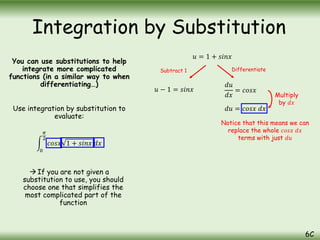
Use integration by substitution to
evaluate:
0
𝜋
2
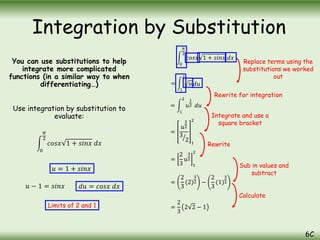
𝑐𝑜𝑠𝑥 1 + 𝑠𝑖𝑛𝑥 𝑑𝑥
 If you are not given a
substitution to use, you should
choose one that simplifies the
most complicated part of the
function
Integration by Substitution
6C
𝑢 = 1 + 𝑠𝑖𝑛𝑥
𝑢 − 1 = 𝑠𝑖𝑛𝑥
𝑑𝑢
𝑑𝑥
= 𝑐𝑜𝑠𝑥
𝑑𝑢 = 𝑐𝑜𝑠𝑥 𝑑𝑥
Subtract 1 Differentiate
Multiply
by 𝑑𝑥
Notice that this means we can
replace the whole 𝑐𝑜𝑠𝑥 𝑑𝑥
terms with just 𝑑𝑢
You can use substitutions to help
integrate more complicated
functions (in a similar way to when
differentiating…)
Use integration by substitution to
evaluate:
0
𝜋
2
𝑐𝑜𝑠𝑥 1 + 𝑠𝑖𝑛𝑥 𝑑𝑥
Integration by Substitution
6C
𝑢 = 1 + 𝑠𝑖𝑛𝑥
𝑢 − 1 = 𝑠𝑖𝑛𝑥 𝑑𝑢 = 𝑐𝑜𝑠𝑥 𝑑𝑥
𝑢 = 1 + 𝑠𝑖𝑛𝑥
When 𝑥 =
𝜋
2
When 𝑥 = 0
𝑢 = 2 𝑢 = 1
So when we do the substitution, we also need to
replace the limits with 2 and 1…
We also need to adjust the limits…
Limits of 2 and 1
You can use substitutions to help
integrate more complicated
functions (in a similar way to when
differentiating…)
Use integration by substitution to
evaluate:
0
𝜋
2
𝑐𝑜𝑠𝑥 1 + 𝑠𝑖𝑛𝑥 𝑑𝑥
Integration by Substitution
6C
𝑢 = 1 + 𝑠𝑖𝑛𝑥
𝑢 − 1 = 𝑠𝑖𝑛𝑥 𝑑𝑢 = 𝑐𝑜𝑠𝑥 𝑑𝑥
Limits of 2 and 1
0
𝜋
2
𝑐𝑜𝑠𝑥 1 + 𝑠𝑖𝑛𝑥 𝑑𝑥
=
1
2
𝑢 𝑑𝑢
=
1
2
𝑢
1
2 𝑑𝑢
=
𝑢
3
2
3
2 1
2
=
2
3
𝑢
3
2
1
2
=
2
3
(2)
3
2 −
2
3
(1)
3
2
=
2
3
2 2 − 1
Replace terms using the
substitutions we worked
out
Rewrite for integration
Integrate and use a
square bracket
Rewrite
Sub in values and
subtract
Calculate
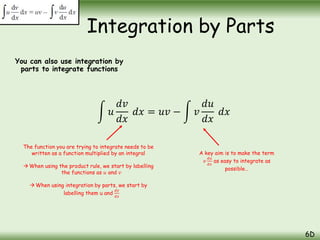
You can also use integration by
parts to integrate functions
Lets begin with the product rule,
and rearranging it…
Integration by Parts
6D
𝑑
𝑑𝑥
𝑢𝑣 = 𝑢
𝑑𝑣
𝑑𝑥
+ 𝑣
𝑑𝑢
𝑑𝑥
𝑑
𝑑𝑥
𝑢𝑣 − 𝑣
𝑑𝑢
𝑑𝑥
= 𝑢
𝑑𝑣
𝑑𝑥
𝑑
𝑑𝑥
𝑢𝑣 𝑑𝑥 − 𝑣
𝑑𝑢
𝑑𝑥
𝑑𝑥 = 𝑢
𝑑𝑣
𝑑𝑥
𝑑𝑥
𝑢𝑣 − 𝑣
𝑑𝑢
𝑑𝑥
𝑑𝑥 = 𝑢
𝑑𝑣
𝑑𝑥
𝑑𝑥
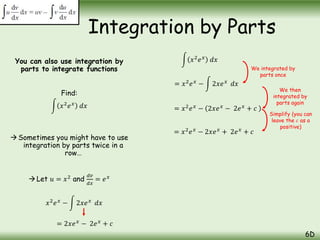
𝑢
𝑑𝑣
𝑑𝑥
𝑑𝑥 = 𝑢𝑣 − 𝑣
𝑑𝑢
𝑑𝑥
𝑑𝑥
Subtract 𝑣
𝑑𝑢
𝑑𝑥
from
both sides
Integrate each term
with respect to x
In the first term, the
integral cancels out the
differential
Rewrite the other
way round
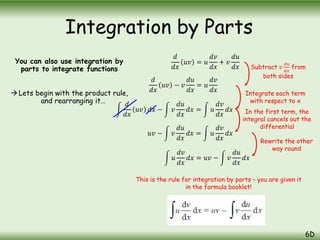
This is the rule for integration by parts – you are given it
in the formula booklet!
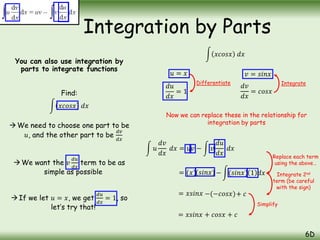
You can also use integration by
parts to integrate functions
Integration by Parts
6D
𝑢
𝑑𝑣
𝑑𝑥
𝑑𝑥 = 𝑢𝑣 − 𝑣
𝑑𝑢
𝑑𝑥
𝑑𝑥
The function you are trying to integrate needs to be
written as a function multiplied by an integral
 When using the product rule, we start by labelling
the functions as 𝑢 and 𝑣
When using integration by parts, we start by
labelling them u and
𝑑𝑣
𝑑𝑥
A key aim is to make the term
𝑣
𝑑𝑢
𝑑𝑥
as easy to integrate as
possible…
You can also use integration by
parts to integrate functions
Find:
𝑥𝑐𝑜𝑠𝑥 𝑑𝑥
We need to choose one part to be
𝑢, and the other part to be
𝑑𝑣
𝑑𝑥
We want the 𝑣
𝑑𝑢
𝑑𝑥
term to be as
simple as possible
If we let 𝑢 = 𝑥, we get
𝑑𝑢
𝑑𝑥
= 1, so
let’s try that!
Integration by Parts
6D
𝑢 = 𝑥
𝑥𝑐𝑜𝑠𝑥 𝑑𝑥
𝑑𝑢
𝑑𝑥
= 1
𝑣 = 𝑠𝑖𝑛𝑥
𝑑𝑣
𝑑𝑥
= 𝑐𝑜𝑠𝑥
Differentiate Integrate
𝑢
𝑑𝑣
𝑑𝑥
𝑑𝑥 = 𝑢𝑣 − 𝑣
𝑑𝑢
𝑑𝑥
𝑑𝑥
= (𝑥) − (𝑠𝑖𝑛𝑥)
= 𝑥𝑠𝑖𝑛𝑥 −(−𝑐𝑜𝑠𝑥)+ 𝑐
= 𝑥𝑠𝑖𝑛𝑥 + 𝑐𝑜𝑠𝑥 + 𝑐
Now we can replace these in the relationship for
integration by parts
Replace each term
using the above…
Integrate 2nd
term (be careful
with the sign)
Simplify
(𝑠𝑖𝑛𝑥) 1 𝑑𝑥
You can also use integration by
parts to integrate functions
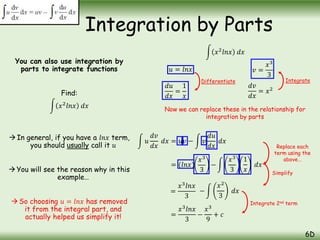
Find:
𝑥2
𝑙𝑛𝑥 𝑑𝑥
In general, if you have a 𝑙𝑛𝑥 term,
you should usually call it 𝑢
You will see the reason why in this
example…
So choosing 𝑢 = 𝑙𝑛𝑥 has removed
it from the integral part, and
actually helped us simplify it!
Integration by Parts
6D
𝑢 = 𝑙𝑛𝑥
𝑥2
𝑙𝑛𝑥 𝑑𝑥
𝑑𝑢
𝑑𝑥
=
1
𝑥
𝑣 =
𝑥3
3
𝑑𝑣
𝑑𝑥
= 𝑥2
Differentiate Integrate
Now we can replace these in the relationship for
integration by parts
𝑢
𝑑𝑣
𝑑𝑥
𝑑𝑥 = 𝑢𝑣 − 𝑣
𝑑𝑢
𝑑𝑥
𝑑𝑥
= (𝑙𝑛𝑥) −
𝑥3
3
=
𝑥3
𝑙𝑛𝑥
3
=
𝑥3
𝑙𝑛𝑥
3
−
𝑥3
9
+ 𝑐
Replace each
term using the
above…
Simplify
Integrate 2nd term
𝑥3
3
1
𝑥
𝑑𝑥
−
𝑥2
3
𝑑𝑥
You can also use integration by
parts to integrate functions
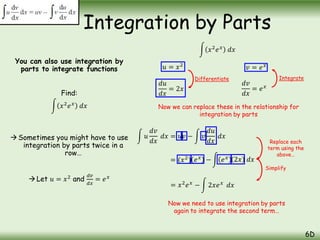
Find:
𝑥2
𝑒𝑥
𝑑𝑥
Sometimes you might have to use
integration by parts twice in a
row…
 Let 𝑢 = 𝑥2
and
𝑑𝑣
𝑑𝑥
= 𝑒𝑥
Integration by Parts
6D
𝑢 = 𝑥2
𝑥2
𝑒𝑥
𝑑𝑥
𝑑𝑢
𝑑𝑥
= 2𝑥
𝑣 = 𝑒𝑥
𝑑𝑣
𝑑𝑥
= 𝑒𝑥
Differentiate Integrate
Now we can replace these in the relationship for
integration by parts
𝑢
𝑑𝑣
𝑑𝑥
𝑑𝑥 = 𝑢𝑣 − 𝑣
𝑑𝑢
𝑑𝑥
𝑑𝑥
= (𝑥2
) − 𝑒𝑥
= 𝑥2
𝑒𝑥
Replace each
term using the
above…
Simplify
Now we need to use integration by parts
again to integrate the second term…
𝑒𝑥 2𝑥 𝑑𝑥
− 2𝑥𝑒𝑥
𝑑𝑥
You can also use integration by
parts to integrate functions
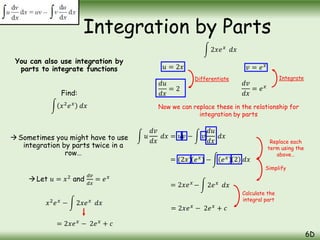
Find:
𝑥2
𝑒𝑥
𝑑𝑥
Sometimes you might have to use
integration by parts twice in a
row…
 Let 𝑢 = 𝑥2
and
𝑑𝑣
𝑑𝑥
= 𝑒𝑥
Integration by Parts
6D
𝑥2
𝑒𝑥
− 2𝑥𝑒𝑥
𝑑𝑥
𝑢 = 2𝑥
2𝑥𝑒𝑥
𝑑𝑥
𝑑𝑢
𝑑𝑥
= 2
𝑣 = 𝑒𝑥
𝑑𝑣
𝑑𝑥
= 𝑒𝑥
Differentiate Integrate
Now we can replace these in the relationship for
integration by parts
𝑢
𝑑𝑣
𝑑𝑥
𝑑𝑥 = 𝑢𝑣 − 𝑣
𝑑𝑢
𝑑𝑥
𝑑𝑥
= (2𝑥) − 𝑒𝑥
= 2𝑥𝑒𝑥
Replace each
term using the
above…
Simplify
𝑒𝑥 2 𝑑𝑥
− 2𝑒𝑥
𝑑𝑥
= 2𝑥𝑒𝑥
− 2𝑒𝑥
+ 𝑐
Calculate the
integral part
= 2𝑥𝑒𝑥
− 2𝑒𝑥
+ 𝑐
You can also use integration by
parts to integrate functions
Find:
𝑥2
𝑒𝑥
𝑑𝑥
Sometimes you might have to use
integration by parts twice in a
row…
 Let 𝑢 = 𝑥2
and
𝑑𝑣
𝑑𝑥
= 𝑒𝑥
Integration by Parts
6D
𝑥2
𝑒𝑥
− 2𝑥𝑒𝑥
𝑑𝑥
= 2𝑥𝑒𝑥
− 2𝑒𝑥
+ 𝑐
𝑥2
𝑒𝑥
𝑑𝑥
= 𝑥2
𝑒𝑥
− 2𝑥𝑒𝑥
− 2𝑒𝑥
+ 𝑐
= 𝑥2
𝑒𝑥
− 2𝑥𝑒𝑥
𝑑𝑥
= 𝑥2
𝑒𝑥
− 2𝑥𝑒𝑥
+ 2𝑒𝑥
+ 𝑐
We integrated by
parts once
We then
integrated by
parts again
Simplify (you can
leave the 𝑐 as a
positive)
𝑥 − 𝑥
1
𝑥
𝑑𝑥
You can also use integration by
parts to integrate functions
Evaluate:
1
2
𝑙𝑛𝑥 𝑑𝑥
Leave your answer in terms of
natural logarithms.
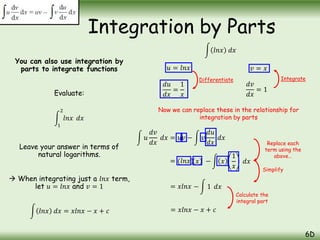
 When integrating just a 𝑙𝑛𝑥 term,
let 𝑢 = 𝑙𝑛𝑥 and 𝑣 = 1
Integration by Parts
6D
𝑢 = 𝑙𝑛𝑥
𝑙𝑛𝑥 𝑑𝑥
𝑑𝑢
𝑑𝑥
=
1
𝑥
𝑣 = 𝑥
𝑑𝑣
𝑑𝑥
= 1
Differentiate Integrate
Now we can replace these in the relationship for
integration by parts
𝑢
𝑑𝑣
𝑑𝑥
𝑑𝑥 = 𝑢𝑣 − 𝑣
𝑑𝑢
𝑑𝑥
𝑑𝑥
= (𝑙𝑛𝑥)
= 𝑥𝑙𝑛𝑥
Replace each
term using the
above…
Simplify
− 1 𝑑𝑥
= 𝑥𝑙𝑛𝑥 − 𝑥 + 𝑐
Calculate the
integral part
𝑙𝑛𝑥 𝑑𝑥 = 𝑥𝑙𝑛𝑥 − 𝑥 + 𝑐
You can also use integration by
parts to integrate functions
Evaluate:
1
2
𝑙𝑛𝑥 𝑑𝑥
Leave your answer in terms of
natural logarithms.
 When integrating just a 𝑙𝑛𝑥 term,
let 𝑢 = 𝑙𝑛𝑥 and 𝑣 = 1
Integration by Parts
6D
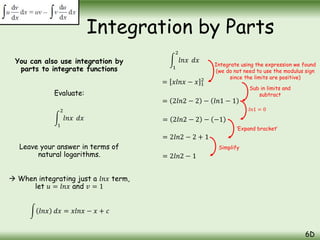
𝑙𝑛𝑥 𝑑𝑥 = 𝑥𝑙𝑛𝑥 − 𝑥 + 𝑐
1
2
𝑙𝑛𝑥 𝑑𝑥
= 𝑥𝑙𝑛𝑥 − 𝑥 1
2
= 2𝑙𝑛2 − 2 − 𝑙𝑛1 − 1
= 2𝑙𝑛2 − 2 + 1
= 2𝑙𝑛2 − 2 − −1
= 2𝑙𝑛2 − 1
Integrate using the expression we found
(we do not need to use the modulus sign
since the limits are positive)
Sub in limits and
subtract
𝑙𝑛1 = 0
‘Expand bracket’
Simplify
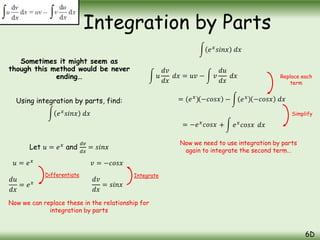
Sometimes it might seem as
though this method would be never
ending…
Using integration by parts, find:
𝑒𝑥
𝑠𝑖𝑛𝑥 𝑑𝑥
Let 𝑢 = 𝑒𝑥
and
𝑑𝑣
𝑑𝑥
= 𝑠𝑖𝑛𝑥
Integration by Parts
6D
𝑒𝑥
𝑠𝑖𝑛𝑥 𝑑𝑥
𝑢
𝑑𝑣
𝑑𝑥
𝑑𝑥 = 𝑢𝑣 − 𝑣
𝑑𝑢
𝑑𝑥
𝑑𝑥
= (𝑒𝑥
) − 𝑒𝑥
= −𝑒𝑥
𝑐𝑜𝑠𝑥
Replace each
term
Simplify
Now we need to use integration by parts
again to integrate the second term…
−𝑐𝑜𝑠𝑥 −𝑐𝑜𝑠𝑥 𝑑𝑥
+ 𝑒𝑥
𝑐𝑜𝑠𝑥 𝑑𝑥
𝑢 = 𝑒𝑥
𝑑𝑢
𝑑𝑥
= 𝑒𝑥
𝑣 = −𝑐𝑜𝑠𝑥
𝑑𝑣
𝑑𝑥
= 𝑠𝑖𝑛𝑥
Differentiate Integrate
Now we can replace these in the relationship for
integration by parts
Integration by Parts
6D
𝑒𝑥
𝑠𝑖𝑛𝑥 𝑑𝑥
𝑢
𝑑𝑣
𝑑𝑥
𝑑𝑥 = 𝑢𝑣 − 𝑣
𝑑𝑢
𝑑𝑥
𝑑𝑥
= (𝑒𝑥
) − 𝑒𝑥
= −𝑒𝑥
𝑐𝑜𝑠𝑥
Replace each
term
Simplify
Now we need to use integration by parts
again to integrate the second term…
−𝑐𝑜𝑠𝑥 −𝑐𝑜𝑠𝑥 𝑑𝑥
+ 𝑒𝑥
𝑐𝑜𝑠𝑥 𝑑𝑥
𝑢 = 𝑒𝑥
𝑑𝑢
𝑑𝑥
= 𝑒𝑥
𝑣 = 𝑠𝑖𝑛𝑥
𝑑𝑣
𝑑𝑥
= 𝑐𝑜𝑠𝑥
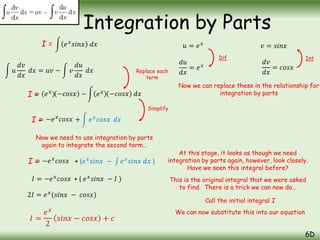
Dif Int
Now we can replace these in the relationship for
integration by parts
= −𝑒𝑥
𝑐𝑜𝑠𝑥 + (𝑒𝑥
𝑠𝑖𝑛𝑥 − 𝑒𝑥
𝑠𝑖𝑛𝑥 𝑑𝑥 )
At this stage, it looks as though we need
integration by parts again, however, look closely.
Have we seen this integral before?
This is the original integral that we were asked
to find. There is a trick we can now do…
Call the initial integral I
I =
I =
I =
I =
We can now substitute this into our equation
𝐼 = −𝑒𝑥
𝑐𝑜𝑠𝑥 + ( 𝑒𝑥
𝑠𝑖𝑛𝑥 − 𝐼 )
2𝐼 = 𝑒𝑥
(𝑠𝑖𝑛𝑥 − 𝑐𝑜𝑠𝑥)
𝐼 =
𝑒𝑥
2
𝑠𝑖𝑛𝑥 − 𝑐𝑜𝑠𝑥 + 𝑐
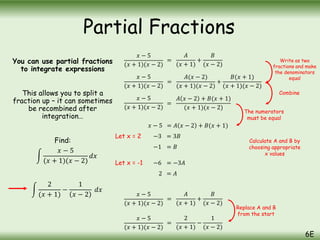
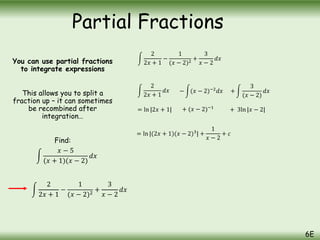
You can use partial fractions
to integrate expressions
This allows you to split a
fraction up – it can sometimes
be recombined after
integration…
Find:
𝑥 − 5
(𝑥 + 1)(𝑥 − 2)
𝑑𝑥
𝑥 − 5
(𝑥 + 1)(𝑥 − 2)
=
𝐴
(𝑥 + 1)
+
𝐵
(𝑥 − 2)
=
𝐴(𝑥 − 2)
(𝑥 + 1)(𝑥 − 2)
+
𝐵(𝑥 + 1)
(𝑥 + 1)(𝑥 − 2)
𝑥 − 5
(𝑥 + 1)(𝑥 − 2)
=
𝐴 𝑥 − 2 + 𝐵(𝑥 + 1)
(𝑥 + 1)(𝑥 − 2)
𝑥 − 5
(𝑥 + 1)(𝑥 − 2)
𝑥 − 5 = 𝐴 𝑥 − 2 + 𝐵(𝑥 + 1)
Let x = 2 −3 = 3𝐵
−1 = 𝐵
Let x = -1 −6 = −3𝐴
2 = 𝐴
𝑥 − 5
(𝑥 + 1)(𝑥 − 2)
=
𝐴
(𝑥 + 1)
+
𝐵
(𝑥 − 2)
𝑥 − 5
(𝑥 + 1)(𝑥 − 2)
=
2
(𝑥 + 1)
−
1
(𝑥 − 2)
Write as two
fractions and make
the denominators
equal
Combine
The numerators
must be equal
Calculate A and B by
choosing appropriate
x values
Replace A and B
from the start
2
(𝑥 + 1)
−
1
𝑥 − 2
𝑑𝑥
Partial Fractions
6E
You can use partial fractions
to integrate expressions
This allows you to split a
fraction up – it can sometimes
be recombined after
integration…
Find:
𝑥 − 5
(𝑥 + 1)(𝑥 − 2)
𝑑𝑥
2
(𝑥 + 1)
−
1
(𝑥 − 2)
𝑑𝑥
2
(𝑥 + 1)
𝑑𝑥
1
(𝑥 − 2)
𝑑𝑥
= 2ln |𝑥 + 1| = ln |𝑥 − 2|
= ln |(𝑥 + 1)2
|
= ln |(𝑥 + 1)2
| − ln 𝑥 − 2 + 𝑐
= ln
𝑥 + 1 2
𝑥 − 2
+ 𝑐
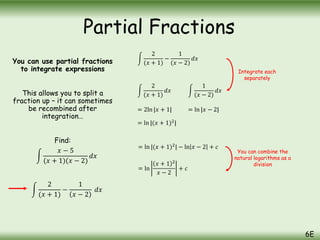
Integrate each
separately
You can combine the
natural logarithms as a
division
Partial Fractions
6E
2
(𝑥 + 1)
−
1
𝑥 − 2
𝑑𝑥
You can use partial fractions
to integrate expressions
This allows you to split a
fraction up – it can sometimes
be recombined after
integration…
Find:
8𝑥2
− 19𝑥 + 1
(2𝑥 + 1)(𝑥 − 2)2
=
𝐴
2𝑥 + 1
+
𝐵
(𝑥 − 2)2
+
𝐶
𝑥 − 2
= 𝐴(𝑥 − 2)2
+ 𝐵 2𝑥 + 1 + 𝐶(2𝑥 + 1)(𝑥 − 2)
Let x = 2 −5 = 5𝐵 𝐵 = −1
Let x = −
1
2
25
2
=
25
4
𝐴 𝐴 = 2
8𝑥2
− 19𝑥 + 1
(2𝑥 + 1)(𝑥 − 2)2
=
2
2𝑥 + 1
−
1
(𝑥 − 2)2
+
3
𝑥 − 2
2
2𝑥 + 1
−
1
(𝑥 − 2)2
+
3
𝑥 − 2
𝑑𝑥
Partial Fractions
6E
8𝑥2
− 19𝑥 + 1
(2𝑥 + 1)(𝑥 − 2)2 𝑑𝑥
8𝑥2 − 19𝑥 + 1
Let x = 0 1 = 4𝐴 + 𝐵 − 2𝐶
𝐶 = 3
1 = 8 − 1 − 2𝐶
You can use partial fractions
to integrate expressions
This allows you to split a
fraction up – it can sometimes
be recombined after
integration…
Find:
𝑥 − 5
(𝑥 + 1)(𝑥 − 2)
𝑑𝑥
2
2𝑥 + 1
−
1
(𝑥 − 2)2
+
3
𝑥 − 2
𝑑𝑥
2
2𝑥 + 1
𝑑𝑥 − (𝑥 − 2)−2
𝑑𝑥
= ln |2𝑥 + 1| + (𝑥 − 2)−1
= ln |(2𝑥 + 1)(𝑥 − 2)3
| +
1
𝑥 − 2
+ 𝑐
Partial Fractions
6E
2
2𝑥 + 1
−
1
(𝑥 − 2)2
+
3
𝑥 − 2
𝑑𝑥
+
3
(𝑥 − 2)
𝑑𝑥
+ 3ln |𝑥 − 2|
You can use partial fractions
to integrate expressions
This allows you to split a
fraction up – it can sometimes
be recombined after
integration…
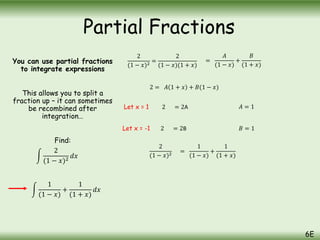
Find:
2
(1 − 𝑥)2
𝑑𝑥
2
(1 − 𝑥)2
=
2
(1 − 𝑥)(1 + 𝑥)
=
𝐴
(1 − 𝑥)
+
𝐵
(1 + 𝑥)
2 = 𝐴 1 + 𝑥 + 𝐵(1 − 𝑥)
Let x = 1 2 = 2A 𝐴 = 1
Let x = -1 2 = 2B 𝐵 = 1
2
(1 − 𝑥)2
=
1
(1 − 𝑥)
+
1
(1 + 𝑥)
1
(1 − 𝑥)
+
1
(1 + 𝑥)
𝑑𝑥
Partial Fractions
6E
You can use partial fractions
to integrate expressions
This allows you to split a
fraction up – it can sometimes
be recombined after
integration…
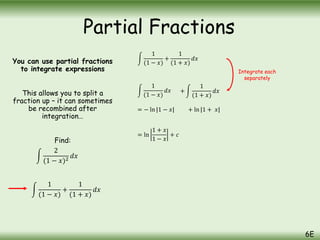
Find:
2
(1 − 𝑥)2
𝑑𝑥
1
(1 − 𝑥)
+
1
(1 + 𝑥)
𝑑𝑥
1
(1 − 𝑥)
𝑑𝑥 +
1
(1 + 𝑥)
𝑑𝑥
= − ln |1 − 𝑥| + ln |1 + 𝑥|
= ln
1 + 𝑥
1 − 𝑥
+ 𝑐
Integrate each
separately
Partial Fractions
6E
1
(1 − 𝑥)
+
1
(1 + 𝑥)
𝑑𝑥
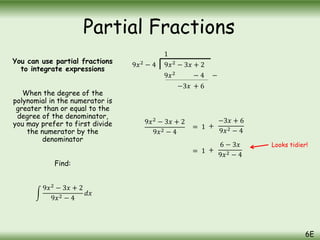
You can use partial fractions
to integrate expressions
When the degree of the
polynomial in the numerator is
greater than or equal to the
degree of the denominator,
you may prefer to first divide
the numerator by the
denominator
Find:
9𝑥2
− 3𝑥 + 2
9𝑥2 − 4
𝑑𝑥
9𝑥2
− 3𝑥 + 2
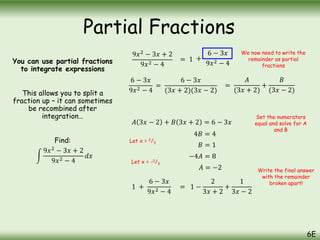
9𝑥2
− 4
1
9𝑥2 − 4 −
−3𝑥 + 6
9𝑥2
− 3𝑥 + 2
9𝑥2 − 4
= 1 +
−3𝑥 + 6
9𝑥2 − 4
= 1 +
6 − 3𝑥
9𝑥2 − 4
Looks tidier!
Partial Fractions
6E
You can use partial fractions
to integrate expressions
This allows you to split a
fraction up – it can sometimes
be recombined after
integration…
Find:
9𝑥2
− 3𝑥 + 2
9𝑥2 − 4
𝑑𝑥
9𝑥2
− 3𝑥 + 2
9𝑥2 − 4
= 1 +
6 − 3𝑥
9𝑥2 − 4
We now need to write the
remainder as partial
fractions
6 − 3𝑥
9𝑥2 − 4
=
6 − 3𝑥
(3𝑥 + 2)(3𝑥 − 2)
=
𝐴
(3𝑥 + 2)
+
𝐵
(3𝑥 − 2)
𝐴 3𝑥 − 2 + 𝐵 3𝑥 + 2 = 6 − 3𝑥
4𝐵 = 4
Let x = 2/3
𝐵 = 1
Let x = -2/3
−4𝐴 = 8
𝐴 = −2
1 +
6 − 3𝑥
9𝑥2 − 4
= 1 −
2
3𝑥 + 2
+
1
3𝑥 − 2
Set the numerators
equal and solve for A
and B
Write the final answer
with the remainder
broken apart!
Partial Fractions
6E
You can use partial fractions
to integrate expressions
This allows you to split a
fraction up – it can sometimes
be recombined after
integration…
Find:
9𝑥2
− 3𝑥 + 2
9𝑥2 − 4
𝑑𝑥
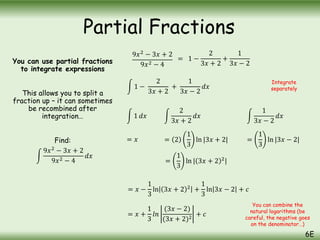
9𝑥2
− 3𝑥 + 2
9𝑥2 − 4
= 1 −
2
3𝑥 + 2
+
1
3𝑥 − 2
1 −
2
3𝑥 + 2
+
1
3𝑥 − 2
𝑑𝑥
1 𝑑𝑥
2
3𝑥 + 2
𝑑𝑥
1
3𝑥 − 2
𝑑𝑥
= 𝑥 = 2
1
3
ln |3𝑥 + 2| =
1
3
ln |3𝑥 − 2|
=
1
3
ln | 3𝑥 + 2 2
|
= 𝑥 −
1
3
ln 3𝑥 + 2 2
+
1
3
ln 3𝑥 − 2 + 𝑐
= 𝑥 +
1
3
𝑙𝑛
(3𝑥 − 2)
(3𝑥 + 2)2
+ 𝑐
Integrate
separately
You can combine the
natural logarithms (be
careful, the negative goes
on the denominator…)
Partial Fractions
6E
You need to be able to form and
solve differential equations, using
a technique called separation of
variables
This often involves having a
differential in terms of both 𝑥
and 𝑦, and reconstructing the
original function
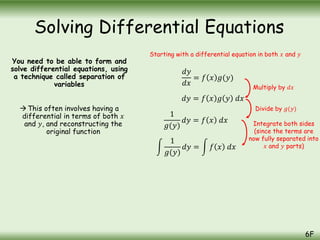
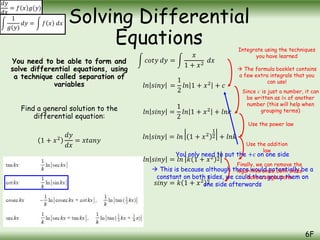
Solving Differential Equations
6F
𝑑𝑦
𝑑𝑥
= 𝑓 𝑥 𝑔(𝑦)
𝑑𝑦 = 𝑓 𝑥 𝑔 𝑦 𝑑𝑥
1
𝑔(𝑦)
𝑑𝑦 = 𝑓 𝑥 𝑑𝑥
1
𝑔(𝑦)
𝑑𝑦 = 𝑓 𝑥 𝑑𝑥
Starting with a differential equation in both 𝑥 and 𝑦
Multiply by 𝑑𝑥
Divide by 𝑔(𝑦)
Integrate both sides
(since the terms are
now fully separated into
𝑥 and 𝑦 parts)
You need to be able to form and
solve differential equations, using
a technique called separation of
variables
Find a general solution to the
differential equation:
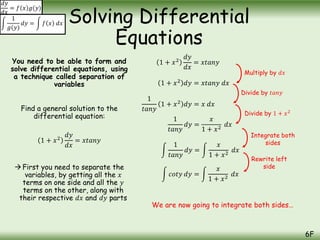
1 + 𝑥2
𝑑𝑦
𝑑𝑥
= 𝑥𝑡𝑎𝑛𝑦
First you need to separate the
variables, by getting all the 𝑥
terms on one side and all the 𝑦
terms on the other, along with
their respective 𝑑𝑥 and 𝑑𝑦 parts
Solving Differential
Equations
6F
𝑑𝑦
𝑑𝑥
= 𝑓 𝑥 𝑔(𝑦)
1
𝑔(𝑦)
𝑑𝑦 = 𝑓 𝑥 𝑑𝑥
1 + 𝑥2
𝑑𝑦
𝑑𝑥
= 𝑥𝑡𝑎𝑛𝑦
1 + 𝑥2
𝑑𝑦 = 𝑥𝑡𝑎𝑛𝑦 𝑑𝑥
1
𝑡𝑎𝑛𝑦
1 + 𝑥2
𝑑𝑦 = 𝑥 𝑑𝑥
1
𝑡𝑎𝑛𝑦
𝑑𝑦 =
𝑥
1 + 𝑥2
𝑑𝑥
1
𝑡𝑎𝑛𝑦
𝑑𝑦 =
𝑥
1 + 𝑥2
𝑑𝑥
𝑐𝑜𝑡𝑦 𝑑𝑦 =
𝑥
1 + 𝑥2
𝑑𝑥
Multiply by 𝑑𝑥
Divide by 𝑡𝑎𝑛𝑦
Divide by 1 + 𝑥2
Integrate both
sides
Rewrite left
side
We are now going to integrate both sides…
You need to be able to form and
solve differential equations, using
a technique called separation of
variables
Find a general solution to the
differential equation:
1 + 𝑥2
𝑑𝑦
𝑑𝑥
= 𝑥𝑡𝑎𝑛𝑦
Solving Differential
Equations
6F
𝑑𝑦
𝑑𝑥
= 𝑓 𝑥 𝑔(𝑦)
1
𝑔(𝑦)
𝑑𝑦 = 𝑓 𝑥 𝑑𝑥
𝑐𝑜𝑡𝑦 𝑑𝑦 =
𝑥
1 + 𝑥2
𝑑𝑥
Integrate using the techniques
you have learned
 The formula booklet contains
a few extra integrals that you
can use!
𝑙𝑛 𝑠𝑖𝑛𝑦 =
1
2
𝑙𝑛 1 + 𝑥2
+ 𝑐
𝑙𝑛 𝑠𝑖𝑛𝑦 =
1
2
𝑙𝑛 1 + 𝑥2
+ 𝑙𝑛𝑘
Since 𝑐 is just a number, it can
be written as 𝑙𝑛 of another
number (this will help when
grouping terms)
𝑙𝑛 𝑠𝑖𝑛𝑦 = 𝑙𝑛 1 + 𝑥2
1
2 + 𝑙𝑛𝑘
𝑙𝑛 𝑠𝑖𝑛𝑦 = 𝑙𝑛 𝑘 1 + 𝑥2
1
2
𝑠𝑖𝑛𝑦 = 𝑘 1 + 𝑥2
1
2
You only need to put the +𝑐 on one side
 This is because although there would potentially be a
constant on both sides, we could then group them on
one side afterwards
Use the power law
Use the addition
law
Finally, we can remove the
logarithm since both sides
have a single term
You need to be able to form and
solve differential equations, using
a technique called separation of
variables
Find a general solution to the
differential equation:
1 + 𝑥2
𝑑𝑦
𝑑𝑥
= 𝑥𝑡𝑎𝑛𝑦
Solving Differential
Equations
6F
𝑑𝑦
𝑑𝑥
= 𝑓 𝑥 𝑔(𝑦)
1
𝑔(𝑦)
𝑑𝑦 = 𝑓 𝑥 𝑑𝑥
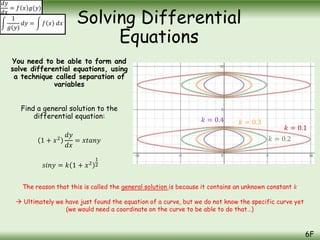
𝑠𝑖𝑛𝑦 = 𝑘 1 + 𝑥2
1
2
The reason that this is called the general solution is because it contains an unknown constant 𝑘
 Ultimately we have just found the equation of a curve, but we do not know the specific curve yet
(we would need a coordinate on the curve to be able to do that…)
𝑘 = 0.1
𝑘 = 0.2
𝑘 = 0.3
𝑘 = 0.4
You need to be able to form and
solve differential equations, using
a technique called separation of
variables
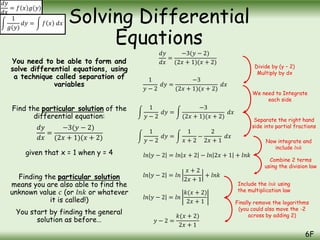
Find the particular solution of the
differential equation:
given that x = 1 when y = 4
Finding the particular solution
means you are also able to find the
unknown value 𝑐 (or 𝑙𝑛𝑘 or whatever
it is called!)
You start by finding the general
solution as before…
Solving Differential
Equations
6F
𝑑𝑦
𝑑𝑥
= 𝑓 𝑥 𝑔(𝑦)
1
𝑔(𝑦)
𝑑𝑦 = 𝑓 𝑥 𝑑𝑥
𝑑𝑦
𝑑𝑥
=
−3(𝑦 − 2)
(2𝑥 + 1)(𝑥 + 2)
𝑑𝑦
𝑑𝑥
=
−3(𝑦 − 2)
(2𝑥 + 1)(𝑥 + 2)
1
𝑦 − 2
𝑑𝑦 =
−3
(2𝑥 + 1)(𝑥 + 2)
𝑑𝑥
1
𝑦 − 2
𝑑𝑦 =
−3
(2𝑥 + 1)(𝑥 + 2)
𝑑𝑥
1
𝑦 − 2
𝑑𝑦 =
1
𝑥 + 2
−
2
2𝑥 + 1
𝑑𝑥
𝑙𝑛 𝑦 − 2 = 𝑙𝑛 𝑥 + 2 − 𝑙𝑛 2𝑥 + 1 + 𝑙𝑛𝑘
𝑙𝑛 𝑦 − 2 = 𝑙𝑛
𝑥 + 2
2𝑥 + 1
+ 𝑙𝑛𝑘
𝑙𝑛 𝑦 − 2 = 𝑙𝑛
𝑘(𝑥 + 2)
2𝑥 + 1
𝑦 − 2 =
𝑘(𝑥 + 2)
2𝑥 + 1
Divide by (y – 2)
Multiply by dx
Separate the right hand
side into partial fractions
We need to Integrate
each side
Now integrate and
include 𝑙𝑛𝑘
Combine 2 terms
using the division law
Include the 𝑙𝑛𝑘 using
the multiplication law
Finally remove the logarithms
(you could also move the -2
across by adding 2)
You need to be able to form and
solve differential equations, using a
technique called separation of
variables
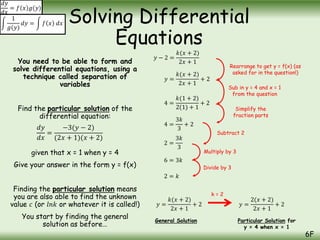
Find the particular solution of the
differential equation:
given that x = 1 when y = 4
Give your answer in the form y = f(x)
Finding the particular solution means
you are also able to find the unknown
value 𝑐 (or 𝑙𝑛𝑘 or whatever it is called!)
You start by finding the general
solution as before…
Solving Differential
Equations
6F
𝑑𝑦
𝑑𝑥
= 𝑓 𝑥 𝑔(𝑦)
1
𝑔(𝑦)
𝑑𝑦 = 𝑓 𝑥 𝑑𝑥
𝑑𝑦
𝑑𝑥
=
−3(𝑦 − 2)
(2𝑥 + 1)(𝑥 + 2)
𝑦 − 2 =
𝑘(𝑥 + 2)
2𝑥 + 1
𝑦 =
𝑘(𝑥 + 2)
2𝑥 + 1
+ 2
4 =
𝑘(1 + 2)
2(1) + 1
+ 2
4 =
3𝑘
3
+ 2
2 =
3𝑘
3
6 = 3𝑘
2 = 𝑘
𝑦 =
𝑘(𝑥 + 2)
2𝑥 + 1
+ 2 𝑦 =
2(𝑥 + 2)
2𝑥 + 1
+ 2
Rearrange to get y = f(x) (as
asked for in the question!)
Sub in y = 4 and x = 1
from the question
Simplify the
fraction parts
Subtract 2
Multiply by 3
Divide by 3
k = 2
General Solution Particular Solution for
y = 4 when x = 1
You need to be able to use
differential equations to model
situations in context
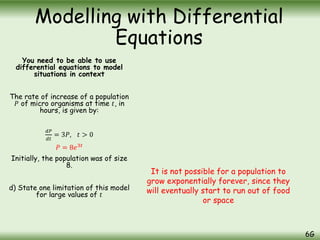
The rate of increase of a population
P of micro organisms at time t, in
hours, is given by:
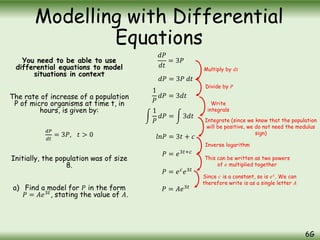
𝑑𝑃
𝑑𝑡
= 3𝑃, 𝑡 > 0
Initially, the population was of size
8.
a) Find a model for 𝑃 in the form
𝑃 = 𝐴𝑒3𝑡
, stating the value of 𝐴.
Modelling with Differential
Equations
6G
𝑑𝑃
𝑑𝑡
= 3𝑃
𝑑𝑃 = 3𝑃 𝑑𝑡
1
𝑃
𝑑𝑃 = 3𝑑𝑡
1
𝑃
𝑑𝑃 = 3𝑑𝑡
𝑙𝑛𝑃 = 3𝑡 + 𝑐
𝑃 = 𝑒3𝑡+𝑐
𝑃 = 𝑒𝑐
𝑒3𝑡
𝑃 = 𝐴𝑒3𝑡
Multiply by 𝑑𝑡
Divide by 𝑃
Write
integrals
Integrate (since we know that the population
will be positive, we do not need the modulus
sign)
Inverse logarithm
This can be written as two powers
of 𝑒 multiplied together
Since 𝑐 is a constant, so is 𝑒𝑐
. We can
therefore write is as a single letter 𝐴
You need to be able to use
differential equations to model
situations in context
The rate of increase of a population
𝑃 of micro organisms at time 𝑡, in
hours, is given by:
𝑑𝑃
𝑑𝑡
= 3𝑃, 𝑡 > 0
Initially, the population was of size
8.
a) Find a model for 𝑃 in the form
𝑃 = 𝐴𝑒3𝑡
, stating the value of 𝐴.
Modelling with Differential
Equations
6G
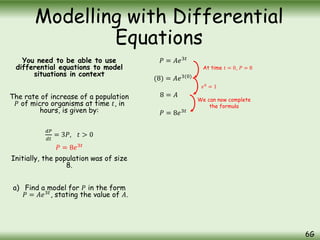
𝑃 = 𝐴𝑒3𝑡
At time 𝑡 = 0, 𝑃 = 8
(8) = 𝐴𝑒3(0)
8 = 𝐴
𝑃 = 8𝑒3𝑡
𝑒0
= 1
We can now complete
the formula
𝑃 = 8𝑒3𝑡
You need to be able to use
differential equations to model
situations in context
The rate of increase of a population
𝑃 of micro organisms at time 𝑡, in
hours, is given by:
𝑑𝑃
𝑑𝑡
= 3𝑃, 𝑡 > 0
Initially, the population was of size
8.
b) Find, to the nearest hundred, the
size of the population at the time
𝑡 = 2
Modelling with Differential
Equations
6G
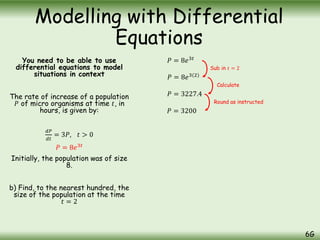
𝑃 = 8𝑒3𝑡
𝑃 = 8𝑒3𝑡
𝑃 = 8𝑒3(2)
𝑃 = 3227.4
𝑃 = 3200
Sub in 𝑡 = 2
Calculate
Round as instructed
You need to be able to use
differential equations to model
situations in context
The rate of increase of a population
𝑃 of micro organisms at time 𝑡, in
hours, is given by:
𝑑𝑃
𝑑𝑡
= 3𝑃, 𝑡 > 0
Initially, the population was of size
8.
c) Find the time at which the
population will be 1000 times its
starting value.
Modelling with Differential
Equations
6G
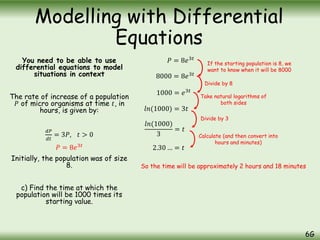
𝑃 = 8𝑒3𝑡
𝑃 = 8𝑒3𝑡
8000 = 8𝑒3𝑡
1000 = 𝑒3𝑡
𝑙𝑛(1000) = 3𝑡
𝑙𝑛(1000)
3
= 𝑡
2.30 … = 𝑡
So the time will be approximately 2 hours and 18 minutes
If the starting population is 8, we
want to know when it will be 8000
Divide by 8
Take natural logarithms of
both sides
Divide by 3
Calculate (and then convert into
hours and minutes)
You need to be able to use
differential equations to model
situations in context
The rate of increase of a population
𝑃 of micro organisms at time 𝑡, in
hours, is given by:
𝑑𝑃
𝑑𝑡
= 3𝑃, 𝑡 > 0
Initially, the population was of size
8.
d) State one limitation of this model
for large values of 𝑡
Modelling with Differential
Equations
6G
𝑃 = 8𝑒3𝑡
It is not possible for a population to
grow exponentially forever, since they
will eventually start to run out of food
or space
You need to be able to use
differential equations to model
situations in context
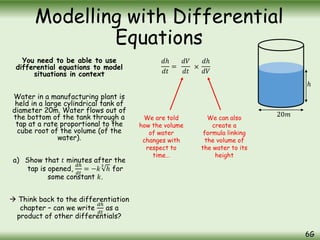
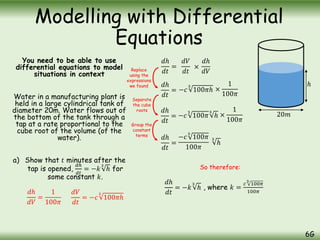
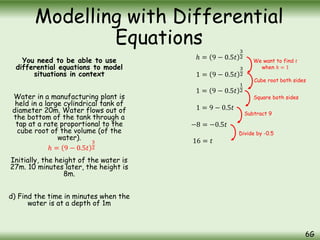
Water in a manufacturing plant is
held in a large cylindrical tank of
diameter 20m. Water flows out of
the bottom of the tank through a
tap at a rate proportional to the
cube root of the volume (of the
water).
a) Show that 𝑡 minutes after the
tap is opened,
𝑑ℎ
𝑑𝑡
= −𝑘
3
ℎ for
some constant 𝑘.
 Think back to the differentiation
chapter – can we write
𝑑ℎ
𝑑𝑡
as a
product of other differentials?
Modelling with Differential
Equations
6G
20𝑚
𝑑ℎ
𝑑𝑡
=
𝑑𝑉
𝑑𝑡
×
𝑑ℎ
𝑑𝑉
We are told
how the volume
of water
changes with
respect to
time…
We can also
create a
formula linking
the volume of
the water to its
height
ℎ
You need to be able to use
differential equations to model
situations in context
Water in a manufacturing plant is
held in a large cylindrical tank of
diameter 20m. Water flows out of
the bottom of the tank through a
tap at a rate proportional to the
cube root of the volume (of the
water).
a) Show that 𝑡 minutes after the
tap is opened,
𝑑ℎ
𝑑𝑡
= −𝑘
3
ℎ for
some constant 𝑘.
Modelling with Differential
Equations
6G
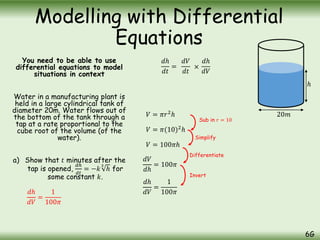
20𝑚
ℎ
𝑉 = 𝜋𝑟2
ℎ
𝑉 = 𝜋(10)2
ℎ
𝑉 = 100𝜋ℎ
𝑑𝑉
𝑑ℎ
= 100𝜋
𝑑ℎ
𝑑𝑉
=
1
100𝜋
Sub in 𝑟 = 10
Simplify
Differentiate
Invert
𝑑ℎ
𝑑𝑉
=
1
100𝜋
𝑑ℎ
𝑑𝑡
=
𝑑𝑉
𝑑𝑡
×
𝑑ℎ
𝑑𝑉
You need to be able to use
differential equations to model
situations in context
Water in a manufacturing plant is
held in a large cylindrical tank of
diameter 20m. Water flows out of
the bottom of the tank through a
tap at a rate proportional to the
cube root of the volume (of the
water).
a) Show that 𝑡 minutes after the
tap is opened,
𝑑ℎ
𝑑𝑡
= −𝑘
3
ℎ for
some constant 𝑘.
Modelling with Differential
Equations
6G
20𝑚
ℎ
𝑑ℎ
𝑑𝑉
=
1
100𝜋
𝑑𝑉
𝑑𝑡
=
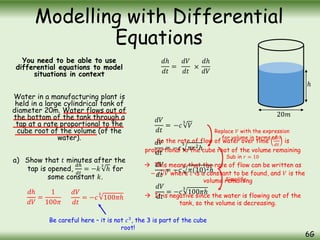
So the rate of flow of water over time
𝑑𝑉
𝑑𝑡
is
proportional to the cube root of the volume remaining
 This means that the rate of flow can be written as
− 𝑐
3
𝑉 where 𝑐 is a constant to be found, and 𝑉 is the
volume remaining
 It is negative since the water is flowing out of the
tank, so the volume is decreasing.
−𝑐
3
𝑉
𝑑𝑉
𝑑𝑡
= −𝑐
3
𝜋𝑟2ℎ
𝑑𝑉
𝑑𝑡
= −𝑐
3
𝜋(10)2ℎ
𝑑𝑉
𝑑𝑡
= −𝑐
3
100𝜋ℎ
Replace 𝑉 with the expression
for volume in terms of ℎ
𝑑𝑉
𝑑𝑡
= −𝑐
3
100𝜋ℎ
Sub in 𝑟 = 10
Simplify
Be careful here – it is not 𝑐3
, the 3 is part of the cube
root!
𝑑ℎ
𝑑𝑡
=
𝑑𝑉
𝑑𝑡
×
𝑑ℎ
𝑑𝑉
You need to be able to use
differential equations to model
situations in context
Water in a manufacturing plant is
held in a large cylindrical tank of
diameter 20m. Water flows out of
the bottom of the tank through a
tap at a rate proportional to the
cube root of the volume (of the
water).
a) Show that 𝑡 minutes after the
tap is opened,
𝑑ℎ
𝑑𝑡
= −𝑘
3
ℎ for
some constant 𝑘.
Modelling with Differential
Equations
6G
20𝑚
ℎ
𝑑ℎ
𝑑𝑉
=
1
100𝜋
𝑑𝑉
𝑑𝑡
= −𝑐
3
100𝜋ℎ
𝑑ℎ
𝑑𝑡
= −𝑐
3
100𝜋ℎ ×
1
100𝜋
𝑑ℎ
𝑑𝑡
= −𝑐
3
100𝜋
3
ℎ ×
1
100𝜋
𝑑ℎ
𝑑𝑡
=
−𝑐
3
100𝜋
100𝜋
3
ℎ
𝑑ℎ
𝑑𝑡
=
𝑑𝑉
𝑑𝑡
×
𝑑ℎ
𝑑𝑉
𝑑ℎ
𝑑𝑡
= −𝑘
3
ℎ , where 𝑘 =
𝑐
3
100𝜋
100𝜋
Replace
using the
expressions
we found
Separate
the cube
roots
Group the
constant
terms
So therefore:
You need to be able to use
differential equations to model
situations in context
Water in a manufacturing plant is
held in a large cylindrical tank of
diameter 20m. Water flows out of
the bottom of the tank through a
tap at a rate proportional to the
cube root of the volume (of the
water).
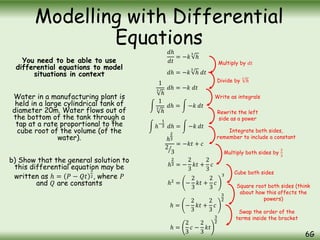
b) Show that the general solution to
this differential equation may be
written as ℎ = 𝑃 − 𝑄𝑡
3
2, where 𝑃
and 𝑄 are constants
Modelling with Differential
Equations
6G
𝑑ℎ
𝑑𝑡
= −𝑘
3
ℎ
𝑑ℎ = −𝑘
3
ℎ 𝑑𝑡
1
3
ℎ
𝑑ℎ = −𝑘 𝑑𝑡
1
3
ℎ
𝑑ℎ = −𝑘 𝑑𝑡
ℎ−
1
3 𝑑ℎ = −𝑘 𝑑𝑡
ℎ
2
3
2
3
= −𝑘𝑡 + 𝑐
ℎ
2
3 = −
2
3
𝑘𝑡 +
2
3
𝑐
ℎ2
= −
2
3
𝑘𝑡 +
2
3
𝑐
3
ℎ = −
2
3
𝑘𝑡 +
2
3
𝑐
3
2
Multiply by 𝑑𝑡
Divide by
3
ℎ
Write as integrals
Rewrite the left
side as a power
Integrate both sides,
remember to include a constant
Multiply both sides by
2
3
ℎ =
2
3
𝑐 −
2
3
𝑘𝑡
3
2
Cube both sides
Square root both sides (think
about how this affects the
powers)
Swap the order of the
terms inside the bracket
You need to be able to use
differential equations to model
situations in context
Water in a manufacturing plant is
held in a large cylindrical tank of
diameter 20m. Water flows out of
the bottom of the tank through a
tap at a rate proportional to the
cube root of the volume (of the
water).
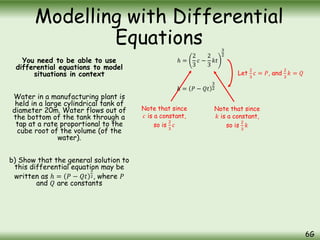
b) Show that the general solution to
this differential equation may be
written as ℎ = 𝑃 − 𝑄𝑡
3
2, where 𝑃
and 𝑄 are constants
Modelling with Differential
Equations
6G
ℎ =
2
3
𝑐 −
2
3
𝑘𝑡
3
2
Note that since
𝑐 is a constant,
so is
2
3
𝑐
Note that since
𝑘 is a constant,
so is
2
3
𝑘
ℎ = 𝑃 − 𝑄𝑡
3
2
Let
2
3
𝑐 = 𝑃, and
2
3
𝑘 = 𝑄
You need to be able to use
differential equations to model
situations in context
Water in a manufacturing plant is
held in a large cylindrical tank of
diameter 20m. Water flows out of
the bottom of the tank through a
tap at a rate proportional to the
cube root of the volume (of the
water).
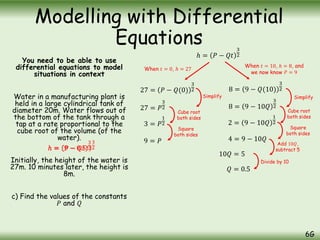
Initially, the height of the water is
27m. 10 minutes later, the height is
8m.
c) Find the values of the constants
𝑃 and 𝑄
Modelling with Differential
Equations
6G
ℎ = 𝑃 − 𝑄𝑡
3
2
ℎ = 𝑃 − 𝑄𝑡
3
2
When 𝑡 = 0, ℎ = 27
When 𝑡 = 10, ℎ = 8, and
we now know 𝑃 = 9
27 = 𝑃 − 𝑄(0)
3
2
27 = 𝑃
3
2
3 = 𝑃
1
2
9 = 𝑃
Simplify
8 = 9 − 𝑄(10)
3
2
8 = 9 − 10𝑄
3
2
2 = 9 − 10𝑄
1
2
4 = 9 − 10𝑄
10𝑄 = 5
𝑄 = 0.5
Simplify
Cube root
both sides
Cube root
both sides
Square
both sides
Square
both sides
Add 10𝑄,
subtract 5
Divide by 10
ℎ = 9 − 0.5𝑡
3
2
You need to be able to use
differential equations to model
situations in context
Water in a manufacturing plant is
held in a large cylindrical tank of
diameter 20m. Water flows out of
the bottom of the tank through a
tap at a rate proportional to the
cube root of the volume (of the
water).
Initially, the height of the water is
27m. 10 minutes later, the height is
8m.
d) Find the time in minutes when the
water is at a depth of 1m
Modelling with Differential
Equations
6G
ℎ = 9 − 0.5𝑡
3
2
ℎ = 9 − 0.5𝑡
3
2
1 = 9 − 0.5𝑡
3
2
1 = 9 − 0.5𝑡
1
2
1 = 9 − 0.5𝑡
−8 = −0.5𝑡
16 = 𝑡
We want to find 𝑡
when ℎ = 1
Cube root both sides
Square both sides
Subtract 9
Divide by -0.5

IAL Edexcel Pure 4 Integration topic 6.pptx

  • 2.
    Prior Knowledge Check 1)Differentiate with respect to 𝑥: a) (2𝑥 − 7)6 b) 𝑠𝑖𝑛5𝑥 c) 𝑒 𝑥 3 2) Given 𝑓 𝑥 = 8𝑥 1 2 − 6𝑥− 1 2 a) Find 𝑓 𝑥 𝑑𝑥 b) Find 4 9 𝑓 𝑥 𝑑𝑥 3) Write 3𝑥+22 4𝑥−1 𝑥+3 as partial fractions. 4) Find the area of the region 𝑅 bounded by the curve 𝑦 = 𝑥2 + 1, the x-axis, and the lines 𝑥 = −1 and 𝑥 = 2. 12(2𝑥 − 7)5 5𝑐𝑜𝑠5𝑥 1 3 𝑒 𝑥 3 16 3 𝑥 3 2 − 12𝑥 1 2 + 𝑐 268 3 7 4𝑥 − 1 − 1 𝑥 + 3 6 units squared
  • 4.
    You need tobe able to find the area under a curve when it is given by Parametric equations The Area under a curve is given by: By the Chain rule: 6A 𝑦 𝑑𝑥 𝑦 𝑑𝑥 𝑑𝑡 𝑑𝑡 Integrate the equation with respect to x y multiplied by dx/dt (x differentiated with respect to t) Integrate the whole expression with respect to t (Remember you don’t have to do anything with the dt at the end!) Finding the area under a curve defined parametrically
  • 5.
    You need tobe able to find the area under a curve when it is given by Parametric equations A curve has Parametric equations: Work out: 𝑦 𝑑𝑥 𝑑𝑡 𝑑𝑡 𝑥 = 5𝑡2 𝑦 = 𝑡3 1 2 𝑦 𝑑𝑥 𝑑𝑡 𝑑𝑡 𝑥 = 5𝑡2 𝑦 = 𝑡3 𝑑𝑥 𝑑𝑡 = 10𝑡 Differentiate 1 2 𝑡3 (10𝑡) 𝑑𝑡 1 2 10𝑡4 𝑑𝑡 1 2 𝑦 𝑑𝑥 𝑑𝑡 𝑑𝑡 = 2𝑡5 1 2 = 10𝑡5 5 1 2 = 2(2)5 − 2(1)5 = 64 − 2 = 62 Sub in y and dx/dt Multiply Remember to Integrate now. A common mistake is forgetting to! Sub in the two limits Work out the answer! 6A Finding the area under a curve defined parametrically
  • 6.
    You need tobe able to find the area under a curve when it is given by Parametric equations The diagram shows a sketch of the curve with Parametric equations: The curve meets the x-axis at x = 0 and x = 9. The shaded region is bounded by the curve and the x-axis. a) Find the value of t when: i) x = 0 ii) x = 9 b) Find the Area of R 𝑦 𝑑𝑥 𝑑𝑡 𝑑𝑡 𝑥 = 𝑡2 𝑦 = 2𝑡(3 − 𝑡) 𝑡 ≥ 0 0 9 R 𝑥 = 𝑡2 0 = 𝑡2 0 = 𝑡 𝑥 = 𝑡2 9 = 𝑡2 ±3 = 𝑡 3 = 𝑡 x = 0 Square root x = 9 Square root t ≥ 0 i) ii) Normally when you integrate to find an area, you use the limits of x, and substitute them into the equation When integrating using Parametric Equations, you need to use the limits of t (since we integrate with respect to t, not x) The limits of t are worked out using the limits of x, as we have just done 6A Finding the area under a curve defined parametrically
  • 7.
    You need tobe able to find the area under a curve when it is given by Parametric equations The diagram shows a sketch of the curve with Parametric equations: The curve meets the x-axis at x = 0 and x = 9. The shaded region is bounded by the curve and the x-axis. a) Find the value of t when: i) x = 0 ii) x = 9 b) Find the Area of R  Limits of t are 3 and 0 𝑦 𝑑𝑥 𝑑𝑡 𝑑𝑡 𝑥 = 𝑡2 𝑦 = 2𝑡(3 − 𝑡) 𝑡 ≥ 0 0 9 R 𝑥 = 𝑡2 𝑦 = 2𝑡(3 − 𝑡) 𝑑𝑥 𝑑𝑡 = 2𝑡 Differentiate 0 3 𝑦 𝑑𝑥 𝑑𝑡 𝑑𝑡 0 3 2𝑡 3 − 𝑡 2𝑡 𝑑𝑡 0 3 12𝑡2 − 4𝑡3 𝑑𝑡 = 12𝑡3 3 − 4𝑡4 4 0 3 = 4𝑡3 − 𝑡4 0 3 = 4(3)3 −(3)4 − 4(0)3 −(0)4 = 108 − 81 = 27 Sub in y and dx/dt Multiply INTEGRATE!! (don’t forget!) Sub in 3 and 0 Work out the answer 6A Finding the area under a curve defined parametrically
  • 8.
    You need tobe able to find the area under a curve when it is given by Parametric equations The diagram shows a sketch of the curve with Parametric equations: Calculate the finite area inside the loop… 𝑦 𝑑𝑥 𝑑𝑡 𝑑𝑡 𝑥 = 2𝑡2 𝑦 = 𝑡(4 − 𝑡2 ) 0 8 We have the x limits, we need the t limits 𝑥 = 2𝑡2 0 = 2𝑡2 0 = 𝑡 𝑥 = 2𝑡2 8 = 2𝑡2 ±2 = 𝑡 x = 0 Halve and square root x = 8 Halve and square root Our t values are 0 and ±2 We have 3 t values. We now have to integrate twice, once using 2 and once using -2  One gives the area above the x-axis, and the other the area below (in this case the areas are equal but only since the graph is symmetrical) 6A Finding the area under a curve defined parametrically
  • 9.
    You need tobe able to find the area under a curve when it is given by Parametric equations The diagram shows a sketch of the curve with Parametric equations: Calculate the finite area inside the loop… 𝑦 𝑑𝑥 𝑑𝑡 𝑑𝑡 The t limits are 0 and ±2 0 2 𝑦 𝑑𝑥 𝑑𝑡 𝑑𝑡 𝑥 = 2𝑡2 𝑦 = 𝑡(4 − 𝑡2 ) 𝑑𝑥 𝑑𝑡 = 4𝑡 0 2 𝑡(4 − 𝑡2) (4𝑡) 𝑑𝑡 0 2 16𝑡2 − 4𝑡4 𝑑𝑡 = 16𝑡3 3 − 4𝑡5 5 0 2 = 16(2)3 3 − 4(2)5 5 − 16(0)3 3 − 4(0)5 5 = 17 1 15 Sub in y and dx/dt Multiply out INTEGRATE!!!! Sub in 2 and 0 Differentiate At this point we can just double the answer, but just to show you the other pairs give the same answer (as the graph was symmetrical) 0 8 6A Finding the area under a curve defined parametrically 𝑥 = 2𝑡2 𝑦 = 𝑡(4 − 𝑡2 )
  • 10.
    You need tobe able to find the area under a curve when it is given by Parametric equations The diagram shows a sketch of the curve with Parametric equations: Calculate the finite area inside the loop… 𝑦 𝑑𝑥 𝑑𝑡 𝑑𝑡 −2 0 𝑦 𝑑𝑥 𝑑𝑡 𝑑𝑡 𝑥 = 2𝑡2 𝑦 = 𝑡(4 − 𝑡2 ) 𝑑𝑥 𝑑𝑡 = 4𝑡 −2 0 𝑡(4 − 𝑡2) (4𝑡) 𝑑𝑡 −2 0 16𝑡2 − 4𝑡4 𝑑𝑡 = 16𝑡3 3 − 4𝑡5 5 −2 0 = 16(0)3 3 − 4(0)5 5 − 16(−2)3 3 − 4(−2)5 5 = 17 1 15 Sub in y and dx/dt Multiply out INTEGRATE!!!! Sub in 0 and -2 Differentiate Here you end up subtracting a negative… = 34 2 15 Double 0 8 6A Finding the area under a curve defined parametrically The t limits are 0 and ±2 𝑥 = 2𝑡2 𝑦 = 𝑡(4 − 𝑡2 )
  • 11.
    You need tobe able to find the area under a curve when it is given by Parametric equations A curve is represented by the Parametric equations: Find the area under the curve from 𝑡 = 𝜋 6 to 𝑡 = 𝜋 4 𝑦 𝑑𝑥 𝑑𝑡 𝑑𝑡 𝜋 6 𝜋 4 𝑦 𝑑𝑥 𝑑𝑡 𝑑𝑡 𝑥 = cos 𝑡 𝑦 = −𝑐𝑜𝑠𝑡 𝑑𝑥 𝑑𝑡 = −𝑠𝑖𝑛𝑡 𝜋 6 𝜋 4 (−𝑐𝑜𝑠𝑡)(−𝑠𝑖𝑛𝑡) 𝑑𝑡 𝜋 6 𝜋 4 𝑠𝑖𝑛𝑡𝑐𝑜𝑠𝑡 𝑑𝑡 = − 1 4 𝑐𝑜𝑠2𝑡 𝜋 6 𝜋 4 = − 1 4 𝑐𝑜𝑠 𝜋 2 − 𝑐𝑜𝑠 𝜋 3 = − 1 4 − 1 2 = 1 8 Sub in y and dx/dt Multiply out INTEGRATE!!!! Sub in 𝜋 6 and 𝜋 6 Differentiate 6A Finding the area under a curve defined parametrically 𝑥 = 𝑐𝑜𝑠𝑡 𝑦 = −𝑐𝑜𝑠𝑡 𝜋 6 𝜋 4 1 2 𝑠𝑖𝑛2𝑡 𝑑𝑡 Use sin2A = 2sinAcosA
  • 13.
    Volumes of Revolution Youcan use Integration to find areas and volumes 6B 𝑦 = 𝑥 x y a b You already know how to find the area under a curve by Integration Imagine we rotated the area shaded around the x-axis  What would be the shape of the solid formed? y x This would be the solid formed In this section you will learn how to find the volume of any solid created in this way. It also involves Integration!
  • 14.
    Volumes of Revolution Youcan use Integration to find areas and volumes 6B x y a b In the trapezium rule we thought of the area under a curve being split into trapezia.  To simplify this explanation, we will use rectangles now instead  The height of each rectangle is y at its x-coordinate  The width of each is dx, the change in x values  So the area beneath the curve is the sum of ydx (base x height)  The EXACT value is calculated by integrating y with respect to x (y dx) y dx y x For the volume of revolution, each rectangle in the area would become a ‘disc’, a cylinder  The radius of each cylinder would be equal to y  The height of each cylinder is dx, the change in x  So the volume of each cylinder would be given by πy2dx  The EXACT value is calculated by integrating y2 with respect to x, then multiplying by π. (πy2 dx) a b y dx
  • 15.
    Volumes of Revolution Youcan use Integration to find areas and volumes The volume of revolution of a solid rotated 2π radians around the x-axis between x = a and x = b is given by: 1) The region R is bounded by the curve y = sin2x, the x-axis and the vertical lines x = 0 and x = π/2. Find the volume of the solid formed when the region is rotated 2π radians about the x-axis. 6B 𝑉𝑜𝑙𝑢𝑚𝑒 = 𝜋 𝑎 𝑏 𝑦2 𝑑𝑥 𝑉𝑜𝑙𝑢𝑚𝑒 = 𝜋 𝑎 𝑏 𝑦2 𝑑𝑥 𝑉𝑜𝑙𝑢𝑚𝑒 = 𝜋 0 𝜋 2 (𝑠𝑖𝑛2𝑥)2 𝑑𝑥 𝑉𝑜𝑙𝑢𝑚𝑒 = 𝜋 0 𝜋 2 𝑠𝑖𝑛2 2𝑥 𝑑𝑥 𝑐𝑜𝑠2𝐴 ≡ 1 − 2𝑠𝑖𝑛2 𝐴 𝑐𝑜𝑠4𝐴 ≡ 1 − 2𝑠𝑖𝑛2 2𝐴 2𝑠𝑖𝑛2 2𝐴 ≡ 1 − 𝑐𝑜𝑠4𝐴 𝑠𝑖𝑛2 2𝐴 ≡ 1 2 (1 − 𝑐𝑜𝑠4𝐴) 𝑉𝑜𝑙𝑢𝑚𝑒 = 𝜋 0 𝜋 2 1 2 (1 − 𝑐𝑜𝑠4𝑥) 𝑑𝑥 𝑉𝑜𝑙𝑢𝑚𝑒 = 1 2 𝜋 0 𝜋 2 (1 − 𝑐𝑜𝑠4𝑥) 𝑑𝑥 𝑉𝑜𝑙𝑢𝑚𝑒 = 1 2 𝜋 𝑥 − 1 4 𝑠𝑖𝑛4𝑥 0 𝜋 2 𝑉𝑜𝑙𝑢𝑚𝑒 = 1 2 𝜋 𝜋 2 − 1 4 𝑠𝑖𝑛2𝜋 − 0 − 1 4 𝑠𝑖𝑛0 𝑉𝑜𝑙𝑢𝑚𝑒 = 𝜋2 4 Sub in a, b and y Square the bracket Using the identity Cos2A = 1 – 2sin2A, replace sin22x with something equivalent The 1/2 can be put outside the integral Integrate and use a square bracket with the limits Sub in the two limits And finally we have the volume!

  • 16.
    Volumes of Revolution Youcan use Integration to find areas and volumes The volume of revolution can also be calculated when x and y are given parametrically. In this case you must also include dx/dt in the integral. You will also need to change limits so they are in terms of t rather than x! 6B 𝑉𝑜𝑙𝑢𝑚𝑒 = 𝜋 𝑎 𝑏 𝑦2 𝑑𝑥 𝑉𝑜𝑙𝑢𝑚𝑒 = 𝜋 𝑎 𝑏 𝑦2 𝑑𝑥 𝑑𝑡 𝑑𝑡
  • 17.
    Volumes of Revolution Youcan use Integration to find areas and volumes The volume of revolution can also be calculated when x and y are given parametrically. In this case you must also include dx/dt in the integral. The curve C has parametric equations: Find the volume of the solid formed when the curve is rotated 2π radians about the x- axis, from t = 2 to t = 4. 6B 𝑉𝑜𝑙𝑢𝑚𝑒 = 𝜋 𝑎 𝑏 𝑦2 𝑑𝑥 𝑑𝑡 𝑑𝑡 𝑉𝑜𝑙𝑢𝑚𝑒 = 𝜋 𝑎 𝑏 𝑦2 𝑑𝑥 𝑥 = 2𝑡 𝑦 = 𝑡2 𝑉𝑜𝑙𝑢𝑚𝑒 = 𝜋 𝑎 𝑏 𝑦2 𝑑𝑥 𝑑𝑡 𝑑𝑡 𝑉𝑜𝑙𝑢𝑚𝑒 = 𝜋 2 4 𝑡2 2 𝑑𝑥 𝑑𝑡 = 2 2𝑑𝑡 𝑉𝑜𝑙𝑢𝑚𝑒 = 2𝜋 𝑎 𝑏 𝑡4 𝑑𝑡 Replace y, and calculate dx/dt Square the bracket and combine them = 2𝜋 1 5 𝑡5 2 4 = 2𝜋 5 1024 − 32 = 1984 5 𝜋 Integrate and write as a square bracket Sub in limits separately Simplify/Calculate
  • 18.
    Volumes of Revolution Youcan use Integration to find areas and volumes The volume of revolution can also be calculated when x and y are given parametrically. In this case you must also include dx/dt in the integral. The curve C has parametric equations: The curve cuts the x-axis at the points A and B. The curve is rotated about the x- axis, between the points A and B. Find the volume generated. 𝑉𝑜𝑙𝑢𝑚𝑒 = 𝜋 𝑎 𝑏 𝑦2 𝑑𝑥 𝑑𝑡 𝑑𝑡 𝑉𝑜𝑙𝑢𝑚𝑒 = 𝜋 𝑎 𝑏 𝑦2 𝑑𝑥 𝑥 = 4𝑡2 − 1 𝑦 = 𝑡2 − 𝑡 𝑉𝑜𝑙𝑢𝑚𝑒 = 𝜋 𝑎 𝑏 𝑦2 𝑑𝑥 𝑑𝑡 𝑑𝑡 𝑉𝑜𝑙𝑢𝑚𝑒 = 𝜋 0 1 𝑡2 − 𝑡 2 𝑑𝑥 𝑑𝑡 = 8𝑡 × 8𝑡 𝑑𝑡 𝑉𝑜𝑙𝑢𝑚𝑒 = 8𝜋 0 1 (𝑡4 −2𝑡3 + 𝑡2 )𝑡 𝑑𝑡 Replace y, and calculate dx/dt Square the bracket and combine them Find where the curve cuts the x- axis 𝑊ℎ𝑒𝑛 𝑦 = 0; 0 = 𝑡2 − 𝑡 0 = 𝑡(𝑡 −1) 𝑡 = 0, 𝑡 = 1 𝑉𝑜𝑙𝑢𝑚𝑒 = 8𝜋 0 1 (𝑡5 −2𝑡4 + 𝑡3 ) 𝑑𝑡 = 8𝜋 1 6 𝑡6 − 2 5 𝑡5 + 1 4 𝑡4 0 1 = 8𝜋 1 6 − 2 5 + 1 4 Integrate and write as a square bracket Sub in limits separately = 2 15 𝜋
  • 19.
    Volumes of Revolution Youcan use Integration to find areas and volumes The volume of revolution can also be calculated when x and y are given parametrically. In this case you must also include dx/dt in the integral. The curve C has parametric equations: Where t ≥ 0. The region R is bounded by C, the x-axis and the lines x = 0 and x = 2. Find the volume of the solid formed when R is rotated 2π radians about the x-axis. 6B 𝑉𝑜𝑙𝑢𝑚𝑒 = 𝜋 𝑎 𝑏 𝑦2 𝑑𝑥 𝑑𝑡 𝑑𝑡 𝑉𝑜𝑙𝑢𝑚𝑒 = 𝜋 𝑎 𝑏 𝑦2 𝑑𝑥 𝑥 = 𝑡(1 + 𝑡) 𝑦 = 1 1 + 𝑡 𝑉𝑜𝑙𝑢𝑚𝑒 = 𝜋 𝑎 𝑏 𝑦2 𝑑𝑥 𝑑𝑡 𝑑𝑡 𝑉𝑜𝑙𝑢𝑚𝑒 = 𝜋 𝑎 𝑏 1 1 + 𝑡 2 𝑥 = 𝑡 + 𝑡2 𝑑𝑥 𝑑𝑡 = 1 + 2𝑡 1 + 2𝑡 𝑑𝑡 𝑉𝑜𝑙𝑢𝑚𝑒 = 𝜋 𝑎 𝑏 1 + 2𝑡 (1 + 𝑡)2 𝑑𝑡 1 + 2𝑡 (1 + 𝑡)2 ≡ 𝐴 (1 + 𝑡)2 + 𝐵 1 + 𝑡 𝐴 + 𝐵(1 + 𝑡) (1 + 𝑡)2 1 + 2𝑡 = 𝐴 + 𝐵(1 + 𝑡) −1 = 𝐴 t = -1 t = 0 1 = 𝐴 + 𝐵 2 = 𝐵 We know A = -1 from before Replace y, and calculate dx/dt Square the bracket and combine them We need to use partial fractions here Combine with a common denominator Sub in values to find A and B 1 + 2𝑡 (1 + 𝑡)2 ≡ −1 (1 + 𝑡)2 + 2 1 + 𝑡 1 + 2𝑡 (1 + 𝑡)2 ≡ − 1 (1 + 𝑡)2 2 1 + 𝑡
  • 20.
    Volumes of Revolution Youcan use Integration to find areas and volumes The volume of revolution can also be calculated when x and y are given parametrically. In this case you must also include dx/dt in the integral. The curve C has parametric equations: Where t ≥ 0. The region R is bounded by C, the x-axis and the lines x = 0 and x = 2. Find the volume of the solid formed when R is rotated 2π radians about the x-axis. 6B 𝑉𝑜𝑙𝑢𝑚𝑒 = 𝜋 𝑎 𝑏 𝑦2 𝑑𝑥 𝑑𝑡 𝑑𝑡 𝑉𝑜𝑙𝑢𝑚𝑒 = 𝜋 𝑎 𝑏 𝑦2 𝑑𝑥 𝑥 = 𝑡(1 + 𝑡) 𝑦 = 1 1 + 𝑡 𝑉𝑜𝑙𝑢𝑚𝑒 = 𝜋 𝑎 𝑏 𝑦2 𝑑𝑥 𝑑𝑡 𝑑𝑡 𝑉𝑜𝑙𝑢𝑚𝑒 = 𝜋 𝑎 𝑏 1 1 + 𝑡 2 𝑥 = 𝑡 + 𝑡2 𝑑𝑥 𝑑𝑡 = 1 + 2𝑡 1 + 2𝑡 𝑑𝑡 𝑉𝑜𝑙𝑢𝑚𝑒 = 𝜋 𝑎 𝑏 1 + 2𝑡 (1 + 𝑡)2 𝑑𝑡 Replace y, and calculate dx/dt Square the bracket and combine them We need to use partial fractions here 𝑉𝑜𝑙𝑢𝑚𝑒 = 𝜋 𝑎 𝑏 2 1 + 𝑡 − 1 (1 + 𝑡)2 𝑥 = 𝑡(1 + 𝑡) We also need to calculate the limits for t rather than x, because we are Integrating with respect to t.  Sub in the x limits and solve for t x = 0 0 = 𝑡(1 + 𝑡) 𝑡 = 0 𝑜𝑟 − 1 𝑡 = 0 x = 2 2 = 𝑡(1 + 𝑡) 0 = 𝑡2 + 𝑡 − 2 0 = (𝑡 + 2)(𝑡 − 1) 𝑡 = −2 𝑜𝑟 1 𝑡 = 1
  • 21.
    Volumes of Revolution Youcan use Integration to find areas and volumes The volume of revolution can also be calculated when x and y are given parametrically. In this case you must also include dx/dt in the integral. The curve C has parametric equations: Where t ≥ 0. The region R is bounded by C, the x-axis and the lines x = 0 and x = 2. Find the volume of the solid formed when R is rotated 2π radians about the x-axis. 6B 𝑉𝑜𝑙𝑢𝑚𝑒 = 𝜋 𝑎 𝑏 𝑦2 𝑑𝑥 𝑑𝑡 𝑑𝑡 𝑉𝑜𝑙𝑢𝑚𝑒 = 𝜋 𝑎 𝑏 𝑦2 𝑑𝑥 𝑥 = 𝑡(1 + 𝑡) 𝑦 = 1 1 + 𝑡 𝑉𝑜𝑙𝑢𝑚𝑒 = 𝜋 𝑎 𝑏 𝑦2 𝑑𝑥 𝑑𝑡 𝑑𝑡 𝑉𝑜𝑙𝑢𝑚𝑒 = 𝜋 𝑎 𝑏 1 1 + 𝑡 2 𝑥 = 𝑡 + 𝑡2 𝑑𝑥 𝑑𝑡 = 1 + 2𝑡 1 + 2𝑡 𝑑𝑡 𝑉𝑜𝑙𝑢𝑚𝑒 = 𝜋 𝑎 𝑏 1 + 2𝑡 (1 + 𝑡)2 𝑑𝑡 Replace y, and calculate dx/dt Square the bracket and combine them We need to use partial fractions here 𝑉𝑜𝑙𝑢𝑚𝑒 = 𝜋 𝑎 𝑏 2 1 + 𝑡 − 1 1 + 𝑡 2 𝑑𝑡 Use t-limits 𝑉𝑜𝑙𝑢𝑚𝑒 = 𝜋 0 1 2 1+𝑡 − 1 (1+𝑡)2 𝑑𝑡
  • 22.
    Volumes of Revolution Youcan use Integration to find areas and volumes The volume of revolution can also be calculated when x and y are given parametrically. In this case you must also include dx/dt in the integral. The curve C has parametric equations: Where t ≥ 0. The region R is bounded by C, the x-axis and the lines x = 0 and x = 2. Find the volume of the solid formed when R is rotated 2π radians about the x-axis. 6B 𝑉𝑜𝑙𝑢𝑚𝑒 = 𝜋 𝑎 𝑏 𝑦2 𝑑𝑥 𝑑𝑡 𝑑𝑡 𝑉𝑜𝑙𝑢𝑚𝑒 = 𝜋 𝑎 𝑏 𝑦2 𝑑𝑥 𝑥 = 𝑡(1 + 𝑡) 𝑦 = 1 1 + 𝑡 𝑥 = 𝑡 + 𝑡2 𝑑𝑥 𝑑𝑡 = 1 + 2𝑡 𝑉𝑜𝑙𝑢𝑚𝑒 = 𝜋 0 1 2 1 + 𝑡 − 1 (1 + 𝑡)2 𝑑𝑡 = 𝜋 2 ln 1 + 𝑡 + 1 1 + 𝑡 0 1 = 𝜋 2𝑙𝑛2 + 1 2 − (2𝑙𝑛1 + 1) = 𝜋 2𝑙𝑛2 − 1 2 Integrate and write as a square bracket Sub in limits separately Simplify/Calculate
  • 24.
    You can usesubstitutions to help integrate more complicated functions (in a similar way to when differentiating…) Find 𝑥 2𝑥 + 5 𝑑𝑥 using the following substitution: 𝑢 = 2𝑥 + 5 You will need to rewrite the integral in terms of 𝑢 only… Integration by Substitution 6C 𝑥 𝑑𝑥 2𝑥 + 5 There are 3 separate parts written in terms of ‘𝑥’  All of these need to replaced with equivalents in 𝑢, based on the substitution we are using… 𝑢 = 2𝑥 + 5 𝑢 − 5 2 = 𝑥 𝑑𝑢 𝑑𝑥 = 2 𝑑𝑢 = 2𝑑𝑥 1 2 𝑑𝑢 = 𝑑𝑥 Subtract 5 and divide by 2 Differentiate Multiply by 𝑑𝑥 Divide by 2 We now have expressions in 𝑢 for all of the 𝑥 terms in the original integral… 𝑥 2𝑥 + 5 𝑑𝑥
  • 25.
    You can usesubstitutions to help integrate more complicated functions (in a similar way to when differentiating…) Find 𝑥 2𝑥 + 5 𝑑𝑥 using the following substitution: 𝑢 = 2𝑥 + 5 Integration by Substitution 6C 𝑥 = 𝑢 − 5 2 1 2 𝑑𝑢 = 𝑑𝑥 = 𝑥 2𝑥 + 5 𝑑𝑥 𝑢 − 5 2 𝑢 1 2 𝑑𝑢 Replace each term in 𝑥 with expressions in 𝑢 = 1 4 𝑢 1 2 𝑢 − 5 𝑑𝑢 = 1 4 𝑢 3 2 − 5 4 𝑢 1 2 𝑑𝑢 = 1 4 𝑢 5 2 5 2 − 5 4 𝑢 3 2 3 2 + 𝑐 Rewrite/simplify Expand the bracket Integrate each term separately = 1 10 𝑢 5 2 − 5 6 𝑢 3 2 + 𝑐 = 1 10 2𝑥 + 5 5 2 − 5 6 2𝑥 + 5 3 2 + 𝑐 Simplify Finally, we can replace all terms with the original substitution that we used!
  • 26.
    You can usesubstitutions to help integrate more complicated functions (in a similar way to when differentiating…) Find 𝑥 2𝑥 + 5 𝑑𝑥 using the following substitution: 𝑢2 = 2𝑥 + 5 You will need to rewrite the integral in terms of 𝑢 only… Integration by Substitution 6C 𝑥 𝑑𝑥 2𝑥 + 5 There are 3 separate parts written in terms of ‘𝑥’  All of these need to replaced with equivalents in 𝑢, based on the substitution we are using… 𝑢2 = 2𝑥 + 5 𝑢2 − 5 2 = 𝑥 2𝑢 𝑑𝑢 𝑑𝑥 = 2 2𝑢 𝑑𝑢 = 2𝑑𝑥 𝑢 𝑑𝑢 = 𝑑𝑥 Subtract 5 and divide by 2 Differentiate Multiply by 𝑑𝑥 Divide by 2 We now have expressions in 𝑢 for all of the 𝑥 terms in the original integral… 𝑥 2𝑥 + 5 𝑑𝑥
  • 27.
    You can usesubstitutions to help integrate more complicated functions (in a similar way to when differentiating…) Find 𝑥 2𝑥 + 5 𝑑𝑥 using the following substitution: 𝑢2 = 2𝑥 + 5 Integration by Substitution 6C 𝑥 = 𝑢2 − 5 2 𝑢 𝑑𝑢 = 𝑑𝑥 = 𝑥 2𝑥 + 5 𝑑𝑥 𝑢2 − 5 2 𝑢2 𝑢 𝑑𝑢 Replace each term in 𝑥 with expressions in 𝑢 = 1 2 𝑢2 𝑢2 − 5 𝑑𝑢 = 1 2 𝑢4 − 5 2 𝑢2 𝑑𝑢 = 1 2 𝑢5 5 − 5 2 𝑢3 3 + 𝑐 Rewrite/simplify Expand the bracket Integrate each term separately = 1 10 𝑢5 − 5 6 𝑢3 + 𝑐 = 1 10 2𝑥 + 5 1 2 5 − 5 6 2𝑥 + 5 1 2 5 + 𝑐 Simplify Finally, we can replace all terms with a substitution for 𝑢 𝑢 = 2𝑥 + 5 1 2 Square root both sides = 1 10 2𝑥 + 5 5 2 − 5 6 2𝑥 + 5 3 2 + 𝑐 Rewrite The answer we got here is exactly the same as using the previous substitution!
  • 28.
    You can usesubstitutions to help integrate more complicated functions (in a similar way to when differentiating…) Use the substitution 𝑢 = 𝑠𝑖𝑛𝑥 + 1 to find: 𝑐𝑜𝑠𝑥𝑠𝑖𝑛𝑥 1 + 𝑠𝑖𝑛𝑥 3 𝑑𝑥  As before, all terms in 𝑥 need to be replaced with equivalent terms in 𝑢… Integration by Substitution 6C 𝑢 = 𝑠𝑖𝑛𝑥 + 1 𝑢 − 1 = 𝑠𝑖𝑛𝑥 𝑑𝑢 𝑑𝑥 = 𝑐𝑜𝑠𝑥 𝑑𝑢 = 𝑐𝑜𝑠𝑥 𝑑𝑥 Subtract 1 Differentiate Multiply by 𝑑𝑥 Notice that this means we can replace the whole 𝑐𝑜𝑠𝑥 𝑑𝑥 terms with just 𝑑𝑢
  • 29.
    You can usesubstitutions to help integrate more complicated functions (in a similar way to when differentiating…) Use the substitution 𝑢 = 𝑠𝑖𝑛𝑥 + 1 to find: 𝑐𝑜𝑠𝑥𝑠𝑖𝑛𝑥 1 + 𝑠𝑖𝑛𝑥 3 𝑑𝑥 Integration by Substitution 6C 𝑢 = 𝑠𝑖𝑛𝑥 + 1 𝑢 − 1 = 𝑠𝑖𝑛𝑥 𝑑𝑢 = 𝑐𝑜𝑠𝑥 𝑑𝑥 𝑐𝑜𝑠𝑥𝑠𝑖𝑛𝑥 1 + 𝑠𝑖𝑛𝑥 3 𝑑𝑥 = 𝑢 − 1 𝑢 3 𝑑𝑢 = 𝑢4 − 𝑢3 𝑑𝑢 = 𝑢5 5 − 𝑢4 4 + 𝑐 Rewrite using the expressions we found Multiply out Integrate Use the original substitution for u… = 𝑠𝑖𝑛𝑥 + 1 5 5 − 𝑠𝑖𝑛𝑥 + 1 4 4 + 𝑐
  • 30.
    You can usesubstitutions to help integrate more complicated functions (in a similar way to when differentiating…) Prove that: 1 1 − 𝑥2 𝑑𝑥 = 𝑎𝑟𝑐𝑠𝑖𝑛𝑥 + 𝑐 Let 𝑥 = 𝑠𝑖𝑛𝜃 Integration by Substitution 6C 𝑥 = 𝑠𝑖𝑛𝜃 Differentiate 𝑑𝑥 𝑑𝜃 = 𝑐𝑜𝑠𝜃 Multiply by 𝑑𝜃 𝑑𝑥 = 𝑐𝑜𝑠𝜃 𝑑𝜃
  • 31.
    You can usesubstitutions to help integrate more complicated functions (in a similar way to when differentiating…) Prove that: 1 1 − 𝑥2 𝑑𝑥 = 𝑎𝑟𝑐𝑠𝑖𝑛𝑥 + 𝑐 Let 𝑥 = 𝑠𝑖𝑛𝜃 Integration by Substitution 6C 𝑑𝑥 = 𝑐𝑜𝑠𝜃 𝑑𝜃 1 1 − 𝑥2 𝑑𝑥 = 1 1 − 𝑠𝑖𝑛2𝜃 𝑐𝑜𝑠𝜃 𝑑𝜃 = 1 𝑐𝑜𝑠2𝜃 𝑐𝑜𝑠𝜃 𝑑𝜃 = 1 𝑐𝑜𝑠𝜃 𝑐𝑜𝑠𝜃 𝑑𝜃 = 1 𝑑𝜃 = 𝜃 + 𝑐 𝑎𝑟𝑐𝑠𝑖𝑛𝑥 = 𝜃 = 𝑎𝑟𝑐𝑠𝑖𝑛𝑥 + 𝑐 Replace the 𝑥 terms with expressions in 𝜃 Use an identity to replace 1 − 𝑠𝑖𝑛2 𝜃 Simplify the denominator Simplify Integrate Replace 𝜃 with an expression in 𝑥 Inverse sine
  • 32.
    You can usesubstitutions to help integrate more complicated functions (in a similar way to when differentiating…) Use integration by substitution to evaluate: 0 2 𝑥(𝑥 + 1)3 𝑑𝑥  If you are not given a substitution to use, you should choose one that simplifies the most complicated part of the function Integration by Substitution 6C 𝑢 = 𝑥 + 1 𝑢 − 1 = 𝑥 𝑑𝑢 𝑑𝑥 = 1 𝑑𝑢 = 𝑑𝑥 Subtract 1 Differentiate Multiply by 𝑑𝑥
  • 33.
    You can usesubstitutions to help integrate more complicated functions (in a similar way to when differentiating…) Use integration by substitution to evaluate: 0 2 𝑥(𝑥 + 1)3 𝑑𝑥 Integration by Substitution 6C 𝑢 = 𝑥 + 1 𝑢 − 1 = 𝑥 𝑑𝑢 = 𝑑𝑥 Something extra we need to do here is replace the limits  The original limits of 2 and 0 were the limits for 𝑥  With the substitution, we should find the limits of 𝑢 instead  We can do this using the substitution we chose before… 𝑢 = 𝑥 + 1 When 𝑥 = 2 When 𝑥 = 0 𝑢 = 3 𝑢 = 1 So when we do the substitution, we also need to replace the limits with 3 and 1… Limits of 3 and 1
  • 34.
    You can usesubstitutions to help integrate more complicated functions (in a similar way to when differentiating…) Use integration by substitution to evaluate: 0 2 𝑥(𝑥 + 1)3 𝑑𝑥 Integration by Substitution 6C 𝑢 = 𝑥 + 1 𝑢 − 1 = 𝑥 𝑑𝑢 = 𝑑𝑥 0 2 𝑥(𝑥 + 1)3 𝑑𝑥 = 1 3 (𝑢 − 1) 𝑢 3 𝑑𝑢 = 1 3 𝑢4 − 𝑢3 𝑑𝑢 = 𝑢5 5 − 𝑢4 4 1 3 = (3)5 5 − (3)4 4 − (1)5 5 − (1)4 4 Limits of 3 and 1 = 28.4 Replace all 𝑥 terms, and the limits, with the information based on the substitution Multiply out the bracket Integrate Sub in limits and subtract Calculate Note that because we adjusted the limits, we did not have to then replace 𝑢 with 𝑥 terms again, as in the previous examples  You could replace the 𝑢 terms and then use the 𝑥 limits, and you would get the same answer!
  • 35.
    You can usesubstitutions to help integrate more complicated functions (in a similar way to when differentiating…) Use integration by substitution to evaluate: 0 𝜋 2 𝑐𝑜𝑠𝑥 1 + 𝑠𝑖𝑛𝑥 𝑑𝑥  If you are not given a substitution to use, you should choose one that simplifies the most complicated part of the function Integration by Substitution 6C 𝑢 = 1 + 𝑠𝑖𝑛𝑥 𝑢 − 1 = 𝑠𝑖𝑛𝑥 𝑑𝑢 𝑑𝑥 = 𝑐𝑜𝑠𝑥 𝑑𝑢 = 𝑐𝑜𝑠𝑥 𝑑𝑥 Subtract 1 Differentiate Multiply by 𝑑𝑥 Notice that this means we can replace the whole 𝑐𝑜𝑠𝑥 𝑑𝑥 terms with just 𝑑𝑢
  • 36.
    You can usesubstitutions to help integrate more complicated functions (in a similar way to when differentiating…) Use integration by substitution to evaluate: 0 𝜋 2 𝑐𝑜𝑠𝑥 1 + 𝑠𝑖𝑛𝑥 𝑑𝑥 Integration by Substitution 6C 𝑢 = 1 + 𝑠𝑖𝑛𝑥 𝑢 − 1 = 𝑠𝑖𝑛𝑥 𝑑𝑢 = 𝑐𝑜𝑠𝑥 𝑑𝑥 𝑢 = 1 + 𝑠𝑖𝑛𝑥 When 𝑥 = 𝜋 2 When 𝑥 = 0 𝑢 = 2 𝑢 = 1 So when we do the substitution, we also need to replace the limits with 2 and 1… We also need to adjust the limits… Limits of 2 and 1
  • 37.
    You can usesubstitutions to help integrate more complicated functions (in a similar way to when differentiating…) Use integration by substitution to evaluate: 0 𝜋 2 𝑐𝑜𝑠𝑥 1 + 𝑠𝑖𝑛𝑥 𝑑𝑥 Integration by Substitution 6C 𝑢 = 1 + 𝑠𝑖𝑛𝑥 𝑢 − 1 = 𝑠𝑖𝑛𝑥 𝑑𝑢 = 𝑐𝑜𝑠𝑥 𝑑𝑥 Limits of 2 and 1 0 𝜋 2 𝑐𝑜𝑠𝑥 1 + 𝑠𝑖𝑛𝑥 𝑑𝑥 = 1 2 𝑢 𝑑𝑢 = 1 2 𝑢 1 2 𝑑𝑢 = 𝑢 3 2 3 2 1 2 = 2 3 𝑢 3 2 1 2 = 2 3 (2) 3 2 − 2 3 (1) 3 2 = 2 3 2 2 − 1 Replace terms using the substitutions we worked out Rewrite for integration Integrate and use a square bracket Rewrite Sub in values and subtract Calculate
  • 39.
    You can alsouse integration by parts to integrate functions Lets begin with the product rule, and rearranging it… Integration by Parts 6D 𝑑 𝑑𝑥 𝑢𝑣 = 𝑢 𝑑𝑣 𝑑𝑥 + 𝑣 𝑑𝑢 𝑑𝑥 𝑑 𝑑𝑥 𝑢𝑣 − 𝑣 𝑑𝑢 𝑑𝑥 = 𝑢 𝑑𝑣 𝑑𝑥 𝑑 𝑑𝑥 𝑢𝑣 𝑑𝑥 − 𝑣 𝑑𝑢 𝑑𝑥 𝑑𝑥 = 𝑢 𝑑𝑣 𝑑𝑥 𝑑𝑥 𝑢𝑣 − 𝑣 𝑑𝑢 𝑑𝑥 𝑑𝑥 = 𝑢 𝑑𝑣 𝑑𝑥 𝑑𝑥 𝑢 𝑑𝑣 𝑑𝑥 𝑑𝑥 = 𝑢𝑣 − 𝑣 𝑑𝑢 𝑑𝑥 𝑑𝑥 Subtract 𝑣 𝑑𝑢 𝑑𝑥 from both sides Integrate each term with respect to x In the first term, the integral cancels out the differential Rewrite the other way round This is the rule for integration by parts – you are given it in the formula booklet!
  • 40.
    You can alsouse integration by parts to integrate functions Integration by Parts 6D 𝑢 𝑑𝑣 𝑑𝑥 𝑑𝑥 = 𝑢𝑣 − 𝑣 𝑑𝑢 𝑑𝑥 𝑑𝑥 The function you are trying to integrate needs to be written as a function multiplied by an integral  When using the product rule, we start by labelling the functions as 𝑢 and 𝑣 When using integration by parts, we start by labelling them u and 𝑑𝑣 𝑑𝑥 A key aim is to make the term 𝑣 𝑑𝑢 𝑑𝑥 as easy to integrate as possible…
  • 41.
    You can alsouse integration by parts to integrate functions Find: 𝑥𝑐𝑜𝑠𝑥 𝑑𝑥 We need to choose one part to be 𝑢, and the other part to be 𝑑𝑣 𝑑𝑥 We want the 𝑣 𝑑𝑢 𝑑𝑥 term to be as simple as possible If we let 𝑢 = 𝑥, we get 𝑑𝑢 𝑑𝑥 = 1, so let’s try that! Integration by Parts 6D 𝑢 = 𝑥 𝑥𝑐𝑜𝑠𝑥 𝑑𝑥 𝑑𝑢 𝑑𝑥 = 1 𝑣 = 𝑠𝑖𝑛𝑥 𝑑𝑣 𝑑𝑥 = 𝑐𝑜𝑠𝑥 Differentiate Integrate 𝑢 𝑑𝑣 𝑑𝑥 𝑑𝑥 = 𝑢𝑣 − 𝑣 𝑑𝑢 𝑑𝑥 𝑑𝑥 = (𝑥) − (𝑠𝑖𝑛𝑥) = 𝑥𝑠𝑖𝑛𝑥 −(−𝑐𝑜𝑠𝑥)+ 𝑐 = 𝑥𝑠𝑖𝑛𝑥 + 𝑐𝑜𝑠𝑥 + 𝑐 Now we can replace these in the relationship for integration by parts Replace each term using the above… Integrate 2nd term (be careful with the sign) Simplify (𝑠𝑖𝑛𝑥) 1 𝑑𝑥
  • 42.
    You can alsouse integration by parts to integrate functions Find: 𝑥2 𝑙𝑛𝑥 𝑑𝑥 In general, if you have a 𝑙𝑛𝑥 term, you should usually call it 𝑢 You will see the reason why in this example… So choosing 𝑢 = 𝑙𝑛𝑥 has removed it from the integral part, and actually helped us simplify it! Integration by Parts 6D 𝑢 = 𝑙𝑛𝑥 𝑥2 𝑙𝑛𝑥 𝑑𝑥 𝑑𝑢 𝑑𝑥 = 1 𝑥 𝑣 = 𝑥3 3 𝑑𝑣 𝑑𝑥 = 𝑥2 Differentiate Integrate Now we can replace these in the relationship for integration by parts 𝑢 𝑑𝑣 𝑑𝑥 𝑑𝑥 = 𝑢𝑣 − 𝑣 𝑑𝑢 𝑑𝑥 𝑑𝑥 = (𝑙𝑛𝑥) − 𝑥3 3 = 𝑥3 𝑙𝑛𝑥 3 = 𝑥3 𝑙𝑛𝑥 3 − 𝑥3 9 + 𝑐 Replace each term using the above… Simplify Integrate 2nd term 𝑥3 3 1 𝑥 𝑑𝑥 − 𝑥2 3 𝑑𝑥
  • 43.
    You can alsouse integration by parts to integrate functions Find: 𝑥2 𝑒𝑥 𝑑𝑥 Sometimes you might have to use integration by parts twice in a row…  Let 𝑢 = 𝑥2 and 𝑑𝑣 𝑑𝑥 = 𝑒𝑥 Integration by Parts 6D 𝑢 = 𝑥2 𝑥2 𝑒𝑥 𝑑𝑥 𝑑𝑢 𝑑𝑥 = 2𝑥 𝑣 = 𝑒𝑥 𝑑𝑣 𝑑𝑥 = 𝑒𝑥 Differentiate Integrate Now we can replace these in the relationship for integration by parts 𝑢 𝑑𝑣 𝑑𝑥 𝑑𝑥 = 𝑢𝑣 − 𝑣 𝑑𝑢 𝑑𝑥 𝑑𝑥 = (𝑥2 ) − 𝑒𝑥 = 𝑥2 𝑒𝑥 Replace each term using the above… Simplify Now we need to use integration by parts again to integrate the second term… 𝑒𝑥 2𝑥 𝑑𝑥 − 2𝑥𝑒𝑥 𝑑𝑥
  • 44.
    You can alsouse integration by parts to integrate functions Find: 𝑥2 𝑒𝑥 𝑑𝑥 Sometimes you might have to use integration by parts twice in a row…  Let 𝑢 = 𝑥2 and 𝑑𝑣 𝑑𝑥 = 𝑒𝑥 Integration by Parts 6D 𝑥2 𝑒𝑥 − 2𝑥𝑒𝑥 𝑑𝑥 𝑢 = 2𝑥 2𝑥𝑒𝑥 𝑑𝑥 𝑑𝑢 𝑑𝑥 = 2 𝑣 = 𝑒𝑥 𝑑𝑣 𝑑𝑥 = 𝑒𝑥 Differentiate Integrate Now we can replace these in the relationship for integration by parts 𝑢 𝑑𝑣 𝑑𝑥 𝑑𝑥 = 𝑢𝑣 − 𝑣 𝑑𝑢 𝑑𝑥 𝑑𝑥 = (2𝑥) − 𝑒𝑥 = 2𝑥𝑒𝑥 Replace each term using the above… Simplify 𝑒𝑥 2 𝑑𝑥 − 2𝑒𝑥 𝑑𝑥 = 2𝑥𝑒𝑥 − 2𝑒𝑥 + 𝑐 Calculate the integral part = 2𝑥𝑒𝑥 − 2𝑒𝑥 + 𝑐
  • 45.
    You can alsouse integration by parts to integrate functions Find: 𝑥2 𝑒𝑥 𝑑𝑥 Sometimes you might have to use integration by parts twice in a row…  Let 𝑢 = 𝑥2 and 𝑑𝑣 𝑑𝑥 = 𝑒𝑥 Integration by Parts 6D 𝑥2 𝑒𝑥 − 2𝑥𝑒𝑥 𝑑𝑥 = 2𝑥𝑒𝑥 − 2𝑒𝑥 + 𝑐 𝑥2 𝑒𝑥 𝑑𝑥 = 𝑥2 𝑒𝑥 − 2𝑥𝑒𝑥 − 2𝑒𝑥 + 𝑐 = 𝑥2 𝑒𝑥 − 2𝑥𝑒𝑥 𝑑𝑥 = 𝑥2 𝑒𝑥 − 2𝑥𝑒𝑥 + 2𝑒𝑥 + 𝑐 We integrated by parts once We then integrated by parts again Simplify (you can leave the 𝑐 as a positive)
  • 46.
    𝑥 − 𝑥 1 𝑥 𝑑𝑥 Youcan also use integration by parts to integrate functions Evaluate: 1 2 𝑙𝑛𝑥 𝑑𝑥 Leave your answer in terms of natural logarithms.  When integrating just a 𝑙𝑛𝑥 term, let 𝑢 = 𝑙𝑛𝑥 and 𝑣 = 1 Integration by Parts 6D 𝑢 = 𝑙𝑛𝑥 𝑙𝑛𝑥 𝑑𝑥 𝑑𝑢 𝑑𝑥 = 1 𝑥 𝑣 = 𝑥 𝑑𝑣 𝑑𝑥 = 1 Differentiate Integrate Now we can replace these in the relationship for integration by parts 𝑢 𝑑𝑣 𝑑𝑥 𝑑𝑥 = 𝑢𝑣 − 𝑣 𝑑𝑢 𝑑𝑥 𝑑𝑥 = (𝑙𝑛𝑥) = 𝑥𝑙𝑛𝑥 Replace each term using the above… Simplify − 1 𝑑𝑥 = 𝑥𝑙𝑛𝑥 − 𝑥 + 𝑐 Calculate the integral part 𝑙𝑛𝑥 𝑑𝑥 = 𝑥𝑙𝑛𝑥 − 𝑥 + 𝑐
  • 47.
    You can alsouse integration by parts to integrate functions Evaluate: 1 2 𝑙𝑛𝑥 𝑑𝑥 Leave your answer in terms of natural logarithms.  When integrating just a 𝑙𝑛𝑥 term, let 𝑢 = 𝑙𝑛𝑥 and 𝑣 = 1 Integration by Parts 6D 𝑙𝑛𝑥 𝑑𝑥 = 𝑥𝑙𝑛𝑥 − 𝑥 + 𝑐 1 2 𝑙𝑛𝑥 𝑑𝑥 = 𝑥𝑙𝑛𝑥 − 𝑥 1 2 = 2𝑙𝑛2 − 2 − 𝑙𝑛1 − 1 = 2𝑙𝑛2 − 2 + 1 = 2𝑙𝑛2 − 2 − −1 = 2𝑙𝑛2 − 1 Integrate using the expression we found (we do not need to use the modulus sign since the limits are positive) Sub in limits and subtract 𝑙𝑛1 = 0 ‘Expand bracket’ Simplify
  • 48.
    Sometimes it mightseem as though this method would be never ending… Using integration by parts, find: 𝑒𝑥 𝑠𝑖𝑛𝑥 𝑑𝑥 Let 𝑢 = 𝑒𝑥 and 𝑑𝑣 𝑑𝑥 = 𝑠𝑖𝑛𝑥 Integration by Parts 6D 𝑒𝑥 𝑠𝑖𝑛𝑥 𝑑𝑥 𝑢 𝑑𝑣 𝑑𝑥 𝑑𝑥 = 𝑢𝑣 − 𝑣 𝑑𝑢 𝑑𝑥 𝑑𝑥 = (𝑒𝑥 ) − 𝑒𝑥 = −𝑒𝑥 𝑐𝑜𝑠𝑥 Replace each term Simplify Now we need to use integration by parts again to integrate the second term… −𝑐𝑜𝑠𝑥 −𝑐𝑜𝑠𝑥 𝑑𝑥 + 𝑒𝑥 𝑐𝑜𝑠𝑥 𝑑𝑥 𝑢 = 𝑒𝑥 𝑑𝑢 𝑑𝑥 = 𝑒𝑥 𝑣 = −𝑐𝑜𝑠𝑥 𝑑𝑣 𝑑𝑥 = 𝑠𝑖𝑛𝑥 Differentiate Integrate Now we can replace these in the relationship for integration by parts
  • 49.
    Integration by Parts 6D 𝑒𝑥 𝑠𝑖𝑛𝑥𝑑𝑥 𝑢 𝑑𝑣 𝑑𝑥 𝑑𝑥 = 𝑢𝑣 − 𝑣 𝑑𝑢 𝑑𝑥 𝑑𝑥 = (𝑒𝑥 ) − 𝑒𝑥 = −𝑒𝑥 𝑐𝑜𝑠𝑥 Replace each term Simplify Now we need to use integration by parts again to integrate the second term… −𝑐𝑜𝑠𝑥 −𝑐𝑜𝑠𝑥 𝑑𝑥 + 𝑒𝑥 𝑐𝑜𝑠𝑥 𝑑𝑥 𝑢 = 𝑒𝑥 𝑑𝑢 𝑑𝑥 = 𝑒𝑥 𝑣 = 𝑠𝑖𝑛𝑥 𝑑𝑣 𝑑𝑥 = 𝑐𝑜𝑠𝑥 Dif Int Now we can replace these in the relationship for integration by parts = −𝑒𝑥 𝑐𝑜𝑠𝑥 + (𝑒𝑥 𝑠𝑖𝑛𝑥 − 𝑒𝑥 𝑠𝑖𝑛𝑥 𝑑𝑥 ) At this stage, it looks as though we need integration by parts again, however, look closely. Have we seen this integral before? This is the original integral that we were asked to find. There is a trick we can now do… Call the initial integral I I = I = I = I = We can now substitute this into our equation 𝐼 = −𝑒𝑥 𝑐𝑜𝑠𝑥 + ( 𝑒𝑥 𝑠𝑖𝑛𝑥 − 𝐼 ) 2𝐼 = 𝑒𝑥 (𝑠𝑖𝑛𝑥 − 𝑐𝑜𝑠𝑥) 𝐼 = 𝑒𝑥 2 𝑠𝑖𝑛𝑥 − 𝑐𝑜𝑠𝑥 + 𝑐
  • 51.
    You can usepartial fractions to integrate expressions This allows you to split a fraction up – it can sometimes be recombined after integration… Find: 𝑥 − 5 (𝑥 + 1)(𝑥 − 2) 𝑑𝑥 𝑥 − 5 (𝑥 + 1)(𝑥 − 2) = 𝐴 (𝑥 + 1) + 𝐵 (𝑥 − 2) = 𝐴(𝑥 − 2) (𝑥 + 1)(𝑥 − 2) + 𝐵(𝑥 + 1) (𝑥 + 1)(𝑥 − 2) 𝑥 − 5 (𝑥 + 1)(𝑥 − 2) = 𝐴 𝑥 − 2 + 𝐵(𝑥 + 1) (𝑥 + 1)(𝑥 − 2) 𝑥 − 5 (𝑥 + 1)(𝑥 − 2) 𝑥 − 5 = 𝐴 𝑥 − 2 + 𝐵(𝑥 + 1) Let x = 2 −3 = 3𝐵 −1 = 𝐵 Let x = -1 −6 = −3𝐴 2 = 𝐴 𝑥 − 5 (𝑥 + 1)(𝑥 − 2) = 𝐴 (𝑥 + 1) + 𝐵 (𝑥 − 2) 𝑥 − 5 (𝑥 + 1)(𝑥 − 2) = 2 (𝑥 + 1) − 1 (𝑥 − 2) Write as two fractions and make the denominators equal Combine The numerators must be equal Calculate A and B by choosing appropriate x values Replace A and B from the start 2 (𝑥 + 1) − 1 𝑥 − 2 𝑑𝑥 Partial Fractions 6E
  • 52.
    You can usepartial fractions to integrate expressions This allows you to split a fraction up – it can sometimes be recombined after integration… Find: 𝑥 − 5 (𝑥 + 1)(𝑥 − 2) 𝑑𝑥 2 (𝑥 + 1) − 1 (𝑥 − 2) 𝑑𝑥 2 (𝑥 + 1) 𝑑𝑥 1 (𝑥 − 2) 𝑑𝑥 = 2ln |𝑥 + 1| = ln |𝑥 − 2| = ln |(𝑥 + 1)2 | = ln |(𝑥 + 1)2 | − ln 𝑥 − 2 + 𝑐 = ln 𝑥 + 1 2 𝑥 − 2 + 𝑐 Integrate each separately You can combine the natural logarithms as a division Partial Fractions 6E 2 (𝑥 + 1) − 1 𝑥 − 2 𝑑𝑥
  • 53.
    You can usepartial fractions to integrate expressions This allows you to split a fraction up – it can sometimes be recombined after integration… Find: 8𝑥2 − 19𝑥 + 1 (2𝑥 + 1)(𝑥 − 2)2 = 𝐴 2𝑥 + 1 + 𝐵 (𝑥 − 2)2 + 𝐶 𝑥 − 2 = 𝐴(𝑥 − 2)2 + 𝐵 2𝑥 + 1 + 𝐶(2𝑥 + 1)(𝑥 − 2) Let x = 2 −5 = 5𝐵 𝐵 = −1 Let x = − 1 2 25 2 = 25 4 𝐴 𝐴 = 2 8𝑥2 − 19𝑥 + 1 (2𝑥 + 1)(𝑥 − 2)2 = 2 2𝑥 + 1 − 1 (𝑥 − 2)2 + 3 𝑥 − 2 2 2𝑥 + 1 − 1 (𝑥 − 2)2 + 3 𝑥 − 2 𝑑𝑥 Partial Fractions 6E 8𝑥2 − 19𝑥 + 1 (2𝑥 + 1)(𝑥 − 2)2 𝑑𝑥 8𝑥2 − 19𝑥 + 1 Let x = 0 1 = 4𝐴 + 𝐵 − 2𝐶 𝐶 = 3 1 = 8 − 1 − 2𝐶
  • 54.
    You can usepartial fractions to integrate expressions This allows you to split a fraction up – it can sometimes be recombined after integration… Find: 𝑥 − 5 (𝑥 + 1)(𝑥 − 2) 𝑑𝑥 2 2𝑥 + 1 − 1 (𝑥 − 2)2 + 3 𝑥 − 2 𝑑𝑥 2 2𝑥 + 1 𝑑𝑥 − (𝑥 − 2)−2 𝑑𝑥 = ln |2𝑥 + 1| + (𝑥 − 2)−1 = ln |(2𝑥 + 1)(𝑥 − 2)3 | + 1 𝑥 − 2 + 𝑐 Partial Fractions 6E 2 2𝑥 + 1 − 1 (𝑥 − 2)2 + 3 𝑥 − 2 𝑑𝑥 + 3 (𝑥 − 2) 𝑑𝑥 + 3ln |𝑥 − 2|
  • 55.
    You can usepartial fractions to integrate expressions This allows you to split a fraction up – it can sometimes be recombined after integration… Find: 2 (1 − 𝑥)2 𝑑𝑥 2 (1 − 𝑥)2 = 2 (1 − 𝑥)(1 + 𝑥) = 𝐴 (1 − 𝑥) + 𝐵 (1 + 𝑥) 2 = 𝐴 1 + 𝑥 + 𝐵(1 − 𝑥) Let x = 1 2 = 2A 𝐴 = 1 Let x = -1 2 = 2B 𝐵 = 1 2 (1 − 𝑥)2 = 1 (1 − 𝑥) + 1 (1 + 𝑥) 1 (1 − 𝑥) + 1 (1 + 𝑥) 𝑑𝑥 Partial Fractions 6E
  • 56.
    You can usepartial fractions to integrate expressions This allows you to split a fraction up – it can sometimes be recombined after integration… Find: 2 (1 − 𝑥)2 𝑑𝑥 1 (1 − 𝑥) + 1 (1 + 𝑥) 𝑑𝑥 1 (1 − 𝑥) 𝑑𝑥 + 1 (1 + 𝑥) 𝑑𝑥 = − ln |1 − 𝑥| + ln |1 + 𝑥| = ln 1 + 𝑥 1 − 𝑥 + 𝑐 Integrate each separately Partial Fractions 6E 1 (1 − 𝑥) + 1 (1 + 𝑥) 𝑑𝑥
  • 57.
    You can usepartial fractions to integrate expressions When the degree of the polynomial in the numerator is greater than or equal to the degree of the denominator, you may prefer to first divide the numerator by the denominator Find: 9𝑥2 − 3𝑥 + 2 9𝑥2 − 4 𝑑𝑥 9𝑥2 − 3𝑥 + 2 9𝑥2 − 4 1 9𝑥2 − 4 − −3𝑥 + 6 9𝑥2 − 3𝑥 + 2 9𝑥2 − 4 = 1 + −3𝑥 + 6 9𝑥2 − 4 = 1 + 6 − 3𝑥 9𝑥2 − 4 Looks tidier! Partial Fractions 6E
  • 58.
    You can usepartial fractions to integrate expressions This allows you to split a fraction up – it can sometimes be recombined after integration… Find: 9𝑥2 − 3𝑥 + 2 9𝑥2 − 4 𝑑𝑥 9𝑥2 − 3𝑥 + 2 9𝑥2 − 4 = 1 + 6 − 3𝑥 9𝑥2 − 4 We now need to write the remainder as partial fractions 6 − 3𝑥 9𝑥2 − 4 = 6 − 3𝑥 (3𝑥 + 2)(3𝑥 − 2) = 𝐴 (3𝑥 + 2) + 𝐵 (3𝑥 − 2) 𝐴 3𝑥 − 2 + 𝐵 3𝑥 + 2 = 6 − 3𝑥 4𝐵 = 4 Let x = 2/3 𝐵 = 1 Let x = -2/3 −4𝐴 = 8 𝐴 = −2 1 + 6 − 3𝑥 9𝑥2 − 4 = 1 − 2 3𝑥 + 2 + 1 3𝑥 − 2 Set the numerators equal and solve for A and B Write the final answer with the remainder broken apart! Partial Fractions 6E
  • 59.
    You can usepartial fractions to integrate expressions This allows you to split a fraction up – it can sometimes be recombined after integration… Find: 9𝑥2 − 3𝑥 + 2 9𝑥2 − 4 𝑑𝑥 9𝑥2 − 3𝑥 + 2 9𝑥2 − 4 = 1 − 2 3𝑥 + 2 + 1 3𝑥 − 2 1 − 2 3𝑥 + 2 + 1 3𝑥 − 2 𝑑𝑥 1 𝑑𝑥 2 3𝑥 + 2 𝑑𝑥 1 3𝑥 − 2 𝑑𝑥 = 𝑥 = 2 1 3 ln |3𝑥 + 2| = 1 3 ln |3𝑥 − 2| = 1 3 ln | 3𝑥 + 2 2 | = 𝑥 − 1 3 ln 3𝑥 + 2 2 + 1 3 ln 3𝑥 − 2 + 𝑐 = 𝑥 + 1 3 𝑙𝑛 (3𝑥 − 2) (3𝑥 + 2)2 + 𝑐 Integrate separately You can combine the natural logarithms (be careful, the negative goes on the denominator…) Partial Fractions 6E
  • 61.
    You need tobe able to form and solve differential equations, using a technique called separation of variables This often involves having a differential in terms of both 𝑥 and 𝑦, and reconstructing the original function Solving Differential Equations 6F 𝑑𝑦 𝑑𝑥 = 𝑓 𝑥 𝑔(𝑦) 𝑑𝑦 = 𝑓 𝑥 𝑔 𝑦 𝑑𝑥 1 𝑔(𝑦) 𝑑𝑦 = 𝑓 𝑥 𝑑𝑥 1 𝑔(𝑦) 𝑑𝑦 = 𝑓 𝑥 𝑑𝑥 Starting with a differential equation in both 𝑥 and 𝑦 Multiply by 𝑑𝑥 Divide by 𝑔(𝑦) Integrate both sides (since the terms are now fully separated into 𝑥 and 𝑦 parts)
  • 62.
    You need tobe able to form and solve differential equations, using a technique called separation of variables Find a general solution to the differential equation: 1 + 𝑥2 𝑑𝑦 𝑑𝑥 = 𝑥𝑡𝑎𝑛𝑦 First you need to separate the variables, by getting all the 𝑥 terms on one side and all the 𝑦 terms on the other, along with their respective 𝑑𝑥 and 𝑑𝑦 parts Solving Differential Equations 6F 𝑑𝑦 𝑑𝑥 = 𝑓 𝑥 𝑔(𝑦) 1 𝑔(𝑦) 𝑑𝑦 = 𝑓 𝑥 𝑑𝑥 1 + 𝑥2 𝑑𝑦 𝑑𝑥 = 𝑥𝑡𝑎𝑛𝑦 1 + 𝑥2 𝑑𝑦 = 𝑥𝑡𝑎𝑛𝑦 𝑑𝑥 1 𝑡𝑎𝑛𝑦 1 + 𝑥2 𝑑𝑦 = 𝑥 𝑑𝑥 1 𝑡𝑎𝑛𝑦 𝑑𝑦 = 𝑥 1 + 𝑥2 𝑑𝑥 1 𝑡𝑎𝑛𝑦 𝑑𝑦 = 𝑥 1 + 𝑥2 𝑑𝑥 𝑐𝑜𝑡𝑦 𝑑𝑦 = 𝑥 1 + 𝑥2 𝑑𝑥 Multiply by 𝑑𝑥 Divide by 𝑡𝑎𝑛𝑦 Divide by 1 + 𝑥2 Integrate both sides Rewrite left side We are now going to integrate both sides…
  • 63.
    You need tobe able to form and solve differential equations, using a technique called separation of variables Find a general solution to the differential equation: 1 + 𝑥2 𝑑𝑦 𝑑𝑥 = 𝑥𝑡𝑎𝑛𝑦 Solving Differential Equations 6F 𝑑𝑦 𝑑𝑥 = 𝑓 𝑥 𝑔(𝑦) 1 𝑔(𝑦) 𝑑𝑦 = 𝑓 𝑥 𝑑𝑥 𝑐𝑜𝑡𝑦 𝑑𝑦 = 𝑥 1 + 𝑥2 𝑑𝑥 Integrate using the techniques you have learned  The formula booklet contains a few extra integrals that you can use! 𝑙𝑛 𝑠𝑖𝑛𝑦 = 1 2 𝑙𝑛 1 + 𝑥2 + 𝑐 𝑙𝑛 𝑠𝑖𝑛𝑦 = 1 2 𝑙𝑛 1 + 𝑥2 + 𝑙𝑛𝑘 Since 𝑐 is just a number, it can be written as 𝑙𝑛 of another number (this will help when grouping terms) 𝑙𝑛 𝑠𝑖𝑛𝑦 = 𝑙𝑛 1 + 𝑥2 1 2 + 𝑙𝑛𝑘 𝑙𝑛 𝑠𝑖𝑛𝑦 = 𝑙𝑛 𝑘 1 + 𝑥2 1 2 𝑠𝑖𝑛𝑦 = 𝑘 1 + 𝑥2 1 2 You only need to put the +𝑐 on one side  This is because although there would potentially be a constant on both sides, we could then group them on one side afterwards Use the power law Use the addition law Finally, we can remove the logarithm since both sides have a single term
  • 64.
    You need tobe able to form and solve differential equations, using a technique called separation of variables Find a general solution to the differential equation: 1 + 𝑥2 𝑑𝑦 𝑑𝑥 = 𝑥𝑡𝑎𝑛𝑦 Solving Differential Equations 6F 𝑑𝑦 𝑑𝑥 = 𝑓 𝑥 𝑔(𝑦) 1 𝑔(𝑦) 𝑑𝑦 = 𝑓 𝑥 𝑑𝑥 𝑠𝑖𝑛𝑦 = 𝑘 1 + 𝑥2 1 2 The reason that this is called the general solution is because it contains an unknown constant 𝑘  Ultimately we have just found the equation of a curve, but we do not know the specific curve yet (we would need a coordinate on the curve to be able to do that…) 𝑘 = 0.1 𝑘 = 0.2 𝑘 = 0.3 𝑘 = 0.4
  • 65.
    You need tobe able to form and solve differential equations, using a technique called separation of variables Find the particular solution of the differential equation: given that x = 1 when y = 4 Finding the particular solution means you are also able to find the unknown value 𝑐 (or 𝑙𝑛𝑘 or whatever it is called!) You start by finding the general solution as before… Solving Differential Equations 6F 𝑑𝑦 𝑑𝑥 = 𝑓 𝑥 𝑔(𝑦) 1 𝑔(𝑦) 𝑑𝑦 = 𝑓 𝑥 𝑑𝑥 𝑑𝑦 𝑑𝑥 = −3(𝑦 − 2) (2𝑥 + 1)(𝑥 + 2) 𝑑𝑦 𝑑𝑥 = −3(𝑦 − 2) (2𝑥 + 1)(𝑥 + 2) 1 𝑦 − 2 𝑑𝑦 = −3 (2𝑥 + 1)(𝑥 + 2) 𝑑𝑥 1 𝑦 − 2 𝑑𝑦 = −3 (2𝑥 + 1)(𝑥 + 2) 𝑑𝑥 1 𝑦 − 2 𝑑𝑦 = 1 𝑥 + 2 − 2 2𝑥 + 1 𝑑𝑥 𝑙𝑛 𝑦 − 2 = 𝑙𝑛 𝑥 + 2 − 𝑙𝑛 2𝑥 + 1 + 𝑙𝑛𝑘 𝑙𝑛 𝑦 − 2 = 𝑙𝑛 𝑥 + 2 2𝑥 + 1 + 𝑙𝑛𝑘 𝑙𝑛 𝑦 − 2 = 𝑙𝑛 𝑘(𝑥 + 2) 2𝑥 + 1 𝑦 − 2 = 𝑘(𝑥 + 2) 2𝑥 + 1 Divide by (y – 2) Multiply by dx Separate the right hand side into partial fractions We need to Integrate each side Now integrate and include 𝑙𝑛𝑘 Combine 2 terms using the division law Include the 𝑙𝑛𝑘 using the multiplication law Finally remove the logarithms (you could also move the -2 across by adding 2)
  • 66.
    You need tobe able to form and solve differential equations, using a technique called separation of variables Find the particular solution of the differential equation: given that x = 1 when y = 4 Give your answer in the form y = f(x) Finding the particular solution means you are also able to find the unknown value 𝑐 (or 𝑙𝑛𝑘 or whatever it is called!) You start by finding the general solution as before… Solving Differential Equations 6F 𝑑𝑦 𝑑𝑥 = 𝑓 𝑥 𝑔(𝑦) 1 𝑔(𝑦) 𝑑𝑦 = 𝑓 𝑥 𝑑𝑥 𝑑𝑦 𝑑𝑥 = −3(𝑦 − 2) (2𝑥 + 1)(𝑥 + 2) 𝑦 − 2 = 𝑘(𝑥 + 2) 2𝑥 + 1 𝑦 = 𝑘(𝑥 + 2) 2𝑥 + 1 + 2 4 = 𝑘(1 + 2) 2(1) + 1 + 2 4 = 3𝑘 3 + 2 2 = 3𝑘 3 6 = 3𝑘 2 = 𝑘 𝑦 = 𝑘(𝑥 + 2) 2𝑥 + 1 + 2 𝑦 = 2(𝑥 + 2) 2𝑥 + 1 + 2 Rearrange to get y = f(x) (as asked for in the question!) Sub in y = 4 and x = 1 from the question Simplify the fraction parts Subtract 2 Multiply by 3 Divide by 3 k = 2 General Solution Particular Solution for y = 4 when x = 1
  • 68.
    You need tobe able to use differential equations to model situations in context The rate of increase of a population P of micro organisms at time t, in hours, is given by: 𝑑𝑃 𝑑𝑡 = 3𝑃, 𝑡 > 0 Initially, the population was of size 8. a) Find a model for 𝑃 in the form 𝑃 = 𝐴𝑒3𝑡 , stating the value of 𝐴. Modelling with Differential Equations 6G 𝑑𝑃 𝑑𝑡 = 3𝑃 𝑑𝑃 = 3𝑃 𝑑𝑡 1 𝑃 𝑑𝑃 = 3𝑑𝑡 1 𝑃 𝑑𝑃 = 3𝑑𝑡 𝑙𝑛𝑃 = 3𝑡 + 𝑐 𝑃 = 𝑒3𝑡+𝑐 𝑃 = 𝑒𝑐 𝑒3𝑡 𝑃 = 𝐴𝑒3𝑡 Multiply by 𝑑𝑡 Divide by 𝑃 Write integrals Integrate (since we know that the population will be positive, we do not need the modulus sign) Inverse logarithm This can be written as two powers of 𝑒 multiplied together Since 𝑐 is a constant, so is 𝑒𝑐 . We can therefore write is as a single letter 𝐴
  • 69.
    You need tobe able to use differential equations to model situations in context The rate of increase of a population 𝑃 of micro organisms at time 𝑡, in hours, is given by: 𝑑𝑃 𝑑𝑡 = 3𝑃, 𝑡 > 0 Initially, the population was of size 8. a) Find a model for 𝑃 in the form 𝑃 = 𝐴𝑒3𝑡 , stating the value of 𝐴. Modelling with Differential Equations 6G 𝑃 = 𝐴𝑒3𝑡 At time 𝑡 = 0, 𝑃 = 8 (8) = 𝐴𝑒3(0) 8 = 𝐴 𝑃 = 8𝑒3𝑡 𝑒0 = 1 We can now complete the formula 𝑃 = 8𝑒3𝑡
  • 70.
    You need tobe able to use differential equations to model situations in context The rate of increase of a population 𝑃 of micro organisms at time 𝑡, in hours, is given by: 𝑑𝑃 𝑑𝑡 = 3𝑃, 𝑡 > 0 Initially, the population was of size 8. b) Find, to the nearest hundred, the size of the population at the time 𝑡 = 2 Modelling with Differential Equations 6G 𝑃 = 8𝑒3𝑡 𝑃 = 8𝑒3𝑡 𝑃 = 8𝑒3(2) 𝑃 = 3227.4 𝑃 = 3200 Sub in 𝑡 = 2 Calculate Round as instructed
  • 71.
    You need tobe able to use differential equations to model situations in context The rate of increase of a population 𝑃 of micro organisms at time 𝑡, in hours, is given by: 𝑑𝑃 𝑑𝑡 = 3𝑃, 𝑡 > 0 Initially, the population was of size 8. c) Find the time at which the population will be 1000 times its starting value. Modelling with Differential Equations 6G 𝑃 = 8𝑒3𝑡 𝑃 = 8𝑒3𝑡 8000 = 8𝑒3𝑡 1000 = 𝑒3𝑡 𝑙𝑛(1000) = 3𝑡 𝑙𝑛(1000) 3 = 𝑡 2.30 … = 𝑡 So the time will be approximately 2 hours and 18 minutes If the starting population is 8, we want to know when it will be 8000 Divide by 8 Take natural logarithms of both sides Divide by 3 Calculate (and then convert into hours and minutes)
  • 72.
    You need tobe able to use differential equations to model situations in context The rate of increase of a population 𝑃 of micro organisms at time 𝑡, in hours, is given by: 𝑑𝑃 𝑑𝑡 = 3𝑃, 𝑡 > 0 Initially, the population was of size 8. d) State one limitation of this model for large values of 𝑡 Modelling with Differential Equations 6G 𝑃 = 8𝑒3𝑡 It is not possible for a population to grow exponentially forever, since they will eventually start to run out of food or space
  • 73.
    You need tobe able to use differential equations to model situations in context Water in a manufacturing plant is held in a large cylindrical tank of diameter 20m. Water flows out of the bottom of the tank through a tap at a rate proportional to the cube root of the volume (of the water). a) Show that 𝑡 minutes after the tap is opened, 𝑑ℎ 𝑑𝑡 = −𝑘 3 ℎ for some constant 𝑘.  Think back to the differentiation chapter – can we write 𝑑ℎ 𝑑𝑡 as a product of other differentials? Modelling with Differential Equations 6G 20𝑚 𝑑ℎ 𝑑𝑡 = 𝑑𝑉 𝑑𝑡 × 𝑑ℎ 𝑑𝑉 We are told how the volume of water changes with respect to time… We can also create a formula linking the volume of the water to its height ℎ
  • 74.
    You need tobe able to use differential equations to model situations in context Water in a manufacturing plant is held in a large cylindrical tank of diameter 20m. Water flows out of the bottom of the tank through a tap at a rate proportional to the cube root of the volume (of the water). a) Show that 𝑡 minutes after the tap is opened, 𝑑ℎ 𝑑𝑡 = −𝑘 3 ℎ for some constant 𝑘. Modelling with Differential Equations 6G 20𝑚 ℎ 𝑉 = 𝜋𝑟2 ℎ 𝑉 = 𝜋(10)2 ℎ 𝑉 = 100𝜋ℎ 𝑑𝑉 𝑑ℎ = 100𝜋 𝑑ℎ 𝑑𝑉 = 1 100𝜋 Sub in 𝑟 = 10 Simplify Differentiate Invert 𝑑ℎ 𝑑𝑉 = 1 100𝜋 𝑑ℎ 𝑑𝑡 = 𝑑𝑉 𝑑𝑡 × 𝑑ℎ 𝑑𝑉
  • 75.
    You need tobe able to use differential equations to model situations in context Water in a manufacturing plant is held in a large cylindrical tank of diameter 20m. Water flows out of the bottom of the tank through a tap at a rate proportional to the cube root of the volume (of the water). a) Show that 𝑡 minutes after the tap is opened, 𝑑ℎ 𝑑𝑡 = −𝑘 3 ℎ for some constant 𝑘. Modelling with Differential Equations 6G 20𝑚 ℎ 𝑑ℎ 𝑑𝑉 = 1 100𝜋 𝑑𝑉 𝑑𝑡 = So the rate of flow of water over time 𝑑𝑉 𝑑𝑡 is proportional to the cube root of the volume remaining  This means that the rate of flow can be written as − 𝑐 3 𝑉 where 𝑐 is a constant to be found, and 𝑉 is the volume remaining  It is negative since the water is flowing out of the tank, so the volume is decreasing. −𝑐 3 𝑉 𝑑𝑉 𝑑𝑡 = −𝑐 3 𝜋𝑟2ℎ 𝑑𝑉 𝑑𝑡 = −𝑐 3 𝜋(10)2ℎ 𝑑𝑉 𝑑𝑡 = −𝑐 3 100𝜋ℎ Replace 𝑉 with the expression for volume in terms of ℎ 𝑑𝑉 𝑑𝑡 = −𝑐 3 100𝜋ℎ Sub in 𝑟 = 10 Simplify Be careful here – it is not 𝑐3 , the 3 is part of the cube root! 𝑑ℎ 𝑑𝑡 = 𝑑𝑉 𝑑𝑡 × 𝑑ℎ 𝑑𝑉
  • 76.
    You need tobe able to use differential equations to model situations in context Water in a manufacturing plant is held in a large cylindrical tank of diameter 20m. Water flows out of the bottom of the tank through a tap at a rate proportional to the cube root of the volume (of the water). a) Show that 𝑡 minutes after the tap is opened, 𝑑ℎ 𝑑𝑡 = −𝑘 3 ℎ for some constant 𝑘. Modelling with Differential Equations 6G 20𝑚 ℎ 𝑑ℎ 𝑑𝑉 = 1 100𝜋 𝑑𝑉 𝑑𝑡 = −𝑐 3 100𝜋ℎ 𝑑ℎ 𝑑𝑡 = −𝑐 3 100𝜋ℎ × 1 100𝜋 𝑑ℎ 𝑑𝑡 = −𝑐 3 100𝜋 3 ℎ × 1 100𝜋 𝑑ℎ 𝑑𝑡 = −𝑐 3 100𝜋 100𝜋 3 ℎ 𝑑ℎ 𝑑𝑡 = 𝑑𝑉 𝑑𝑡 × 𝑑ℎ 𝑑𝑉 𝑑ℎ 𝑑𝑡 = −𝑘 3 ℎ , where 𝑘 = 𝑐 3 100𝜋 100𝜋 Replace using the expressions we found Separate the cube roots Group the constant terms So therefore:
  • 77.
    You need tobe able to use differential equations to model situations in context Water in a manufacturing plant is held in a large cylindrical tank of diameter 20m. Water flows out of the bottom of the tank through a tap at a rate proportional to the cube root of the volume (of the water). b) Show that the general solution to this differential equation may be written as ℎ = 𝑃 − 𝑄𝑡 3 2, where 𝑃 and 𝑄 are constants Modelling with Differential Equations 6G 𝑑ℎ 𝑑𝑡 = −𝑘 3 ℎ 𝑑ℎ = −𝑘 3 ℎ 𝑑𝑡 1 3 ℎ 𝑑ℎ = −𝑘 𝑑𝑡 1 3 ℎ 𝑑ℎ = −𝑘 𝑑𝑡 ℎ− 1 3 𝑑ℎ = −𝑘 𝑑𝑡 ℎ 2 3 2 3 = −𝑘𝑡 + 𝑐 ℎ 2 3 = − 2 3 𝑘𝑡 + 2 3 𝑐 ℎ2 = − 2 3 𝑘𝑡 + 2 3 𝑐 3 ℎ = − 2 3 𝑘𝑡 + 2 3 𝑐 3 2 Multiply by 𝑑𝑡 Divide by 3 ℎ Write as integrals Rewrite the left side as a power Integrate both sides, remember to include a constant Multiply both sides by 2 3 ℎ = 2 3 𝑐 − 2 3 𝑘𝑡 3 2 Cube both sides Square root both sides (think about how this affects the powers) Swap the order of the terms inside the bracket
  • 78.
    You need tobe able to use differential equations to model situations in context Water in a manufacturing plant is held in a large cylindrical tank of diameter 20m. Water flows out of the bottom of the tank through a tap at a rate proportional to the cube root of the volume (of the water). b) Show that the general solution to this differential equation may be written as ℎ = 𝑃 − 𝑄𝑡 3 2, where 𝑃 and 𝑄 are constants Modelling with Differential Equations 6G ℎ = 2 3 𝑐 − 2 3 𝑘𝑡 3 2 Note that since 𝑐 is a constant, so is 2 3 𝑐 Note that since 𝑘 is a constant, so is 2 3 𝑘 ℎ = 𝑃 − 𝑄𝑡 3 2 Let 2 3 𝑐 = 𝑃, and 2 3 𝑘 = 𝑄
  • 79.
    You need tobe able to use differential equations to model situations in context Water in a manufacturing plant is held in a large cylindrical tank of diameter 20m. Water flows out of the bottom of the tank through a tap at a rate proportional to the cube root of the volume (of the water). Initially, the height of the water is 27m. 10 minutes later, the height is 8m. c) Find the values of the constants 𝑃 and 𝑄 Modelling with Differential Equations 6G ℎ = 𝑃 − 𝑄𝑡 3 2 ℎ = 𝑃 − 𝑄𝑡 3 2 When 𝑡 = 0, ℎ = 27 When 𝑡 = 10, ℎ = 8, and we now know 𝑃 = 9 27 = 𝑃 − 𝑄(0) 3 2 27 = 𝑃 3 2 3 = 𝑃 1 2 9 = 𝑃 Simplify 8 = 9 − 𝑄(10) 3 2 8 = 9 − 10𝑄 3 2 2 = 9 − 10𝑄 1 2 4 = 9 − 10𝑄 10𝑄 = 5 𝑄 = 0.5 Simplify Cube root both sides Cube root both sides Square both sides Square both sides Add 10𝑄, subtract 5 Divide by 10 ℎ = 9 − 0.5𝑡 3 2
  • 80.
    You need tobe able to use differential equations to model situations in context Water in a manufacturing plant is held in a large cylindrical tank of diameter 20m. Water flows out of the bottom of the tank through a tap at a rate proportional to the cube root of the volume (of the water). Initially, the height of the water is 27m. 10 minutes later, the height is 8m. d) Find the time in minutes when the water is at a depth of 1m Modelling with Differential Equations 6G ℎ = 9 − 0.5𝑡 3 2 ℎ = 9 − 0.5𝑡 3 2 1 = 9 − 0.5𝑡 3 2 1 = 9 − 0.5𝑡 1 2 1 = 9 − 0.5𝑡 −8 = −0.5𝑡 16 = 𝑡 We want to find 𝑡 when ℎ = 1 Cube root both sides Square both sides Subtract 9 Divide by -0.5