Holt Algebra 2
5-1
Using Transformations to Graph
Quadratic Functions
The vertex of the parabola is at (h, k).
Holt Algebra 2
5-1
Using Transformations to Graph
Quadratic Functions
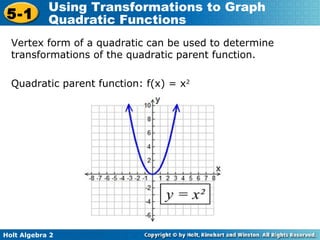
Vertex form of a quadratic can be used to determine
transformations of the quadratic parent function.
Quadratic parent function: f(x) = x2
Holt Algebra 2
5-1
Using Transformations to Graph
Quadratic Functions
Horizontal Translations:
If f(x) = (x – 2)2
then for (x – h)2
,(x – (2))2
, h = 2.
The graph moves two units to the right.
Holt Algebra 2
5-1
Using Transformations to Graph
Quadratic Functions
Horizontal Translations:
If f(x) = (x + 3)2
then for (x – h)2
,(x – (-3))2
, h = -3
The graph moves three units to the left.
Holt Algebra 2
5-1
Using Transformations to Graph
Quadratic Functions
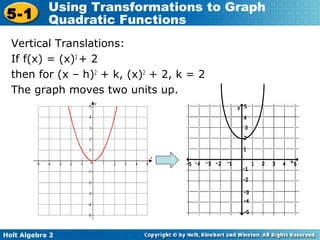
Vertical Translations:
If f(x) = (x)2
+ 2
then for (x – h)2
+ k, (x)2
+ 2, k = 2
The graph moves two units up.
Holt Algebra 2
5-1
Using Transformations to Graph
Quadratic Functions
Vertical Translations:
If f(x) = (x)2
– 1
then for (x – h)2
+ k, (x)2
– 1, k = -1
The graph moves one unit down.
Holt Algebra 2
5-1
Using Transformations to Graph
Quadratic Functions
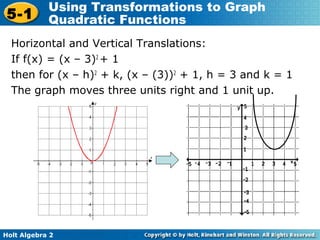
Horizontal and Vertical Translations:
If f(x) = (x – 3)2
+ 1
then for (x – h)2
+ k, (x – (3))2
+ 1, h = 3 and k = 1
The graph moves three units right and 1 unit up.
Holt Algebra 2
5-1
Using Transformations to Graph
Quadratic Functions
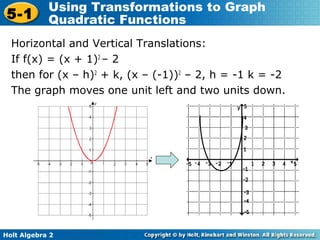
Horizontal and Vertical Translations:
If f(x) = (x + 1)2
– 2
then for (x – h)2
+ k, (x – (-1))2
– 2, h = -1 k = -2
The graph moves one unit left and two units down.
Holt Algebra 2
5-1
Using Transformations to Graph
Quadratic Functions
Horizontal and Vertical Translations:
The vertex of a parabola after a translation is located
at the point (h, k).
If f(x) = (x + 7)2
+ 3
then for (x – h)2
+ k, (x – (-7))2
+ 3, h = -7 k = 3.
The translated vertex is located at the point (-7, 3).
Holt Algebra 2
5-1
Using Transformations to Graph
Quadratic Functions
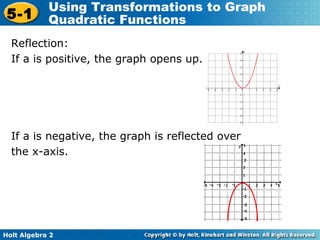
Reflection:
If a is positive, the graph opens up.
If a is negative, the graph is reflected over
the x-axis.
Holt Algebra 2
5-1
Using Transformations to Graph
Quadratic Functions
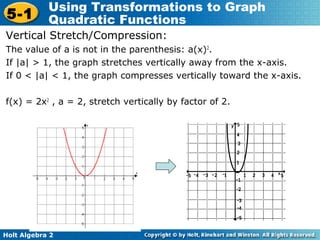
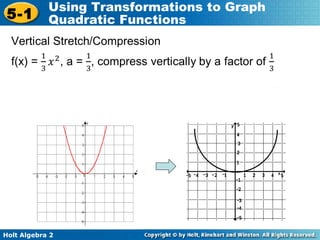
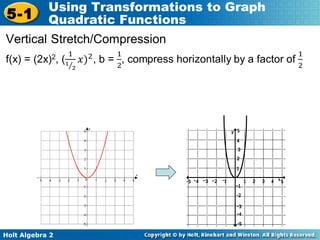
Vertical Stretch/Compression:
The value of a is not in the parenthesis: a(x)2
.
If |a| > 1, the graph stretches vertically away from the x-axis.
If 0 < |a| < 1, the graph compresses vertically toward the x-axis.
f(x) = 2x2
, a = 2, stretch vertically by factor of 2.
Holt Algebra 2
5-1
Using Transformations to Graph
Quadratic Functions
Holt Algebra 2
5-1
Using Transformations to Graph
Quadratic Functions
Holt Algebra 2
5-1
Using Transformations to Graph
Quadratic Functions
Holt Algebra 2
5-1
Using Transformations to Graph
Quadratic Functions
Horizontal and Vertical Stretch/Compression:
Create a table of values of a horizontal and vertical stretch and
compression.
Holt Algebra 2
5-1
Using Transformations to Graph
Quadratic Functions
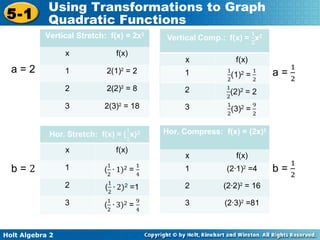
Vertical Stretch: f(x) = 2x2
x f(x)
1 2(1)2
= 2
2 2(2)2
= 8
3 2(3)2
= 18
Hor. Compress: f(x) = (2x)2
x f(x)
1 (2∙1)2
=4
2 (2∙2)2
= 16
3 (2∙3)2
=81
a = 2

5 1 quadratic transformations

  • 1.
    Holt Algebra 2 5-1 UsingTransformations to Graph Quadratic Functions The vertex of the parabola is at (h, k).
  • 2.
    Holt Algebra 2 5-1 UsingTransformations to Graph Quadratic Functions Vertex form of a quadratic can be used to determine transformations of the quadratic parent function. Quadratic parent function: f(x) = x2
  • 3.
    Holt Algebra 2 5-1 UsingTransformations to Graph Quadratic Functions Horizontal Translations: If f(x) = (x – 2)2 then for (x – h)2 ,(x – (2))2 , h = 2. The graph moves two units to the right.
  • 4.
    Holt Algebra 2 5-1 UsingTransformations to Graph Quadratic Functions Horizontal Translations: If f(x) = (x + 3)2 then for (x – h)2 ,(x – (-3))2 , h = -3 The graph moves three units to the left.
  • 5.
    Holt Algebra 2 5-1 UsingTransformations to Graph Quadratic Functions Vertical Translations: If f(x) = (x)2 + 2 then for (x – h)2 + k, (x)2 + 2, k = 2 The graph moves two units up.
  • 6.
    Holt Algebra 2 5-1 UsingTransformations to Graph Quadratic Functions Vertical Translations: If f(x) = (x)2 – 1 then for (x – h)2 + k, (x)2 – 1, k = -1 The graph moves one unit down.
  • 7.
    Holt Algebra 2 5-1 UsingTransformations to Graph Quadratic Functions Horizontal and Vertical Translations: If f(x) = (x – 3)2 + 1 then for (x – h)2 + k, (x – (3))2 + 1, h = 3 and k = 1 The graph moves three units right and 1 unit up.
  • 8.
    Holt Algebra 2 5-1 UsingTransformations to Graph Quadratic Functions Horizontal and Vertical Translations: If f(x) = (x + 1)2 – 2 then for (x – h)2 + k, (x – (-1))2 – 2, h = -1 k = -2 The graph moves one unit left and two units down.
  • 9.
    Holt Algebra 2 5-1 UsingTransformations to Graph Quadratic Functions Horizontal and Vertical Translations: The vertex of a parabola after a translation is located at the point (h, k). If f(x) = (x + 7)2 + 3 then for (x – h)2 + k, (x – (-7))2 + 3, h = -7 k = 3. The translated vertex is located at the point (-7, 3).
  • 10.
    Holt Algebra 2 5-1 UsingTransformations to Graph Quadratic Functions Reflection: If a is positive, the graph opens up. If a is negative, the graph is reflected over the x-axis.
  • 11.
    Holt Algebra 2 5-1 UsingTransformations to Graph Quadratic Functions Vertical Stretch/Compression: The value of a is not in the parenthesis: a(x)2 . If |a| > 1, the graph stretches vertically away from the x-axis. If 0 < |a| < 1, the graph compresses vertically toward the x-axis. f(x) = 2x2 , a = 2, stretch vertically by factor of 2.
  • 12.
    Holt Algebra 2 5-1 UsingTransformations to Graph Quadratic Functions
  • 13.
    Holt Algebra 2 5-1 UsingTransformations to Graph Quadratic Functions
  • 14.
    Holt Algebra 2 5-1 UsingTransformations to Graph Quadratic Functions
  • 15.
    Holt Algebra 2 5-1 UsingTransformations to Graph Quadratic Functions Horizontal and Vertical Stretch/Compression: Create a table of values of a horizontal and vertical stretch and compression.
  • 16.
    Holt Algebra 2 5-1 UsingTransformations to Graph Quadratic Functions Vertical Stretch: f(x) = 2x2 x f(x) 1 2(1)2 = 2 2 2(2)2 = 8 3 2(3)2 = 18 Hor. Compress: f(x) = (2x)2 x f(x) 1 (2∙1)2 =4 2 (2∙2)2 = 16 3 (2∙3)2 =81 a = 2