APPLICATIONS OF INTEGRATION
6
6.2
Volumes
APPLICATIONS OF INTEGRATION
In this section, we will learn about:
Using integration to find out
the volume of a solid.
In trying to find the volume of a solid,
we face the same type of problem as
in finding areas.
VOLUMES
We have an intuitive idea of what volume
means.
However, we must make this idea precise
by using calculus to give an exact definition
of volume.
VOLUMES
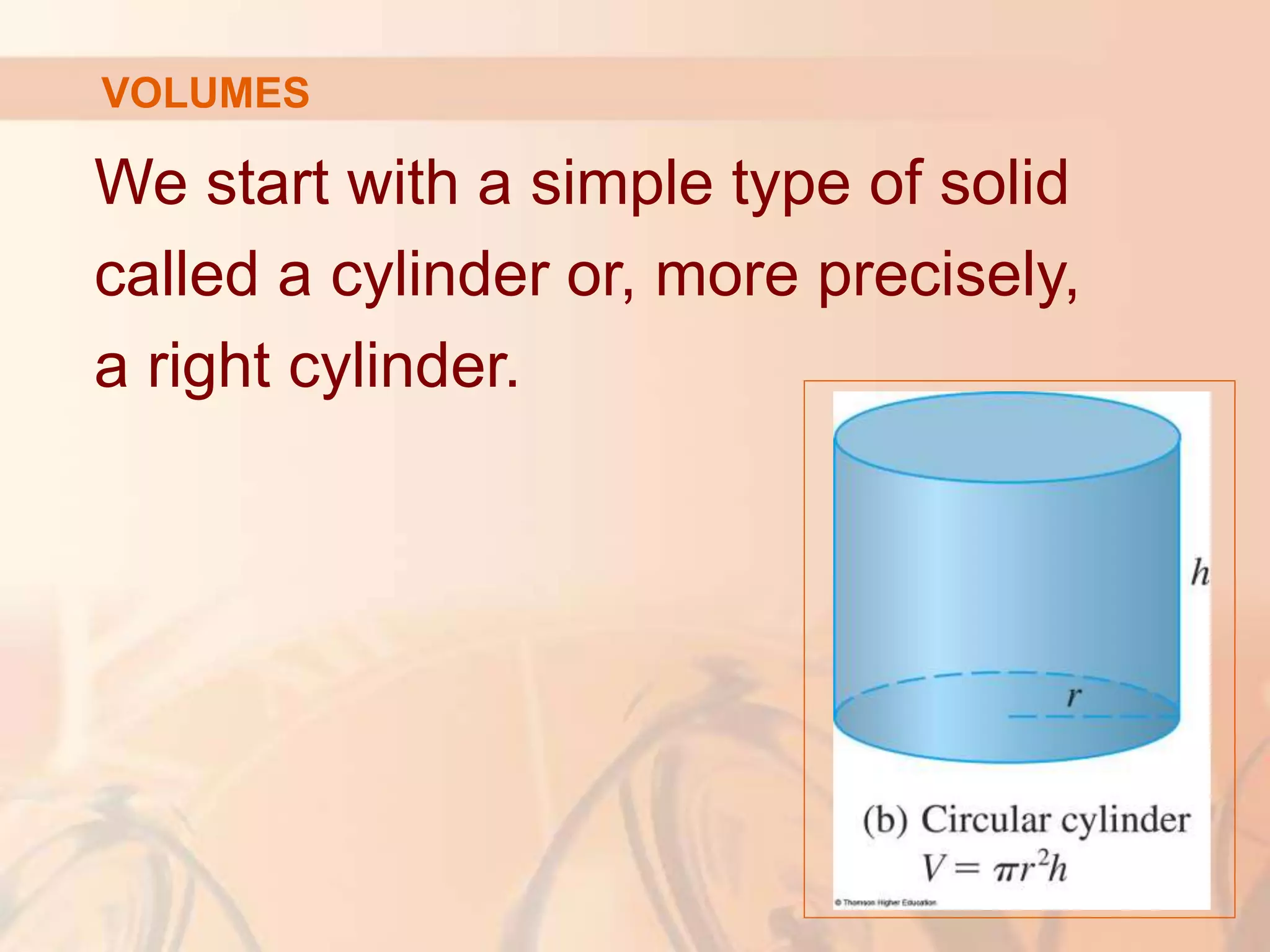
We start with a simple type of solid
called a cylinder or, more precisely,
a right cylinder.
VOLUMES
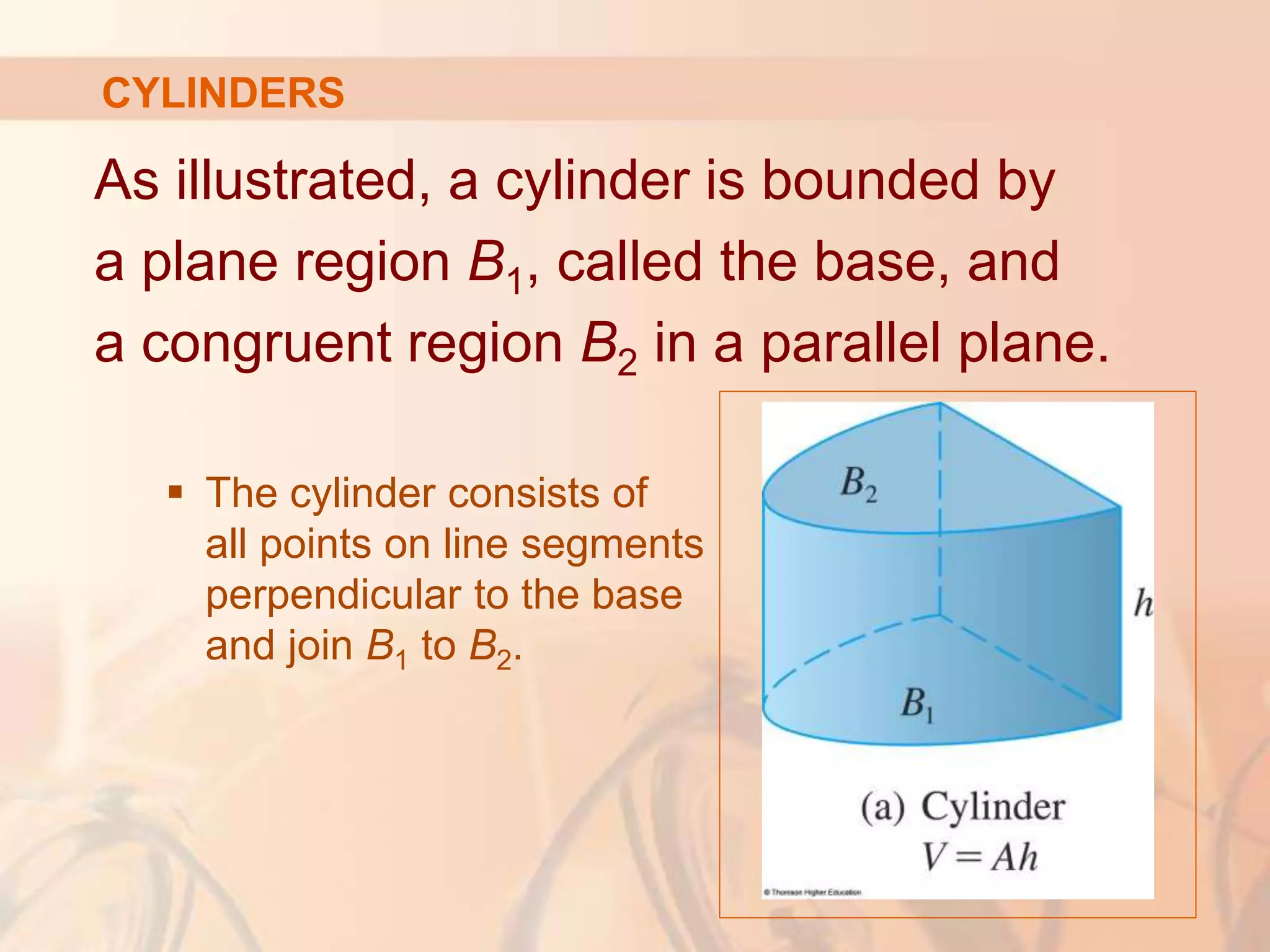
As illustrated, a cylinder is bounded by
a plane region B1, called the base, and
a congruent region B2 in a parallel plane.
 The cylinder consists of
all points on line segments
perpendicular to the base
and join B1 to B2.
CYLINDERS
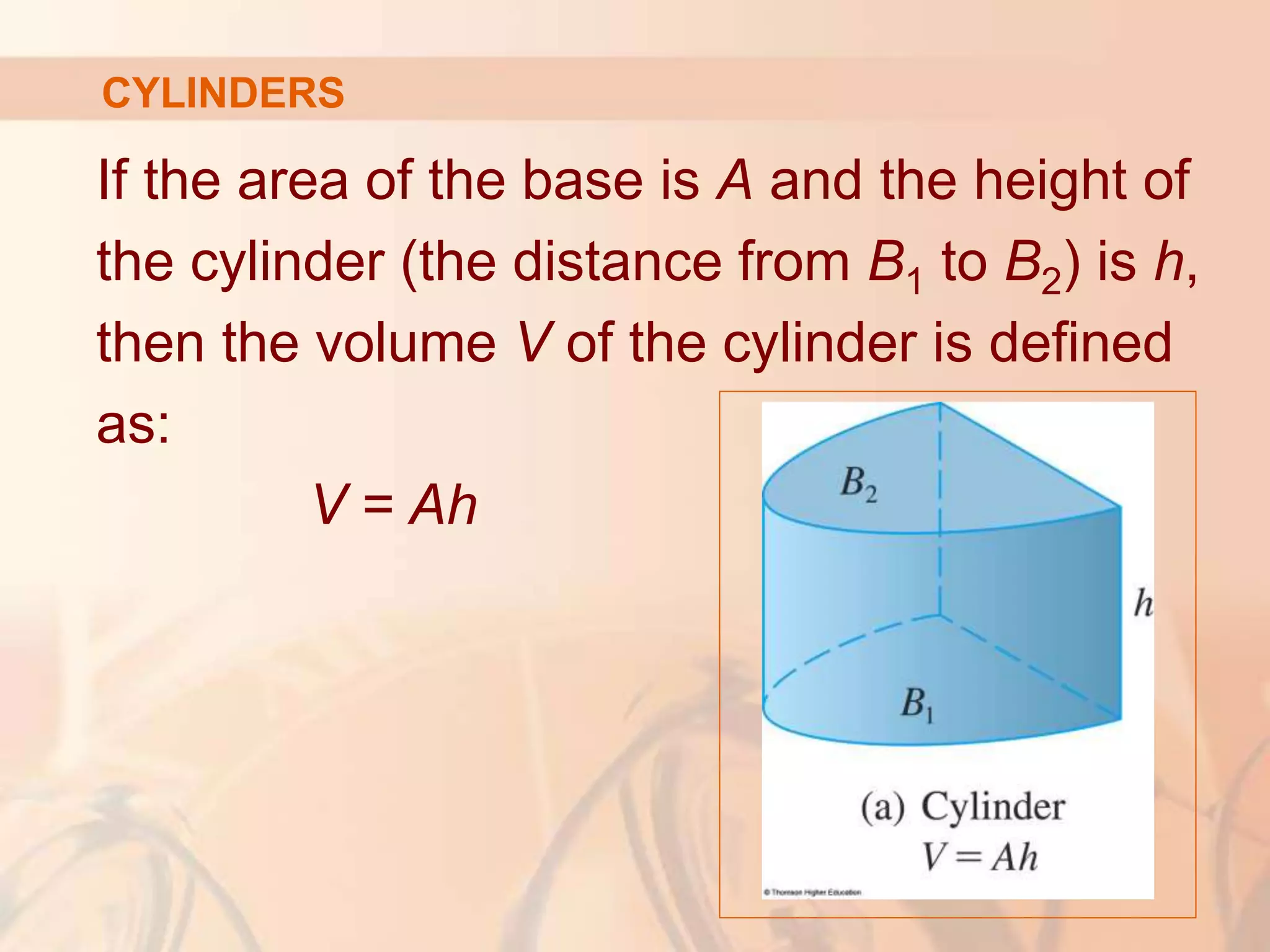
If the area of the base is A and the height of
the cylinder (the distance from B1 to B2) is h,
then the volume V of the cylinder is defined
as:
V = Ah
CYLINDERS
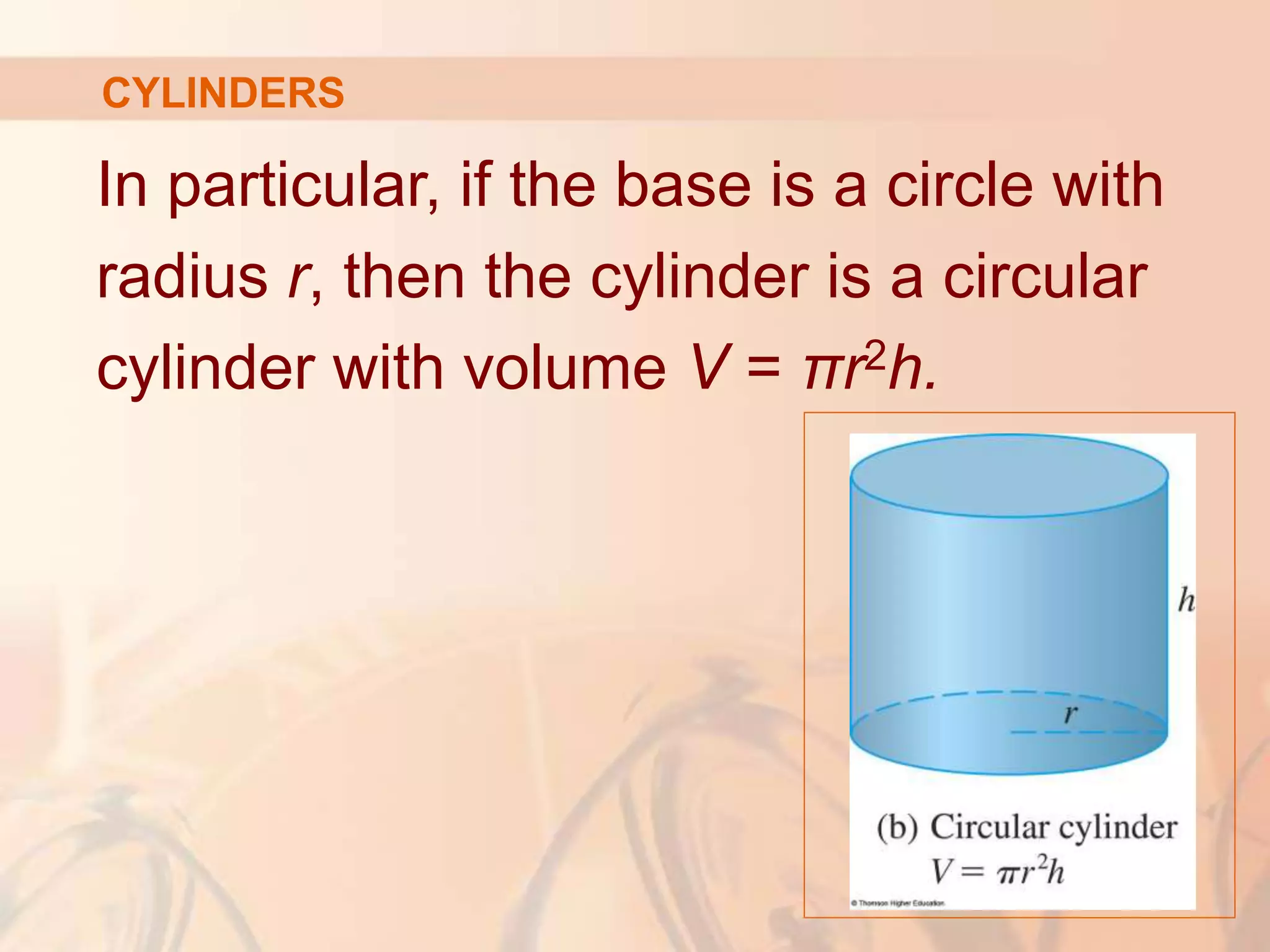
In particular, if the base is a circle with
radius r, then the cylinder is a circular
cylinder with volume V = πr2h.
CYLINDERS
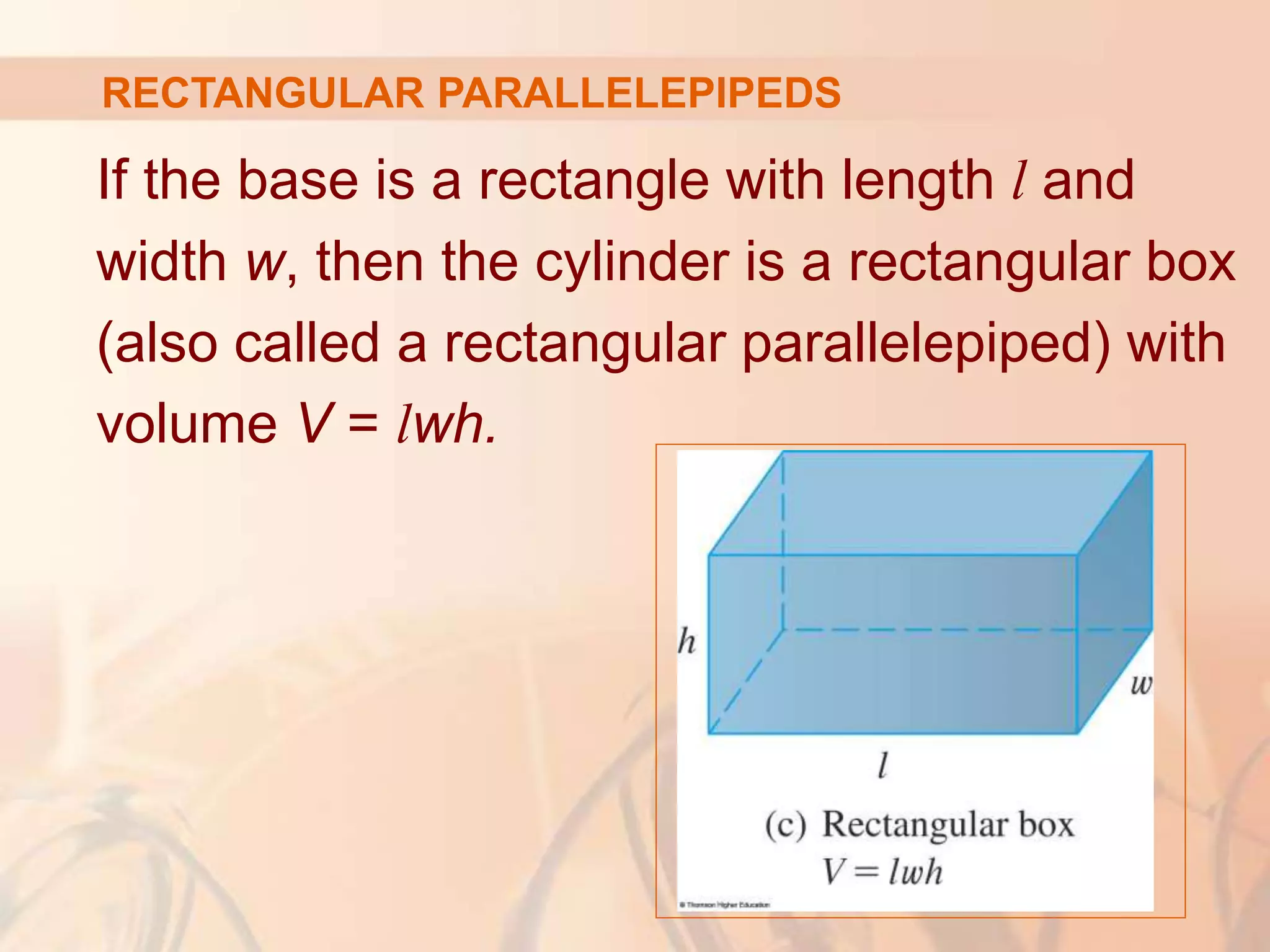
If the base is a rectangle with length l and
width w, then the cylinder is a rectangular box
(also called a rectangular parallelepiped) with
volume V = lwh.
RECTANGULAR PARALLELEPIPEDS
For a solid S that isn’t a cylinder, we first
‘cut’ S into pieces and approximate each
piece by a cylinder.
 We estimate the volume of S by adding the volumes
of the cylinders.
 We arrive at the exact volume of S through a limiting
process in which the number of pieces becomes large.
IRREGULAR SOLIDS
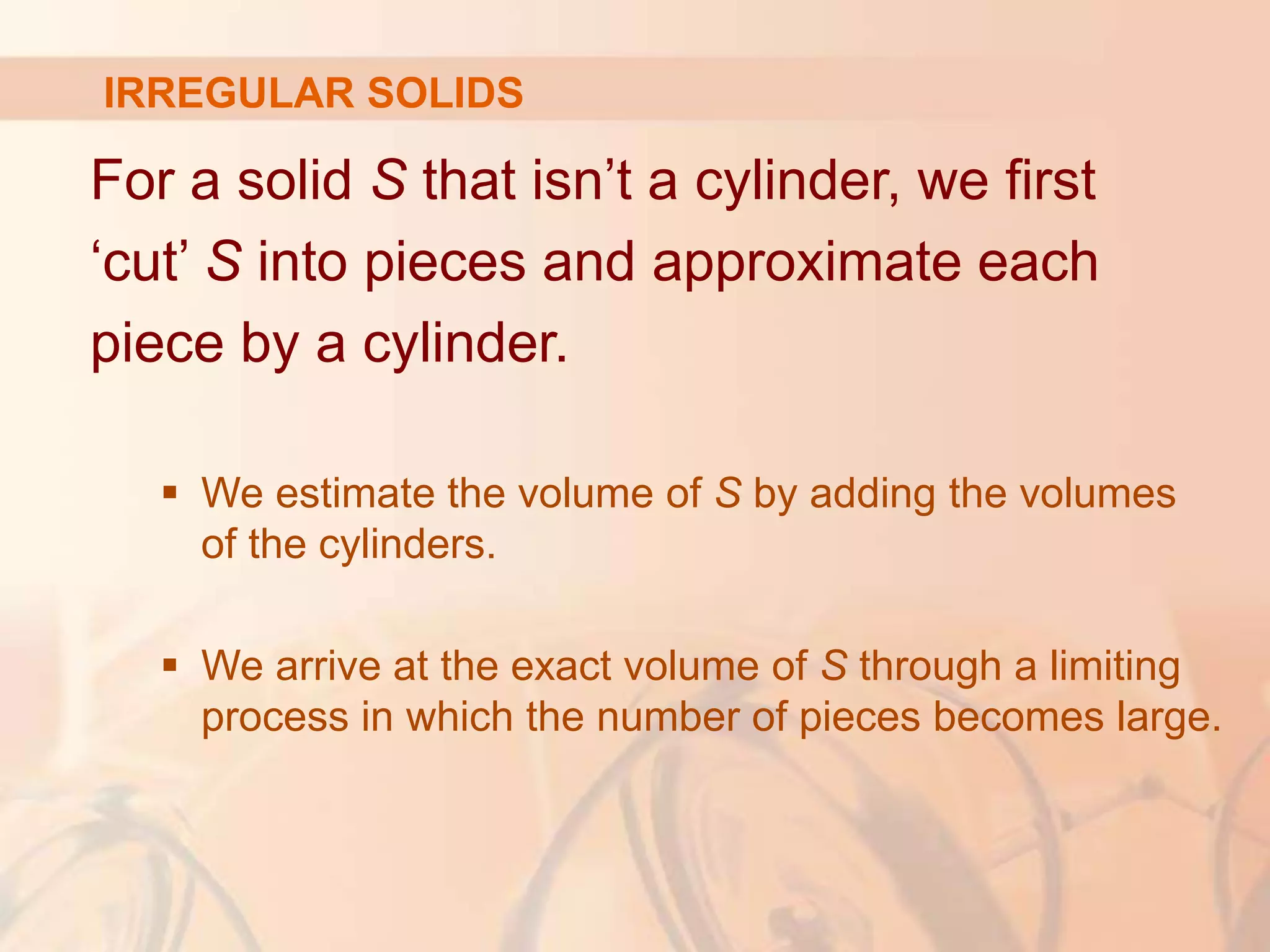
We start by intersecting S with a plane
and obtaining a plane region that is called
a cross-section of S.
IRREGULAR SOLIDS
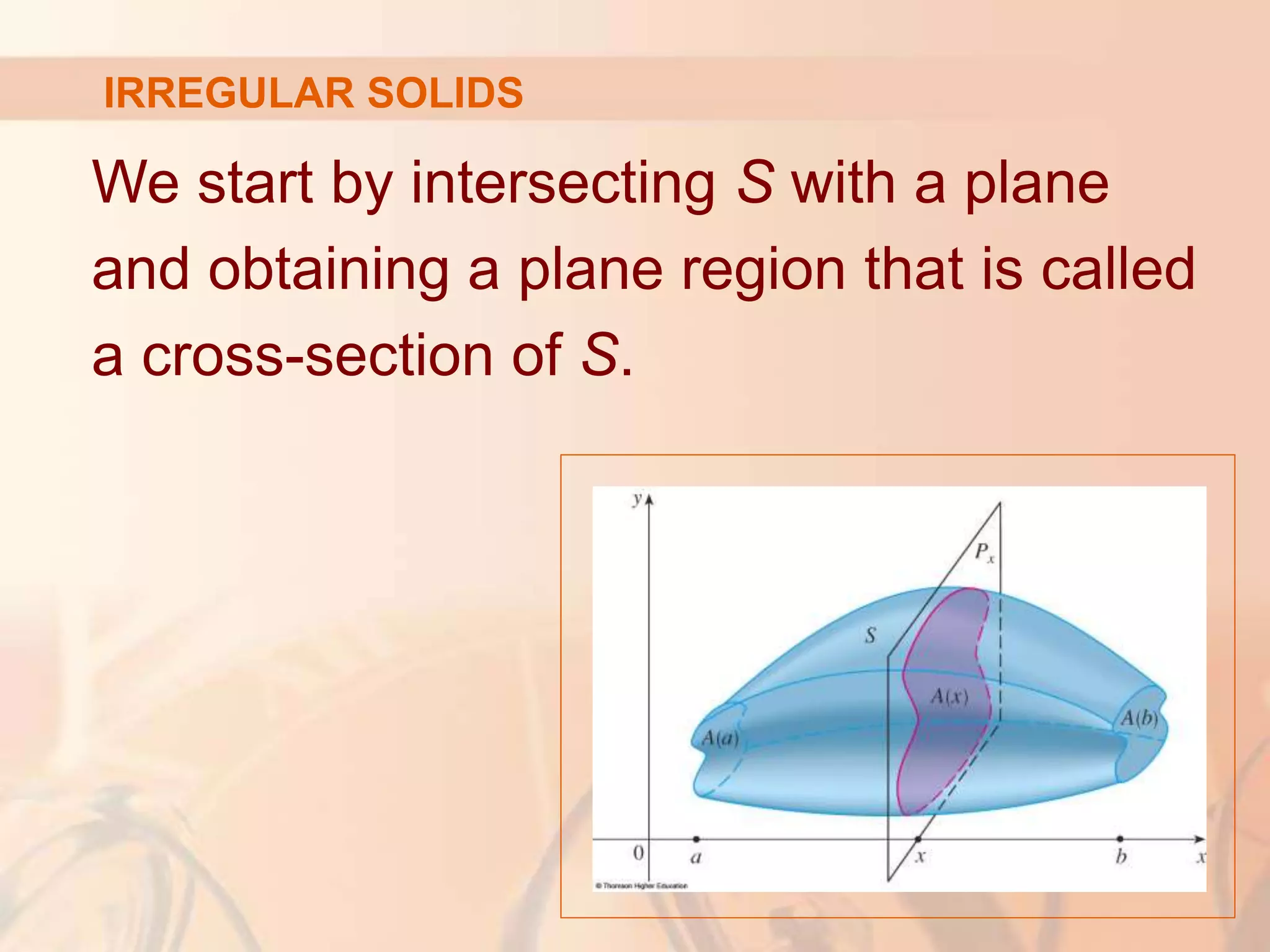
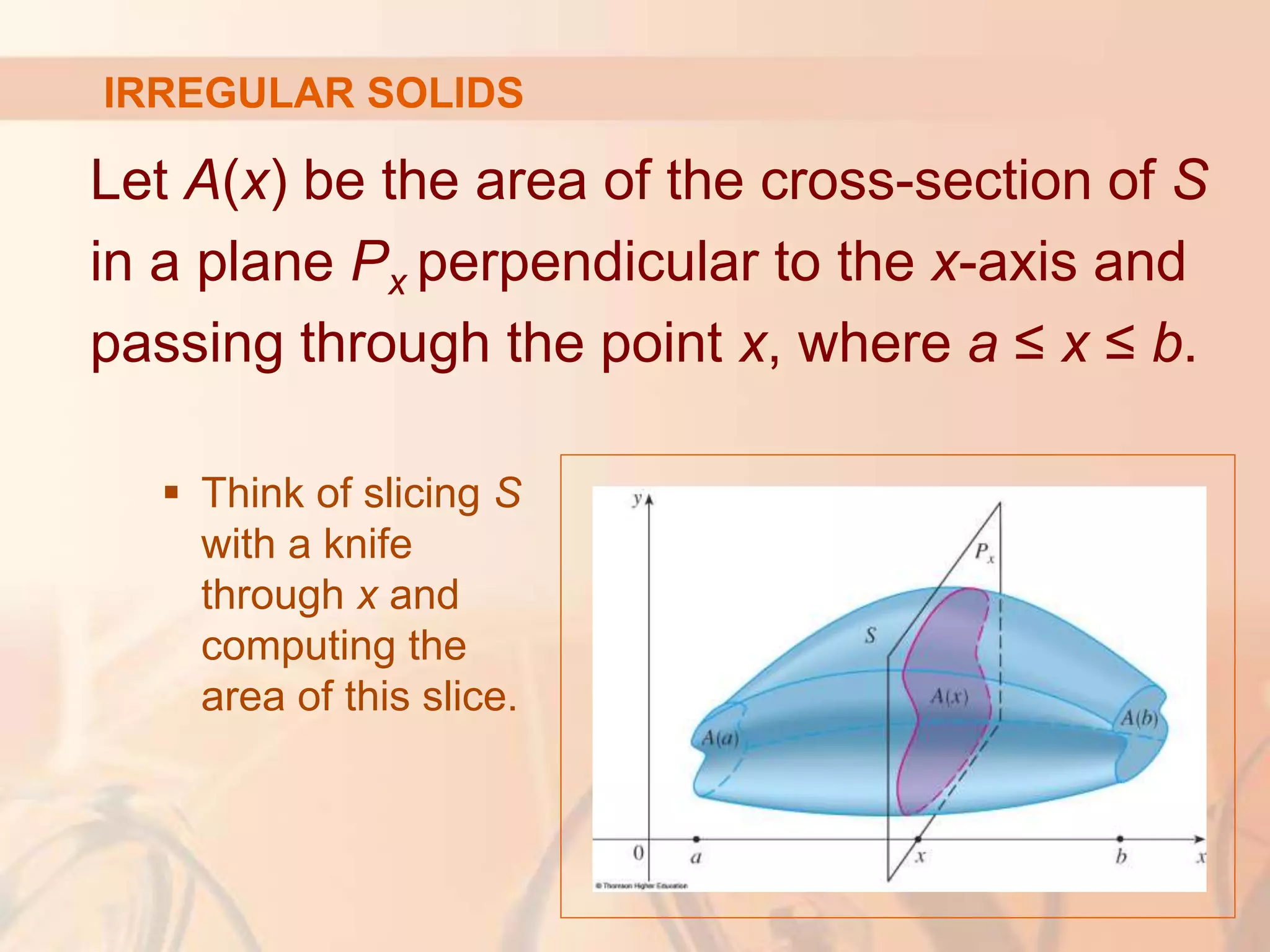
Let A(x) be the area of the cross-section of S
in a plane Px perpendicular to the x-axis and
passing through the point x, where a ≤ x ≤ b.
 Think of slicing S
with a knife
through x and
computing the
area of this slice.
IRREGULAR SOLIDS
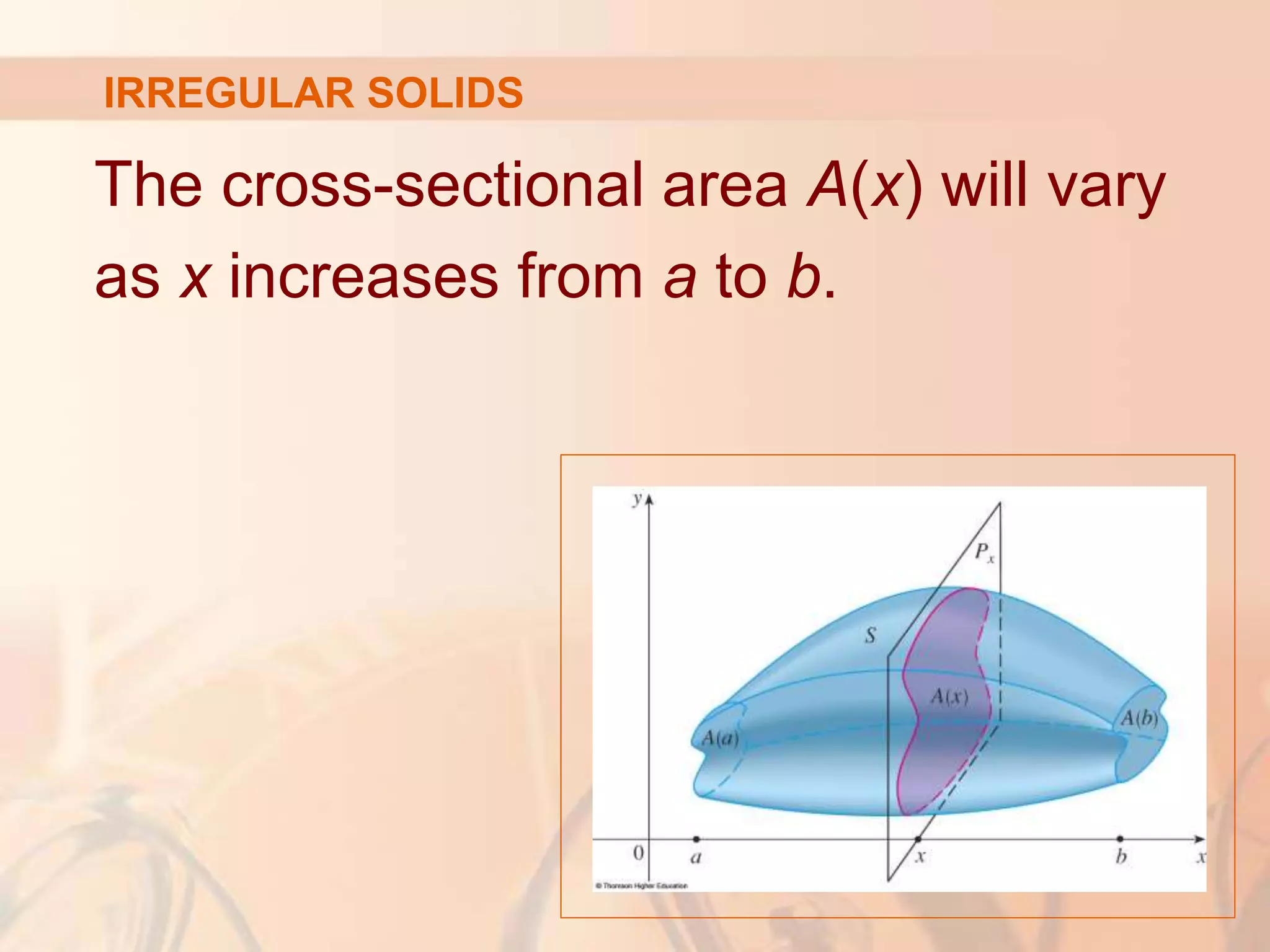
The cross-sectional area A(x) will vary
as x increases from a to b.
IRREGULAR SOLIDS
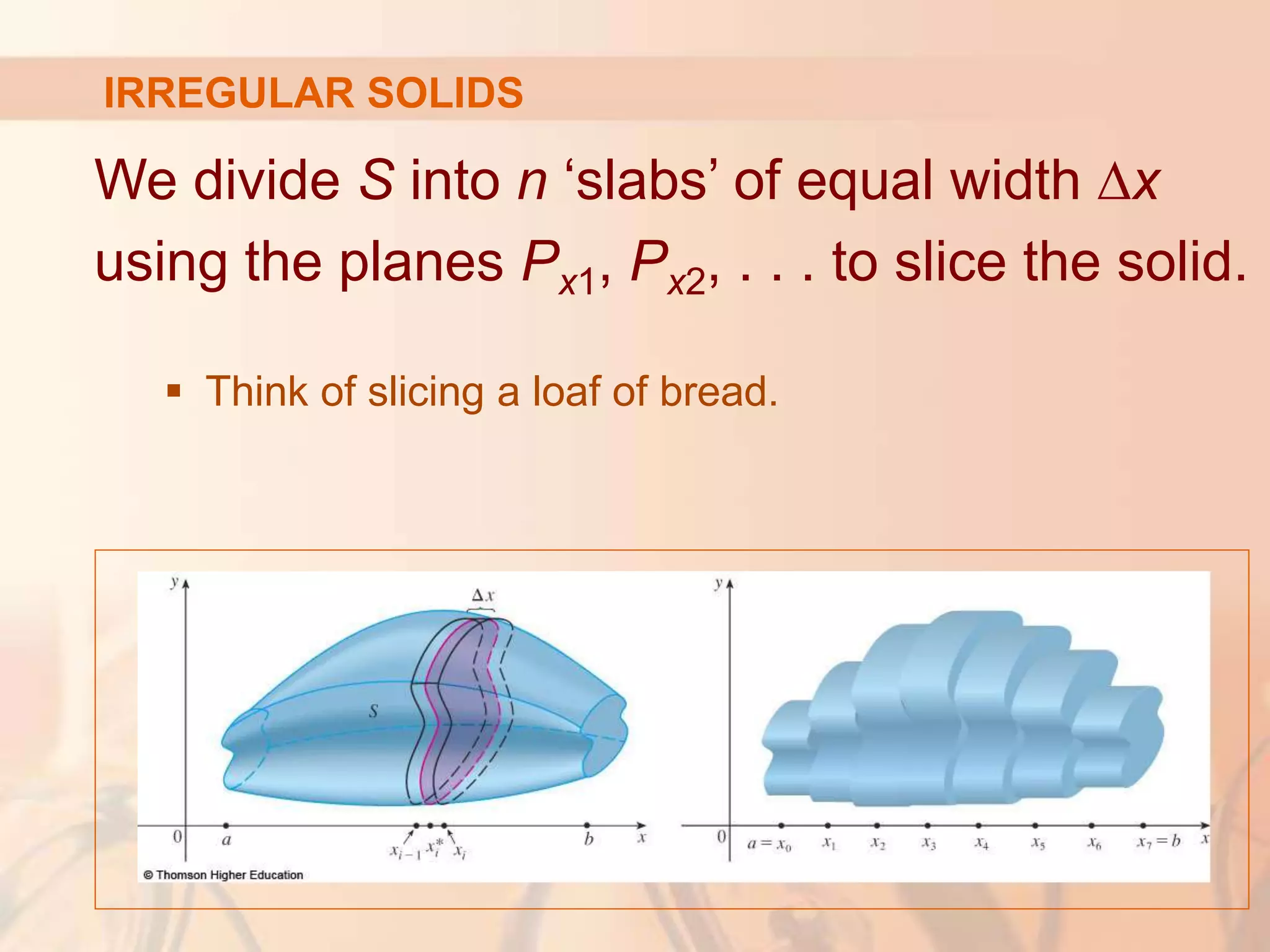
We divide S into n ‘slabs’ of equal width ∆x
using the planes Px1, Px2, . . . to slice the solid.
 Think of slicing a loaf of bread.
IRREGULAR SOLIDS
If we choose sample points xi* in [xi - 1, xi], we
can approximate the i th slab Si (the part of S
that lies between the planes and ) by a
cylinder with base area A(xi*) and ‘height’ ∆x.
1
i
x
P  i
x
P
IRREGULAR SOLIDS
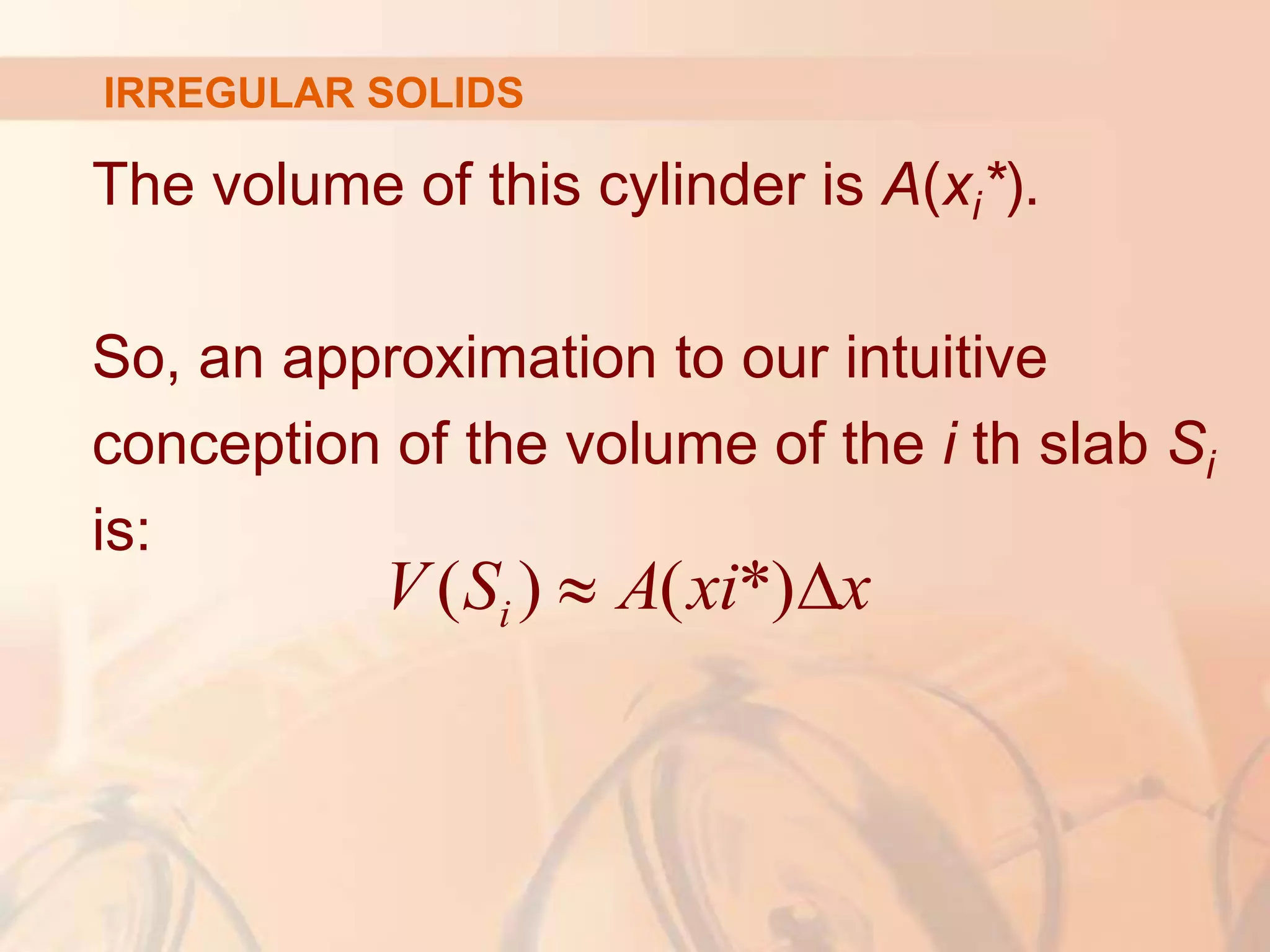
The volume of this cylinder is A(xi*).
So, an approximation to our intuitive
conception of the volume of the i th slab Si
is:
( ) ( *)
 
i
V S A xi x
IRREGULAR SOLIDS
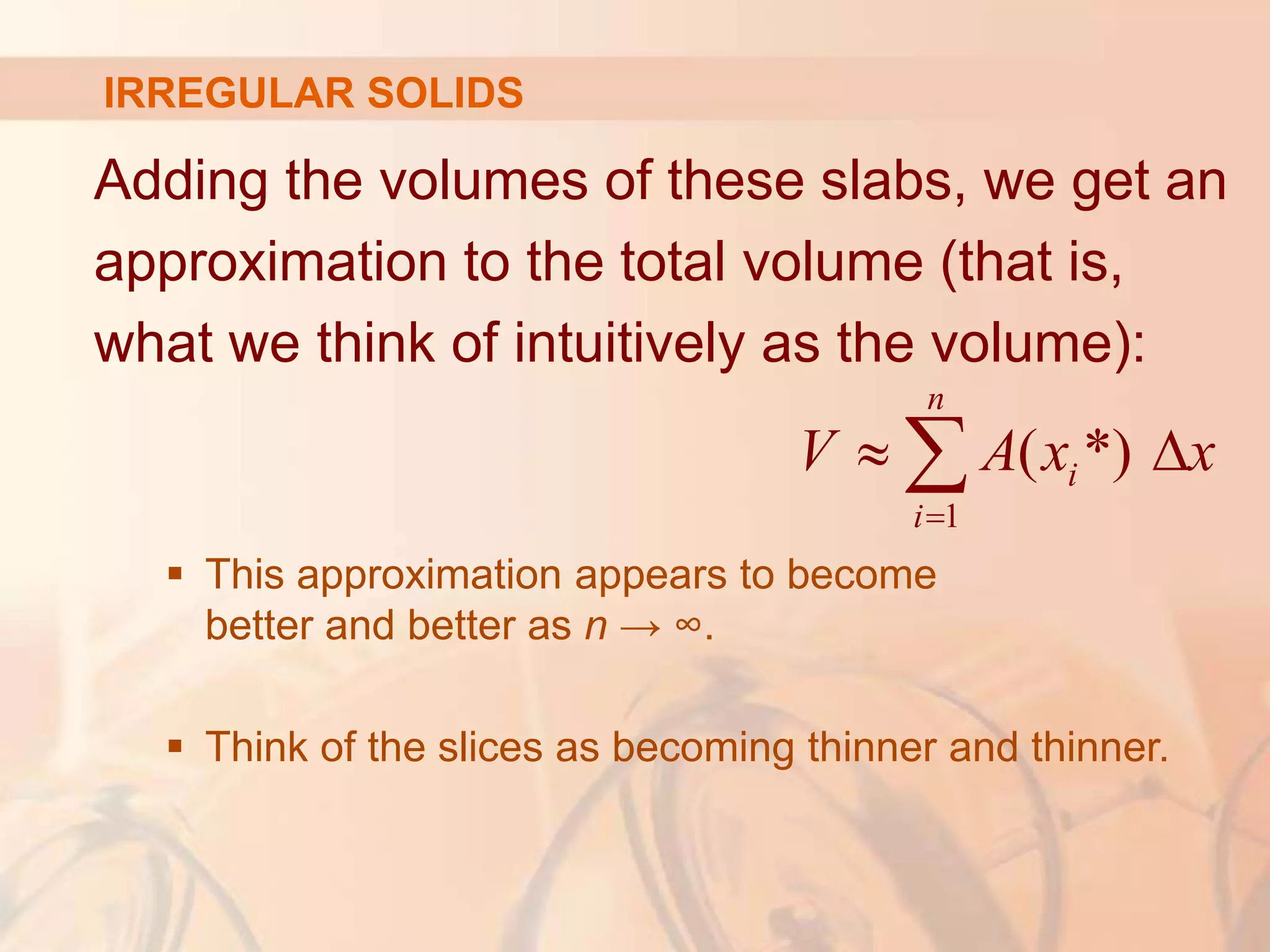
Adding the volumes of these slabs, we get an
approximation to the total volume (that is,
what we think of intuitively as the volume):
 This approximation appears to become
better and better as n → ∞.
 Think of the slices as becoming thinner and thinner.
1
( *)
n
i
i
V A x x

 

IRREGULAR SOLIDS
Therefore, we define the volume as the limit
of these sums as n → ∞).
However, we recognize the limit of Riemann
sums as a definite integral and so we have
the following definition.
IRREGULAR SOLIDS
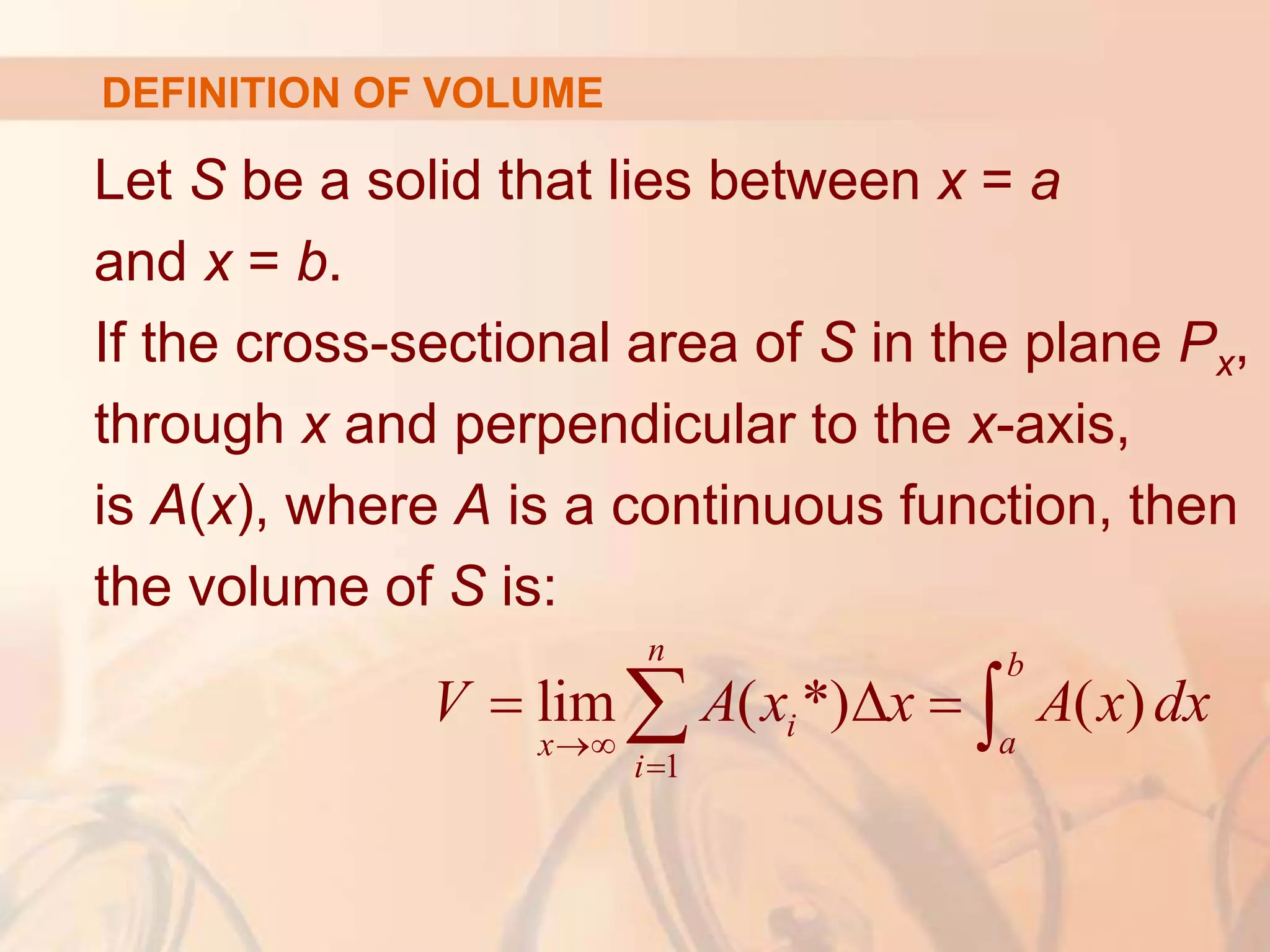
Let S be a solid that lies between x = a
and x = b.
If the cross-sectional area of S in the plane Px,
through x and perpendicular to the x-axis,
is A(x), where A is a continuous function, then
the volume of S is:
1
lim ( *) ( )
n b
i a
x
i
V A x x A x dx


  
 
DEFINITION OF VOLUME
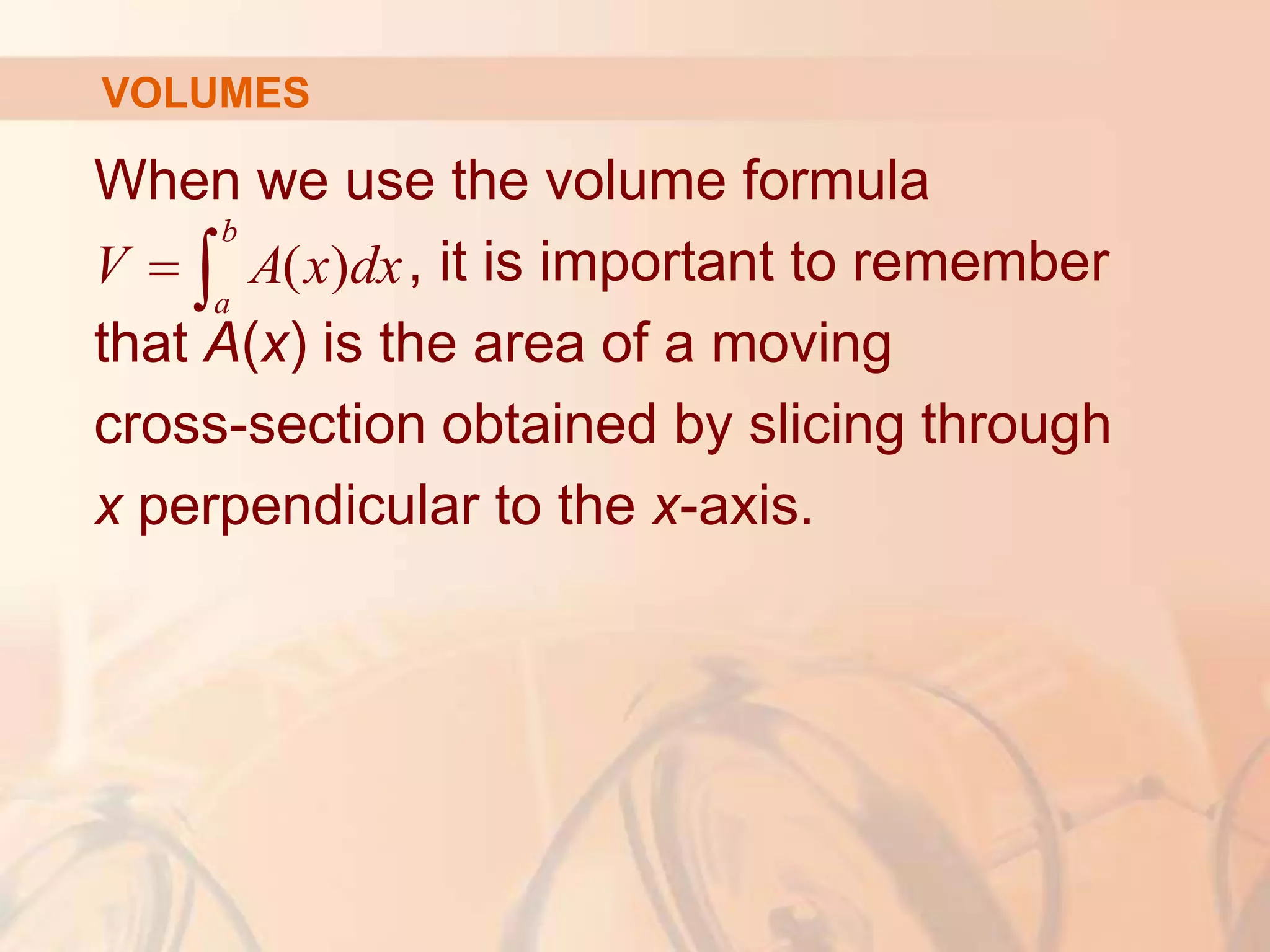
When we use the volume formula
, it is important to remember
that A(x) is the area of a moving
cross-section obtained by slicing through
x perpendicular to the x-axis.
VOLUMES
( )
b
a
V A x dx
 
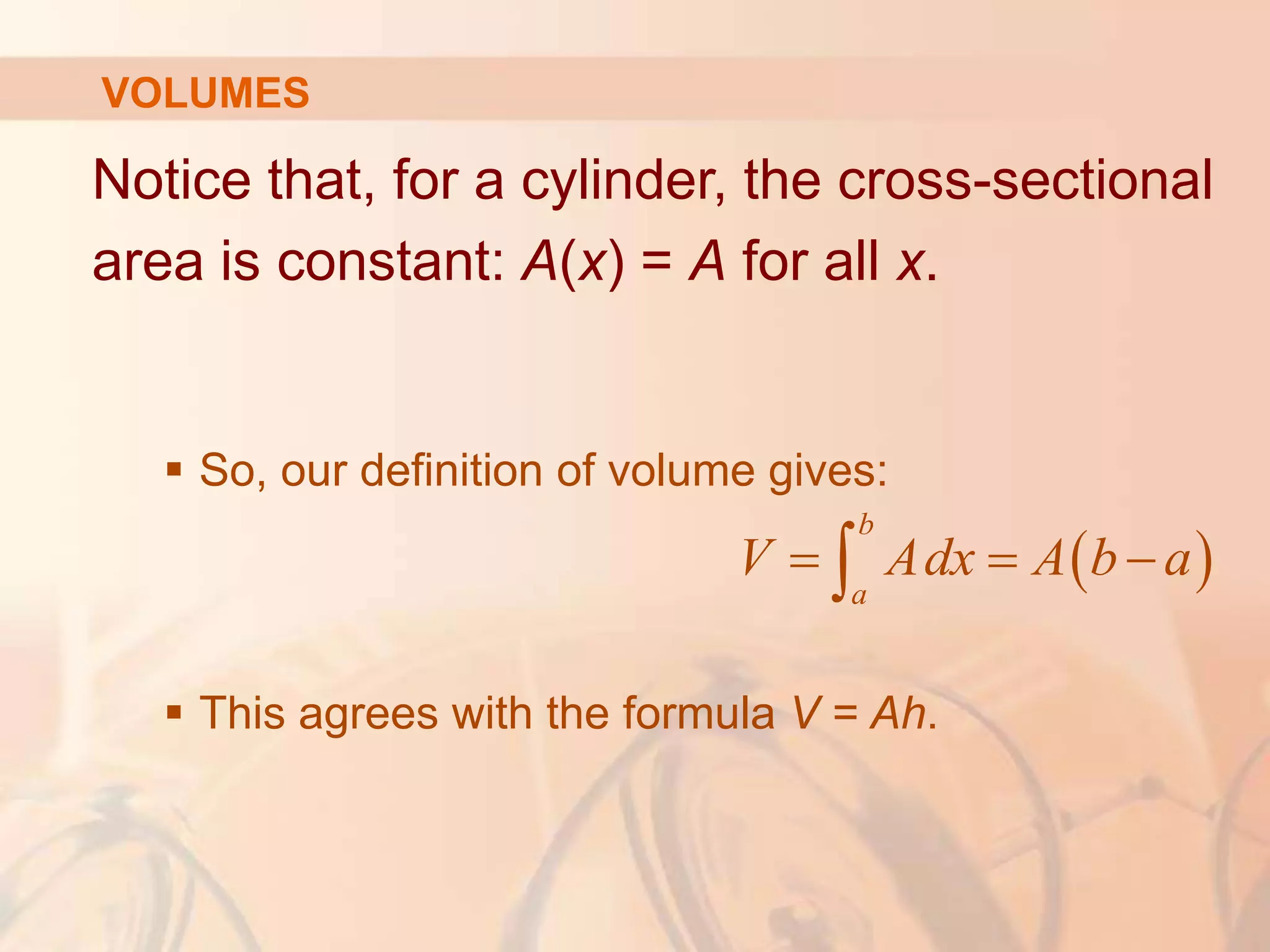
Notice that, for a cylinder, the cross-sectional
area is constant: A(x) = A for all x.
 So, our definition of volume gives:
 This agrees with the formula V = Ah.
 
b
a
V Adx A b a
  

VOLUMES
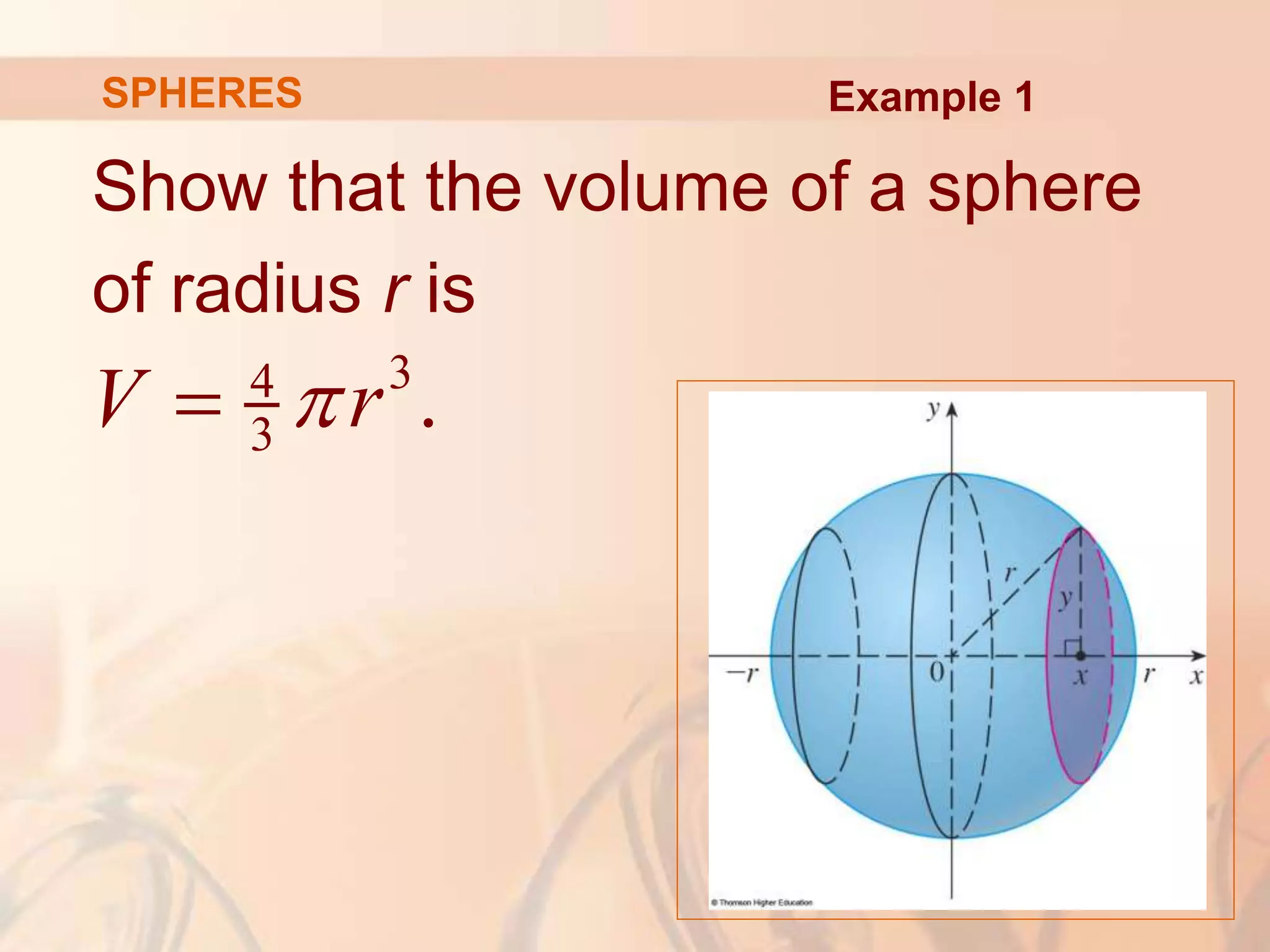
Show that the volume of a sphere
of radius r is
3
4
3 .
V r


Example 1
SPHERES
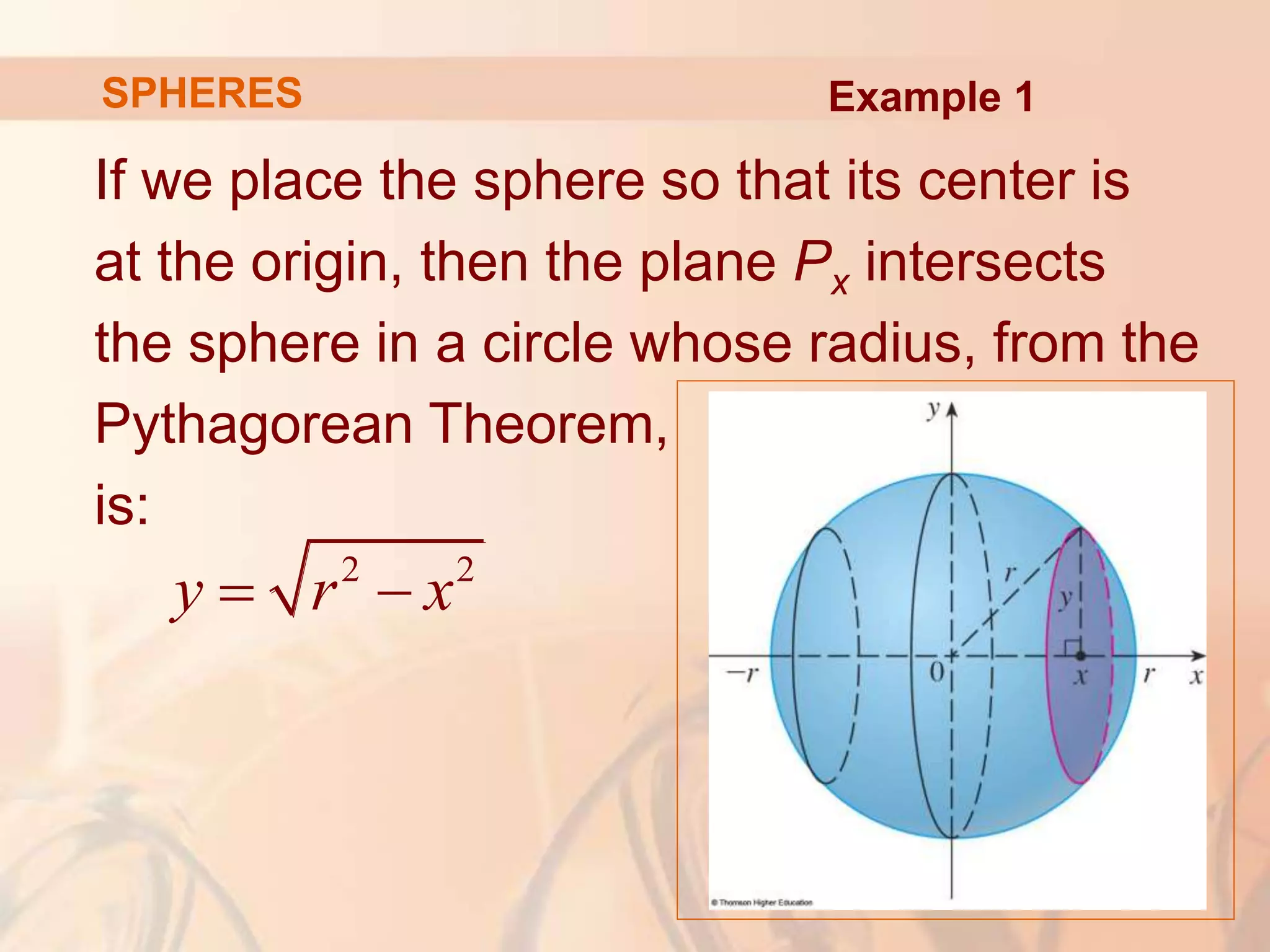
If we place the sphere so that its center is
at the origin, then the plane Px intersects
the sphere in a circle whose radius, from the
Pythagorean Theorem,
is:
2 2
y r x
 
Example 1
SPHERES
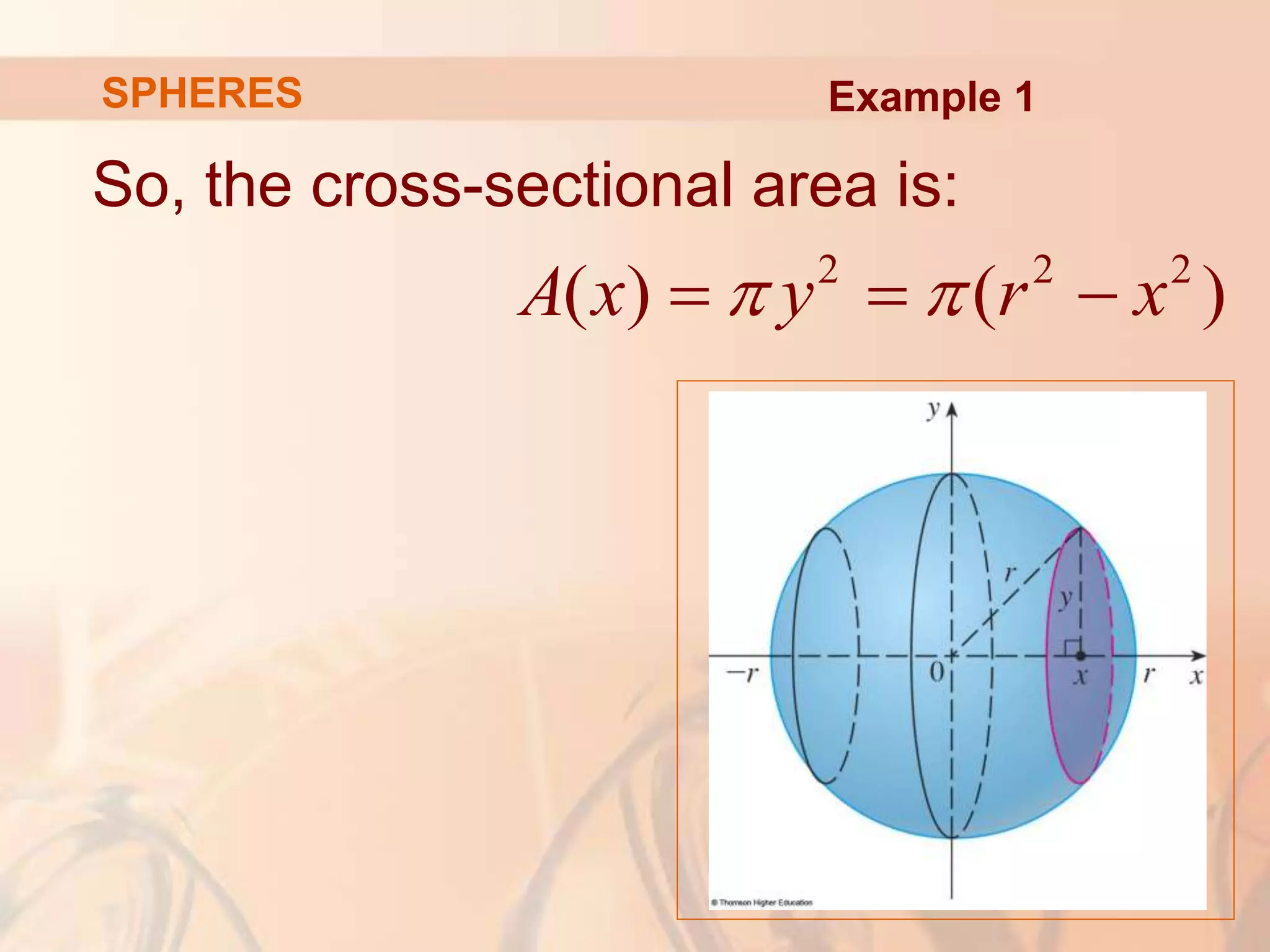
So, the cross-sectional area is:
2 2 2
( ) ( )
A x y r x
 
  
Example 1
SPHERES
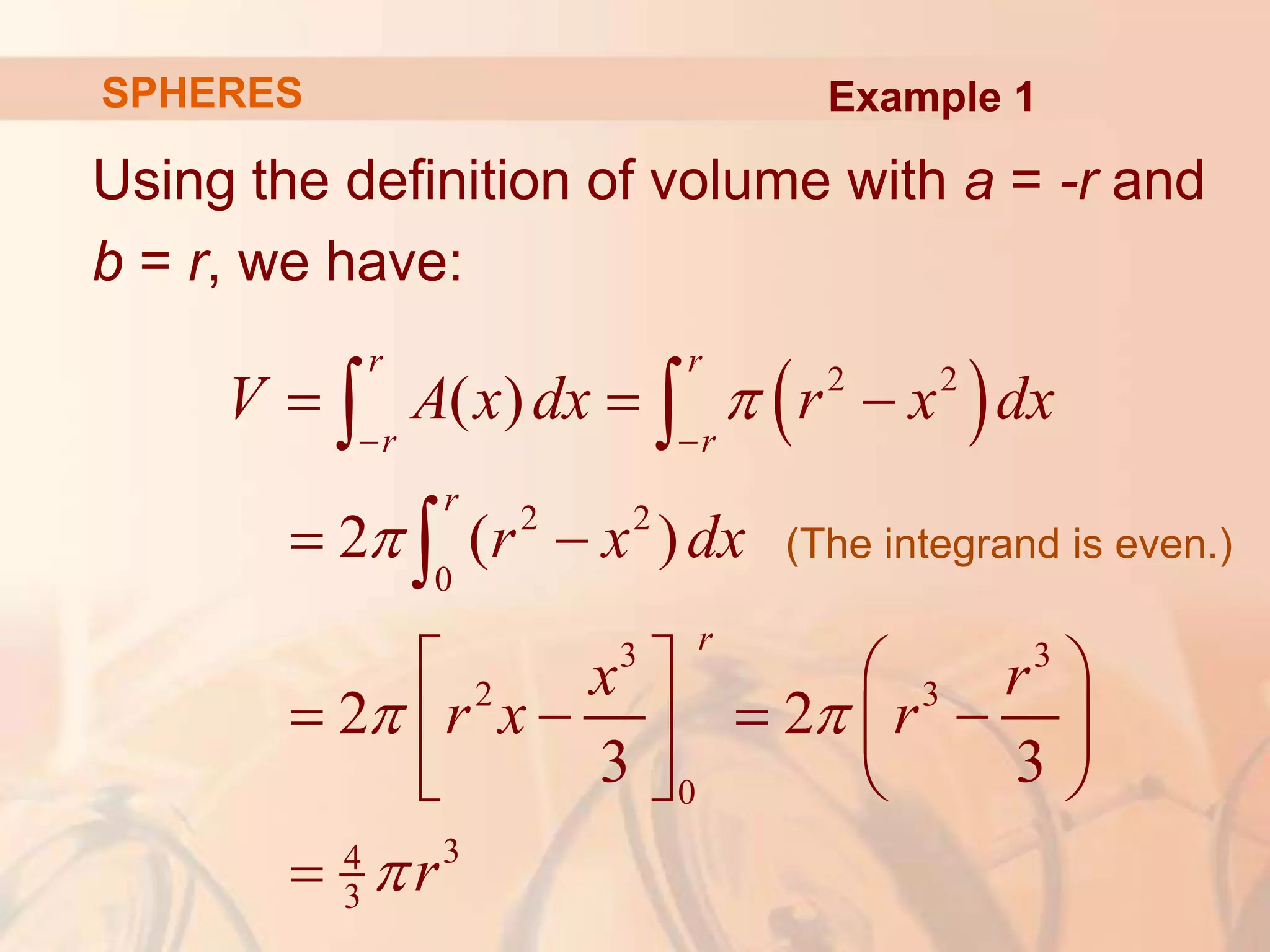
Using the definition of volume with a = -r and
b = r, we have:
(The integrand is even.)
 
2 2
2 2
0
3 3
2 3
0
3
4
3
( )
2 ( )
2 2
3 3
r r
r r
r
r
V A x dx r x dx
r x dx
x r
r x r
r


 

 
  
 
   
   
 
 
   

 

Example 1
SPHERES
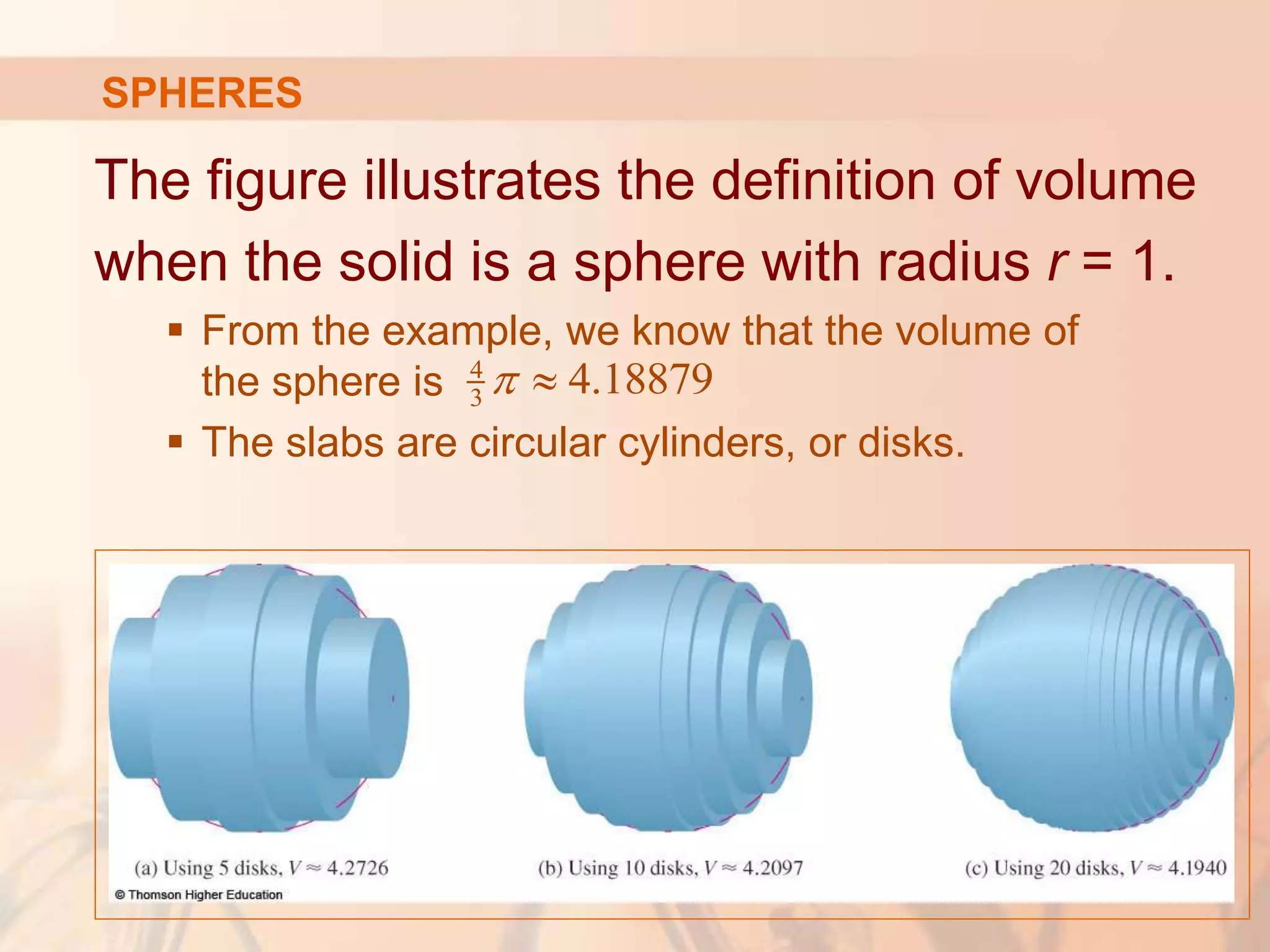
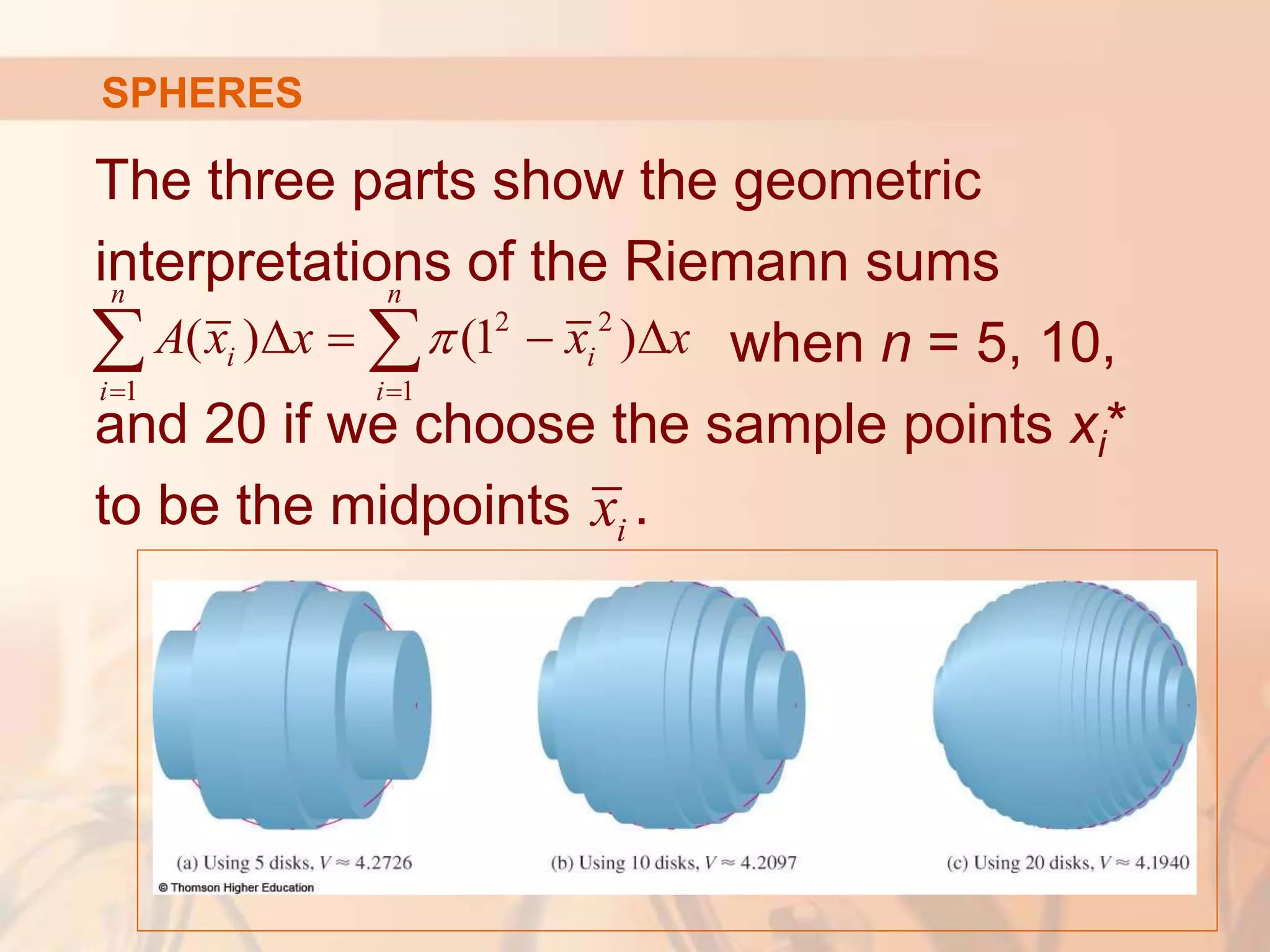
The figure illustrates the definition of volume
when the solid is a sphere with radius r = 1.
 From the example, we know that the volume of
the sphere is
 The slabs are circular cylinders, or disks.
4
3 4.18879
 
SPHERES
The three parts show the geometric
interpretations of the Riemann sums
when n = 5, 10,
and 20 if we choose the sample points xi*
to be the midpoints .
2 2
1 1
( ) (1 )
n n
i i
i i
A x x x x

 
   
 
i
x
SPHERES
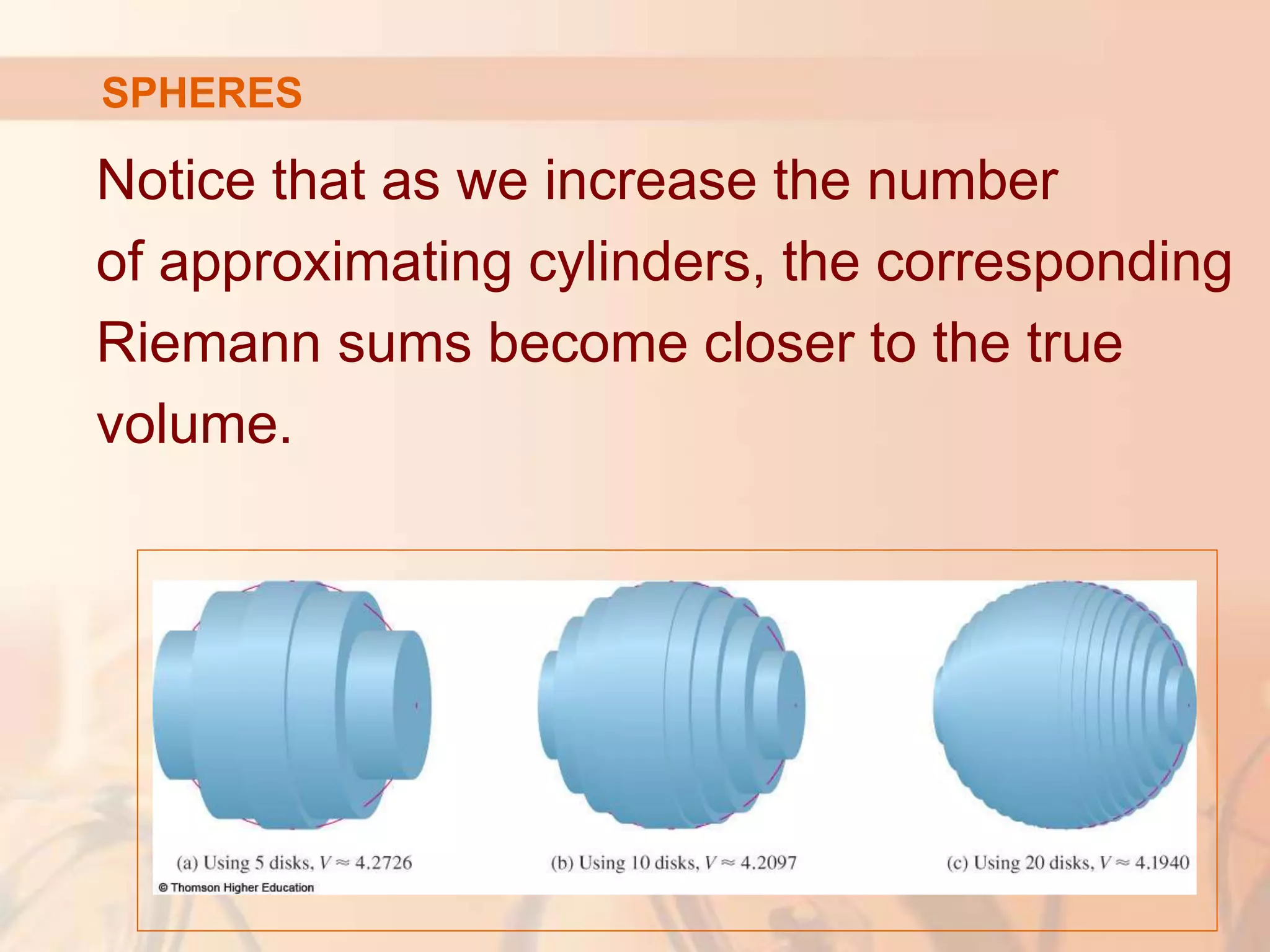
Notice that as we increase the number
of approximating cylinders, the corresponding
Riemann sums become closer to the true
volume.
SPHERES
Find the volume of the solid obtained by
rotating about the x-axis the region under
the curve from 0 to 1.
Illustrate the definition of volume by sketching
a typical approximating cylinder.
y x

Example 2
VOLUMES
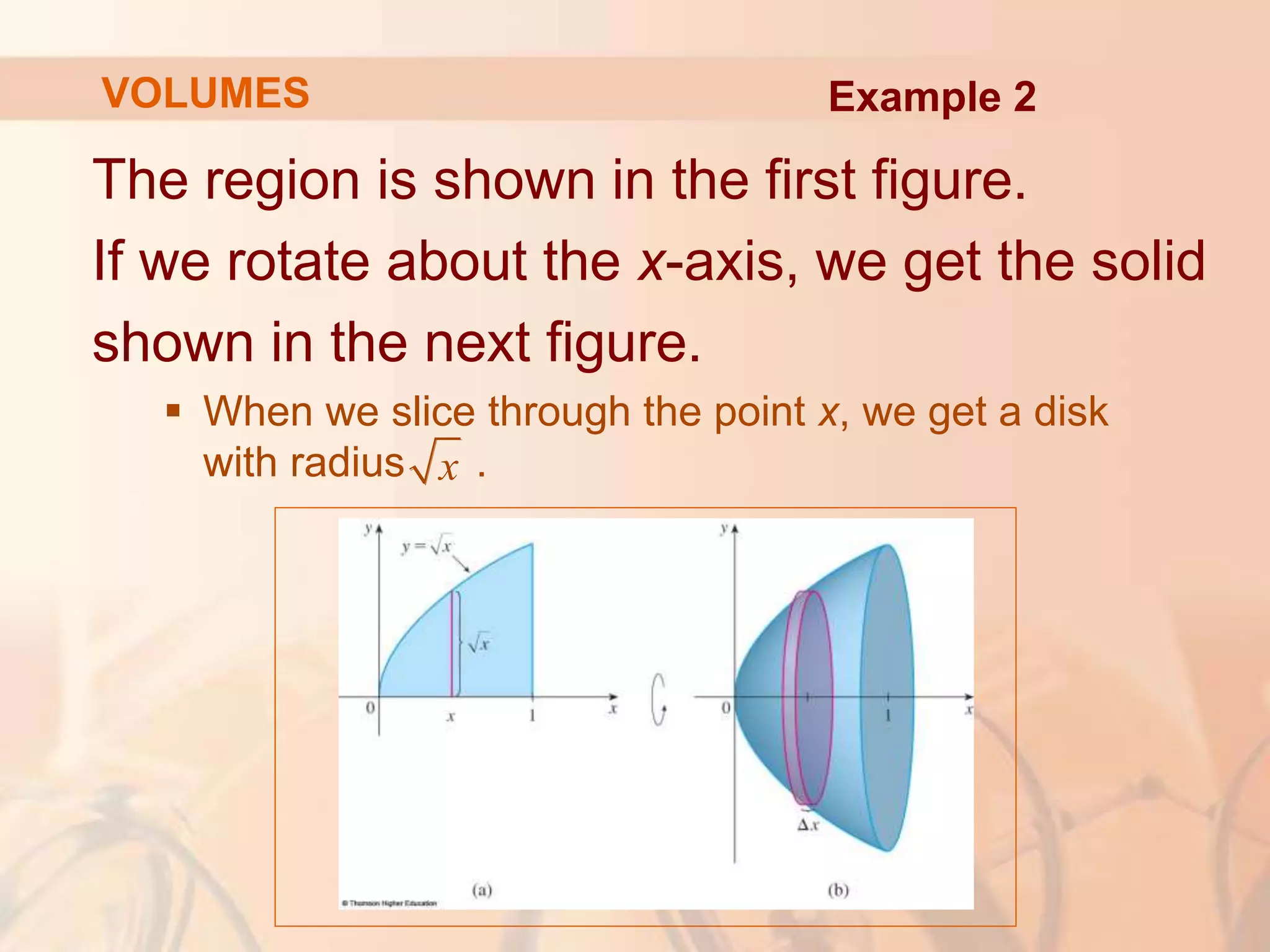
The region is shown in the first figure.
If we rotate about the x-axis, we get the solid
shown in the next figure.
 When we slice through the point x, we get a disk
with radius .
VOLUMES
x
Example 2
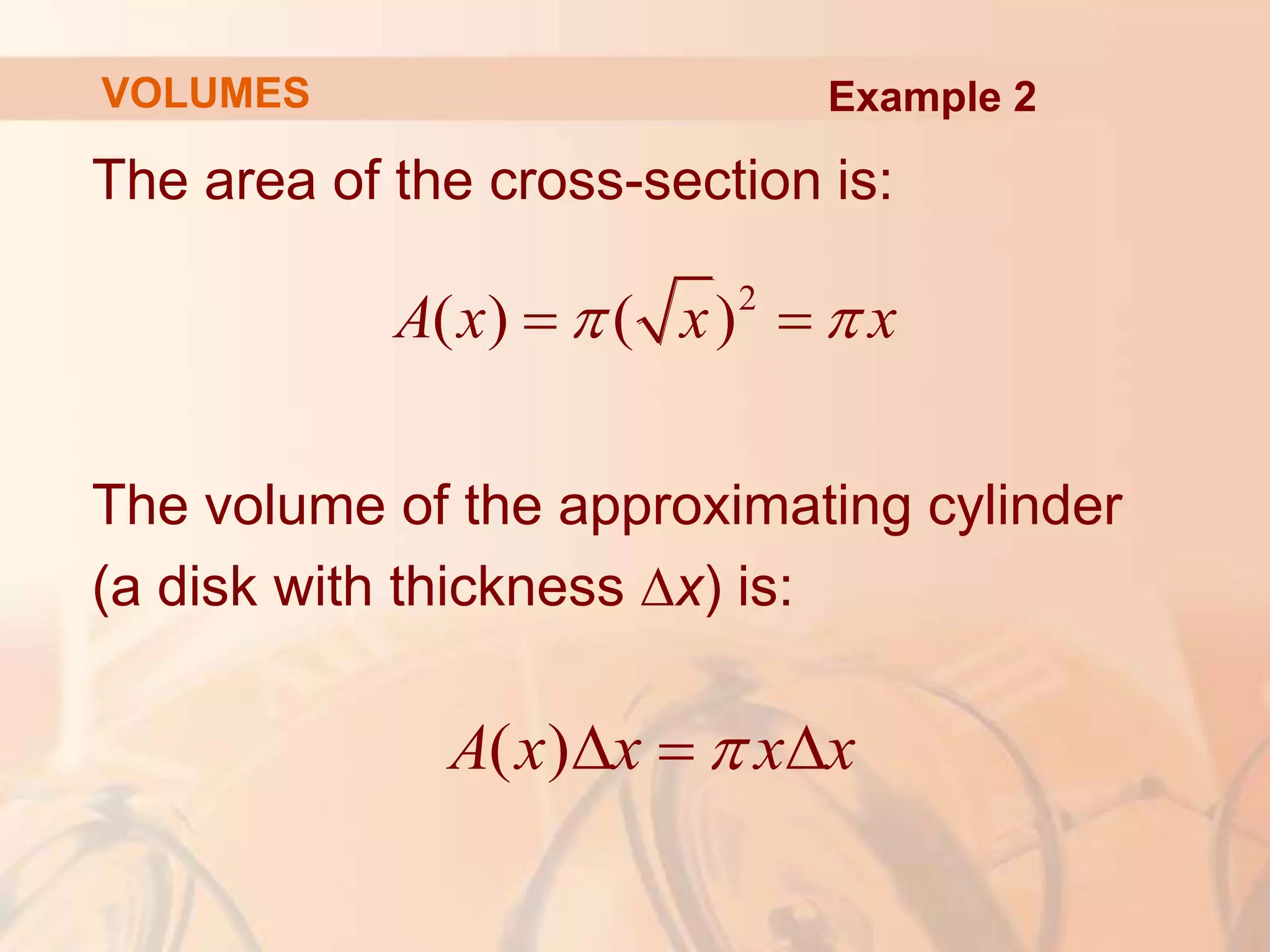
The area of the cross-section is:
The volume of the approximating cylinder
(a disk with thickness ∆x) is:
2
( ) ( )
A x x x
 
 
( )
A x x x x

  
Example 2
VOLUMES
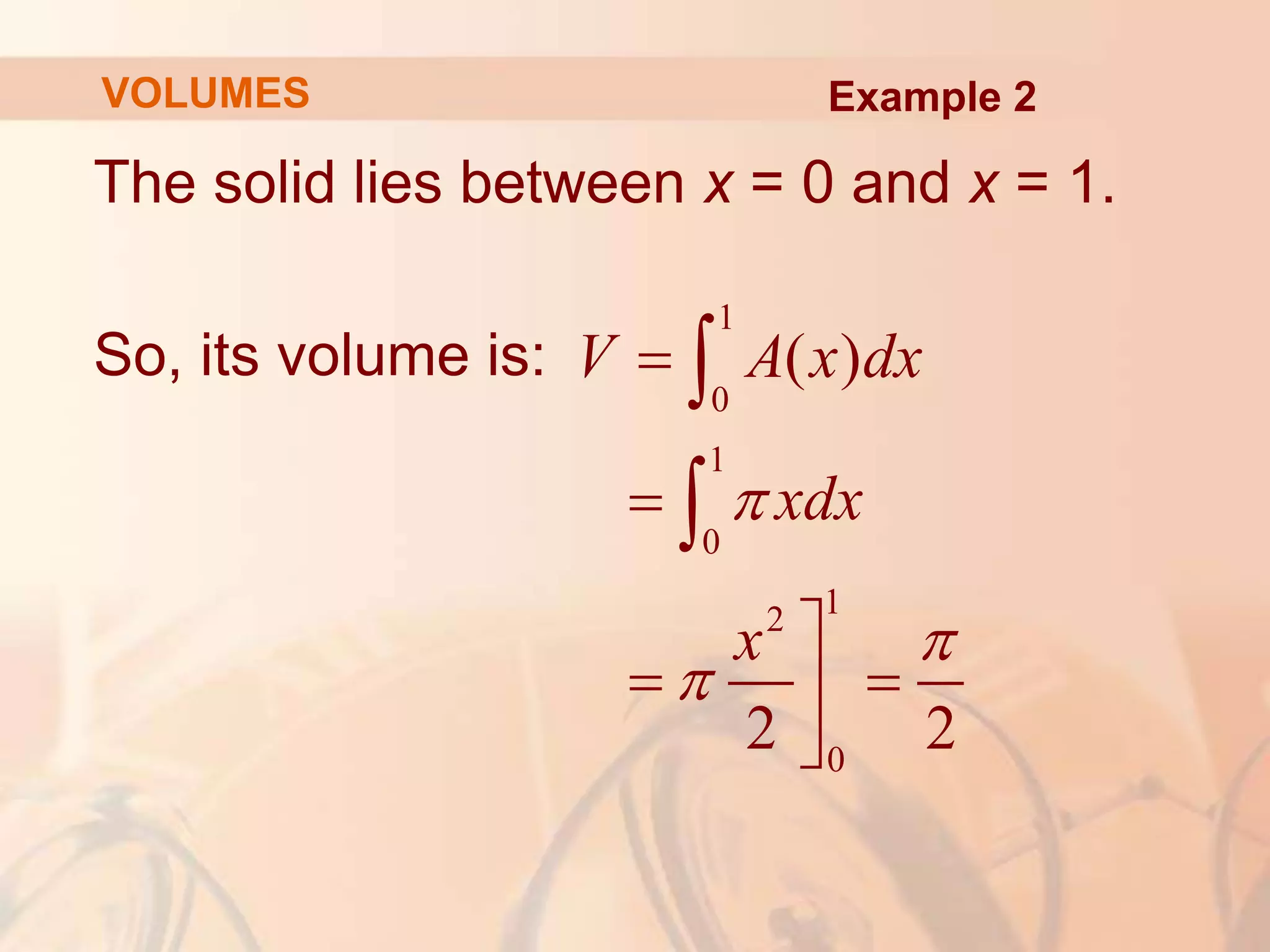
The solid lies between x = 0 and x = 1.
So, its volume is:
1
0
1
0
1
2
0
( )
2 2
V A x dx
xdx
x






 




VOLUMES Example 2
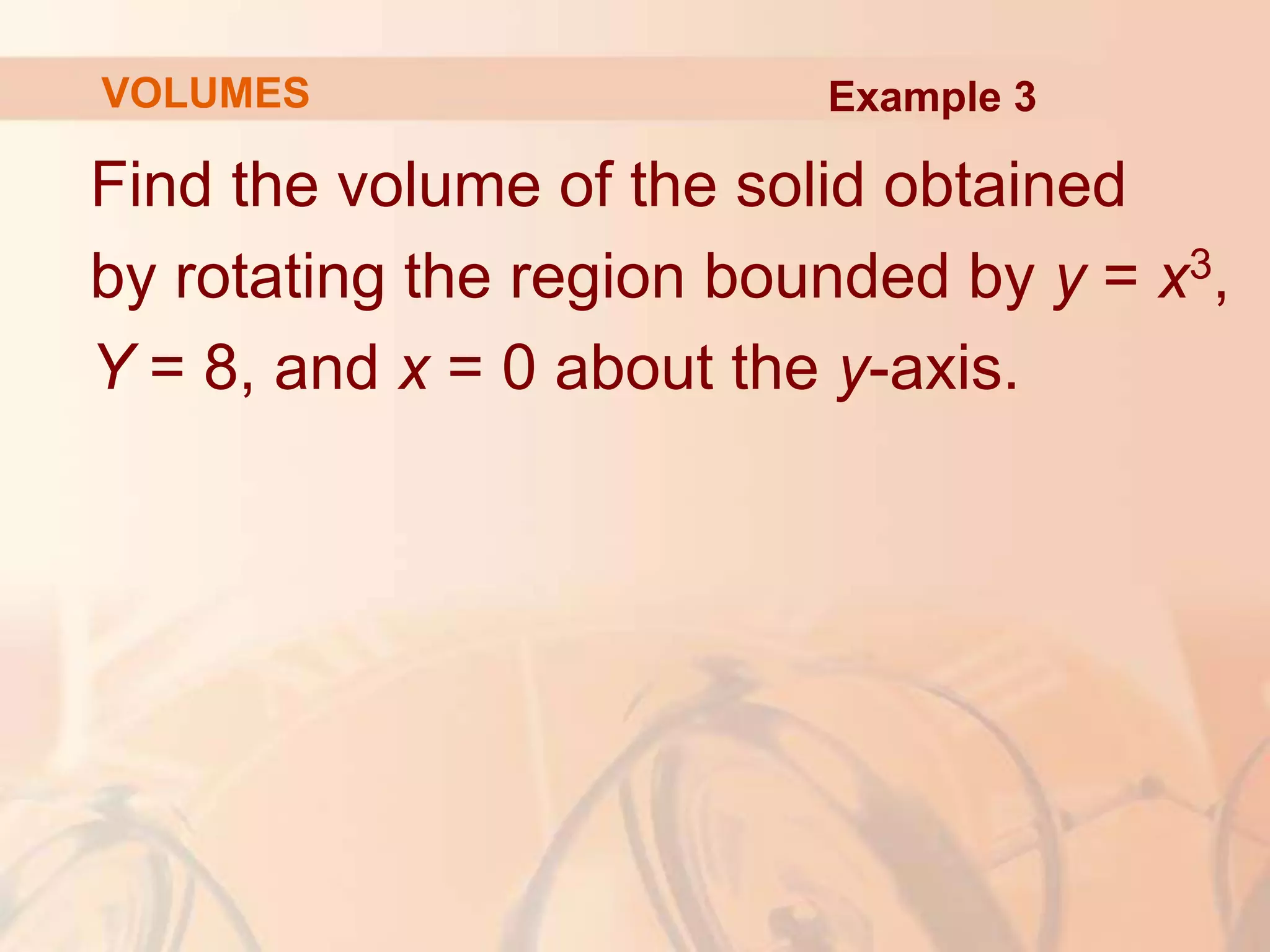
Find the volume of the solid obtained
by rotating the region bounded by y = x3,
Y = 8, and x = 0 about the y-axis.
Example 3
VOLUMES
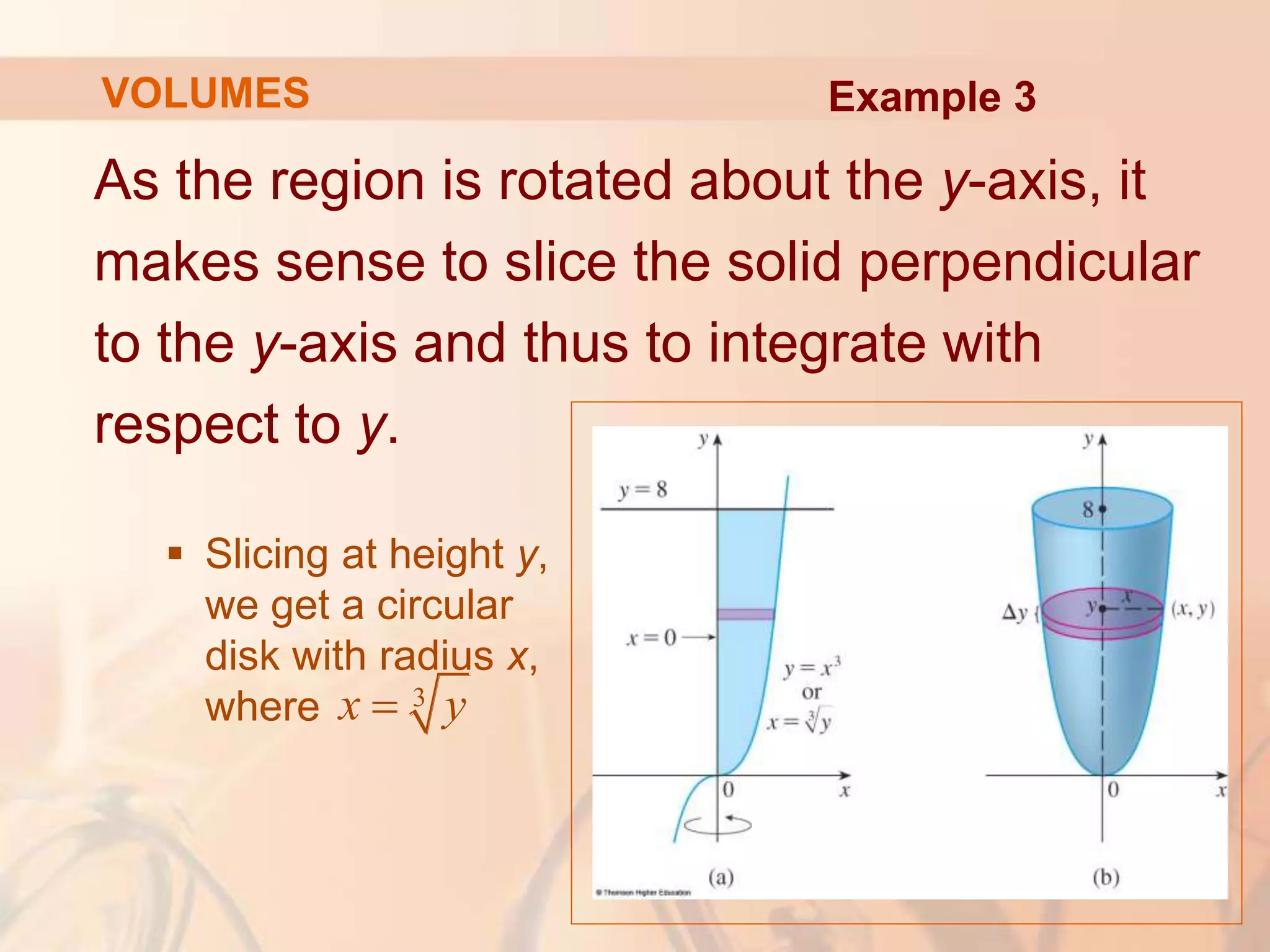
As the region is rotated about the y-axis, it
makes sense to slice the solid perpendicular
to the y-axis and thus to integrate with
respect to y.
 Slicing at height y,
we get a circular
disk with radius x,
where
VOLUMES Example 3
3
x y

So, the area of a cross-section through y is:
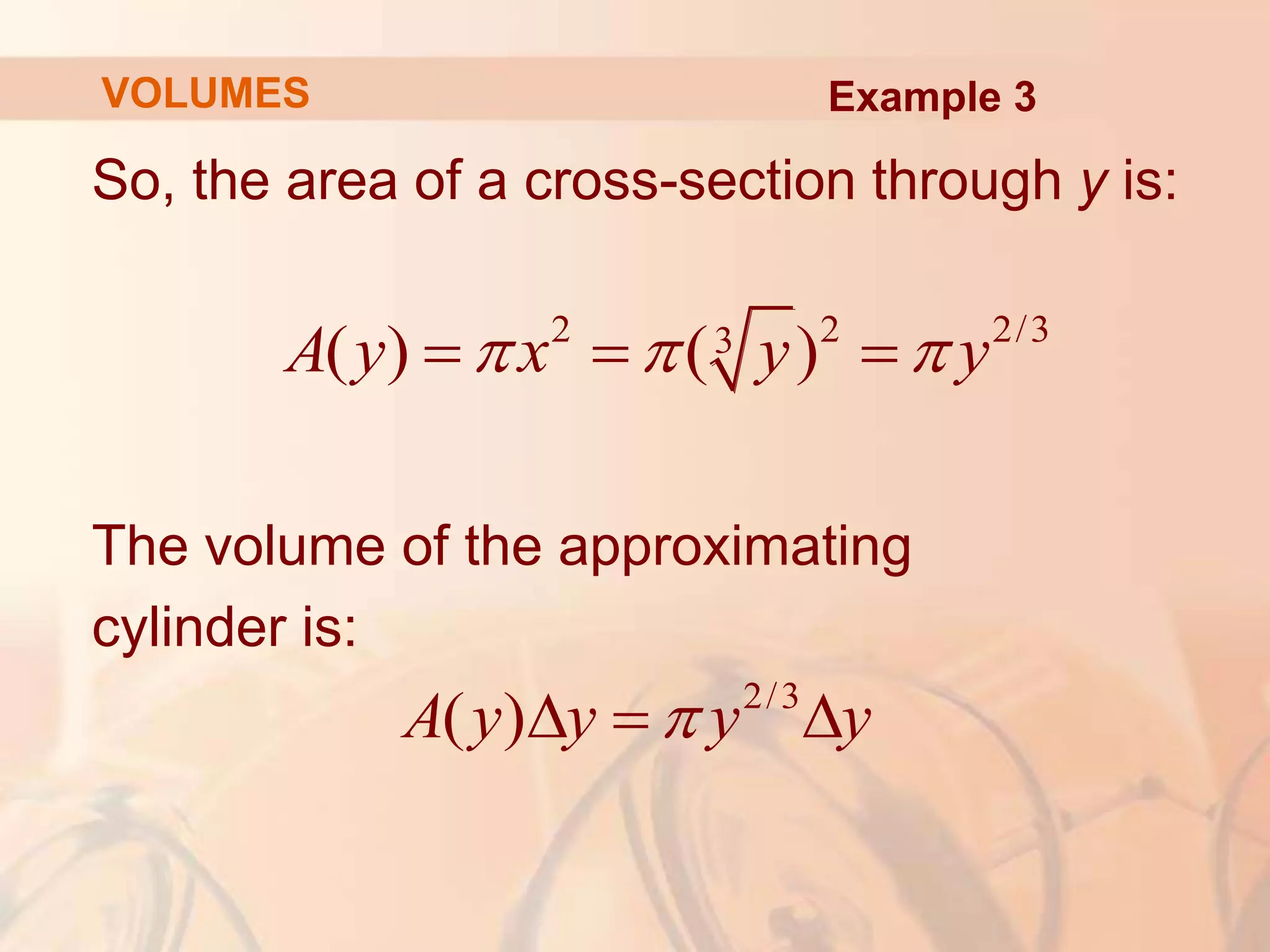
The volume of the approximating
cylinder is:
2 2 2/3
3
( ) ( )
A y x y y
  
  
2/3
( )
A y y y y

  
Example 3
VOLUMES
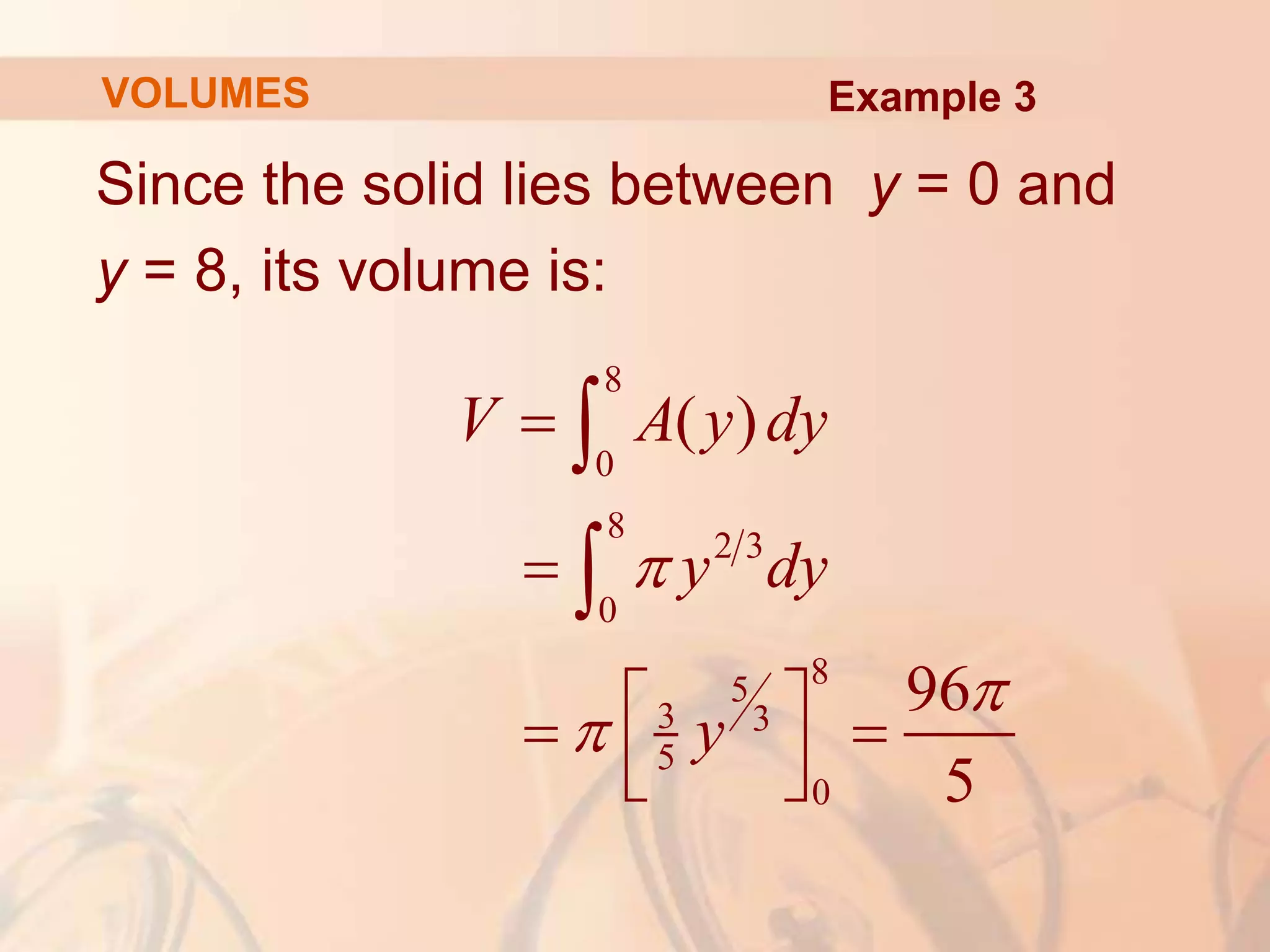
Since the solid lies between y = 0 and
y = 8, its volume is:
8
0
8
2 3
0
8
5
3 3
5
0
( )
96
5
V A y dy
y dy
y





 
 
 
 


Example 3
VOLUMES
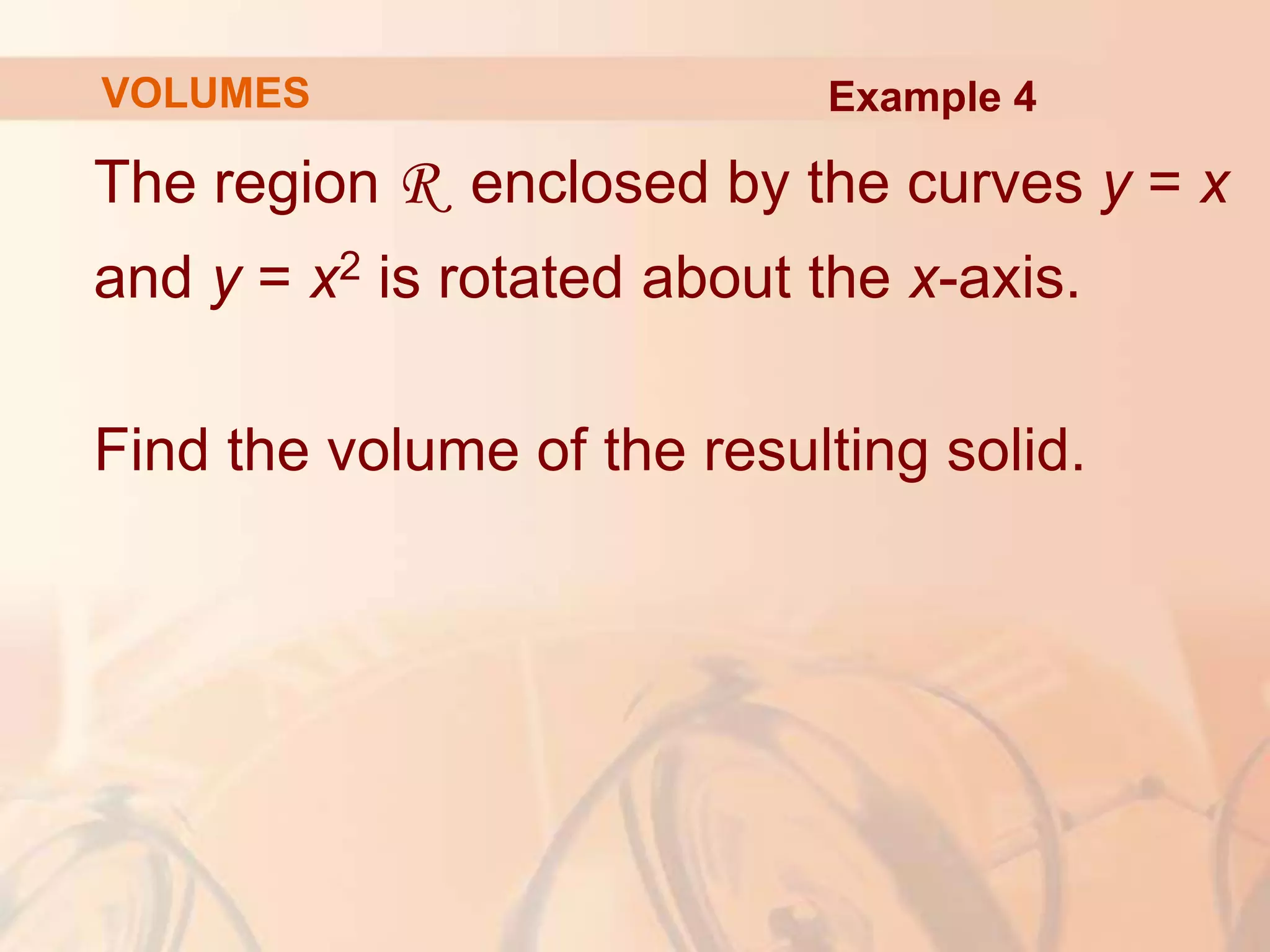
The region R enclosed by the curves y = x
and y = x2 is rotated about the x-axis.
Find the volume of the resulting solid.
Example 4
VOLUMES
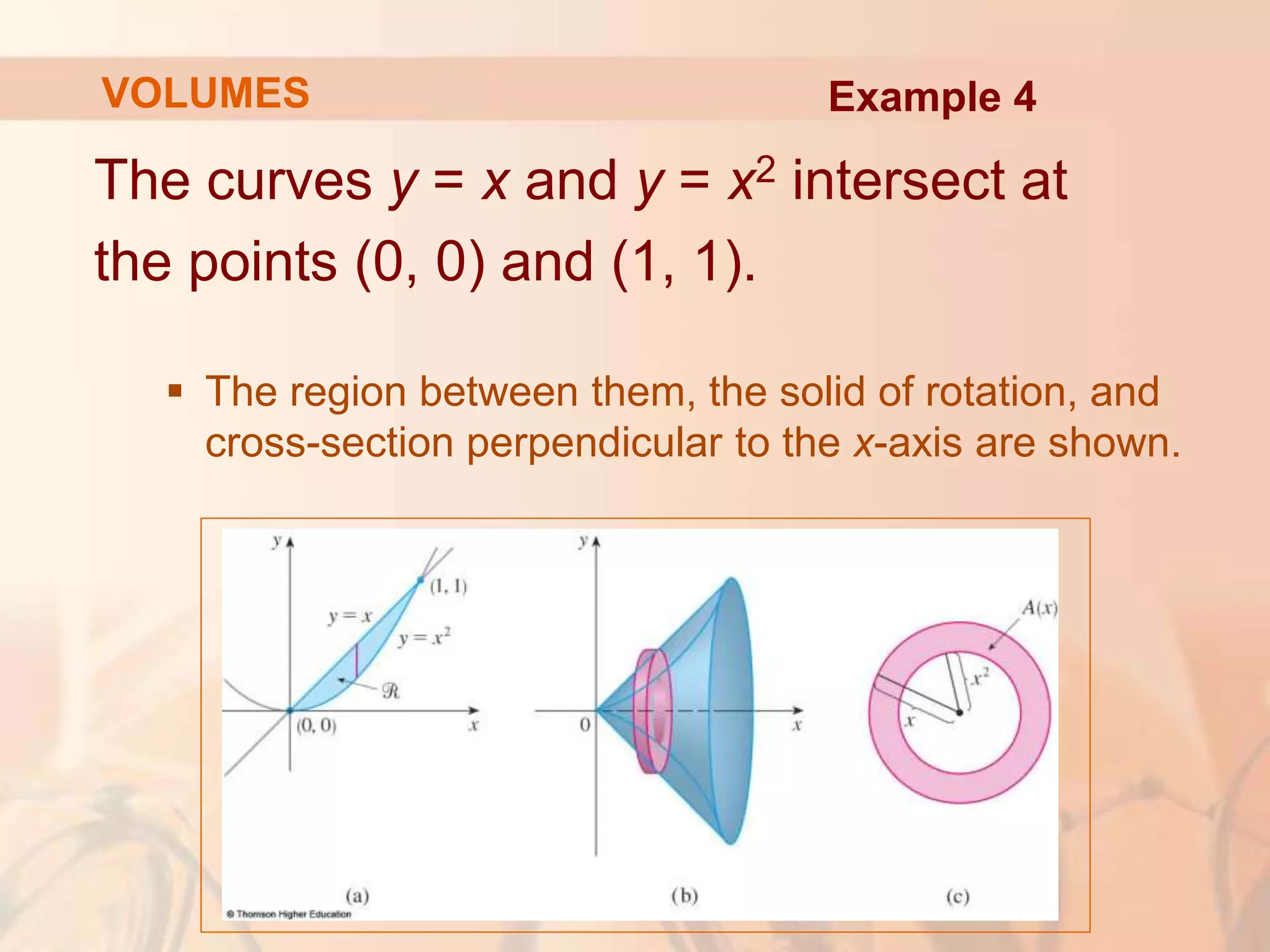
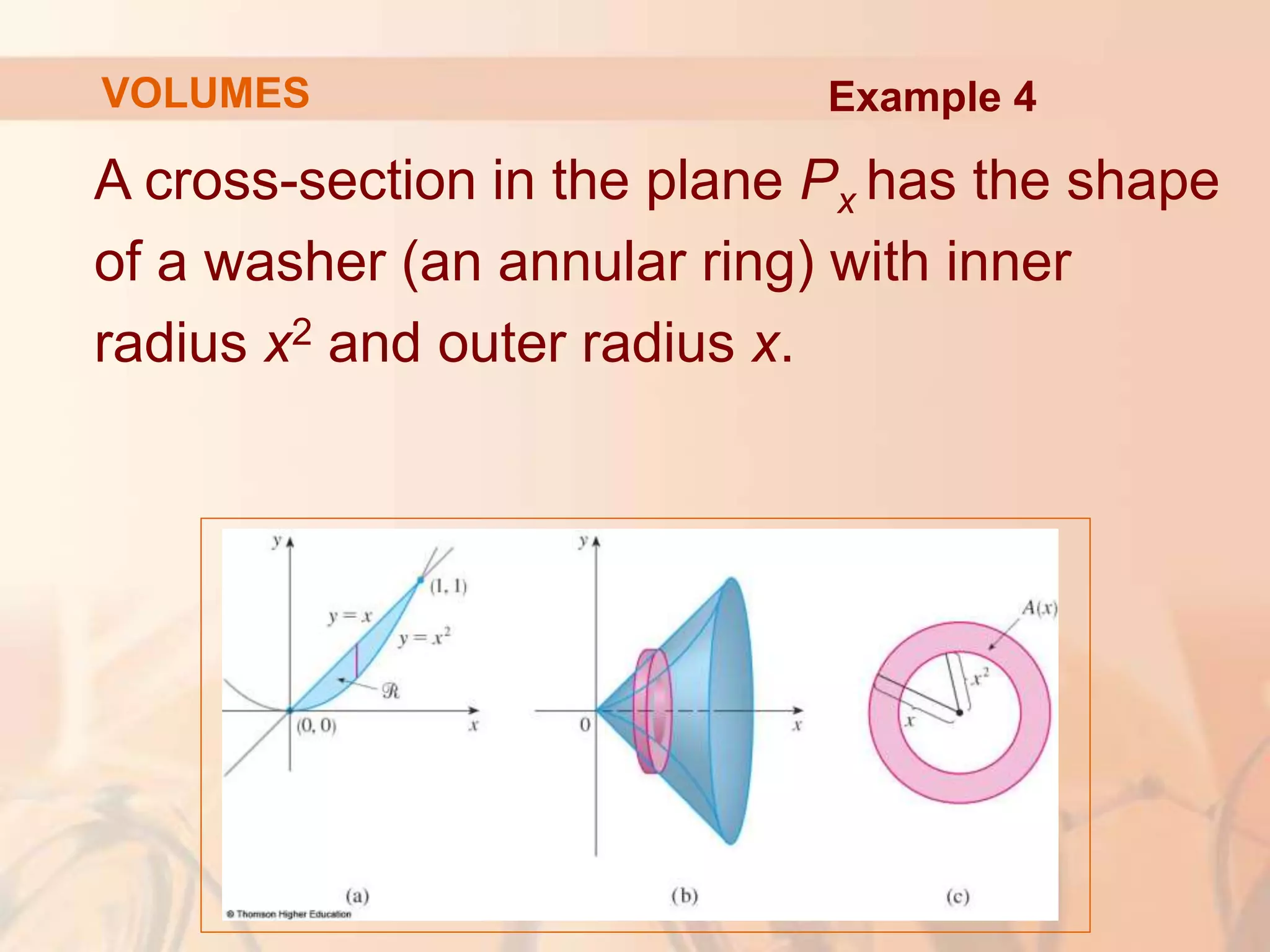
The curves y = x and y = x2 intersect at
the points (0, 0) and (1, 1).
 The region between them, the solid of rotation, and
cross-section perpendicular to the x-axis are shown.
VOLUMES Example 4
A cross-section in the plane Px has the shape
of a washer (an annular ring) with inner
radius x2 and outer radius x.
Example 4
VOLUMES
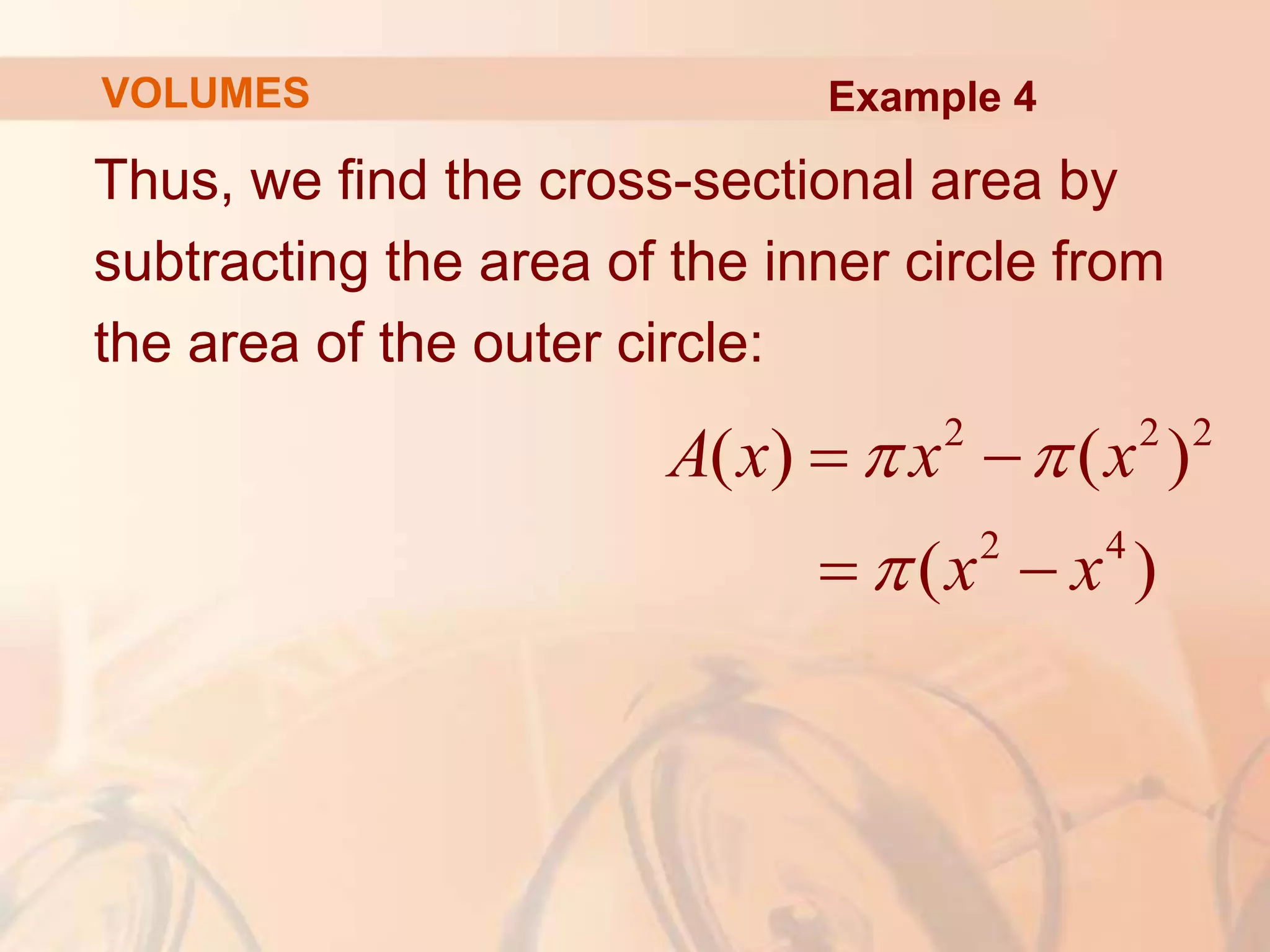
Thus, we find the cross-sectional area by
subtracting the area of the inner circle from
the area of the outer circle:
2 2 2
2 4
( ) ( )
( )
A x x x
x x
 

 
 
VOLUMES Example 4
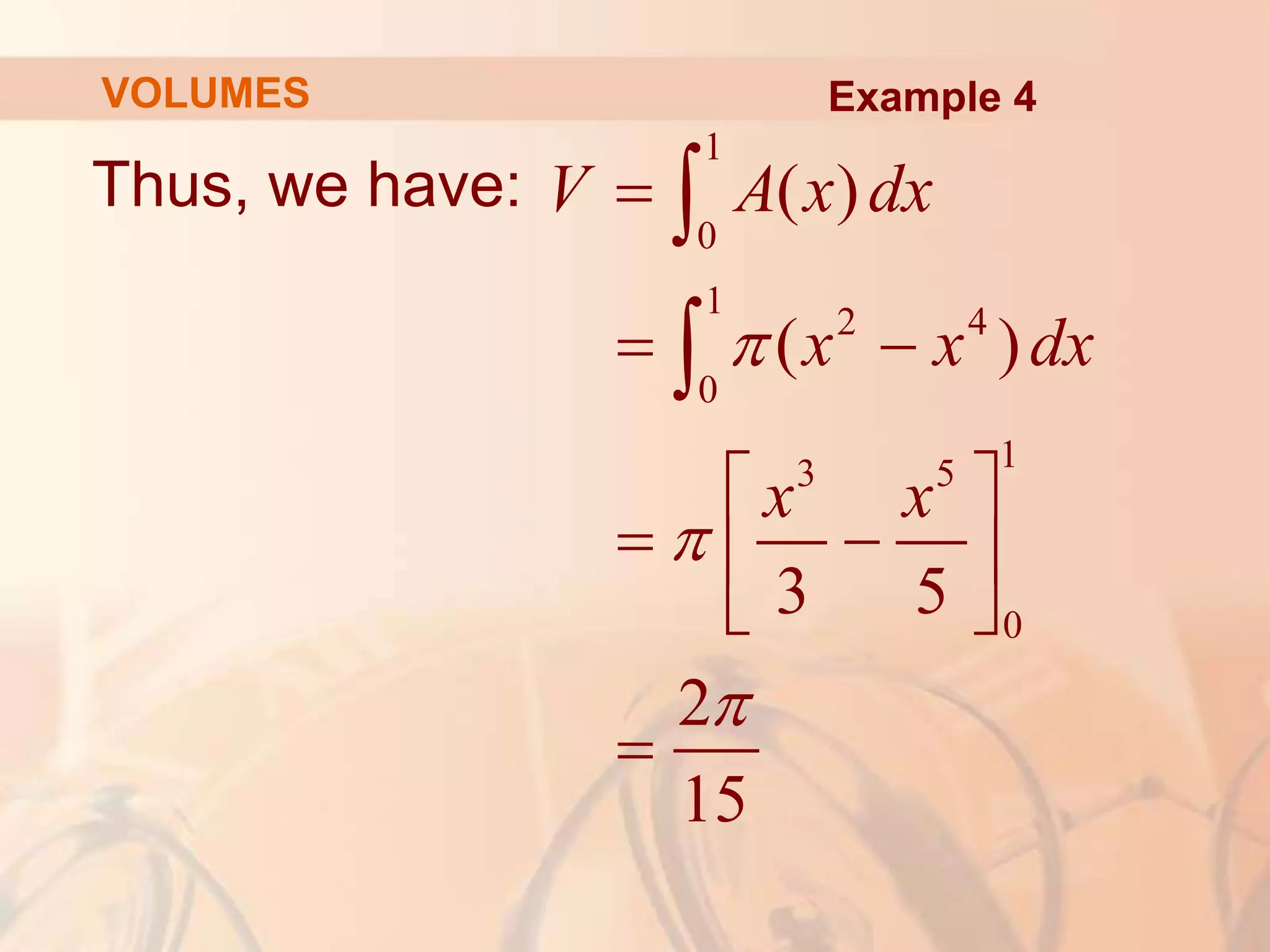
Thus, we have:
1
0
1
2 4
0
1
3 5
0
( )
( )
3 5
2
15
V A x dx
x x dx
x x




 
 
 
 
 



Example 4
VOLUMES
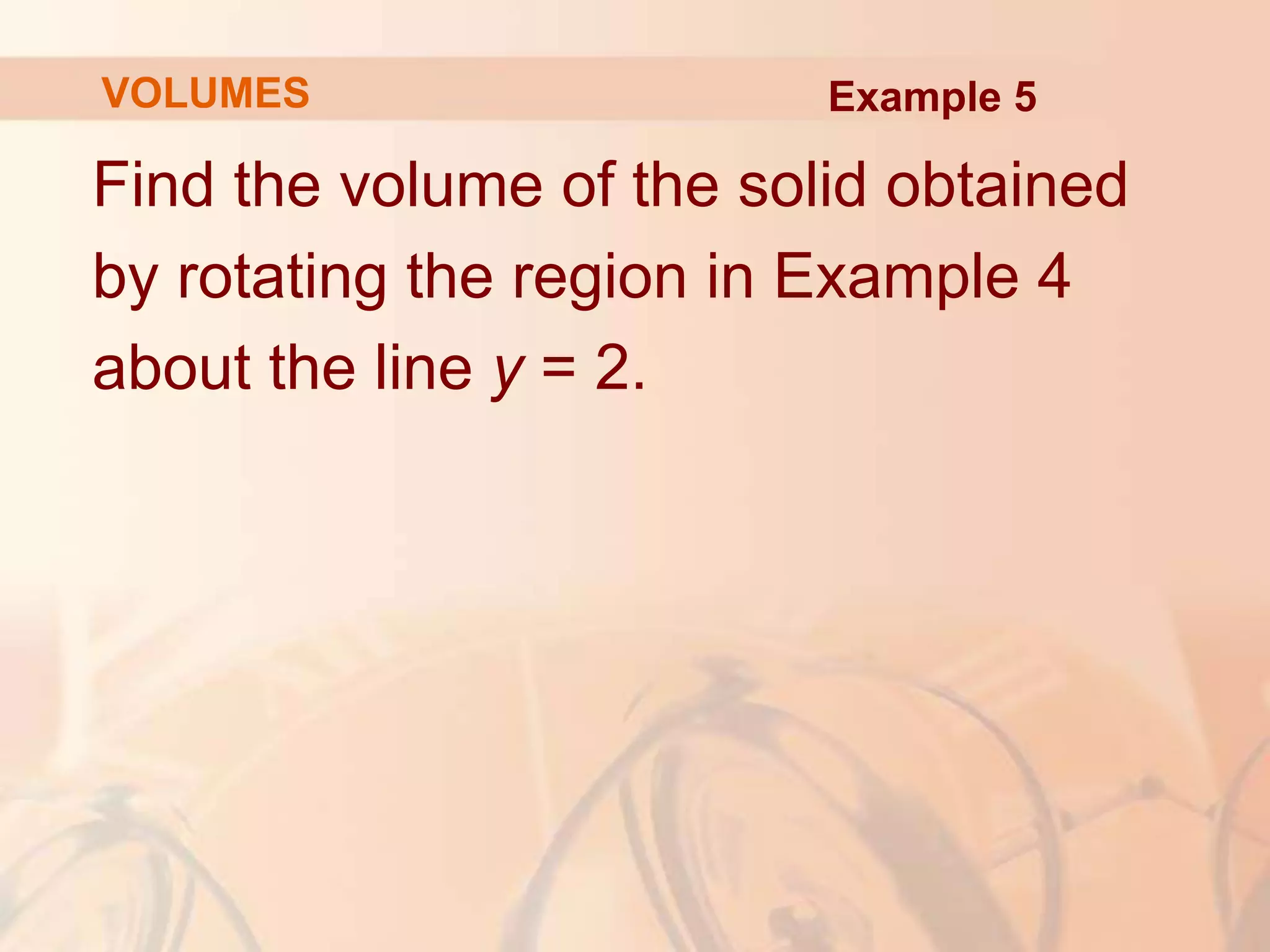
Find the volume of the solid obtained
by rotating the region in Example 4
about the line y = 2.
Example 5
VOLUMES
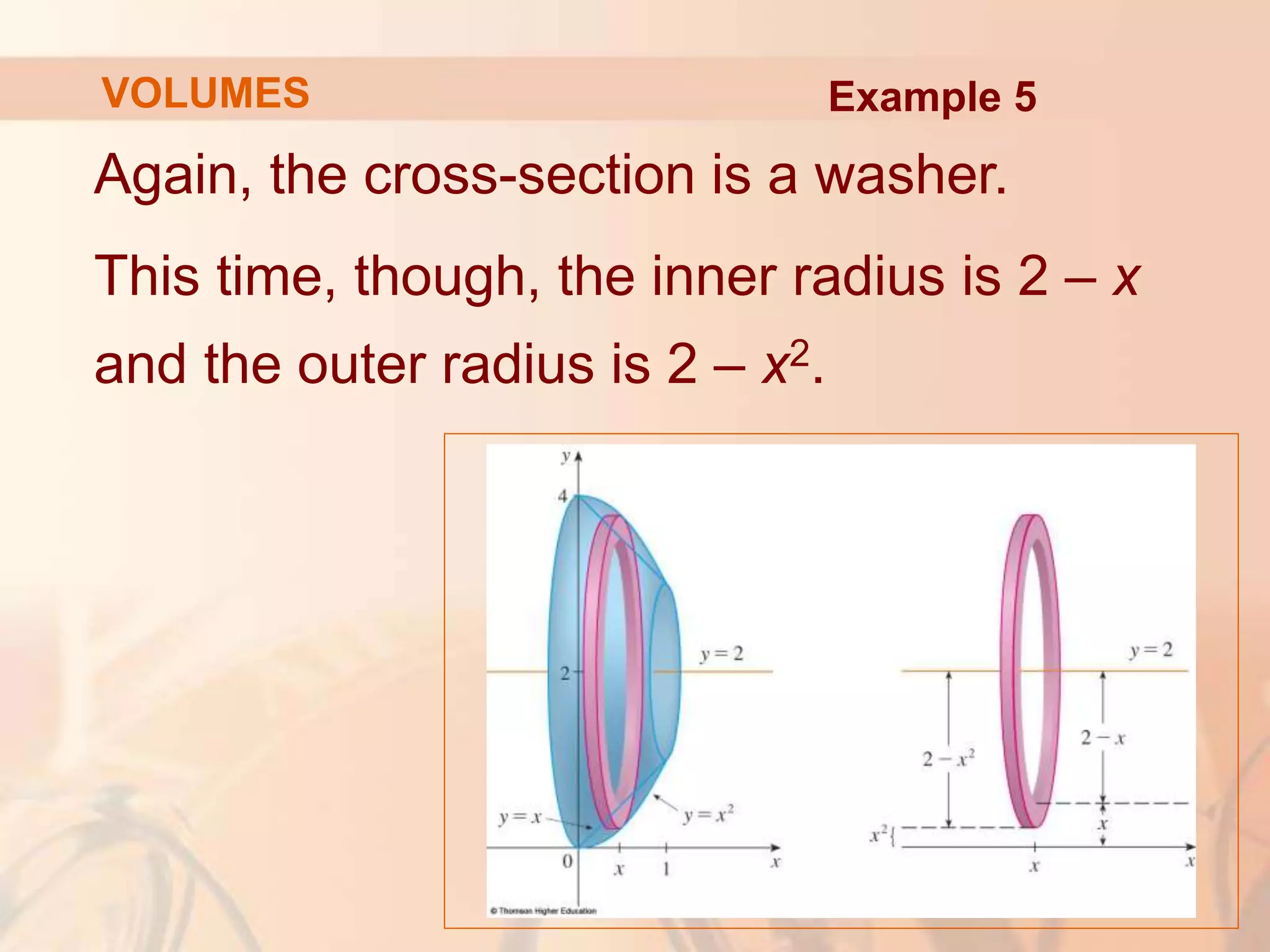
Again, the cross-section is a washer.
This time, though, the inner radius is 2 – x
and the outer radius is 2 – x2.
VOLUMES Example 5
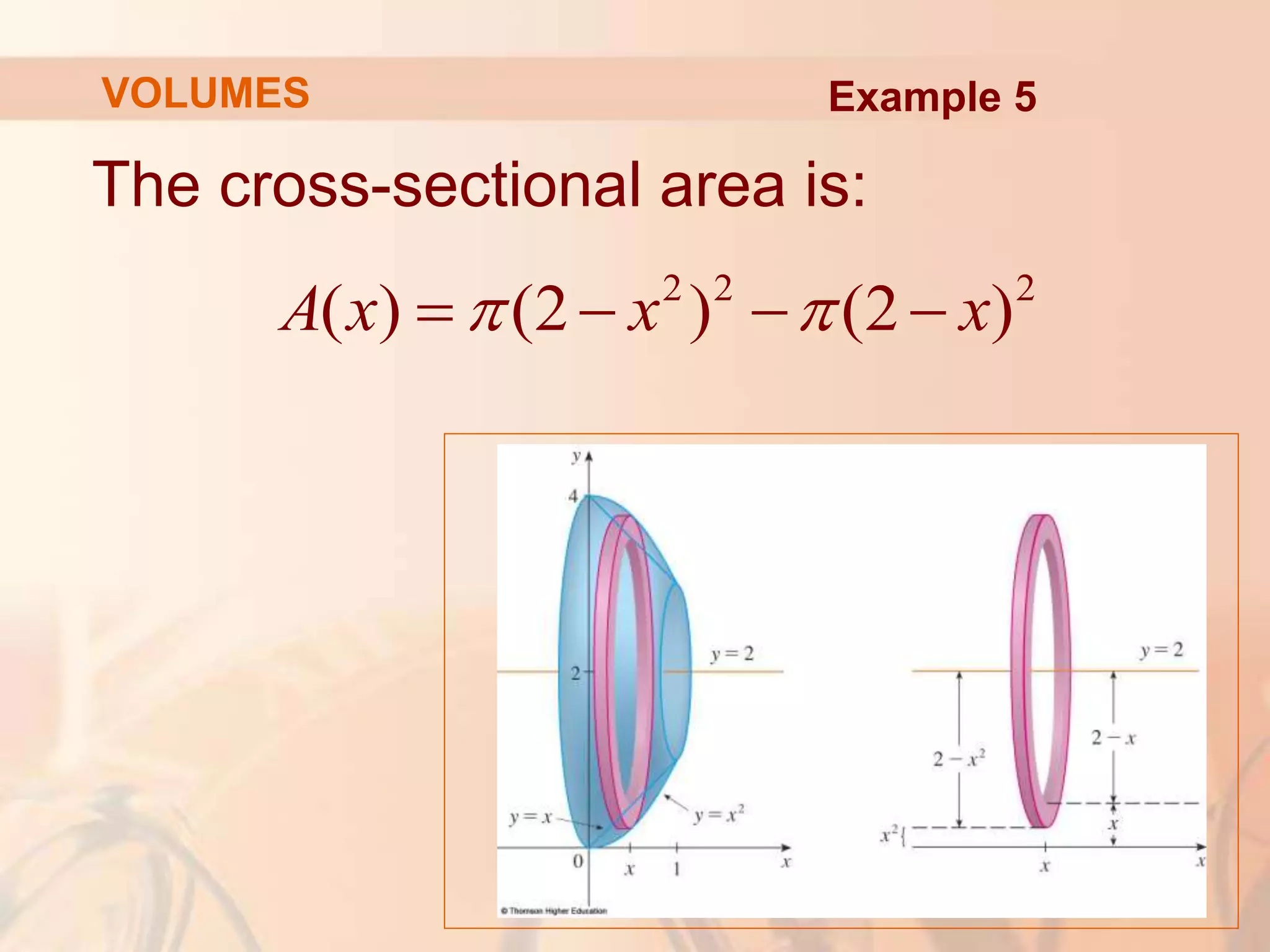
The cross-sectional area is:
2 2 2
( ) (2 ) (2 )
A x x x
 
   
Example 5
VOLUMES
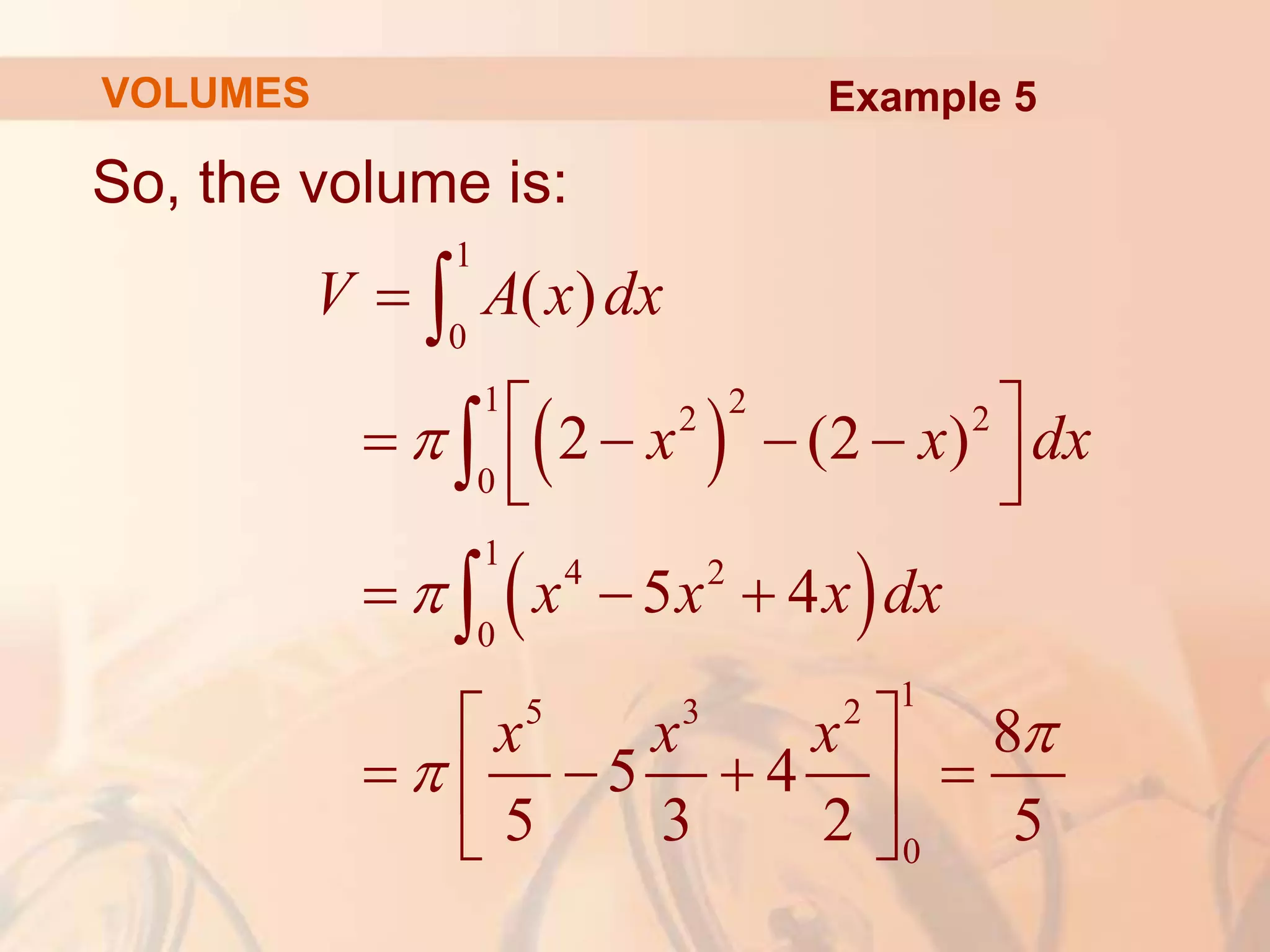
So, the volume is:
 
 
1
0
1 2
2 2
0
1
4 2
0
1
5 3 2
0
( )
2 (2 )
5 4
8
5 4
5 3 2 5





 
   
 
 
  
 
   
 
 



V A x dx
x x dx
x x x dx
x x x
VOLUMES Example 5
The solids in Examples 1–5 are all
called solids of revolution because
they are obtained by revolving a region
about a line.
SOLIDS OF REVOLUTION
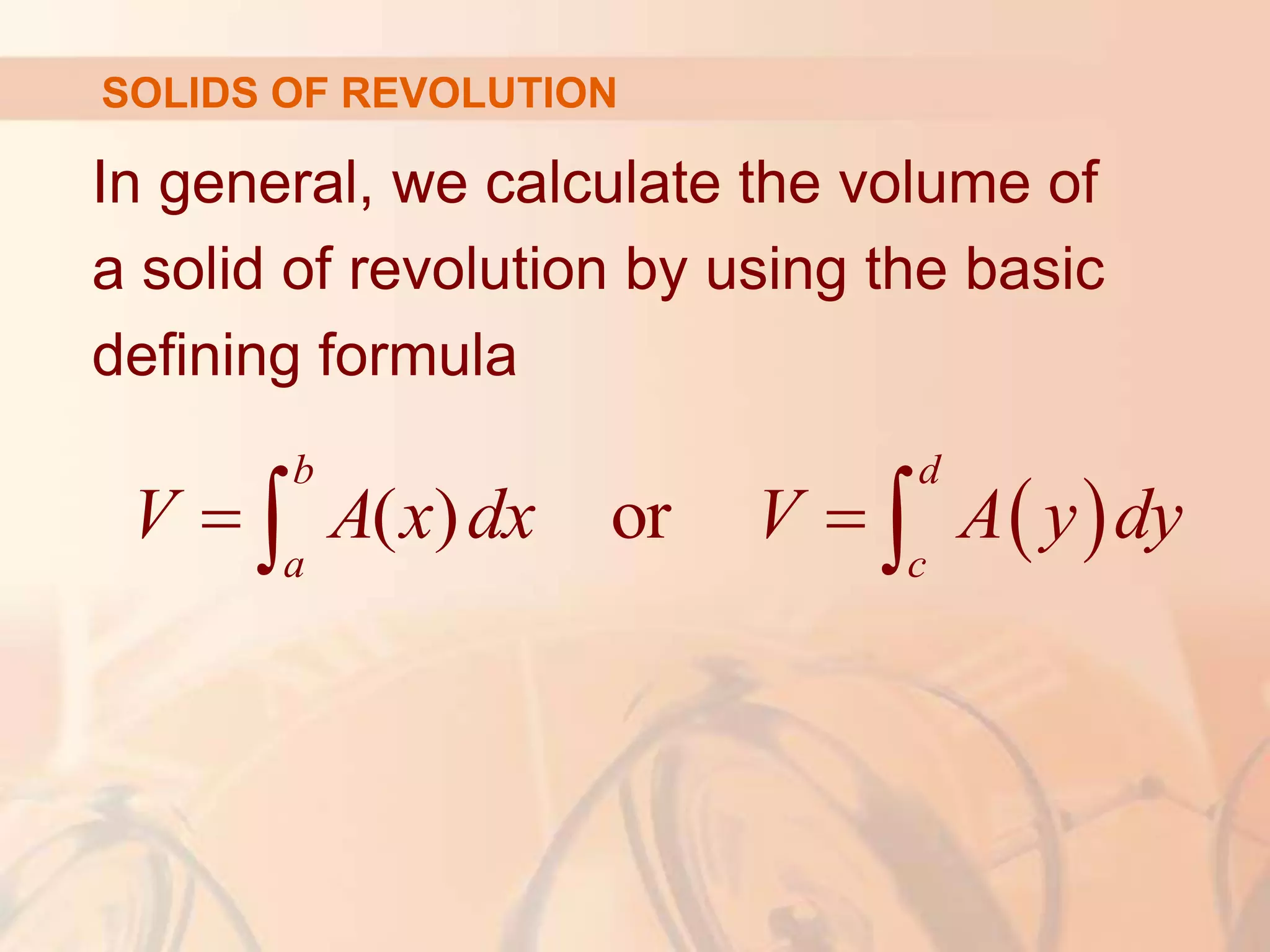
In general, we calculate the volume of
a solid of revolution by using the basic
defining formula
 
( ) or
b d
a c
V A x dx V A y dy
 
 
SOLIDS OF REVOLUTION
We find the cross-sectional area
A(x) or A(y) in one of the following
two ways.
SOLIDS OF REVOLUTION
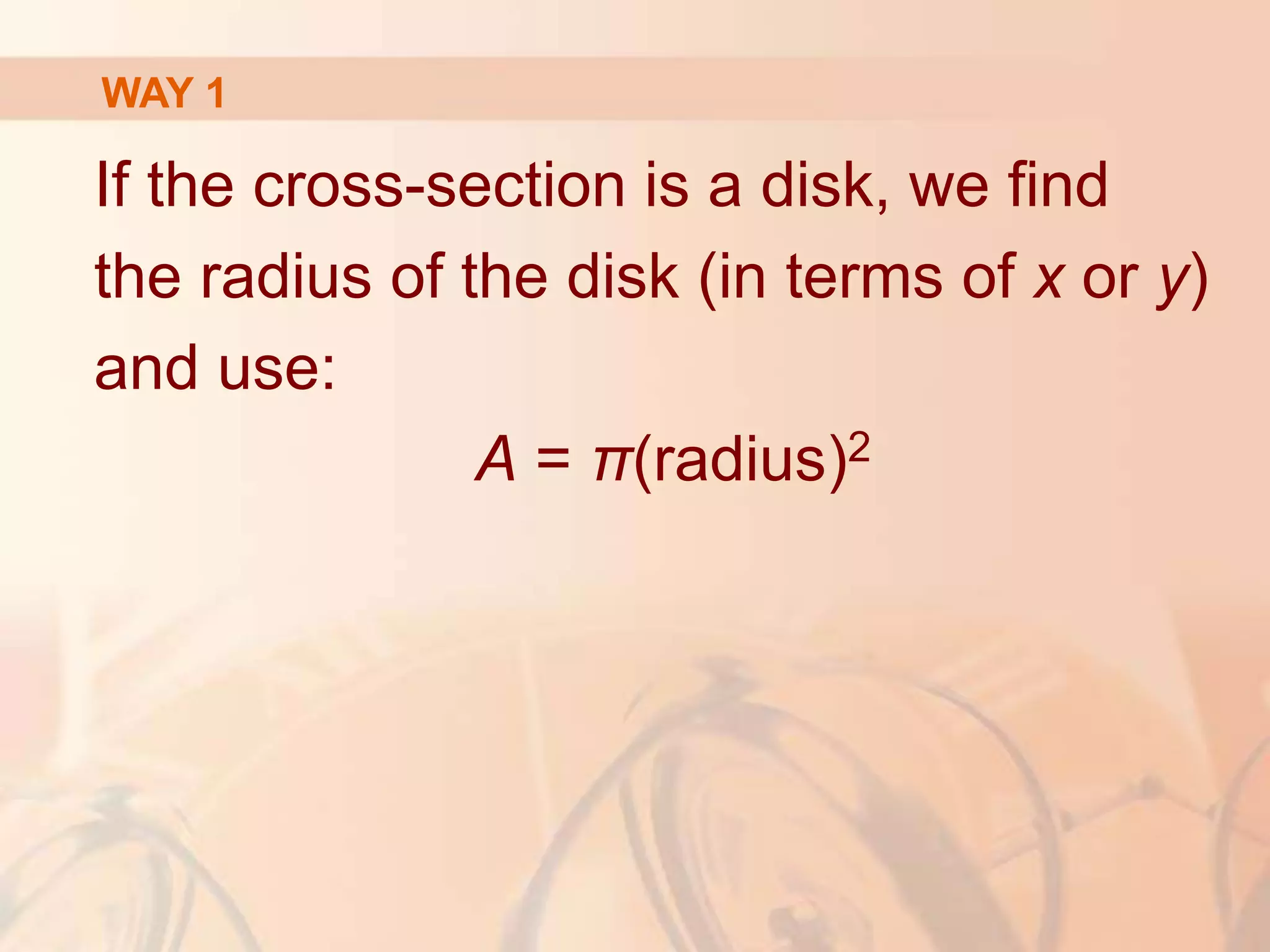
If the cross-section is a disk, we find
the radius of the disk (in terms of x or y)
and use:
A = π(radius)2
WAY 1
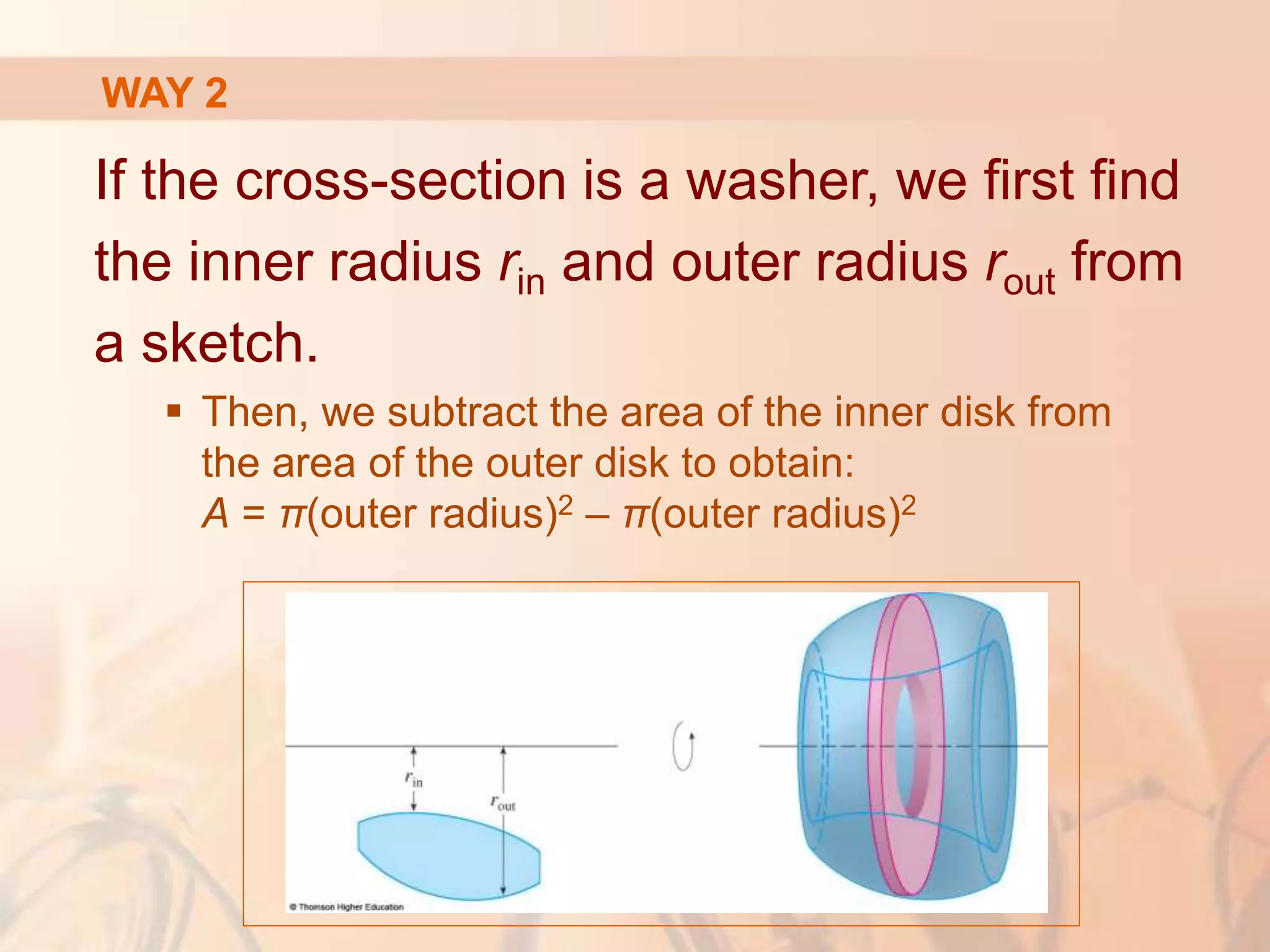
If the cross-section is a washer, we first find
the inner radius rin and outer radius rout from
a sketch.
 Then, we subtract the area of the inner disk from
the area of the outer disk to obtain:
A = π(outer radius)2 – π(outer radius)2
WAY 2
Find the volume of the solid obtained
by rotating the region in Example 4
about the line x = -1.
Example 6
SOLIDS OF REVOLUTION
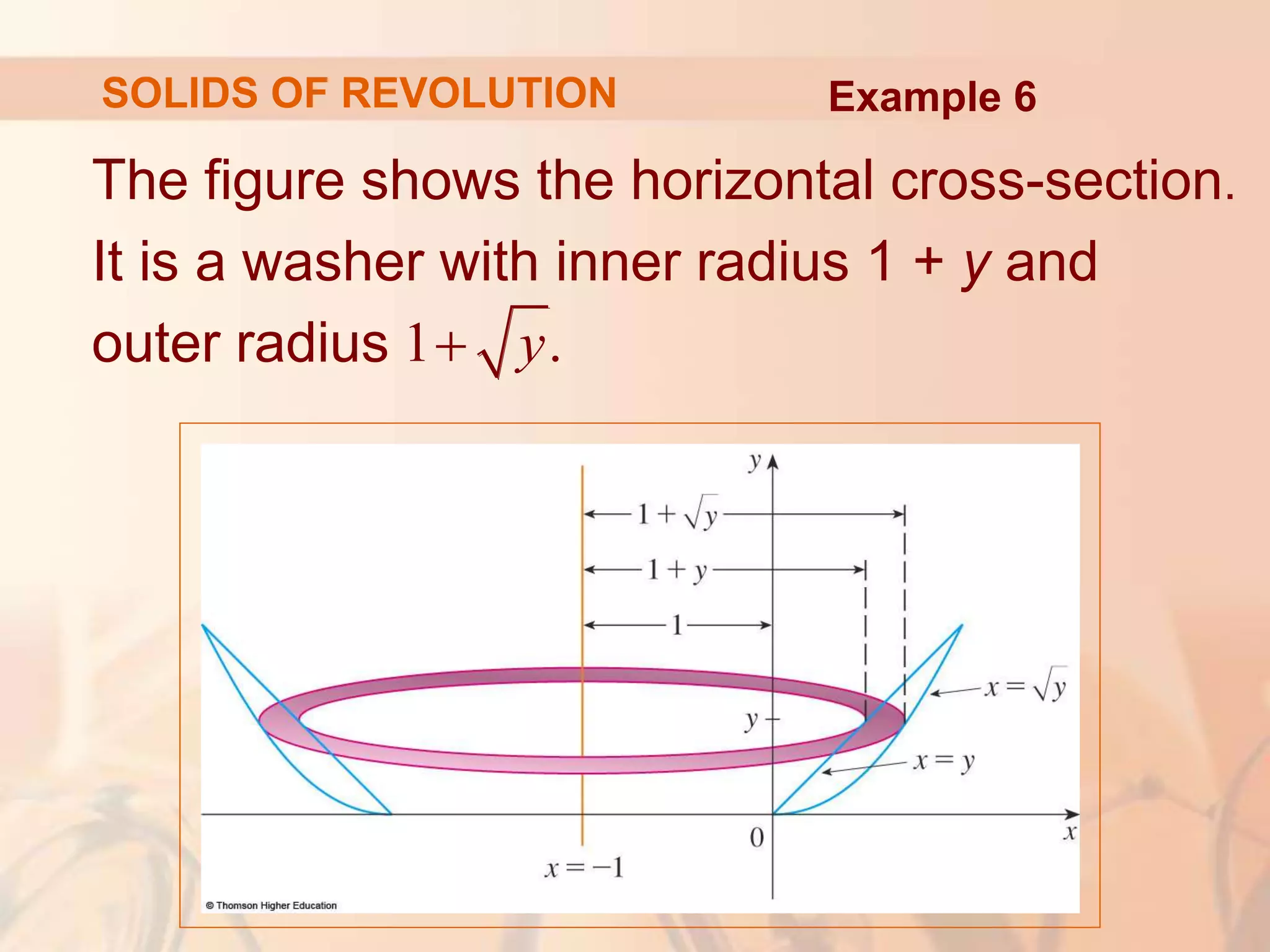
The figure shows the horizontal cross-section.
It is a washer with inner radius 1 + y and
outer radius
Example 6
1 .
y

SOLIDS OF REVOLUTION
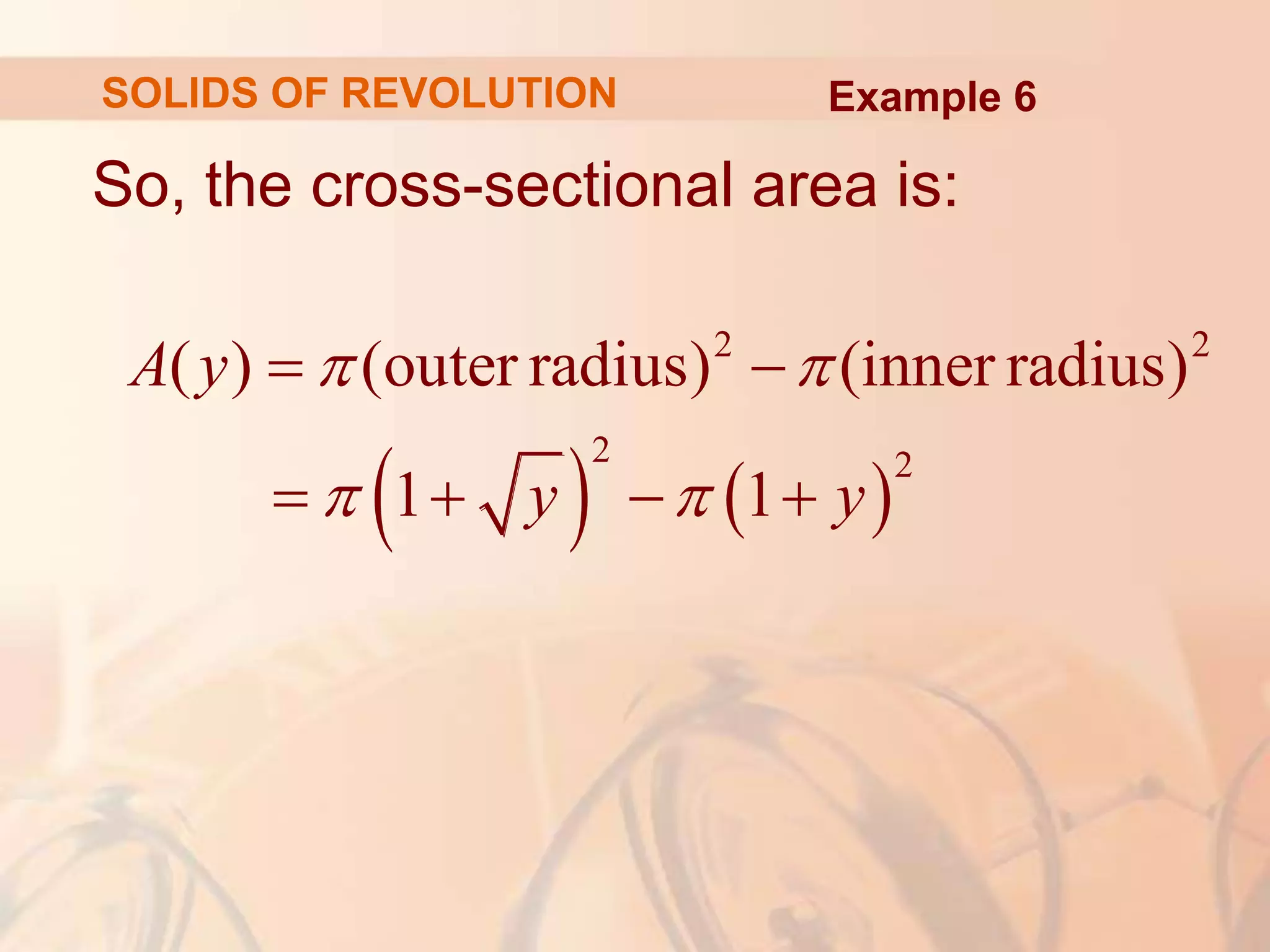
So, the cross-sectional area is:
   
2 2
2 2
( ) (outer radius) (inner radius)
1 1
A y
y y
 
 
 
   
Example 6
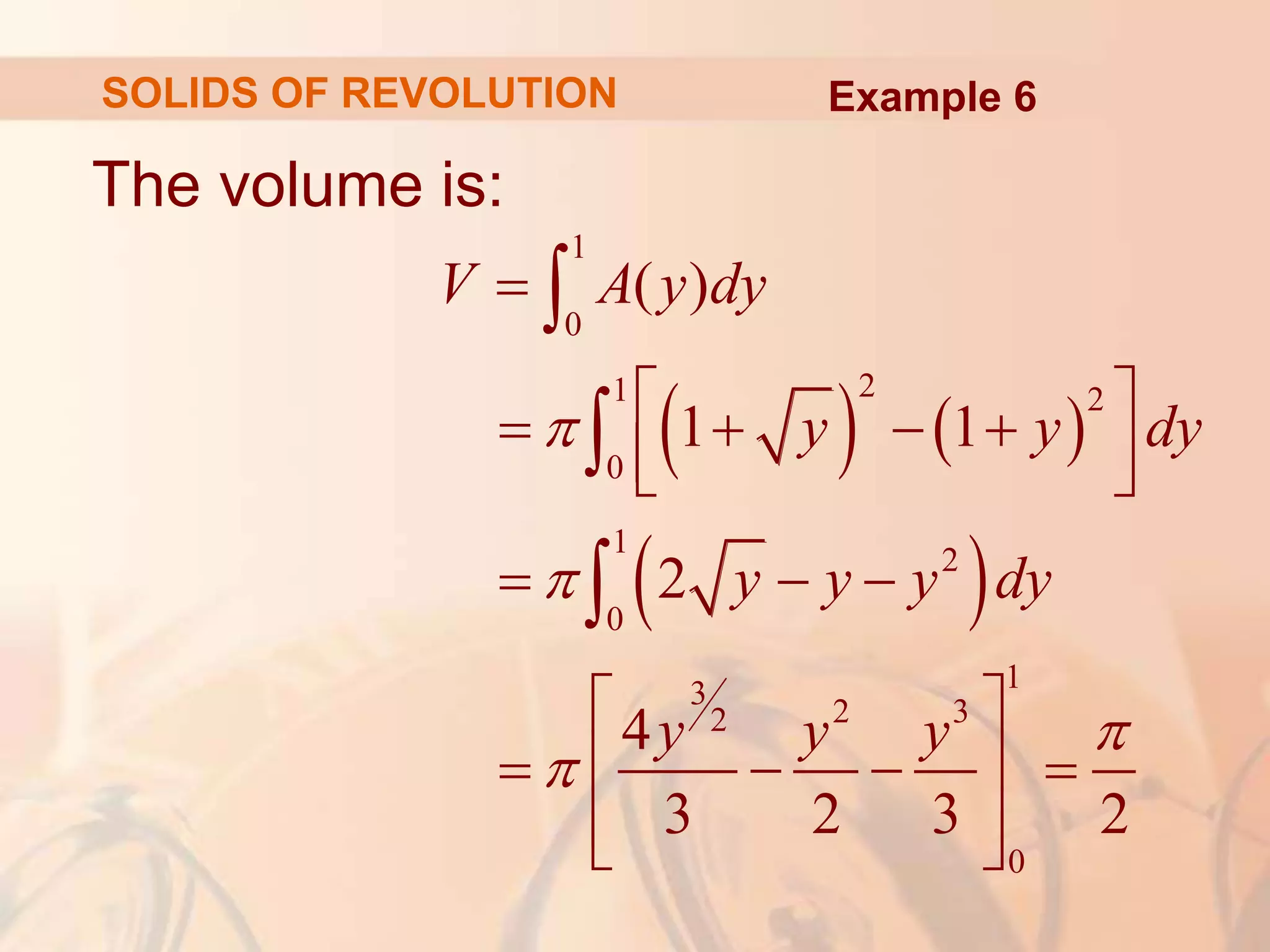
SOLIDS OF REVOLUTION
The volume is:
   
 
1
0
2
1 2
0
1
2
0
1
3
2 3
2
0
( )
1 1
2
4
3 2 3 2
V A y dy
y y dy
y y y dy
y y y





 
   
 
 
  
 
 
   
 
 



Example 6
SOLIDS OF REVOLUTION
In the following examples, we find
the volumes of three solids that are
not solids of revolution.
VOLUMES
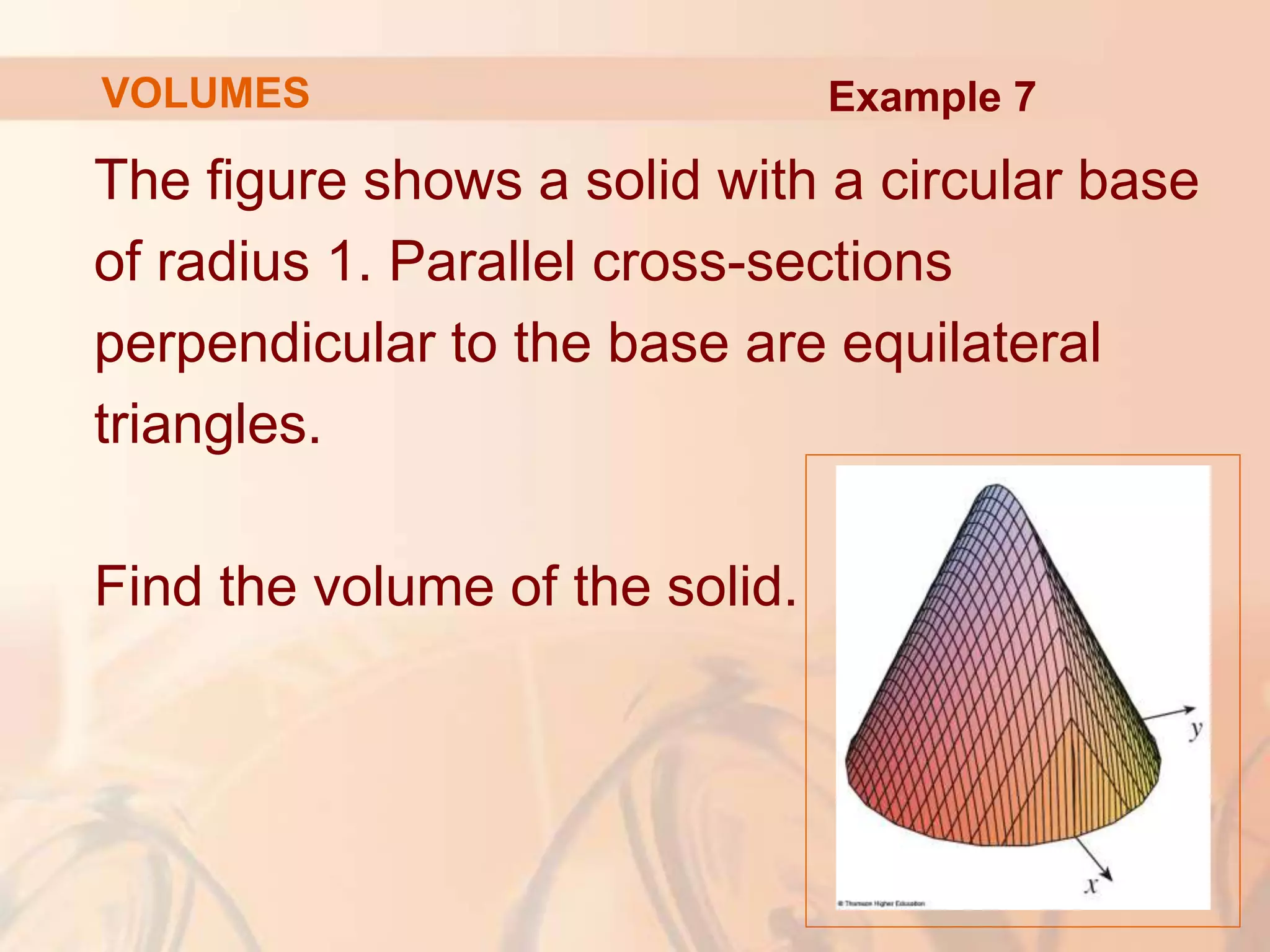
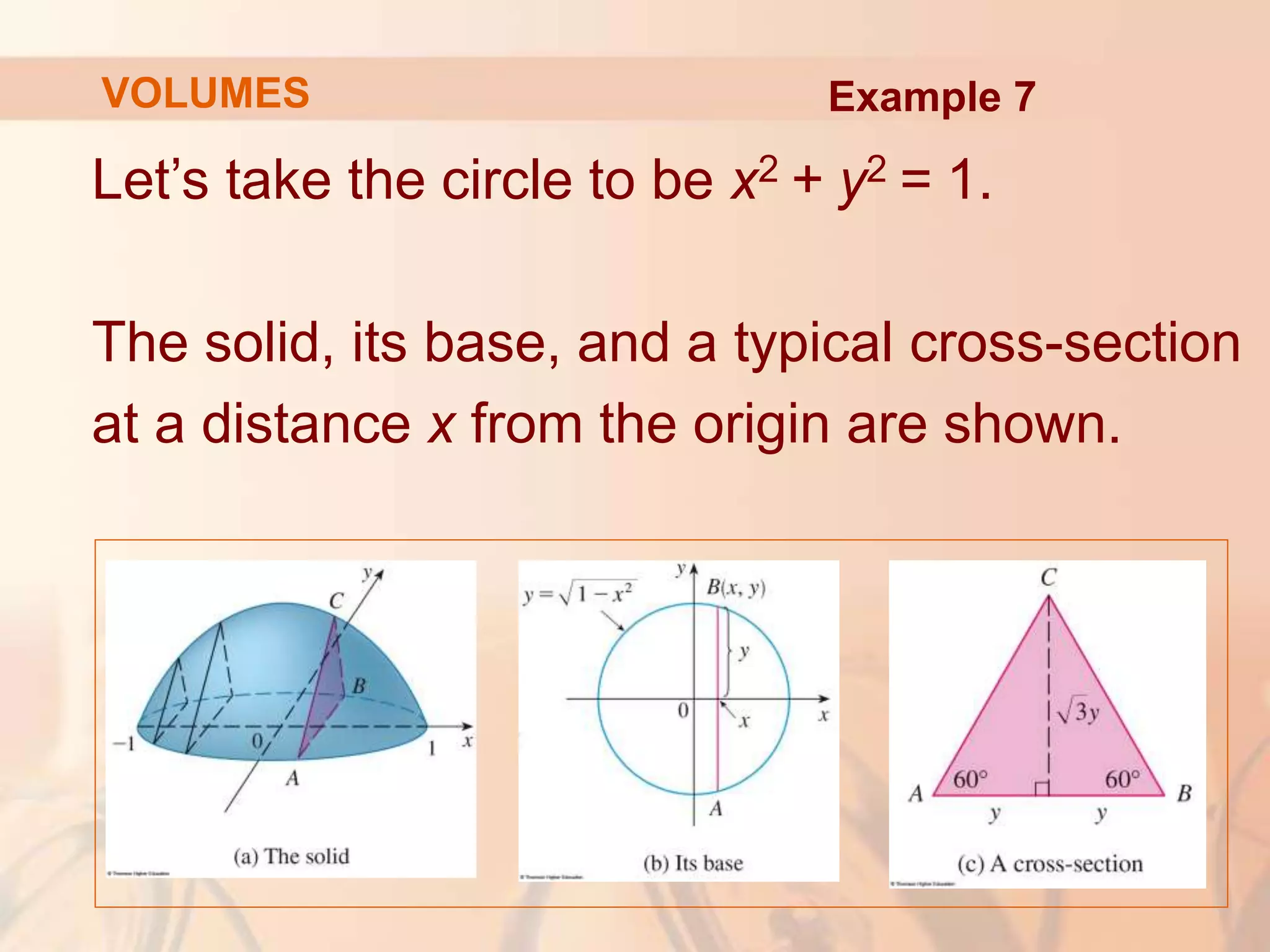
The figure shows a solid with a circular base
of radius 1. Parallel cross-sections
perpendicular to the base are equilateral
triangles.
Find the volume of the solid.
Example 7
VOLUMES
Let’s take the circle to be x2 + y2 = 1.
The solid, its base, and a typical cross-section
at a distance x from the origin are shown.
Example 7
VOLUMES
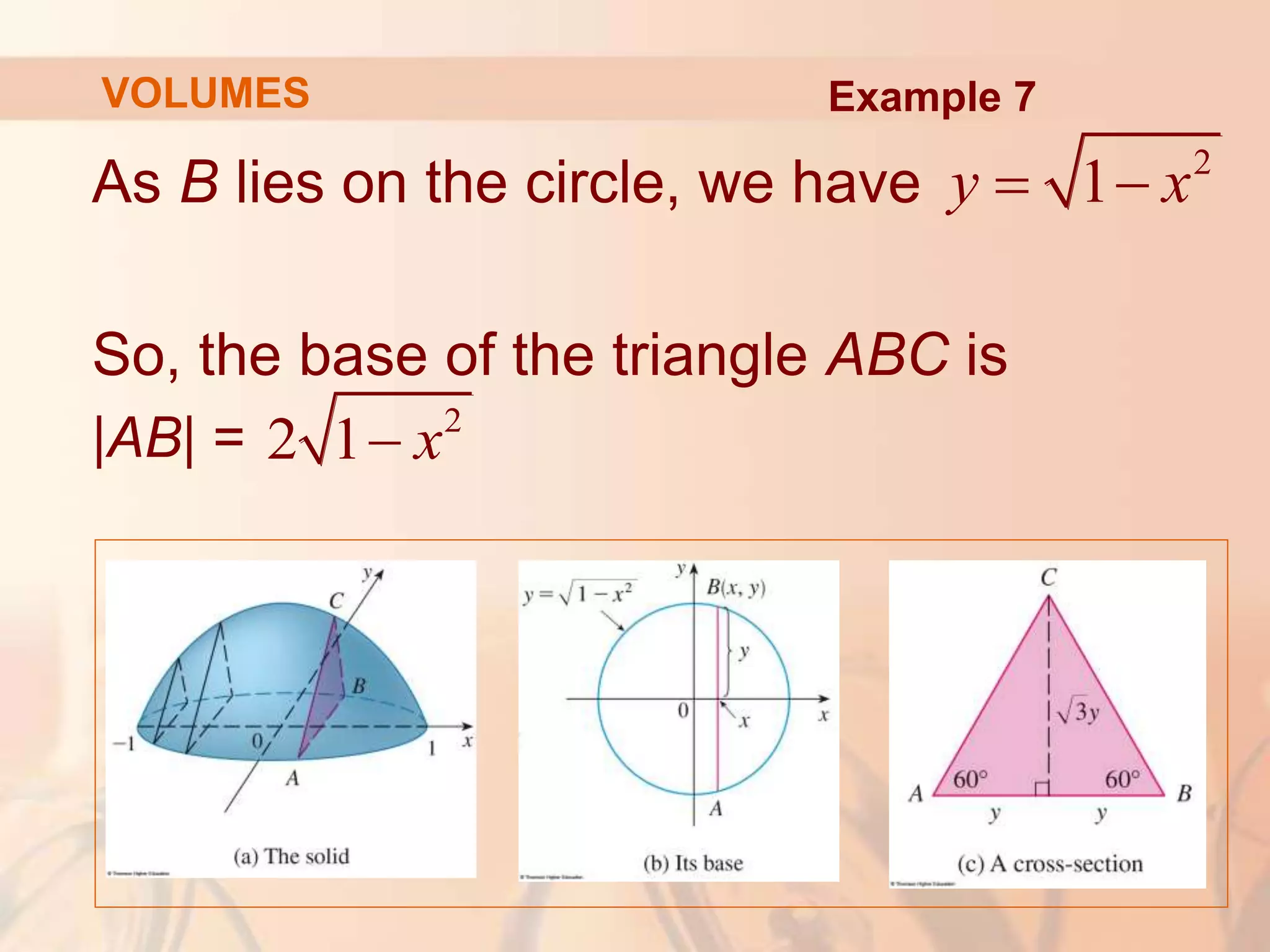
As B lies on the circle, we have
So, the base of the triangle ABC is
|AB| =
2
1
y x
 
2
2 1 x

Example 7
VOLUMES
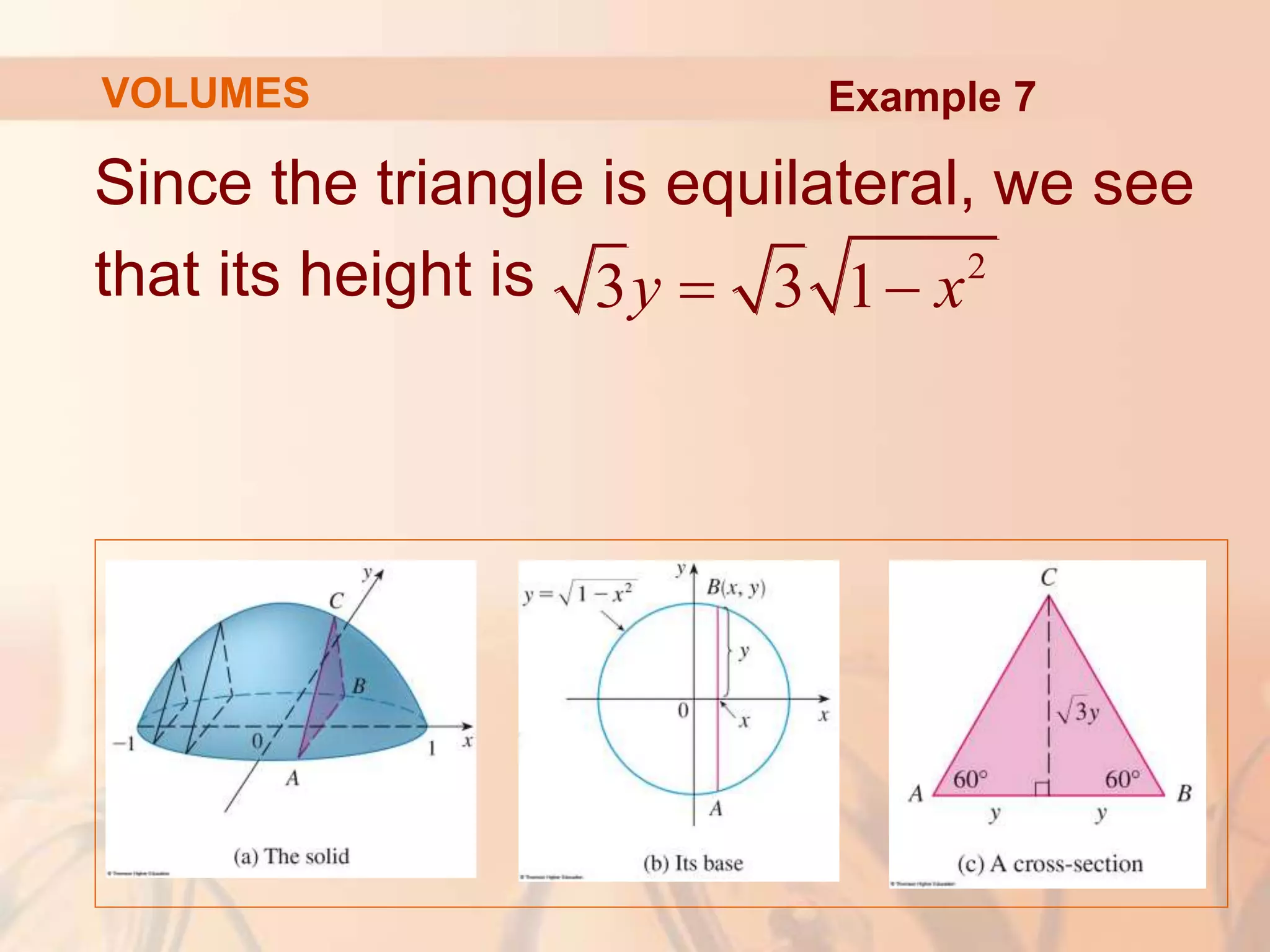
Since the triangle is equilateral, we see
that its height is 2
3 3 1
y x
 
VOLUMES Example 7
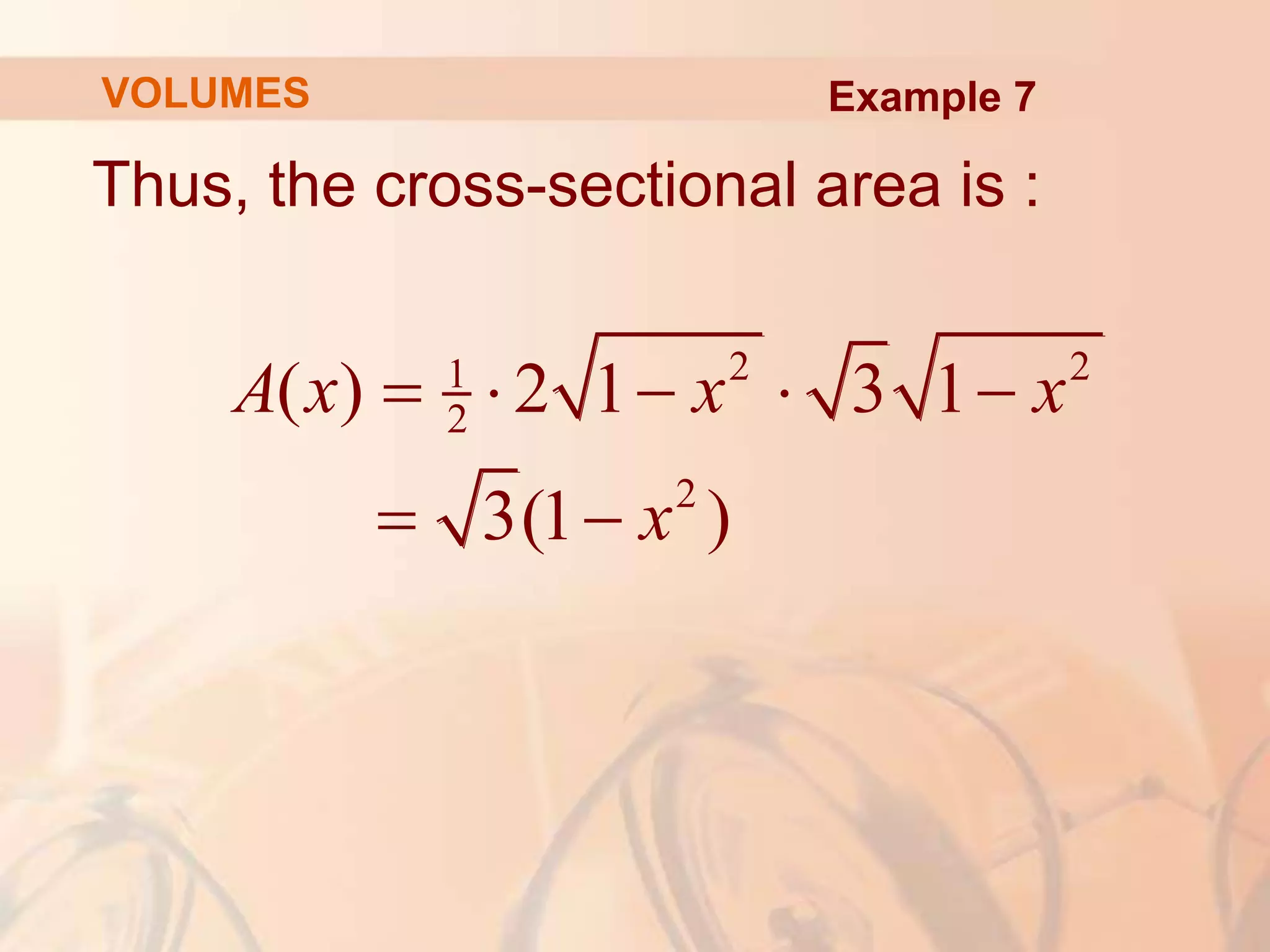
Thus, the cross-sectional area is :
VOLUMES Example 7
2 2
1
2
2
( ) 2 1 3 1
3(1 )
A x x x
x
    
 
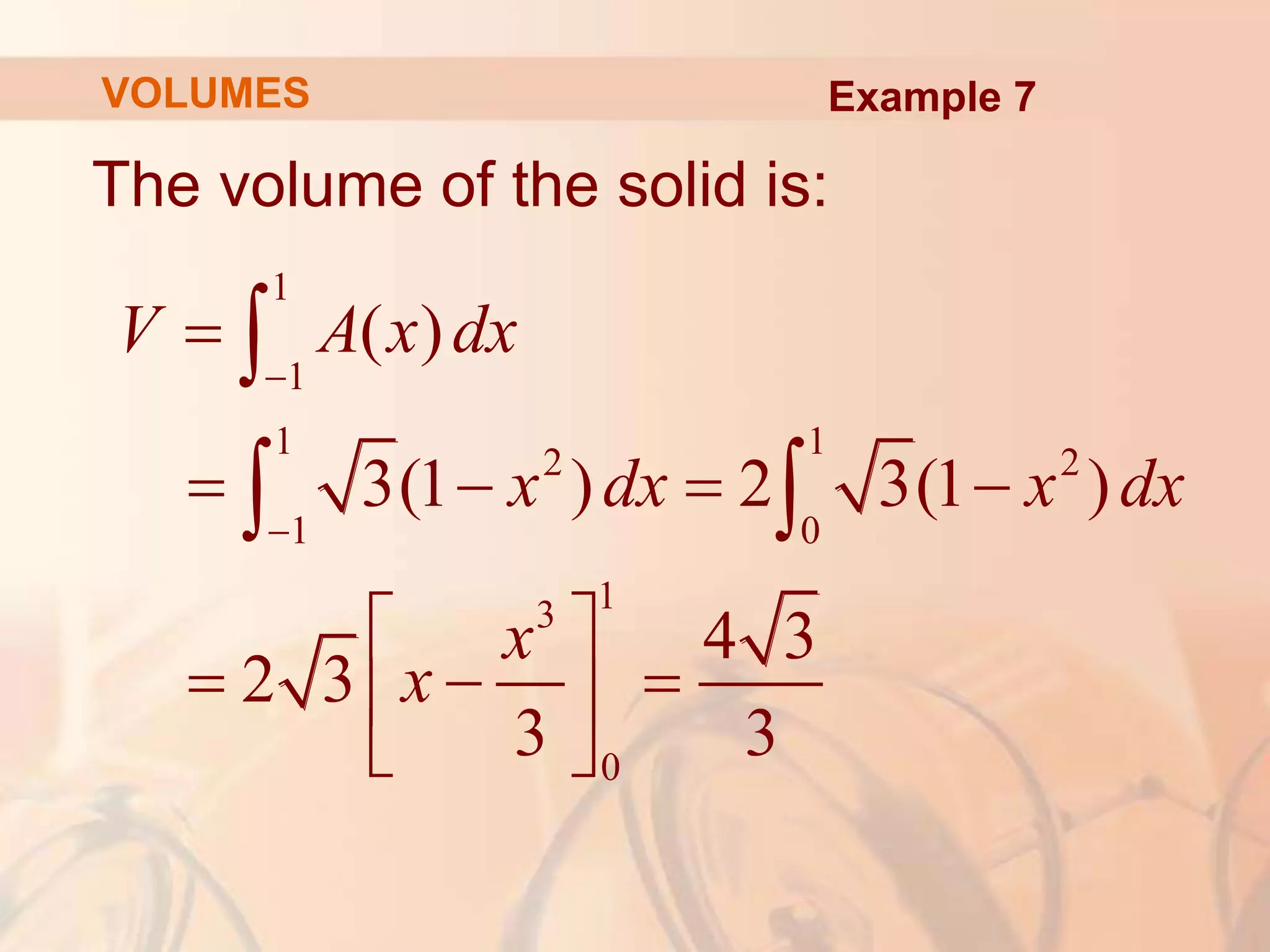
The volume of the solid is:
1
1
1 1
2 2
1 0
1
3
0
( )
3(1 ) 2 3(1 )
4 3
2 3
3 3
V A x dx
x dx x dx
x
x



   
 
  
 
 

 
Example 7
VOLUMES
Find the volume of a pyramid
whose base is a square with side L
and whose height is h.
Example 8
VOLUMES
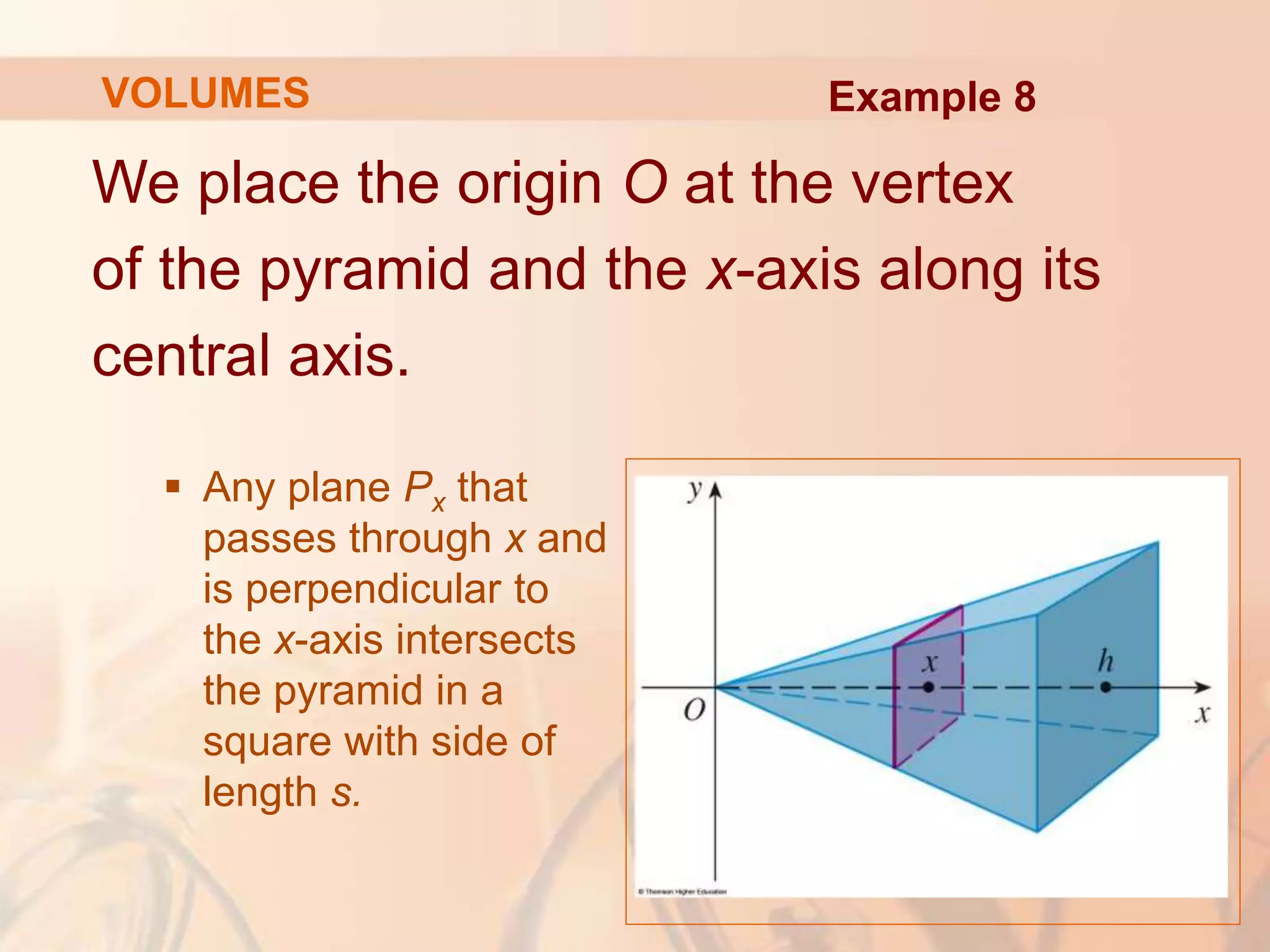
We place the origin O at the vertex
of the pyramid and the x-axis along its
central axis.
 Any plane Px that
passes through x and
is perpendicular to
the x-axis intersects
the pyramid in a
square with side of
length s.
VOLUMES Example 8
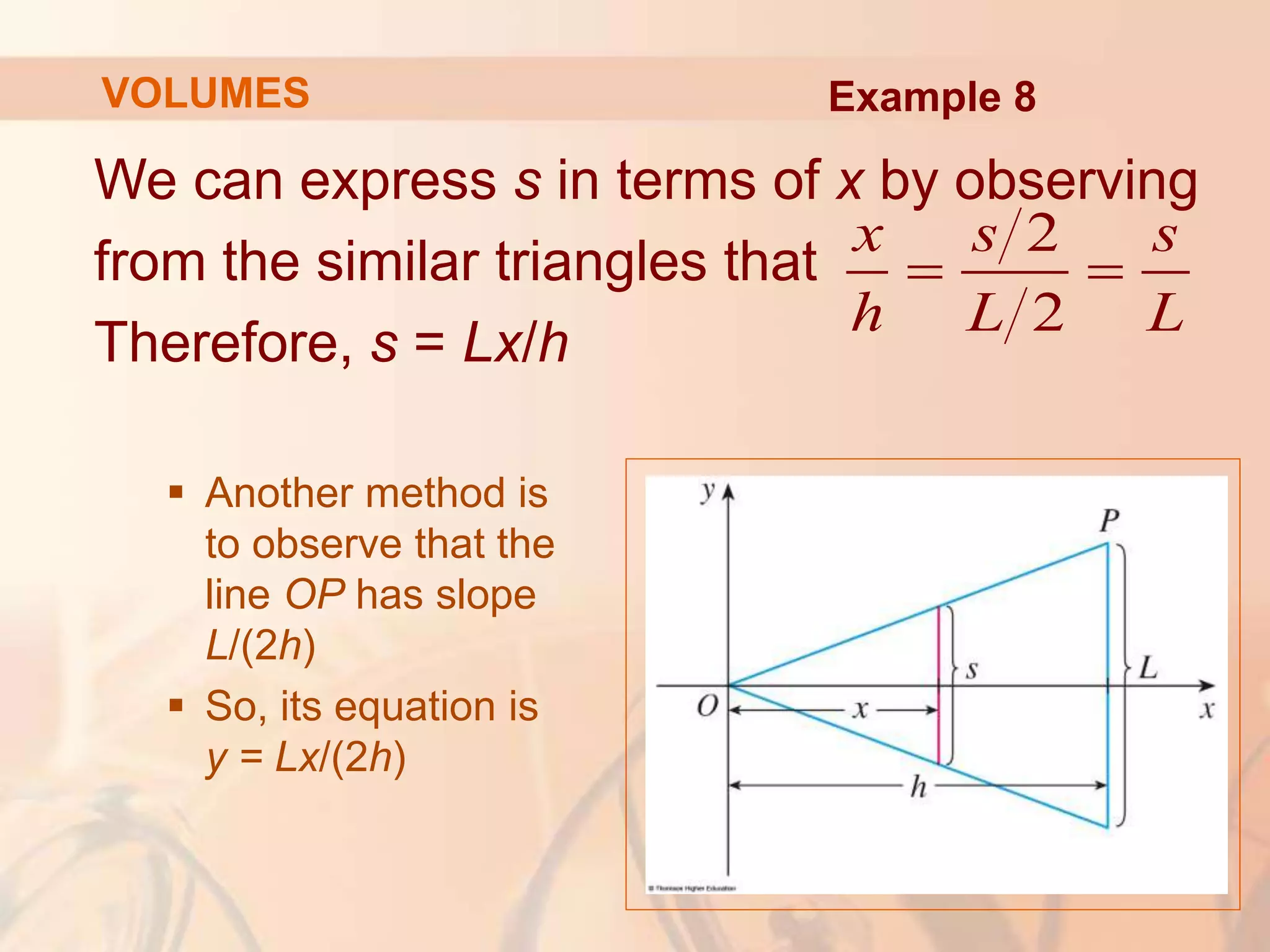
We can express s in terms of x by observing
from the similar triangles that
Therefore, s = Lx/h
 Another method is
to observe that the
line OP has slope
L/(2h)
 So, its equation is
y = Lx/(2h)
2
2
x s s
h L L
 
Example 8
VOLUMES
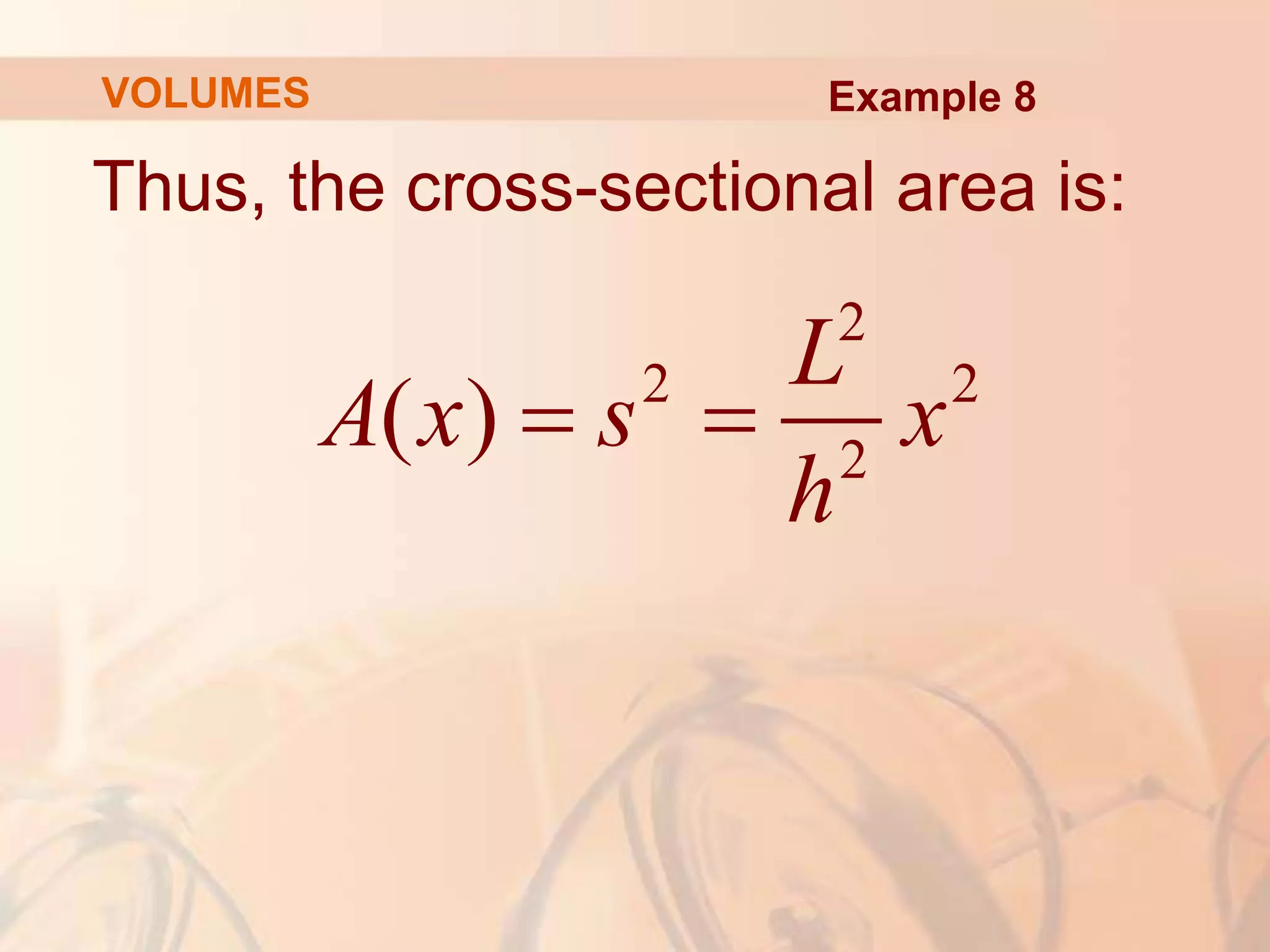
Thus, the cross-sectional area is:
VOLUMES Example 8
2
2 2
2
( )
L
A x s x
h
 
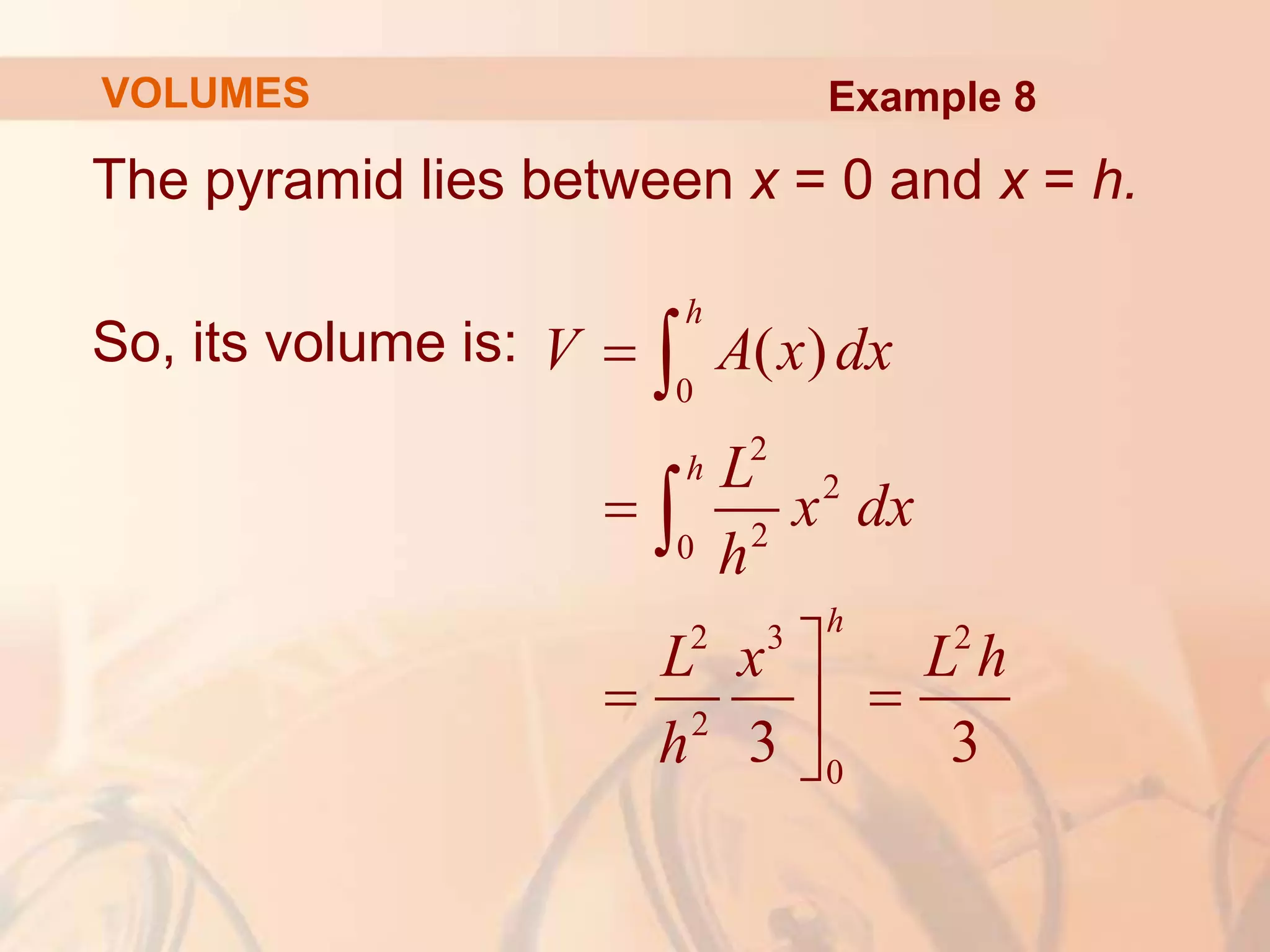
The pyramid lies between x = 0 and x = h.
So, its volume is:
0
2
2
2
0
2 3 2
2
0
( )
3 3
h
h
h
V A x dx
L
x dx
h
L x L h
h



 




Example 8
VOLUMES
In the example, we didn’t need to place
the vertex of the pyramid at the origin.
 We did so merely to make the equations
simple.
NOTE
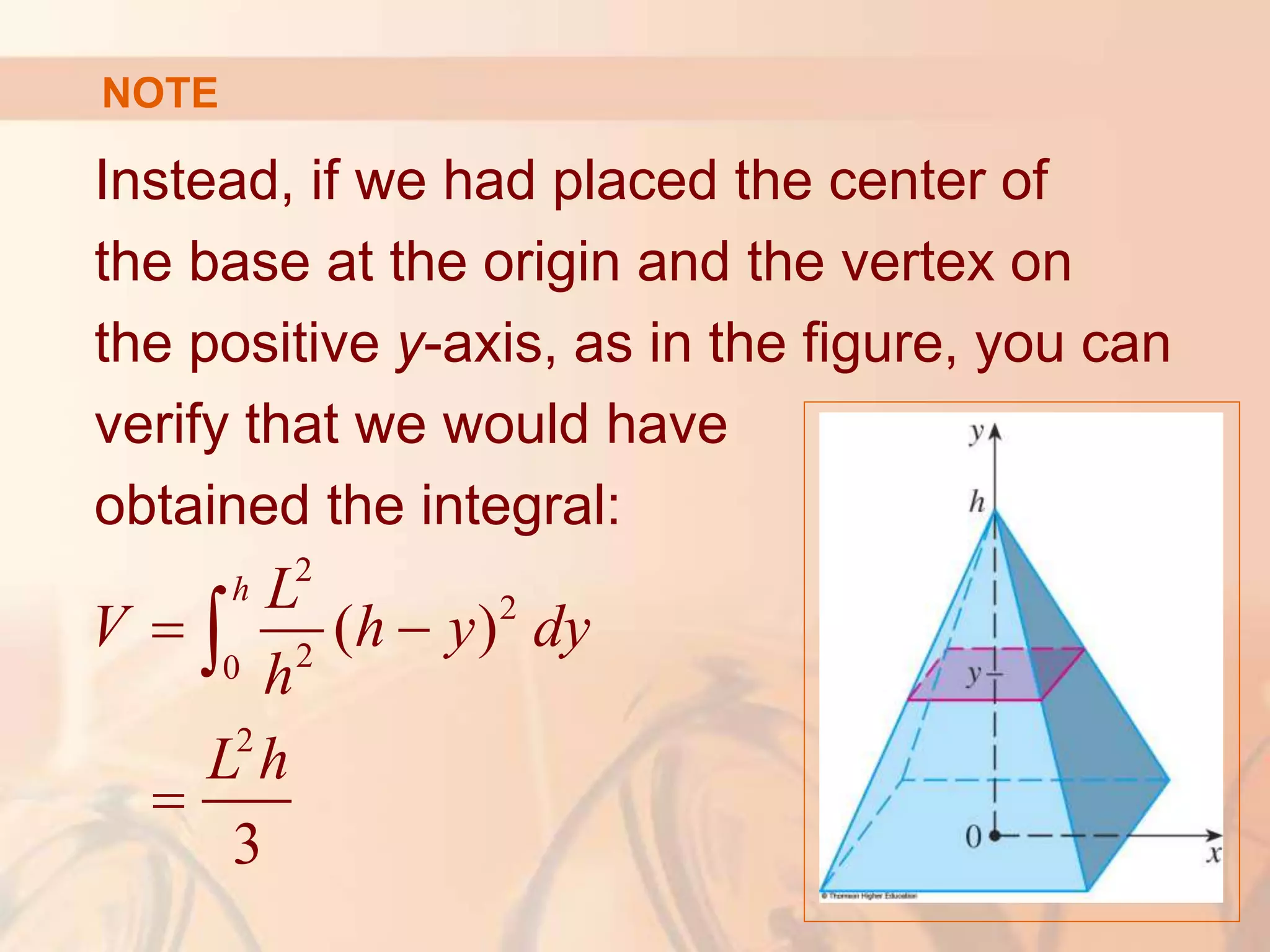
Instead, if we had placed the center of
the base at the origin and the vertex on
the positive y-axis, as in the figure, you can
verify that we would have
obtained the integral:
2
2
2
0
2
( )
3
h L
V h y dy
h
L h
 


NOTE
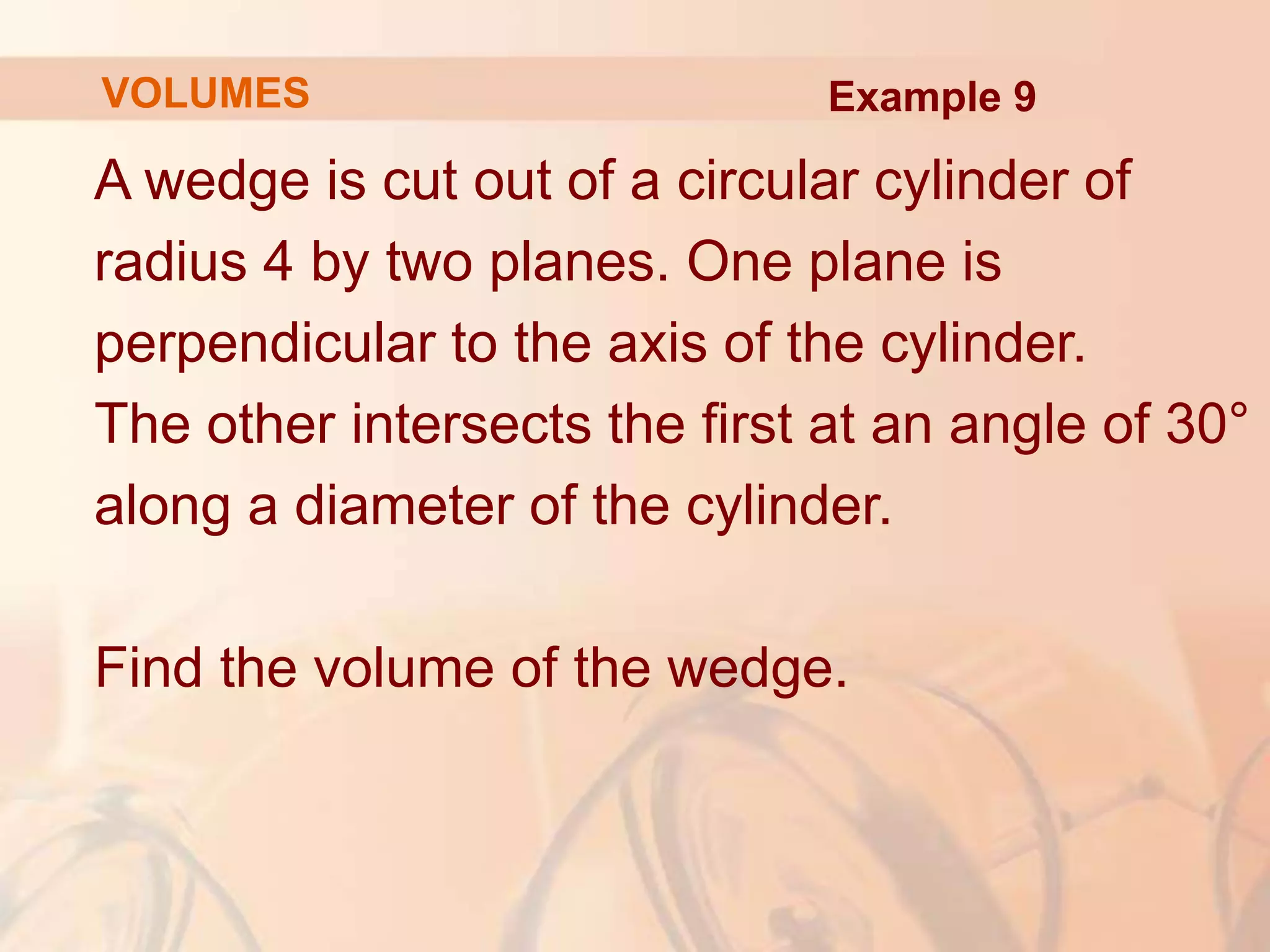
A wedge is cut out of a circular cylinder of
radius 4 by two planes. One plane is
perpendicular to the axis of the cylinder.
The other intersects the first at an angle of 30°
along a diameter of the cylinder.
Find the volume of the wedge.
Example 9
VOLUMES
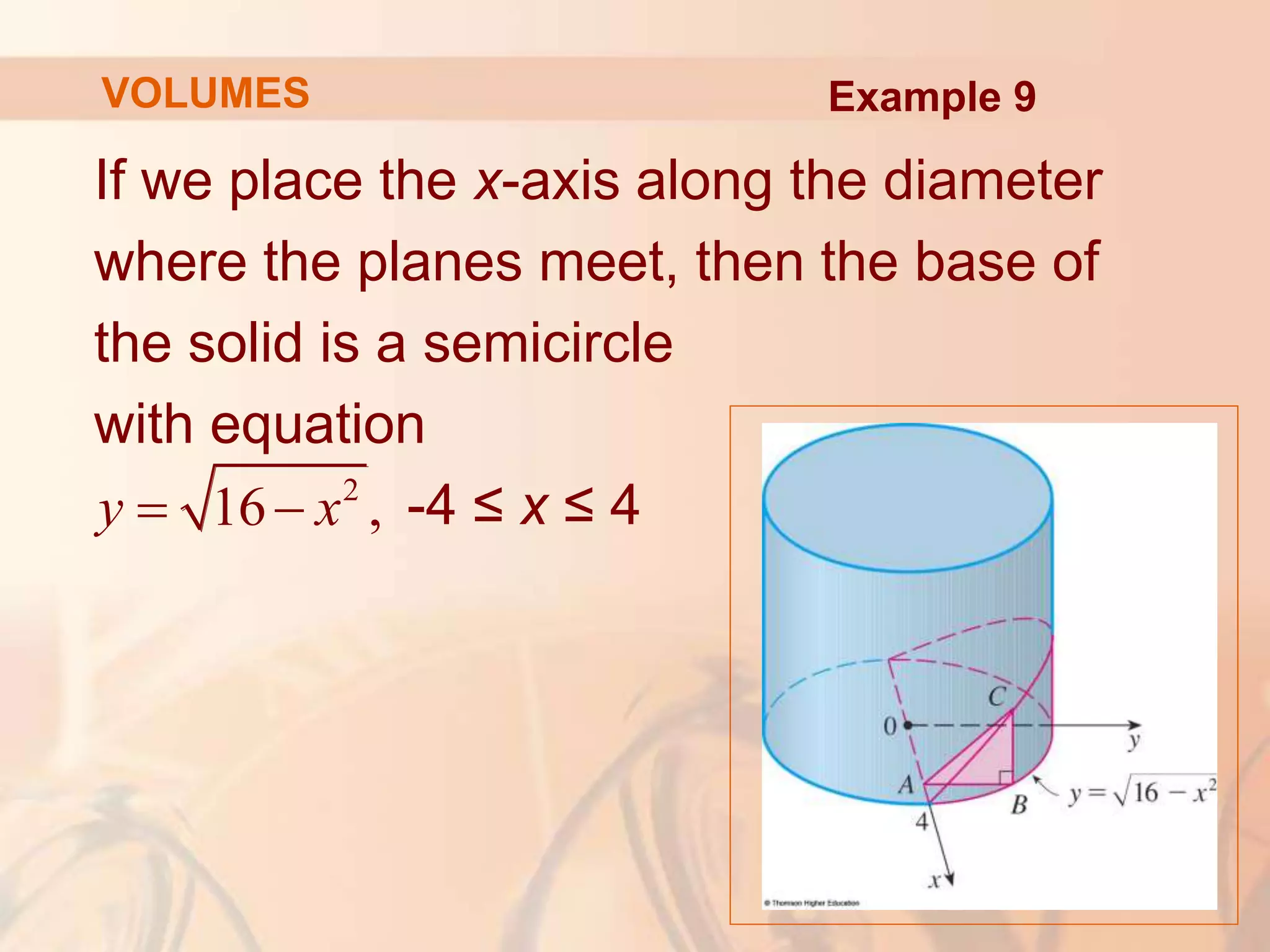
If we place the x-axis along the diameter
where the planes meet, then the base of
the solid is a semicircle
with equation
-4 ≤ x ≤ 4
2
16 ,
y x
 
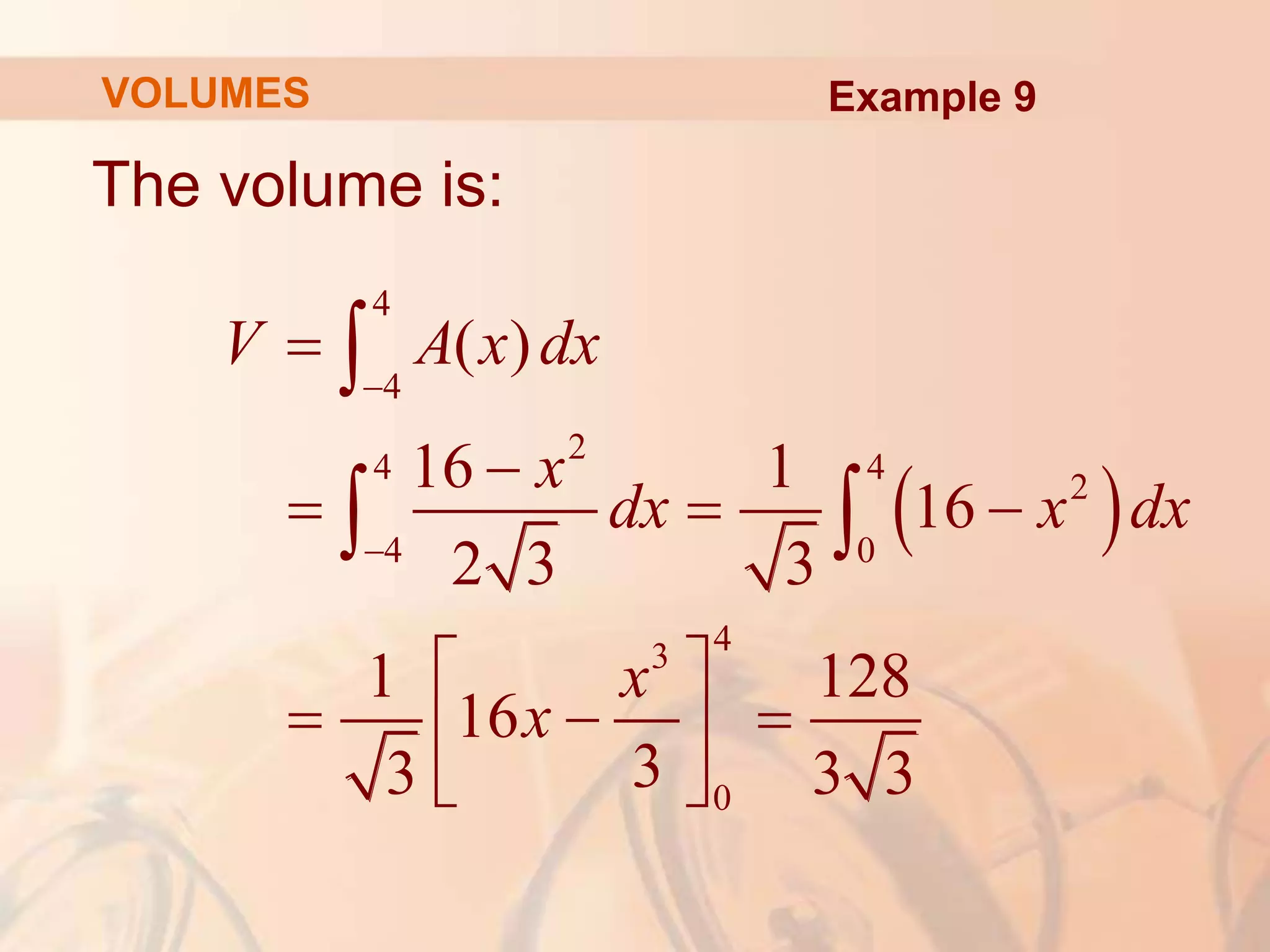
VOLUMES Example 9
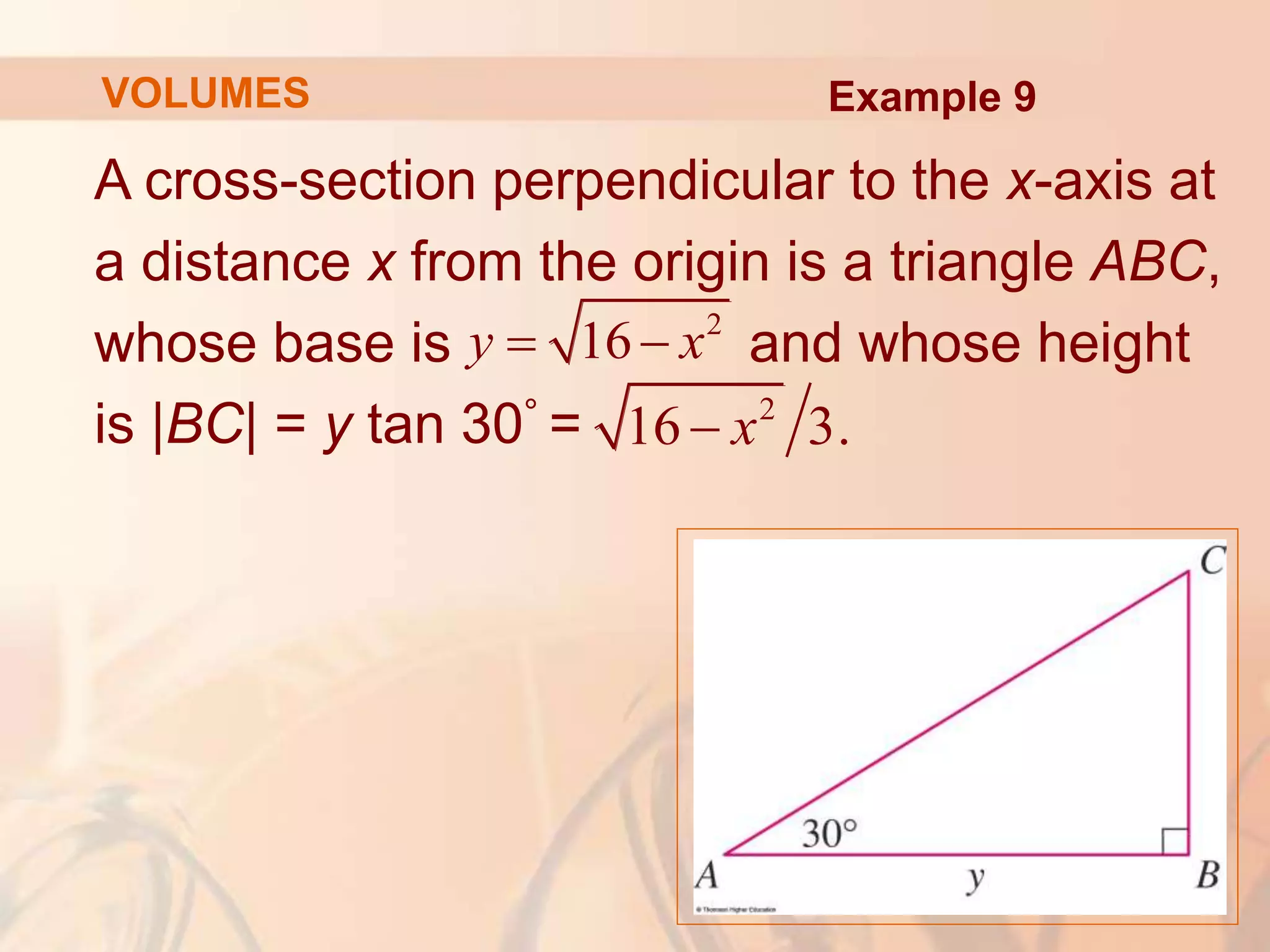
A cross-section perpendicular to the x-axis at
a distance x from the origin is a triangle ABC,
whose base is and whose height
is |BC| = y tan 30° =
2
16
y x
 
2
16 3.
x

Example 9
VOLUMES
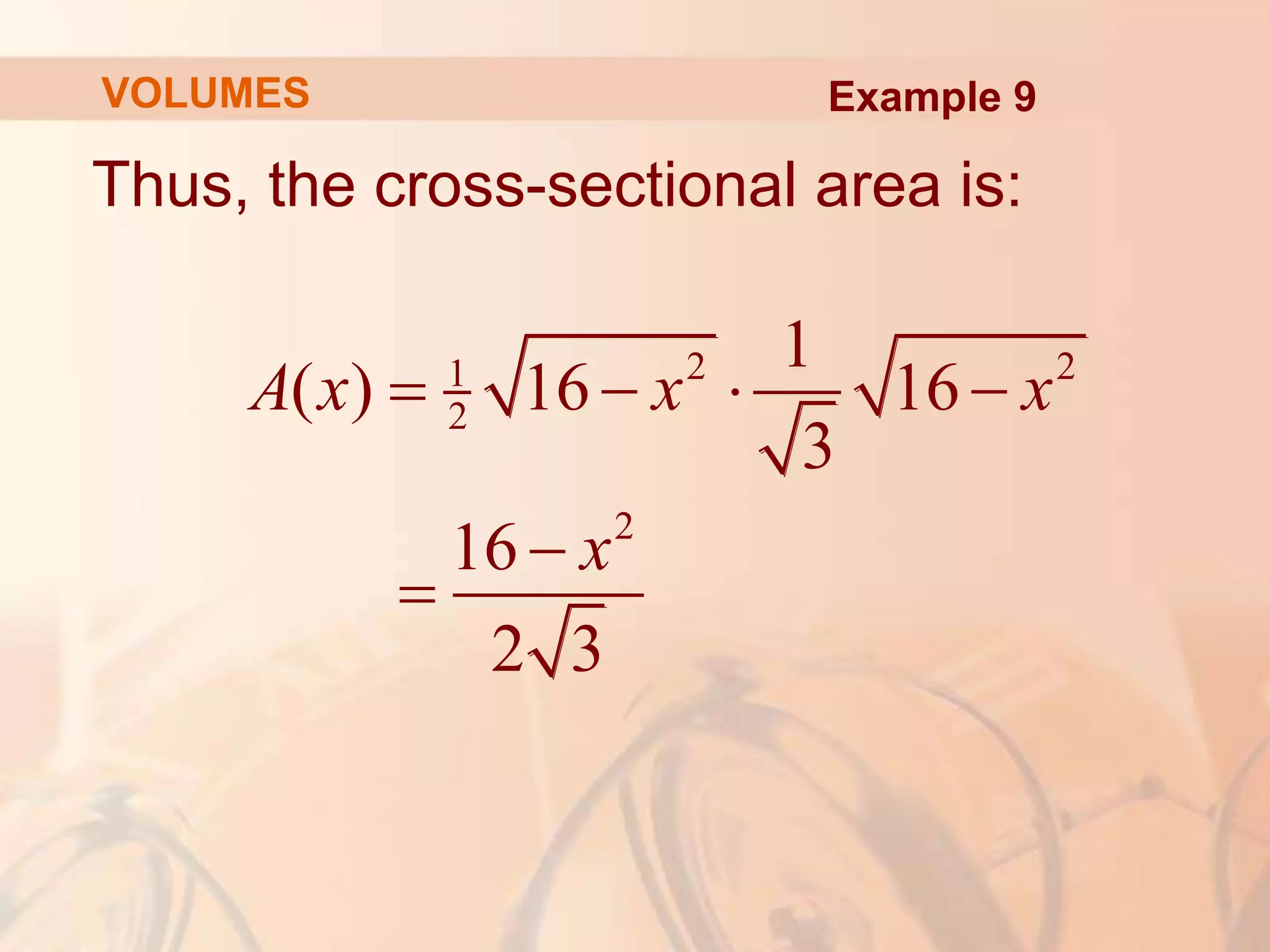
Thus, the cross-sectional area is:
2 2
1
2
2
1
( ) 16 16
3
16
2 3
A x x x
x
   


VOLUMES Example 9
The volume is:
 
4
4
2
4 4
2
4 0
4
3
0
( )
16 1
16
2 3 3
1 128
16
3
3 3 3
V A x dx
x
dx x dx
x
x




  
 
  
 
 

 
Example 9
VOLUMES

calculus applications integration volumes.ppt

  • 1.
  • 2.
    6.2 Volumes APPLICATIONS OF INTEGRATION Inthis section, we will learn about: Using integration to find out the volume of a solid.
  • 3.
    In trying tofind the volume of a solid, we face the same type of problem as in finding areas. VOLUMES
  • 4.
    We have anintuitive idea of what volume means. However, we must make this idea precise by using calculus to give an exact definition of volume. VOLUMES
  • 5.
    We start witha simple type of solid called a cylinder or, more precisely, a right cylinder. VOLUMES
  • 6.
    As illustrated, acylinder is bounded by a plane region B1, called the base, and a congruent region B2 in a parallel plane.  The cylinder consists of all points on line segments perpendicular to the base and join B1 to B2. CYLINDERS
  • 7.
    If the areaof the base is A and the height of the cylinder (the distance from B1 to B2) is h, then the volume V of the cylinder is defined as: V = Ah CYLINDERS
  • 8.
    In particular, ifthe base is a circle with radius r, then the cylinder is a circular cylinder with volume V = πr2h. CYLINDERS
  • 9.
    If the baseis a rectangle with length l and width w, then the cylinder is a rectangular box (also called a rectangular parallelepiped) with volume V = lwh. RECTANGULAR PARALLELEPIPEDS
  • 10.
    For a solidS that isn’t a cylinder, we first ‘cut’ S into pieces and approximate each piece by a cylinder.  We estimate the volume of S by adding the volumes of the cylinders.  We arrive at the exact volume of S through a limiting process in which the number of pieces becomes large. IRREGULAR SOLIDS
  • 11.
    We start byintersecting S with a plane and obtaining a plane region that is called a cross-section of S. IRREGULAR SOLIDS
  • 12.
    Let A(x) bethe area of the cross-section of S in a plane Px perpendicular to the x-axis and passing through the point x, where a ≤ x ≤ b.  Think of slicing S with a knife through x and computing the area of this slice. IRREGULAR SOLIDS
  • 13.
    The cross-sectional areaA(x) will vary as x increases from a to b. IRREGULAR SOLIDS
  • 14.
    We divide Sinto n ‘slabs’ of equal width ∆x using the planes Px1, Px2, . . . to slice the solid.  Think of slicing a loaf of bread. IRREGULAR SOLIDS
  • 15.
    If we choosesample points xi* in [xi - 1, xi], we can approximate the i th slab Si (the part of S that lies between the planes and ) by a cylinder with base area A(xi*) and ‘height’ ∆x. 1 i x P  i x P IRREGULAR SOLIDS
  • 16.
    The volume ofthis cylinder is A(xi*). So, an approximation to our intuitive conception of the volume of the i th slab Si is: ( ) ( *)   i V S A xi x IRREGULAR SOLIDS
  • 17.
    Adding the volumesof these slabs, we get an approximation to the total volume (that is, what we think of intuitively as the volume):  This approximation appears to become better and better as n → ∞.  Think of the slices as becoming thinner and thinner. 1 ( *) n i i V A x x     IRREGULAR SOLIDS
  • 18.
    Therefore, we definethe volume as the limit of these sums as n → ∞). However, we recognize the limit of Riemann sums as a definite integral and so we have the following definition. IRREGULAR SOLIDS
  • 19.
    Let S bea solid that lies between x = a and x = b. If the cross-sectional area of S in the plane Px, through x and perpendicular to the x-axis, is A(x), where A is a continuous function, then the volume of S is: 1 lim ( *) ( ) n b i a x i V A x x A x dx        DEFINITION OF VOLUME
  • 20.
    When we usethe volume formula , it is important to remember that A(x) is the area of a moving cross-section obtained by slicing through x perpendicular to the x-axis. VOLUMES ( ) b a V A x dx  
  • 21.
    Notice that, fora cylinder, the cross-sectional area is constant: A(x) = A for all x.  So, our definition of volume gives:  This agrees with the formula V = Ah.   b a V Adx A b a     VOLUMES
  • 22.
    Show that thevolume of a sphere of radius r is 3 4 3 . V r   Example 1 SPHERES
  • 23.
    If we placethe sphere so that its center is at the origin, then the plane Px intersects the sphere in a circle whose radius, from the Pythagorean Theorem, is: 2 2 y r x   Example 1 SPHERES
  • 24.
    So, the cross-sectionalarea is: 2 2 2 ( ) ( ) A x y r x      Example 1 SPHERES
  • 25.
    Using the definitionof volume with a = -r and b = r, we have: (The integrand is even.)   2 2 2 2 0 3 3 2 3 0 3 4 3 ( ) 2 ( ) 2 2 3 3 r r r r r r V A x dx r x dx r x dx x r r x r r                                 Example 1 SPHERES
  • 26.
    The figure illustratesthe definition of volume when the solid is a sphere with radius r = 1.  From the example, we know that the volume of the sphere is  The slabs are circular cylinders, or disks. 4 3 4.18879   SPHERES
  • 27.
    The three partsshow the geometric interpretations of the Riemann sums when n = 5, 10, and 20 if we choose the sample points xi* to be the midpoints . 2 2 1 1 ( ) (1 ) n n i i i i A x x x x          i x SPHERES
  • 28.
    Notice that aswe increase the number of approximating cylinders, the corresponding Riemann sums become closer to the true volume. SPHERES
  • 29.
    Find the volumeof the solid obtained by rotating about the x-axis the region under the curve from 0 to 1. Illustrate the definition of volume by sketching a typical approximating cylinder. y x  Example 2 VOLUMES
  • 30.
    The region isshown in the first figure. If we rotate about the x-axis, we get the solid shown in the next figure.  When we slice through the point x, we get a disk with radius . VOLUMES x Example 2
  • 31.
    The area ofthe cross-section is: The volume of the approximating cylinder (a disk with thickness ∆x) is: 2 ( ) ( ) A x x x     ( ) A x x x x     Example 2 VOLUMES
  • 32.
    The solid liesbetween x = 0 and x = 1. So, its volume is: 1 0 1 0 1 2 0 ( ) 2 2 V A x dx xdx x             VOLUMES Example 2
  • 33.
    Find the volumeof the solid obtained by rotating the region bounded by y = x3, Y = 8, and x = 0 about the y-axis. Example 3 VOLUMES
  • 34.
    As the regionis rotated about the y-axis, it makes sense to slice the solid perpendicular to the y-axis and thus to integrate with respect to y.  Slicing at height y, we get a circular disk with radius x, where VOLUMES Example 3 3 x y 
  • 35.
    So, the areaof a cross-section through y is: The volume of the approximating cylinder is: 2 2 2/3 3 ( ) ( ) A y x y y       2/3 ( ) A y y y y     Example 3 VOLUMES
  • 36.
    Since the solidlies between y = 0 and y = 8, its volume is: 8 0 8 2 3 0 8 5 3 3 5 0 ( ) 96 5 V A y dy y dy y                Example 3 VOLUMES
  • 37.
    The region Renclosed by the curves y = x and y = x2 is rotated about the x-axis. Find the volume of the resulting solid. Example 4 VOLUMES
  • 38.
    The curves y= x and y = x2 intersect at the points (0, 0) and (1, 1).  The region between them, the solid of rotation, and cross-section perpendicular to the x-axis are shown. VOLUMES Example 4
  • 39.
    A cross-section inthe plane Px has the shape of a washer (an annular ring) with inner radius x2 and outer radius x. Example 4 VOLUMES
  • 40.
    Thus, we findthe cross-sectional area by subtracting the area of the inner circle from the area of the outer circle: 2 2 2 2 4 ( ) ( ) ( ) A x x x x x        VOLUMES Example 4
  • 41.
    Thus, we have: 1 0 1 24 0 1 3 5 0 ( ) ( ) 3 5 2 15 V A x dx x x dx x x                  Example 4 VOLUMES
  • 42.
    Find the volumeof the solid obtained by rotating the region in Example 4 about the line y = 2. Example 5 VOLUMES
  • 43.
    Again, the cross-sectionis a washer. This time, though, the inner radius is 2 – x and the outer radius is 2 – x2. VOLUMES Example 5
  • 44.
    The cross-sectional areais: 2 2 2 ( ) (2 ) (2 ) A x x x       Example 5 VOLUMES
  • 45.
    So, the volumeis:     1 0 1 2 2 2 0 1 4 2 0 1 5 3 2 0 ( ) 2 (2 ) 5 4 8 5 4 5 3 2 5                                V A x dx x x dx x x x dx x x x VOLUMES Example 5
  • 46.
    The solids inExamples 1–5 are all called solids of revolution because they are obtained by revolving a region about a line. SOLIDS OF REVOLUTION
  • 47.
    In general, wecalculate the volume of a solid of revolution by using the basic defining formula   ( ) or b d a c V A x dx V A y dy     SOLIDS OF REVOLUTION
  • 48.
    We find thecross-sectional area A(x) or A(y) in one of the following two ways. SOLIDS OF REVOLUTION
  • 49.
    If the cross-sectionis a disk, we find the radius of the disk (in terms of x or y) and use: A = π(radius)2 WAY 1
  • 50.
    If the cross-sectionis a washer, we first find the inner radius rin and outer radius rout from a sketch.  Then, we subtract the area of the inner disk from the area of the outer disk to obtain: A = π(outer radius)2 – π(outer radius)2 WAY 2
  • 51.
    Find the volumeof the solid obtained by rotating the region in Example 4 about the line x = -1. Example 6 SOLIDS OF REVOLUTION
  • 52.
    The figure showsthe horizontal cross-section. It is a washer with inner radius 1 + y and outer radius Example 6 1 . y  SOLIDS OF REVOLUTION
  • 53.
    So, the cross-sectionalarea is:     2 2 2 2 ( ) (outer radius) (inner radius) 1 1 A y y y           Example 6 SOLIDS OF REVOLUTION
  • 54.
    The volume is:      1 0 2 1 2 0 1 2 0 1 3 2 3 2 0 ( ) 1 1 2 4 3 2 3 2 V A y dy y y dy y y y dy y y y                                  Example 6 SOLIDS OF REVOLUTION
  • 55.
    In the followingexamples, we find the volumes of three solids that are not solids of revolution. VOLUMES
  • 56.
    The figure showsa solid with a circular base of radius 1. Parallel cross-sections perpendicular to the base are equilateral triangles. Find the volume of the solid. Example 7 VOLUMES
  • 57.
    Let’s take thecircle to be x2 + y2 = 1. The solid, its base, and a typical cross-section at a distance x from the origin are shown. Example 7 VOLUMES
  • 58.
    As B lieson the circle, we have So, the base of the triangle ABC is |AB| = 2 1 y x   2 2 1 x  Example 7 VOLUMES
  • 59.
    Since the triangleis equilateral, we see that its height is 2 3 3 1 y x   VOLUMES Example 7
  • 60.
    Thus, the cross-sectionalarea is : VOLUMES Example 7 2 2 1 2 2 ( ) 2 1 3 1 3(1 ) A x x x x       
  • 61.
    The volume ofthe solid is: 1 1 1 1 2 2 1 0 1 3 0 ( ) 3(1 ) 2 3(1 ) 4 3 2 3 3 3 V A x dx x dx x dx x x                    Example 7 VOLUMES
  • 62.
    Find the volumeof a pyramid whose base is a square with side L and whose height is h. Example 8 VOLUMES
  • 63.
    We place theorigin O at the vertex of the pyramid and the x-axis along its central axis.  Any plane Px that passes through x and is perpendicular to the x-axis intersects the pyramid in a square with side of length s. VOLUMES Example 8
  • 64.
    We can expresss in terms of x by observing from the similar triangles that Therefore, s = Lx/h  Another method is to observe that the line OP has slope L/(2h)  So, its equation is y = Lx/(2h) 2 2 x s s h L L   Example 8 VOLUMES
  • 65.
    Thus, the cross-sectionalarea is: VOLUMES Example 8 2 2 2 2 ( ) L A x s x h  
  • 66.
    The pyramid liesbetween x = 0 and x = h. So, its volume is: 0 2 2 2 0 2 3 2 2 0 ( ) 3 3 h h h V A x dx L x dx h L x L h h          Example 8 VOLUMES
  • 67.
    In the example,we didn’t need to place the vertex of the pyramid at the origin.  We did so merely to make the equations simple. NOTE
  • 68.
    Instead, if wehad placed the center of the base at the origin and the vertex on the positive y-axis, as in the figure, you can verify that we would have obtained the integral: 2 2 2 0 2 ( ) 3 h L V h y dy h L h     NOTE
  • 69.
    A wedge iscut out of a circular cylinder of radius 4 by two planes. One plane is perpendicular to the axis of the cylinder. The other intersects the first at an angle of 30° along a diameter of the cylinder. Find the volume of the wedge. Example 9 VOLUMES
  • 70.
    If we placethe x-axis along the diameter where the planes meet, then the base of the solid is a semicircle with equation -4 ≤ x ≤ 4 2 16 , y x   VOLUMES Example 9
  • 71.
    A cross-section perpendicularto the x-axis at a distance x from the origin is a triangle ABC, whose base is and whose height is |BC| = y tan 30° = 2 16 y x   2 16 3. x  Example 9 VOLUMES
  • 72.
    Thus, the cross-sectionalarea is: 2 2 1 2 2 1 ( ) 16 16 3 16 2 3 A x x x x       VOLUMES Example 9
  • 73.
    The volume is:  4 4 2 4 4 2 4 0 4 3 0 ( ) 16 1 16 2 3 3 1 128 16 3 3 3 3 V A x dx x dx x dx x x                    Example 9 VOLUMES