LESSON 9
RATIO, PROPORTION and VARIATION
RATIO
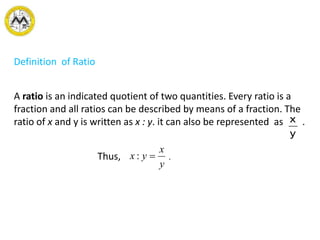
Definition of Ratio
A ratio is an indicated quotient of two quantities. Every ratio is a
fraction and all ratios can be described by means of a fraction. The
ratio of x and y is written as x : y. it can also be represented as .
Thus, .
y
x
y
x
yx :
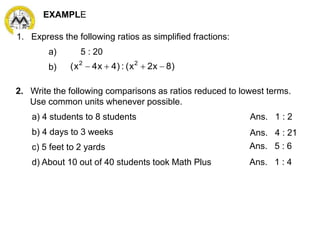
1. Express the following ratios as simplified fractions:
a) 5 : 20
b) )8x2x(:)4x4x( 22

EXAMPLE
2. Write the following comparisons as ratios reduced to lowest terms.
Use common units whenever possible.
a) 4 students to 8 students
b) 4 days to 3 weeks
c) 5 feet to 2 yards
d) About 10 out of 40 students took Math Plus
Ans. 1 : 2
Ans. 4 : 21
Ans. 5 : 6
Ans. 1 : 4
PROPORTION
Definition of Proportion
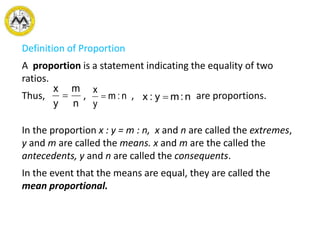
A proportion is a statement indicating the equality of two
ratios.
Thus, , , are proportions.
In the proportion x : y = m : n, x and n are called the extremes,
y and m are called the means. x and m are the called the
antecedents, y and n are called the consequents.
In the event that the means are equal, they are called the
mean proportional.
n
m
y
x
 n:m
y
x
 n:my:x 
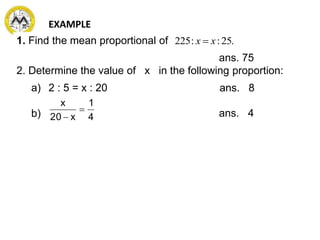
1. Find the mean proportional of
ans. 75
2. Determine the value of x in the following proportion:
a) 2 : 5 = x : 20
b)
EXAMPLE
.25::225 xx 
4
1
x20
x


ans. 8
ans. 4
VARIATION
DIRECT VARIATION
DIRECT VARIATION
Many real-life situations involve variables that are related by a
type of equation called a variation.
For example, a stone thrown into a pond generates circular
ripples whose circumferences and diameters increase in size.
The equation C = d expresses the relationship between the
circumference C of a circle and its diameter d. If d increases, then
C increases. The circumference C is said to vary directly as the
diameter d.
DIRECT VARIATION
Definition of Direct Variation
The variable y varies directly as the variable x, or y is directly
proportional to x, if and only if
y = kx
where k is a constant called the constant of proportionality or
the variation constant.
DIRECT VARIATION
Direct variation occurs in many daily applications. For example,
suppose the cost of a newspaper is 50 cents.
The cost C to purchase n newspapers is directly proportional to
the number n.
That is, C = 50n. In this example the variation constant is 50.
To solve a problem that involves a variation, we typically write a
general equation that relates the variables and then use given
information to solve for the variation constant.
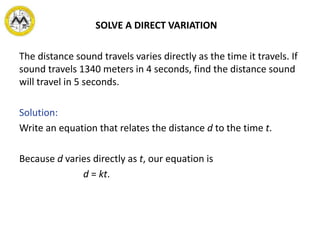
SOLVE A DIRECT VARIATION
The distance sound travels varies directly as the time it travels. If
sound travels 1340 meters in 4 seconds, find the distance sound
will travel in 5 seconds.
Solution:
Write an equation that relates the distance d to the time t.
Because d varies directly as t, our equation is
d = kt.
SOLUTION
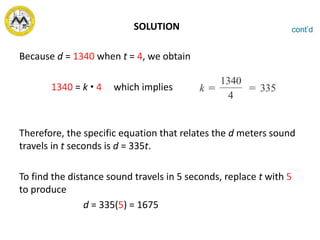
Because d = 1340 when t = 4, we obtain
1340 = k  4 which implies
Therefore, the specific equation that relates the d meters sound
travels in t seconds is d = 335t.
To find the distance sound travels in 5 seconds, replace t with 5
to produce
d = 335(5) = 1675
cont’d
SOLUTION
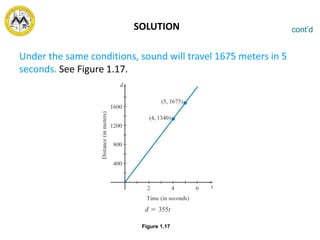
Under the same conditions, sound will travel 1675 meters in 5
seconds. See Figure 1.17.
cont’d
Figure 1.17
DIRECT VARIATION
Definition of Direct Variation as the nth Power
If y varies directly as the nth power of x, then
y = kxn
where k is a constant.
INVERSE VARIATION
INVERSE VARIATION
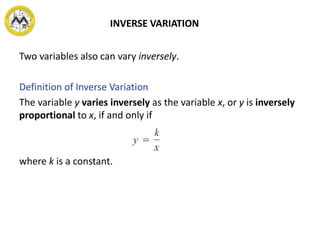
Two variables also can vary inversely.
Definition of Inverse Variation
The variable y varies inversely as the variable x, or y is inversely
proportional to x, if and only if
where k is a constant.
INVERSE VARIATION
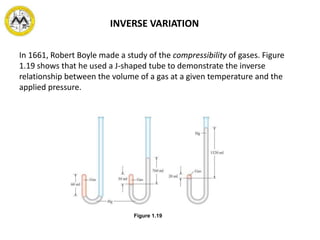
In 1661, Robert Boyle made a study of the compressibility of gases. Figure
1.19 shows that he used a J-shaped tube to demonstrate the inverse
relationship between the volume of a gas at a given temperature and the
applied pressure.
Figure 1.19
INVERSE VARIATION
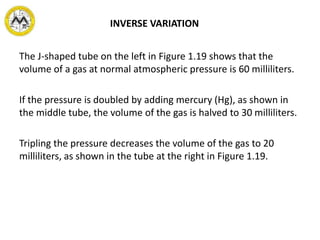
The J-shaped tube on the left in Figure 1.19 shows that the
volume of a gas at normal atmospheric pressure is 60 milliliters.
If the pressure is doubled by adding mercury (Hg), as shown in
the middle tube, the volume of the gas is halved to 30 milliliters.
Tripling the pressure decreases the volume of the gas to 20
milliliters, as shown in the tube at the right in Figure 1.19.
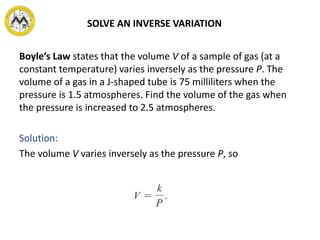
SOLVE AN INVERSE VARIATION
Boyle’s Law states that the volume V of a sample of gas (at a
constant temperature) varies inversely as the pressure P. The
volume of a gas in a J-shaped tube is 75 milliliters when the
pressure is 1.5 atmospheres. Find the volume of the gas when
the pressure is increased to 2.5 atmospheres.
Solution:
The volume V varies inversely as the pressure P, so
SOLUTION
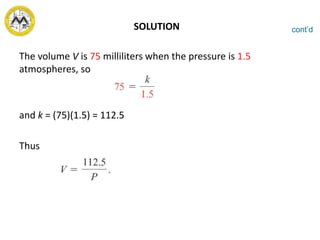
The volume V is 75 milliliters when the pressure is 1.5
atmospheres, so
and k = (75)(1.5) = 112.5
Thus
cont’d
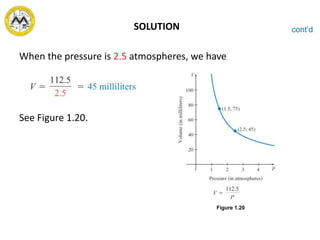
SOLUTION
When the pressure is 2.5 atmospheres, we have
See Figure 1.20.
cont’d
Figure 1.20
INVERSE VARIATION
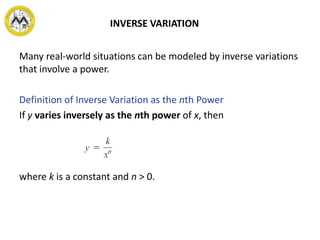
Many real-world situations can be modeled by inverse variations
that involve a power.
Definition of Inverse Variation as the nth Power
If y varies inversely as the nth power of x, then
where k is a constant and n > 0.
JOINT AND COMBINED VARIATIONS
Some variations involve more than two variables.
Definition of Joint Variation
The variable z varies jointly as the variables x and y if and only if
z = kxy
where k is a constant.
SOLVE A JOINT VARIATION
The cost of insulating the ceiling of a house varies jointly as the
thickness of the insulation and the area of the ceiling. It costs
$175 to insulate a 2100-square-foot ceiling with
insulation that is 4 inches thick. Find the cost of insulating a
2400-square-foot ceiling with insulation that is 6 inches thick.
Solution:
Because the cost C varies jointly as the area A of the ceiling and
the thickness T of the insulation, we know
C = kAT.
SOLUTION
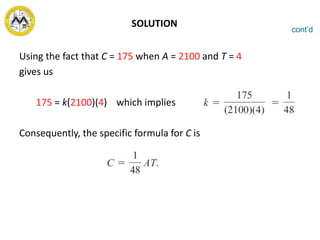
Using the fact that C = 175 when A = 2100 and T = 4
gives us
175 = k(2100)(4) which implies
Consequently, the specific formula for C is
cont’d
SOLUTION
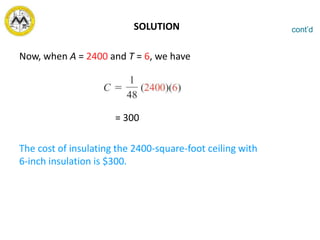
Now, when A = 2400 and T = 6, we have
= 300
The cost of insulating the 2400-square-foot ceiling with
6-inch insulation is $300.
cont’d
JOINT AND COMBINED VARIATIONS
Combined variations involve more than one type of variation.
SOLVE A COMBINED VARIATION
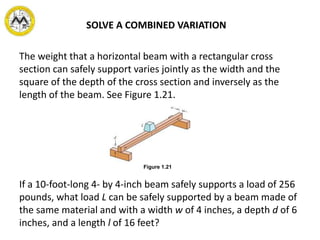
The weight that a horizontal beam with a rectangular cross
section can safely support varies jointly as the width and the
square of the depth of the cross section and inversely as the
length of the beam. See Figure 1.21.
If a 10-foot-long 4- by 4-inch beam safely supports a load of 256
pounds, what load L can be safely supported by a beam made of
the same material and with a width w of 4 inches, a depth d of 6
inches, and a length l of 16 feet?
Figure 1.21
SOLUTION
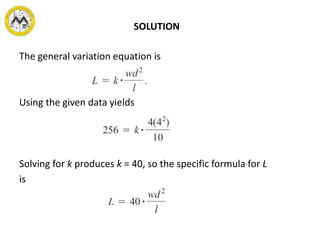
The general variation equation is
Using the given data yields
Solving for k produces k = 40, so the specific formula for L
is
SOLUTION
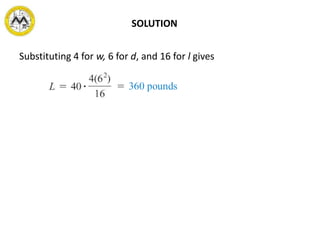
Substituting 4 for w, 6 for d, and 16 for l gives

MIT Math Syllabus 10-3 Lesson 9: Ratio, proportion and variation

  • 1.
  • 2.
  • 3.
    Definition of Ratio Aratio is an indicated quotient of two quantities. Every ratio is a fraction and all ratios can be described by means of a fraction. The ratio of x and y is written as x : y. it can also be represented as . Thus, . y x y x yx :
  • 4.
    1. Express thefollowing ratios as simplified fractions: a) 5 : 20 b) )8x2x(:)4x4x( 22  EXAMPLE 2. Write the following comparisons as ratios reduced to lowest terms. Use common units whenever possible. a) 4 students to 8 students b) 4 days to 3 weeks c) 5 feet to 2 yards d) About 10 out of 40 students took Math Plus Ans. 1 : 2 Ans. 4 : 21 Ans. 5 : 6 Ans. 1 : 4
  • 5.
  • 6.
    Definition of Proportion Aproportion is a statement indicating the equality of two ratios. Thus, , , are proportions. In the proportion x : y = m : n, x and n are called the extremes, y and m are called the means. x and m are the called the antecedents, y and n are called the consequents. In the event that the means are equal, they are called the mean proportional. n m y x  n:m y x  n:my:x 
  • 7.
    1. Find themean proportional of ans. 75 2. Determine the value of x in the following proportion: a) 2 : 5 = x : 20 b) EXAMPLE .25::225 xx  4 1 x20 x   ans. 8 ans. 4
  • 8.
  • 9.
  • 10.
    DIRECT VARIATION Many real-lifesituations involve variables that are related by a type of equation called a variation. For example, a stone thrown into a pond generates circular ripples whose circumferences and diameters increase in size. The equation C = d expresses the relationship between the circumference C of a circle and its diameter d. If d increases, then C increases. The circumference C is said to vary directly as the diameter d.
  • 11.
    DIRECT VARIATION Definition ofDirect Variation The variable y varies directly as the variable x, or y is directly proportional to x, if and only if y = kx where k is a constant called the constant of proportionality or the variation constant.
  • 12.
    DIRECT VARIATION Direct variationoccurs in many daily applications. For example, suppose the cost of a newspaper is 50 cents. The cost C to purchase n newspapers is directly proportional to the number n. That is, C = 50n. In this example the variation constant is 50. To solve a problem that involves a variation, we typically write a general equation that relates the variables and then use given information to solve for the variation constant.
  • 13.
    SOLVE A DIRECTVARIATION The distance sound travels varies directly as the time it travels. If sound travels 1340 meters in 4 seconds, find the distance sound will travel in 5 seconds. Solution: Write an equation that relates the distance d to the time t. Because d varies directly as t, our equation is d = kt.
  • 14.
    SOLUTION Because d =1340 when t = 4, we obtain 1340 = k  4 which implies Therefore, the specific equation that relates the d meters sound travels in t seconds is d = 335t. To find the distance sound travels in 5 seconds, replace t with 5 to produce d = 335(5) = 1675 cont’d
  • 15.
    SOLUTION Under the sameconditions, sound will travel 1675 meters in 5 seconds. See Figure 1.17. cont’d Figure 1.17
  • 16.
    DIRECT VARIATION Definition ofDirect Variation as the nth Power If y varies directly as the nth power of x, then y = kxn where k is a constant.
  • 17.
  • 18.
    INVERSE VARIATION Two variablesalso can vary inversely. Definition of Inverse Variation The variable y varies inversely as the variable x, or y is inversely proportional to x, if and only if where k is a constant.
  • 19.
    INVERSE VARIATION In 1661,Robert Boyle made a study of the compressibility of gases. Figure 1.19 shows that he used a J-shaped tube to demonstrate the inverse relationship between the volume of a gas at a given temperature and the applied pressure. Figure 1.19
  • 20.
    INVERSE VARIATION The J-shapedtube on the left in Figure 1.19 shows that the volume of a gas at normal atmospheric pressure is 60 milliliters. If the pressure is doubled by adding mercury (Hg), as shown in the middle tube, the volume of the gas is halved to 30 milliliters. Tripling the pressure decreases the volume of the gas to 20 milliliters, as shown in the tube at the right in Figure 1.19.
  • 21.
    SOLVE AN INVERSEVARIATION Boyle’s Law states that the volume V of a sample of gas (at a constant temperature) varies inversely as the pressure P. The volume of a gas in a J-shaped tube is 75 milliliters when the pressure is 1.5 atmospheres. Find the volume of the gas when the pressure is increased to 2.5 atmospheres. Solution: The volume V varies inversely as the pressure P, so
  • 22.
    SOLUTION The volume Vis 75 milliliters when the pressure is 1.5 atmospheres, so and k = (75)(1.5) = 112.5 Thus cont’d
  • 23.
    SOLUTION When the pressureis 2.5 atmospheres, we have See Figure 1.20. cont’d Figure 1.20
  • 24.
    INVERSE VARIATION Many real-worldsituations can be modeled by inverse variations that involve a power. Definition of Inverse Variation as the nth Power If y varies inversely as the nth power of x, then where k is a constant and n > 0.
  • 25.
  • 26.
    JOINT AND COMBINEDVARIATIONS Some variations involve more than two variables. Definition of Joint Variation The variable z varies jointly as the variables x and y if and only if z = kxy where k is a constant.
  • 27.
    SOLVE A JOINTVARIATION The cost of insulating the ceiling of a house varies jointly as the thickness of the insulation and the area of the ceiling. It costs $175 to insulate a 2100-square-foot ceiling with insulation that is 4 inches thick. Find the cost of insulating a 2400-square-foot ceiling with insulation that is 6 inches thick. Solution: Because the cost C varies jointly as the area A of the ceiling and the thickness T of the insulation, we know C = kAT.
  • 28.
    SOLUTION Using the factthat C = 175 when A = 2100 and T = 4 gives us 175 = k(2100)(4) which implies Consequently, the specific formula for C is cont’d
  • 29.
    SOLUTION Now, when A= 2400 and T = 6, we have = 300 The cost of insulating the 2400-square-foot ceiling with 6-inch insulation is $300. cont’d
  • 30.
    JOINT AND COMBINEDVARIATIONS Combined variations involve more than one type of variation.
  • 31.
    SOLVE A COMBINEDVARIATION The weight that a horizontal beam with a rectangular cross section can safely support varies jointly as the width and the square of the depth of the cross section and inversely as the length of the beam. See Figure 1.21. If a 10-foot-long 4- by 4-inch beam safely supports a load of 256 pounds, what load L can be safely supported by a beam made of the same material and with a width w of 4 inches, a depth d of 6 inches, and a length l of 16 feet? Figure 1.21
  • 32.
    SOLUTION The general variationequation is Using the given data yields Solving for k produces k = 40, so the specific formula for L is
  • 33.
    SOLUTION Substituting 4 forw, 6 for d, and 16 for l gives