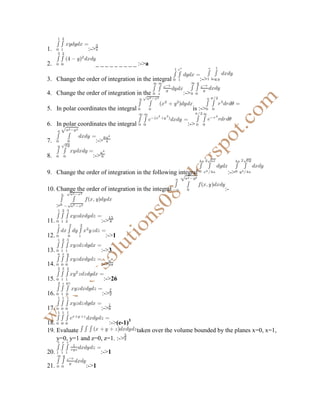
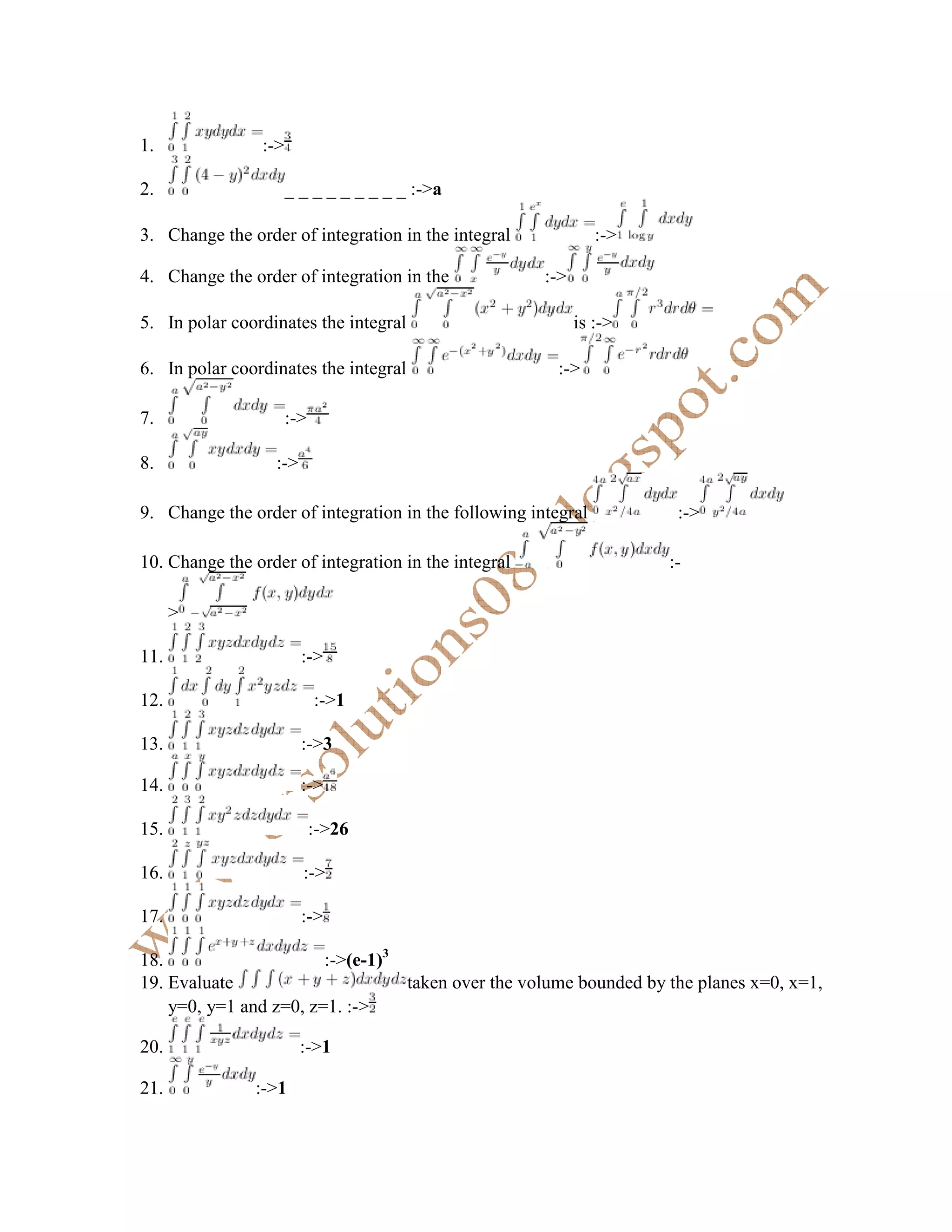
1.              :->

2.                    _ _ _ _ _ _ _ _ _ :->a

3. Change the order of integration in the integral             :->

4. Change the order of integration in the             :->

5. In polar coordinates the integral                        is :->

6. In polar coordinates the integral                    :->

7.                    :->

8.                :->

9. Change the order of integration in the following integral          :->

10. Change the order of integration in the integral                  :-

      >

11.                     :->

12.                         :->1

13.                     :->3

14.                     :->

15.                         :->26

16.                     :->

17.                     :->

18.                     :->(e-1)3
19. Evaluate                      taken over the volume bounded by the planes x=0, x=1,
    y=0, y=1 and z=0, z=1. :->

20.                     :->1

21.            :->1
www.prsolutions08.blogspot.com


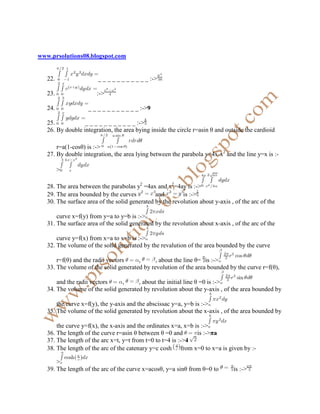
   22.                  _ _ _ _ _ _ _ _ _ _ _ :->

   23.                 :->

   24.             _ _ _ _ _ _ _ _ _ _ _ :->9

   25.            _ _ _ _ _ _ _ _ _ _ _ :->
   26. By double integration, the area bying inside the circle r=asin θ and outside the cardioid

       r=a(1-cosθ) is :->
   27. By double integration, the area lying between the parabola y=4x-x2 and the line y=x is :-

         >

   28. The area between the parabolas y2 =4ax and x2=4ay is :->
   29. The area bounded by the curves          and        is :->
   30. The surface area of the solid generated by the revolution about y-axis , of the arc of the

       curve x=f(y) from y=a to y=b is :->
   31. The surface area of the solid generated by the revolution about x-axis , of the arc of the

       curve y=f(x) from x=a to x=b is :->
   32. The volume of the solid generated by the revalution of the area bounded by the curve

       r=f(θ) and the radii vectors    ,      , about the line θ= is :->
   33. The volume of the solid generated by revolution of the area bounded by the curve r=f(θ),

       and the radii vectors     ,     , about the initial line θ =0 is :->
   34. The volume of the solid generated by revolution about the y-axis , of the area bounded by

       the curve x=f(y), the y-axis and the abscissac y=a, y=b is :->
   35. The volume of the solid generated by revolution about the x-axis , of the area bounded by

       the curve y=f(x), the x-axis and the ordinates x=a, x=b is :->
   36. The length of the curve r=asin θ between θ =0 and        is :->πa
   37. The length of the arc x=t, y=t from t=0 to t=4 is :->4
   38. The length of the arc of the catenary y=c cosh from x=0 to x=a is given by :-

       >
   39. The length of the arc of the curve x=acosθ, y=a sinθ from θ=0 to        is :->
www.prsolutions08.blogspot.com

   40. The length of the arc of the curve θ=f(r) between the points where r=a and r=b, is :->L=


   41. The length of the arc of the curve r=f(θ) between the points where        and       , is :-

       >L=
   42. The length of the arc of the curve x=f(t), y=g(t) between the points where t=a and t=b is :-

       >L=
   43. The length of the are of the curve x=f(y) between the points where y=a and y=b is :->L=


   44. The length of the arc of the curve y=f(x) between the points where x=a and x=b is :-

       >
   45. The length of the curve x=et cost from t=oto t=π/2 is :->
   46. The length of the curve y=x from x=0 to x=4/3 is :->
   47. The arc of the upper half of the cardioid r=a(1+cos θ) is bisected at θ = _ _ _ _ _ _ _ _ _ _
       _ _ _ :->π/2
   48. The length of one arch of the cycloid x=a(t-sint), y=a(1-cost) is :->8a
   49. The entire length of the cardioid r=a(1+cosθ) is :->8a
   50. Where the curve x=a(θ+sin θ), y=a(1+cos θ) is symmetrical about :->y-axis
   51. Where the curve x=a(θ+sin θ), y=a(1-cos θ) meet the x-axis? :->(0,0)
   52. The curve x= a(t-sint) ; x=a(1-cost) is symmetrical about :->y-axis
   53. If x=f(x) is odd and y=g(t) is even then the curve is symmetrical about :->y-axis
   54. If x=f(t) is even and y=g(t) is odd then the curve is symmetrical about :->x-axis
   55. The curve x=a (cost + log Tan ), y= a sin t is symmetrical about :->x-axis
   56. Where the curve x=a(cost + log tan ), y=a sint meet the y-axis ? :->(0, )
   57. Where the curve x=acos y=b sin ) meet the y-axis ? :->(0, )
   58. The Asymptotes to the curve x=a[cos                     )], y= a sin θ is :->y=0
   59. The Asymptotes to the curve x=a(            ), y= a(1+cos θ) is :-> o asymptotes
   60. The line θ=0 is tangent at the pole to the following ine of the curve :->r=a(1-cos θ)
   61. The Tangents at the pole to the curve r=a(1+cos θ) is :->θ =π
   62. The Tangents at origin to the curve r2=a2 cos 2 θ are :->θ =
   63. The curve r=a(1+sin θ) is symmetrical about :->θ = π/2
   64. If the equation of a curve does not change when θ is replaced by `-θ' then the curve is
       symmetrical about the _ _ _ _ _ :->initial line
   65. The curve r2 = a2sin 2 θ is symmetrical about :->The pole and the line θ =
   66. The curve r=acos2 θ, a 0 consists of _ _ _ _ _ _ _ _ _ _ loops :->4
   67. The tangents at the pole to the curve r=a sin 3 θ are :->The Lines
   68. The tangents at the pole to the curve r2=a2sin 2θ are :->θ = 0 and θ=
   69. The equations of asymptotes to the curve r2=a2sec2θ are :->
www.prsolutions08.blogspot.com

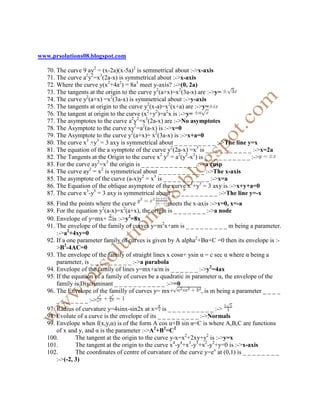
   70. The curve 9 ay2 = (x-2a)(x-5a)2 is semmetrical about :->x-axis
   71. The curve a2y2=x3(2a-x) is symmetrical about :->x-axis
   72. Where the curve y(x2+4a2) = 8a3 meet y-axis? :->(0, 2a)
   73. The tangents at the origin to the curve y2(a+x)=x2(3a-x) are :->y=
   74. The curve y2(a+x) =x2(3a-x) is symmetrical about :->y-axis
   75. The tangents at origin to the curve y2(x-a)=x2(x+a) are :->y=
   76. The tangent at origin to the curve (x2+y2)=a2x is :->y=
   77. The asymptotes to the curve a2y2=x3(2a-x) are :-> o asymptotes
   78. The Asymptote to the curve xy2=a2(a-x) is :->x=0
   79. The Asymptote to the curve y2(a+x)= x2(3a-x) is :->x+a=0
   80. The curve x3 +y3 = 3 axy is symmetrical about _ _ _ _ _ _ _ _ _ :->The line y=x
   81. The equation of the a symptote of the curve y2(2a-x) =x3 is _ _ _ _ _ _ _ _ _ _ :->x=2a
   82. The Tangents at the Origin to the curve x2 y2 = a2(y2-x2) is _ _ _ _ _ _ _ _ _ _ :->
   83. For the curve ay2=x3 the origin is _ _ _ _ _ _ _ _ _ _ _ _ :->a cusp
   84. The curve ay2 = x2 is symmetrical about _ _ _ _ _ _ _ _ _ _ :->The x-axis
   85. The asymptote of the curve (a-x)y2 = x3 is _ _ _ _ _ _ _ _ _ _ :->x=a
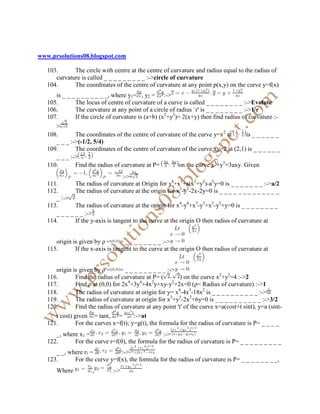
   86. The Equation of the oblique asymptote of the curve x3+y3 = 3 axy is :->x+y+a=0
   87. The curve x3-y3 = 3 axy is symmetrical about _ _ _ _ _ _ _ _ _ _ :->The line y=-x
   88. Find the points where the curve               meets the x-axis :->x=0, x=-a
   89. For the equation y2(a-x)=x2(a+x), the origin is _ _ _ _ _ _ _ :->a node
   90. Envelope of y=mx+ is :->y2=8x
   91. The envelope of the family of curves y=m2x+am is _ _ _ _ _ _ _ _ _ m being a parameter.
       :->a2+4xy=0
   92. If a one parameter family of curves is given by A alpha2+Bα+C =0 then its envelope is :-
       >B2-4AC=0
   93. The envelope of the family of straight lines x cosα+ ysin α = c sec α where α being a
       parameter, is _ _ _ _ _ _ _ _ _ :->a parabola
   94. Envelope of the family of lines y=mx+a/m is _ _ _ _ _ _ :->y2=4ax
   95. If the equation of a family of curves be a quadratic in parameter α, the envelope of the
       family is Discriminant _ _ _ _ _ _ _ _ _ _ _ :->=0
   96. The Envelope of the familly of curves y= mx+                 , is m being a parameter _ _ _ _
       _ _ _ _ _ _ _ :->
   97. Radius of curvature y=4sinx-sin2x at x= is _ _ _ _ _ _ _ _ _ _ :->
   98. Evolute of a curve is the envelope of its _ _ _ _ _ _ _ _ _ :-> ormals
   99. Envelope when f(x,y,α) is of the form A cos α+B sin α=C is where A,B,C are functions
       of x and y, and α is the parameter :->A2+B2=C2
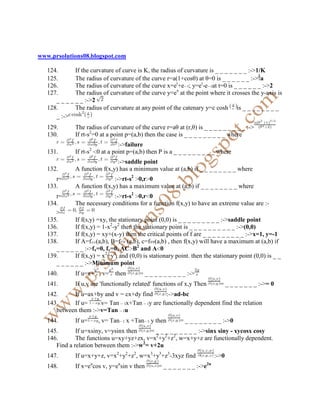
   100.        The tangent at the origin to the curve y-x=x2+2xy+y2 is :->y=x
   101.        The tangent at the origin to the curve x4-y4+x3-y3+x2-y2+y=0 is :->x-axis
   102.        The coordinates of centre of curvature of the curve y=ex at (0,1) is _ _ _ _ _ _ _ _
       :->(-2, 3)
www.prsolutions08.blogspot.com

   103.      The circle with centre at the centre of curvature and radius equal to the radius of
      curvature is called _ _ _ _ _ _ _ _ _ :->circle of curvature
   104.      The coordinates of the centre of curvature at any point p(x,y) on the curve y=f(x)
      is _ _ _ _ _ _ _ _ _ _, where y1= , y2 = :->
   105.       The locus of centre of curvature of a curve is called _ _ _ _ _ _ _ _ :->Evolute
   106.       The curvature at any point of a circle of radius `r' is _ _ _ _ _ _ _ _ :->1/r
   107.       If the circle of curvature is (a+b) (x2+y2)= 2(x+y) then find radius of curvature :-
      >
   108.       The coordinates of the centre of curvature of the curve y=x2 at      is _ _ _ _ _ _
      _ _ _ :->(-1/2, 5/4)
   109.       The coordinates of the centre of curvature of the curve xy=2 at (2,1) is _ _ _ _ _ _
      _ _ _ :->
   110.       Find the radius of curvature at P=       on the curve x3+y3=3axy. Given
                                   :->
   111.       The radius of curvature at Origin for y4+x3+a(x2+y2)-a2y=0 is _ _ _ _ _ _ _ :->a/2
   112.       The radius of curvature at the origin for x2-y2-2x-2y=0 is _ _ _ _ _ _ _ _ _ _ _ _ _
      _ :->
   113.       The radius of curvature at the origin for x4-y4+x3-y3+x2-y2+y=0 is _ _ _ _ _ _ _ _
      _ _ _ _ _ _ :->
   114.       If the y-axis is tangent to the curve at the origin O then radius of curvature at


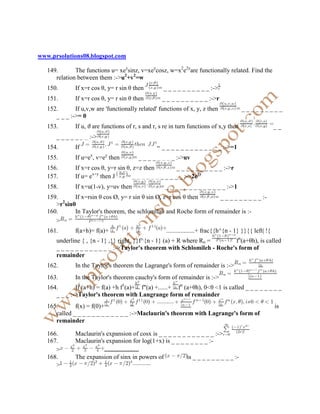
      origin is given by ρ        = _ _ _ _ _ _ _ _ :->
   115.       If the x-axis is tangent to the curve at the origin O then radius of curvature at


      origin is given by ρ        = _ _ _ _ _ _ _ _ _ :->
   116.        Find the radius of curvature at P= (        ) on the curve x2+y2=4 :->2
                                     4     4   2        2
   117.        Find ρ at (0,0) for 2x +3y +4x y+xy-y +2x=0 (ρ= Radius of curvature) :->1
   118.        The radius of curvature at origin for y= x4-4x3-18x2 is _ _ _ _ _ _ _ _ _ _ :->
   119.        The radius of curvature at origin for x3+y3-2x2+6y=0 is _ _ _ _ _ _ _ _ _ _ :->3/2
   120.        Find the radius of curvature at any point 't' of the curve x=a(cost+t sint), y=a (sint-
      t cost) given = tant, =           :->at
   121.        For the curves x=f(t); y=g(t), the formula for the radius of curvature is P= _ _ _ _
      _, where x1 =                              :->
   122.      For the curve r=f(θ), the formula for the radius of curvature is P= _ _ _ _ _ _ _ _ _
      _ _, where r =           :->
   123.      For the curve y=f(x), the formula for the radius of curvature is P= _ _ _ _ _ _ _ _,
      Where           ,       :->
www.prsolutions08.blogspot.com

   124.       If the curvature of curve is K, the radius of curvature is _ _ _ _ _ _ _ :->1/K
   125.       The radius of curvature of the curve r=a(1+cosθ) at θ=0 is _ _ _ _ _ _ :-> a
   126.       The radius of curvature of the curve x=et+e ; y=et-e at t=0 is _ _ _ _ _ _ :->2
   127.       The radius of curvature of the curve y=ex at the point where it crosses the y-axis is
      _ _ _ _ _ _ :->2
   128.       The radius of curvature at any point of the catenary y=c cosh is _ _ _ _ _ _ _ _
      _ :->
   129.       The radius of curvature of the curve r=aθ at (r,θ) is _ _ _ _ _ _ _ _ _ :->
   130.       If rt-s2=0 at a point p=(a,b) then the case is _ _ _ _ _ _ _ _ _ where
                                :->failure
   131.       If rt-s2 0 at a point p=(a,b) then P is a _ _ _ _ _ _ _ _ _ where
                               :->saddle point
   132.       A function f(x,y) has a minimum value at (a,b) if _ _ _ _ _ _ _ _ where
      r=                      :->rt-s2 0,r 0
   133.       A function f(x,y) has a maximum value at (a,b) if _ _ _ _ _ _ _ _ where
      r=                       :->rt-s2 0,r 0
   134.       The necessary conditions for a function f(x,y) to have an extreme value are :-
      >
   135.       If f(s,y) =xy, the stationary point (0,0) is _ _ _ _ _ _ _ _ _ :->saddle point
   136.       If f(x,y) = 1-x2-y2 then the stationary point is _ _ _ _ _ _ _ _ _ _ :->(0,0)
   137.       If f(x,y) = xy+(x-y) then the critical points of f are _ _ _ _ _ _ _ _ _ :->x=1, y=-1
   138.       If A=f (a,b), B=f (a,b), c=f (a,b) , then f(x,y) will have a maximum at (a,b) if
      _ _ _ _ _ _ :->fx=0, fy=0, AC B2 and A 0
   139.       If f(x,y) = x2+y2, and (0,0) is stationary point. then the stationary point (0,0) is _ _
      _ _ _ _ _ _ :->Minimum point
   140.       If u=x+ , v=      then       = _ _ _ _ _ _ _ _ _ :->
   141.       If u,v are 'functionally related' functions of x,y Then          = _ _ _ _ _ _ _ :->= 0
   142.     If u=ax+by and v = cx+dy find  :->ad-bc
   143.     If u=     v= Tan x+Tan y are functionally dependent find the relation
      between them :->v=Tan u
   144.       If u=       , v= Tan     x +Tan   y then     = _ _ _ _ _ _ _ _ :->0
   145.       If u=xsiny, v=ysinx then    = _ _ _ _ _ _ _ _ _ :->sinx siny - xycosx cosy
   146.       The functions u=xy+yz+zx, v=x2+y2+z2, w=x+y+z are functionally dependent.
      Find a relation between them :->w2= v+2u
   147.       If u=x+y+z, v=x2+y2+z2, w=x3+y3+z3-3xyz find                   :->0
                      u          u                                      2u
   148.       If x=e cos v, y=e sin v then        = _ _ _ _ _ _ _ :->e
www.prsolutions08.blogspot.com

   149.       The functions u= xeysinz, v=xeycosz, w=x2e2yare functionally related. Find the
      relation between them :->u2+v2=w
   150.       If x=r cos θ, y= r sin θ then       = _ _ _ _ _ _ _ _ _ _ :->
   151.       If x=r cos θ, y= r sin θ then      = _ _ _ _ _ _ _ _ _ _ :->r
   152.       If u,v,w are 'functionally related' functions of x, y, z then          =_________
      _ _ _ :->= 0
   153.       If u, ϑ are functions of r, s and r, s re in turn functions of x,y then                    __
      _ _ _ _ _ _ _ :->
   154.       If                                 = _ _ _ _ _ _ _ _ _ _ _ _ _ :->=1
                     x     y
   155.       If u=e , v=e then        = _ _ _ _ _ _ _ _ :->uv
   156.       If x=r cos θ, y=r sin θ, z=z then        = _ _ _ _ _ _ _ _ _ _ :->r
                     x+y
   157.       If u= e then J        = _ _ _ _ _ _ _ _ _ _ _ :->2e2y
   158.       If x=u(1-v), y=uv then               = _ _ _ _ _ _ _ _ _ _ _ _ _ :->1
   159.      If x=rsin θ cos Ø, y= r sin θ sin Ø, z=r cos θ then   = _ _ _ _ _ _ _ _ _ :-
      >r2sinθ
   160.      In Taylor's theorem, the schlomilah and Roche form of remainder is :-
      >
   161.       f(a+h)= f(a)+                          ..................+ frac{{h^{n - 1} }}{{ left| !{
      underline { , {n - 1} ,}} right. }}f^{n - 1} (a) + R where Rn =      fn(a+θh), is called
      _ _ _ _ _ _ _ _ _ _ _ _ :->Taylor's theorem with Schlomileh - Roche's form of
      remainder
   162.       In the Taylor's theorem the Lagrange's form of remainder is :->
   163.       In the Taylor's theorem cauchy's form of remainder is :->
   164.       If (a+h) = f(a) +h f1(a)+ f"(a) +......+ fn (a+θh), 0 θ 1 is called _ _ _ _ _ _ _ _
      _ _ _ :->Taylor's theorem with Langrange form of remainder
   165.       f(x) = f(0)+                                                                               is
      called _ _ _ _ _ _ _ _ _ _ _ _ :->Maclaurin's theorem with Lagrange's form of
      remainder

   166.       Maclaurin's expansion of cosx is _ _ _ _ _ _ _ _ _ _ _ _ :->
   167.       Maclaurin's expansion for log(1+x) is _ _ _ _ _ _ _ _ :-
      >                  ......................
   168.       The expansion of sinx in powers of           is _ _ _ _ _ _ _ _ _ :-
      >
www.prsolutions08.blogspot.com


   169.       The expansion of ex in power of (x-1) is _ _ _ _ _ _ _ _ _ _ :->
   170.       The c of the cauchy's mean value theorem for the pair of functions f(x) = sinx,
      g(x) = cos x for all x in [ -π/2, 0] is _ _ _ _ _ _ _ _ _ :->-π/4
   171.       The value of c of cauchy's mean value theorem for f(x)= log x, g(x) = in [1,e] is
      :->
   172.       The value of c of cauchy's mean value theorem for f(x)= x3 and g(x) = x2 in [1,2]
      is :->
   173.       The value of c of cauchy's mean value theorem for f(x)= and g(x) = in [1,4]
      is :->2
   174.       The value of c of cauchy's mean value theorem for f(x) = sinx and g(x) = cos x in
      [0, π/2] is :->π/4
   175.       Lagrange's mean-value theorem for f(x) = sec x in (0, 2 π) is :->not applicable
      due to discontinuity
   176.       If f and g are differentiable on [0, 1] such that f(0) =2 and g(0) = 0 ; f(1) =6 and
      g(1)=2 then there exists Cε (0,1) such that _ _ _ _ _ _ _ _ _ _ _ :->f1(c) = 2 g1(c)
   177.       The value of c of cauchy's mean-value theorem for the functions f(x) = x2, g(x) =
      x4 in [1,2] is _ _ _ _ _ _ _ _ :->
   178.       The value of c of cauchy's mean-value theorem for the functions f(x) = 1/x2, g(x)
      = 1/x in [ a,b], 0 a b is :->
   179.       The value of c of cauchy's mean-value theorem for the functions f(x) = ex and g(x)
      = e defined on [ a,b], 0 a b is _ _ _ _ _ _ _ _ _ _ :->
   180.       The value of c of lagrange's mean value theorem for f(x)=             in [2,4] is :->
   181.       The value of c in lagrange's mean value theorem for f(x) = (x-2) (x-3) in [0,1] is :-
      >0.5
   182.       The value of c in lagrange's mean-value theorem for f(x)= cosx in [ 0, ] is :->sin
        ( 2/π)
   183.       The value of c in lagrange's mean-value theorem for f(x) = log x in [1,e] is :->e-1
   184.       The value of c in lagrange's mean-value theorem for f(x) = ex in (0,1) is :->log (e-
      1)
   185.       If f(x) = x2, find θε(0, 1) such that f (x+h) = f(x) +h f1 (x+θh) :->
   186.       Lagrange's mean value theorem is not applicable to the function defined on [-1, 1]
      by f(x) = sin , (x      ) and f(0) = 0, because :->f is not derivable in (-1, 1)
   187.       Lagrange's mean value theorem is not applicable to the function f(x) =x in [-1,
      1] because :->f is not derivable in (-1, 1)
   188.       Find c of Lagrange's mean value theorem for f(x) = x(x-1) (x-2) in [ 0, 1/2] :-
      >
   189.       Find c of Lagrange's mean value theorem for f(x) = (x-1) (x-2) in [1,3] :->2
   190.       The value of c in Rolle's theorem for f(x)= sinx in (0, π) is :->
   191.       The value of c in Rolle's theorem for f(x) = x2 in (-1, 1) is :->0
   192.       The value of c in colle's theorem for f(x) = sinax in (0, πa) is :->
www.prsolutions08.blogspot.com

   193.        If a fuction is such that (i) it is continuous in [a,a+h], (ii) it is derivable in (a,a+h)
      (iii) f(a)=f(a+h) then there exists at least one number              such that _ _ _ _ _ _ _ _ :-
      >f1(a+θh)=0
   194.        If F:[a,b] R is (i) continuous in [a,b] (ii) derivable in (a,b) (iii) f(a) = f(b) then
      there exist at least one point c in (a,b) such that _ _ _ _ _ _ _ _ _ _ _ :->f1(c) =0
   195.        The value of c in Rolle's theorem f(x) = ex sin x in [0,π] is :->
   196.        Rolle's theorem is not applicable to the function f(x) = x in[-1, 1] because :->f is
      not derivable at x=0ε(-1,1)
   197.        Rolle's theorem is not applicable to the function f(x) = sinx in [0, ] because :-
      >f(0) ≠ f ( )
   198.        The value of c in Rolle's theorem for f(x) = log [         ] in [a,b] is _ _ _ _ _ _ _ _ _
      _ :->
   199.        The value of c in Rolle's theorem for f(x)= frac {sinx} {ex} in (0, π) is :->

M1 Prsolutions08

  • 1.
    1. :-> 2. _ _ _ _ _ _ _ _ _ :->a 3. Change the order of integration in the integral :-> 4. Change the order of integration in the :-> 5. In polar coordinates the integral is :-> 6. In polar coordinates the integral :-> 7. :-> 8. :-> 9. Change the order of integration in the following integral :-> 10. Change the order of integration in the integral :- > 11. :-> 12. :->1 13. :->3 14. :-> 15. :->26 16. :-> 17. :-> 18. :->(e-1)3 19. Evaluate taken over the volume bounded by the planes x=0, x=1, y=0, y=1 and z=0, z=1. :-> 20. :->1 21. :->1
  • 2.
    www.prsolutions08.blogspot.com 22. _ _ _ _ _ _ _ _ _ _ _ :-> 23. :-> 24. _ _ _ _ _ _ _ _ _ _ _ :->9 25. _ _ _ _ _ _ _ _ _ _ _ :-> 26. By double integration, the area bying inside the circle r=asin θ and outside the cardioid r=a(1-cosθ) is :-> 27. By double integration, the area lying between the parabola y=4x-x2 and the line y=x is :- > 28. The area between the parabolas y2 =4ax and x2=4ay is :-> 29. The area bounded by the curves and is :-> 30. The surface area of the solid generated by the revolution about y-axis , of the arc of the curve x=f(y) from y=a to y=b is :-> 31. The surface area of the solid generated by the revolution about x-axis , of the arc of the curve y=f(x) from x=a to x=b is :-> 32. The volume of the solid generated by the revalution of the area bounded by the curve r=f(θ) and the radii vectors , , about the line θ= is :-> 33. The volume of the solid generated by revolution of the area bounded by the curve r=f(θ), and the radii vectors , , about the initial line θ =0 is :-> 34. The volume of the solid generated by revolution about the y-axis , of the area bounded by the curve x=f(y), the y-axis and the abscissac y=a, y=b is :-> 35. The volume of the solid generated by revolution about the x-axis , of the area bounded by the curve y=f(x), the x-axis and the ordinates x=a, x=b is :-> 36. The length of the curve r=asin θ between θ =0 and is :->πa 37. The length of the arc x=t, y=t from t=0 to t=4 is :->4 38. The length of the arc of the catenary y=c cosh from x=0 to x=a is given by :- > 39. The length of the arc of the curve x=acosθ, y=a sinθ from θ=0 to is :->
  • 3.
    www.prsolutions08.blogspot.com 40. The length of the arc of the curve θ=f(r) between the points where r=a and r=b, is :->L= 41. The length of the arc of the curve r=f(θ) between the points where and , is :- >L= 42. The length of the arc of the curve x=f(t), y=g(t) between the points where t=a and t=b is :- >L= 43. The length of the are of the curve x=f(y) between the points where y=a and y=b is :->L= 44. The length of the arc of the curve y=f(x) between the points where x=a and x=b is :- > 45. The length of the curve x=et cost from t=oto t=π/2 is :-> 46. The length of the curve y=x from x=0 to x=4/3 is :-> 47. The arc of the upper half of the cardioid r=a(1+cos θ) is bisected at θ = _ _ _ _ _ _ _ _ _ _ _ _ _ :->π/2 48. The length of one arch of the cycloid x=a(t-sint), y=a(1-cost) is :->8a 49. The entire length of the cardioid r=a(1+cosθ) is :->8a 50. Where the curve x=a(θ+sin θ), y=a(1+cos θ) is symmetrical about :->y-axis 51. Where the curve x=a(θ+sin θ), y=a(1-cos θ) meet the x-axis? :->(0,0) 52. The curve x= a(t-sint) ; x=a(1-cost) is symmetrical about :->y-axis 53. If x=f(x) is odd and y=g(t) is even then the curve is symmetrical about :->y-axis 54. If x=f(t) is even and y=g(t) is odd then the curve is symmetrical about :->x-axis 55. The curve x=a (cost + log Tan ), y= a sin t is symmetrical about :->x-axis 56. Where the curve x=a(cost + log tan ), y=a sint meet the y-axis ? :->(0, ) 57. Where the curve x=acos y=b sin ) meet the y-axis ? :->(0, ) 58. The Asymptotes to the curve x=a[cos )], y= a sin θ is :->y=0 59. The Asymptotes to the curve x=a( ), y= a(1+cos θ) is :-> o asymptotes 60. The line θ=0 is tangent at the pole to the following ine of the curve :->r=a(1-cos θ) 61. The Tangents at the pole to the curve r=a(1+cos θ) is :->θ =π 62. The Tangents at origin to the curve r2=a2 cos 2 θ are :->θ = 63. The curve r=a(1+sin θ) is symmetrical about :->θ = π/2 64. If the equation of a curve does not change when θ is replaced by `-θ' then the curve is symmetrical about the _ _ _ _ _ :->initial line 65. The curve r2 = a2sin 2 θ is symmetrical about :->The pole and the line θ = 66. The curve r=acos2 θ, a 0 consists of _ _ _ _ _ _ _ _ _ _ loops :->4 67. The tangents at the pole to the curve r=a sin 3 θ are :->The Lines 68. The tangents at the pole to the curve r2=a2sin 2θ are :->θ = 0 and θ= 69. The equations of asymptotes to the curve r2=a2sec2θ are :->
  • 4.
    www.prsolutions08.blogspot.com 70. The curve 9 ay2 = (x-2a)(x-5a)2 is semmetrical about :->x-axis 71. The curve a2y2=x3(2a-x) is symmetrical about :->x-axis 72. Where the curve y(x2+4a2) = 8a3 meet y-axis? :->(0, 2a) 73. The tangents at the origin to the curve y2(a+x)=x2(3a-x) are :->y= 74. The curve y2(a+x) =x2(3a-x) is symmetrical about :->y-axis 75. The tangents at origin to the curve y2(x-a)=x2(x+a) are :->y= 76. The tangent at origin to the curve (x2+y2)=a2x is :->y= 77. The asymptotes to the curve a2y2=x3(2a-x) are :-> o asymptotes 78. The Asymptote to the curve xy2=a2(a-x) is :->x=0 79. The Asymptote to the curve y2(a+x)= x2(3a-x) is :->x+a=0 80. The curve x3 +y3 = 3 axy is symmetrical about _ _ _ _ _ _ _ _ _ :->The line y=x 81. The equation of the a symptote of the curve y2(2a-x) =x3 is _ _ _ _ _ _ _ _ _ _ :->x=2a 82. The Tangents at the Origin to the curve x2 y2 = a2(y2-x2) is _ _ _ _ _ _ _ _ _ _ :-> 83. For the curve ay2=x3 the origin is _ _ _ _ _ _ _ _ _ _ _ _ :->a cusp 84. The curve ay2 = x2 is symmetrical about _ _ _ _ _ _ _ _ _ _ :->The x-axis 85. The asymptote of the curve (a-x)y2 = x3 is _ _ _ _ _ _ _ _ _ _ :->x=a 86. The Equation of the oblique asymptote of the curve x3+y3 = 3 axy is :->x+y+a=0 87. The curve x3-y3 = 3 axy is symmetrical about _ _ _ _ _ _ _ _ _ _ :->The line y=-x 88. Find the points where the curve meets the x-axis :->x=0, x=-a 89. For the equation y2(a-x)=x2(a+x), the origin is _ _ _ _ _ _ _ :->a node 90. Envelope of y=mx+ is :->y2=8x 91. The envelope of the family of curves y=m2x+am is _ _ _ _ _ _ _ _ _ m being a parameter. :->a2+4xy=0 92. If a one parameter family of curves is given by A alpha2+Bα+C =0 then its envelope is :- >B2-4AC=0 93. The envelope of the family of straight lines x cosα+ ysin α = c sec α where α being a parameter, is _ _ _ _ _ _ _ _ _ :->a parabola 94. Envelope of the family of lines y=mx+a/m is _ _ _ _ _ _ :->y2=4ax 95. If the equation of a family of curves be a quadratic in parameter α, the envelope of the family is Discriminant _ _ _ _ _ _ _ _ _ _ _ :->=0 96. The Envelope of the familly of curves y= mx+ , is m being a parameter _ _ _ _ _ _ _ _ _ _ _ :-> 97. Radius of curvature y=4sinx-sin2x at x= is _ _ _ _ _ _ _ _ _ _ :-> 98. Evolute of a curve is the envelope of its _ _ _ _ _ _ _ _ _ :-> ormals 99. Envelope when f(x,y,α) is of the form A cos α+B sin α=C is where A,B,C are functions of x and y, and α is the parameter :->A2+B2=C2 100. The tangent at the origin to the curve y-x=x2+2xy+y2 is :->y=x 101. The tangent at the origin to the curve x4-y4+x3-y3+x2-y2+y=0 is :->x-axis 102. The coordinates of centre of curvature of the curve y=ex at (0,1) is _ _ _ _ _ _ _ _ :->(-2, 3)
  • 5.
    www.prsolutions08.blogspot.com 103. The circle with centre at the centre of curvature and radius equal to the radius of curvature is called _ _ _ _ _ _ _ _ _ :->circle of curvature 104. The coordinates of the centre of curvature at any point p(x,y) on the curve y=f(x) is _ _ _ _ _ _ _ _ _ _, where y1= , y2 = :-> 105. The locus of centre of curvature of a curve is called _ _ _ _ _ _ _ _ :->Evolute 106. The curvature at any point of a circle of radius `r' is _ _ _ _ _ _ _ _ :->1/r 107. If the circle of curvature is (a+b) (x2+y2)= 2(x+y) then find radius of curvature :- > 108. The coordinates of the centre of curvature of the curve y=x2 at is _ _ _ _ _ _ _ _ _ :->(-1/2, 5/4) 109. The coordinates of the centre of curvature of the curve xy=2 at (2,1) is _ _ _ _ _ _ _ _ _ :-> 110. Find the radius of curvature at P= on the curve x3+y3=3axy. Given :-> 111. The radius of curvature at Origin for y4+x3+a(x2+y2)-a2y=0 is _ _ _ _ _ _ _ :->a/2 112. The radius of curvature at the origin for x2-y2-2x-2y=0 is _ _ _ _ _ _ _ _ _ _ _ _ _ _ :-> 113. The radius of curvature at the origin for x4-y4+x3-y3+x2-y2+y=0 is _ _ _ _ _ _ _ _ _ _ _ _ _ _ :-> 114. If the y-axis is tangent to the curve at the origin O then radius of curvature at origin is given by ρ = _ _ _ _ _ _ _ _ :-> 115. If the x-axis is tangent to the curve at the origin O then radius of curvature at origin is given by ρ = _ _ _ _ _ _ _ _ _ :-> 116. Find the radius of curvature at P= ( ) on the curve x2+y2=4 :->2 4 4 2 2 117. Find ρ at (0,0) for 2x +3y +4x y+xy-y +2x=0 (ρ= Radius of curvature) :->1 118. The radius of curvature at origin for y= x4-4x3-18x2 is _ _ _ _ _ _ _ _ _ _ :-> 119. The radius of curvature at origin for x3+y3-2x2+6y=0 is _ _ _ _ _ _ _ _ _ _ :->3/2 120. Find the radius of curvature at any point 't' of the curve x=a(cost+t sint), y=a (sint- t cost) given = tant, = :->at 121. For the curves x=f(t); y=g(t), the formula for the radius of curvature is P= _ _ _ _ _, where x1 = :-> 122. For the curve r=f(θ), the formula for the radius of curvature is P= _ _ _ _ _ _ _ _ _ _ _, where r = :-> 123. For the curve y=f(x), the formula for the radius of curvature is P= _ _ _ _ _ _ _ _, Where , :->
  • 6.
    www.prsolutions08.blogspot.com 124. If the curvature of curve is K, the radius of curvature is _ _ _ _ _ _ _ :->1/K 125. The radius of curvature of the curve r=a(1+cosθ) at θ=0 is _ _ _ _ _ _ :-> a 126. The radius of curvature of the curve x=et+e ; y=et-e at t=0 is _ _ _ _ _ _ :->2 127. The radius of curvature of the curve y=ex at the point where it crosses the y-axis is _ _ _ _ _ _ :->2 128. The radius of curvature at any point of the catenary y=c cosh is _ _ _ _ _ _ _ _ _ :-> 129. The radius of curvature of the curve r=aθ at (r,θ) is _ _ _ _ _ _ _ _ _ :-> 130. If rt-s2=0 at a point p=(a,b) then the case is _ _ _ _ _ _ _ _ _ where :->failure 131. If rt-s2 0 at a point p=(a,b) then P is a _ _ _ _ _ _ _ _ _ where :->saddle point 132. A function f(x,y) has a minimum value at (a,b) if _ _ _ _ _ _ _ _ where r= :->rt-s2 0,r 0 133. A function f(x,y) has a maximum value at (a,b) if _ _ _ _ _ _ _ _ where r= :->rt-s2 0,r 0 134. The necessary conditions for a function f(x,y) to have an extreme value are :- > 135. If f(s,y) =xy, the stationary point (0,0) is _ _ _ _ _ _ _ _ _ :->saddle point 136. If f(x,y) = 1-x2-y2 then the stationary point is _ _ _ _ _ _ _ _ _ _ :->(0,0) 137. If f(x,y) = xy+(x-y) then the critical points of f are _ _ _ _ _ _ _ _ _ :->x=1, y=-1 138. If A=f (a,b), B=f (a,b), c=f (a,b) , then f(x,y) will have a maximum at (a,b) if _ _ _ _ _ _ :->fx=0, fy=0, AC B2 and A 0 139. If f(x,y) = x2+y2, and (0,0) is stationary point. then the stationary point (0,0) is _ _ _ _ _ _ _ _ :->Minimum point 140. If u=x+ , v= then = _ _ _ _ _ _ _ _ _ :-> 141. If u,v are 'functionally related' functions of x,y Then = _ _ _ _ _ _ _ :->= 0 142. If u=ax+by and v = cx+dy find :->ad-bc 143. If u= v= Tan x+Tan y are functionally dependent find the relation between them :->v=Tan u 144. If u= , v= Tan x +Tan y then = _ _ _ _ _ _ _ _ :->0 145. If u=xsiny, v=ysinx then = _ _ _ _ _ _ _ _ _ :->sinx siny - xycosx cosy 146. The functions u=xy+yz+zx, v=x2+y2+z2, w=x+y+z are functionally dependent. Find a relation between them :->w2= v+2u 147. If u=x+y+z, v=x2+y2+z2, w=x3+y3+z3-3xyz find :->0 u u 2u 148. If x=e cos v, y=e sin v then = _ _ _ _ _ _ _ :->e
  • 7.
    www.prsolutions08.blogspot.com 149. The functions u= xeysinz, v=xeycosz, w=x2e2yare functionally related. Find the relation between them :->u2+v2=w 150. If x=r cos θ, y= r sin θ then = _ _ _ _ _ _ _ _ _ _ :-> 151. If x=r cos θ, y= r sin θ then = _ _ _ _ _ _ _ _ _ _ :->r 152. If u,v,w are 'functionally related' functions of x, y, z then =_________ _ _ _ :->= 0 153. If u, ϑ are functions of r, s and r, s re in turn functions of x,y then __ _ _ _ _ _ _ _ :-> 154. If = _ _ _ _ _ _ _ _ _ _ _ _ _ :->=1 x y 155. If u=e , v=e then = _ _ _ _ _ _ _ _ :->uv 156. If x=r cos θ, y=r sin θ, z=z then = _ _ _ _ _ _ _ _ _ _ :->r x+y 157. If u= e then J = _ _ _ _ _ _ _ _ _ _ _ :->2e2y 158. If x=u(1-v), y=uv then = _ _ _ _ _ _ _ _ _ _ _ _ _ :->1 159. If x=rsin θ cos Ø, y= r sin θ sin Ø, z=r cos θ then = _ _ _ _ _ _ _ _ _ :- >r2sinθ 160. In Taylor's theorem, the schlomilah and Roche form of remainder is :- > 161. f(a+h)= f(a)+ ..................+ frac{{h^{n - 1} }}{{ left| !{ underline { , {n - 1} ,}} right. }}f^{n - 1} (a) + R where Rn = fn(a+θh), is called _ _ _ _ _ _ _ _ _ _ _ _ :->Taylor's theorem with Schlomileh - Roche's form of remainder 162. In the Taylor's theorem the Lagrange's form of remainder is :-> 163. In the Taylor's theorem cauchy's form of remainder is :-> 164. If (a+h) = f(a) +h f1(a)+ f"(a) +......+ fn (a+θh), 0 θ 1 is called _ _ _ _ _ _ _ _ _ _ _ :->Taylor's theorem with Langrange form of remainder 165. f(x) = f(0)+ is called _ _ _ _ _ _ _ _ _ _ _ _ :->Maclaurin's theorem with Lagrange's form of remainder 166. Maclaurin's expansion of cosx is _ _ _ _ _ _ _ _ _ _ _ _ :-> 167. Maclaurin's expansion for log(1+x) is _ _ _ _ _ _ _ _ :- > ...................... 168. The expansion of sinx in powers of is _ _ _ _ _ _ _ _ _ :- >
  • 8.
    www.prsolutions08.blogspot.com 169. The expansion of ex in power of (x-1) is _ _ _ _ _ _ _ _ _ _ :-> 170. The c of the cauchy's mean value theorem for the pair of functions f(x) = sinx, g(x) = cos x for all x in [ -π/2, 0] is _ _ _ _ _ _ _ _ _ :->-π/4 171. The value of c of cauchy's mean value theorem for f(x)= log x, g(x) = in [1,e] is :-> 172. The value of c of cauchy's mean value theorem for f(x)= x3 and g(x) = x2 in [1,2] is :-> 173. The value of c of cauchy's mean value theorem for f(x)= and g(x) = in [1,4] is :->2 174. The value of c of cauchy's mean value theorem for f(x) = sinx and g(x) = cos x in [0, π/2] is :->π/4 175. Lagrange's mean-value theorem for f(x) = sec x in (0, 2 π) is :->not applicable due to discontinuity 176. If f and g are differentiable on [0, 1] such that f(0) =2 and g(0) = 0 ; f(1) =6 and g(1)=2 then there exists Cε (0,1) such that _ _ _ _ _ _ _ _ _ _ _ :->f1(c) = 2 g1(c) 177. The value of c of cauchy's mean-value theorem for the functions f(x) = x2, g(x) = x4 in [1,2] is _ _ _ _ _ _ _ _ :-> 178. The value of c of cauchy's mean-value theorem for the functions f(x) = 1/x2, g(x) = 1/x in [ a,b], 0 a b is :-> 179. The value of c of cauchy's mean-value theorem for the functions f(x) = ex and g(x) = e defined on [ a,b], 0 a b is _ _ _ _ _ _ _ _ _ _ :-> 180. The value of c of lagrange's mean value theorem for f(x)= in [2,4] is :-> 181. The value of c in lagrange's mean value theorem for f(x) = (x-2) (x-3) in [0,1] is :- >0.5 182. The value of c in lagrange's mean-value theorem for f(x)= cosx in [ 0, ] is :->sin ( 2/π) 183. The value of c in lagrange's mean-value theorem for f(x) = log x in [1,e] is :->e-1 184. The value of c in lagrange's mean-value theorem for f(x) = ex in (0,1) is :->log (e- 1) 185. If f(x) = x2, find θε(0, 1) such that f (x+h) = f(x) +h f1 (x+θh) :-> 186. Lagrange's mean value theorem is not applicable to the function defined on [-1, 1] by f(x) = sin , (x ) and f(0) = 0, because :->f is not derivable in (-1, 1) 187. Lagrange's mean value theorem is not applicable to the function f(x) =x in [-1, 1] because :->f is not derivable in (-1, 1) 188. Find c of Lagrange's mean value theorem for f(x) = x(x-1) (x-2) in [ 0, 1/2] :- > 189. Find c of Lagrange's mean value theorem for f(x) = (x-1) (x-2) in [1,3] :->2 190. The value of c in Rolle's theorem for f(x)= sinx in (0, π) is :-> 191. The value of c in Rolle's theorem for f(x) = x2 in (-1, 1) is :->0 192. The value of c in colle's theorem for f(x) = sinax in (0, πa) is :->
  • 9.
    www.prsolutions08.blogspot.com 193. If a fuction is such that (i) it is continuous in [a,a+h], (ii) it is derivable in (a,a+h) (iii) f(a)=f(a+h) then there exists at least one number such that _ _ _ _ _ _ _ _ :- >f1(a+θh)=0 194. If F:[a,b] R is (i) continuous in [a,b] (ii) derivable in (a,b) (iii) f(a) = f(b) then there exist at least one point c in (a,b) such that _ _ _ _ _ _ _ _ _ _ _ :->f1(c) =0 195. The value of c in Rolle's theorem f(x) = ex sin x in [0,π] is :-> 196. Rolle's theorem is not applicable to the function f(x) = x in[-1, 1] because :->f is not derivable at x=0ε(-1,1) 197. Rolle's theorem is not applicable to the function f(x) = sinx in [0, ] because :- >f(0) ≠ f ( ) 198. The value of c in Rolle's theorem for f(x) = log [ ] in [a,b] is _ _ _ _ _ _ _ _ _ _ :-> 199. The value of c in Rolle's theorem for f(x)= frac {sinx} {ex} in (0, π) is :->