BINOMIAL
EXPANSION
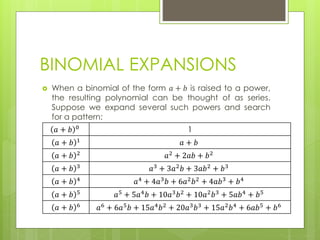
BINOMIAL EXPANSIONS
ο‚› When a binomial of the form π‘Ž + 𝑏 is raised to a power,
the resulting polynomial can be thought of as series.
Suppose we expand several such powers and search
for a pattern:
π‘Ž + 𝑏 0 1
π‘Ž + 𝑏 1
π‘Ž + 𝑏
π‘Ž + 𝑏 2 π‘Ž2 + 2π‘Žπ‘ + 𝑏2
π‘Ž + 𝑏 3 π‘Ž3 + 3π‘Ž2 𝑏 + 3π‘Žπ‘2 + 𝑏3
π‘Ž + 𝑏 4
π‘Ž4
+ 4π‘Ž3
𝑏 + 6π‘Ž2
𝑏2
+ 4π‘Žπ‘3
+ 𝑏4
π‘Ž + 𝑏 5 π‘Ž5 + 5π‘Ž4 𝑏 + 10π‘Ž3 𝑏2 + 10π‘Ž2 𝑏3 + 5π‘Žπ‘4 + 𝑏5
π‘Ž + 𝑏 6
π‘Ž6
+ 6π‘Ž5
𝑏 + 15π‘Ž4
𝑏2
+ 20π‘Ž3
𝑏3
+ 15π‘Ž2
𝑏4
+ 6π‘Žπ‘5
+ 𝑏6
In each case we observe the
following:
1. There are always 𝑛 + 1 term in the expansion.
2. The exponents on π‘Ž start with 𝑛 and decrease to 0.
3. The exponents on 𝑏 start with 0 and increase to 𝑛.
4. The sum of the exponents in each term is always 𝑛.
5. If π‘Ž and 𝑏 are both positive, all terms are positive.
6. If π‘Ž is positive and 𝑏 is negative, the terms have
alternating signs; those with odd powers of 𝑏 are
negative.
7. If π‘Ž is negative and 𝑏 is positive, the terms have
alternating signs; those with odd powers of π‘Ž are
negative.
8. If π‘Ž and 𝑏 are both negative, all terms are positive if
𝑛 is even and negative if 𝑛 is odd.
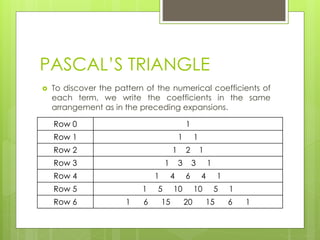
PASCAL’S TRIANGLE
ο‚› To discover the pattern of the numerical coefficients of
each term, we write the coefficients in the same
arrangement as in the preceding expansions.
Row 0 1
Row 1 1 1
Row 2 1 2 1
Row 3 1 3 3 1
Row 4 1 4 6 4 1
Row 5 1 5 10 10 5 1
Row 6 1 6 15 20 15 6 1
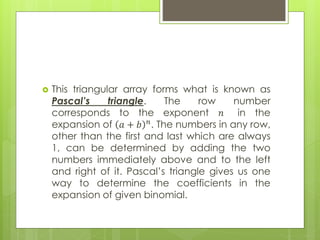
ο‚› This triangular array forms what is known as
Pascal’s triangle. The row number
corresponds to the exponent 𝑛 in the
expansion of π‘Ž + 𝑏 𝑛
. The numbers in any row,
other than the first and last which are always
1, can be determined by adding the two
numbers immediately above and to the left
and right of it. Pascal’s triangle gives us one
way to determine the coefficients in the
expansion of given binomial.
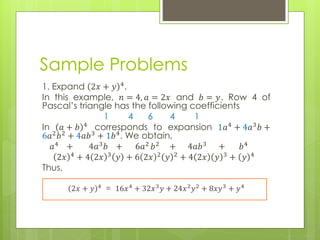
Sample Problems
1. Expand 2π‘₯ + 𝑦 4.
In this example, 𝑛 = 4, π‘Ž = 2π‘₯ and 𝑏 = 𝑦. Row 4 of
Pascal’s triangle has the following coefficients
1 4 6 4 1
In π‘Ž + 𝑏 4 corresponds to expansion 1π‘Ž4 + 4π‘Ž3 𝑏 +
6π‘Ž2 𝑏2 + 4π‘Žπ‘3 + 1𝑏4. We obtain,
π‘Ž4 + 4π‘Ž3 𝑏 + 6π‘Ž2 𝑏2 + 4π‘Žπ‘3 + 𝑏4
2π‘₯ 4 + 4 2π‘₯ 3 𝑦 + 6 2π‘₯ 2 𝑦 2 + 4 2π‘₯ 𝑦 3 + 𝑦 4
Thus,
2π‘₯ + 𝑦 4
= 16π‘₯4
+ 32π‘₯3
𝑦 + 24π‘₯2
𝑦2
+ 8π‘₯𝑦3
+ 𝑦4
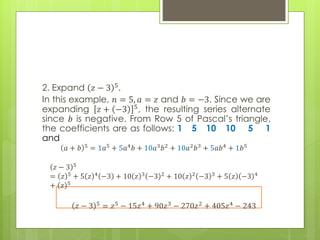
2. Expand 𝑧 βˆ’ 3 5.
In this example, 𝑛 = 5, π‘Ž = 𝑧 and 𝑏 = βˆ’3. Since we are
expanding 𝑧 + βˆ’3 5, the resulting series alternate
since 𝑏 is negative. From Row 5 of Pascal’s triangle,
the coefficients are as follows: 1 5 10 10 5 1
and
π‘Ž + 𝑏 5
= 1π‘Ž5
+ 5π‘Ž4
𝑏 + 10π‘Ž3
𝑏2
+ 10π‘Ž2
𝑏3
+ 5π‘Žπ‘4
+ 1𝑏5
𝑧 βˆ’ 3 5
= 𝑧 5 + 5 𝑧 4 βˆ’3 + 10 𝑧 3 βˆ’3 2 + 10 𝑧 2 βˆ’3 3 + 5 𝑧 βˆ’3 4
+ 𝑧 5
𝑧 βˆ’ 3 5 = 𝑧5 βˆ’ 15𝑧4 + 90𝑧3 βˆ’ 270𝑧2 + 405𝑧4 βˆ’ 243
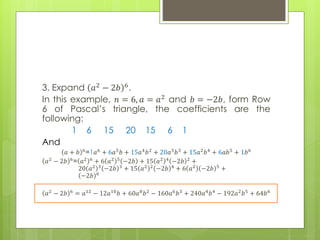
3. Expand π‘Ž2 βˆ’ 2𝑏 6.
In this example, 𝑛 = 6, π‘Ž = π‘Ž2 and 𝑏 = βˆ’2𝑏, form Row
6 of Pascal’s triangle, the coefficients are the
following:
1 6 15 20 15 6 1
And
π‘Ž + 𝑏 6
=1π‘Ž6
+ 6π‘Ž5
𝑏 + 15π‘Ž4
𝑏2
+ 20π‘Ž3
𝑏3
+ 15π‘Ž2
𝑏4
+ 6π‘Žπ‘5
+ 1𝑏6
π‘Ž2
βˆ’ 2𝑏 6
= π‘Ž2 6
+ 6 π‘Ž2 5
βˆ’2𝑏 + 15 π‘Ž2 4
βˆ’2𝑏 2
+
20 π‘Ž2 3
βˆ’2𝑏 3
+ 15 π‘Ž2 2
βˆ’2𝑏 4
+ 6 π‘Ž2
βˆ’2𝑏 5
+
βˆ’2𝑏 6
π‘Ž2
βˆ’ 2𝑏 6
= π‘Ž12
βˆ’ 12π‘Ž10
𝑏 + 60π‘Ž8
𝑏2
βˆ’ 160π‘Ž6
𝑏3
+ 240π‘Ž4
𝑏4
βˆ’ 192π‘Ž2
𝑏5
+ 64𝑏6
Break a leg!
1. Expand π‘₯βˆ’2 βˆ’ 3 5.
2. Expand π‘₯2
+ 𝑦 6
.
THANK YOU VERY MUCH!!!
PROF. DENMAR ESTRADA MARASIGAN

Binomial expansion

  • 1.
  • 2.
    BINOMIAL EXPANSIONS ο‚› Whena binomial of the form π‘Ž + 𝑏 is raised to a power, the resulting polynomial can be thought of as series. Suppose we expand several such powers and search for a pattern: π‘Ž + 𝑏 0 1 π‘Ž + 𝑏 1 π‘Ž + 𝑏 π‘Ž + 𝑏 2 π‘Ž2 + 2π‘Žπ‘ + 𝑏2 π‘Ž + 𝑏 3 π‘Ž3 + 3π‘Ž2 𝑏 + 3π‘Žπ‘2 + 𝑏3 π‘Ž + 𝑏 4 π‘Ž4 + 4π‘Ž3 𝑏 + 6π‘Ž2 𝑏2 + 4π‘Žπ‘3 + 𝑏4 π‘Ž + 𝑏 5 π‘Ž5 + 5π‘Ž4 𝑏 + 10π‘Ž3 𝑏2 + 10π‘Ž2 𝑏3 + 5π‘Žπ‘4 + 𝑏5 π‘Ž + 𝑏 6 π‘Ž6 + 6π‘Ž5 𝑏 + 15π‘Ž4 𝑏2 + 20π‘Ž3 𝑏3 + 15π‘Ž2 𝑏4 + 6π‘Žπ‘5 + 𝑏6
  • 3.
    In each casewe observe the following: 1. There are always 𝑛 + 1 term in the expansion. 2. The exponents on π‘Ž start with 𝑛 and decrease to 0. 3. The exponents on 𝑏 start with 0 and increase to 𝑛. 4. The sum of the exponents in each term is always 𝑛. 5. If π‘Ž and 𝑏 are both positive, all terms are positive. 6. If π‘Ž is positive and 𝑏 is negative, the terms have alternating signs; those with odd powers of 𝑏 are negative. 7. If π‘Ž is negative and 𝑏 is positive, the terms have alternating signs; those with odd powers of π‘Ž are negative. 8. If π‘Ž and 𝑏 are both negative, all terms are positive if 𝑛 is even and negative if 𝑛 is odd.
  • 4.
    PASCAL’S TRIANGLE ο‚› Todiscover the pattern of the numerical coefficients of each term, we write the coefficients in the same arrangement as in the preceding expansions. Row 0 1 Row 1 1 1 Row 2 1 2 1 Row 3 1 3 3 1 Row 4 1 4 6 4 1 Row 5 1 5 10 10 5 1 Row 6 1 6 15 20 15 6 1
  • 5.
    ο‚› This triangulararray forms what is known as Pascal’s triangle. The row number corresponds to the exponent 𝑛 in the expansion of π‘Ž + 𝑏 𝑛 . The numbers in any row, other than the first and last which are always 1, can be determined by adding the two numbers immediately above and to the left and right of it. Pascal’s triangle gives us one way to determine the coefficients in the expansion of given binomial.
  • 6.
    Sample Problems 1. Expand2π‘₯ + 𝑦 4. In this example, 𝑛 = 4, π‘Ž = 2π‘₯ and 𝑏 = 𝑦. Row 4 of Pascal’s triangle has the following coefficients 1 4 6 4 1 In π‘Ž + 𝑏 4 corresponds to expansion 1π‘Ž4 + 4π‘Ž3 𝑏 + 6π‘Ž2 𝑏2 + 4π‘Žπ‘3 + 1𝑏4. We obtain, π‘Ž4 + 4π‘Ž3 𝑏 + 6π‘Ž2 𝑏2 + 4π‘Žπ‘3 + 𝑏4 2π‘₯ 4 + 4 2π‘₯ 3 𝑦 + 6 2π‘₯ 2 𝑦 2 + 4 2π‘₯ 𝑦 3 + 𝑦 4 Thus, 2π‘₯ + 𝑦 4 = 16π‘₯4 + 32π‘₯3 𝑦 + 24π‘₯2 𝑦2 + 8π‘₯𝑦3 + 𝑦4
  • 7.
    2. Expand π‘§βˆ’ 3 5. In this example, 𝑛 = 5, π‘Ž = 𝑧 and 𝑏 = βˆ’3. Since we are expanding 𝑧 + βˆ’3 5, the resulting series alternate since 𝑏 is negative. From Row 5 of Pascal’s triangle, the coefficients are as follows: 1 5 10 10 5 1 and π‘Ž + 𝑏 5 = 1π‘Ž5 + 5π‘Ž4 𝑏 + 10π‘Ž3 𝑏2 + 10π‘Ž2 𝑏3 + 5π‘Žπ‘4 + 1𝑏5 𝑧 βˆ’ 3 5 = 𝑧 5 + 5 𝑧 4 βˆ’3 + 10 𝑧 3 βˆ’3 2 + 10 𝑧 2 βˆ’3 3 + 5 𝑧 βˆ’3 4 + 𝑧 5 𝑧 βˆ’ 3 5 = 𝑧5 βˆ’ 15𝑧4 + 90𝑧3 βˆ’ 270𝑧2 + 405𝑧4 βˆ’ 243
  • 8.
    3. Expand π‘Ž2βˆ’ 2𝑏 6. In this example, 𝑛 = 6, π‘Ž = π‘Ž2 and 𝑏 = βˆ’2𝑏, form Row 6 of Pascal’s triangle, the coefficients are the following: 1 6 15 20 15 6 1 And π‘Ž + 𝑏 6 =1π‘Ž6 + 6π‘Ž5 𝑏 + 15π‘Ž4 𝑏2 + 20π‘Ž3 𝑏3 + 15π‘Ž2 𝑏4 + 6π‘Žπ‘5 + 1𝑏6 π‘Ž2 βˆ’ 2𝑏 6 = π‘Ž2 6 + 6 π‘Ž2 5 βˆ’2𝑏 + 15 π‘Ž2 4 βˆ’2𝑏 2 + 20 π‘Ž2 3 βˆ’2𝑏 3 + 15 π‘Ž2 2 βˆ’2𝑏 4 + 6 π‘Ž2 βˆ’2𝑏 5 + βˆ’2𝑏 6 π‘Ž2 βˆ’ 2𝑏 6 = π‘Ž12 βˆ’ 12π‘Ž10 𝑏 + 60π‘Ž8 𝑏2 βˆ’ 160π‘Ž6 𝑏3 + 240π‘Ž4 𝑏4 βˆ’ 192π‘Ž2 𝑏5 + 64𝑏6
  • 9.
    Break a leg! 1.Expand π‘₯βˆ’2 βˆ’ 3 5. 2. Expand π‘₯2 + 𝑦 6 .
  • 10.
    THANK YOU VERYMUCH!!! PROF. DENMAR ESTRADA MARASIGAN