 INTRODUCTION
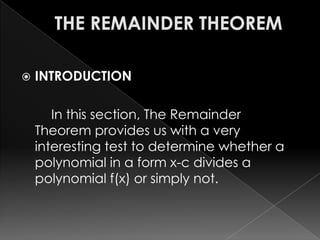
In this section, The Remainder
Theorem provides us with a very
interesting test to determine whether a
polynomial in a form x-c divides a
polynomial f(x) or simply not.
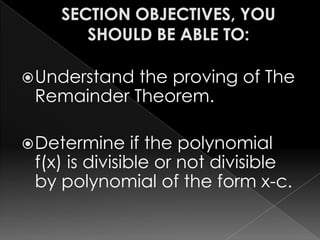
Understand the proving of The
Remainder Theorem.
Determine if the polynomial
f(x) is divisible or not divisible
by polynomial of the form x-c.
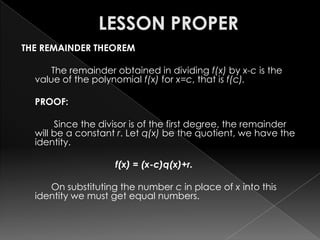
THE REMAINDER THEOREM
The remainder obtained in dividing f(x) by x-c is the
value of the polynomial f(x) for x=c, that is f(c).
PROOF:
Since the divisor is of the first degree, the remainder
will be a constant r. Let q(x) be the quotient, we have the
identity.
f(x) = (x-c)q(x)+r.
On substituting the number c in place of x into this
identity we must get equal numbers.
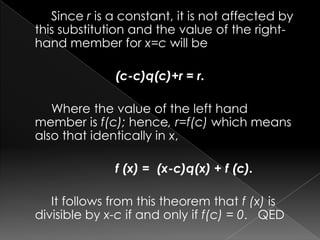
Since r is a constant, it is not affected by
this substitution and the value of the right-
hand member for x=c will be
(c-c)q(c)+r = r.
Where the value of the left hand
member is f(c); hence, r=f(c) which means
also that identically in x,
f (x) = (x-c)q(x) + f (c).
It follows from this theorem that f (x) is
divisible by x-c if and only if f(c) = 0. QED
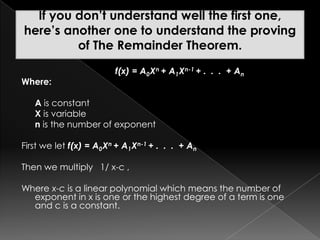
f(x) = A0Xn + A1Xn-1 + . . . + An
Where:
A is constant
X is variable
n is the number of exponent
First we let f(x) = A0Xn + A1Xn-1 + . . . + An
Then we multiply 1/ x-c ,
Where x-c is a linear polynomial which means the number of
exponent in x is one or the highest degree of a term is one
and c is a constant.
If you don’t understand well the first one,
here’s another one to understand the proving
of The Remainder Theorem.
(1/ x-c)[f(x) = A0Xn + A1Xn-1 + . . . + An](1/x-c)
Then,
f(x) = A0Xn + A1Xn-1 + . . . + An
x-c x-c
Recall this,
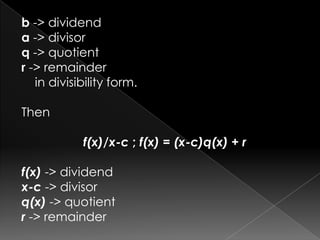
b/a ; b = aq + r
b -> dividend
a -> divisor
q -> quotient
r -> remainder
in divisibility form.
Then
f(x)/x-c ; f(x) = (x-c)q(x) + r
f(x) -> dividend
x-c -> divisor
q(x) -> quotient
r -> remainder
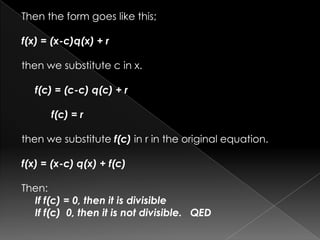
Then the form goes like this;
f(x) = (x-c)q(x) + r
then we substitute c in x.
f(c) = (c-c) q(c) + r
f(c) = r
then we substitute f(c) in r in the original equation.
f(x) = (x-c) q(x) + f(c)
Then:
If f(c) = 0, then it is divisible
If f(c) 0, then it is not divisible. QED
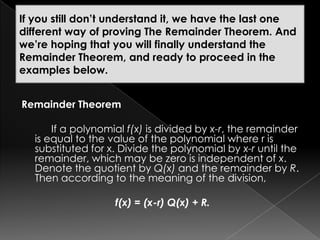
Remainder Theorem
If a polynomial f(x) is divided by x-r, the remainder
is equal to the value of the polynomial where r is
substituted for x. Divide the polynomial by x-r until the
remainder, which may be zero is independent of x.
Denote the quotient by Q(x) and the remainder by R.
Then according to the meaning of the division,
f(x) = (x-r) Q(x) + R.
If you still don’t understand it, we have the last one
different way of proving The Remainder Theorem. And
we’re hoping that you will finally understand the
Remainder Theorem, and ready to proceed in the
examples below.
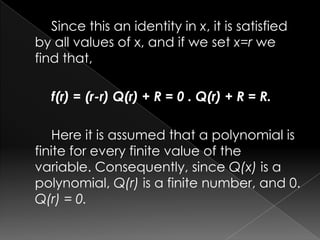
Since this an identity in x, it is satisfied
by all values of x, and if we set x=r we
find that,
f(r) = (r-r) Q(r) + R = 0 . Q(r) + R = R.
Here it is assumed that a polynomial is
finite for every finite value of the
variable. Consequently, since Q(x) is a
polynomial, Q(r) is a finite number, and 0.
Q(r) = 0.
 Note: The solutions of the following
examples are given step by step in
order that any student (fast or slow
learners) could be able to understand
the process.
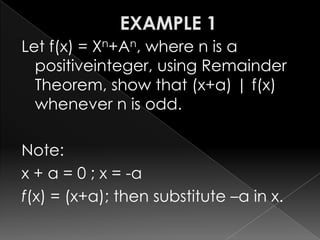
Let f(x) = Xn+An, where n is a
positiveinteger, using Remainder
Theorem, show that (x+a) | f(x)
whenever n is odd.
Note:
x + a = 0 ; x = -a
f(x) = (x+a); then substitute –a in x.
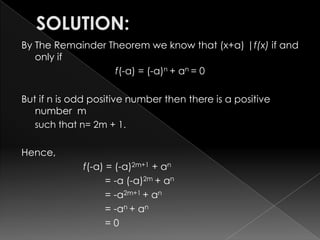
By The Remainder Theorem we know that (x+a) |f(x) if and
only if
f(-a) = (-a)n + an = 0
But if n is odd positive number then there is a positive
number m
such that n= 2m + 1.
Hence,
f(-a) = (-a)2m+1 + an
= -a (-a)2m + an
= -a2m+1 + an
= -an + an
= 0
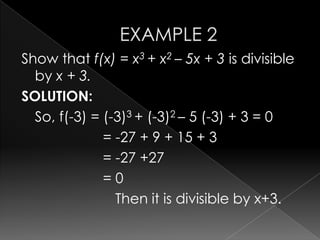
Show that f(x) = x3 + x2 – 5x + 3 is divisible
by x + 3.
SOLUTION:
So, f(-3) = (-3)3 + (-3)2 – 5 (-3) + 3 = 0
= -27 + 9 + 15 + 3
= -27 +27
= 0
Then it is divisible by x+3.
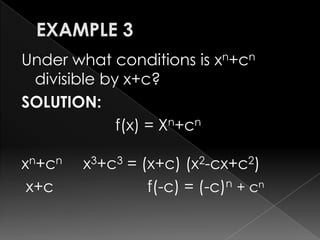
Under what conditions is xn+cn
divisible by x+c?
SOLUTION:
f(x) = Xn+cn
xn+cn x3+c3 = (x+c) (x2-cx+c2)
x+c f(-c) = (-c)n + cn
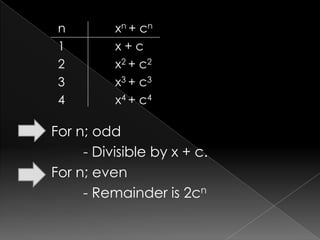
n xn + cn
1 x + c
2 x2 + c2
3 x3 + c3
4 x4 + c4
For n; odd
- Divisible by x + c.
For n; even
- Remainder is 2cn
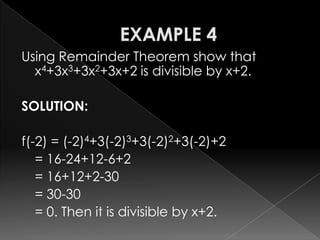
Using Remainder Theorem show that
x4+3x3+3x2+3x+2 is divisible by x+2.
SOLUTION:
f(-2) = (-2)4+3(-2)3+3(-2)2+3(-2)+2
= 16-24+12-6+2
= 16+12+2-30
= 30-30
= 0. Then it is divisible by x+2.
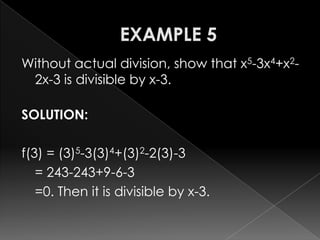
Without actual division, show that x5-3x4+x2-
2x-3 is divisible by x-3.
SOLUTION:
f(3) = (3)5-3(3)4+(3)2-2(3)-3
= 243-243+9-6-3
=0. Then it is divisible by x-3.
Are the lessons clear?
If yes then you may
proceed to the practice
exercises.
If you think you cannot still
manage, please go over
the examples once more.
1. Show x3–6x2+11x-6 that is divisible by x-1
2. Use the Remainder Theorem to determine whether x = –4 is a
solution of x6 + 5x5 + 5x4 + 5x3 + 2x2 – 10x – 8
3. x4+7x3+3x2-63x-108 is divisible by x+3.
4. X3+4x2-9x-36 is divisible by x-3.
5. X3+4x2-9x-36 is divisible by x-1.
I can do it
alone.
Check your answers
next page “BE
HONEST”
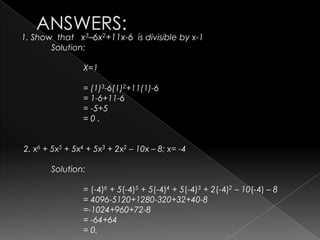
1. Show that x3–6x2+11x-6 is divisible by x-1
Solution:
X=1
= (1)3-6(1)2+11(1)-6
= 1-6+11-6
= -5+5
= 0 .
2. x6 + 5x5 + 5x4 + 5x3 + 2x2 – 10x – 8; x= -4
Solution:
= (-4)6 + 5(-4)5 + 5(-4)4 + 5(-4)3 + 2(-4)2 – 10(-4) – 8
= 4096-5120+1280-320+32+40-8
=-1024+960+72-8
= -64+64
= 0.
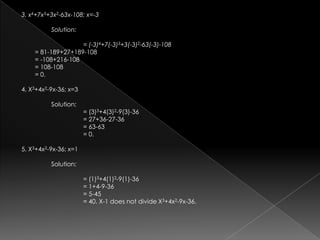
3. x4+7x3+3x2-63x-108; x=-3
Solution:
= (-3)4+7(-3)3+3(-3)2-63(-3)-108
= 81-189+27+189-108
= -108+216-108
= 108-108
= 0.
4. X3+4x2-9x-36; x=3
Solution:
= (3)3+4(3)2-9(3)-36
= 27+36-27-36
= 63-63
= 0.
5. X3+4x2-9x-36; x=1
Solution:
= (1)3+4(1)2-9(1)-36
= 1+4-9-36
= 5-45
= 40. X-1 does not divide X3+4x2-9x-36.
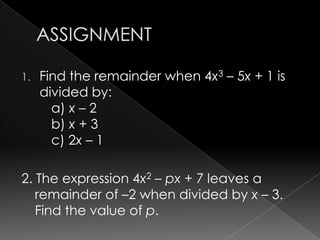
1. Find the remainder when 4x3 – 5x + 1 is
divided by:
a) x – 2
b) x + 3
c) 2x – 1
2. The expression 4x2 – px + 7 leaves a
remainder of –2 when divided by x – 3.
Find the value of p.
 http://www.purplemath.com/modules/r
emaindr.htm
 http://www.onlinemathlearning.com/re
mainder-theorem.html
 http://www.wyzant.com/help/math/alg
ebra/remainder_theorem
 Marvin Marcus, Henryk Minc. College
Algebra. USA. Houghton Mifflin
Company, 1970.
 Rider, Paul R. College Algebra.

The remainder theorem powerpoint

  • 2.
     INTRODUCTION In thissection, The Remainder Theorem provides us with a very interesting test to determine whether a polynomial in a form x-c divides a polynomial f(x) or simply not.
  • 3.
    Understand the provingof The Remainder Theorem. Determine if the polynomial f(x) is divisible or not divisible by polynomial of the form x-c.
  • 4.
    THE REMAINDER THEOREM Theremainder obtained in dividing f(x) by x-c is the value of the polynomial f(x) for x=c, that is f(c). PROOF: Since the divisor is of the first degree, the remainder will be a constant r. Let q(x) be the quotient, we have the identity. f(x) = (x-c)q(x)+r. On substituting the number c in place of x into this identity we must get equal numbers.
  • 5.
    Since r isa constant, it is not affected by this substitution and the value of the right- hand member for x=c will be (c-c)q(c)+r = r. Where the value of the left hand member is f(c); hence, r=f(c) which means also that identically in x, f (x) = (x-c)q(x) + f (c). It follows from this theorem that f (x) is divisible by x-c if and only if f(c) = 0. QED
  • 6.
    f(x) = A0Xn+ A1Xn-1 + . . . + An Where: A is constant X is variable n is the number of exponent First we let f(x) = A0Xn + A1Xn-1 + . . . + An Then we multiply 1/ x-c , Where x-c is a linear polynomial which means the number of exponent in x is one or the highest degree of a term is one and c is a constant. If you don’t understand well the first one, here’s another one to understand the proving of The Remainder Theorem.
  • 7.
    (1/ x-c)[f(x) =A0Xn + A1Xn-1 + . . . + An](1/x-c) Then, f(x) = A0Xn + A1Xn-1 + . . . + An x-c x-c Recall this, b/a ; b = aq + r
  • 8.
    b -> dividend a-> divisor q -> quotient r -> remainder in divisibility form. Then f(x)/x-c ; f(x) = (x-c)q(x) + r f(x) -> dividend x-c -> divisor q(x) -> quotient r -> remainder
  • 9.
    Then the formgoes like this; f(x) = (x-c)q(x) + r then we substitute c in x. f(c) = (c-c) q(c) + r f(c) = r then we substitute f(c) in r in the original equation. f(x) = (x-c) q(x) + f(c) Then: If f(c) = 0, then it is divisible If f(c) 0, then it is not divisible. QED
  • 10.
    Remainder Theorem If apolynomial f(x) is divided by x-r, the remainder is equal to the value of the polynomial where r is substituted for x. Divide the polynomial by x-r until the remainder, which may be zero is independent of x. Denote the quotient by Q(x) and the remainder by R. Then according to the meaning of the division, f(x) = (x-r) Q(x) + R. If you still don’t understand it, we have the last one different way of proving The Remainder Theorem. And we’re hoping that you will finally understand the Remainder Theorem, and ready to proceed in the examples below.
  • 11.
    Since this anidentity in x, it is satisfied by all values of x, and if we set x=r we find that, f(r) = (r-r) Q(r) + R = 0 . Q(r) + R = R. Here it is assumed that a polynomial is finite for every finite value of the variable. Consequently, since Q(x) is a polynomial, Q(r) is a finite number, and 0. Q(r) = 0.
  • 12.
     Note: Thesolutions of the following examples are given step by step in order that any student (fast or slow learners) could be able to understand the process.
  • 13.
    Let f(x) =Xn+An, where n is a positiveinteger, using Remainder Theorem, show that (x+a) | f(x) whenever n is odd. Note: x + a = 0 ; x = -a f(x) = (x+a); then substitute –a in x.
  • 14.
    By The RemainderTheorem we know that (x+a) |f(x) if and only if f(-a) = (-a)n + an = 0 But if n is odd positive number then there is a positive number m such that n= 2m + 1. Hence, f(-a) = (-a)2m+1 + an = -a (-a)2m + an = -a2m+1 + an = -an + an = 0
  • 15.
    Show that f(x)= x3 + x2 – 5x + 3 is divisible by x + 3. SOLUTION: So, f(-3) = (-3)3 + (-3)2 – 5 (-3) + 3 = 0 = -27 + 9 + 15 + 3 = -27 +27 = 0 Then it is divisible by x+3.
  • 16.
    Under what conditionsis xn+cn divisible by x+c? SOLUTION: f(x) = Xn+cn xn+cn x3+c3 = (x+c) (x2-cx+c2) x+c f(-c) = (-c)n + cn
  • 17.
    n xn +cn 1 x + c 2 x2 + c2 3 x3 + c3 4 x4 + c4 For n; odd - Divisible by x + c. For n; even - Remainder is 2cn
  • 18.
    Using Remainder Theoremshow that x4+3x3+3x2+3x+2 is divisible by x+2. SOLUTION: f(-2) = (-2)4+3(-2)3+3(-2)2+3(-2)+2 = 16-24+12-6+2 = 16+12+2-30 = 30-30 = 0. Then it is divisible by x+2.
  • 19.
    Without actual division,show that x5-3x4+x2- 2x-3 is divisible by x-3. SOLUTION: f(3) = (3)5-3(3)4+(3)2-2(3)-3 = 243-243+9-6-3 =0. Then it is divisible by x-3.
  • 20.
    Are the lessonsclear? If yes then you may proceed to the practice exercises. If you think you cannot still manage, please go over the examples once more.
  • 21.
    1. Show x3–6x2+11x-6that is divisible by x-1 2. Use the Remainder Theorem to determine whether x = –4 is a solution of x6 + 5x5 + 5x4 + 5x3 + 2x2 – 10x – 8 3. x4+7x3+3x2-63x-108 is divisible by x+3. 4. X3+4x2-9x-36 is divisible by x-3. 5. X3+4x2-9x-36 is divisible by x-1. I can do it alone.
  • 22.
    Check your answers nextpage “BE HONEST”
  • 23.
    1. Show thatx3–6x2+11x-6 is divisible by x-1 Solution: X=1 = (1)3-6(1)2+11(1)-6 = 1-6+11-6 = -5+5 = 0 . 2. x6 + 5x5 + 5x4 + 5x3 + 2x2 – 10x – 8; x= -4 Solution: = (-4)6 + 5(-4)5 + 5(-4)4 + 5(-4)3 + 2(-4)2 – 10(-4) – 8 = 4096-5120+1280-320+32+40-8 =-1024+960+72-8 = -64+64 = 0.
  • 24.
    3. x4+7x3+3x2-63x-108; x=-3 Solution: =(-3)4+7(-3)3+3(-3)2-63(-3)-108 = 81-189+27+189-108 = -108+216-108 = 108-108 = 0. 4. X3+4x2-9x-36; x=3 Solution: = (3)3+4(3)2-9(3)-36 = 27+36-27-36 = 63-63 = 0. 5. X3+4x2-9x-36; x=1 Solution: = (1)3+4(1)2-9(1)-36 = 1+4-9-36 = 5-45 = 40. X-1 does not divide X3+4x2-9x-36.
  • 25.
    1. Find theremainder when 4x3 – 5x + 1 is divided by: a) x – 2 b) x + 3 c) 2x – 1 2. The expression 4x2 – px + 7 leaves a remainder of –2 when divided by x – 3. Find the value of p.
  • 26.
     http://www.purplemath.com/modules/r emaindr.htm  http://www.onlinemathlearning.com/re mainder-theorem.html http://www.wyzant.com/help/math/alg ebra/remainder_theorem  Marvin Marcus, Henryk Minc. College Algebra. USA. Houghton Mifflin Company, 1970.  Rider, Paul R. College Algebra.