This document discusses different methods for calculating the volumes of solids of revolution: the disk method and washer method. It provides step-by-step explanations of how to set up and evaluate the definite integrals needed to calculate these volumes, whether the region is revolved about an axis that forms a border or not. Examples are given to illustrate each method. The key steps are to divide the solid into slices, approximate the volume of each slice, add the slice volumes using a limit of a Riemann sum, and evaluate the resulting definite integral.
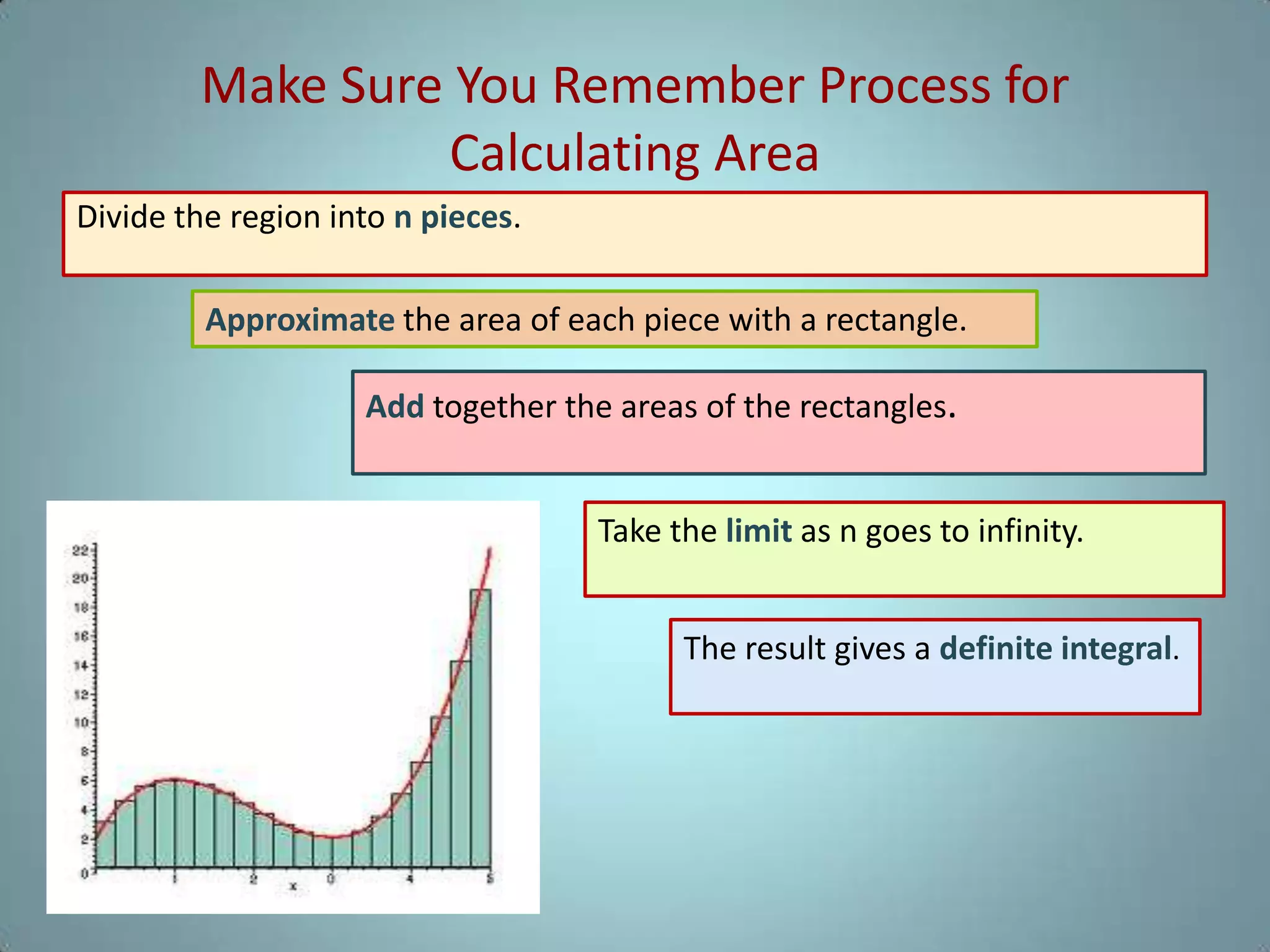
Make Sure YouRemember Process for
Calculating Area
Divide the region into n pieces.
Approximate the area of each piece with a rectangle.
Add together the areas of the rectangles.
Take the limit as n goes to infinity.
The result gives a definite integral.
3.
General Idea -Slicing
1.
Divide the solid into n pieces (slices).
2.
Approximate the volume of each slice.
3.
Add together the volumes of the slices.
4.
Take the limit as n goes to infinity.
5.
The result gives a definite integral.
Volume of aSlice
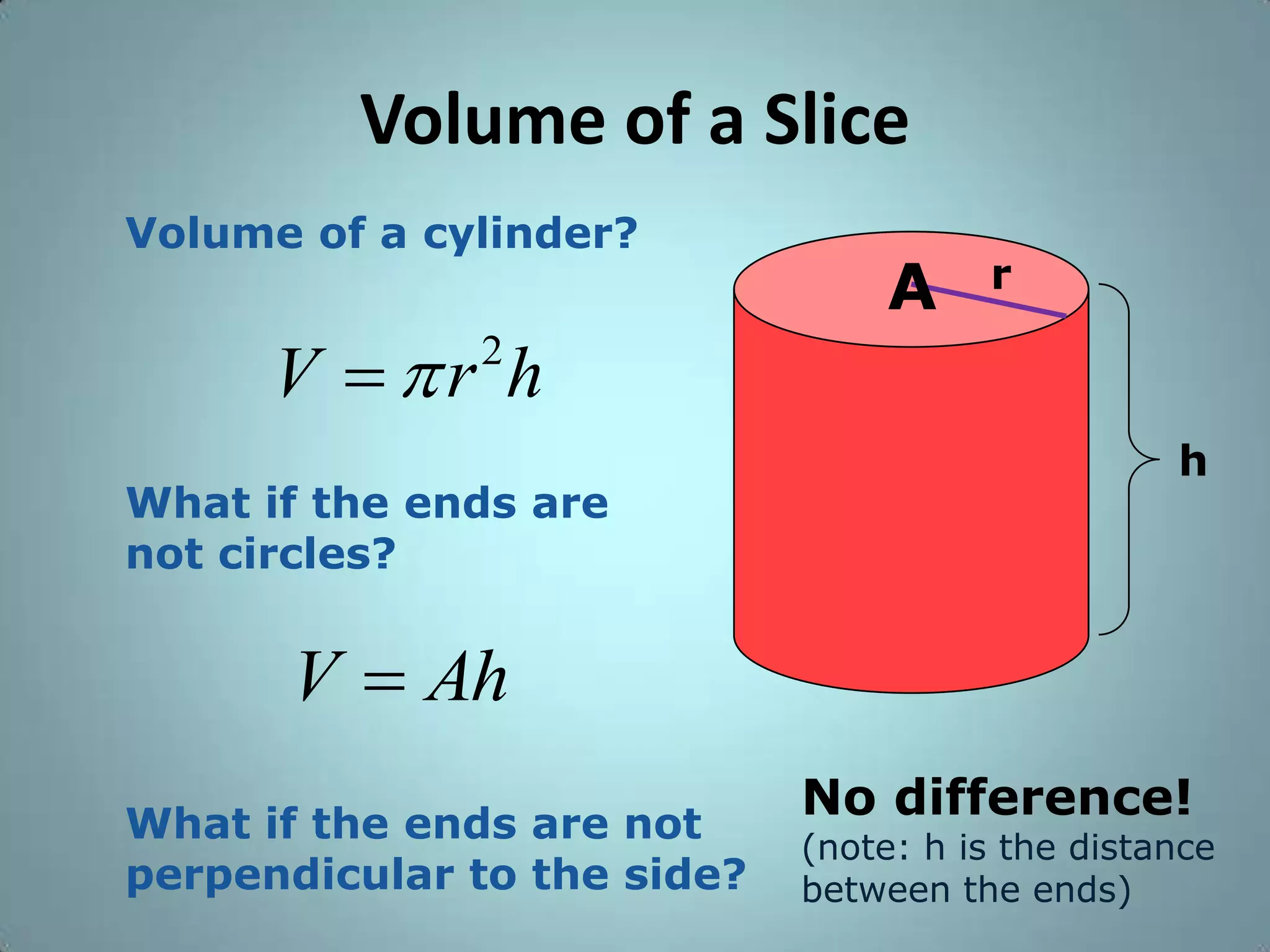
Volume of a cylinder?
V r h
A
r
2
What if the ends are
not circles?
h
V Ah
What if the ends are not
perpendicular to the side?
No difference!
(note: h is the distance
between the ends)
6.
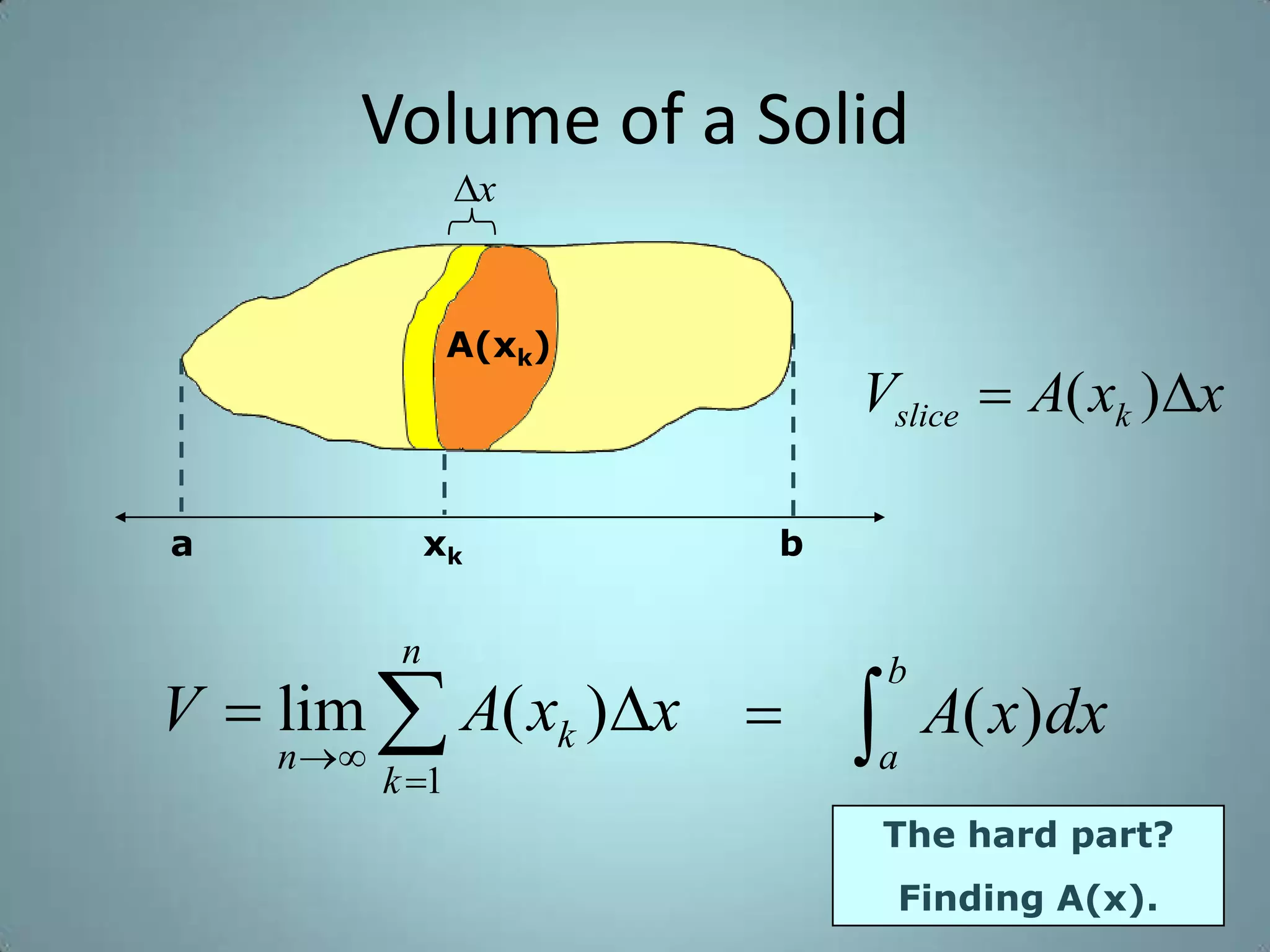
Volume of aSolid
x
A(xk)
a
xk
n
Vslice A( xk )x
b
V lim A( xk )x
n
k 1
b
a
A( x)dx
The hard part?
Finding A(x).
7.
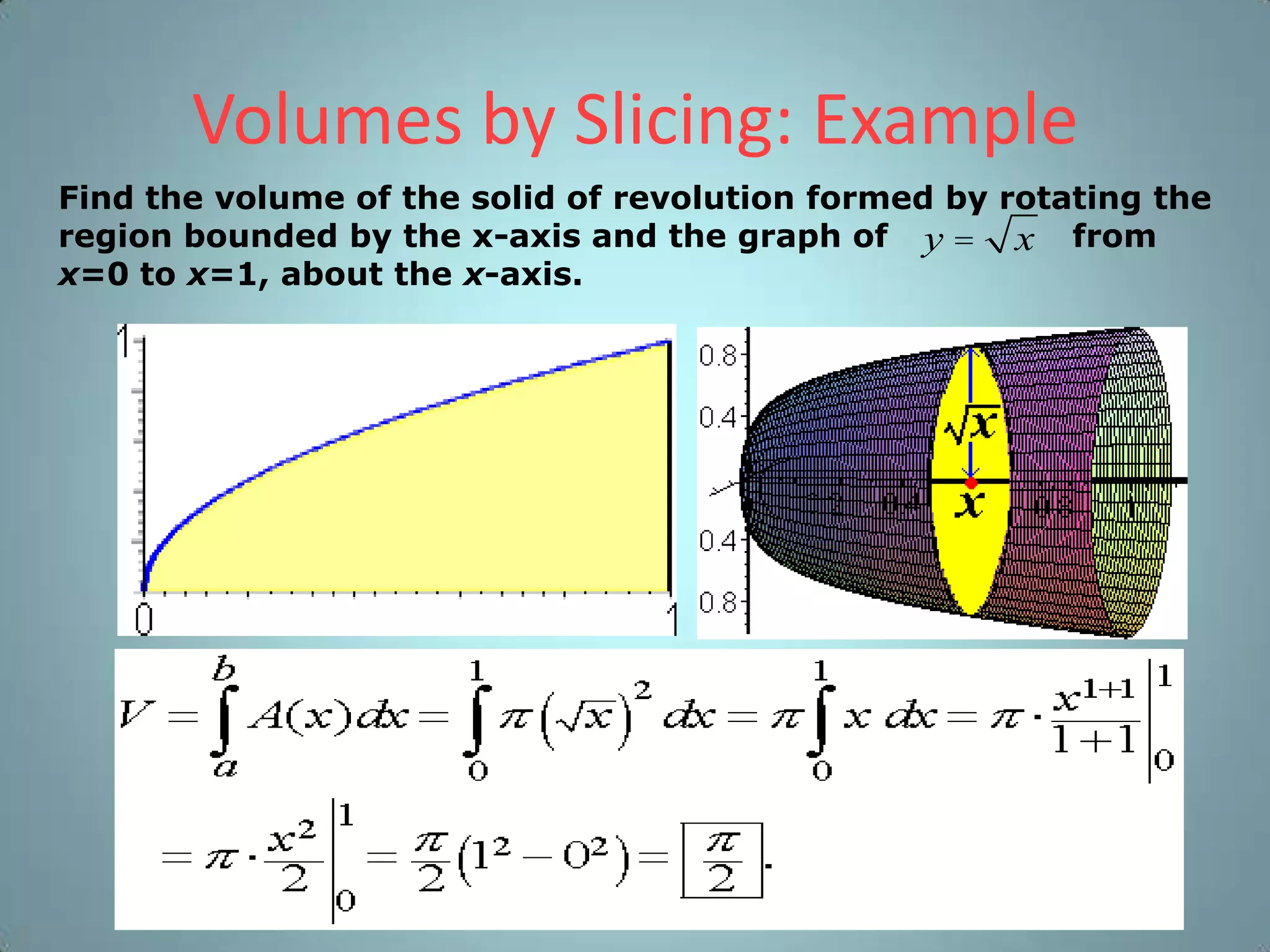
Volumes by Slicing:Example
Find the volume of the solid of revolution formed by rotating the
region bounded by the x-axis and the graph of y = x from
x=0 to x=1, about the x-axis.
8.
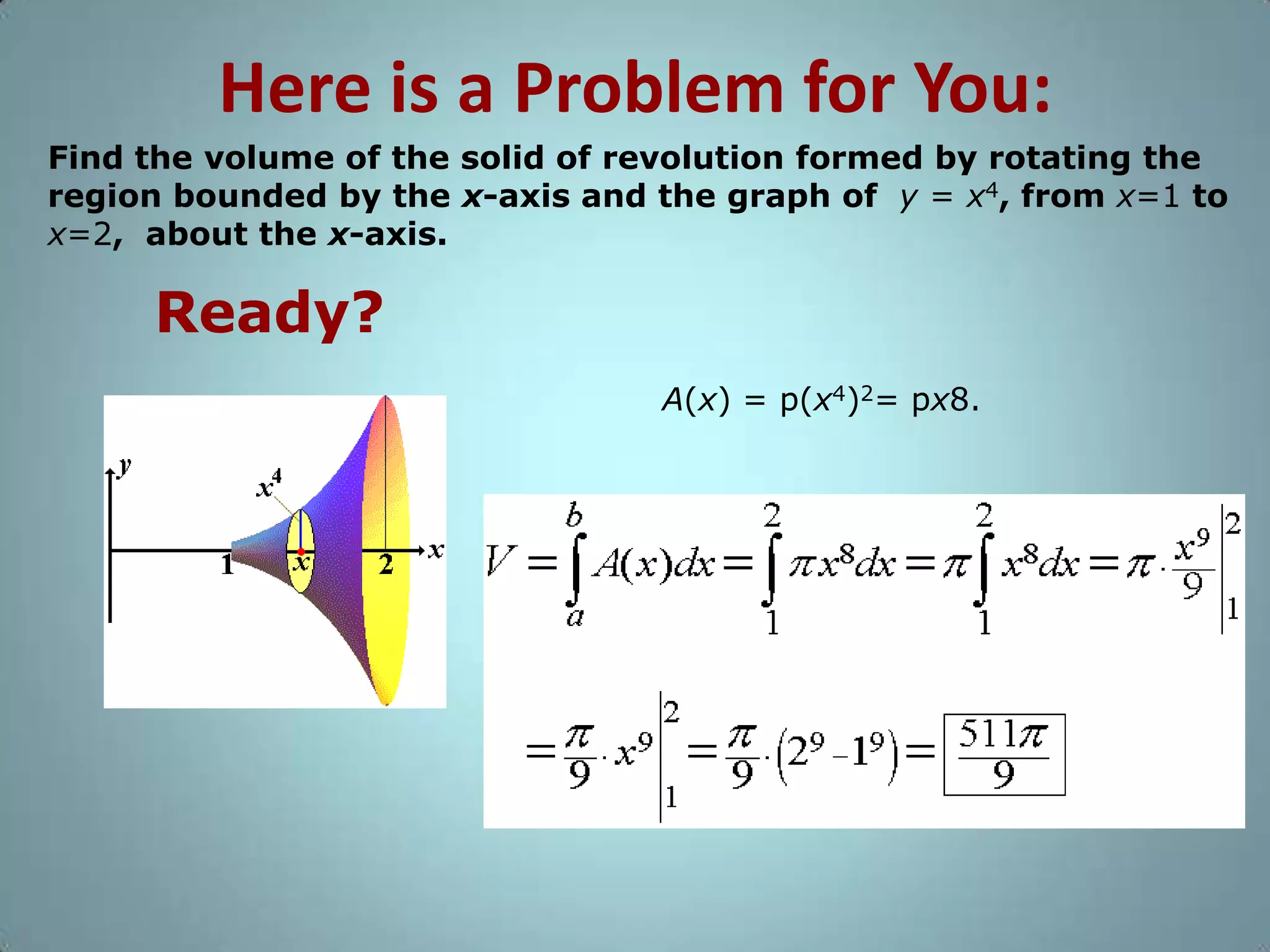
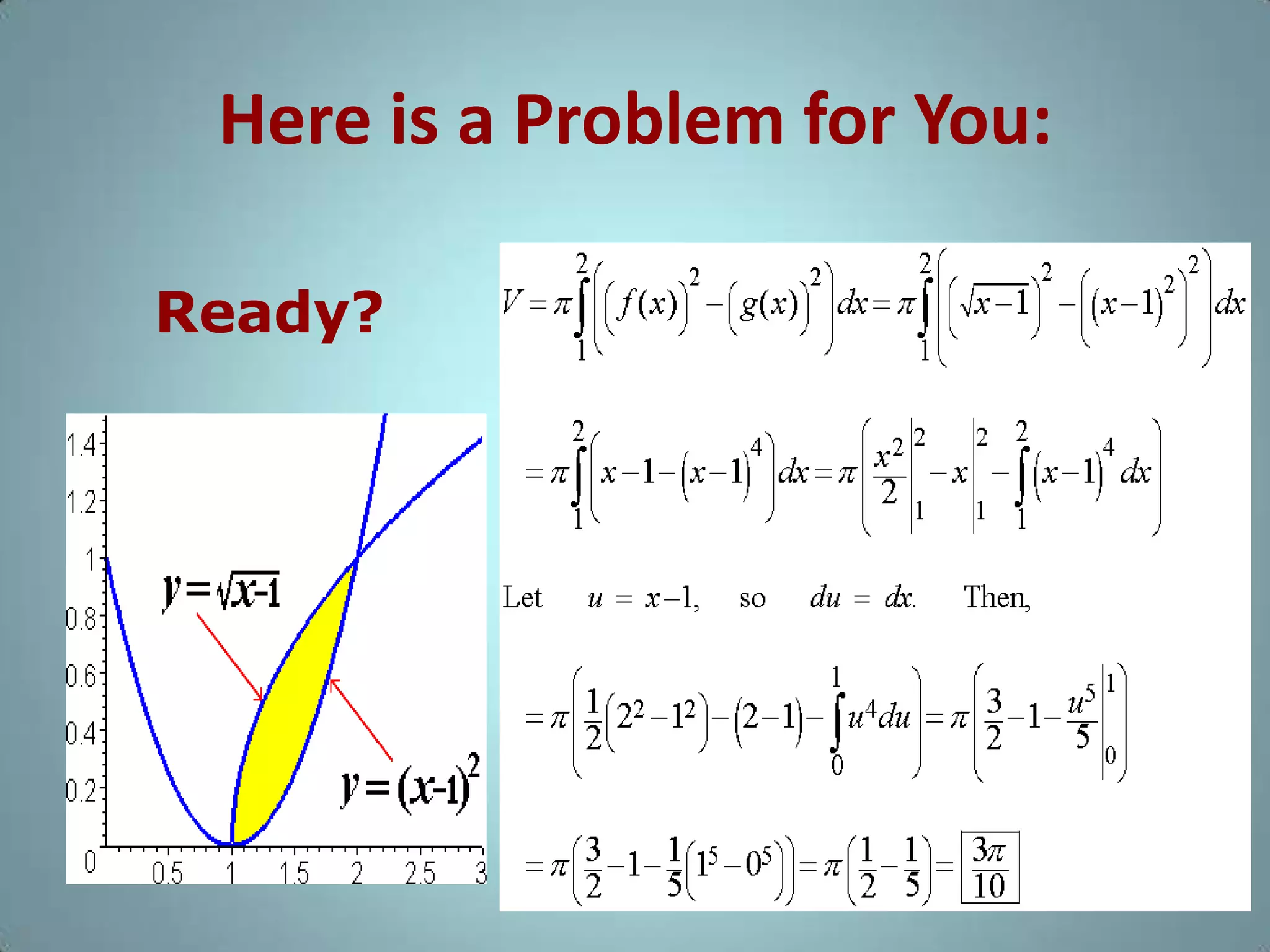
Here is aProblem for You:
Find the volume of the solid of revolution formed by rotating the
region bounded by the x-axis and the graph of y = x4, from x=1 to
x=2, about the x-axis.
Ready?
A(x) = p(x4)2= px8.
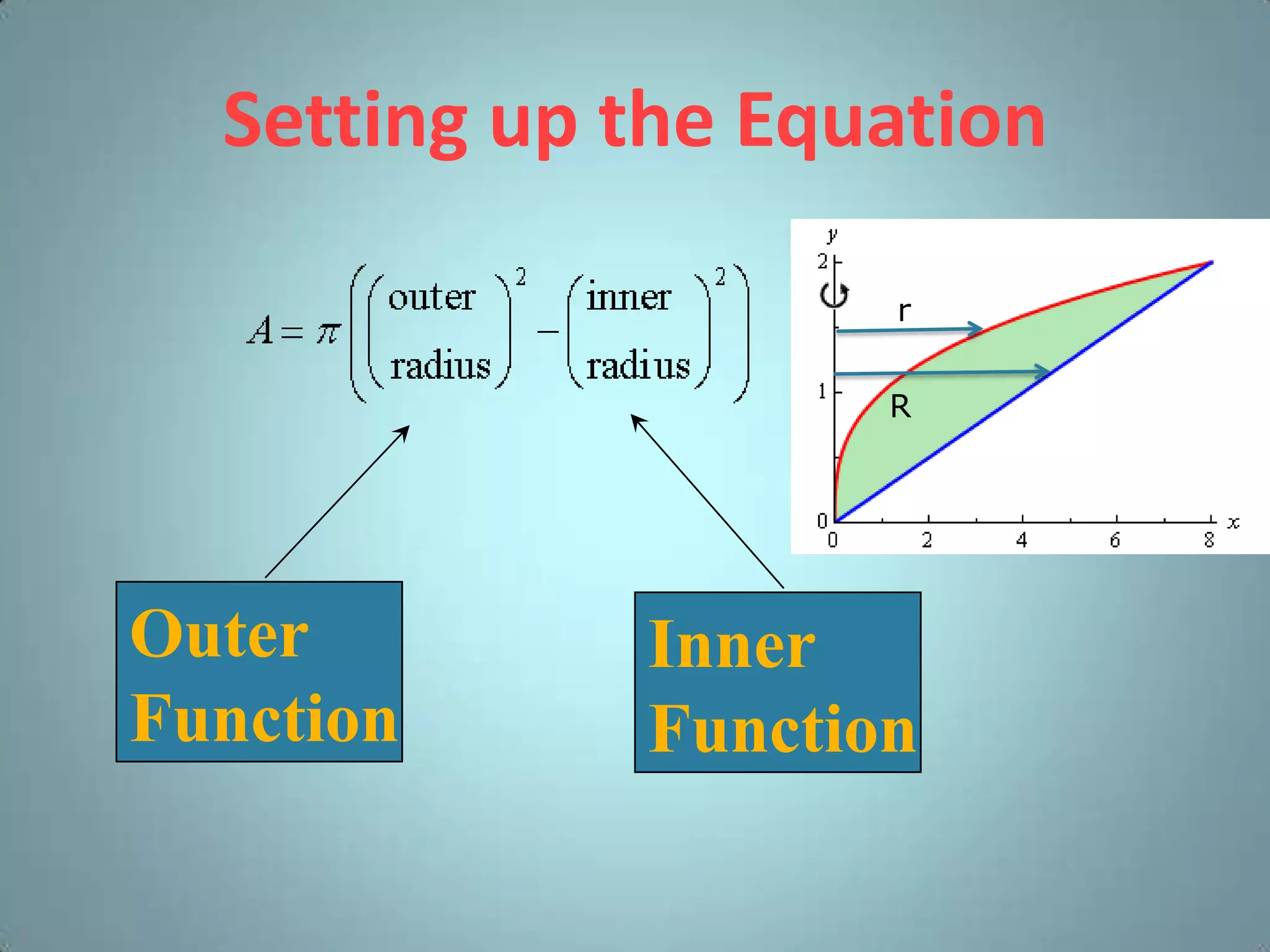
Setting up theEquation
r
R
Outer
Function
Inner
Function
11.
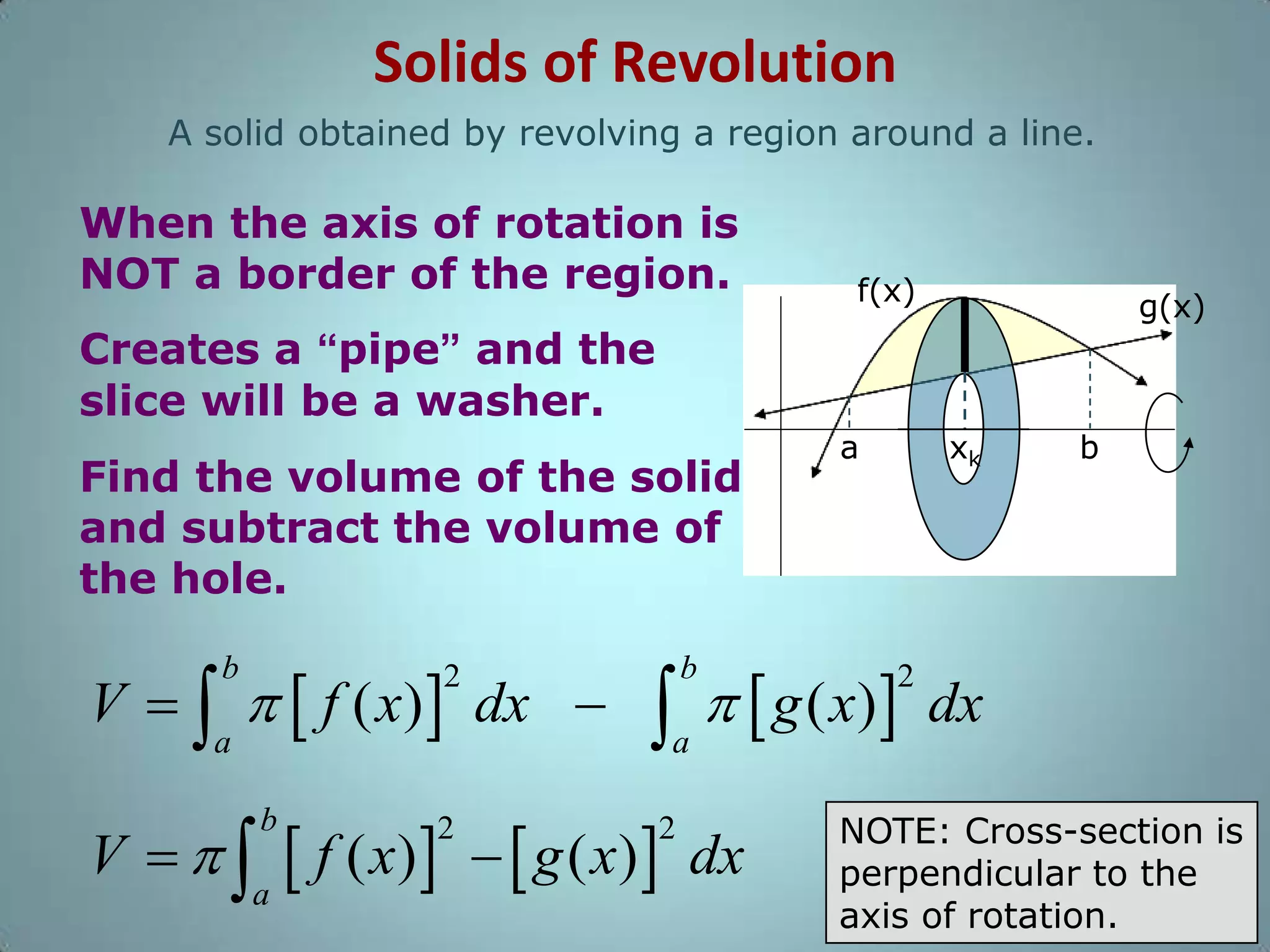
Solids of Revolution
Asolid obtained by revolving a region around a line.
When the axis of rotation is
NOT a border of the region.
f(x)
g(x)
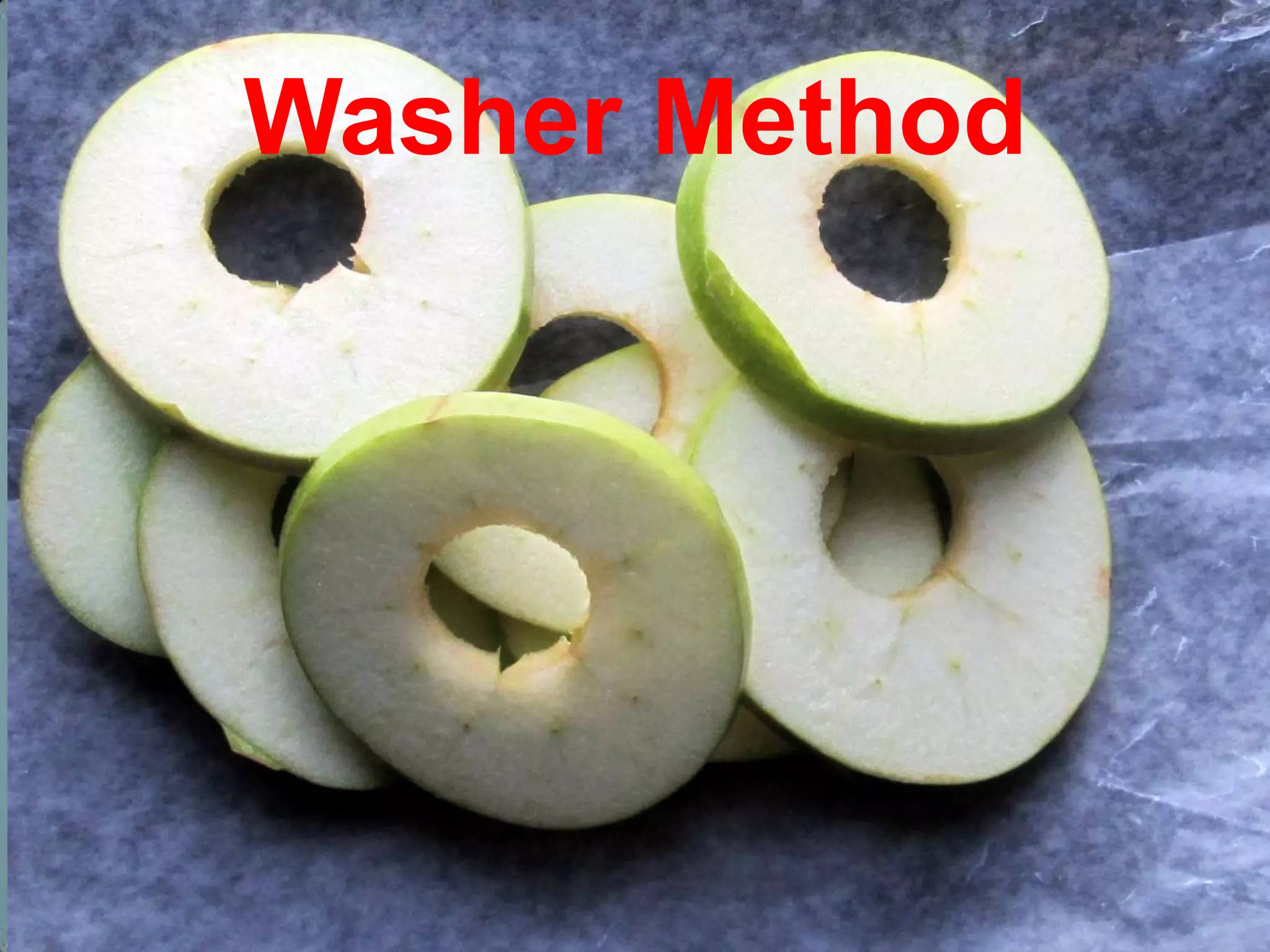
Creates a “pipe” and the
slice will be a washer.
Find the volume of the solid
and subtract the volume of
the hole.
V f ( x) dx
b
2
a
2
xk
g ( x)
b
a
f ( x) g ( x)
a
V
b
a
2
dx
2
b
dx
NOTE: Cross-section is
perpendicular to the
axis of rotation.
12.
Example:
Find the volumeof the solid formed by revolving the
region bounded by y = (x) and y = x² over the interval [0,
1] about the x – axis.
b
V ([ f ( x)]2 [ g ( x)]2 )dx
a
1
V
x x dx
2
2 2
0
V = p ò (x - x )dx
1
4
0
æx x ö
3
V =pç - ÷ =
è 2 5 ø 0 10
2
5
1
So……how do youcalculate
volumes of revolution?
• Graph your functions to create the region.
• Spin the region about the appropriate axis.
• Set up your integral.
• Integrate the function.
• Evaluate the integral.

![Example:
Find the volume of the solid formed by revolving the
region bounded by y = (x) and y = x² over the interval [0,
1] about the x – axis.
b
V ([ f ( x)]2 [ g ( x)]2 )dx
a
1
V
x x dx
2
2 2
0
V = p ò (x - x )dx
1
4
0
æx x ö
3
V =pç - ÷ =
è 2 5 ø 0 10
2
5
1](https://image.slidesharecdn.com/7-131206202559-phpapp01/75/7-2-volumes-by-slicing-disks-and-washers-12-2048.jpg)


![PM [B04] Plane Polar Coordinates](https://cdn.slidesharecdn.com/ss_thumbnails/pmb04planepolarcoordinates-151011170403-lva1-app6891-thumbnail.jpg?width=640&height=640&fit=bounds)


